IB Diploma Programme 2019-2021 - India International School in Japan - India International ...
←
→
Page content transcription
If your browser does not render page correctly, please read the page content below
India International School in Japan

IB Diploma Programme
      2019-2021

                                        1
Contents

Focus                                                        Page

Cover Page                                                   1

Table of Contents                                            2

Introduction                                                 3

IBO Mission Statement                                        3

IB DP Programme Model                                        4

IB Diploma Programme Requirements                            4

IB Diploma Subject Options at IISJ 2019-2021                 6

IB Subject Options Form 2019-2021                            7

IISJ IB Programme Fee Structure                              8

Student Timetable                                            9

Assessment in the IB DP Programme                            9

Assessment criteria in IB Diploma                            10

Eligibility criteria for IB Diploma certificate              11

IISJ Subject Outlines 2019-2021                              12

Group 1: English A Language and Literature HL                12

Group 2: English B, Japanese B, French B HL/SL               16

Group 3: Psychology HL/SL                                    19
         Business Management HL/SL                           22

Group 4: Biology HL/SL                                       27
         Physics HL/SL                                       30
         Chemistry HL/SL                                     33
         Computer Science HL/SL                              36

Group 5: Mathematics HL/SL                                   40

Group 6: Electives and Pathways                              45

Mandatory IB Core Courses                                    46

                                                                    2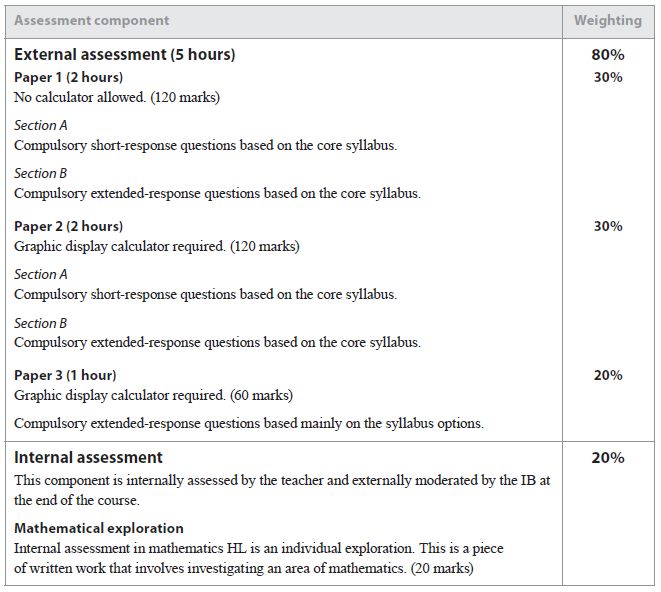
INTRODUCTION

The International Baccalaureate Organization (IBO) offers high quality programme throughout the
schools in the world. The IB diploma program is well appreciated program suitable for students
entering to top universities around the globe. IB DP is a challenging and balanced academic
program suitable for successful university education. It is targeted towards 16-19 years old students
and being offered as a 2 year pre-university course. There are more than 700,000 thousand IB
students in 140 countries all over the world.

IB MISSION STATEMENT

“The International Baccalaureate aims to develop inquiring, knowledgeable and caring young people
who help to create a better and more peaceful world through intercultural understanding and respect.”
IB diploma program aims to develop internationally-minded people who, recognizing their common
humanity and shared guardianship of the planet help to create a better and more peaceful world. The
IB learners strive to be:

Inquirers
Knowledgeable
Thinkers
Communicators
Principled
Open-minded
Caring
Risk-takers
Balanced
Reflective

In IB program, we focus on effective oral and written communication of and with the students
throughout the course. Students are encouraged to carry out original investigations in each field of
study while inculcating elements of research in them. This course aims at holistic development of a
child while preparing them to face challenges of today’s increasingly complex world.

                                                                                                   3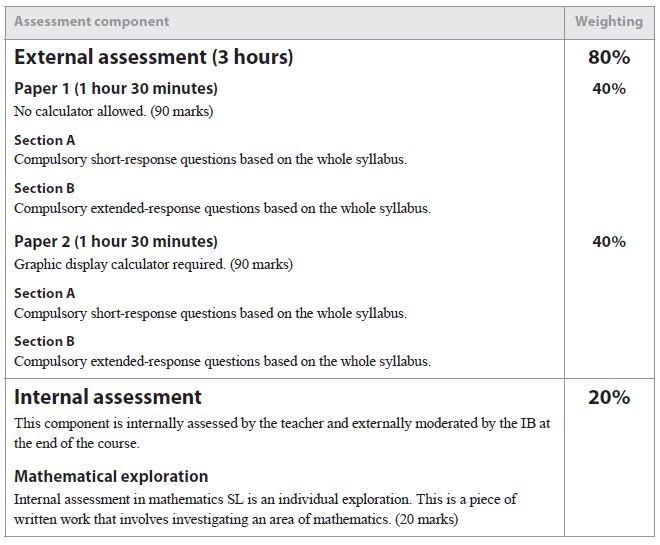
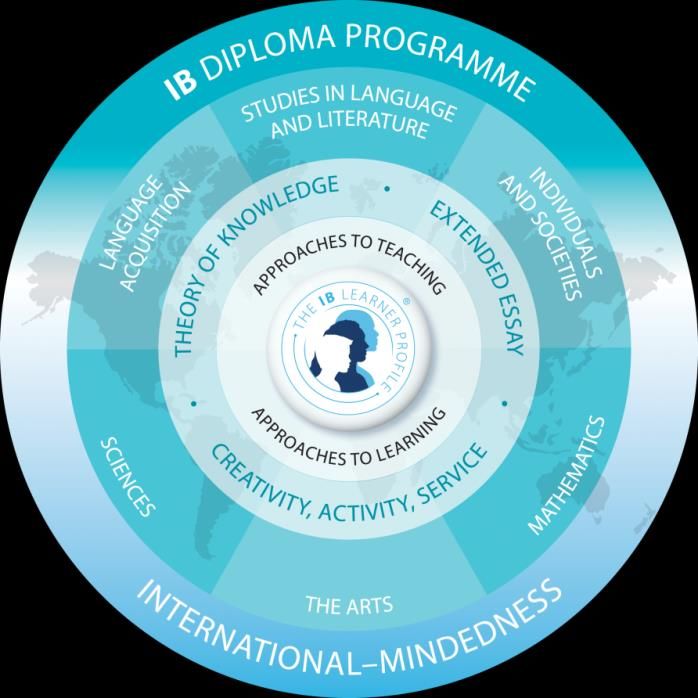
THE IB DIPLOMA PROGRAMME MODEL

The vision of a curriculum of breadth, depth and flexibility is today known as the Diploma
Programme Model, with six academic areas surrounding the Learner Profile and a set of Core
elements.

                        http://www.ibo.org/en/programmes/diploma-programme/

IB DIPLOMA PROGRAMME REQUIREMENTS

Theory of Knowledge (TOK), Creativity, Activity, Service (CAS) and Extended Essay (EE) are core
elements of IB Diploma Programme. Language acquisition (Group 1), Studies in Language and
Literature (Group 2), Individual and Societies (Group 3), Sciences (Group 4), Mathematics (Group
5) and The Arts (Group 6) are the subject groups incorporated by IB as principal domains of
knowledge.

Language acquisition (Group 1)– This group consists of mainly English, Spanish and French as
Language A. Other languages are also included in this group. The courses available in this group are
(i) language and literature and (ii) literature offered at both Standard Level (SL) and Higher Level
(HL). Literature and Performance course is available in Standard Level (SL) only.

Studies in Language and Literature (Group 2)- It consists of the nearly 80 additional
languages offered as Language B at both standard level (SL) and Higher level (H), or Ab Initio (SL
only).

Individual and Societies (Group 3)- This group consists of courses like Business Management,
Geography, History, Information technology in a global society

                                                                                                  4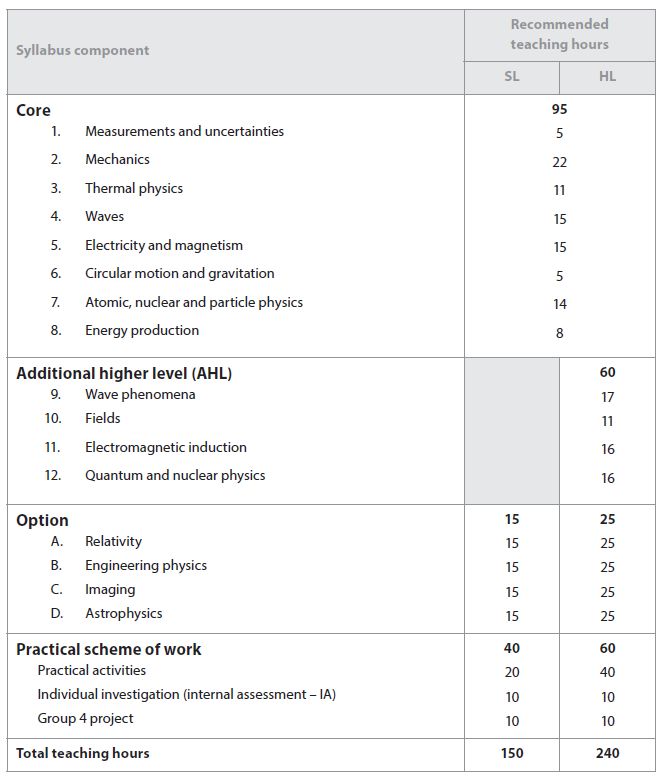
(ITGS), Philosophy, Psychology, Social and cultural anthropology offered at both Standard level
(SL) and Higher level (HL).

Sciences (Group 4) -This group consists of Chemistry, Biology, Physics, Design Technology and
Computer Science offered at both the Standard Level (SL) and Higher Level (HL). In this group,
Environmental Systems and Societies (transdisciplinary between group 3 and group 4) and Sports,
Exercise and Health Science are offered at Standard Level (SL) only.

Mathematics (Group 5) - This group consists of three main mathematics courses: Mathematical
Studies SL (Standard Level), Mathematics SL or Mathematics HL (Higher Level).Further
Mathematics HL can be taken as an elective in addition to Mathematics HL

The Arts (Group6) - This group consists of five courses like Dance, Music, Theatre, Visual Arts,
and Film at both Standard Level (SL) and Higher Level (HL): Literature and Performance
(transdisciplinary between Groups 1 and 6) is also available at SL in this group.

The Group 6 is also called Electives group as students may choose from amongst the courses of
other five groups in place of a course from this group. IB DP two year programme usually consists
of following subjects.

                   Core Subjects                    Courses from Group 1 to Group 6

    (i) Theory of Knowledge (TOK)                   (i) 3 courses at higher level (HL)
    (ii) Extended Essay (EE)                        (ii) 3 courses at standard level (SL)
    (iii) Creativity Activity Service (CAS)

                                                                                               5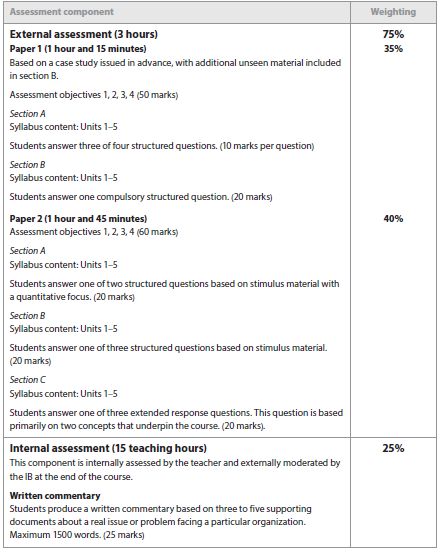
IB DIPLOMA SUBJECT OPTIONS AT IISJ 2019-2021

One subject from each group must be chosen. If students select English A and Hindi A or Japanese
A, this qualifies them for a Bilingual IB Diploma on the condition that the candidate obtains a level
3 or greater in both subjects.

                Group                                          Subjects
                                          (i) English A : Language and Literature SL/HL
Group 1-Language acquisition
                                          (ii) Japanese A : Language and Literature SL/HL

Group 2 – Studies in Language and
                                          (i) Japanese B SL/HL
Literature
                                          (ii) Independent Self-Taught Language B SL

                                          (i) Psychology SL/HL
Group 3–Individuals and Societies         (ii) Economics SL/HL
                                          (iii) Business Management SL/HL

                                          (i) Biology SL/HL
                                          (ii) Physics SL/HL
Group 4–Experimental Sciences
                                          (iii) Chemistry SL/HL
                                          (iv) Computer Science SL/HL

Group 5–Mathematics                       (i) Mathematics HL/ SL

                                          Either of Group 3 or Group 4 or Group 5
Group 6–The Arts and Electives
                                          subjects may be chosen.

                                                                                                   6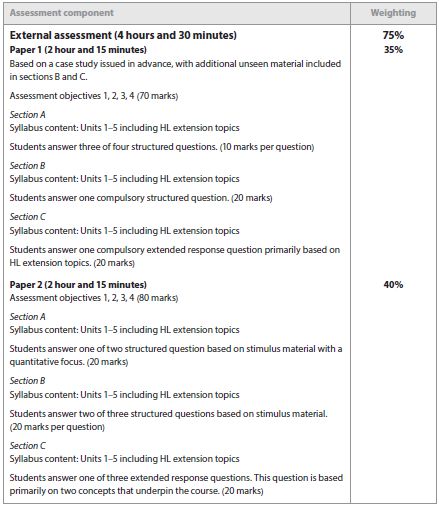
India International School in Japan
                         IB SUBJECT OPTIONS FORM 2019-2021

One subject from each group must be chosen. Students are required to select 3 HL and 3 SL
subjects.

        Group                 Subjects available                Subject              Level
                         (i) English A : Language and
Group 1 - Language            Literature SL/HL
acquisition              (ii) Japanese A : Language and
                              Literature SL/HL
Group 2 – Studies in
                         (i) Japanese B SL/HL
Language and
                         (ii) Independent Self-Taught
Literature
                              Language and Literature SL

                         (i) Psychology SL/HL
Group 3 – Individuals    (ii) Economics SL/HL
and Societies            (iii) Business Management
                               SL/HL

                         (i) Biology SL/HL
Group 4 –                (ii) Physics SL/HL
Experimental Sciences    (iii) Chemistry SL/HL
                         (iv) Computer Science SL/HL

Group 5 – Mathematics (i) Mathematics SL/HL

                         Either of Group 3 or Group 4
Group 6 – The Arts
                         or Group 5 subjects may be
and Electives
                         chosen.

Student’s Name: _________________________            Student’s signature: __________________

Parents’ approval: I, hereby, endorse and consent to selection of IB subject options by my
son/daughter ________________________________

Parent’s signature: _______________________          Date: ____________________________

                                                                                               7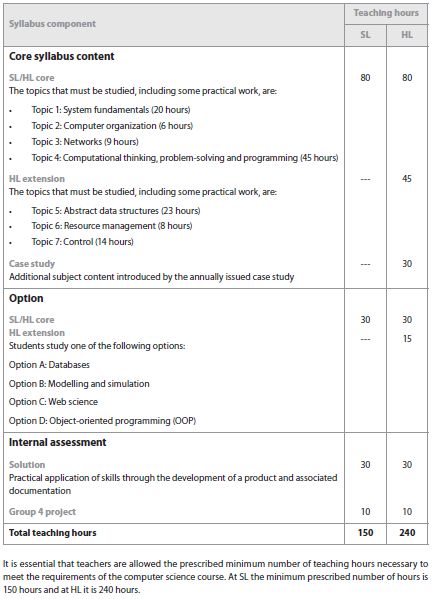
IISJ IB PROGRAMME FEE STRUCTURE

IISJ has consistently maintained a fee structure to lessen financial burdens on parents while
providing quality education. We have strived for providing good English medium education to all
the expatriates who are not in position to pay exorbitant school fees under various headings. Being
not-for-profit organization, we charge for covering operational costs only. So, there may be periodic
adjustments in fee structure but it will not include additional fee under separate heading.

IB assessment fees are based on fixed foreign exchanges like US dollar and due to fluctuation in
conversion rate, the registration and assessment fees in Japanese Yen may fluctuate. For
convenience all fees are indicated in Japanese and adjustments in IB fees will be done as per the
currency conversion rate of the day.

 Fee category            Amount               Day of payment                  Method of payment
                                         At the time of admission in     All payments are to be made by
Application Fee       JPY 10,000
                                         IISJ                            bank transfers to the following
                                                                         account of IISJ ;

IB registration fee   JPY 20,000         At the time of admission in     Sumitomo     Mitsui    Banking
                                         IISJ                            Corporation,        Marunouchi
                                                                         Branch (245), Account type -
                                                                         Touza, Account No.: 1008024
Tuition Fee           JPY 1,500,000      (a) First installment by May    for account of Bank of India,
                                             15 : JPY 750,000            Tokyo Branch.
                                         (b) Second installment by
                                             November 15 : JPY           Please mention IISJ next to
                                             750,000                     remitter's name.

IB Diploma            JPY 160,000        Grade 12 only (will be
                                         notified in second half of
Examination Fee                          Grade 12)

Note: Please send a mail to iisjtokyo@gmail.com after every payment to notify the day of money
transfer so that we can make confirmation of the payment at the earliest.

                                                                                                   8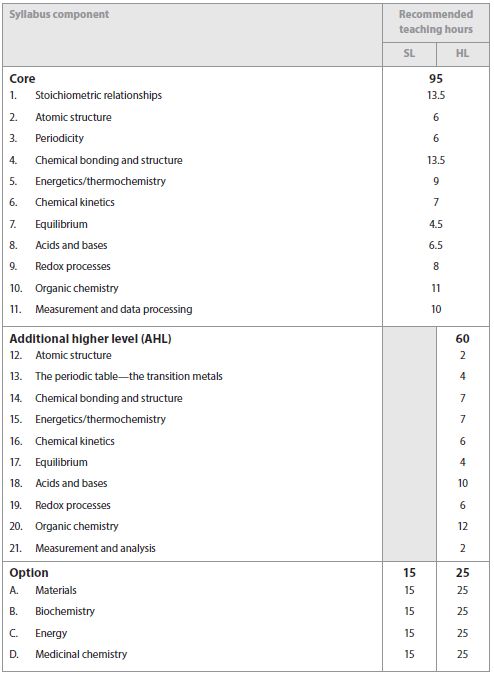
STUDENT TIMETABLE

The student timetable at IISJ is 8-10 forty minute lessons per day. During two years of IBDP,
students will complete a minimum of 150 hours of classes for an SL subject and 240 hours for an
HL subjects. Generally, TOK, CAS and EE are completed outside of the regular school timetable
and around 100 hours are used for them. For TOK and EE, there are 4 lessons per week provided
for monitoring and guidance to the students. Similarly, 5 lessons are allocated for CAS so that
student can carry out CAS related activities as well as seek guidance and suggestions from CAS
coordinator.

ASSESSMENT IN THE IB DIPLOMA PROGRAMME

IB assessment philosophy centers on preparing students towards university education. IB uses
criterion based grading system where each student’s performance is measured against well-defined
levels of achievement Subject grades reflect attainment of knowledge and skills relative to set
standards that are applied equally to all schools.

IB assessment consists of two components; (i) Internal Assessments (IAs) and (ii) External
Assessments (EAs). Internal assessments consist of assignments completed during the two years
period of IB DP. These are internally assessed by IISJ teachers that externally moderated by IB
examiners. Internal assessment usually plays very crucial role in the final grade achieved by the
students in the concerned courses.

External Assessments are done around the end of the two years in IB DP program and are
externally graded by IB Examiners. Some assessment tasks are conducted and overseen by teachers
without the restrictions of examination conditions, but are then marked externally by examiners.
Examples of these include language written tasks, essays for Theory of Knowledge and Extended
Essays.

                                                                                               9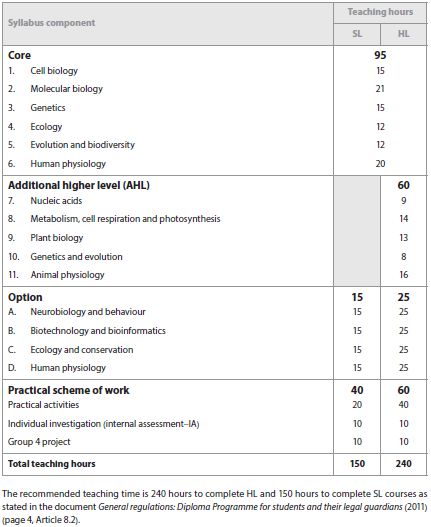
ASSESSMENT CRITERIA IN IB DIPLOMA

Based on total marks secured by the students in both IAs and EAs, students are given marks from 1
to 7 for each of the group subjects. Similarly, students can receive maximum 3 bonus points for
TOK/EE. So, altogether students can secure maximum 45 marks. For receiving IB Diploma,
students must complete 150 hours of CAS also.

                                  IB MARKS DESCRIPTION
                IB Assessment Marks                Performance level
                           7                  Excellent Performance
                           6                  Very Good Performance
                           5                  Good Performance
                           4                  Satisfactory Performance
                           3                  Mediocre Performance
                           2                  Poor Performance
                              1               Very Poor Performance

       The Diploma point matrix for bonus points in TOK & EE (From May 2015)

                      Excellent        Good      Satisfactory    Mediocre   Elementary
       TOK/EE
                         A              B             C            D            E
       Excellent
                          3              3            2               2
           A
         Good
                                                                                Failing condition
                          3              2            2               1
           B
      Satisfactory
                          2              2            1               0
           C
       Mediocre
                          2              1            0               0
           D
      Elementary
           E                            Failing condition

                                                                                                    10
ELIGIBILITY CRITERIA FOR IB DIPLOMA CERTIFICATE
In order to achieve the IB Diploma a candidate must fulfill certain requirements; at its most basic a
candidate must achieve at least 24 points from their combined grades in six subjects, together with
their grades for theory of knowledge and the extended essay, and also complete the Creativity,
Activity, Service (CAS) element. However, to ensure a diploma reflects sufficient breadth in
achievement across subjects and the core there are particular requirements stated in articles of the
General regulations: Diploma Programme. These are the “requirements” and are phrased positively.
The “failing conditions” are an interpretation of these requirements intended to indicate why a
candidate has failed to achieve the diploma.
Diploma HL HL HL SL SL SL TOK/ Total
Level Subject Subject Subject Subject Subject Subject EE Marks
Excellent 7 7 7 7 7 7 3 45
Very Good 6 6 6 6 6 6 3 39
Good 5 5 5 5 5 5 3 33
Satisfactory 4 4 4 3 3 3 3 24
From the May 2015 session the following failing conditions and associated codes
will replace those in current use.
1. CAS requirements have not been met.
2. Candidate’s total points are fewer than 24.
3. An N has been given for theory of knowledge, extended essay or for a
contributing subject.
4. A grade E has been awarded for one or both of theory of knowledge and the
Failing extended essay.
conditions
5. There is a grade 1 awarded in a subject/level.
6. Grade 2 has been awarded three or more times (HL or SL).
7. Grade 3 or below has been awarded four or more times (HL or SL).
8. Candidate has gained fewer than 12 points on HL subjects (for candidates who
register for four HL subjects, the three highest grades count).
9. Candidate has gained fewer than 9 points on SL subjects (candidates who
register for two SL subjects must gain at least 5 points at SL).
11SUBJET OUTLINES
GROUP 1
LANGUAGE A: LANGUAGE AND LITERATURE (ENGLISH, JAPANESE)
Group 1 courses are designed to support future academic study by developing a high social,
aesthetic and cultural literacy, as well as effective communication skills. While there is significant
difference in the texts presented for study in the three courses, they will clearly overlap somewhat.
There is no aim for each course to define completely separate territory. Instead, the main difference
lies in the different areas of focus each takes. The focus of the language A: language and literature
course is directed towards developing and understanding the constructed nature of meanings
generated by language and the function of context in this process. Literature and performance allows
students to combine literary analysis with the investigation of the role of performance in our
understanding of dramatic literature.
Language A: language and literature comprises four parts—two relate to the study of language and
two to the study of literature.
The study of the texts produced in a language is central to an active engagement with language and
culture and, by extension, to how we see and understand the world in which we live. A key aim of
the language A: language and literature course is to encourage students to question the meaning
generated by language and texts, which, it can be argued, is rarely straightforward and unambiguous.
Helping students to focus closely on the language of the texts they study and to become aware of
the role of each text’s wider context in shaping its meaning is central to the course. The language A:
language and literature course aims to develop in students skills of textual analysis and the
understanding that texts, both literary and non-literary, can be seen as autonomous yet
simultaneously related to culturally determined reading practices. The course is designed to be
flexible—teachers have the opportunity to construct it in a way that reflects the interests and
concerns that are relevant to their students while developing in students a range of transferable skills.
An understanding of the ways in which formal elements are used to create meaning in a text is
combined with an exploration of how that meaning is affected by reading practices that are culturally
defined and by the circumstances of production and reception.
Distinction between SL and HL
The model for language A: language and literature is the same at SL and HL, but there are significant
quantitative and qualitative differences between the levels. In the literature sections the number of
texts prescribed is greater at HL than at SL. In the language sections students are generally expected
to cover many more texts of all kinds at HL than at SL. Two of the assessment tasks at SL are
significantly easier than the comparable tasks at HL. The first is the paper 1 textual analysis, where
SL students address and analyse only one passage, while HL students make a comparative analysis of
two passages. The second is the written tasks, where HL students must produce four tasks, rather
than the three produced by SL students. Two of these tasks are submitted for external assessment at
HL, while only one is submitted at SL. One of the assessed tasks submitted at HL must be a critical
response that addresses one of six set questions and requires students to explore the values, attitudes
and beliefs that are implied in the texts they select for this task.
12SYLLABUS OUTLINE – SL AND HL
13ASSESSMENT OUTLINE—SL
14ASSESSMENT OUTLINE—HL
15GROUP 2
LANGUAGE B (ENGLISH, JAPANESE, FRENCH)
Language B is an additional language-learning course designed for students with some previous
learning of that language. It may be studied at either SL or HL. The main focus of the course is on
language acquisition and development of language skills. These language skills should be developed
through the study and use of a range of written and spoken material. Such material will extend from
everyday oral exchanges to literary texts, and should be related to the culture(s) concerned. The
material should be chosen to enable students to develop mastery of language skills and intercultural
understanding. It should not be intended solely for the study of specific subject matter or content.
Distinction between SL and HL
Most language B subjects are available at SL and HL. The courses give students the possibility of
reaching a high degree of competence in an additional language while exploring the culture(s) where
that language is spoken. The courses aim to develop the students’ linguistic competence and
intercultural understanding. There is a common syllabus at SL and HL (with literature as an
additional component of the HL course). The differences between levels are determined by the
assessment objectives, the depth and breadth of syllabus coverage, the assessment details, the
assessment criteria, literature coverage and suggested teaching hours.
SYLLABUS OUTLINE
16ASSESSMENT OUTLINE—SL
17ASSESSMENT OUTLINE—HL
18GROUP 3
PSYCHOLOGY
Psychology is the systematic study of behaviour and mental processes. Psychology has its roots in
both the natural and social sciences, leading to a variety of research designs and applications, and
providing a unique approach to understanding modern society.
IB psychology examines the interaction of biological, cognitive and sociocultural influences on
human behaviour, thereby adopting an integrative approach. Understanding how psychological
knowledge is generated, developed and applied enables students to achieve a greater understanding
of themselves and appreciate the diversity of human behaviour. The ethical concerns raised by the
methodology and application of psychological research are key considerations in IB psychology.
Psychology and the international dimension
IB psychology takes a holistic approach that fosters intercultural understanding and respect. In the
core of the IB psychology course, the biological level of analysis demonstrates what all humans share,
whereas the cognitive and sociocultural levels of analysis reveal the immense diversity of influences
that produce human behaviour and mental processes. Cultural diversity is explored and students are
encouraged to develop empathy for the feelings, needs and lives of others within and outside their
own culture. This empathy contributes to an international understanding.
Distinction between SL and HL
Both SL and HL students are assessed on the syllabus core (levels of analysis) in paper 1. In
addition:
• SL students are assessed on their knowledge and comprehension of one option in paper 2,
whereas HL students are assessed on two options
• HL students are assessed on their knowledge and comprehension of qualitative research
methodology in paper 3 in the internal assessment, the report of a simple experimental study
conducted by HL students requires inferential statistical analysis and a more in‑depth
approach than that required of SL students.
19SYLLABUS OUTLINE
20ASSESSMENT OUTLINE – SL
ASSESSMENT OUTLINE –HL
21BUSINESS MANAGEMENT
Business management is a rigorous, challenging and dynamic discipline in the individuals and
societies subject group. This course is designed to develop students’ knowledge and understanding
of business management theories, as well as their ability to apply a range of tools and techniques.
Students learn to analyse, discuss and evaluate business activities at local, national and international
levels. The course covers a range of organizations from all sectors, as well as the socio-cultural and
economic contexts in which those organizations operate.
Although business management shares many skills and areas of knowledge with other humanities
and social sciences, it is distinct in a number of ways. For example, business management is the
study of decision-making within an organization, wherein business functions, management processes
and decision-making in contemporary contexts of strategic uncertainty are studied. It examines how
business decisions are influenced by factors internal and external to an organization, and how these
decisions impact upon its stakeholders, both internally and externally. Business management also
explores how individuals and groups interact within an organization, how they may be successfully
managed and how they can ethically optimize the use of resources in a world with increasing scarcity
and concern for sustainability. Business management is, therefore, perfectly placed within the
individuals and societies subject area: aiming to develop in students an appreciation both for our
individuality and our collective purposes.
Emphasis is placed on strategic decision-making and the operational business functions of human
resource management, finance and accounts, marketing and operations management. Links between
the topics are central to the course, as this integration promotes a holistic overview of business
management. Through the exploration of six concepts underpinning the subject (change, culture,
ethics, globalization, innovation and strategy), the business management course allows students to
develop their understanding of interdisciplinary concepts from a business management perspective.
The course encourages the appreciation of ethical concerns, as well as issues of corporate social
responsibility (CSR), at both a local and global level. Through the study of topics such as human
resource management, organizational growth and business strategy, the course aims to develop
transferable skills relevant to today’s students. These include the ability to: think critically; make
ethically sound and well-informed decisions; appreciate the pace, nature and significance of change;
think strategically; and undertake long term planning, analysis and evaluation. The course also
develops subject-specific skills, such as financial analysis.
Distinction between SL and HL
The HL course in business management differs from the SL course in business management in
terms of the:
recommended hours devoted to teaching (240 hours for HL compared to 150 hours for SL)
extra depth and breadth required (extension units for HL)
nature of the internal assessment task
nature of the examination questions.
22SYLLABUS OUTLINE
2324
ASSESSMENT OUTLINE – SL

                          25
ASSESSMENT OUTLINE – HL
26GROUP 4
BIOLOGY
Biology is the study of life. The first organisms appeared on the planet over 3 billion years ago and,
through reproduction and natural selection, have given rise to the 8 million or so different species
alive today. Estimates vary, but over the course of evolution 4 billion species could have been
produced. Most of these flourished for a period of time and then became extinct as new, better
adapted species took their place. There have been at least five periods when very large numbers of
species became extinct and biologists are concerned that another mass extinction is under way,
caused this time by human activity. Nonetheless, there are more species alive on Earth today than
ever before. This diversity makes biology both an endless source of fascination and a considerable
challenge.
Distinction between SL and HL
Group 4 students at standard level (SL) and higher level (HL) undertake a common core syllabus, a
common internal assessment (IA) scheme and have some overlapping elements in the option
studied. They are presented with a syllabus that encourages the development of certain skills,
attributes and attitudes, as described in the “Assessment objectives” section of the guide.
While the skills and activities of group 4 science subjects are common to students at both SL and
HL, students at HL are required to study some topics in greater depth, in the additional higher level
(AHL) material and in the common options. The distinction between SL and HL is one of breadth
and depth.
27SYLLABUS OUTLINE
28ASSESSMENT OUTLINE—SL
ASSESSMENT OUTLINE—HL
29PHYSICS
Past experience shows that students will be able to study a group 4 science subjects at SL
successfully with no background in, or previous knowledge of, science. Their approach to study,
characterized by the specific IB learner profile attributes—inquirers, thinkers and communicators—
will be significant here. However, for most students considering the study this group subject at HL,
while there is no intention to restrict access to group 4 subjects, some previous exposure to the
specific group 4 subjects would be necessary. Specific topic details are not specified but students
who have undertaken the IB Middle Years Programme (MYP) or CBSE or IGCSE science subject
would be well prepared. Other national science qualifications or a school-based science course
would also be suitable preparation for study of a group 4 subject at HL.
Difference between SL and HL
Group 4 students at standard level (SL) and higher level (HL) undertake a common core syllabus, a
common internal assessment (IA) scheme and have some overlapping elements in the options
studied. They are presented with a syllabus that encourages the development of certain skills,
attributes and attitudes, as described in the “Objectives” section of this guide. While the skills and
activities of group 4 science subjects are common to students at both SL and HL, students at HL are
required to study some topics in greater depth, to study additional topics and to study extension
material of a more demanding nature in the common options. The distinction between SL and HL is
one of breadth and depth.
30SYLLABUS OUTLINE
31ASSESSMENT OUTLINE—SL
ASSESSMENT OUTLINE—HL
32CHEMISTRY
Chemistry is an experimental science that combines academic study with the acquisition of practical
and investigational skills. It is often called the central science, as chemical principles underpin both
the physical environment in which we live and all biological systems. Apart from being a subject
worthy of study in its own right, chemistry is a prerequisite for many other courses in higher
education, such as medicine, biological science and environmental science, and serves as useful
preparation for employment.
Earth, water, air and fire are often said to be the four classical elements. They have connections with
Hinduism and Buddhism. The Greek philosopher Plato was the first to call these entities elements.
The study of chemistry has changed dramatically from its origins in the early days of alchemists, who
had as their quest the transmutation of common metals into gold. Although today alchemists are not
regarded as being true scientists, modern chemistry has the study of alchemy as its roots. Alchemists
were among the first to develop strict experimentation processes and laboratory techniques. Robert
Boyle, often credited with being the father of modern chemistry, began experimenting as an
alchemist.
Despite the exciting and extraordinary development of ideas throughout the history of chemistry,
certain things have remained unchanged. Observations remain essential at the very core of chemistry,
and this sometimes requires decisions about what to look for. The scientific processes carried out by
the most eminent scientists in the past are the same ones followed by working chemists today and,
crucially, are also accessible to students in schools. The body of scientific knowledge has grown in
size and complexity, and the tools and skills of theoretical and experimental chemistry have become
so specialized, that it is difficult (if not impossible) to be highly proficient in both areas. While
students should be aware of this, they should also know that the free and rapid interplay of
theoretical ideas and experimental results in the public scientific literature maintains the crucial link
between these fields.
The Diploma Programme chemistry course includes the essential principles of the subject but also,
through selection of an option, allows teachers some flexibility to tailor the course to meet the needs
of their students. The course is available at both standard level (SL) and higher level (HL), and
therefore accommodates students who wish to study chemistry as their major subject in higher
education and those who do not.
Difference between SL and HL
Group 4 students at standard level (SL) and higher level (HL) undertake a common core syllabus, a
common internal assessment (IA) scheme and have some overlapping elements in the options
studied. They are presented with a syllabus that encourages the development of certain skills,
attributes and attitudes, as described in the “Objectives” section of this guide. While the skills and
activities of group 4 science subjects are common to students at both SL and HL, students at HL are
required to study some topics in greater depth, to study additional topics and to study extension
material of a more demanding nature in the common options. The distinction between SL and HL is
one of breadth and depth.
33SYLLABUS OUTLINE
34ASSESSMENT OUTLINE—SL
ASSESSMENT OUTLINE—HL
35COMPUTER SCIENCE
Computer science requires an understanding of the fundamental concepts of computational thinking
as well as knowledge of how computers and other digital devices operate.
The Diploma Programme computer science course is engaging, accessible, inspiring and rigorous. It
has the following characteristics.
draws on a wide spectrum of knowledge
enables and empowers innovation, exploration and the acquisition of further knowledge
interacts with and influences cultures, society and how individuals and societies behave
raises ethical issues
is underpinned by computational thinking.
Computational thinking involves the ability to:
think procedurally, logically, concurrently, abstractly, recursively and think ahead
utilize an experimental and inquiry-based approach to problem-solving
develop algorithms and express them clearly
appreciate how theoretical and practical limitations affect the extent to which problems can
be solved computationally.
During the course the student will develop computational solutions. This will involve the ability to:
identify a problem or unanswered question
design, prototype and test a proposed solution
liaise with clients to evaluate the success of the proposed solution and make
recommendations for future developments.
Computer science has links with subjects outside of group 4, notably information technology in a
global society (ITGS), but it should be noted that there are clear differences between the subjects.
Distinction between SL and HL
While the skills and activities of computer science are common to students at both SL and HL,
students at HL are required to study additional topics in the core, a case study and also extension
material of a more demanding nature in the option chosen. The distinction between SL and HL is
therefore one of both breadth and depth.
Additionally, the HL course has 240 hours devoted to teaching, compared with 150 hours for the SL
course.
Students at SL and HL in computer science study a common core consisting of:
four topics (system fundamentals; computer organization; networks; and computational
thinking, problem-solving and programming)
one option (chosen from databases; modelling and simulation; web science; or object-
oriented programming)
36 one piece of internally assessed work, which includes a computational solution.
The HL course has three additional elements:
three further topics (abstract data structures; resource management; control)
additional and more demanding content for the option selected
an additional externally assessed component based on a pre-seen case study of an
organization or scenario; this requires students to research various aspects of the subject—
which may include new technical concepts and additional subject content—in greater depth.
Prior learning
Past experience shows that students will be able to study computer science at SL successfully with
no background in, or previous knowledge of, computer science. Their approach to study,
characterized by specific IB learner profile attributes—inquirers, thinkers and communicators—will
be significant here. Students who have undertaken the IB Middle Years Programme (MYP) or
studied a similar course prior to commencing the IB Diploma Programme would also be well
prepared.
The study of computer science at HL demands a higher level of problem-solving skills and the
ability to understand and manipulate abstract concepts. Although no previous knowledge of
computer science is required, some exposure to programming is desirable.
37SYLLABUS OUTLINE
38ASSESSMENT OUTLINE—SL
ASSESSMENT OUTLINE—HL
39GROUP 5
MATHEMATICS SL
This course caters for students who already possess knowledge of basic mathematical concepts, and
who are equipped with the skills needed to apply simple mathematical techniques correctly. The
majority of these students will expect to need a sound mathematical background as they prepare for
future studies in subjects such as chemistry, business management, psychology and business
administration.
SYLLABUS OUTLINE
40ASSESSMENT OUTLINE
41MATHEMATICS HL
This course caters for students with a good background in mathematics who are competent in a
range of analytical and technical skills. The majority of these students will be expecting to include
mathematics as a major component of their university studies, either as a subject in its own right or
within courses such as physics, engineering and technology. Others may take this subject because
they have a strong interest in mathematics and enjoy meeting its challenges and engaging with its
problems.
Paper 1
Duration: 2 hours
Weighting: 30%
• This paper consists of section A, short-response questions, and section B, extended-response
questions.
• Students are not permitted access to any calculator on this paper.
Paper 2
Duration: 2 hours
Weighting: 30%
• This paper consists of section A, short-response questions, and section B, extended-response
questions.
• A GDC is required for this paper, but not every question will necessarily require its use.
Paper 3
Duration: 1 hour
Weighting: 20%
• This paper consists of a small number of compulsory extended-response questions based on the
option chosen.
• Where possible, the first part of each question will be on core material leading to the option topic.
When this is not readily achievable, as, for example, with the discrete mathematics option, the level
of difficulty of the earlier part of a question will be comparable to that of the core questions.
42SYLLABUS OUTLINE
43ASSESSMENT OUTLINE
44GROUP 6: ELECTIVES AND PATHWAYS
The IISJ usually allows the students to choose subjects according to their natural academic
preferences. For that different pathways are considered for IB diploma in IB. Usually, group 6
subject is chosen from amongst the other groups to enable the students to achieve IB Diploma of
their choice. One sample of IB pathways available for IISJ students is shown below;
Group Liberal Arts Bac. Science Bac. Languages Bac. Arts Bac. I Arts Bac. II
Language A Language A Language A Language
Group 1 (HL) Language A (HL) (HL) A(HL)
Group 2 Language B Language B Language A (HL) Language B Language B
Humanity 1 Humanity
Group 3 (HL) Humanity Humanity (HL) Arts I (HL)
Science 1
Group 4 Science (HL) Science Science Science: ESS
Mathematics
Group 5 Mathematics (HL) Mathematics Mathematics Mathematics
Humanity 2 Science 2 Language B Arts Arts II
Group 6 (HL) (HL) (HL) (HL) (HL)
The group 3 and group 6 subjects may be offered by online teachers from PAMOJA Education. The
details of course delivery can be accessed at https://pamojaeducation.com/.
45MANDATORY IB CORE COURSES
THEORY OF KNOWLEDGE (TOK)
A key element in the educational philosophy of the IB is the Theory of Knowledge (TOK) course.
The purpose of TOK is to stimulate critical reflection upon the knowledge and experience of
students both within and outside the classroom. The course is ‘philosophical’ in the sense that it
encourages students to acquire a critical awareness of what they and others know through the
analysis of concepts, arguments and value judgments.
During the course, TOK students will consider the role of language, the requirements of logical
rigour, value judgments, ways of knowing (language, sense perception, emotion, reason, imagination,
faith, intuition, memory) and issues of knowledge and truth.
EXTENDED ESSAY (EE)
By the end of November of the second year of the IB Diploma program, students will have
completed a substantial piece of independent work of up to 4,000 words in length with the guidance
from a subject teacher and the IB Coordinator. The essay will derive from one of the subjects in the
IB curriculum. The purpose of this exercise is to prepare students for university-level research work
and to provide the opportunity for them to follow personal interests in greater depth. These essays
are marked externally by IB examiners. "
CREATIVITY ACTIVITY AND SERVICE (CAS)
As part of the philosophy of educating the “whole person” the IB Diploma requires that students
actively involve themselves in Creative, Activity, and Service (CAS) activities. Participation in
activities such as community service, drama, band, sports, student council, MUN, charity fund
raising, yearbook, as well as many other activities, would satisfy this requirement. Students are
expected to a complete a total of 150 hours over two years, which is evenly balanced among all three
areas of creativity, activity and service. Students will be given a report at the end of each semester to
show their activities and hours. Failure to meet CAS requirements means that a student will not
receive their IB Diploma.
46You can also read


