Indoor Har-Tru
 Maintenance
    Manual
←
→
Page content transcription
If your browser does not render page correctly, please read the page content below
Indoor Har-Tru
Maintenance
Manual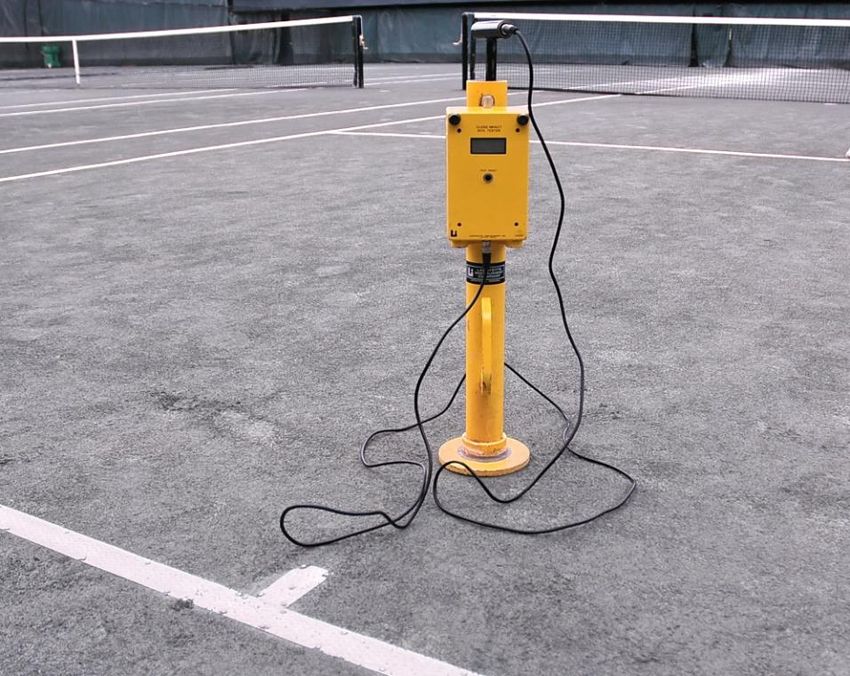
Table of Contents
1.0   Introduction                      3
2.0   The Issues                        3
      A. Surface Compaction             3
      B. Irrigation                     4
      C. Humidity                       5
3.0   Daily Maintenance                 5
      A. Tools Required                 5
      B. Rolling                        5
      C. Grooming                       5
      D. Scarification                  6
      E. Watering                       6
4.0   Periodic Maintenance              7
      A. Tools and Materials Required   7
      B. Scarification                  7
      C. Application of Coarse Blend    8
      D. Patching                       8
5.0   Annual Reconditioning             9
      A. Tools and Materials Required   9
      B. Cleaning the Court Surface     9
      C. Deep Scarification             10
      D. Application of New Material    10
6.0   Long-Term Renovation Practices    11
      A. Aerification                   11
      B. Deep Scarification             12
      C. Milling Machines               12
7.0   Conclusion                        13
8.0   Indoor Parameters                 13
      A. Surface Stiffness/Compaction   13
9.0   Indoor Structures                 15

                                    2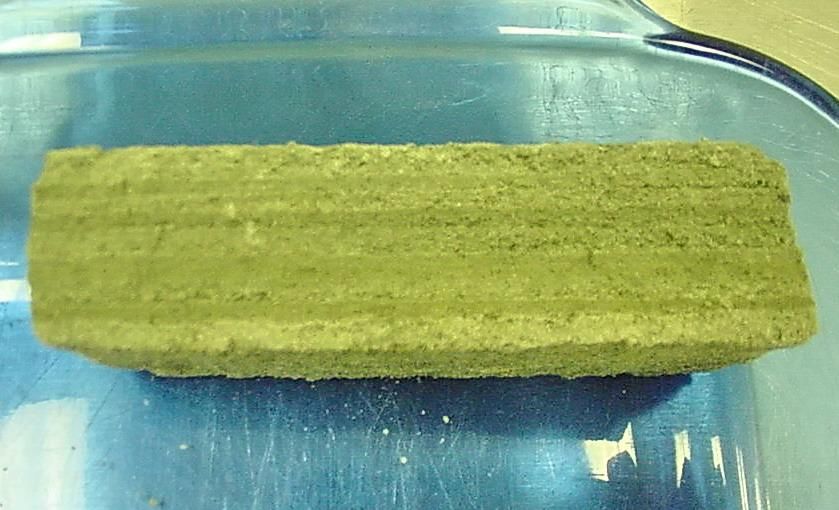
1.0 INTRODUCTION
      What is the perfect winter bubbled or indoor Har-Tru court? What does it look like,
      feel like and play like? Should it just be the same as an outdoor Har-Tru court?
      Because there are considerably more outdoor courts than there are winter bubbled or
      indoor courts, outdoor playability and performance is generally used as the standard.
      However, even outdoor courts perform across a widely variable range. And player
      preferences vary widely only adding to the confusion – one person’s perfect court is
      another’s disaster.

      The objective of this manual is not to answer the question of what is the perfect
      winter bubbled or indoor Har-Tru court. It is to provide bubbled and indoor court
      owners with information about indoor courts and with routines for maintaining them
      at optimum playability. It is an attempt to synthesize industry practices with the
      principals of Har-Tru and the latest tools, equipment and technology. Also provided
      with this manual are some parameters for indoor courts and a resource page for
      information on indoor structures.

2.0 THE ISSUES
      Indoor and bubbled Har-Tru courts exist in a controlled environment, free from rain
      and wind and freezing and thawing. Evaporation rates are typically very low and
      hours of use are typically very high. Consequently, indoor Har-Tru courts present a
      different set of maintenance challenges than their outdoor counterparts, and a
      discussion of these challenges up front helps frame the maintenance
      recommendations that follow in this manual. The issues are surface compaction,
      irrigation and humidity.

A. SURFACE COMPACTION
     Severe compaction in the Har-Tru surface occurs indoors because of extremely high
     use and because of the lack of weatherization; rain/evaporation and freeze/thaw
     cycles that keep outdoor courts soft. This compaction creates a surface that is bald,
     slippery and difficult to irrigate. Compaction occurs when the loose surface material
     gets ground down into extremely fine particles that come to rest on the court
     surface. These “fines” cement together, creating a thin surface layer that is
     extremely hard and nearly impervious. Water contributes to the cementing, and if
     the water has a high salts content it likely exacerbates the problem. Consistent use
     of aggressive grooming tools daily, and scarification tools and Coarse Blend
     periodically will help keep courts safe, but unless the fines generated during the
     season are removed the problem will not be resolved. The 4 photographs below
     illustrate a compacted surface.

                                            3
Photo 1: Top 1/16” Compacted                 Photo 2: Bald Top Surface

    Photo 3: Good Surface Below Compaction        Photo 4: Magnified View of Compaction

B. IRRIGATION
      It may be difficult to maintain an appropriate amount of water in the surface profile
      of an indoor court. A dry court surface is extremely hard and slippery but with slow
      evaporation rates indoors, flooding the courts with too much water is also a real
      concern. Adding to the challenge is that fact that the external temperature and
      relative humidity have an impact. A truly cold dry winter day in the northeast can
      dry courts out faster than even the hottest days in the southeast.

      Strategies for maintaining water in the profile without over-wetting the court are
      difficult to come by for several reasons. The first is that surface compaction in most
      cases keeps the water from penetrating into the court surface. Instead the water
      pools on top and the court rapidly becomes too flooded to continue watering. The
      second challenge is scheduling time to water. Playing schedules are so busy that in
      most cases, the only time is between 11pm and 6am. Most are watering by hand
      with a hose and this is slow and time-consuming.

                                             4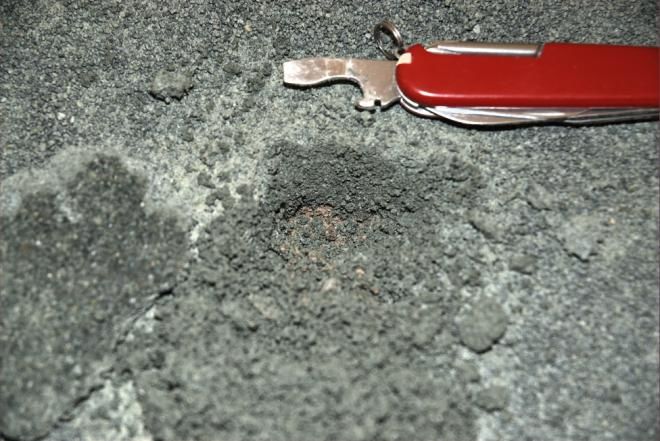
One solution is to keep the court surface soft so water penetrates easily. Strategies
      for accomplishing this were discussed above. Another solution, though not available
      to many facilities because of hours of use, is to water frequently for very short
      durations. Watering every 3-4 hours for 2-3 minutes just to keep the dust down is
      an example of this. This solution is short term because, unless water truly
      penetrates down into the surface, it will get harder and harder.

      Sub-surface irrigation, when properly regulated, has been used effectively indoors to
      keep the courts soft and uniformly wet. Water itself tends to soften courts and when
      it is being fed from below, this process occurs during every watering cycle.

C. HUMIDITY
     Whether the indoor courts are in a permanent structure or and air structure,
     controlling humidity levels is vital to make the playing environment safe and
     pleasant. Simultaneously trying to keep the court surface wet and the air dry is a bit
     if a conundrum. In relative humidity greater than 65% condensation occurs more
     frequently causing mold and mildew to start growing. Too much humidity also
     results in the “fines” clinging to tennis balls making them dirty and heavy.

3.0 DAILY MAINTENANCE
     Your daily maintenance routines keep the courts in optimal playing condition. At the
     same time, effective daily practices will reduce the amount of periodic and annual
     maintenance that is required.

A. TOOLS REQUIRED
     Steel Bristle Drag Brush (Photo 5)
     Court Rake (Photo 6)
     Line Sweeper (Photo 7)
     Lute Scarifier (Photo 8)

      Photo 5                 Photo 6                 Photo 7                  Photo 8

B. ROLLING
     Indoor Har-Tru courts do not require rolling. The surface gets compacted by
     repeated, high volume use and does not undergo any of the environmental or
     weathering changes that loosen it up.

C. GROOMING
     Har-Tru courts are groomed to redistribute the loose granular surface. This ensures
     safe traction, proper ball bounce and a good appearance.

                                             5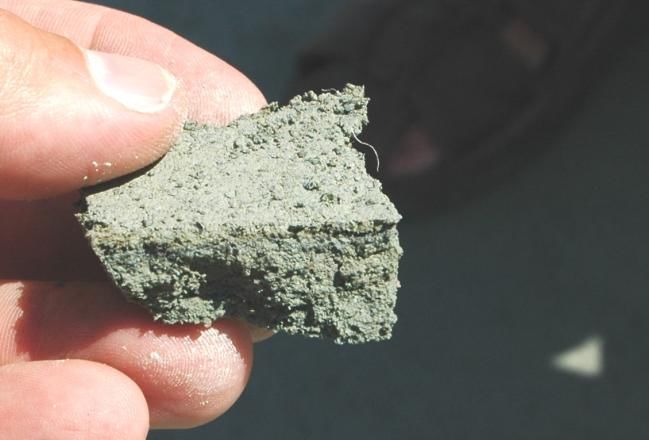
Indoor courts can and should be groomed as often as the playing schedule will allow,
      using aggressive grooming tools such as the Steel Drag Brush and the Court Rake.
      Aggressive tools help scarify while sweeping. This increases the amount of loose
      granular material improving traction, and keeps the top surface layer porous allowing
      water to penetrate. Adding weight to the Steel Drag Brush and Court Rake increases
      effectiveness, but may decrease the life of the tool.

D. SCARIFICATION
     After grooming, the court should be inspected for areas that are devoid of surface or
     particularly slippery under foot, and for any spots that need to be repaired. These
     areas should be scarified using the serrated edge of a Lute/Scarifier. Scratching up
     bald areas will increase sliding material and improve traction. Scratching up sections
     that need repair will take out the high spots and fill in the low. If hand scarifying
     fails to produce the desired results, application of some Coarse Blend or some
     patching may be necessary (see Periodic Maintenance).

E. WATERING
     On an indoor Har-Tru court, water keeps the dust down, reduces or minimizes
     compaction and improves traction. The more water that can be applied to the Har-
     Tru surface, the better the court will play. That being said, evaporation rates indoors
     are very low and care must be taken not to over water for two reasons. One is that
     the court simply will not dry and will be unplayable. Two is that too much water will
     cause humidity levels within the structure to rise to unsafe levels. Playing on a
     surface that has too much moisture will also increase the level of compaction.

      Structures that have the capability to move air across the court, whether via air
      conditioning, dehumidification or ventilation, typically have greater room for error
      and can apply water more liberally. Develop an understanding for your facility’s air
      handling systems and apply water with care. Apply as much water as possible daily
      while keeping humidity levels within the structure below 65%.

      Facilities with sub-surface irrigation are typically able to get more water into the
      profile of the court as they are not restricted by the surface puddling that occurs
      during above ground watering. Good record keeping and a complete understanding
      of how the system works is necessary to avoid getting the courts too wet.

                                             6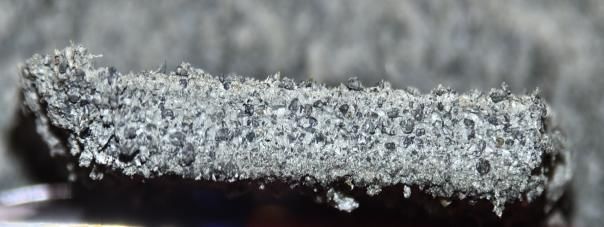
4.0 PERIODIC MAINTENANCE
      Periodic Maintenance is performed to keep problems small and manageable and to
      ensure the court performs at its best. For an indoor court it includes scarification,
      patching and the application of Coarse Blend. These procedures are detailed below.

A. TOOLS AND MATERIALS REQUIRED
     Lute/Scarifier (Photo 9)
     Court Devil (Photo 10)
     Court Devil Jr. (Photo 11)
     Tow Scarifier (Photo 12 – which cannot be pulled over line tapes)
     Coarse Blend (Photo 13)
     Har-Tru (Photo 14)
     Hand Roller (Photo 15)
     Spreader (Photo 16)

         Photo 9                Photo 10               Photo 11              Photo 12

                                                       Photo 15              Photo 16

         Photo 13              Photo 14

B. SCARIFICATION
     Mitigating surface compaction is essential to keeping the courts performing well.
     Scarifying keeps the court soft, increases loose granular sliding material and allows
     water to penetrate more freely.

      Although using aggressive tools for daily maintenance helps with surface compaction,
      weekly scarification with heavier, more aggressive tools is recommended. These
      tools should be pulled across the court in multiple directions with the focus being on
      the low play areas where less foot traffic occurs. These areas, typically the center of

                                             7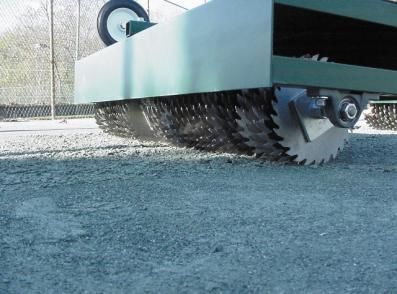
no man’s land and the doubles alleys, are locations where ground up fines tend to
      settle and lock in place.

      Often these areas will be notably higher than other sections of the court. Weight can
      be added as necessary to increase effectiveness. The goal is to break up the top
      sixteenth to quarter inch of the court surface, scrape it into piles and remove it.
      Once accomplished, the court should be swept in two directions using the Steel Drag
      Brush or Court Rake and then watered. The work will require closing the court for
      approximately two hours and should be performed as scheduling permits.

C. APPLICATION OF COARSE BLEND
     Coarse Blend is Har-Tru with lower dust content. It consists of the larger, coarser
     size particles that when applied to the court surface, increase traction and scarify the
     surface during play. An application of one bag per court per week throughout the
     indoor playing season is recommended. It can be applied with a broadcast spreader
     or cast out by hand with a shovel.

      During the playing season, bald areas often develop where the surface has become
      compacted and the sliding material has been pushed away. Apply Coarse Blend to
      these areas in small amounts and distribute it with the flat edge of the Lute/Scarifier.
      This will provide better traction and sliding capability and also help loosen these
      areas up. A one court application will take 10-20 minutes depending on the condition
      of the court and the method of application.

D. PATCHING
     Due to the high volume of doubles play, the area of the court just behind the
     baseline and the tracks where players serve and volley for doubles, tend to get worn
     down. These areas of the playing surface should be inspected weekly and patched as
     needed. Experience has shown that frequent thin patches set up more effectively
     and require fewer repairs. Patching indoors can be tricky because it is hard to get
     the patch to adhere to the compacted court surface and there is rarely much time to
     let the patch set up before players are back on it.

      If possible, the court should be shut down about 3pm and should be dry. The
      affected area should be thoroughly cleaned of old material and ball fuzz using a brush
      and scarified to a minimum depth of 1/16” using any or all of the tools listed above.
      New Har-Tru should be opened and dumped onto the court surface and spread
      evenly with a long straight edge, such as a ladder, to fill in all low spots. Once
      complete, the patch should be hand watered just enough to activate the binder (not
      so much as to puddle) and rolled by hand. The patch should be watered and rolled
      again 2 or 3 more times that day. The court can be opened for play the next
      morning at the normal time. (NOTE: Only regular Har-Tru should be used for
      patching. Coarse Blend will not work.) Patching areas will tend to be softer than the
      rest of the court and will get damaged during play. Touch the patch up by lightly
      hand scarifying.

                                              8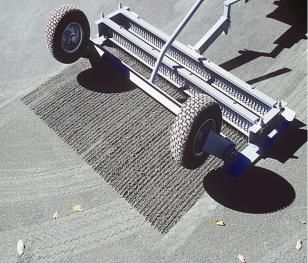
5.0 ANNUAL RECONDITIONING
     Annual reconditioning is performed to preserve the life of the court and to improve
     playability. It includes removing all of the old, worn Har-Tru and the ball fuzz and
     debris that accumulate during a season of play, patching low spots and adding new
     material as needed. These procedures are discussed below.

A. TOOLS AND MATERIAL REQUIRED
     Lute Scarifier (Photo 17)
     Har-Tru (Photo 18)
     Coarse Blend (Photo 19)
     Court Devil (Photo 20)
     Tow Scarifier (Photo 21 – which cannot be pulled over line tapes)
     Push Broom (No photo)
     Aussie Clean Sweep (Photo 22)
     Spreader (Photo 23)

         Photo 17               Photo 18           Photo 19                 Photo 20

         Photo 21                Photo 22                Photo 23

(NOTE: Prior to reconditioning, all tools and equipment should be inspected thoroughly.
Nails, blades, teeth and tines wear down very quickly on the hardened indoor surface and
are rendered ineffective. Purchase and install replacement parts as needed.)

B. CLEANING THE COURT SURFACE
      If replacing the marking tapes begin by removing all tapes and nails from the court
      surface (NOTE: Tapes may not need to be replaced every season. Monitor the wear
      of the pattern on the tape surface. When worn the tape will become slippery and will
      need to be replaced). Using a power brush or push broom, sweep all loose surface

                                            9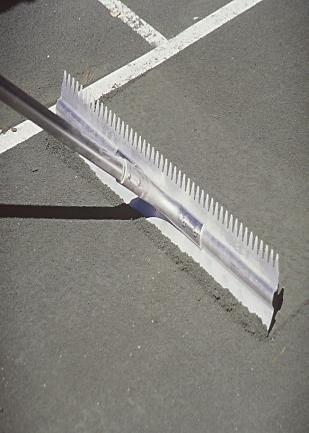
material and debris into piles and remove it with a flat bottom shovel and
      wheelbarrow or cart.

      Caution: The use of dust masks while top dressing indoors is highly recommended.
      Every attempt should be made to ventilate the area as well. Use of gasoline or diesel
      equipment produces carbon monoxide that must be ventilated completely during
      emission. Use of a carbon monoxide detector is required for safety.

C. DEEP SCARIFICATION
     The objective of deep scarification is to penetrate a minimum of ¼” into the court
     surface to loosen it up. Deep scarification should be performed after fines have been
     removed as described above. Add weight to a court devil or tow scarifier and make
     multiple passes in all different directions until surface penetration of ¼” is achieved.
     Then drag the court with an Aussie Clean Sweep to redistribute and level the
     loosened surface. The leveled surface may need to be rolled if the surface has
     broken up in clumps.

D. APPLICATION OF NEW MATERIAL
     Indoor courts experience very little surface erosion. Most of that erosion comes from
     tracking Har-Tru off the court in the soles of shoes. It is estimated that less that ½ a
     ton of material is lost during the playing season. Therefore it is not necessary to add
     large quantities of Har-Tru each season.

      The first step is to assess the surface depth on the court. Perform core tests in four
      locations across the court and average the numbers together to get the average
      surface depth. Be sure to check the high wear areas just behind the baseline as
      those spots typically wear faster than the rest of the court.

      Assuming that the average surface depth is 7/8” or greater, no new Har-Tru needs to
      be added. Instead, an application of 6 bags of Coarse Blend per court is
      recommended. It can be applied with a drop spreader and brushed out using a Steel
      Drag Brush or Aussie Clean Sweep.

      Any patching that needs to be done should be done after scarification and before
      surface application. See the Periodic Maintenance section for instructions on
      patching. After patching and applying new material, the entire surface should be
      watered thoroughly by hand. Once the surface dries, new line tapes can be installed.

                                              10
6.0 LONG TERM RENOVATION OF COURTS
Over a period of years, an indoor Har-Tru court will end up with successive layers of
cemented fines covered with layers of new Har-Tru. This layering significantly
reduces permeability and makes managing both surface hydration and hydration and
humidity levels very difficult. Additionally, effective scarification becomes tougher.
Aggressive grooming tools, Coarse Blend, and heavy duty scarifiers are no longer
effective in improving playing conditions and the only answer is to keep adding more
and more Har-Tru. At this point, it is time for more major intervention.
Photo 24: Har-Tru Surface Layering
Several techniques are currently used to counteract the negative effects of the
compaction. They are procedures that may require the assistance of an outside
professional and it is recommended that clubs consult Lee Tennis and their local
contractor. The procedures are discussed below.
A. AERIFICATION
The Toro HydroJect (photo 25) and the DriJect (photo 26) are two pieces of
equipment that were invented for use on golf courses and have been applied
successfully on indoor courts. These machines shoot highly pressurized jets of water,
about the size of a pencil lead, down into the court surface (photo 27). In the
process they create lateral fractures in the surface. These holes and lateral fractures
open space for water to travel through the profile, loosening or softening it up.
The procedure is typically conducted several weeks before the indoor playing season
begins. Multiple passes are made with the machine across the court surface. After
the holes are drilled, they are back filled with Coarse Blend and then the courts are
flooded.
11Photo 25 Photo 26 Photo 27
A big advantage of this procedure is that the marking tapes do not need to be
removed and it takes only a couple of days to conduct, with minimal surface
disruption. As a result, many facilities are choosing to have this done annually as a
preventive measure rather than waiting until the court becomes very hard an
impermeable. The disadvantage of the procedure is that depending on the level of
compaction, the machine may not achieve very deep penetration and the process
may need to be repeated more than once. Fortunately, the effects of aerification are
cumulative and compaction is lessened with each time it is performed.
B. DEEP SCARIFYING
Tennis court contractors with a laser grader have a box blade with teeth on it that
they can use to tear up hardened surfaces. The laser can be set to a controlled
depth to avoid getting into the stone base below. Once broken, the surface can be
re-graded flat and the facility is left with a court that is almost like new.
The advantages of this technique are that it is quick and accurate. The disadvantage
is that some courts are so hard that the teeth cannot penetrate. Even if they can
penetrate, the surface typically comes up in chunks and these have to be eliminated
before the surface can be re-graded effectively. Also, this procedure does not
remove all the fines generated during the playing season or over many playing
seasons. This means that the material being reused is out of specification and will
tend to compact too much and be less permeable than new Har-Tru. If the courts
are very old, removal of the existing surface material and applying 1” of new Har-Tru
is recommended.
C. MILLING MACHINES
The Milling Machine (photos 28-30) and the Asphalt Grinder (photo 31) are
specialized pieces of equipment that can be used to mill the surface into powder.
They can be operated with a tractor and the depth can be controlled automatically
with a laser. There are several types of machines from asphalt grinders to
pulverizers that have been used to varying degrees of success.
The advantage of using these machines is they are most effective at breaking up the
old Har-Tru and making the court almost like new. The disadvantage is the process
requires specialized equipment, more time and typically costs more. Also, as above,
this procedure does not remove all the fines generated during the playing season or
over many playing seasons. This means that the material being reused is out of
specification and will tend to compact too much and be less permeable than new Har-
Tru. If the courts are very old, removal of the existing surface material and applying
1” of new Har-Tru is recommended.
12Photo 28 Photo 29 Photo 30 Photo 31
Photo 28 Photo 29 Photo 30 Photo 31
7.0 CONCLUSION
Prevailing wisdom has it that Har-Tru courts perform too poorly in an indoor
environment to bother installing them. Perhaps by understanding what is happening
and clearly outlining a proactive approach to handling the challenges associated with
indoor clay courts, this manual will help to dispel that sentiment. We have a tennis
population that is rapidly aging and needs the soft sliding characteristics of Har-Tru,
both indoor and out, to be able to play the game of tennis for life.
One observation in closing – facilities with continuity in their maintenance personnel
and facilities that keep detailed records always have the best performing courts. This
is true regardless of the age of the courts, the type of structure they are under, the
irrigation system, or the air handling system in place. Keep detailed records of
temperature and humidity, amounts of water applied, time spent on the different
maintenance procedures, dates and amounts for when material was added, and
records of when parts were replaced on tools and equipment. These records, along
with a person who understands what they mean, are likely the most important
ingredients for having a successful indoor clay court facility.
8.0 INDOOR PARAMETERS
Lee Tennis is in the process of developing parameters around what makes an optimal
Har-Tru court. The goal is to provide a range for the variables below that create the
best playing conditions. A facility will be able to use these parameters for guidance
and comparative purposes. It is a work in process and the information will be added
to this manual as it comes in. You can stay up to date by becoming an active
member of the Indoor Clay Court Community Forum on our web-site,
www.hartru.com.
A. SURFACE STIFFNESS/COMPACTION
Har-Tru has been using a piece of equipment called a Clegg Hammer to establish a
measure of how hard a court is. We have now used this tool for 2 years on dozens of
courts, some multiple times. We have correlated readings with a subjective
observation of the softness and traction. Additionally, we have compared readings
from facility to facility, indoors to outdoors, from court to court and even from one
location on the court surface to another. These readings have given us a sense for
what is too hard and what is too soft. It has also allowed us to understand which
areas of a court are most susceptible to hardening.
13We feel fairly confident that this is an acceptable tool for measuring hardness and we
will continue to test courts and build a data bank. We will also be trying to conduct
play testing and correlate readings with player observations.
Photo 32: The Clegg Hammer is used to measure surface stiffness
Traction – TBD: This parameter will help clubs understand if their courts are too slippery
or do not allow enough slide.
Surface Hydration – TBD: This parameter will allow facilities to discern whether there is a
desirable amount of water in the surface profile.
Air Temperature – Recommended Range = 50-65 F
149.0 Indoor Structures
Below is an alphabetical list of companies that manufacture structures for use over
Har-Tru courts. This list will be updated when more information comes in. Contact
them directly for technical assistance or sales information.
Indoor Courts of America
ICA East*
1280 N. Winchester
Olathe, KS 66061
T: 913-780-0775 F: 913-780-0770
Or:
39 Fields Lane
North Salem, NY 10560
T: 914-669-4394 F: 914-669-4395
www.icasbs.com
Membrane Structure Solutions
27 O’Conner Circle
West Orange, NJ 07052
T: 908-520-0112 F:908-520-0116
Email: Waldemar@goes.com
www.membranestructuresolutions.com
Summit Structures
946 North Van Buren Street
Allentown, PA 18109
T: 800-615-4777 (toll free)
www.summitstructures.com
Universal Fabric Structures, Inc.
Corporate Headquarters/USA and International Sales
2200 Kumry Road
Quakertown, PA 18951
T: 215-529-9921 F: 215-529-9936 Toll Free: 800-634-8368
www.usfinc.com
Yeadon Fabric Domes, Inc.
1567 East Country Road E.
St. Paul, Minnesota 55510
T: 651-633-7400 F: 651-633-2019 Toll Free: 800-493-2366
Email: SFYeadon@aol.com
www.yeadondomes.com
15Har-Tru
2200 Old Ivy Road, Suite 100
Charlottesville, VA 22903
877-4-HAR-TRU fax 434-971-6995
www.hartru.com
16You can also read


