Integrated Switch Fabric - A uniquely scalable approach to forwarding and security processing
←
→
Page content transcription
If your browser does not render page correctly, please read the page content below
TECHNOLOGY BRIEF

Integrated Switch Fabric
A uniquely scalable approach to forwarding and security processing
FORTINET – Integrated Switch Fabric Technology Brief PAGE 2
Introduction
When designing the next generation of high-end FortiGate appliances the design team at Fortinet wanted
to achieve that often referenced modular and scalable architecture, but to deliver it within an appliance
utilizing the power of the new FortiASIC-NP4 and FortiASIC-SP2 designs. Initially introduced in the
FortiGate 1240B appliance, the integrated switch fabric design provides for an any-to-any approach to
traffic forwarding powered by the FortiASIC-NP4 with additional security processing offload capabilities
being delivered by the FortiASIC-SP2
Integrated Switch Fabric
The integrated switch fabric (ISF) design of today’s high-end FortiGate appliances provides three
significant advantages when designing security solutions
ISF allows the FortiASIC-NP4 to provide increased port density where multiple 1-Gbps ports are
required.
ISF provides line rate firewall processing across the entire appliance, any port to any port.
ISF enables security processing resources to be shared across physical ports
FortiASIC-NP4
The FortiASIC-NP4 belongs to a family of purpose built high performance ASICs designed to accelerate
security services at the interface level hence the term Network Processor. The FortiASIC-NP4 design
provides
Packet size independent wirespeed low latency performance for millions of sessions with
dynamic address translation
IPSec ESP encryption and decryption processing
Anomaly based intrusion prevention, checksum offload, and packet defragmentation
Traffic Shaping and Priority Queuing
The FortiASIC-NP4 itself comprises two 10-
Gbps interfaces that connect in to the ISF to
provide flexible port configurations without
sacrificing performance.
Figure 1 illustrates a single NP4 connecting
via an ISF to provide twenty 1-Gbps
wirespeed ports – each port represents a
separate firewall interface.
Multiple NP4s can be provided with various
physical port combinations to build out a
range of appliance designs.
Figure 1. FortiASIC-NP4 and Integrated Switch Fabric
FortiASIC-SP2
The FortiASIC-SP2 represents the second generation of Fortinet Security Processor technology building
on the runaway success of the ADM-XE2, ADM-FE8, and ASM-CE4 SP1 modules. The FortiASIC-SP2
provides, in addition to hardware based acceleration, a multi-core multi-threaded security processing
complex which builds on the capabilities of the FortiASIC-NP4 to provide additional services, including,
but not limited to IPS signature analysis, application control, DOS protection, and locally encrypted
multicast acceleration.
The FortiASIC-SP2 is also able to connect directly to the ISF where it can be accessed by all physical
ports.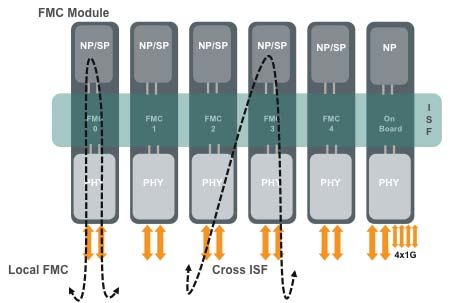
FORTINET – Integrated Switch Fabric Technology Brief                                                               PAGE 3

     Fortinet Mezzanine Cards
     As a part of the next generation design goal for a modular architecture it was natural to include a
     separately available module to be installed in to the high-end platforms as performance requirements
     demanded. Since the physical size of current series of AMC cards presented some constraints to the
     performance goals of the new design, it was decided to opt for a larger form factor providing more space
     for future designs and thermal demands.

     The Fortinet Mezzanine Card (FMC) has
     been designed to provide a combined
     physical port and processing resource –
     initially for the FortiGate 3950 series. The
     FMC based physical ports connect directly
     to the integrated switch fabric (ISF) with the
     processing resource, whether FortiASIC-
     NP4, or FortiASIC-SP2, having their own
     direct connections. In this way the
     additional processing power can be
     distributed across the entire appliance via
     the ISF.

     Figure 2 illustrates a fully populated
     FortiGate 3950 showing both the
     onboard FortiASIC-NP4 and optional                     Figure 2. FMC and ISF Connectivity
     FMC hosted NP4 and SP2 modules.                         in a FortiGate 3950 Series System
     Meaning each FMC module has four 10-
     Gbps connections.

     At the heart of the FortiGate 3950 is a 24 port 10-Gbps integrated switch fabric. The ISF enables fully
     meshed connectivity between all the FMC slots and associated processing modules.

     The FortiGate 3950 series has five slots, a sixth slot represents the on board physical port module and its
     FortiASIC-NP4 resources. Meaning that even with no modules installed, the FortiGate 3950 series can
     provide 20-Gbps of firewall performance.

     Planned FMC Modules
     The FMC-XD2 and FMC-XG2 represent the FortiASIC-NP4 and FortiASIC-SP2 powered modules
     respectively, in addition to these, multiple 1-Gbps SFP and RJ45 modules are also planned.

     Packet Flow
     All ISF enabled FortiGate units share the same capability of flexibly mapping resources and physical
     ports, however this is perhaps most evident with the FortiGate 3950 where multiple FMC modules will
     deliver different port and processing configurations over time.

     As has been already stated, the ISF allows each port of the FortiGate 3950 series to utilize the resources
     from any of the FMC processing modules.

     There is no requirement to use the processing resource (NP or SP) on the ingress FMC.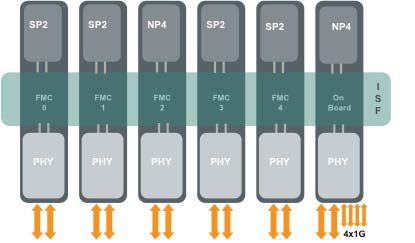
FORTINET – Integrated Switch Fabric Technology Brief                                                             PAGE 4

     Figure 3 illustrates both these local
     FMC and cross-ISF flows. The
     cross-ISF flows are set up within the
     ISF and are created according to the
     egress port requirements.

     Notice that only one NP or SP is
     used whether we have local FMC or
     cross-ISF forwarding.

     Load Balancing
     A future software enhancement will
     make it possible to use an NP4 as a
     load balancing module for multiple
     SP2 units to further assist in those
     topologies that require high capacity
     security processing.
                                                          Figure 3. Example Packet Flow within a
                                                              FortiGate 3950 Series System
     Control Plane
     Although not directly linked to the ISF implementation the control plane separation apparent with
     FortiASIC-NP4 powered platforms has been designed from their inception.

     This separation includes
     prioritization of specific network
     control ingress traffic, a high
     priority CPU queue, and the
     ability to distribute control plane
     processing across multiple CPU
     cores. This process distribution
     ensures the CPU block is able
     to scale both the session set up
     and network control plane.

     In addition, at egress control
     traffic is a dispatched to the
     priority output queue with a
     dedicated egress queue from
     the network or security
     processor minimizing any
     forwarding delays.

                                                         Figure 4. Control Plane Distribution
     FortiGate 5000 Series
     Chassis-Based Systems
     The flagship of the Fortinet product line also shares this integrated switch fabric approach, however it
     provides additional levels of sophistication, scalability, and redundancy not available from a standalone
     appliance.

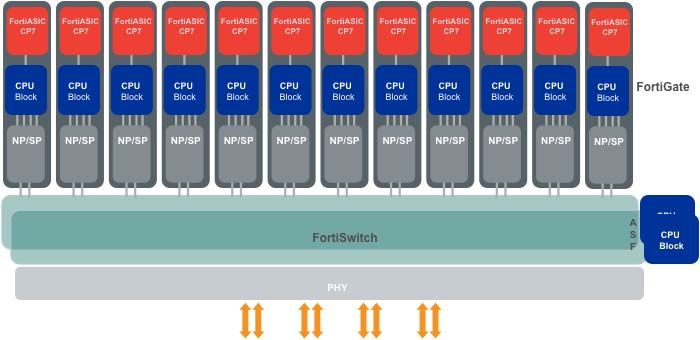
     The FortiGate 5000 series chassis-based systems allow FortiGate blades to be added to a common
     backplane, it is to this backplane that the interconnecting switch fabric blades are connecting. This
     Advanced Switch Fabric (ASF) can be programmed depending on the specific application of the chassis.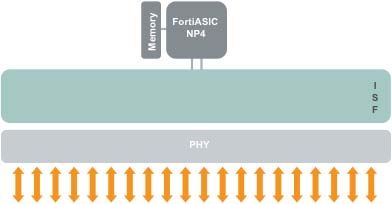
FORTINET – Integrated Switch Fabric Technology Brief                                                                                                          PAGE 5

     The ASF allows scalability not only in the NP4 and SP2 area but also for the control and so called slow
     path traffic that requires access to a host CPU. This linear scalability of control plane traffic allows for
     planned 1M plus connections per second.

     The ASF can be provided in a dual redundant mode either within a chassis, or between chassis
     depending on the resilience demanded at the blade level.

     FortiGate blade level resilience and redundancy can exist within or between chassis and this will form the
     subject of a separate paper.

                                         Figure 5. FortiGate 5000 Series Advanced Switch Fabric

      Fortinet (NASDAQ: FTNT) is a worldwide provider of network secur.ity appliances and the market leader in unified threat management (UTM). Our
      products and subscription services provide broad, integrated and high-performance protection against dynamic security threats while simplifying
      the IT security infrastructure. Our customers include enterprises, service providers and government entities worldwide, including the majority of the
      2009 Fortune Global 100. Fortinet’s flagship FortiGate product delivers ASIC-accelerated performance and integrates multiple layers of security
      designed to help protect against application and network threats. Fortinet’s broad product line goes beyond UTM to help secure the extended en-
      terprise – from endpoints, to the perimeter and the core, including databases and applications. Fortinet is headquartered in Sunnyvale, Calif., with
      offices around the world.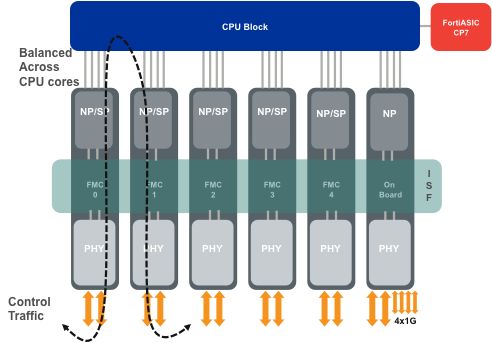
You can also read


