KLIP-LOK 700 HI-STRENGTH - DESIGN AND INSTALLATION GUIDE - BlueScope Steel
←
→
Page content transcription
If your browser does not render page correctly, please read the page content below
KLIP-LOK 700
HI-STRENGTH®
DESIGN AND INSTALLATION GUIDE
LYSAGHT KLIP-LOK 700 HI-STRENGTH®
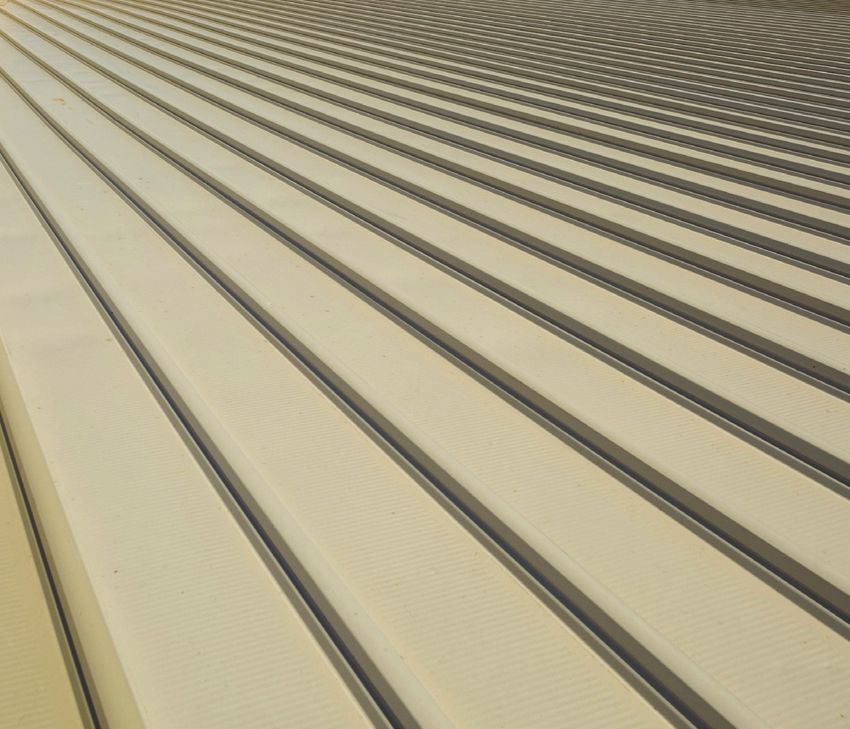
               Visually, a bold rib makes a strong statement rising from the flat pans. Thermal expansion of long, straight
               runs are achievable, and with no exposed fasteners, the long, straight lines of KLIP-LOK 700 HI-STRENGTH®
               (KL-700HS) remain clean and smooth.
               At the heart of our system is our fixing clip, which can be laid in place and fixed simpler and faster than ever
               before. This is because the KLIP-LOK 700 HI-STRENGTH® clip is fixed with hex. Head screws, which are easier
               to drive. The clip also gives roofers the ability to accommodate up to 100mm of insulation.
               KLIP-LOK 700 HI-STRENGTH® is available in rolled-on-site lengths. Our mobile on-site rollformer means
               extra long lengths of KLIP-LOK 700 HI-STRENGTH® can be made on-site and looks fantastic and also
               eliminates expansion joints. Longitudinal fluting manufactured from the mobile rollformer. Its availability
               is subject to enquiry.

                                                                            43mm

                                700mm cover

               MATERIAL SPECIFICATIONS                                                  COLORBOND® STEEL WITH THERMATECH® TECHNOLOGY
               Next generation ZINCALUME aluminium/zinc/magnesium alloy
                                              ®
                                                                                        THERMATECH® solar reflectance technology is now included
               coated steel complies with AS 1397:2011 G550, AM125 (550 MPa             in the standard COLORBOND® steel palette. COLORBOND®
               minimum yield stress, 125g/m2 minimum coating mass).                     steel with THERMATECH® technology reflects more of the sun’s
                                                                                        heat, allowing both roofs and buildings stay cooler in summer.
               COLORBOND® is pre-painted steel for exterior roofing and walling.
                                                                                        In moderate to hot climates, compared to roofing materials of
               It is the most widely used. The painting complies with AS/NZS
                                                                                        similar colour with low solar reflectance, COLORBOND® steel
               2728:2013 and the steel base is an aluminium/zinc alloy-coated
                                                                                        with THERMATECH® can reduce annual cooling and energy
               steel complying with AS 1397:2011. Minimum yield strengths is
                                                                                        consumption by up to 20%.
               G550 (550 MPa). Minimum coating mass is AM100 (100g/m2).
               COLORBOND® Metallic is pre-painted steel for superior aesthetic          LENGTHS
               qualities displaying a metallic sheen.                                   Mobile rollformed sheets are custom cut on-site. Factory sheets cut
                                                                                        to order.
               COLORBOND® Ultra is pre-painted steel for severe coastal or
               industrial environments (generally within about 100-200 metres of        MASSES
               the source). The painting complies with AS/NZS 2728:2013 and
                                                                                                               BMT (mm)     kg/m       kg/m2      m2/t
               the steel base is an aluminium/zinc alloy-coated steel complying
                                                                                        ZINCALUME steel
                                                                                                  ®
                                                                                                               0.42         3.23       4.61       217
               with AS 1397:2011. Minimum coating mass is AM150 (150g/m2).
                                                                                        COLORBOND® steel       0.42         3.26       4.65       215
               COLORBOND® Stainless is a pre-painted steel and is used for              ZINCALUME® steel       0.48         3.67       5.24       191
               severe and coastal environments. The painting complies with              COLORBOND® steel       0.48         3.70       5.28       189
               AS/NZS 2728:2013 and the steel base is a stainless steel
               complying with AISI/ASTM Type 430; UNS No. S43000.
               MATERIAL AND COLOUR AVAILABILITY
               For local availability of KLIP-LOK 700 HI-STRENGTH® in the base
               metal thicknesses or the large range of available finishes (from plain
HI-STRENGTH®

               ZINCALUME® steel to COLORBOND® pre-painted steel), contact
KLIP-LOK 700

               your nearest Lysaght service centre.
               For the local availability of colours for KLIP-LOK 700 HI-STRENGTH®
               please enquire at your nearest Lysaght service centre.
  2
TOLERANCES MAXIMUM ROOF LENGTHS FOR DRAINAGE
Length: + 0mm, – 15mm; Width: + 4mm, – 4mm MEASURED FROM RIDGE TO GUTTER
Make allowance for thermal expansion or contraction for long Penetrations will alter the flow of water on a roof. For assistance in
length roofs at sheeting ends. design of roofs with penetrations, please seek advice from our
information line.
The equation ΔL = α x ΔT x L gives an indication of the sheeting
extent or contraction (ΔL). LIMIT STATES WIND PRESSURES
KLIP-LOK 700 HI-STRENGTH® offers the full benefits of the latest
α = 12 x 10-6 (coefficient of linear expansion for steel)
methods for modelling wind pressures. The wind pressure capacity
ΔT = temperature change in °C table is determined by full scale tests conducted at Lysaght’s NATA-
registered testing laboratory, using the direct-pressure testing rig.
L = sheet length in mm
Testing was conducted in accordance with AS 1562.1:1992
MAXIMUM SUPPORT SPACINGS
Design and Installation of Sheet Roof and Wall Cladding—Metal,
The maximum recommended support spacings are based on and AS 4040.2:1992 Resistance to Wind Pressure for
testing in accordance with AS 1562.1-1992, AS 4040.0-1992 and Non-cyclonic Regions.
AS 4040.1-1992.
The pressure capacities for serviceability are based on a deflection
Roof spans consider both resistance to wind pressure and light roof limit of (span/120) + (maximum fastener pitch/30).
traffic (traffic arising from incidental maintenance).
The pressure capacities for strength have been determined by
Wall spans consider resistance to wind pressure only. testing the cladding to failure (ultimate capacity). These pressures
The pressure considered is based on buildings up to 10m high in are applicable when the cladding is fixed to a minimum of 1.0mm,
Region B, Terrain Category 3, Ms=0.85, Mi=1.0, Mt=1.0 with the G550 steel. For material less than 1.0mm thick, refer to the
following assumptions made: TOPSPAN® Design and Installation Guide and Selection Tables, or
seek advice from our information line.
ROOFS:
ADVERSE CONDITIONS
Cpi=+0.20, Cpe=-0.90, Kl=2.0 for single and end spans,
Kl=1.5 for internal spans. If this product is to be used in marine, severe industrial, or unusually
corrosive environments, ask for advice from our information line.
WALLS: MAXIMUM ROOF LENGTHS FOR DRAINABLE
Cpi=0.20, Cpe=-0.65, Kl=2.0 for single and end spans, MEASURED FROM RIDGE TO GUTTER (M)
Kl=1.5 for internal spans.
Peak Rainfall Intensity Roof Slopes (degrees)
These spacings may vary by serviceability and strength limit states (mm/hr) 1 2 3 5 7.5 10
for particular projects. 100 344 428 502 624 745 856
MAXIMUM SUPPORT SPACINGS (MM) 150 229 285 334 416 496 571
BMT 200 172 214 251 312 372 428
Type of Span 0.42mm 0.48mm 250 137 171 201 250 298 342
Roofs 300 115 143 167 208 248 285
Single span 1650 2050 400 86 107 125 156 186 214
End span 1750 2350 500 69 86 100 125 149 171
Internal span 2200 2800
MINIMUM ROOF PITCH
Unstiffened eaves overhang 150 200
Stiffened eaves overhang 450 500
Our unique anti-capillary side-lap allows you to use KLIP-LOK 700
HI-STRENGTH® on roof pitches from as low as 1° (1 in 50) for 0.48
Walls
and 2° for 0.42 BMT.
Single span 2600 3000
End span 3000# 3000# NON-CYCLONIC AREAS
Internal span 3000# 3000# The information in this brochure is suitable for use only in areas
Overhang 150 200 where a tropical cyclone is
For roofs: the data are based on foot-traffic loading. unlikely to occur as defined in AS
For walls: the data are based on pressures for transverse fluted material. 1170.2:2002.
Table data are based on supports of 1mm BMT. Refer to the TOPSPAN® Design and
Installation Guide and Selection Tables for support thickness less than 1.0 mm BMT, or seek For information on the use of
advice from our information line. LYSAGHT® products in cyclonic
# Spans in excess of 3000mm may be available subject to enquiry. Wall applications or long
spans require particular attention to installation practice.
conditions, refer to the Cyclonic
Area Design Manual which is
SPAN TYPES available on our website:
Roofing & Walling Profiles www.lysaght.com.
HI-STRENGTH®
KLIP-LOK 700
or
if end lap
End spans t in sheeting SS
join
expansion ES IS IS ES O
Step
ES O
Spacing definitions
ES = End Span
IS = Internal Span
IS
O = Overhang
IS
SS = Single Span
O ES
Walling Profiles Only
ES O
Spacing definitions
ES = End Span
IS
3
IS = Internal Span
O = Overhang
IS
SS = Single Span
SS
O ESKLIP-LOK 700 HI-STRENGTH® (TRANSVERSE FLUTES) LIMIT STATE WIND PRESSURE CAPACITIES (KPA) 0.42 BMT
Span Type Limit State Span (mm)
900 1200 1500 1800 2100 2400 2700 3000
Single Serviceability 3.08 2.53 2.00 1.53 1.15 0.86 0.65 0.49
Strength* 4.95 4.15 3.50 2.85 2.30 1.85 1.55 1.30
End Serviceability 3.05 2.73 2.40 2.02 1.64 1.32 1.07 0.91
Strength* 5.55 4.30 3.35 2.75 2.55 2.40 2.20 1.85
Internal Serviceability 2.90 2.64 2.39 2.16 1.94 1.74 1.55 1.38
Strength* 5.40 4.60 3.90 3.25 2.75 2.40 2.20 2.00
KLIP-LOK 700 HI-STRENGTH (TRANSVERSE FLUTES) LIMIT STATE WIND PRESSURE CAPACITIES (KPA) 0.48 BMT
®
Span Type Limit State Span (mm)
900 1200 1500 1800 2100 2400 2700 3000
Single Serviceability 4.22 3.35 2.54 1.83 1.28 0.90 0.69 0.57
Strength* 6.30 5.20 4.25 3.35 2.70 2.15 1.80 1.60
End Serviceability 3.81 3.34 2.88 2.43 2.02 1.67 1.38 1.15
Strength* 6.30 5.10 4.15 3.55 3.15 2.85 2.50 2.20
Internal Serviceability 3.76 3.32 2.91 2.54 2.24 2.01 1.84 1.68
Strength* 6.35 5.55 4.80 4.10 3.60 3.20 2.85 2.60
KLIP-LOK 700 HI-STRENGTH® (LONGITUDINAL FLUTES) LIMIT STATE WIND PRESSURE CAPACITIES (KPA) 0.42 BMT
Span Type Limit State Span (mm)
900 1200 1500 1800 2100 2400 2700 3000
Single Serviceability 2.52 2.05 1.60 1.22 0.91 0.69 0.56 0.48
Strength* 4.85 4.10 3.40 2.75 2.20 1.80 1.45 1.20
End Serviceability 2.65 2.48 2.26 1.92 1.53 1.19 0.94 0.79
Strength* 3.40 2.95 2.60 2.30 2.15 2.00 1.80 1.55
Internal Serviceability 2.63 2.40 2.17 1.96 1.76 1.57 1.41 1.25
Strength* 3.85 3.40 3.00 2.65 2.35 2.15 2.00 1.95
KLIP-LOK 700 HI-STRENGTH® (LONGITUDINAL FLUTES) LIMIT STATE WIND PRESSURE CAPACITIES (KPA) 0.48 BMT
Span Type Limit State Span (mm)
900 1200 1500 1800 2100 2400 2700 3000
Single Serviceability 2.80 2.27 1.77 1.33 0.98 0.74 0.59 0.50
Strength* 5.80 4.75 3.80 2.95 2.30 1.80 1.50 1.30
End Serviceability 3.11 2.51 2.01 1.64 1.40 1.23 1.07 0.93
Strength* 5.10 4.05 3.20 2.65 2.30 2.10 1.85 1.60
Internal Serviceability 2.68 2.47 2.27 2.09 1.94 1.81 1.70 1.60
Strength* 5.00 4.30 3.65 3.10 2.70 2.45 2.35 2.30
* Above tables are based on supports of 1mm BMT.
HI-STRENGTH®
KLIP-LOK 700
4INSTALLATION
PREPARATION Figure 1
Before starting work ensure that: Lay sheets towards prevailing weather.
• check flatness, slope and overhang;
Sheet 2 Sheet 3
• o
rient the sheets before lifting. Note the overlapping rib is Sheet 1
towards the end of the building where you start;
• c heck that the overhang of the sheets from the clips, Direction of laying Prevailing weather
at both eaves and ridge, is not less than the minimum
permitted.
• t he first and the last supports and clips should be at least 75mm Figure 2
from each end of the sheet to keep maximum holding power. Alternative methods for first clips.
Make any necessary adjustments before you start laying sheets,
KLIP-LOK 700HS: Starting method 1
because they will be difficult to rectify later.
cut here
ORIENT SHEETS BEFORE LIFTING Discard
Towers
Consider which end of the building is best to start from. For
maximum weather-tightness, start laying sheets from the end of
25mm
the building that will be downwind of the worst-anticipated or
prevailing weather (Figure 1).
Standard flashing
It is much easier and safer to turn sheets on the ground than up on
the roof. Before lifting sheets on to the roof, check that they are the
correct way up and the overlapping side is towards the edge of the Second clip
roof from which installation will start.
Place bundles of sheets over or near firm supports, not at mid span
of roof members.
KLIP-LOK 700HS: Starting method 2
Starting method 1. Cut the 1st clip 25mm from the centre of the Standard flashing
second tower (as shown). The first tower on the cut clip locates in
the 1st rib of the first sheet (Figure 2) but you must fix two clips at
the start. First clip Second clip
Starting method 2. The first tower on the first clip locates in the
first rib of the first sheet (Figure 2). The clip fixes the edge of the first Figure 3
sheet. Fix the first row of clips. Fix the next (and subsequent) clips and
sheets.
KLIP-LOK 700 HI-STRENGTH INSTALLATION ®
1. Lay and fix wire mesh to the supports and glass wool insulation KLIP-LOK 700 HI-STRENGTH®
in accordance with the appropriate building requirements.
2. P osition the first clips on each support by placing onto the
support nearest the roof edge (Figure 3).
3. F ix the first clip on the support so they point in the direction of
laying. Ensure the clip is 90 degrees to the edge of the sheet.
4. A
lign the clips using a string line (or the first sheet as a straight
edge) to align the clips as you fix a clip to each support working
towards the high end of the roof.
5. D
rive hex-head screws through the top of the clip, into the
support. Figure 4
6. W
ork along the edge of the roof ensuring it aligns correctly Placing the first sheet.
at its ends in relation to the gutter and ridge (or parapet or
transverse wall).
Overlapping rib
7. P osition the first sheet so that it overhangs the desired amount
(usually 50mm) to the gutter. It is important to ensure this first
HI-STRENGTH®
KLIP-LOK 700
sheet is placed square to adjacent edges (Figure 4).
8. E
ngage the sheet with clips using vertical foot pressure on all
the ribs over each clip.
Underlapping rib
9. F ix the next row of clips, one to each support with the slots
and tabs engaged. Be sure the clip is 90 degrees to the edge
of the sheet. It is good practice to bend down the tabs once
engaged. This can be done with the bit of a screw gun.
510. As before, place the next sheet over its clips ensuring you also Figure 5
engage the edge of the preceding sheet.
Engaging the lapping ribs.
11. A
ccurately position the sheet so that it overhangs the desired
amount into the gutter. It is important that you keep the
gutter-end of all sheets in a straight line.
12. Fully engage the two sheets along the overlapping rib. You
can do this by walking along the full length of the sheet with
one foot in the centre pan of the previous sheet and the other
foot applying vertical pressure to the top of the interlocking
ribs at regular intervals. It is important that you don’t walk in the
unsupported pan beside the overlap (Figure 5).
13. With long spans, additional care may be required to ensure the
overlapping rib adequately engages onto the underlapping
leg. Care should be exercised due to the potential instability of
the side-lap when it is not adequately engaged (interlocked). Don't step in this pan
until ribs are engaged
14. Similarly, engage all the clips by applying vertical foot pressure
to the top of the other two ribs over each clip.
It is essential that the sheets interlock completely. It is important that
your weight is fully on the sheet you are installing.
Figure 6
CHECK ALIGNMENT OCCASIONALLY
Check alignment occasionally.
Occasionally check that the sheets are still parallel with the first
sheet, by taking two measurements across the width of the fixed
sheeting. Fixed sheets Purlin
At about half way through the job, perform a similar check but take
Early checks = Later checks =
the measurements from the finishing line to aim for the final sheet
to be parallel with the end of the roof. If the measurements are not
Finish
Start
close enough, lay subsequent sheets very slightly out of parallel
to gradually correct the error (Figure 6). Therefore, to allow this to Early checks = Later checks =
happen, flatten the tabs on the base of subsequent clips—the slot in
the clip will allow the clips to be fixed out of standard pitch.
FIX THE LAST SHEET
If the final space is less than the full width of a sheet, you can cut a Figure 7
sheet along its length and shorten the clips as appropriate. LOK-KLIP® and KLIP-LOK 700 HI-STRENGTH®
INSTALLING KLIP-LOK 700 HI-STRENGTH® WALLS
In walling applications, horizontal pressure will need to be applied
locally to the sheets to engage the ribs. Use body pressure (torso,
hand or foot) or use a rubber mallet if required. Care should be LOK-KLIP
exercised due to the potential instability of the temporary worker bracket
access equipment.
To prevent KLIP-LOK 700 HI-STRENGTH® from sliding downward in Rib of
cladding
the fixing clips, you should pierce-fix through each sheet under the
flashing or capping, along the top of the sheets. Weather
strip
LOK-KLIP AND KLIP-LOK 700 HI-STRENGTH
® ®
The new LOK-KLIP® system provides installers with quick and easy
end joint/expansion joint solution. For more details refer to the
LOK-KLIP® brochure available on our website (Figure 7).
INSTALLING TRANSLUCENT SHEETS WITH
KLIP-LOK 700 HI-STRENGTH®
Because of its greater thermal expansion, translucent cladding
should be fixed using oversized holes and sealing washers
recommended by the cladding manufacturer. When used with
HI-STRENGTH®
KLIP-LOK 700
concealed fixed claddings, ensure the fasteners do not penetrate
the steel cladding. There are translucent products available that
easily accommodate this.
Note: Don’t exceed the maximum support spacing specified by the
translucent cladding manufacturer. Use of translucent sheeting may
result in lower limit state capacities.
For installation of translucent sheets with LOK-KLIP®, refer to the
Ampelite Clearslide® installation guidelines on LOK-KLIP®.
6FASTENERS WITHOUT INSULATION
Fix to Steel Fix to Steel Fix to Steel Fix to Timber Hardwood Fix to Timber Softwood
Single & lapped Single steel thickness Total lapped thickness J1-J3 J4
steel thickness ≥1.0mm BMT ≥1.00 BMT
≥0.55 up to 1.0mm BMT up to 3.0mm BMT up to 3.8mm BMT
Clip Fixed RoofZips M6-11x25 12-14x20*, Metal Teks, HH 12-14x20*, Metal Teks, HH 12-11x25, Type 17, HH 12-11x45, Type 17, HH or
RoofZips M6-11x25
Notes:
1. For other steel thicknesses not specified please seek advice from screw manufacturer.
2. HH = Hex. Head.
3. Use 3 screws per clip.
4. As above or equivalent fastener.
* Longer screws may be easier to install (e.g. 12-14x30).
WALKING ON ROOFS END LAPS/EXPANSION JOINTS
Keep your weight evenly distributed over the soles of both feet to KLIP-LOK 700 HI-STRENGTH® cannot be end lapped however
avoid concentrating your weight on either heels or toes. Always LOK-KLIP® provides an acceptable solution as an ‘end joint’. (Or use
wear smooth soft-soled shoes; avoid ribbed soles that pick up and long length sheets from a mobile rollformer.)
hold small stones, swarf and other objects.
FASTENERS
Be careful when moving between supports. Do not walk in the pan Where insulation is to be installed, you may need to increase the
immediately adjacent to flashings or translucent sheeting. Walk at length of the screws given, depending on the density and thickness
least one pan away. of the insulation. When the screw is properly tightened:
MAINTENANCE • i nto metal: there should be at least three threads protruding
Optimum product life will be achieved if all external walls are past the support you are fixing to, but the Shankguard® must not
washed regularly. Areas not cleaned by natural rainfall (such as reach that support;
the tops of walls sheltered by eaves) should be washed down • into timber: the screw must penetrate the timber by the same
every six months. amount that the recommended screw would do if there were no
STORAGE AND HANDLING insulation.
Keep the product dry and clear of the ground. If stacked or SEALED JOINTS
bundled product becomes wet, separate it, wipe it with a clean For sealed joints use screws or rivets and neutral-cure silicone
cloth to dry thoroughly. sealant branded as suitable for use with galvanised or
Handle materials carefully to avoid damage: don’t drag materials zincalume® steel.
over rough surfaces or each other; don’t drag tools over material; SWARF
protect from swarf.
Sweep all metallic swarf and other debris from roof areas and
METAL & TIMBER COMPATIBILITY gutters at the end of each day and at the completion of the
Lead, copper, free carbon, bare steel and green or some other installation. Failure to do so can lead to surface staining when the
chemically-treated timbers are not compatible with this product. metal particles rust.
Don’t allow any contact of the product with those materials, nor EXTRA VERSATILITY OF MOBILE ROLLFORMING
discharge of rainwater from them onto the product. Supporting
The mobile rollformer delivers on-site rolling for extra long lengths.
members should be coated to avoid problems with underside
In some cases the mobile rollformer has the unique ability to ‘roll-to-
condensation. If there are doubts about the compatibility of other
roof’ saving you time and money for transport and craneage.
products being used, ask for advice from our information line.
CUTTING
For cutting thin metal on site, we recommend a circular saw
with a metal-cutting blade because it produces fewer damaging
hot metal particles and leaves less resultant burr than does a
carborundum disc.
Cut materials over the ground and not over other materials.
TURN UP-DOWN TOOLS
On all roofs of pitches less than 15 degrees, the high end of all
sheets must be turned up to stop water from being driven under
the flashing and into the building.
Similarly, the pans at the gutter end must be turned down to stop
HI-STRENGTH®
KLIP-LOK 700
water running back along the underside of the sheets.
Tools are available for both applications.
7PRODUCT DESCRIPTIONS
• All descriptions, specifications, illustrations, drawings,
data, dimensions and weights contained in this catalogue,
all technical literature and websites containing information
from Lysaght are approximations only. They are intended
by Lysaght to be a general description for information
and identification purposes and do not create a sale by
description. Lysaght reserves the right at any time to:
(a) supply Goods with such minor modifications from
its drawings and specifications as it sees fit; and
(b) alter specifications shown in its promotional
literature to reflect changes made after the date
of such publication.
DISCLAIMER, WARRANTIES
AND LIMITATION OF LIABILITY
• This publication is intended to be an aid for all trades
and professionals involved with specifying and
installing Lysaght products and not to be a substitute for
professional judgement.
• Terms and conditions of sale available at local Lysaght
sales offices.
• Except to the extent to which liability may not lawfully
be excluded or limited, BlueScope Steel Limited will
not be under or incur any liability to you for any direct or
indirect loss or damage (including, without limitation,
consequential loss or damage such as loss of profit or
anticipated profit, loss of use, damage to goodwill and
loss due to delay) however caused (including, without
limitation, breach of contract, negligence and/or breach
of statute), which you may suffer or incur in connection
with this publication.
FOR YOUR NEAREST SUPPLIER VISIT:
WWW.LYSAGHT.COM
FOR SALES ENQUIRIES CALL 13 30 38
FOR TECHNICAL ENQUIRIES CALL 1800 641 417
COLORBOND® steel, ZINCALUME® steel, BlueScope, the BlueScope
brand mark, product and product brand names are registered trademarks
and TM product and product brand names are trademarks of BlueScope
Steel Limited.
LYT0017 - 01/2020
The LYSAGHT® range of products is exclusively made by or for
BlueScope Steel Limited trading as Lysaght.
© BlueScope Steel Limited January 2020 ABN 16 000 011 058.
All rights reserved.You can also read


