KOM GERMAN STAKEHOLDER DESK - 1ST REPORT - WINWIND
←
→
Page content transcription
If your browser does not render page correctly, please read the page content below
WinWind has received funding from European Union's
       Horizon 2020 Research and Innovation programme
       under Grant Agreement Nº 764717

KoM German Stakeholder Desk – 1st Report

                                                            Drafted by

                                                            Environmental Policy Research
                                                            Centre, Freie Universität Berlin
                                                            Maria Rosaria Di Nucci and Michael
                                                            Krug
                                                            Seecon Ingenieure
                                                            Gabi Zink-Ehlert

                                                            Berlin, March 2018
Project Partners

                                                www.winwind-project.eu
                                     info-winwind@PolSoz.FU-Berlin.de
                                 @winwind_eu                                      WinWind project

Contents

Introduction ............................................................................................................................................ 3
   Preliminary list of stakeholders joining and contributing to the desks ............................................ 6
Kick-off Meeting of the stakeholder desk in Germany ....................................................................... 12
   Agenda .............................................................................................................................................. 12
   Key objectives ................................................................................................................................... 13
   Organisation and outcome of the German stakeholder desk kick-off meeting ............................. 13
   Good practice measures addressing social acceptance barriers ..................................................... 15
   Core findings and conclusions .......................................................................................................... 16
Next steps ............................................................................................................................................. 17

                   WinWind has received funding from European Union's Horizon 2020 Research and                                                          2
                   Innovation programme under Grant Agreement Nº 764717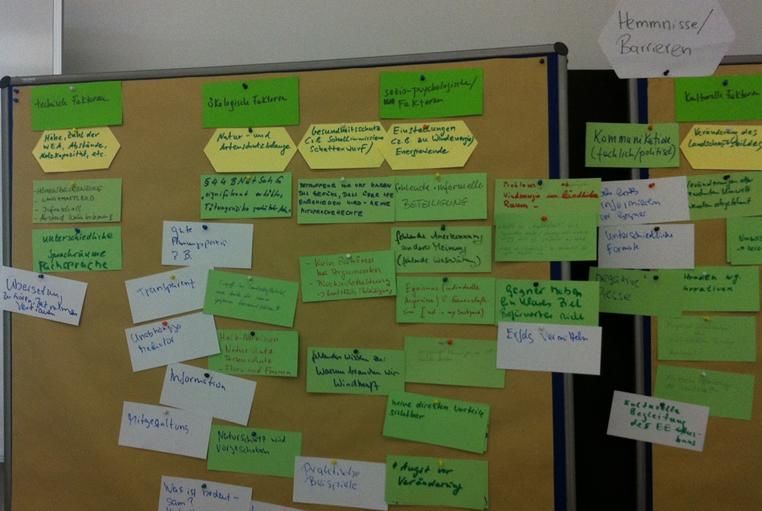
Introduction
Stakeholder engagement in the WinWind project
In parallel to the conceptual work performed in the WinWind project, the project
consortium seeks to initiate a dialogue with market actors and stakeholders from the target
regions by setting up country-specific stakeholder desks.

                                                  Policy recommendations,
                                                       policy dialogue

                                               Transfer of good/best practices

                                             Case studies (good/best practices +
                                                    innovative measures)

                                                  Stakeholder dialogue and
                                                       consultations

                                               Involvement of stakeholders in
                                                       country desks

                                               Review and systematisation of
                                               regionally specific acceptance
                                                    factors (Taxonomy)

These stakeholder desks are key vehicles to ensure a wide stakeholder engagement and
participation in the project. Primarily the desks provide informal fora for a dialogue with a
key group of committed actors with regular desk meetings and consultations. The
stakeholder desks accompany all work phases and tasks, provide advice and support the
dissemination of the project results within their respective interest groups.
Furthermore, the country desks shall help to initiate a continuous, solution-oriented
dialogue with other market actors and stakeholders. This is implemented by a) thematic
workshops, b) policy roundtables and c) dedicated stakeholder consultations, with the
purpose of addressing critical socio-political/market/ community acceptance issues and to
develop proposals how to ensure social acceptance in each WinWind target region.
In each WinWind country one stakeholder desk has been established and these are
coordinated by one of the WinWind partners representing that country, optionally in
collaboration with other partners and supporting stakeholders. Each country desk comprises
at least 15 representatives from different stakeholder groups and market actors (e.g.
developers, investors, community energy organisations and co-operatives, wind energy and
business associations, regional/local governments, agencies, municipal and regional

           WinWind has received funding from European Union's Horizon 2020 Research and    3
           Innovation programme under Grant Agreement Nº 764717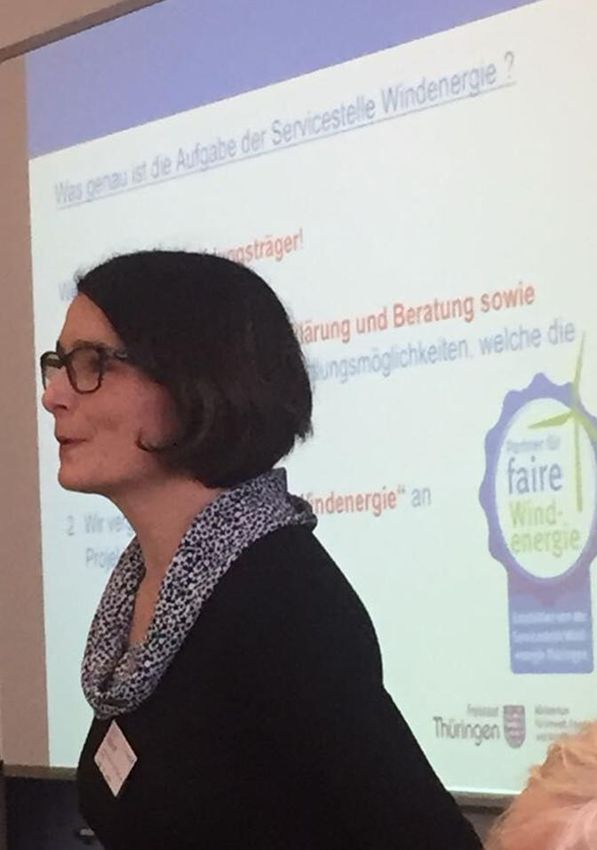
authorities, policy-makers, advisers, NGOs, citizen groups, ethnic minorities, research
institutes). The desks meet on a regular basis.
The specific tasks of the desks are summarized as follows:
   • Gather information and provide input for activities and analyses for the respective
       target regions/countries;
    •   Provide input on potential best practices and innovative measures and concepts
        which help to improve social acceptance;
    •   Check the transferability of good/best practices;
    •   Develop proposals how to address social acceptance barriers in the target regions;
    •   Initiate a continuous, solution-oriented stakeholder dialogue with other market
        actors and stakeholders via a) thematic workshops and b) stakeholder consultations,
        with the purpose of addressing critical socio-political/market/community acceptance
        issues;
    •   Share knowledge- and disseminate the outcomes and results.

While inspired by the same specific objectives, the activities of the stakeholder desks and
consultation plans vary from country to country. This applies to the selection of
stakeholders, as well as to the thematic priorities and procedures chosen for the stakeholder
consultations. Although there are stakeholder groups that are present in each country, there
are also stakeholder groups that are more influential in one country than in another or that
are specific to a country (e.g. representatives of ethnic minorities).

Stakeholder engagement in Germany and the role of the stakeholder desk
The stakeholder desk in Germany is coordinated by seecon Ingenieure GmbH in cooperation
with the Environmental Policy Research Centre. Stakeholders joining the German desk have
been selected according to specific criteria set up by the project coordinator (Environmental
Policy Research Centre of the Freie Universität Berlin). These criteria have been applied to all
countries participating in the WinWind project.
When selecting the stakeholders for the desk, a set of minimum requirements has been
considered:
•       Include representatives of civil society and local communities particularly to
        understand best practices and increase knowledge about social and environmental
        impact of wind energy (e.g. citizen/community energy initiatives, municipal
        organisations, NGOs, business organisations, chambers of commerce and trade,
        ethnic minorities);
•       Involve and/or engage relevant stakeholders and market actors who are committed
        to adopting/implementing WinWind project results. These might be actors, such as
        project developers/investors in the target regions, wind energy associations,

            WinWind has received funding from European Union's Horizon 2020 Research and      4
            Innovation programme under Grant Agreement Nº 764717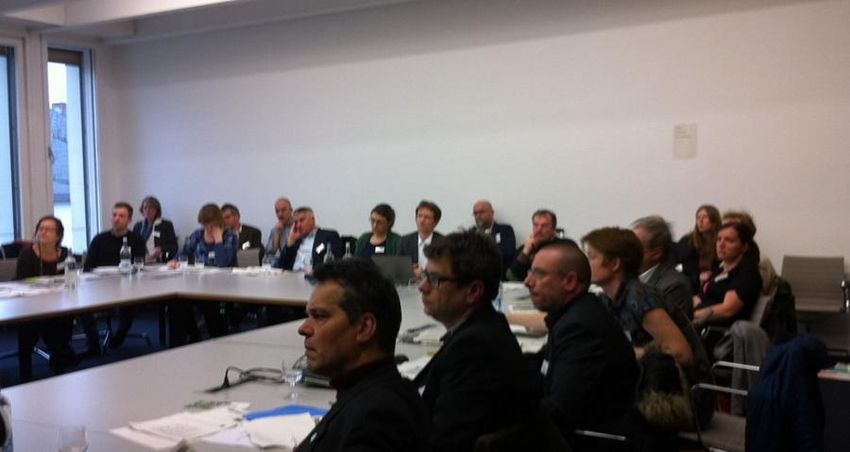
municipal/regional authorities, other public authorities, energy agencies, spatial
       planning authorities, etc.
Furthermore, taking into account the WinWind objectives, it was recommended to consider
the following issues:
          o Stakeholders should help to identify social acceptance barriers and drivers.
          o Stakeholders should help to identify good/best practice policies and measures
            with a special focus on informal procedural participation as well as
            direct/indirect financial participation of the public.
          o Stakeholders should be interested in developing solutions for the target
            regions.
          o Stakeholders should help to disseminate project results.
          o Representatives from wind energy “rich” model regions (Brandenburg,
            Schleswig-Holstein) might be invited either directly as members of the
            stakeholder desks or invited on a case to case basis, e.g. as experts joining the
            thematic workshops.
          o Finally, a fair and balanced (also with respect to gender) distribution of actors
            without having particular actor groups dominating the desks.
The relevant stakeholder groups which have been considered for the stakeholder desk
include developers, investors, community energy organisations and co-operatives, wind
energy and business associations, regional/local governments, energy agencies, regional
development agencies, municipal and regional authorities, policy-makers, advisers, NGOs,
citizen groups, ethnic minorities, research institutes, etc.
In total, roughly 40 stakeholders expressed their interest to join the German stakeholder
desk.
The goal of the stakeholder engagement and consultations in Germany is to obtain feedback
from the stakeholders on:
   •      general and region-specific market barriers in the target regions Saxony and
          Thuringia,
   •      general and region-specific social acceptance problems and barriers,
   •      promising good practice approaches from the target regions, model regions and
          beyond,
   •      the perspective of transferring best practice solutions.
In the frame of the WinWind project, stakeholder engagement and consultation activities
are performed mainly at three different levels:
   •      through the regular stakeholder desk meetings and dialogue,
   •      through complementary thematic workshops and policy roundtables,
   •      through dedicated stakeholder consultations (e.g. via expert interviews, focus
          groups, etc.).

           WinWind has received funding from European Union's Horizon 2020 Research and    5
           Innovation programme under Grant Agreement Nº 764717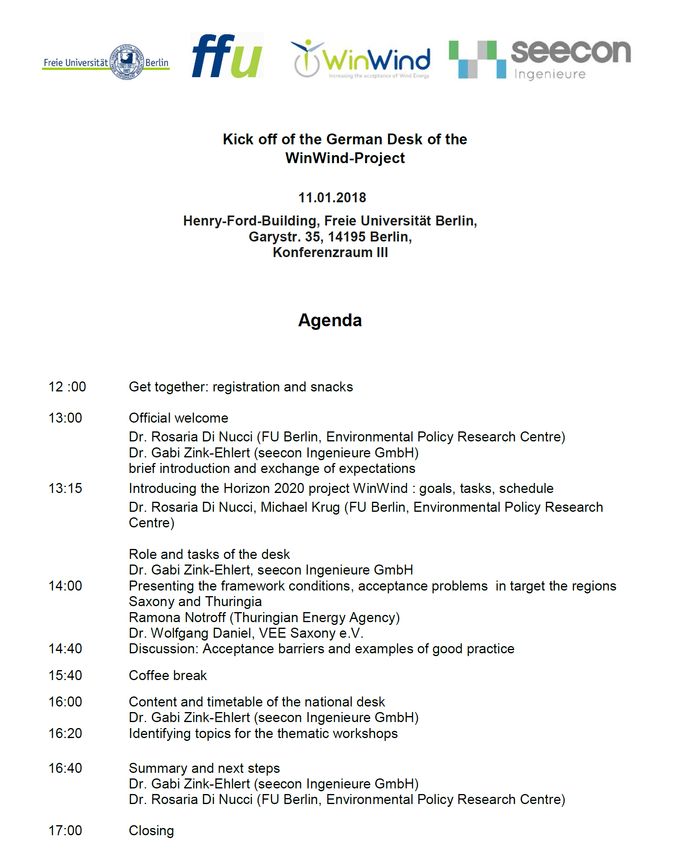
Preliminary list of stakeholders joining and contributing to the German desk
The following table illustrates the stakeholders joining the German stakeholder desk and contributing
to the desk tasks.

 Stakeholder category          Name of                 Person, Position          Target region/
                               Organisation                                      model region/
                                                                                 none

 Turbine manufacturers         ENERCON GmbH            Dr. Ruth Brand – Schock, none
                                                       Head of Political and
                                                       Governmental Relations

 Turbine manufacturers         ENERCON GmbH            Julia Brandt, sales       Model region
                                                       manager                   Brandenburg
                                                       Brandenburg/Saxony/
                                                                                 Target regions
                                                       Saxony-Anhalt/Thuringia
                                                                                 Thuringia/Saxony

 Community wind energy         BürgerEnergie        Reinhard Guthke,             Target region
 initiatives/co-operatives     Thüringen e.V. c/o   chairman                     Thuringia
                               Kommunale
                               Dienstleistungs-GmbH
                               Thüringen (KDGT)
                               (municipal service
                               society Thuringia)

 Community wind energy         Rehfelde                Dietrich von Tengg-     Model region
 initiatives/co-operatives     EigenEnergie e.G.       Knobligk, member of the Brandenburg
                                                       board

 Community wind energy         Rehfelde                Helmut Grützbach          Model region
 initiatives/co-operatives     EigenEnergie e.G.                                 Brandenburg

 Renewable energy /wind        BWE Thuringia       Frank Groß, regional          Target region
 energy associations           (German Wind Energy chairman                      Thuringia
                               Association)

 Renewable energy /wind        BWE Bund            Martha Kaiser, staff          none
 energy associations           (German Wind Energy member
                               Association)

 Renewable energy /wind        BWE Saxony          Prof. Dr. Martin              Target region
 energy associations           (German Wind Energy Maslaton, regional            Saxony
                               Association)        chairman

            WinWind has received funding from European Union's Horizon 2020 Research and            6
            Innovation programme under Grant Agreement Nº 764717
Renewable energy /wind BWE Schleswig- Nicole Knudsen Model region
energy associations Holstein Schleswig-Holstein
(German Wind Energy
Association)
Renewable energy /wind ThEEN Thüringer Jana Liebe, CEO Target region
energy associations Erneuerbare Energien Thuringia
Netzwerk e.V.
(Thuringian
Renewable Energies
Network)
Renewable energy /wind ThEEN Thüringer Maria Ehrich, project Target region
energy associations Erneuerbare Energien manager Thuringia
Netzwerk e.V.
(Thuringian
Renewable Energies
Network)
Renewable energy /wind Onshore Wind Energy Axel Tscherniak, CEO none
energy associations Agency (Fachagentur
Windenergie an Land
e.V)
Renewable energy /wind Onshore Wind Energy Bettina Bönisch, staff none
energy associations Agency (Fachagentur member
Windenergie an Land
e.V.
Renewable energy /wind VEE Sachsen e.V. Dr. Wolfgang Daniels, Target region
energy associations Vereinigung zur president Saxony
Förderung der
Nutzung Erneuerbarer
Energien (association
for the promotion of
renewable energies
Saxony)
Renewable energy /wind VEE Sachsen e.V. Georg Liskowsky, vice Target region
energy associations Vereinigung zur president Saxony
Förderung der
Nutzung Erneuerbarer
Energien (association
for the promotion of
renewable energies
Saxony)
WinWind has received funding from European Union's Horizon 2020 Research and 7
Innovation programme under Grant Agreement Nº 764717Renewable energy /wind VEE Sachsen e.V. Andreas W. Poldrack, Target region
energy associations Vereinigung zur business unit manager Saxony
Förderung der (Geschäftsstellenleiter)
Nutzung Erneuerbarer
Energien (association
for the promotion of
renewable energies
Saxony)
Renewable energy /wind FGW e.V. Jens Rauch, CEO none
energy associations Fördergesellschaft
Windenergie und
andere erneuerbare
Energien
Renewable energy /wind Agentur für Erneuerbare Sven Kirrmann, project none
energy associations Energien manager
(Renewable Energies
Agency)
Public body KNE Dr. Bettina Knothe, head none
Kompetenzzentrum of department “conflict
Naturschutz und consulting”
Energiewende
(Competence Center
for nature
conservation and
energy transition)
NGO BUND Sachsen e.V. Dr. David Greve, CEO Target Region
Bund für Umwelt und Saxony
Naturschutz
(Association for the
Environment and
Nature Conservation)
National authorities BMUB (Federal Julia Rufin none
Ministry for the
Environment, Nature
Conservation,
Building and Nuclear
Safety)
Regional/local authorities Regionaler Dr. Jens Uhlig, staff Target region
Planungsverband member Saxony
Region Chemnitz
(regional planning
association for the
region of Chemnitz)
WinWind has received funding from European Union's Horizon 2020 Research and 8
Innovation programme under Grant Agreement Nº 764717Regional/local authorities Regionale Planungs- Wolfgang Rump, Model region
gemeinschaft director Brandenburg
Oderland - Spree
(regional planning
group for the region
of Oderland)
Regional/local authorities Regionaler Manfred Friedrich Target region
Planungsverband Leiter der Saxony
Leipzig-Westsachsen Verbandsverwaltung
(regional planning
association for the
region of Leipzig-
Westsachsen)
Regional/local authorities Rural district of Ursula Wermelt, staff None
Steinfurt member (pioneering region
in the federal state
of North-Rhine-
Westphalia)
Regional/local energy ThEGA Thüringer Ramona Notroff, Head Target region
agencies Energie und of the Wind Energy Thuringia
GreenTech Agentur Service Unit
(Thuringian Energy
and GreenTech
Agency)
Regional/local energy ThEGA Thüringer Ulrike Lilie Target region
agencies Energie und Thuringia
GreenTech Agentur
(Thuringian Energy
and GreenTech
Agency)
Regional/local energy WFBB (Brandenburg Andrea Skowronek, staff Model region
agencies Invest) member Brandenburg
Regional/local energy WFBB (Brandenburg Bert Tschirner Model region
agencies Invest) Brandenburg
Local community Association of Towns Sebastian Kunze, Model region
organisations and Municipalities in director of the Brandenburg
Brandenburg department of energy
(Städte- und
Gemeindebund
Brandenburg)
WinWind has received funding from European Union's Horizon 2020 Research and 9
Innovation programme under Grant Agreement Nº 764717Research and academia European Academy of Dr.-Ing. Bert Droste- none
Technology and Franke, head of
Innovation department „Energy“
Assessment
Research and academia Technische Prof. Dr. Katharina Löwe Model region
Hochschule Brandenburg
Brandenburg
(Technical College
Brandenburg)
Ministries and other public BfN Bundesamt für Kathrin Ammermann, none
authorities Naturschutz (Office head of department
for Nature “Renewable Energies”
Conservation)
Ministries and other public UBA Marie-Luise Plappert, none
authorities Umweltbundesamt department “Renewable
(Federal Energies”
Environmental
Agency)
Ministries and other public UBA Manuel Rudolph, none
authorities Umweltbundesamt department “Renewable
(Federal Energies”
Environmental
Agency)
Ministries and other public Sächsisches Florian Schäfer, head of Target region
authorities Staatsministerium für division „Energy Policy“ Saxony
Wirtschaft, Arbeit und
Verkehr (Saxon
Department of
Economics, Labor and
Transport)
Project developers Innogy Wind Onshore Jens Edler-Krupp none
Deutschland GmbH
Project developers OSTWIND AG Christoph Markl-Meider none
Leiter
Unternehmenskommuni
kation
Journalist Tagesspiegel Susanne Ehlerding none
WinWind has received funding from European Union's Horizon 2020 Research and 10
Innovation programme under Grant Agreement Nº 764717Politician Fraktion DIE LINKE im Steffen Harzer, Target region
Thüringer Landtag spokesman for energy Thuringia
(Parliamentary group politics and climate
of DIE LINKE in the protection
Thuringian state
parliament)
Politician SPD Fraktion des Jörg Vieweg, Sprecher Target region
Sächsichen Landtages für Energiepolitik Saxony
(SPD Parliamentary
group in the Saxon
state parliament)
Politician Fraktion DIE LINKE im Marco Böhme, Target region
Sächsischen Landtag spokesman for climate Saxony
(DIE LINKE protection, energy and
Parliamentary group mobility
in the Saxon state
parliament)
WinWind has received funding from European Union's Horizon 2020 Research and 11
Innovation programme under Grant Agreement Nº 764717Kick-off Meeting of the stakeholder desk in Germany
Agenda
WinWind has received funding from European Union's Horizon 2020 Research and 12
Innovation programme under Grant Agreement Nº 764717Key objectives
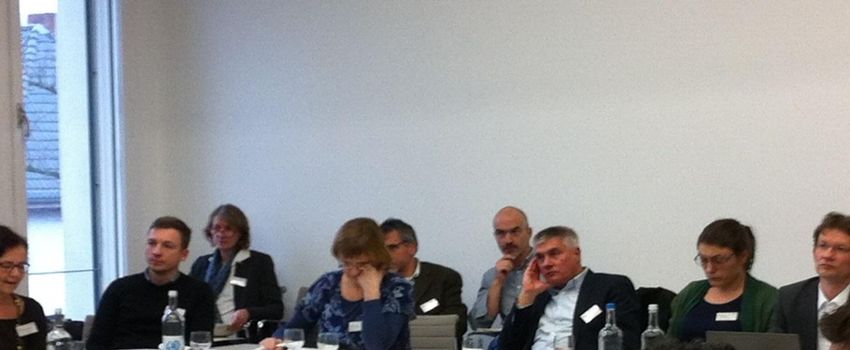
The Kick off meeting of the German desk was held on January 11, 2018 at the premises of
the Freie Universität Berlin. The meeting was attended by 33 stakeholders and market
actors, mainly from Saxony, Thuringia, Brandenburg and Berlin.
The objectives of the kick-off meeting were:
• to present the highlights of the WinWind project and the role of the stakeholders
desk
• to understand the local framework conditions in the selected target regions
• to identify region-specific barriers and social acceptance problems of wind energy
in the selected target regions
• to identify and discuss good practices
• to establish a structured, continuous and solutions oriented dialogue.
Organisation and outcome of the German stakeholder desk kick-off meeting
The coordinators of the project FUB-FFU and of the German desk, seecon Ingenieure
presented the highlights of WinWind including project objectives, activities and time plan.
Furthermore, they explained the role of the stakeholders desk within the project. They also
referred the theoretical and conceptual background of the project and explained the reasons
for selecting Thuringia and Saxony as target regions. Thereafter, Wolfgang Daniels
(Association for the Promotion of Renewable Energy Saxony/Vereinigung zur Förderung der
Nutzung Erneuerbarer Energien VEE Sachsen e.V.) and Ramona Notroff (Service Unit Wind
WinWind has received funding from European Union's Horizon 2020 Research and 13
Innovation programme under Grant Agreement Nº 764717Energy in Thuringia) illustrated the local framework conditions, acceptance barriers and
measures to address social acceptance barriers in their regions.
In an interactive session, key market barriers and social acceptance barriers were identified
and classified according to the following categories: technical barriers, ecological barriers,
socio-psychologic barriers, cultural barriers, legal/administrative barriers, political barriers
and economic barriers. Each participant identified two major barriers and classified them by
help of those categories. In a second stage, the barriers were clustered by the coordinators.
Finally, the participants identified good practices.
WinWind has received funding from European Union's Horizon 2020 Research and 14
Innovation programme under Grant Agreement Nº 764717Good practice measures addressing social acceptance barriers
The following good practices were briefly discussed:
(1) Thuringia: Service Unit for wind energy under the Thuringian Energy and GreenTech
Agency (TheGA) providing comprehensive advisory services for citizens,
municipalities and developers on a regular base, including issues like informal
procedural participation and financial participation of citizens/communities.
(2) Voluntary agreements between the Service Unit for wind energy in Thuringia and
project developers and issuance of the quality label “Fair wind energy” by the Service
Unit to project developers committing themselves to comply with certain
quality/transparency/participation criteria formulated and controlled by the Service
Unit.
(3) Role of intermediary organisations including mediators in achieving trust in planning
Ramona Notroff, Head of the Service Unit Wind Energy in Thuringia presented the framework
conditions in Thuringia and the activities of the Unit to promote social acceptance of wind energy.
WinWind has received funding from European Union's Horizon 2020 Research and 15
Innovation programme under Grant Agreement Nº 764717Core findings and conclusions
• In Saxony and Thuringia there is generally a low share of citizen/community
owned wind energy and a high share of wind energy plants planned by
external project developers and/or owned by investors from outside. Often,
landowners are non-locals either. The opportunities for local value creation is
therefore limited.
• In both federal states, the designation of priority zones for wind energy in
regional plans is partly in a transitional stage, either due to political decisions
or due to court decisions which declared existing priority zones ineffective.
This transitional stage creates insecurity both for investors and communities
and increases the fear of uncontrolled development of wind energy.
• Protest groups and opponents of wind energy are well organized. At least
partly, opponent groups have close affiliations to right wing populistic parties
and movements (particularly in Saxony).
• Many municipalities seem to be overloaded and over-challenged with wind
energy planning in their jurisdictions and several participants emphasized the
lack of a level playing field between municipalities and project developers/
investors.
• There is a clear need to support municipalities and residents by providing
neutral information and advice regarding the planning of wind energy plants,
including informal procedural participation formats and financial participation
for citizens and communities. In this context, the example of Thuringia was
appreciated by many participants.
• Intermediary organisations including conflict mediators can play a key role in
establishing trust in planning and permitting processes (e.g. Service Unit Wind
Energy in Thuringia, Competence Center Energiewende/Naturschutz).
• Lighthouse projects/initiatives involving citizens, highlighting local benefits
and positively influencing public opinion can be a good vehicle for increasing
acceptability.
• There is a group of opponents that is hardly willing to discuss and is opposing
any wind energy project in general. Several participants highlighted the need
of communication strategies addressing the “silent” group of supporters and
the group of indifferent/undecided persons in local communities.
• There seems to be a need to develop local energy strategies and local energy
concepts actively involving citizens from the very beginning.
• Other regions/federal states in Germany show interest in adopting/
transferring the “Thuringian model” (wind energy service unit and/or labelling
/certification system for project developers). This provides a window of
opportunity for WinWind to step up and support those initiatives.
WinWind has received funding from European Union's Horizon 2020 Research and 16
Innovation programme under Grant Agreement Nº 764717Next steps
•11.01.2018, venue: Berlin
•Presentation of WinWind and the German target regions;
Country Desk Kick-off Definition of the purpose of the country desk
•Stakeholder dialogue on market barriers, acceptance
barriers and good practices
•April 2018
Country Desk •Consultation of country desk participants on topics for the
consultation thematic workshop (online/email)
Consultation of •April 2018
desk participants •Consultation on barriers for the acceptance of wind
energy (online/e-mail)
absent at KOM
•20.06.2018, venue to be defined
Thematic •Topic: Intermediary organizations/voluntary self-
workshop 1 commitments/certifications as measures to raise social
acceptance
Stakeholder •June 2018
•Consultation of stakeholders on potential good practices
consultation (online/e-mail)
•September 2018, venue: Saxony
Country Desk 2 •Dialogue on the results of Thematic workshop 1
•Dialogue on good pratices elaborated in the project
•November 2018
Transfer workshop •Proposed topic: Implementation of a wind energy service
unit in Brandenburg
Thematic
workshop 2 • practices and transfer opportunities
(incl. policy roundtable)
Stakeholder •3/2019 - 6/2019: Dedicated stakeholder consultations
consultation (probably on transfer opportunities)
•September 2019, venue: Thuringia
Country Desk 3 •Dialogue on the results of the thematic workshops,
stakeholder consultations, transfer of good practiceYou can also read


