Logistics Course catalogue Logistics Management (EN) - Year 2020-2021 - BUas
←
→
Page content transcription
If your browser does not render page correctly, please read the page content below

––

     Logistics
.

     Course catalogue Logistics Management (EN)
     Year 2020-2021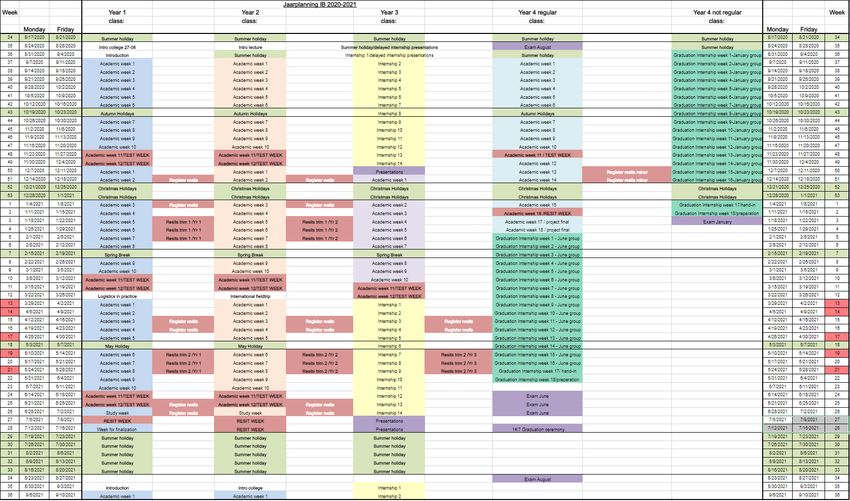
Foreword

This course catalogue gives you an overview of your study programme. You will find the following content:
• the annual schedule, examination periods, holidays, etc;
• an overview of all the study components, including workload;
• learning objectives and content for all the study components;
• an overview of the competences;
• an explanation of the competences and the three levels.

Teaching methods
In your study programme, you will be exposed to four teaching methods: projects, courses, training sessions,
and mentoring.
• In the projects/labs you will work together with fellow students in a project group on a large professional
assignment. You will acquire knowledge and learn to apply this knowledge in a professional context, operating
as a professional in training. The lecturer will coach the groups of students as a project leader.
• In the courses you will acquire profession-relevant knowledge by attending lectures and actively working on
assignments. The lecturer will have the role of teacher and expert supervisor.
• In the training sessions you will acquire skills. These sessions are held in smaller groups, in which the lecturer
will act as instructor and expert.
• Your mentor will be your personal coach. He or she will keep track of your academic development. You will
have regular contacts with your mentor.

Years 1 and 2
The first year is called the propaedeutic phase and it consists of three trimesters of twelve weeks each. The
trimesters are usually filled with 1 project and several courses and training sessions. Each academic year
comprises sixty ECs study credits.

The main phase of the study programme will start in year 2. This year too consists of 3 trimesters of twelve
weeks each. This year will further prepare you for the third and fourth years, which is when learning in practice
will be an important component.

Years 3 and 4
The third year of study consists of three trimesters. As a third-year student you will switch between working in
practice and studying. Two out of the three trimesters you will be doing a work placement. During the other
trimester you will attend classes.
You are to find a work placement yourself. Obviously, you will be supported in this process by the placement
coordinator. More detailed information can be found in the placement handbook.

The fourth year consists of two semesters. The first semester will be your chosen minor. In the second
semester you will work on a graduation project for an industry client. This project is also something that you
need to acquire yourself. More detailed information can be found in the graduation handbook.

TER
All relevant rules can be found in the Teaching and Examination Regulations (TER) 2020-2021. In the academic
year of 2020-2021, a transitional arrangement will apply. This transitional arrangement will be announced after
the board of examiners has approved and officially adopted this arrangement. The transitional arrangement
will apply to students who started a project, a course, etc. last year, but have not yet completed it.

We wish you an enjoyable and successful year!

On behalf of the management team of Built Environment and Logistics.

Debbie Dermout – Director of Built Environment and Logistics
This Course catalogue is part of the Teaching and Examination Regulations (TER) 2020-2021 Built Environment and
Logistics.

1

2

International logistics management 2020 - 2021:
year 1

Trimester 1
Name                                              Osiris-code             ECTS   Page
Starting Project                                  BIP1.STARTPR-18P           4     10
Introduction into Logistics                       BIP1.INTLOG-18C            3     11
Statistics                                        BIP1.STATIS-18C            3     12
Cross Cultural Management                         BIP1.CROS-18C              3     13
Introduction into Economics                       BIP1.INTRECO-18C           3     14
Excel                                             BIP1.EXCEL-18T             2     15
Mentoring 1                                       B1.MENTOR1-18              2     16
                                                            Subtotal        20

Trimester 2
Name                                              Osiris-code             ECTS   Page
Blokko                                            BIP1.BLOKKO-18P            5     18
Warehousing                                       BIP1.WHOUSE-18C            2     19
Inventory Management                              BIP1.INV-18C               2     20
Mathematics                                       BIP1.MATHS-18C             3     21
Management Accounting                             BIP1.MGTACC-18C            3     22
Service Operations Management                     BIP1.SOM-18C               2     23
Professional English 1                            BIP1.ENGPRO1-18C           3     24
                                                            Subtotal        20

Trimester 3
Name                                              Osiris-code             ECTS   Page
Warehousing                                       BIP1.WAREH-18P             6     26
Transport Management                              BIP1.TRMGT-18C             3     27
Global Economics                                  BIP1.GLECO-18C             3     28
Basic Principles of Law                           BIP1.LAW1-18C              2     29
Marketing                                         BIP1.MARK-18C              3     30
Professional English 2                            BIP1.ENGPRO2-18C           3     31
                                                            Subtotal        20

                                                                  Total     60

3
International logistics management 2020 - 2021:
year 2

Trimester 1
Name                                              Osiris-code             ECTS   Page
Intermodal Transport                              BIP2.MULTI-18P             5     35
Operations Management                             BIP2.COPMGT-18C            2     36
Business Process Management & ICT                 BIP2.ICTLOG1-19C           3     37
Procurement Management                            BIP2.CINKMG-18C            3     38
Professional Writing and Com. 1                   BIP2.PCW1-19C              2     39
Management & Organisation                         BIP2.MTORG-18C             2     40
Mentoring 2                                       B2.MENTOR2-18              3     41
                                                            Subtotal        20

Trimester 2
Name                                              Osiris-code             ECTS   Page
Aurora                                            BIP2.AURORA-18P            5     43
Production Management                             BIP2.PRMA-18C              3     44
Physical Distribution & ICT                       BIP2.ICT-18C               2     45
Research Methods                                  BIP2.MTO-18C               3     46
Financial Accounting & ABCosting                  BIP2.FINACC-18C            2     47
Import & Export Management                        BIP2.IMEXMT-18C            2     48
Professional Writing and Com. 2                   BIP2.PCW2-19C              3     49
                                                            Subtotal        20

Trimester 3
Name                                              Osiris-code             ECTS   Page
External Project                                  BIP2.EXPRO-18P             5     51
Supply Chain Management                           BIP2.SCM-18C               2     52
Trade & Transport Law                             BIP2.HVRE-18C              3     53
Sales Management                                  BIP2.SALESM-18C            2     54
Operations Research                               BIP2.COR-18C               3     55
Professional Writing and Com. 3                   BIP2.PCW3-19C              3     56
Free Elective 1                                   BIP2.FREE1-02              1     57
Free Elective 2                                   BIP2.FREE2-02              1     58
                                                            Subtotal        20

                                                                  Total     60

4
International logistics management 2020 - 2021:
year 3
Trimester 1
Name Osiris-code ECTS Page
Internship 1 BIP3.IS1-19 20 62
Subtotal 20
Trimester 2
Name Osiris-code ECTS Page
Network Logistics BIP3.NETLOG-18C 3 64
E-Logistics BIP3.ELOG-18C 3 65
Entrepreneurship BIP3.ENT-18C 3 66
Quality Management BIP3.QUAMG-18C 3 67
Port Logistics BIP3.PORTL-18C 3 68
Business Communication & Ethics BIP3.BCE-18C 3 69
Company Analysis BIP3.COMPANY-18C 2 70
Subtotal 20
Trimester 3
Name Osiris-code ECTS Page
Internship 2 BIP3.IS2-19 20 72
Subtotal 20
Total 60
5International logistics management 2020 - 2021: year 4 Semester 1 Name Osiris-code ECTS Page The Modern Supply Chain BMSC.20MINOR 30 74 Modern Business in a Changing World BCW.20MINOR 30 76 Crowd Safety in Hubs & Events ACS.20MINOR 30 77 Kennislab People and Goods on the Move BPGM.20MINOR 30 79 Urban Retrofitting BUR.20MINOR 30 80 Externe Minor ABEL BEXT.20MINOR 30 Semester 2 Name Osiris-code ECTS Page Graduation Thesis B4.SC-18* 30 82 6
Logistics Management
.

        Year 1

    7
Logistics management 2020- 2021:
year 1
Social and communicative subcompetencies 1
Social and communicative subcompetencies 2
Social and communicative subcompetencies 3
Self-directing subcompetency 1
Self-directing subcompetency 2
Self-directing subcompetency 3
Self-directing subcompetency 4
Steering activities 1
Steering activities 2
Steering activities 3
Steering activities 4
Developing policy 1
Developing policy 2
Developing policy 3
Implementing 1
Implementing 2
Implementing 3
Trimester 1
Starting Project 1 1 1 1 1 1 1 1 1
Introduction into Economics 1 1 1 1
Excel 1 1 1 1 1 1 1
Introduction into Logistics 1 1 1 1 1 1 1 1 1 1
Cross Cultural Management 1 1 1 1 1 1 1 1
Statistics 1
Trimester 2
Blokko 1 1 1 1 1 1 1 1 1 1 1 1 1 1 1 1
Management Accounting 1 1 2 1 1
Mathematics 1 1 1
Inventory Management 1 1 1 1 1 1 1 1 1
Warehousing 1 1 1 1 1 1 1 1 1
Service Operations
Management 1 1 1 1 1 1 1 1 1 1 1 1 1
Professional English 1 1 1 1 1
Trimester 3
Warehousing 1 1 1 1 1 1 1 1 1 1 1
Marketing 1 1 1 1 1 1
Basic Principles of Law 1 1 1 1 1
Global Economics 1 1
Transport Management 1 1 1 1 1 1 1 1 1
Professional English 2 2 1 2 1
8Logistics Management
.
Year 1
Trimester 1
9OSIRIS-code: BIP1.STARTPR-18P
Course name: Starting Project
Study load: 4 EC (=112 hours)
Coordinator: Sijbren Hogewerf
Lecturer(s): Emelie Bral, Sijbren Hogewerf, Justin van de Pas, Raechel Torner
Learning objective(s): Upon completion of this study component you are able to:
- have effective meetings, collaborate with each other and to define tasks to
achieve a final product;
- write a comprehensive and understandable report (according to the
requirements of good reporting);
- give a presentation;
- show initiative and effort;
- provide constructive feedback.
Content description: In this study component, the following content is covered:
- Belbin and project roles;
- meeting structure;
- introduction to logistic themes;
- plan of approach;
- literature research;
- reporting;
- collaborate in a structured way;
- peer evaluation.
Language: EN
Teaching activity: Project
Examination: Group assignment 50%
Individual assignment 50%
Training 0%
Mark: Marks, F, MO
Required literature: R. Gritt. Project management: a practical approach. 5e druk. Noordhoff
uitgevers (ISBN 9789001575625)
Required other materials: --
10OSIRIS-code: BIP1.INTLOG-18C
Course name: Introduction into Logistics
Study load: 3 EC (=84 hours)
Coordinator: Jef Houtepen
Lecturer(s): Jan van Elderen, Jef Houtepen, Studentassistent Logistiek
Learning objective(s): Upon completion of this study component you are able to:
- recall the different parts, functions and roles within a logistic supply chain, in
a way that he/she can give a visual representation of this supply chain.
- recognize the different possible roles of the customer and their influence on
a supply chain.
- explain the different phases of a product life cycle and give practical
examples.
- identify the different modalities of transport in a way that he/she can match a
modality based on the attributes of the goods and the flow of goods.
- indicate and interpret the importance of logistics within different kind of
companies, in a way that he/she can recognize the different challenges that
can appear in logistics.
- reallocate the different phases within the Logistic Integral Concept, in a way
that he/she can relate it to a company in a practical example
- Solve a simple (production) planning issue with the use of specific tools (MRP-
I) and outline the different roles of inventory within this planning.
- work in a small group of persons to deliver a product/assignment under time
pressure.
- be aware of the different backgrounds of the other students, in a way that
he/she can help others.
- make a summary or visual of new knowledge in a way that he/she can
recognize the (different between) the essence and the details.
Content description: In this study component, the following content is covered:
- Logistics in various forms
- The logistics framework
- The relationship of market demand and logistics
- Inventory management, Purchasing logistics & E-commerce
- Production logistics
- Reverse logistics
Language: EN
Teaching activity: Lecture, Training
Examination: Written exam 50%
Group assignment 50%
Mark: Marks, F, MO
Required literature: Visser and van Goor. Logistics: Principles and Practice : a demand and supply
chain management approach. Heruitgave. eigen uitgave (ISBN 9789081649117)
Required other materials: --
11OSIRIS-code: BIP1.STATIS-18C
Course name: Statistics
Study load: 3 EC (=84 hours)
Coordinator: Elly Khademi
Lecturer(s): Eric Hopstaken, Elly Khademi
Learning objective(s): Upon completion of this study component you are able to:
- apply and interpret the basic concepts of descriptive statistics;
- apply the basic concepts of probabiltity;
- distinguish between and apply discrete and continuous probability
distributions;
- apply binomial, Poisson, and normal distributions to calculate probabilities;
- apply and interpret correlation and regression analysis using Excel;
- apply forecasting techniques.
Content description: In this study component, the following content is covered:
- descriptive Statistics/ data analysis including graphical presentations,
measures for average, dispersion, and shape for probability distributions;
- probability calculations;
- expected values and combinatorial theory;
- binomial distribution;
- poisson distribution;
- normal distribution;
- forecasting including trend curves, correlation and regression.
Language: EN
Teaching activity: Lecture, Training
Examination: Written exam 80%
Individual assignment 20%
Mark: Marks, F, MO
Required literature: --
Required other materials: --
12OSIRIS-code: BIP1.CROS-18C
Course name: Cross Cultural Management
Study load: 3 EC (=84 hours)
Coordinator: Raechel Torner
Lecturer(s): Raechel Torner, Letty Zhu
Learning objective(s): Upon completion of this study component you are able to:
- understand the importance of cross-cultural management, and the
relationship between culture, organisations, and management;
- identify the effect cultural values have on various managerial processes;
- apply Erin Meyer's eight scale tool to perform more effectively within
intercultural groups;
- use Trompenaars' dimensions to compare dilemmas between cultures;
- apply Hofstede’s dimensions to identify and articulate some of the similarities
and differences between various cultures;
- identify various ways of developing cross-cultural competences;
- explain the benefits and challenges of having a multicultural workforce to
others;
- recognise aspects of your own culture that shape the way you view the world
and interact with others;
- relate themes and concepts learned in class to other courses in the ILE/ILN
curriculum;
- explain the interaction between culture and verbal and non-verbal
communication.
Content description: In this study component, the following content is covered:
This course aims to provide students with an overview of the concepts,
theories, and tools necesary to understand the complexities of culturally
diverse societies and organisations. The meaning of culture will be explored as
well as the influence of culture on a wide array of management practices.
Emerging challenges related to globalisation and international management will
be discussed, and students will reflect upon ways in which they can improve
their own intercultural communication skills.
Language: EN
Teaching activity: Lecture, Training
Examination: Individual assignment 60%
Group assignment 40%
Mark: Marks, F, MO
Required literature: Meyer, Erin. The Culture Map. Ingram Publisher Services US (ISBN
9781610392501)
Required other materials: --
13OSIRIS-code: BIP1.INTRECO-18C
Course name: Introduction into Economics
Study load: 3 EC (=84 hours)
Coordinator: Sijbren Hogewerf
Lecturer(s): Sijbren Hogewerf
Learning objective(s): Upon completion of this study component you are able to:
- calculate (taxation on) added value and work from the circular flow of
income;
- distinguish between economic and structural developments;
- identify different business characteristics, changes in the supply chain and
business processes;
- process simple financial facts in the ledger and process this into an eight-
column financial statement;
- prepare the financial statements of a business plan.
Content description: In this study component, the following content is covered:
- types of companies as for size, legal entity, line of business, etc.;
- added value in a production, trade and service company;
- financial and non-financial objectives;
- ledger accounts and the Eight column financial statements;
- business plan (e.g. Investment- and financing plan and forecast income
statement);
- dupont chart;
- the circular flow of income;
- economic growth and the business cycle.
Language: EN
Teaching activity: Lecture
Examination: Written exam 100%
Mark: Marks, F, MO
Required literature: Hulleman and Marijs. Economics and business environment.. Noordhoff
Uitgevers (ISBN 9789001889432)
Required other materials: Reader, e-book, Edubook Finance & Control year 1 (part 1), Purchase
14OSIRIS-code: BIP1.EXCEL-18T
Course name: Excel
Study load: 2 EC (=56 hours)
Coordinator: Peter Kole
Lecturer(s): Peter Kole, Tanja Monker
Learning objective(s): Upon completion of this study component you are able to:
- design spreadsheets;
- use basic functions to perform calculations within a spreadsheet;
- create and format charts.
Content description: In this study component, the following content is covered:
- open, edit, save and print a spreadsheet;
- create a spreadsheet with text, numbers and formulas;
- format cells;
- use the basic functions;
- understand and use relative and absolute cell referencing;
- create, format and print charts;
- solving simple problems with a spreadsheet;
- use of a pivot table;
Excel 2016 is key part of the Microsoft Office suite 2016 applications. This
spreadsheet application is one of the most popular microcomputer
applications to date. It features calculation, graphing tools, pivot tables and a
macro programming language. Excel has great tools for manipulating,
analyzing, sorting, organizing, and charting all kinds of data.
Language: EN
Teaching activity: Training
Examination: Computer exam 100%
Mark: Marks, F, MO
Required literature: Ben Groenendijk. Getting More Out of Excel 2019 : essential Topics for the
Professional. Heruitgave. Boom Uitgevers Amsterdam (ISBN 9789024402281)
Required other materials: --
15OSIRIS-code: B1.MENTOR1-18 (LG-EN)
Course name: Mentoring 1
Study load: 2 EC (=56 hours)
Coordinator: Ilse Hens
Lecturer(s): Ilse Hens
Learning objective(s): Upon completion of this study component you are able to:
- reflect on your academic career and on yourself as a starting professional;
- understand that you are responsible for your own course of study;
- use the right study approach and study skills.
Content description: In this study component, the following content is covered:
- introduction to the study programme and the industry;
- acquaintance with the industry;
- better insight into your qualities and your areas for improvement;
- feedback;
- independence;
- study progress;
- planning activities;
- learn to study;
- self directness;
- individual meetings (also non-study related matters);
- evaluations.
Language: EN
Teaching activity: Training, Fieldtrip, Training
Examination: Individual assignment 100%
Mark: P, F, MO
Required literature: --
Required other materials: Other, Edubook, buas.myedumundo.com, Studie & loopbaan, costs app 40
euro, Purchase
16Logistics Management
.
Year 1
Trimester 2
17OSIRIS-code: BIP1.BLOKKO-18P
Course name: Blokko
Study load: 5 EC (=140 hours)
Coordinator: Jan van Elderen
Lecturer(s): Dirk Broek, Jan van Elderen, Jef Houtepen, Aline de Jong, Letty Zhu
Learning objective(s): Upon completion of this study component you are able to:
- determine the basis structure of a production proces, it’s control system and
the logistic consequences of those decisions;
- create financial and operational plannings for a simple logistics company;
- translate customer requests and orders to logistical consequenses for the
company;
- reflect on the planning and company results in the BLOKKO game.
Content description: In this study component, the following content is covered:
- introduction into production logistics and introduction operations
management;
- customer requests;
- competition;
- organisation of a (virtual) company;
- financial and operational company results.
You are an employee of the competitor of the ‘Blokko turrets®’ company.
The market for this project is since years a stable one Your company wants
to gain a vast share of the total market. To do so your company has to be
designed as a fast and flexible turrets production unit, which is able to satisfy
the customers demand. The results of all the preparations to establish a
competitve company, will be tested in a ‘game’ situation. During the game,
the different companies will play against each other to achieve the best
company results.
Language: EN
Teaching activity: Project
Examination: Group assignment 50%
Individual assignment 50%
Training 0%
Mark: Marks, F, MO
Required literature: Visser, H.M. and A.R. van Goor. Logistics: Principles and Practice : a demand and
supply chain management approach. Heruitgave. Wolters-Noordhoff (ISBN
9789081649117)
Required other materials: --
18OSIRIS-code: BIP1.WHOUSE-18C
Course name: Warehousing
Study load: 2 EC (=56 hours)
Coordinator: Irma Lenselink
Lecturer(s): Irma Lenselink
Learning objective(s): Upon completion of this study component you are able to:
- indicate what different storage and handling methods are used in
warehouses;
- choose the best option(s) for a warehouse operation;
- perform the basic steps to design a warehouse according to a structured
approach.
Content description: In this study component, the following content is covered:
- introduction to warehousing: Warehouse function and types;
- introduction to Distribution network studies;
- location selection;
- warehouse processes;
- warehouse storage methods;
- material handling equipment;
- pick strategies;
- warehouse design;
- warehouse costing;
- performance management;
- warehouse management system.
Language: EN
Teaching activity: Lecture
Examination: Written exam 100%
Mark: Marks, F, MO
Required literature: Gwynne Richards. Warehouse Management: A Complete Guide to Improving
Efficiency and Minimizing Costs in the Modern Warehouse. 2nd Revised edition.
Kogan Page (ISBN 9780749479770)
Required other materials: Handouts, articles, magazines, relevant articles, Published on LMS
19OSIRIS-code: BIP1.INV-18C
Course name: Inventory Management
Study load: 2 EC (=56 hours)
Coordinator: Luuk Koopman
Lecturer(s): Azadeh Irajifar, Luuk Koopman
Learning objective(s): Upon completion of this study component you are able to:
- understand, remember and describe the relevant choices that have to be
made with regard to operational inventory management and you will learn
how to apply this knowledge in real life situations;
- assess and if necessary improve the operational inventory management of a
company.
Content description: In this study component, the following content is covered:
- types of inventory;
- demand patterns;
- assortment decisions;
- selection of pull inventory management methods (Reorder point, Periodic
Review, Min-Max);
- application of inventory management methods on a database;
- allocation of inventory in the supply chain.
Language: EN
Teaching activity: Lecture, Training
Examination: Written exam 100%
Mark: Marks, F, MO
Required literature: --
Required other materials: --
20OSIRIS-code: BIP1.MATHS-18C
Course name: Mathematics
Study load: 3 EC (=84 hours)
Coordinator: Elly Khademi
Lecturer(s): Elly Khademi, Tanja Monker
Learning objective(s): Upon completion of this study component you are able to:
- conduct basic arithmetic with constants (numerical values) and variables;
- solve linear and nonlinear equations with one variable analytically;
- solve two linear equations with two unknowns;
- find derivatives of different functions using formula sheet and rules;
- find the tangent line to the graph of a function at a certain point using the
derivative;
- create, from a practical problem description, a mathematical model with
appropriate variables and solve this problem to find a solution.
Content description: In this study component, the following content is covered:
- important number systems and basic operations;
- neutral element and inverse of a number;
- rules for compound calculations;
- algebra for numbers and letters (variables);
- calculations with fractions and powers;
- algebra: special products;
- equality versus equation;
- linear eqations;
- working with percentages;
- linear equations with two unknowns;
- quadratic equations;
- functions in general and special functions (Linear, Quadratic, Polynomial,
Rational, Powers, Roots, Exponential, Logarithms);
- analysis of functions;
- derivative (definition and meaning);
- tangent line;
- derivatives of standard functions;
- rules of differentiation;
- inflection points;
- asymptotes;
- mathematics’ application in Logistics.
Language: EN
Teaching activity: Lecture, Training
Examination: Written exam 100%
Mark: Marks, F, MO
Required literature: --
Required other materials: --
21OSIRIS-code: BIP1.MGTACC-18C
Course name: Management Accounting
Study load: 3 EC (=84 hours)
Coordinator: Sijbren Hogewerf
Lecturer(s): Sijbren Hogewerf, Azadeh Irajifar, Semi Torun
Learning objective(s): Upon completion of this study component you are able to:
- compute calculations regarding the unit cost and the break-even analysis;
- apply absorption costing and direct costing in cost and profit calculations;
- use different methods to allocate indirect costs in order to calculate the unit
costs of a good or service;
- analyze budget variances by means of a variance analysis;
- calculate the effect of various depreciation methods.
Content description: In this study component, the following content is covered:
- cost structures within the organization;
- standard unit costs;
- fixed and variable costs;
- direct costing and absorption costing;
- break-even analysis;
- direct and indirect costs;
- allocation methods for indirect costs (cost center method and surcharge
method);
- budgeting, the master budget and variance analysis;
- selection of the most suitable cost calculation technique in a given situation;
- bottleneck analysis;
- depreciation methods;
- financial statements within the business plan (e.g. cash flow and income
statement). Based on this: investment selection, based on cash flows and pay-
back period.
Language: EN
Teaching activity: Lecture, Training
Examination: Written exam 100%
Mark: Marks, F, MO
Required literature: --
Required other materials: Reader, e-book, Edubook Finance & Control year 1 (part 2), Published on LMS
22OSIRIS-code: BIP1.SOM-18C
Course name: Service Operations Management
Study load: 2 EC (=56 hours)
Coordinator: Justin van de Pas
Lecturer(s): Diana van Dijk, Justin van de Pas
Learning objective(s): Upon completion of this study component you are able to:
- recognize logistic aspects of the services sector and understand logistic
principles.
Content description: In this study component, the following content is covered:
- gaining an insight into different aspects of logistic processes in the services
sector for example events and healthcare;
- recognizing and presenting examples of services;
- classifying principles within the services sector;
- describing types of services aimed at people and resources in relation to
quality, time and costs;
- an introduction to waiting time theory.
Language: EN
Teaching activity: Lecture
Examination: Written exam 65%
Group assignment 35%
Mark: Marks, F, MO
Required literature: --
Required other materials: --
23OSIRIS-code: BIP1.ENGPRO1-18C
Course name: Professional English 1
Study load: 3 EC (=84 hours)
Coordinator: Raechel Torner
Lecturer(s): Leigh Stevens, Raechel Torner
Learning objective(s): Upon completion of this study component you are able to:
- understand the main ideas of complex articles and texts related to the field of
logistics without serious misunderstanding;
- identify and proactively use resources available to help you further improve
your reading, writing, speaking, and listening skills in English;
- give a clear presentation on a familiar topic, and answer predictable or factual
questions;
- scan texts for relevant information, and understand detailed instructions or
advice;
- relate themes and concepts learned in class to other courses in the
curriculum.
Content description: In this study component, the following content is covered:
This training develops English language skills through an interactive learning
format. Students will develop their reading, writing, speaking, and listening
skills via a variety of in-class activities and self-study exercises.
Language: EN
Teaching activity: Training
Examination: Individual assignment 50%
Group assignment 50%
Mark: Marks, F, MO
Required literature: --
Required other materials: --
24Logistics Management
.
Year 1
Trimester 3
25OSIRIS-code: BIP1.WAREH-18P
Course name: Warehousing
Study load: 6 EC (=168 hours)
Coordinator: Luuk Koopman
Lecturer(s): Jef Houtepen, Azadeh Irajifar, Aline de Jong, Luuk Koopman, Letty Zhu
Learning objective(s): Upon completion of this study component you are able to:
- select an appropriate location for a warehouse;
- design a warehouse for your customer based on, amongst others, article and
sales characteristics;
- select an appropriate inventory management concept and calculate the
impact of the chosen concept on the inventory levels and associated costs.
Content description: In this study component, the following content is covered:
- location selection;
- warehouse lay-out;
- inventory management;
- performance quick scan of an existing warehouse.
Language: EN
Teaching activity: Project
Examination: Group assignment 50%
Individual assignment 50%
Training 0%
Mark: Marks, F, MO
Required literature: --
Required other materials: --
26OSIRIS-code: BIP1.TRMGT-18C
Course name: Transport Management
Study load: 3 EC (=84 hours)
Coordinator: Dirk Broek
Lecturer(s): Dirk Broek
Learning objective(s): Upon completion of this study component you are able to:
- to choose the right logistic units and mode of transport related to product
characteristics, requirements of the shipper and consignee and the
characteristics of the various modes of transport. This all within an unimodal
or multimodal network;
- analyse and discuss the various kind of freight transport within different
chains and markets and can recognize and nominate the different levels of
steering above these kind of networks.
Content description: In this study component, the following content is covered:
- standardization and normalization;
- function and qualities of the following logistic units like loading units, loading
equipment, transport units and mode of transport units;
- the influence of the choice on the cost structure and sustainable
management;
- the influence of the choice of logistic units for organisations and steering
departments;
- market transparancy within the chain and the consequences for transport;
- secure of cargo;
- perishable transport;
- base principles of Dangerous Goods related to transport and storage;
- the (dis)advantages of the different modes of transport;
- first acquaintance with possible combinations of various modes of transport;
- the organisation within the transport chain;
- the choice of the mode of transport;
- micro, meso and macro level within transport;
- a sustainable composition of transport chains by using more clean fuels,
more efficient engines.
Language: EN
Teaching activity: Lecture, Project
Examination: Written exam 80%
Group assignment 20%
Mark: Marks, F, MO
Required literature: --
Required other materials: Reader, e-book, Reader Transport Management, Published on LMS
27OSIRIS-code: BIP1.GLECO-18C
Course name: Global Economics
Study load: 3 EC (=84 hours)
Coordinator: Jan Verhey
Lecturer(s): Jan Verhey
Learning objective(s): Upon completion of this study component you are able to:
- calculate elasticities and market equilibrium, based on supply and demand
function;
- apply Porter’s five forces model and other market analysis models in a
elementary setting;
- analyze the business cycle and determine the impact on company policy;
- explain the effect of input costs (wages and commodities) for a company;
- analyze interest rate and currency movements and, based on this determine
business policies.
- analyze reasons and effects of protectionism
Content description: In this study component, the following content is covered:
- business environment and market power;
- Porter’s Five Forces model;
- price, cross price and income elasticity;
- market equilibrium and price mechanism;
- business cycles, business cycle indicators and company policies;
- energy prices, commodities, wages and company policies;
- interest rates, inflation and their effect on costs;
- company's susceptibility to exchange rates and corresponding company
approach;
- protectionism vs free trade
Language: EN
Teaching activity: Lecture, Training
Examination: Group assignment 100%
Studio
Mark: Marks, F, MO
Required literature: Hulleman and Marijs. Economics and business environment.. Noordhoff
Uitgevers (ISBN 9789001889432)
Required other materials: --
28OSIRIS-code: BIP1.LAW1-18C
Course name: Basic Principles of Law
Study load: 2 EC (=56 hours)
Coordinator: Aline de Jong
Lecturer(s): Aline de Jong
Learning objective(s): Upon completion of this study component you are able to:
- analyse basic legal cases with regard to the topics mentioned below.
Content description: In this study component, the following content is covered:
- the relevance of law for the logistic profession;
- a company’s legal / regulatory environment;
- EU’s influence on national regulatory environments;
- property law as a foundation of trade;
- contract law as a foundation of commercial relationships;
- the characteristics of Sales and Services contracts;
- the legal forms of companies;
- the balance between creating value and legal rules.
Language: EN
Teaching activity: Lecture
Examination: Written exam 90%
Group assignment 10%
Mark: Marks, F, MO
Required literature: Jansen M.A. Law & Self-regulation : legal and business perspectives. (ISBN
9789053834107)
Required other materials: --
29OSIRIS-code: BIP1.MARK-18C
Course name: Marketing
Study load: 3 EC (=84 hours)
Coordinator: Eric Hopstaken
Lecturer(s): Eric Hopstaken
Learning objective(s): Upon completion of this study component you are able to:
- to acknowledge the concepts, techniques and organization of creating a
marketing plan
- to understand the marketing planning process;
- to define new ideas for marketing campaigns;
- to understand the different components of the marketing mix
- to understand the position of marketing versus logistics/supply chain in a
business organisation
- to undrstand how marketing and logistics/supply chain management can
help each other
Content description: In this study component, the following content is covered:
- marketing strategies, models and concepts
- marketing plan;
- brand development;
- future perspectives of marketing;
- digital marketing;
- creativity in marketing for logistics/supply chain management
Language: EN
Teaching activity: Lecture, Training
Examination: Written exam 40%
Group assignment 60%
Lecture 0%
Mark: Marks, F, MO
Required literature: --
Required other materials: Handouts, articles, magazines, online course materials, Published on LMS
30OSIRIS-code: BIP1.ENGPRO2-18C
Course name: Professional English 2
Study load: 3 EC (=84 hours)
Coordinator: Raechel Torner
Lecturer(s): Leigh Stevens, Raechel Torner
Learning objective(s): Upon completion of this study component you are able to:
- understand the main ideas of complex articles and texts related to the field of
logistics without serious misunderstanding;
- identify and proactively use resources available to help you further improve
your reading, writing, speaking, and listening skills in English;
- give a clear presentation on a familiar topic, and answer predictable or factual
questions;
- scan texts for relevant information, and understand detailed instructions or
advice;
- relate themes and concepts learned in class to other courses in the
curriculum.
Content description: In this study component, the following content is covered:
- This training develops English language skills through an interactive learning
format. Students will develop their reading, writing, speaking, and listening
skills via a variety of in-class activities and self-study exercises.
Language: EN
Teaching activity: Training
Examination: Individual assignment 100%
Mark: Marks, F, MO
Required literature: --
Required other materials: --
31Logistics Management
.
Year 2
32Logistics management 2020- 2021:
year 2
Social and communicative subcompetencies 1
Social and communicative subcompetencies 2
Social and communicative subcompetencies 3
Self-directing subcompetency 1
Self-directing subcompetency 2
Self-directing subcompetency 3
Self-directing subcompetency 4
Steering activities 1
Steering activities 2
Steering activities 3
Steering activities 4
Developing policy 1
Developing policy 2
Developing policy 3
Implementing 1
Implementing 2
Implementing 3
Trimester 1
Intermodal Transport 2 2 2 2 2 2 2 2 2 2 2 2 2
Operations Management 2 2 1 2 2 2 2 2 2 2
Professional Writing and Com. 1 2 2 2 2 2 2
Management & Organisation 1 1 1 1 1 1
Business Process Management &
ICT 2 2 1 2 1 1 1 1 1 1
Procurement Management 3 2 2 2 2 2 2
Mentoring 2 2 2 2
Trimester 2
Aurora 2 2 2 2 2 2 2 2 2 2 2 2 2 2 2
Physical Distribution & ICT 1 2 1 2 2 1 2 1 1
Financial Accounting & ABCosting 1 1 1 1 2 1
Import & Export Management 2 2 1 2 1 1 1
Research Methods 2 2 2 2 2 2 2 2 2 2 2 2
Production Management 2 2 1 2 1 2 2 2
Trimester 3
Supply Chain Management 2 2 1 2 1 2
Sales Management 2
Operations Research 2 2 2
Trade & Transport Law 2 2 2 2 2 2
External Project 2 2 2 2 2 1 1 1 1 2 2 1 2 2 2 2
Free Elective 1 2
33Logistics Management
.
Year 2
Trimester 1
34OSIRIS-code: BIP2.MULTI-18P
Course name: Intermodal Transport
Study load: 5 EC (=140 hours)
Coordinator: Dirk Broek
Lecturer(s): Dirk Broek, Azadeh Irajifar, Letty Zhu
Learning objective(s): Upon completion of this study component you are able to:
- determine the economic feasibility of the intermodal transport chains;
- determine the logistics feasibility of the intermodal transport networks;
- draw up the accompanying analyses;
- compile a business plan;
- implement DESTEP for an intermodal terminal;
- set-up proposals.
Content description: In this study component, the following content is covered:
- the project will be preceded by 10 lectures, in which the theory will be
discussed. The project is carried out by order of the customer. Elements of
competition and play have been incorporated into the project for the project
groups. Subsequently, the following parts are dealt with;
- elaboration on the offer of the intermodal terminal's services with a
determination of an area and destination origin;
- making a set-up proposal for an inland terminal;
- making a business plan for the inland terminal;
- compiling a commercial offer from a perspective of a logistics service
provider from a designated country of origin to various ports in the Westen
Europe.
Language: EN
Teaching activity: Project, Lecture
Examination: Written exam 50%
Group assignment 50%
Training 0%
Mark: Marks, F, MO
Required literature: Jong, F., Rodeman, H., Ruijgrok, K., Verweij, K.. The Vitality of Intermodal
Transport. InterRoJo Publications (ISBN 9789082814200)
Required other materials: --
35OSIRIS-code: BIP2.COPMGT-18C
Course name: Operations Management
Study load: 2 EC (=56 hours)
Coordinator: André Gijsberts
Lecturer(s): André Gijsberts
Learning objective(s): Upon completion of this study component you are able to:
- know the principles of the three most important manufacturing philosophies;
- have an overview regarding Operations Management;
- solve related practice problems.
Content description: In this study component, the following content is covered:
Operations management is the activity of managing the resources which are
devoted to the production and delivery of products and services. We use a
broad definition of operations, which includes the processes in hospitals, banks
and airlines besides the more classic one focused on manufacturing companies
only;
We start with an introduction in the field of OM and focus mainly on planning
and control, with a slight touch on design of products and processes.In the
second part of the course manufacturing philosophies MRP and ERP, TOC, Lean
and JIT are discussed;
The course uses Introduction into Logistics as a foundation.
Language: EN
Teaching activity: Lecture, Training
Examination: Written exam 100%
Mark: Marks, F, MO
Required literature: E. Goldratt. The Goal: A Process of Ongoing Improvement. 3rd. Novel, every
edition is allright (ISBN 9780884271956)
Required other materials: --
36OSIRIS-code: BIP2.ICTLOG1-19C
Course name: Business Process Management & ICT
Study load: 3 EC (=84 hours)
Coordinator: Irene Meeuwesen
Lecturer(s): Irene Meeuwesen
Learning objective(s): Upon completion of this study component you are able to:
- understand the possibilities which logistic software solutions (amongst all
ERP) offer in improving the effectiveness of information availability in
organisations;
- describe the steps which a company takes to select and implement logistic
software solutions;
- execute purchasing, sales and warehouse transactions in a logistical
application (specifically in an ERP environment);
- understand how methodical process design helps to formulate process
requirements;
- draw proces schemes with help of the international standard BPMn;
- explain how the use of logistical software solutions creates better alignment
of processes and therefor has a positive impact on KPI’s;
- independently select and apply BPM techniques to recognize, describe and
assess processes.
Content description: In this study component, the following content is covered:
- the role and use of ICT in companies;
- the design, function and use of logistic software systems by purchasers,
salesmen and warehouse employees;
- the various types of order flows in an ERP system;
- selection and implementation of logistic software systems;
- ICT projects
- datamanagement & Business Inteligence.
Language: EN
Teaching activity: Lecture, Training
Examination: Computer exam 100%
Mark: Project
Required literature: Visser and van Goor. Logistics: Principles and Practice : a demand and supply
chain management approach. Heruitgave. eigen uitgave (ISBN 9789081649117)
Required other materials: Handouts, articles, magazines, docent publiceert, Published on LMS
37OSIRIS-code: BIP2.CINKMG-18C
Course name: Procurement Management
Study load: 3 EC (=84 hours)
Coordinator: Luuk Koopman
Lecturer(s): Sijbren Hogewerf, Luuk Koopman
Learning objective(s): Upon completion of this study component you are able to:
- identify the core procurement strategies, make a difference between
procurement, purchasing and supply chain management;
- advise how to establish an effective purchasing system;
- advise how to identify the best suppliers;
- identify the major cost drivers and advise to add value and reduce costs;
- advise how procurement activities should be performed best;
- identify how procurement activities may impact profitability.
Content description: In this study component, the following content is covered:
- procurement scope and development;
- strategic aspects of purchasing;
- procurement, structure and organization;
- the purchasing and supply environment;
- key considerations: Quality, Quantity, Time, Source decision making, Price;
- purchasing negotiations;
- international purchasing;
- capital goods;
- purchasing for resale;
- purchasing systems;
- people in Procurement;
- research into Procurement and Supply.
Language: EN
Teaching activity: Lecture, Training
Examination: Written exam 50%
Group assignment 50%
Mark: Marks, F, MO
Required literature: --
Required other materials: --
38OSIRIS-code: BIP2.PCW1-19C
Course name: Professional Writing and Com. 1
Study load: 2 EC (=56 hours)
Coordinator: Raechel Torner
Lecturer(s): Diana van Dijk, Raechel Torner
Learning objective(s): Upon completion of this study component you are able to:
- write a professional literature study on a logistic topic;
- discuss logistic topics in a professional way.
Content description: In this study component, the following content is covered:
- the structure of a literature study based on different perspectives;
- the use of reliable sources;
- the use of academic vocabulary (The Manchester Academic Phrasebank);
- preparing relevant discussion questions and input;
- practising different roles: chairman, discussion member and observer.
Language: EN
Teaching activity: Lecture, Training
Examination: Individual assignment 60%
Individual assignment 40%
Mark: Marks, F, MO
Required literature: --
Required other materials: --
39OSIRIS-code: BIP2.MTORG-18C
Course name: Management & Organisation
Study load: 2 EC (=56 hours)
Coordinator: Erik van Diffelen
Lecturer(s): Erik van Diffelen
Learning objective(s): Upon completion of this study component you are able to:
- describe foundation concepts and theories in the field of Management &
Organization;
- to analyze practical organizational processes through a theoretical lens;
- explicate effective behavior in future work-related situations.
Content description: In this study component, the following content is covered:
- job satisfaction;
- perception and decision making;
- motivation;
- group behavior;
- leadership;
- organization structure;
- change management.
Language: EN
Teaching activity: Lecture
Examination: Individual assignment 20%
Written exam 80%
Mark: Marks, F, MO
Required literature: Robbins & Judge. Essentials of Organizational Behavior. Pearson (ISBN
9781292221410)
Required other materials: --
40OSIRIS-code: B2.MENTOR2-18 (LG-EN)
Course name: Mentoring 2
Study load: 3 EC (=84 hours)
Coordinator: Ilse Hens
Lecturer(s): Ilse Hens
Learning objective(s): Upon completion of this study component you are able to:
- learn about skills and interests;
- learn about strong and weak points;
- see possibilities and constraints;
- make a well considered choice for a work placement;
- give feedback;
- share experiences.
Content description: In this study component, the following content is covered:
- feedback;
- discuss PDP; Personal Development Plan;
- identify ambitions, goals and capacities;
- international field trip;
- guest lectures from the industry;
- work placement preparations;
- individual meetings;
- placement workshops.
Language: EN
Teaching activity: Training, Fieldtrip, Training
Examination: Individual assignment 100%
Mark: P, F, MO
Required literature: --
Required other materials: --
41Logistics Management
.
Year 2
Trimester 2
42OSIRIS-code: BIP2.AURORA-18P
Course name: Aurora
Study load: 5 EC (=140 hours)
Coordinator: Irene Meeuwesen
Lecturer(s): Aline de Jong, Irene Meeuwesen, Letty Zhu
Learning objective(s): Upon completion of this study component you are able to:
- Use the theoretical background in Operations Management for an advice in a
practical case study.
Content description: In this study component, the following content is covered:
Aurora has several problems in its operations at different companies. You are
asked in your role as consultant to analyse these problems and invent solution
strategies. These solutions are presented by your consultancy agency at the
end of the project (group product).
Further on: there will be an assignment to choose a company, contact and
interview the operations manager and make an analysis of this company. This
will result in a report (individual product).
The project uses the course Operations Management as a foundation.
Language: EN
Teaching activity: Project
Examination: Group assignment 50%
Individual assignment 50%
Training 0%
Mark: Marks, F, MO
Required literature: --
Required other materials: Reader, e-book, to be handed out in kick off session, Published on LMS
43OSIRIS-code: BIP2.PRMA-18C
Course name: Production Management
Study load: 3 EC (=84 hours)
Coordinator: André Gijsberts
Lecturer(s): André Gijsberts
Learning objective(s): Upon completion of this study component you are able to:
- use different techniques from Operations Management.
Content description: In this study component, the following content is covered:
- rehearsal concepts of OM;
- planning on different levels: from S&OP, workforce planning to machine
planning
- scheduling on differnet levels (with LEKIN);
- guest lectures(if possible)
- jobbing & project production (with network planning & MS-project);
- queuing theory
Language: EN
Teaching activity: Lecture, Training
Examination: Written exam 75%
Group assignment 25%
Mark: Marks, F, MO
Required literature: --
Required other materials: --
44OSIRIS-code: BIP2.ICT-18C
Course name: Physical Distribution & ICT
Study load: 2 EC (=56 hours)
Coordinator: Jan van Elderen
Lecturer(s): Jan van Elderen
Learning objective(s): Upon completion of this study component you are able to:
- recognize the role of ICT within a (distribution) organization and understand
the implications involved;
- solve a (complex) route and route planning issue using specific software
solutions;
- name and interpret the relationships between different software solutions
(ERP, FMS, TMS, WMS) within a distribution environment;
- recognize and continue the process of the selection process and
implementation of performance indicators within a distribution environment;
- describe the current developments (innovations) within ICT & distribution and
provide advice on the practical applicability of these developments in
distribution logistics.
Content description: In this study component, the following content is covered:
- role of ICT within distribution;
- trip- and Routeplanning;
- transportmanagement Systems;
- fleet Management Systems;
- automatic Identification;
- performance Indicators within Distribution;
- innovation in Distribution (&ICT);
- ICT and distribution in practice: Casestudy/Examples.
Language: EN
Teaching activity: Lecture, Training
Examination: Written exam 70%
Group assignment 30%
Mark: Marks, F, MO
Required literature: --
Required other materials: --
45OSIRIS-code: BIP2.MTO-18C
Course name: Research Methods
Study load: 3 EC (=84 hours)
Coordinator: Justin van de Pas
Lecturer(s): Sannie van Boxtel, Justin van de Pas, Maarten van Rijn
Learning objective(s): Upon completion of this study component you are able to:
- understand, remember and describe how to design and conduct an applied
research project such as
- an internship assignment;
- apply a selected number of research methods in real life situations.
Content description: In this study component, the following content is covered:
- the research process and making a research plan;
- research design;
- types of research and relation with the handling cycle;
- research techniques;
- data collection and corresponding plans;
- sampling and reliability intervals.
Language: EN
Teaching activity: Lecture, Training
Examination: Written exam 55%
Group assignment 45%
Mark: Marks, F, MO
Required literature: --
Required other materials: --
46OSIRIS-code: BIP2.FINACC-18C
Course name: Financial Accounting & ABCosting
Study load: 2 EC (=56 hours)
Coordinator: Jan Verhey
Lecturer(s): Jan Verhey
Learning objective(s): Upon completion of this study component you are able to:
- read financial overviews and analyze financial statements;
- interpret financial reports;
- choose between and apply financial sources;
- compose and analyze the basics of Activity Based Costing.
Content description: In this study component, the following content is covered:
- financial planning;
- the financial structure;
- capital budgeting;
- working capital management;
- reverse factoring and other methods of Supply Chain Finance;
- capital structure;
- financial statement analysis;
- activity based costing (basics).
Language: EN
Teaching activity: Lecture
Examination: Written exam 100%
Mark: Marks, F, MO
Required literature: . E-book Finance and Control Year 2. Edubook (ISBN )
Required other materials: --
47OSIRIS-code: BIP2.IMEXMT-18C
Course name: Import & Export Management
Study load: 2 EC (=56 hours)
Coordinator: Erik van Diffelen
Lecturer(s): Erik van Diffelen
Learning objective(s): Upon completion of this study component you are able to:
- obtain an insight on import management;
- get a principle of export management;
- analyse on operational, tactical and strategic levels export-import operations;
- discuss trade facilitation in a glance;
- define HS-codes;
- give a description of imported items for the customs purposes;
- calculate customs duties and import duties.
Content description: In this study component, the following content is covered:
- logistic aspects of import and export;
- customs aspects of import and export;
- financial aspects of import and export;
- an import/export plan;
- WTO;
- HS-codes.
Language: EN
Teaching activity: Lecture
Examination: Written exam 80%
Group assignment 20%
Lecture
Mark: Marks, F, MO
Required literature: Hans Veldman. Export Management: A European Perspective. Noordhoff
Uitgevers (ISBN 9789001700324)
Required other materials: --
48OSIRIS-code: BIP2.PCW2-19C
Course name: Professional Writing and Com. 2
Study load: 3 EC (= hours)
Coordinator: Raechel Torner
Lecturer(s): Raechel Torner
Learning objective(s): Upon completion of this study component you are able to:
- identify your qualities, development points, interests and ambitions in
relation to the industry, your education, and your future career;
- apply for a placement or job in a professional manner;
- profile yourself in a professional manner;
- make choices as to which application method(s) best suit your personality
and the organisation to which you are applying;
- identify and proactively use resources available to help you reach your
personal development goals in the 3rd and 4th year of the study.
Content description: In this study component, the following content is covered:
- tools, resources, and exercises to aid you in your professional development;
- the use of various online and offline application methods;
- networking skills and how to increase your professional visibility.
Language: EN
Teaching activity: Training
Examination: Individual assignment 100%
Mark: Marks, F, MO
Required literature: --
Required other materials: --
49Logistics Management
.
Year 2
Trimester 3
50OSIRIS-code: BIP2.EXPRO-18P
Course name: External Project
Study load: 5 EC (=140 hours)
Coordinator: Sannie van Boxtel
Lecturer(s): Sannie van Boxtel, Semi Torun, Letty Zhu
Learning objective(s): Upon completion of this study component you are able to:
- analyse a logistic problem in an actual project in the field of transport and
traffic, events or production logistics;
- give recommendations for logistic improvements.
Content description: In this study component, the following content is covered:
- professional behavior;
- contact with commissionar;
- preparation for the first internship;
- report writing;
- literature study.
Language: EN
Teaching activity: Project
Examination: Individual assignment 50%
Process (obligatory) 50%
Training 0%
Mark: Marks, F, MO
Required literature: --
Required other materials: --
51OSIRIS-code: BIP2.SCM-18C
Course name: Supply Chain Management
Study load: 2 EC (=56 hours)
Coordinator: Danielle Dielemans
Lecturer(s): Pauline van Beusekom, Danielle Dielemans, Jef Houtepen
Learning objective(s): Upon completion of this study component you are able to:
- analyse the control side of logistic chains;
- declare the risks in a supply chain;
- use different supply chain concepts;
- understand the effects of SRM and CRM.
Content description: In this study component, the following content is covered:
- chain integration;
- ECR ( efficient consumer response);
- efficient replenisment;
- supply chain concepts;
- supply chain risks;
- SRM ( supplier relationship management );
- CRM ( customer relationship management);
Language: EN
Teaching activity: Lecture, Training, Project
Examination: Group assignment 30%
Individual assignment 30%
Written exam 40%
Mark: Marks, F, MO
Required literature: Martin Christopher. Logistics & Supply Chain Management. Pearson
education (ISBN 9781292083797)
Visser and van Goor. Logistics: Principles and Practice : a demand and supply
chain management approach. Heruitgave. eigen uitgave (ISBN 9789081649117)
Required other materials: --
52You can also read


