MONOFOCAL, MULTIFOCAL, AND EDOF IOLS - CRST Europe
←
→
Page content transcription
If your browser does not render page correctly, please read the page content below
s    PERSPECTIVES IN IOL TECHNOLOGY | FOCUS ON MONOFOCALS

                                                               MONOFOCAL, MULTIFOCAL,                                                                                                   SURGEONS OFFER
                                                                                                                                                                                        INSIGHT INTO THEIR
                                                               AND EDOF IOLS                                                                                                            PREFERENCES.
                                                               BY P. DEE STEPHENSON, MD, FACS; DETLEV R.H. BREYER, MD, PHD; LENA BECKERS, MD; DAVID LÜCHT; AND
                                                               HIROTAKA TANABE, MD, PHD

                                                                                    MONOFOCAL IOLS | P. Dee Stephenson, MD, FACS

                                                                 It is sometimes surprisingly difficult to pick the                                     I believe that IOL material matters. Some IOLs have glistenings,
                                                               most appropriate lens for a patient. Many options are                                    some have ridges on the optic edge, and some rotate more
                                                               available—some with negative aberrations, some with                                      than others. I have used almost every IOL platform, mixed
                                                               positive aberrations, and some that are aberration-free                                  and matched many of them, and have found the most
                                                               (aspheric). The postoperative quality of vision attained                                 success with monofocal IOLs—specifically, the enVista
                                                               makes IOL selection worth the hard work it requires.                                     aspheric IOL and the enVista aspheric monofocal toric IOL
                                                                 The average spherical aberration of the anterior corneal                               (Bausch + Lomb).
                                                               surface is +0.27 µm. I achieve the best results for patients
                                                               when the cornea has positive aberrations postoperatively.                                A STRONG PREFERENCE
                                                                                                                                                           The enVista lenses have the same power from their center
                                                                  A
         Figures 1–3 courtesy of P. Dee Stephenson, MD, FACS

                                                                                                                                                        to their edge, and they induce no spherical aberrations. In
                                                                                                                                                        my hands, these IOLs are forgiving, with little in the way of
                                                                                                                                                        dysphotopsias and increased depth of field postoperatively.
                                                                                                                                                        In my practice, 86.4% of patients who have received these
                                                                                                                                                        IOLs have achieved postoperative uncorrected intermediate
                                                                                                                                                        visual acuity of 20/40 or better, and they have been able to
                                                                                                                                                        use handheld devices and perform some near-vision tasks
                                                                                                                                                        without glasses (Figure 1A). They have some uncorrected
                                                                                                                                                        near visual acuity as well (Figure 1B). Because patients
                                                                                                                                                        retain consistent uncorrected distance visual acuity across
                                                                                                                                                        a wide range of manifest refraction spherical equivalent,

                                                                   B

                                                                 Figure 1. Postoperative uncorrected intermediate visual acuity (A) and postoperative
                                                                 uncorrected near visual acuity (B) among patients who received an enVista monofocal    Figure 2. Postoperative tolerance of defocus among patients who received an enVista
                                                                 toric IOL in Dr. Stephenson’s practice.                                                monofocal toric IOL in Dr. Stephenson’s practice.

    24 CATARACT & REFRACTIVE SURGERY TODAY EUROPE | JANUARY 2021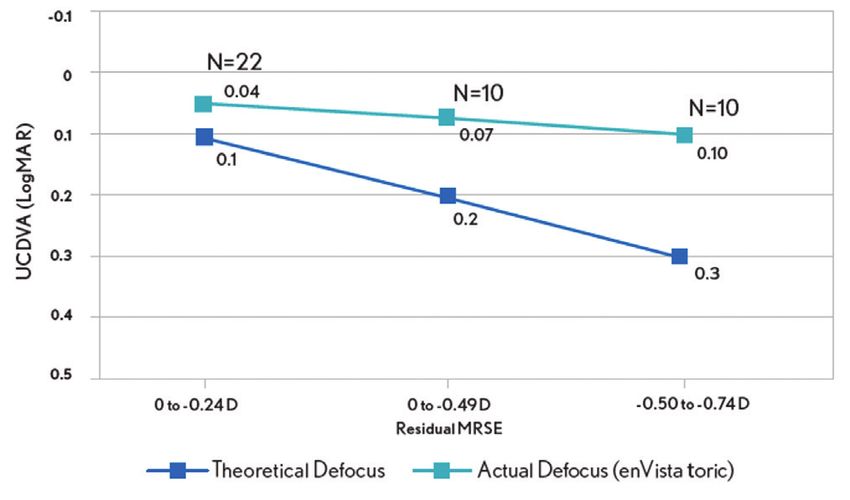
PERSPECTIVES IN IOL TECHNOLOGY | FOCUS ON MONOFOCALS

                                                                                                                                                                                                                                              s
                                                       they tolerate defocus well (Figure 2). In my experience, the
                                                       enVista aspheric monofocal toric IOL is also a great choice
                                                       for patients with aberrated corneas because this lens does
                                                       not induce spherical aberration and offers a large range of
                                                       cylinder correction (+0.77 to +4.53 D).
                                                          When I compared my results with low-add toric IOLs and
                                                       monofocal lenses, I found that using the former improved
                                                       clinical outcomes and patient satisfaction and expanded the
                                                       treatment options for cataract patients with a low amount
                                                       of corneal astigmatism (Figure 3).
                                                                                                                                                  Figure 3. Dr. Stephenson’s comparison of postoperative refractive astigmatism in cataract
                                                                                                                                                  patients with a low amount of corneal astigmatism after the implantation of an enVista
                                                        CONCLUSION                                                                                toric IOL versus an enVista monofocal IOL.
                                                         I work hard to optimize my surgical outcomes, honing
                                                       my surgical skills and preoperative workups and doing                                      Monofocal IOLs, specifically the enVista aspheric and
                                                       everything from correcting dry eye disease and identifying                                 monofocal toric IOLs, allow me to enhance my patients’ lives
                                                       preexisting ocular surface to addressing retinal disease.                                  with stable, predictable outcomes and great quality of vision.

                                                                                                    EDOF BLENDED VISION | Detlev R.H. Breyer, MD, PhD; Lena Beckers, MD; and David Lücht

                                                          The standard procedure to treat                       customized premium treatment from                                 similarly to the natural lens by
                                                       cataract patients is currently to replace                their surgeons.                                                   bending light once.
                                                       the crystalline lens with a monofocal                                                                                         Another way to classify the optic
                                                       posterior chamber IOL. Patients must                      THE PLAYERS: ADVANCED OPTICS                                     of an IOL is by its focality. If the lens
                                                       decide preoperatively whether they                        FOR SPECTACLE INDEPENDENCE                                       provides a single focal point, it is
                                                       prioritize good near, intermediate, or                      Multifocal IOLs feature either                                 categorized as a monofocal. If the lens
                                                       distance vision postoperatively. Over                    refractive or diffractive optics and                              provides two or more focal points, it is
                                                       the past few years, numerous IOLs                        vary on the optical physics of how                                categorized as a multifocal. Bifocal IOLs
                                                       designed according to different optical                  light is distributed and centered on                              have two focal points, and trifocal IOLs
                                                       principles have been developed to                        the retina. Refractive IOLs function                              have three focal points. An extended
                                                       provide spectacle independence after
                                                       lens surgery (Figure 4). Only 1% to 5% of
                                                       patients, even in western industrialized
                                                       countries, receive this advanced
Figures 4–11 courtesy of Detlev R.H. Breyer, MD, PhD

                                                                                                             Figure 5. The intensity of IOL-induced halos increases with higher
                                                                                                             near additions of the optic.
                                                                                                                                                                                  Figure 7. Blended vision according to the Düsseldorf
                                                                                                                                                                                  formula shortens neural adaptation time.

                                                                                                                                                                                  Figure 8. Defocus curve of the Düsseldorf formula, a
                                                       Figure 4. The most commonly used IOLs (organized by   Figure 6. A simplified eye model to describe the theoretical         comfortable way to offer a high range of spectacle
                                                       focality and optical design).                         background of halos.                                                 independence with a minor increase in photopic phenomena.

                                                                                                                                                                       JANUARY 2021 | CATARACT & REFRACTIVE SURGERY TODAY EUROPE 25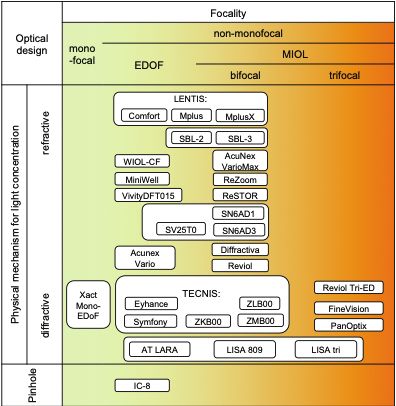
s    PERSPECTIVES IN IOL TECHNOLOGY | FOCUS ON MONOFOCALS

                                                                                                                         Figure 11. The preoperative use of display boards is
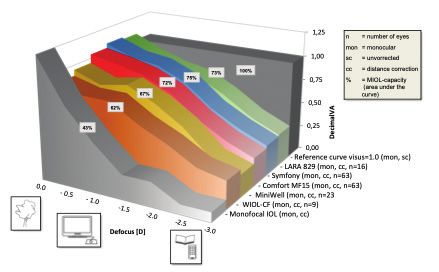
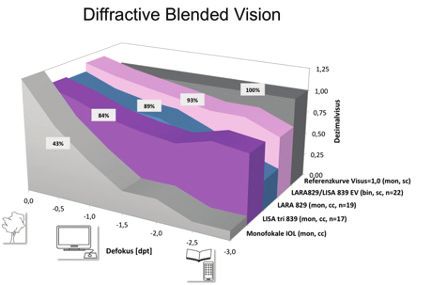
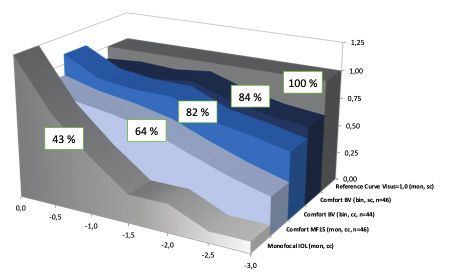
            Figure 9. Defocus curves of diffractive blended vision.   Figure 10. Defocus curves for various EDOF IOLs.   important when explaining the possible side effects of multi-
                                                                                                                         focal IOLs to patients.

            depth of focus (EDOF) IOL has a                                 be achieved with multifocal IOLs.              phenomena. A knowledge of defocus
            longitudinally extended focal point.                            Compared with monofocal optics,                curves and lens design capacities and
              The term multifocal lens is also                              disadvantages of IOLs that feature             halo and glare incidence and gravity
            often applied to EDOF IOLs. The                                 diffractive and refractive optics              is mandatory for every refractive
            AAO defines the depth of focus as the                           include halos, glare, and reduced              surgeon, and this information has
            range at which the lens provides a                              light transmission. Multifocal IOLs            to be made understandable to the
            mean acuity of at least 0.2 logMAR.                             decrease contrast sensitivity and              patient (Figure 11).
            We, however, agree with the scientific                          therefore impair vision under mesopic             If the patient cannot tolerate halos
            interpretation of Damien Gatinel, MD,                           conditions.                                    and glare and is willing to accept
            PhD, that the IC-8 IOL (AcuFocus) is                               The postoperative refractive                glasses for reading, micromonovision
            the only true EDOF IOL.1                                        error should not exceed 0.50 D of              of -0.75 D anisometropia is another
                                                                            astigmatism and sphere. A refractive           option. In our experience, patients who
             UNAVOIDABLE OPTICAL SIDE                                       enhancement may be required to                 do not tolerate photopic phenomena
             EFFECTS WITH MULTIFOCAL IOLS                                   achieve this result.                           may achieve a high rate of spectacle
               When counseling patients, the                                                                               independence with a refractive
            preoperative discussion of multifocal                            MIX-AND-MATCH AND BLENDED                     low-add EDOF IOL such as the Lentis
            IOLs must address optical side effects                           VISION STRATEGIES FOR EVEN                    Comfort, MF15, or Acunex Vario (all
            such as photopic phenomena, reduced                              BETTER CLINICAL OUTCOMES E                    from Teleon Surgical) with a blended
            contrast sensitivity, changes to light                             When multifocal IOLs are implanted          vision strategy. We have created
            distribution, and waxy vision. When light                       bilaterally, different lens types              a technique called the Düsseldorf
            passes through a multifocal IOL, various                        (ie, refractive and diffractive designs)       Strategy. In general, these patients
            mechanisms can disturb its distribution                         and near addition powers (+1.50                have a continuous broad range of
            on the retina (Figures 5 and 6). Halos                          to +2.00 D and +3.00 to +4.00 D)               vision from far to near, excluding small
            and glare are the most common forms                             can be combined to achieve better              print reading, and report photopic
            of dysphotopsia. In general, photopic                           binocular visual outcomes (Figures 7           phenomena comparable to in the
            phenomena are more common and                                   and 8). This mix-and-match or blended          general population.
            severe with diffractive than refractive                         vision approach can provide greater               We are currently studying this
            optics. The Zernike decompensation                              spectacle independence and less                EDOF blended vision model with the
            defocus corresponds mathematically to                           severe dysphotopsias than the bilateral        AcrySof IQ Vivity EDOF IOL (Alcon).
            the Zernike term Z(2,0) of the wavefront                        implantation of one type of multifocal         The results are promising and close to
            error. Higher-order aberrations                                 IOL with a high near add power                 the Düsseldorf strategy with the Lentis
            include coefficients Z(n,m) with n                              (Figures 9 and 10).4,5                         Comfort EDOF IOL.
            greater than 2, such as coma Z(3,±1)
            or spherical aberrations Z(4,0). They                            CUSTOMIZED SURGERY                            1. Rampat R, Gatinel D. Multifocal and extended depth-of-focus intraocular
                                                                                                                           lenses in 2020. Ophthalmology. 2020;S0161-6420(20)30931-30933.
            can be important contributors to the                              When deciding which IOL to                   2. Breyer DRH, Kaymak H, Ax T, Kretz FTA, Auffarth GU, Hagen PR. Intraocular
            presence of halos postoperatively. In                           implant, it is important to consider the       lenses and extended depth of focus intraocular lenses. Asia Pac J Ophthalmol
                                                                                                                           (Phila). 2017;6(4):339-349.
            our experience, halos are an inevitable                         patient’s visual needs, including their        3. Breyer DRH, Hagen PR. Monovision vs. Multifokallinsen-Pro und Contra. DOC
            side effect of multifocal and EDOF IOLs                         occupation and leisure activities. Often       Nürnberg: International Congress of German Ophthalmic Surgeons. 2019.
                                                                                                                           4. Tarib I, Kasier I, Herbers C, et al. Comparison of visual outcomes and patient
            and increase with higher near addition                          underestimated and of even greater             satisfaction after bilateral implantation of an EDOF IOL and a mix-and-match
            powers.2,3                                                      importance is knowing the extent to            approach. J Refract Surg. 2019;35(7):408-416.
               On the other hand, a high degree                             which a patient is willing to accept           5. Kretz FTA, Tarib I, Teisch S, et al. Clinical evaluation of a novel intraocular lens
                                                                                                                           with enhanced depth of focus (EDOF) to increase visual acuity for intermediate
            of spectacle independence can                                   optical side effects such as photopic          distances. Klin Monbl Augenheilkd. 2018;235(8):874-880.

    26 CATARACT & REFRACTIVE SURGERY TODAY EUROPE | JANUARY 2021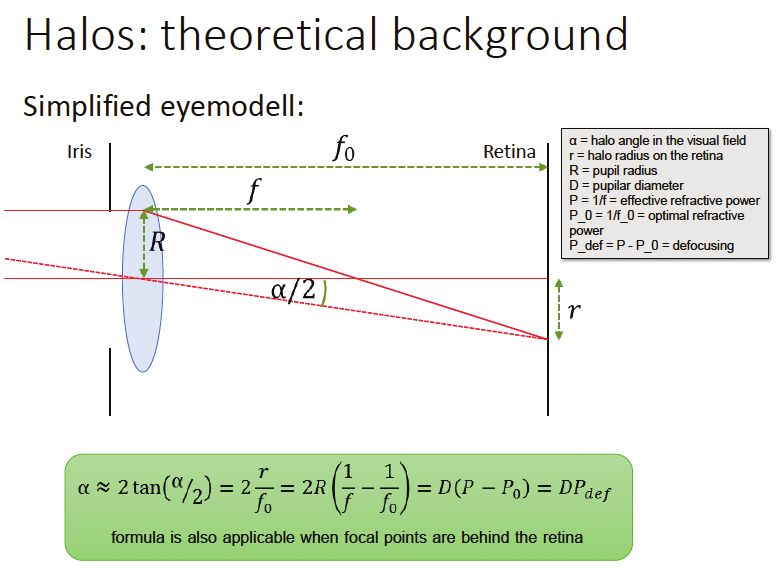
PERSPECTIVES IN IOL TECHNOLOGY | FOCUS ON MONOFOCALS
s
MULTIFOCAL IOLS | By Hirotaka Tanabe, MD, PhD
There are three basic representative TABLE. RATES OF COMPLETE SPECTACLE INDEPENDENCE IN PATIENTS WHO RECEIVE A
design concepts for IOLs: monofocal, MONOFOCAL, MULTIFOCAL, OR EDOF IOL OVER A 10-YEAR PERIOD AT ONE HOSPITAL 1
multifocal, and EDOF. Multifocal
IOLs provide not only good distance IOL Number of Number of Patients Rate of Complete
and near functional vision but also Patients Who Achieved Complete Spectacle
intermediate vision without the use Spectacle Independence Independence (%)
of corrective lenses in new types of ZCB00 (Tecnis Monofocal 3431 371 10.81
IOLs with more than two foci or One-Piece)
EDOF mixtures. Currently, for this
ZMB00 (Tecnis Multifocal) 5231 4301 82.21
and several reasons described herein,
multifocal and EDOF lenses are my Lentis Comfort LS-313 MF15 210 (unpublished 83 (unpublished data) 39.5 (unpublished
preference for a majority of patients, data) data)
but I consider a broad range of factors Acrysof IQ PanOptix TFNT00 49 (unpublished 41 (unpublished data) 83.7 (unpublished data)
when customizing IOL selection to data)
each patient.
Tecnis Symfony ZXR00V 100 (unpublished 42 (unpublished data) 42.0 (unpublished
RARELY USED IN JAPAN TO DATE data) data)
Concerns remain about Manufacturer information: ZCBOO, ZMBOO, ZXROOV: Johnson & Johnson Vision; LS-313 MF15: Teleon Surgical; TFNTOO: Alcon
compromised contrast sensitivity and
problems driving at night because that the rates of multifocal and EDOF that provided insurance contractors
of unwanted subjective phenomena IOL use in cataract surgery were just with full financial support through
(halos, glares, and/or starbursts) 3.9% and 5.1%, respectively.2,3 insurance companies to use the
associated with multifocal IOLs. These Moreover, as of this writing, registered multifocal and EDOF IOLs
disturbances may affect the patient’s multifocal and EDOF IOLs are not ended in March 2020. Thus, there
visual performance and overall supported by the regular national are financial barriers to the use of
postoperative satisfaction. These are medical insurance in Japan (with these IOLs.
several reasons that, in Japan, many the exception of the Lentis Comfort
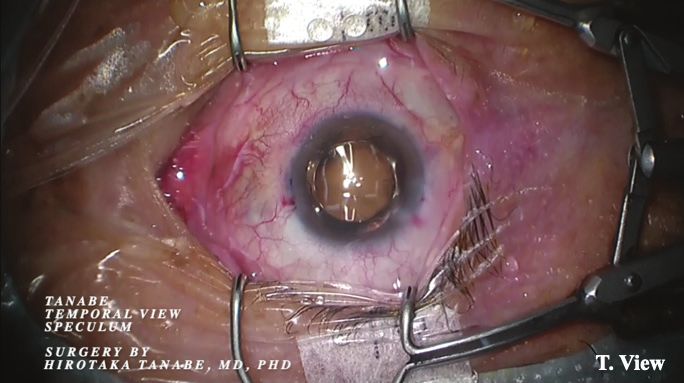
doctors and patients are unlikely to LS-313 MF15 and Lentis Comfort Toric MONOFOCAL VERSUS MULTIFOCAL:
choose a multifocal lens. National LS-313 MF15 T1-3; Figure 12). The COMPARING POSTOPERATIVE
surveys from 2019 and 2020 reported advanced medical insurance services VISUAL PERFORMANCE
A large-scale retrospective study
conducted at Tsukazaki Hospital and
Figure 12 courtesy of M.E. Technica
based on approximately a decade of
practice from December 13, 2010,
to July 29, 2019, compared visual
performance with a monofocal and
a multifocal IOL made of the same
material and using the same basic
design, the ZCB00 and ZMB00 models,
respectively, of the Tecnis IOL (Johnson
& Johnson Vision).1 Over the course
of approximately 10 years, 904 eyes of
452 patients received the monofocal
lens, and 1,326 eyes of 663 patients
received the multifocal lens.
Contrast sensitivity (4.0º, 2.5º,
1.6º, 1.0º, 0.7º), contrast sensitivity
Figure 12. Lentis Comfort Toric LS-313 MF15 T1 IOL at cataract surgery. The eye is held open with the Tanabe Temporal View with glare (1.6º, 1.0º, 0.7º), and
Speculum (Eye Technology [UK] and M.E. Technica [Japan]) to achieve a maximum view of the temporal surgical field. the National Eye Institute Visual
JANUARY 2021 | CATARACT & REFRACTIVE SURGERY TODAY EUROPE 27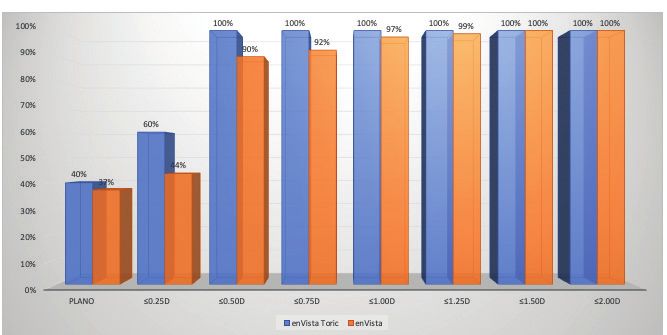
s    PERSPECTIVES IN IOL TECHNOLOGY | FOCUS ON MONOFOCALS

            Function Questionnaire-25 (NEI                      an aspheric aberration-free distance                light scattering, the rate of postopera-
            VFQ-25) score for driving at night                  vision zone with a sector-shaped                    tive spectacle independence in this
            were significantly better in the                    near vision zone with +1.50 D added                 group was lower than in the bifocal
            monofocal group (P < .00068, Wald                   power in the IOL plane (+1.06 D in the              and trifocal multifocal IOL groups
            test), as were the NEI VFQ-25 scores                corneal plane).4                                    (postoperative spectacle independence
            for mental health, driving in general,                 Unpublished data from a                          rates for each IOL included in the
            driving during the day, and driving                 retrospective comparison of the                     study are included in the Table).
            under adverse conditions (P < .05,                  postoperative visual performance with
            Wald test). Uncorrected intermediate                the Lentis Comfort LS-313 MF15 and                   CONCLUSION
            visual acuity, uncorrected near visual              with monofocal (Tecnis Monofocal                       Many reports have demonstrated
            acuity, and spectacle independence                  ZCB00, Johnson & Johnson Vision),                   that the most unsatisfactory subjective
            at near were significantly better in                bifocal multifocal (Tecnis Multifocal               phenomena experienced by patients
            the multifocal group (P < .00068,                   ZMB00, Johnson & Johnson Vision),                   who receive multifocal IOLs result
            Wald test), as were the NEI VFQ-25                  trifocal multifocal (AcrySof IQ                     from factors unrelated to the lens
            scores for general health and spectacle             PanOptix, Alcon), and EDOF IOLs                     itself. For patients who wish to be
            independence at distance (P < .05,                  (Tecnis Symfony ZXR00V, Johnson                     completely spectacle independent
            Wald test).1                                        & Johnson Vision) in patients oper-                 without monovision postoperatively,
                                                                ated on over a 10-year period at                    opting for multifocals or employing a
             EDOF IOLS                                          Tsukazaki Hospital indicated not only               mix-and-match approach is, in most
              Although EDOF IOLs were                           that the Lentis Comfort IOLs were                   cases, the best option at this time. n
            developed to overcome the drawbacks                 associated with greater higher-order
            of mono- and multifocal IOLs, in                    aberrations but also that the lenses                1. Tanabe H, Tabuchi H, Shojo T, Yamauchi T, Takase K. Comparison of visual
                                                                                                                    performance between monofocal and multifocal intraocular lenses of the same
            most cases, the rate of spectacle                   provided high contrast sensitivity with             material and basic design. Sci Rep. 2020; 10:15490.
            independence with EDOF IOLs is                      and without glare and high VFQ-25                   2. Sato M, Kamiya K, Kojima T, et al. Clinical survey of the Japanese society of
                                                                                                                    cataract and refractive surgery. IOL&RS. 2019;33:453–473.
            lower than in patients who receive                  scores for driving at night or driving              3. Sato M, Kamiya K, Kojima T, et al. Clinical survey of the Japanese society of
            multifocal IOLs. The Lentis Comfort                 under adverse conditions. Because                   cataract and refractive surgery. IOL&RS. 2020;34:412-432.
                                                                                                                    4. Oshika T, Arai H, Fujita Y, et al. One-year clinical evaluation of rotationally
            IOLs are rotationally asymmetric IOLs               the Lentis Comfort LS-313 MF15 has a                asymmetric multifocalfocal intraocular lens with +1.5 diopters near addition.
            with a refractive design, combining                 mild added power that helps suppress                Sci Rep. 2019;9:13117.

            LENA BECKERS, MD                                    P. DEE STEPHENSON, MD, FACS                                              QR codes make accessing
            n  Resident, Breyer-Kaymak-Klabe Eye Surgery,      n  Founder, Stephenson Eye Associates,
                Düsseldorf, Germany                                 Venice, Florida                                                digital exclusive content easier than
            n l .beckers@augenchirurgie.clinic                 n P resident, American Board of Eye Surgery                       ever. Simply open your smartphone’s
            n F inancial disclosure: None                      n M ember, CRST Editorial Advisory Board

                                                                n e yedrdee@aol.com; www.stephensoneye.com
                                                                                                                                   camera, aim it at a code like the one
            DETLEV R.H. BREYER, MD                              n F inancial disclosure: Advisory board                              below, and view your content.
            n  Owner, PremiumEyes and Breyer-Kaymak-Klabe           (Bausch + Lomb)
                Eye Surgery, Düsseldorf, Germany
            n M ember, CRST Europe Editorial Advisory Board    HIROTAKA TANABE, MD, PHD                                                            TRY IT NOW!
            n d r.detlev.breyer@gmail.com                      n C hief Ophthalmologist, Department of

            n F inancial disclosure: Consultant,                  Ophthalmology, Tsukazaki Hospital, Himeji,
                Advisory board member, and Travel grants           Hyogo, Japan
                (Alcon, AcuFocus, Teleon Surgical)              n t ennsyoudragon@icloud.com;

                                                                   ORCID ID: http://orcid.org/0000-0002-1948-7408
            DAVID LÜCHT                                         n F inancial disclosure: Inventor of the Tanabe
            n  Medical student, Student researcher for the        Temporal View Speculum (Design Registration:
                Internationale Innovative Ophthalmochirurgie,      D1640365, DM/206179; Eye Technology [United
                Düsseldorf, Germany                                Kingdom] and M.E. Technica [Japan])
            n d avid.luecht@gmx.de

            n F inancial disclosure: None

    28 CATARACT & REFRACTIVE SURGERY TODAY EUROPE | JANUARY 2021

You can also read


