NATIVE PLANT SALE JUNE26,2021 8AM-1PM - MARIANIST ENVIRONMENTAL ...
←
→
Page content transcription
If your browser does not render page correctly, please read the page content below
Native Plant Sale
                                        About the sale
                                        We will provide additional space between plants to help ensure
                                        adequate social distancing and staff, volunteers and shoppers
                                        will be required to wear a mask. All indoor facilities (including
 June 26, 2021 8 am - 1 pm              restrooms) will remain closed. This year, we are limiting pre-
                                        orders to Friends of MEEC members only. If you have questions
                                        about the status of your membership, email info@meec.center.

                                        About our plants
                                         • Our plants are grown in the Mount St. John nursery and
                                        originated from local seed sources unless otherwise noted. We
                                        propagate many more species than are included in this catalog. If
                                        you don’t see a plant you’re looking for, just ask!
                                         • All plants are perennials unless noted as self-seeding annuals or
                                        biennials.
                                         • Nearly every plant in this catalog is a nectar plant for at least
                                        one species of butterfly. Butterfly icons ᑼ indicate host plants,
                                        which feed caterpillars and are crucial to habitat.

                                        What are the codes to the right of plant names?
                                        The letters indicates the probability a plant will be found in a
                                        wetland community. A “+” indicates a higher probability, while a “-”
                                        indicates a lower probability.
                                        • OBL = Obligate Wetland; Occurs almost always (99% probability)
                                        under natural conditions in wetlands.
                                        • FACW = Facultative Wetland; Usually (67%-99% prob.) occurs in
                                        wetlands.
                                        • FAC = Facultative; Likely to occur in wetlands and non-wetlands
                                        (34%-66% probability)
                                        • FACU = Facultative Upland; Usually (67%-99% prob.) occurs in
                                        non-wetlands.
                                        • UPL = Upland; Occurs almost always (99% probability) in non-
                                        wetlands.

                                        The numbers represent Coefficients of Conservatism (CC),
                                        the probability that a plant will occur in a relatively unaltered
                         Marianist      landscape. A CC of 1 is given to plants that demonstrate little
                         Environmenta   fidelity to any remnant natural community, and may be found
                         Education      almost anywhere. A CC of 10 is applied to plants that are almost
                         Center         always restricted to a high-quality remnant.
                  https://meec.center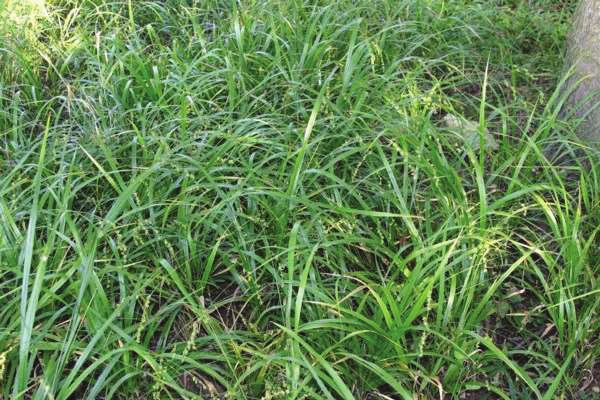
FAC, 6
                            WILDFLOWERS                                              WILD COLUMBINE
                                                                                     Aquilegia canadensis
                                                                          [OBL], 6
AMERICAN SWEET-FLAG                                                                                                            Full sun-full shade, Dry-mesic
Acorus americanus                                                                                                       Flowers April-July, 1-2 ft. tall, 1 ft. spread
                                             Full sun-part shade, Wet                                         A food source for hummingbirds grown for both showy
                                 Flowers May-June, 2-4 ft. tall, 1 ft. spread                                 flowers and soft, green foliage. Blooms just as the
                      Stiff green iris-like foliage has a sweet aroma when                                    woodland sping ephemerals are concluding their season.
                      crushed. A great addition to a pond edge or rain garden. It                             Tolerant of a wide range of soil moisture and light
                      will slowly naturalize by rhizomes and help stablize bank                               conditions.
                      soils.                                                                                                                                         OBL, 4
                                                                                     SWAMP MILKWEED
                                                                            FAC, 4   Asclepias incarnata
SLENDER FOXGLOVE                                                                                                               Full sun-part shade, Mesic-wet
Agalinis tenuifolia                                                                                                     Flowers July-Sept., 3-5 ft. tall, 1 ft. spread
                                       Full sun-part shade, Dry-mesic                                         Popular for wet areas, swamp milkweed is favored for its
                             Flowers Aug.-Oct., 1-2 ft. tall, Under 1 ft. spread                              pink clusters of crown-shaped flowers. The favored
                      Annual. Showy delicate flowers ranges from pink to purple                               milkweed host plant for monarchs and an important nectar
                      with the short tubular corolla attracting long-tongued bees.                            source for a wide range of insects.
                      Tuck this plant in with little bluestem grasses and allow it
                      to self seed in open, dry soil spaces for a yearly presence.                                                                                FACU-, 1
                                                                                     COMMON MILKWEED
                                                                         [FACU], 5   Asclepias syriaca
NODDING PINK ALLIUM                                                                                                             Full sun-part shade, Dry-mesic
Allium cernuum                                                                                                          Flowers June-Aug., 2-5 ft. tall, 2 ft. spread
                                        Full sun-part shade, Dry-mesic                                        Stunning clusters of fragrant, pale, purplish-pink flowers
                             Flowers July-Aug., 1-2 ft. tall, Under 1 ft. spread                              attract butterflies and beneficial insects. Seed pods add
                      A pollinator attractor, this plant is topped by rounded,                                unusual late-fall interest.
                      nodding clusters of pale pink flowers for late summer
                      color. Performs well as a border planting and tolerant of
                      clay soils.                                                                                                                                  [UPL], 4
                                                                                     BUTTERFLY-WEED
                                                                         FACW, 5     Asclepias tuberosa
CANADA ANEMONE                                                                                                                Full sun-part shade, Dry-mesic
Anemone canadensis                                                                                                      Flowers June-Sept., 1-3 ft. tall, 2 ft. spread
                                       Full sun-full shade, Mesic-wet                                         Emerging in late spring, butterfly-weed's bright orange
                                 Flowers May-June, 1-2 ft. tall, 3 ft. spread                                 flowers are worth the wait. Thrives in hot weather and dry,
                      Large 2" white blooms in late spring and foliage that adds                              well-drained, sandy soil. Often blooms twice in a year if
                      interest throughout the seasons. The rhizomatous root                                   seed pods are not formed in the early summer flush.
                      system makes this a vigorous native plant ground cover.
                      Growth is tempered in dry shade conditions.                                                                                                  [UPL], 4
                                                                                     WHORLED MILKWEED
                                                                          FACU, 3    Asclepias verticillata
WOODLAND THIMBLEWEED                                                                                                             Full sun-part shade, Dry-mesic
Anemone virginiana                                                                                                       Flowers July-Sept., 1-2 ft. tall, 2 ft. spread
                                        Full sun-full shade, Dry-mesic                                        NEW! A fine foliaged milkweed topped with white flowers
                                 Flowers July-Aug., 2-3 ft. tall, 1 ft. spread                                in late summer. Pollinators will visit and monarchs will lay
                      Beautifully-veined dark green foliage creates an excellent                              eggs on this species too. Shallow rhizomatous colonies do
                      ground cover for dry, shady spots with low fertility. It                                well in infertile soil where plant competition is minimal.
                      features numerous white blossoms on a tall spike and in
                      the fall cottony seed heads appear.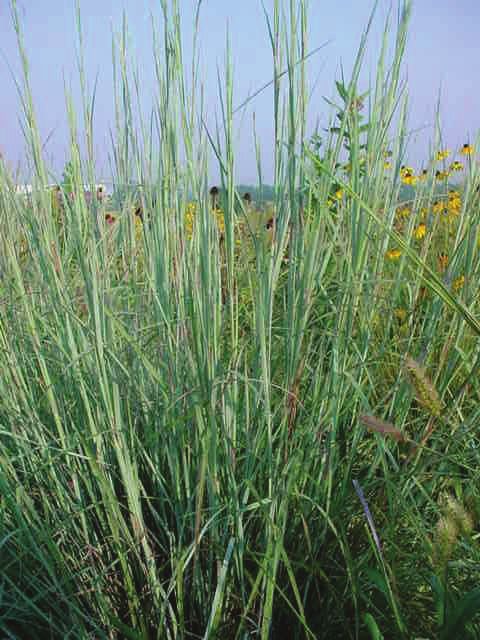
[FACU-], 6                                                                                    OBL, 6
BLUE FALSE INDIGO                                                                     TURTLEHEAD
Baptisia australis                                                                    Chelone glabra
                                      Full sun-part shade, Dry-mesic                                                           Full sun-part shade, Mesic-wet
                                Flowers May-June, 1-4 ft. tall, 2 ft. spread                                            Flowers Aug.-Sept., 2-3 ft. tall, 1 ft. spread
                     A beautiful specimen plant favored for its blue-green                                   Named for stunning bright white flowers shaped like a
                     foliage, purple-blue pea-like flowers. Showy, decorative,                               turtle's head late season. Blossoms are arranged in dense
                     dark seed pods create late season interest. Slow growing                                spikes at the top of the plant where they are pollinated by
                     but long-lived.                                                                         bumblebees. Grows best in moist soil.

                                                                          FACU, 8                                                                                     UPL, 4
WHITE FALSE INDIGO                                                                    PASTURE THISTLE
Baptisia lactea                                                                       Cirsium discolor
                                        Full sun-part shade, Dry-mesic                                                         Full sun-part shade, Dry-mesic
                                 Flowers June-July, 2-5 ft. tall, 2 ft. spread                                          Flowers July-Oct., 3-8 ft. tall, 2 ft. spread
                     A terrific specimen plant with spikes of pea-like flowers                               Biennial or short-lived perennial. A host for the painted
                     and blue-green leaves that adds character to a garden well                              lady butterfly. Help bring back our native thistles and be
                     into the fall. Distinctive seed pods add to the beauty of this                          rewarded with summer-long pink blooms pollinators
                     long-lived plant.                                                                       galore. Distinct leaves are soft white underneath and deer
                                                                                                             resistant.
                                                                           [UPL], 4                                                                                  FAC, 3
DOWNY WOODMINT                                                                        BLUE MISTFLOWER
Blephilia ciliata                                                                     Conoclinium coelestinum
                                     Full sun-part shade, Dry- mesic                                                              Full sun-part shade, Mesic
                              Flowers June - July, 1-3 ft. tall, 2 ft. spread                                           Flowers Aug.-Sept., 1-3 ft. tall, 2 ft. spread
                     Whorls of lavendar flowers and aromatic dense gray green                                An attractive late season perennial that bees and
                     foliage makes this plant a good addition for dry shade                                  butterflies can't resist. Its bright blue-violet flower clusters
                     areas attracting bees and butterflies. A fasting growing                                have a fine-textured "misty" look. It prefers full sun but
                     spreading plant can been used as a groundcover.                                         tolerates some shade. Once established it can spread by
                                                                                                             rhizomes.
                                                                         FACU-, 4
HAIRY WOODMINT                                                                        TALL COREOPSIS                                                                    FAC, 5
Blephilia hirsuta                                                                     Coreopsis tripteris
                                         Full sun-full shade, Mesic                                                           Full sun-part shade, Mesic-wet
                                Flowers June-July, 2-3 ft. tall, 1 ft. spread                                         Flowers Aug.-Sept., 3-9 ft. tall, 2 ft. spread
                     White to light purple clustered flowers in tiers along the                              Also known as tall tickseed, this plant is known for large,
                     stem and a strong mint fragrance make this a popular                                    showy yellow flower heads and attractive divided foliage.
                     plant for woodland gardens and edge habitats.                                           A show-stopper for the back of your native landscape.
                                                                                                             Goldfinches will feast on the seeds in fall.
                                                                            FAC, 4
TALL BELLFLOWER                                                                       TALL LARKSPUR                                                                [FACU], 7
Campanulastrum americanum                                                             Delphinium exaltatum
                                        Part-full shade, Dry-mesic                                                             Full sun-part shade, Dry-mesic
                                Flowers June-Sept., 2-4 ft. tall, 1 ft. spread                                          Flowers July-Aug., 3-4 ft. tall, 1 ft. spread
                     Biennial. A spike-like cluster of showy lavender-blue five-                             This perennial is perfect for the woodland edge. Spikes of
                     petaled flowers with a distinctive protruding style adds                                bluish purple-spurred flowers appear in summer to attract
                     color in the summer woodland and attracts hummingbirds.                                 hummingbirds and butterflies. Deep grayish green-lobed
                     Thriving in rich moist open woods where it can self-sow                                 foliage is not favored by deer.
                     freely.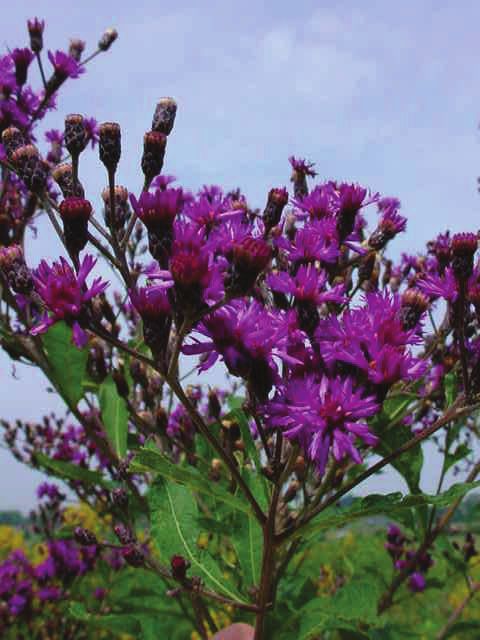
FAC, 3                                                                                FACW, 6
PRAIRIE MIMOSA                                                                           HOLLOW-STEMMED JOE-PYE WEED
Desmanthus illinoensis                                                                   Eutrochium fistulosum
                                        Full sun-part shade, Dry-mesic                                                             Full sun-part shade, Mesic-wet
                                  Flowers July-Aug., 2-4 ft. tall, 2 ft. spread                                            Flowers July-Sept., 4-8 ft. tall, 3 ft. spread
                       Favored for its soft, fern-like foliage and white stamens                                 A large perennial with 10” long whorled leaves on dark red-
                       which resemble a starburst, this plant is rare in eastern                                 purple stalks adds a dramatic focal point in native
                       prairies. Curved, wafer-shaped pods add winter interest.                                  landscapes. Large doomed pinkish-purple flower heads
                       Also called prairie bundle-flower.                                                        attract pollinators of all sorts in mid-late summer. Great in
                                                                                                                 combination with ironweed.
                                                                              [UPL], 6                                                                                FACW, 6
PURPLE CONEFLOWER                                                                        SPOTTED JOE-PYE WEED
Echinacea purpurea                                                                       Eutrochium maculatum
                                        Full sun-part shade, Dry-mesic                                                            Full sun-part shade, Mesic-wet
                                 Flowers June-Sept., 3-4 ft. tall, 1 ft. spread                                            Flowers July-Sept., 3-6 ft. tall, 2 ft. spread
                       A perennial favored by gardeners, birds and bees. Purple                                  Whorls of coarse, toothed leaves add texture, and grand
                       flowers add color throughout the growing season, and as                                   umbrels of pink flowers are irresistable to butterflies.
                       petals drop the cone-shaped seed head adds winter                                         Perfect for rain gardens, stream banks or pond plantings.
                       interest and a valuable seed source.

                                                                               FAC, 7                                                                                  FAC, 5
RATTLESNAKE-MASTER                                                                       PURPLE JOE-PYE WEED
Eryngium yuccifolium                                                                     Eutrochium purpureum
                                                Full sun, Dry-mesic                                                                 Part-full shade, Dry-mesic
                                  Flowers July-Sept., 3-4 ft. tall, 2 ft. spread                                           Flowers July-Sept., 4-6 ft. tall, 2 ft. spread
                       An excellent specimen plant with yucca-like leaves and                                    Great for architectural height in your native plant garden.
                       unusual white flowers that resemble golf balls. Flowers                                   Showy and fragrant purple flower heads attract butterflies,
                       attract a wide diversity of pollinators. Performs well in a                               and attractive seed heads persist into winter. Ideal for
                       variety of soils including clay.                                                          woodland edges. Also called Sweet Joe-Pye Weed.

                                                                           FACW+, 3                                                                                  FACW, 8
BONESET                                                                                  QUEEN-OF-THE-PRAIRIE
Eupatorium perfoliatum                                                                   Filipendula rubra
                                       Full sun-part shade, Mesic-wet                                                             Full sun-part shade, Mesic-wet
                                 Flowers July-Sept., 3-4 ft. tall, 2 ft. spread                                            Flowers June - July, 3-5 ft. tall, 1 ft. spread
                       Thrives in moist, sunny conditions. This relative of Joe                                  A truly remarkable plant that lives up to its name and is
                       Pye Weed is known for leaves that unite around the stem.                                  easy to grow if you have plenty of room. It is topped by
                       White flower clusters are attractive to birds and butterflies.                            large plumes of pink flowers, tolerant of clay soils and not
                                                                                                                 palatable to deer.

                                                                              [UPL], 4                                                                                FACU, 4
FLOWERING SPURGE                                                                         WILD GERANIUM
Euphorbia corollata                                                                      Geranium maculatum
                                      Full sun-part shade, Dry-mesic                                                                Full sun-full shade, Dry-mesic
                                 Flowers June-Aug., 2-4 ft. tall, 2 ft. spread                                              Flowers April-May, 1-3 ft. tall, 1 ft. spread
                       Likened to baby's breath, airy white flowers appear for                                   A woodland spring bloomer with tolerance for full sun. It
                       weeks during the summer. Tolerant of a wide range of soil                                 forms loose clusters of basal leaves that can be act as
                       and performs well in poor, droughty soils. Deer avoid the                                 ground cover. Showy pale pink to lilac colored flowers
                       toxic leaves.                                                                             attract butterflies and other pollinators.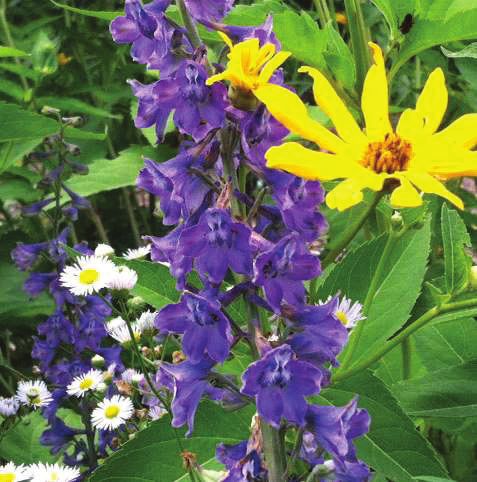
FACW+, 4                                                                                 FACU-, 5
HELEN'S FLOWER                                                                          ROUND-HEADED BUSH-CLOVER
Helenium autumnale                                                                      Lespedeza capitata
                                       Full sun-part shade, Mesic-wet                                                          Full sun-part shade, Dry-mesic
                                  Flowers Aug.-Oct., 2-5 ft. tall, 1 ft. spread                                         Flowers Aug.-Sept., 2-4 ft. tall, 1 ft. spread
                       A fall bloomer with distinctive yellow flowers. Makes a                                Small white flowers pack the rounded heads at the top of
                       spectacular color combination in the fall when planted with                            this drought tolerant plant. The mature dark brown
                       New England aster. Contrary to its former common name,                                 seedheads add winter interest and food for birds.
                       sneezeweed, Helen's flower does not cause seasonal
                       allergies.
                                                                             [UPL], 7                                                                              [UPL], 6
ASHY SUNFLOWER                                                                          NORTHERN BLAZING-STAR
Helianthus mollis                                                                       Liatris scariosa
                                              Full sun, Dry-mesic                                                               Full sun-part shade, Dry-mesic
                                 Flowers Aug.-Sept., 2-4 ft. tall, 3 ft. spread                                          Flowers Aug.-Sept., 2-5 ft. tall, 1 ft. spread
                       Large butter-yellow flower heads and distinctive clasping                              Large, showy, button-like purple blooms add interest to the
                       gray-green leaves covered with fine hair. Best suited for                              summer landscape. This blazingstar species is tough and
                       large landscapes where it will form a colonies.                                        adaptable, performing well in drier soils and more shade
                                                                                                              than its relatives.

                                                                            [UPL], 5                                                                               FAC+, 7
SMOOTH OXEYE                                                                            SPIKED BLAZING-STAR
Heliopsis helianthoides                                                                 Liatris spicata
                                       Full sun-part shade, Dry-mesic                                                                 Full sun, Mesic-wet
                                Flowers June - Sept., 4-6 ft. tall, 1 ft. spread                                         Flowers July-Aug., 2-5 ft. tall, 1 ft. spread
                       Easy-to-grow, this wildflower races to maturity with a long                            A gardener's favorite, this plant is topped by tall spikes of
                       bloom period and bright yellow flowers. Grows well in                                  bright, bold purple flowers that bloom from the top down.
                       almost any soil and self-seeds readily. A host plant for                               Excellent for attracting butterflies and rare moths. Tolerant
                       painted ladies and checkerspots.                                                       of clay soils.

                                                                             OBL, 7                                                                              FACW+, 5
HALBERD-LEAVED ROSE-MALLOW                                                              CARDINAL-FLOWER
Hibiscus laevis                                                                         Lobelia cardinalis
                                        Full sun-part shade, Mesic-wet                                                         Full sun-part shade, Mesic-wet
                                  Flowers July-Aug., 3-6 ft. tall, 3 ft. spread                                          Flowers July-Sept., 2-5 ft. tall, 1 ft. spread
                       Striking 4-6 inch pink flowers open during the day and                                 Fire-red flowers that are stunning even at a distance
                       close at night. Great for larger wet areas and rain gardens.                           attract hummingbirds and butterflies. Prefers moist soil
                       Named because the leaves resemble a medieval sword.                                    and light shade but tolerates a wide-range of conditions.
                                                                                                              An instantly-recognizable classic native plant.

                                                                            [UPL], 7                                                                             FACW+, 3
FALSE BONESET                                                                           GREAT BLUE LOBELIA
Kuhnia eupatorioides                                                                    Lobelia siphilitica
                                         Full sun-part shade, Dry-mesic                                                        Full sun-part shade, Mesic-wet
                                 Flowers Aug.-Sept., 1-3 ft. tall, 1 ft. spread                                        Flowers July - Sept., 2-3 ft. tall, 1 ft. spread
                       Lends interest to sunny locations with cream-colored                                   A showy plant topped by deep blue 1" irregular flowers.
                       flowers in late summer and early fall. A flowering                                     Great for early fall color in combination with goldenrods.
                       companion for the flat-topped goldenrod. Visited by an                                 Rabbits and deer tend to leave the lobelia species alone.
                       array of insects.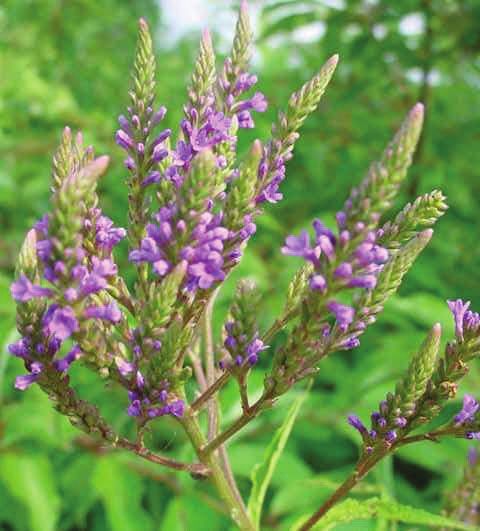
OBL, 4                                                                                  FAC, 2
MONKEY-FLOWER                                                                             FOXGLOVE BEARD-TONGUE
Mimulus ringens                                                                           Penstemon digitalis
                                         Full sun-part shade, Mesic-wet                                                           Full sun-part shade, Dry-mesic
                             Flowers June-Sept., 1-3 ft. tall, Under 1 ft. spread                                          Flowers June-July, 2-3 ft. tall, 1 ft. spread
                        Profuse bluish-purple 1" flowers grow in pairs along the                                A late-spring bloomer, this plant loves clay but thrives in a
                        stem of this late summer beauty. A great plant for moist                                variety of soils. White, tubular blooms are numerous and
                        areas. Blooms for many weeks.                                                           long-lasting and favored by bees. Naturalizes well.

                                                                                UPL, 3                                                                                [UPL], 3
WILD BERGAMOT                                                                             HAIRY BEARD-TONGUE
Monarda fistulosa                                                                         Penstemon hirsutus
                                         Full sun-part shade, Dry-mesic                                                           Full sun-part shade, Dry-mesic
                                  Flowers July-Sept., 2-4 ft. tall, 2 ft. spread                                          Flowers May-June, 1-3 ft. tall, 1 ft. spread
                        Another favorite of prairie gardeners and herb enthusiasts,                             Tubular white flowers with purple throats bring early color
                        this member of the mint family produces dense, rounded                                  to the prairie garden. In late fall foliage turns deep red and
                        clusters of tube-shaped light purple flowers. Will grow near                            handsome brown seed heads add winter interest.
                        black walnut trees and is not palatable to deer.

                                                                                UPL, 7                                                                                [UPL], 2
DOTTED HORSEMINT                                                                          SWEET EVERLASTING
Monarda punctata                                                                          Pseudognaphalium obtusifolium
                                             Full sun-part shade, Dry                                                                  Full sun, Dry-mesic
                                  Flowers July-Sept., 1-2 ft. tall, 1 ft. spread                                          Flowers July-Sept., 1-2 ft. tall, 1 ft. spread
                        Unusual pale pink bracts surround nectar rich yellow and                                Biennial that self-seeds easily. Woolly foliage with cream-
                        purple spotted flowers making this plant an eye-catcher.                                colored flower heads that resemble pussytoes when
                        Deer resistant due to aromatic leaves. A short-lived                                    young. The aromatic flowers smell of maple syrup when
                        perennial for well-drained or sandy sites.                                              crushed and dry well for arrangements.

                                                                                OBL, 8                                                                                [FAC], 5
RIDDELL'S GOLDENROD                                                                       HAIRY MOUNTAIN-MINT
Oligoneuron riddellii                                                                     Pycnanthemum verticillatum
                                        Full sun-part shade, Mesic-wet                                                            Full sun-part shade, Dry-mesic
                                 Flowers Sept.-Oct., 3-4 ft. tall, 1 ft. spread                                           Flowers July-Sept., 2-3 ft. tall, 2 ft. spread
                        An uncommon, hard to find goldenrod that thrives in sunny                               Fine hairs give this plant an appearance of frosted foliage
                        wet areas. This plant produces dense, flat to slightly                                  which aids in deterring deer browse. Excellent ground
                        rounded clusters of yellow flowers that attracts an                                     cover for light shaded areas. Aromatic.
                        abundance of pollinators.

                                                                                UPL, 8                                                                                  FAC, 4
STIFF GOLDENROD                                                                           VIRGINIA MOUNTAIN-MINT
Oligoneuron rigidum                                                                       Pycnanthemum virginianum
                                               Full sun, Dry-mesic                                                                          Full sun, Mesic
                                 Flowers Aug.-Sept., 3-5 ft. tall, 2 ft. spread                                       Flowers July - September, 1-3 ft. tall, 2 ft. spread
                        An ideal addition to a bird and butterfly garden, this plant is                         The white flowers cover this plant through the summer and
                        topped by bright yellow clusters of flowers in late summer.                             attracts beneficial insects. Stunning in combination with
                        Gray-green foliage adds interest and is not favored by                                  royal catchfly and little bluestem.
                        deer.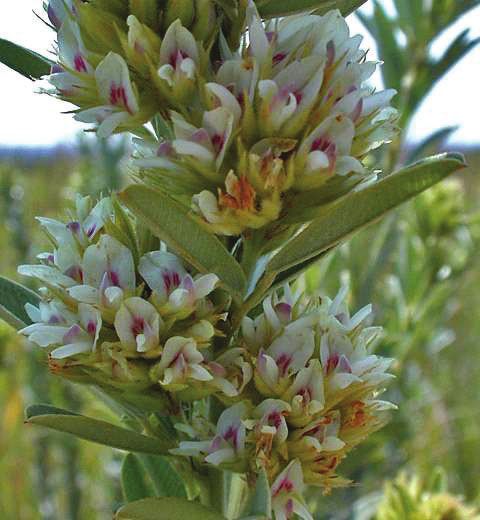
[UPL], 5                                                                              FAC+, 4
GRAY-HEADED CONEFLOWER                                                                ROSE-PINK
Ratibida pinnata                                                                      Sabatia angularis
                                        Full sun-part shade, Dry-mesic                                                        Full sun-part shade, Mesic-wet
                                Flowers July-Sept., 3-5 ft. tall, 2 ft. spread                                       Flowers June-Aug., 1-2 ft. tall, 1-2 ft. spread
                      Topped with droopy, bright yellow flower petals set against                            NEW! Biennial beauty that is worth waiting for every other
                      black centers, the seed heads are a favorite food source                               year and will re-seed in open places. Large pink and
                      for finches in fall. Tolerant of drought and clay soils.                               yellow showy, fragrant flowers appear in summer attract
                                                                                                             long tongued bees and some other insects.

                                                                            FAC, 6                                                                               FAC+, 4
ORANGE CONEFLOWER                                                                     SOUTHERN WILD SENNA
Rudbeckia fulgida                                                                     Senna marilandica
                                       Full sun-part shade, Mesic-wet                                                        Full sun-part shade, Mesic-wet
                                 Flowers July-Sept., 2-4 ft. tall, 1 ft. spread                                        Flowers July - Aug., 3-5 ft. tall, 3 ft. spread
                      Bright yellow-orange flowers appear all summer. Excellent                              A great specimen plant that provides interest well into the
                      in plantings with mountain mints and wild bergamot. A                                  winter with branched clusters of 1" yellow flowers and
                      hardy plant for clay soils.                                                            decorative, persistent seed pods. A host plant for several
                                                                                                             migratory sulphur butterflies in Ohio.

                                                                          FACU-, 1                                                                               [UPL], 8
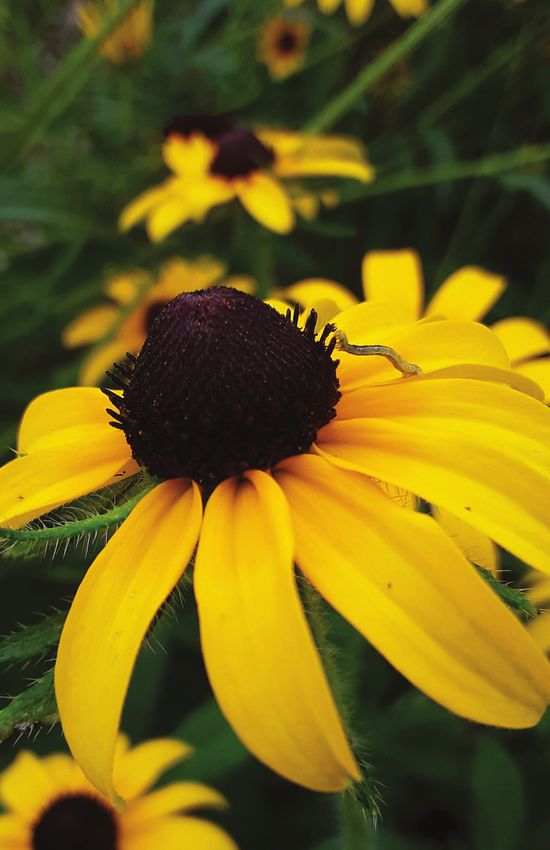
BLACK-EYED SUSAN                                                                      ROYAL CATCHFLY
Rudbeckia hirta                                                                       Silene regia
                                       Full sun-part shade, Dry-mesic                                                                Full sun, Dry-mesic
                                Flowers June-Sept., 1-3 ft. tall, 1 ft. spread                                         Flowers June-Aug., 2-4 ft. tall, 1 ft. spread
                      Biennial. Rich yellow flower petals contrast with black                                A classic prairie plant that you must protect from deer.
                      centers. Look for the abundant flowers in early summer                                 Topped by bright, showy 1" crimson-red flowers that are
                      just ahead of the other rudbeckias. Grows in a wide range                              visited by hummingbirds. A standout in the prairie garden.
                      of soil conditions where is will self-seed into open areas.

                                                                          FACW, 6                                                                                [UPL], 8
GREEN-HEADED CONEFLOWER                                                               COMPASS PLANT
Rudbeckia laciniata                                                                   Silphium laciniatum
                                          Full sun-part shade, Wet                                                                  Full sun, Dry-mesic
                                Flowers July-Oct., 3-9 ft. tall, 3 ft. spread                                          Flowers July-Sept., 3-9 ft. tall, 3 ft. spread
                      Favored for both its leaves as well as its bright yellow                               A slow-growing but long-lived plant topped with large,
                      flowers with lime green centers. This plant makes a great                              showy yellow flowers on stalks that can reach 9 foot tall
                      backdrop to your prairie planting.                                                     and tolerant of poor soils. The deeply lobed leaves orient
                                                                                                             north-south. A popular food source for birds.

                                                                           FACU, 5                                                                               FACU, 6
THREE-LOBED CONEFLOWER                                                                CUP-PLANT
Rudbeckia triloba                                                                     Silphium perfoliatum
                                       Full sun-part shade, Dry-mesic                                                         Full sun-part shade, Dry-mesic
                                Flowers Aug.-Oct., 3-5 ft. tall, 2 ft. spread                                          Flowers July-Sept., 6-8 ft. tall, 3 ft. spread
                      Biennial or short lived perennial. This clump-forming and                              Robust tall plants with leaves fused at the stem that can
                      densely-branched plant self-sows readily and maintains its                             hold rain water. Bright yellow flowers appear through the
                      bounteous bright yellow and black flowers well into the fall.                          summer and the seed are savored by finches in the fall.
                      Tolerant of drought and not palatable to deer.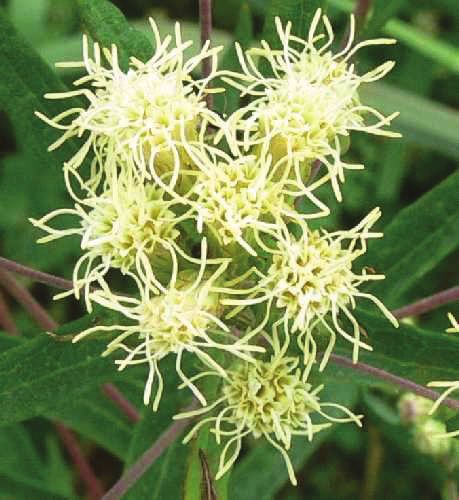
UPL, 8                                                                               [UPL], 5
PRAIRIE DOCK                                                                          ELM-LEAVED GOLDENROD
Silphium terebinthinaceum                                                             Solidago ulmifolia
                                               Full sun, Dry-mesic                                                             Part-full shade, Dry-mesic
                                 Flowers Aug.-Sept., 2-10 ft. tall, 3 ft. spread                                     Flowers Aug.-Sept., 2-4 ft. tall, 1-2 ft. spread
                       Similar to compass plant, with toothed leaves that can                              NEW! Arching panicles burst of yellow flowers late season
                       grow to 2 feet. Produces numerous bright yellow flowers                             full of nectar and pollen attracting bees, wasp, and flies.
                       on tall stalks. A must-have in a large prairie area.                                Top of the herbaceous list for a self-seeding alternative to
                                                                                                           honeysuckle at the woodland edge. Birds feed on seeds
                                                                                                           into the winter.
                                                                         FACW-, 2                                                                                 [UPL], 4
STOUT BLUE-EYED-GRASS                                                                 HEART-LEAVED ASTER
Sisyrinchium angustifolium                                                            Symphyotrichum cordifolium
                                        Full sun-part shade, Mesic-wet                                                          Part-full shade, Dry-mesic
                             Flowers May-July, 0.5-1 ft. tall, Under 1 ft. spread                                     Flowers Aug.-Oct., 2-4 ft. tall, 1 ft. spread
                       A short-lived perennial with delicate blue flowers with                             Wildlife feeds on its seeds which develop from dense
                       bright yellow centers are a favorite of pollinators. Fine                           clusters of pale blue flowers in the fall. A bird magnet! Also
                       grass-like foliage forms clumps that work great for borders                         attracting butterflies and bees while in flower.
                       especially in moist soils of poor fertility.

                                                                          FACU, 5                                                                                 UPL, 6
BLUE-STEMMED GOLDENROD                                                                SMOOTH ASTER
Solidago caesia                                                                       Symphyotrichum laeve
                                        Full sun-part shade, Dry-mesic                                                     Full sun-part shade, Dry-mesic
                                 Flowers Sept.-Oct., 1-3 ft. tall, 1 ft. spread                                       Flowers Aug.-Oct., 2-4 ft. tall, 2 ft. spread
                       An unusual, shade-tolerant goldenrod with delicate flower                           Billowing 1"-wide blue and yellow flower heads appear in
                       clusters at the base of the leaves along the stem as well                           loose panicles and feed the bees and butterflies in fall.
                       as an inflorescence at the top. A strong-stemmed,                                   This tough, adapatable species is tolerant of drought and
                       beautiful addition to the autumn scene.                                             salt and features lovely, smooth blue-gray leaves.

                                                                          FACU, 5                                                                              FACW-, 2
ZIGZAG GOLDENROD                                                                      NEW ENGLAND ASTER
Solidago flexicaulis                                                                  Symphyotrichum novae-angliae
                                        Full sun-full shade, Dry-mesic                                                     Full sun-part shade, Mesic-wet
                                  Flowers Aug.-Oct., 1-3 ft. tall, 2 ft. spread                                      Flowers Aug.-Oct., 3-5 ft. tall, 2 ft. spread
                       A shade-loving goldenrod with bright yellow flowers that                            A showy late-bloomer topped by clusters of bright purple
                       cluster along the zig-zag stem, adding splashes of color to                         flower heads with yellow disks. Plant this in combination
                       woodland and shade plantings in fall.                                               with goldenrods for fantastic fall color. An excellent nectar
                                                                                                           source for monarchs in migration.

                                                                           [UPL], 2                                                                              [UPL], 4
GRAY GOLDENROD                                                                        SHORT'S ASTER
Solidago nemoralis                                                                    Symphyotrichum shortii
                                        Full sun-part shade, Dry-mesic                                                        Part-full shade, Dry-mesic
                                 Flowers Aug.-Sept., 2-3 ft. tall, 1 ft. spread                                       Flowers Aug.-Oct., 1-4 ft. tall, 1 ft. spread
                       A compact well-behave goldenrod slowly spreading by                                 Late summer blooms kick-off the spectacular season of
                       rhizomes whose small size makes it ideal for small prairie                          asters and goldenrods. This clay-tolerant plant is perfectly
                       gardens. Unique for its gray-green foliage, it will also                            suited to dry woodland habitats. Similar to heart-leaved
                       tolerate very dry conditions and attract pollinators.                               aster but devoid (or nearly so) of teeth along the leaf edge.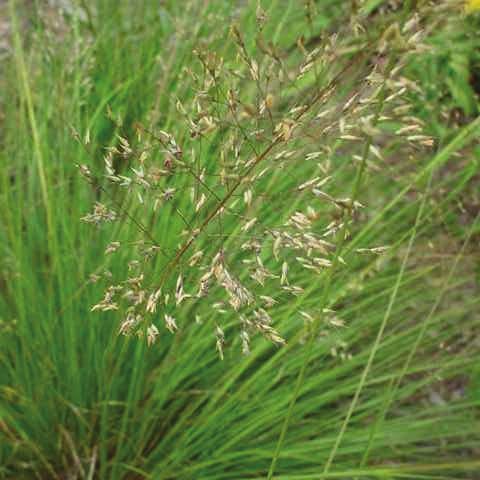
[UPL], 3                                                                               [UPL], 3
ARROW-LEAVED ASTER                                                                       HOARY VERVAIN
Symphyotrichum urophyllum                                                                Verbena stricta
                                        Full sun-full shade, Dry-Mesic                                                                    Full sun, Dry
                                  Flowers Aug.-Oct., 2-4 ft. tall, 1-2 ft. spread                                        Flowers July-Sept., 1-3 ft. tall, 1 ft. spread
                        NEW! An aster powerhouse for insects both in the rich                                 A short-lived perennial with showy purple flower spikes
                        nectar and pollen resources but also leaves feed a wide                               bloom from the bottom up and provide color in mid to late
                        assemblage of insect larvae and adults (moths, leaf                                   summer. Thrives in poor soil and is drought-tolerant.
                        hoppers, leaf beetles, grasshoppers). Pale purple flowers                             Attracts butterflies, and provides winter food for cardinals
                        are late season delights.                                                             and juncos.
                                                                             FACW-, 3                                                                                [UPL], 5
AMERICAN GERMANDER                                                                       HAIRY WINGSTEM
Teucrium canadense                                                                       Verbesina helianthoides
                                           Full sun-part shade, Mesic                                                         Full sun-part shade, Dry-mesic
                                 Flowers June-Sept., 1.5-3 ft. tall, 3 ft. spread                                       Flowers June-July, 3-5 ft. tall, 1 ft. spread
                        A stout, hollow stemmed mint with attractive foliage                                  Also known as ozark flatseed sunflower, covered in bright
                        spreads by rhizomes. In the summer, narrow upright                                    yellow blooms in late spring and early summer. Foliage is
                        terminal clusters of white to light lavendar flowers with                             covered in fine white hairs giving it a fuzzy appearance
                        purple at the base attract a wide range of nectar and                                 and making it less attractive to deer.
                        pollen seeking insects.
                                                                            FACW+, 5                                                                                  FAC, 2
TALL MEADOW-RUE                                                                          TALL IRONWEED
Thalictrum pubescens                                                                     Vernonia gigantea
                                         Full sun-part shade, Mesic-wet                                                          Full sun-part shade, Mesic-wet
                                   Flowers May-June, 3-7 ft. tall, 2 ft. spread                                          Flowers July-Sept., 5-8 ft. tall, 3 ft. spread
                        Soft and airy blue-green foliage of compound divided                                  Stunning magenta flowers that pop in late summer through
                        leaflets adds height. Frilly clusters of white male flowers                           fall. Butterflies can't resist this plant and deer don't browse
                        are borne on separate plants from female flowers. Ideal for                           on it. Great in combination with native grasses and
                        a wet meadow, rich woodland edge, or stream and pond                                  coneflowers.
                        banks.
                                                                                                                                                                    FACU, 7
OHIO SPIDERWORT                                                                 FAC, 5   CULVER'S-ROOT
Tradescantia ohiensis                                                                    Veronicastrum virginicum
                                        Full sun-part shade, Dry-mesic                                                         Full sun-part shade, Dry-mesic
                                  Flowers June-July, 2-3 ft. tall, 2 ft. spread                                          Flowers July-Aug., 3-5 ft. tall, 2 ft. spread
                        Sturdy blue-green stems and thin leaves are topped by                                 A tall and sturdy-stemmed plant with dark green whorls of
                        gorgeous clusters of blue flowers with striking bright yellow                         leaves and tall spikes of white flowers. Handsome in
                        anthers. Flowers open in the morning and on cloudy days,                              combination with little bluestem and royal catchfly.
                        and close in hot sun.
                                                                                                                                                                      FAC, 6
BLUE VERVAIN                                                               FACW+, 4      GOLDEN ALEXANDERS
Verbena hastata                                                                          Zizia aurea
                                        Full sun-part shade, Mesic-wet                                                         Full sun-part shade, Mesic-wet
                                  Flowers July-Aug., 2-5 ft. tall, 1 ft. spread                                         Flowers April-June, 2-3 ft. tall, 1 ft. spread
                        A biennial or short-lived perennial with spiky clusters of                            Multiple delicate yellow flower heads, 2-3 inches wide, give
                        deep blue to wet prairies. Thrives in moist areas with                                a lacy appearance and attract beneficial insects in late
                        adequate sun. A great addition to a rain garden.                                      spring. Thrives in moist woods and meadows. A host plant
                                                                                                              for the black swallowtail.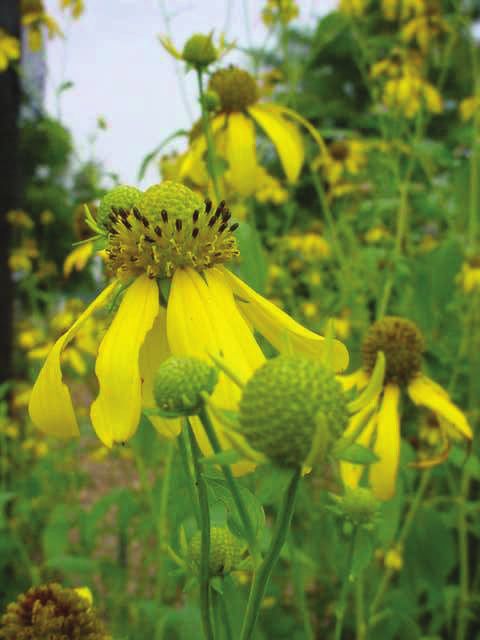
FACU, 7
                         GRASSES & SEDGES                                                WILD RIVER OATS
                                                                                         Chasmanthium latifolium
                                                                               FAC, 5
BIG BLUESTEM                                                                                                                    Full sun-full shade, Dry-mesic
Andropogon gerardii                                                                                                      Flowers Aug.-Oct., 2-3 ft. tall, 2 ft. spread
                                         Full sun-part shade, Dry-mesic                                        This grass has even larger, showier seeds than most
                                   Flowers July-Oct., 4-8 ft. tall, 2 ft. spread                               natives and makes an excellent addition to dried
                      The king of the prairie, this grass will thrive in a variety of                          arrangements. Striking when used along a woodland
                      soil types. The "turkey-foot" flower head is instantly                                   border and will grow underneath black walnuts.
                      recognizable, and the leaves and stem turn bronze-red in
                      late fall for winter interest.                                                                                                              [FAC+], 7
                                                                                         AMERICAN BEAK GRASS
                                                                                         Diarrhena americana
                                                                              [UPL], 8
SIDE-OATS GRAMA GRASS                                                                                                               Part-full shade, Mesic
Bouteloua curtipendula                                                                                                  Flowers June-July, 1-3 ft. tall, 1 ft. spread
                                      Full sun-part shade, Dry-mesic                                           A shade-tolerant woodland grass species of glossy green
                                Flowers July - Aug., 2-3 ft. tall, 1 ft. spread                                broad leaves turns golden for season long interest. The
                      A smaller, shade-intolerant grass that is perfect for a small                            drooping spikelets develop tiny beak-shaped fruit that are
                      home prairie patch, but tolerant of poor soils and black                                 consumed by turkey and other wildlife.
                      walnuts. Noted for its distinctive seed stalks with tiny
                      seeds lining one side of the stem.                                                                                                         FACU+, 6
                                                                                         CANADA WILD RYE
                                                                                         Elymus canadensis
                                                                           FACW+, 5
GRAY'S SEDGE                                                                                                                   Full sun-part shade, Dry-mesic
Carex grayi                                                                                                              Flowers July-Aug., 2-5 ft. tall, 2 ft. spread
                                       Full sun-full shade, Mesic-wet                                          Handsome nodding seed heads in summer turn to a
                                   Flowers May, 2-3 ft. tall, 1 ft. spread                                     golden yellow in fall. Perfect for dry, sunny slope. This
                      If you're considering sedges, this is a spectacular one! It's                            drought hardy cool season, clump forming grass is tolerant
                      green spring flowering head and and brown fall seed head                                 of black walnuts.
                      looks like a medieval mace. Butterflies feed on the foliage
                      and songbirds love the seed.                                                                                                                  UPL, 4
                                                                                         BOTTLEBRUSH GRASS
                                                                                         Elymus hystrix
                                                                              [UPL], 3
ROSE SEDGE                                                                                                                       Part-full shade, Dry-mesic
Carex rosea                                                                                                              Flowers June-July, 2-4 ft. tall, 2 ft. spread
                                         Part-full shade, Dry-mesic                                            The whispy bottlebrush-shaped seed heads appear in
                                  Flowers May, 1 ft. tall, Under 1 ft. spread                                  summer and persist through the fall. Excellent plant for
                      NEW! A fine textured clump sedge of deep green foliage                                   shaded dry areas as a back drop for other woodland
                      in dry woodlands especially along path light openings. Star-                             wildflowers.
                      like seedheads in late spring and are eaten by song birds
                      and not by deer. Naturalizing groundcover adds winter                                                                                      FACW-, 3
                                                                                         VIRGINIA WILD RYE
                      interest in a shade garden.
                                                                                         Elymus virginicus
                                                                            OBL, 1                                                   Part-full shade, Mesic
FOX SEDGE
Carex vulpinoidea                                                                                                        Flowers July-Aug., 2-4 ft. tall, 1 ft. spread
                                        Full sun-part shade, Mesic-wet                                         A cool season clump grass grows well in shade and can
                                  Flowers May-June, 2-3 ft. tall, 2 ft. spread                                 naturalize and stablize woodland slopes. Light green
                      Named for its mid-summer seed heads that resemble                                        stems have dark green, narrow, flexible leaves and
                      foxtails, this sedge features arching, thin, grass-like leaves                           seedheads similar to canada wild rye making it excellent
                      that create a fountain effect. Perfect for a pond edge or                                food and cover for wildlife.
                      other low, wet area. Salt tolerant.
[UPL], 2
PURPLE LOVE GRASS SHRUBS
Eragrostis spectabilis
FACW, 3
Full sun-part shade, Dry FALSE INDIGO
Flowers Sept.-Oct., 1-2 ft. tall, 2 ft. spread Amorpha fruticosa
This deer resistant grass grows in dense tufts low to the Full sun-part shade, Mesic-wet
ground on sandy and poor soil sites. In late summer airy Flowers April-June, 6-10 ft. tall, Up to 12 ft. spread
clouds of soft reddish-purple flowers appear fading to A fragrant purple-flowered shrub of medium height. It
brown that will break away like tumbleweeds. attracts and is host to a number of butterfly species. Its
attractive compound leaves also look great as autumn
FAC, 4 foliage. Great for wet areas, ponds and water gardens.
SWITCH GRASS
Panicum virgatum
FACU+, 6
Full sun-part shade, Dry-mesic PAWPAW
Flowers Aug.-Sept., 4-5 ft. tall, 2 ft. spread Asimina triloba
This lacy-topped native grass is a great alternative to non- Full sun-full shade, Mesic
native ornamental grasses. Switch grass is often used to Flowers April, 15-30 ft. tall, 15-30 ft. spread
enhance habitat and soil conservation. Not as tall as An understory multi-stemmed woodland species that
Indian grass, but they grow well together and adapt to tolerates full sun conditions. Glossy green foliage appears
various soil conditions. as the maroon flowers fade in spring. Small banana-like
FACU-, 5 fruits are favored by wildlife and humans in the falI.
LITTLE BLUESTEM
Schizachyrium scoparium FACU-, 2
Full sun-part shade, Dry-mesic BITTERSWEET
Flowers Aug.-Oct., 2-4 ft. tall, 2 ft. spread Celastrus scandens
A clump-forming, classic prairie grass with fine blue-green Full sun-part shade, Dry-mesic
foliage that turns reddish in the fall. Works well as a Flowers May, Up to 20 ft. tall, 4-6 ft. spread
specimen plant or among a collection of forbs in a Bright orange/red fruit is very popular with wildlife. Differs
naturalistic arrangement. from the more aggressive oriental bittersweet in that the
flowers form at the branch tips. Requires male and female
UPL, 5 plants to set fruit.
INDIAN GRASS
Sorghastrum nutans OBL, 6
Full sun-part shade, Dry-mesic BUTTONBUSH
Flowers Aug.-Sept., 4-7 ft. tall, 3 ft. spread Cephalanthus occidentalis
Large golden seed heads resemble flames when they Full sun-full shade, Mesic-wet
emerge and as they open make a gorgeous late season Flowers June-Aug., Up to 15 ft. tall, 5-8 ft. spread
display. Fast growing and realiable on any well-drained soil. A large wetland shrub that attracts butterflies to spherical,
white flower clusters. It can form a thicket, or can be
pruned for a more formal look. Drooping seeds add winter
[UPL], 8 interest. It can in corporated at a pond's edge or in rich,
PRAIRIE DROPSEED medium garden soils.
Sporobolus heterolepis
FAC, 3
Full sun-part shade, Dry-mesic VIRGIN'S-BOWER
Flowers July-Sept., 2-3 ft. tall, 1 ft. spread Clematis virginiana
A low-growing specimen plant with very numerous thin Full sun-part shade, Dry-mesic
leaves that flow outward from the center like a green Flowers July-Sept., Up to 9 ft. tall, 6-12 ft. spread
fountain. Fanstastic as an edge plant, where it can neatly A showy, semi-woody vine with profuse fragrant white
delineate your native garden. Delicate seed heads add to flowers that develop into plume-like seed heads. Will grow
the fall display. high if supported, or will tumble over the ground. Tolerant
of dry and compacted soils.FACW, 2 FACW-, 5
SILKY DOGWOOD SPICEBUSH
Cornus amomum Lindera benzoin
Full sun-part shade, Mesic-wet Part-full shade, Mesic
Flowers May-June, Up to 12 ft. tall, 6-12 ft. spread Flowers Mar.-Apr., 6-8 ft. tall, 6-12 ft. spread
NEW! White flower clusters in spring attract many An aromatic, deciduous shrub with profuse yellow flowers
pollinators. Blue fruit ripen in late summer/early fall and red that bloom in spring before leaves emerge. Great as a
winter stems are beautiful while also hosting azure replacement for bush honeysuckle. Host plant for Eastern
butterflies and many moth species. It will naturalize and tiger and spicebush swallowtails.
stablize stream and pond banks.
FACU-, 4 FACW-, 4
AMERICAN HAZELNUT NINEBARK
Corylus americana Physocarpus opulifolius
Full sun-part shade, Dry-mesic Full sun-part shade, Mesic-wet
Flowers March, Up to 12 ft. tall, 10-15 ft. spread Flowers May-June, Up to 10 ft. tall, 3-6 ft. spread
A beautiful addition to an edible landscape with dense A thicket-forming deciduous shrub with ball-shaped
foliage and stunning fall color. Mature plants produce clusters of white flowers. As flowers fade the seed pods
hazelnuts, a favorite for people and wildlife. Wind turn pink-red and eventually to golden brown. Exfoliating
pollinated, so plant more than one. bark adds winter interest.
FACW, 10 OBL, 5
SHRUBBY CINQUEFOIL SWAMP ROSE
Dasiphora fruticosa Rosa palustris
Full sun, Mesic-wet Full sun-part shade, Mesic-wet
Flowers July-Sept., Up to 4 ft. tall, 2-3 ft. spread Flowers June-July, Up to 6 ft. tall, 3-4 ft. spread
A small, compact deciduous shrub with yellow flowers that A large, upright, branching rose that likes to get its feet
attract butterflies. One of the longest bloom periods of our wet. Grows well along stream or pond banks with ample
native shrubs. Deer resistant and low-maintenance sun. Very fragant flowers and fruit that is a favorite with
preferring moist soils. birds.
FACU, 3 FACU, 4
EASTERN WAHOO CLIMBING PRAIRIE ROSE
Euonymus atropurpureus Rosa setigera
Part shade, Dry-mesic Full sun, Dry-mesic
Flowers June, 12-20 ft. tall, 15-25 ft. spread Flowers June-July, Up to 12 ft. tall, Up to 10 ft.
Smooth, glossy dark green foliage offers contrast to the spread
woodland landscape. Small dark purple flowers mature to Features long arching canes that can fill a large area with
bright pink-red fruits that are a late fall/ early winter bright lush foliage. Strong-scented flowers emerge late in the
delight. rose season. A favorite for butterflies, this rose also
provides a nesting site for birds.
FACU, 3
SHRUBBY ST. JOHN'S-WORT FACW-, 3
Hypericum prolificum COMMON ELDERBERRY
Full sun-part shade, Dry-mesic Sambucus canadensis
Flowers June-Aug., Up to 4 ft. tall, 3-5 ft. spread Full sun - part shade, Mesic-wet
An attractive specimen shrub with showy masses of ball- Flowers June, 6-12 ft. tall, 6-12 ft. spread
shaped, bright yellow flowers. Dark green leaves and pale A multi-stemmed shrub ideal for moist soils. Large white
orange bark add appeal. Excellent for honeybees and a umbel-shaped blooms cover the shrub in early summer.
host for gray hairstreak caterpillars. The dark purple edible fruits can be used in preserves,
wines and herbal remedies.FACW+, 3
MEADOW-SWEET
Spiraea alba
Land Stewardship at MEEC
Full sun-part shade, Mesic-wet
Flowers June-Aug., 3-6 ft. tall, 3-6 ft. spread MEEC stewards 100 acres at
A native spirea with beautiful white blooms that attract Mount St. John, which includes
butterflies and can be used as cut flowers. The leaves turn the Marianist Nature Preserve,
golden yellow for autumn attractiveness. It requires water, which has been protected by a
so is a natural for boggy areas, water gardens and ponds. conservation easement since
2019. A trail guide is available
FAC, 6
AMERICAN BLADDERNUT at https://meec.udayton.edu.
Staphylea trifolia For directions to the property,
Part-full shade, Dry-mesic select “Visitor information.”
Flowers April-May, Up to 15 ft. tall, 6-12 ft. spread
A thicket-forming shrub with soft, white bell-shaped flowers
The Bro. Don Geiger, SM
in the spring. Ornate Chinese lantern-shaped seed pods
add fall and winter interest. Tolerant of heavy clay, shallow Prairie was planted in 1986 and was our first foray into ecological
rocky soils and drought. restoration. In the past thirty-five years, we’ve developed techniques
to recreate and restore not only eastern tallgrass prairie, but wetlands,
CORALBERRY UPL, 3 oak-hickory-dogwood woodlands and meadows. We share our expertise
Symphoricarpos orbiculatus through a year-round programming schedule, community science
Full sun-part shade, Dry-mesic initiatives and our land steward volunteer program.
Flowers June-July, 2-5 ft. tall, Up to 6 ft. spread
Attractive purplish red berries add interest to a garden Our volunteers help collect and clean seeds, control invasives, transplant
through the fall and winter months. Spreads by runners to natives into the preserve, prepare for the plant sale and manage our
form thickets. Tolerant of dry and clay soils and seldom labyrinth and earthwork plantings. We offer special trainings for stewards
bothered by deer. in the spring and fall. Volunteering is a great way to meet other native
FACU, 4
plant enthusiasts and learn valuable skills you can put to use on your
BLACK-HAW own property. Service learing opportunities for students can also be
Viburnum prunifolium arranged.
Full sun-part shade, Dry-mesic
Flowers April-May, Up to 15 ft. tall, Up to 10 ft.
spread We offer public and custom programs on
A very dense viburnum noted for its fall colors which range
native plants, rain gardens, ecological
from dark green, burgundy, reddish-orange, yellow or restoration, environmental justice,
purple. Creamy white flowers fill the shrub in late spring. sustainability and spiritual development.
Attractive to wildlife as refuge and a food source. To discuss having one of our staff
members speak to your garden club,
church or other group, contact our office.
The Marianist Environmental Education Center
St. Joseph Hall, Mount St. John
4435 E. Patterson Road • Dayton, OH 45430-1095
937/429-3582 • info@meec.center • http://meec.centerGardening with
Native Plants
A 3-part online series
Marianist Environmental Education Center
Restoring communities of land and people.
This series will provide everything
you need to know to get started May 14, 21 & 28
with native plants. MEEC staff will 11 a.m. - Noon
cover the specialized interactions Register for one, two
Tentative 2021 plant sale opportunities
St. Joseph Hall, Mount St. John
that occur between our garden or all three!
Saturday, June 26, 8 a.m. - 1 p.m.
Midwest Native Plant Conference
Saturday, July 24, 9 a.m. - 5 p.m.
plants and the insects that are
Native Plant & Artisan Sale:
Dayton, OH 45430-1095
4435 E. Patterson Road
MEEC Native Plant Sale:
so vital to ecosystem function,
at Mount St. John
what to expect from your native Marianist
plant garden, how to manage Environmental
your landscape to provide year- Education
round habitat, and which plants Center
will perform best in particular
conditions. (937)429-3582
info@meec.center
There is no fee for this series, For map and directions,
but registration is required. For visit https://meec.center
more info or to register, visit and select “visit.”
https://meec.center.You can also read


