QR CODE BASED TECHNIQUE FOR DATA TRANSFER FROM COMPUTER TO ANDROID MOBILE DEVICES - IRJET
←
→
Page content transcription
If your browser does not render page correctly, please read the page content below
International Research Journal of Engineering and Technology (IRJET)                                         e-ISSN: 2395-0056
         Volume: 07 Issue: 06 | June 2020                   www.irjet.net                                             p-ISSN: 2395-0072

 QR CODE BASED TECHNIQUE FOR DATA TRANSFER FROM COMPUTER
                 TO ANDROID MOBILE DEVICES
                                          Kavita S. Kulkarni1, Dr. P. C. Bhaskar2,
       1PG  SCOLAR(CST), DEPARTMENT OF TECHNOLOGY SHIVAJI UNIVERSITY, KOLHAPUR, MAHARASHTRA
          2PROFESSOR       DEPARTMENT OF TECHNOLOGY SHIVAJI UNIVERSITY, KOLHAPUR, MAHARASHTRA
---------------------------------------------------------------------***---------------------------------------------------------------------
Abstract - Data transfer between devices is becoming a                   2. LITURATURE REVIEW
crucial part and nowadays we are having many options to
transfer data to and from devices. Theoretically data transfer           The content discussed in this paper are related to QR code
needs wired or wireless connection between devices. In                   Review, Camera base channel capacity and Data Recognition.
proposed system, we present a differnt camera phone-based V
Barcode technology, which allows users to download content               2.1 QR code Review: The various barcodes like 1D Barcode,
to their camera-enabled android mobile phones. The visual                Line barcode, PDF457, QR Code have various data encoding
content is encoded in a streaming barcode which can be                   techniques. The exposure of smart phones increases the use
decoded efficiently by camera smart phone. Significant work is           of QR code because a smart phone has features of scanning
that content can be reliably transferred through camera                  and decoding a QR code. QR code stands for ‘Quick Response’
anytime and anywhere without any kind of connection                      code. QR codes developed by Denso Wave Corporation in
between computer to Android device. The system does not                  Japan. QR code is a two-dimensional barcode which is able to
requires special hardware, and users do not need to spend                encode more information than one-dimensional barcode.[3]
money for the data plan since it relies on “visual”                      Also, reading of QR codes are fast. There are different
communication. This application allows a user to select any              Methods for improving speed of encoding and decoding.
media file from computer and transfer this file to Mobile phone          Even faster data transfer as pressing needs and there have
just by converting it to QR code sequence and scanning this              been many improvements with high reliability have emerged
sequence.                                                                on the original barcode designs that were made [12]. QR
                                                                         Codes are categorized into five broad categories. The original
Key Words: Quick Response code, Data transfer, Barcode,                  QR Code is QR Code Model 1, a code capable of coding 1,167
Encoder, Decoder, Smart phone, Mobile application, etc                   numerals with its maximum version being 14 (73 x 73
                                                                         modules). [14]QR Code created by improving Model 1 so that
1. INTRODUCTION                                                          this code can be read smoothly even if it is distorted in some
                                                                         way. [14]
Mobile phones are poised to be the world's most pervasive
technology, already outnumbering landlines, personal                     2.2 Camera base Channel capacity: comparing wired or
computers, and even people in some countries. The                        wireless data channels to visual channel i.e. using camera
innovation and growth on the mobile phones front are highly              has normally less capacity. A specially designed images
amazing. The increased use of Smartphone turned them into                needs to be generated for data transfer. An encoder to
a microcomputer which can be used almost for anything. It                generated these images and camera specific module to
allows Creating and Editing of documents, audio, Video and               decode these images need to be developed.[9] To send
presentations. This need data transfer from various devices.             maximum data 2D barcodes plays important role. As images
Most of the Mobile applications are now using Camera of                  are used, colour degradation in images and optimized colour
smart phone as input channel and this made a new and fast                selection protocols need to be considered [7]
trend of information transfer. Nowadays popular application
                                                                         2.3 Data Recognition: Visual communication uses camera
of camera phones is not just capturing the image but to scan
                                                                         and barcode, at the time of acquiring barcode image relative
QR codes shared online for advertisements or printed on
                                                                         movements can induce motion-blur distortions in the
business cards.
                                                                         captured image. This problem can be solved by using
In this system we use similar technique to transfer input file           orthogonal frequency division multiplexing (OFDM)
by scanning sequence of QR code generated of that file and               modulation along with differential phase shift keying
decode it in the original format on scanning device. The                 (DPSK). 2D barcodes are index-based barcodes which
increased ability of camera of smartphones makes this task               internally a data matrix of encoded data.[11]
very easy for the user. Use of QR code makes data
transmission faster and simpler because of its 2D format.
This 2D format again allows to store more data than the
normal one-dimensional barcode.

© 2020, IRJET        |    Impact Factor value: 7.529           |    ISO 9001:2008 Certified Journal            |   Page 3313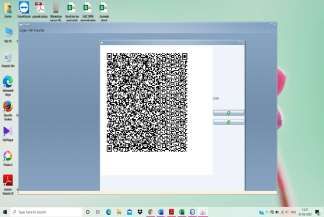
International Research Journal of Engineering and Technology (IRJET) e-ISSN: 2395-0056
Volume: 07 Issue: 06 | June 2020 www.irjet.net p-ISSN: 2395-0072
3. SYSTEM ARCHITECHURE: 3.1 Algorithms
As shown in the block diagram of this System, it
The system can be loosely partitioned into encoding, frame starts with the first module that encodes the file into
display, barcode acquisition, code area detection and sequence of QR codes.
recognition, error correction and their implementation on
mobile devices. Overall, the procedures presented include 3.1.1 Encoding Algorithm for Desktop Application
the following. INPUT: //Decide type of media file to be encoded
MEDIA FILE(Fm), PACKETSIZE (Ps)
• Design of the QR code symbology by considering the OUTPUT: Sequence of QR code Image.
specifics of various devices. Begin:
• Development of an encoder so that any data stream can be 1: Select Media file to be decoded.
encoded as a QR code sequence. 2: Read file_name and Packet size
• Development of display module which can display QR code 3: IF Fm not Exist THEN Generate Error Massage
on flat panel displays. Else Create Array of Strings
Development of components for acquisition and 4: Read data from file [Packet size] to Buffer
processing of QR code images, including a user interface, 5: Encode Buffer to Hex Values.
acquisition and image-enhancement components. This can 6: Covert Hex_values to String
include image detection, normalization, decoding. 7: Add String to ArrayList
• Decoding the captured QR code frame by frame and 8: Repeat step 4 to step 7 until end of the file
reconstruct the data encoded. 9: FOR All strings S in array
• Integrating all of the algorithms onto the mobile device. We APPEND file_info to Array[string]
propose a preliminary user interface, developed integrated 10: End For
software on mobile devices, and optimized code for best 11: FOR all Strings S in array
resource utilization. Generate QR Code ()
12: End FOR
13: Display QR code Sequence
Encoding (QR Image
Media File 3.1.3 QR code Acquisition by Mobile Camera
Generation)
Analyze Conversion The acquisition of QR code are constrained by the size of an
Unicode to Hex Code encoded image and rate of display the sequence of these
Data
aracters images. Here Camera specification of the device and user
Processing
movements during capturing the image performs major role.
Chunks Creation of Conversi The process, however, must optimize performance by
Creation Segment on of Hex balancing the acquisition speed, image resolution, and
to Byte processing requirements.
QR generation 3.1.3 Decoding Algorithm for Mobile Application
INPUT: Sequence of QR code Images
//scanned using camera of smart phone.
Decoding (QR Image QR Code OUTPUT: Original Media file
Generation) Mobile Display (Loop)
Begin:
QR Image Collecting 1: Create a Buffer //to store the scanned data
Processin Image 2: Create an Empty File
Sequence QR CODE
g 3: Loop till user exit
Original Acquisition a) Scan QR header Section
Media (Mobile b) Set error correction bits
Converting
File Camera) c) Scan QR Data Section
byte to HEX
d)Read data Section into buffer
e) Convert Hex Value to Byte
Figure 1: Basic System architecture f) Extract File name
g) Extract Data part into blocks as per image.
h) Save data blocks in to created file
4: Combine all data blocks file into one Main file
5 Validate the data
© 2020, IRJET | Impact Factor value: 7.529 | ISO 9001:2008 Certified Journal | Page 3314International Research Journal of Engineering and Technology (IRJET) e-ISSN: 2395-0056
Volume: 07 Issue: 06 | June 2020 www.irjet.net p-ISSN: 2395-0072
6: Display original file on Device. 4.2 QR Decoder
4. IMPLEMENTATION
Decoder is an android application (mobile application)
In encoding of the file into QR Code the data is encoded in which can run on any Android smartphone. Before decoding,
different frames. In each frame, the first byte indicates its each captured frame needs to be corrected, enhanced, and
frame type. Data partitioning and Error correction is converted into a binary sequence.
required to while framing the data.
1. Image Processing: The application works efficiently to
4.1 QR Encoder: meet the real-time requirement. The following are the
challenges when processing the detected image.
Encoder of this system is developed as a desktop application a) Perspective distortion: when users capture the image, it
using Java Language. This application allows to choose any is not guaranteed that the camera image plane is parallel to
file (Audio, Video, Image, PDF etc). the display plane. Perspective distortion is inevitable. The
To encode a data file into a QR Code, we first need to split the Square boundary box appears as a border.
data file into small segments, and then encode each segment b) Uneven lighting: Parts of the image are darker than
into an image sequence. This scheme is straightforward but, other parts.
the challenge is to make the encoding robust to the 2. Binarization: This part converts the processed image
degradation and data loss which is inevitable in the imaging into binary values which will further be converted into
process. original data form. For M × N Matrix computer sample M×
1. Dividing data into small chunks each of which is further N coordinates on the image and read their gray scale values.
divided into individual frames which forms three layers.
Each chunk can be visualized as cube which consists of The decoder tries to decode every single frame it “sees”
three areas: data area, inter and intra frame error through the camera. To guarantee that the frame is read
correction areas. The data file to be encoded is filled into correctly, the first byte is used as a verification byte which
this “Data Cube”. must be 0x10, 0x2x or 0x30 indicating Type I, II or III,
respectively, to be accepted as a valid frame. For Type I, it
will decode all other bits in this frame and show it as a pop-
up message.
After completion of the decoding the file is stored at basic
Android directory of device.
5. EXPERIMENTS AND RESULTS
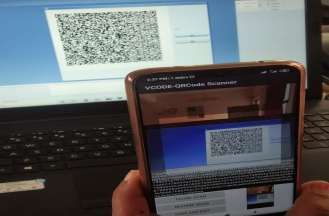
Figure 2. Data chunks QREncoder: -This desktop application generates a series of
2. Error correction coding is done while partitioning data QR codes for a single file. For testing the working of Encoder
into 3 dimensions K*W*H where K is frame number, W following 4 test sample files are considered. It generates
and H are the width and height of each frame. Error different number of QR codes shown in the Table 2 and
correction in inter and intra frames is done by padding images. Table provides data about file, its size and number of
error control bits in frames. QR codes generated after encoding. The number of bytes for
3. QR code rendering that is converting each frame encoding each packet are 400 bytes.
(including error correction frames) into an image, which
can be displayed on flat screens. Table 1: Encoding Test samples
4. QR code acquisition – The acquisition process itself is
very simple: Users only need to aim the camera at the QR Sr.no Test samples Size Encoded
Code to keep the frames at the center of the display. QR Image
Detection and decoding will occur at frame rate. For each 1 teddy-small-size- 40KB 54
frame, the first type indicates its frame type. 500x500
Type I – Static Single Frame: the following bytes encode 2 Sample Videos - 64KB 289
the message body as a null-terminated string. Dummy Videos For
Type II – Sequence Header: this is a unique frame for Demo Use
sending data file in hand-held mode and dock mode. This
frame encodes the file name and size. 3 IPhone Note 72KB 188
Type III – Data Frame: this frame encodes a chunk of SMS(Audio)
data beginning with its offset and chunk length. Since 4 NOTICES FOR 72KB 178
each frame carries with its own offset and chunk length, BARCODE4J(PDF)
the reading order of the frames has no importance.
© 2020, IRJET | Impact Factor value: 7.529 | ISO 9001:2008 Certified Journal | Page 3315International Research Journal of Engineering and Technology (IRJET) e-ISSN: 2395-0056
Volume: 07 Issue: 06 | June 2020 www.irjet.net p-ISSN: 2395-0072
If packet size is low like 100 or 200 bytes for single QR code QRDecoder: - This is an android application which is
generation the for-sample file then it generates more QR installed on the following testing devices which have
codes and if it is high e.g. 400 or 500 then encoder generates different camera specification as well as processor. For
a smaller number of QR codes. Example is shown in Decoding QR code image – QRDecoder uses rear camera of
following Table 2. the mobile. Following Table 3 shows the specification of
mobile phone used for testing.
Table 2: Encoding of Images with packet size 200
Table 3: Test device specification
File Encoded Test Device Camera Spec. Device name
Sr.no Test samples
size QR
teddy-small-size- Device 1 48.0 MP + 12.0 MP Samsung
40KB 194 + 5.0 MP + 5.0 MP Galaxy A51
1 500x500
Sample Videos - Device 2 12 MP, f/2.0 Moto 5g plus
Dummy Videos for 64KB 577 Device 3 12MP+5MP Asus
2 Demo Use Zenphone Max
Pro M2
IPhone Note
72KB 360 Device 4 12MP AI camera Redmi 7A
3 SMS(Audio)
NOTICES FOR To validate results of decoder same test samples are used as
72KB 355
4 BARCODE4J(PDF) mentioned in table no 2. When a series of QR code of same
test file is being decoded on different smart phones, it
By comparing Table 1 and Table 2 it is seen that as packet requires different time to complete scanning and decoding.
size varies number of QR code images created also varies as This is because of the camera specifications of the test
well as the type of file also a considerable element while devices as well as processing speed. The next table shows
creating QR codes. the time required to perform scanning and decoding of each
file on each device.
Results of Encoder:
Table 4 : Decoding Time for file.
Table 4 shows that the device with high camera specification
captures image fast and decoding time required is less than
other low cameras. It is observed that when a file is encoded
with minimum number packet size, decoding becomes faster
but number of QR code generated are more. The encoder
works similar for each file, while result of scanning and
decoding of series of QR code is different for each decoding
device. This difference is due to camera quality and handling
of camera to scan the QR code.
© 2020, IRJET | Impact Factor value: 7.529 | ISO 9001:2008 Certified Journal | Page 3316International Research Journal of Engineering and Technology (IRJET) e-ISSN: 2395-0056
Volume: 07 Issue: 06 | June 2020 www.irjet.net p-ISSN: 2395-0072
Results of decoder: Transmission in Mobile Devices", IEEE Transactions on
Multimedia, | Volume: 17, Issue: 1 | Journal Article, Year:
2015
5. Xu Liu, David Doermann, Member, IEEE, and Huiping Liu
“VCode – Pervasive Data Transfer Using Video Barcode",
IEEE TRANSACTIONS ON MULTIMEDIA, VOL. 10, NO. 3,
APRIL 2008
6. Imaging as an Alternative Data Channel for Camera
Phones Xu Liu 1 ∗ David Doermann Huiping Li MUM’06,
December 4-6, 2006, Stanford, CA, USA
7. A Camera-based Mobile Data Channel: Capacity and
Analysis Xu Liu, David Doermann and Huiping Li MM’08,
October 26–31, 2008, Vancouver, British Columbia,
Canada
8. Camera-based barcode recognition: United States Patent
7172124
9. Pooja Shejwal, Amita Wankhede, Vivek Shimpi, Ajit Wale,
Prof.A.D.Sawant, “A Survey on Existing Barcodes and
Barcode Generation Techniques”, (IJCSIT) International
Journal of Computer Science and Information
Technologies, Vol. 7 (5) , 2307-2310, 2016,
10. Anusree Jayadhar, Sajin Salim “Secure Data Transmission
using Barcodes in Mobile Devices “
11. Pervasive 2D Barcodes for Camera Phone Applications
Hiroko Kato Edith Cowan University Keng T. Tan Edith
Cowan University IEEE Pervasive Computing ( Volume:
6 , Issue: 4 , Oct.-Dec. 2007 )
12. Xu Liu, David S. Doermann, Huiping Li: Imaging as an
alternative data channel for camera phones. MUM 2006:
5
13. S. Tiwari, "An Introduction to QR Code Technology," 2016
International Conference on Information Technology
6. CONCLUSION
(ICIT), Bhubaneswar, 2016, pp. 39-44, doi:
10.1109/ICIT.2016.021.
In this paper, a novel scheme for data transfer between
14. Vinit Kumar and Manish Kumar Dubey “ENCRYPTED QR
computer to mobile phone is demonstrated. This consist of
CODE GENERATOR”, International Journal of Recent
QREncoder and QRDecoder which are briefly described. This
Scientific Research Vol. 10, Issue, 06(C), pp. 32854-
system will help to transfer data without using any existing
32856, Jun, 2019
wired or wireless channel. The experimental result shows
that the system works robustly during entire process. The
major part focused in this approach is introducing mobile
camera as a data channel.
REFERENCES
1. D. Wu and Y. Wu, "Covert Communication via the QR
Code Image by a Data Hiding Technique Based on
Module Shape Adjustments," in IEEE Open Journal of the
Computer Society, doi: 10.1109/OJCS.2020.2984473.
2. Protection and Hiding Algorithm of QR Code Based
on Multi-channel Visual Masking 2019 IEEE Visual
Communications and Image Processing (VCIP),1-4, Dec.
2019
3. Sangeeta Singh “QR Code Analysis”, IJARCSSE, Volume 6,
Issue 5, May 2016 ISSN: 2277 2016,
4. Amin Motahari, Member, IEEE, and Malek Adjouadi,
Member, IEEE “Barcode Modulation Method for Data
© 2020, IRJET | Impact Factor value: 7.529 | ISO 9001:2008 Certified Journal | Page 3317You can also read


