Reference Guide for Nurses in Prevention Of Patient Fall - Fall Prevention Is the Responsibility of All Healthcare Workers
←
→
Page content transcription
If your browser does not render page correctly, please read the page content below
MOH/P/BKT/2.18(GU)

Reference Guide for
Nurses in Prevention
   Of Patient Fall

              Patient’s Safety
              is our Priority

Fall Prevention Is the Responsibility of
       All Healthcare Workers

             BAHAGIAN KEJURURAWATAN
          KEMENTERIAN KESIHATAN MALAYSIA

                    March 2018
REFERENCE GUIDE FOR NURSES IN PREVENTION OF PATIENT FALL
l. INTRODUCTION
World Health Organisation places great emphasis on Patient Safety and launched the
World Alliance for Patient Safety in 2004. Malaysia adopted this programme in May 2006
and become one of the pioneer members of this global effort to enhance Patient Safety
which is now an ongoing responsibility of all hospital staff.
As quoted by our Director-General of Health Malaysia in his “Forward” in the Malaysian
Patient Safety Goal Guidelines on Implementation & Surveillance book, 1 st Edition 2013:
“Safety is everyone’s business! Let us all work together in the spirit of teamwork and
learning to make our health care system a safer one in 2013 and beyond. Success does not
consist in never making mistakes but in never making the same one a second time.”
The Patient Fall Prevention Program is to be practiced across all hospital areas and help
safeguard patients, visitors and staff. Failure to maintain a safe and conducive environment
can put any of these people at risk for fall. Thus, implementation of Fall Prevention Program
requires training all hospital staff who interact with patients to reduce the risk of patient
injuries due to a fall. The hospital staff especially nurses, will need to assess and reassess the
patient’s level of risk for fall to ensure that his/her patients are safe during their stay in the
hospital.
ll. OBJECTIVES
To identify patients who are at risk of fall
To prevent any fall incidences from occurring
To implement preventive strategies
lll. PURPOSE
A process exists to prevent patient falls by:
i) establishing a consistent mechanism to identify patients who are at risk for a fall
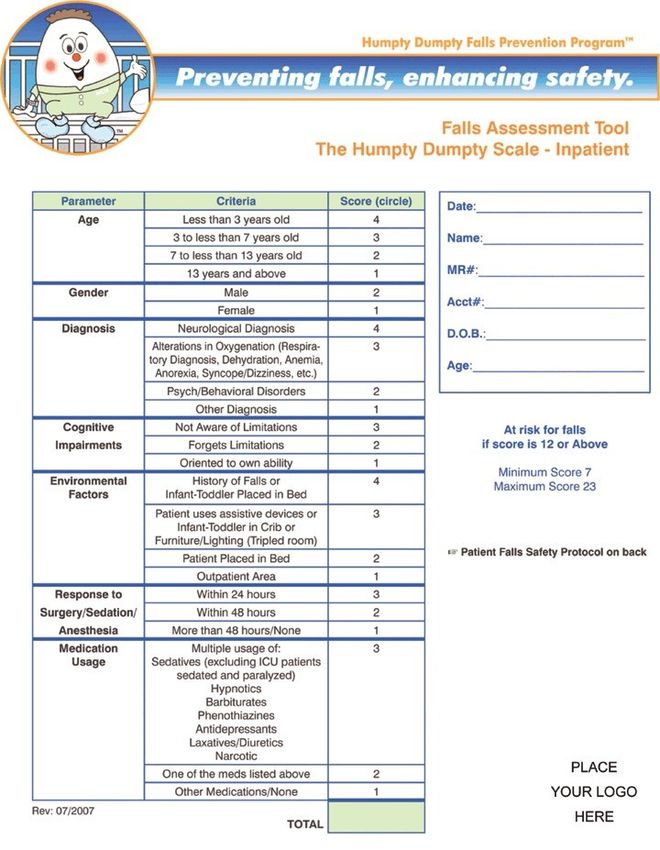
upon admission using the Morse Fall Scale Assessment Chart (BKJ-BOR-PPK-Fall 2
Pind.1/2018) and the Humpty Dumpty Fall Risk Assessment Chart for Paediatric
(BKJ-BOR-PPK-Fall 6 pind.1/2018).
ii) providing an on-going assessment to those patients identified as a fall risk
utilising the Daily Morse Fall Scale Assessment Chart and the Humpty Dumpty Fall
Risk Assessment Chart for Paediatric.
iii) establishing a comprehensive standard of care for the initiation of appropriate
safety measures and interventions.
March 1, 2018 1REFERENCE GUIDE FOR NURSES IN PREVENTION OF PATIENT FALL
lV. DEFINITION
Fall : A patient fall is witnessed or un-witnessed unplanned descent to the floor (or
extension of the floor, e.g. trash can or other equipment) with or without injury to
the patient. All types of fall are to be included whether it is from physiological
reasons(fainting) or environmental reasons (slippery floor). This would include
assisted falls such as when a staff member attempts to minimize the impact of the
fall by easing the patient’s descent to the floor or by breaking the patient’s fall.
(NCPS Concept Dictionary)
CLASSIFICATION OF FALL :
Accidental Fall: Fall that occurs unintentionally (e.g. Slip, trip). Patients at risk for
these falls cannot be identified prior to a fall and generally do not score are risk for
falling on a predictive instrument. These falls maybe prevented through providing a
safe environment.
Unanticipated Fall: Fall that occurs when the physical cause of the fall is not
reflected in the patient’s assessed risk factors for fall.
Anticipated Fall: Fall that occurs in patient whose risk factor score indicated the
patient is at risk of falling.
Near fall: An event in which a person feels a fall is imminent but avoids it by
compensatory action, such as grabbing a nearby object or controlling the fall.
(Medical Dictionary)
Factors which may increase risk for fall:
Fear of falling
Transient ischemic attack
Parkinson’s disease
History of fracture
Musculoskeletal deformities or myopathy
Bowel/bladder incontinence/frequent toileting
Auditory impairment
Dehydration
Previous fall
Use of restraints
Difficulty understanding /retaining instructions
Cardiac arrhythmia
Stroke
Delirium/agitation
Depression
Mobility/gait impairment
Visual impairment
Dizziness
Hypoglycaemia
March 1, 2018 2REFERENCE GUIDE FOR NURSES IN PREVENTION OF PATIENT FALL
Multiple medications
Receiving laxatives and or diuretics
V. PROCEDURE
1. The registered nurse will screen every patient for potential fall risk upon admission
/transferred in by utilizing the Morse Fall Scale Assessment Chart (BKJ-BOR-PPK-Fall 2
Pind.1/2018) and the Humpty Dumpty Fall Risk Assessment Chart for Paediatric (BKJ-
BOR-PPK-Fall 6 pind.1/2018).
2. Each patient will be reassessed on daily basis.
3. Reassessment must be completed if there is a change in the patient’s mental status
or physical condition.
Vl. INSTRUCTION FOR COMPLETION OF THE DAILY FALL RISK ASSESSMENT FORM
1. The nurse will evaluate the patient by scoring each of the “AT Risk” criteria the
patient presents. With the total score of the assessment, along with the nurse’s
clinical judgement, will conclude the patient’s level of risk for fall. Should the nurse
based upon her clinical judgement chooses to deviate from the risk level determined
by the fall risk assessment, he/she must document in the patient chart the reason
which supported his/her decision.
2. The nurse will then identify and adhere to the “Fall Prevention measures” based
upon:
a. Identified Level of Risk
b. Individualized patient needs and limitations
c. Patient’s history of fall and use of safety devices
d. Daily Clinical Assessment
3. The Fall Prevention Measures for patients at either low, moderate or high risk must be
implemented and appropriate equipment required must be utilised.
4. Documentation will be done in the Daily Fall Risk Assessment Forms for adult and
Paediatric and in patient’s case notes.
5. Communication: Each patient’s assessed data risk for fall will be communicated at
every shift through end- of- shift report.
6. Reassessment:
a. All patients, regardless of fall risk will be reassessed daily while the patient is
awake.
b. Any change in the patient’s level of risk will be recorded into the Daily fall Risk
Assessment Forms and the patient’s casenotes.
March 1, 2018 3REFERENCE GUIDE FOR NURSES IN PREVENTION OF PATIENT FALL
VIl. FALL PREVENTION MEASURES FOR ALL PATIENT REGARDLESS OF RISK
1. Orientate patient to environment.
2. Position call bell, urinal/commode/bedpan if applicable, and bedside table within
patient’s reach.
3. Keep walkways free from obstruction / spillage
4. Keep all electrical cords from equipment away from walking areas.
5. Place bed in lowest position with brakes locked (specialty low beds are to be kept at
a height of 25” or less from the floor to the top of the mattress)
6. Determine the safest use of bed side rails.
7. Patient is to wear non- skid footwear whenever out of bed.
8. Make sure that night lights are turn on in patient’s room or near patient’s bed for an
open ward during evening rounds.
9. Place patient’s things of need within easy reach.
10. Assist patient with toileting as appropriate.
11. Evaluate effectiveness of medications that predispose patients to fall
(sedatives/hypnotics, anti-hypertensives, diuretics, benzodiazepines, skin ointment
etc.) and consult with doctor and pharmacist as needed.
12. Collaborate with doctor regarding the need to obtain Physio or Occupational Therapy
for patient with gait, balance problems or where there is a decline in functional
activity.
13. Reassess patient’s ambulatory status daily.
14. Monitor for Orthostatic Hypotension if patient complain of dizziness or vertigo and
teach patient to rise slowly when getting in and out of bed.
15. Encourage use of assistive devices (i.e. walker / wheelchair and cane) as appropriate.
16. Provide health education on fall prevention measures to patients and families.
VIII. FALL PREVENTION MEASURES FOR MODERATE AND HIGH RISK PATIENTS
These additional Fall Prevention Measures will be initiated for all patients identified
as either moderate or high risk for fall immediately upon admission to the ward.
a. Use a signage in or outside the patient’s room or bed head to identify the
patient at risk for falls.
b. Relocate patient’s bed closer to nurse’s station, if possible.
c. Check patient at least hourly and maintain close supervision.
d. Ensure that all times, unless bedside care is being provided, patient’s bed is in
the lowest position and the 2 bedside rails are put up.
e. Ideally offer toilet visits every 2 hourly or PRN.
f. Reinforce activity limits and safety precautions with patient and family
members.
g. Nursing Staff will need to notify family members to obtain footwear and
ambulation equipment from home (i.e. walker, cane) when applicable.
March 1, 2018 4REFERENCE GUIDE FOR NURSES IN PREVENTION OF PATIENT FALL
h. Assess the need for physiotherapy or occupational therapy consultation.
i. Assess patient’s gait daily and document in the Risk fall assessment Chart and
patient’s case note.
j. Ensure that patient is assisted at all times when ambulating.
k. Ensure that patient safety devices identified on the Prevention Fall Risk Plan
are in use and functioning properly.
lX. IN THE EVENT OF A PATIENT FALL, WITH OR WITHOUT INJURY:
The staff member who discovered the fall will attend to the patient’s immediate
needs:
a. A nurse will assess the patient immediately and notify the ward sister or sister on
call.
b. The attending doctor will be promptly notified to determine the need for further
evaluation.
c. The nurse follows the doctor’s treatment orders post-fall and implement the
nursing care according to the patient fall care plan.
d. Move the patient closer to the nurse’s station if a bed is available and put up
bedside rails.
e. If the patient is demonstrating some degree of cognitive impairment, utilize a bed
alarm or call bell system.
f. Neurological checks and vital signs as ordered or appropriate for injury(GCS
score).
g. Patient is to be observed closely with assistance for the first 24 hours then
reassess.
h. With the patient’s consent or in the event the patient has a legal guardian or the
patient’s family will be notified of any patient fall, including injuries in a timely
manner.
i. The fall will be documented in patient’s case note and Incident Report Form
(IR2.0/2017)
j. The nurse who witness the patient fall or found patient after a un-witness fall will
complete an incident report and send to the Ward Sister. The ward sister will
then send the incident report to the Incident Report Committee/ Coordinator
collecting the Incident Report for the hospital.
k. Teaching about falls and safety measures will be reinforced to patient/family as
needed.
l. Patient ‘s fall risk will be reassessed utilizing the “Daily Morse Fall Scale
Assessment Chart”(BKJ-BOR-PPK-Fall 2 Pind.1/2018)or “Humpty Dumpty Fall risk
Assessment Scale Chart (Paediatric)(BKJ-BOR-PPK-Fall 6 Pind.1/2018)
immediately after the fall and identifying appropriate interventions and the
needed safety devices for use.
*Note
Please refer the Bahasa Malaysia version on Tindakan Kejururawatan Selepas Kejadian Jatuh from
the Malaysian Patient Safety Goal Guideline (Nurses Roles And Responsibilities). Nursing Division,
st
Ministry of Health Malaysia. 1 Edition June 2015
March 1, 2018 5REFERENCE GUIDE FOR NURSES IN PREVENTION OF PATIENT FALL
HOW TO USE THE MORSE FALL SCALE
RISK ASSESSMENT TOOL
Every patient will be assessed:
On admission
Daily on the morning shift
When patient’s condition changes or there has been a change in the patient’s
medication regimen that could put the patient at risk for a fall.
When a patient is transferred to another unit.
After a fall
1. History of Falling:
If the patient has fallen during the present admission or there was an immediate history of
physiological falls, such as syncope or impaired gait within the past 3 months, score 25. If
the patient has not fallen, score 0.
2. Secondary Diagnosis:
If the patient has more than one medical diagnosis and is active for current admission, score
15; if only 1 active medical diagnosis or more, score 0.
3. Ambulatory Aid:
If patient is clutching on the furniture for support, score 30. If the patient uses crutches,
cane or walker, score 15.
If the patient walks without walking aid or uses a wheelchair or is bed rest and does not get
up at all, score 0.
4. Intravenous Therapy/ IV devices:
If patient has intravenous therapy attached to an equipment, score 20; if none score 0.
5. Gait:
If patient had an impaired gait; has difficulty rising from a chair, uses the arms of the chair to
push off, head is down, eyes focus on the floor, uses moderate to heavy assistance for
balance through use of furniture, persons or walking aids and steps are short or shuffled,
score 20.
If patient walks with a weak gait; patient is stooped; unable to lift head without losing
balance or support is required with limited assistance and steps are short and shuffled, score
10.
If the patient walks with a normal gait, score 0.
March 1, 2018 6REFERENCE GUIDE FOR NURSES IN PREVENTION OF PATIENT FALL
6. Mental status:
Identifying the patient’s self assessment of his/her ability to walk. If the patient over
estimates his/her physical ability ,score 15.
If the patient’s assessment is consistent with his/her ability, score 0.
MORSE FALL RISK ASSESSMENT CHART
Risk Factor Scale Points Patient’s
Score
Yes 25
History of Falls No 0
Secondary Diagnosis Yes 15
(Two or more medical No 0
Diagnosis/ co-morbid)
Furniture (Patient walks 30
clutching onto furniture)
Ambulatory Aid
Crutches/Cane/Walker 15
None/Bedrest/Wheelchair/ 0
Nurse assisted
IV Therapy/ IV device Yes 20
No 0
Impaired 20
Gait Weak 10
Normal/Bedrest/immobile 0
Mental Status Forgets Limitations 15
Orientated to own ability 0
TOTAL :____________
High Risk = > 45 and higher
Moderate Risk = 25 – 45
Low Risk = 1- 24
No Risk = 0
Adopted Source: Morse, J.M(1997). Preventing Patient falls. Thousand Oaks: Sage Broda. 1999Safety Operating Instruction
March 1, 2018 7REFERENCE GUIDE FOR NURSES IN PREVENTION OF PATIENT FALL
https://www.researchgate.net/figure/Humpty-Dumpty-Tool-and-Protocol_fig1_23930742 .Retrieved on 9th March 201
March 1, 2018 8REFERENCE GUIDE FOR NURSES IN PREVENTION OF PATIENT FALL
Definitions to Assist in Grading the Humpty Dumpty Falls Assessment Scale
The Humpty Dumpty Falls Assessment Scale requires nursing judgment and individualization
to each patient.
Age- Parameter can be based on chronological or developmental age of the patient.
Gender- Self explanatory
Diagnosis- (Associated symptoms that put patient at risk for falls)
If the patient has multiple, secondary or underlying diagnosis then the score is based
on the highest acuity diagnosis. (example- a sickle cell patient with history of strokes
or seizures would receive the higher neurological score)
Examples of diagnosis include but are not limited to-
o Neurological- seizures, head traumas, hydrocephalus, cerebral palsy, etc. This
would include patients being worked up for neurological diagnosis.
o Alterations in oxygenation- This category encompasses any diagnosis that can
result in the decrease in oxygenation to the brain or a decrease in oxygen
carrying
ability of the red blood cells. Alteration in oxygenation goes beyond respiratory
diseases and may include dehydration, anaemia, anorexia and syncope.
o Psychiatric/Behavioural disorders- can include mood disorders (major
depression, bi-polar disorder) and impulse control disorders eg. ADHD (attention-
deficit/hyperactivity disorder)
o Other diagnosis- anything that does not fall into the other categories (examples
include but not limited to cellulites, orthopaedics)
Cognitive Impairments- (1- Awareness of one’s ability to function and perform ADLs; 2-
Not necessarily based on age rather on physiologic components that affect cognitive
awareness)
o Not aware of limitations- Can be any age group and is dependent on
inability to understand the consequences to their actions. (Example- severe
head trauma, infancy)
o Forgets limitations- Can be any age group. The child has the ability to be
aware of their limitations however do to the factors such as age, diagnosis,
current presenting symptoms, or current alteration in function (such as
weakness or hypoglycaemia) the child forgets their limitations. Can include
children prone to temper tantrums.
o Oriented to ability- Able to make appropriate decisions, understanding
consequences of actions.
March 1, 2018 9REFERENCE GUIDE FOR NURSES IN PREVENTION OF PATIENT FALL
Environmental Factors -
o History of Falls- during admission or previous admission.
o Infant/toddler placed in bed- Inappropriate placement of infant/toddler in a
bed versus a proper placement in a crib.
o Patient uses assistive devices- includes but not limited to crutches, walkers,
canes, splints.
o Infant/toddler in crib- appropriate crib placement.
o Furniture/Lighting- multiple pieces of furniture or pumps/low lighting in the
room.
o Patient placed in bed- appropriate bed placement.
o Outpatient area - in-patient receiving services in an outpatient area.
Response to Surgery/Sedation/Anaesthesia- Patient received one within in the allotted
time frames. No including bedside procedures without anaesthesia.
Medication Usages- Purpose of this section is to identify patients who may be at risk for
alteration in level of consciousness due to medications that affect cognitive awareness.
Medications that are included in any for the medications categories are included,
including seizure medications.
https://www.nicklauschildrens.org/NCH/media/docs/pdf/Nursing/HDFS-definitions-
cheat-sheet.pdf. Date retrieved on 8/3/2018
March 1, 2018 10REFERENCE GUIDE FOR NURSES IN PREVENTION OF PATIENT FALL
APPENDIX 1
CARTA ALIRAN PENGENDALIAN PESAKIT BERISIKO JATUH
MULA
Pesakit masuk wad
Penilaian pesakit (grading)
Risiko rendah Risiko Sederhana Risiko tinggi
( MFS 1-24 ) ( MFS 25-45 ) ( MFS >45 )
Pasang Signage Putih Pasang Signage kuning Pasang Signage Merah
Implemen Tindakan
Kejururawatan Risiko Pesakit
Jatuh
Orientasi dan pendidikan kesihatan
kepada pesakit dan waris
Penilaian semula mengikut
keadaan pesakit.
Dokumentasi
Serah tugas syif ke syif
Hingga pesakit discaj
TAMAT
March 1, 2018 11REFERENCE GUIDE FOR NURSES IN PREVENTION OF PATIENT FALL
APPENDIX 2
SIGNAGES TO USE FOR PATIENT WITH RISK FOR FALL
SIGNAGE RISIKO PESAKIT JATUH - RENDAH
Morse Fall Scale - skor 1 - 24
SIGNAGE RISIKO PESAKIT JATUH - SEDERHANA
Morse Fall Scale - skor 25 - 45
SIGNAGE RISIKO PESAKIT JATUH - TINGGI
Morse Fall Scale - skor > 45
March 1, 2018 12REFERENCE GUIDE FOR NURSES IN PREVENTION OF PATIENT FALL
APPENDIX 3
FLOW CHART FOR DATA COLLECTION
START
FALL
Fill up incident
Reporting Form
Investigation by ward Sister, Area Matron
& HOD
- e-R 2.0 Incident Reporting Form
- BKJ-BOR-PPK-Fall 3 Pind.1/2018
Chief Hospital Matron/ Quality
Unit Hospital
BKJ-BOR-PPK-Fall 4 Pind.1/2018
Nursing Division, KKM
Completed
March 1, 2018 13REFERENCE GUIDE FOR NURSES IN PREVENTION OF PATIENT FALL
APPENDIX 4
BKJ-BOR-PPK- Fall-1(Pind.1/2018
BAHAGIAN KEJURURAWATAN
KEMENTERIAN KESIHATAN MALAYSIA
SENARAI SEMAK KEJURURAWATAN SEMASA KEMASUKKAN PESAKIT YANG
BERISIKO JATUH
NAMA : RN:
BIL PERKARA ADA TIADA
(√) (X)
1. Melakukan penilaian pesakit dengan menggunakan Nursing Assessment On
Admission For Adult or Pediatric :
- BKJ-BOR-PPK-20 Adult (Pind.1/2016)
- BKJ-BOR-PPK-21 Pediatric (Pind.1/2017)
2. Grading pesakit mengikut tahap risiko berpandukan jumlah Morse Fall
Score - sama ada Low Risk - warna Putih, Moderate Risk – Warna Kuning
atau High Risk - warna merah (Rujuk Appendix 2)
3. Menempatkan pesakit di atas katil berpagar di kubikel yang berdekatan
dengan kaunter jururawat dan memastikan pagar sentiasa dinaikkan jika
pesakit berada di katil .
4 Letakkan signage yang bersesuian di dinding dekat kepala katil pesakit untuk
makluman kepada semua anggota jururawat semasa mengambil alih
tugas.
5. Memberi penerangan tentang risiko jatuh kepada pesakit dan penjaga :
i) Jangan tinggalkan pesakit berseorangan dan beritahu jururawat bertugas
sebelum penjaga balik ke rumah atau keluar urusan lain.
ii)Pastikan loker dan keperluan pesakit diletak berhampiran dengan katil
pesakit.
iii) Jangan tinggalkan pesakit yang berisiko atas kerusi berseorangan.
iv) Panggil Jururawat untuk bantuan apabila diperlukan untuk turun dari
katil.
v) Menggalakan ahli keluarga bersama pesakit bagi kes-kes yang berisiko
tinggi.
6. Jururawat melakukan pemerhatian bagi pesakit yang berisiko dengan
menggunakan borang BKJ-BOR-PPK- fall 2(pind.1/2018) (Adult) & BKJ-
BOR-PPK-Fall 6 Pind.1/2017(Paeds)
7. Menggunakan restrainer (dengan consent daripada waris pesakit ) pada
pesakit yang gelisah
8. Dokumentasikan dalam BHT
*Diisi oleh Ketua Jururawat Wad /Penyelia Jururawat kawasan semasa membuat audit
March 1, 2018 14REFERENCE GUIDE FOR NURSES IN PREVENTION OF PATIENT FALL
APPENDIX 5
BKJ-BOR-PPK-Fall 6 Pind.1/2018
BAHAGIAAN KEJURURAWATAN
KEMENTERIAN KESIHATAN MALAYSIA
HUMPTY DUMPTY FALL RISK ASSESSMENT SCALE CHART (PAEDIATRIC)
Name: Age:
RN No: Ward:
PARAMETER DATE
TIME
AGE SCORE SCORE SCORE SCORE SCORE SCORE SCORE SCOREREFERENCE GUIDE FOR NURSES IN PREVENTION OF PATIENT FALL
APPENDIX 6
BKJ-BOR-PPK-Fall 2(Pind.2/2018)
BAHAGIAN KEJURURAWATAN
KEMENTERIAN KESIHATAN MALAYSIA
DAILY MORSE FALL SCALE ASSESSMENT CHART
NAME: REG WARD:
NO.:
DIAGNOSIS: Age: ADMISSION DATE:
DATE
ITEMS TIME
SCORE
History of Fall
No history of fall 0
Fall (immediate or within 3 25
months)
Secondary Diagnosis
If only 1 active medical diagnosis 0
Secondary diagnosis ≥2 medical
diagnosis in chart 15
Ambulatory Aids
None/Bedrest/Nurse assisted 0
Crutches/cane/walker 15
Furniture/patient on stretcher 30
trolley or wheelchair
IV Therapy / IV Devices No : 0
Yes: 20
Gait 0
Normal/Bedrest/Wheelchair
Weak 10
Impaired 20
Mental Status
Oriented to own ability 0
Over estimates or forgets 15
limitations
Total Score:
Signature of Staff:
LEVEL OF RISK MFS COLOUR
CODE Patient assessment MUST be done Daily and
LOW RISK 1 - 24 WHITE during change of patient’s status
MODERATE RISK 25 - 45 YELLOW
HIGH RISK >45 RED
March 1, 2018 16REFERENCE GUIDE FOR NURSES IN PREVENTION OF PATIENT FALL
APPENDIX 7
BKJ-BOR-PPK-Fall 3(Pind.1/2018)
KEMENTERIAN KESIHATAN MALAYSIA
BORANG DATA PESAKIT JATUH SUKU TAHUN PERTAMA, KEDUA, KETIGA DAN EMPAT
WARD:________________________ SUKU TAHUN:________________________
Ringkasan Faktor Penyebab
Jumlah kes Jumlah kes
Bil. Kes Jatuh yang ada Utama
Jatuh Jatuh
Bil. Bulan Rate Rate kecederaan Sila hantar RCA jika ada SIQ Tindakan Penambahbaikan
Adult Paediatric
Adult Paediatric
N D N D
JAN
FEB
MAC
APR
MAY
JUN
JUL
OGOS
SEPT
OCT
NOV
DIS
JUMLAH=
Diisi oleh Ketua Jururawat wad dan hantar kepada Ketua Penyelia Hospital
N =Numerator (No. of fall per month) D = Denominator (No. of occupied bed days for the month )
eg. If all 28 beds were occupied on all 30 days in April, then 28x30 = 840 occupied bed days
Calculation: 1. Rate of Fall per month = No. of Fall per month ÷ No. of occupied bed days for the month x 1,000 =______fall rate/1,000 occupied bed days
Di semak oleh:
Di sediakan Oleh: ___________________________
________________________ (Penyelia Jururawat Kawasan)
(Ketua Jururawat Wad) Tarikh:
Tarikh :
March 1, 2018 17REFERENCE GUIDE FOR NURSES IN PREVENTION OF PATIENT FALL
APPENDIX 8
BKJ-BOR-PPK-Fall 4 (Pind.1/2018)
KEMENTERIAN KESIHATAN MALAYSIA
BORANG DATA PESAKIT JATUH SUKU TAHUN PERTAMA, KEDUA, KETIGA DAN KEEMPAT
HOSPITAL:________________________ SUKU TAHUN:________________________
Ringkasan Faktor
Jumlah kes Jumlah kes Bil. Kes Jatuh yang ada Penyebab Utama. Tindakan
Jatuh Jatuh kecederaan (Sila hantar RCA jika Penambahbaikan
Bil. Bulan Rate Rate ada SIQ)
Adult Paediatric
Adult Paediatric
N D N D
1 JAN
2 FEB
3 MAC
4 APR
5 MAY
6 JUN
7 JUL
8 OGOS
9 SEPT
10 OCT
11 NOV
12 DIS
JUMLAH=
Diisi oleh Penyelia Jururawat Hospital dan hantar kepada Ketua Penyelia Jururawat Negeri
N =Numerator ( Total No. of falls per month from the wards involved)
D = Denominator ( Total No. of occupied bed days for the month from the wards involved )
Calculation: Rate of Fall per month = Total No. of Rate from each ward
Di sediakan Oleh:
_____________________________ ______________________________________
(Ketua Penyelia Jururawat Hosp) (Pengarah / Timb. Pengarah Hosp)
Tarikh : Tarikh:
March 1, 2018 18REFERENCE GUIDE FOR NURSES IN PREVENTION OF PATIENT FALL
APPENDIX 9
BKJ-BOR-PPK-Fall 5(Pind.1/2018)
KEMENTERIAN KESIHATAN MALAYSIA
BORANG DATA PESAKIT JATUH SUKU TAHUN PERTAMA, KEDUA, KETIGA DAN KEEMPAT
Negeri:________________________ SUKU TAHUN:________________________
Jumlah kes Jumlah kes Bil. Kes Jatuh Bil. Kes Jatuh 1. Ringkasan Penyebab Faktor Utama
Jatuh Jatuh yang ada yang ada Kecederaan
Bil. HOSPITAL Bulan Rate Rate kecederaan kecederaan (Sila hantar Borang RCA jika ada SIQ)
Adult Paediatric
Adult Paediatric
N D N D
JAN
FEB
MAC
JUMLAH =
JAN
FEB
MAC
JUMLAH =
JAN
FEB
MAC
JUMLAH =
JAN
FEB
MAC
JUMLAH =
JAN
FEB
MAC
JUMLAH =
Diisi oleh Penyelaras JKN dan hantar kepada Bhg. Kejururawatan ,KKM
N =Numerator (Total No. of fall per month from each hospital )
D= Denominator (Total No. of occupied days for the month from each ward)
Rate of Fall per month = Total No. of Rate of fall per month from each hospital
Disediakan oleh:_________________ Disemak oleh:__________________
(Ketua Penyelia Jururawat Negeri/Penyelaras) (Pengarah/ Timb. Pengarah JKN)
Tarikh: Tarikh:
March 1, 2018 19REFERENCE GUIDE FOR NURSES IN PREVENTION OF PATIENT FALL
APPENDIX 10
CALCULATION OF FALL RATE
Example : To calculate the fall rate for the month of March on a 28 bed unit. Rates are
calculated as follows:
1. First count the number of falls that occurred during the month of March from your
incident reporting system. Let’s say there were 3 falls during the month of March.
2. Then figure out, for each day of the month at the same point of time (e.g.12MN-12MN),
how many beds were occupied on the unit. For example, on 1 st March, there may have
been 24 beds occupied; on 2nd March, there may have been 28 beds occupied and so
on.
3. Add up the total occupied beds each day, starting from 1st March till 31st March. Let’s
say the total adds up to 800 occupied beds for the month of March..
4. Divide the number of falls by the number of occupied bed days for the month of March,
which is 4 ÷ 800 = 0.005
5. Multiply the result by 1,000. Then, 0.005 x 1,000 =5.0. Thus, your fall rate was 5.0 falls
per 1,000 occupied bed days.
FORMULA :
Rate of fall per month =
No. of fall per month_______________ x 1,000 =_____ fall rate/ 1,000 occupied bed days.
No. of occupied bed days for the month
4__ x 1,000 = 5.0 fall rate/ 1,000 occupied bed days.
800
March 1, 2018 20REFERENCE GUIDE FOR NURSES IN PREVENTION OF PATIENT FALL
APPENDIX 11
BKJ-BOR-PPK- Fall 7 Pind.1/2018
LAPORAN “SIQ FALL” SUKU TAHUN
NEGERI :___________________________
HOSPITAL:________________________
MONTH:___________________________
BIL. SUMMARY OF THE ROOT REMEDIAL ACTION RESPONSIBILITY
INCIDENT CAUSE /RECOMMENDATION KJ/PJ KAWASAN
DIISI OLEH KETUA JURURAWAT
DI SEDIAKAN OLEH: DI SEMAK OLEH PJ KAWASAN:
_____________________ ____________________
TARIKH:_______________________ TARIKH:________________
March 1, 2018 21REFERENCE GUIDE FOR NURSES IN PREVENTION OF PATIENT FALL
APPENDIX 12
The National Database of Nursing Quality Indicators (NDNQI) Definitions for
fall injury :
Level of Injury:
None—patient had no injuries (no signs or symptoms) resulting from the fall; if an
x-ray, CT scan or other post fall evaluation results in a finding of no injury
Minor—resulted in application of a dressing, ice, cleaning of a wound, limb elevation,
topical medication, pain, bruise or abrasion
Moderate—resulted in suturing, application of steri-strips/skin glue, splinting, or
muscle/joint strain
Major—resulted in surgery, casting, traction, required consultation for neurological
(basilar skull fracture, small subdural hematoma) or internal injury (rib fracture, small
liver laceration) or patients with coagulopathy who receive blood products because
of a fall
Death—the patient died because of injuries sustained from the fall (not from
physiologic events causing the fall)
Nursing Report Card Metrics NDNQI Definitions-March 2012
March 1, 2018 22REFERENCE GUIDE FOR NURSES IN PREVENTION OF PATIENT FALL
APPENDIX 13
Technical Specification
Patient Safety Goal To Reduce Patient Fall
No.9 :
Rationale : Patient falls are a potentially serious form of incident and are
considered largely preventable.
Strategies & : To implement a patient fall prevention program
Implementation
KPI No. 14 : Percentage reduction in the number of falls(adults)
Formula : No. of falls this year- (minus)no. of falls last year x 100
No. of falls last year
Target : 10% reduction or more
Negative value means reduction in the number of falls
whereas positive value means increment in the number of
falls
KPI No. 15 : Percentage reduction in the number of falls (paediatrics patient)
Formula : No. of falls this year- (minus)no. of falls last year x 100
No. of falls last year
Target : 10% reduction or more
Negative value means reduction in the number of falls
whereas positive value means increment in the number of
falls
Definition of Terms : Fall: fall that happens at the facility’s premises.
Paediatric fall: fall amongst patients aged 12 years old and below
Exclusion Criteria : Exclusion criteria for paediatric fall: non injurious developmental
fall for infants toddlers as they are learning to walk
Data Collection : Monthly
March 1, 2018 23REFERENCE GUIDE FOR NURSES IN PREVENTION OF PATIENT FALL
References
Hendrich ,A, Kippenbrock,T,et al,(1995). Hospital falls: development of a predictive Model of
Clinical practice. Applied Nursing research, 8.129-139.
Malaysian Patient safety Goals (Guidelines on Implementation & Surveillance), Ministry of
Health Malaysia & Patient Safety Council of Malaysia. 1st Edition 2013.
Malaysian patient Safety Goals (Nurses Roles and Responsibilities). Nursing Division, Ministry
of Health Malaysia. 1st Edition June 2015.
Morse, J. Enhancing the Safety of Hospitalisation by Reducing Patient Falls. American journal
of Infection Control, Vol. 30(6), October,2002, pg.376-380.
Nursing Report Card Metrics – NDNQI Definitions-march 2012.
www.qualityhealthnd.org/wp-content/uploads/nursing...Doc file. Retrieved on 12th March
2018.
Rawsky,E (1998). Review of the Literature on Falls Among the Elderly. Image,30 (1),47-2.
Stefler, C, Corrigan, B, Sander-Buscami, K, Burns, M. Integration of Evidence into Practice
and the Change Processes: Fall Prevention Program as a Model. Outcomes management in
Nursing Practice, July/Sep., 1999, pg 102-111.
VA National Center for Patient Safety(NCPS).(2000). NCPS Concept Dictionary.
March 1, 2018 24REFERENCE GUIDE FOR NURSES IN PREVENTION OF PATIENT FALL
NURSING DIVISION
MINISTRY OF HEALTH MALAYSIA
LEVEL 3, BLOCK E7, PARCEL E, PRECINT 1,
FEDERAL GOVERNMENT ADMINISTRATIVE CENTER
62590 PUTRAJAYA
Tel: 03-8883 3520
Fax: 03-88904149
Website: nursing.moh.gov.my
March 1, 2018 25You can also read


