REGIONAL INTEREST DEVELOPMENT APPLICATION ASSESSMENT REPORT LEGBAR PPL2064 - Prepared for: Santos Ltd
←
→
Page content transcription
If your browser does not render page correctly, please read the page content below
REGIONAL INTEREST DEVELOPMENT
APPLICATION ASSESSMENT REPORT
                LEGBAR PPL2064

                   Prepared for: Santos Ltd
Assessment Report Legbar PPL 2064
May 2021
PREPARED BY
T29 Holdings Pty Ltd
ABN 50 628 672 677
E: admin@t29.com.au
BASIS OF REPORT
This report has been prepared by T29 Holdings Pty Ltd (T29) with all reasonable skill, care
and diligence, and taking account of the timescale and resources allocated to it by
agreement with Santos Ltd (the Client). Information reported herein is based on the
interpretation of data collected, which has been accepted in good faith as being accurate
and valid.
This report is for the exclusive use of the Client. No warranties or guarantees are
expressed or should be inferred by any third parties. This report may not be relied upon
by other parties without written consent from T29.
T29 disclaims any responsibility to the Client and others in respect of any matters outside
the agreed scope of the work.
DOCUMENT CONTROL
Date Prepared Checked Authorised
May 2021 TW AS LD
Page iAssessment Report Legbar PPL 2064
May 2021
CONTENTS
1 INTRODUCTION..........................................................................................................1
1.1 Overview ........................................................................................................................... 1
1.2 Applicant and related approvals ....................................................................................... 1
1.3 Non-notifiable application ................................................................................................ 1
1.4 Landholder copy of the application .................................................................................. 2
1.5 Referable application ........................................................................................................ 2
2 PROPOSED ACTIVITY – PPL 2064 LEGBAR ...................................................................4
2.1 Description of activities .................................................................................................... 4
2.2 Construction methodology ............................................................................................... 4
2.2.1 Construction ................................................................................................................................................... 4
2.2.2 Operation ....................................................................................................................................................... 5
3 ENVIRONMENTAL ATTRIBUTES AND POTENTIAL IMPACTS .........................................7
3.1 Land Use............................................................................................................................ 7
3.2 Climate .............................................................................................................................. 8
3.3 Relevant environmental values ........................................................................................ 8
3.3.1 Riparian processes and regional ecosystems ................................................................................................. 9
3.3.2 Wildlife Corridors and protected flora and fauna ........................................................................................ 12
3.3.3 Surface water and wetlands ......................................................................................................................... 14
3.3.4 Land resources and geomorphic processes .................................................................................................. 15
4 IMPACT ASSESSMENT .............................................................................................. 18
4.1 Surface waters and wetlands .......................................................................................... 18
4.1.1 Water quality ................................................................................................................................................ 18
4.1.2 Hydrological processes and beneficial flooding............................................................................................ 18
4.1.3 Riparian processes, regional ecosystems ..................................................................................................... 19
4.2 Wildlife corridors and protected flora and fauna ........................................................... 19
4.3 Land resources and geomorphic processes .................................................................... 20
4.4 Rehabilitation.................................................................................................................. 20
4.5 Risk Assessment of Environmental Values ..................................................................... 21
5 REQUIRED OUTCOME ASSESSMENT ......................................................................... 26
REFERENCES..............................................................................................................................27
Page iiAssessment Report Legbar PPL 2064
May 2021
DOCUMENT REFERENCES
Tables
Table 1 Regional Ecosystems Descriptions ............................................................................... 10
Table 2 Cooper Creek Surface Water Quality (1956-2016) ...................................................... 14
Table 3 Risk assessment of environmental values.................................................................... 21
Table 4 Risk assessment matrix ................................................................................................ 25
Table 5 Schedule 2, Part 5 RPI Reg............................................................................................ 26
Figure
Figure 1 PPL 2064 location ........................................................................................................... 3
Figure 2 Monthly Average Rainfall and Temperature for Ballera Gas Field Station (2000-
2019) .............................................................................................................................. 8
Figure 3 Regional Ecosystems .................................................................................................... 11
Figure 4 State and Regional Biodiversity Corridors .................................................................... 13
Figure 5 Watercourses and Wetlands ........................................................................................ 16
Figure 6 Soils .............................................................................................................................. 17
Page iiiAssessment Report Legbar PPL 2064
May 2021
Abbreviations
The following abbreviations are used throughout this Supporting Information Report.
Acronym Description
ATP Authority to Prospect
BIM Block Identification Map
BPEM Best Practice Environmental Management
DEHP Department of Environment and Heritage Protection, Queensland
DES Department of Environment and Science, Queensland
EA Environmental Authority
EO Act Environmental Offsets Act 2014
EP Act Environmental Protection Act 1994
EP Reg Environmental Protection Regulation 2008
EPP Environmental Protection Policy 2008
ERA Environmentally Relevant Activities
ESA Environmentally Sensitive Area
GES General Ecological Significance
ha Hectares
IEMS Integrated environmental management system
km Kilometre
LC Least Concern
m Metres
MSES Matters of State Environmental Significance
N/A Not Applicable
NCA Nature Conservation Act 1992
NCAP No Concern at Present
PJ Petajoule
PL Petroleum Lease
PMST Commonwealth Protected Matters Search Tool
PPL 2064 Petroleum Pipeline Licence 2064
RE Regional Ecosystem
RoW Right of Way
SEA Strategic Environmental Area
SMP Site Management Plan
SMS Santos Management System
Page ivAssessment Report Legbar PPL 2064
May 2021
1 Introduction
1.1 Overview
Santos Limited (Santos) is the applicant for a new petroleum pipeline licence (PPL) 2064 known as the
Legbar 1 Flowline. PPL 2064 is a point-to-point PPL from the Legbar 1 petroleum well in ATP 934, to
an existing petroleum well (Bantam 1) in ATP 1189 in the Cooper Basin, south-west Queensland
(Figure 1).
PPL 2064 is located within the Channel Country strategic environmental area (SEA) prescribed under
the Regional Interests Planning Regulation 2014 (RPI Reg). Prescribed SEAs are identified as ‘areas of
regional interest’ under section 7 of the Regional Interests Planning Act 2014 (RPI Act). A regional
interest development approval (RIDA) issued under section 53 of the RPI Act is required in order to
carry out a resource activity within an ‘area of regional interest’.
Santos has prepared this assessment report to support an assessment application for a RIDA. This RIDA
proposes to construct and operate 5.5 km of gas flowline on PPL 2064 within the Channel Country
SEA.
The assessment report has been prepared in accordance with the RPI Act Statutory Guideline 01/14:
How to make an assessment application for a regional interests development approval under the RPI
Act and the RPI Act Statutory Guideline 05/14: Carrying out resource activities and regulated activities
within a Strategic Environmental Area.
This assessment report provides the following:
• Description of the proposed activities
• Identification of the relevant environmental attributes of the land subject to the application
• Evaluation of the potential impacts on the identified relevant environmental attributes
• An assessment of how the proposed activities meet the required outcome for SEA as
detailed in the RPI Reg.
1.2 Applicant and related approvals
Santos is the applicant for PPL 2064 and associated Environmental Authority, and is therefore an
eligible person under s28 of the RPI Act.
1.3 Non-notifiable application
In accordance with Section 34(2) of the RPI Act, and Section 13 of the RPI Reg, notification of the
assessment application is not mandatory, as the activities are not proposed to be carried out in an
area of regional interest that is a priority living area.
The proposed activities within the SEA are located on entirely on the Durham Downs Pastoral Station
(Lot 1 on Plan SP133822). Discretionary notification under s34(4) would not be necessary given that
Page 1Assessment Report Legbar PPL 2064
May 2021
separate regulatory systems are in place that require Santos to notify the landholder of petroleum
activities occurring within their properties, the very large size of the cattle station relative to the
activities, and that the landholder will receive a copy of the application as described below.
1.4 Landholder copy of the application
In accordance with Section 30 of the RPI Act and Schedule 5 of the RPI Reg, a copy of the application
will be given to the landowner within 5 business days after the application is made.
1.5 Referable application
In accordance with Section 12(2) and Schedule 1 of the RPI Reg, the application is referrable to the
Department of Environment and Science (DES) and the Department of Resources (DoR).
Page 2Æ INSET
ATP 934
26°30'0"S
PL 1055
Æ
GDA94 z54 Easting Northing
Legbar 1 Start of Line 609721.913 6992574.014
Bantam 1 End of Line 606966.554 6996604.293
27°0'0"S
ATP 934
Legbar 1
Æ
PL 1055 Æ
Bantam 1
Durham
-
27°30'0"S
141°30'0"E 142°0'0"E 142°30'0"E
M
Legend
Proposed Well
Regional Location
Æ
Projection: Longitude/Latitude - GDA94 Æ Existing Well Author: GCH Date: 1/07/2021 Checked: TW
Scale: [A4] 1:750,000 Path:
Proposed PPL
T:\GIS_Data\90_WorkRequests\0001_0100\0030\WR_0030_RegionalLocation.pdf
0 5 10 20 30
Kilometers
Based on or contains data provided by the State of Queensland Department of Natural Roads
Resources and Mines & Energy (DNRME) 2014. In consideration of the state permitting
use of this data you acknowledge and agree that the State gives no warranty in relation
to the data (including accuracy, reliability, com pleteness or suitability) and accepts Strategic Environmental Area
QLD
no liability (including without limitation, liability in negligence) for any loss, damage or
costs (including consequential dam age) relating to any use of the data.
Gladstone -
LotPlan 1SP133822
Data must not be used for direct markerting or be used in breach of the privacy laws.
i. SANTOS gives no warranty to the data (including accuracy, reliability,
completeness or suitability) and accepts no liability for any loss, dam age or costs
(including consequential damage) relating to any use of the data in this map
ii. T29 gives no warranty to the data (including accuracy, reliability, com pleteness or
suitability) and accepts no liability for any loss, damage or costs (including Permits Brisbane -
consequential damage) relating to any use of the data in this map.Assessment Report Legbar PPL 2064
May 2021
2 Proposed activity – PPL 2064 Legbar
2.1 Description of activities
The proposed PPL 2064 flowline is a south-east to north-west running, buried pipeline approximately
5.5 km kilometres in length. The flowline has been sited to reduce overall length and therefore
disturbance, avoid large areas of cultural heritage exclusion zones and co-locate with existing
infrastructure (i.e. fence line). The flowline is entirely located within the Channel Country SEA.
The flowline will be constructed in compliance with the eligibility criteria and standard conditions for
petroleum pipeline activities. Construction activities would occur within a right of way (RoW) width
on average 15 m wide and include:
• clearing and grading the route
• transporting and laying out piping sections
• trenching and padding
• stringing, laying and welding pipe within trench
• backfilling the trench.
The flowline would include two mid-line risers and pigging facilities. The pigging facilities will be co-
located on the well pads. The final location of the pipeline may shift slightly within a construction
disturbance zone because of cultural heritage, engineering and environmental constraints; however,
the overall disturbance area will not change.
Following completion of construction, the construction corridor would be rehabilitated to an
operational right-of-way approximately three metres wide. This would involve reinstating topsoil and
establishing self-sustaining groundcover consistent with surrounding undisturbed land and absent of
declared pest species.
During operation, gas from the Legbar 1 well would flow to the Bantam 1 well (ATP 1189) and into an
existing flowline which connects into the Santos operated Tartulla Petroleum lease (PL 1054).
Following cessation of petroleum activities, the flowline would be rehabilitated in accordance with
the PPL EA conditions.
2.2 Construction methodology
2.2.1 Construction
The RoW width comprises the topsoil bank on either side of the ROW, access for the pipe truck and
side boom tractor/excavator, the flowline trench, and a trench spoil bank.
The length of the flowline through the SEA is 5.5 km.
Page 4Assessment Report Legbar PPL 2064
May 2021
Once the flowline is laid within the trench, it would be bedded with padding placed around it,
backfilled and compacted. The ROW would then be reinstated to the condition and profiles existing at
the commencement of activities. All wheel and equipment ruts along the flowline route would be
filled in and levelled by grading. Topsoil and seed stock removed during installation would be re-spread
over the ROW and windrows removed. Where seed stock has not been displaced during installation,
the area would be lightly scarified to promote regrowth.
Above ground infrastructure will include two mid-line risers and pigging facilities. The pigging facilities
will be co-located on the well pads at either end of the flowline.
2.2.2 Operation
Pipeline maintenance activities, such as pigging, and inspections would also be carried from time to
time. The flowline would be decommissioned at end-of-life in accordance with the Petroleum and Gas
(Production and Safety) Act 2004 (P&G Act 2004) and the relevant EA conditions.
Page 5Assessment Report Legbar PPL 2064
May 2021
3 Environmental Attributes and Potential Impacts
Section 7 of the RPI Reg prescribes the following environmental attributes relevant to the Channel
Country SEA:
a) the natural hydrologic processes of the area characterised by-
i. natural, unrestricted flows in and along stream channels and the channel network in the
area; and
ii. overflow from stream channels and the channel network onto the flood plains of the area,
or the other way; and
iii. natural flow paths of water across flood plains connecting waterholes, lakes and wetlands
in the area; and
iv. groundwater sources, including the Great Artesian Basin and springs, that support
waterhole persistence and ecosystems in the area;
b) the natural water quality in the stream channels and aquifers and on flood plains in the area;
c) the beneficial flooding of land that supports flood plain grazing and ecological processes in the
area.
DSDMIP's RPI Act Statutory Guideline 05/14: Carrying out resource activities and regulated activities
within a Strategic Environmental Area summarises the above attributes to broadly relate to:
• Riparian process
• Wildlife corridors
• Water quality
• Hydrologic processes
• Geomorphic processes
• Beneficial flooding.
The relevance of the above environmental attributes to the proposed activities is described below.
3.1 Land Use
The Durham Downs Pastoral Station (Lot 1 on Plan SP133822) is a pastoral lease that operates as a cattle
station with a capacity of up to 21,500 head of cattle 1. The primary land uses are cattle grazing and
petroleum activities. Sections of the pastoral leases have been subject to long-term grazing from pastoral
operations.
1
S. Kidman & Co Ltd (2018) Durham Downs, https://www.kidman.com.au/locations/durham-downs/ Accessed
05/02/21.
Page 7Assessment Report Legbar PPL 2064
May 2021
3.2 Climate
The Channel Country SEA is in an arid to semi-arid region of central Australia where the average rainfall
is low. Seasons in the area are characterised by dry, hot summers and short, very dry winters as shown
on Figure 2. Climate data from a nearby weather station (Ballera Gas Field (Station Number 045009)
shows that the mean rainfall for the project area from 2000 - 2019 is 181.8 mm/year. The mean number
of days of rain more than or equal to 1 mm is 20.1 days/year; that is on average, the project area can
expect approximately 344 days each year of less than 1 mm of rainfall. The El-Nino Southern Oscillation
(ENSO) exerts significant influence on inter-annual climate variability across the area, producing marked
fluctuations in the amount, timing and distribution of rainfall. As such, there is considerable year-to-year
variation, particularly during the summer months, ranging from 'failed' wet seasons, to 'normal' and
above average rainfall and tropical cyclone activity.
Figure 2 Monthly Average Rainfall and Temperature for Ballera Gas Field Station (2000-2019)
3.3 Relevant environmental values
The proposed activity would comply with the standard conditions for petroleum pipelines with the
exception of conditions PPSCB 4 where it is located within the administrative boundary of the Channel
Country SEA. Environmental attributes of the Channel Country SEA are identified in section 7 of the
Regional Planning Interests Regulation 2014 and include:
a) the natural hydrologic processes of the area characterised by—
i. natural, unrestricted flows in and along stream channels and the channel network
in the area; and
Page 8Assessment Report Legbar PPL 2064
May 2021
ii. overflow from stream channels and the channel network onto the flood plains of
the area, or the other way; and
iii. natural flow paths of water across flood plains connecting waterholes, lakes
and wetlands in the area; and
iv. groundwater sources, including the Great Artesian Basin and springs, that
support waterhole persistence and ecosystems in the area;
b) the natural water quality in the stream channels and aquifers and on flood plains in the area;
c) the beneficial flooding of land that supports flood plain grazing and ecological processes in
the area.
The Department of Infrastructure, Local Government and Planning’s (DILGP) RPI Act Statutory Guideline
05/14 states that these attributes broadly relate to:
• riparian processes
• wildlife corridors
• water quality
• hydrologic processes
• geomorphic processes
• beneficial flooding.
These attributes (and related values including regional ecosystems, environmentally sensitive areas,
protected plants and animals, surface waters and wetlands, land resources and Matters of State
Environmental Significance) are considered the primary environmental values for this EA application.
While the EA application only seeks to remove condition PPSCB 4, for completeness, the following
additional environmental values have been considered:
• air and noise
• waste
• rehabilitation.
Given the proposed activity is for a pipeline and would not impact on groundwater, and no particular
cultural heritage values within PPL 2064 have been identified, these values have not been considered
further.
3.3.1 Riparian processes and regional ecosystems
Regional Ecosystem (RE) mapping and aerial photography indicate that vegetation present within the
project area is typical of the elsewhere in the bioregion (Channel Country) and subregions (Cooper -
Diamantina Plains and Sturt Stony Desert) - dominated by tussock grasslands and forblands through
the centre of ATP 1189, with large sections of wetlands to the west and other acacia dominated open
forests, woodlands and shrublands to the east. REs present are widespread and commonly present
across the Cooper Creek catchment area. Vegetation within area has been subject to long- term cattle
grazing from the operation of pastoral stations.
Page 9Assessment Report Legbar PPL 2064
May 2021
REs mapped to be present within area is shown in Figure 3 and detailed in Table 1. All REs are listed as
No Concern at Present (NCAP). The proposed activities are entirely located within NCAP REs.
There are no other mapped Environmentally Sensitive Areas (ESAs) present within or surrounding the
tenure area. The proposed activities will not be undertaken within areas mapped as essential habitat.
Table 1 Regional Ecosystems Descriptions
VM
RE BD Structural
RE Short Description Act
Code Status Category
Class
Duma florulenta open shrubland in depressions
Very
5.3.13a on flood plains, interdune flats, clay pans and clay LC NCAP
plains. Sparse
Eragrostis australasica sparse tussock grassland
Very
5.3.16b on intermittently inundated depressions on flood LC NCAP
plains, interdune flats, clay pans and clay plains. Sparse
Braided channel complex of major alluvial plains,
5.3.18b includes Chenopodium auricomum open LC NCAP Sparse
shrubland and variable sparse to open-herbland.
Variable sparse to open herbland, Senna spp. open
shrubland and bare scalded areas on
5.3.21a LC NCAP Sparse
infrequently flooded alluvia of major rivers their
distributaries, drainage channels and creeks.
Eucalyptus coolabah +/- Lysiphyllum gilvum +/- Acacia
Very
5.3.7 stenophylla +/- Acacia cambagei low open LC NCAP
woodland on major channels. Sparse
Eucalyptus coolabah low open woodland +/-
Very
5.3.8a Duma florulenta on braided channels, drainage LC NCAP
lines, flood plain lakes and claypans. Sparse
Page 105.6.1 5.3.18b
5.3.18b
5.3.16b
5.6.1
5.9.3
5.6.1
5.3.19
ATP 934
Legbar 1Æ
5.3.21a/5.3.7
5.3.18b
5.3.13a/5.3.8a
5.6.4
5.3.21a/5.3.7
5.3.16b/5.3.18b
Bantam 1Æ
ATP 1189
5.9.3
5.3.18b
5.9.3
5.6.4/5.3.16a
5.3.16a
M
Legend
Æ Proposed Well Figure 3 Regional Ecosystems
Projection: Longitude/Latitude - GDA94 Æ Existing Well Author: Gary Hatton Date: 30/04/2021 Checked: TW
Proposed PPL
Scale: [A4] 1:50,000
N
N .. TT..
Path: A:\GIS_Data\90_WorkRequests\0001_0100\0030\WR_0030_Santos - RegionalEcosystems.mxd
Based on or contains data provided by the State of Queensland Department of ATP's Q
Q LL D
D
Natural Resources and Mines & Energy (DNRME) 2014. In consideration of the
No concern at present
state permitting use of this data you acknowledge and agree that the State gives no
warranty in relation to the data (including accuracy, reliability, completeness or
suitability) and accepts no liability (including without limitation, liability in negligence)
Brisbane
for any loss, damage or costs (including consequential damage) relating to any use
of the data. Data must not be used for direct markerting or be used in breach of the
privacy laws. X
i. SANTOS gives no warranty to the data (including
accuracy, reliability, completeness or suitability) and accepts no liability for any loss, damage or
costs (including consequential damage) relating to any use of the data in this map
S
S .. A
A ..
ii. T29 gives no warranty to the data (including accuracy, reliability, completeness
or suitability) and accepts no liability for any loss, damage or costs (including N
N .. S
S .. W
W
consequential damage) relating to any use of the data in this map.Assessment Report Legbar PPL 2064
May 2021
3.3.2 Wildlife Corridors and protected flora and fauna
Figure 4 shows state and regional riparian and terrestrial corridors as per DES Biodiversity Planning
Assessments and Aquatic Conservation Assessments environmental reports.
Riparian corridors identified within these environmental reports are based upon major channels (250k
geodata hierarchy 1) and minor channels (250k geodata hierarchy 2 and 3) necessary to capture
permanent waterholes, buffered by 1 km either side and clipped to land zone 3 2. Terrestrial corridors
identified within these environmental reports are based upon major themes of habitat connectivity
across the bioregion. It includes the north/south and east/west links that cover areas characterised by a
relative continuity of similar or related habitat.
The proposed flowline will cross a mapped riparian corridor.
The proposed flowline is not within an area identified as essential habitat on the essential habitat map
for an animal or plant that is endangered or vulnerable wildlife, or an area shown as a high-risk area on
the flora survey trigger map.
There is potential for endangered, vulnerable or special least concern animal wildlife habitat to occur
along the proposed flowline route. A species list was generated from the WildNet database for a 50
kilometre radius of the proposed flowline. The list included records of one vulnerable species and one
near threatened species listed under the Nature Conservation Act 1992:
• grey falcon (Falco hypoleucos)
• grey grasswren (Amytornis barbatus)
Habitat for the above species, or other endangered or vulnerable species, or special least concern
animals not previously recorded, may exist along the flowline route.
2
DERM 2009 Biodiversity Planning Assessment, Channel Country Bioregion, Landscape Expert Panel Report,
Version 1.1
Page 12ATP 934
Legbar 1 Æ
Bantam 1 Æ
ATP 1189
M
Legend
Æ Proposed Well Figure 4 Wildlife Corridors
Æ Existing Well
Projection: Longitude/Latitude - GDA94 Author: Gary Hatton Date: 30/04/2021 Checked: TW
Scale: [A4] 1:50,000 Proposed PPL
N
N .. TT..
Path: A:\GIS_Data\90_WorkRequests\0001_0100\0030\WR_0030_Santos - Wildlife Corridors.mxd
ATP's
Q
Q LL D
D
Main Road
Based on or contains data provided by the State of Queensland Department of
Natural Resources and Mines & Energy (DNRME) 2014. In consideration of the
state permitting use of this data you acknowledge and agree that the State gives no
Minor Road
warranty in relation to the data (including accuracy, reliability, completeness or
suitability) and accepts no liability (including without limitation, liability in negligence)
Brisbane
for any loss, damage or costs (including consequential damage) relating to any use
of the data. Data must not be used for direct markerting or be used in breach of the
Riparian centrelines
privacy laws. X
i. SANTOS gives no warranty to the data (including
accuracy, reliability, completeness or suitability) and accepts no liability for any loss, damage or
S
S .. A
A ..
Riparian Corridor
costs (including consequential damage) relating to any use of the data in this map
ii. T29 gives no warranty to the data (including accuracy, reliability, completeness
or suitability) and accepts no liability for any loss, damage or costs (including N
N .. S
S .. W
W
consequential damage) relating to any use of the data in this map.Assessment Report Legbar PPL 2064
May 2021
3.3.3 Surface water and wetlands
The proposed flowline is located in the Cooper Creek catchment area will traverse 5 DNRME mapped
streams (Figure 5). The drainage system is dominated by the Cooper Creek Basin draining towards Lake
Eyre. During periods of high rainfall, the flat topography and drainage channel system becomes a largely
flooded plain with water flow concentrating where Cooper Creek crosses the QLD-SA border.
The Cooper Creek system catchment covers an area of approximately 300,000 km2. Generally, Cooper
Creek streamflow is confined to the main channels, but every 3-4 years, flows are sufficient to inundate
parts of the Cooper floodplain via a network of tributary channels. During extended periods of no flow,
the Cooper Creek contracts to a series of waterholes. Very large Cooper Creek flood events with the
potential to inundate the broader Channel Country region, and flow water into the lower Cooper Creek
in South Australia, occur on average once every 10 years, reaching Lake Eyre North in an estimated 1 in
every 20 years. As discussed above, the pipeline alignment is located outside recent flood events.
While there is limited water quality data available for Cooper Creek, the data that is available indicates
water quality is likely subject to local influence and conditions vary between flood times and periods of
no-flow (Smith et al. 2016). Electrical conductivity (EC) levels, while normally low and stable, tend to
increase during low or no-flow periods and sharply decrease following inundation (Smith et al. 2016).
Turbidity is generally high but varies subject to local influences (Smith et al. 2016). Turbidity decreases
from upstream to downstream and then increases again before the Cooper Creek crosses the
Queensland–SA border (Smith et al. 2016; Karim et al. 2015).
Historical (1965-2016) water quality data from the QLD Government's Cooper Creek gauging station
003103A, located approximately 99 kilometres south west, is summarised in Table 2.
Table 2 Cooper Creek Surface Water Quality (1956-2016)
Parameter Average Value
Conductivity @ 25oC 345 µS/cm
Turbidity 512 NTU
pH 7.4
Total Nitrogen 1.4 mg/L
Total Phosphorus as P 0.4 mg/L
Sodium as Na 44.6 mg/L
Magnesium as Mg 7.4 mg/L
Chloride as Cl 62.6 mg/L
Fluoride as F 0.2 mg/L
Page 14Assessment Report Legbar PPL 2064
May 2021
3.3.4 Land resources and geomorphic processes
Regionally, surface geology is dominated by Quaternary alluvium deposits associated with floodplains,
with consolidated Tertiary sediments or Winton Formation on the higher ground. Cooper Creek is a large
sedimentary sump accreting over a vast floodplain.
According to Regional Ecosystem mapping, the dominant land zone traversed by and surrounding the
proposed flowline is Land Zone 3 (alluvial river and creek flats including closed depressions, paleo-
estuarine deposits currently under freshwater influence, inland lakes and associated wave-built lunettes).
The dominant soil around the proposed Legbar PPL is CC88 (Figure 6): Clay plains marginal to major rivers
and not channelled to the same extent as unit CC87; subject to seasonal inundation for the greater part;
some sand dune and sand-hill areas: chief soils are grey clays (Ug5.24) but brown clays (Ug5.3) may occur
also. There are (Uc1.2) soils on dunes and sand-hills, while other soils (undescribed) may occur on the flanks
of the sandy areas.
Page 15Legbar 1 Æ
Bantam 1 Æ
M
Legend
Æ Proposed Well Figure 5 Wetlands &
Æ Existing Well Watercourses
Projection: Longitude/Latitude - GDA94
Proposed PPL Author: Gary Hatton Date: 26/05/2021 Checked: TW
Scale: [A4] 1:50,000 Main Road
N
N .. TT..
Path: A:\GIS_Data\90_WorkRequests\0001_0100\0030\WR_0030_Santos - Wetlands Watercourses.mxd
Minor Road
DP Wetland Lines
Q
Q LL D
D
Palustrine Waterbodies
Based on or contains data provided by the State of Queensland Department of
Natural Resources and Mines & Energy (DNRME) 2014. In consideration of the
Palustrine RE
state permitting use of this data you acknowledge and agree that the State gives no
warranty in relation to the data (including accuracy, reliability, completeness or
suitability) and accepts no liability (including without limitation, liability in negligence)
for any loss, damage or costs (including consequential damage) relating to any use
of the data. Data must not be used for direct markerting or be used in breach of the
RE 51-80% wetland Brisbane
privacy laws.
i. SANTOS gives no warranty to the data (including RE 01-50% wetland X
accuracy, reliability, completeness or suitability) and accepts no liability for any loss, damage or
costs (including consequential damage) relating to any use of the data in this map Wetland of General Ecological Significance S
S .. A
A ..
ii. T29 gives no warranty to the data (including accuracy, reliability, completeness
or suitability) and accepts no liability for any loss, damage or costs (including N
N .. S
S .. W
W
consequential damage) relating to any use of the data in this map.BE14
ATP 934
Legbar 1 Æ
CC87
Bantam 1 Æ
CC88
ATP 1189
BE14
M
Legend
Æ Proposed Well Figure 6 Soils Atlas
Æ Existing Well
Projection: Longitude/Latitude - GDA94 Author: Gary Hatton Date: 30/04/2021 Checked: TW
Scale: [A4] 1:50,000 Proposed PPL
N
N .. TT..
Path: A:\GIS_Data\90_WorkRequests\0001_0100\0030\WR_0030_Santos - Soils.mxd
ATP's
Q
Q LL D
D
MAP_UNIT
Based on or contains data provided by the State of Queensland Department of
Natural Resources and Mines & Energy (DNRME) 2014. In consideration of the
state permitting use of this data you acknowledge and agree that the State gives no
BE14
warranty in relation to the data (including accuracy, reliability, completeness or
suitability) and accepts no liability (including without limitation, liability in negligence)
Brisbane
for any loss, damage or costs (including consequential damage) relating to any use
of the data. Data must not be used for direct markerting or be used in breach of the
CC87
privacy laws. X
i. SANTOS gives no warranty to the data (including
accuracy, reliability, completeness or suitability) and accepts no liability for any loss, damage or
S
S .. A
A ..
CC88
costs (including consequential damage) relating to any use of the data in this map
ii. T29 gives no warranty to the data (including accuracy, reliability, completeness
or suitability) and accepts no liability for any loss, damage or costs (including N
N .. S
S .. W
W
consequential damage) relating to any use of the data in this map.Assessment Report Legbar PPL 2064
May 2021
4 Impact assessment
The proposed flowline would have a total initial (construction) disturbance area of approximately 8.5 ha
within the administrative boundary of the SEA. Following completion of construction, the right-of-way
would be rehabilitated to reinstate groundcover consistent with surrounding undisturbed land and to
reduce the operational width to three metres (1.65 ha).
4.1 Surface waters and wetlands
4.1.1 Water quality
Vegetation removal and earthworks during construction of the flowline may increase the erosion
potential of the site, which in turn could increase sedimentation of surrounding waterways. The DNRME
vegetation management watercourse and drainage feature map identified that four stream order 4
features and one stream order 5 feature will be crossed by PPL 2064. A survey conducted by E2M (March
2021) of the underlying ATP 1189 (Bantam) found that the watercourses are minor with a size that is
reflective of a stream order 1.
The flowline has been sited to co-locate with existing infrastructure (i.e., fence line) and reduce overall
length and therefore disturbance whilst avoiding large areas of cultural heritage exclusion zones. To
further reduce disturbance levels and erosion potential of the site, Santos would commence
rehabilitation as soon as reasonably practicable following the cessation of activities.
Work programs in floodplains/riparian/water crossing areas will be scheduled to take into account
seasonal conditions and rainfall/flood likelihood. The pipeline construction will be conducted in the
following preferential order:
(a) firstly, in times where there is no water present;
(b) secondly, in times of no flow; and
(c) thirdly in times of flow, but in a way that does not impede low flow
Any fuels / chemicals used on site will be stored and handled in accordance with Australian Standards
and spill kits will be located onsite where required to contain any spills should they occur. All waste
materials and non-essential infrastructure will be removed at the end of the petroleum activities as soon
as reasonably practicable, minimising risks associated with contamination, or a reduction in water
quality, in accordance with EA conditions. Rehabilitation to promote conditions suitable for the natural
revegetation of disturbed areas will occur progressively.
Contingency measures for unplanned releases of contaminants will be implemented in accordance with
EA conditions.
4.1.2 Hydrological processes and beneficial flooding
The proposed activity is unlikely to effect existing hydrological processes and beneficial flooding given its
small footprint. The proposed flowline would be buried underground and the surface rehabilitated
following construction to reinstate natural drainage patterns.
Following cessation of petroleum production, the flowline right-of-way would be rehabilitatedto promote
the natural re-establishment of vegetation consistent to the surrounding undisturbed land.
Page 18Assessment Report Legbar PPL 2064
May 2021
4.1.3 Riparian processes, regional ecosystems
The proposed flowline is within riparian corridors, wetlands and watercourses, however the alignment
would require minimal vegetation clearing given the sparse or very sparse structure of the vegetation
communities present. The REs present within and near the disturbance footprint are naturally ephemeral
and resilient to disturbance having adapted to the boom-and-bust periods associated with the Channel
Country Bioregion. Given their sparse structure, they are likely to respond well to rehabilitation under
appropriate conditions.
The PPL 2064 alignment proposes to approximately disturb the following mapped REs:
• 5.3.13a / 5.3.8a – 2.5 ha
• 5.3.21a / 5.3.7 – 2.5 ha
• 5.3.16a / 5.3.18a – 3.5 ha
The REs mapped as present have >99% of their pre-clear extent mapped for the underlying tenures in
the 2017 remnant mapping. This indicates the level of historic vegetation clearing for replacement land
in the locality is minimal and any additional clearing required for the proposed activity will not significantly
reduce the area of occupancy of the existing RE vegetation. As such, the proposed flowline is unlikely to
compromise riparian function or critically impede the use of the riparian vegetation for migration, shelter
and habitat associated with watercourses.
In addition, Santos would implement the following measures to ensure that the proposed flowline does
not compromise riparian processes:
o Vegetation disturbance would be minimised as far as practicable including
lopping/trimming branches rather than removing mature trees and shrubs where
practicable
• The width of the corridor would be restricted to the smallest extent practicable in watercourse
crossings.
• Chemicals and fuels would be stored and handled in accordance with Australian Standards and
spill kits would be located onsite to contain any spills if required.
• Access to and from the flowline would occur along the three-metre operational right-of-way.
• The flowline right-of-way would be rehabilitated to the minimum width required for operations
on completion of construction. This would aim to promote the natural re-establishment of
vegetation of similar species composition and density to the surrounding undisturbed land in
accordance with EA conditions.
• Following cessation of petroleum activities, the flowline right-of-way would be fully rehabilitated
in accordance with EA conditions.
4.2 Wildlife corridors and protected flora and fauna
Potential impacts to protected flora and fauna species during construction of the flowline would include:
• removal of potential habitat for species
• fauna strike from machinery or vehicles
• fauna entrapment in trenches
• disturbance to fauna from noise.
These impacts, if eventuated, would be minor in nature and temporary in duration and are unlikely to
result in significant impacts to protected flora and fauna species.
Measures would be adopted to prevent fauna entrapment in excavation work areas, including:
Page 19Assessment Report Legbar PPL 2064
May 2021
• Pipes capped to prevent fauna entrapment during construction or after abandonment
• Minimising the period trenches remain open to as short as reasonably practicable
• Regular inspections of open trenches and prior to backfilling
• Provision of escape ramps for fauna that do enter trenches.
4.3 Land resources and geomorphic processes
As discussed in section 4.1, the proposed activity may increase the erosion potential of the site during
construction. This is considered unlikely to significantly affect geomorphic processes of the SEA given the
minor area of proposed disturbance, and the temporary nature of construction.
Following completion of construction, the flowline right-of-way would be rehabilitated to three metres
for ongoing operations. Rehabilitation would aim to reinstate the natural drainage features, and promote
vegetation consistent with the surrounding undisturbed land such that natural erosion, sedimentation
and depositional processes are maintained in the long- term.
4.4 Rehabilitation
Following cessation of petroleum activities, the flowline would be rehabilitated to meet the following final
acceptance criteria:
• any contaminated land (e.g. contaminated soils) is remediated and rehabilitated
• rehabilitation is undertaken in a manner such that any actual or potential acid sulfate soils on
the area of significant disturbance are treated to prevent or minimise environmental harm in
accordance with the Instructions for the treatment and management of acid sulfate soils
(2001)
• groundcover, that is not a declared pest species is established and self-sustaining
• vegetation of similar species richness and species diversity to pre-selected analogue sites is
established and self-sustaining.
Page 20Assessment Report Legbar PPL 2064
May 2021
4.5 Risk Assessment of Environmental Values
Table 3 Risk assessment of environmental values
Unmitigated Risk Controls Residual Risk
Environmental
Consequence
Consequence
Risk Rating
Risk Rating
Likelihood
Likelihood
Risk Cause Potential Impacts
Value
Geomorphic Environmental Ineffective • Erosion • Staff Induction Program
harm causes land • Degradation of downstream • Site planning constraints
Low - moderate
impacts to management water quality from methodology
Occasionally
landforms, during
Unlikely
sediment releases • Erosion and Sediment Control
Minor
Minor
Low
productivity and construction
• Land degradation Implementation
soils activities
• Land contamination • Progressive rehabilitation
• Land compaction • Santos Contracting Strategy and pre-
qualification of contractors
Wildlife Flora values are Ineffective • Clearing/removal of high • Staff Induction Program
corridors - impacted causing planning, value plants (prescribed • Site planning constraints
Flora environmental awareness environmental matters, methodology
harm and flora endangered plants,
• Weed management
Low - moderate
management vulnerable plants)
during • Santos Contracting Strategy and pre-
Unlikely
Unlikely
• Clearing/removal of
Minor
Minor
Low
construction qualification of contractors
vegetation communities,
activities specifically ERE, OCRE • Progressive rehabilitation
and/or regulated vegetation
• Translocation or
exacerbation of invasive
plants
Page 21Assessment Report Legbar PPL 2064
May 2021
Unmitigated Risk Controls Residual Risk
Environmental
Consequence
Consequence
Risk Rating
Risk Rating
Likelihood
Likelihood
Risk Cause Potential Impacts
Value
Wildlife Fauna values are Ineffective • Impacts on threatened • Staff Induction Program
corridors - impacted causing planning, species and associated • Site planning constraints
Fauna environmental awareness habitat as a result of methodology
harm and fauna vegetation clearing
• Controlled vehicle speed where
management • Reduced movement potential fauna movements may
during opportunities through the occur
construction creation of barriers within
activities • Santos Contracting Strategy and pre-
local and regional fauna
qualification of contractors
corridors
• Short duration of activity
Unlikely
Unlikely
• Changes in fauna behaviour
Minor
Minor
Low
Low
and/or breeding patterns • Progressive rehabilitation
from noise, dust and/or
vibration
• Entrapment of wildlife in
pipeline trench
• Accidental injury or death
during construction
activities (e.g. entrapment
in the open pipeline trench,
vehicle strikes etc)
Page 22Assessment Report Legbar PPL 2064
May 2021
Unmitigated Risk Controls Residual Risk
Environmental
Consequence
Consequence
Risk Rating
Risk Rating
Likelihood
Likelihood
Risk Cause Potential Impacts
Value
Water quality Quality and Construction • Construction of linear • Work programs in
quantity is of flowlines infrastructure through floodplains/riparian/water crossing
impacted beyond watercourses and wetlands areas will be scheduled to take into
existing impacts disrupting bed and banks, account seasonal conditions and
in the region habitats, fauna and rainfall/flood likelihood
impacting upon water • The pipeline construction will be
quality conducted in the following
• Linear infrastructure preferential order:
altering or disrupting flows (a) firstly, in times where there is no
• Increased impervious areas water present;
and associated increased (b) secondly, in times of no flow; and
Unlikely
Unlikely
Minor
Minor
Low
Low
runoff from site potentially (c) thirdly in times of flow, but in a
causing sedimentation of way that does not impede low flow
watercourses and
degradation of aquatic • Staff Induction Program
habitats and water quality • Progressive rehabilitation
• Hydrocarbon or chemical • Santos Contracting Strategy and pre-
spills and/or runoff qualification of contractors
potentially causing
degradation of aquatic
habitats and water quality
• Sedimentation of waters as
a result of land disturbance
Page 23Assessment Report Legbar PPL 2064
May 2021
Unmitigated Risk Controls Residual Risk
Environmental
Consequence
Consequence
Risk Rating
Risk Rating
Likelihood
Likelihood
Risk Cause Potential Impacts
Value
Rehabilitation Rehabilitation is Ineffective • Erosion • Implementation of erosion and
not successful on rehabilitation • Degradation of downstream sediment controls
completion of planning and water quality from • Site planning constraints
development execution. sediment releases methodology
Moderate
Moderate
Unlikely
Unlikely
activities or as
Minor
Low
• Loss of topsoil • Staff Induction Program
required by
Environmental • Land suitability changes • Progressing rehabilitation
Authority. • Land degradation • Santos Contracting Strategy and pre-
• Reduction in agricultural qualification of contractors
productivity
Waste General and Ineffective • Waste incorrectly managed • Implementation of Waste and
management Regulated waste waste causing unintended resource management hierarchy as
causing harm to management environmental harm prescribed in the Waste Reduction
environment practices and Recycling Act 2011.
Moderate
Moderate
Unlikely
Unlikely
• Register of all chemicals stored on
Minor
Low
site.
• Wastes are not burned or allowed to
be burned on site
• Santos Contracting Strategy and pre-
qualification of contractors.
Page 24Assessment Report Legbar PPL 2064
May 2021
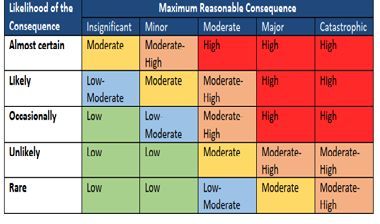
Table 4 Risk assessment matrix
Definitions
Likelihood of Consequence
• Rare: this will probably never happen / recur
• Unlikely: Do not expect it to happen / recur but it is possible it may do so
• Occasional: might happen or recur occasionally
• Likely: will probably happen/recur, but is not a persisting issue/ circumstance
• Almost certain: will undoubtedly happen/recur, possibly frequently
Maximum reasonable consequence
• Insignificant: A risk event that, if it occurs, will have little or no impact on the environmental
value
• Minor: A risk event that, if it occurs, will have a minor impact on the environmental value
• Moderate: A risk event that, if it occurs, will have a minor impact on the environmental value
• Major: A risk event that, if it occurs, will have a major impact on the environmental value
• Catastrophic: A risk event that, if it occurs, will have a catastrophic impact on the
environmental value
Page 25Assessment Report Legbar PPL 2064
May 2021
5 Required Outcome Assessment
Schedule 2, Part 5 of the RPI Reg provides criteria for assessment by agencies. In accordance with Section
14(3) of the RPI Reg, if the application demonstrates compliance with either of the prescribed solutions
stated in Part 5, Schedule 2, the proposed activities will meet the required outcome for the regional
interest. Critically, the application demonstrates that the prescribed solution provided in s15(1)(a) will be
met as the proposed activity, a 5.5 km buried flowline will not impact on an environmental attribute of the
Channel Country SEA. The application also demonstrates the prescribed solution provided in s15(1)(b) will
also be met (Table 5).
Table 5 Schedule 2, Part 5 RPI Reg
Schedule 2, Part 5 RPI Reg Relevance To Application
14 Required outcome ü The petroleum activities would not result in a widespread or
The activity will not result in a irreversible impact on each of the environmental attributes as
widespread or irreversible impact provided in section 3 and 4.
on an environmental attribute of a
strategic environmental area.
15 Prescribed solution ü Refer to section 3 and 4.
(1) The application demonstrates
either-
(a) the activity will not, and is not
likely to, have a direct or indirect
impact on an environmental
attribute of the strategic
environmental area; or
(b) all of the following- ü The proposed activities do not include any of the unacceptable
(i) if the activity is being carried out
uses prescribed by Section 15(2) of the RPI Act.
in a designated precinct in the
strategic environmental area-the
activity is not an unacceptable use
for the precinct;
(ii) the construction and operation ü Constraints planning will be implemented to minimise
footprint of the activity on the
disturbance to an absolute must.
environmental attribute is
minimised to the greatest extent
possible;
(iii) the activity does not ü Refer to section 3 and 4.
compromise the preservation of the
environmental attribute within the
strategic environmental area;
(iv) if the activity is to be carried out ü The South West Regional Plan does not identify the Channel
in a strategic environmental area
Country SEA.
identified in a regional plan- the
activity will contribute to the regional
outcomes, and be consistent with the
regional policies, stated in the
regional
plan.
Page 26Assessment Report Legbar PPL 2064
May 2021
References
BOM (2021). Climate Data Online Accessed: 03/04/2021. Available at:
http://www.bom.gov.au/climate/data/
BOM (2021). Queensland Flood History. Accessed: 03/04/2021.
http://www.bom.gov.au/qld/flood/fld_history/
DEHP (2014) Queensland Environmental Offsets Policy Significant Residual Impact Guideline,
Department of Environment and Heritage Protection.
DEHP (2013) Guideline: Application requirements for petroleum activities, version 4. Department of
Environment and Heritage Protection.
DoE (2019) Consultation document on listing eligibility and conservation actions Falco hypoleucos
(Grey Falcon). Accessed 03/04/2021. Available at:
http://www.environment.gov.au/search/site/%29%20Consultation%20document%20on%20listing
%20eligibility%20and%20conservation%20actions%20Falco%20hypoleucos
Karim F, Smith M and Cassel R (2015) Current water accounts and water quality for the Cooper
subregion. Product 1.5 for the Cooper subregion from the Lake Eyre Basin Bioregional Assessment.
Department of the Environment, Bureau of Meteorology, CSIRO and Geoscience Australia, Australia.
http://data.bioregionalassessments.gov.au/product/LEB/COO/1.5.
Marree Soil Conservation Board (2004). Marree Soil Conservation Board, District Plan. Government of
South Australia, Adelaide.
Smith M, Karim F, Sparrow A, Cassel R and Hall L (2015) Context statement for the Cooper subregion.
Product 1.1 for the Cooper subregion from the Lake Eyre Basin Bioregional Assessment. Department of
the Environment, Bureau of Meteorology, CSIRO and Geoscience Australia, Australia.
Page 27You can also read


