Santa Margarita River Conjunctive Use Project - Final Technical Memorandum No. 1 - U.S. Department of the Interior Bureau of Reclamation
←
→
Page content transcription
If your browser does not render page correctly, please read the page content below
Final Technical Memorandum No. 1

Santa Margarita River
Conjunctive Use Project

U.S. Department of the Interior
Bureau of Reclamation              April 2007
Mission Statements
The mission of the Department of the Interior is to
protect and provide access to our Nation’s natural and
cultural heritage and honor our trust responsibilities to
Indian Tribes and our commitments to island
communities.

The mission of the Bureau of Reclamation is to
manage, develop, and protect water and related
resources in an environmentally and economically
sound manner in the interest of the American public.
Final Technical Memorandum No. 1.0

Santa Margarita River
Conjunctive Use Project
Statistical Analysis of Santa Margarita River
Surface Water Availability at the Conjunctive
Use Project’s Point of Diversion

Prepared by:

Stetson Engineers

Prepared for:

Bureau of Reclamation
Southern California Area Office

U.S. Department of the Interior
Bureau of Reclamation                           April 2007
Santa Margarita River Conjunctive Use Project

CONTENTS
                                                                                                                 Page

Statistical Analysis of Santa Margarita River Surface
   Water Availability at the Conjunctive Use Project’s
   Point of Diversion...................................................................................           1
   Historical Reconstructed Streamflow at the Point of Diversion.............                                      2
   Frequency Analysis of Streamflow at the Point of Diversion ................                                     9
   Hydrologic Condition ..............................................................................            11
   Maximum Potential Diversion.................................................................                   13
   Peak Surface Flows..................................................................................           17
   Hydrologic Trends and Future Period of Record.....................................                             20
   Conclusions and Recommendations ........................................................                       22
   References................................................................................................     25

Attachments
Attachment A .................................................................................................    27
Attachment B .................................................................................................    31
Attachment C .................................................................................................    33
Attachment D .................................................................................................    37

Tables
   Table                                                                                                         Page

     1          Stream Gauging Stations Used to Reconstruct Streamflow
                    in the Santa Margarita River at the Point of Diversion..........                               4
     2          Exceedence Intervals and Annual Streamflow in the
                    Santa Margarita River at the Point of Diversion for
                    Water Years 1925-2005 .........................................................               11
     3          Delineation of Hydrologic Condition Based on Wintertime
                    Streamflow for Water Years 1925-2005................................                          12
     4          Median Wintertime Streamflow During Each Hydrologic
                    Condition for Water Years 1925-2005 ..................................                        13
     5          Exceedence Interval for Maximum Potential Diversion
                    and Annual Streamflow in the Santa Margarita
                    River at the Point of Diversion for Water
                    Years 1925-2005....................................................................           15
     6          Average Number of Days Each Year Daily Streamflow
                    Exceeds Diversion Capacity ..................................................                 19
     7          Summary of Median Annual Available Streamflow
                    and Maximum Potential Diversion for Water
                    Years 1925-2005....................................................................           23

                                                                                                                   iii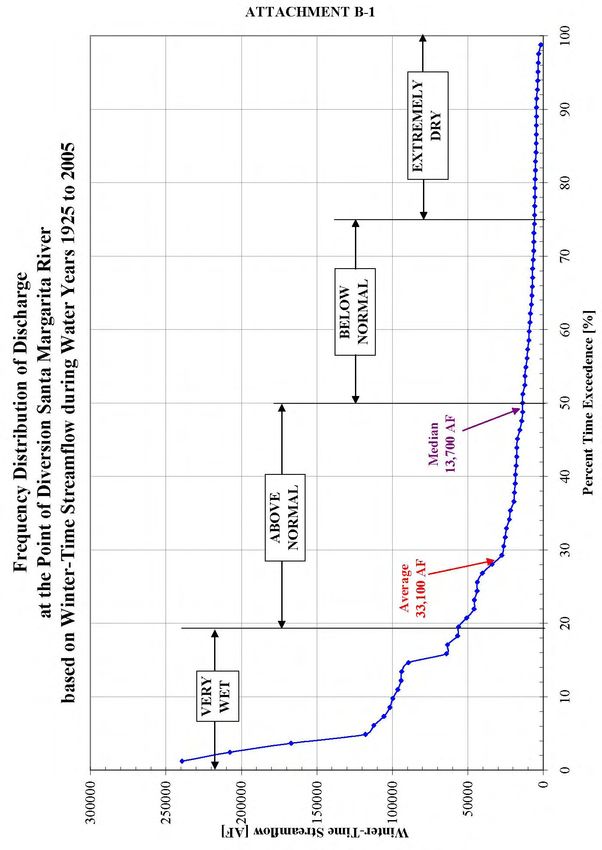
Final Technical Memorandum 1.0

Figures
 Figure                                                                                               Page

     1    Location of Proposed Point of Diversion for the Santa
              Margarita River CUP .............................................................         3
     2    Streamflow Gauging Stations Used to Reconstruct
              Streamflow in the Santa Margarita River at the
              Point of Diversion ..................................................................     5
     3    Reconstructed Streamflow in the Santa Margarita River
              at the Point of Diversion Water Years 1925-2005.................                          8
     4    Frequency Distribution of Reconstructed Annual
              Streamflow at the Point of Diversion for Water
              Years 1925-2005....................................................................      10
     5    Frequency Distribution of Maximum Potential Diversion
              and Streamflow at the Point of Diversion for Water
              Years 1925-2005....................................................................      15
     6    Variability of Annual Streamflow and Maximum Potential
              Diversion for Each Hydrologic Condition for Water
              Years 1925-2005....................................................................      18
     7    Cumulative Departure from the Mean Curves for Water
              Years 1925-2005....................................................................      21

iv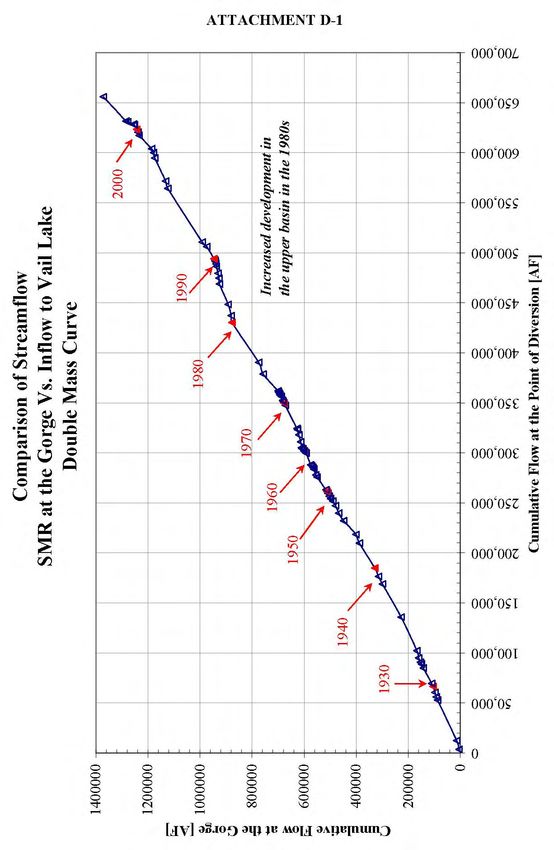
Santa Margarita River Conjunctive Use Project

STATISTICAL ANALYSIS OF SANTA MARGARITA
RIVER SURFACE WATER AVAILABILITY AT THE
CONJUNCTIVE USE PROJECT’S POINT OF DIVERSION
The Bureau of Reclamation (Reclamation) has begun work on a feasibility-level
study of the Santa Margarita River Conjunctive Use Project (CUP). The CUP is
intended to utilize surface water from the Santa Margarita River to enhance
groundwater supplies in aquifers located within the Marine Corps Base Camp
Pendleton (Camp Pendleton or Base). An environmental impact report and
environmental impact statement (EIR/EIS) is concurrently being prepared to
identify the environmental impact of various alternatives that may be used to
achieve the purpose and need of the proposed CUP. The purpose of this technical
memorandum is to develop statistics that describe the availability of Santa
Margarita River surface water at the CUP’s point of diversion.

Technical Memorandum 1.0 (TM 1.0) is the first in a series of two technical
memoranda that describe the hydrology and hydrogeology of the Santa Margarita
River. TM 1.0 addresses the historical variation of flows in the Santa Margarita
River over the historical period of record and presents statistics that describe those
flows in terms of both total water supply and water available for diversion.
Technical Memorandum 2.0 (TM 2.0) will report on the expected groundwater
yield from the CUP based on the surface water analysis presented in TM 1.0. The
determination of the CUP yield will involve an iterative process of optimizing
surface and groundwater resources. These surface and groundwater analyses will
be developed based on the statistical variability described and identified below.

Stetson Engineers received authority to proceed from Reclamation on
September 20, 2005. Mr. Stephen Reich, Ms. Jean Moran, and Ms. Dawn Taffler
of Stetson Engineers met with Reclamation’s feasibility design team members at a
kickoff meeting in Denver, Colorado, on October 24 and 25, 2005.
Representatives from Reclamation included Mr. Del Holz, Mr. Tom Bellinger,
Mr. Bob Talbot, Mr. Bob Hamilton, and the study team’s project manager
Ms. Meena Westford. Discussions during the kickoff meeting framed the
constraints that would be used for the statistical analysis of water availability over
the historical period of record. The purpose of studying Santa Margarita River
water availability is to address the probability and occurrence of surface water
available for future groundwater modeling runs and eventually the ultimate water
yield from the CUP. These model runs will be used to develop management
scenarios that maximize groundwater pumping yield from the Base’s aquifers.

The statistical analysis and supporting hydrologic study analyzed and reported in
TM 1.0 establishes the boundary conditions that will eventually support
Reclamation’s design of extraction, conveyance, and water treatment facilities.
The groundwater modeling analysis to be completed under TM 2.0 will consider

                                                                                    1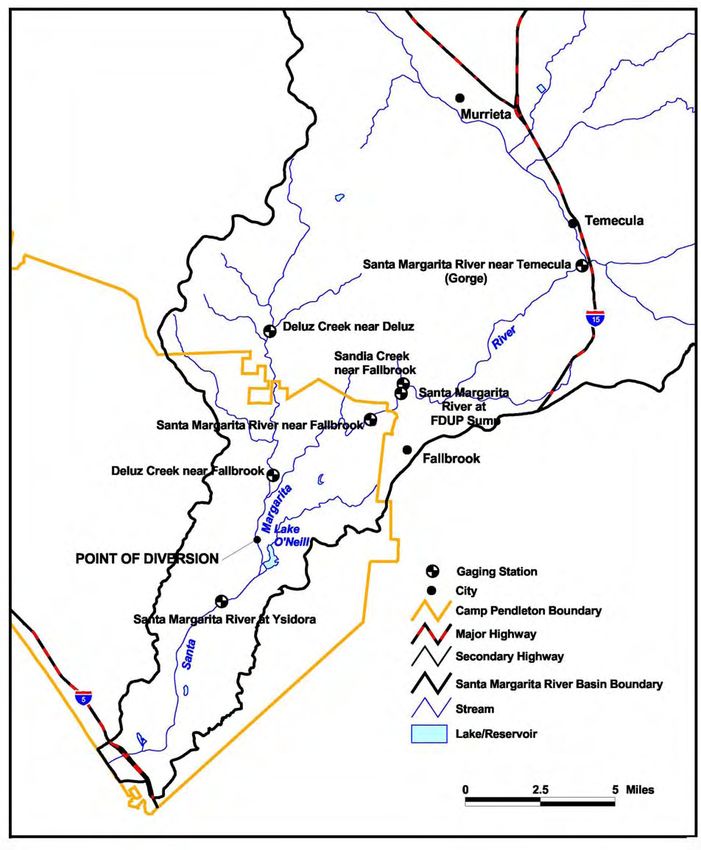
Final Technical Memorandum 1.0

enhanced groundwater pumping from the Lower Santa Margarita River Basin
using the available surface water identified in this technical memorandum.
TM 2.0 will eventually describe the monthly and annual volume of water
available for delivery to the Haybarn Canyon Water Treatment Plant.

Surface water availability was analyzed for historical hydrologic conditions based
on long-term precipitation and streamflow records. Results of previous studies
reflected hydrologic conditions based on historical records from 1980 through
1999 (Stetson, 2001). TM 1.0 utilizes the entire historical hydrologic record to
extend the previous study period’s hydrologic cycle so that it reflects the driest
and wettest periods on record. The flows considered at the point of diversion
represent regulated or depleted conditions occurring over the historical period of
record, not natural flow conditions that would have been maintained had no
development occurred. The use of historical conditions represents the operational
water supply available at the point of diversion and provides a more realistic
estimation of the CUP’s potential yield. Previous estimates of CUP yield
provided by Stetson (2001, 2002) and Reclamation (2005) will be updated with
values developed in TM 1.0 and TM 2.0. The surface water availability in
TM 1.0 was developed for use in the groundwater model. The recoverable water
supply will continue to be refined through the groundwater model calibration
process.

The 744-square-mile (mi2) Santa Margarita River basin lies within the counties of
San Diego and Riverside in southern California. Hydrological conditions in the
Santa Margarita River basin are controlled by wintertime tropical and northern
Pacific storm events and, to a minor, degree summer monsoon events. While
most of the precipitation occurs as rainfall throughout the watershed, snowfall
may occur in the higher mountain ranges located in the upper reaches of the
watershed influencing springtime baseflows above Vail Dam. Typical of many
Southwestern United States stream systems, extreme peak flows often occur
during winter rain events, and minimum baseflows occur during the dry summer
months. The flashy nature of the Santa Margarita River and the daily streamflow
variability were considered to statistically describe the volume of water available
at the point of diversion.

Historical Reconstructed Streamflow at the
Point of Diversion
Streamflow in the Santa Margarita River at the CUP’s point of diversion
(figure 1) was reconstructed using a composite record of observed streamflow
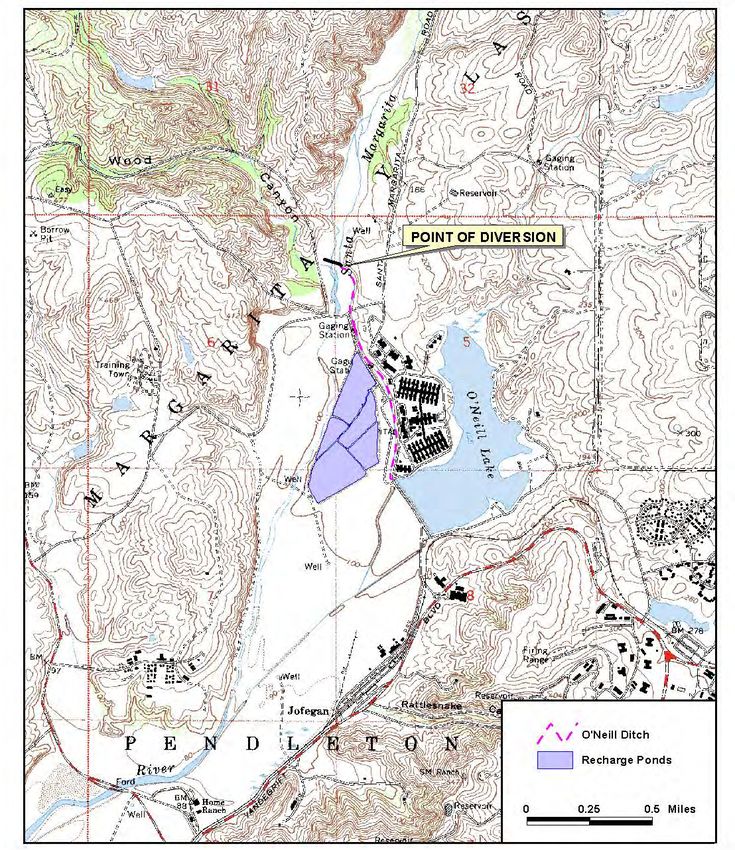
data for water years 1925 through 2005. The CUP’s proposed point of diversion
is expected to be constructed at Camp Pendleton’s existing diversion point to
O’Neill ditch (Reclamation, 2005). Because no long-term United States Geologic

2
Santa Margarita River Conjunctive Use Project

Figure 1. Location of Proposed Point of Diversion for the Santa Margarita River CUP.

                                                                                        3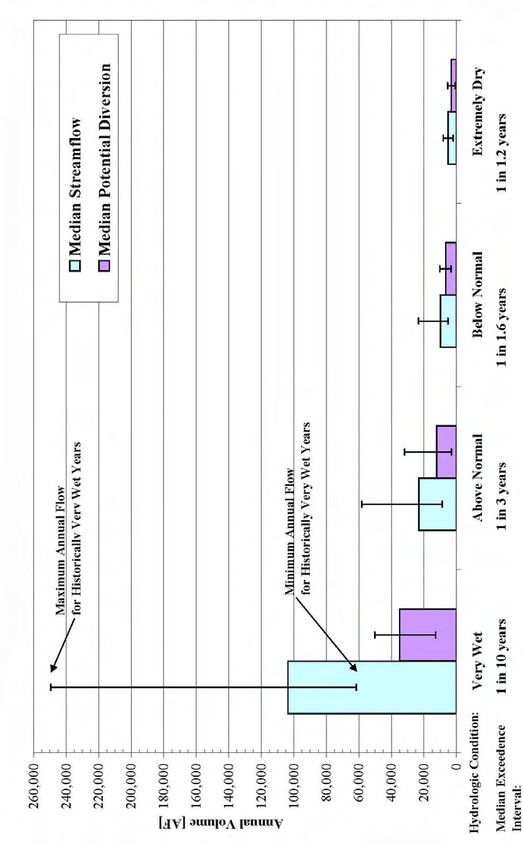
Final Technical Memorandum 1.0

  Survey (USGS) gauge has ever been established at the existing diversion
  structure, recorded streamflow data from the USGS gauges listed in table 1 were
  used to develop a streamflow hydrograph at the diversion point. Figure 2 depicts
  the location of the historical USGS gauges used to reconstruct flow at the CUP’s
  proposed point of diversion. Historical daily streamflow observed at these gauge
  sites were used to simulate an 81-year period of record of streamflow at the
  CUP’s point of diversion. Missing data from streamflow gauges with incomplete
  periods of record were reconstructed and calibrated using established hydrologic
  methods and available data.

Table 1. Stream Gauging Stations Used to Reconstruct Streamflow in the Santa
Margarita River at the Point of Diversion1
                                                                               Drainage
                                       Station     Operating     Period of       Area
               Station Name            ID No.       Agency        Record         (mi2)
Santa Margarita River near            11044000      USGS       2/23-Present       588.0
  Temecula (Gorge)
Santa Margarita River at FPUD         11044300      USGS       10/89-Present      620.0
  Sump
Sandia Creek near Fallbrook           11044350      USGS       10/89-Present       21.1
Santa Margarita River near            11044500      USGS       10/24-9/80         644.0
  Fallbrook
De Luz Creek near De Luz              11044800      USGS       10/92-Present       33.0
De Luz Creek near Fallbrook           11044900      USGS       10/51-9/67          47.5
Santa Margarita River at Ysidora      11046000      USGS       3/23-Present       723.0
  (various locations)
      1
          mi2 = square miles.

  A spreadsheet model was developed to reconstruct the streamflow in the Santa
  Margarita River at the point of diversion. The period of record was divided into
  three temporal intervals based on the period of record established by the available
  streamflow gauge data. The development of reconstructed streamflow at the point
  of diversion is based on observed daily streamflow recorded by the USGS and
  precipitation data from the National Ocean and Atmospheric Administration
  (NOAA) and Camp Pendleton. Annual and monthly streamflow records, at the
  point of diversion, were also developed from the hydrologic analysis that relied
  on the historical daily data. The hydrologic record is described by three time
  periods defined by the date when streamflow gauges in the lower Santa Margarita
  River Watershed were established.

           •   Water Years 1925 to 1980: The total streamflow at the point of
               diversion was calculated based on adding the streamflow from the Santa

  4
Santa Margarita River Conjunctive Use Project
Figure 2. Streamflow Gauging Stations Used to Reconstruct Streamflow in the Santa
Margarita River at the Point of Diversion.
5Final Technical Memorandum 1.0
Margarita River near Fallbrook gauge (USGS #11044500) to streamflow
from DeLuz Creek, plus estimated accretion between the downstream
gauges and the point of diversion. The contribution from Sandia Creek
was included in the Santa Margarita River near Fallbrook gauge during
this period since the former gauge was located downstream from their
confluence. During water years 1952 through 1967, streamflow from the
DeLuz Creek gauge near Fallbrook (USGS #11044900) accounted for the
contribution of streamflow from DeLuz Creek. For all other years, the
contribution from DeLuz Creek was calculated using proportionality
constant based on ratio of DeLuz Creek gauge and Santa Margarita River
near Fallbrook gauge drainage areas.
• Water Years 1981 to 1989: The streamflow records in the lower Santa
Margarita River basin during water years 1981 through 1989 were
deficient due to missing gauge data. During the 1980 flood, the Santa
Margarita River near Fallbrook gauge (USGS #11044500) was washed out
and was not reconstructed until 1989. A new gauge was installed in 1989
at the Fallbrook Public Utility District (FPUD) Sump on the Santa
Margarita River (USGS #11044300), upstream of the confluence with
Sandia Creek. The only reliable historical streamflow dataset available
during the 1981 to 1989 period of record was from the Santa Margarita
River near Temecula gauge (USGS #11044000), commonly referred to as
the Gorge.
To reconstruct streamflow at the point of diversion, the contribution of
streamflow below the Gorge was estimated using the Soil Conservation
Service (SCS) Curve Number method and the United States
Environmental Protection Agency’s (USEPA) Hydrologic Simulation
Program-Fortran (HSPF). The SCS method was used to calculate surface
runoff during precipitation events while the HSPF model was used to
simulate baseflows in each drainage area. Stetson Engineers applied these
two methods in the development of the Permit 15000 water availability
study (Stetson, 2001).
• Water Years 1990 to 2005: Streamflow at the point of diversion for the
most recent period was developed by summing historical streamflow data
from the Santa Margarita River at FPUD Sump (USGS #11044300),
Sandia Creek (USGS #11044350), and De Luz Creek (USGS #11044800)
gauges, plus estimated accretion between the downstream gauges and the
point of diversion. The new DeLuz Creek gauge, located in the upper
two-thirds of the DeLuz Creek basin, was multiplied by a proportionality
constant to calculate contributions from lower DeLuz Creek. Missing data
from De Luz Creek between October 1989 and October 1992 was
calculated using a proportionality constant based on ratio of the DeLuz
and Sandia Creek (47.5 mi2/ 21 mi2) drainage areas. The observed
6Santa Margarita River Conjunctive Use Project
streamflow data obtained from the USGS for water year 2005 was
identified as “Provisional” at the time of this analysis.
Geomorphologic conditions significantly influence the occurrence of surface flow
and subsurface flow occurring below the Gorge. The geologic map indicates
minimal stream channel alluvial sediments at the Gorge, thus the flow at this
location is considered to be entirely surface flow. From the Gorge to the
confluence with DeLuz Creek, the amount of alluvial sediment ranges from 15 to
20 feet, allowing for a portion of the total water supply to occur as subflow.
Below the DeLuz Creek confluence, the alluvium increases considerably,
supporting a larger volume of subflow. A general head boundary in the
groundwater model evaluates the subflow contribution at the model boundary,
identifying subflow contributions on a monthly basis. Thus, the recoverable
portion of subflow is accounted for in the groundwater model, which will be
examined in more detail in TM 2.0. Due to the occurrence of alluvial sediments
in the stream channel, a portion of the baseflow for the drainage areas below the
USGS gauges is accounted for in the groundwater model.
The surface water analysis utilized the SCS Curve Number method to calculate
the contribution to peak flows occurring during storm events for the drainage
areas below the USGS gauges. A California isohyetal map depicting average
annual precipitation contours was used to predict the spatial distribution of
rainfall in the lower portion of the Santa Margarita River Basin (Daly, 1998). A
precipitation ratio, interpreted from the distribution of the average annual
isohyetal contours below the USGS gauges, was employed to account for local
variability in rainfall when calculating peak flow contributions for ungauged
drainage areas. Daily and hourly Oceanside precipitation data were multiplied by
the precipitation ratio to calculate precipitation excess, antecedent moisture
conditions, and surface runoff during storm events for ungauged drainage areas.
An iterative calibration process using actual and simulated data was employed to
reconstruct the streamflow at the point of diversion. The analysis included the
investigation of multiple streamflow computational methods to calculate peak
flow events and baseflows for ungauged drainage areas and missing data. The
methods employed to estimate streamflow during periods of missing data were
calibrated to periods of known streamflow to correlate results and identify
inconsistencies. Observed flows from the Santa Margarita River near the Ysidora
gauge were not used in the surface water calibration process due to the poorly
constrained physical conditions that influence the quality of the data, the impact
of groundwater pumping from the lower Santa Margarita River basin, and the
effect of five different historical gauge locations over 7 miles. The surface water
hydrology was developed to statistically describe surface water availability and to
reconstruct streamflow at the groundwater model boundary. Additional
refinements to streamflow at the point of diversion may occur throughout the
groundwater model calibration process.
7Final Technical Memorandum 1.0
The reconstructed annual streamflow at the point of diversion in the Santa
Margarita River for water years 1925 to 2005 is represented by the bar graph in
figure 3. The reconstructed monthly streamflow values for the same period are
presented in Attachment A-1. A review of figure 3 indicates that the maximum
annual streamflow of 249,500 acre-feet (AF) occurred during water year 1993,
and the minimum annual streamflow (2,000 AF) occurred in 1961. This
significant range in annual flows typifies the variability of streamflow in the Santa
Margarita River, where the wettest year is 125 times greater than the driest year
on record. The reconstructed streamflow at the point of diversion represents
observed streamflow influenced by historical conditions and activities in the Santa
Margarita River Basin. Groundwater pumping in the upper basin, changes in land
use, increased development, discharge agreements, and other impacts to changes
in hydrology are represented in this historical period of record.
The reliability and usefulness of the reconstructed streamflow is a function of the
availability of observed data and a representative period of record. Based on the
81-year period of record, more than 70 percent (%) of the reconstructed flow in
the Santa Margarita River at the point of diversion is based on observed flows at
USGS gauges. This extensive period of record captures the long-term variability
260,000
240,000
220,000
200,000
180,000
Annual Streamflow [AF]
160,000
140,000
120,000
100,000
80,000
60,000
40,000
20,000
0
1925
1930
1935
1940
1945
1950
1955
1960
1965
1970
1975
1980
1985
1990
1995
2000
2005
Water Year
Figure 3. Reconstructed Streamflow in the Santa Margarita River at the Point of Diversion
Water Years 1925-2005 [AF].
8Santa Margarita River Conjunctive Use Project
of surface water in the Santa Margarita River at the point of diversion. The 81-
year period of record includes extended dry and wet hydrologic periods. For
example, the period from the late 1940s to early 1960s is characteristic of an
extended dry-cycle in the Santa Margarita River watershed (Stetson, 2001).
Conversely, the 1990s is considered to be an extended wet period. The extended
wet and dry cycles can best be described using cumulative departure from mean
curves that graphically describe wet and dry cycles (Stetson, 2001, 2002).
Frequency Analysis of Streamflow at the
Point of Diversion
A frequency analysis was performed on historical annual streamflow in the Santa
Margarita River at the point of diversion for the 81-year period of record to
establish the frequency that annual streamflow volumes were historically
exceeded. Similar to recurrence intervals assigned to flood events, exceedence
intervals are used to establish a basis for predicting the frequency of future annual
streamflow values. The historical streamflow for each year is ranked and
assigned a percent time exceedence. The frequency curve depicts the frequency
at which a given annual streamflow at the point of diversion was historically
exceeded during the 81-year historical period (figure 4). Attachment A-2 lists the
annual streamflow values at the point of diversion for this period, ranked in
descending order.
The exceedence interval provides a statistical expression of the probability that an
annual streamflow will be equaled or exceeded in any given year. For this
analysis, the exceedence interval represents the period of time, in years, that an
annual flow will likely be exceeded and is calculated as the inverse of the percent
time exceedence. For example, the median (50%) annual flow (15,400 AF)
represents a minimum volume that is expected to be exceeded 1 year out of every
2 years (1 divided by 50%). Streamflow during the other of the 2 years is
statistically expected to be less than 15,400 AF.
Similar to flood events in which two or three “10-year” events may occur in a
single year, annual streamflow above the median flow value may occur on the
Santa Margarita River concurrently from year to year. Storage facilities,
including both surface reservoirs and groundwater aquifers, uniquely reduce the
natural variability so that the median flow value becomes a more statistically
meaningful number in the arid Southwestern United States. Diversion of water to
either surface or underground storage reduces the impact of the natural variability
to the water supply. Surface water during dry years may be captured and stored,
increasing the water available during those years—effectively reducing the
occurrence interval of dry years.
9Final Technical Memorandum 1.0
260,000
240,000
220,000
200,000
180,000
Annual Streamflow [AF]
160,000
140,000
120,000
100,000
80,000
MEDIAN = 15,400 AF
60,000
40,000
20,000
0
0 10 20 30 40 50 60 70 80 90 100
Percent Time Exceedence [%]
Figure 4. Frequency Distribution of Reconstructed Annual Streamflow at the Point of
Diversion for Water Years 1925-2005.
The anticipated annual streamflow for a variety of exceedence intervals, passing
the point of diversion on the Santa Margarita River, is shown in table 2. A
minimum of 25,500AF have statistically passed the point of diversion once out of
every 3 years during the 81-year period of record. Another application of the
exceedence interval to project design is to suggest that annual streamflow has
historically exceeded 15,400 AF 50% of the time.
The frequency distribution and exceedence intervals represent the historical
annual streamflow in the Santa Margarita River at the point of diversion.
However, these values do not necessarily represent the potential diversion to
O’Neill ditch or the potential yield of the Santa Margarita River CUP. The ability
to divert surface water from the Santa Margarita River is dependent upon the
frequency of wintertime rainfall events and antecedent conditions, but also relies
upon a complicated function of water rights, environmental requirements, and
operation of the diversion structure. The quantity of water diverted in a given
10Santa Margarita River Conjunctive Use Project
Table 2. Exceedence Intervals and Annual Streamflow in the
Santa Margarita River at the Point of Diversion for Water
Years 1925-2005
Percent
Time Annual Streamflow
Exceedence Exceedence at Point of Diversion
(%) Interval [AF]
4 1 in 25 years 159,800
5 1 in 20 years 124,100
7 1 in 15 years 118,700
10 1 in 10 years 103,400
11 1 in 9 years 102,700
13 1 in 8 years 100,300
14 1 in 7 years 94,500
17 1 in 6 years 65,600
20 1 in 5 years 56,900
25 1 in 4 years 45,700
33% 1 in 3 years 25,500
50 1 in 2 years 15,400
75 1 in 1.3 years 6,700
100 1 in 1 years 2,000
year is limited by the diversion capacity (assumed 200 cubic feet per second
(cfs)), a bypass requirement (assumed 3 cfs), and the deflation of the diversion
structure during the 10-year event or greater streamflow event to allow for
sediment to pass from behind the diversion structure. The portion of water supply
available for diversion is described in the following section entitled “Maximum
Potential Diversion.”
Hydrologic Condition
The long-term reconstruction of annual streamflow at the point of diversion
provides a significant dataset to define appropriate boundaries that can be used to
categorize hydrologic conditions. The following section of TM 1.0 describes the
development of hydrologic conditions that are used to categorize different levels
of water availability that would be expected at the point of diversion. The
different categories of hydrologic conditions presented in TM 1.0 were discussed
with Reclamation’s technical team during the October 24 and 25 meeting.
11Final Technical Memorandum 1.0
Hydrologic conditions in the lower Santa Margarita River basin were established
in order to statistically group each year’s water availability into one of four
different categories. Due to the influence of wintertime precipitation events on
annual streamflow, October through April wintertime total streamflow volume
was used to define the limits of four hydrologic conditions: Very Wet, Above
Normal, Below Normal, and Extremely Dry. These four hydrologic conditions
establish the boundaries that will be used to identify and statistically describe
historical and future streamflow at the point of diversion. Furthermore, these four
hydrologic conditions will be used to create limitations and boundary conditions
that will be used to establish project yield from the groundwater model.
The four hydrologic conditions for the lower Santa Margarita River basin are
based on the wintertime flows during the 81-year reconstructed streamflow in the
Santa Margarita River at the point of diversion to O’Neill ditch. The frequency
distribution of October through April total streamflow at the point of diversion
was used to define the upper and lower boundary of each hydrologic condition.
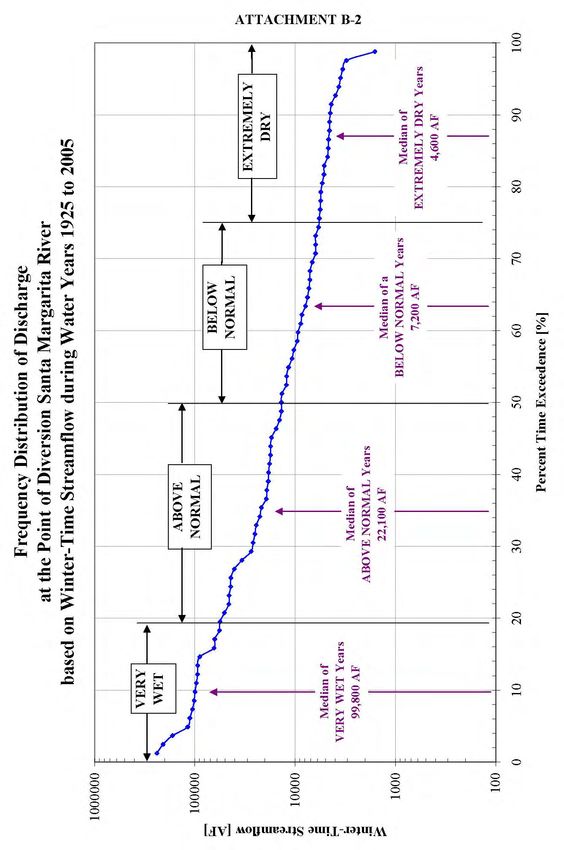
The wintertime streamflow frequency curve is divided into four parts, established
by graphical slope breaks (Attachment B-1). These slope breaks allow each water
year in the 81-year period of record to be categorized by a hydrologic condition
based on the total volume of wintertime streamflow. The range of results
extracted from the frequency distribution and graphical slope break analysis for
each hydrologic condition are shown in Table 3. The median wintertime
streamflow (13,700 AF) represents the break between Above Normal and Below
Normal hydrologic conditions, while the average wintertime streamflow
(33,100 AF) falls within the Above Normal hydrologic category. This is typical
in the arid Southwest, where high volumes of wintertime streamflow during Very
Wet hydrologic years significantly increase the range between the average and
median streamflow values. The median wintertime streamflow (13,700 AF) is
predictably less than the median annual streamflow (15,400 AF) due to the
exclusion of nonwinter streamflow values.
Table 3. Delineation of Hydrologic Condition Based on Wintertime Streamflow for
Water Years 1925-2005
Range of
Range of Wintertime Streamflow
Hydrologic Wintertime Streamflow Percent Time Exceedence
Condition [AF] [%]
Very Wet 239,400 to 56,700 1 to 19
Above Normal 56,699 to 13,700 20 t0 50
Below Normal 13,699 to 5,800 51 to 75
Extremely Dry 5,799 to 1,600 76 to 100
Notes: Wintertime streamflow calculated as the total October through April Santa Margarita River
streamflow at the point of diversion. The median wintertime streamflow (13,700 AF) represents the
break between Above Normal and Below Normal hydrologic conditions.
12Santa Margarita River Conjunctive Use Project
Wintertime streamflow at the point of diversion during Very Wet hydrologic
conditions ranged between 56,700 and 239,400 AF based on the 81-year historical
period. Further review of the annual percent time exceedence for flows that fell
within this range indicated these flows occurred between 1 and 19% of the time.
Similarly, review of Below Normal hydrologic conditions indicated that
streamflow during these periods ranged between 5,800 and 13,699 AF and
occurred between 51 and 75% of the time. Interpretation of exceedence intervals
of streamflow during the historical period of record further suggests that annual
flows will be 5,800 AF or greater at least 75% of the time.
Another aspect of describing the variability of flows during each hydrologic
condition can be expressed in median wintertime streamflow values (table 4 and
Attachment B-2). The median wintertime streamflow at the point of diversion
during Very Wet hydrologic conditions was 99,800 AF. While Very Wet
hydrologic conditions occurred 19% of the time on the Santa Margarita River, the
median wintertime flow associated with Very Wet conditions occurred only 10%
of the time. Similarly, Above Normal hydrologic conditions took place between
20% and 50% of the time, but the median wintertime flow associated with Above
Normal conditions (22,100 AF) occurred only 35% of the time.
Table 4. Median Wintertime Streamflow During Each
Hydrologic Condition for Water Years 1925–2005
Median Median Wintertime
Wintertime Streamflow Percent
Hydrologic Streamflow Time Exceedence
Condition [AF] [%]
Very Wet 99,800 10
Above Normal 22,100 35
Below Normal 8,200 62
Extremely Dry 4,600 87
Maximum Potential Diversion
The availability of surface water in the Santa Margarita River is highly variable.
Large storms in the winter months typically provide a significant portion of the
total annual flow in the river. The most efficient diversion of peak flow events
would be the use of an in-stream dam and reservoir. Development of off-stream
reservoirs are similarly infeasible since they demand large diversion and
conveyance facilities that would require a design with flow rates exceeding at
least 1,000 cfs. As previously stated, the quantity of water diverted under the
proposed CUP is limited by the diversion capacity (200 cfs), the assumed year-
around bypass requirement (3 cfs), and the deflation of the diversion structure
13Final Technical Memorandum 1.0 during the 10-year or greater event to allow for sediment to pass from behind the diversion structure, all of which are incorporated into the TM 1.0 analysis. The quantity of water diverted is further limited by storage in Lake O’Neill and the existing and rehabilitated recharge ponds, the groundwater aquifer’s recharge capacity, the pumping schedule, and the groundwater aquifer’s storage capacity, which will be accounted for in the TM 2.0 analysis. The maximum potential diversion is defined in TM 1.0 as the water diverted from the Santa Margarita River to O’Neill ditch for use by the CUP and is based on the assumed diversion constraints. Water diverted for use by the CUP includes surface water diverted to both Lake O’Neill and the groundwater recharge ponds. The actual determination of CUP yield will be presented in TM 2.0 based on an iterative process that optimizes surface water diversions and groundwater withdrawals using the lower Santa Margarita Groundwater model. As stated above, the maximum potential surface water available for diversion assumes the following constraints: 200-cfs maximum capacity diversion structure, a 3-cfs bypass, and the deflation of the diversion structure during the 10-year or greater event. This analysis does not take into account overflow spill from the recharge ponds, variable recharge rates, or the capacity of the groundwater basin influenced by groundwater pumping. The maximum monthly streamflow that can potentially be diverted in water years 1925 through 2005 based on the assumed diversion constraints is presented in Attachment C-1. A frequency distribution was performed to rank and analyze the maximum potential diversion to Lake O’Neill and the recharge ponds for the 81-year period of record. The annual volume of maximum potential diversion for water years 1925 through 2005 is ranked in descending order in Attachment C-2. The frequency curve shown in figure 5 depicts a comparison between the percent time exceedence of the maximum potential diversion and the annual streamflow at the point of diversion. The gap between annual streamflow and maximum potential diversion is greatest during years characterized by a probability of exceedence of less than 30% (1 in every 3.3 years), typically Very Wet or Above Normal hydrologic conditions. The gap is due to the inability of the proposed facilities to capture large peak flow events. The gap between the two curves also includes the quantity of streamflow bypassed each year to satisfy the 3-cfs bypass requirement. The deviation between available water supply and maximum potential diversion illustrates the importance of designing conveyance systems based on that portion of total annual flow that can realistically captured. 14
.                            260000

                                  240000                                                              Streamflow at Point of Diversion
                                                                                                      Maximum Potential Diversion
                                  220000

                                  200000

                                  180000
         Annual Streamflow [AF]

                                  160000

                                  140000

                                  120000

                                                                                                                                                    Santa Margarita River Conjunctive Use Project
                                                                     MEDIAN SMR Flow at Diversion = 15,400 AFY
                                  100000
                                                                     MEDIAN Potential Diversion = 8,600 AFY
                                  80000

                                  60000

                                  40000

                                  20000

                                       0
                                           0      10        20         30        40        50        60        70         80        90        100
                                                                              Percent Time Exceedence [%]
15

                                   Figure 5. Frequency Distribution of Maximum Potential Diversion and Streamflow at the Point of Diversion for
                                   Water Years 1925-2005.
Final Technical Memorandum 1.0
The annual streamflow at the point of diversion and the maximum potential
diversion for common exceedence intervals are shown in table 5. The table is
reflective of historical conditions and may not necessarily reflect the maximum
potential diversion due to changes in future flow regimes due to urban
development and upstream mitigation of the water supply stipulated in the 2002
Cooperative Water Resources Management Agreement (CWRMA). The table
also fails to account for water that may recharge the groundwater aquifer by
infiltrating the stream channel alluvium downstream from the point of diversion.
The accounting of water spilling from either Lake O’Neill or the recharge ponds
is incorporated in a Reservoir Operations Model (ROM) which is an input to the
groundwater model to be analyzed in TM 2.0. The analysis of the groundwater
model will provide a final value of maximum potential diversion once recharge to
the aquifer, spill from the facilities, and changes due to the CWRMA have been
fully accounted for in the development of CUP project yield.
Table 5. Exceedence Interval for Maximum Potential
Diversion and Annual Streamflow in the Santa Margarita
River at the Point of Diversion for Water Years 1925–2005
Annual
Percent Streamflow
Time at Point of Potential
Exceedence Exceedence Diversion Diversion
[%] Interval [AF] [AF]
4% 1 in 25 years 159,800 44,800
5% 1 in 20 years 124,100 42,600
7% 1 in 15 years 118,700 40,400
10% 1 in 10 years 103,400 34,300
11% 1 in 9 years 102,700 31,200
13% 1 in 8 years 100,300 25,800
14% 1 in 7 years 94,500 23,300
17% 1 in 6 years 65,600 21,500
20% 1 in 5 years 56,900 18,600
25% 1 in 4 years 45,700 17,000
33% 1 in 3 years 25,500 12,700
50% 1 in 2 years 15,400 8,600
75% 1 in 1.3 years 6,700 4,100
100% 1 in 1 years 2,000 700
As previously discussed, each water year in the 81-year period of record can be
categorized by hydrologic condition based on the total volume of wintertime
streamflow. The variability of annual streamflow and maximum potential
diversion for the water years grouped in each hydrologic condition is graphically
16Santa Margarita River Conjunctive Use Project
represented in figure 6. The median annual streamflow and median potential
diversion for the water years grouped in each hydrologic condition are
represented by the vertical bars. The length of the vertical line, centered on each
bar, represents the historical range in annual volume for the 81-year period. For
example, water passing the point of diversion during Very Wet hydrologic
conditions ranged between 61,600 and 249,500 AF with a median value of
103,600 AF, while the water available for diversion during these same years
ranged between 12,800 and 50,200 AF with a median value of 35,000 AF. The
reason for the disparity between the two ranges and median values is largely due
to the volume of water contained in flows greater than 200 cfs which pass the
point of diversion during short-duration peak flow events. These large flows
cannot be captured by the diversion facilities due to capacity limitations and the
deflation requirement. A daily accounting of streamflow rates is provided in the
following section to describe the frequency and quantity of large flow events that
are either difficult or impossible to capture without an in-stream storage facility.
Peak Surface Flows
In addition to investigating the annual flows at the point of diversion and the
maximum potential diversion, Stetson Engineers investigated both daily and
monthly surface water flows. Similar to the trends in variability that exists when
reviewing annual volumes, the variability in daily and monthly streamflow in any
given year is greatest during Very Wet hydrologic conditions and least during
Extremely Dry conditions. Water Year 1991 is a typical example of the
variability that exists in the Santa Margarita River’s monthly and daily
streamflow record during Very Wet hydrologic conditions. Daily streamflow at
the point of diversion averaged 25 cfs from October 1990 through February 1991
but increased to average more than 400 cfs from March 1991 through April 1991.
This demonstrates that low baseflows typically occur in the early winter period
following the dry summer months. As spring arrives, the ground has become
saturated, and increased precipitation events translate into surface runoff and
higher baseflows. Thus, in Very Wet hydrologic conditions, a large portion of the
annual flow volume tends to pass the point of diversion over a few days during
peak flow events. This results in a significant amount of the annual flow volume
that cannot be captured by CUP facilities designed to divert only 200 cfs. The
following section presents the variability in daily streamflow during each type of
hydrologic condition that affects the volume of water that can be utilized by the
CUP.
TM 1.0 has described the difference between water passing the point of diversion
(annual streamflow) and maximum potential diversion for use by the CUP.
The disparity between the values is based on the maximum 200-cfs diversion, the
3-cfs bypass, and the need to deflate the diversion structure to allow sediment to
pass
1718
Final Technical Memorandum 1.0
Figure 6. Variability of Annual Streamflow and Maximum Potential Diversion for Each Hydrologic Condition for Water
Years 1925-2005.Santa Margarita River Conjunctive Use Project
during the 10-year or greater storm event. Figure 6 graphically depicts the
variance during Very Wet hydrologic conditions, demonstrating the median
streamflow passing the point of diversion (103,600 AF) is three times greater than
the median potential water available for diversion (35,000 AF). The difference
between water availability and maximum potential diversion can best be
explained by investigating the percent time exceedence of flows greater than
200 cfs.
Table 6 shows that the average number days per year in each hydrologic condition
when flow at the diversion is less than 200 cfs, between 200 and 240 cfs, greater
than 240 cfs without deflating the diversion structure, and the number of days
when the diversion structure will deflate during each type of hydrologic condition.
The 240-cfs interval is based on the potential ability to divert an additional 40 cfs
to an off-stream reservoir, as investigated in Alternative 4 of the Permit 15000
(Stetson, 2001) or to direct use at the Haybarn Canyon Water Treatment Plant.
On days when the diversion structure deflates, it is assumed that no water can be
diverted.
Table 6. Average Number of Days Each Year Daily Streamflow Exceeds Diversion
Capacity (Days Per Year)
Average Number of Days Per Year
Flow Flow Greater
Flow Less Between than 240 cfs Diversion
Hydrologic than 200 and Without Deflating Structure
Condition 200 cfs 240 cfs1 Diversion Structure Deflates2
Very Wet 327 4 31 3
Above Normal 355 2 9 0
Below Normal 362 1 3 0
Extremely Dry 363 1 2 0
1
Interval based on potential 40-cfs diversion to an off-stream storage reservoir (Alternative 4,
Permit 15000) or direct use at the Haybarn Canyon Water Treatment Plant.
2
Deflation of the diversion structure occurs during the 10-year of greater event (Permit 15000).
Of the 30 days in which the flow was greater than 240 cfs during Very Wet
hydrologic conditions, approximately 80% of the annual streamflow passed the
point of diversion. For example, in 1991, there were 11 days when the flow was
greater than 240 cfs. On these 11 days, 45,600 AF passed the point of diversion,
which constituted nearly 75% of the annual flow for water year 1991. Similar to
Very Wet hydrologic conditions, the peak flows during Above Normal years also
dominated the annual flow volume passing the point of diversion. Of the 9 days
in which the flow was greater than 240 cfs, approximately 60% of the annual
streamflow passed the point of diversion. During years categorized as Below
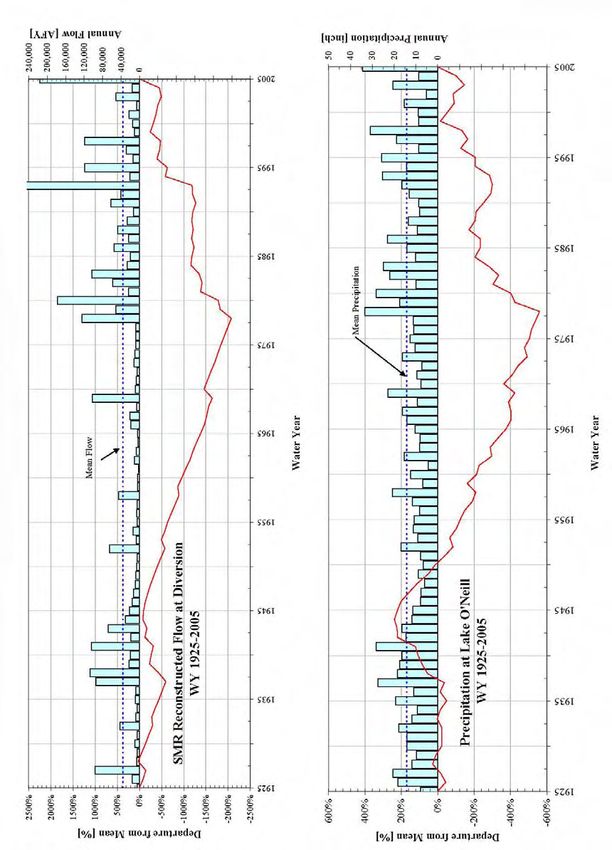
19Final Technical Memorandum 1.0 Normal and Extremely Dry, there are only a few days when the flow was greater than 240 cfs, but even one storm event may account for a significant percentage of that year’s total flow. The computation of the average number of days per year that daily streamflow exceeds diversion capacity has been presented to show the number of days that elevated flows in the Santa Margarita River occur. Elevated streamflow beyond 200 cfs may be due to a peak storm event that occurred either that day or as the result of a previous day’s peak flow event. In either case, a statistical analysis of peak storm events is not warranted at this time because the effect of groundwater recharge through the streambed alluvium has not been taken into account. The need to recharge the aquifer and utilize the storage capacitance of the aquifer should be considered before statistical analysis regarding availability of peak daily streamflow is performed. Hydrologic Trends and Future Period of Record Due to the hydrologic variability of the Santa Margarita River Basin, the surface water and groundwater analysis (TM 2.0) for the CUP will require the development of a future period of record that is representative of the historical variability of hydrologic conditions. The statistics presented in this technical memorandum are based on the historical 81-year period of record. For the next phase of the water availability analysis, it is recommended that the groundwater model simulate historic trends over a 50-year period of record. The 50-year period of record will be developed to represent hydrology that captures antecedent conditions over extended dry and wet periods. Long-term precipitation and streamflow datasets can be used to demonstrate hydrologic trends over the historical 81-year period of record for the lower Santa Margarita River Basin. Figure 7 shows a cumulative departure from the mean curve of annual streamflow at the point of diversion and annual precipitation at Lake O’Neill for water years 1925 to 2005. Monthly precipitation records from Lake O’Neill (Marine Corps Base Camp Pendleton [MCBCP] Office of Water Resources [OWR], 2005) were used to evaluate annual precipitation trends at the point of diversion. The annual departure from the mean graph is used to depict wet and dry cycles over an extended period of record. The solid line describes the hydrologic trend, where a downward slope indicates that the trend is to dry conditions and an upward slope indicates that the trend is to wetter conditions. The dashed line shows the long-term average annual precipitation at Lake O’Neill (14.2 inches) and the long-term average annual streamflow at the point of diversion (35,600 AF) during the 81-year period of record. 20
Santa Margarita River Conjunctive Use Project
21

     Figure 7. Cumulative Departure from the Mean Curves for Water Years 1925-2005.
Final Technical Memorandum 1.0 The cumulative departure from the mean curve reveals that an extended dry period occurred from 1945 to 1978, followed by a prolonged wet period from 1979 to 1984. A moderately dry period occurred from 1985 to 1991, followed by a significantly wet period from 1993 to 1999. This pattern is similarly represented in both the precipitation and streamflow cumulative departure from the mean curves. Stetson Engineers recommends that groundwater model years 1-50 should be chosen based on both extended dry and wet periods. One possible scenario for the future 50-year record would start with an Above Normal year, followed by an extended drought period, followed by another wet period, and eventually ending with normal hydrologic conditions. Stetson Engineers and Reclamation staff will work together to determine the best 50 years to provide an appropriate hydrologic record that can be used to optimize the design of the CUP’s water supply facilities. This will require multiple iterations in the surface water and groundwater modeling process before a final composite record is established. Conclusions and Recommendations Results of TM 1.0’s analyses confirm the wide variability of surface flows indicative of streams and rivers in the Southwestern United States. Large quantities of water are contained in peak flow events that commonly occur in the winter during Above Normal and Very Wet hydrologic conditions. Surface water availability during drier Below Normal and Extremely Dry hydrologic conditions occur from less frequent rainfall events and sustained baseflow releases from springs and groundwater sources. Review of the 81-year period of record, available for the lower Santa Margarita River watershed shows that total annual surface flow passing the point of diversion for the CUP has ranged between 2,000 and 249,500 AF between 1925 and 2005. During the same period, the maximum potential surface diversion available to the proposed CUP would have ranged between 700 and 50,200 AF. The maximum potential surface diversion for this analysis assumes a 200-cfs diversion structure, a 3-cfs bypass, and the deflation of the diversion structure during the 10-year or greater event. This maximum potential surface diversion does not take into account overflow spill from the recharge ponds, variable recharge rates, or the capacity of the groundwater basin influenced by groundwater pumping, which will be addressed in TM 2.0. Four hydrologic conditions were established to statistically describe both the annual surface water at the point of diversion and the maximum potential diversion. The basis for the division of the four hydrologic conditions was a graphical interpretation method common to flood frequency analysis and other types of surface water flow characterizations. Reflective of the variability in 22
Santa Margarita River Conjunctive Use Project

streamflow volumes, the division of hydrologic conditions indicates that extreme
wet cycles and extreme dry cycles occur less frequently than Above Normal and
Below Normal Conditions. Table 7 summarizes the quantity of annual
streamflow at the point of diversion and the maximum potential diversion to the
CUP for the 81 years categorized by the four hydrologic conditions, based on
historical streamflow only. Based on the statistical analysis provided in the
previous section, the median potential diversion for Very Wet, Above Normal,
Below Normal, and Extremely Dry conditions is expected to occur approximately
10%, 30%, 60%, and 85% of the time, respectively.

             Table 7. Summary of Median Annual Available
             Streamflow and Maximum Potential Diversion for Water
             Years 1925-2005
                                       Median             Median
                                      Available          Potential
                 Hydrologic          Streamflow          Diversion
                 Condition               [AF]               [AF]
             Very Wet                  103,600              34,900
             Above Normal                23,000             12,200
             Below Normal                 9,900              6,600
             Extremely Dry                5,200              3,200

The values presented in table 7, and the discussion of probability of exceedence
presented in this technical memorandum, present two important concepts critical
to the optimization of a long-term supply of water from the CUP. First, large
quantities of water pass the point of diversion in very short periods of time during
all hydrologic conditions. Lastly, the wide range in median annual available
streamflow and maximum potential diversion underscore the importance of the
groundwater aquifer capacitance to store large surface flow events for use during
Extremely Dry and Below Normal hydrologic conditions.

One constraint imposed to TM 1.0’s analysis of the annual available streamflow
and maximum potential diversion includes its limitations to historical conditions
only. Increased groundwater pumping in the upper basin has reduced baseflow
levels in the Santa Margarita River, which have subsequently reduced the water
available at the point of diversion. The effect of upstream groundwater
development is most pronounced during Below Normal and Extremely Dry
hydrologic conditions. Conversely, increased urban runoff may mitigate some
baseflow reductions but has not been quantified for the purpose of this analysis.
There are many factors that have contributed to the historic value of flow in the
Santa Margarita River reaching the point of diversion, which have not been
enumerated in this technical memorandum. Factors which will likely contribute
to future changes in the flow regime at the CUP’s point of diversion will be

                                                                                  23
Final Technical Memorandum 1.0
further investigated and accounted for in the evaluation of the 50-year hydrologic
cycle applied to the analyses in TM 2.0.
To accurately specify the surface water available for diversion to the CUP, the
following recommendations should be followed:
1. Commence TM 2.0 CUP water yield optimization.
2. Initiate Peer-Review of the existing groundwater model by Reclamation.
3. Adopt the four hydrologic conditions presented in TM 1.0.
4. Adopt the exceedence interval of each hydrologic condition presented in
TM 1.0.
5. Update hydrology with flows from CWRMA. Address other aspects of
urban development in the upper basin with respect to future changes in the
flow regime at the point of diversion.
6. Establish a 50-year future hydrologic cycle that reflects prolonged
droughts, wet periods, and normal hydrologic conditions that have been
identified in TM 1.0.
7. Using the groundwater model, identify water available to the CUP, both
upstream of and downstream from the point of diversion.
8. Using the groundwater model, refine the ROM to maximize the water
diverted to O’Neill ditch, Lake O’Neill, and the recharge ponds.
9. Update water available for diversion following the surface
water/groundwater optimization process.
The recommendations have been provided to establish a methodology for
ultimately determining the yield of the CUP. Extensive hydrologic and
hydrogeologic field investigations were initiated and completed in 2005 in order
to refine previous estimates of groundwater yield from the CUP. Following
development of the future 50-year hydrologic cycle, which includes changes and
constraints identified by Reclamation and the Study Team, the surface and
groundwater withdrawals will be optimized using the groundwater model.
TM 2.0 will provide the project yield, the maximum potential diversion, and
exceedence interval for each hydrologic condition.
24Santa Margarita River Conjunctive Use Project
References
Daly, Chris and George Taylor. 1989. California average Monthly or Annual
Precipitation, 1961-1990. [Map, GIS Coverage.] 1:250,000 Map downloaded
from the Oregon Climate Service and Oregon State University. Portland,
Oregon: Water and Climate Center of the Natural Resources Conservation
Service.
MCBCP Assistant Chief of Staff, Facilities Office of Water Resources (MCBCP
OWR), 2005. Lake O’Neill, monthly data - Period of Record Precipitation.
[Precipitation Data.] Excel data files and hard copy data obtained from Mike
Malloy, March – December 2005.
Stetson Engineers, Inc., March 23, 2001. “Permit 15000 Feasibility Study: The
Santa Margarita River Recharge and Recovery Enhancement Program.”
Prepared for Marine Corps Base, Camp Pendleton, CA.
Stetson Engineers, Inc., February 2002. “Recycle and Reuse Study: Conjunctive
Use Project for the Lower Santa Margarita River. Fallbrook Public Utility
District. Supplemental Study to the Santa Margarita River Recharge and
Recovery Enhancement Program – Permit 15000 Feasibility Study for Marine
Corps Base Camp Pendleton.” Prepared for Fallbrook Public Utility District,
CA.
United States Geological Survey (USGS). [Streamflow Data & Metadata.]
National Water Information System Web (NWISWeb). December 2005.
.
United States Department of the Interior, Bureau of Reclamation (Reclamation),
May 2005. Santa Margarita River Conjunctive Use Project. Pre-Feasibility
Plan Formulation Study. San Diego County, CA.
25Santa Margarita River Conjunctive Use Project
27Final Technical Memorandum 1.0 28
Santa Margarita River Conjunctive Use Project

                                          29
Final Technical Memorandum 1.0 30
Santa Margarita River Conjunctive Use Project
                                          31
Final Technical Memorandum 1.0 32
Santa Margarita River Conjunctive Use Project

                                          33
Final Technical Memorandum 1.0 34
Santa Margarita River Conjunctive Use Project

                                          35
Final Technical Memorandum 1.0 36
Santa Margarita River Conjunctive Use Project
                                          37
Final Technical Memorandum 1.0 38
You can also read


