Silicom's Intel-based Palma Ready for 5G Networks
←
→
Page content transcription
If your browser does not render page correctly, please read the page content below

Solution Brief
Mobile Network Operators
Radio Access Network

Silicom’s Intel®-based Palma
Ready for 5G Networks

Silicom’s Palma is a highly customizable Open RAN platform tailored for urban deployment.
Based on 3rd Gen Intel® Xeon® Scalable processors, it offers flexible acceleration
capabilities and a variety of synchronization options.

                              5G continues to gain traction around the world. According to a new report from
                              technology analyst PwC, 5G had achieved 75% coverage of the US in January 2021,
                              and the percentage will soon rise to 80%.
                              While the proportion of devices actually using 5G is considerably lower—just about
                              12% in July 2021 according to PwC—a tipping point is expected to arrive in 2023, with
                              usage rates increasing strongly and steadily as customers reach the tech refresh point
                              in their mobile device upgrade cycles and mobile network operators (MNOs) solve their
                              5G deployment challenges.¹
                              This is desirable because 5G holds such great promise. 5G is needed to enable new
                              types of applications well beyond today’s voice communications and internet access
                              services: powerful virtual and augmented reality applications that will only be practical
                              when the internet of things (IoT) becomes more responsive and reliable.
                              As such, MNOs are looking for more effective ways to implement 5G technology. They
                              will have to make choices regarding how to configure the architecture, implement
                              virtualization, and manage their operations. For many MNOs, the right decision is to
                              build out an Open RAN platform rather than to use a proprietary radio access network
                              (RAN).
                              That is why Open RAN is gaining momentum. Open RAN is a series of standards managed
                              by the O-RAN Alliance and 3GPP that supports disaggregation, open APIs, and multi-
                              vendor interoperability, all attractive features for MNOs seeking to build flexible,
                              responsive networks. It enables a new level of flexibility in network configuration, and
                              supports multi-vendor deployments, which is why an extensive ecosystem² of companies
                              and products are now designing for the Open RAN environment. In addition, the fact
                              that Open RAN is designed for building virtualized RAN (vRAN) systems enables RAN
                              software to be run on commercial off-the-shelf (COTS) servers.
                              In previous cellular communications generations, RAN platforms included a baseband
                              unit installed on a powerful server at a central facility to handle signal processing and
                              to communicate with individual remote radio units (RRUs) installed at or near the cell
                              tower. The RAN, including its RRUs, makes up the bulk of the cellular base station.
                              The Open RAN standard disaggregates the baseband unit into a centralized unit (CU)
                              and one or more distributed units (DUs). The DU software handles real-time L1 and L2
                              scheduling functions, while the CU is responsible for non-real-time L2 and L3 processing.
                              DU software can be installed on an Intel® architecture server at the cell site, or in an edge
                              cloud data center. The CU software is likely to be installed in a regional cloud data center.
                              Silicom, an Intel® Network Builders ecosystem partner, offers a ready-made DU hardware
                              platform called Palma, which is an Intel architecture-based, fully integrated DU platform,
                              designed for OpenRAN environments. The appliance has the processor performance,
                              optional acceleration, memory, and precise time synchronization needed to support
                              even high-density DU deployments.

                                                                                                                              1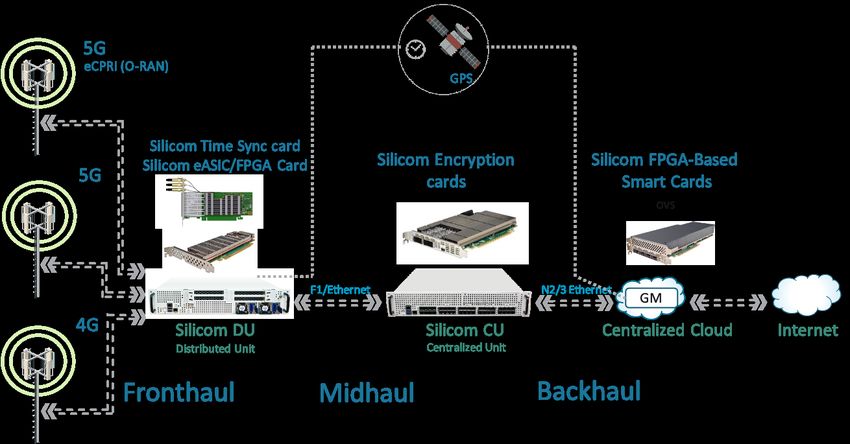
Solution Brief | Silicom’s Intel®-based Palma Ready for 5G Networks

Figure 1. 5G RAN network design using Silicom Palma.

DU: The Basic Anatomy                                                  Palma: 5G DU Hardware in a Box
While the CU manages high-layer functions, multiple DUs are            Palma is Silicom’s DU hardware platform for high-density
deployed in a network to support lower layers of the protocol          urban environments (see Figure 1). It is a companion product
stack such as the radio link control (RLC) and medium access           to Silicom’s Vigo. While Vigo provides four slots for optional
control (MAC).                                                         cards and runs on an Intel® Xeon® D processor, Palma provides
                                                                       six card slots and runs on 3rd generation Intel Xeon Scalable
To maintain connectivity and throughput, the choice of the RAN
                                                                       processors, with 8 to 36 cores depending on the chosen
fronthaul interface is vital. This is usually a wired, but sometimes
                                                                       configuration.
a wireless, network with control systems that connect the CU
to the DUs, and the DUs to radio units (RUs), maintaining              3rd generation Intel Xeon Scalable processors feature PCIe
throughput and reliability between other components of the             Gen 4.0 connectivity, enhanced hardware-based security
network.                                                               features, and hardware-enhanced data service delivery. These
                                                                       CPUs deliver improvements in I/O, memory, storage, and
5G networks are expected to require many more base stations
                                                                       network technologies over previous generations.³
and antennas than 4G because they operate at higher
frequencies, which increases support for more devices but              Several Intel technologies power key Palma security features,
attenuates the wavelength of a given antenna, thus reducing            including the Trusted Platform Module, which securely stores
its range. In cities, buildings and other structures can impede        keys, passwords, and digital certificates; hardware-based
signals, requiring MNOs to deploy small cells along city streets       encryption through Intel® Software Guard Extensions; a solid-
and inside buildings to route signals around barriers.                 state drive with integrated encryption; and built-in Intel®
                                                                       QuickAssist Technology (Intel® QAT) cryptography accelerator
The separation of the CU from the DU means that control
                                                                       on the motherboard.
data flows need precise time synchronization—on the order of
microseconds or even nanoseconds—for coordination. Time                Palma features 12 fixed ports of 10/25 GbE using the Intel®
synchronization ensures that data packets can move from one            Ethernet Controller E810; support for additional networking
network element to the next smoothly and in the correct order.         ports and different technologies is possible via Silicom’s
                                                                       network adapter cards. Palma is designed to be installed in
Since the DU is a key to a fast, reliable network, MNOs must
                                                                       environments without climate control, with an operating range
choose hardware wisely. It is possible to develop a customized
                                                                       from -4 to 135 degrees F (-20 to 55 degrees C). It is optimized
DU hardware platform by selecting servers, processors,
                                                                       for edge computing services with a 1U and 2U-high rack-
accelerators, fronthaul interfaces, and software separately,
                                                                       mounted form factor with a front panel I/O interface for RU
and then integrating them. This approach can enable some
                                                                       connectivity.
flexibility, but it is costly, time-consuming, requires significant
integration, and increases the risk of inefficient operation.

                                                                                                                                         2
Solution Brief | Silicom’s Intel®-based Palma Ready for 5G Networks
Silicom Time Sync Solves Timing Issue To augment the built-in processing power provided by the 3rd
generation Intel Xeon Scalable processor, MNOs can deploy a
Precise synchronization timing is a significant technical variety of combinations of accelerator cards in the six card slots
challenge for 5G DU deployments. LTE networks, and even 5G that can be augmented or revamped as needs change. Silicom
networks on a frequency-divided (FDD) spectrum, can survive card options include:
a loss of synchronization that exceeds an hour. However, 5G on
a time division duplex (TDD) spectrum requires synchronization • Oakham Network Adapter: The Silicom Oakham Adapter
on the order of microseconds to prevent interference. For carrier for 5G delivers high-performance and precise time
aggregation and other use cases, the time synchronization synchronization and is based on the Intel® FPGA
accuracy has to be within 65 nanoseconds. Programmable Acceleration Card N3000 utilizing Intel®
Arria® 10 FPGA combined with the unique Silicom Time
Palma supports Silicom Time Sync Technology (STS) through its Sync (STS) technology.
I/O interface. Silicom STS is available in several configurations
utilizing the Intel Ethernet Controller E810. STS offers • Lisbon ACC100 FEC network accelerator: The Lisbon
Synchronous Ethernet (G.8261, G.8262) combined with IEEE ACC100⁵ offloads forward error correction (FEC) processing
1588 precision time protocol (PTP). STS can serve as a from the CPU, speeding up network throughput. The ACC100
transparent clock, boundary clock, and a grandmaster clock, is based on the Intel® eASIC™ N3XS device, a new class of
accurate to the nanosecond level. It ensures synchronization configurable integrated circuit (IC) that balances the fast
within the physical and protocol layers. time-to-market of a field programmable gate array (FPGA)
with the power-efficient, purpose-built performance of a
Silicom offers several STS-enabled adapters for Palma including custom-developed application specific integrated circuit
a 1/10 GbE card, a 10/25 GbE and a 25 GbE card. (ASIC).
RAN technologies and features rely on time sync levels of Silicom has tested Palma with FlexRAN for initial validation.
various accuracies. For example, the deployment of coordinated The company further tested the unit with leading 5G software
RAN features such as coordinated multi-point transmission and operating systems from leading vendors, including Red
(CoMP) requires a relative time sync of less than a microsecond Hat and VMWare. Palma is available now and ready for proof-
between radios.⁴ of-concept implementations.
Why Time Synchronization Matters
In 3G and 4G networks, the necessary time synchronization features were built into the circuit-switched
equipment on which they relied. Full packet-based voice and other real-time applications on 5G require
highly accurate packet synchronization.
Synchronization ensures data packets flow from one network element to the next at a fast, steady
rate and in the proper order. Packets can get out of order when they take alternate routes through the
network. Time sync ensures packet order so that communications are undistorted and accurate.Solution Brief | Silicom’s Intel®-based Palma Ready for 5G Networks
Conclusion Learn More
The fact that RAN functionality in MNO 5G networks has become Silicom Palma
open and virtualized brings the potential for greater agility and
lower costs, but the increased integration effort makes the Lisbon ACC100
selection of the right hardware platform—one that offers both
performance and customization—crucial. Silicom’s Palma, an Oakham FPGA Programmable Acceleration Card
Open RAN platform based on open Intel technologies, is custom-
designed to meet the real-time processing needs of 5G DUs. With Silicom Time Sync and Acceleration Adapters
a 3rd generation Intel Xeon Scalable processor and six expansion
card slots, MNOs can configure Palma for a wide range of network Intel® Network Builders
deployments, including urban locations that need processing
Intel® Xeon® Scalable Processors
power for large groups of users. Silicom has designed Palma to
be the choice of MNOs seeking a cost-effective self-contained Intel eASIC devices
server that bridges flexibility with simplicity.
Intel® Arria® 10 GX Devices
Notices & Disclaimers
¹ https://www.pwc.com/us/5g
² https://www.o-ran.org/membership
³ https://www.intel.com/content/www/us/en/products/docs/processors/xeon/3rd-gen-xeon-scalable-processors-brief.html
⁴ https://www.ericsson.com/en/blog/2019/8/what-you-need-to-know-about-timing-and-sync-in-5g-transport-networks
⁵ https://networkbuilders.intel.com/solutionslibrary/silicom-fec-acceleration-adapter-designed-for-4g-5g-networks
Intel technologies may require enabled hardware, software or service activation.
No product or component can be absolutely secure.
Your costs and results may vary.
Intel does not control or audit third-party data. You should consult other sources to evaluate accuracy.
© Intel Corporation. Intel, the Intel logo, and other Intel marks are trademarks of Intel Corporation or its subsidiaries. Other names and brands may be claimed as the property of others.
0821/DO/H09/PDF Please Recycle 347633-001US
4You can also read


