Speak with signs: Active learning platform for Greek Sign Language, English Sign Language, and their translation - SHS Web of Conferences
←
→
Page content transcription
If your browser does not render page correctly, please read the page content below
SHS Web of Conferences 102, 01008 (2021)                                                             https://doi.org/10.1051/shsconf/202110201008
ETLTC2021

      Speak with signs: Active learning platform for Greek Sign Language, English
      Sign Language, and their translation

      Maria Papatsimouli1 , Lazaros Lazaridis1 , Konstantinos-Filippos Kollias1 , Ioannis Skordas1 , and George F. Fragulis1,∗
      1
          Laboratory of Robotics, Embedded and Integrated Systems,
          Dept. of Electrical and Computer Engineering,
          University of Western Macedonia, Hellas

                    Abstract. Sign Language is used to facilitate the communication between Deaf and non-Deaf people. It uses
                    signs-words with basic structural elements such as handshape, parts of face, body or space, and the orientation
                    of the fingers-palm. Sign Languages vary from people to people and from country to country and evolve as
                    spoken languages. In the current study, an application which aims at Greek Sign Language and English Sign
                    Language learning by hard of hearing people and talking people, has been developed. The application includes
                    grouped signs in alphabetical order. The user can find Greek Sign Language signs, English sign language signs
                    and translate from Greek sign language to English sign language. The written word of each sign, and the
                    corresponding meaning are displayed. In addition, the sound is activated in order to enable users with partial
                    hearing loss to hear the pronunciation of each word. The user is also provided with various tasks in order to
                    enable an interaction of the knowledge acquired by the user. This interaction is offered mainly by multiple-
                    choice tasks, incorporating text or video. The current application is not a simple sign language dictionary as
                    it provides the interactive participation of users. It is a platform for Greek and English sign language active
                    learning.

          Keywords: Deaf, Sign Language, Greek Sign Lan-                      1.1 Deaf and Sign Languages
      guage, English Sign Language, Learning, Interaction, Ac-
      tive Learning, Open Source software.                                    According to [4], Deaf with ‘D’ are those deaf/hard of
                                                                              hearing people who belong to the Deaf community and use
                                                                              sign language in order to communicate, while deaf with
                                                                              ‘d’ are those who are hard of hearing and do not neces-
      1 Introduction                                                          sarily need sign language as a communication tool. Sign
                                                                              language is the natural language of Deaf people and not
      Language is an innate mechanism that humans develop                     just an artificial communication system. Each country has
      [1]. People with hearing problems also seek a way to com-               its own Sign Language with structural features that differ
      municate and need to develop a language that is directly                from spoken languages. The gestures consist of regular
      accessible and effective for them. One such language is                 structures and semantics that correspond to spoken lan-
      sign language [2]. Sign languages are the only languages                guages [5]. Deaf people of each country use their own
      that Deaf people can use in order to communicate in a                   Sign Language [6].
      natural, effortless, easy, reciprocal and effective way. In
      Greece, Greek Deaf people use the Greek Sign Language                   1.2 Greek Sign Language
      (GSL), which is their natural language, as it is used not
      only by the majority of them but also by their hearing chil-            Greek Sign Language is the mother tongue of Greek Deaf
      dren, as well as by professionals and experts who work                  people. Sign Language had been sidelined in many Eu-
      with deaf people. Nowadays, the use of Information and                  ropean countries, for many years. Greek Sign Language
      Communication Technologies in everyday life has shown                   is a complete and independent language, recognized as
      an increasing trend and has helped many people in their                 "a non-written language with all the linguistic phenom-
      everyday life. The deaf/hard of hearing people could not                ena observed in the spoken languages” (grammar, syntax,
      have been unaffected by these rapid changes. The use of                 dictionary, phonology). In addition, the natural language
      technology has the effect of reducing isolation, increasing             of Deaf people presents elements of morphology, syntax,
      independence, and offering educational, economic, and so-               semantics, and pragmatics, while the linguistic system of
      cial opportunities to deaf/hard of hearing people [3].                  phonology is replaced by the corresponding italics [7]. In
                                                                              sign language, the combination of handshape with other
           ∗ e-mail: gfragulis@uowm.gr                                        elements, such as direction, position and movement, gives

© The Authors, published by EDP Sciences. This is an open access article distributed under the terms of the Creative Commons Attribution License 4.0
(http://creativecommons.org/licenses/by/4.0/).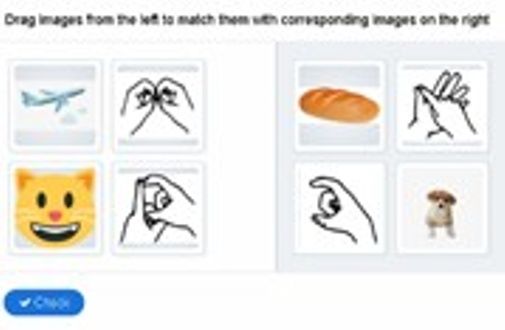
SHS Web of Conferences 102, 01008 (2021)                                                       https://doi.org/10.1051/shsconf/202110201008
ETLTC2021

      a specific meaning to a word. More specifically, direction           following are some applications from Greece and World-
      has to do with the orientation that the palm takes, posi-            wide:
      tion shows the point where the hand is placed in relation
      to the body and movement shows other syntactic informa-                1. Greek Sign Language: The web application has
      tion such as the subject-object agreement [8], [3], [9], [10],            been operating with free access since 2016 and it
      [11]. One or both hands are utilized in order to express                  was developed by the University of Patras. In this
      the sign, while making the necessary movements. The                       application, users can find signs of the basic vocab-
      signs that are rendered in this way are the main elements                 ulary for everyday use. The application is aimed at
      that distinguish sign language from spoken language [12].                 children and adults who want to learn Greek sign
      Finally, there is a Finger Alphabet that is a morphologi-                 language. However, there is no interaction between
      cal element of sign language [7]. Finger alphabet repre-                  the user and the content [18].
      sents Greek alphabet of spoken language and differs from               2. Greek Sign Language Center: It is a free access web
      signs. A Deaf person can use this alphabet in order to spell              application. It has been developed by the Greek
      some Greek words as they are in a visualized way, or form                 Sign Language Center and contains alphabetically
      names with his fingers [13].                                              ordered videos for sign learning. The platform is ad-
                                                                                dressed to children and adults and provides quizzes
      1.3 Education and Information & Communication                             for practice that contain videos with multiple-choice
          Technologies (ICT)                                                    questions. Users can see a video and then choose the
                                                                                right answer.
      During the training process, the use of tools and software
      for educational purposes which utilize multimedia and in-              3. DIOLKOS Software: Educational software for
      ternet technologies is proposed. In this way, students are                training in computers operation with terminology in
      enabled to develop and adapt the knowledge acquired at                    Greek Sign Language, Greek, and English. Devel-
      school to the modern educational environment, and have                    oped in 2006.
      the opportunity to collect, represent, analyze, transfer, and          4. LEARNING MEANINGS Software: It is a teach-
      utilize information. Mental processes and knowledge ac-                   ing environment for Greek Sign Language (GSL)
      quisition [14] are utilized through an educational environ-               vocabulary developed in 2013. This software had
      ment which results in the development of new skills and                   been addressed to students in the first grades of Pri-
      abilities. Therefore, a new learning culture is created and               mary School. The arranging of its contents based on
      leads to a meaningful relationship between knowledge and                  the principles, characteristics and rules regulate the
      its construction.                                                         vocabulary of the language.
                                                                             5. CHILDREN’S DICTIONARY OF GREEK SIG-
      1.4 Active learning in education with ICT
                                                                                NIFICANT LANGUAGE Software: It included
          technologies
                                                                                videos with Greek signs translated into the corre-
      The active learning is an educational process consists                    sponding Greek words. It had been addressed to
      of short-related individual or small-group activities that                kindergarten and first grades of primary school chil-
      all students are called to carry on. Instructors pro-                     dren. Developed in 2001.
      cess students’ responses and new information is pre-                   6. Greek Sign Language Courses: This application
      sented[? ] . The use of ICT in education require the                      contains words translated into GSL. It includes basic
      change from teacher-centered learning to student-centered                 signs, complex signs, synonyms and antonyms, the
      learning. Furthermore, ICT in teaching has a much                         finger alphabet and vocabulary groups. It is avail-
      stronger transformative effect because students’ evolve-                  able for free and is addressed to all age groups [19].
      ment is required.[15]
                                                                             7. ASL-LEX: It is an online application that displays
                                                                                signs of American Sign Language. Users can see the
      2 Related Work - Applications of Sign                                     frequency of use, lexical properties, the phonologi-
        language in Greece and Worldwide                                        cal coding, and other characteristics of each sign.
                                                                                Also, they have the aability to search for the written
      One of the most fundamental features of software appli-                   word of each sign to display [20].
      cations is interaction. Interaction helps each user to be
      transformed from a passive recipient to an active member               8. preadTheSign: It is an online application that gives
      of learning process that keeps his interest undiminished.                 signs in many different sign languages. For exam-
      Sign Language is a visual language, and with the contribu-                ple, English of the United States, English of In-
      tion of video, it can be included in any application in order             dia, German, Greek, Japanese, etc. This applica-
      to transfer information and provide deaf/hard of hearing                  tion groups its content in terms of subject and not
      people with easy access to knowledge [16],[17].                           alphabetically. Users can interact with the content
          The majority of applications that have been developed                 by using 360 degrees images where, there are points
      to date are related to learning sign language and translating             of interest that the user can click and see the corre-
      from signs to text or spoken language. For example, the                   sponding signs [21].

                                                                       2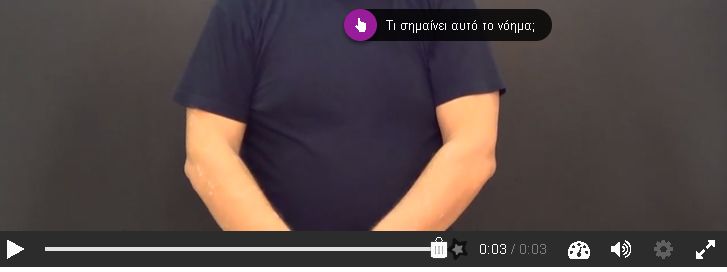
SHS Web of Conferences 102, 01008 (2021)                                                       https://doi.org/10.1051/shsconf/202110201008
ETLTC2021

         9. Handspeak: It is an online application that dis-               written language (e.g. children or adults with low edu-
            plays the signs in English Sign Language but also              cational level)
            in American Sign Language. This application gives            • The interface should be as simple as possible and easy
            the content in alphabetical order and is addressed             for users
            to groups of all age. The synonyms of each word
            are displayed and the user can see them by click-            • In this application, the user will be able to see displays
            ing on the corresponding word.Also, it is possi-               of signs/videos. In addition, practice will provide users
            ble to display videos that show stories in sign lan-           with increased and appropriate knowledge through ac-
            guage(storytelling in sign language) [22] .                    tive learning
                                                                         • The repetition of videos should be possible
      3 Application Description                                          • Audio integration should be available in order to support
                                                                           hard of hearing people
      The                    proposed                application
      (http://signlanguage.groupdvs.com/) has been devel-
      oped aiming at the acquisition of a basic Greek Sign
      Language vocabulary that is used daily. Particularly, it
      is addressed to children and adults who want to learn
      Greek Sign Language(GSL), deaf children who do not
      have prior knowledge of GSL, parents of deaf children
      and hearing children who want to learn GSL. It has to
      be mentioned that relevant applications with a purely
                                                                         Figure 2. Detailed Application Workflow
      educational character both in Greece and internationally,
      do not exist. As it was mentioned above, there are some
      dictionarylike applications, which are used for Sign Lan-
      guage learning. Most of the aforementioned applications
      do not provide user interaction for practice and in-depth          3.2 User Interface and Functionality
      learning of sign language. The application was designed
      as an autonomous platform for tele-education and was               User’s registration is not required in order to access the
      created under the philisophy of open source software. In           application. During the operation of the application, there
      recent years our research team has developed a number of           is immediate feedback for every action of the user.
      applications using open-source programming languages
      and tools such as PHP, MySQL and WordPress [23], [24],
      [25], [26], [27], [28].

                                                                         Figure 3. Home page

      Figure 1. Main Workflow
                                                                         3.2.1 HomePage

          In the figures (1)-(2), we give the main & detailed Ap-        The Home page (http://signlanguage.groupdvs.com/) con-
      plication workflow. The administrator can upload training          sists of 5 different menus: Home, Greek Sign Language,
      material to the application and users have access to this          English Sign Language, GSL to ESL, Contact. The con-
      material and can practice aiming at acquiring knowledge            tent is automatically translated depending on the language
      through their active participation (active learning).              chosen by each user (English, Chinese, German, etc.) The
                                                                         Home page provides information about sign language and
                                                                         the Contact page allows the user to contact the administra-
      3.1 Requirements’ Analysis                                         tor.
      The main points of the requirements analysis found for
      online educational applications are the following:                 3.2.2 Greek Sign Language Menu
      • Vocabulary categorization into semantic sections for the
        facilitation of users                                            In this section, the user can learn the Greek Sign Language
                                                                         alphabet, search for signs which are categorized in alpha-
      • Videos are the best format for use, except for the display       betical order and practice on the acquired knowledge. En-
        of finger alphabets where images are appropriate, too            glish Sign Language menu has the same structure as the
      • There should be a connection between each word and               Greek Sign Language one. Specifically, it contains alpha-
        each meaning in a visual form (image/video) in order             bet presentation, search for signs by their first letter, and
        to support users who have a poor knowledge of Greek              practice.

                                                                     3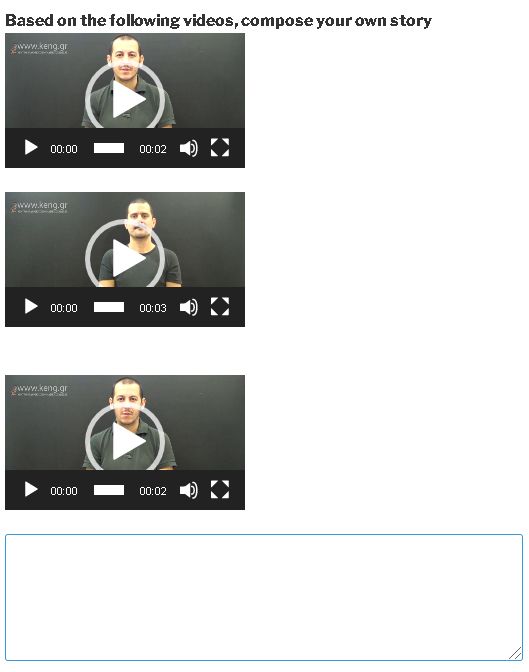
SHS Web of Conferences 102, 01008 (2021)                                                           https://doi.org/10.1051/shsconf/202110201008
ETLTC2021

                                                                                 The first option is translation of Greek sign language
                                                                             signs into English sign language and vice versa. The signs
                                                                             are categorized according to Greek Alphabet, and the user
                                                                             can select the word group to be displayed. At this point,
                                                                             the written text, the sign (in video format), and the pronun-
                                                                             ciation are displayed both in Greek and English (Figures
                                                                             7-8).

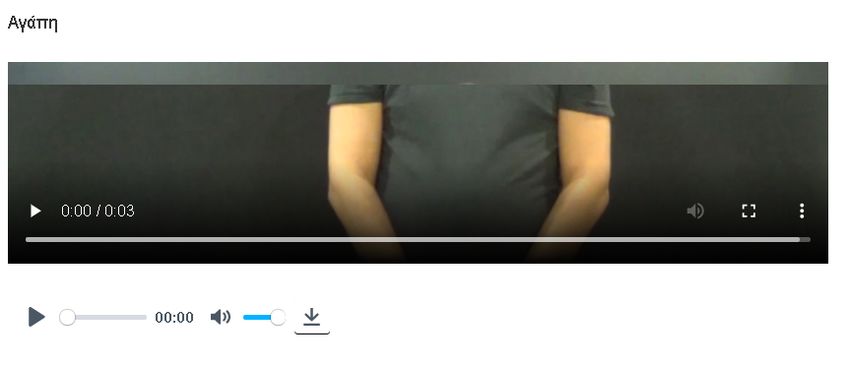
      Figure 4. Greek Sign Language submenu

                                                                             Figure 8. Group content to view

      Figure 5. Example of an alphabetical display of signs per letter

                                                                             3.2.4 Practice content task
          The user selects the category that he wants, and all the
                                                                             In this task, users can exercise the Greek finger alpha-
      words that start with the selected letter are displayed. As it
                                                                             bet with Figures. Users see the letters and then enter the
      is presented in figure (6), for each selected word the writ-
                                                                             correct answer. At the end of the task, users can see the
      ten text, the sign (in video format), and the pronunciation
                                                                             achieved results on the screen.
      are displayed, for supporting the hard of hearing people,
      who do not have complete hearing loss.

      Figure 6. Example of selected word display

      3.2.3 Translation of Greek Sign Language to English                    Figure 9. Choose the right answer
            Sign Language

      In this menu, the user can translate Greek sign language                   The user enters the answer in the box, and then he
      signs into English sign language and exercise in the trans-            presses the Check button (Figure 9) . The answer is cor-
      lation of signs, as well.                                              rected automatically depending on the result (Figures 10-
                                                                             11). After completing the task, users can see the overall
                                                                             results (Figure 12)).

                                                                             3.2.5 Choose the correct answers for Greek Sign
                                                                                   Language practice

                                                                             This task is about Greek Finger Alphabet practice. Various
                                                                             options are presented and the user chooses the right com-
      Figure 7. Greek sign language to English sign language                 bination of a letter and a Figure. When the test is finished,
                                                                             the achieved results are displayed (Figure 13).

                                                                         4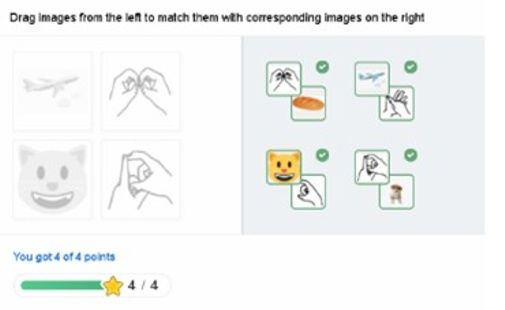
SHS Web of Conferences 102, 01008 (2021)                                                       https://doi.org/10.1051/shsconf/202110201008
ETLTC2021

      Figure 10. Correct answer

                                                                         Figure 13. Select the correct match

      Figure 11. Wrong answer

                                                                         Figure 14. Arrange in correct order

      Figure 12. Final results presentation

                                                                         3.2.8 Videos with Multiple Choice questions

      3.2.6 Arrange in correct order task in the Greek finger            In this task, the user can see the signs in video format (Fig-
            alphabet                                                     ure 16)., choose the correct answer from the available op-
                                                                         tions that are shown and press the Check button to check
                                                                         the answer.
      In this task, the user places the Figures in correct or-
      der so that the finger alphabet appears in alphabetical or-
      der(Figure 14).                                                    3.2.9 Choose the first letter of the word
          Also the users can see the time that they spent on doing
      the task, and the total moves that were made. In addition,         In this task, the initial letters in English Sign Language and
      they can press either Check button to complete the task or         pictures that start with the corresponding letters are given
      Show Solution to see the solution.                                 (Figures 17 - 19). The user makes the right combinations,
                                                                         and feedback appears by pressing the Check button.

      3.2.7 English finger alphabet recognition task
                                                                         3.2.10 Practice in storytelling

      Here, the user recognizes the English finger alphabet (Fig-        In this task, the user watches some videos including signs
      ure 15). The user sees figures depicting the English Sign          and then uses these signs in order to write a short story
      Language letters and by moving the cursor over them, the           (Figure 20). It is one of the tasks that contribute to the
      English characters corresponding to them will appear.              development of imagination of users as everyone can write

                                                                     5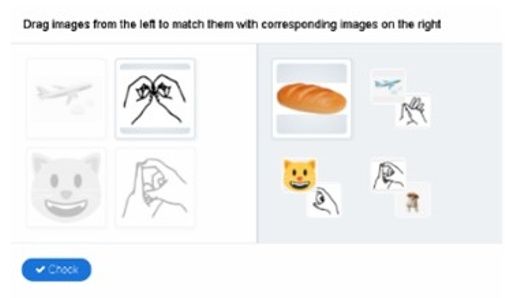
SHS Web of Conferences 102, 01008 (2021)                                                        https://doi.org/10.1051/shsconf/202110201008
ETLTC2021

                                                                         3.2.12 Interactive Videos Task

                                                                         In this task, a sign is shown on a video and then it stops
                                                                         (Figure 22). The user needs to answer what this sign
                                                                         means by clicking on an active point on the video, and
                                                                         choosing one of the available options that are shown. The
                                                                         user can check his answer by pressing the Check button.

                                                                         4 Conclusions

                                                                         Sign languages are similar to spoken languages and it is
                                                                         the communication system that is used in deaf commu-
      Figure 15. Recognition of English Sign Language letters            nities. It is acquired during childhood without being in-
                                                                         structed, achieves the same social and mental functions
                                                                         as spoken languages and can be interpreted in real-time
                                                                         [29]. The introduction of ICT in education can bring im-
                                                                         portant results to the educational process. Moreover, the
                                                                         appropriate introduction of educational methods in online
                                                                         platforms can give the best results in knowledge acquisi-
                                                                         tion and make the educational process more interesting.
                                                                         In the current application, users can learn both Greek and
                                                                         English sign language and translate them, as well. The ed-
                                                                         ucational content of all these categories has been grouped
                                                                         in alphabetical order in order to enable the user to easily
                                                                         find it. Each word has been presented in written text both
                                                                         in Greek and English, in sign language in video format
      Figure 16. Videos with Multiple Choice questions task              and its pronunciation has been presented as well in order
                                                                         to support the hard of hearing people without total hear-
                                                                         ing loss. The current platform -using only open source
                                                                         software- is not just a simple dictionary of signs. Users
                                                                         can interact with the educational content and actively par-
                                                                         ticipate in the educational process through active learning.
                                                                         The user can exercise in various types of tasks and receive
                                                                         feedback. User’s interaction is based on Figures, depicting
                                                                         the finger alphabet and videos displaying signs. The most
                                                                         important and innovative tasks that were used for sign lan-
                                                                         guage learning are:
                                                                         • Arrange in correct order, in which the user places the
                                                                           letters of the finger alphabet in right order
                                                                         • Memory Cards where users have to match each Greek
                                                                           finger alphabet letter with the English finger alphabet
                                                                           one
      Figure 17. Choose the first letter of the word task

      his/her own story without being right or wrong. It is a non-
      linear task that helps the development of written narrative
      speech.

      3.2.11 Memory cards task

      In this task, the user matches the letters of the Greek Sign
      Language with the English Sign Language ones (Figure
      21) . The user can see the moment and the amount of                Figure 18. Match the letters with the right Figure
      times the cards were turned.

                                                                     6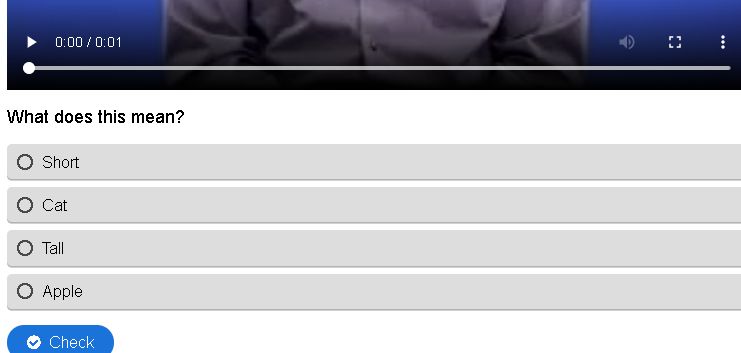
SHS Web of Conferences 102, 01008 (2021)                                                        https://doi.org/10.1051/shsconf/202110201008
ETLTC2021

                                                                         Figure 21. Memory Cards Task
      Figure 19. Feedback given

      • Interactive videos, which show a sign and the user
        chooses what this sign means by choosing one of the
        available options

      • Choose the first letter of the word, where initial letters
        in English sign language and pictures that start with the
        corresponding letters are given. The user recognizes the         Figure 22. Interactive videos task
        letters of the finger alphabet and makes the right combi-
        nations.
                                                                         5 Future extensions
      • Storytelling where videos are displayed, and the user
        can write his own story based on the signs that he just          In the current version of Speak with Signs platform, stu-
        saw.                                                             dents are able to learn two sign languages, Greek and En-
                                                                         glish, and their translation, and practice is available on the
                                                                         educational content. In future extensions:
                                                                         • More sign languages will be available and users will be
                                                                           able to select the language that they want for translation
                                                                         • Online courses will be available for providing humans’
                                                                           interaction
                                                                         • The number and the type of exercises will be increased
                                                                           for providing better practice to learners.
                                                                         • Educational games will be developed, as well.

                                                                         References
                                                                          [1] B. Malmberg, Structural linguistics and human com-
                                                                              munication: an introduction into the mechanism of

      Figure 20. Practice in storytelling                                Figure 23. Answer selection in interactive videos task

                                                                     7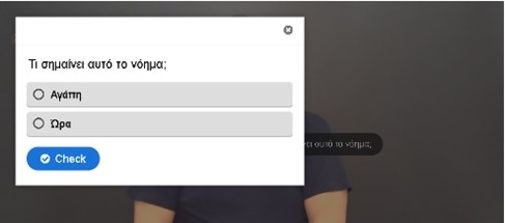
SHS Web of Conferences 102, 01008 (2021)                                                      https://doi.org/10.1051/shsconf/202110201008
ETLTC2021

             language and the methodology of linguistics, Vol. 2         [21] Various, Tech. rep. (2020), https://www.
             (Springer Science & Business Media, 2012)                        spreadthesign.com/en.us/search/
       [2]   M.S. Kushwah, M. Sharma, K. Jain, A. Chopra,                [22] J. Lapiak, Tech. rep. (2020), https://www.
             Sign language interpretation using pseudo glove, in              handspeak.com/word/
             Proceeding of International Conference on Intelli-          [23] G.F. Fragulis, L. Lazaridis, M. Papatsimouli, I.A.
             gent Communication, Control and Devices (Springer,               Skordas, O.D.E.S.: An Online Dynamic Examina-
             2017), pp. 9–18                                                  tion System based on a CMS Wordpress plugin, in
       [3]   M. Maiorana-Basas, C.M. Pagliaro, Journal of deaf                2018 South-Eastern European Design Automation,
             studies and deaf education 19, 400 (2014), publisher:            Computer Engineering, Computer Networks and So-
             Oxford University Press UK                                       ciety Media Conference (SEEDA_CECNSM) (IEEE,
       [4]   J.C. Woodward, Sign Language Studies 1, 1 (1972)                 Kastoria, 2018), pp. 1–8, ISBN 978-618-83314-1-
       [5]   W.C. Stokoe, Annual Review of Anthropology pp.                   9, https://ieeexplore.ieee.org/document/
             365–390 (1980), publisher: JSTOR                                 8544928/
       [6]   Panagiotakopoulos, Labropoulou, Education Sci-              [24] L. Lazaridis, M. Papatsimouli, G.F. Fragulis,
             ences, 1, 39-50 (2003)                                           S.A.T.E.P.:       Synchronous-Asynchronous Tele-
       [7]   A. Aarssen, R. Genis, E. van der Veeken, A Bibliog-              education Platform, in Proceedings of the SouthEast
             raphy of Sign Languages, 2008-2017: With an Intro-               European Design Automation, Computer Engi-
             duction by Myriam Vermeerbergen and Anna-Lena                    neering, Computer Networks and Social Media
             Nilsson (Brill, 2018)                                            Conference on - SEEDA-CECNSM ’16 (ACM Press,
       [8]   N. Ackovska, M. Kostoska, M. Gjurovski, ICT In-                  Kastoria, Greece, 2016), pp. 92–97, ISBN 978-1-
             novations 2012, Web Proceedings, ISSN 1857-7288                  4503-4810-2, http://dl.acm.org/citation.
             pp. 103–112 (2012)                                               cfm?doid=2984393.2984395
       [9]   H. Papaspyrou, Routes in Language Rhythms: Stud-            [25] L. Lazaridis, M. Papatsimouli, G.F. Fragulis, Interna-
             ies on Sign Language and Deaf Education (Atropos,                tional Journal of Smart Technology and Learning 1,
             Athens, 2003)                                                    122 (2019), publisher: Inderscience Publishers (IEL)
      [10]   W. Sandler, D. Lillo-Martin, The handbook of lin-           [26] E. Michailidi, I. Skordas, M. Papatsimouli,
             guistics pp. 533–562 (2001)                                      L. Lazaridis, H. Michailidis, S. Tavoultzidou,
      [11]   C. Valli, C. Lucas, Linguistics of American sign lan-            G.F. Fragulis, GrfKids: Development of a Greek
             guage: An introduction (Gallaudet University Press,              language teaching platform via a Learning Manage-
             2000)                                                            ment System for primary school pupils with Russian
                                                                              as a mother tongue (TheACM Chapter International
      [12]   G. Sapountzaki, Sign languages of the world: A
                                                                              Conference on Educational Technology,Language
             comparative handbook p. 317 (2015), publisher:
                                                                              and Technical Communication (ETLTC), Aizuwaka-
             Walter de Gruyter GmbH & Co KG
                                                                              matsu,Fukushima, Japan, 2020), p. 8
      [13]   M. Marschark, Raising and educating a deaf child:
                                                                         [27] M. Papatsimouli, J. Skordas, L. Lazaridis, E. Michai-
             A comprehensive guide to the choices, controversies,
                                                                              lidi, V. Saprikis, G.F. Fragulis, Cyberbullying and
             and decisions faced by parents and educators (Ox-
                                                                              Traditional Bullying in Greece: An Empirical
             ford University Press, 2007)
                                                                              Study (ETLTC2020-Virtual ACM Chapter Workshop
      [14]   D.H. Jonassen, Computers as mindtools for schools:
                                                                              on Professional and Social Media Communication,
             Engaging critical thinking (Prentice hall, 2000)
                                                                              Aizuwakamatsu, Fukushima, Japan, 20-22nd August
      [15]   J.L. Duffany, IEEE Revista Iberoamericana de Tec-                2020, 2020)
             nologias del Aprendizaje 12, 62 (2017)
                                                                         [28] I.A. Skordas, N. Tsirekas, N. Kolovos, G.F. Fragulis,
      [16]   N.M. Kakoty, M.D. Sharma, Procedia Computer Sci-                 A.G. Triantafyllou, M.G. Bouliou, e-Sem: Dynamic
             ence 133, 55 (2018), publisher: Elsevier                         seminar management system for primary, secondary
      [17]   J. Kim, P. O’Neill-Brown, Improving American Sign                and tertiary education, in 2017 South Eastern Eu-
             Language Recognition with Synthetic Data, in Pro-                ropean Design Automation, Computer Engineering,
             ceedings of Machine Translation Summit XVII Vol-                 Computer Networks and Social Media Conference
             ume 1: Research Track (2019), pp. 151–161                        (SEEDA-CECNSM) (IEEE, Kastoria, 2017), pp. 1–4,
      [18]   Various, Tech. rep. (2020), https://www.ocean.                   ISBN 978-618-83314-0-2, http://ieeexplore.
             upatras.gr/gsl/                                                  ieee.org/document/8088228/
      [19]   Various, Tech. rep. (2020), http://www.xanthi.              [29] K. Cormier, Journal of Linguistics 42, 738 (2006),
             ilsp.gr/eng_sys/                                                 publisher: Cambridge University Press
      [20]   Various, Tech. rep. (2020), http://asl-lex.org/

                                                                     8
You can also read


