SSC18-IX-01 - DigitalCommons@USU
←
→
Page content transcription
If your browser does not render page correctly, please read the page content below
SSC18-IX-01

                    Small Launch Vehicles – A 2018 State of the Industry Survey
                                               Carlos Niederstrasser
                                         Northrop Grumman Corporation
                             45101 Warp Drive, Dulles, VA 20166 USA; +1.703.406.5504
                                         Carlos.Niederstrasser@ngc.com

                                                       ABSTRACT
The 2010’s has seen a dramatic increase in potential small launch vehicle contenders, which we define as rockets
capable of carrying at most 1000 kg to Low Earth Orbit. Spurred on by government programs such as SALVO, VCLS,
and Horizon 2020, and the rapid proliferation of CubeSats and nanosatellites, more than 50 different commercial,
semi-commercial, and government entities worldwide are now working on new entrants of this class. To date the most
successful small launcher, the Northrop Grumman Pegasus has launched 43 times, but its flight rate has dropped to
less than one a year. At the same time launch opportunities on ESPA rings, secondary slots on larger launchers, and
CubeSat missions as cargo to the International Space Station have proliferated. Despite this seemingly bleak market
environment, new entrants have merged looking for a new magic formula. This paper presents an overview of the
small satellite launch systems under development today. We compare capabilities, stated performance goals, cost, and
funding sources where available. This paper is a yearly update of a paper originally presented at the 2015 AIAA/USU
Conference on Small Satellites.1 The authors welcome any comments, feedback, or corrections.

INTRODUCTION                                                       capability increases, operators are no longer satisfied
                                                                   with the traditional rideshare and secondary payload
The Tradition of Small Launch Vehicles                             opportunities available to them. During the past decade,
Many of today’s heavy launch vehicles (LVs) – Atlas V,             there has been an increasing swell of interest in having
Delta IV, Falcon 9, and Ariane 5 – started their lives in a        new, lower cost, dedicated small launchers. This has led
smaller form. The Delta IV as Thor, growing from an                to a new wave of proposed small launch vehicles ranging
Intermediate Range Ballistic Missile with space launch             in capability from a single 3U CubeSat (roughly 5 kg) to
capabilities a bit above a metric ton to one of the heaviest       larger small launch vehicles reaching up to 1000 kg to
launch vehicles the US is currently flying. Atlas V from           Low Earth Orbit (LEO).
an InterContinental Ballistic Missile with staging engines         These vehicles are hoping to solve the same problem that
and a pressure stabilized tank to today’s launch vehicle           vexed the earlier generation of small launchers and
that nearly equals the Delta IV heavy in capability.               satellites – large constellations are only financially
Ariane 5 grew from the purpose-designed Ariane 1.                  feasible if launch costs are low, but launch costs can only
Similarly SpaceX’s Falcon 1 was quickly abandoned in               be kept low if there is a high rate of launch. This
favor of the larger Falcon 9 which in turn evolved into            “chicken and egg” problem proved untenable in the 90s,
the Falcon Heavy. Of the small launchers in the 60s and            and it remains to be seen whether it can be solved today.
70s, only the Scout stayed small – limited by its
technology and eventually being replaced by the Pegasus            Drivers and Motivation
to fulfil NASA’s need for a small space launch vehicle.
                                                                   For many of the new entrants the drive to develop a new
Athena joined Pegasus and Taurus, and several versions
                                                                   vehicles is purely commercial. Driven by visions of
of Minotaur came along to utilize excess government
                                                                   hundreds, if not thousands, of small satellites launching
assets in meeting the small space launch need, but the low
                                                                   annually; buoyed by venture capitals markets that
launch rate destined these vehicles to high-priced niche
                                                                   become friendlier to space endeavors; and inspired by the
markets.
                                                                   highly visible success of SpaceX, entrepreneurs across
The Second Small Sat Revolution                                    the globe have embarked on what was once considered
                                                                   the incredibly risky and financially non-rewarding
Just like ORBCOMM and Iridium led the commercial                   venture of designing and fielding a new rocket.
perception of a need for small launchers in the 1980s and          Furthermore, beyond the commercial visions of
90s (and directly resulted in the Pegasus development),            economic glory, the lure of government contracts has
CubeSats and new constellations such as OneWeb and                 likewise increased.
Planet are leading the demand now. As small satellite

Niederstrassser                                                1                                  32nd Annual AIAA/USU
                                                                                             Conference on Small Satellites
In recent years, The U.S. Department of Defense (DOD) an overall drive by Chinese leadership to significantly
and NASA have significantly increased the attention paid increase commercial space activities in the country.6
to small launchers. As small satellites increase in utility
and capability, DoD and its associated agencies are Underlying all the government and commercial
interested not just in traditional launch services, but also investment is the very fast growth in small satellites over
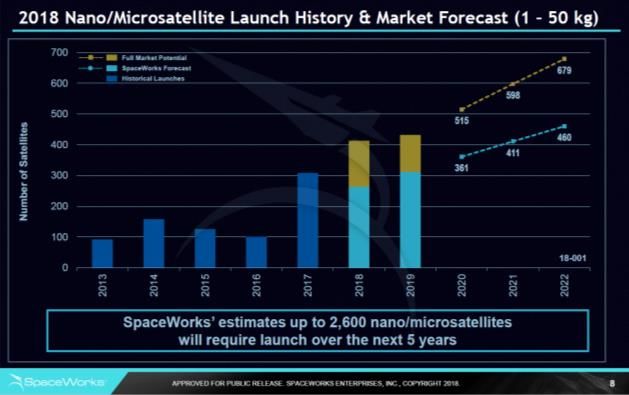
in “launch on demand” services. Programs like the past ten years. SpaceWorks Commercial in their
DARPA’s Airborn Launch Assist Space Access 2018 Nano-Microsatellite Market Forecast projects up to
(ALASA) and NASA’s Venture Class Launch Services 2,600 nano-microsatellites launching in the next 5 years
(VCLS) promised to fund new entrants in their as shown in Figure 1.7 This growth matches the growth
development of small launch vehicles. The latest in private investment dollars and government interest
DARPA launch challenge aims to launch payloads with throughout the world, but especially in the United States.
just 14 day notice to a previously unspecified orbit. The There is also a perceived shortage of launch opportunities
successful team stands to win a $2M reward on the initial with many of the new entrants habitually quoting a “2
launch and $10M reward on a second launch within two year backlog” on existing vehicles as a potential
weeks. To many of the small launch vehicle contenders, differentiator for their on endeavor. The potential for
DARPA’s interest makes a lot of sense. “[DARPA's] capturing even a small portion of this market is what
seeing the same scenarios or requirements that a lot of us drives many of the organizations developing new
are seeing — the need for more responsive access," said vehicles.
John Garvey, president of launch services at Vector.2
Across the Atlantic, European governments have not
been idle either. ESA’s Future Launchers Preparatory
Programme (FLPP)3 and studies funded through the
European Union’s Horizon 20204 have both contributed
needed investment in the European market. Individual
countries have also taken a new interest in small
satellites; for instance the United Kingdom has been
actively pursuing potential launch sites for many of the
new entrants.
A significant new player in the small launch vehicle
arena is China. While China has been on the foreground
of global launch services for many years, in the past four Figure 1: Growth in nano/microsatellite market
years they have also made significant investments in the (Source: SpaceWorks)
domain of small launch vehicles. Of the 40 vehicles
captured in this survey, six are from China. Three of SURVEY CRITERIA
them are currently operational, the most of any country.
One of the factors that makes Chinese involvement This survey’s goal is to identify active commercial (or so
particularly interesting is that several of the companies, designated) efforts in the field of small launch vehicles.
such as Linkspace, are privately held. In the past all of Before starting the survey we laid down some
Chinese launch efforts were carried out through state- requirements for inclusion in the list. This was needed
owned companies or agencies. It is not clear at this point both to limit the field and to provide some clear definition
how much government involvement, technology, or of what an “active effort” entails. These requirements are
funding has been given to these companies, but it is neither scientifically rigorous nor complete; rather they
evident that, at least on paper, there is a formal separation are simply designed to serve as a filtering mechanism.
between the Chinese government and the launch vehicle The requirements, with some minor variations have
developers. This is all part of a big bigger effort in China; remained the same in every yearly edition of the survey
the Beijing-Based consulting firm Future Aerospace (the 2016 edition limited the upper mass of the payload
recently stated that there are over 60 private Chinese performance to 500 kg, with only 3 vehicles dropping out
firms in existence.5 of the survey).
To be included in this list a launch vehicle under
Although at the moment U.S. companies are prohibited development must meet the following requirements:
from using Chinese launch services, companies in most
of the rest of the world do not have such limitations. Thus Have a maximum capability to LEO of 1000 kg
U.S. launch companies will feel significant competitive (definition of LEO left to the LV provider).
pressure from their Chinese counterparts. This is part of
Niederstrassser 2 32nd Annual AIAA/USU
Conference on Small Satellites The effort must be for the development of an published country(s) of origin, and the first successful
entire space launch vehicle system (with the launch of the vehicle.
exception of carrier aircraft for air launched
vehicles). Table 1: Operational Small Launch Vehicles
Vehicle First
Some indication through a web site, social Organization Country
Name Launch
media, traditional media, conference paper, China Aerospace
Chang
press release, etc. that the effort has been active Science and Technology China 25 Sep 2015
Zheng 11
in the past two years. Corporation
USA/New
Rocket Lab Electron 21 Jan 2018
Zealand
No specific indication that the effort has been China Aerospace
cancelled, closed, or otherwise disbanded. Science and Technology Kaituozhe-2 China 3 Mar 2017
Corporation
Have a stated goal of completing a fully ExPace Kuaizhou-1A China 9 Jan 2017
Northrop Grumman Minotaur I USA 27 Jan 2000
operational space launch (orbital) vehicle.
Northrop Grumman Pegasus XL USA 5 April 1990
Funded concept or feasibility studies by
government agencies, patents for new launch New Entrants
methods, etc., do not qualify, but have been
included in the “Other Potential Players” For our market survey, Table 3 presents an alphabetical
section. roster of the 34 different organizations that qualified
under the criteria set forth in the previous section. It also
The launch vehicle must be available on the includes the vehicle’s name, the published country(s) of
open, commercial market. (With the origin and last announced date of first launch (if
understanding that some countries are restricted available). It is worth noting that a number of
with regards to what vehicles their space organizations have not updated their estimated date for
systems can launch on) first launch, and this date now lies in the past.
The philosophy behind the guidelines to be considered International participation
“active” is based on the fact many of these efforts require One of the hallmarks of this new wave of launch vehicle
some amount of confidentiality and secretiveness or may developments is the broad international representation.
go dormant as a result of funding gaps. Therefore we do Table 2 shows the country of origin of all the current
not consider the absence of new information (in the last systems we list as operational or under development.
two years) to be indicative of the project standing down. While the US continues to dominate in the field, there is
Beyond these criteria the authors have not attempted to a significant presence building from China, as was
validate the technology, business plan, feasibility, or discussed in the introduction. Spain and the United
realism of the systems documented herein. We do not Kingdom are also well represented, partially as a result
make any value judgements on technical or financial of initiatives taken by their respective governments to
credibility or viability. promote the development of new space enterprises.
CONTENDERS Table 2: Country of Origin of Launch Vehicle
Developers
Operational Systems
Country Count
When the survey was started in 20151 only two USA 20
operational systems fit into the category of “small launch China 6
vehicles” as defined by the 1000 kg to LEO limit. Spain 3
Northrop Grumman’s (then Orbital ATK) Pegasus XL United Kingdom 3
and Minotaur I were fully operational with a combined Argentina 1
flight total of 53 flights. At the time, Lockheed’s Athena Australia 1
I was dormant and was not included as “operational”, Australia/Singapore 1
although it too met the operational criteria with four Brazil 1
flights. Europe 1
India 1
In the intervening three years, four more new entrants UK/Ukraine 1
have fielded a new vehicle and conducted a successful USA/New Zealand 1
flight. Table 1 presents all the organizations that have an
operational small launch vehicle, the vehicle’s name, the
Niederstrassser 3 32nd Annual AIAA/USU
Conference on Small SatellitesTable 3: Small Launch Vehicles Under Development
Latest Launch
Organization Vehicle Name Country Date
ABL Space Systems RS1 USA Q3 2020
Aphelion Orbitals Helios USA 2021
Bagaveev Corporation Bagaveev USA 2019
bspace Volant USA 2018
Celestia Aerospace Sagitarius Space Arrow CM Spain 2016
Cloud IX Unknown USA
CONAE Tronador II Argentina 2020
CubeCab Cab-3A USA 2020
Departamento de Ciencia e
Tecnologia Aeroespacial VLM-1 Brazil 2019
ESA Space Rider Europe 2020
Firefly Aerospace Firefly Alpha USA Q3 2019
Gilmour Space Technologies Eris Australia/Singapore Q4 2020
Interorbital Systems NEPTUNE N1 USA
ISRO PSLV Light India Q1 2019
LandSpace LandSpace-1 China H2 2018
Launcher Rocket-1 USA 2025
LEO Launcher Chariot USA Q4 2018
Linkspace Aerospace
Technology Group NewLine-1 China 2020
One Space Technology OS-M1 China 2018
Orbex Orbex United Kingdom
Orbital Access Orbital 500R United Kingdom 2020
PLD Space Arion 2 Spain 3Q 2021
Rocketcrafters Intrepid-1 USA Q1 2019
RocketStar Star-Lord USA 2018
Skyrora Skyrora XL UK/Ukraine
Space Ops Rocky 1 Australia 2019
SpaceLS Prometheus-1 United Kingdom Q4 2017
SpinLaunch Unknown USA
Stofiel Aerospace Boreas-Hermes USA 2019
Stratolaunch Pegasus (Strato) USA
VALT Enterprises VALT USA
Vector Space Systems Vector-R USA H2 2018
Virgin Orbit LauncherOne USA H1 2018
zero2infinity Bloostar Spain 2017
MARKET SURVEY lists details of how the space launch system starts its
journey upward, and the published launch location. It is
We conducted a market survey to identify a variety of
worth noting that while ground, water, and carrier aircraft
performance, design, and financial parameters. Each of
based systems already exist, balloon-based systems are a
the following sections presents a subset of these
new concept not previously seen. In the “Other Potential
parameters. Not all companies will be listed in all tables,
as some information may not be available. For simplicity Player” section, there are also entrants with more exotic
sake, subsequent tables will only refer to the Vehicle launch methods such as electro-rails and gas guns.
Name. Where one organization has multiple vehicles
Vehicle Technology
under development, the smallest vehicle will be listed.
All operational vehicles are also included to provide a Many of the new entrant launch vehicles have a
comparison. Operational vehicles are highlighted in technology or concept that is their key to reducing the
Green. cost of space access. All are assuming that many
launches will be in the manifest – almost nobody goes
into this market assuming that they are only going to
Launch Method/Location
launch every few years. In this section, we will outline
To start the characterization of the launch system, we will the vehicle details – number of stages, propellant,
start with the fundamental base – how/where the space “breakthrough” idea, and any other pertinent facts that
launch system starts its journey to space. For many of make the vehicle stand out from their competitors. The
the launch systems, this has not been designated at this benefits of the technology described are as presented by
time; in that case only the launch mode will be designated the developer; the authors have not attempted to validate,
– ground, water, air (carrier aircraft), or balloon. Table 4
Niederstrassser 4 32nd Annual AIAA/USU
Conference on Small SatellitesBloostar – Zero2Infinty offers a unique launch vehicle
Table 4: Launch Type and Location
design that is lofted via high altitude balloon before being
Vehicle Name Launch Type Launch Location air launched. Since the powered flight occurs in the
Arion 2 Land South Europe upper atmosphere where atmospheric density is
Bagaveev Land, Sea
Bloostar Balloon Int'l Water
negligible, the Bloostar utilizes three concentric, toroidal
Boreas-Hermes Balloon stages rather than traditional, elongated, in-line stages.
Cab-3A Air KSC, Int'l Water All stages utilize liquid cryogenic propellants and
Chang Zheng 11 Land, Sea China identical engines – varying the number of engines per the
Chariot Air stage requirements.
Cloud IX Air
Electron Land Birdling's Flat, New Zealand Boreas-Hermes – The Hermes is launched from a
Eris Land Queensland, Australia balloon system dubbed Boreas being developed by
VAFB, Cape Canaveral,
Spaceport Camden,
Stofiel Aerospace. Key to their design is what the
Firefly Alpha Land Wallops company claims is the first solid fuel rocket to thrust,
Helios Land throttle, and vector, as well as a proprietary thermal
Intrepid-1 Land Kennedy Space Center coating. The system is designed to have a wide range of
Kaituozhe-2 Land China payload scalability from 15 kg to 250 kg.
Kuaizhou-1A Land China
LandSpace-1 Land Wenchang, Hainan, China Cab-3A – CubeCab’s small launch vehicle is optimized
LauncherOne Air Int'l Water for launching a 3U CubeSat. The CubeCab is launched
Minotaur I Land VAFB, KLC, WFF, CCAFS
Moody Space Centre,
from an F-104 fighter yet. Details on the rocket design
Australia. Int'l Water; also are not publically available, but the propellants will be
NEPTUNE N1 Land, Sea US? room-temperature storable to facilitate aircraft-like
Orbital 500R Air Malta operations.
Pegasus (Strato) Air Mojave, CA
Int’l Water – Multiple Chang Zheng 11 – Also known as Long March 11, CZ11
Pegasus XL Air locations demonstrated is developed by China’s Aerospace Science and
Prometheus-1 Land Technology Corporation (CASTC). It is a four stage solid
PSLV Light Land
RS1 Land Camden, GA; Kodiak, AK motor rocket believed to be derived from the DF-31
Sagitarius Space ICBM. There are reports that in addition to land
Arrow CM Air Int'l Water, Spanish airport launches, the CZ11 will also be compatible with sea
Skyrora XL Land Scotland launches. OPERATIONAL as of 25 September 2015.
Space Rider Land Kouru
Star-Lord Sea KSC, 20 km offshore Chariot – The Chariot from LEO Launcher intends to
Tronador II Land Puerto Belgrano Naval Base use only previously developed technology, but the details
VALT Land, Sea, Air of the rocket have not been released. Some reports
Kodiak, Cape Canaveral,
Vector-R Land, Sea Wallops indicate that it may not just utilize previously developed
VLM-1 Land Alcatara, Brazil technology, but a previously developed flight-proven
Volant Land Kodiak system.
Cloud IX – This currently unnamed rocket by Cloud IX
evaluate, or in any other way judge the described is a balloon lofted vehicle which will deploy from an
technology. altitude of 41 km. It is a relatively small two stage, solid
motor rocket. Cloud IX is aiming for rapid deployment
Arion 2 – PLD Space’s vehicle is a liquid fueled, three
within 60 days of contract authorization anywhere in
stage rocket. In an effort to reduced costs, PLD plans to
North America.
make portions of the rocket reusable. Due to its southern
Europe launch site, the rocket will be able to access Electron – Rocket Lab’s Electron rocket is a two stage
retrograde orbits with inclinations up to 140°. Unique vehicle powered by LOx and RP-1. To reduce the
amongst most vehicles here, PLD also lists potential complexity of the engines while maintaining high
payload mass delivered to lunar orbit (5 kg). performance, Electron has designed electric turbopumps
that are powered by batteries rather than combustion
Bagaveev – Bagaveev’s rocket is a very small launch products. The Electron also utilizes a composite
vehicle optimized for CubeSat-class spacecraft. It will structure and 3D printed engines to increase performance
utilize a 3D printed engine (the company claims to have and decrease cost. OPERATIONAL as of 21 January
been the first to successfully test-fly a 3D printed engine). 2018.
The vehicle is a two stage rocket which can be launched
Eris – Rocket engine developer Gilmour Space
from land or a sea-faring platform.
Technologies is hoping to expand its business into full
Niederstrassser 5 32nd Annual AIAA/USU
Conference on Small Satellitessuborbital and orbital launch vehicles. The Eris is a three launch domain. LauncherOne is air launched from a
stage rocket utilizing hybrid propulsion. Unique to its modified Boeing 747 as its carrier aircraft. The company
propulsion technology is hydrogen peroxide as an is applied the experience gained in developing Spaceship
oxidizer combined with a proprietary high Isp fuel that Two to the initial development of LauncherOne, but has
will be 3D printed. since separated operations into two different companies
under the Virgin umbrella. LauncherOne is a two stage
Firefly Alpha – Firefly Aerospace utilized and expanded
vehicle powered by LOx/RP-1 and utilizes an all
the design of the former Firefly Space Systems Firefly α
composite design.
to develop a larger launch vehicle. The Alpha abandons
a number of Firefly α’s more exotic technologies such as Minotaur I – The Minotaur I is a four stage solid launch
a methane-based aerospike engine for “well established” vehicle. It uses the lower two stages from a Minuteman
technologies such as a LOX/Kerosene conventional ICBM (USAF provided) and the upper two solid rocket
engines. Firefly Alpha is a two stage rocket able to launch motors, avionics, and fairing that were originally derived
twice a month from a wide variety of sites. from Pegasus. It has the option for a larger fairing that
takes advantage of the greater mass capability to orbit
Helios – Aphelion Orbitals is developing the Trailblazer
that the Minotaur I has over Pegasus. Originally
suborbital vehicle that will also serve as the second stage
developed by Orbital Sciences, which is now part of
for the three stage orbital Helios rocket. The Helios
Northrop Grumman. It has had 11 launches with 100%
utilizes a combination of Lox/Methane and solid stages.
reliability. OPERATIONAL as of 27 January 2000.
An aerospike engine and proprietary high density
propellant combination allow the vehicle to remain NEPTUNE N1 – The N1 from Interorbital systems is the
tailored for its small-sized specifications. This is one of smallest in their line of modular NEPTUNE launchers.
the few vehicles that have had an increase in potential All NEPTUNE launchers are assembled from multiple
launch mass as the concept evolve (from 14 kg to 20 kg). Common Propulsion Modules (CPMs) with an engine
utilizing a mixture of white fuming nitrous acid and
Intrepid-1 – The Rocketcrafter’s Intrepid-1 uses a
turpentine. The N1 utilizes one CPMs as its first stage
patented and proprietary hybrid rocket technology to
with two smaller tandem upper stages.
power its two stages. Initial plans are to launch Intrepid-
1 from existing pads at the Kennedy Space Center in Orbital 500R – Orbital Access will use an air launched
Florida. The company has previously looked at point-to- scheme utilizing a converted jet liner, likely a DC-10, as
point delivery systems as well as larger variants of the the carrier aircraft. The company has not disclosed any
Intrepid. design details for its rocket.
Kaituozhe-2 – Kaitouzhe-2 is another entrant from the Pegasus Strato – Stratolaunch is developing a custom-
China Aerospace Science and Technology Corporation built carrier aircraft specifically designed for air
(CASTC). While not much information is available, it is launching rockets. In its initial configuration the
believed to be derived from the DF-31 missile. Stratolaunch aircraft will be able to carry up to three
OPERATIONAL as of 3 March 2017. Pegasus XL rockets. Different from all the other entrants
in our list, this is primarily an aircraft development effort
Kuaizhou-1A – Sometime’s also known as Fei Tian 1,
rather than a launch vehicle development effort.
the Kuaizhou-1A is believed to be a commercial variant
of the Kuaizhou-2 military launch vehicle. It is developed Pegasus XL – The Northrop Grumman Pegasus, uses
by ExSpace, the private sector arm of the China three solid rocket motors and is launched from a modified
Aerospace Science and Industry Corporation (CASIC). Lockheed L-1011 carrier aircraft. The aircraft allows the
It is a three stage solid motor rocket designed for rapid small space launch vehicle to be launched from any site
response launches from a mobile launch platform, with local large aircraft landing facilities and appropriate
especially of imaging satellites. OPERATIONAL as of 9 range safety capabilities. Originally designed by Orbital
January 2017. Sciences (now part of Northrop Grumman), Pegasus has
launched (taken off) from seven different launch sites,
LandSpace-1 – Sometimes billed as the “Chinese
and used 5 different ranges over its 43 launch lifespan.
SpaceX” LandSpace plans to offer one-stop-shop
solutions to its customers, including launch services, Prometheus-1 – SpaceLS seeks to keep costs down by
logistics, TT&C, and insurance. The LandSpace rocket optimizing the design and production of its Prometheus-
is a four stage solid motor rocket that is small enough to 1 rocket even if it comes at the expense of system
fit on a mobile launch platform and be transported by performance. Prometheus-1 utilizes hydrogen
cargo container. peroxide/kerosene engines and will have a reusable first
stage.
LauncherOne – LauncherOne is Virgin Orbit’s
(formerly Virgin Galactic) entry into the orbital space
Niederstrassser 6 32nd Annual AIAA/USU
Conference on Small SatellitesPSLV Light – PSLV Light is a derivative of the Indian LOX/RP-1 in the first stage, and hydrazine/nitrogen
Space Research Organization (ISRO) Polar Space tetroxide for the second stage.
Launch Vehicle (PSLV). Designed to cater to the smaller
VALT – The Vertical Air Launch Technology (VALT)
satellite market, PSLV Light will be able to undergo final
rocket from VALT enterprises uses an air-breathing
assembly in 3 days and will have manufacturing costs
vertical multi-stage rocket to eliminate the need to carry
that are one tenth of the larger variant.
oxidizers for part of the trajectory, greatly decreasing the
RS1 – ABL Space Systems is utilizing propulsion size of the rocket. The performance of a 20,000 lb rocket
systems from Ursa Major Technologies to outfit its RS1 should be accomplished with a rocket weighing only
space launch vehicle. The RS1 will utilize a “Dirt 3500 lbs.
Simple” design in order to minimize costs. As a result
Vector-R – Vector Space’s Vector-R launch vehicle is a
launch operations are expected to require no fixed
two stage all composite, pressure fed propylene/LOX
infrastructure and have service will have a one-week call
liquid rocket, with an optional electric propulsion third
up time. RS1 is a two stage vehicle with RP-1/LOX
stage. Cost control is achieved through a high flight rate.
engines.
The rocket is designed to be mass produced to reduce
Sagitarius Space Arrow – Celestia Aerospace’s costs. An optional electric propulsion third stage is
Sagitarius Space Arrow is a flexible air launch system available.
utilizing existing fighter jet and missile vehicles. The
VLM-1 – The VLM-1 is being designed by Brazil’s
modified missiles are carried aloft by a MiG 29 UB
Department of Aerospace Science and Technology (CTA
fighter. The MiG 29 permits use of two different
by its Portuguese initials). It will utilize the VS-50
configurations: four smaller rockets, or one larger rocket.
suborbital vehicle’s first stage motor. The German DLR
The rockets utilize solid propellants for their propulsion.
is assisting with the qualification of the motors. It is a
Skyrora XL – The same Ukranian team that helped two stage vehicle utilizing solid propellants.
develop the first engine from the Antares and Sea Launch
Volant – bspace plans to use Orion and Star motors
rockets has spun off to develop a new launch vehicle
developed for the Pegasus and optimize them to create a
known as Skyora XL. It will be a three stage rocket
3-stage, land-launch rocket system.
utilizing Hydrogen Peroxide and RP-1.
KEY PARAMETERS
Space Rider – Funded by ESA, the Space Rider is a
reusable space plane launched on top of a Vega-C. The There are several factors that one looks at when
Vega-C itself is a four stage vehicle (3 solids + 1 liquid) investigating a launch vehicle, regardless of size. These
with performance that exceeds the 1000 kg threshold for are explored, to the extent possible, with the small launch
this survey. However, the Space Rider system will have vehicles.
a lower payload capability. Reusability of the spaceplane
is partially achieved by a parafoil landing system. Performance
Spin Launch – Spin Launch is a unique company aiming The primary parameters of launch performance is how
to “revolutionize the space-launch industry”. Very little much mass the vehicle can lift to space. Vehicle
is known about their solution other than it is based on a developers do not have a standard way of quoting
centrifuge/sling shot that achieves 4800 km/hr. While
there does not seem to be enough information to include
them in this survey, financial findings indicate that they
have raised as much as $55M USD, warranting inclusion
due to their being one of the best funded companies on
our list.
Star-Lord – RocketStar is developing the two stage Star-
Lord vehicle. The first stage utilizes a cluster of eight
engines to create an aerospike engine. Production will
utilize a significant number of 3D printed parts. This
LOX/Methane system is baselined to launch form an off-
shore platform. The ultimate goal of the company is to
achieve a Single Stage to Orbit (SSTO) design.
Tronador II – Comision Nacional de Actividades
Espaciales (CONAE)’s two stage Tronador II uses
Figure 2: Performance Classes for Launch
Vehicles
Niederstrassser 7 32nd Annual AIAA/USU
Conference on Small Satellitesperformance, so it is difficult to normalize across it is Launch Vehicle weight. For small missions, this is
multiple vehicles. Roughly speaking vehicles can be not insignificant. Because the performance numbers are
broken down into “CubeSat” (< 20 kg), “Mini sat” (2-200 not normalized a one-to-one comparison is not
kg), and “Small Sat” (200-1000kg) classes. The necessarily possible, even though we have presented the
distribution of entrants in these three categories is shown vehicles sorted by their nominal performance value.
in Figure 2.
Table 5 lists the published payload capability for each Mission Cost
vehicle. When a developer has specified it, a definition Perceived advantage in cost is the real key to this sudden
for a reference “LEO” orbit is provided. Unless labeled expansion in small launch vehicles. The current launch
as Sun Synchronous Orbit (SSO), it is assumed that the vehicles on the market are seen to be far too expensive to
reference LEO orbit is between 0° and 28.5° inclination. support the business plans of the upcoming small satellite
For vehicle’s that are part of a multi vehicle family, market expansion. Cost containment is also the key to
performance for the smallest vehicle is given. For continued market success of the vehicle as past vehicles
vehicles that have enhanced/optional upper stages the have seen their cost increase significantly from original
highest vehicle performance is given when available. No estimates once they became operational. Table 6 outlines
accounting has been made for the mass of supporting the planned launch service price, with a comparative cost
hardware (for example, separation systems). Different basis utilizing Table 5’s mass performance extrapolated
systems treat this differently, for instance: for Minotaur in an attempt to normalize the metric. Launch costs are in
USAF missions, the separation system mass is millions of US Dollars; costs per kg are in thousands of
considered payload weight; for Pegasus NASA missions, US Dollars per kg.
Table 5: System Performance
Table 6: Launch Costs
Vehicle Name Performance Orbit
Cab-3A 5 kg 400 km
Projected Launch Estimated Cost
NEPTUNE N1 6 kg 310 km SS) Vehicle Name Cost (US$M) per kg (US$k)
Bagaveev 10 kg SSO Firefly Alpha $10.0 M $10.0 k
Rocky 1 10 kg 600 km SSO Sagitarius Space
Sagitarius Space Arrow CM 16 kg LEO Arrow CM $0.2 M $14.7 k
Helios 20 kg 400 km OS-M1 $3.2 M $15.5 k
RS1 $17.0 M $18.9 k
Cloud IX 22 kg 515 km
VALT 25 kg 500 km SSO Kuaizhou-1A $5.0 M $20.0 k
Vector-R 30 kg 450 km SSO Star-Lord $6.0 M $20.0 k
Boreas-Hermes $5.0 M $20.0 k
Bloostar 75 kg 600 km SSO
OS-M1 143 kg 300 km SSO LauncherOne $10.0 M $20.0 k
Arion 2 150 kg 400 km Vector-R $1.5 M $22.7 k
Eris $8.7 M $23.0 k
Electron 150 kg 500 km SSO
VLM-1 150 kg LEO NewLine-1 $4.7 M $23.4 k
LandSpace-1 200 kg 500 km SSO Intrepid-1 $9.0 M $23.9 k
Bagaveev $0.3 M $25.0 k
NewLine-1 200 kg 500 km SSO
Volant 215 kg LEO Helios $0.6 M $27.5 k
Orbex 220 kg 200 km Electron $4.9 M $32.7 k
Rocket-1 $10.0 M $33.3 k
Boreas-Hermes 250 kg LEO
Kaituozhe-2 250 kg SSO NEPTUNE N1 $0.3 M $39.7 k
Space Rider $32.0 M $40.0 k
Kuaizhou-1A 250 kg 500 km SSO
Prometheus-1 250 kg LEO Bloostar $4.0 M $40.0 k
Tronador II 250 kg 600 km SSO Arion 2 $7.1 M $47.1 k
Cab-3A $0.3 M $50.0 k
LauncherOne 300 kg 500 km SSO
Rocket-1 300 kg 200 km VLM-1 $10.0 M $66.7 k
Star-Lord 300 kg 185 km VALT $1.7 M $68.0 k
Skyora XL 320 kg 600 km SSO Figure 3 shows the same data graphically. The cost per
Chang Zheng 11 350 kg SSO
kg metric should only be used as a rough comparison
Intrepid-1 376 kg 500 km SSO
Eris 380 kg 350 km metric. Absent more specific data, a number of
Pegasus (Strato) 455 kg LEO assumptions had to be made in order to normalize the
Pegasus XL 468 kg 200 km data. For instance, mass to a nominal low LEO orbit (e.g.
Orbital 500R 500 kg 600 km SSO 200 km) was treated the same as mass to a high sun-
PSLV Light 500 kg LEO synchronous LEO orbit. When multiple orbits or a range
Minotaur I 584 kg 200 km
Firefly Alpha 600 kg 500 km SSO of launch costs were given, we picked the numbers that
RS1 650 kg 500 km SSO resulted in the lowest cost per kilogram. No obvious trend
Chariot 681 kg LEO is discernable in the cost per kg, but it is interesting to
Space Rider 800 kg 400 km
Niederstrassser 8 32nd Annual AIAA/USU
Conference on Small Satellitesnote that all vehicles with performance under 500kg have mechanisms. This section details a key parameter to
a cost under $10M. Nonetheless, none of the vehicles system achieving initial launch success. Any space
come close to the much lower per kilogram cost of larger launch vehicle can be made to successfully achieve
rockets such as the Falcon 9 ($2.7k/kg for the reusable launch if funding is adequate to overcome all obstacles
variant). that will be encountered in development. Table 8 lists all
the identified external sources of funding for each
vehicle. Self-funding for all the vehicles is assumed and
therefore not called out in the table. The amount of
external funding varies from a few thousand dollars to
millions of dollars in investment; e.g. NASA may have
provided the company a small SBIR contract valued at
$50k. Because of strategic reasons many companies
keep this information under tight control, and thus it is
not publically available.
Table 8: Financial Investment Sources
Organization Funding Source
Aphelion Orbitals Angel investors
Tim Draper, Adam Draper, DCVC, New Gen
Silicon Valley Partners, Wei Guo, Data
Bagaveev Corporation Coolective, Sand Hill Angels
Celestia Aerospace One signed up customer
CubeCab Biz Plan Competition, Self funded
ESA ESA
Figure 3: Launch Costs ExPace 8 investment institutions
Gilmour Space
Technologies Blackbird Ventures, 500 Startups
Launch Frequency Interorbital Systems Self, Presales
A key aspect of many of these newer systems is the goal Angel Investors; Series B (all from non-
LandSpace government)
of achieving very high launch rates. These high launch
Legend Holdings, HIT Robot Group at Harbin
rates are seen as critical to helping drive costs down. Institute of Technology, Chun Xiao Capital,
Several of the teams designing new vehicles have One Space Technology Land Stone Capital
publically stated what their ultimate launch rate goal is. High-Tech Gründerfonds, private investors,
Note that for most systems, it is expected that it will take the UK Space Agency and the European
Orbex Commission Horizon 2020 programme
several years before this optimal launch rate is achieved. Spanish government, EC, Caixa Capital Risc,
Table 7 captures the publically announced target launch Gobierno de Aragon, GMV, ESA, Gonzalo de
rates. PLD Space la Pena, EC
NZ Gov, Kholsa, VBP, K1W1, LM, Promus
Rocket Lab Ventures, Bessemer, Data Collective
Table 7: Projected Launch Frequency
Rocketcrafters State of Florida, DARPA
Vehicle Name Launch Frequency SpinLaunch Adrian Aoun, Asher Delug
Arion 2 10/year Stratolaunch Paul Allen
Bagaveev 50/yr Office of Naval Research, Mainte Space
Electron 1/week VALT Enterprises Grant
Firefly Alpha 2/month Seed Angels, NASA, DARPA, Space Angels,
Kuaizhou-1A 10/year Vector Space Systems Sequoia Capital
LauncherOne 24/yr Virgin Group; Aabar Investments; Saudi
Star-Lord 1/month Virgin Orbit Arabia
VALT 1000s/year zero2infinity Pre sales, Investors, Caixa Capital
Vector-R 100/yr
Volant Multiple/quarter OTHER POTENTIAL PLAYERS
Funding Source A number of other proposed launch vehicles were
identified in the course of our research. They failed to
Traditionally, governments have been the main source of meet one or more of the criteria for inclusion in the
funding for launch vehicle development; however, much survey. For completeness and future reference, they are
like in the wave of development in the 1990s, many of listed in Table 9. Many of these vehicles are “paper
vehicles under development today are utilizing private studies” funded by governments. For other vehicles, not
funding. Some are entirely founder-funded, while others enough public information is known to warrant inclusion
are funded through venture capital, prizes, and other in the main list. Others can be classified as unconfirmed
Niederstrassser 9 32nd Annual AIAA/USU
Conference on Small Satellites“rumors”. We have found out about many of these Generation Orbit and UP Aerospace appear to
vehicles by word of mouth from readers of our previous have abandoned any near-term goal of
papers. completing a space launch vehicle in favor of
focusing on their suborbital vehicle.
Table 9: Watch List
The funding for a new Super Strypi launch is
Organization Vehicle Name Country currently in question and subject to political
Aerojet Rocketdyne Hera II USA
Aevum Ravn USA
discussions in the U.S. Congress
Airbus Unknown France JAXA had indicated that the SS-520-4 launch
ArianeGroup Q@ts Europe
Astra Space Astra USA
was a one-time effort to convert a sounding
Avio SpA VegaC Lite Italy rocket into an orbital launch vehicle. After its
B2Space Colibri UK second test flight was successful reports in the
Blue Origin New Shepard+ USA media indicated that there may be an attempt to
bluShift Aerospace Unknown USA commercialize the vehicle.
Cloud Aerospace CloudOne Plus USA
Deimos Unknown Portugal CHANGES FROM PAST SURVEYS
FORE Dynamics NFR-1 USA
Generation Orbit GOLauncher 2 USA This is the fourth edition of this market survey to be
Heliaq Advanced Engineering Austral Launch Vehicle Australia published, the fist having been presented at the 29 th
HyImpulse Unknown Germany SmallSat Conference1 in 2015. Subsequent editions were
Independence-X Aerospace DNLV Malaysia presented at the 64th International Aerospace Congress in
InterStellar Technologies Zero Japan
iSpace Hyperbola-1 China
20168, and at the 98th Transportation Research Board
JAXA SS-520-4 Japan Annual Meeting in early 20189 (2017 edition of survey).
JP Aerospace Airship to Orbit (ATO) USA As such it is instructive to see what has over the years.
KB Yuzhnoye Unknown Ukraine
Leaf Space Primo Italy In 2015 we identified 22 organizations and their
LEO Aerospace Rockoon USA corresponding launch vehicle efforts that qualified for
MT Aerospace Unknown Germany inclusion in our survey. This stands in dramatic contrast
New Ascent Unknown USA to the 40 efforts identified this year. However, the
Light Satellite Launch
New Rocket Technologies Vehicle Russia
number of additional teams is even more impressive
Odyne Space Unknown USA when one considers that a number of the 2015 entrants
Onera Altair France dropped out altogether in the intervening years. Two of
Pangea Aerospace Meso Spain the teams identified to “watch” in 2015 have been
Pipeline2Space Unknown USA “promoted” to the main list, with additional “watch”
Roketsan Space Launch System Turkey
Rose Galactic Anthium Orbital Cannon USA
teams in 2016 and 2017 also being considered active
SMILE SMILE Europe now.
Thor Launch Systems Thor USA
TiSpace Unknown Taiwan
Of the 19 teams we identified in 2015 only one, the Super
U. Hawaii, Aerojet Strypi, conducted a flight in the following 12 months,
Rocketdyne, Sandia Super Strypi USA even though five teams had stated that they would
UP Aerospace Spyder USA conduct a flight before the second half of 2016.
Vanguard Advanced Systems Athena UK Unfortunately the Super Strypi launch resulted in loss of
Vogue Aerospace Vogue RLV USA/Italy
vehicle and mission. Since then Electron has also
Several of the vehicles on the watch list warrant some conducted a successful flight. The three Chinese vehicles
additional notes: currently operational, Chang Zheng 11, Kaituozhe-2, and
Kuaizhou-1A were not in our original 2015 list.
Airbus and Avio Spa do not have a known small
vehicle effort, but there have been varying Some vehicles and organizations previously on the list
reports that Europe will develop a vehicle were downgraded to “watch” status over the years. This
smaller than Vega (sometimes termed Vega included Super Strypi due to its uncertain funding status,
Light) UP Aerospace and Generation Orbit which appear to be
focusing on their suborbital vehicles, and Leaf Space and
Blue Origin has not publically disclosed any Heliaq which appear to be active but show very little
intent to create a small sat launcher, however information on their orbital launch vehicle.
there has been speculation that they are
modifying the New Shepard suborbital vehicle Finally 21 vehicles that appeared on the active or watch
for this purpose. list in previous editions of the survey have been removed
altogether from this year’s version. These include 10
programs we consider “defunct” since they have been
Niederstrassser 10 32nd Annual AIAA/USU
Conference on Small Satellitesofficially canceled or the companies that have ceased original entries in the list have been kept, with just a
operations, and 11 programs for which no new change in organization name.
information has been available for over two years and
Of note in the status unknown category is Arca Space
thus have an “unknown” status.
Corporation. Its CEO was arrested and then released
Some programs like the ALASA program and the closely without indictment, and subsequently told that he was
related SALVO pathfinder were canceled by their subject to deportation. As such, the status of the
DARPA customer leading to an end of the program. company is currently unknown.
Over the past four years several companies have Table 10 lists the efforts that were previously considered
disbanded, undergone bankruptcy proceedings, or active or on our watch list that are now considered
stopped all development on a space launch vehicle defunct or have an unknown status.
thereby eliminating them from our list. XCOR Aerospace
decided to stop all work on the Lynx spaceplane and CONCLUSIONS
focus solely on engine development. MicroLaunchers The past four years have been an extremely dynamic
ceased operations after its founder passed away in 2015. period for the launch vehicle industry. Larger players
Swiss Space Systems and Firefly Space Systems have announced or introduced new rockets such as the
underwent bankruptcy proceedings. Swiss Space did not Blue Origin New Glenn, the SpaceX BFR, the ULA
re-emerge, while Firefly Space reemerged as Firefly Vulcan, and the Northrop Grumman OmegA. But the
Aerospace with significant investment from Noosphere real action has been in the extremely fast introduction of
Ventures. Garvey Spacecraft Corporation was bought potential new vehicles in the sub-1000 kg to LEO class.
out and merged into Vector Space Systems. In the case
of both Firefly and Vector, the new vehicle under It is clear that the market will not be able to support most
development utilizes technology from the previous of this new entrants, but it is equally clear that both the
company, but is significantly different. As such the founders and the capital markets think that there will be
original vehicle is considered to be “defunct” and a new room for multiple players. We have seen some of the
vehicle has been added to the list. new entrants commence operations, and a number of
other players are likely to have their first flight in the next
Orbital ATK was bought and merged into Northrop few months.
Grumman Corporation. Because both the Pegasus XL
and Minotaur I vehicles were already operational, and no To best illustrate this growth, Figure 3 summarizes the
vehicle changes resulted from the acquisition, the changes over the past four editions of this survey. The
bar chart shows the total number of vehicles tracked in
Table 10: Defunct or Status Unknown Efforts
our survey and divides them into four categories:
Organization Vehicle Name Status
Boeing ALASA Defunct Operational – The vehicle has conducted a
Bristol Spaceplanes Spacecab Defunct successful first flight and more flights are
Firefly Space Systems Firefly α Defunct planned.
Nanosat Launch
Garvey Spacecraft Corporation Vehicle Defunct Active – The vehicle meets the criteria set out
Lockheed Martin Athena Ic Defunct in this paper for inclusion
MicroLaunchers LLC ML-1 Defunct
Open Space Orbital Neutrino I Defunct Watch – The vehicle has the potential to meet
Rainbow Smallsat the criteria for inclusion, but it is currently just
Swedish Space Corporation Express Defunct
Swiss Space Systems SOAR Defunct a “paper study” or not enough information is
Ventions SALVO Defunct publically known.
XCOR Aerospace Lynx Mark III Defunct
ARCA Space Corporation Haas 2CA Unknown Unknown – The vehicle was either active or on
EXO Corp EXO Unknown the watch list in a previous survey but no
Horizon Space Technologies Black Arrow 2 Unknown updates have been seen in two or three years.
Lin Industrial Taimyr-1A Unknown
MISHAAL Aerospace M-OV Unknown Defunct – The vehicle development has been
North Star Launch cancelled or the company developing it has
Nammo Vehicle Unknown disbanded.
Newton Launch Systems Unknown Unknown
Scorpius Space Launch Total – The total number of efforts we are
Company Demi-Sprite Unknown
Tranquility Aerospace Devon Two Unknown
tracking, which has increased from a mere 31 in
Unreasonable Rocket Unreasonable Rocket Unknown 2015 to over 101 in 2018.
Minimum Cost Launch
Whittinghill Aerospace Vehicle Unknown
Niederstrassser 11 32nd Annual AIAA/USU
Conference on Small SatellitesFigure 4: Growth of the Small Launcher Market 2015-2018
Conference for Aeronautics and Space Sciences.
ACKNOWLEDGEMENTS
2017
We’d like to acknowledge Mr. Tomas Svitek, Mr. Doug
Messier, Mr. Holger Burkhardt, Mr. Blaine Pellicore, 5. Staff Writers. “Sunrise for China’s Commercial
Space Industry.” Space Daily. 14 May 2018: Web:
Ms. Laura Forczyk, members of the
www.spacedaily.com
NASASpaceFlight.com forums, vehicle developers, and
other interested individuals that have provided us 6. Jones, Andrew. “Chinese commercial launch
corrections and inputs over the past years. sector nears takeoff with suborbital rocket test.”
Space News. 15 May 2018: Web.
REFERENCES
7. 2018 Nano/Microsatellite Market Forecast, 8th
The majority of the included research was collected from
Edition. SpaceWorks Commercial. 2018.
public references, including the web sites of the vehicles
discussed and corporations discussed. Additional 8. Frick, Warren, and Carlos Niederstrasser. “Small
references are provided below. Launch Vehicles – A 2016 State of the Industry
Survey”. Proceedings of the 64th International
1. Frick, Warren, and Carlos Niederstrasser. “Small Astronautical Congress. Guadalajara, Mexico.
Launch Vehicles – A 2015 State of the Industry 2016.
Survey”. Proceedings of the 29th Annual
9. Frick, Warren, and Carlos Niederstrasser. “Small
AIAA/USU Conference on Small Satellites. Logan,
Launch Vehicles – A 2017 State of the Industry
UT.
Survey”. Proceedings of the 98th Transportation
2. Masunga, Samantha. “The Defense Department Research Board Annual Meeting. Washington,
wants small rockets that can launch satellites at a DC. 2018.
moment's notice.” LA Times. 24 May 2018: Web.
3. “ESA Explores Microlaunchers for Small
Satellites”. ESA. 8 February 2018:
http://www.esa.int/Our_Activities/Space_Transpo Copyright © 2018, Northrop Grumman Corporation.
rtation/ESA_explores_microlaunchers_for_small Published by the Utah State University Research
_satellites Foundation (USURF), with permission and released to
the USURF to publish in all forms
4. Oving, Berti, et al. “Small Innovative Launcher for
Europe: achievement of the H2020 project
SMILE”. Proceedings of the 7th European
Niederstrassser 12 32nd Annual AIAA/USU
Conference on Small SatellitesYou can also read


