Survey 2016 Insights from the FSN - The Future of Planning, Modern Finance Forum on LinkedIn - IBM
←
→
Page content transcription
If your browser does not render page correctly, please read the page content below

The Future of Planning,
Budgeting and Forecasting
                                                        Insights from the FSN
Survey 2016                                             Modern Finance Forum
                                                        on LinkedIn

© Copyright 2016 FSN Publishing Limited. All rights reserved
Letter from the Leader of the Modern Finance Forum

                                              Dear Colleagues,

                                              I would like to thank all of the members of the FSN Modern
                                              Finance Forum that contributed to the “Future of Planning,
                                              Budgeting and Forecasting ” (PBF) 2016 survey, building on the
                                              success of our June 2016 research into the Future of the Finance
                                              Function.

  Gary Simon                                  The detailed survey was completed by more than 955 senior
  CEO FSN & Leader of the
  Modern Finance Forum
                                              finance members from across the globe, making it one of the
  LinkedIn                                    largest and most authoritative studies of its kind. And it confirms
                                              once again that wherever finance professionals happen to be
                                              situated in the world and no matter what industries they serve,
                                              we all share the same ambitions and hurdles.

                                              As modern finance professionals, we are facing some of the most
                                              demanding and challenging conditions for decades as we strive
                                              to be better business partners. Our ability to deliver dependable
                                              business forecasts, optimise the allocation of resources and
                                              steer the business to new heights of performance, agility and
                                              competitiveness remain central to our professional standing
                                              with the rest of the C-suite. Yet more than more than 50% of us
                                              struggle to forecast beyond 6 months, more than 60% still can’t
                                              forecast revenue to within plus or minus 5% and almost half of us
                                              take more than a week to reforecast earnings.

                                              But encouragingly the survey shines a light on the way forward,
                                              namely;

                                              •     making better use of non-financial data and forward looking
                                                    indicators
                                              •     developing greater specialisation and expertise in FP&A along
                                                    with the enabling tools
                                              •     placing greater emphasis on process redesign before
                                                    deploying in the cloud
                                              •     transitioning to a culture of continuous planning
                                              •     widening the net of PBF to include more stakeholders from
                                                    other business functions.

                                                                     2
© Copyright 2016 FSN Publishing Limited. All rights reserved
Letter from the Leader of the Modern Finance Forum

I hope you find the study interesting and illuminating. Over
the next few months we will be exploring and discussing what
lessons we can draw from the survey and how we can each
improve our contribution to our own organisations.
It is an immense privilege to have worked with you all on this
survey and I look forward to some quality discussions in the
forum.

Gary Simon

Gary Simon
CEO FSN & Leader of the Modern Finance Forum

                                3
                                            © Copyright 2016 FSN Publishing Limited. All rights reserved
Table of Contents

                                        Executive Summary                                       5

      Chapter One                       Non-Financial Data - the Forecasting Game Changer      10

      Chapter Two                       CFOs and Heads of FP&A at Loggerheads                  16

      Chapter Three                     Cloud Uptake is Rising but Outdated Processes Remain   21
                                        Unchallenged

      Chapter Four                      CFOs Who Ignore Continuous Planning May be Putting     27
                                        Their Business at Risk

      Chapter Five                      Bigger Models and More Stakeholders Don’t Make for     32
                                        Better Business Modelling

                                        How our research was conducted                         38

                                        About IBM                                              40

                                        About FSN                                              41

                                                               4
© Copyright 2016 FSN Publishing Limited. All rights reserved
The Future of Planning, Budgeting & Forecasting

Executive Summary

Planning, budgeting and forecasting (PBF) is one of the only corners of finance
where the future is as important as the present, and it plays a crucial role in
underpinning the outlook and direction of the business. As the entire finance
function goes through a seismic evolution, the planning, budgeting and forecasting
role is also in a state of flux

The changes within PBF are evident. Technology has enabled more stakeholders
to participate in the process, advanced software has expanded the complexity
and scope of forecasts, and finance professionals are rebalancing their skills as the
requirements of their job changes before them.

But the PBF journey is only just beginning. This survey identified several instances
where the function has not reached its potential to contribute fully to the future
of the business. For example, the benefits of non-financial data have been widely
overlooked, dedicated FP&A capability is still in its infancy, cloud deployment
has been patchy and larger more complex models are not necessarily delivering
commensurately more benefit.

                                           5
                                                       © Copyright 2016 FSN Publishing Limited. All rights reserved
The Future of Planning, Budgeting & Forecasting

                 Non-financial data holds impressive latent potential

                 The survey revealed that the most pronounced shortcoming is in the dearth of
                 non-financial data being used in planning, budgeting and forecasting, despite non-
                 financial data being a crucial component of improved outcomes. By any measure,
                 organizations that draw on this rich seam of corporate intelligence perform better,
                 and generate more accurate, faster forecasts and plans. As a result, these plans
                 are more widely appreciated and accepted within the business giving rise to higher
                 levels of trust and confidence.

                 Yet despite the obvious benefits of leveraging non-financial data to provide a more
                 well-rounded corporate view of the future, finance professionals put very little
                 emphasis on it, preferring to focus on traditional “lagging” financial measures. Non-
                 financial measures languish at the bottom of the CFO’s list of top 5 priorities for
                 enhancing the planning process.

                 Figure 1:          CFOs rank the importance of
                                    non-financial data capture as
                                    their lowest priority.

                                                                    6
© Copyright 2016 FSN Publishing Limited. All rights reserved
The Future of Planning, Budgeting & Forecasting

FP&A in the ascendency

One of the surprise findings of the survey was the markedly different perspectives of
specialist FP&A professionals compared to their more ‘generalist’ colleagues in the
finance function.

FP&A professionals see the need for specialisation so that finance professionals
can make the fullest contribution to the strategic direction of their organisations.
The survey detects a degree of frustration and, for example, FP&A professionals
are seeking their own separate identity within their organization. They also firmly
believe that the existing professional bodies are failing to provide the skills and
resources needed for the future.

In broad terms FP&A professionals seem to be more tech-savvy and are more
inclined to invest in technology than their contemporaries. They are also more
likely to stretch the boundaries of business modelling by placing greater store by
computer simulation and scenario planning – techniques which they believe can
deliver deeper and more telling insights.

Cloud progress is very worthwhile but patchy

It seems that few organizations have reached what this report calls cloud “Utopia”,
i.e. implementing a single shared business model across the enterprise in the cloud,
from a single vendor and with all relevant stakeholders connected. In the main,
those that have migrated to the cloud appear to have replicated the limitations of
the processes they had on-premise, with partial implementations in the cloud and
different business models in different parts of the business.

Yet despite the incompleteness of implementation this report records tangible
benefits to using cloud software, not least the speed, collaboration and complex
data analysis possible to facilitate effective planning, budgeting and forecasting. But
there is much more that can be achieved if cloud implementation is coupled with
an in-depth overhaul of PBF processes and business modelling. This could truly
transform the PBF process.

On the other hand, organisations that haven’t yet started the cloud journey are
struggling to improve their visibility. Over half of all organisations are unable to
forecast beyond six months.

                                            7
                                                         © Copyright 2016 FSN Publishing Limited. All rights reserved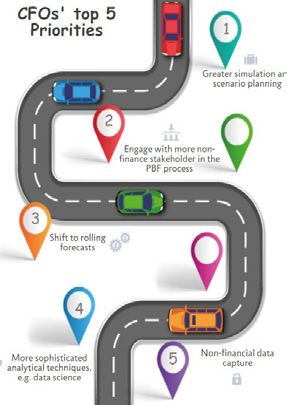
The Future of Planning, Budgeting & Forecasting

                                             Continuous planning is on the rise
  73%        percent of
                                             Growing business uncertainty coupled with an inability to look out
  organizations have reported
  a move to a culture of                     much beyond a six-month time horizon raises considerable concerns
  continuous planning over the               for the accuracy and integrity of business planning. The only way
  last 3 years.
                                             around this is to reforecast more frequently and indeed 73% percent
                                             of organizations have reported a move to a culture of continuous
                                             planning over the last 3 years.

                                             Organizations that have embraced this mode of working are seen to
                                             reforecast more quickly and accurately and are therefore in better
                                             position to respond to market change. They also tend to leverage
                                             non-financial data more effectively and involve more stakeholders.

                                             Continuous planning is an increasingly important tool in the PBF
                                             arsenal, and organisations that haven’t yet evolved their budget
                                             process from the traditional annual plan, run the risk of falling behind
                                             competitors with a more agile view of the future.

                                                                   8
© Copyright 2016 FSN Publishing Limited. All rights reserved
The Future of Planning, Budgeting & Forecasting

Technology is less of a limitation
                                                                                 25%       of businesses fail
Technology has enabled enormous strides in PBF which means                       to engage with stakeholders
it is now feasible to build much more granular and complex                       outside of the finance function.
business models that involve a greater number of participants
and stakeholders in the planning process. But adding stakeholders
or producing bigger models doesn’t always equate to better
outcomes. Without the right stakeholders, the best use of data and
a sophisticated approach to modelling, PBF practitioners achieve
little better than their less inclusive counterparts. For example, 38%
of businesses get within plus or minus 5% of forecasts whether they
reported more stakeholder engagement or not. The key to better
accuracy appears to be involving the ‘right’ stakeholders, yet almost
25% of businesses fail to engage with stakeholders outside of the
finance function.

Planning, budgeting and forecasting has a substantial contribution to
make to both the finance function and the executive function. With a
shift in perspective and a boost to resources, the future will become
much clearer.

IBM Solution

 In an environment where heightened volatility, uncertainty and
 risk are part of the normal course of business, FP&A teams need
 to rethink, redesign and retool planning, analysis and forecasting
 to help the business drive profitable growth and adapt to risk.
 IBM solutions for planning, budgeting and forecasting enable
 FP&A professionals to measure and monitor performance through
 interactive, self-service dashboards and visualizations, examine
 root-causes with high-fidelity analysis of dimensionally rich data,
 evaluate trends and make predictions automatically from internal
 or external data, perform rapid what-if scenario modelling and
 create timely, reliable plans and forecasts. With agile planning and
 exploratory analytics solutions in the cloud or on-premises from
 IBM, thousands of companies world-wide are steering business
 performance with greater speed, agility and foresight.

                                                9
                                                            © Copyright 2016 FSN Publishing Limited. All rights reserved
Chapter 1

                   Non-Financial Data

                   The Forecasting Game Changer
                   "Beyond the financial ledgers, FP&A teams now have access to ever growing operational
                   data sources (ie. data on customers, demand, and supply chain), as well as data outside
                   the corporate transaction systems (ie. weather data, social sentiment data, econometric
                   data). With predictive insights drawn automatically from data, FP&A professionals can
                   identify evolving trends and guide decision making with foresight, not just hindsight."

                                                               10
© Copyright 2016 FSN Publishing Limited. All rights reserved
Non-Financial Data - The Forecasting Game Changer
Non-Financial Data - the Forecasting Game Changer Financial indicators are
no longer enough. Those
Financial indicators have long been the backbone of forecasting organizations at the leading
models. What has gone before is assumed to be a reasonable edge are using non-financial
metrics to great effect.
indicator of what is to come. And when that was the only source
of corporate information on which to plan, it was enough. But
times have changed. The volume and variety of non-financial data
is being driven by business complexity, growing consumer choice
and channels to market, as well as the Internet of Things which
is daily expanding the connections between man and machine.
These connections are feeding a trove of data filled with future
performance indicators that can be invaluable to forecasters, if
identified and used effectively.
What are non-financial indicators?
Although specific to each industry, most businesses will have a few
non-financial metrics that are key leading indicators, which will
ultimately manifest in their P&L. Web analytics will indicate the
most popular item being browsed online long before sales data
reflects high demand. Customer satisfaction surveys will indicate the
effectiveness of the customer experience long before the company
sees an uptick, or downturn, in trade. And a significant change in
headcount may portend supply or back office issues long before
profit suffers.
By putting in place tools and applications to monitor and model the
impact of non-financial data, companies gain much-needed agility,
accuracy and responsiveness, as the survey reveals.
Governments, regulators and investors are also latching onto the
importance of non-financial indicators. A balance of financial and
non-financial reporting provides shareholders and other stakeholders
with a meaningful, comprehensive view of the position and
performance of companies that financial information alone cannot
provide.
11
© Copyright 2016 FSN Publishing Limited. All rights reservedNon-Financial Data - The Forecasting Game Changer
The new EU Non-Financial Reporting Directive (2014/95/EU) aims to
bring the quality of non-financial reporting across the EU up to the
high standards exemplified by the best European businesses. The
Directive, which applies to large Public Interest Entities (PIEs) with
more than 500 employees provides for consistency and conformity
across Europe in relation to disclosure requirements - providing
investors and other stakeholders with a comprehensive picture of a
company’s performance.
The impact on time to re-forecast
Our research shows that senior executives who make better use of
non-financial data are more than twice as likely to be able to turn
around their forecasts within 24 hours, with almost 25% achieving
this target. They are also two and a half times more likely to agree
ABLE TO RESPOND MORE that over the last three years they have been able to respond more
QUICKLY TO MARKET CHANGE quickly to market changes.
Both quick forecasting and responsiveness provide a vital competitive
2.5x
Those organizations
that make better use of advantage, which can be a game-changer for businesses competing
non-finanical data are
more likley to be able to with nimble upstarts and disruptor brands. And it follows that
respond quickly to market if companies are making better use of forward indicators that
change.
specifically impact their business, they are also able to bring more
accuracy to their forecasting.
Over half of CFOs and senior executives who make better use of non-
financial data are able to forecast with 0-5% accuracy. This compares
with 29% of respondents who have not increased their use of non-
financial data in the last three years.
12
© Copyright 2016 FSN Publishing Limited. All rights reservedNon-Financial Data - The Forecasting Game Changer
Non-financial data improves visibility & confidence
In addition, responsiveness and accuracy are further enhanced by
foresight. Finance professionals and forecasters who make better
use of non-financial data are more than twice as likely to be able to
forecast beyond the 12-month horizon compared with those that are
not harnessing this resource effectively. ABLE TO FORECAST WITH
MORE ACCURACY
Harvesting non-financial data and analyzing it through a wide range
of predictive, forward-looking managerial tools gives forecasters
1.7x
Those organizations
a competitive edge that translates into a business advantage. Yet that make better use of
non-finanical data are
while executives are aware that financial indicators alone cannot more likely to be able to
adequately capture the strengths and weaknesses of their company, forecast earnings within
+/- 0-5%
improving or taking control of non-financial data is very low on their
priority list. Respondents ranked non-financial data capture fifth on a
scale of five priorities for the future of planning.
Yet CFOs who take better advantage of non-financial data are twice
as likely to report a greater degree of confidence in the planning,
budgeting and forecasting process (88% expressed an increase in
confidence in PBF over the last three years).
Making effective use of non-financial indicators requires a clear
understanding of the best metrics for the business, a proven method
of analysis and a clear presentation of the outcomes of these KPIs. ABLE TO FORECAST BEYOND
12 MONTHS
Companies that have a strong grasp of these measures and are using
them effectively are often those that are already further along the
2x
Those organizations
modern finance journey. that make better use of
non-finanical data are
more likely to be able to
In our previous research The Future of the Finance Function Survey forecast beyond the 12
2016, automation and standardization emerged as key facilitators in month horizon.
the evolution of an effective modern finance function (which includes
new methods of planning, budgeting and forecasting). Ultimately
CFOs can’t deliver a modern finance function without the use of
technology. Standardisation, automation and front-to-back office
interconnection all require effective technology, and if properly
implemented will free up valuable time to spend on business
partnering and strategic advice.
13
© Copyright 2016 FSN Publishing Limited. All rights reservedNon-Financial Data - The Forecasting Game Changer
Those organizations which
have built in non-finanical
The PBF survey showed that respondents who made more use of
indicators tend to be further non-financial data were 50% less likely to report that automation
along the modern finance and standardization are obstacles to process improvement. This
journey. implies that the companies which focus on non-financial data already
subscribe to a technologically innovative approach, and are further
along the PBF journey. They are able to generate the sort of non-
financial data that can truly enhance their forecasting, improve
visibility and help promote agile business practices.
For this benefit, the capture of non-financial data deserves to
move further up the finance function’s priority list.
IBM Solution
With IBM solutions, users gain predictive insights into factors
that influence business drivers automatically from financial and
operational data, and incorporate these insights into more reliable
plans and analyses. For instance, Marketing uncovers new insights
into the way customers search for information and buy, and uses
these insights to adjust market promotion plans. Call-center
managers uncover new insights into predictors of call volumes, and
use these insights to create more reliable staffing plans; and so
forth across supply chain, HR and sales.
14
© Copyright 2016 FSN Publishing Limited. All rights reservedNon-Financial Data - The Forecasting Game Changer
CASE STUDY 1: Demand Forecasting
Better forecasting helps
us avoid problems coming
from both sides of the We developed a demand-forecasting solution that
demand planning equation. analyzes historical sales and order data within
the context of current market conditions and key
influencers such as weather and even sporting events.
Better forecasting helps us avoid problems coming
from both sides of the demand planning equation.
It helps us minimize stockouts that lead to lost sales,
and reduce overproduction that leads to waste. In
our process, each prediction is fed back through the
analytical algorithms after sales figures are posted so
that we can continuously fine-tune our forecasting and
avoid wild swings in demand. – CFO, large US brewery
15
© Copyright 2016 FSN Publishing Limited. All rights reservedThe Future of Planning, Budgeting & Forecasting Chapter 2
CFOs and Heads of FP&A at
Loggerheads
"One unanticipated risk of continuing to support manual, spreadsheet planning,
budgeting and forecasting processes is talent flight, as valuable analytic talent
departs to join more modern finance organizations. FP&A organizations that
automate and transform their recurring performance management processes
create a technology-enabled environment that attracts, develops and retains
analytic talent and prepares the finance organization for the future."
16
© Copyright 2016 FSN Publishing Limited. All rights reservedCFOs and Heads of FP&A at Loggerheads The Future of Planning, Budgeting & Forecasting
CFOs and Heads of FP&A at Loggerheads
Presently, across the entire 48,000 finance professionals in the FSN
Modern Finance Forum on Linkedin “Heads of FP&A” represent
around 1% of the membership. But this survey finds that where
FP&A is looking for its own organizations have a Head of FP&A (financial planning and analysis),
identiy their views on the future of the role can be markedly at odds with
the rest of the finance function.
In the main, only large organisations can afford to, or find the need
to, separate out FP&A duties. In some organizations, especially
smaller enterprises, the role is not always differentiated, may go
by another name, or be subsumed into a general management
accounting role. This is reflected in the relatively modest number
(6%) of survey respondents who identified themselves as Head of
FP&A.
It is a niche field, and accounts for only a small percentage of senior
finance professionals, but as the finance function of the future
grows increasingly complex, demand is growing for these specialized
practitioners.
In an ideal finance scenario, the head of financial planning and
analysis would report directly to the CFO, build forecasts from
both financial and key non-financial data, and use their analysis
to underpin the strategic direction of the business. Crucially, they
should be the repository for a diverse array of performance data
that goes well beyond a company’s historical financial figures, and
be able to present a view of the future, rather than just review the
past.
In truth that’s not always the case. Too often the FP&A function
is consigned to basic budgeting duties, which merely stagnates
the potential of the finance function as a whole. Meanwhile FP&A
straddles both the financial and management accounting disciplines,
and they see themselves as a different class of accountant.
17
© Copyright 2016 FSN Publishing Limited. All rights reservedThe Future of Planning, Budgeting & Forecasting CFOs and Heads of FP&A at Loggerheads
FP&A in a class of its own?
According to the survey, the heads of FP&A firmly believe that their FP&A heads looking to break
role will become a separate discipline from the accounting function. away: 44% of FP&A heads
44% of FP&A heads strongly agree financial planning and analysis strongly agree financial
planning and analysis will
will become a separate discipline, compared with 18% of non-FP&A become a separate discipline,
respondents. Including the survey respondents who both agree compared with 18% of non-
and strongly agree the ratio rises to 76% for FP&A professionals, FP&A respondents.
compared with 64% for the remaining finance executives surveyed.
Although there is majority agreement amongst all finance 44% vs 18%
professionals that the FP&A function should be recognized for its
role and position in the organization through a separation from the
accounting function, the call is louder from within. Heads of FP&A Non-Heads of
FP&A
29% of heads of FP&A strongly agree that the financial planning and
accounting function will become a separately recognized function
with its own professional accounting body, compared with just 11%
of non-FP&A heads. FP&A heads do not think
the accounting bodies
This result may stem from the belief that current accounting bodies are doing enough: 50%
of Heads of FP&A do not
are not producing the specialists in the FP&A field that the future believe accounting bodies
finance function requires. Almost half within the discipline agree are producing the FP&A
with this, compared with just a quarter of executives in other roles specialists for the future
within the finance function.
FP&A professionals rely more on tech 50% vs 25%
Still, despite a clear view on the lack of qualified FP&A professionals,
only a third of FP&A heads expected to be investing more in Heads of FP&A Non-Heads of
analytical skills rather than technology in the next three years, FP&A
compared with 41% of the remaining respondents.
This focus on technology likely arises because FP&A practitioners
recognize that technology is the essential enabler. In order to extract
the most useful, predictive, forward looking data, FP&A needs more
18
© Copyright 2016 FSN Publishing Limited. All rights reservedCFOs and Heads of FP&A at Loggerheads The Future of Planning, Budgeting & Forecasting
FP&A heads are more complex analytics, more complex technology and more innovative
focused on technology: 33% applications. Once armed with the right technology, an FP&A Head
of FP&A heads expected
to be investing more in
with the right analytical skillset will be able to distil this into usable
analytical skills rather than strategic information.
technology in the next three
years, compared with 41% of Unfortunately, this skillset is not being provided by the standard
the remaining respondents. accounting bodies, and in some cases is not being nurtured by the
remainder of the finance function either.
33% vs 41% This will only come when the finance function recognises the value
of FP&A in providing insight that is progressive and predictive rather
than historical and backward-looking. Within the finance function,
Heads of FP&A Non-Heads of FP&A is the only discipline that can present a picture of the future
FP&A from which an organisation can build their strategy.
The survey did show that the heads of FP&A and their non-FP&A
counterparts were broadly in agreement on their priorities for the
future of planning, budgeting and forecasting, although the former
put slightly more emphasis on the need for greater simulation and
scenario planning.
The gulf between the finance executives who contribute to and
use the plans, budgets and forecasts, and the FP&A professionals
who generate them, is wide but not insurmountable. The
finance function is evolving and technology is changing the way
financial executives make decisions. The role of the FP&A expert
is expanding to encompass a wider range of data, more complex
analysis and a more demanding C-suite. If senior executives
recognize the change within the finance function, it behooves
them to bring the planning, budgeting and forecasting function
along for the journey.
IBM Solution
Fast, flexible solutions from IBM help FP&A professionals
deliver deeper insights and stronger foresight to steer business
performance effectively. The agility they gain from these
solutions helps them serve the broader goals of the organization
by adapting plans, budgets and forecasts to changing business
conditions and aligning financial plans with corporate objectives,
linked to operational tactics and market events.
19
© Copyright 2016 FSN Publishing Limited. All rights reservedCFOs and Heads of FP&A at Loggerheads
CASE STUDY 2: IBM TM1
…the data we are now able
to pull out of IBM TM1 is
welcomed by the Chief IBM TM1 is helping us to identify pockets of excessive
Operating Officer optimism earlier in the year, allowing us to redeploy
unused funds. We are also experimenting with using
IBM TM1 to find specific projects that are beginning to
fall behind schedule. …the data we are now able to pull
out of IBM TM1 is welcomed by the Chief Operating
Officer, which is helping to move things forward. –
Senior Director of Cost and Capital Management,
regional telecommunications company
20
© Copyright 2016 FSN Publishing Limited. All rights reservedChapter 3
Cloud Uptake is Rising but
Outdated Processes Remain
Unchallenged
"A range of deployment options – in the cloud, on-premises, or hybrid - allows
technology decisions and process change decisions to be made independently."
21
© Copyright 2016 FSN Publishing Limited. All rights reservedCloud Uptake is Rising but Outdated Processes Remain Unchallenged
Cloud Uptake is Rising but Outdated Processes Remain
Unchallenged
Only 11% of As more and more organisational services move to the cloud,
respondents have planning, budgeting and forecasting is being swept along the same
deployed cloud tide. Yet even as uptake is gradually rising, the real benefits are
solutions across all
often lagging.
their business units
In a utopia of cloud-based planning, budgeting and forecasting,
there should be seamless information flow, inclusive communication
with all relevant stakeholders, and open discussions that lead to a
perfectly refined forecast. The theory is that deploying a centralised
cloud solution for PBF has the power to radically change the
processes and outcomes of the discipline.
But the reality is that uptake is still low (only 11% of respondents
have deployed cloud solutions across all their business units), and
those that have begun the journey are a long way from achieving
the full benefits.
Cloud utopia remains elusive
Instead of the utopia of a unified solution, more than a third
of cloud users still use multiple software vendors for planning,
budgeting and forecasting. And only half agreed to using one model
shared by the whole enterprise, the same percentage as those that
had yet to move to the cloud. Meanwhile the same percentage of
cloud and non-cloud users (36%) responded that each major part of
the business has its own standalone model, which invariably creates
issues when trying to collate and unify these disparate models.
It is inevitable that business functions will argue that by their
very difference they need models specific to them. But when a
central cloud solution is implemented, retaining this disparate
model structure immediately reduces the potential benefits of
a centralised system. Re-engineering the models to allow for
differences under a unified cloud is the next logical step to making
the most out of a cloud investment.
22
© Copyright 2016 FSN Publishing Limited. All rights reservedCloud Uptake is Rising but Outdated Processes Remain Unchallenged
Cloud users were also equally as likely to find cross-business
Of the 11% who have fully
collaboration difficult. This despite the expectation that cloud
deployed Cloud solutions
services should bring and bind business areas together under across the organization less
a software umbrella accessible from anywhere. Instead 34% of than 50% of these use one
respondents said they found it difficult to collaborate across software vendor
functional areas, the same as those yet to implement the cloud,
whilst 28% still struggle to collaborate across business units.
Figure 2:
Organizations are failing to fully embrace the move to the Cloud.
Only 55%
Only 11% have reported an
fully deployed increase in
Cloud solutions the number of
across the stakeholders able
business to update plans
themselves
CLOUD
REALITY
Less than 50%
use one software
Only 50% use one
vendor
business model
23
© Copyright 2016 FSN Publishing Limited. All rights reservedCloud Uptake is Rising but Outdated Processes Remain Unchallenged
Cloud implementations often mirror the on-premise
limitations
This echoes the problem of lack of progression within the planning,
budgeting and forecasting process. When cloud solutions are
implemented, the opportunity to investigate and improve processes
is missed. Instead they are merely substituted into the existing
framework, replicating the processes already in place.
The benefits of the cloud include:
That said, even those companies that have yet to take full advantage
Quicker at reforecasting of the cloud are reaping some of the rewards that the agile cloud
offers. Those that have started on the cloud journey are over one
More accurate forecasting and a half times more likely to be able to reforecast earnings for
the organisation within 24 hours and a third more likely to get the
More stakeholders connected
forecast right to within 5%.
Ability to connect more
easily to new sources of This highlights one of the key selling points of cloud software, the
data and produce larger ability to quickly and comprehensively draw data from numerous
and more detailed plans locations and stakeholders for immediate analysis, thereby
producing timely, and accurate reports.
The process of implementation will invariably also encompass a
wider range of stakeholders, by the very nature of its connectivity.
Cloud adopters are more than twice as likely to strongly agree they
have more stakeholders involved in the process compared with
three years ago.
Their plans are also more integrated between different business
functions, with 78% in agreement compared with 60% for non-cloud
users. Cloud adopters are also more than twice as likely to agree
that all users have visibility of changes in real time, and the centre
has improved visibility too (more than one and a half times the
number of cloud-based respondents agreed).
The upshot is that the cloud brings connectivity and collaboration to
the planning, budgeting and forecasting process. And this is critical
for companies that need all their functions and divisions to be
working towards a common financial goal. Too often departments
24
© Copyright 2016 FSN Publishing Limited. All rights reservedCloud Uptake is Rising but Outdated Processes Remain Unchallenged
work in silos to generate plans and forecasts that aren’t holistic, and
would offer little in the way of strategic input.
Unsurprisingly for a new technology, cloud adopters were almost
50% more likely to have reported an improved ability to connect
more easily with new sources of data, and 20% more likely to be
able to produce larger plans.
Cloud adopters are more process-savvy
Cloud users tend to include the early technology adopters that Cloud can be used as a
proof of concept tool and
have recognised the financial advantages of improved business
is often used as a method
processes. Respondents who had already implemented cloud PBF to overcome the hurdle of
solutions were a third less likely to see automation as an obstacle to seeking investment from
process improvement, and a fifth less likely to view standardisation the Board of Directors
as an obstacle either.
Tellingly those using the cloud were also 17% less likely to see the
Board as an obstacle to seeking investment, possibly because their
implementation of the cloud could be used as a proof of concept
tool.
The benefits of unifying the planning, budgeting and forecasting
process under a single cloud solution are significant even without a
re-engineering of BPF processes. Combine both the technology and
the business process improvements, and the cloud utopia is very
achievable and vastly beneficial.
IBM Solution
Advanced performance management processes and practices
often depend on enabling technology. The cloud offers
many undeniable benefits in cost, scalability and resource
commitments. But with IBM, the same PBF solution can be
deployed in cloud, on-premises or in hybrid environments. This
gives organizations the flexibility to pursue process improvements
without being limited by their software choices.
25
© Copyright 2016 FSN Publishing Limited. All rights reservedCloud Uptake is Rising but Outdated Processes Remain Unchallenged
CASE STUDY 3: Benefits of a Cloud Solution
We are counting on cloud to
negate these issues so we
can focus on managing our From our perspective, there is a constant barrage of
capital. upgrades, patches and new features that we don’t
have the capacity to read up on. As a result we’ve
stumbled into compatibility problems that slowed
down deployment while we researched a fix. We are
counting on cloud to negate these issues so we can
focus on managing our capital. – Senior Director of Cost
and Capital Management, regional telecommunications
company
26
© Copyright 2016 FSN Publishing Limited. All rights reservedChapter 4 The Future of Planning, Budgeting & Forecasting
CFOs Who Ignore
Continuous Planning May
be Putting Their Business
at Risk
"Rolling forecasts enable managers to see trends, patterns, and
'breaks in the curve' long before their competitors."
27
© Copyright 2016 FSN Publishing Limited. All rights reservedCFOs Who Ignore Continuous Planning May be Putting Their Business at Risk
CFOs Who Ignore Continuous Planning May be Putting
Their Business at Risk
The central plank of the planning, budgeting and forecasting cycle
has historically been the annual budget. Preparations can start
several months before it is due, data is sourced, forecasts are
73% of survey
respondents have reported a
submitted and after intensive negotiations and discussions a budget move to continuous planning
is agreed, frequently forming the basis on which bonuses are paid
and strategic decisions are made.
Unfortunately this process is entirely out-dated. Organizations,
sectors and markets move increasingly quickly, and no sooner has
the budget been agreed, than it is no longer relevant because the
assumptions on which it is based have changed. Making decisions
based on stale information can put businesses at risk of competitive
pressure and the failure to respond timeously to market changes.
To be fair, many CFOs are all too aware that annual budgets are
archaic and ineffective in a competitive market, but not everyone
has managed to evolve their planning, budgeting and forecasting
programmes into something more effective.
It starts with the recognition that budgets or forecasts developed
with the most up-to-date information will invariably provide the Continuous Planning is the
most accurate picture of the future. This means shortening the process of reforecasting a
given time period on a regular
time between budget preparation and approval, and the climax
or an adhoc basis in response
of this approach is being able to budget, plan or forecast almost to a significant economic or
immediately, whenever assumptions or data changes. political event
Continuous planning is increasingly important in a volatile market.
Over half of executives surveyed said their company could forecast
no further than six months into the future. To alleviate this short-
sightedness, companies are turning to continuous planning. 73% of
respondents agreed or strongly agreed that they now have more of
a culture of continuous planning.
28
© Copyright 2016 FSN Publishing Limited. All rights reservedCFOs Who Ignore Continuous Planning May be Putting Their Business at Risk
Continuous planning improves agility and accuracy
The organizations that strongly agreed (16.7%) are one and a half
times more likely to be able to reforecast within one week, and are
almost four times more likely to be able to respond more quickly to
market change.
ABLE TO REFORECAST MORE
The move to continuous planning also improves accuracy, with QUICKLY
organizations being almost twice as likely to be able to forecast
1.5x
within 5% of earnings compared with companies that remain organizations that have
moved to continuous
wedded to static forecasts. planning are 1.5 times
more likely to be able to
reforecast within 1 week
Clear visibility from continuous planning also means organizations
are three times more likely to report that the business as a whole
has more confidence in the planning process.
Significantly, organizations which implement a continuous planning
process are almost twice as likely to engage more stakeholders
in the process and two times as likely to make more use of non-
financial data.
It makes sense that when a company looks to improve their visibility
they do so by including in their models and forecasts more of the
data that they need to plan accurately. Non-financial data has ABLE TO RESPOND MORE
already been shown to be crucial to the accuracy and horizon of the QUICKLY TO MARKET CHANGE
forecasting process, and organizations that have moved towards
continuous planning are more likely to have recognised this. This
implies they are further along the journey to future-proofing
4x organizations that have
moved to continuous
planning are 4 times
their planning, budgeting and forecasting process. Despite non- as likley to be able to
respond quickly to
financial data use being the lowest ranked priority on the survey market change.
list, organizations that use continuous data have recognised the
limitations of annual budgeting and the advantages of incorporating
non-financial data into these rolling forecasts.
29
© Copyright 2016 FSN Publishing Limited. All rights reservedCFOs Who Ignore Continuous Planning May be Putting Their Business at Risk
With the added granularity of non-financial data, continuous
planners are almost twice as likely to agree that they can now
produce much larger and more complex models, with better
visibility of the process for all users.
ABLE TO FORECAST WITH
MORE ACCURACY
The annual budgeting process is slowly becoming obsolete, as
organizations recognise the limitations of developing strategies
based on out-of-date assumptions. But implementing a truly
1.7x organizations that have
moved to continuous
planning are almost
effective continuous planning process requires buy-in from all
business functions, not just the finance core. If an organization is
twice as likely to be able
to forecast earnings going to overhaul their planning and budgeting process, they must
between +/- 0-5% broaden the inputs to include non-financial data. This brings an
accuracy and agility to forecasting that will adequately prepare
organisations for their fast-paced future.
IBM Solution
With IBM solutions, FP&A teams create more timely, reliable
driver-based, rolling forecasts to complement annual planning
cycles with more regular business reviews that enable managers
to see trends, patterns, and “breaks in the curve” long before
their competitors, and thus make better informed decisions
regarding products and markets. FP&A teams manage through
continuous planning cycles, making rolling forecasts the primary
management tool, and reporting on key metrics daily and weekly
30
© Copyright 2016 FSN Publishing Limited. All rights reservedCFOs Who Ignore Continuous Planning May be Putting Their Business at Risk
CASE STUDY 4: IBM TM1 Speeds Up Time to Re-
The Finance team was able
to increase the tempo of Forecast
reporting and analysis…
saving approximately 32 With over 100 Microsoft Excel based cost centers,
hours per month in forecast CAPEX and OPEX plans, managing labor and capital
preparation time. planning was a time consuming annual process
that would not allow the company to move away
from annual planning models to rolling-forecasts.
In addition, the workflow approval process for new
capital expenditures was tedious, and the tracking of
existing assets was overly complicated. After deploying
IBM TM1, the Finance team was able to increase the
tempo of reporting and analysis, improving decision
support and saving approximately 32 hours per month
in forecast preparation time. – California-based
manufacturer of irrigation equipment and sprinkler
systems
31
© Copyright 2016 FSN Publishing Limited. All rights reservedChapter 5
Bigger Models and More
Stakeholders Don’t Make
for Better Business
Modelling
"Granular analysis of dimensionally rich data reveals new insights
into the drivers of product and customer profitability that can
be applied to create more reliable forecasts. When automated
collaboration is designed into the solution, managed workflow can
get information to the right people, with the right knowledge, in a
timely fashion."
32
© Copyright 2016 FSN Publishing Limited. All rights reservedBigger Models and More Stakeholders Don’t Make for Better Business Modelling
Bigger Models and More Stakeholders Don’t Make for
Better Business Modelling
The goal of an effective business planning process is to build a
business plan that underpins an organization’s strategy while also
evolving as circumstances change. Historically it has been a largely
51% of organizations
still struggle to forecast out
linear process, with input from departments and business units that beyond a six month horizon
are discussed, distilled and finally delivered into the plan.
But the nature of business modeling and the process of planning
has changed in tandem with the evolution of the finance function.
There is now far more data, many more stakeholders and
increasingly complex modeling applications from which to develop
plans. And while this should theoretically lead to better planning
this isn’t always the case as the survey reveals.
On the face of it, survey respondents believe they are doing a better
job than three years ago, with two-thirds saying the organization has
more confidence in the planning process. But if that’s the case how
do we reconcile the fact that more than half still struggle to forecast
out beyond six months, a quarter still can’t forecast revenue to
within 10%, and almost half take more than a week to reforecast
earnings?
CFOs and their finance executives appear to be in denial about
how efficacious their planning, budgeting and forecasting really is.
The issue may lie in the flawed idea that bigger is necessarily more
accurate.
Building complexity
These days the finance function has access to tools that allow it
to process more data and develop more complex models, and this
certainly comes with some advantages.
60% of respondents said they could handle more complexity and
build much more granular plans compared with three years ago.
Those planning in more detail are almost twice as likely to be able
33
© Copyright 2016 FSN Publishing Limited. All rights reservedBigger Models and More Stakeholders Don’t Make for Better Business Modelling
Planning in more detail to forecast more quickly, with 23% reforecasting within 24 hours
doesn’t necessarily mean compared with 12% for the remaining respondents.
increased accuracy
The executives who are building larger models are also two and a
half times more likely to react more quickly to market change, with
80% in agreement. In addition, those that are forecasting in more
detail also appear to be able to forecast further into the future. They
are twice as likely to be able to forecast out 12 months, with over a
quarter claiming this is achievable.
But more detail doesn’t always translate into increased accuracy. Of
the respondents who were forecasting in more detail and those who
weren’t, a similar percentage (38% and 39%) were able to forecast
within 5% of earnings. They were better at forecasting revenue (40%
more organizations with detailed planning were able to forecast
within 5%), but seemed unable to follow through to more accurate
earnings forecasts.
Adding voices
As organizations increasingly recognize the need to incorporate
more data and detail into their planning process, so the number
of people engaged in the process has risen. But involving more
stakeholders in the process doesn’t necessarily translate into richer
forecasts, although it does improve acceptance of plans and the
ability of the organization to react more quickly to market change.
Perhaps counter intuitively, involving more stakeholders doesn’t
produce better earnings forecasts. 38% of businesses with more
stakeholders were able to forecast within 5%, compared with 35%
who still have a similar number of people inputting into their plans.
The effect on speed of reforecasting was similarly comparable. 57%
of those involving more stakeholders in the process reported being
able to reforecast in under a week, compared with 52%.
While the impact on actual forecasting times and accuracy was
small, there was a very tangible increase in cross-organizational
34
© Copyright 2016 FSN Publishing Limited. All rights reservedBigger Models and More Stakeholders Don’t Make for Better Business Modelling
acceptance of the plans that resulted, which is a laudable objective
in itself.
Where an increased number of stakeholders (not just finance) were
inputting into the business modeling process, these organizations
were two and a half times more likely to report that their process is
perceived more positively by other functions now compared with
three years ago. And these organizations were almost twice as likely
to have responded that they have more confidence in their planning
process.
They were also twice as likely to believe that all business functions
feel they have adequate input into the process, 20% less likely to
feel that planning, budgeting and forecasting created conflict, and
30% more likely to trust the operational data provided to them.
Crucially, with more stakeholders engaged and looking out on the
horizon, these organizations were almost twice as likely to have an
improved ability to react more quickly to market change.
While there may be some advantages to building bigger plans
or involving more stakeholders, it isn’t the panacea of business
modeling. The plans (big or small) need to be the right ones and the
people involved need to be the most effective stakeholders in the
business.
Prioritizing the right voices
While 63% of respondents now have more users engaged in the 63% of respondents say
planning process, almost a quarter of businesses fail to involve they now engage with
more stakeholder in the
stakeholders outside of the finance function. Their input, on non- PBF process, but almost
financial data, is crucial to ensuring a complete picture, and vision, 25% of businesses fail
of the organization, rather than one blinkered by the narrow to involve stakeholders
confines of financial results. Luckily this is at least on the agenda as outside of the finance
a top three priority for finance executives in the survey. function
Involving more stakeholders does require the use of specialist
planning, budgeting and forecasting tools to be able to coordinate
35
© Copyright 2016 FSN Publishing Limited. All rights reservedBigger Models and More Stakeholders Don’t Make for Better Business Modelling
the process. Similarly, being able to build larger and more detailed
Not just finance teams, but plans is usually facilitated by more specialized technology.
business analysts, line-of- Respondents building more detailed plans are 20% less reliant on
business managers and spreadsheets, three times more likely to be using cloud software
users on the front lines
across all their business units and twice as likely to be using on-
can… make more intelligent
premise software.
choices and allocate
resources more effectively.
There is a quiet revolution going on in the finance function, and it is
spreading to planning, budgeting and forecasting. With many more
data or stakeholder inputs into increasingly complex plans, finance
professionals can be forgiven for believing they are getting better
outcomes. But the survey shows that earnings forecasts are similarly
constrained, whatever the detail and size of plans or number of
stakeholders.
Instead executives must work smarter rather than larger. Involving
the right stakeholders (especially non-financial executives) while
ensuring visibility of plans and timely updating of real-time
information, is worth more than just another voice in the crowd.
Linking stakeholders through cross-departmental cloud software can
help keep the data updated, improving the accuracy of the plans
and ultimately the accuracy of the forecasts.
IBM Solution
How often do you re-organize, integrate a new acquisition or
simply need to adapt your plans, analyses and reports to changing
product or organizational hierarchies and dimensions? Manual,
spreadsheet systems struggle to cope with these changes.
Adjustments take a long time and are error prone. With IBM
solutions, FP&A professionals can quickly and easily develop
and adapt business structures, rules and relationships in their
planning and analysis models to match prevailing business
conditions. FP&A can perform complex cost allocations and
profitability analysis, and drill down for a granular view of
profitability by product, customer or channel. With powerful
scenario modelling, FP&A can evaluate strategies, and test
assumptions about possible future outcomes.
36
© Copyright 2016 FSN Publishing Limited. All rights reservedBigger Models and More Stakeholders Don’t Make for Better Business Modelling
CASE STUDY 5: IBM TM1 Allows for More
The changes have affected
the entire organization, Granular Planning
from senior executives to
front-line staff.
One of the largest blood banks in the US completely
transformed its financial planning and reporting
capabilities over the past two years using IBM TM1.
The organization can now model, plan, allocate, report
and manage costs on a per-unit basis for its complex
logistical operation. The changes have affected the
entire organization, from senior executives to front-line
staff. – Major regional blood bank based in Northeast
US
37
© Copyright 2016 FSN Publishing Limited. All rights reservedThe Future of Planning, Budgeting & Forecasting Methodology
Methodology
38
© Copyright 2016 FSN Publishing Limited. All rights reservedMethodology The Future of Planning, Budgeting & Forecasting
METHODOLOGY
The survey drew responses from 955 international senior finance professionals from our
48,000 strong FSN Modern Finance Forum on LinkedIn.
This survey covered finance professionals across 23 different industries. 81% of which were
considered to have senior job titles and above.
Orgaizational Size - Number of employees Industry of Respondents
Geography of Respondents
39
© Copyright 2016 FSN Publishing Limited. All rights reservedAbout IBM
ABOUT IBM
IBM analytic solutions for enterprise performance management deliver speed, agility and
foresight to organizations of all sizes—from large-scale enterprises to small and midsize
businesses. They help transform slow, disconnected processes into more dynamic, efficient
and connected experiences. Finance, line-of-business and IT professionals alike can use IBM
solutions to drive financial process efficiency, deliver stronger business foresight and steer
business performance.
With flexible deployment options including cloud, on premises and hybrid, IBM enterprise
performance management solutions enable organizations to:
• Replace rigid budgets with continuous planning and more frequent forecasting involving all
the right participants.
• Create a dynamic, collaborative and reliable planning process across geographies, business
units and functional silos to improve visibility into the impact of business drivers.
• Harness big data analytics to deliver deeper predictive insights and improve decision
making.
• Track performance against corporate objectives to identify performance gaps and assess
alternatives with “what-if” scenario modeling.
• Report with confidence to internal and external stakeholders.
Contact:
To request a call or to ask a question, go
to www.ibm.com/analytics/contactus. An
IBM representative will respond to your
inquiry within two business days. For more
information on IBM solutions, go to www.
ibm.com/planning.
40
© Copyright 2016 FSN Publishing Limited. All rights reservedAbout FSN
ABOUT FSN
FSN is a global publisher of thought leadership, research and “must-have” content for CFOs
and senior finance professionals around the world. FSN’s highly popular and active Modern
Finance Forum on LinkedIn has a membership of more than 48,000 readers in more than 23
countries and across every major industry segment. It is also the publisher of the popular
www.fsn.co.uk and www.fsnelite.com websites and regularly holds, networking dinners and
events for its members.
Contact:
Gary Simon, CEO: gary.simon@fsn.co.uk
Michelle Fabian: michelle.fabian@fsn.co.uk
HQ Office in United Kingdom
Clarendon House
125, Shenley Road, ®
Borehamwood,
Herts, WD6 1AG
Switchboard: +44 (0)20 84452688
https://fsnelite.com
The Modern Finance Forum LinkedIn
http://www.fsn.co.uk
Disclaimer of Liability
© 2016 FSN Publishing Limited. All rights reserved. FSN is a registered trademark of FSN Publishing Limited (“FSN”). This publication may
not be reproduced or distributed, in part or as a whole, in any form without FSN’s prior written permission. This report is exclusively for your
personal use and cannot be shared outside your company, or via email, internet posting, social media or other external information storage
& retrieval systems.
Whilst every attempt has been made to ensure that the information in this document is accurate and complete some typographical errors or
technical inaccuracies may exist. This report is of a general nature and not intended to be specific to a particular set of circumstances. The
report contains the views and opinions of FSN Publishing Limited and FSN Publishing Limited make no representations or warranties with
respect to the accuracy or completeness of the contents of this report and specifically disclaim any implied warranties of merchantability or
fitness for a particular purpose. No warranty may be created or extended by sales representatives, or written sales materials. FSN Publishing
does not provide advisory services and no part of this research report should be construed or used as such. You should consult with a
professional where appropriate. FSN Publishing Limited and the author shall not be liable for any loss of profit or any other commercial
damages, including but not limited to special, incidental, consequential, or other damages.
41
© Copyright 2016 FSN Publishing Limited. All rights reservedYou can also read


