Modelling of Cross-Organisational Cooperation for Social Entrepreneurship
←
→
Page content transcription
If your browser does not render page correctly, please read the page content below
$
         £ ¥€
                social sciences
Article
Modelling of Cross-Organisational Cooperation for
Social Entrepreneurship
Aneta Pachura

                                          Faculty of Management, Cz˛estochowa University of Technology, ul. H. Dabrowskiego
                                                                                                                 ˛          69,
                                          42-200 Cz˛estochowa, Poland; aneta.pachura@wz.pcz.pl

                                          Abstract: Objectives: The objective of the study is to advance the conceptualisation of social en-
                                          trepreneurship and report the results of empirical research related to the identification of the archi-
                                          tecture of the model of interorganisational collaboration for the growth of social entrepreneurship
                                          potential at the local level. Research Design and Methods: The research presented in the article is based
                                          on a case study performed on an example of the Polish institutional landscape. Multidimensional
                                          empirical research methodology was applied in the form of participant observation, analysis of focus
                                          group results and business modelling techniques. The literature review contains an analysis of reports
                                          from the area of social economy and related fields. Findings: The result of the conducted research is
                                          the discovery of primary dimensions of effective interorganisational cooperation in the form of an
                                          analogue-representational model. Implication/Recommendations: In the process of strengthening the
                                          potential of social entrepreneurship, the cooperation of actors from different organisational fields is a
                                          key factor. An appropriate level of social capital is an essential requirement for effective cooperation.
                                          Contribution/Value Added: The developed model of cooperation for social entrepreneurship is based on
                                          an initiative that is unique and innovative on a national scale and is the result of empirical research.

                                   It also seems that the approach presented may be universal and could be extrapolated to other regions
                                          and cultural contexts. Article Classification: Research article.
Citation: Pachura, Aneta. 2021.
Modelling of Cross-Organisational
Cooperation for Social
                                          Keywords: cross-organisational cooperation and collaboration; social entrepreneurship; social enter-
Entrepreneurship. Social Sciences 10:     prise; business models; social capital
201. https://doi.org/10.3390/
socsci10060201

Academic Editor: Louis Brennan            1. Introduction
                                                For some time now, we have seen a growing interest in social issues within the broadly
Received: 4 May 2021                      defined economic sciences. As proof of this interest, it is worth noting the recent decisions
Accepted: 28 May 2021
                                          regarding some of the most prestigious economic awards. In 2019, the Sveriges Riksbank
Published: 31 May 2021
                                          Prize in Economic Sciences in Memory of Alfred Nobel was awarded to researchers working
                                          on poverty issues (Esther Duflo and Abhijit Banerjee). The previous achievements of Elinor
Publisher’s Note: MDPI stays neutral
                                          Ostrom (Nobel in 2009) and her work on the concept of common-pool resources as well as
with regard to jurisdictional claims in
                                          Angus Deaton’s (Nobel in 2015) study on consumption, wealth and poverty should also be
published maps and institutional affil-
                                          highlighted (https://www.nobelprize.org, accessed on 5 September 2020).
iations.
                                                The need to create jobs, improve the quality of life or develop new forms of en-
                                          trepreneurship is increasingly emphasised as the context for stimulating local development,
                                          pursuit of cohesion and social responsibility (Roelants and Bajo 2002, p. 6). The culmination
                                          of this specific social turn is considered to be the emergence of a new trend or area of study,
Copyright: © 2021 by the author.          namely, social economy. Generally speaking, social economy, in a sense, encompasses the
Licensee MDPI, Basel, Switzerland.
                                          social and economic system, combining the achievement of social and economic goals.
This article is an open access article
                                          However, the field of social economy is a conglomerate of many different aspects, often
distributed under the terms and
                                          difficult to grasp and analyse. Bearing in mind the essence of social economy, for example,
conditions of the Creative Commons
                                          one can seek references to the creation of social capital and the achievement of social
Attribution (CC BY) license (https://
                                          benefits. It is assumed that social economy not only recognises and engages in socially
creativecommons.org/licenses/by/
4.0/).
                                          important dilemmas but also creates social capital.

Soc. Sci. 2021, 10, 201. https://doi.org/10.3390/socsci10060201                                              https://www.mdpi.com/journal/socsci
Soc. Sci. 2021, 10, 201 2 of 14
The context of social capital creation may lead, among other things, to directing at-
tention towards the issues of social entrepreneurship and interorganisational cooperation
and collaboration. The distinction between the concept of cooperation and the concept
of collaboration is of course observable; however, from the perspective of the reported
research, these concepts are treated as equally important for social entrepreneurship pro-
cesses in the cross-sectoral perspective. Collaboration most often refers to a collective effort
towards a common goal. Cooperation, rather, has a broader perspective and concerns a
synergic combination of efforts of various entities. Intersectoral linkages are therefore more
based on the phenomenon of cooperation. Social entrepreneurship, by participating in
solving real-world social problems and facing the tough rules of the market, sees a need to
develop cooperation with other organisations. Cooperation is increasingly moving towards
collaborations between various organisations from different sectors of the economy. At the
heart of engaging in cooperation and collaboration for purposes of social entrepreneurship
is, on one hand, the development of interorganisational networks in a multisectoral envi-
ronment and, on the other hand, the possibility of achieving synergistic effects. Combining
the potential of different organisations from the social economy sector, the public and pri-
vate sector or the academic community is conducive to discovering new, nonstereotypical
and nonstandard ways of acting for the benefit of local communities, including effective
identification of needs and solving important social issues. Simultaneously, within social
entrepreneurship itself, as noted by Jiao (2011), research on the conceptualisation of social
entrepreneurship is full of inconsistencies and conceptual ambiguities. Similar conclusions
are reached by Marshall (2011) and Zahra et al. (2009), while on the other hand, Murphy
and Coombes (2009) state that social entrepreneurship research is most often located within
general entrepreneurship theory, but it requires a separate approach due to its specificity.
Therefore, addressing the issue of entrepreneurship from the perspective of the institutional
environment seems justified and relevant to the research gap that exists.
The research presented in this paper was performed in Poland. It should be mentioned
that the social economy sector in Poland has a long tradition. This tradition, existing since
the end of the 19th century, was related to the creation of cooperatives at that time, often
associated with patriotic and independence reasons (Brandeleer 2013). Today, in line
with EU policy (European Commission 2020), we can observe a slow revival of the social
economy sector. In 2016, the social economy sector was formed by 91,000 nongovernmental
(civil) organisations and 1500 active cooperatives, among which the majority 60%, were
social cooperatives (Social Economy in Poland 2020). However, it seems that the sector is
in its early stages of development, and these questions also need scientific reflection.
2. Literature Review
Spear points out the need for research in the field of conceptualisation of social en-
trepreneurship, as models of social entrepreneurship differ from the classical approaches
to the analysis of SMS entrepreneurship (Spear 2006). At the same time, he raises the
issue of the importance of sectoral cooperativeness in the study of the specificity of social
entrepreneurship. There are many examples of research on partnerships between non-
profit organisations and the business sector to achieve a social mission. An interesting
approach related to value creation in the chain of such cooperation is presented by Austin
and Seitanidi (2012). However, it seems that further exploration of this complex topic,
especially in different cultural and administrative contexts, is still justified. An example
of research within a national context can be the analysis of public–private partnerships
presented by Brinkerhoff and Brinkerhoff (2012). An example of research in the Korean
context is presented by Park et al. (2018), conducting an analysis of power asymmetry in
a partnership setting towards answering the question, “how social enterprises can suc-
cessfully achieve their social missions through partnerships with large firms in order to
pursue both economic and social goals” (p. 3). As noted by Dacin el al., research on social
entrepreneurship requires capturing the multifaceted and transdisciplinary nature of the
issue (Dacin et al. 2011).setting towards answering the question, “how social enterprises can successfully achieve
their social missions through partnerships with large firms in order to pursue both eco-
Soc. Sci. 2021, 10, 201 3 of 14
nomic and social goals” (p. 3). As noted by Dacin el al., research on social entrepreneur-
ship requires capturing the multifaceted and transdisciplinary nature of the issue (Dacin
et al. 2011).
The
The opinion
opinion thatthat social entrepreneurship plays
social entrepreneurship plays aa special
special role
role in
in the
the socioeconomic
socioeconomic
space
space is one that is difficult to debate, in particular since the possibility of achieving ben-
is one that is difficult to debate, in particular since the possibility of achieving ben-
efits
efits and
and scaling
scalingup upsocial
socialefficiency
efficiencyisisindicated
indicatedasasthe thefoundation
foundation forfor
thethe
development
development of
social
of social entrepreneurship
entrepreneurship (Perrini
(Perrini etetal.al.2010,
2010,p. p. 515).
515). Social entrepreneurship, without
Social entrepreneurship, without
doubt,
doubt, contributes
contributes to the activation and involvement of local communities in social and
economic initiatives and stimulates civic engagement and the creation of social capital. It
also fits within the scope of integration and reintegration of individuals and groups that
are excluded or at risk of social social and
and occupational
occupational exclusion.
exclusion. What is highly important is
that actions
actions for
for the
thebenefit
benefitofoflocal
localcommunities
communities are
are taken
taken as as part
part of social
of social entrepreneur-
entrepreneurship
ship
efforts.efforts.
SocialSocial entrepreneurship
entrepreneurship rootedrooted in theenvironment
in the local local environment
remainsremains
in close in close
proxim-
proximity
ity to localtocommunities.
local communities. It responds
It responds to actual
to actual socialsocial
needs needs
andand participates
participates in solv-
in solving
ing important
important locallocal problems.
problems.
entrepreneurship focuses
One of the interpretations of social entrepreneurship focuses onon entrepreneurial
entrepreneurial ac- ac-
tivities of individuals or communities oriented towards creating social value (Peredo and
McLean 2006; after: Zahra et al. 2009, p. 521). 521). IfIf we
we were
were toto extend
extend this
this perspective
perspective aa little,
little,
worth referring
it is worth referring to the basics
basics ofof conceptualisation
conceptualisation of social economy. economy. In the description
of the functions of social economy, one may refer, for for example,
example, to to social
social integration
integration and
cohesion policy. It is emphasised that social economy focuses
cohesion policy. It is emphasised that social economy focuses on creating social on creating social capital
capital as
as a result of reinforcing activities within the area of social entrepreneurship.
a result of reinforcing activities within the area of social entrepreneurship. Social entre- Social en-
trepreneurship,
preneurship, in in
thisthis case,
case, createsspace
creates spacefor forthe
thedevelopment
developmentof ofinitiatives
initiatives aimed
aimed atat social
social
and occupational
and occupational integration
integrationand andreintegration,
reintegration,asaswell wellasastaking
takingananactive
active part in in
part activating
activat-
locallocal
ing communities.
communities. The The
aspect of stimulating
aspect of stimulatingcivic involvement in socioeconomic
civic involvement in socioeconomicinitiatives
ini-
is also significant (Figure 1).
tiatives is also significant (Figure 1).
Figure 1. An attempt at the interpretation of social entrepreneurship against the background of social economy. Source:
theoretical research.
own study based on theoretical research.
The discourse regarding the development of institutional economics, in turn, directs
attention to the theory of public goods. This theory may serve as a reference point for
distinguishing social economy entities with a view to meeting needs, promoting grassroots
initiatives and civic engagement. The institutional approach to social economy thus forms
the basis for recognising social entrepreneurship against the background of the functioning
of organisational entities (Figure 1). However, attention is drawn to certain difficulties inSoc. Sci. 2021, 10, 201 4 of 14
distinguishing social entrepreneurship against the backdrop of institutional economics,
particularly in view of the search for perspectives compatible with the applied theoretical
basis and modelled practice of social enterprises. The literature postulates the need to pay
attention to both the formal characteristics that define social enterprises and the experiences
resulting from the practice of their functioning in the socioeconomic space. The features
that characterise social entrepreneurship entities and are recognised against the background
of social economy include the superiority of social objectives over economic objectives,
voluntary commitment, democratic standards, management autonomy, independence
from public authorities, needs of stakeholders, strict, defined rules for the distribution of
financial surplus, etc. (Roelants and Bajo 2002, p. 5). However, against this background,
significant deviations from the formulated cognitive theories can be observed in practice,
all the more so as one of the areas in discovering the essence of social entrepreneurship is
the context of independence. There are some doubts regarding the independence of the
organisational environment of formalised social entrepreneurship entities. The literature
discusses autonomy in the strict sense as a characteristic feature of social enterprises.
This is because considerations regarding the independence of these entities against the
background of financial support mechanisms from the state come to the forefront.
It is worth noting that activities in the area of social entrepreneurship are not exclu-
sively reserved for formalised and constituted entities assuming specific organisational and
legal forms. Entrepreneurship activities are undertaken by both social entrepreneurship
entities and civil society (Figure 1). Civic initiatives are autonomous in nature and most
often relate to social and occupational integration and reintegration, as well as individually
provided social services. Undoubtedly, the development of social enterprises is conducive
to achieving measurable benefits in the form of poverty reduction, prevention of social
and occupational exclusion, reduction of pathologies, etc. Nonformalised civic initiatives
respond to the actual needs and problems of local communities and are also geared to-
wards scaling up social efficiency. Therefore, it seems important to view the activities of
formalised and grassroots civic initiatives as a certain inseparable set of entrepreneurial
activities for the benefit of society. Regardless of whether we are dealing with a formalised
organisational environment or grassroots activity, social entrepreneurship requires involve-
ment of, and increase in, social capital. It is worth remembering that although social
entrepreneurship entities and local communities often have unique social potential, this
potential is not always discovered and effectively managed.
The perspective of the social economy model sets another direction for the interpre-
tation of social entrepreneurship (Figure 1). The literature points to the need to combine
business and social approaches in finding new methods of addressing social issues (Chell
et al. 2010, p. 485). In this case, the business approach is related to business activity that is
geared towards creating products and services that are attractive in market and social terms
and which serve local communities and society at large. Social orientation, on the other
hand, concerns the implementation of the social mission and in a way obliges one to im-
prove the methods of effectively recognising the needs of local communities and designing
solutions to existing social problems. The characteristics of this form of entrepreneurship
are therefore based, on one hand, on the balancing of the business and social approaches, so
that the social mission is not compromised. On the other hand, this form of entrepreneur-
ship requires overcoming the natural resistance to scaling up the economic efficiency of
the activities undertaken in the area of social entrepreneurship. It can be assumed that
the social mission, defined social goals and willingness to help others may, to some extent,
limit the possibility of perceiving business orientation as an opportunity to increase the
scope and scale of the initiatives undertaken for the benefit of local communities. It is
worth noting the American model of social economy, where social entrepreneurship entities
adopt a clear market orientation that does not limit the possibility of achieving social and
economic goals (Hoogendoorn et al. 2010, pp. 6–7). Such an approach corresponds to the
perception of social entrepreneurship in the business dimension. However, keeping in
mind the fact that social entrepreneurship entities carry out, first of all, a social mission,Soc. Sci. 2021, 10, 201 5 of 14
they are assigned a significant share in the shaping of social capital, demand and supply of
social services, creating social innovations, meeting social needs and solving the problems
of local communities—although, in this respect, it is also important to emphasise the impor-
tance of grassroots initiatives. From the perspective of the implementation of economic and
social objectives, it seems, however, entirely possible to develop entrepreneurial behaviour
among social enterprises and local communities towards the effective use of business orien-
tation to increase the scale and scope of social activities. Looking at social entrepreneurship
in the dimension of social business, the focus on creating social value added does not ex-
clude the possibility of implementing entrepreneurial experience and tools. It even seems
desirable to apply the methods and tools of typical business entrepreneurship in the area
of activities aimed at recognising and solving contemporary social issues. Proven, effective
business entrepreneurship mechanisms can help to scale up social benefits and achieve
social efficiency. It is worth noting that although high significance is attributed to grassroots
civic initiatives, many entrepreneurial activities are undertaken by social enterprises. It
seems that the formalisation and establishment of the organisational environment may, in
some respects, facilitate the implementation of entrepreneurial activities and scaling up of
social efficiency—for example, within the perspective of increasing the scope and scale of
social activities for local communities, job creation or diversification of funding sources.
The need to develop cooperation and collaboration activities is being increasingly
recognised in the area of social entrepreneurship. The literature emphasises the importance
of pursuing relationships and building a network of cooperation between organisations
(Thorelli 1986; Cleland and Gareis 2006). Cooperation and collaboration in local networks
creates an opportunity to jointly undertake a number of initiatives, both business and social.
The literature points to active cooperation and collaboration in the social and economic
space as a context for seeking and achieving efficiency by an organisation (Nonaka and
Takeuchi 1995). Building and strengthening a set of shared goals, values and actions
is considered particularly important (Finnis 2011). The joint efforts of different actors
from different sectors in a local space requires the development of a set of shared goals
and values based primarily on mutual commitment, honesty and trust. Maintaining a
certain organisational closeness in a cooperation network stimulates the achievement of
synergistic effects as well as mutual learning and exchange of experiences (Boschma 2005).
Interorganisational cooperation and collaboration are based on combining the potentials
of different organisations to achieve social goals, active and genuine commitment, as
well as the creation, maintenance and taking advantage of lasting and continuous social
relationships. Access to and sharing of resources, as well as joint creation of new resources,
including new knowledge, is not without its significance.
The perspective of involving various partners from different sectors in local coop-
eration and collaboration networks is also reflected in business models (Prescott and
Filatotchev 2020). From the very beginning, business models have paid particular attention
to delivering value to the customer (Chesbrough and Rosenbloom 2002). The business
model “visualises” the company in a simplified way, thus identifying the business idea and
the method of generating revenue. It also often sets the direction for the required changes
and leads to concrete actions. It seems that the recognition of the problem of business
modelling for social enterprises requires paying attention not only to the business and
social dimension of social entrepreneurship, but also to the role of internal and external
customers. It is therefore essential to investigate in detail the problems and needs identified
not only by customers as the final recipients of products and services, but also by repre-
sentatives of local communities as the recipients of socially useful activities. This is due to
the probability of achieving economic benefits from the implementation of a new business
model, while concurrently fulfilling some social mission. It is also worth noting that crisis
situations often become a source of attractive business ideas. Therefore, reaching out to
groups of local communities and recognising their actual needs and problems may lead to
joint development of interesting business solutions. This, in turn, may result in the creation
of new jobs or the strengthening of the scope and scale of measures undertaken towardsSoc. Sci. 2021, 10, 201 6 of 14
achieving the social mission. The issue of building social capital and engaging the resources
of local communities to increase civic participation, sense of belonging and community, as
well as activism, decision making and shared responsibility for the undertaken activities
is also important. On one hand, interorganisational cooperation and collaboration help
to improve business models through the exchange of knowledge, experience and good
practice. On the other hand, by combining the potentials of different organisations within
the framework of local cooperation and collaboration, this cooperation can be directed
towards developing a new business model. The model in this case may reflect a joint action
plan or take the form of a project, developed for a specific organisation. This approach
encourages the following reflections:
− Improvement of the business models of social enterprises favours the search for “new”
values for the customer as a context for changes in products and services, distribution
channels or methods of promotion and advertising, as well as for the reorientation
towards previously served market segments and diversification of activities; and
− “Scanning” of the local environment allows for effective identification of the real
problems and needs of local communities as a direction of activities for individuals
suffering from social and occupational exclusion.
In this cognitive context, it is worth noting the foundations of (neo-)institutional
theory as a reference point for interorganisational cooperation and collaboration for social
entrepreneurship. At first glance, it may seem that since the subject of deliberations is
cooperation or collaboration between organisations, the introduction of the category of
an institution does not seem to be appropriate. This is all the more so, as it is commonly
understood that the organisation can be attributed an institutional dimension. However,
the theory of institutions applies to a broad cognitive context, where norms, rules and
values are indicated which, in a way, identify the relationships between individuals that
constitute an institution, which, de facto, define a certain social structure (Parsons 1990).
That is to say, an institution is much more than just an organisation or organisational
system or subsystem of an enterprise. Through the category of institutions, it becomes
possible to recognise certain attributes which apply only to a specific social construct. It
becomes, then, possible to grasp, within an institution, certain norms characteristic of
a given community, reflecting the specificity of behaviours, activities or actions, while
making them more predictable (North 1990).
An interesting dimension for describing the institutional environment from the per-
spective of cooperation and collaboration in the context of social entrepreneurship is the
organisational field. In literature, the field is defined as a certain community of organisa-
tions that stand out contextually from others through certain characteristic, perceptible
and identical dimensions of coexistence in an institutional space (DiMaggio and Powell
1983, pp. 148–49). The basis for the functioning of such a community is, on one hand,
bringing together various organisations and, on the other, their unification around a set of
common meanings (Scott 2008, p. 86). In a sense, an organisation can be seen as a social
actor (Patriotta 2020); it is, however, created by individuals and reflects their preferences
or priorities (Jackson 2010). It can be assumed that within the organisational field, there
is a mutual convergence of organisations and imitation of certain behaviours or forms
of communication. However, the merging of different organisational fields opens new
perspectives for cooperation and collaboration. Agreeing with the opinion that research
on social entrepreneurship should have a complex, multifaceted and interdisciplinary
character (Murphy and Coombes 2009; Spear 2006; Dacin et al. 2011), it seems that the
approach presented in the article fills the research gap within the addressed issue of social
entrepreneurship.
3. Material and Methods
The empirical study was based on an exploratory approach design. This type of
research is usually an initial qualitative research phase that precedes a deeper, often
quantitative approach. As Casula et al. note, “deductive, exploratory research does notSoc. Sci. 2021, 10, 201 7 of 14
have a framing device like the hypothesis” (Casula et al. 2020). Babbie recognises that this
methodological approach allows the research to raise new questions and issues that require
further exploration (Babbie 2007). It can be said that this type of approach leads to the
formulation of a more narrowed research field for future investigation (Stebbins 2001).
The research problem concerned the analysis of mechanisms of effective interorgani-
sational cooperation for social entrepreneurship. At the heart of this problem is the need to
develop certain areas of joint action in which various organisations from different sectors
can become involved. The following research question was asked: How can we pursue
interorganisational cooperation for the development of social entrepreneurship? The study
area was the northern subregion of the Silesian Province of Poland.
For the needs of the operationalisation of issues related to interorganisational and
intersectoral cooperation, a research project was developed, including studies of the devel-
opment of a model of cooperation for social entrepreneurship for the example of cooper-
ation between a university and the Social Economy Support Centre (SESC). The applied
research procedure included theoretical research and exploration of the phenomenon of so-
cial entrepreneurship in the practice of social economy entities, including social enterprises
(empirical research). It is worth noting that the empirical research was conducted in the
conditions of real-life cooperation between the university and the Social Economy Support
Centre (SESC), including:
− Joint identification of areas for real activity;
− Active and genuine commitment to joint activities; and
− Real inclusion of groups and entities from the area of social economy in the imple-
mentation of joint activities.
These elements served as conditions for real cooperation and were negotiable and
consequently accepted by each group and each entity involved in the implementation of
joint activities. The cooperation initiative was initiated from the bottom up. The detailed
scope of the initiative included (Figure 2):
− Activities aimed at strengthening the development potential of social economy entities
for their possible transformation into social enterprises; and
− Activities aimed at real strengthening of the business potential of social enterprises in
the form of developing innovative business models for their needs.
The first area of activity was addressed to social economy entities which are not
social enterprises and have not yet carried out economic activity in the strict sense but are
considering such a possibility in the future. The second was dedicated to social enterprises
currently operating in the social and economic space (Figure 2). Conclusions from the
conducted activities were the basis for developing an innovative model of cooperation
towards social entrepreneurship.
In the area of theoretical research, deductive and inductive methods were applied.
Empirical data were collected by the researcher through multiple qualitative research tech-
niques such as participatory observation, focus group techniques (including projection and
self-assessment), heuristic techniques (i.e., individual–group brainstorming) and business
modelling tools from the practice of start-ups (Lean Canvas) (Figure 2). The empirical data
set in the form of paper surveys, written records and audio recordings was analysed using
content analysis and emergence of theoretical generalisations. Based on the conclusions of
empirical research, a conceptual and empirical model was developed.Soc.
Soc.Sci.
Sci.2021,
2021,10,
10,x201
FOR PEER REVIEW 88ofof14
14
Anexploration
Figure2.2.An
Figure explorationofofinstitutional
institutionalcooperation
cooperationininsocial
socialentrepreneurship
entrepreneurshipareas
areasofofcooperation
cooperationbetween
betweenaauniversity
university
and Social Economy Support Centre (SESC). Source: own study based on empirical
and Social Economy Support Centre (SESC). Source: own study based on empirical research. research.
4. Results and Discussion
In the area of theoretical research, deductive and inductive methods were applied.
The initiative
Empirical data wereofcollected
cooperationby thebetween the university
researcher and Social
through multiple Economyresearch
qualitative Support
Centre (SESC)
techniques such was started in March
as participatory 2019. The
observation, focusdevelopment
group techniquesof cooperation
(including towards
projec-
interorganisational
tion collaboration
and self-assessment), heuristic towards
techniquessocial
(i.e.,entrepreneurship
individual–groupcan be describedand
brainstorming) as a
process. In attempting to capture certain stages, it seems important to
business modelling tools from the practice of start-ups (Lean Canvas) (Figure 2). The em- pay attention to the
contextdata
pirical of building trust,
set in the formtheofflow of information
paper and knowledge,
surveys, written records and theaudio
sharing of experiences
recordings was
and a mutual
analysed using learning process. and
content analysis Theemergence
undertakenofcooperation evolved from the
theoretical generalisations. stageon
Based of
preliminary
the conclusions preparations
of empirical (stage I), through
research, detailedand
a conceptual identification of cooperation
empirical model partners
was developed.
and trust building (stage II) to real interorganisational collaboration (stage III).
The stage
4. Results of preliminary preparations (stage I) was characterised by a certain form of
and Discussion
balance
The initiativeopenness
between and a manner
of cooperation betweenofthe reticence
university in terms
and of the expressed
Social Economy opinions,
Support
views or expectations. As part of this stage, two formal meetings with representatives of the
Centre (SESC) was started in March 2019. The development of cooperation towards inter-
university and SESC were organised. The first discussions were marked by considerable
organisational collaboration towards social entrepreneurship can be described as a pro-
anxiety and concern. Some attempts were made to share information, but this stage was
cess. In attempting to capture certain stages, it seems important to pay attention to the
mainly devoted to the transmission of nonsensitive information (Figure 3). A certain capital
context of building trust, the flow of information and knowledge, the sharing of experi-
of trust was built during subsequent formal meetings and informal discussions (stage II).
ences and a mutual learning process. The undertaken cooperation evolved from the stage
At this stage of cooperation, a set of shared objectives was developed. It was recognised
of preliminary preparations (stage I), through detailed identification of cooperation part-
that the values that accompany seemingly different organisations not only encourage
ners and trust building (stage II) to real interorganisational collaboration (stage III).
interorganisational cooperation but can also provide a basis for collaboration based on
The stage of preliminary preparations (stage I) was characterised by a certain form
combining potentials towards the development of social entrepreneurship. At this stage,
of balance between openness and a manner of reticence in terms of the expressed opin-
areas of cooperation had been agreed upon, and the preliminary outline of the initiative
ions, views or expectations. As part of this stage, two formal meetings with representa-
was planned (Stage III). It was only the designs for specific joint activities based on the
tives of the university
combination and SESC
of the potential were
of the organised.
university and theTheSESCfirst discussions
that triggered were marked by
the processes of
considerable anxiety and concern. Some attempts were made to share
mutual learning, experiencing new practices and discovering further dimensions of joint information, but
this stage was
activities mainly
(Figure 3). devoted to the transmission of nonsensitive information (Figure 3).
A certain capital of trust was built during subsequent formal meetings and informal dis-
cussions (stage II). At this stage of cooperation, a set of shared objectives was developed.
It was recognised that the values that accompany seemingly different organisations not
only encourage interorganisational cooperation but can also provide a basis for collabo-
ration based on combining potentials towards the development of social entrepreneur-
ship. At this stage, areas of cooperation had been agreed upon, and the preliminary out-line of the initiative was planned (Stage III). It was only the designs for specific joint ac-
Soc. Sci. 2021, 10, 201
tivities based on the combination of the potential of the university and the SESC that9trig-
of 14
gered the processes of mutual learning, experiencing new practices and discovering fur-
ther dimensions of joint activities (Figure 3).
Figure 3.
Figure Developmentofofcooperation
3. Development cooperation between
between thethe university
university andand Social
Social Economy
Economy Support
Support Centre
Centre (SESC)
(SESC) towards
towards col-
collaboration.
laboration. Source:
Source: ownown study
study based
based on empirical
on empirical research.
research.
In the
In the process
processofofdeveloping
developing cooperation
cooperation towards
towardscollaboration, the interorganisational
collaboration, the interorganisa-
and interpersonal relationships were somehow changed.
tional and interpersonal relationships were somehow changed. Initially, Initially, these were
theseof a rather
were of a
occasional or accidental nature (stage I). The eventual basis for cooperation
rather occasional or accidental nature (stage I). The eventual basis for cooperation and and practical
implementation of the planned joint activities (Stage III) was permanent and continuous
practical implementation of the planned joint activities (Stage III) was permanent and con-
relationships between the university and SESC. During Stage III, specific activities were
tinuous relationships between the university and SESC. During Stage III, specific activities
carried out (Figure 3), including:
were carried out (Figure 3), including:
− Conducting practical workshops for community leaders, mainly representing founda-
− Conducting practical workshops for community leaders, mainly representing foun-
tions and associations; and
− dations and associations; and
The inclusion of elements from the practice of social entrepreneurship in the didactic
− The inclusion of elementsof
process and involvement from the practice
students of social
in solving entrepreneurship
business problems of socialin the didactic
enterprises.
process and involvement of students in solving business problems of social enter-
The workshops were carried out in two groups: 25 September 2019 and 8 January
prises.
2020. A total of 18 community leaders, representing mainly foundations and associations,
The workshops
attended the workshops were(8carried out and
in the first in two groups:
10 in 25 September
the second 2019
group). The and 8matter
subject January of
2020. A total of 18 community leaders, representing mainly foundations
the workshops concerned the conceptualisation of the business approach, including issues and associations,
attended
related tothetheworkshops
creation of (8 in the first
a business and 10
vision. Theinscope
the second
of the group).
workshopsThe included:
subject matter of
the workshops concerned the conceptualisation of the business
− Recognition of a business approach in the area of social entrepreneurshipapproach, including issues
and visuali-
related to the creation of a
sation of social business;business vision. The scope of the workshops included:
−− Recognition
Self-assessmentof a of
business approach in qualities
the entrepreneurial the area ofof social entrepreneurship
leaders; and visu-
− alisation
Seeking and development
of social business;of business ideas, as well as analysis and verification; and
−− Self-assessment
Recognition of business models.
of the entrepreneurial qualities of social leaders;
− Seeking
The secondand development of business
area of activities, carriedideas, as well the
out within as analysis
frameworkand verification; and
of collaboration
−between the university and SESC,
Recognition of business models. concerned the development of innovative business
models
Thefor six social
second areaenterprises. Activities
of activities, in this
carried out respect
within thewere carried of
framework outcollaboration
on the basis of
be-a
project process. Six interdisciplinary project teams were established. Each
tween the university and SESC, concerned the development of innovative business mod- team consisted
of three
els students
for six and one or two
social enterprises. representatives
Activities of a social
in this respect were enterprise.
carried outThe project
on the teams
basis of a
were involved in the process of solving real-life business problems of social
project process. Six interdisciplinary project teams were established. Each team consisted enterprises.
The detailed scope of activities included:
− Identifying the needs and problems of social enterprises;
− Study visits at social enterprises;
− Formal and informal meetings;
− Designing business solutions;Soc. Sci. 2021, 10, 201 10 of 14
− Preparing specific business models for social enterprises;
− Evaluation of results; and
− Dissemination of the results among the community of social economy actors of the
northern subregion of the Silesian Province in Poland.
The activities listed above were implemented in the period from 4 October 2019 to 26
February 2020, based on an original curriculum.
As a result of these activities, which also served as an area of intensive empirical
research, the following conclusions were drawn:
− The development of competences of cooperation and collaboration for social en-
trepreneurship requires building interorganisational trust, acceptance of shared goals
and values and sharing of knowledge, skills and experience (social capital context);
− Strengthening the competences of social economy entities, including social enterprises
with the ability to design business ventures and apply business models, requires dedi-
cated training, design and educational activities (context of strengthening business
competences);
− Real involvement of the academic community in the practice of social entrepreneur-
ship causes an increase in the awareness among the university community, which
fosters intersectoral cooperation (context of knowledge transfer); and
− The interaction between the academic and commercial business communities within
the framework of interorganisational collaboration for social entrepreneurship can
strengthen the networking potential and build sustainable relationships between
social economy actors (business and social networking context).
On the basis of these conclusions, resulting from the conducted activities and anal-
ysis of interorganisational collaboration, a model of cooperation for the development of
social entrepreneurship was formulated. The construction of models in science is most
often recognised as a process of describing or reflecting reality and its fragments for a
better understanding of the essence of phenomena and organising knowledge about them.
Importantly, at the same time, the models should always aspire to a certain universality,
expressed, for example, in the possibility of operationalisation by modifying their compo-
nents. A model most often also describes cause-and-effect relationships with respect to the
studied phenomena, i.e., it can serve as an experimental tool.
In the case of conducted research, the model of collaboration towards social en-
trepreneurship emerged as a result of empirical activities. Thus, on one hand, it constitutes
a conceptualisation of phenomena, therefore being an analogue model, but above all, it is a
representational model in relation to the structure of real-world phenomena. The model
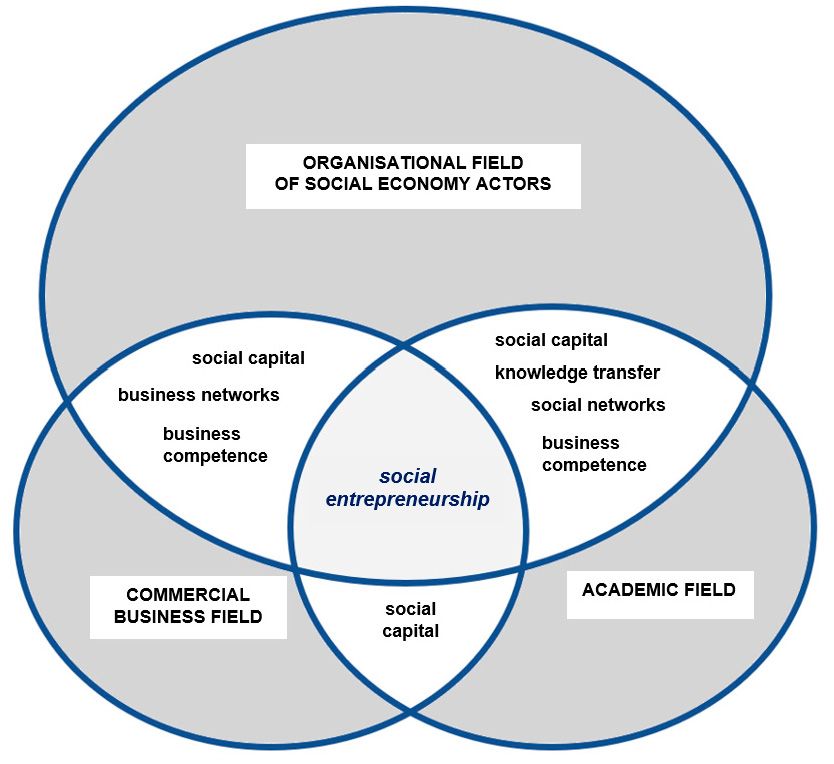
presented in the form of a Venn diagram identifies the structure of collaboration between
various organisations from different sectors. The (neo-)institutional theory and the concept
of the organisational field inspired the development of the model architecture, based on
the specific institutional fields of individual actors. Thus, among the structural elements,
the following were distinguished (Figure 4):
− Field of social economy actors, i.e., self-government, Regional Development Agencies
(ARR), Social Economy Support Centres (SESC) and social economy entities, including
social enterprises;
− Field of commercial business, i.e., for-profit companies, market, customers, suppliers,
etc.; and
− Field of academia, i.e., universities and research and educational institutions.
The highlighted organisational fields describe the primary structure of the proposed
model of collaboration towards social entrepreneurship. However, it is worth paying
particular attention to the perspective of merging the fields of social economy actors,
commercial business and academia (Figure 4). At the core of the emerging common areas
is social capital, with the creation of social capital and the possibility of its increase in
interorganisational cooperation networks being crucial. As a result of the interaction
between the fields of social economy actors and commercial business, it becomes possible− Field of academia, i.e., universities and research and educational institutions.
The highlighted organisational fields describe the primary structure of the proposed
model of collaboration towards social entrepreneurship. However, it is worth paying par-
ticular attention to the perspective of merging the fields of social economy actors, com-
Soc. Sci. 2021, 10, 201 mercial business and academia (Figure 4). At the core of the emerging common areas is
11 of 14
social capital, with the creation of social capital and the possibility of its increase in inter-
organisational cooperation networks being crucial. As a result of the interaction between
the fields of social economy actors and commercial business, it becomes possible to in-
to include
clude socialsocial enterprises
enterprises in business
in business networks
networks (Figure
(Figure 4).sharing
4). The The sharing of resources,
of resources, espe-
especially the transfer of knowledge and skills and the sharing of experiences
cially the transfer of knowledge and skills and the sharing of experiences and good and good
prac-
practices
tices as a manifestation
as a manifestation of the of the merging
merging of organisational
of organisational fields,
fields, helps helps to the
to improve improve
busi-
the business
ness competencecompetence of social enterprises.
of social enterprises. Thanks
Thanks to this, they to this,
have they have
a chance a chance
to develop part-to
develop partnership cooperation ventures not only in the local environment,
nership cooperation ventures not only in the local environment, but also in broader per- but also in
broader perspectives. It should be emphasised that the perspective of increasing economic
spectives. It should be emphasised that the perspective of increasing economic efficiency
efficiency does not have to threaten the social mission but opens up new possibilities
does not have to threaten the social mission but opens up new possibilities of implement-
of implementing social activities. The development of cooperation networks is based
ing social activities. The development of cooperation networks is based on the capital of
on the capital of trust, honest and authentic commitment and investment in lasting and
trust, honest and authentic commitment and investment in lasting and continuous social
continuous social relationships.
relationships.
Figure 4.
Figure Modelofofcooperation
4. Model cooperationtowards
towards social
social entrepreneurship
entrepreneurship in the
in the form
form of aofVenn
a Venn diagram.
diagram.
Source:
Source: own
own study
study based
based on
on empirical research.
In order
In order to
to strengthen
strengthen thetheapplication
applicationvalue
valueofofthe
thedeveloped
developedmodel
modelofofcooperation,
cooperation, it
seems desirable to pay attention to the organisational, sectoral and localisation
it seems desirable to pay attention to the organisational, sectoral and localisation condi- conditions
in context.
tions Interorganisational
in context. cooperation
Interorganisational for social
cooperation entrepreneurship
for social is always
entrepreneurship embedded
is always em-
bedded in the local context. Admittedly, one can think that in such a form, theuniversal,
in the local context. Admittedly, one can think that in such a form, the model is model is
all the more
universal, all so
thebecause
more soits architecture
because is made is
its architecture upmade
of three
up oforganisational fields which
three organisational fields
permeate each other. However, within each field, different organisations
which permeate each other. However, within each field, different organisations coexist, coexist, in a
manner, connected to each other by a certain set of meanings. This does not mean
in a manner, connected to each other by a certain set of meanings. This does not mean that that the
merging of organisational fields cannot cause conflicts at the level of meanings
the merging of organisational fields cannot cause conflicts at the level of meanings or val- or values.
ues. Kusa presents the results of an interesting study on the issue of internationalisation of
social enterprises, introducing a classification of types of international social entrepreneurs
(solution providers, entrepreneurial charities, intermediaries) (Kusa 2016). Other research
related to the conceptualisation of social entrepreneurship was conducted by Wulleman
and Hudon identifying a typology of social enterprises using an empirical study in Mexico
as an example (Wulleman and Hudon 2016). The results of the study lead to the proposal of
archetypes of social enterprises (Bricoleur, Constructionist, Engineer); however, they do not
lead to the identification of relationships between social entrepreneurship in the context of
interorganisational relationships. Croatian research in the field of social entrepreneurship
used the classification introduced by Wulleman and Hudon, also paying attention to the
lack of institutional arrangements at the national level in this area (Kolaković et al. 2018).Soc. Sci. 2021, 10, 201 12 of 14
Weerawardena and Mort, based on their research, state that “social entrepreneurship can
be conceptualized as a multidimensional model involving the three dimensions: innova-
tiveness, proactiveness, and risk management” (Weerawardena and Mort 2006, p. 31). This
is an example of identifying a model and architecture of social entrepreneurship, but it
does not refer directly to institutional intersectoral cooperation. Interesting research on
trust between actors is presented by Smith and Besharov (2019), highlighting the role of
leadership in trust-building processes. Therefore, it seems that the research presented in
this article in a way fills the research gap in the study of social entrepreneurship, especially
in the institutional environment.
5. Conclusions
The architecture of the proposed model of cooperation is a result of practical experience
in the implementation of measures for the development of social entrepreneurship in the
northern subregion of the Silesian Province in Poland. The model reflects the conditions
of actual cooperation between a university and Social Economy Support Centre (SESC).
From preliminary opinions of the institutions working in the field of social economy at the
national level, it can be assumed that the implemented initiative is innovative in nature.
The involvement of students in the process of solving problems of social enterprises, active
involvement and participation of organisational partners, as well as feedback regarding
the usefulness of the developed business models, obtained from representatives of social
economy entities, including social enterprises, contradict stereotypical thinking about
collaboration as something unattainable, impossible or unavailable.
The developed mechanisms of cooperation and collaboration between a university
and SESC can serve as an example of good practice. The implemented joint activities
allowed for real strengthening of the development potential for social economy entities
and business potential for social enterprises. At the same time, there is a possibility of
some repeatability to the sequence of actions. The developed model of cooperation opens
a discussion on seeking even greater involvement of the local government and business
communities. It seems that in the case of cooperation of various actors for the development
of social entrepreneurship, the university can play a special role (Mangan et al. 2017). This
can be not only an analytical, research or training role, but more importantly, the university
can be an agent of changes. It seems that in the context of intersectoral cooperation, the
academic sector can take on the function of an animator of activities and builder of trust
and social leadership.
Activities undertaken towards the development of social entrepreneurship were
implemented without support from external financing sources. From the perspective of the
developed business models, particularly the prototyping of solutions and their practical
testing in a business environment, this constitutes a certain limitation. Furthermore, the
engagement of students in the process of solving business problems had to be adjusted to
the structure of the academic year. However, in the opinion of all the actors involved, the
project was a success. At the same time, the research results achieved in the course of its
implementation concerning the factors influencing the efficiency of cooperation towards
local social entrepreneurship may constitute an interesting contribution to the scientific
discussion in the field of social economy.
There are many limitations in social entrepreneurship research due to the multilevel
nature of the issue and methodological difficulties. The methodologically applied ex-
ploratory approach has its own limitations, such as basing inferences on a small number
of cases. More than that, we are dealing with a very complex issue, and at the same time,
classical methods related to the study of entrepreneurship or SME development are not
fully applicable in this case. However, research should be aimed at the most complete and
holistic understanding of the phenomenon of social entrepreneurship. In terms of interor-
ganisational cooperation, the processes of hybridisation and structured flexibility, resulting
in greater adaptability and cooperative behaviour, are indicated (Smith and Besharov 2019).
Similar approaches can be applied in further research on the organisational context of so-Soc. Sci. 2021, 10, 201 13 of 14
cial entrepreneurship. It also seems that research should aim to increasingly justify the
importance of social entrepreneurship in the face of a changing business world and the
rise of social economy, as well as problems associated with the disruption of classical
economic cycles.
Funding: This research received no external funding.
Institutional Review Board Statement: Not applicable.
Informed Consent Statement: Not applicable.
Data Availability Statement: Not applicable.
Conflicts of Interest: The author declares no conflict of interest.
References
Austin, James E., and May Seitanidi. 2012. Collaborative Value Creation: A Review of Partnering Between Nonprofits and Businesses:
Part I. Value Creation Spectrum and Collaboration Stages. Nonprofit and Voluntary Sector Quarterly 41: 726–58. [CrossRef]
Babbie, Earl. 2007. The Practice of Social Research, 11th ed. Belmont: Thompson-Wadsworth.
Boschma, Ron. 2005. Proximity and Innovation: A Critical Assessment. Regional Studies 39: 61–74. [CrossRef]
Brandeleer, Celine. 2013. Social Economy in Poland. The European Think Tank Pour la Solidarité. Bruxelles: Europe for Citizens.
Brinkerhoff, Derick, and Jennifer Brinkerhoff. 2012. Public–Private Partnerships: Perspectives on Purposes, Publicness, And Good
Governance. Public Administration and Development 31: 2–14. [CrossRef]
Casula, Mattia, Nandhini Rangarajan, and Patricia Shields. 2020. The potential of working hypotheses for deductive exploratory
research. Quality & Quantity. [CrossRef]
Chell, Elizabeth, Katerina Nicolopoulou, and Mine Karataş-Özkan. 2010. Social Entrepreneurship and Enterprise: International and
Innovation Perspectives. Entrepreneurship & Regional Development 22: 485–93.
Chesbrough, Henry, and Richard S. Rosenbloom. 2002. The role of the business model in capturing value from innovation: Evidence
from Xerox Corporation’s technology spin-off companies. Industrial and Corporate Change 11: 529–55. [CrossRef]
Cleland, David, and Roland Gareis, eds. 2006. Global Project Management Handbook. Planning, Organizing and Controlling International
Projects. New York, Chicago and San Francisco: McGraw-Hill.
Dacin, M. Tina, Peter A. Dacin, and Paul Tracey. 2011. Social Entrepreneurship: A Critique and Future Directions. Organization Science
22: 1203–13. [CrossRef]
DiMaggio, Paul J., and Walter W. Powell. 1983. The iron cage revisited: Institutional isomorphism and collective rationality in
organizational fields. American Sociological Review 48: 147–60. [CrossRef]
European Commission. 2020. Europe 2020. A Strategy for Smart, Sustainable and Inclusive Growth, (COM 2010). Brussels. Available
online: https://ec.europa.eu/eu2020/pdf/COMPLET%20EN%20BARROSO%20%20%20007%20-%20Europe%202020%20-%2
0EN%20version.pdf (accessed on 22 May 2021).
Finnis, John. 2011. Natural Law and Natural Rights, 2nd ed. Oxford: Oxford University Press.
Hoogendoorn, Brigitte, Enrico Pennings, and Roy Thurik. 2010. What Do We Know about Social Entrepreneurship? An Analysis of
Empirical Research. International Review of Entrepreneurship 8: 1–42.
Jackson, Gregory. 2010. Actors and Institutions. In The Oxford Handbook of Comparative Institutional Analysis. Edited by Glenn Morgan,
John L. Campbell, Colin Crouch, Ove Kay Pedersen and Richard Whitley. Oxford: Oxford University Press, pp. 63–86.
Jiao, Hao. 2011. A conceptual model for social entrepreneurship directed toward social impact on society. Social Enterprise Journal 7:
130–49. [CrossRef]
Kolaković, Marko, Mladen Turuk, and Ivan Turčić. 2018. Social Entrepreneurship: Strategic Development in Croatia. Zagreb International
Review of Economics & Business 21: 129–43.
Kusa, Rafał. 2016. Internationalization of the Entrepreneurial Activity of Social Purpose Organizations. International Journal of
Management and Economics 52: 77–93. [CrossRef]
Mangan, Ben, Claire Markham, and Kristiana Raube. 2017. Three Ways Universities Can Dramatically Advance Social Enterprise,
Stanford Social Innovation Review. Available online: https://ssir.org/articles/entry/three_ways_universities_can_dramatically_
advance_social_enterprise (accessed on 22 May 2021).
Marshall, R. Scott. 2011. Conceptualizing the International For-Profit Social Entrepreneur. Journal of Business Ethics 98: 183–98.
[CrossRef]
Murphy, Patrick J., and Susan M. Coombes. 2009. A Model of Social Entrepreneurial Discovery. Journal of Business Ethics 87: 325–36.
[CrossRef]
Nonaka, Ikujiro, and Hirotaka Takeuchi. 1995. The Knowledge-Creating Company. New York: Oxford University Press.
North, Douglass C. 1990. Institutions, Institutional Change, and Economic Performance. Cambridge: Cambridge University Press.
Park, Jaehong, Kumju Hwang, and Sang-Joon Kim. 2018. Forming a Social Partnership between a Small Social Enterprise and a Large
Corporation: A Case of the Joint Platform, H-JUMP. Sustainability 10: 3612. [CrossRef]
Parsons, Talcott. 1990. Prolegomena to a theory of social institutions. American Sociological Review 55: 319–33. [CrossRef]You can also read


