The Evolution of Motorola's Global Financial Supply Chain Strategy
←
→
Page content transcription
If your browser does not render page correctly, please read the page content below
Proceedings of the 44th Hawaii International Conference on System Sciences - 2011

        The Evolution of Motorola’s Global Financial Supply Chain Strategy

                        Ian D. Blackman             Christopher P. Holland                   Tim Westcott
                        Brunel University          Manchester Business School                  Motorola
                     ian.blackman@brunel.ac.uk         chris.holland@mbs.ac.uk          tim.westcott@motorola.com
                                                                ian

                      Abstract
    This paper charts the progress of Motorola’s                    common, global standards and products have been
global cash management strategy encompassing                        questioned, and the importance of local requirements
Motorola’s internal factories worldwide, Motorola’s                 have received more attention, the trends described and
customers and suppliers, and partner banks in the US,               forecasted by Levitt have been of particular importance
Europe and Asia. It explains how their financial supply             in high-technology markets. The Internet, cheaper
chain strategy has evolved over a period of over thirty             travel and the availability of low-cost manufacturing
five years from a relatively simple internally focused              have all contributed to the homogenization of many
system into a fully integrated global system that                   high-tech consumer markets, particularly computing,
enables the flow of currency and associated foreign                 mobile phones and software. These market changes
exchange processes to mirror the Just-In-Time (JIT)                 have been accompanied by the emergence of global
flow of products throughout the supply chain. The                   organizations, which have defined and shaped their
performance of the finance systems is analyzed using                strategies in order to take advantage of global
detailed statistical techniques including six-sigma. The            standards and increased standardization, whilst also
strategy is characterized by incremental changes                    recognizing the importance of local market
punctuated by significant shifts in the strategy,                   requirements. Other examples of global technical
organizational design and information systems. It is                standards include GSM in the mobile phone industry
demonstrated that the financial processes that connect              and de facto standards defined by dominant market
Motorola with its suppliers enable the supply chain to              shares e.g. computer operating systems, Microsoft’s
behave more like a single, cohesive unit rather than a              office productivity software and eBay’s shopping
collection of autonomous organizational units.                      platform.

                                                                        The critical element of any global strategy is to be
1. Introduction                                                     able to manage and co-ordinate operations efficiently
                                                                    in order to achieve economies of scale and maintain or
                                                                    lower their operating costs. Dicken [2] makes a
    The globalization of markets has attracted
                                                                    distinction between the notion of ‘pure’ globalization
increasing attention in the academic and business
                                                                    exemplified by Ohmae [3] and more complex
literature and although there is continuing debate into
                                                                    developments where geography and local product
the extent and nature of globalization in terms of
                                                                    design are reflected in the structure and management of
market behavior and trends, the structure of supply
                                                                    international supply chains. An important analytical
chains and organization design, it is widely accepted
                                                                    tool that emerges from the discussion of globalization
that all types of businesses must develop their
                                                                    is the network concept of inter-linked organizations,
production and marketing strategies in a global
                                                                    typically formed into a supply chain that manages the
context. This is particularly true in the high technology
                                                                    flow of raw materials, product assembly,
and banking markets, which have been at the forefront
                                                                    manufacturing and distribution through shared business
of globalization. In this paper we examine the
                                                                    processes and Information Systems.
globalization process in Motorola’s financial supply
chain. The strategy analysis incorporates theory
                                                                        Multinational organizations have gained huge
elements from the strategy, IS and operational
                                                                    benefits from the integration of management processes
management literatures. An outline of the relevant
                                                                    within their organizations through the use of Enterprise
theory concepts is given below.
                                                                    Resource Planning (ERP) systems that have been
                                                                    accompanied by the development of shared
   In his seminal article, Levitt [1] identified the
                                                                    information systems along the supply chain, either by
importance of the globalization of markets, and in
                                                                    simple EDI systems or more sophisticated electronic
particular the standardization of products to suit global
                                                                    business standards such as RosettaNet. The supply
markets. Although the overarching trend towards

                                              1530-1605/11 $26.00 © 2011 IEEE                                                  1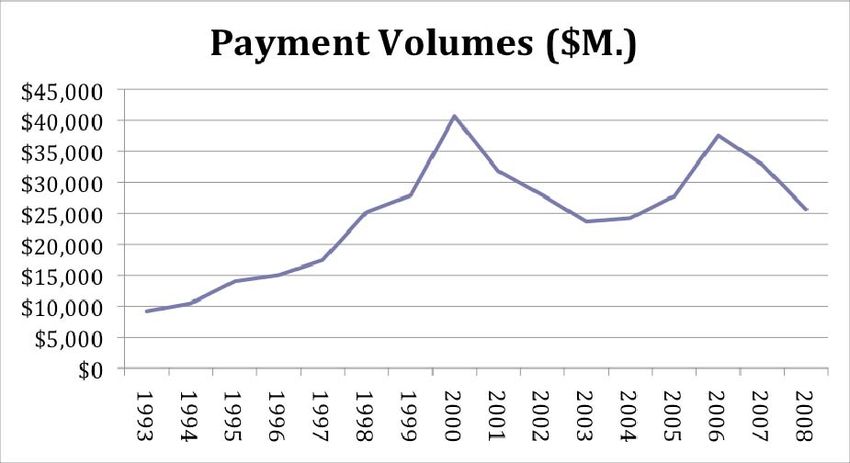
Proceedings of the 44th Hawaii International Conference on System Sciences - 2011

chain management literature typically focuses on the               chain strategy of Motorola and its global partners over
operations management aspects of supply chain, e.g.                a significant time period. Of particular importance was
the benefits of integrating manufacturing and                      to understand the inter-relationships between external
marketing [4] and the benefits of sharing information              factors such as globalization of markets and common
between separate companies to support the co-                      systems on the development and evolution of the
ordination of inventory management [5]. More recently              financial supply chain strategy, and to measure the
an increased emphasis has been placed on the global                actual outcomes and performance based on detailed
aspects of supply chain management [6] including the               operational statistics combined with judgmental
proposal of a theoretical governance framework.                    evaluation and interpretation of the data by key
However, there are very few documented cases of                    informants within the company working closely with
global strategies in action that capture the evolution             the researchers. The research therefore involved a
and benefits gained from integrating management                    detailed exploration and analysis of the strategy
processes along the supply chain through a description             content, process and outcomes within Motorola based
of operations and systems development in a dynamic                 on longitudinal data profiles. The data collection
context.                                                           process involved detailed interviews and discussions
                                                                   with senior management within Motorola and one of
    This paper describes the development and evolution             their bank partners, and included full and open access
of Motorola’s global financial supply chain strategy               to relevant internal management reports and
over the period 1976 to 2009. It identifies the major              operational data.
factors that shaped the strategy, notably the external,
market catalysts for change, the impact and interaction                The case study method was chosen because it
with strategic partners and the enabling effects of                enabled new theory development concerning financial
Information Systems that connect Motorola to a global              supply chain strategy related to information systems
business network of customers and suppliers involved               and operational performance measures, including six-
in the manufacturing and banking supply chains. A                  sigma, and it enabled the researchers to uncover
research framework that shows the relationships                    aspects and inter-relationships of complex phenomena
between external factors, strategy evolution and                   in an organizational setting [7, 8] There is a strong
performance is shown in figure one. The framework is               tradition of using case study research to study
used to structure the case analysis and defines the                information systems in practice [9, 10, 11] and it has
strategic themes and operational variables that are used           been shown to be an effective methodology to evaluate
to describe and analyze the case data.                             the role and impact of information systems within an
                                                                   organizational context. An important point to note
                                                                   regarding the theoretical validity and generalizability
                                                                   of the results is that the empirical results are
                                                                   generalized to a theory which can be further developed
                                                                   and extended by additional research, both individual
                                                                   case studies and survey type research [12].

                                                                   3. Motorola

                                                                       Motorola has played an iconic role in the
                                                                   development of mobile and wireless communication
                                                                   products in the US and globally. Since its inception, it
                                                                   has launched a series of innovative and technology-
                                                                   leading devices starting with mobile radios in the
                                                                   1930s through to web 2.0 phones and services in the
                                                                   past year. In addition to its technology, other defining
                                                                   features of the company include its international
                                                                   outlook, its leading role in the implementation and
                                                                   continued development of the six-sigma framework
       Figure One: Research Framework                              and its Information Systems infrastructure which
                                                                   enable it to manage geographically disparate
2. Methodology                                                     manufacturing and financial entities on a global scale.
                                                                   This paper builds on an earlier case study of Motorola
    The objectives of the research were to understand              and Citibank [13], by extending the timeframe from
the evolution and performance of the financial supply              1993 to 2009, which provides a unique opportunity to

                                                                                                                              2
Proceedings of the 44th Hawaii International Conference on System Sciences - 2011

illustrate how long-term changes in global systems and                        matched to reduce the actual amount of
strategies are implemented in practice, and how their                         foreign exchange required. This is achieved
performance can be measured and evaluated.                                    by making the dollars in the US subsidiary
                                                                              available to Motorola France, and vice versa.
    The traditional financial process introduces                              This is a simple dyadic example, and the
uncertainty into the supply chain. The more powerful                          actual system was much more complex
organization will typically demand that the price of an                       because it matched international payments
international transaction is agreed in their preferred                        across the whole group of companies in a
currency. As foreign exchange rates will fluctuate                            wide range of currencies.
between the time of the sale and when the payment is
received, the supplier is exposed to a foreign exchange                  3.   An electronic file of payments was forwarded
risk that is not realized until the completion of the                         to Citibank, their global bank partner.
transaction. It is common for large organizations to                          Motorola sent remittance advices directly to
delay payment beyond the agreed credit period. An                             suppliers so that they would know the exact
additional problem for the suppliers is the uncertain                         payment date.
date for the payment due to the operational
inefficiencies of the customer’s financial process and             3.2. The need for change
the banks processing the payments [14]. The
uncertainty increases the financing cost of the                        By 1993, Motorola had established a worldwide
suppliers, as they have to hold higher cash balances.              netting system that provided a mechanism for
The uncertainty introduced by a powerful organization              coordinating almost $5bn. of global payments between
increases the costs within the supply chain. Certain               separate Motorola operating companies, and with
payment dates allow the supplier to arrange cheaper                external suppliers. Significant cost savings were being
sources of finance. Motorola appreciated and realized              achieved in the areas of international bank payments,
these issues very early on and built a global netting              foreign exchange and operating savings gained from
system that started to address them.                               simplification and centralization of the treasury
                                                                   management function.           However, there were
3.1. The original netting system                                   significant operational and HR issues that needed to be
                                                                   addressed in order to develop the system further and
    The original cash management system connected                  fully exploit its strategic potential.       The main
over one hundred Motorola entities worldwide through               operational problem that required immediate attention
a centralized netting system based in London. The                  was the quality of supplier data that enabled the
system would reduce the amount of foreign exchange                 payment and remittance advice processes.
that would need to be converted and the number of
payments between Motorola’s operations.         Each                   Any inaccurate or incomplete data on suppliers
Motorola would enter its payment instructions on a                 resulted in the payment being rejected by the electronic
weekly basis. The payments consisted of inter-                     system and in its place a check was issued. However,
company payments, e.g. Motorola US and Motorola                    this led to further problems if the beneficiary details
Germany, and payments between Motorola companies                   were inaccurate and of the 70,000 payments made in
and their external suppliers. The system would then                1993, several hundred failed each month or were
carry out a defined set of business processes:                     delayed and required additional work. The relatively
                                                                   small number of staff in the treasury department who
    1.   Offset payments and receivables within                    had experience of how the netting system worked also
         Motorola to reduce the total payments volume              meant that the company was over-reliant on key
         internally.                                               individuals for specific knowledge. This exacerbated
                                                                   operational difficulties and also made it more difficult
    2.   Net off the foreign exchange by matching                  to understand the root causes of payment errors.
         international payments between all of
         Motorola’s companies and their suppliers to                   The principal method used to tackle the operational
         reduce the volume of weekly foreign                       problems was the application of the manufacturing
         exchange deals required. So for example, if               statistical process control method, six-sigma. The
         Motorola US is making a payment of                        objective of six-sigma was to eliminate defects in the
         €200,000 to a European supplier, and                      manufacturing process. Motorola originally developed
         Motorola France is making a US dollar                     the technique in 1981 and had reaped significant
         payment of $230,000 to an American                        rewards [15]. Motorola has also been the recipient of
         supplier, then the two payments can be                    the coveted Malcolm Baldridge quality award based on

                                                                                                                              3
Proceedings of the 44th Hawaii International Conference on System Sciences - 2011
its innovation and application of these techniques in systems. Rather than the Treasury making the
manufacturing (see [16] for a discussion of the impact corrections the cash was refunded to the operating
of the Baldridge awards on a range of leading units until the details were checked for the next cycle.
companies). However, the use of these techniques in a Naming and shaming the business units with the worst
finance function was a new venture, and took quality issues also applied peer pressure.
considerable effort and training to make it work.
Similar to manufacturing the finance function was The catalyst for further significant improvement
focused on the improvement of the certainty of the over the period 1999 to 2001 was the improvement of
process. the consistency of the data originating from the
introduction of standard Oracle ERP implementations.
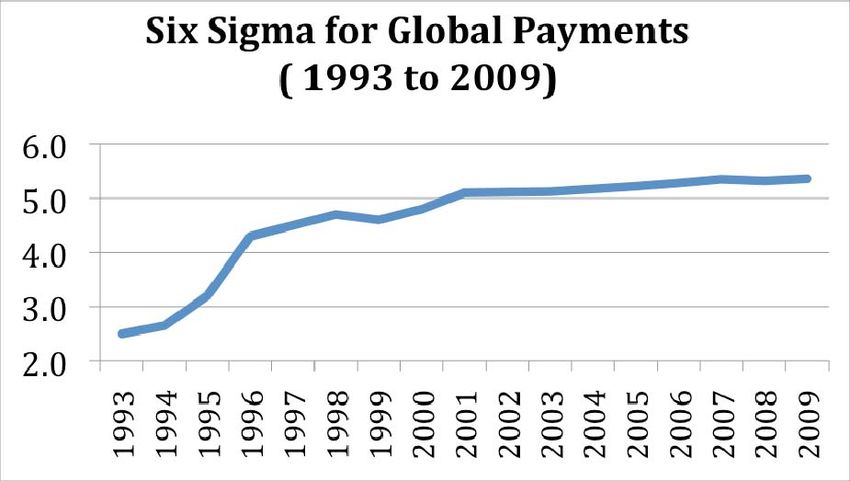
The results from the application of six-sigma to The slight dip in 1998-1999 is explained by the fact
global payments are shown in figure two below. that this was a transition period during which the
Oracle systems were introduced. In 2005 the co-
location of the banking systems, in China, with the
internal production management systems was a logical
development because the payment instructions are
initiated by production and supply chain management
activities. Production management and banking
processes use common data and the close integration of
the Information Systems further increased the accuracy
and timeliness of this data. There have been continuous
improvements since 2005 and in 2010 it has reached a
point where further improvements will only yield
minimal benefits because the number of payment
failures per month is now very small, i.e. less than 10
per month that was equivalent to 5.4 sigma. The errors
could be resolved relatively quickly and easily using
Figure 2. The dynamic improvement in six- manual processes.
sigma performance for Motorola’s global
payments 1993-2009. 3.3. Growth and evolution of the cash
management strategy
To give an idea of the scale and complexity of the
operations, the total volume of supplier payments rose
from around 70k per annum in 1993 to almost 100k in The growth pattern in payment volumes is shown in
1998 with an average payment value of $62k. Inter- figure three.
company payments between Motorola operating
companies rose from 10k to 21k over the same time
period with an average value of $715k.
In terms of actual payments affected, a 3-sigma
level equated to problems with around 7% of total
payments so in 1995 there was some type of
operational problem with almost 6,000 payments out of
a total of 92,000. The issue was that rejected payments
had to be re-inputted to the netting system in time to
complete the process. Operational issues at the bank
also introduced error rates as high as 20%. It can be
seen that the initial improvements from 1993-1998
were significant. By 1998, the sigma level had risen to Figure 3. Growth in Motorola’s payment
4.7. The factors that help explain this rapid volumes
improvement were the increased focus on quality
processes within the treasury function and the There was steady growth in payment volumes over
operating companies, particularly on measuring, the period 1993-2000 and the peak coincided with the
improving and controlling the accuracy and dot-com bubble. In 2001, Motorola sold its government
completeness of bank data for suppliers. To improve and defense business to General Dynamics, and in
the quality of the process, errors had to be corrected at 2004, its semiconductor division was set up as a
their source, within the operating company ERP separate company, ‘Freescale Semiconductors’. In
4Proceedings of the 44th Hawaii International Conference on System Sciences - 2011
2006, the automotive division was sold to Continental complexity of the operational requirements facing the
AG. Together with other market and regulatory factors, cash management function. From the perspective of
these sales partly explain the fluctuation in payment the treasury function, an overview of the strategic
volumes. However, for the purposes of this paper, the changes and the resulting outcomes for the period
important result here is to demonstrate the scale and 1976-2005 is shown in table 1.
Table 1. The evolution of Motorola’s financial supply chain from 1976 - 2009
Date Key Events and Strategic Changes Results and Outcomes
All payment data were collected in Chicago and
controlled from Geneva. The currency netting system
was implemented. The original system exploited a Reduction of cash flows within the organisation and the
1976
COBOL email system that connected all the Motorola establishment of a simple global system.
companies together and enabled them to share data
quickly and easily.
The skills required to manage an international treasury
The European treasury management function was moved
were readily available in London. The treasury was
to London. Secure electronic links with Citibank enabled
1988 also close to its key banking suppliers. A significant
the electronic payments process to be extended to
increase in the scale of the netting process was
suppliers.
achieved.
The IT infrastructure composed of the global email Strategic alliance with Citibank developed further
system, leased lines and Value-Added-Networks (VANs) through the use of EDI systems. Option to move to
1991
enabled the sharing of data between Motorola, its bank another supplier retained with the use of an industry
and its suppliers on a worldwide basis. standard for the payment orders.
The process made the payment process more
transparent and enabled the suppliers to easily identify
Development of EDIFACT standards for supplier payment delays. Suppliers received significant benefits
1992
remittance advice. in terms of timely payments and advanced notification
of payment dates from the electronic remittance advice
message.
The electronic payment system was used for all payments
greater than $14k. Worldwide checks were used for The poor quality of the payment data resulted in a high
payments with a value less than $14k and also for level of repairs and delays to higher value payments
1993
payments that did not have sufficient banking details to combined with the significant use of checks because of
be paid electronically. All inter-company payments incomplete suppliers’ electronic bank details.
within the Motorola group are electronic payments.
Centralising the collection of funds increased the
Introduced the ability to collect payments through the efficiency of the netting process. Motorola reduced its
1993 netting system. Hedging of foreign exchange risk was costs to trade foreign currency. The efficiency of
included in the netting cycle (based on forecasts). Motorola’s hedging process was increased, which
reduced the level of foreign exchange exposure.
Started to use purchase order details to improve the
Management of the foreign exchange risk was moved
visibility of foreign exchange exposure. The netting
1996 from forecasts to real time data at the point the risk was
system was used to process the transactions required to
generated, i.e. when the purchase order is raised.
hedge the foreign currency exposure.
Dutch BV European cash management centre was used Centralised the management of surplus cash and short
1997
as the in-house bank. term funding in Europe.
The inclusion of insurance payments increased the
The netting system was used to collect insurance scale of the netting system and reduced the
1997
payments on a worldwide basis for the captive insurer. transactional costs of currency trading and foreign
exchange processes.
5Proceedings of the 44th Hawaii International Conference on System Sciences - 2011
To introduce competitive pressures to resolve the quality
The service levels of the two main relationship banks
issues - a multibank payment capability was developed.
1997 could be compared. Splitting the business also put the
Payment files were split between Citibank and JP
banks’ pricing under pressure.
Morgan.
More payments were processed electronically, which
benefitted suppliers in terms of improved cash flow and
improved quality of the payment process. The process
1997 Reduced the lower limit for checks to $7k.
increased the cost to Motorola, although the cost to
Motorola was significantly less than the benefit to
suppliers.
The cost for making an ACH payment is significantly
Introduced Automated Clearing House (ACH) payment
lower than an international wire payment. There is
1998 process. This significantly reduced Motorola’s cost to
greater consistency in the time taken for suppliers to
process payments.
receive the funds.
Centralising the treasury process was reasonably
Semiconductors division was on SAP. Motorola moved
straightforward at Motorola because most of the
1998 to Oracle. Some parts of the company remained on SAP
manufacturing operations were using the same version
after 3 years but 85% on Oracle.
of an ERP system.
The services centre integrates the Oracle manufacturing
Asian Services Centre set up in China to manage and
platform with the banking systems, which gives
1998 process all Asian payments. Six-sigma techniques were
operational advantages in terms of business process
used to track the operational performance.
design, data consistency and accuracy of payments.
The service provided by the treasury was extended to
1999 Globalized treasury cash management function
Asia.
Processing errors reduced to the point that all payments The suppliers benefited from receiving lower value
2002
could be paid electronically. payments earlier.
Back office systems and operations were improved using Incremental process improvements related to the Oracle
six-sigma methodology, which exploited the improved system continued to improve the certainty of the
2003
accuracy from the new Oracle system. System payment date for suppliers and further improved the
enhancements were also carried out during this period. quality of the financial processes.
Motorola’s semiconductor division was sold. The netting
The treasury only had eight months to replace the
2004 system was a mainframe system that was included as part
netting system.
of the sale – a new solution was therefore required.
Outsourcing the netting was the most pragmatic
solution compared to the other two main options. (1)
New netting system was implemented which was based Renting space on another IBM mainframe was deemed
2005 on an outsourced solution from ABN AMRO (now part to be too expensive and also tied Motorola to old
of RBS). technology, (2) Developing a new version to run on
servers was too expensive and unlikely to be completed
on time.
An improvement in scale efficiencies was achieved. In
Third party payment processing was transferred to China
2005 addition, a dedicated specialist team further reduced
(with the exception of US payments).
errors in the payments and foreign exchange processes.
Although Motorola appeared to weaken its negotiating
position in a sole-supply banking relationship, the
JP Morgan was chosen as the sole supplier of payment
2005 arrangement generated operational benefits because it
processing outside the US.
made it easier to resolve payment errors and service
levels were also improved.
6Proceedings of the 44th Hawaii International Conference on System Sciences - 2011
Major acquisition of Symbol Inc. required the treasury The integration with the SAP system required
2007 system to be integrated with SAP in addition to the significantly more effort than Motorola’s standard
existing Oracle system. Oracle ERP system.
The basic advantages were to save overhead costs and
2008 European cash management office moved to Poland.
also to access skilled staff.
An incremental process enabled the quality of the
process to be maintained. This was vital because with
In total, 12 release versions of the netting system were
1990- only a small treasury staff it would not have been
implemented, each one representing significant
2010 possible to manually correct errors in a high volume,
operational enhancements.
high value environment where the payment processes
were time-critical.
other, the resulting foreign exchange requirements
The current organizational and banking were reduced to $3bn. To see how the performance of
arrangements for Motorola’s global cash management the system has improved over time, the foreign
system are shown in figure four. The IT infrastructure exchange requirements as a percentage of total
within Motorola is now based on an Oracle enterprise international payments over time are shown in figure
system, which connects together all of the Motorola five.
entities with a single, standard technology. The
treasury system benefits from the operational ease of
maintaining the integration with operating companies.
The initiation of supplier payments originates from the
Oracle production management system and payment
instructions are sent to the global netting system. In the
original system, Motorola used a bespoke, internally
developed netting system but this was replaced by an
outsourced solution in 2005, provided by ABN
AMRO, which is now part of RBS.
Figure 5. Motorola’s netted foreign
exchange as a percentage of total payments
It can be seen that the volume of foreign exchange
payments that are netted against each other has risen
from 60% in 1993 to around 85% in 2009. While
Motorola had developed a very efficient system to
manage the conversion of foreign exchange and
process payments, the issue of the foreign exchange
risk was outstanding. Motorola accepted the foreign
exchange risk from its suppliers as soon as a contract
was agreed in a foreign currency. The time between the
Figure 4. Motorola’s global financial supply purchase order being agreed and the conversion of the
currency to make the payment could be months (figure
system in 2009
six). During the intervening period the exchange rate
could move adversely. As a result, when a purchasing
The netting system collects all of the global
manager agreed a price they did not know the final
payment instructions and offsets the value of intra-
cost.
company payments between Motorola companies, and
then nets off the foreign exchange payments in order to
reduce the spot foreign exchange requirements. $20
billion of payments were input to the netting system in
2009. After netting the currency payments against each
7Proceedings of the 44th Hawaii International Conference on System Sciences - 2011
to act opportunistically and to remove the uncertainty
of the payment date. The certainty is possible because
Motorola has automated the process. Most significantly
Motorola has made the decision to pay on time and in
the suppliers’ currency.
The internal operational processes developed by
Motorola’s global treasury function are examples of
best practice in the treasury management function. The
strategic innovation lies in the use of the centralized
treasury function to manage supplier payments and
also to collect funds from customers. The collection of
funds and the initiation of payments is a high-value and
high-volume transaction process, which makes the
emphasis and achievements in using six-sigma of
Figure 6. The period exchange rates can critical importance. Without the very high quality
change based on automated systems, the benefits would be lost
through increased administrative and banking costs. To
To remove the uncertainty the purchase order get to this stage has required decades of continuous
details were extracted from the Oracle ERP systems improvement and a strategic commitment to
and fed into the foreign exchange hedging system implementing quality strategies originally designed for
(Chart/Taurus) on a bimonthly cycle. The treasury manufacturing in a finance context.
would hedge (confirm the exchange rate) of the net
exposure with Motorola’s foreign exchange banks, The time and effort to duplicate the system should
which were settled via the netting system. Although the not be underestimated. Collecting the purchase order
process is not complex it was only possible due to the information required data to be extracted from the ERP
long-term effort to integrate the manufacturing and systems used by each of the Motorola operations.
treasury systems. Once implemented the cost to Fortunately, Motorola had demanded that each of its
Motorola of removing the foreign exchange risk from operations install the same version of an ERP system to
the supply chain was negligible. simplify the exchange of information required to
manage its supply chain. As a result the Global
Treasury only had to integrate once with the Asian
4. Case discussion and comparison with services centre that operated the ERP system.
theory
Rather than using the automated system to deal
Beyond the initial internal netting system, Motorola with multiple banks the choice was made to
has maintained a focus on integrating its suppliers into concentrate the business with sole suppliers. The scale
the financial supply chain in the same way that of Motorola’s requirement for transactional banking
operational improvements in the manufacturing supply services made them a valuable customer. In addition to
chain have been achieved by sharing systems and offering competitive prices, the banks were willing to
business processes across organizational boundaries. tailor their services to meet Motorola’s needs. To retain
One of the key outcomes of an integrated financial the business the banks are required to keep their focus
supply chain is that the uncertainty of when the on improving the quality of the transactional services
international suppliers will receive payments and how and acting promptly to resolve any operational
much they will receive in their currency is largely problems.
eliminated.
The fundamental barrier is that the senior
The integration of financial processes along the management was willing to sanction an incremental
supply chain is a logical and natural development that development, over an extended period that primarily
builds on the emergence of global integrated supply provides a benefit to the supplier base. The enlightened
chains designed around logistics and manufacturing recognition was that by improving the efficiency of the
systems. Motorola’s willingness to share the financial financial process Motorola was able to increase the
and operational benefits of an integrated payments efficiency of the supply chain.
system with its suppliers is further evidence that the
supply chain is the unit of analysis to focus on in order In summary, the case of Motorola’s global treasury
to understand how global trading networks function has several unique and strategically important
and operate. Motorola has also made the decision not attributes. It is a clear example of the development of a
8Proceedings of the 44th Hawaii International Conference on System Sciences - 2011
global financial supply chain that mirrors the importance of the dynamic element of the analysis.
manufacturing and network of relationships between Measuring and evaluating strategic change over time is
Motorola and its global supply base. It builds on the necessary in order to illustrate how global strategies
theoretical concepts from the literature and illustrates are shaped by the involvement and impact of key
with empirical evidence the benefits that can be managers and also to understand how broader events
achieved by adopting a global strategic perspective, such as organizational restructuring and changes to
supported by standardized information systems. In banking and supplier relations have a direct bearing on
terms of the discussion about the scale and extent of the continuing evolution of the globalization process.
the globalization process in different markets, money is
arguably the ultimate commodity. The global treasury References
function, payment systems, banking arrangements and
underlying information systems infrastructure is [1] T. Levitt, “The Globalization of Markets”, Harvard
managed as a single entity. The national differences are Business Review, May-June 1983, pp. 92-102.
relatively minor and are determined largely by local
th
regulatory requirements that govern international [2] P. Dicken, Global Shift, 2007, Sage, 5 Edition.
payments. The human element of implementing a
global system should not be forgotten. The stability of
the management of the project greatly helped the [3] K. Ohmae, “The Borderless World”, Harper, New York,
1990.
process of reaching agreements with the finance
functions within Motorola. Not a little tenacity was [4] L. Cooper, “Strategic Marketing Planning for Radically
required to maintain the support to improve the New Products”, Journal of Marketing, Vol. 64, 2000, pp. 1-
process. 16.
5. Conclusions and future direction [5] H.L. Lee, K.C. So and C.S. Tang, “The Value of
Information Sharing in a Two-Level Supply Chain”,
Management Science, Vol. 46, No. 5, 2000, pp. 626-643.
The evolution of the strategy over a long period of
time is characterized by incremental improvements, [6] G.J. Gereffi, J. Humphrey and T. Sturgeon, “The
often based on six-sigma concepts, punctuated by step- Governance of Global Value Chains”, Review of
changes in organizational and information systems International Political Economy, Vol. 12, No. 1, 1995 pp. 78-
design. The overwhelming trend is towards a standard 104.
global treasury model to enable international banking
and payments throughout the product supply chain. [7] R.K. Yin, “Case Study Research: Design and Methods”,
The movement of products and services is now Third ed. Applied Social Research Series, Volume 5, 2003,
supported by parallel financial and banking systems. Sage, London.
As close collaboration is required between the trading
[8] K.M. Eisenhardt, “Building Theories from Case Study
partners within the supply chain to meet customer
Research”, Academy of Management Review, Vol. 14, No.
needs, the movement of funds has evolved to track the 4, 1989, pp. 532-550.
movement of goods in a concomitant manner rather
than as a distinct and separate management function. [9] I. Benbasat, D.K. Goldstein and M. Mead, “The Case
Research Strategy in Studies of Information Systems”, MIS
The case clearly illustrates how the strategic focus Quarterly, Vol. 11, No. 3, 1987, pp. 369-386.
has shifted from attempting to optimize the
performance of an individual company to improving [10] A.S. Lee, “A Scientific Methodology for MIS Case
the performance of the supply chain as a cohesive unit. Studies”, MIS Quarterly, Vol.13, No. 1, 1989, pp. 33-50.
This is reflected by the fact that a significant share of
the benefits gained from integrating the financial [11] H. K. Klein and M. D. Myers, “A Set of Principles for
supply chain are accrued by the suppliers. But this in Conducting and Evaluating Interpretive Field Studies in
turn has intangible benefits such as better co-operation Information Systems”. MIS Quarterly Vol. 23, No. 1, 1999,
pp. 67-93.
and a willingness to adapt in the context of the overall
relationship, including flexibility in the management of [12] A.S. Lee and R.L. Baskerville, “Generalizing
the manufacturing and logistics. Generalizability. Information Systems Research”, Vol. 14,
No. 3, 2003, pp. 221-243.
Much more research needs to be undertaken to
ground the theoretical models of globalization in terms [13] C.P. Holland, A.G. Lockett, I.D. Blackman and J.M.
of the actual structure and operation of global business Richard, “The Evolution of a Global Cash Management
networks and systems. This case illustrates the System”, Sloan Management Review, Vol. 36, No. 1, 1994,
pp. 37-47.
9Proceedings of the 44th Hawaii International Conference on System Sciences - 2011
[16] R. Blackburn and B. Rosen, “Total Quality and Human
[14] P. Naudé, I.D. Blackman and S. Dengler, “The Resources Management: Lessons Learned from Baldrige
Managerial Implications of Real-Time New Product Award-Winning Companies”, Academy of Management
Development in Financial Services” Creativity and Executive, Vol. 7, No. 3, 1993, pp. 49-66.
Innovation Management, Vol. 7, No. 2, 1998, pp. 54-61.
[15] M.J. Marquardt and A. Reynolds, “Motorola: Trans-
Cultural Learning and Global Alliances”, Chapter 19, in The
Global Learning Organization, Irwin Professional Publishing,
1994.
10You can also read


