The OIA and the public policy making process - Ombudsman
←
→
Page content transcription
If your browser does not render page correctly, please read the page content below
The OIA and the public policy
making process
A guide to how the OIA applies to information
generated in the context of the public policy
making process
This guide explains the most common reasons why it can sometimes
be necessary to withhold official information generated in the context
of the public policy making process.
These reasons relate to the withholding grounds in sections 9(2)(f)(iv)
and 9(2)(g)(i) of the OIA—often referred to as the ‘good government’
withholding grounds.
The guide contains general principles and case studies to illustrate the
application of these grounds in relation to public policy-related official
information.
There are some related guides that may help as well:
Our detailed guide on section 9(2)(f)(iv) can be found here.
Our detailed guide on section 9(2)(g)(i) can be found here.
Our detailed guide on the application of the public interest test
can be found here.
Guide: The OIA and the public policy making process March 2018 | Page 1
Office of the Ombudsman | Tari o te Kaitiaki Mana Tangata

Contents
The public policy making process _______________________________________ 3
The need to withhold _________________________________________________ 3
Generation of policy advice _________________________________________________ 3
Consideration of policy advice _______________________________________________ 4

The public interest in release __________________________________________ 6
General principles ___________________________________________________ 7
Basic information _________________________________________________________ 8
Early and formative stages __________________________________________________ 8
Factual, background or publicly available material _______________________________ 9
Options v analysis _________________________________________________________ 9
Internal and inter-agency consultation and discussions on draft policy proposals ______ 10
Internal working documents and draft policy advice to Ministers or Cabinet __________ 10
Informal exchanges between Ministers and officials _____________________________ 11
Policy advice to Ministers and Cabinet while under consideration __________________ 11
Policy advice to Ministers and Cabinet after decisions have been taken______________ 11
Political consultation and negotiations ________________________________________ 12
Passage of time—stalled processes __________________________________________ 12

Planning the public policy making process _______________________________ 12
Further information _________________________________________________ 13

Appendix 1. Visual summary of general principles ________________________ 14
Alternative-text version of visual summary ____________________________________ 15

Appendix 2. Case studies _____________________________________________ 17
Index __________________________________________________________________ 17
Good reason for withholding _______________________________________________ 20
No good reason for withholding _____________________________________________ 32

                                       Guide: The OIA and the public policy making process March 2018 | Page 2
Office of the Ombudsman | Tari o te Kaitiaki Mana Tangata
The public policy making process
The public policy making process involves the elected government (Ministers or Cabinet),
taking decisions for the public good, based at least in part on advice and recommendations
provided by an independent and impartial public service. It can include the following steps:
Issue/problem identification (including anticipation of potential or emerging issues or
problems)
Information gathering and research
Policy formulation (generating and analysing options; identifying risks)
Inter-agency consultation
Tendering advice and recommendations to the government
Decision-making
Political consultation and negotiation
Legislation (if the policy requires new law or the amendment of existing law)
Implementation
Evaluation.
The process may not be as linear as this suggests. The order of these steps may vary, and some
steps may need to be repeated.
In addition to these steps, Ministers may decide to undertake some form of public
consultation or engagement. This can be at any stage, or at multiple stages, of the process.
The need to withhold
Generally, there are two main reasons why it can be necessary to withhold public policy-
related official information. The first relates to the generation of policy advice, and the second
relates to the consideration of policy advice.
Generation of policy advice
There may be a legitimate concern that release of certain information would prejudice the free
and frank exchange of opinions between participants in the public policy making process.
Usually this is in the early and formative stages of the public policy making process, or when
sensitivities are high. The consequences of release at this stage may be that:
advice is softened, or conveyed orally in preference to formal written briefings;
safe options are preferred at the expense of controversial or innovative ones; and
risks are left unexplored or unstated.
Guide: The OIA and the public policy making process March 2018 | Page 3Office of the Ombudsman | Tari o te Kaitiaki Mana Tangata
The possibility of release may induce a degree of caution that undermines the quality of advice
produced in the policy development process, and thereby the quality of the decision ultimately
reached.
The withholding ground that is relevant in this regard is section 9(2)(g)(i) of the OIA, which
provides good reason to withhold official information if, and only if:
1. it is necessary to maintain the effective conduct of public affairs through the free and
frank expression of opinions between Ministers and officials; and
2. the need to withhold is not outweighed by the public interest in release.
In summary, section 9(2)(g)(i) applies when:
release of the information at issue would inhibit the future exchange of free and frank
opinions; and
that inhibition would prejudice the effective conduct of public affairs.
A common misunderstanding is that the information at issue has to be in the nature of ‘free
and frank opinion’ to be withheld. It doesn’t. What matters is that disclosure of the
information at issue (whatever its nature and content), will inhibit the exchange of free and
frank opinions in future, and that the ability to exchange such opinions is necessary for the
robust and effective conduct of the public policy making process.
Detailed information about the application of this withholding ground, and the public interest
test, can be found in our guides:
Free and frank opinions
Public interest.
Consideration of policy advice
There may be a legitimate concern that release of policy advice before the Government has
seen it, or had the chance to fully consider it in context, may prejudice the orderly and
effective conduct of the decision making process. Ministers would be called upon to justify and
debate policy proposals still in development and subject to change, thereby diverting their
attention from the core process of developing the policy to the stage where it is fit to inform
collective decisions.
The withholding ground that is relevant in this regard is section 9(2)(f)(iv) of the OIA. Section
9(2)(f)(iv) provides good reason to withhold official information if, and only if:
1. the withholding is necessary to maintain the constitutional convention protecting the
confidentiality of advice tendered by Ministers and officials; and
2. the need to withhold is not outweighed by the public interest in release.
Guide: The OIA and the public policy making process March 2018 | Page 4Office of the Ombudsman | Tari o te Kaitiaki Mana Tangata
In summary, section 9(2)(f)(iv) usually applies:
to advice related to executive government decision making processes;
that has or will be tendered to Ministers or Cabinet;
by Ministers or officials;
where disclosure would harm the orderly and effective conduct of the relevant decision
making process; and
most often on a temporary basis—while the advice remains under active consideration.
Detailed information about the application of this withholding ground, and the public interest
test, can be found in our guides:
Confidential advice to government
Public interest.
What about section 9(2)(ba)(i)?
Section 9(2)(ba)(i) of the OIA (information subject to an obligation of confidence, where
disclosure would prejudice the supply of similar information in future) could potentially
apply to protect contributions by private individuals or entities to a public policy process.
However, Ombudsmen have consistently rejected the argument that section 9(2)(ba)(i)
can apply to advice from officials to Ministers, as Ministers do not owe a duty of
confidence to their officials.1 The confidentiality of such advice is protected by section
9(2)(f)(iv).
The Danks Committee on effective government
It is worth recounting in full what the committee that recommended the enactment of
the OIA said about the rationale for withholding official information in order to protect
the conduct of effective government and administration:2
There is widespread interest in the activities of government. The fact that the release of
certain information may give rise to criticism or embarrassment of the government is
not an adequate reason for withholding it from the public [emphasis in original]. To run
the country effectively the government of the day needs nevertheless to be able to take
advice and to deliberate on it, in private, and without fear of premature disclosure
[emphasis added]. If the attempt to open processes of government inhibits the offering of
blunt advice or effective consultation and arguments, the net result will be that the
quality of decisions will suffer, as will the quality of the record. The processes of
government could become less open and, perhaps, more arbitrary.
1 See Ombudsman’s opinion, case 179181 at paragraphs 115-122, available here.
2 Committee on Official Information. Towards Open Government: General Report. (December 1980) at 19-20.
Guide: The OIA and the public policy making process March 2018 | Page 5Office of the Ombudsman | Tari o te Kaitiaki Mana Tangata
It has been argued in the freedom of information debate that as Ministers are
accountable for their decisions, so should officials be obliged to reveal their part in and
share the consequences of these decisions. The possible outcomes of this sort of
development would need to be carefully weighed. The requirement of openness could be
evaded, for example, by preparing and giving advice orally, or by maintaining parallel
private filing systems; the record of how decisions are arrived at would be incomplete or
inaccessible; public confidence would suffer, and if the relative roles and responsibilities of
ministers and officials became the subject of public debate, mutual recriminations could
all too often develop. The desire to avoid this sort of situation could incline governments
to look for politically acceptable or compliant people at senior levels in the public service;
such a service is not likely to be able to recruit and retain staff of ability and integrity.
These dangers are not such as to deter us from supporting greater openness. But they
should be taken carefully into account in mapping out the critical path for change. A new
and sharper definition of areas of responsibility at senior levels, and the development of
new and perhaps more explicit codes governing the relationship between Ministers and
officials might be required. The importance of careful adjustments in this area does point
yet again to an evolutionary approach to openness.
We therefore conclude that there should be continuing protection as needs be for the
free and frank exchange of views between Ministers and their colleagues, between
Ministers and officials, or between other officers of the Government in the course of
their duty [emphasis in original]. Such protection would not always be needed, will
certainly often need to be of only a short-term kind, and should not preclude sensible
steps to involve public servants in public debate about policy options and national choices
before decisions are taken. Nor should it prevent the release of information explaining the
bases of decisions and policies after they have been adopted.
The public interest in release
The key public interest considerations in favour of releasing public policy-related information
are participation and accountability. Both of these considerations are directly reflected in one
of the purposes of the OIA, which is to progressively increase the availability of official
information in order to enable effective public participation in the making and administration
of laws and policies, and to promote the accountability of Ministers and officials.3
The relevance and strength of these considerations will vary depending on the stage that the
public policy making process is at. Accountability considerations are usually strongest after
decisions have been made. Public participation considerations are usually strongest before
decisions have been made, but equally, the likelihood of risk to the orderly and effective
conduct of the decision making process is higher at this time. Determining the correct balance
3 See s 4(a) OIA.
Guide: The OIA and the public policy making process March 2018 | Page 6Office of the Ombudsman | Tari o te Kaitiaki Mana Tangata
between these competing interests can be tricky.
So what does ‘effective participation’ mean? It doesn’t mean that ‘the public should sit in the
councils of government when decisions are taken’.4 It does mean that ‘the public should be able
to debate the issues involved and, through their representatives, whether Members of
Parliament or leaders of special interest groups, put their views so that decision makers can
take them into account when the decision is taken’. This is the notion of contestable advice,
which is an essential element of any healthy democracy.
Accordingly, Ombudsmen have long argued that even where withholding of public policy-
related official information is necessary under the ‘good government’ withholding grounds,
there is a public interest in disclosure of basic information about the proposal itself, factual,
background or publicly available material, and the options being considered. In that way,
decision makers will have a contestable avenue of advice to that put forward by officials when
taking their decisions.
General principles
Some general principles that apply to information generated in the context of the public policy
making process are described below. A visual summary of these principles is presented at
Appendix 1.
Important note
The application of these principles still depends on the facts of the specific case. Agencies
must consider the content and context of the actual information at issue. Detailed advice
on the factors to be considered can be found in our guides:
Confidential advice to government
Free and frank opinions.
Agencies must also consider whether the need to withhold is outweighed by the public
interest in release. Detailed advice on the application of the public interest test, including
alternative ways addressing the public interest, can be found our guide: Public interest.
4 Former Chief Ombudsman Sir John Robertson, Report of the Ombudsmen for the year ended 1993 at 8.
Guide: The OIA and the public policy making process March 2018 | Page 7Office of the Ombudsman | Tari o te Kaitiaki Mana Tangata
Type of Ombudsman position
information
Basic information Basic information about the policy development process,
such as the fact that an issue is under consideration, the
process by which decisions will be taken, and any
opportunities for public participation, should be able to be
released in most cases.
While it is possible to argue that simply releasing the fact that
an issue is under consideration would prejudice the ability to
generate or consider policy advice, Ministers and agencies
must be able to make clear and convincing arguments in
support of any such contention. Case 175435 is an example
of a case where the Ombudsman did not accept that the fact
that a matter was under consideration could be withheld.
Early and Information generated in the early and formative stages of a
formative stages policy development process can be withheld where that is
necessary to ensure the free and uninhibited exchange of
Relevant provision: ideas between Ministers and officials. Premature disclosure
Section 9(2)(g)(i) of informal and exploratory (‘blue skies’) thinking or
discussions can inhibit the free and frank exchange of
opinions that is necessary for the development of robust
policy advice (see cases 173774 and 293216). Controversial
or innovative options might not make it to the table, or be
taken off the table before the thinking around them is able to
fully develop. Officials may pull their punches in order to
preserve a relationship of trust and confidence with the
Minister. Ministers may not seek advice on politically
sensitive issues, or seek it orally rather than in writing.
The Chief Ombudsman has stated:
My view is that section 9(2)(g)(i) will afford protection to
information generated during the early formulation of:
exploratory advice;
‘blue skies’ thinking; and
advice that is intended to be provocative
with a view to testing issues and policy ideas as part of a
‘first principles conversation’ between a chief executive or
officials carrying out the delegated authority of the chief
executive and his or her Minister, if its release would harm
the effective conduct of public affairs by inhibiting the free
Guide: The OIA and the public policy making process March 2018 | Page 8Office of the Ombudsman | Tari o te Kaitiaki Mana Tangata
Type of Ombudsman position
information
and frank expression of opinions in similar circumstances in
the future.
Any countervailing public interest considerations favouring
release in a particular case would need to be very strong to
outweigh the valid interest in protecting the effective
conduct of public affairs in this context.
In certain cases, it may well be that rather than release of
such early exploratory or provocative advice which would
likely result in damaging or inhibiting the ability of officials
to express similar free and frank opinions in future, the
balance of any public interest consideration favouring
release might be met by other means. Depending on the
circumstances, this could take the form of an explanation
of a process being undertaken, the current stage it is at,
and if possible, when the public can expect to be consulted
or otherwise informed so as to be able to participate and
influence policy development once serious work is
underway. Any such statement could be provided without
revealing the substance of the requested advice.
Factual, Factual, background or publicly available material should
background or usually be released (see case 174609). Release of such
material cannot generally be expected to harm any of the
publicly available interests protected in the OIA. It can also help to promote
material effective public participation in the public policy making
process by allowing the public to identify gaps or inaccuracies
in the material, and to offer a source of contestable advice.
This kind of information can exist in standalone research or
background papers or literature reviews, or it may be part of
the policy advice that has or will be tendered to Ministers or
Cabinet.
Options v Agencies should try to distinguish between bare options and
analysis the analysis or evaluation of those options. While evaluative
material may be protected, bare options should usually be
released. It is not generally necessary to withhold
information about bare options under section 9(2)(f)(iv) (for
example, see case 172541). As the Committee that
recommended the enactment of the OIA noted, ‘it is by no
means now the case—if it ever was—that the canvassing of
options within government administration must always be
Guide: The OIA and the public policy making process March 2018 | Page 9Office of the Ombudsman | Tari o te Kaitiaki Mana Tangata
Type of Ombudsman position
information
protected by confidentiality’.5 Disclosure of options is also
consistent with one of the purposes of the OIA, which is to
promote public participation in the making of laws and
policies. Release of information about options can promote
informed public debate, which enhances the policy
development process.
Internal and Opinions expressed by officials during internal and inter-
inter-agency agency consultation and discussions on draft policy proposals
may be withheld, depending on the content and context of
consultation and the information. These opinions may be expressed orally or
discussions on in writing, often by email, or suggested amendments by way
draft policy of tracked changes on the draft policy documents. In addition
proposals to a certain degree of informality in the way they are
exchanged, they can tend to be conveyed under pressure of
Relevant provision: time. There can be a risk that release of such information
Section 9(2)(g)(i) would inhibit officials from discussing each other’s work or
positions, or critiquing the views advanced by others, in a
free and frank way; something which is crucial to the quality
and robustness of the final policy that is developed. It could
also result in a preference for more formal communications,
which could mean consultation takes longer, undermining
the speed and efficiency of the policy making process. For
example, see cases 285265, 176192 and W48162.
Internal working Internal working documents and draft advice to Ministers can
documents and be withheld if release would inhibit the free and frank
expression of opinions in the context of the drafting process.
draft policy Withholding may also be necessary if release would
advice to effectively reveal the advice that will be tendered to
Ministers or Ministers or Cabinet, and thereby prejudice the orderly and
Cabinet effective conduct of the decision making process.
Relevant provision: The intended recipient of the advice is generally entitled to
Sections 9(2)(f)(iv) and see it first, and have a reasonable period of time to consider
9(2)(g)(i) it, before it is disclosed to others. Disclosure to others first
could lead to Ministers being unfairly scrutinised on the
detail of proposals still in the formative stages on which they
may not have been adequately briefed. It could force
Ministers to take a position on a policy before they have had
5 Note 2 at 17.
Guide: The OIA and the public policy making process March 2018 | Page 10Office of the Ombudsman | Tari o te Kaitiaki Mana Tangata
Type of Ombudsman position
information
the chance to consider it properly. It could also divert
Ministers and officials from the core process of developing
the policy. For example, see cases 175799 and 175628.
Informal At stages during the public policy making process, officials
exchanges may need to convey informal, ‘off the cuff’ advice to
Ministers under pressure of time.
between
Ministers and This advice can be withheld if release would inhibit the future
free and frank exchange of opinions between Ministers and
officials
officials, either by making officials reluctant to give such
Relevant provision: advice, or Ministers reluctant to receive it. This would be
Section 9(2)(g)(i) detrimental to the effective conduct of the public policy
making process.
Policy advice to Subject to the general priciples above (see Factual,
Ministers and background or publicly available material and Options v
analysis) policy advice to Ministers and Cabinet can be
Cabinet while withheld on a temporary basis while it remains under active
under consideration, if it is necessary to enable the orderly and
consideration effective conduct of the decision making process (for
example, see cases 369357, 318858, 285135, 285265, 175799
Relevant provision:
and 175628). Agencies must be able to demonstrate that
Section 9(2)(f)(iv)
release of the specific information at issue would prejudice
the ability of the Minister or Cabinet to consider and decide
on the advice tendered.
Policy advice to Unless it is essential to enable the effective conduct of
Ministers and political consultation and negotiations on the proposed policy
(see immediately below), policy advice to Ministers and
Cabinet after Cabinet should be released once decisions have been taken
decisions have (for example, see cases 328421, 342796, 309664 and
been taken 176459). Once decisions have been taken, there is a strong
public interest in disclosure to promote the public interest in
accountability.
This is usually the case even if the decision is to abandon the
options under consideration (see cases 288708 and 176675).
Any potential harm from release of abandoned options can
often be mitigated by release of an explanatory statement.
Paragraph 8.17 of the Cabinet Manual 2017 states:
Guide: The OIA and the public policy making process March 2018 | Page 11Office of the Ombudsman | Tari o te Kaitiaki Mana Tangata
Type of Ombudsman position
information
It is generally expected that Cabinet material (Cabinet and
Cabinet committee papers and minutes) on significant
policy decisions will be released proactively once decisions
have been taken, most often by publication online.
Political Advice can be withheld if it is necessary to enable the
consultation and effective conduct of political consultation and negotiations
on the proposed policy (for example, see cases 175609 and
negotiations W44732). Disclosure before negotiations have been
Relevant provision: concluded may prejudice the ability of the parties to reach
Section 9(2)(f)(iv) agreement.
Passage of The legitimate expectation of confidentiality under section
time—stalled 9(2)(f)(iv) can diminish over time (see case 177645). In
addition, if the public policy making process has stalled or
processes become unreasonably protracted, there may be a public
interest in disclosure of more information than would
otherwise be the case in order to promote the accountability
of Ministers and officials for the conduct of that process (see
case 172541). The passage of time can similarly diminish the
need to withhold information under section 9(2)(g)(i).
Generally speaking, the older the information, the less likely
its disclosure can be expected to have an inhibiting effect on
the future exchange of free and frank opinions.
Planning the public policy making process
Agencies will be much better off if they think in advance about the official information that’s
likely to be generated in the context of the public policy making process.
At the planning stage, agencies should consider the following.
Whether people should be able to participate in the policy process, and if so, when and
how; what information needs to be disclosed and when, to ensure that participation can
be on an informed basis.
What information will be generated during the public policy making process; what
information will need to be protected, and for how long; what information can be
released, preferably proactively but otherwise in response to an OIA request, and when.
Guide: The OIA and the public policy making process March 2018 | Page 12Office of the Ombudsman | Tari o te Kaitiaki Mana Tangata
How the policy advice to Ministers and Cabinet should be structured—for example, clear
distinctions between the following components of the advice will help if it is requested
under the OIA:
- the background, facts, and principles involved (usually capable of release);
- the range of options (usually capable of release);
- analysis and evaluation of the options (may be necessary to withhold on a
temporary basis while under active consideration, subject to the application of the
public interest test);
- the advice or recommendation(s) (may be necessary to withhold on a temporary
basis while under active consideration, subject to the application of the public
interest test); and
- information that may be sensitive for other reasons, for example, because it is
legally privileged.
Information about public participation is available in the Policy methods toolbox published by
the Department of the Prime Minister and Cabinet.
Further information
Appendix 1 of this guide has a diagram summarising the general principles that apply to
information generated in the context of the public policy making process.
Appendix 2 has case studies illustrating the application of sections 9(2)(f)(iv) and 9(2)(g)(i) to
public policy-related information.
Related Ombudsman guides include:
The OIA for Ministers and agencies
Confidential advice to government
Free and frank opinions
Public interest
Our website contains searchable case notes, opinions and other material, relating to past cases
considered by the Ombudsmen: www.ombudsman.parliament.nz.
You can also contact our staff with queries about the application of the OIA to public policy-
related information by email info@ombudsman.parliament.nz or freephone 0800 802 602. Do
so as early as possible to ensure we can answer your queries without delaying your response to
a request for official information.
Guide: The OIA and the public policy making process March 2018 | Page 13Office of the Ombudsman | Tari o te Kaitiaki Mana Tangata
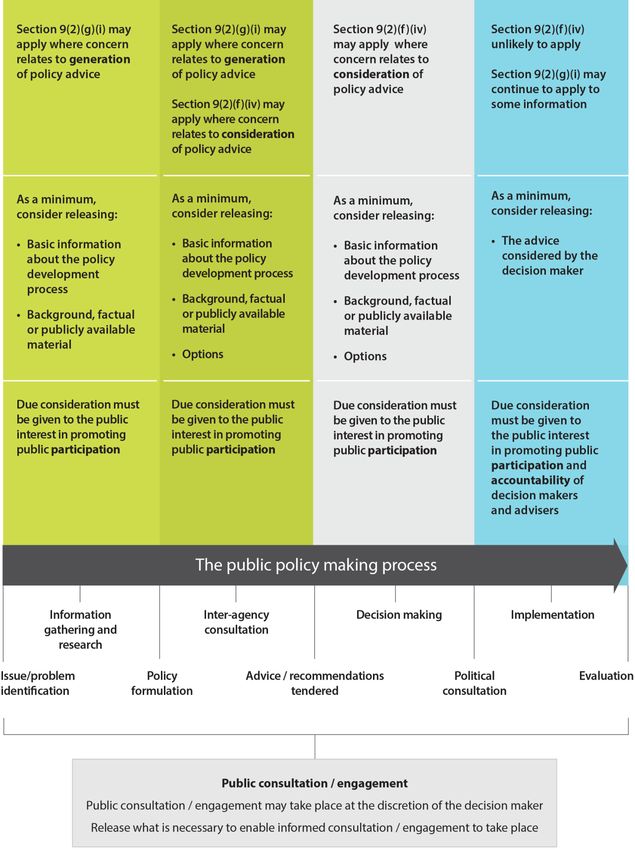
Appendix 1. Visual summary of general principles
You can find a full alternative-text version of this visual summary below.
Guide: The OIA and the public policy making process March 2018 | Page 14Office of the Ombudsman | Tari o te Kaitiaki Mana Tangata
Alternative-text version of visual summary
General notes
This diagram is a visual summary of the general principles discussed on pages 8–11 of this
guide. It is made up of 3 main sections. Each section runs across the width of the page. The first
section is a 4 column table split into 3 rows. Each column is a different colour. The second
section is directly below the first and is a dark grey arrow that represents a continuum (the
arrow runs horizontally across the page, with the arrow-head at the right hand side indicating
progression). Text in the arrow reads ‘The public policy making process’. Directly below this
arrow are the phases in the process marked along the arrow/continuum, from left to right,
with phase 1 on the left and phase 9 at the right hand side of the page. The third section is a
grey box at the bottom of the diagram which has a centre line linking it to the continuum
directly above.
Section 1
Column 1 (light green) covers the early phases: from issue/problem identification, to
information gathering and research, to policy formulation.
Row 1 text: Section 9(2)(g)(i) may apply where concerns relate to the generation of policy
advice.
Row 2 text: As a minimum, agencies should consider releasing:
Basic information about the policy development process
Background, factual or publicly available material.
Row 3 text: Due consideration must be given to the public interest in promoting public
participation.
Column 2 (dark green) covers the next phases: from policy formulation, to inter-agency
consultation, to advice/recommendations tendered.
Row 1 text: Section 9(2)(g)(i) may apply where concerns relate to the generation of policy
advice AND section 9(2)(f)(iv) may apply where concerns relate to the consideration of policy
advice.
Row 2 text: As a minimum, agencies should consider releasing:
Basic information about the policy development process
Background, factual or publicly available material
Options.
Row 3 text: Due consideration must be given to the public interest in promoting public
participation.
Guide: The OIA and the public policy making process March 2018 | Page 15Office of the Ombudsman | Tari o te Kaitiaki Mana Tangata
Column 3 (grey) covers the next phases: from advice/recommendations tendered, to decision
making, to political consultation and negotiation.
Row 1 text: 9(2)(f)(iv) may apply where concerns relate to the consideration of policy advice.
Row 2 text: As a minimum, agencies should consider releasing:
Basic information about the policy development process
Background, factual or publicly available material
Options.
Row 3 text: Due consideration must be given to the public interest in promoting public
participation.
Column 4 (blue) covers the final phases: from political consultation and negotiation, to
implementation, to evaluation.
Row 1 text: Section 9(2)(f)(iv) is unlikely to apply after decisions have been made. 9(2)(g)(i) may
continue to apply to some information.
Row 2 text: As a minimum, agencies should consider releasing the advice considered by the
decision maker.
Row 3 text: Due consideration must be given to the public interest in promoting public
participation and the accountability of decision makers and advisers.
Section 2
The continuum: The following phases are marked along the continuum represented as an
arrow. The text marked out below it reads from left to right: Issue/problem identification;
Information gathering and research; Policy formulation; Inter-agency consultation;
Advice/recommendations tendered; Political consultation and negotiation; Decision making;
Implementation; Evaluation.
Section 3
This grey box is at the bottom of the page, linking to the continuum above. The title reads:
Public consultation/engagement. Text below the title reads: Public consultation / engagement
may take place at the discretion of the decision maker and the line directly below reads
‘Release what is necessary to enable informed consultation/engagement to take place.’
Back to contents
Guide: The OIA and the public policy making process March 2018 | Page 16Office of the Ombudsman | Tari o te Kaitiaki Mana Tangata
Appendix 2. Case studies
These case studies are published under the authority of the Ombudsmen Rules 1989. They set
out an Ombudsman’s view on the facts of a particular case. They should not be taken as
establishing any legal precedent that would bind an Ombudsman in future.
Index
Good reason for withholding
Case Year Subject
number
369357 2014 Ministerial briefings and Cabinet papers on telecommunications
and ultra-fast broadband
Section 9(2)(f)(iv) applied—while some decisions had been made, others
were still required, and disclosure would prejudice the ongoing decision
making process
318858 2011 Information about the Government’s proposed mixed
ownership programme
Sections 9(2)(f)(iv) and 9(2)(g)(i) applied—disclosure of preliminary advice
would prejudice ongoing decision making process and inhibit future
expression of free and frank opinions by officials
293216 2011 Internal discussion paper on privatisation
Section 9(2)(g)(i) applied—disclosure of early internal discussion paper on
sensitive issue would inhibit future expression of free and frank opinions by
officials
175609 2007 Advice relating to Amendment Bill
Section 9(2)(f)(iv) applied—disclosure would prejudice orderly and effective
conduct of political negotiations
285135 2010 Cabinet paper relating to review of the Overseas Investment
Act
Section 9(2)(f)(iv) applied—advisory and decision making processes
ongoing—disclosure would prejudice the orderly and effective conduct of
those processes
285265 2010 Advice and inter-agency consultation relating to Whānau Ora
Sections 9(2)(f)(iv) and 9(2)(g)(i) applied—disclosure while policy advice still
under consideration by Ministers would prejudice ongoing decision making
process—disclosure of inter-agency consultation would inhibit future
expression of free and frank opinions by officials
Guide: The OIA and the public policy making process March 2018 | Page 17Office of the Ombudsman | Tari o te Kaitiaki Mana Tangata
176192 2007 Inter-agency consultation on draft discussion document
Sections 9(2)(f)(iv) and 9(2)(g)(i) applied—disclosure of inter-agency
consultation on draft discussion document would inhibit future expression of
free and frank opinions by officials, and undermine the efficiency of the
consultation process—it would also prejudice Ministers’ ability to consider
advice that would be tendered at the conclusion of the policy process
175799 2007 Advice on electoral finance
Section 9(2)(f)(iv) applied—disclosure while policy advice still under
consideration by Ministers would prejudice ongoing decision making
process—also necessary to withhold connected internal discussion
documents—compare with 176459, advice on electoral finance, after the
introduction of the Electoral Finance Bill
175628 2007 Advice on emissions trading scheme
Section 9(2)(f)(iv) applied—disclosure of preliminary advice would prejudice
ongoing decision making process
173774 2006 Advice and ‘think piece’ on reprioritisation or savings in Vote
Education
Sections 9(2)(f)(iv) and 9(2)(g)(i) applied—disclosure of internal discussion
documents and advice to Ministers would prejudice ongoing decision making
process—disclosure of internal ‘think piece’ would inhibit future expression
of free and frank opinions by officials
W48162 2003 Comments on early draft Cabinet papers
Section 9(2)(g)(i) applied—disclosure of inter-agency consultation would
inhibit future expression of free and frank opinions by officials
W44732 2000 Advice relating to pre-funding of New Zealand Superannuation
W44790
Section 9(2)(f)(iv) applied—disclosure would prejudice orderly and effective
conduct of political negotiations
No good reason for withholding
Case Year Subject
number
328421 2013 Advice concerning partnership schools
Section 9(2)(f)(iv) did not apply—decisions had been made
342796 2012 Advice regarding proposals for the future of Christchurch
education
Section 9(2)(f)(iv) did not apply—decisions had been made—strong public
interest in disclosure to enable informed public consultation
Guide: The OIA and the public policy making process March 2018 | Page 18Office of the Ombudsman | Tari o te Kaitiaki Mana Tangata
309664 2012 Cabinet paper on decision to retain newborn blood spot cards
Section 9(2)(f)(iv) did not apply—decisions had been made—information did
not reveal advice that would subsequently be tendered
288708 2010 Abandoned options, merger of Archives and National Library
Section 9(2)(g)(i) did not apply—release of formal advice to Ministers about
abandoned options after decisions had been made would not inhibit the free
and frank expression of opinions by officials
172541 2008 Options and analysis in the review of New Zealand
Superannuation Portability
Section 9(2)(f)(iv) did not apply to all the information—options released,
analysis withheld—public interest in release of options given protracted
policy process
176459 2008 Advice on electoral finance, after the introduction of the
Electoral Finance Bill
Section 9(2)(f)(iv) did not apply—introduction of Bill constituted discrete end-
point in the policy development process—disclosure would not prejudice
ability of Ministers to consider advice eventually tendered by officials—
compare with 175799, advice on electoral finance
176675 2008 Abandoned options, South Auckland primary teacher supply
Section 9(2)(f)(iv) did not apply—decisions had been made—disclosure of
abandoned options posed no risk
177645 2008 Information relating to appointment of an honorary consul in
Monaco
Section 9(2)(f)(iv) did not apply—confidentiality can diminish over time
174609 2007 Ministerial briefing on citizenship review
Section 9(2)(f)(iv) did not apply to background / factual information
175435 2007 Advice on daylight savings and the 2011 Rugby World Cup
Section 9(2)(f)(iv) did not apply to protect the fact that the matter was under
consideration
Guide: The OIA and the public policy making process March 2018 | Page 19Office of the Ombudsman | Tari o te Kaitiaki Mana Tangata
Good reason for withholding
Case 369357 (2014)—Ministerial briefings and Cabinet papers on
telecommunications and ultra-fast broadband
A request for information about telecommunications and ultra-fast broadband was
refused under a number of grounds, and the requester complained to the Chief
Ombudsman.
The information at issue included partially redacted ministerial briefings and Cabinet
papers. Although these papers had been considered, and a decision made to bring
forward a review of the regulatory framework, the Ombudsman accepted it was still
necessary to withhold parts of them under section 9(2)(f)(iv). The decision to bring
forward a review of the regulatory framework was not the culmination of a discrete
policy process that had been completed. The review of the regulatory framework had yet
to be completed, and the Commerce Commission was also yet to report back on related
matters. These ongoing processes may have given rise to a need to revisit the advice that
had been tendered previously. It was therefore necessary to withhold the parts of the
papers in respect of which additional work was underway, and further advice would be
tendered. Disclosure of the earlier advice would prejudice the ability of Ministers and
Cabinet to consider the related advice that would be tendered in future.
It was also necessary to withhold some advice in the papers in order to maintain the
expression of free and frank opinion that is integral to a robust policy process (section
9(2)(g)(i)). The opinions were expressed in an area where final decisions had not been
made. In particular, some of the advice was conveyed to the Minister in an informal
manner to provide her with a quick, rough cut analysis in advance of expected
announcements by the Commerce Commission. The ability of officials to generate fast
reactive advice is essential for the effective conduct of public affairs.
Back to index.
Cases 318858, 319224 and 319684 (2011)—Information about the Government’s
proposed mixed ownership programme
In the run-up to the 2011 general election the National Government announced its
commitment to pursue a ‘mixed ownership model’ in relation to certain state-owned
assets. In essence, this meant partial privatisation of four state-owned energy
companies, and a reduction in the Crown’s holdings in Air New Zealand. The Treasury
was tasked with undertaking some preliminary work. The media and opposition MPs
sought information about this work, and complained to the Chief Ombudsman when
their requests were partially refused under sections 9(2)(f)(iv) and 9(2)(g)(i). The
information at issue included ministerial reports and discussion papers.
The Chief Ombudsman considered the content and context of the information at issue:
It comprises early advice on two of the many aspects under consideration: encouraging
New Zealand participation and limiting foreign ownership. It is in the nature of possible
Guide: The OIA and the public policy making process March 2018 | Page 20Office of the Ombudsman | Tari o te Kaitiaki Mana Tangata
options for consideration, rather than detailed advice and recommendations as to action.
Any detailed advice and recommendations as to action will come after the election, once
the preparatory work, including detailed scoping studies, is complete. Seen in this context,
the information at issue may be characterised as limited in scope, as well as partial and
incomplete. Treasury submitted that release would create pressure to design and
structure a sales programme based on one or two narrow aspects, rather than what
would be the best design and structure for the Crown and investors taking into account all
relevant aspects.
She accepted that release of the information at issue at this stage of the process would
be premature and undermine the orderly and effective conduct of that process.
The risk was heightened by the ‘complicated and dynamic’ nature of the advisory
process:
There are a number of aspects to the potential sales programme that need to be
considered (e.g. sequencing, estimated proceeds, offer instrument, offer structure,
governance, ownership, scale of sell-down, selling syndicate structure, maximising
investor participation, marketing and communications, programme management and risk
monitoring). These aspects are interrelated, so that advice developed on one aspect may
cause earlier advice on another aspect to be reconsidered. Advice may also need to be
revisited to take account of changing market conditions.
It was also heightened by the potentially adverse economic impact of premature release
of the information:
...there is a genuine and valid concern that release of information that commits Ministers
too early in the process to particular design elements, or creates expectations about the
use of such elements, will detrimentally affect investor participation, and therefore the
level of return to the Crown. Given that the estimated level of return is between $5 and $7
billion, the potential economic impact could be significant.
The Chief Ombudsman accepted that the economic stakes were such that if the
information were disclosed, officials would re- think the manner in which they provided
advice to Ministers on the programme on an ongoing basis. In the context where release
of official information could have potentially affected the success of the offers and the
level of return to the Crown, she accepted that officials were likely to feel inhibited in
generating, expressing and recording their opinions, and that a degree of protection at
that stage of the process was required so that this particular harm did not eventuate.
The Chief Ombudsman concluded that the information at issue needed to remain
confidential at that particular stage of the policy development process in order to protect
the interests specified in sections 9(2)(f)(iv) and 9(2)(g)(i). The need to withhold was not
outweighed by the public interest in release (this case is also discussed in our public
interest guide). You can read the Chief Ombudsman’s full opinion here.
Back to index.
Guide: The OIA and the public policy making process March 2018 | Page 21Office of the Ombudsman | Tari o te Kaitiaki Mana Tangata
Case 293216 (2011)—Internal discussion paper on privatisation
In 2010, the Treasury Secretary appeared on Q+A. In reply to a question about internal
papers prepared by the Treasury on privatisation of state assets, he replied:
Well one of the things I asked my staff some time ago, is to really think about what are
some of the arguments that people advance against privatisation, because New Zealand's
a bit unusual. Most countries overseas that's not particularly controversial nowadays, it is
here, and we want to get a better understanding of what it is that people are worried
about in privatisation.
A request was made for ‘the reports produced by The Treasury on “the arguments that
people advance against privatisation”’. The requester complained to the Chief
Ombudsman when it was refused under section 9(2)(g)(i) of the OIA.
The information at issue was two drafts of an internal discussion paper commissioned by
the Treasury’s Executive Leadership Team. The drafts were discussed at an internal policy
forum and no further work was undertaken. The Treasury clarified that the Government
had sought no advice on this issue, and none had been provided. It argued that disclosing
this kind of background work would prejudice its ability to undertake self-initiated
internal dialogues, especially in the case of sensitive policy issues. It said it was critical for
the Treasury to be able to do background work on a range of topics before Ministers ask
for advice. This enables it to ensure the advice ultimately tendered is robust, and that it
can respond to requests for advice quickly and efficiently.
The Chief Ombudsman accepted that section 9(2)(g)(i) of the OIA applied to the
information. In her words:
This provision recognises that some processes will need to be carried out without public
scrutiny with the rationale being that the opportunity to express opinions in a free and
frank manner will ultimately result in better decisions.
It was important that the Treasury had the confidence to explore its initial thinking on
the important issue of privatisation in a candid way. Confidentiality was needed to
induce the degree of free and frank opinion required during this process to place the
Treasury in a position to best advise the Government if and when it decided to have such
a discussion.
The Chief Ombudsman concluded that the public interest in disclosure of this early work
did not outweigh the need to withhold it. However, if and when the Government actually
sought advice on privatisation, the balance between the public interest favouring
disclosure and the need to withhold under 9(2)(g)(i) may change, and a fresh assessment
would be necessary.
Back to index.
Guide: The OIA and the public policy making process March 2018 | Page 22Office of the Ombudsman | Tari o te Kaitiaki Mana Tangata
Case 175609 (2007)—Advice relating to Amendment Bill
A requester sought information relating to the Births, Deaths and Marriages Registration
Amendment Bill (the Amendment Bill), and complained to the Ombudsman when that
request was refused under section 9(2)(f)(iv). The information at issue included
ministerial briefings and Cabinet papers on the Amendment Bill.
The request was made at the time that Cabinet had approved the legislative proposals in
principle. However, there were still key steps to be taken before the Bill could be
introduced to the House, including drafting, approval by the Cabinet Legislation
Committee and Cabinet of the draft Bill for introduction, and consultation within caucus
and with coalition and support parties. The proposed legislation remained subject to
negotiation and potential change, and any change required as a result of that process
may have necessitated further consideration and approval by the Cabinet Legislation
Committee, Cabinet, and caucus.
The Ombudsman concluded that withholding was necessary in this context in order to
maintain the constitutional convention protecting the confidentiality of advice.
Confidentiality was required in order to protect the executive government’s ability to
develop and negotiate political support for the draft legislation, in a timely and orderly
fashion.
The Ombudsman accepted that there was a convention that draft legislation and
associated advice would remain confidential until that legislation was introduced to the
House, subject of course to an assessment of the countervailing public interest
considerations favouring disclosure of such information under section 9(1) of the OIA.
This was supported by paragraph 7.44 of the Cabinet Manual (2008), which stated:
At every stage of its development, draft legislation is confidential and must not be
disclosed to individuals or organisations outside government, except in accordance with
the Official Information Act or Cabinet approved consultation procedures. Any such
release or disclosure must first have the approval of the Minister concerned. Premature
disclosure of the contents of a draft Bill could embarrass the Minister, and imply that the
prerogative of Parliament is being usurped. Cabinet, government caucus(es) and
Parliament must always retain the freedom to amend, delay or reject a Bill.
The Ombudsman made clear that she was not concerned about the potential for
Ministerial embarrassment. Her view was based on the fact that ‘the Government of the
day must assume responsibility for assessing changes in the political, economic and social
environment and for determining whether adjustments to the law are needed in response
to those changes’.6 The process of developing and negotiating political support for draft
legislation may, in the circumstances of a particular case, be unduly impeded by
premature disclosure of advice concerning the proposed content and operation of that
legislation. Ministers would be called upon to justify and debate legislative proposals that
6 Legislation Advisory Committee Guidelines on Process and Content of Legislation, 2001 Edition (now
superseded by 2014 Edition), page 9.
Guide: The OIA and the public policy making process March 2018 | Page 23Office of the Ombudsman | Tari o te Kaitiaki Mana Tangata
were still in development and subject to change. This in turn would divert ministerial
attention from the core process of developing the legislation to the stage where it was fit
for introduction to the House, and had sufficient political support to proceed.
For these reasons, the Ombudsman accepted the Minister’s submission that ‘releasing
information on the development of the Bill at this stage could potentially undermine the
policy and legislative development process’.
The Ombudsman acknowledged the public interest in enabling public participation in the
making and administration of laws. However, she was not persuaded that this
consideration outweighed the need to withhold the information at the time that decision
was taken.
There are opportunities for public participation in the legislative process once draft
legislation has been introduced to Parliament. Select committee consideration allows
members of the House, interest groups, and the general public to examine and have
input into draft legislation before it passes into law. Select committees may recommend
amendments to the House that are relevant to the subject matter and consistent with
the principles and objects of the Bill as introduced. The Ombudsman also noted that
papers relating to the Amendment Bill were to be published on the Department of
Internal Affairs’ website following the Bill’s introduction.
Back to index.
Case 285135 (2010)—Cabinet paper relating to review of the Overseas Investment
Act
The Minister of Finance refused a request for all recent Cabinet papers on a review of the
Overseas Investment Act, and the requester complained to the Chief Ombudsman.
The information at issue was a paper and attached draft policy document that had been
considered by the Cabinet Economic Growth and Infrastructure Committee. Following
consideration of the papers, the Cabinet Committee decided that further analysis of the
overseas investment regime and any proposed amendments to that regime was
required. The Treasury was engaged in further policy work, at the completion of which a
further paper would be referred to Cabinet.
The Chief Ombudsman was satisfied, given the contentious nature of the issue of
overseas investment in New Zealand, that disclosure of the information at issue would
have prejudiced the ability of Cabinet to give undisturbed consideration to the advice
tendered. Not all relevant advice was completed and to hand, which would have put
Ministers at an unfair disadvantage in terms of adequately explaining publicly the issues
that would likely stem from any disclosure.
The Chief Ombudsman acknowledged the public interest in disclosure of information
related to the review of the Overseas Investment Act, but concluded the overall public
interest would not be served by the disclosure of information that would undermine the
ability of the Cabinet to receive and consider, in confidence, advice relating to the
Guide: The OIA and the public policy making process March 2018 | Page 24Office of the Ombudsman | Tari o te Kaitiaki Mana Tangata
review. In coming to this view, she had regard to the expectation that the policy advice
relating to the review would be disclosed once decisions had been made, and that the
public would have an opportunity to make submissions on any changes requiring
legislative amendment through the Select Committee process.
Back to index.
Case 285265 (2010)—Advice and inter-agency consultation relating to Whānau
Ora
A requester sought ‘copies of all Cabinet papers, advice, briefings and correspondence on
the development of the Whānau Ora policy’ over a period of one month. She complained
when her request was refused on a number of grounds. The Chief Ombudsman formed
the opinion that section 9(2)(g)(i) applied to exchanges between officials drafting the
policy, and section 9(2)(f)(iv) applied to the advice tendered to Ministers. There were,
she said, two elements of the policy development process that required protection.
First, some of the information at issue comprised free and frank discussion between
officials and to Ministers about certain issues relating to the policy development process.
The Chief Ombudsman was satisfied that it was necessary to withhold this information to
protect the ability of officials to engage in this type of debate as part of the process of
developing robust policy. It seemed to her that, if these particular communications were
to be released, officials would indeed feel inhibited in the future from discussing each
other’s work or positions, or critiquing the views advanced by others, in a free and frank
way; something which is crucial to the quality and robustness of the final shape of the
policy in question (section 9(2)(g)(i) refers).
Second, it was clear that Whānau Ora was a significant policy development process,
involving a number of Ministers and a range of different government agencies. The policy
development process involved a number of different streams of advice from government
agencies regarding the finer details and shape of the policy. When the request was
refused, decisions regarding certain aspects of the policy had been made but a number
of further decisions regarding fairly fundamental aspects of the final shape of the policy
still had to be made.
Given the scale of the policy development process; the range of policy options to be
considered; and the fact that decisions regarding certain elements of the policy had not
been made, the Chief Ombudsman was satisfied that it was necessary to withhold the
information at issue in order to allow undisturbed ministerial consideration of the
different options available before decisions were made on the final shape of the policy.
She was not persuaded that the public interest considerations favouring the disclosure of
this information outweighed the interests in favour of withholding it. In her opinion,
disclosure of the information, in a piece-meal fashion, prior to decisions being taken on
the final shape of the policy, would not have served to promote the overall public
interest.
The Chief Ombudsman also noted that the Taskforce’s final report had since been
Guide: The OIA and the public policy making process March 2018 | Page 25You can also read


