THE OPEN SOURCE NETWORK - Linux Foundation Events
←
→
Page content transcription
If your browser does not render page correctly, please read the page content below
THE OPEN SOURCE NETWORK

                          1
FRINX – THE OPEN SOURCE NETWORK

FRINX VISION STATEMENT

  “Deliver real and sustainable productivity gain
   by automating processes required to build,
  operate and grow communication networks.”

                                                    2
NETWORK PROVISIONING SOLUTION WITH FRINX ODL

FRINX TYPICAL USE CASES
•   Overall Network Device Automation, including but not limited to
         •   LACP link bundles
         •   BGP peering services
         •   Business internet
         •   EVPN
         •   L2VPN (VLL, VPLS)
         •   L3VPN
         •   LLDP topology collection services
         •   DOCSIS
         •   Amazon VPCs & Direct connect (interface & peering)
•   Network Inventory and Change Management
         •   Network inventory (heterogeneous platform data transformed to common data model)
         •   Operating software management
         •   Device configuration
•   Workflow management;
         •   Network devices
         •   Customer care tools
         •   Subscriber provisioning tools
         •   Billing systems
                                                                                                3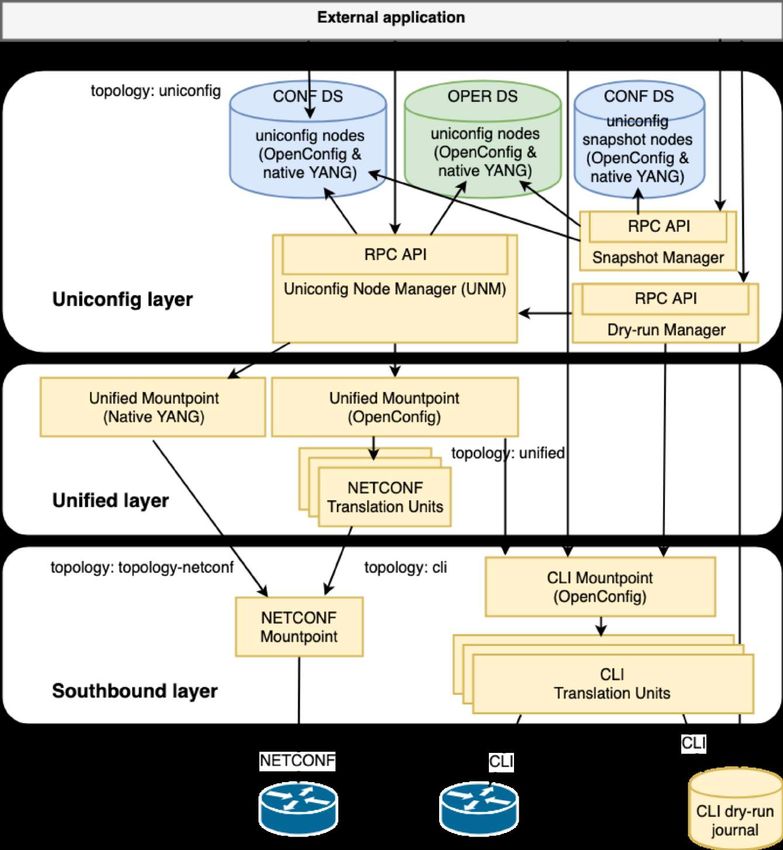
FRINX – THE OPEN SOURCE NETWORK

FRINX STRATEGY
• Develop a controller and agent to connect to customer network devices and provide an
  upstream network API for our customers.
• Use cloud native software architectures to provide workflow and inventory solutions that
  control one or many customers network APIs.
• Develop a thriving community to grow our open source device library supporting all device
  vendors.
• Partner with industry leaders to deliver a multi-tenant, massively scalable cloud based
  platform for communications and connectivity service providers.

                                                                                              4
FRINX – THE OPEN SOURCE NETWORK

CODE THAT WE WORK ON
• FRINX UniConfig, with FRINX ODL (for controllers) and Lighty.io (for agents) and deploy with
  large multi-national customers
• FRINX Open Source device library
• FRINX Machine, a cloud native workflow product based on Netflix Conductor and
  Elasticsearch
• FRINX contributions to the ODL project (NETCONF, GBP)

                                                                                                 5
FRINX UNICONFIG

                  6
FRINX UNICONFIG ECOSYSTEM

                                                                         Go and Python client libraries
                                                                            generated by Swagger

                                                                                     RESTconf or
                                 FRINX UniConfig Layer                                NETCONF
                                 UniConfig Node Manager

                                  FRINX Unified Layer

                                   Southbound Layer

                       NETCONF                            SSH / Telnet

                                                                                CLI, NETCONF ...
Multivendor networks
FRINX UNICONFIG NETWORK AUTOMATION

                                                                             Unstructured data
               Any vendor YANG model

    YANG

                                                                                                    RESTconf or
                                              FRINX UniConfig Layer                                  NETCONF
                                              UniConfig Node Manager

                   UniConfig                       FRINX Unified Layer
                    Native     Translation Units                         Translation Units

                                  NETCONF                                      CLI

                                                   Southbound Layer

                               NETCONF                                   SSH / Telnet

                                                                                                 CLI, NETCONF ...
Multivendor networks
FRINX MACHINE - NETWORK AUTOMATION

                                                                                            REST Service &
                                                                                            Workflow APIs
                                         FRINX Workflow & Inventory

                                                                                                RESTconf or
                                             FRINX UniConfig Layer                               NETCONF
                                             UniConfig Node Manager

                  UniConfig                       FRINX Unified Layer
                   Native     Translation Units                         Translation Units

                                 NETCONF                                      CLI

                                                  Southbound Layer

                              NETCONF                                   SSH / Telnet

                                                                                             CLI, NETCONF ...
Multivendor networks
FRINX UniConfig
Open Source Device Library

                             10
OPEN SOURCE DEVICE LIBRARY
OSS DEVICE LIBRARY
• Support for stateful translation between CLI (semi-unstructured data) and YANG models
• CLI models are sequence aware. UniConfig service graph is implemented in Create, Read,
Update & Delete operations for CLI configs. Required for rollback logic.
• Support for stateful translation between YANG models (e.g. private YANG models translated
into OpenConfig and back)
• Stateful means that device configuration is stored in structured format (YANG) in
operational and config data stores. This enables UniConfig operations (sync-from-network,
diff between config and operational, commit to network, rollback & snapshots) on all device
configurations that are mounted in UniConfig.
• Scales up to thousands of devices per controller (with 1000s of lines of config per device)
11FRINX UniConfig
UniConfig Native
12UNICONFIG NATIVE
UNICONFIG NATIVE
• Read and write to and from devices using their native YANG data models (e.g. Cisco YANG
models, JunOS Yang models, CableLabs YANG models …)
• Use the same features on native YANG models as with regular UniConfig OpenConfig models
(e.g. sync-from-network, commit, checked-commit, calculate-diff, replace-config-with-
operational, rollback, create and load snapshots)
• Works along side UniConfig (some devices can be mounted as UniConfig native, while some
devices can be mounted as UniConfig at the same time)
• Available starting with the FRINX ODL 4.2.0 release (April 2019)
• Loading and transformation of YANG models from devices happens on-the-fly. No pre-
compilation required.
• Tested scale data point: 1120 devices with 4700 lines of configuration per device, require 3GB
of heap
13FRINX UniConfig
FRINX SOLUTIONS
14FRINX UNICONFIG FRAMEWORK
FRINX UniConfig Framework – A Layered
Architecture
FRINX ODL service components uses layered design where functionality of
upper layers depends on the functionality of the layer underneath. Each layer
thus provides a higher level of abstraction from the network elements.
Applications are allowed to utilize any of the layers in the system.
There are 3 main layers represented by these components (from top to
bottom):
• Uniconfig layer
• Unified layer
• Southbound layer (NETCONF mountpoint, CLI mountpoint with
translation units)
The Datastore is a component in ODL which stores structured data described
by YANG models. There are two separate Datastores:
• Config datastore (CONF DS) - contains intended state (intended device
configuration). This datastore is persistent and external (outside ODL)
applications have read/write access.
• Operational datastore (OPER DS) - contains actual state (actual device
configuration). OPER DS is not persistent and external applications have
read only access.
Mountpoints in ODL represent communication interfaces with an external
& Native Vendor YANG Models 15
system. Mountpoints are usually registered under a node in a topology.FRINX UNICONFIG & UNICONFIG NATIVE
Business application using UniConfig
Device abstraction provides API to create, read, update
and delete device configurations in common
OpenConfig Format. Config data store contains
intended configurations of all network devices, while
operational data store contains all current
configurations. Network transaction capabilities provide
commit, snapshot and rollback functions across one or
multiple devices.
Unified layer provides the ability to combine devices
connected with different transport protocols and different
models into one common representation. Includes open
source device library (YANG YANG) and the ability to
interact with vendor YANG models (UniConfig native)
Southbound layer provides connectivity to devices via
multiple protocols (NETCONF, SSH, Telnet, …). Includes
open source device library (YANG CLI)
& Native Vendor YANG Models 16UNICONFIG REMOTE PROCEDURE CALLS
OPERATIONS
• UniConfig Manager • Snapshot Manager
• sync-from-network • create-snapshot
• commit • delete-snapshot
• checked-commit • replace-config-with-snapshot
• calculate-diff
• replace-config-with-
operational
• Dry-run Manager
• dry-run – works only with CLI
nodes
17Machine
18FRINX MACHINE - NETWORK AUTOMATION
REST Service &
Workflow APIs
Workflow & Inventory
RESTconf or
FRINX UniConfig Layer NETCONF
UniConfig Node Manager
UniConfig FRINX Unified Layer
Native Translation Units Translation Units
NETCONF CLI
Southbound Layer
NETCONF SSH / Telnet
CLI, NETCONF ...
Multivendor networksFRINX MACHINE - NETWORK AUTOMATION
REST Service &
Workflow APIs
Workflow & Inventory
RESTconf or
FRINX UniConfig Layer NETCONF
UniConfig Node Manager
UniCo
nfig
FRINX Unified Layer !-services
Native Translation Translation Units
Units
CLI
NETCONF
Southbound Layer
NETCONF SSH / Telnet
Stateful Stateless
CLI, NETCONF ...
Multivendor networksFRINX MACHINE – COMPONENTS
Inventory UI Workflow UI UniConfig UI User Interface
REST API
Other Systems
(e.g. IPAM, Conductor Server Micro services
JBPM, CRM, (workflow
Conductorgraphs)
Server
Conductor Server
NetInfra
(taskmicro
logic)services
NetInfra micro services Execution Logic
Ticketing,
Legacy DB, …)
REST API
Elasticsearch FRINX ODL
REDIS / Dynomite FRINX ODL
(Inventory,
Elasticsearch (workflow
REDIS / Dynomite
state)
Infra services
Infra services
FRINX
Distribution
UniConfig
Distribution State and/or
timeElasticsearch
series data) REDIS / Dynomite Infra services (includes
(includes
UniConfig)
Transformation
UniConfig)
Inventory Workflow Infrastructure ControlFRINX NETWORK AUTOMATION Key Solution Tenets • Use existing solutions wherever available (OpenDaylight, Elasticsearch, Conductor, Ansible, Terraform, …) • Provide stateful and stateless interaction with network infrastructure • Provide a framework for components and how they interact • Provide out-of-the-box workflows & services • Provide open source device library • Provide customer access to all source code • Provide solution support for enterprises and operators • FRINX Machine fits in 6 GB RAM / 30GB disk and installs and starts in a few minutes
FRINX MACHINE
   User Interface

                    23
FRINX Workflow UI
• Users can build on a library of workflows
that ship with FRINX Machine to create
their own automation workflows.
• Workflows can be started via REST
interface or GUI.
• Workflows can be created without
writing code
• Workflows can integrate with other
systems (Ticketing, E-mail, Slack, …)
24FRINX Workflow UI
FRINX MACHINE UIFRINX Workflow UI
FRINX Machine Workflows – Edit Workflow
FRINX Machine Workflows – Edit Workflow
FRINX Machine Workflows – Detailed Execution Information
FRINX Workflow UI provides detailed task information
(input and output data per task, failure reason, time stats)

                                                               30
FRINX Workflow UI provides detailed stats about task and
workflow execution and status
31FRINX Inventory UI
32FRINX UniConfig Console
33For more details about Frinx please
contact frinx@frinx.io
© 2019 frinx.io 34You can also read


