TOGGLe, a flexible framework for easily building complex workflows and performing robust large-scale NGS analyses - bioRxiv
←
→
Page content transcription
If your browser does not render page correctly, please read the page content below
bioRxiv preprint first posted online Jan. 10, 2018; doi: http://dx.doi.org/10.1101/245480. The copyright holder for this preprint
                                           “toggle” —who
  (which was not peer-reviewed) is the author/funder,      2018/1/9     — bioRxiv
                                                              has granted    14:37 a—    pageto1display
                                                                                     license      — #1  the preprint in perpetuity.
                               It is made available under a CC-BY-NC-ND 4.0 International license.

Published online -

TOGGLe, a flexible framework for easily building complex
workflows and performing robust large-scale NGS analyses
Christine Tranchant-Dubreuil 1,6,∗ , Sébastien Ravel 2,6 , Cécile Monat 1,6,† , Gautier Sarah 3,6 , Abdoulaye
Diallo 1,‡ , Laura Helou 1 , Alexis Dereeper 5,6 , Ndomassi Tando 1,6 , Julie Orjuela-Bouniol 4 , and François
Sabot 1,6,∗∗
1 DIADE   IRD, University of Montpellier, 911 Avenue Agropolis, 34934 Montpellier Cedex 5, France 2 BGPI CIRAD, INRA,
TA A-54/K, Campus International de Baillarguet,34398 Montpellier Cedex 5,France 3 AGAP CIRAD, INRA, SupAgro, TA
A-108/03, 1000 Avenue Agropolis, 34398 Montpellier Cedex 5, France 4 ADNid-QualTech, 830 Avenue du campus
agropolis Baillarguet, 34980 Montferrier-sur-Lez, France 5 IPME IRD, University of Montpellier, 911 Avenue Agropolis,
34934 Montpellier Cedex 5, France 6 South Green Bioinformatics Platform, BIOVERSITY,CIRAD,INRA,IRD,SupAgro,
Montpellier, France
† Present address: IPK Leibniz Institute of Plant Genetics and Crop Plant Research (IPK) Gatersleben, Seeland, Germany
‡ Present address: SEQONE, 80 avenue Augustin Fliche, IRMB - CHRU SAINT-ELOI, 34090 Montpellier, France

ABSTRACT                                                                          INTRODUCTION
The advent of NGS has intensified the need for robust                             Advances in Next-Generation Sequencing (NGS)
pipelines to perform high-performance automated analyses.                         technologies have provided a cost-effective approach to
The required softwares depend on the sequencing method                            unravel many biological questions, and revolutionized our
used to produce raw data (e.g. Whole genome sequencing,                           understanding of Biology. Nowadays, any laboratories can
                                                                                  be involved in large-scale sequencing projects, delivering
Genotyping By Sequencing, RNASeq) as well as the kind                             astonishing volumes of sequence data. Although NGS are
of analyses to carry on (GWAS, population structure,                              powerful technologies, they have produced a paradigm shift
differential expression). These tools have to be generic and                      from data acquisition to data management, storage and in
scalable, and should meet the biologists needs.                                   fine biological analyses. This has intensified the need for
   Here, we present the new version of TOGGLe (Toolbox                            robust and easy-to-use pipelines to perform high-performance
for Generic NGS Analyses), a simple and highly flexible                           automated analyses. However, most pipelines depend on the
framework to easily and quickly generate pipelines for large-                     sequencing method used to generate raw data and on the type
scale second- and third-generation sequencing analyses,                           of analyses to perform (variant calling, GWAS, differential
including multi-threading support. TOGGLe comprises a                             gene expression,...) (1, 2, 3, 4).
workflow manager designed to be as effortless as possible                            To enable processing of large datasets, numerous pipelines
                                                                                  frameworks are available, either web-based or command-lines
to use for biologists, so the focus can remain on the
                                                                                  based. The formers, Galaxy (5, 6) or Taverna (7) for instance,
analyses. Embedded pipelines are easily customizable and                          can be easily understood by lab biologists as it is accessible
supported analyses are reproducible and shareable. TOGGLe                         via a graphical interface. Accessible to non-programmers, they
is designed as a generic, adaptable and fast evolutive                            allow adding additional workflows, picking up various pre-
solution, and has been tested and used in large-scale                             packed software, but with limited access to their options. In
projects with numerous samples and organisms. It is freely                        addition, managing more than a dozen of samples, or having
available at http://toggle.southgreen.fr/ under the GNU                           access to different versions of the same software, are not
GPLv3/CeCill-C licenses) and can be deployed onto HPC                             possible without having a high-level access level to the host
clusters as well as on local machines.                                            servers. Thus, they are generally used for small-scale analyses,
                                                                                  prototyping or training (8). The second type of frameworks
                                                                                  such as Snakemake (9), Bpipe (10), Ruffus (11), ClusterFlow
Keywords                                                                          (12) targets programmers and expert users. Many of theses
                                                                                  tools rely on non-standard, adapted programming languages
Data-intensive analysis, Workflow manager, NGS                                    (e.g. derived either from Python, Bash or Make). Even if
pipeline, parallel computing, high-performance computing,                         bioinformaticians can write complex pipelines using those
reproducible research                                                             frameworks, they require high-level skills in programming and
                                                                                  are not suitable for lab biologists.

∗ To   whom correspondence should be addressed. Email: christine.tranchant@ird.fr francois.sabot@ird.fr

c 2017 The Author(s)
This is an Open Access article distributed under the terms of the Creative Commons Attribution Non-Commercial License (http://creativecommons.org/licenses/
by-nc/2.0/uk/) which permits unrestricted non-commercial use, distribution, and reproduction in any medium, provided the original work is properly cited.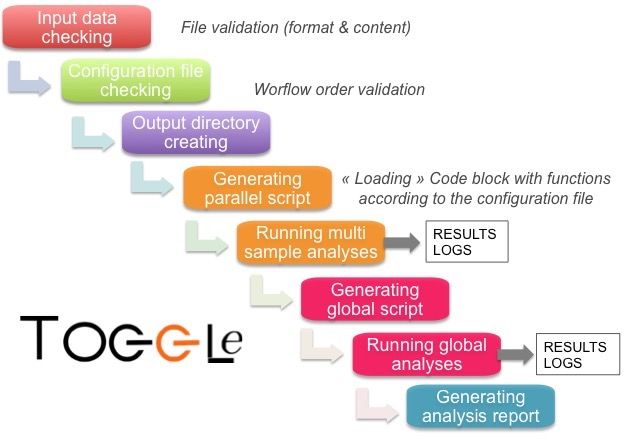
bioRxiv preprint first posted online Jan. 10, 2018; doi: http://dx.doi.org/10.1101/245480. The copyright holder for this preprint
                                              “toggle” —who
     (which was not peer-reviewed) is the author/funder,      2018/1/9     — bioRxiv
                                                                 has granted    14:37 a—    pageto2display
                                                                                        license      — #2  the preprint in perpetuity.
                                  It is made available under a CC-BY-NC-ND 4.0 International license.

2

   TOGGLe (Toolbox for Generic NGS Analyses) is an                            consists of the step number followed by an equal sign then by
alternate solution mixing advantages from the two kinds                       the software’s name (e.g. 1=FastQC).
of workflow managers, offering a robust and scalable                             If the step number is lower than 1000, the analysis step
bioinformatic framework for a wide range of NGS                               is carried out for each sample separately, while the step is
applications. Compared to the previous version (version 2                     performed as a global analysis with the results of all the
(13)), the current TOGGLe (version 3) is a framework                          samples for a value higher or equal to 1000 (see Figure 2 and
based on command-line, and no more hard-coded pipelines,                      3).
targeting both biologists and bioinformaticians. Workflows are
now designed through a simple text file specified by the user.                Providing software parameters and external tools usage The
TOGGLe is also highly flexible on the data type, working on                   syntax for setting software parameters is identical to that
sequencing raw data (Illumina, 454 or Pacific Biosciences),                   used by each software using the command line. Indeed, these
as well as on various other formats (e.g. SAM, BAM, VCF).                     parameters can be provided after the line composed of the
Carrying out analyses does not require any programming                        symbol $ followed by the software name (also called tag line;
skills, but only basic Linux ones. With TOGGLe, scientists                    see Figure 2). If no software parameter is provided, the default
can create robust, customizable, reproducible and complex                     ones are used. TOGGLe will handle itself the input and output
pipelines, through an user-friendly approach, specifying the                  files as well as the references (if needed).
software versions as well as parameters. It thus offers access                   The user can also use a software not included in TOGGLe
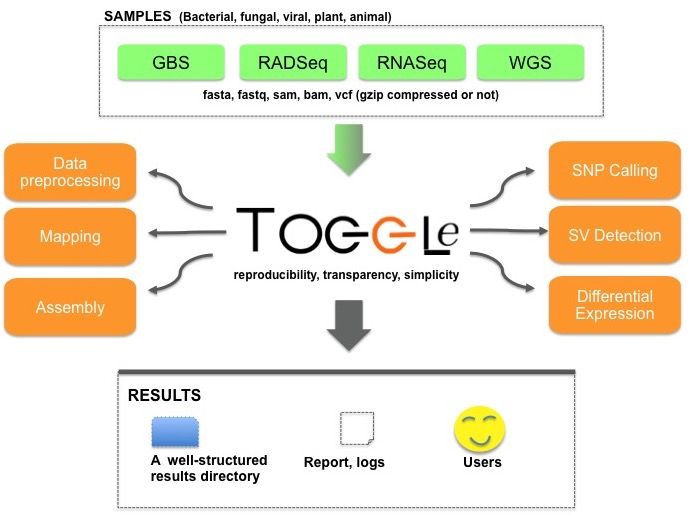
to a vast landscape of external bioinformatics software (Figure               with the generic tag followed by the command-line.
1).
                                                                              Compressing or removing intermediate data Analyses
DESIGN AND IMPLEMENTATION                                                     generating a large amount of data, we included the possibility
                                                                              to gzip compress or to remove some intermediate data
Input data formats and Sample IDs                                             ($compress and $cleaner tags), as specified by the user in the
There is no limit to the number of input files, as soon as all the            configuration file (see manual).
data are in the same unique directory and of the same format.
Input data format can be either FASTA, FASTQ (paired-                         Setting jobs scheduler When analyzing large amounts of
end, single-end and mate-pair; second- and third-generation),                 samples, TOGGLe workflows support parallel processing
SAM, BAM, BED or VCF, either plain or compressed (i.e.                        on high performance computing (HPC) systems. They run
gzip).                                                                        seamlessly on a workstation or clusters with either LSF,
  Sample IDs and read groups are automatically generated                      MPRUN, SLURM or SGE jobs schedulers. When the
by TOGGLe using the file read name, and no dedicated                          configuration file contains a tag composed of the symbol $
nomenclature or external sample declaration is needed. For                    followed by one of the jobs scheduler name cited above,
pair-end/mate-pair FASTQ data, no specific name or directory                  TOGGLe pipelines will be submitted as background parallel
organization is required for pairs to be recognized as such.                  jobs; otherwise they will run in ”local” linear mode. The
                                                                              parameters provided through the configuration file (i.e. queue
Running a TOGGLe pipeline                                                     name, number of processors allocated) will be transmitted
                                                                              to the job submission scheduler. The jobs (one per sample)
TOGGLe workflows can be launch from start-to-end with a                       will be submitted as bash scripts automatically generated.
single command-line, with three mandatory arguments:                          In addition, the $env tag can be used to provide specific
    1. the input directory containing files to analyze,                       environment variables to be transferred to the scheduler via
    2. the output directory that will contains files generated by             these bash scripts (such as the paths or modules to be
        TOGGLe,                                                               loaded). Finally, node data transfer is automatically managed
    3. the configuration file.                                                by TOGGLe when requested by user ($scp tag).
   According to the workflow (e.g. a mapping step of reads
upon a reference), a transcriptome or genome reference
sequence (FASTA), an annotation file (GFF or GTF) or a key                    Workflows Management
file (for demultiplexing) must be also provided.                              The core of TOGGLe is the toggleGenerator.pl script which (i)
                                                                              parses the configuration file, (ii) generates the pipeline scripts,
Configuration file                                                            and then (iii) executes them as parallel or global analyses
                                                                              (see Figure 4). Basically, toggleGenerator.pl compiles blocks
The configuration file plays a central role in TOGGLe, by                     of code (themselves allowing the launching of the different
enabling users to generate highly flexible and customizable                   tools) to create the requested pipeline. It allows the developer
workflows in a simple way. Indeed, this basic text file is                    to easily add any new tool without having to modify the main
composed of different parts allowing to build the workflow,                   code.
to provide software parameters, to compress or remove
intermediate data, and to set up a scheduler if needed (Figure
2).                                                                           Platforms, Installation and Customization
                                                                              TOGGLe currently runs on any recent GNU/Linux system
Building Workflow Steps composing the pipeline (e.g.                          (Debian Lenny and more, Ubuntu 12.04 and more, and
aligning reads upon a reference genome, calling variants) and                 CentOS 6 and more were tested). TOGGLe was developed
their relative order are defined after the $order tag. Each line              to be straightforward to install in several ways : manually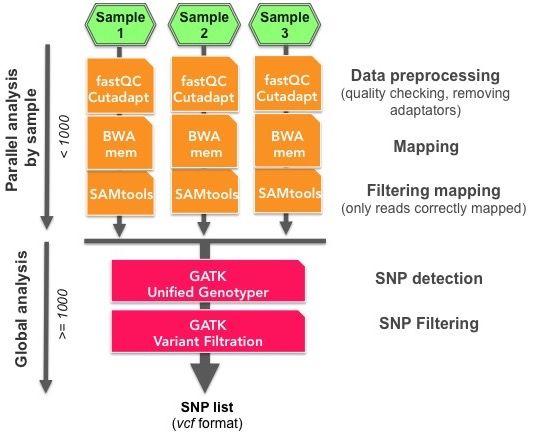
bioRxiv preprint first posted online Jan. 10, 2018; doi: http://dx.doi.org/10.1101/245480. The copyright holder for this preprint
                                          “toggle” —who
 (which was not peer-reviewed) is the author/funder,      2018/1/9     — bioRxiv
                                                             has granted    14:37 a—    pageto3display
                                                                                    license      — #3  the preprint in perpetuity.
                              It is made available under a CC-BY-NC-ND 4.0 International license.

                                                                                                                                            3

(git clone), through a bash script, or using a Docker machine                input file formats). The block files are composed of codes
(available as a pre-packed machine as well as a DockerFile).                 implementing a single function at a time. These blocks
   A unique file (localConfig.pm) needs to be filled at                      are then concatenated together following the user pipeline
installation to ensure the integration of the whole software list            specifications by toggleGenerator.pl, to provide a dedicated
(path and version), allowing TOGGLe to run. However, the                     script pipeline.
whole set of integrated tools is not required to run TOGGLe:                    This code modularity as well as testing and development
one can use it only with SAMtools for instance, and does                     processes adopted in TOGGLe prevents the regressions and
not need to install the other tools. More detailed information               bugs, facilitating maintenance in a collaborative environment.
on the different installation procedures can be found at the
TOGGLe website (http://toggle.southgreen.fr)                                 Production and development versions, and speed of
                                                                             releasing Two versions of TOGGLe are available,
                                                                             the production one and the development version. The
RESULTS
                                                                             former (http://toggle.southgreen.fr) is validated on a
Analyses and post-analysis tools integrated in TOGGLe                        large set of test data before any release, while the latter
Developed in Perl, TOGGLe incorporates more than 120                         (http://github.com/SouthGreenPlatform/TOGGLE-DEV/),
functions from 40 state-of-the-art open-source tools (such                   more up-to-date, is not completely validated and may provoke
as BWA, Abyss or HT-Seq) and home-made ones (Table 1                         errors. Nevertheless, the development version is merged to
and Supplementary Table S1), making it the command line                      the production version on a monthly basis, after unitary and
workflow manager with the highest number of integrated tools                 pipeline tests and true data validation.
by now (Figure 1; Table 2).
                                                                             A robust bioinformatics framework
Analyses Once installed, a large array of tools are ready                    As TOGGLe was developed initially for performing data-
to use with TOGGLe for various type of analyses: input                       intensive bioinformatics analyses, our main aim was to build a
data QC control, cleaning FASTQ, mapping, post-mapping                       robust workflow framework without sacrificing the simplicity
treatment, SNP calling and filtration, structural variation                  of use and the ease of development (Table 2).
analyses, assembly (genome and transcriptome). A more
detailed list of tools implemented is listed in Table 1 and                  Pipeline and data sanity controls Numerous automatic
Supplementary Table S1.                                                      controls are carried out at different levels as transparent
                                                                             actions : validation of the workflow structure defined by the
Post-Analyses Post-analysis tools were added in the current                  user (checking if the output file format by step n is supported
version of TOGGLe, for population genetics, genomic                          by the step n+1), format control on input data provided by
duplication, transcriptomics (Table 1 and Supplementary                      user, checking format of intermediate data.
Table S1).                                                                      Missing but requested steps for ensuring the pipeline
                                                                             running (such as indexing reference) are added automatically
A tool targeting both biologists and bioinformaticians                       if omitted.
Ease of use TOGGLe drastically simplifies NGS analyses
(such as SNP calling, differential expression for RNA, in silico             Reproducibility and traceability TOGGLe ensures that all
assembly). Workflows can be easily set up in a few minutes                   experimental results are reproducible, documented as well as
through a unique configuration file, and can be executed                     ready to be retrieved and shared. Indeed, results are organized
through a short command line. In addition, TOGGLe offers                     in a structured tree of directories: all outputs are sorted into
access to all parameters without restrictions (or name change)               separate directories grouped by analyses type (sample or
proposed by each software. Finally, users can provide any                    global analyses) and by workflow step (see supplementary
reference files, without any additional step to add them, at the             figure 1).
opposite of ClusterFlow (12) for instance.                                      All parameters, commands executed as well as software
   As prototyping optimized workflows (software order and                    versions are kept in logs and reports. Files such as the pipeline
parameters) requires a good knowledge of the tools to be                     configuration or the input data used (reference file e.g.) are
used, numerous pre-defined validated configuration files are                 duplicated in the output folder, in which are also produced
available on our website (http://toggle.southgreen.fr/) for                  the specific scripts used for the analyses. The original input
various type of analyses.                                                    files, at the opposite to reference and configuration files, are
   In addition, the effective output files naming convention                 not duplicated to reduce disk usage. Finally, a PDF report for
used by TOGGLe as the well-organized file tree make it easy                  the whole analysis is produced, providing global and visual
for the user to identify the different dataset produced (see                 informations for each sample at each step of the workflow.
Supplementary Figure 1).                                                     This report provides also a view of the workflow, and all the
                                                                             parameters used.
Ease of development and evolution: Simpler is Clever
TOGGLe is designed as a set of separated modules/functions                   Error tracking and reentrancy All errors and warnings
and blocks of code, simplifying code integration and                         encountered are recorded in audit logs, structured at sample
evolution. Each module is written either to run bioinformatic                and global levels. Hence, finding the origin of an error is
software (topHat2.pm, GATK.pm, for instance) or to ensure                    simplified. If a sample provokes an error, this sample will be
functionalities for a specific purpose (such as checking                     ignored for the rest of the analysis, and the failing reported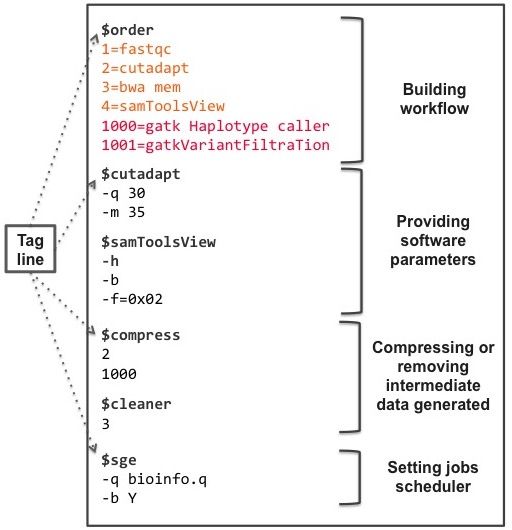
bioRxiv preprint first posted online Jan. 10, 2018; doi: http://dx.doi.org/10.1101/245480. The copyright holder for this preprint
                                              “toggle” —who
     (which was not peer-reviewed) is the author/funder,      2018/1/9     — bioRxiv
                                                                 has granted    14:37 a—    pageto4display
                                                                                        license      — #4  the preprint in perpetuity.
                                  It is made available under a CC-BY-NC-ND 4.0 International license.

4

in the error logs. Moreover, as TOGGLe can start from any                     success of the analysis: automatic reference indexing, data
format or tool, restarting jobs from the failure point is easy                format checking, workflow structure validation, and so on.
and avoid to re-launch the whole analysis.                                    In addition, the unique possibility offered by TOGGLe to
                                                                              carry out analyses at different levels (per samples then global)
Large numbers of sample analyzed There is no true limits to                   reduces the difficulty of use, the manipulation time, and the
the number of samples or the sequencing depth of a project                    errors linked to file manipulations (Table 2).
that TOGGLe can take in charge. TOGGLe was already used                          TOGGLe was used on numerous sequencing projects with
on hundreds of samples jointly, from different types of assays                high number of samples, or high depth sequencing or both
(RNAseq, GBS, WGS,...), different analyses (polymorphism                      (Table 3), computing capacities and data storage being the
detection, read count), and on different models (Table 3).                    only observed limits. It was shown to be very adaptable to
The only observed current limits are the data storage and the                 various biological questions as well as to a large array of
computing capacities available.                                               architecture, data, and users.
                                                                                 TOGGLe has some features to be enhanced, as a complete
HPC and parallel execution TOGGLe supports different job                      reentrancy after a failed run is not yet possible and request
scheduling systems and can be efficiently run either on a                     the user to modify the data organization before relaunch. We
distributed computing system or on a single server (default                   are working on a new management version allowing to re-
behavior). According to the configuration file, TOGGLe can                    launch directly without any other manipulations. Moreover,
perform parallel analyses simultaneously, at the sample level.                the current version of the configuration file is not exportable
In addition, TOGGLe can transfer data on calculation nodes                    to another workflow system using CWL (Common Workflow
instead of working through NFS/network filesystem, in order                   Language), and it would be interesting to also provide in
to improve computation time and to reduce latency.                            TOGGLe a translator to CWL. Finally, the current grain of
                                                                              parallelization is the sample level (as for ClusterFlow or
Documentation                                                                 Bpipe), and a lot of computation time can also be saved at that
                                                                              point. We are exploring the way to use embarrassingly-parallel
Installation, quick and complete user manuals, screencasts                    approaches (splitting samples in numerous subsamples), in
and a complete developer documentation are available on                       order to launch pipelines optimized on highly distributed
our website http://toggle.southgreen.fr. In addition, we also                 infrastructures.
provide pre-packed configuration files for different types of                    As NGS analyses and sequencing technologies are
classical analyses.                                                           continuously evolving, the modularity and the ease of
                                                                              development of our tool is a true advantage to stay up-to-
                                                                              date. For instance, the two-year old previous version of our
DISCUSSION & PERSPECTIVES                                                     software, TOGGLe v2 (13), integrated only 50 tools and
Nowadays, data preprocessing and analyses are the main                        was hard-coded. By now, more than 120 tools are available
bottleneck of scientific projects based on the high-throughput                with TOGGLe v3, the pipeline creation system is much more
sequencing technologies. To deal with this issue, various                     flexible and robust, and new tools are under integration on a
workflow managers have been proposed, with different                          monthly basis to widen the scope of analyses possible using
philosophies. GUI tools (such as Galaxy) provides a graphical                 TOGGLe (metagenomics, pangenomics).
user interface to easily and quickly design workflows.
They have been developed especially for users without any
                                                                              AVAILABILITY
programming knowledge. While very useful for prototyping
pipelines with a limited data set and for performing small-                   The       source    code      is    freely   available     at
scale analyses, they are less suitable to carry out large scale               http://toggle.southgreen.fr, under the double license GNU
analyses or to create highly flexible pipelines (e.g. access                  GPLv3/CeCiLL-C. The TOGGLe website comprises a
to the whole set of software options). In contrast, many                      comprehensive step-by-step tutorial to guide the users to
of the recent published workflow managers are aimed at                        install and run the software. An online issue request is also
bioinformaticians (e.g. Bpipe (10)), based on an extension                    available under GitHub of the South Green platform(14)
of a programming language, allowing to design highly                          (http://github.com/SouthGreenPlatform/TOGGLE/issues/) to
customizable and complex workflows through a command line                     report bugs and troubleshooting.
interface. This efficiency comes at the expense of the ease of
use.                                                                              • Project home page: http://toggle.southgreen.fr
   TOGGLe is an alternate solution taking advantages of these                     • Code repository: https://github.com/SouthGreenPlatform/TOGGLE
two kinds of tools. Based on a command line interface, it is                      • Operating system: GNU/Linux (CentOS, Debian,
suitable for bioinformaticians as well as biologists. Through a                     Ubuntu)
unique text file, it offers a simple way to build highly complex                  • Programming Language: Perl 5.16 of higher (5.24
and completely customizable workflows for a broad range of                          recommended)
NGS applications, from raw initial data to high-quality post-                     • License: GNU GPLv3/CeCill-C
analyses ones. This ease of use allows to greatly reduce hands-
on time spent on technical aspects and to focus on the analyses
themselves.                                                                   FUNDINGS
   Thus, to improve user experience, TOGGLe performs, in                      CM was supported by grants from ANR (AfriCrop project
a transparent way, different actions requested to ensure the                  #ANR-13-BSV7-0017) and NUMEV Labex (LandPanToggle
bioRxiv preprint first posted online Jan. 10, 2018; doi: http://dx.doi.org/10.1101/245480. The copyright holder for this preprint
“toggle”who
(which was not peer-reviewed) is the author/funder, — has
2018/1/9 — bioRxiv
granted 14:37 —a license
page 5 to
—display
#5 the preprint in perpetuity.
It is made available under a CC-BY-NC-ND 4.0 International license.
5
#2015-1-030-LARMANDE). All authors are supported by 16. Lab, H. (2010) FASTX Toolkit, http://hannonlab.cshl.edu/fastx toolkit/index.html.
their respective institutes. ,.
17. Martin, M. (may, 2011) Cutadapt removes adapter sequences from high-
throughput sequencing reads. EMBnet.journal, 17(1), 10.
18. Didion, J. P., Martin, M., and Collins, F. S. (August, 2017) Atropos:
ACKNOWLEDGEMENTS specific, sensitive, and speedy trimming of sequencing reads. PeerJ, 5,
The authors thank users (especially Emira Cherif, Laurence e3720.
19. Catchen, J., Hohenlohe, P. A., Bassham, S., Amores, A., and Cresko,
Albar, Remi Tournebize) for testing the first phases of this W. A. (jun, 2013) Stacks: an analysis tool set for population genomics.
new version. We also thank Mohamed Kassam (Nestle) for Molecular Ecology, 22(11), 3124–3140.
his feedbacks on the TOGGLe usage, and Mathieu Rouard and 20. Li, H. and Durbin, R. (mar, 2010) Fast and accurate long-read alignment
Laurence Albar for their useful comments on the manuscript. with Burrows-Wheeler transform.. Bioinformatics (Oxford, England),
26(5), 589–95.
21. Li, H. and Durbin, R. (jul, 2009) Fast and accurate short read alignment
with Burrows-Wheeler transform.. Bioinformatics (Oxford, England),
REFERENCES 25(14), 1754–60.
1. Djebali, S., Wucher, V., Foissac, S., Hitte, C., Corre, E., and Derrien, T. 22. Kim, D., Pertea, G., Trapnell, C., Pimentel, H., Kelley, R., Salzberg,
Bioinformatics Pipeline for Transcriptome Sequencing Analysis pp. 201– S. L., Mortazavi, A., Williams, B., McCue, K., Schaeffer, L., Wold,
219 Springer New York New York, NY (2017). B., Pei, B., Sisu, C., Frankish, A., Howald, C., Habegger, L., Mu, X.,
2. Wu, X., Kim, T.-K., Baxter, D., Scherler, K., Gordon, A., Fong, O., Harte, R., Balasubramanian, S., Tanzer, A., Diekhans, M., Reymond,
Etheridge, A., Galas, D. J., and Wang, K. (2017) sRNAnalyzera flexible A., Hubbard, T., Harrow, J., Gerstein, M., Roberts, A., Trapnell, C.,
and customizable small RNA sequencing data analysis pipeline. Nucleic Donaghey, J., Rinn, J., Pachter, L., Trapnell, C., Pachter, L., Salzberg,
Acids Research, p. gkx999. S., Wu, T., Nacu, S., Grant, G., Farkas, M., Pizarro, A., Lahens, N.,
3. Maarala, A. I., Bzhalava, Z., Dillner, J., Heljanko, K., and Bzhalava, Schug, J., Brunk, B., Stoeckert, C., Hogenesch, J., Pierce, E., Dobin,
D. (2017) ViraPipe: Scalable Parallel Pipeline for Viral Metagenome A., Davis, C., Schlesinger, F., Drenkow, J., Zaleski, C., Jha, S., Batut,
Analysis from Next Generation Sequencing Reads. Bioinformatics, p. P., Chaisson, M., Gingeras, T., Wang, K., Singh, D., Zeng, Z., Coleman,
btx702. S., Huang, Y., Savich, G., He, X., Mieczkowski, P., Grimm, S., Perou,
4. Blawid, R., Silva, J., and Nagata, T. (2017) Discovering and sequencing C., MacLeod, J., Chiang, D., Prins, J., Liu, J., Zhang, Z., Harrison, P.,
new plant viral genomes by next-generation sequencing: description of a Liu, Y., Gerstein, M., Kalyana-Sundaram, S., Kumar-Sinha, C., Shankar,
practical pipeline. Annals of Applied Biology, 170(3), 301–314. S., Robinson, D., Wu, Y., Cao, X., Asangani, I., Kothari, V., Prensner,
5. Afgan, E., Baker, D., vandenBeek, M., Blankenberg, D., Bouvier, D., J., Lonigro, R., Iyer, M., Barrette, T., Shanmugam, A., Dhanasekaran, S.,
Čech, M., Chilton, J., Clements, D., Coraor, N., Eberhard, C., Grüning, Palanisamy, N., Chinnaiyan, A., Chen, R., Mias, G., Li-Pook-Than, J.,
B., Guerler, A., Hillman-Jackson, J., VonKuster, G., Rasche, E., Soranzo, Jiang, L., Lam, H., Miriami, E., Karczewski, K., Hariharan, M., Dewey,
N., Turaga, N., Taylor, J., Nekrutenko, A., and Goecks, J. (jul, 2016) F., Cheng, Y., Clark, M., Im, H., Habegger, L., Balasubramanian, S., O,
The Galaxy platform for accessible, reproducible and collaborative M., Xing, J., Zhang, Y., Han, K., Salem, A., Sen, S., Huff, C., Zhou, Q.,
biomedical analyses: 2016 update. Nucleic Acids Research, 44(W1), Kirkness, E., Levy, S., Batzer, M., Jorde, L., Levy, S., Sutton, G., Ng,
W3–W10. P., Feuk, L., Halpern, A., Walenz, B., Axelrod, N., Huang, J., Kirkness,
6. Goecks, J., Nekrutenko, A., Taylor, J., and Galaxy Team, T. E., Denisov, G., Lin, Y., MacDonald, J., Pang, A., Shago, M., Stockwell,
(2010) Galaxy: a comprehensive approach for supporting accessible, T., Tsiamouri, A., Bafna, V., Bansal, V., Kravitz, S., Busam, D., Beeson,
reproducible, and transparent computational research in the life sciences. K., McIntosh, T., Remington, K., Abril, J., Gill, J., Borman, J., Rogers,
Genome Biology, 11(8), R86. Y., Frazier, M., Scherer, S., Strausberg, R., Langmead, B., Salzberg, S.,
7. Oinn, T., Addis, M., Ferris, J., Marvin, D., Senger, M., Greenwood, M., Kim, D., Salzberg, S., Langmead, B., Trapnell, C., Pop, M., Salzberg, S.,
Carver, T., Glover, K., Pocock, M. R., Wipat, A., and Li, P. (nov, 2004) Griebel, T., Zacher, B., Ribeca, P., Raineri, E., Lacroix, V., Guigo, R., and
Taverna: a tool for the composition and enactment of bioinformatics Sammeth, M. (2013) TopHat2: accurate alignment of transcriptomes in
workflows. Bioinformatics, 20(17), 3045–3054. the presence of insertions, deletions and gene fusions. Genome Biology,
8. Mulder, N. J., Adebiyi, E., Alami, R., Benkahla, A., Brandful, J., 14(4), R36.
Doumbia, S., Everett, D., Fadlelmola, F. M., Gaboun, F., Gaseitsiwe, S., 23. Langmead, B., Trapnell, C., Pop, M., and Salzberg, S. L. (2009) Ultrafast
Ghazal, H., Hazelhurst, S., Hide, W., Ibrahimi, A., Jaufeerally Fakim, and memory-efficient alignment of short DNA sequences to the human
Y., Jongeneel, C. V., Joubert, F., Kassim, S., Kayondo, J., Kumuthini, J., genome. Genome Biology, 10(3), R25.
Lyantagaye, S., Makani, J., Mansour Alzohairy, A., Masiga, D., Moussa, 24. Langmead, B. and Salzberg, S. L. (mar, 2012) Fast gapped-read alignment
A., Nash, O., Ouwe Missi Oukem-Boyer, O., Owusu-Dabo, E., Panji, S., with Bowtie 2. Nature Methods, 9(4), 357–359.
Patterton, H., Radouani, F., Sadki, K., Seghrouchni, F., Tastan Bishop, Ö., 25. Philippe, N., Salson, M., Commes, T., and Rivals, E. (mar, 2013) CRAC:
Tiffin, N., and Ulenga, N. (2016 Feb, 2016) H3ABioNet, a sustainable an integrated approach to the analysis of RNA-seq reads. Genome
pan-African bioinformatics network for human heredity and health in Biology, 14(3), R30.
Africa.. Genome Res, 26(2), 271–7. 26. Grabherr, M. G., Haas, B. J., Yassour, M., Levin, J. Z., Thompson, D. A.,
9. Köster, J. and Rahmann, S. (2012) Snakemake–a scalable bioinformatics Amit, I., Adiconis, X., Fan, L., Raychowdhury, R., Zeng, Q., Chen, Z.,
workflow engine.. Bioinformatics (Oxford, England), 28(19), 2520–2. Mauceli, E., Hacohen, N., Gnirke, A., Rhind, N., di Palma, F., Birren,
10. Sadedin, S. P., Pope, B., and Oshlack, A. (jun, 2012) Bpipe: a tool for B. W., Nusbaum, C., Lindblad-Toh, K., Friedman, N., and Regev, A. (jul,
running and managing bioinformatics pipelines. Bioinformatics, 28(11), 2011) Full-length transcriptome assembly from RNA-Seq data without a
1525–1526. reference genome.. Nature biotechnology, 29(7), 644–52.
11. Goodstadt, L. (nov, 2010) Ruffus: a lightweight Python library for 27. Pertea, G., Huang, X., Liang, F., Antonescu, V., Sultana, R.,
computational pipelines. Bioinformatics, 26(21), 2778–2779. Karamycheva, S., Lee, Y., White, J., Cheung, F., Parvizi, B., Tsai, J.,
12. Ewels, P., Krueger, F., Käller, M., and Andrews, S. (dec, 2016) Cluster and Quackenbush, J. (mar, 2003) TIGR Gene Indices clustering tools
Flow: A user-friendly bioinformatics workflow tool. F1000Research, 5, (TGICL): a software system for fast clustering of large EST datasets..
2824. Bioinformatics (Oxford, England), 19(5), 651–2.
13. Monat, C., Tranchant-Dubreuil, C., Kougbeadjo, A., Farcy, C., Ortega- 28. Robertson, G., Schein, J., Chiu, R., Corbett, R., Field, M., Jackman, S. D.,
Abboud, E., Amanzougarene, S., Ravel, S., Agbessi, M., Orjuela-Bouniol, Mungall, K., Lee, S., Okada, H. M., Qian, J. Q., Griffith, M., Raymond,
J., Summo, M., and Sabot, F. (2015) TOGGLE: toolbox for generic NGS A., Thiessen, N., Cezard, T., Butterfield, Y. S., Newsome, R., Chan, S. K.,
analyses. BMC Bioinformatics, 16(1), 374. She, R., Varhol, R., Kamoh, B., Prabhu, A.-L., Tam, A., Zhao, Y., Moore,
14. (2016 Nov, 2016) The South Green portal: a comprehensive resource for R. A., Hirst, M., Marra, M. A., Jones, S. J. M., Hoodless, P. A., and Birol,
tropical and Mediterranean crop genomics. Current Plant Biology, 7-8, I. (nov, 2010) De novo assembly and analysis of RNA-seq data. Nature
6–9. Methods, 7(11), 909–912.
15. S., A. (2010) FastQC: a quality control tool for high throughput sequence 29. Wysoker, A., Tibbetts, K., and Fennell, T. (2013) Picard tools,
data, http://www.bioinformatics.babraham.ac.uk/projects/fastqc. ,. http://picard.sourceforge.net. ,.bioRxiv preprint first posted online Jan. 10, 2018; doi: http://dx.doi.org/10.1101/245480. The copyright holder for this preprint
“toggle” —who
(which was not peer-reviewed) is the author/funder, 2018/1/9 — bioRxiv
has granted 14:37 a— pageto6display
license — #6 the preprint in perpetuity.
It is made available under a CC-BY-NC-ND 4.0 International license.
6
30. (aug, 2009) The Sequence Alignment/Map format and SAMtools.. ADDITIONAL FILES
Bioinformatics (Oxford, England), 25(16), 2078–9.
31. Li, H. (nov, 2011) A statistical framework for SNP calling, mutation 1 – List of currently tools integrated (Table S1)
discovery, association mapping and population genetical parameter
estimation from sequencing data.. Bioinformatics (Oxford, England),
2 – An example of results file tree created by TOGGLe
27(21), 2987–93. (Figure S1)
32. Van der Auwera, G. A., Carneiro, M. O., Hartl, C., Poplin, R., Del Angel,
G., Levy-Moonshine, A., Jordan, T., Shakir, K., Roazen, D., Thibault,
FIGURES AND TABLES
J., Banks, E., Garimella, K. V., Altshuler, D., Gabriel, S., and DePristo,
M. A. (2013) From FastQ data to high confidence variant calls: the
Genome Analysis Toolkit best practices pipeline.. Current protocols in
bioinformatics / editoral board, Andreas D. Baxevanis ... [et al.], 43,
11.10.1–33.
33. DePristo, M. A., Banks, E., Poplin, R., Garimella, K. V., Maguire,
J. R., Hartl, C., Philippakis, A. A., del Angel, G., Rivas, M. A., Hanna,
M., McKenna, A., Fennell, T. J., Kernytsky, A. M., Sivachenko, A. Y.,
Cibulskis, K., Gabriel, S. B., Altshuler, D., and Daly, M. J. (may, 2011) A
framework for variation discovery and genotyping using next-generation
DNA sequencing data.. Nature genetics, 43(5), 491–8.
34. McKenna, A., Hanna, M., Banks, E., Sivachenko, A., Cibulskis, K.,
Kernytsky, A., Garimella, K., Altshuler, D., Gabriel, S., Daly, M., and
DePristo, M. A. (sep, 2010) The Genome Analysis Toolkit: A MapReduce
framework for analyzing next-generation DNA sequencing data. Genome
Research, 20(9), 1297–1303.
35. Breese, M. R. and Liu, Y. (feb, 2013) NGSUtils: a software suite
for analyzing and manipulating next-generation sequencing datasets.
Bioinformatics, 29(4), 494–496.
36. Anders, S., Pyl, P. T., and Huber, W. (jan, 2015) HTSeq–a
Python framework to work with high-throughput sequencing data..
Bioinformatics (Oxford, England), 31(2), 166–9.
37. Trapnell, C., Williams, B. A., Pertea, G., Mortazavi, A., Kwan, G., van
Baren, M. J., Salzberg, S. L., Wold, B. J., and Pachter, L. (may, 2010)
Transcript assembly and quantification by RNA-Seq reveals unannotated
transcripts and isoform switching during cell differentiation. Nature Figure 1. Overview of TOGGLe, a flexible framework for performing large-
Biotechnology, 28(5), 511–515. scale NGS analyses such as SNP Calling, Structural Variation Detection,
38. Quinlan, A. R. and Hall, I. M. (mar, 2010) BEDTools: a flexible suite of Differential expression or in silico assembly.
utilities for comparing genomic features. Bioinformatics, 26(6), 841–842.
39. Danecek, P., Auton, A., Abecasis, G., Albers, C. A., Banks, E., DePristo,
M. A., Handsaker, R. E., Lunter, G., Marth, G. T., Sherry, S. T., McVean,
G., and Durbin, R. (aug, 2011) The variant call format and VCFtools.
Bioinformatics, 27(15), 2156–2158.
40. Cingolani, P., Platts, A., Coon, M., Nguyen, T., Wang, L., Land, S., Lu,
X., and Ruden, D. (2012) A program for annotating and predicting the
effects of single nucleotide polymorphisms, SnpEff: SNPs in the genome
of Drosophila melanogaster strain w1118; iso-2; iso-3. Fly, 6(2), 80–92.
41. Chen, K., Wallis, J. W., McLellan, M. D., Larson, D. E., Kalicki, J. M.,
Pohl, C. S., McGrath, S. D., Wendl, M. C., Zhang, Q., Locke, D. P., Shi,
X., Fulton, R. S., Ley, T. J., Wilson, R. K., Ding, L., and Mardis, E. R.
(sep, 2009) BreakDancer: an algorithm for high-resolution mapping of
genomic structural variation. Nature Methods, 6(9), 677–681.
42. Ye, K., Schulz, M. H., Long, Q., Apweiler, R., and Ning, Z. (nov, 2009)
Pindel: a pattern growth approach to detect break points of large deletions
and medium sized insertions from paired-end short reads.. Bioinformatics
(Oxford, England), 25(21), 2865–71.
43. Djedatin, G., Monat, C., Engelen, S., and Sabot, F. (2017)
DuplicationDetector, a light weight tool for duplication detection
using NGS data. Current Plant Biology, 9-10(Supplement C), 23 – 28
Special issue on Plant Development.
44. Pinel-Galzi, A., Dubreuil-Tranchant, C., Hbrard, E., Mariac, C.,
Ghesquire, A., and Albar, L. (2016) Mutations in Rice yellow mottle
virus Polyprotein P2a Involved in RYMV2 Gene Resistance Breakdown.
Frontiers in Plant Science, 7, 1779.
Figure 2. Example of a configuration file used for detecting polymorphisms.
This file is composed of 4 parts. Concerning the ”Building workflow” section,
the first 4 analysis (steps lower than 1000, in orange) will be carried out
separately for each sample (parallel analyses, in pink) whereas the last two
steps will be performed as a global common analysis.bioRxiv preprint first posted online Jan. 10, 2018; doi: http://dx.doi.org/10.1101/245480. The copyright holder for this preprint
“toggle” —who
(which was not peer-reviewed) is the author/funder, 2018/1/9 — bioRxiv
has granted 14:37 a— pageto7display
license — #7 the preprint in perpetuity.
It is made available under a CC-BY-NC-ND 4.0 International license.
7
Figure 3. Overview of a TOGGLe pipeline for basic SNP detection from 3
samples. This figure shows the different steps performed either as parallel (in
orange) or as global analysis (in pink; see the corresponding configuration file
in Figure 2).
Figure 4. Schematic diagram of the different actions performed by
toggleGenerator.pl, the TOGGLe supervising program.bioRxiv preprint first posted online Jan. 10, 2018; doi: http://dx.doi.org/10.1101/245480. The copyright holder for this preprint
“toggle” —who
(which was not peer-reviewed) is the author/funder, 2018/1/9 — bioRxiv
has granted 14:37 a— pageto8display
license — #8 the preprint in perpetuity.
It is made available under a CC-BY-NC-ND 4.0 International license.
8
Type of analyses Software names
Data Preprocessing FastQC (15), FASTX-Toolkit (16), Cutadapt (17), Atropos (18), checkFormat tools *
Demultiplexing Stacks (19)
Mapping BWA (20, 21), TopHat (22), Bowtie (23), Bowtie2 (24), CRAC (25)
Assembly Trinity (26), TgiCl (27), Trans-Abyss (28)
SAM/BAM Management and analysis Picard-Tools (29), SAMtools (30, 31), GATK (32, 33, 34), NGSutils (35)
ReadCount tools HTSeq (36), cufflinks (37)
SNP detection and VCF management GATK (32, 33, 34), BEDtools (38), vcftools (39), SnpEff (40)
Structural variant detection BreakDancer (41), Pindel (42), DuplicationDetector (43)
Generic command line Any bash command *
Table 1. Bioinformatic software currently integrated in TOGGLe. *: home-made tools for data format control and generic command line.
Features TOGGLe v3 TOGGLe v2 (13) Bpipe (10) Clusterflow (12) SnakeMake (9)
Biologist use +++ ++ - + -
Ease of pipeline design for biologists +++ - + ++ -
Transparent supplementary actions +++ - - - +
Pipeline configuration language Text Text Bash-like Tabulated format Python
Integrated tools 120 50 None* 31 None*
Sanity check +++ ++ + + -
Software version control +++ + + - +
Reproducibility +++ ++ ++ ++ ++
Re-entrancy + - ++ + +++
Schedulers integration +++ + +++ +++ ++
Parallel-then-Global analyses +++ ++ - - +
Easy to install +++ ++ + ++ ++
Documentation +++ + ++ ++ +++
Release frequency +++ - ++ + +++
Table 2. Comparison with commonly used command-line workflows managers. More details on each feature are provided in the main text. Release frequency
was estimated from previous release date for each tool.
*: no tools are already included in Bpipe and SnakeMake, users have to include them through coding by themselves.bioRxiv preprint first posted online Jan. 10, 2018; doi: http://dx.doi.org/10.1101/245480. The copyright holder for this preprint
“toggle” —who
(which was not peer-reviewed) is the author/funder, 2018/1/9 — bioRxiv
has granted 14:37 a— pageto9display
license — #9 the preprint in perpetuity.
It is made available under a CC-BY-NC-ND 4.0 International license.
9
NGS type Organism Type Analysis type Description
GBS Millet Plant Polymorphism detection desc (sample, study)
Date Palm and Phoenix sp. Plant Polymorphism detection 242 samples
RNASeq Arabidopsis thaliana Plant Differential expression 36 samples, 14 millions reads per sample
Pacaya Plant Transcriptome Assembly 20 samples, 34 millions reads per sample
Polymorphism detection
Differential expression
Magnaporthe oryzae Fungus Differential expression 6 samples, 90 millions reads
Burkholderia gladioli Bacteria Differential expression 6 samples, 90 millions reads
WGS Coffea canephora Plant Polymorphism detection 12 samples, 55x mean
African Rice Plant Duplication detection 16 samples, 35x mean (43)
African and Asian Rices Plant Polymorphism detection 350 samples, 35x mean
Rice Yellow Mottle Virus Virus Polymorphism detection 50 samples, 8,000x mean (44)
Leichmanii Animal Polymorphism detection 15 samples, 20x mean
Magnaporthe oryzae Fungus Polymorphism detection 52 samples, 20x mean
Micosphaerella fijensis Fungus Polymorphism detection 160 samples, 50x mean
CaptureSeq Rice Plant Polymorphism detection 200 targets (genes), 100 samples
Palm Plant Polymorphism detection 150 targets (800 exons), 120 samples
Prunus persica Plant Polymorphism detection 540 targets (exons), 16 samples
Human Animal Polymorphism detection 241 targets (8800 exons), 48 samples
Table 3. List of selected projects using TOGGLe.You can also read


