TREASURY INSPECTOR GENERAL FOR TAX ADMINISTRATION
←
→
Page content transcription
If your browser does not render page correctly, please read the page content below
TREASURY INSPECTOR GENERAL FOR TAX ADMINISTRATION

                           Review of the System Failure
                          That Led to the Tax Day Outage

                                     September 19, 2018

                             Reference Number: 2018-20-065

This report has cleared the Treasury Inspector General for Tax Administration disclosure review process
 and information determined to be restricted from public release has been redacted from this document.

Phone Number / 202-622-6500
E-mail Address / TIGTACommunications@tigta.treas.gov
Website        / http://www.treasury.gov/tigta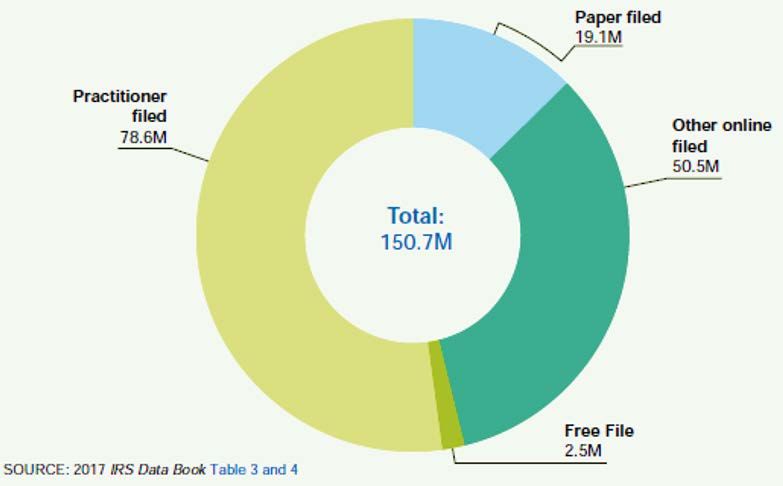
To report fraud, waste, or abuse, call our toll-free hotline at:
                         1-800-366-4484

                              By Web:
                      www.treasury.gov/tigta/

                              Or Write:
          Treasury Inspector General for Tax Administration
                           P.O. Box 589
                        Ben Franklin Station
                    Washington, D.C. 20044-0589

Information you provide is confidential and you may remain anonymous.
HIGHLIGHTS

REVIEW OF THE SYSTEM FAILURE                           In January 2018, IBM product engineers
THAT LED TO THE TAX DAY OUTAGE                         developed a script for another client that
                                                       experienced an outage due to this firmware bug.
                                                       However, prior to the IRS outage, IBM did not
Highlights                                             provide the IRS with any details regarding the
                                                       other client outage or the availability of a script
Final Report issued on                                 that would have prevented the Tax Day outage.
September 19, 2018                                     While the response team’s substantial efforts
                                                       allowed the IRS to resume tax processing
Highlights of Reference Number: 2018-20-065            operations the same day, improvements are
to the Commissioner of Internal Revenue.               needed to help mitigate or prevent outages. The
                                                       “lessons learned” process lacks an overall
IMPACT ON TAXPAYERS                                    strategy to consolidate multiple action plans, and
The filing season, defined as the period from          monthly microcode bundle meetings have no
January 1 through mid-April, is critical for the       meeting minutes or documentation of decisions
IRS because it is during this time that most           made. The current Tier 1 storage environment,
individuals file their income tax returns. If the      with an average equipment age of less than
tax processing system fails, taxpayers may lose        three years, hosts a portion of core tax
confidence in the IRS’s ability to administer the      processing data. However, it does not have an
tax code.                                              automatic failover or built-in redundancies and is
                                                       currently a single point of failure.
WHY TIGTA DID THE AUDIT
                                                       TIGTA also found that the Enterprise Storage
This audit was initiated to review the IRS             Services contract is not meeting business
systems outage that occurred on Tax Day,               needs. During the Tax Day outage, the
April 17, 2018, and identify solutions to prevent      contractor failed to meet several service level
future disruptions.                                    objectives, and this failure requires the
                                                       contractor to pay liquidated damages to the
WHAT TIGTA FOUND                                       Government. Additionally, the contract lacks
On the last day of the 2018 Filing Season              detailed service level objectives for performance
(April 17, 2018), the IRS experienced a storage        monitoring and incident management.
outage due to a firmware bug that caused a
                                                       WHAT TIGTA RECOMMENDED
storage array to fail. As a result, 59 tax
systems, including the Modernized e-File               TIGTA recommended that the Chief Information
system, were unavailable for about 11 hours.           Officer should: 1) document lessons learned
The IRS Computer Security Incident Response            and implement a corrective action plan,
Center found no evidence of any breach or              2) formalize the monthly microcode bundle
cyber threat activity related to the outage. The       meetings, 3) ensure that decisions not to install
IRS restored mainframe operations by the               microcode bundle updates are documented and
afternoon of the day the outage occurred and           approved, and 4) seek liquidated damages from
processed almost 4 million tax returns before          the contractor and make modifications to the
midnight.                                              Enterprise Storage Services contract.
In June 2017, International Business Machines          The IRS agreed with all of the recommendations
(IBM) initially discovered the firmware bug            and has formalized the monthly microcode
associated with the IRS Tax Day outage and             bundle meetings and sought damages from the
developed a fix, made publicly available in a          Enterprise Storage Services contractor. The
November 2017 microcode bundle. In                     IRS plans to document a consolidated action
December 2017, the IRS agreed with the                 plan, ensure decisions to not install microcode
contractor recommendation to remain on the             bundles are approved, and make modifications
older microcode bundle for the 2018 Filing             to the contract.
Season because it was considered more stable.
DEPARTMENT OF THE TREASURY
                                                 WASHINGTON, D.C. 20220

TREASURY INSPECTOR GENERAL
  FOR TAX ADMINISTRATION

                                         September 19, 2018

MEMORANDUM FOR COMMISSIONER OF INTERNAL REVENUE

FROM:                        Michael E. McKenney
                             Deputy Inspector General for Audit

SUBJECT:                     Final Audit Report – Review of the System Failure That Led to the Tax
                             Day Outage (Audit # 201820027)

This report presents the results of our review to analyze the Internal Revenue Service (IRS)
system outage that occurred on April 17, 2018, and identify solutions to prevent future
disruptions. This audit addresses the major management challenges of Security Over Taxpayer
Data and Protection of IRS Resources and Providing Quality Taxpayer Services and Expanding
Online Services.
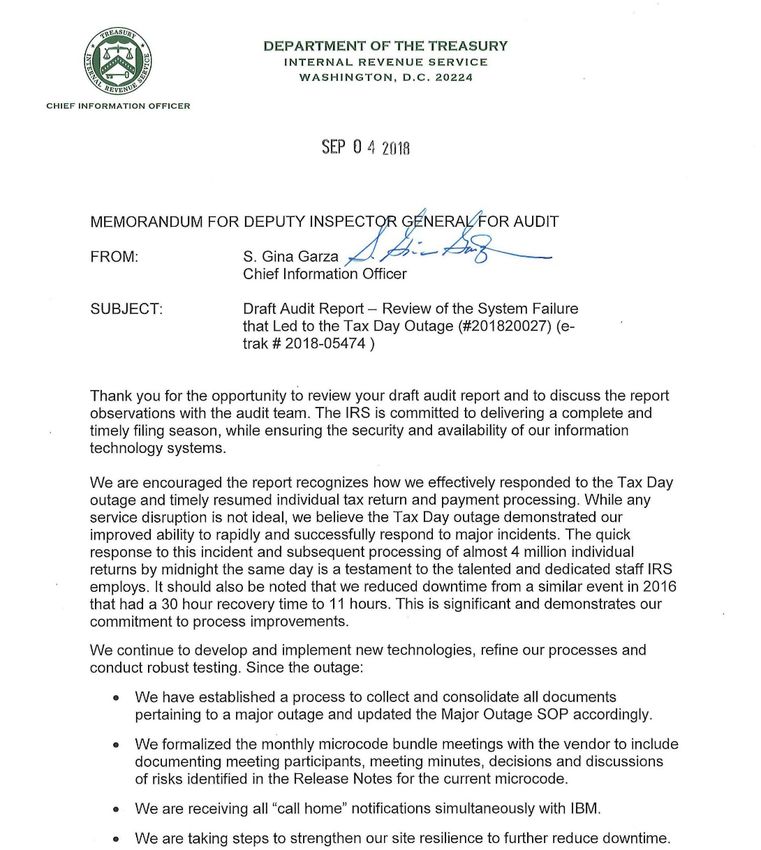
Management’s complete response to the draft report is included as Appendix VI.
Copies of this report are also being sent to the IRS managers affected by the report
recommendations. If you have any questions, please contact me or Danny R. Verneuille,
Assistant Inspector General for Audit (Security and Information Technology Services).
Review of the System Failure
That Led to the Tax Day Outage
Table of Contents
Background ............................................................................................................ Page 1
Results of Review ................................................................................................ Page 3
A Storage Device Failure Caused a Tax Processing
System Outage for Approximately 11 Hours................................................ Page 3
Improvements Are Needed to Reduce Risks and
Response Times for Future Outages ............................................................. Page 4
Recommendations 1 and 2: .............................................. Page 8
Recommendation 3:........................................................ Page 9
The Current Enterprise Storage Services Contract Is
Not Meeting Business Needs ........................................................................ Page 9
Recommendation 4:........................................................ Page 11
Recommendations 5 and 6: .............................................. Page 12
Appendices
Appendix I – Detailed Objective, Scope, and Methodology ........................ Page 13
Appendix II – Major Contributors to This Report ........................................ Page 15
Appendix III – Report Distribution List ....................................................... Page 16
Appendix IV – Tax Day Outage Timeline .................................................... Page 17
Appendix V – Glossary of Terms ................................................................. Page 21
Appendix VI – Management’s Response to the Draft Report ...................... Page 23Review of the System Failure
That Led to the Tax Day Outage
Abbreviations
EOps Enterprise Operations
ESS Enterprise Storage Services
IBM International Business Machines
IRS Internal Revenue Service
ITOCC Information Technology Operations Command Center
KISAM Knowledge, Incident/Problem, and Service Asset Management
MeF Modernized E-File
SLO Service Level Objective
SOP Standard Operating ProcedureReview of the System Failure
That Led to the Tax Day Outage
Background
The Internal Revenue Service (IRS) relies extensively on information technology systems to
annually collect more than $3 trillion in taxes, distribute more than $400 billion in refunds, and
carry out its mission of providing service to America’s taxpayers in meeting their tax obligations.
In Fiscal Year 1 2017, the IRS processed more than 187 million Federal tax returns. Of those,
over 150 million were individual returns, with over 87 percent of these individual returns filed
electronically. During Calendar Year 2018, the IRS expects to receive approximately
153.7 million individual income tax returns, with more than 89 percent of those filed
electronically. See Figure 1 for a chart of individual returns filed in Fiscal Year 2017
electronically and via paper.
Figure 1: Individual Tax Returns Filed in Fiscal Year 2017
Source: IRS 2017 Data Book.
The IRS continues to modernize its operations and applications by developing and implementing
new information technology to provide taxpayers and IRS employees with tools that are more
sophisticated. As part of this effort, on June 29, 2012, the IRS awarded the Enterprise Storage
Services (ESS) Managed Services contract to the Unisys Corporation to manage planning,
designing, building, deploying, and maintaining a new storage environment. According to the
1
See Appendix V for a glossary of terms.
Page 1Review of the System Failure
That Led to the Tax Day Outage
IRS, this new environment provides an agile solution for rapid deployment of continuous
improvements, optimized data storage and retrieval, and flexibility to adapt to IRS growth. The
IRS environment consists of 7.5 petabytes of disk space in various configurations in data centers
and other facilities across the country. In October 2015, we reported that the ESS contract
Service Level Objectives (SLO) 2 do not clearly define important aspects of risk mitigation
controls needed to protect data under the ESS Program. 3
This review was performed from May through July 2018 at the New Carrollton Federal Building
in Lanham, Maryland, and the Enterprise Computing Center in Martinsburg, West Virginia. We
worked closely with IRS personnel from the Information Technology organization’s Enterprise
Operations (EOps) organization and the Wage and Investment Division. In addition, we worked
with contractor personnel responsible for the performance of the ESS contract. We conducted
this performance audit in accordance with generally accepted government auditing standards.
Those standards require that we plan and perform the audit to obtain sufficient, appropriate
evidence to provide a reasonable basis for our findings and conclusions based on our audit
objective. We believe that the evidence obtained provides a reasonable basis for our findings
and conclusions based on our audit objective. Detailed information on our audit objective,
scope, and methodology is presented in Appendix I. Major contributors to the report are listed in
Appendix II.
2
The SLOs are a means of measuring the performance of the service provider. The SLO may be composed of
one or more quality-of-service measurements to produce the SLO achievement value.
3
Treasury Inspector General for Tax Administration, Ref. No. 2016-20-002, Measurable Agreements on Security
Controls Are Needed to Support the Enterprise Storage Services Solution (Oct. 2015).
Page 2Review of the System Failure
That Led to the Tax Day Outage
Results of Review
A Storage Device Failure Caused a Tax Processing System Outage for
Approximately 11 Hours
On Tax Day, April 17, 2018, the IRS experienced a storage outage due to a firmware bug on one
of the IRS’s high-availability storage arrays. Because of the outage, 59 tax processing systems,
including the Modernized e-File (MeF) system, were unavailable for approximately 11 hours
between 2:57 a.m. and 1:40 p.m. 4 See Appendix IV for a detailed timeline of the outage. The
IRS Computer Security Incident Response Center concluded that the outage fit the pattern of a
previously known firmware bug and determined that there was no evidence of any breach or
cyber threat activity related to this outage. The timing and severity of the outage prompted the
IRS to allow an additional day to file to April 18, 2018.
The Information Technology Operations Command Center (ITOCC) Incident Management
Standard Operating Procedures (SOP) 5 outline the subprocesses, roles, and responsibilities for
incident management and supporting functions with the goal of restoring service in a timely
manner for Priority 1 and Priority 2 incidents. These procedures identify the activities performed
by key personnel to ensure that high-priority incidents are worked and, when needed, activate the
Service Restoration Team process to facilitate restoration of service to customers for all
production systems. Another document, the Major Outage SOP, 6 addresses the process,
activities, and integration relationships required to manage the restoration and continuation of
business after a major outage. This SOP also defines the roles and responsibilities for
implementing business restoration after a major outage has occurred.
At 2:24 a.m. on April 17, 2018, the IRS’s ITOCC received the first system-generated error
messages and invoked its established procedures to troubleshoot the problem. At 2:57 a.m.,
one of the high-availability storage arrays used its automated “call home” capability to send an
alert to the vendor, International Business Machines (IBM). It detected a deadlock condition
after a warmstart due to cache overflow. IBM never provided an acknowledgement of the
performance issue and did not initiate any incident management procedures because IBM
identified the call home as a Severity Level 3 (response time for a Severity Level 3 issue is by
the end of the next business day). By 3:30 a.m., ITOCC personnel detected problems with
several systems and submitted a trouble ticket via the Knowledge, Incident/Problem, and Service
Asset Management (KISAM) system.
4
All times are reported in Eastern Standard Time.
5
ITOCC Incident and Problem Management Branch Incident Management Section SOP, dated January 19, 2018.
6
Major Outage SOP, dated July 28, 2017.
Page 3Review of the System Failure
That Led to the Tax Day Outage
By 6:45 a.m., the ITOCC designated the Incident Manager of Record as part of the Incident
Management SOP and worked through several service restoration phases (investigation,
assessment, and technical). An hour later, the Toolkit Suite With Command Centre identified a
total of 59 tax systems, including the MeF system, affected by the storage array issue. By
9:30 a.m., the IRS declared a Major Outage, initiated the Major Outage SOP, and designated a
Major Outage Incident Commander.
By early afternoon on April 17, 2018, the contractors had determined that the root cause of the
Tax Day outage was a cache overflow issue causing repeated warmstarts and had deployed a
preventive script on the storage device that will monitor and correct the issue if the condition
reoccurs. At 1:40 p.m., all IRS mainframes and databases were fully operational and ready to
resume tax processing operations. Once these systems were operational, the Wage and
Investment Division coordinated a plan with several Electronic Return Originators to initially
limit the number of returns submitted in an effort to prevent a second outage due to the system
overload. By 3:00 p.m., the IRS started receiving tax returns on a limited basis. Once the initial
returns were received with no issues, the IRS notified all taxpayers that the MeF system was
online and available for submitting tax returns. By 5:00 p.m., the IRS resumed full tax
processing operations. Once tax processing operations resumed, the backlog of unprocessed
returns peaked at 12:45 a.m. on April 18, 2018, with 2.3 million returns, but the backlog was
fully resolved by 5:30 a.m. that day (April 18, 2018).
Throughout the Tax Day outage, the Communications and Liaison organization released several
public messages informing taxpayers of the outage and providing guidance on how taxpayers
should continue to file their tax returns. The IRS also sent electronic filing software providers
messages, i.e., Quick Alerts, that morning regarding the outage and instructed IRS customer
service representatives on how to respond to questions from callers.
Even though tax operations resumed by late afternoon on April 17, 2018, the IRS widely
publicized that taxpayers had an additional day to file through midnight on Wednesday,
April 18, 2018. The IRS shared this information via a national news release, IRS.gov, and social
media.
Established contingency tools, processes, and procedures for mainframe outages served the IRS
well during the Tax Day outage. The IRS detected, assessed, repaired, and restored mainframe
operations by the afternoon of the day the outage occurred and processed almost 4 million tax
returns before midnight within acceptable performance time frames for acknowledgement and
receipt.
Improvements Are Needed to Reduce Risks and Response Times for
Future Outages
While the IRS effectively responded to the Tax Day outage and timely resumed tax processing
operations, the major outage process needs improvement to reduce risks and response times for
Page 4Review of the System Failure
That Led to the Tax Day Outage
future outages. To reduce these risks, the IRS needs to better track lessons learned and
vulnerabilities to ensure that remediation and other corrective actions are implemented in full,
require sufficient information from contractors about microcode upgrades in order to facilitate
better decision-making by IRS management regarding microcode bundle implementation, and
improve the resiliency and availability of the Tier 1 architecture.
Lessons learned
The Office of Management and Budget requires that Federal agencies document incident
response lessons learned and ensure that processes are in place to verify corrective actions. 7 The
IRS’s Major Outage SOP requires the EOps Security Operations and Standards Division to
conduct after-action activities. Specifically, the Division Director executes the following
post-procedural or validation actions as part of the lessons learned process:
• Documents and updates lessons learned and process improvements in the appropriate
SOP.
• Creates a corrective action plan and briefs the Information Technology organization for
approval and periodic status updates.
• Implements the corrective action plan.
• Verifies completion with approval of the Associate Chief Information Officer, EOps.
EOps organization officials analyzed the Tax Day outage and identified multiple lessons learned
and improvements needed to better respond to future outages. However, they did not consolidate
all lessons learned and weaknesses into one document for the purposes of monitoring and
verifying the completion of the planned corrective actions. Instead, they recorded the corrective
actions in multiple documents. The lessons learned process has no overall strategy to
consolidate the multiple action plans that would allow the IRS to cohesively track the status of
all corrective actions by assigned responsibilities.
For example, two EOps divisions each prepared a separate lessons learned document. One of the
two divisions is also tracking major outage weaknesses in a Business Restoration Strategy Plan.
In addition, some lessons learned and needed improvements are listed in the notes of EOps
monthly meeting minutes. EOps officials told us that corrective actions will be tracked in the
2019 Filing Season Readiness Plan. We reviewed this plan and determined that it does not
include some of the corrective actions listed in three of the above four sources. The plan also
does not assign responsibilities for task completion and does not include a mechanism for
monitoring or tracking the status of work in progress. The 2019 Filing Season Readiness Plan is
not appropriate for the purposes of coherently tracking major outage corrective actions.
7
Office of Management and Budget, OMB Circular No. A-130 (Revised), Managing Information as a Strategic
Resource, Appendix I (July 2016).
Page 5Review of the System Failure
That Led to the Tax Day Outage
Significant weaknesses identified by the IRS during the outage that are not consolidated centrally
for status and tracking purposes include:
• Quality of KISAM Tickets – The IRS determined that the quality of the KISAM tickets
needs to be improved and tickets need to be prepared early on in the outage to better
describe the conditions observed so that the description captured in the trouble ticket and
the subject line of the e-mail sent are readily identifiable and understood by all recipients.
For example, the subject line of the Tax Day outage trouble ticket, “Warning: Catalog
Task Contention wait-time was exceeded,” was not updated at any point during the
incident to adequately reflect outage observations.
• Notification of IRS Personnel and Contractors – IRS personnel did not inform the
Associate Chief Information Officer and the Deputy Associate Chief Information Officer,
EOps, about the outage until they arrived at work later that morning, approximately
four hours after the outage was first reported. The ITOCC personnel were not sure about
whom to contact at Unisys or IBM to begin triage of the mainframes and tried an
800 number they found online for Unisys storage support. Per the ESS Managed
Services contract, Unisys or IBM as the managing contractors who are responsible for the
IRS Tier 1 storage environment should have been first to identify the outage and contact
the IRS. During this outage, it was the IRS who initially recognized a problem, and the
IRS had to reach out and notify its contractors to prompt action on remediation. The
contractors did not uphold their contractual agreement.
• Training Needed for Toolkit Suite With Command Centre – IRS executives and
managers with outage remediation and decision-making responsibilities expressed the
need for a better understanding of the Business Restoration Strategy process and the
Toolkit Suite With Command Centre.
The EOps organization has neither clearly assigned responsibility nor created procedures for
documenting all problems or issues identified during the outage or for monitoring to ensure the
completion of corrective actions. The current Major Outage SOP states that a single individual
will be responsible for documenting an action plan. Information Technology organization
management told us that the lessons learned after-action requirements documented in the Major
Outage SOP apply only to the Continuity Management Office and not to the entire Information
Technology organization. Without central tracking and monitoring of corrective actions for all
weaknesses identified in the major outage process, there is a risk that the IRS will not correct all
weaknesses. This could reduce response effectiveness and add to delays in responding to future
outages.
Microcode bundle process
The Information Technology organization holds monthly meetings with Unisys and IBM to
discuss current microcode bundle levels on the IRS mainframes. At these meetings, IBM makes
recommendations to Unisys, as the prime contractor, as to whether or not to implement the latest
Page 6Review of the System Failure
That Led to the Tax Day Outage
microcode bundle. The IRS will either concur or nonconcur with the proposal. Unisys follows
an internal company policy that requires microcode bundles to have, at a minimum, 450 machine
weeks in a production environment prior to installation on IRS equipment. This internal policy
is part of a draft document, created in 2013, that was never formalized by Unisys.
In June 2017, IBM discovered a firmware bug while conducting testing in a laboratory
environment. In response to the bug, IBM developed a fix and made it part of IBM’s Microcode
Bundle 88.24.6.0, released to the public on November 7, 2017. As part of the bundle release
process, IBM includes release notes that provide technical details for each individual update,
such as the specific risks associated with each known bug or defect.
The bug discovered in IBM’s laboratory in June 2017 is the microcode defect that caused the
Tax Day outage. During the December 2017 monthly microcode bundle meeting, upon
recommendation from contractors, the IRS agreed with the decision to continue with what was
considered a more stable version of the microcode, Bundle 88.23.20.0, for the remainder of the
filing season. This decision was based on the relatively recent release date of Microcode
Bundle 88.24.6.0 (it did not yet meet Unisys’s requirement of 450 machine weeks in a
production environment). However, there was no detailed discussion regarding individual fixes
and whether these defects and associated updates could affect the IRS environment.
Documentation of the monthly microcode meetings is limited to a single spreadsheet that
identifies the recommended microcode updates and an e-mail sent to stakeholders containing
high-level comments about the meeting. The meeting documentation lacks an agenda, meeting
minutes, a list of attendees, and any relevant documentation about decisions made. According to
the Internal Revenue Manual, any decision to forego installation of upgrades should be
documented as a risk-based decision and approved by the system authorizing official. 8
In January 2018, another IBM client experienced an outage triggered by the same firmware bug
discovered in June 2017. To resolve the issue with the other client, IBM product engineers
developed and deployed a script that corrected and monitored the storage array cache that
ensured the condition does not reoccur. After this event, IBM made no efforts to communicate
this condition to the IRS or notify the IRS about the preventative script it had developed that
would have prevented the Tax Day outage. By June 9, 2018, all Tier 1 storage arrays were
upgraded to Microcode Bundle 88.24.6.0. In addition, all of the Tier 1 storage arrays show no
signs of ongoing system vulnerabilities, and the condition related to the Tax Day outage has not
reoccurred.
Tier 1 storage architecture
The Tier 1 storage architecture includes mainframes, storage arrays, computer hardware and
software maintenance, and related services. As part of the ESS contract, the Tier 1 architecture
8
Internal Revenue Manual 10.8.50, Information Technology Security, Servicewide Security Patch Management
(April 29, 2016).
Page 7Review of the System Failure
That Led to the Tax Day Outage
receives Gold Storage Class service that provides high-speed, high-availability storage for tax
processing systems and applications. The Gold Storage Class SLO for mainframe availability
requires a 99.999 percent uptime and less than 26.5 minutes of unplanned downtime per year.
However, the current configuration of the Tier 1 storage environment cannot meet these
requirements.
The Tier 1 storage architecture consists of seven high-speed, high-availability storage arrays with
an average age of less than three years. Presently, three of the storage arrays, located at the
Martinsburg Computing Center, host a portion of core tax processing data. However, there are
no automatic failovers or built-in redundancies for these three storage arrays. Additionally, not
all of the applications and systems data hosted in the Martinsburg Computing Center are fully
replicated to the Memphis Computing Center. As demonstrated during the Tax Day systems
outage, this creates a single point of failure for tax processing operations. Because of this
architecture, it takes up to 36 hours for the IRS to conduct disaster recovery operations, shifting
tax processing activities from the Martinsburg Computing Center to the Memphis Computing
Center.
In response to the outage, the IRS expedited existing plans to eliminate this single point of
failure and improve restoration time. This includes the procurement of three additional storage
arrays, which will provide automatic failover and built-in redundancy for the Tier 1 storage
environment. In addition, each array hosting core tax processing data will fully replicate to the
Memphis Computing Center. The project goal is to reduce any system outage to two hours or
less. These enhancements are tentatively scheduled to be completed prior to the 2019 Filing
Season and will cost approximately $5.8 million.
Recommendations
The Chief Information Officer should:
Recommendation 1: Ensure that the Director, Security Operations and Standards Division,
collects and formally documents in one consolidated action plan any lessons learned for all major
outages and implements the approved corrective action plan per the Major Outage SOP.
Management’s Response: The IRS agreed with this recommendation. Enterprise
Operations created a process that will be used to collect and document a consolidated
action plan in accordance with the updated Major Outage SOP.
Recommendation 2: Formalize the monthly microcode bundle meetings with IBM and
Unisys to include documenting meeting participants, detailed meeting minutes, and discussions
of risks identified in the release notes for the current microcode updates.
Management’s Response: The IRS agreed with this recommendation. The IRS
formalized the monthly microcode bundle meetings which includes documenting meeting
Page 8Review of the System Failure
That Led to the Tax Day Outage
participants, meeting minutes, decisions, and discussions of risks identified in the Release
Notes for the current microcode upgrades.
Recommendation 3: Ensure that all decisions to not install the latest microcode bundle
updates are documented and approved by the system Authorizing Official.
Management’s Response: The IRS agreed with this recommendation. The IRS will
implement a process to ensure that the Authorizing Official and responsible directors are
aware of the content of the microcode bundle updates and approve decisions to not
install.
The Current Enterprise Storage Services Contract Is Not Meeting
Business Needs
Under the ESS contract, the IRS’s Tier 1 storage environment receives Gold Storage Class
service. As part of the service, there are several SLOs that the contractor must satisfy in order to
meet IRS business needs. These objectives meet the requirements of the Internal Revenue
Manual 9 regarding establishing metrics for continuous monitoring. Similar to our Fiscal
Year 2016 report, we found issues with the SLOs. Specifically, the SLOs do not clearly define
how performance is guaranteed in key areas, including monitoring and incident management.
Additionally, we found that the contractor failed to meet several SLOs.
SLOs
The ESS contract SLOs define maximum contractor response times for performance problems.
During the Tax Day outage, the contractor failed to meet the SLO requirements for initial
acknowledgement of the problem, creating a plan for resolution, and actual resolution of the
problem. Additionally, the SLOs define mainframe availability (uptime), maximum unplanned
downtime, and array performance average response times. As part of the ESS contract, if the
contractor fails to perform the services within the time specified, the contractor shall pay to the
Government liquidated damages. Figure 2 summarizes the ESS SLOs for Gold Storage Class
and actual contractor performance in these areas.
9
Internal Revenue Manual 10.8.1, Information Technology Security, Policy, and Guidance (July 8, 2015).
Page 9Review of the System Failure
That Led to the Tax Day Outage
Figure 2: ESS SLO for Gold Storage Class
SLO ESS Contract Requirement Actual Contractor Performance
Contractor Acknowledgement
30 minutes Approximately 3 hours
of Performance Problems
Contractor Creates a
2 hours Approximately 6.5 hours
Plan for Resolution
Problem Resolution 4 hours Approximately 11 hours
Mainframe Availability
99.999% 99.877%
(Uptime)
Maximum Unplanned
Less than 26.5 minutes Approximately 11 hours
Downtime (Per Year)
Source: Treasury Inspector General for Tax Administration analysis of the ESS contract, outage documentation,
and interviews conducted during fieldwork.
Although not defined by an SLO, the ESS contract also states that the contractor must deliver
capacity management reports to the IRS on a monthly basis. These reports are the result of prior
iterative testing to determine capacity limits. Further, the contract states that the contractor is
required to maintain a buffer percentage of no less than 25 percent. We reviewed capacity
reports from March 2017 through May 2017 and from March 2018 through May 2018 and found
that the contractor failed to meet this contractual requirement. Figure 3 summarizes our review
of the capacity management reports.
Figure 3: ESS Capacity Management Review
Contract Buffer
Report Time Period Percentage Requirement Actual Buffer Percentage
March 2017 25% 11.69%
April 2017 25% 16.39%
May 2017 25% 13.37%
March 2018 25% 20.65%
April 2018 25% 20.88%
May 2018 25% 21.02%
Source: Treasury Inspector General for Tax Administration analysis of contractor’s monthly capacity
management reports.
Page 10Review of the System Failure
That Led to the Tax Day Outage
Performance monitoring and incident management
The ESS contract states that the contractor shall acknowledge, plan, and resolve performance
service failures 24 hours per day, seven days per week, and 365 days per year according to the
SLO defined for each storage class. Because the IRS’s Tier I storage arrays receive Gold
Storage Class service, the contract requires initial acknowledgement of the reported failure
within 30 minutes by the contractor sending an electronic trouble ticket to the IRS.
To satisfy the contractors’ 24/7/365 service requirement, an embedded software program is used
to monitor performance issues for both the mainframe computers and storage arrays. Once a
performance issue is detected, the program generates an automated “call home” notification that
includes an error code and associated severity level. On the morning of the Tax Day outage, the
affected storage array made two automated “call home” notifications. Although the two error
codes were different for the automated notifications, both were classified as Severity Level
3 issues.
Per IBM guidance, normal response time to a Severity Level 3 issue is by the end of the next
business day. Due to this IBM guidance regarding response time, IBM never provided an
acknowledgement of the performance issues and did not initiate any incident management
procedures. Furthermore, IBM’s stated response time to a Severity 1 issue (most critical) is
within two hours, while the ESS contract mandates that the contractor provide the IRS with
acknowledgement of performance issues within 30 minutes. These notifications would have
alerted the IRS that there was a performance issue with one of the Tier 1 storage arrays.
Following the outage, Unisys and the IRS started receiving all “call home” notifications
simultaneously with IBM. Unisys now evaluates these notifications at its 24-hour Federal Help
Desk. After evaluation of the notification, Unisys is supposed to escalate issues as needed and
communicate with the IRS at least daily during a scheduled conference call. However, these
interim procedures have not been formalized as part of the ESS contract.
More detailed SLOs for performance monitoring and incident management would strengthen the
IRS’s ability to ensure that the ESS contractor provides timely notification of any failures and
demonstrates evidence that problems have been resolved or mitigated. Without such agreements,
the IRS may be unable to determine contractor compliance with applicable policies and
procedures that ensure system availability and protect sensitive taxpayer data.
Recommendations
The Chief Information Officer should:
Recommendation 4: Seek liquidated damages from the contractor per the ESS contract.
Management’s Response: The IRS agreed with this recommendation. The IRS has
sought liquidated damages from Unisys in accordance with ESS contract provisions.
Page 11Review of the System Failure
That Led to the Tax Day Outage
Recommendation 5: Modify the ESS contract to require the contractor to provide the IRS
with timely notifications of all alerts, to include “call home” events regardless of severity level.
Management’s Response: The IRS agreed with this recommendation. Enterprise
Operations will modify the ESS contract to require the contractor to provide the IRS with
notifications of all alert events regardless of severity level.
Recommendation 6: Modify the ESS contract to address specific risks affecting IRS systems
related to ESS performance monitoring and incident management, including 24-hour system
monitoring and detailed incident response processes.
Management’s Response: The IRS agreed with this recommendation. Enterprise
Operations will modify the ESS contract to address specific risks affecting IRS systems
related to ESS performance monitoring and incident management, to include 24-hour
system monitoring and detailed incident response processes.
Page 12Review of the System Failure
That Led to the Tax Day Outage
Appendix I
Detailed Objective, Scope, and Methodology
The overall objective was to analyze the IRS systems outage that occurred on April 17, 2018,
and identify solutions to prevent future disruptions. To accomplish our objective, we:
I. Evaluated all aspects of the outage.
A. Interviewed IRS personnel and contractors involved with identifying the outage and
restoring the systems affected.
B. Identified and obtained information about the mainframe 1 computers and software
involved in the incident, including age.
C. Determined how and when the incident was first identified.
D. Developed a timeline that includes initial warning signs of an imminent outage,
notifications or alerts, time of the actual outage, when IRS personnel were first
alerted about a warning or the actual outage, and time of resolution.
E. Obtained and reviewed the Computer Security Incident Response Center incident
report and outage assessment.
F. Identified all affected systems and their outages.
G. Identified the cause of the outage, including any one or more of the following:
firmware, software, or hardware issue; known bugs; capacity management issues; or
other causes.
II. Determined whether the IRS could have prevented the outage.
A. Determined that there was a known update for the firmware bug that was not applied.
We also:
1. Determined when the update was first available to the IRS.
2. Determined who made the decision to not apply the update and when the decision
was made.
3. Determined whether the decision was documented in a formal risk-based
decision.
4. Obtained and reviewed decision documentation.
1
See Appendix V for a glossary of terms.
Page 13Review of the System Failure
That Led to the Tax Day Outage
B. Reviewed capacity management of the IRS mainframes.
1. Identified capacity management requirements and procedures for the mainframes.
III. Evaluated the IRS response to the outage, including the timeliness of resumed system
operations.
A. Reviewed any IRS contingency plans and procedures for dealing with an incident
causing widespread outages and recovery.
1. Determined whether the IRS declared this outage a major outage per the Major
Outage SOP.
2. Identified and interviewed the Incident Commander.
3. Evaluated IRS compliance with plans, requirements, and procedures.
4. Reviewed disaster recovery procedures for failover, backup, or redundancy
between the Enterprise Computing Centers at Martinsburg, West Virginia, and
Memphis, Tennessee.
B. Reviewed documented lessons learned.
C. Evaluated whether the affected systems have ongoing vulnerabilities.
D. Determined whether the IRS has taken or should take any actions to prevent a future
outage.
IV. Evaluated the impact of the system outage.
A. Determined whether there is any backlog of returns requiring delayed processing.
B. Determined the total hours of downtime.
Internal controls methodology
Internal controls relate to management’s plans, methods, and procedures used to meet their
mission, goals, and objectives. Internal controls include the processes and procedures for
planning, organizing, directing, and controlling program operations. They include the systems
for measuring, reporting, and monitoring program performance. We determined that the
following internal controls were relevant to our audit objective: Office of Management and
Budget guidance on incident response lessons learned; IRS SOPs relating to incident
management and major outages; Internal Revenue Manual policies addressing information
technology security and Service-wide patch management. We evaluated these controls by
interviewing IRS personnel and contractors and reviewing relevant documentation provided by
the IRS. We also developed a timeline of events and identified the root cause of the Tax Day
outage. Additionally, we examined the ESS contract to determine contractor compliance with
stated SLO and other contractual requirements.
Page 14Review of the System Failure
That Led to the Tax Day Outage
Appendix II
Major Contributors to This Report
Danny R. Verneuille, Assistant Inspector General for Audit (Security and Information
Technology Services)
John L. Ledford, Director
Jena Whitley, Audit Manager
Mike Curtis, Lead Auditor
Joan Bonomi, Senior Auditor
Nicholas Reyes, Senior Auditor
Andrea Nowell, Auditor
Page 15Review of the System Failure
That Led to the Tax Day Outage
Appendix III
Report Distribution List
Deputy Commissioner for Operations Support
Deputy Commissioner for Services and Enforcement
Chief Information Officer
Chief, Procurement
Commissioner, Wage and Investment Division
IRS Human Capital Officer
Associate Chief Information Officer, Applications Development
Associate Chief Information Officer, Strategy and Planning
Director, Office of Audit Coordination
Page 16Review of the System Failure
That Led to the Tax Day Outage
Appendix IV
Tax Day Outage Timeline
Date/Time Description of Event
June 2017 IBM initially discovered the firmware bug associated with the IRS
Tax Day outage in a test laboratory.
Nov. 2017 IBM released a Microcode Bundle 88.24.6.0, which included a patch
for the firmware bug identified in June 2017.
Dec. 2017 The IRS concurs with a Unisys decision to continue with Microcode
Bundle 88.23.20.0 for the 2018 Filing Season because it was
considered a more stable version (based on the relatively recent
release date of Microcode Bundle 88.24.6.0, which failed to meet
Unisys’s requirement of 450 machine weeks in a production
environment).
Jan. 2018 Another IBM client experienced an outage triggered by the firmware
bug previously discovered in June 2017. IBM product engineers
developed and deployed a script that monitored and corrected the bug
issue for the affected client. After this event, IBM made no efforts to
communicate this condition to the IRS or notify the IRS about the
preventative script it had developed that would have prevented the
Tax Day outage.
Apr. 17, 2018 The ITOCC received the first system-generated error messages and
invoked its established procedures to troubleshoot the problem.
2:24 a.m.
2:57 a.m. Storage array 75FZB70, located at the Martinsburg Computing Center,
generated a “call home” notification for the first time (IBM Problem
Management Record Ticket #66780).
3:00 a.m. The ITOCC Incident Management Section Technician informed the
IRS’s Chief, Mainframe Support Branch, about a performance issue
with one of the mainframes.
3:30 a.m. KISAM Incident Management Ticket # 00222120 was opened as a
Priority II.
4:45 a.m. Storage array 75FZB70 generated a second “call home” notification
with a different error code (IBM Problem Management Record
Ticket #66783).
4:45 a.m. Per the ITOCC Incident Management SOP, the ITOCC initiated an
Incident Management call (investigation).
Page 17Review of the System Failure
That Led to the Tax Day Outage
Date/Time Description of Event
5:43 a.m. The ITOCC contacted Unisys for storage support related to the current
incident.
5:45 a.m. Per the Incident Management SOP, the ITOCC initiated an Incident
Management call. ESS contractors, Unisys and IBM, joined the call at
6:45 a.m.
5:56 a.m. After receiving a call from the ITOCC, Unisys manually opened a
Severity 1 IBM Problem Management Record Ticket (#58435) with
IBM.
6:20 a.m. The IRS Chief, Data Storage and Protection Branch, notified the
Unisys ESS Program Manager of the outage.
6:38 a.m. KISAM Incident Management Ticket # 00222120 was upgraded from
Priority II to Priority I.
6:45 a.m. Unisys contractors joined the IRS Incident Management call. The
ITOCC designated the Incident Manager of Record as part of the
Incident Management SOP and worked through several service
restoration phases (investigation, assessment, and technical).
6:45 a.m. The IRS determined that the mainframe outage was related to the
storage array.
7:11 a.m. The Information Technology Continuity Management Office added the
incident to the Toolkit Suite With Command Centre.
7:44 a.m. The Toolkit Suite With Command Centre identified 59 tax systems,
including the MeF system, affected by the storage array issue and
created and distributed a report to the incident management team.
8:15 a.m. A daily conference call with the Chief Information Officer and all
Associate Chief Information Officers was held:
• Due to a previously planned meeting at IRS Headquarters,
several other IRS executives joined this call.
• The Enterprise Computing Center Director stated that the
technicians were still troubleshooting and reviewing logs.
• The team knew the outage related to the storage array but could
not determine its extent or if it involved hardware or firmware.
• Executives discussed the possibility of moving operations to
Memphis (enacting the Disaster Recovery Plan).
• The primary directive from the IRS executive level was to have
contractors involved to resolve the issue in Martinsburg.
Page 18Review of the System Failure
That Led to the Tax Day Outage
Date/Time Description of Event
8:46 a.m. An IRS Quick Alert was issued (a message to electronic filing software
providers):
Subject: MeF Is Unavailable
The MeF Assurance Testing System and Production systems are
unavailable. A Quick Alert will be issued when the systems are back
online.
Thank you in advance for refraining from accessing the MeF
Systems during this period.
9:20 a.m. The ITOCC coordinated an Incident Management call.
• Participants determined that the incident was a Major Outage and
designated the Enterprise Computing Center Director as the
Major Outage Incident Commander.
9:41 a.m. A joint conference call with IRS, Unisys, and IBM was held to discuss
repair options. IBM presented three options to the IRS:
• Clear cache from the affected storage array, restart the
mainframe, and install a script that would serve as a monitoring
tool. [the IRS selected this option.]
• Install Microcode Bundle 88.24.6.0.
• Remove FlashCopy use.
9:45 – 10:50 a.m. IBM product engineers performed the steps to clear out the cache
from the affected storage array, followed by a 19-step process to
restart the mainframe.
12:45 p.m. IBM product engineers remotely logged in to the system and deployed
the script that monitored and cleared the cache issue.
12:51 p.m. IRS held an Incident Management call to discuss the deployed script,
and participants decided to bring the mainframes back online.
1:00 p.m. The Incident Commander finalized a Controlled Launch plan with the
Commissioner, Wage and Investment Division, to initially control the
volume of incoming returns in an effort to prevent a possible second
outage due to system overload.
1:39 p.m. The IRS alerted participating Electronic Return Originators to prepare
to submit returns per the Controlled Launch plan.
1:40 p.m. All IRS mainframes, databases, and regions were back online and
available for processing returns.
3:00 p.m. The IRS began receiving tax returns as part of the Controlled Launch
period.
Page 19Review of the System Failure
That Led to the Tax Day Outage
Date/Time Description of Event
4:47 p.m. A second IRS Quick Alert was issued:
Subject: MeF Is Available
Attention: Software Developers, Transmitters, and States.
The MeF Assurance Testing System and Production systems are
now available. We apologize for any inconvenience.
4:49 p.m. A message sent to throttle participants stated that there were no
longer any volume constraints and to resume normal processing.
5:00 p.m. The IRS decided to add an additional day to the tax filing deadline.
6:29 p.m. Incident status was changed from Work in Progress to Resolved.
6:46 p.m. The IRS issued a press release informing the public of an additional
day to file.
Apr. 18, 2018 The backlog of returns peaked at 2.3 million.
12:45 a.m.
5:30 a.m. The system backlog of returns was cleared.
Source: Treasury Inspector General for Tax Administration analysis based on interviews conducted with
IRS employees and contractors and by reviewing procedures and documentation obtained
throughout fieldwork.
Page 20Review of the System Failure
That Led to the Tax Day Outage
Appendix V
Glossary of Terms
Term Definition
Buffer A temporary storage place for data before it is transferred to another
location.
Cache Stores recently used information so that it can be quickly accessed at a
later time. Computers incorporate several different types of caching in
order to run more efficiently, thereby improving performance.
Enterprise Computing Center Supports tax processing and information management through a data
processing and telecommunications infrastructure.
Failover The capability to switch over automatically (typically without human
intervention or warning) to a redundant or standby information system
upon the failure or abnormal termination of the previously active system.
Filing Season The period from January through mid-April when most individual income
tax returns are filed.
Firmware Software instructions residing in nonvolatile memory chips that hold their
content without power. Firmware is found on computer motherboards to
hold hardware settings and booting data and on a myriad of consumer
electronics devices to hold the operating system or control program.
Fiscal Year Any yearly accounting period, regardless of its relationship to a calendar
year. The Federal Government’s fiscal year begins on October 1 and
ends on September 30.
Flash Copy A process that creates an instant copy of a volume at a specific point-in-
time, which is why it is often referred to as Point-in-Time Copy,
instantaneous copy or time zero (t0) copy. Flash Copy is a hardware
(storage system based) function that the software invokes.
Incident Management The process for managing incidents with the goal of restoring service as
quickly as possible and minimizing the adverse impact on the customer.
Information Technology Serves as the Information Technology organization’s first line of defense
Operations Command by executing Event Management, Incident Management, and Problem
Center Management activities on the IRS's mainframes, servers, and the
enterprise network.
Machine Week The number of boxes with the code installed multiplied by how many
weeks the code has been running.
Mainframe A powerful, multiuser computer capable of supporting many hundreds of
thousands of users simultaneously.
Page 21Review of the System Failure
That Led to the Tax Day Outage
Term Definition
Microcode The lowest specified level of processor and machine instruction sets. It
is a layer comprised of small instruction sets, which are derived from
machine language. Microcode performs short, control-level register
operations, including multiple microinstructions, each of which performs
one or more microoperations.
Modernized e-File An IRS system that receives and processes tax returns in an Internet
environment.
Petabyte A unit of computer memory or data storage capacity equal to
1,024 terabytes.
Priority 1 Incident Priority is based on impact and urgency and is used to identify required
times for actions to be taken. Priority 1 is a critical ranked incident with
an immediate target response time and four-hour target resolution time.
Priority 2 Incident Priority is based on impact and urgency and is used to identify required
times for actions to be taken. Priority 2 is a high-ranked incident with a
one-hour target response time and eight-hour target resolution time.
Storage Array A data storage system that is used for block-based, file-based, or object
storage.
Terabytes A unit of measure used to describe memory and disk capacity that is
equal to approximately 1 trillion bytes or 1,024 gigabytes. It is also
equivalent to approximately 500,000,000 pages of text.
Tier 1 Computing infrastructure consisting of mainframe computers that handle
a high volume of critical operational data.
Toolkit Suite With Command IRS enterprise-level repository and incident management decision
Centre support tool and plan repository for Business Continuity and Disaster
Recovery.
Warmstart Synonymous with warmboot. Reloading the operating system by
performing a restart operation from the computer's main menu while it is
still turned on. The warm boot does not turn the power off and back on,
and it does not clear memory.
Page 22Review of the System Failure
That Led to the Tax Day Outage
Appendix VI
Management’s Response to the Draft Report
Page 23Review of the System Failure
That Led to the Tax Day Outage
Page 24Review of the System Failure
That Led to the Tax Day Outage
Page 25Review of the System Failure
That Led to the Tax Day Outage
Page 26You can also read


