2021 BOARD EFFECTIVENESS SURVEY - DIGITAL TRANSFORMATION FROM NECESSITY: HOW BOARDS DROVE POSITIVE CHANGE IN A PANDEMIC - ONBOARD
←
→
Page content transcription
If your browser does not render page correctly, please read the page content below

2021
Board Effectiveness
Survey
Digital Transformation from Necessity:
How Boards Drove Positive Change in a Pandemic

Introduction
The tremendous challenges of COVID-19 This is the first year of the new, annual
have propelled progress for boards OnBoard Board Effectiveness survey aimed
working across a variety of sectors, as at monitoring trends and priorities in board
directors, administrators, and others have engagement and effectiveness. The goal is
tackled pandemic-related difficulties with to identify the key challenges that board
staunch resolve. At a fundamental level, leaders face in the current environment, how
the pandemic has accelerated the digital they are addressing those challenges, and
transformation of boards, and helped best practices for more effective governance
them to realize the many benefits that moving forward. With the profound
technology has to offer in enabling them disruption of the COVID-19 pandemic as
to better serve their missions. the context for this inaugural report, the
survey results reflect both the trials & hard-
In the 12 months from March 2020 to
fought successes of boards navigating these
March 2021, boards have become more
tumultuous times, and the crucial role the
effective, more collaborative, and are
digital transformation has played in
spending more time on vital strategic
their journey.
issues than prior to the pandemic,
according to a survey of 282 board Sur vey Respondents’
directors, administrators, & staff members
Relation to their Boards
in more than six countries. A majority
plan to push for additional improvements 27%
Don’t Serve 33%
in the months ahead in areas such as Executive
Directly on
board engagement, diversity, and building the Board Directors
enhanced focus on environmental, social,
and governance issues.
The survey spanned a variety of boards—
large and small—across numerous
industries, including non-profits, education,
higher education, financial services,
healthcare/life sciences, professional
associations, and others.
40%
Non-Executive
Directors
2021 Board Effectiveness Survey onboardmeetings.com | 2
Executive Summary
Despite its many challenges, the COVID-19
pandemic has helped drive progress for boards
across the country. Boards that previously 79%
had been reluctant or slow to embrace digital
transformation suddenly were forced to shift
to virtual formats. As a result of this and other 79% said their boards have improved
factors, our survey of 282 board directors, effectiveness in the past 12 months
administrators, and staff members in more than
six countries found:
Many said the shift to digital significantly
contributed to their success, yet only 57% 66%
of survey respondents use specialized board
management software. Survey results show that
boards that use such software are more likely to 66% have seen improvements in
have achieved positive governance outcomes, board collaboration
and to have board members who are more
prepared for meetings. They also are more likely
to have evaluated themselves on environmental,
social, and governance issues, in part because
the software gives them the tools to conduct
47%
such evaluations easily and efficiently.
Moving forward, board leaders must build upon 47% have spent more time
the lessons of the past year. Organizations discussing strategic issues
should seek to fully leverage the advantages
that board management software and other
technology advancements have to offer in
helping their boards be more effective in serving
their communities and their missions.
54%
Moving forward, board leaders
54% have achieved good governance
must build upon the lessons of under challenging conditions
the past year.
2021 Board Effectiveness Survey onboardmeetings.com | 3
COVID-19 As A Catalyst for
Digital Transformation

The onset of the COVID-19 pandemic in          Despite the myriad challenges, 79% of
March 2020 sent shock waves through            respondents said their boards have improved
boards across nearly every industry            effectiveness in the past 12 months, including
around the globe. Many were forced to          56% who said they have improved slightly and
rapidly adjust their outlooks and operating    23% who have seen significant improvements
models to adapt to widespread social and       in effectiveness. The remaining 21% said their
economic disruptions. Schools, businesses,     boards have slightly or significantly decreased
government offices, and other organizations    in effectiveness since the early months of
underwent shutdowns or shifted abruptly to     the pandemic.
remote operations.

Many boards that previously had been
                                               Does your board use board
reluctant or slow to join the digital          management software?
transformation already underway in other
sectors were forced to transition to digital
platforms. Board administrators quickly
cancelled in-person meeting plans and             YES                             81%
moved to all-virtual board and committee           57 %
meetings. Survey respondents said the
rapid shift to a remote environment created
                                               57% of boards we surveyed used board
numerous challenges for boards, including:
                                               management software and noted 81%
   • Difficulties recreating casual/           improved board effectiveness.
     face-to-face interactions

   • Lack of opportunities for ad hoc
                                                   NO
     and post-meeting conversations
                                                   43%
                                                                                  58%
   • A less conducive format for
     engaging in complex discussions
                                               43% of boards we surveyed do not use
   • A need to use and adapt to                board management software and noted
     new technologies                          58% improved board effectiveness.

2021 Board Effectiveness Survey                                  onboardmeetings.com | 4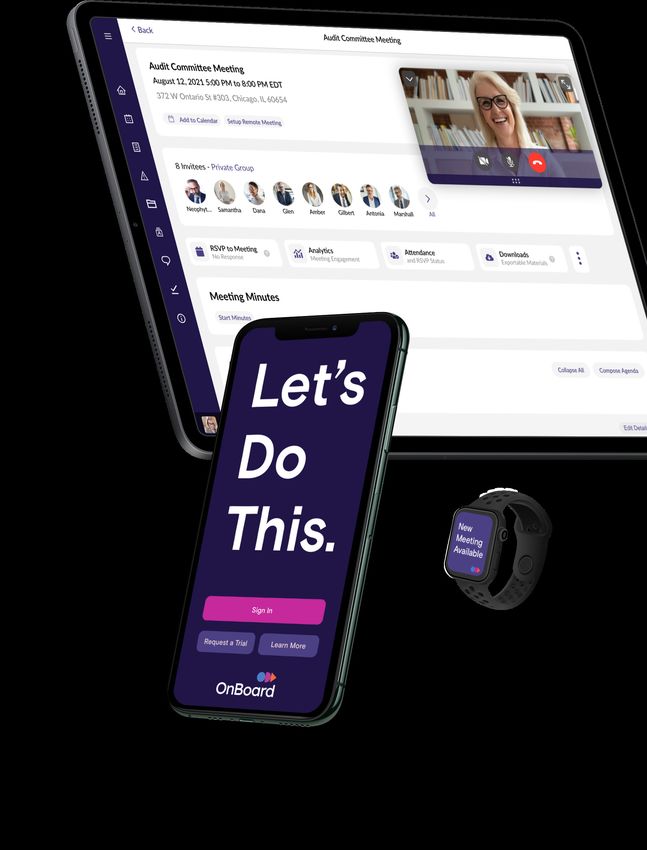
The proportions of responses were                A full two-thirds of survey respondents said
 consistent across different categories of        board collaboration has improved since the
 respondents, whether they were executive         shift to remote work and meetings, with 54%
 directors, non-executive directors, or board     saying they have seen some improvement
 administrators and staff members.                and 12% seeing a lot of improvement.

 Many said the shift to digital contributed
 to their success. When asked which
 factors most influenced the change in
                                                        59% of respondents
 effectiveness, 59% of respondents indicated            indicated the move to a
 the move to a remote work and virtual                  remote work and virtual
 meeting environment had a major impact.                meeting environment had
 Forty percent attributed it to a change in
                                                        a major impact.
 the general business environment, and 34%
 said the performance of the organization
 changed significantly.

 How Has Your Board’s Collaboration Changed
 Since the Shif t to Remote?

 Improved
   a lot            12%
                                                                        66%
                                                                      Improved
 Improved
   some
                                                  54%

Deteriorated
   a little
                          20%

Deteriorated
    a lot      3%

               0%           20%             40%            60%

 2021 Board Effectiveness Survey                                    onboardmeetings.com | 5
About half said their boards have spent more Board administrators and staff were slightly
time discussing strategic issues over the more affirming, with nearly 60% of
past 12 months than prior to the pandemic, non-directors saying good governance had
while 39% indicated they spend about the been achieved versus 53% of executive and
same amount of time discussing such issues. non-executive directors.
Four in 10 respondents also said they have
Thirty-eight percent of overall respondents
spent more time discussing organizational
said their boards have maintained
risk over the past year. Other areas such as
consistent levels of governance
fiduciary topics, investments, talent, board
compared to pre-COVID times, while 8%
reinvention, and board education generally
said governance has been difficult and
have received about the same amount of
challenging throughout the pandemic.
attention compared to before the pandemic.
When asked to describe the effectiveness
of their board’s governance in a virtual
environment, 54% of survey respondents
said they have achieved good governance
under challenging conditions.
Describe the Ef fectiveness of your Board’s Governance
in the Vir tual Environment
Good governance has
been achieved in a 54%
challenging environment
Continuity of governance
has been maintained, 38%
but challenging
Governance has been 8%
difficult and challenging
0% 20% 40% 60%
2021 Board Effectiveness Survey onboardmeetings.com | 6E XPERT ANALYSIS
Should Boards Transition to a Hybrid Model?
Despite the challenges of the past year,
many boards made successful transitions
to digital platforms. However, it is important
to keep those gains in an appropriate
context, says Matt Fullbrook, Manager of
the David & Sharon Johnston Centre for
Corporate Governance Innovation at the
University of Toronto’s Rotman School of
Management. There are pros and cons to
both virtual and in-person meetings. Now,
many boards are considering transitioning
to a hybrid approach—with some attendees
in-person and others remote—but Fullbrook
recommends proceeding with caution.
He contends that communication and
collaboration work best when everyone is
on a level playing field.
“When you get everybody on the same
platform, effectiveness increases,” says
Fullbrook, who has led research centers
focused on governance issues for more
than 20 years. “[Boards] should think twice
before going back to this blended model
that wasn’t working in the first place. Don’t [Boards] should think twice
let the fact that virtual meetings are good before going back to this
distract you from the fact that blended blended model that wasn’t
meetings are bad.”
working in the first place.
Instead, Fullbrook recommends Don’t let the fact that virtual
organizations consider a split approach,
meetings are good distract
with a designated number of full, in-person
meetings and a designated number of
you from the fact that
all-remote meetings per year. blended meetings are bad.
2021 Board Effectiveness Survey onboardmeetings.com | 7Greater Focus on Critical Issues
In addition to the challenges of the More than three-quarters of respondents
pandemic, widespread social and political said their boards are highly or somewhat
turmoil over the past year have fueled a focused on environmental, social, and
groundswell of support for assessing and governance issues. Yet 58% said their
advancing fundamental structural changes. organizations have not evaluated themselves
A majority of respondents to the on those issues, and 28% said they have
OnBoard survey said their boards have only partially assessed such issues internally.
significant room for improvement in Eighty-seven percent said their boards do
areas such as diversity, and the level not have committees dedicated to addressing
of focus on environmental, social, and environmental, social, or governance issues,
governance issues. and only 9% have plans to establish such
committees in the future.
Less than a quarter (21%) rated their
boards as very diverse, while 56% said Respondents cited several areas that should
they are somewhat diverse, and 23% said be of high importance to their boards moving
they are not diverse. Nearly half (48%) forward including:
said increasing board diversity is a serious • Ethics & compliance
strategic priority with specific actions
• COVID-19 response
planned, while another 39% said their
• Diversity, inclusion, & culture
boards have discussed the issue but have
not developed plans to address diversity. • Cybersecurity
• Local impact
76% 58% 87%
76% are focused on 58% of organizations have not 87% have no committees
environmental, social, and evaluated themselves on environmental, focused on environment, social,
governance issues social, and governance issues and governance issues
2021 Board Effectiveness Survey onboardmeetings.com | 8The Importance of Casting
a Broader Net
The need to increase diversity on boards More and more, organizations are realizing
to make them more representative of that they benefit from having a broader
the communities they serve is nothing range of experience, with individuals from
new. “Over the last 20 years, there’s no a variety of industries and backgrounds
governance topic that’s gotten more represented on their boards.
coverage and conversation than board
“When they’re looking for a new director,
diversity,” says Fullbrook of the Rotman
boards in general are casting their nets
School of Management. “Despite the fact
wider,” Fullbrook says. “There is a slow,
that it’s gotten so much airtime, if you take a
but meaningful evolution on the part of
snapshot, the numbers are still really low.”
board nominating committees in their
While overall diversity is lacking, there understanding of what actually makes a
have been clear gains when looking at new good director.”
directors coming onto boards. Compared
to 10 or 15 years ago, those individuals
today are much more likely to be younger,
female, or a person of color, he explains. For
example, a recent Rotman study* found that
after boards on the S&P/TSX Composite
Index changed their approach to recruiting
new directors, the percent of new, first-time
directors increased from 57% in 2008 to
72% in 2018. Among those, the percent of
visible minorities increased from 2% to 15%,
and the percent of female directors rose
from 15% to 38%. While turnover on boards
is historically slow, such trends will lead to
significant, long-term changes in
board composition.
*Source: The David and Johnson Centre for Corporate
Governance Innovation: “The Evolution of the Canadian Corporate
Director from 2008-18,” University of Toronto Rotman School of
Management, 2020.
2021 Board Effectiveness Survey onboardmeetings.com | 9Continuing The Momentum
While different boards have had varying Asked to rate the current effectiveness of
levels of successes or failures over the their boards, 63% chose between 6-8 on a
course of the past year, the survey results 10-point scale, for an average rating of 7.1.
indicate that a majority have embraced The responses were the same regardless
digital transformation and made important of whether respondents were executive or
gains in the face of immense adversity. non-executive directors, or non-director
Many boards strive to make further progress administrators or staff members.
in a post-pandemic environment.
Ninety-one percent of respondents said
Two-thirds (67%) said they anticipate their their boards have potential to reach an
boards will spend more time discussing effectiveness level of 8-10, for an average
strategy over the next 12 months, and more achievable score of 8.9. Making those gains
than 80% said their organizations are will require organizations to remain diligent
investing in their boards. That includes 47% in identifying shortfalls, and establishing and
that are making significant investments to acting upon clear goals for enhancing the
improve board composition, engagement, effectiveness of their boards. Leveraging
and education. technology has the potential to help boards
maximize their gains and continue to
Are You Making Significant accelerate their forward progress.
Investments in your Board?
Optimizing board management tools is
18% essential for boards seeking to maintain
35% No notable
Small investment momentum and build upon the important
investments
advancements they have made over the
past 12 months. While more than half of
survey respondents said they use board
management software, the degree to which
boards use such tools varies widely.
47%
Significant
investments
2021 Board Effectiveness Survey onboardmeetings.com | 10Of those that have board management
software, 56% said they use it primarily for
board meetings. Only 10% fully leverage
the software to conduct meetings, actions,
annual activities, and board education.
The survey results show that organizations 57%
that use specialized board management
software are more likely to:
• Have achieved positive governance
outcomes during the pandemic
Use Board
• Distribute meeting materials to board
members earlier
Management Software
• Have board members who are well
prepared for meetings
Those organizations also were more likely Among those who use
to have evaluated themselves on
environmental, social, and governance board management software:
issues, in part because the software
provides readily available tools for them to • 81% believed they increased board
conduct such evaluations. More than half of effectiveness in the last 12 months. For
organizations that use board management those without board management
software had partially or fully evaluated software, 58% believed they increased
themselves on such issues, compared to board effectiveness.
29% of those without software.
• 91% receive board materials three
Used optimally, board management or more days in advance vs. 78%
solutions have the potential to drive further for those with no software
progress by enhancing collaboration, and
helping boards make more informed, timely • 94% have board members who
decisions. Continued digital transformation are prepared for meetings vs. 88%
in the boardroom also has the potential for those who do not use board
to enable organizations to more easily management software
compare their performance to that of
their peers.
2021 Board Effectiveness Survey onboardmeetings.com | 11Conclusion
The COVID-19 pandemic compelled many Yet 43% of organizations still do not utilize
organizations to make much-needed even basic board management software in
and long-overdue changes to integrate any way, and therefore have no opportunity
technology into their everyday board to reap its benefits. Such organizations
management functions. Moving board work should take the lessons of the past year to
from the boardroom to the “Zoom room” heart and consider joining the 21st Century.
enabled organizations that were lagging The digital transformation is well underway
in digital transformation to experience its and moving forward at full steam, with or
benefits firsthand. Board leaders now face without them.
the critical decision of whether to continue
After all, it’s 2021. We’re flying helicopters
their momentum and lean into that digital
on Mars. Why isn’t your organization using
transformation, or to push away and revert
board management software to empower
to a traditional governance approach.
your board to accomplish more and be
Our data suggest that boards that have more effective?
leaned in and embraced digital tools
over the course of the past year are
more effective, more prepared, and
more collaborative as a result. Use of
board management software has helped
organizations improve efficiencies and
eliminate outdated and time-consuming
processes. In doing so, it has freed up their
time to focus on more important issues.
Those who continue to optimize board
management software and other
technology tools in the years ahead
have the potential to move well beyond
basic digital table stakes to affect real
change, including making advancements in
economic, social, and governance issues,
and promoting diversity, equity,
and inclusion.
2021 Board Effectiveness Survey onboardmeetings.com | 12E XPERT ANALYSIS
Key Recommendations from OnBoard
Based on our analyses of the 2021 survey
results, OnBoard recommends the following
steps as critical to helping boards continue
to improve:
• Carefully consider the optimal
formats—or combination of formats—
for hosting meetings in a post
pandemic environment to best suit
the unique needs of your organization.
• Collaborate to establish common
priorities and goals to ensure directors
can dedicate the valuable meeting
time needed to focus on vital
strategic issues.
• Move beyond talking about
environmental, social, and governance
issues, and take actionable steps to
improve in those areas.
• Commit to making meaningful
investments to improve board
composition, engagement,
and education.
• Ensure administrators and directors Commit to making
have the best tools available to do their
meaningful investments to
jobs, and that they are able to maximize
the full capabilities of those tools for improve board composition,
more effective governance. engagement, & education.
2021 Board Effectiveness Survey onboardmeetings.com | 13Get Started with OnBoard
Now more than ever, you need board and
leadership meeting management software
that’s comprehensive, secure, and helps
keep your team connected even while
working remotely. The answer is OnBoard.
OnBoard provides your team a complete
suite of tools to make smarter decisions,
remotely, in real-time. It enables directors
and leaders to think critically and
communicate seamlessly – no matter where
they are. So when the meeting starts,
directors are empowered to focus on
strategy and outcomes.
OnBoard is trusted by more than 12,000
boards and committees around the world
because it transforms meetings from
operational presentations to strategic
working sessions. See why OnBoard is
unquestionably essential below.
JOIN DEMO
FREE TRIAL
(765) 535-1882
onboardmeetings.com
more@onboardmeetings.com
US | UK | Canada | AustraliaYou can also read


