Bin Site Transition Plan - Prepared for the Ministry of the Environment, Conservation and Parks - AWS
←
→
Page content transcription
If your browser does not render page correctly, please read the page content below
PW-12-2019-3 - Attachment B

Bin Site Transition Plan
Prepared for the Ministry of the Environment, Conservation and Parks

DRAFT FOR DISCUSSION

September 25, 2019

The District Municipality of Muskoka
Engineering and Public Works Department
70 Pine Street, Second Floor
Bracebridge, Ontario
P1L 1N3
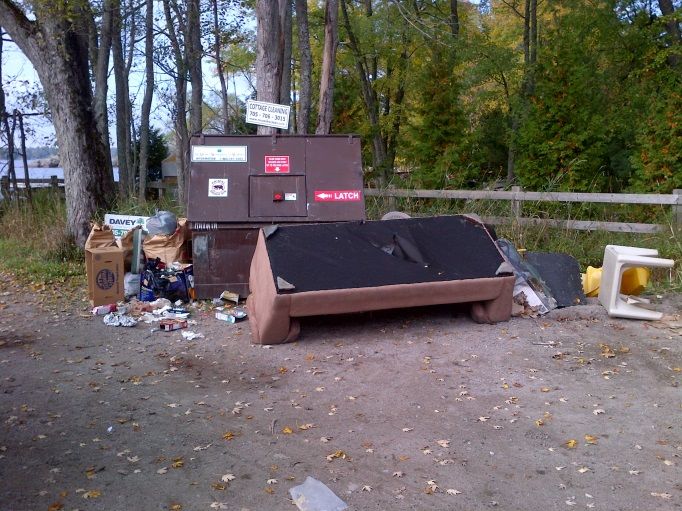
TABLE OF CONTENTS
PART 1 – BACKGROUND .............................................................................................................. 1

      1.1     INTRODUCTION ............................................................................................................ 1
      1.2     MUSKOKA WASTE MANAGEMENT ............................................................................. 1
      1.3     PROVINICIAL POLICY ................................................................................................... 2
          1.3.1       Waste Sites and the Environmental Protection Act (EPA) .................................... 2
      1.4     HISTORY OF THE “BIN SITE” ....................................................................................... 3
      1.5     THE PROBLEM .............................................................................................................. 3
      1.6     CURRENT BIN SITE NETWORK ................................................................................... 4
      1.7     MUSKOKA’S WASTE MANGEMENT STRATEGY ........................................................ 5
PART 2 – CHANGE IMPACT ASSESSMENT ................................................................................ 6

      2.1     ASSESSING IMPACT OF BIN SITE REMOVAL ............................................................ 6
      2.2     IMPACT EVALUATION CRITERIA ................................................................................. 6
      2.3     METHODOLOGY............................................................................................................ 8
          2.3.1       Consideration for “Positive” and “Negative” Impacts ............................................. 8
      2.4     RESULTS OF CHANGE IMPACT ASSESSMENT ....................................................... 12
      2.5     PHASING THE TRANSITION OF SITES ..................................................................... 12
      2.6     OTHER CONSIDERATIONS FOR PHASING .............................................................. 13
          2.6.1       Phase I Exemptions ............................................................................................ 14
PART 3 – SUPPORTING THE TRANSITION ............................................................................... 15

      3.1     ALTERNATE SERVICING STUDY – MUSKOKA WASTE COLLECTION ................... 15
          3.1.1       Consultation on Alternate Servicing for Waste Collection ................................... 15
          3.1.2       Concern of Increased Illegal Dumping ................................................................ 15
      3.2     DEVELOPMENT OF NEW DROP-OFF FACILITIES ................................................... 16
          3.2.1       Approval Process ................................................................................................ 16
          3.2.2       Proposed Timing ................................................................................................. 16
      3.3     COMMUNICATION PLAN ............................................................................................ 17
          3.3.1       Notification Process ............................................................................................. 17
          3.3.2       Communication Tools .......................................................................................... 18
      3.4     MONITORING AND REPORTING................................................................................ 19
          3.4.1       Illegal Dumping .................................................................................................... 19
          3.4.2       Annual Update to MECP on Transition Status .................................................... 19

  Bin Site Transition Plan – DRAFT FOR DISCUSSION
  Prepared for the Ministry of the Environment, Conservation and Parks
  September 25, 2019
                                                                                                                                  Page | i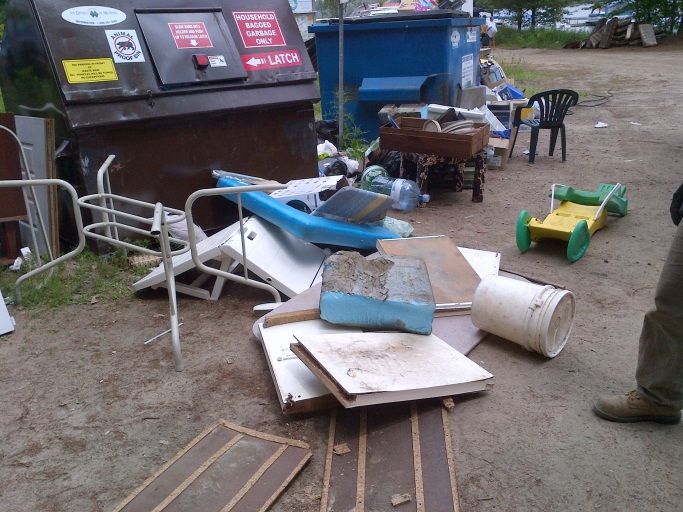
APPENDICIES
Appendix A      Correspondence from MECP on Bin Sites
Appendix B      Change Impact Assessment – Bin Site List and Phasing

LIST OF FIGURES

Figure 1        Muskoka Waste Management Facilities & Bin Site Locations

LIST OF TABLES

Table 1         Summary of 2019 Bin Site Network
Table 2         Impact Evaluation Criteria and Scoring
Table 3         Phases of Bin Site Transition
Table 4         Phase I Exemptions

 Bin Site Transition Plan – DRAFT FOR DISCUSSION
 Prepared for the Ministry of the Environment, Conservation and Parks
 September 25, 2019
                                                                           Page | ii
PART 1 – BACKGROUND
1.1 INTRODUCTION
Throughout Muskoka, approximately ninety (90) unstaffed dumpsters, referred to as “bin sites”,
are managed by The District Municipality of Muskoka (District) for provision of waste and blue
box recycling drop-off collection service to residents. In 2018, discussions began with the
Ministry of the Environment, Conservation and Parks (MECP) that these unlicensed, unstaffed
waste sites were essentially serving as transfer stations and they did not comply with the
Environmental Protection Act, 1990 (EPA), which governs waste management in Ontario.
Although the District is responsible for provision of waste management services to Muskoka’s
six Area municipalities, governing regulations and enforcement related to proper waste
management and associated facilities/infrastructure are the responsibility of the MECP whose
oversight ensures protection of human health and the natural environment. In 2019, the District
was formally notified by the MECP that unstaffed, unlicensed bins sites would have to be
removed over a four-year period, with complete abatement by 2023. Further, a plan outlining
how the District will ensure that their waste management system will come into full compliance
with the EPA – with complete abatement of the unlicensed bin sites – was given a deadline of
September 30, 2019 for submission.
Correspondence from the MECP in regard to Muskoka’s bin sites (e-mail dated June 14, 2019
and letter September 16, 2019) is provided for reference in Appendix A. Since receiving the
Ministry’s direction, District staff have made best efforts to expedite the preparation of the draft
plan to meet the September 30, 2019 submission deadline.
The purpose of this report is to outline the District’s draft plan for removing the bin sites – noting
that this process will be complicated by the extent these bins provide waste collection service
across the District, provision of alternate service in a complicated geographic region with many
water access-only residents, Muskoka residents’ dependence on convenient and free disposal,
and, essentially, change management. It will require comprehensive engagement, on-going
consultation, and a supportive communication plan.
As previously advised, it is noted that this draft transition plan will be presented to the District’s
Engineering and Public Works (EPW) Committee and District Council on October 23, 2019 and
November 18, 2019, respectively, for their consideration and endorsement. Until such time as
District Council’s endorsement is received, this plan should be considered to be in draft as has
been noted.
1.2 MUSKOKA WASTE MANAGEMENT
The District manages Muskoka’s integrated waste management system on behalf of six Area
Municipalities:
Township of Georgian Bay
Township of Muskoka Lakes
Township of Lake of Bays
Town of Huntsville
Town of Bracebridge
Town of Gravenhurst
Bin Site Transition Plan – DRAFT FOR DISCUSSION
Prepared for the Ministry of the Environment, Conservation and Parks
September 25, 2019
Page | 1The majority of its residential property owners are serviced through curbside collection with
approximately 37,000 curbside stops each week during the summer season. Curbside diversion
programs include blue box recycling and green bin organics.
In addition to curbside service, the District manages thirteen (13) licensed waste-receiving
facilities (transfer stations and depots) offering numerous diversion programs for residents such
as blue box recycling, scrap metal, mattresses, and leaf and yard waste/brush. Operations
include processing of organics/leaf and yard waste and landfilling at one remaining active site in
Bracebridge. Other services comprise long-term planning and policy, oversight of over 95
closed landfills (twenty-eight (28) with inspection and environmental monitoring requirements),
and supporting promotion and education programs.
As there is significant residential development on private road systems and water access
properties throughout Muskoka (over 15,500 units), the District has historically provided these
ratepayers with waste collection options that include drop-off alternatives such as the transfer
stations, depots, and unsupervised dumpsters – the “bin sites”.
1.3 PROVINICIAL POLICY
Although waste is controlled at all levels of government – federal, provincial, and municipal – it
is primarily regulated at the provincial level. In Ontario, waste management is governed by three
provincial Acts – the Environmental Protection Act (EPA), the Environmental Assessment Act
(EAA), and the Waste-Free Ontario Act (WFOA). These Acts, along with the Regulations under
them, establish and detail the authority and responsibility of the MECP and the legal
requirements for municipalities and proponents.
1.3.1 Waste Sites and the Environmental Protection Act (EPA)
The role of the EPA is to provide for the protection and conservation of the natural environment
(air, land, and water) and provide approval mechanisms for various waste management and
environmental operations. Within the EPA, there are specific regulations that mandate how all
waste generators in Ontario must manage their waste. These regulations pertain to various
aspects of a waste management system – operation of landfills and transfer stations, leaf and
yard waste composting, and management of blue box recycling, for example. Key regulations
include Ontario Regulation (O. Reg.) 347 – General – Waste Management and O. Reg. 101/94
– Recycling and Composting of Municipal Waste.
Under O. Reg. 347, operations at District waste management facilities are set out in
Environmental Compliance Approvals (ECAs), specific to each site. An ECA outlines rules of
operation for the storage, transportation, or disposal of waste. They are intended to protect
human health and the natural environment and are legally enforceable. The District’s active
landfill, closed landfill sites, and transfer stations/depots all operate under these licenses –
many have environmental monitoring programs, reporting requirements, and are inspected by
the MECP for compliance. Significant resources are expended each year (on inspections and
monitoring programs, for example) to ensure compliance and protection of the environment.
Bin Site Transition Plan – DRAFT FOR DISCUSSION
Prepared for the Ministry of the Environment, Conservation and Parks
September 25, 2019
Page | 21.4 HISTORY OF THE “BIN SITE”
For over 20 years, dumpsters have been provided throughout Muskoka by the District on road
allowances, vacant lands, and at commercial businesses such as marinas. Although effectively
acting as waste transfer stations, these dumpsters – commonly referred to as “bin sites” – have
operated without provincial approval – i.e. without a Certificates of Approval (C of A) or ECAs.
They have no environmental monitoring programs, reporting requirements, or security.
The intention of these bin sites was to provide convenient waste collection for residents that do
not receive curbside collection at their property. Water access residents, for example, could
utilize the bin site to drop-off their waste at a marina on the mainland. Other intended users of
these unmanned sites were residents on:
roads unsuitable for travel by a collection vehicles
water access/island residences and cottages
seasonal private roads/hunt camp trails
numbered private/seasonal roads with unit numbers
dirt paths and unassumed roadways
It was intended that these residents – again those without curbside collection – could drop off
three (3) bags of household garbage per week and divert blue box recyclables (i.e. the same
waste limits as residents with curbside collection).
Unfortunately, the reality of these sites is that they are heavily used, abused, and have become
exceptionally problematic throughout Muskoka.
1.5 THE PROBLEM
Unsupervised sites for waste collection have propagated abuse, illegal dumping, and serious
environmental risk as waste is left outside of provided bins, some along shorelines, and along
Muskoka’s beautiful roadsides. Many residents receiving curbside collection are utilizing bin
sites as a convenient alternative – increasing the volume of material received beyond what the
site can manage or what has been planned for based on the number of eligible serviced units. It
has also become apparent that many sites are utilized by commercial businesses – which are
not eligible for District waste management services – to avoid tipping fees. Items that should be
taken to a transfer station for diversion or disposal – such as large items, construction and
demolition materials, and household hazardous waste – are dumped at bin sites requiring
extensive District resources and funds to clean-up. On average, approximately ten (10) full-time
District staff are employed throughout the summer months to maintain and manage clean-up at
these sites. There is little diversion and what is placed in provided recycling bins is heavily
contaminated with garbage – impacting revenues, increasing disposal costs, and resulting in
landfilling of recyclable materials.
The MECP has identified potential human health and environmental impacts from this
uncontrolled dumping – noting that many of these bin sites are in close proximity to Muskoka’s
waterways. This was noted by the Ministry in discussions on their future and this transition plan.
This represents a significant liability to the District and property owners if a spill or other
environmental incident were to occur.
Bin Site Transition Plan – DRAFT FOR DISCUSSION
Prepared for the Ministry of the Environment, Conservation and Parks
September 25, 2019
Page | 3Bin sites have become a collection method which is unsustainable and, importantly, does not
align with the vision for future waste management in Muskoka.
1.6 CURRENT BIN SITE NETWORK
Bin sites are located in five of Muskoka’s Area Municipalities (the exception being the Township
of Lake of Bays) providing three types of service – year-round, summer-only, or winter-only
service. Table 1 below summarizes their usage throughout Muskoka and the type of service
they provide:
Table 1: Summary of 2019 Bin Site Network
Number of
Number of Number of
Year-
Area Municipality Winter Summer TOTAL
Round
Sites Sites
Sites
Township of Georgian Bay 11 - 8 19
Township of Muskoka Lakes 1 3 17 21
Town of Huntsville 9 2 5 16
Town of Bracebridge 3 11 3 17
Town of Gravenhurst 7 - 8 15
TOTAL 32 16 40 88
The locations of bin sites throughout the District are outlined on Figure 1 for reference.
Bin Site Transition Plan – DRAFT FOR DISCUSSION
Prepared for the Ministry of the Environment, Conservation and Parks
September 25, 2019
Page | 4Currently, winter and summer bins are put in place or removed (i.e. “shuffled”) in October (fall
shuffle) and April (spring shuffle) to prepare for both winter and summer service, respectively.
1.7 MUSKOKA’S WASTE MANGEMENT STRATEGY
Looking forward, Muskoka’s waste management Strategy will consider Muskoka’s inherent
dedication to environmental stewardship and that this be extended to our waste management
system. That through strong leadership and vision, the beauty of this region be protected from
illegal dumping and unsustainable disposal – leaving a legacy that reduces the amount of waste
we generate, reuses what we can, and recycles and recovers remaining resources.
Bin sites, although providing a convenient collection service for Muskoka’s residents, have
become exceptionally problematic and do not align with the future vison for sustainable waste
management. Specifically:
bag limits are unenforceable and users of bins sites are taking advantage of unsupervised
service;
illegal dumping is significant and unmanageable and commercial businesses are utilizing
bin sites to avoid tipping fees;
approximately 80% of recyclable materials collected at bins sites are landfilled due to
contamination and improper separation;
increased diversion at these sites is not possible – including any consideration for
implementing green bin options for organics diversion; and
increased costs for “free” and convenient garbage disposal – noting that this collection
method has the highest associated collection costs in Muskoka’s integrated waste
management system.
Transition of the bin sites will be an important first step towards a better, more responsible
integrated waste management system for Muskoka.
Bin Site Transition Plan – DRAFT FOR DISCUSSION
Prepared for the Ministry of the Environment, Conservation and Parks
September 25, 2019
Page | 5PART 2 – CHANGE IMPACT ASSESSMENT
2.1 ASSESSING IMPACT OF BIN SITE REMOVAL
It is acknowledged that transitioning bin sites will be challenging given their extent of usage
throughout the District, residents’ reliance on the convenient service they provide, and the
impact this change will have on the District’s integrated waste management system. They will
require service alternatives for waste collection, notification to impacted households,
communication and customer service support, and short-term monitoring for illegal dumping and
litter. The transition must be undertaken in a prudent and systematic manner with consideration
for the extent of impact to residents and District resources. In addition, there must be
opportunity for public input and stakeholder consultation in regard to alternate servicing.
Given the number of bin sites and the understanding that this will be a multi-year program for
transition, a Change Impact Assessment (Assessment) was undertaken to assess a wide range
of impacts that could potentially result from removing a bin site. Assessing impacts of removal –
and their severity – was seen as the best approach forward to determining the order of removal
and how to best prepare for the subsequent impacts on the District’s waste management
system. Sites were evaluated or “scored” across a wide range of impact criteria to fully examine
which sites could be transitioned first and those which will take more time and consultation to
effectively transition and determine alternate service.
Sites with the potential to impact human health and/or the natural environment are the first
priority – this is clearly understood direction from the MECP. From there, sites with lesser
impact will be transitioned – noting that there is varied usage, reliance on, and anticipated to be
different levels of impact from removing these sites. For example, some sites are less than
ten (10) km from an existing transfer station and will be less challenging to transition in
comparison to a site supporting a vast community of water access/island residents located more
than twenty (20) km from an existing waste facility.
The Assessment is an important first step in the transition plan – a tool that was used to assess
and fully understand the implications of changing the District’s waste operations from the
extensive use of unstaffed dumpsters to a better network of supervised drop-off facilities.
2.2 IMPACT EVALUATION CRITERIA
A range of criteria was used to assess the impact of removing a bin site – noting again that
impacts will vary across the District and communities. The criteria were used to evaluate and
prioritize bin site transitions and were identified by the Project Team based on their extensive
knowledge of the sites and how the District’s waste system currently operates. Criteria were
grouped into four main “buckets” – noting that some would be positive and some negative:
i. Impact on human health and the environment
given the lack of supervision and no monitoring requirements, there is the potential for bin
sites to negatively impact human health and the environment. Many sites have had
reported wildlife concerns (i.e. bears), household hazardous waste left behind, and
potential for concerning discharges to waterways.
Bin Site Transition Plan – DRAFT FOR DISCUSSION
Prepared for the Ministry of the Environment, Conservation and Parks
September 25, 2019
Page | 6 as was made clear in conversations with the MECP on the bin sites, those sites in close
proximity to receiving water bodies (including at marinas, etc.) would have the greatest
potential to negatively impact the environment – and, conversely, removing these sites
would have the greatest potential to bring positive change and minimize risk.
the evaluation considered any previous MECP involvement, direction, or history of spills or
bear activity, for example, at a site.
ii. Impact on residents
the number of eligible households that would be impacted by a site’s removal was
considered. For large numbers of impacted residents, for example, time would be required
to prepare for increased awareness, greater communication, and supportive customer
service. There would be greater impact.
the proposed alternative collection service was considered. For residents that could have
curbside collection service or be redirected to an existing, close-by transfer station, for
example, the impact would be less than having to travel a greater distance for service.
historical complaints and issues with the site were considered. For example, there would
be positive impact in transitioning sites that have been the subject of complaints in the
past from neighbours, have had reported illegal dumping, or requests to have them
removed.
iii. Impact on District operations and resources
two major considerations in regard to impact on District waste management operations
were considered – resources that may be required to advance alternative collection
service (such as new supervised waste drop-off facilities) and, secondly, resources
required for preparing for increased customer service and communication support.
Consultation and communication on alternate service for water access or island residents,
for example, would require additional resources given the extent of the service level
change.
the evaluation considered sites with large amounts of garbage, commercial usage (which
is not permitted given the District’s requirement to provide service for residential
customers only), and/or considerable resources being expended to clean-up litter.
Transitioning these sites would have a positive impact on District waste operations.
based on staff knowledge of the site and historical usage, the potential to easily transition
first was assessed – which would have a positive impact on District resources given that
bin sites are the most expensive collection method and require extensive staff time to
manage.
iv. Impact on Strategic direction
based on the District’s waste vision (as outlined in Section 1.7), the impact of a bin site on
the overall strategic direction for District waste management operations was assessed. For
example, transitioning sites with historical issues of illegal dumping or little diversion would
have a positive impact when considering the desire for increased diversion and reducing
disposal. Removing well-stewarded sites, however, would have less positive impact on
furthering the District’s Strategic vision as they already contribute to diversion, respect
garbage limits, and have few known illegal dumping issues.
Bin Site Transition Plan – DRAFT FOR DISCUSSION
Prepared for the Ministry of the Environment, Conservation and Parks
September 25, 2019
Page | 72.3 METHODOLOGY
The evaluation considered that a more impactful bin removal would have a higher overall score
– these sites would be more challenging – and should transition last. Lowest scoring bin sites
would transition first, indicating the potential for positive change impact, with removing many of
these sites having a positive impact on protection of the environment and Muskoka’s watershed.
Based on the four “buckets” described in Section 2.2, more specific evaluation scoring was
prepared. Criteria were weighted based on the Project Team’s understanding of the bin sites,
waste management operations, and previous direction on what would be considered critical
impacts. For example, potential for positive impacts on human health and the environment were
weighted heavily given their priority, followed by consideration for impact on service to
Muskoka’s residents. The impact on large numbers of residents – including those with water-
only access or with island properties – was considered throughout the evaluation.
Based on the criteria, weighting, and assessment, a “total impact score” could then be
determined for each of the sites.
2.3.1 Consideration for “Positive” and “Negative” Impacts
For reference, it is noted that positive impacts were weighted to reduce the impact score –
indicating that the negative impact of the bin’s removal on residents and/or the waste
management system could be offset when considering factors such as minimizing
environmental risk, stopping illegal dumping, and responding to some neighbourhood requests
to have the bin site removed.
In summary:
positive impacts – reduced the total impact score, with priority on protection of the
environment
negative impacts – increased the total impact score, with priority on how change would
impact residents utilizing the site
Impact evaluation criteria and corresponding scoring is provided for reference in Table 2 on the
following pages.
Bin Site Transition Plan – DRAFT FOR DISCUSSION
Prepared for the Ministry of the Environment, Conservation and Parks
September 25, 2019
Page | 8Table 2: Impact Evaluation Criteria and Scoring
Description –
Impact Evaluation Criteria Weighting Score
Impact of Bin Site Removal
Impact on human health and the environment
little increased positive impact – site has no historical issues with bears or
1
environmental concerns, not close to receiving water bodies (>50 m)
potential for positive impact on
some positive impact – potential for some positive impact, some noted bear
protection of human health and the
3 activity or site is close to receiving water body (approximately 15 to 50 m) or
natural environment – including -125
within a flood zone (but no major historical issues)
removing the potential for bears and
wildlife, protection of adjacent or significant positive impact – bin move will bring noted benefits to the protection
nearby water bodies of human health and/or the natural environment surrounding the site, location
5
has historical bear issues, or is very close to a receiving water body
(approximatelyTable 2: Impact Evaluation Criteria and Scoring continued
Description –
Impact Evaluation Criteria Weighting Score
Impact of Bin Site Removal
Impact on District operations and resources
little positive impact – change management is more complicated and transition
1 can't be undertaken in spring 2020 , no potential for significant positive impact
on budget, staffing, etc.
ability to implement change in the some positive impact – some potential for removal in spring 2020 although
first phase resulting in a positive -5 3 notification could be challenging, some potential for positive impact on budget,
impact on resources staffing, etc.
significant positive impact – spring 2020 would be a reasonable time to make the
5 transition, ability to provide adequate notification, significant positive impact on
budget, staffing, etc.
little impact – potential for curbside collection or existing manned facility already
1
in place as alternate service
ease of implementing the proposed
some impact – no curbside collection, some staff resources will be required for
alternative – curbside collection or 15 3
alternative service – but no complicated approval process
existing staffed transfer facility
significant impact – no curbside collection, approvals will be required for a
5
proposed alternative – will be a more lengthy/complicated process to implement
little impact on resources – existing manned facility already in place as a service
1
alternative
capital, operating budget required
some impact on resources – some budget will be required for alternative (such
for proposed alternative (use of 25 3
as curbside collection) but not extensive capital
resources)
significant impact on resources – proposed alternative will require extensive
5
capital funds to be budgeted accordingly
Bin Site Transition Plan – DRAFT FOR DISCUSSION
Prepared for the Ministry of the Environment, Conservation and Parks
September 25, 2019
Page | 10Table 2: Impact Evaluation Criteria and Scoring continued
Description –
Impact Evaluation Criteria Weighting Score
Impact of Bin Site Removal
little impact on resources – simple communication plan, few residents to be
1
notified, customer service can be easily managed with existing resources
some impact on resources – communication plan will be somewhat challenging,
implementation of a comprehensive 3 some resources will be required to manage/support anticipated customer service
15 needs
and adequate communications plan
significant impact to resources – more complicated notification and an extensive
communication plan (to both residents and political representatives) will be
5
required – significant number of residents impacted, nature of the site,
challenging proposed alternative, etc.
Impact on Strategic direction
little positive impact – site is already well-managed and diversion is occurring, no
1
dumping of garbage without participation in diversion (blue box recycling)
removal would align with District
waste management Strategy and some positive impact – site has some recycling or is sometimes contaminated
-5 3
vision and would positively impact with garbage, some diversion occurring
diversion goals
significant positive impact – site historically contributes little recycling or material
5
is considerably contaminated, little diversion, and substantial dumping of waste
Bin Site Transition Plan – DRAFT FOR DISCUSSION
Prepared for the Ministry of the Environment, Conservation and Parks
September 25, 2019
Page | 112.4 RESULTS OF CHANGE IMPACT ASSESSMENT
Applying the criteria outlined on Table 2, the Project Team reviewed all sites and discussed
historical issues, how waste is being collected in communities around the sites, resources being
allocated to maintain the bin site, and concerns from neighbouring landowners, for example. As
outlined in Section 2.3, the Assessment was comprehensive and considered a range of both
positive and negative potential impacts from each bin site’s removal. Positive impacts – such as
protection of the environment or reducing illegal dumping – were an important part of the
evaluation. Each site was scored – to get a “total impact score” – and ranked accordingly. It is
noted again that the higher scored sites would have more challenging transitions given their
increased negative impact on the waste management system.
Appendix B outlines the review and scoring of the eighty-eight (88) bin sites across the District.
Based on the results of the Assessment, the transition is proposed to be phased over a three-
year period to meet the MECP’s 2023 deadline. Assessing the sites and their alternate service
options resulted in a clear understanding that a phased transition will be necessary to ensure
further consultation and that resources are in place – including the provision of new supervised
drop-off facilities to service residents and, in addition, supportive customer service to respond to
inquiries and correspondence. The sites cannot be transitioned simultaneously given the
pressure that this would place on the District’s waste management system.
It is noted that District Council may require additional time to consider bin site removal in 2021
through 2023. However, the District intends to meet the overall deadline of April 30, 2023 as
mandated by the MECP.
2.5 PHASING THE TRANSITION OF SITES
Given an understanding of how the bins are managed each year (i.e. to consider winter and
summer collection service), bin transition phases will follow the annual “bin shuffle” to assist with
communication and District contract arrangements.
The description of bin site transition phases are outlined below in Table 3.
Bin Site Transition Plan – DRAFT FOR DISCUSSION
Prepared for the Ministry of the Environment, Conservation and Parks
September 25, 2019
Page | 12Table 3: Phases of Bin Site Transition
Sites to
Phase Timing Description of Bin Sites Transitioning
Transition
year-round and summer bin sites that have the
potential to negatively impact human health and the
environment (i.e. history of bear activity or sites in
spring close proximity to waterways)
I 19
2020
these sites have an alternate drop-off waste
receiving facility less than 15 km away or are in an
area to expand curbside collection
primarily winter bin sites close to existing transfer
stations or have alternate reasonable collection
fall service (curbside collection)
II 10
2020 considers other sites in the same vicinity that would
act as alternate dumping locations if not transitioned
with the other winter sites
advancing MECP approvals for alternate waste facilities
2021
contingency (for Council-directed expedited transitions, etc.)
primarily bin sites that are close to existing transfer
stations or in areas where curbside collection can
spring be extended to provide alternate service
III 29
2022 further study, however, will be required on alternate
service provision as many sites support water
access and/or island residents
bin sites that will require advancing additional
staffed waste facilities to provide alternate service
anticipate at least two additional drop-off waste
spring
IV 30 facilities (Torrance area and Highway 118E)
2023
further study will be required on alternate service
provision and consideration for water access and/or
island residents
2.6 OTHER CONSIDERATIONS FOR PHASING
It is noted that over 2020, supplementary works such as additional public consultation and
engagement, District and lower-tier Council approvals, advancement of works associated with
investigating alternate service (see Section 3.1), and determining the location of additional
waste drop-off locations will be undertaken. Phase IV sites will require additional time to further
necessary provincial approval (i.e. ECAs for new waste transfer sites). In addition, bin sites
providing dockside service at marinas for water access residents or in locations that are
geographically challenging will require additional time for determining alternate waste collection
service. It is noted that 2021 will be a year of waiting on MECP approvals and contingency
should Council direct that some bin site transitions be expedited pending the recommendations
in the Alternate Servicing Study.
Bin Site Transition Plan – DRAFT FOR DISCUSSION
Prepared for the Ministry of the Environment, Conservation and Parks
September 25, 2019
Page | 13It is also noted that “bin families” were considered in the phasing. For example, if a bin site was
scored as a Phase II site, all bin sites close were phased to transition with it. The reasoning – if
bin sites are left in areas where some have been removed, the remaining sites are vulnerable to
increased dumping, excessive amounts of garbage, and communication to residents will be
challenging. Sites will transition together to allow for consistent and targeted messaging.
2.6.1 Phase I Exemptions
As indicated on the summary table in Appendix B, some bin sites that, although are close to
existing waterways or potentially pose a risk to human health, have considerable challenges on
provision of immediate alternate waste collection service. These sites are considered Phase I
exemptions – listed in Appendix B as Phase III or Phase IV sites. They will require further
examination of alternate collection service and additional time will be required to assess waste
collection in these areas. This will be discussed further in Section 3.1.
Table 4 below notes the bin sites that were considered exemptions to Phase I due to their
distance to existing transfer stations, inability to extend curbside collection, or require further
examination of alternate service provision (consideration of water access properties and island
residents, etc.).
Table 4: Phase I Exemptions
Closest Distance to
Area Site
Site Name Existing Transfer
Municipality Number
Station (km)
Wawatosa Marina Georgian Bay 89 9
Woods Landing Marina Georgian Bay 94 11
Minors Bay Road
Georgian Bay 50 18
Parking Lot
King Bay Marina Georgian Bay 40 28
Riley Lake Road Gravenhurst 70 32
Troy Cove Marina
Muskoka Lakes 85 30
(Skeleton Lake Road #2)
Beaumaris Yacht Club Muskoka Lakes 7 19
Caribou Road Bracebridge 16 30
Walkers Point Marina Muskoka Lakes 88 25
Campbells Landing Marina Gravenhurst 15 21
Villas Marina (formerly
Gravenhurst 65 23
Pride West Marina)
Bin Site Transition Plan – DRAFT FOR DISCUSSION
Prepared for the Ministry of the Environment, Conservation and Parks
September 25, 2019
Page | 14PART 3 – SUPPORTING THE TRANSITION
3.1 ALTERNATE SERVICING STUDY – MUSKOKA WASTE COLLECTION
The goal of transitioning the bin sites is to replace all unstaffed sites with alternate waste
collection service that will provide a reasonable level of service for Muskoka’s residents while, at
the same time, align with Muskoka’s waste management Strategy as we seek to increase waste
diversion to more than 60%, extend the life of the Rosewarne Landfill Site, and to encourage the
diversion of food and organic waste by expanding the District’s Green Bin program.
With the transition of the bin sites, an Alternate Servicing Study – Muskoka Waste Collection will
be advanced early in 2020 to present information on the existing system and future options for
waste collection service throughout the District. As outlined in Appendix B, the study will focus
on Phase III and IV bin sites and provision of alternate service – including both curbside
collection and opportunities for public drop-off of garbage and divertible materials. It will
consider the existing level of service, Best Practices, diversion goals, and other municipal
integrated waste management systems and depot networks as comparators. This study will
review special Muskoka considerations such as the large number of seasonal residents, water
access and island residents, and geographical challenges that influence how waste is collected.
It is expected that the study will provide recommendations for District Council’s consideration on
advancing additional licensed facilities to coincide with the later transition phases (Phase III and
IV). Further, it is anticipated that this study will review potential sites and make
recommendations based on land use and the best potential locations for new facilities.
3.1.1 Consultation on Alternate Servicing for Waste Collection
As noted throughout this report, transitioning of the bin sites will be challenging as many
residents – both with land and water-only access – rely on this service for waste collection and
have expectations on the level of service received. It is well understood that the transition
process must engage stakeholders and provide opportunity for consultation with ratepayers as
Muskoka’s waste management system changes with removal of the bins. As outlined in
Section 3.3, consultation will be imperative to the success of the bin site transition.
It is anticipated that in 2020, sessions will be organized as part of the Alternate Servicing Study
to focus on reviewing service levels, options for alternate methods of waste collection, proposed
locations for new drop-off facilities, and specific challenges different areas throughout Muskoka
face in regard to waste collection. This will form part of the Alternate Servicing Study report and
provide feedback for District Council’s consideration and to guide decision-making.
3.1.2 Concern of Increased Illegal Dumping
Given concerns of area residents that the transition of bin sites may increase illegal dumping,
the Alternate Servicing Study will extend to consider mechanisms available to the District and
Area Municipalities to address this province-wide problem. It is noted that many existing bin
sites are already acting as illegal dumping sites – collecting garbage from commercial
businesses, non-residents, and garbage from residents far beyond Muskoka’s free weekly
limits. Control mechanisms for consideration could include increased by-law enforcement,
collaboration with Area Municipalities and the MECP, a plan for better reporting mechanisms,
cameras at historically problematic sites, and targeted promotion and education campaign(s).
Bin Site Transition Plan – DRAFT FOR DISCUSSION
Prepared for the Ministry of the Environment, Conservation and Parks
September 25, 2019
Page | 153.2 DEVELOPMENT OF NEW DROP-OFF FACILITIES
Based on the findings of the Alternate Servicing Study and District Council’s direction, new
drop-off facilities will be advanced – with anticipated commissioning in spring 2023 to coincide
with the transition of the Phase IV bins sites.
Based on the Project Team’s knowledge of the area and the District’s waste management
operations, it is anticipated that at least two new facilities will be required – one in the Township
of Muskoka Lakes in the Torrance area, one on Highway 118 E in the Town of Bracebridge.
This is preliminary at this time and will be furthered with information from the formal servicing
study – noting that there still may be areas in the District that require supporting licensed drop-
off waste collection sites to support bin site removal.
It is noted that a new transfer facility is currently being developed in Huntsville to provide greater
access for residents to an efficient transfer station with expanded diversion opportunities. Once
commissioned, the Stisted Transfer Station will close.
3.2.1 Approval Process
New waste receiving facilities advanced to facilitate the bin site transition will be fully permitted
as per the requirements in the EPA and as outlined by the MECP in the following document:
https://www.ontario.ca/document/guide-applying-environmental-compliance-approval-0
With Council direction on the recommendations brought forward in the Alternate Servicing
Study, works will begin on preparing documents to submit applications for Environmental
Compliance Approvals (ECAs) for new waste receiving site(s).
3.2.2 Proposed Timing
Anticipated timing to receive approval from the MECP of an ECA application is one (1) year
from submission. To prepare for the 2023 deadline, works will begin immediately on the
Alternate Servicing Study and determination of new site(s) given the lengthy approval period.
Again – some contingency has been allotted to ensure full abatement by April 30, 2023 but
some discussion may be necessary with the MECP to ensure approvals are received with time
to construct and commission new facilities to coincide with transitioning Phase IV bin sites.
2019 (Q4) to 2020 (Q3) advance Alternate Servicing Study (and consultation process)
determine number and location of new waste receiving facilities
obtain District Council and lower-tier approval of proposed
alternatives, submit budget request for funding approval
2020 (Q4) to 2021 (Q1) budget approval confirmed, advance studies
submission of ECA application(s)
2021 (Q1) to 2021 (Q4) MECP approval process for new ECAs
2022 construction of new waste receiving facilities
2023 (Q1) commissioning of new staffed waste receiving facilities to prepare
for Phase IV bin site transition (anticipated for April 2023)
Bin Site Transition Plan – DRAFT FOR DISCUSSION
Prepared for the Ministry of the Environment, Conservation and Parks
September 25, 2019
Page | 163.3 COMMUNICATION PLAN
It is well understood that the transition process must engage stakeholders and provide
opportunity for consultation with ratepayers as bins are removed and alternate service is
advanced. Further, as sites are transitioned, the communication plan must involve District and
local Councils, the MECP, and utilize a variety of methods to relay information to residents. Prior
to each phase, the District will work with stakeholders to ensure that key messages and
information is provided to support the change.
The four (4) transition phases have strategically been planned to align with the timing of the
regular set-out of bins to accommodate both summer and winter collection. Prior to the seasonal
shuffle of bins, the number of impacted residents with transitioning bin sites and specific details
of alternate service will be assessed. Notification will be sent by mail only to residents who are
noted to be eligible for the bin site service – noting that many of these sites support ineligible
users such as households receiving curbside collection or contractors with construction and
demolition waste. Formal notification by mail is not intended for these users.
Further, should the bin site be known to support an area represented by a cottage or lake
association, as is quite common throughout Muskoka, the association will be notified and
material provided to circulate to its’ members.
3.3.1 Notification Process
Prior to each of the transition phases, the following process is proposed to ensure proper
communication amongst all stakeholders:
notification to District Engineering and Public Works (EPW) Committee/Council that
communication regarding the bin site transition is being initiated and circulated
↓
notification to the MECP that residents will be notified that the bins will be removed or
not placed back at the fall/spring “bin shuffle”
notification to the Area Municipality on the impacted bin sites and that residents will
be notified of the transition plan
↓
letter sent to impacted households – provision of information on the alternate service
and FAQ Document (see Section 3.3.2)
↓
site signage put at impacted bin site indicating that the bin will be removed/not placed
back at the regular spring/fall “bin shuffle” (see Section 3.3.2)
↓
e-mail sent to “Bin Site Transition” project contact list with update
↓
information placed on the District’s webpage and EngageMuskoka.ca (i.e. why are bin
sites going?) and the Project Team and Councillors readied for response to residents
Bin Site Transition Plan – DRAFT FOR DISCUSSION
Prepared for the Ministry of the Environment, Conservation and Parks
September 25, 2019
Page | 173.3.2 Communication Tools
Change is hard – and the Project Team will work to prepare supportive messaging at all stages
of the bin site transition and plan in advance for the questions and concerns of residents.
Specific communication tools will include:
FAQ document – this document will be updated frequently to address the various questions
and concerns that will come with the transition. The FAQ will be used to respond to
inquiries, will be posted on the District’s webpage and EngageMuskoka.ca, and circulated
with notifications (as outlined in Section 3.3.1). Supplied in “editions”, it is anticipated that
the first edition will be prepared following approval of this plan and will provide detailed
answers on matters such as:
→ Why are the bin sites being removed?
→ My bin is gone, now what do I do with my garbage?
→ Where is there more information on location of waste transfer stations?
→ Where can residents submit comments or feedback?
→ I don’t get anything for my taxes except garbage disposal at the bin site. What do I
get for my taxes?
→ Why do all residents have to be punished for those who illegally dump? Can’t you
use cameras to fine the offenders?
→ If a site is well-stewarded and does not allow illegal dumping, can it stay?
→ Can I get a bin site at my marina?
→ What is the future use of the bin site property?
→ Will the District continue to clean up illegal dumping at this location after the bins
are taken away?
→ How can I find out if I receive curbside collection on my street or add my street to
a collection route?
a project contact list will be formed to keep residents updated on consultation/information
sessions, the status of the transition, and to provide communication material such as the
updated FAQ document
utilization of social media and EngageMuskoka.ca to provide updates and receive feedback
site signage – sites to be transitioned will have signs posted noting the location of alternate
waste collection (the nearest transfer station(s)) and contact information. It is anticipated
that signs will be posed once residents have been notified that the bin will be removed/not
placed back at the next “bin shuffle”
Bin Site Transition Plan – DRAFT FOR DISCUSSION
Prepared for the Ministry of the Environment, Conservation and Parks
September 25, 2019
Page | 183.4 MONITORING AND REPORTING
3.4.1 Illegal Dumping
Further to the recommendations brought forward in the Alternate Servicing Study (as outlined in
Section 3.1.2) and at the direction of District Council, measures will be enacted to address
illegal dumping. Such measures may include:
stricter waste management by-laws and enforcement
dedicated by-law staff
greater collaboration with Area Municipalities and the MECP on enforcement
prevention measures such as surveillance cameras at problematic sites
consideration for bulky item collection services
new reporting tools such as the waste management app and District website
creation of community watch programs
It is noted that District staff will continue to monitor bin sites that have been transitioned to
ensure that no garbage or litter is left at these sites.
3.4.2 Annual Update to MECP on Transition Status
As part of this plan, the District commits to provision of an annual update and summary of works
prepared as part of the bin site transition to be submitted by April 30 of each year until all bin
sites are transitioned by April 30, 2023.
This update – to be provided also to District EPW/Council – will provide details on the sites
transitioned and progress made in regard to alternate collection service. In addition, it is
anticipated to provide information on illegal dumping observed, feedback received, and impacts
on District customer service.
Bin Site Transition Plan – DRAFT FOR DISCUSSION
Prepared for the Ministry of the Environment, Conservation and Parks
September 25, 2019
Page | 19FIGURES Bin Site Transition Plan DRAFT FOR DISCUSSION September 25, 2019
Figure 1: Muskoka Waste Management Facilities
& Bin Site Locations
Stisted T.S.
Novar
26
!
Township
of
Lake of Bays
r
61
( Sinclair T.S
71
L
M !
L
M
Town of Huntsville
Hidden Valley Hillside
Huntsville
82
93
!
17
Tower Rd T.S ( 85 ! The Locks 58
84 ( 46 31 !
51
12 Mile Bay Depot 40 66 Minett( ( 74
( ! <
54
Franklin T.S
Mactier Foots Bay
(Summer Only)
( ( 90
73
! Dwight
( 24 <
47
( 25 Windermere 45
(
L
M
L
M (95
(
( 44 ( Utterson
Township
60 32
Q
M ( ( !
of Port Sydney
Port Carling
Muskoka Lakes 57
(
Township Glen Orchard 14
of
<
L
M Ridout T.S
Georgian Bay Eveleigh T.S
McLean T.S
South Gibson Depot 30 Dorset
Town of Bracebridge
50 2 Milford Bay
(Year Round)
! ! ( (
13 7
43
< 81
L
M
Baysville
L
M
Bala 4 23 < <
34
( ( 27
63APPENDIX A Correspondence from MECP on Bin Sites Bin Site Transition Plan DRAFT FOR DISCUSSION September 25, 2019
SEP 19 'M«
                                                                             Ontario^
Ministry of the Environment,   Ministere de I'Environnement, de
Conservation and Parks         la Protection de la nature et des Pares

Barrie District                District de Barrie

1201-54 Cedar Pointe Drive     1201-54 chemin Cedar Pointe
Barrie ON L4N5R7               Barrie ON L4N 5R7
Tel: (705)739-6441             Tel:   (705)739-6441
1-800-890-8511                 1-800-890-8511
Fax:(705)739-6440              Telec: (705)739-6440

September 16, 2019

Fred Jahn
Commissioner, Engineering and Public Works
The District Municipality of Muskoka
70 Pine Street, Bracebridge, ON P1L 1N3

RE: Abatement Plan for the Closure of the Unapproved Waste Transfer Stations (Bin Sites)

Dear Fred,

As follow-up to our meeting on September 6, 2019, I wanted to take this opportunity to reiterate
the Barrie District Office's (Ministry) requirements in relation to the unapproved waste transfer
stations (bin sites) being operated by the District Municipality of Muskoka (the District).

The District has been operating over 90 unapproved waste transfer stations (bin sites),
on public and private properties, for greater than 20 years, in non-compliance with
Section 40 of the Environmental Protection Act, R.S.O. 1990, c. E.19. As you are
aware, these unapproved bin sites present potential human health and environmental
impacts, as well as legislative non-compliance issues, so we are encouraged to see that
the District is addressing this issue.

The bin sites are not designed to be environmentally secure, as they permit 24 hour per
day access, with no site supervision. As a result, Ministry Environmental Officers have
identified potential human health and environmental impacts from the uncontrolled
dumping, which has at times, included the dumping of hazardous wastes. As many of
the bin sites are located at boat launches and marinas, they present a significant risk of
spills to the lakes in Muskoka. This also represents a significant liability to the District
and the property owner, if there was a spill or other environmental incident.

During our meeting you confirmed that the District will submit an abatement plan by
September 30, 2019, that will ensure that all of the unapproved bin sites will be
removed/decommissioned by April 31, 2023, and that it is the District's intension to
establish more centralized, approved, waste transfer stations, that meet all of the
Ministry's design and operational standards, and are protective of human health and the
Muskoka watershed. The abatement plan will include a schedule for the closure and

Bin Site Transition Plan                                                     DRAFT FOR DISCUSSION
September 25, 2019
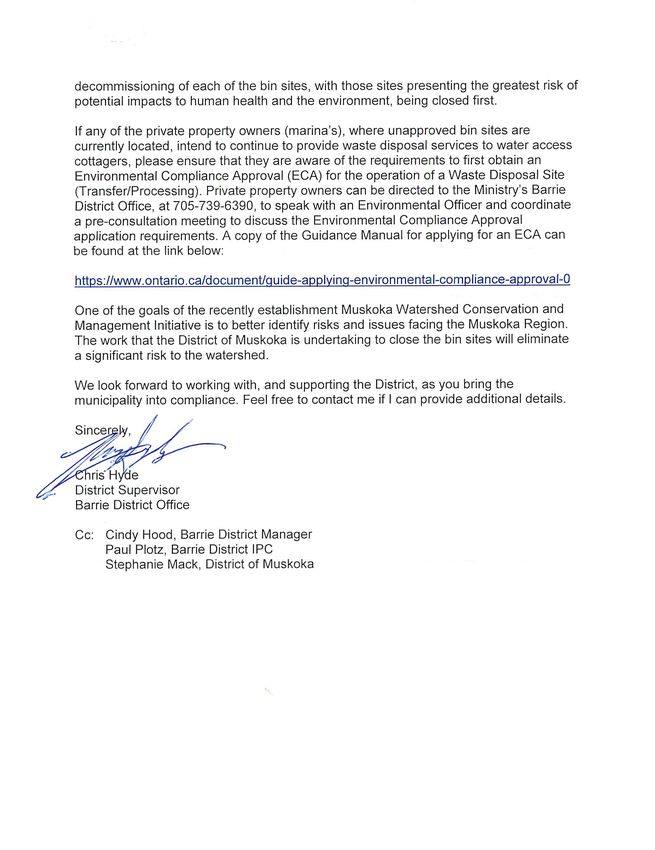
decommissioning of each of the bin sites, with those sites presenting the greatest risk of
potential impacts to human health and the environment, being closed first.
If any of the private property owners (marina's), where unapproved bin sites are
currently located, intend to continue to provide waste disposal services to water access
cottagers, please ensure that they are aware of the requirements to first obtain an
Environmental Compliance Approval (ECA) for the operation of a Waste Disposal Site
(Transfer/Processing). Private property owners can be directed to the Ministry's Barrie
District Office, at 705-739-6390, to speak with an Environmental Officer and coordinate
a pre-consultation meeting to discuss the Environmental Compliance Approval
application requirements. A copy of the Guidance Manual for applying for an ECA can
be found at the link below:
https://www.ontario.ca/document/quide-applving-environmental-compliance-approval-0
One of the goals of the recently establishment Muskoka Watershed Conservation and
Management Initiative is to better identify risks and issues facing the Muskoka Region.
The work that the District of Muskoka is undertaking to close the bin sites will eliminate
a significant risk to the watershed.
We look forward to working with, and supporting the District, as you bring the
municipality into compliance. Feel free to contact me if I can provide additional details.
me
District Supervisor
Barrie District Office
Cc: Cindy Hood, Barrie District Manager
Paul Plotz, Barrie District IPC
Stephanie Mack, District of Muskoka
Bin Site Transition Plan DRAFT FOR DISCUSSION
September 25, 2019You can also read


