Chromosome Evolution in Marsupials - Review - MDPI
←
→
Page content transcription
If your browser does not render page correctly, please read the page content below
G C A T
T A C G
G C A T
           genes
Review
Chromosome Evolution in Marsupials
Janine E. Deakin      ID

 Institute for Applied Ecology, University of Canberra, Canberra, ACT 2617, Australia;
 janine.deakin@canberra.edu.au; Tel.: +61-2-6206-8663

 Received: 23 December 2017; Accepted: 1 February 2018; Published: 6 February 2018

 Abstract: Marsupials typically possess very large, distinctive chromosomes that make them excellent
 subjects for cytogenetic analysis, and the high level of conservation makes it relatively easy to track
 chromosome evolution. There are two speciose marsupial families with contrasting rates of karyotypic
 evolution that could provide insight into the mechanisms driving genome reshuffling and speciation.
 The family Dasyuridae displays exceptional karyotype conservation with all karyotyped species
 possessing a 2n = 14 karyotype similar to that predicted for the ancestral marsupial. In contrast,
 the family Macropodidae has experienced a higher rate of genomic rearrangement and one genus of
 macropods, the rock-wallabies (Petrogale), has experienced extensive reshuffling. For at least some
 recently diverged Petrogale species, there is still gene flow despite hybrid fertility issues, making
 this species group an exceptional model for studying speciation. This review highlights the unique
 chromosome features of marsupial chromosomes, particularly for these two contrasting families,
 and the value that a combined cytogenetics, genomics, and epigenomics approach will have for
 testing models of genome evolution and speciation.

 Keywords: cytogenetics; epigenomics; genome evolution; genomics; speciation; wallaby

1. Introduction
      Two observations led to the idea that chromosome rearrangements may play a role in speciation;
chromosome numbers can vary greatly, even between closely related species, and hybrids resulting
from crosses of individuals with different chromosome arrangements often experience reduced
fertility [1,2]. Whether chromosome rearrangements actively contribute to the speciation process or are
an incidental consequence remains unclear and has been much debated in the literature (reviewed
in [3]). How chromosome rearrangements occur in the first place is fundamental to understanding
genome evolution. Do rearrangements occur randomly across the genome or are certain regions prone
to rearrangement and if so do these regions have common features? These are the questions that
have driven genome evolution research in recent years (reviewed in [4]). Comparisons of different
sequenced vertebrate genomes have supported a “fragile breakage model” for genome evolution,
identifying regions of the genome prone to breakage [5–7]. In mammalian genomes, these fragile
regions are enriched for repetitive sequences, including segmental duplications, are often gene
dense, and are actively transcribed (reviewed in [4]). Recently, the “integrative breakage model”
was proposed. This model not only considers the sequence content but also takes into account gene
function, epigenomic features, and chromatin conformation of regions involved in chromosome
rearrangements [4]. The model posits that regions prone to genomic reshuffling have an open chromatin
conformation, are enriched with actively transcribed genes but not those with an essential function,
and are regions in physical contact within the nucleus [4]. This model is supported by fine-scale
comparisons of rodent genomes with those of outgroup species where evolutionary breakpoints were
gene-rich and had an epigenetic profile of open, actively-transcribed chromatin [8].
      The challenge is finding appropriate groups of study species on which to test models of genome
evolution and speciation. One group of mammals that may be ideal for these purposes is the infraclass

Genes 2018, 9, 72; doi:10.3390/genes9020072                                       www.mdpi.com/journal/genes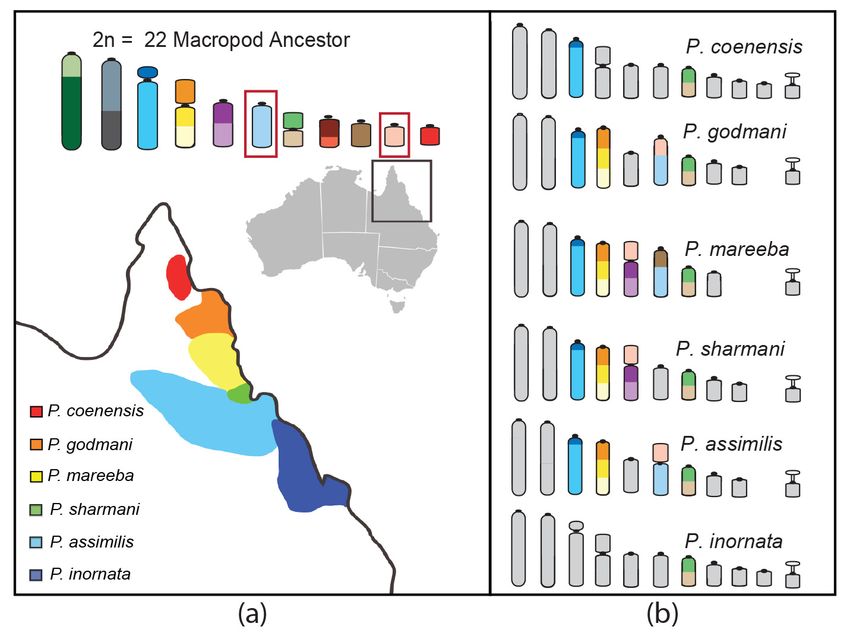
Genes 2018, 9, 72                                                                                                          2 of 15
 Genes 2018, 9, x FOR PEER REVIEW                                                                                           2 of 15

Metatheria—the     marsupials. marsupials.
 infraclass Metatheria—the       Here, I highlight theI unique
                                               Here,            features
                                                          highlight   the of marsupial
                                                                           unique        chromosomes
                                                                                    features          and
                                                                                              of marsupial
how   these features could  help  to address questions   regarding   the mechanisms    involved
 chromosomes and how these features could help to address questions regarding the mechanisms    in genome
reshuffling
 involved inand  the role
              genome      that rearrangements
                       reshuffling  and the roleplay
                                                 that in speciation.
                                                      rearrangements     play in speciation.

2.2.Marsupial
    MarsupialChromosome
              ChromosomeEvolution
                        Evolution
      There
       Thereare
              areover
                   over300300species
                               speciesof  ofmarsupials
                                            marsupialsthat thatarearesplit
                                                                       splitbetween
                                                                             betweenthe theAmericas
                                                                                             Americaswith withapproximately
                                                                                                                approximately
100  species   (Ameridelphia)        and    Australasia,    consisting     of  just  over   200   species
 100 species (Ameridelphia) and Australasia, consisting of just over 200 species (Australidelphia). The     (Australidelphia).
The  Ameridelphia
 Ameridelphia      andand     Australidelphia
                         Australidelphia          last
                                               last    shared
                                                     shared   a acommon
                                                                    commonancestor
                                                                                ancestoraround
                                                                                           around80  80 million
                                                                                                         million years
                                                                                                                   years ago
                                                                                                                          ago [9].
                                                                                                                               [9].
Marsupials,
 Marsupials,with with their  large
                         their      chromosomes
                                 large    chromosomes and small
                                                             and diploid       numbers,
                                                                     small diploid         were among
                                                                                        numbers,      werethe   first mammals
                                                                                                              among     the first
to have theirtochromosomes
 mammals                            observed in theobserved
                   have their chromosomes                early partinofthe  last early
                                                                                 century    andoftheir
                                                                                         part        lastchromosomes
                                                                                                           century and were  their
noted
 chromosomes were noted to be particularly amenable to being studied [10–13].isThe
        to be  particularly     amenable     to being   studied      [10–13].   The  ancestral     marsupial       proposed     to
                                                                                                                        ancestral
have  possessed
 marsupial          a 2n = 14tokaryotype,
              is proposed                       similar
                                   have possessed         to the
                                                       a 2n   = 14karyotype
                                                                      karyotype,observed
                                                                                    similar to in the
                                                                                                   many   species distributed
                                                                                                      karyotype     observed in
across
 many species distributed across the marsupial phylogeny [14–16]. The large marsupial to
        the marsupial     phylogeny      [14–16].  The  large   marsupial     chromosomes        are predicted      have arisen
                                                                                                                  chromosomes
mainly   from   the  fusion   of  chromosomes        present   in  the  common      ancestor
 are predicted to have arisen mainly from the fusion of chromosomes present in the common       of marsupial    and   eutherian
                                                                                                                        ancestor
(therian)   mammals       (Figure    1)  [14]. In  contrast,    a  more   complex      set  of  rearrangements,
 of marsupial and eutherian (therian) mammals (Figure 1) [14]. In contrast, a more complex set of                     including
arearrangements,
  series of fission and     fusionaevents,
                       including      series ofarefission
                                                    predicted
                                                           and to    haveevents,
                                                                 fusion    led to aarehigher    chromosome
                                                                                         predicted     to have number      in the
                                                                                                                 led to a higher
ancestral
 chromosome eutherian
                  number (Figure
                              in the1). ancestral
                                        Chromosome         complements
                                                     eutherian     (Figure 1).observed     amongstcomplements
                                                                                  Chromosome            marsupials are     easily
                                                                                                                       observed
derived   from   the  predicted    marsupial    ancestral   karyotype      by  various   combinations
 amongst marsupials are easily derived from the predicted marsupial ancestral karyotype by various         of fissions,  fusions,
and  centromereofrepositioning
 combinations                         [17].and centromere repositioning [17].
                      fissions, fusions,

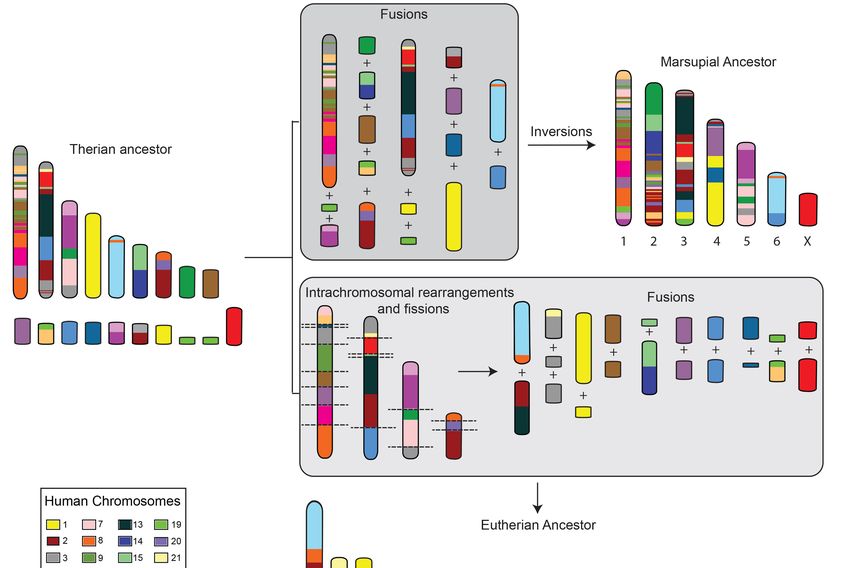
       Figure 1. Predicted events leading to the proposed ancestral marsupial and eutherian karyotypes.
      Figure 1. Predicted events leading to the proposed ancestral marsupial and eutherian karyotypes.
       Chromosomes have been color-coded to reflect their homology to human chromosomes.
      Chromosomes have been color-coded to reflect their homology to human chromosomes. Chromosome
       Chromosome fusions followed by inversions resulted in a 2n = 14 marsupial ancestral karyotype [14]
      fusions followed by inversions resulted in a 2n = 14 marsupial ancestral karyotype [14] whereas a series
       whereas a series of intrachromosomal rearrangements followed by fissions and fusions resulted in
      of intrachromosomal rearrangements followed by fissions and fusions resulted in the predicted 2n = 42
       the predicted 2n = 42 ancestral eutherian karyotypes [18].
      ancestral eutherian karyotypes [18].

     Marsupial chromosomes were intensively studied when cytogenetics was at its peak in the 1970s
 and 1980s [19]. These studies revealed some interesting observations that make marsupials good
 models for investigating the mechanisms behind chromosome evolution. For instance, the family
 Dasyuridae, consisting of over 70 species, has remarkable chromosome conservation with all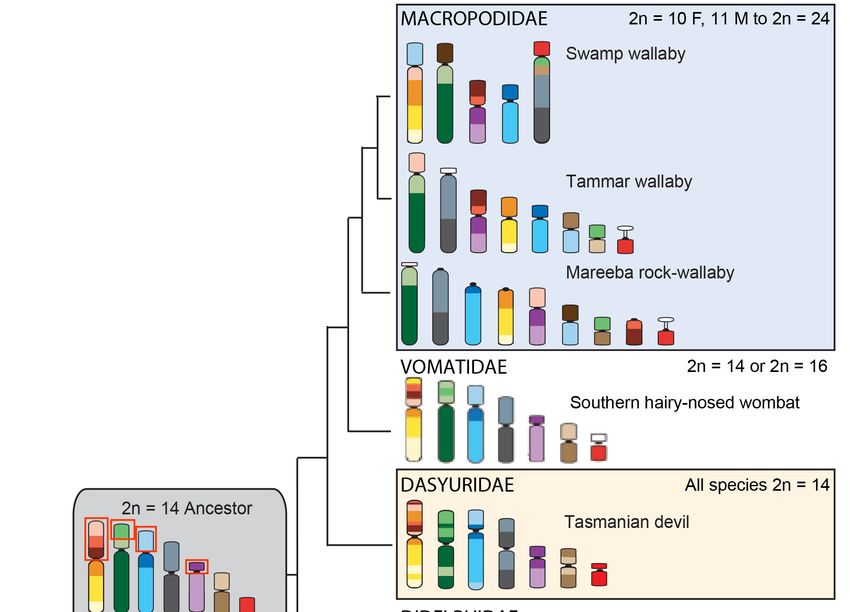
Genes 2018, 9, 72                                                                                                     3 of 15

       Marsupial chromosomes were intensively studied when cytogenetics was at its peak in the 1970s
 and 1980s [19]. These studies revealed some interesting observations that make marsupials good
 models for investigating the mechanisms behind chromosome evolution. For instance, the family
Genes 2018, 9, x FOR PEER REVIEW                                                                                 3 of 15
 Dasyuridae, consisting of over 70 species, has remarkable chromosome conservation with all
 karyotyped members
karyotyped       members possessing
                            possessingaa 2n 2n ==1414 karyotype
                                                       karyotype(Figure
                                                                  (Figure 2),
                                                                           2), which
                                                                               which appears
                                                                                        appears toto differ
                                                                                                      differ between
                                                                                                             between
 some species
some    species only
                   only by
                         by intrachromosomal
                             intrachromosomal rearrangements.
                                                     rearrangements. In In contrast,
                                                                            contrast, the
                                                                                        the family
                                                                                             family Macropodidae
                                                                                                      Macropodidae
 (kangaroos      and  wallabies)   has experienced      considerable  genomic    reshuffling
(kangaroos and wallabies) has experienced considerable genomic reshuffling amongst its          amongst    its 60
                                                                                                               60 odd
                                                                                                                   odd
 species. In
species.   In comparison
                comparison to to eutherian
                                  eutherian mammals
                                               mammals where
                                                           where chromosome
                                                                  chromosome numbers
                                                                                   numbers can can differ
                                                                                                    differ markedly
                                                                                                            markedly
 between     closely  related  species  (e.g.,  the Indian   muntjac  with  2n  =  6  Female
between closely related species (e.g., the Indian muntjac with 2n = 6 Female (F), 7 Male (M)   (F), 7 Male    (M) and
                                                                                                                    and
 Chinese   muntjac    2n = 46), the marsupial    families provide an opportunity     to dissect
Chinese muntjac 2n = 46), the marsupial families provide an opportunity to dissect out the      out the  mechanisms
 involved in chromosome
mechanisms                      evolution and
                 involved in chromosome           speciation.
                                               evolution   and speciation.

     Figure
      Figure2.2.Arrangement
                Arrangementof     ofthe
                                      theconserved
                                          conservedsegments
                                                     segments(C1–C19)
                                                                (C1–C19)identified
                                                                           identifiedin
                                                                                      inthe
                                                                                         theancestral
                                                                                             ancestralmarsupial
                                                                                                        marsupialand
                                                                                                                   and
     in species  from    different marsupial    families. The diploid  number    range  is indicated  for
      in species from different marsupial families. The diploid number range is indicated for each family.each family.
     Chromosomes
      Chromosomesare     arecolor-coded
                             color-codedto  toshow
                                               showthe
                                                    thearrangement
                                                         arrangementof  ofthe
                                                                           the19
                                                                               19conserved
                                                                                  conservedsegments
                                                                                              segmentsidentified
                                                                                                          identifiedby
                                                                                                                     by
     chromosome
      chromosome painting [20]. The conserved segments most commonly rearranged across themarsupial
                     painting   [20].  The conserved   segments  most  commonly     rearranged  across  the  marsupial
     phylogeny
      phylogeny areare indicated
                        indicated by
                                   by red
                                        red boxes
                                            boxes on
                                                  on the
                                                      the ancestral
                                                          ancestral karyotype.
                                                                    karyotype. Mya—Millions
                                                                                 Mya—Millions of  of years
                                                                                                     years ago.
                                                                                                            ago.

     Chromosome painting of distantly related species has shown that marsupial chromosomes are
basically divided into 19 conserved segments; 18 autosomal segments and one corresponding to the
X chromosome (Figure 2) [20]. Comparisons of the arrangement of these segments between species
using chromosome painting make it clear that some chromosomes or chromosomal segments have
been particularly prone to rearrangement during marsupial evolution [20]. More detailed
comparisons afforded by genome assemblies and dense cytogenetic maps have made it even more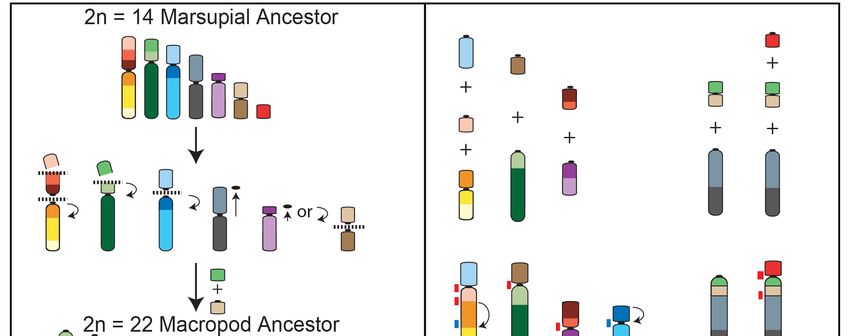
Genes 2018, 9, 72                                                                                 4 of 15

      Chromosome painting of distantly related species has shown that marsupial chromosomes are
basically divided into 19 conserved segments; 18 autosomal segments and one corresponding to the
X chromosome (Figure 2) [20]. Comparisons of the arrangement of these segments between species
using chromosome painting make it clear that some chromosomes or chromosomal segments have
been particularly prone to rearrangement during marsupial evolution [20]. More detailed comparisons
afforded by genome assemblies and dense cytogenetic maps have made it even more evident the extent
to which some regions of marsupial chromosomes are prone to breakage. For instance, comparisons of
the grey short-tailed opossum (Monodelphis domestica) with the Tasmanian devil (Sarcophilus harrisii)
and tammar wallaby (Notamacropus eugenii) show that segments corresponding to the short arms of
the ancestral marsupial chromosomes 1, 2, 3, and 5 are more rearranged than other segments [14,21].
When a broader comparison across marsupials is made, it becomes clear that some of these segments
are commonly involved in rearrangements, even between species within the family Dasyuridae with
its highly conserved karyotype.

2.1. Recombination in Marsupials
      The exchange of genetic material between homologous chromosomes is important for the
proper segregation of chromosomes during meiosis. A reduced recombination rate, whether a cause
or consequence of chromosome rearrangements, is associated with speciation, so it is important
to have a basic understanding of recombination rates and the regions involved in chiasmata in
marsupials. Cytological studies of marsupial chromosomes during meiosis have reported lower
frequencies of chiasmata in females than males. In the opossum, fat-tailed dunnart (Sminthopsis
crassicaudata), and brushtail possum (Trichosurus vulpecula), crossovers occurred more often at the ends
of chromosomes in females but were more likely to occur interstitially on male chromosomes [22–24].
These sex differences have been supported by linkage mapping data for two of these species,
the opossum and the dunnart [22,25]. A linkage map generated for the tammar wallaby also shows
a reduced level of recombination in females compared to males but it appears to be localized to specific
regions of the genome rather than a genome-wide phenomenon [26,27]. The recombination rates
reported for the wallaby and opossum are among the lowest rates reported for vertebrates and the
lower female recombination rate in the opossum and other species is opposite to that observed for
most eutherians mammals or other vertebrates [28]. The brushtailed bettong (Bettongia penicillata) is
an exception with no difference in chiasma observed between males and females [29]. The reason
for the low recombination rate reported for most species examined or why there is a lower female to
male recombination rate is unknown. A more thorough investigation of recombination in marsupials,
both cytologically and by linkage mapping, is warranted. In addition, determining the epigenetic
profile of female compared to male chromosomes during meiosis may shed light on the differences in
recombination rates.

2.2. Marsupial Sex Chromosomes
     The X chromosomes of marsupials vary substantially in size, morphology, and banding pattern,
even between species with an ancestral-like 2n = 14 karyotype [16,19]. In most species, chromosome
painting has demonstrated that the X consists of a single conserved segment, sharing homology with
two-thirds of the human X [20,30]. The remaining third of the human X is autosomal in marsupials,
corresponding to part of chromosome 3 in the ancestral marsupial [14,31]. The marsupial X, therefore,
represents the ancestral therian X chromosome to which an autosomal chromosome segment was
added to after the divergence of the marsupial and eutherian lineages (Figure 1) [32]. Among even
the most distantly related eutherians, gene content and gene order are typically highly conserved,
with rodents and cetartiodactyls being exceptions [33,34]. In contrast, gene order on the X chromosome
of marsupials is not conserved, with a high degree of rearrangement being observed between opossum,
devil and tammar wallaby X chromosomes [31,35]. In rodents and cetartiodactyls, rearrangements of
the X chromosome have been proposed to be associated with repetitive and/or duplicated sequences,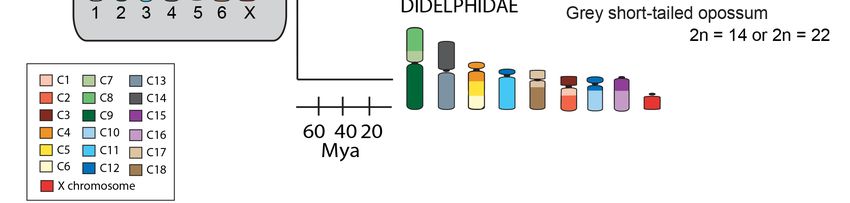
Genes 2018, 9, 72                                                                                    5 of 15

which may have facilitated rearrangement [34,36]. The fragmented nature of the genome assemblies
for the devil and tammar wallaby have made an analysis of the repetitive sequences occurring at
breakpoints on marsupial X chromosomes difficult at this stage. However, it will be interesting to test
this hypothesis for eutherian species having similarly experienced X chromosome rearrangements
using marsupial genome data.
     Ohno’s law posited that translocations between the X and autosomes would be selected against
to avoid disrupting the dosage compensation mechanism [37]. However, translocations or fusions
between autosomes and the sex chromosomes have been observed in a number of eutherian
species (reviewed in [38]), as well as in several marsupial species including the swamp wallaby
(Wallabia bicolor; 2n = 10 XX F 2n = 11 XY1 Y2 M), the long-nosed potoroo (Potorous tridactylus;
2n = 12 XX F, 2n = 13 XY1 Y2 M), greater bilby (Macrotis lagotis), and spectacled hare-wallaby (Lagorchestes
conspicillatus; 2n = 18 F X1 X1 X2 X2 , 2n = X1 X2 Y M) (reviewed in [18]). Chromosome painting has verified
the chromosomes involved in sex chromosome-autosome fusions for the swamp wallaby [39] and
potoroo [20]. The short arm of the swamp wallaby X chromosomes is homologous to the X of other
marsupials, whereas the long arm of the X and the entire Y2 share homology with ancestral marsupial
chromosomes distal 1p, distal 2p, and the entire chromosome 4 [38]. Chromosome painting with the
tammar wallaby Y chromosome showed that Y1 is homologous to the tammar wallaby Y chromosome
but there are also some shared sequences on Y2 and the X [38]. The lack of gene order and the finding of
several species with X-autosome fusions may be related to the differences in the dosage compensation
mechanism between marsupials and eutherians.
     Like eutherians, marsupials inactivate one X chromosome in female somatic cells as part of the
dosage compensation mechanism to equalize expression between males with one X and females with
two. However, there are some striking differences in the X inactivation mechanism between marsupials
and eutherians. Marsupials preferentially inactivate the paternally-derived X and inactivation is often
incomplete. This contrasts with the random and more tightly controlled inactivation observed in
eutherians (reviewed in [40]). Furthermore, the long non-coding RNA, X-inactive specific transcript
(XIST), which plays a critical role in X inactivation in eutherians, is absent in marsupials. Instead,
marsupials have independently evolved a non-coding RNA called RSX (RNA on the silent X) that
appears to perform the equivalent role of XIST [41]. Although there are some shared epigenetic marks
between marsupial and eutherian X inactivation, such as the depletion of marks associated with active
chromatin from the inactive X (e.g., H3K4me2, H4Kac, H3K9ac) and enrichment of the repressive
marks H3K27me3 and H3K9me2 (reviewed in [40]), there are additional epigenetic modifications
that may be responsible for the more complete and stable inactivation observed in most eutherians.
The more incomplete form of inactivation observed in marsupials may enable rearrangements on the X
chromosome to be tolerated more so than on the X chromosome of eutherians. Very few species, either
marsupial or eutherian, have had their X inactivation mechanisms studied in detail. Comparisons
of marsupials with eutherian species that have experienced either intra- or interchromosomal X
chromosome rearrangement could help to determine whether the X inactivation mechanism plays
a role in the level of tolerance of rearrangement.
     The Y chromosome in marsupials is typically very small, being no more than 12 Mb in some
dasyurids as compared to the ~60 Mb human Y chromosome [42]. The marsupial Y chromosome
has been referred to as a “minimal mammalian Y”, carrying the Sex determining region Y gene
(SRY), the presumed sex-determining gene in marsupials [42,43]. A set of ten ancestral marsupial Y
chromosome genes have been discovered so far by sequencing of bacterial artificial chromosome (BAC)
clones mapping to the tammar wallaby and opossum Y chromosomes or identified in a devil testis
transcriptome [44–46]. In marsupials, the X and Y chromosomes do not share a pseudoautosomal
region and, therefore, do not form a synaptonemal complex, nor do the X and Y recombine [47].
In marsupials with sex chromosome-autosome fusions, a synaptonemal complex is formed between the
regions homologous to the ancestral marsupial autosomal regions but not between the sex chromosome
segments [19]. The absence of X–Y recombination and lack of synaptonemal complex formation may
Genes 2018, 9, 72                                                                                 6 of 15

contribute to the high frequency at which the X and Y chromosomes are observed to separate in
metaphase I during meiosis [19].

2.3. Marsupial Genomics
     To date, much of the work on marsupial chromosome evolution has focused purely on
a cytogenetic perspective. It is timely that we now revisit this area of research to bring it more fully
into the genomics era. Currently, there are five sequenced marsupial genomes: the grey short-tailed
opossum (M. domestica) [48], Tasmanian devil (S. harrisii) [49,50], tammar wallaby (N. eugenii) [51],
koala (Phascolarcotos cinereus) [52], and the extinct Tasmanian tiger (Thylacinus cynocephalus) [53].
The opossum, devil, and wallaby genomes have cytogenetic mapping data to anchor sequence to
chromosomes [14,21], which is essential if these genomes are to be useful for studying marsupial
chromosome evolution. The Oz Mammals Genomics Initiative is currently underway to sequence
many more genomes of Australian marsupials distributed across the Australidelphia phylogeny [54],
which will provide a much-needed resource for a more detailed study of marsupial chromosome
evolution. The stark differences between dasyurid and macropod chromosome evolution make genome
assemblies from these families particularly valuable for gaining insight into the drivers of chromosome
evolution and for testing the role of chromosome rearrangements in speciation. The sequencing of
many more marsupial genomes will make it possible to uncover the features of these chromosome
segments that have made them prone to breakage throughout marsupial evolution.

3. Dasyurid Chromosome Evolution and Unique Chromosome Features
      Dasyurids essentially share the same karyotype with all species studies to date (>40), having
almost identical 2n = 14 chromosome complements [16,55–59]. This level of karyotypic conservation
is remarkable considering their divergence from a common ancestor approximately 55 million
years ago. Intrachromosomal rearrangements are the only exceptions to this striking conservation
observed by G-banding. These rearrangements are essentially inversions observed in just four
species; a paracentric inversion on chromosome 6 of the kultarr (Antechinomys laniger), a pericentric
inversion on chromosome 6 of the Wongai ningaui (Ningaui ridei) and the southern ningaui (Ningaui
yvonneae) [59], and a pericentric inversion on devil (S. harrisii) chromosome 5 [60]. Centromere
repositioning has been shown in some mammals to distinguish species (reviewed in [61]). In dasyurids,
the only centromere repositioning relates to a couple of pericentric inversions. In N. yvonneae
and S. harrisii, these inversions are polymorphic in the population [59,60] and may, therefore,
have little or no effect on fertility of heterozygous individuals. It is important to keep in mind
that very few studies have used multiple samples from the same species, so it is unclear whether
polymorphisms also exist in populations of other dasyurids. In addition, G-banding is limited
in its ability to detect intrachromosomal rearrangements, particularly small-scale rearrangements.
For instance, fluorescence in situ hybridization (FISH) of four different BAC clones has detected
more chromosome 5 variants amongst devils than the simple pericentric inversion detected by
G-banding [62]. Similarly, a comparison of the dense devil cytogenetic map to the chromosome
painting data for Sminthopsis crassicaudata suggests there has been intrachromosomal rearrangements
between these two species [20,21].
      Another striking feature of dasyurid chromosomes is a telomere length dimorphism, where one
homolog of each chromosome has long telomeres and the other has noticeably shorter telomeres [63].
Such a dimorphism has not been observed in any other group, making dasyurids rather unique.
It has been proposed that the paternally-derived haploid set of chromosomes possess long telomeres
based on the Y chromosome of five species examined always possessing long telomeres [63].
The maternally-derived chromosomes, therefore, have short telomeres. This parental control of
telomere length model suggests resetting of telomere length in the germline, with elongation of
telomeres taking place in the male germ line and trimming of telomeres in the female germline [63,64].
Genes 2018, 9, 72                                                                                     7 of 15

      It is curious, given the unusual telomeric feature of dasyurid chromosomes that there appears to be
an absence of interchromosomal rearrangements in germ cells to generate karyotypic diversity between
species. Is there some relationship between the resetting of telomere length in the germline that inhibits
interchromosomal rearrangements from occurring? It is tempting to speculate that the more common
occurrence of chiasmata at the ends of chromosomes in female S. crassicaudata, as opposed to males [22],
is related to the difference in their telomere length and the effect this may have on the epigenetic profile
of the adjacent region. However, this difference in recombination pattern is not restricted to dasyurids
and is observed in more distantly related species such as the opossum and brushtail possum, which do
not possess a telomere length dimorphism [23,24,63].
      Conversely, this telomere length dimorphism may have played a role in the apparent susceptibility
of dasyurids to developing cancers [65–67], including two devil facial tumors. Devil facial tumor
1 (DFT1) and devil facial tumor 2 (DFT2) are deadly transmissible tumors decimating the devil
population. The erosion of the short telomeres over time may have led to the fusion of the maternal
copies of chromosomes 1 and X in DFT1, and chromosomes 1 and 6 in DFT2 [21,62,68]. Why this
telomere length dimorphism persists and has not been selected against, given the role it may play in
tumorigenesis, is an interesting question.

Future Directions for Dasyurid Chromosome Research
      With their highly conserved karyotypes and unique telomere length dimorphism, dasyurids
make a fascinating group of marsupials for gaining insight into genome evolution and speciation.
Unfortunately, large comparative studies of their genomes have not been carried out since the original
characterization of their chromosomes by G-banding were reported. The dunnart (S. crassicaudata) has
in the past been used as a model marsupial species because of its ability to be bred in a laboratory
setting in a similar fashion to mice and its ability to produce multiple young in one litter [69]. Indeed,
the dunnart is gaining traction as a model species with its genome currently being sequenced to
hopefully a chromosome-level assembly [54]. This level of assembly will be critical for exploring more
fully the level of rearrangement among dasyurids. Although the devil genome has been sequenced
and a comparison of these two more distantly related dasyurids would be insightful, a more interesting
comparison would be with one of the members of the Sminthopsis genus. Have there been chromosome
rearrangements between closely related species that are undetectable by the low-resolution G-banding
technique? For that matter, are dasyurid chromosomes as highly conserved as proposed based on
G-banding? Based on G-banding studies, bird karyotypes, particularly their macrochromosomes,
were thought to be highly conserved but a combination of molecular cytogenetic mapping and
bioinformatics analysis has demonstrated that these presumably conserved chromosomes have
experienced numerous intrachromosomal rearrangements [70,71]. Similar findings are likely should
dasyurid genomes be compared using higher-resolution approaches. It would also be useful to carry
out more population-based cytogenetic studies on dasyurids to see how widespread chromosome
polymorphisms are within and between populations and the effect, if any, these polymorphisms have
on fertility.
      Microdissection of the tiny dunnart Y chromosome would be ideal for direct sequencing to
obtain a Y-specific sequence. Unlike the tammar wallaby Y chromosome, it does not contain repetitive
sequences shared with the X or autosomes that would complicate assemblies [42]. It is likely to contain
Y-specific repeats but at least there would be one less challenge to overcome for assembly. Obtaining
the sequence for another marsupial Y chromosome would provide greater insight into the evolution of
this tiny yet important chromosome.
      The telomere length dimorphism raises many questions that may be important for understanding
genome evolution in this species. Is there a relationship between the mechanisms involved establishing
the dimorphism, presumably in the germline, and the lack of interchromosomal rearrangements
between species? The dunnart provides a model to further explore this fascinating phenomenon.
Genes 2018, 9, 72 8 of 15
4. Macropod Chromosome Evolution
Macropods have experienced extensive genomic reshuffling since they diverged 23 million years
ago from a common ancestor with a 2n = 22 karyotype [19]. This macropodid ancestral karyotype
can be derived from that of the ancestral marsupial by five fissions followed by one fusion and
two centromere repositioning events (Figure 3a) [19,72–74]. The chromosomal segments involved
in these rearrangements overlap with those demonstrated to be highly rearranged amongst the
broader marsupial phylogeny [62]. The extent of rearrangement experienced during the evolution
of this family has led to macropods being the most comprehensively studied marsupial family at
the chromosome level [75]. Diploid numbers vary among macropods from the most derived and
lowest diploid number karyotype for a marsupial, consisting of 2n = 10 F /11 for the swamp wallaby
(Wallabia bicolor) to 2n = 24 for the banded hare wallaby (Lagostrophus fasciatus) [74]. Techniques such
as G-banding [72,76–82], chromosome painting [39,83,84], and FISH with a telomeric probe used to
detect chromosome fusions [85–89] have all helped to decipher the genomic reshuffling events among
Genes 2018, 9, x FOR PEER REVIEW 8 of 15
macropods, including a large number of interchromosomal rearrangements. For example, using probes
for each tammar
swamp wallaby wallaby chromosome
chromosome 1 was and FISH by
formed withthe
a telomeric
fusion ofprobe demonstrated
ancestral macropod that(AnMac)
swamp
wallaby chromosome 1 was formed by the fusion of ancestral macropod (AnMac)
chromosomes 6, 10, and 4 and an inversion; chromosomes 2 and 3 were the result of a Robertsonian chromosomes 6,
10, and 4 and an inversion; chromosomes 2 and 3 were the result of a Robertsonian
fusion [39,86]. The long arm of the X and Y2 is the result of fusion of AnMac chromosomes 2 and 7, fusion [39,86].
The
withlong
the arm of theofXthe
addition andAnMac
Y2 is the
X result of fusionmaking
chromosome of AnMacup chromosomes
the short arm 2ofand
the7,swamp
with the addition
wallaby X
of the AnMac
(Figure 3b). X chromosome making up the short arm of the swamp wallaby X (Figure 3b).
Figure 3.
Figure 3. Chromosome
Chromosome rearrangements resulting in
rearrangements resulting in the
the (a)
(a) macropod
macropod 2n2n =
= 22
22 ancestral
ancestral karyotype
karyotype from
from
the 2n
the 2n == 14
14 ancestral
ancestral marsupial
marsupialand
and(b)
(b)the
therearrangements
rearrangementsofofthetheancestral
ancestral macropod
macropod chromosomes
chromosomes to
to result
result in the
in the 2n 2n = 10
= 10 female,
female, 11 11 male
male karyotypes
karyotypes of the
of the swamp
swamp wallaby
wallaby (W.(W. bicolor).
bicolor).
Unlike dasyurids, rearrangements of macropod chromosomes have often involved the
Unlike dasyurids, rearrangements of macropod chromosomes have often involved the
centromeres through either centromere repositioning, Robertsonian fusions, or pericentric inversions
centromeres through either centromere repositioning, Robertsonian fusions, or pericentric
[55,89]. Furthermore, several breakpoints reused during macropodid evolution occur at centromeres
inversions [55,89]. Furthermore, several breakpoints reused during macropodid evolution occur
and have involved five of the same chromosome segments most often rearranged more broadly
at centromeres and have involved five of the same chromosome segments most often rearranged
among marsupials [90]. Interestingly, there is a correlation among centromere satellite sequences,
more broadly among marsupials [90]. Interestingly, there is a correlation among centromere
breakpoint reuse, and karyotype convergence amongst nine macropod species, with contractions and
satellite sequences, breakpoint reuse, and karyotype convergence amongst nine macropod species,
expansions of predominant satellites appearing to occur with particular chromosome rearrangements
[90]. For instance, in the antilopine wallaroo (Osphranter antilopinus) and common wallaroo
(Osphranter robustus), satellite sat1 was restricted to centromeres separating rearranged chromosomal
segments [90]. The centromere, therefore, in macropods appears to contribute in some way to
chromosome rearrangement in this family. The study of macropod species hybrids supports this ideaGenes 2018, 9, 72 9 of 15
with contractions and expansions of predominant satellites appearing to occur with particular
chromosome rearrangements [90]. For instance, in the antilopine wallaroo (Osphranter antilopinus)
and common wallaroo (Osphranter robustus), satellite sat1 was restricted to centromeres separating
rearranged chromosomal segments [90]. The centromere, therefore, in macropods appears to contribute
in some way to chromosome rearrangement in this family. The study of macropod species hybrids
supports this idea as chromosome aberrations in these hybrids are generally associated with the
centromere [91,92].
The ability to cross different macropodid species to generate interspecific hybrids makes this
family an excellent model group for studying the role of chromosome rearrangements in speciation [93].
The 42 recorded macropod hybrids generated from crosses of species with diploid numbers ranging
from 2n = 11 to 2n = 22 have either been discovered in the wild or bred in captivity [93,94]. The extent to
which the fertility of these hybrids is affected varies from complete sterility (more commonly observed
in males) to partial fertility in both sexes [93,94]. Macropod hybrids provide an excellent opportunity to
study the role of chromosome rearrangements in meiosis and the role, if any, they play in reproductive
isolation [93].
The centromeres of these hybrids are hotspots of genome instability [91]. Examination of some of
the hybrids has revealed destabilization of the centromeres, resulting in chromosome rearrangements
such as fissions, isochromosome formation, whole-arm reciprocal translocations, and the formation of
minichromosomes [92], as well as the amplification of repetitive sequences associated with macropod
centromeres [91,92]. Amplification of the kangaroo endogenous retrovirus (KERV) in a tammar
wallaby (2n = 16) × swamp wallaby (2n = 11) cross was also associated with demethylation of
these transposable elements [91]. The propensity of particular genomic regions in these hybrids to
be involved in rearrangements could lead to independent derivation of the same rearrangements in
different hybrid individuals [95]. If this were to occur in the wild, the chances of homozygous offspring
for rearrangements could be feasible within one or a small number of generations [95].
Rock-Wallabies as a Model Group for Studying Speciation
The genus Petrogale (rock-wallabies) has been put forward as an excellent model system for
studying chromosomal speciation because of the extensive genomic reshuffling they have experienced
and their habitat specialization to rock outcrops resulting in small and isolated populations [1]. Petrogale
is the most karyotypically diverse genus of marsupials, consisting of 17 species with 23 chromosomal
races [96]. Four species have retained the 2n = 22 ancestral macropod karyotype (P. lateralis, P. persephone,
P. rothschildi, and P. xanthopus) [97]. Rearrangements in other species range from simple to complex
but the most interesting group from a speciation perspective is the penicillata group in Queensland
(Figure 4). This group of parapatric species (P. coenensis, P. godmani, P. mareeba, P. sharmani, P. assimilis,
P. inornata) diverged between 0.5 and 2.7 million years ago [98] and in some respects it would seem that
speciation is still in the process of occurring in this genus, which provides an opportunity to potentially
distinguish causes from consequences when it comes to the role of chromosome rearrangements
in speciation.
Breeding experiments provided evidence of reproductive isolation occurring between the species
within the pencillata group, with male hybrids being infertile and either reduced fertility or infertile
female hybrids [94,99]. The extent of chromosomal heterozygosity in these hybrids was related to the
degree of issues experienced during spermatogenesis and sex chromosome-autosome associations [100].
Despite these meiotic issues, there may be gene flow between these species as there is extensive
allele sharing between some of the most karyotypic divergent pencillata group species [101]. Hence,
the penicillata group provides the opportunity to comprehensively assess the contribution of genome
sequence and function, as well as chromatin conformation to genomic reshuffling and the role this
reshuffling may play in speciation [96].infertile female hybrids [94,99]. The extent of chromosomal heterozygosity in these hybrids was
related to the degree of issues experienced during spermatogenesis and sex chromosome-autosome
associations [100]. Despite these meiotic issues, there may be gene flow between these species as there
is extensive allele sharing between some of the most karyotypic divergent pencillata group species
[101]. Hence, the penicillata group provides the opportunity to comprehensively assess the
Genes 2018, 9, 72
contribution of genome sequence and function, as well as chromatin conformation to genomic 10 of 15
reshuffling and the role this reshuffling may play in speciation [96].
Figure 4. Karyotypic variation amongst six parapatric Petrogale species in Queensland. (a) The geographic
distribution of the six species (adapted from [101]). (b) The differences from the ancestral macropod
karyotype are highlighted to demonstrate the frequent involvement of ancestral chromosomes 6 and 10
in rearrangements among these species.
A combined cytogenetics, genomics, and epigenomics approach is required to test models of
speciation and genome evolution in the Petrogale system. Current efforts are focused on producing
molecular cytogenetic maps for four of the six species to anchor whole-genome sequence assemblies
and provide the necessary resources for a thorough analysis of the features of rearranged versus
non-rearranged regions and breakpoints. Data suggests that—just as broader marsupial comparisons
have shown certain regions to be susceptible to rearrangement—there will be hotspots for breakage in
the Petrogale genome. Experiments on Petrogale cells in culture treated with gamma radiation revealed
hotspots for breakage on mitotic chromosomes equivalent to AnMac chromosomes 5 and 6 of P. mareeba
and P. assimilis [89]. Treatment of P. penicillata cells with mitomycin C induced centric fusions more
frequently with the equivalent of AnMac 10 than any other chromosome [89]. These chromosomes
correspond to those commonly involved in rearrangements across marsupials. The integrative breakage
model [4] would predict these regions to have an open chromatin conformation so assessing the
epigenetic landscape and transcription output of Petrogale chromosomes will be a crucial step towards
testing this model and determining the features that may be making AnMac chromosomes 5, 6, and 10
susceptible to rearrangement.
5. Conclusions
Marsupials, with their distinctively large chromosomes, provide some excellent opportunities to
test models of genome evolution and speciation but to do this there needs to be a closer union between
cytogenetics, genomics, and epigenomics. Genomes anchored to chromosomes are the essential
resources required to delve deeper into the mechanisms driving genome reshuffling and speciation.
It will be particularly interesting to compare and contrast the two families (the dasyurids and
macropods) with opposing rates of karyotypic evolution. Until we have anchored genome assemblies,
many questions regarding these opposing rates of genomic reshuffling will remain unanswered.
With the proper genomic resources and with comparisons between these two families, it may be
possible to determine whether chromosome rearrangements are a cause or consequence of speciation.
Acknowledgments: My research on rock-wallaby chromosomes is funded by an Australian Research Council
Discovery Grant (DP 160100187) awarded to J.E.D., Jason Bragg, Mark Eldridge, Craig Moritz, Mark Kirkpatrick.Genes 2018, 9, 72 11 of 15
Conflicts of Interest: The author declares no conflict of interest.
References
1. King, M. Species Evolution: The Role of Chromosome Change; Cambridge University Press: Cambridge, UK,
1993; ISBN 0521484545.
2. White, M.J.D. Modes of Speciation; W.H. Freeman and Co.: New York, NY, USA, 1978; ISBN 0716702843.
3. Faria, R.; Navarro, A. Chromosomal speciation revisited: Rearranging theory with pieces of evidence.
Trends Ecol. Evol. 2010, 25, 660–669. [CrossRef] [PubMed]
4. Farré, M.; Robinson, T.J.; Ruiz-Herrera, A. An Integrative Breakage Model of genome architecture, reshuffling
and evolution: The Integrative Breakage Model of genome evolution, a novel multidisciplinary hypothesis
for the study of genome plasticity. BioEssays 2015, 37, 479–488. [CrossRef] [PubMed]
5. Pevzner, P.; Tesler, G. Genome rearrangements in mammalian evolution: Lessons from human and mouse
genomes. Genome Res. 2003, 13, 37–45. [CrossRef] [PubMed]
6. Murphy, W.J.; Larkin, D.M.; Everts-van der Wind, A.; Bourque, G.; Tesler, G.; Auvil, L.; Beever, J.E.;
Chowdhary, B.P.; Galibert, F.; Gatzke, L.; et al. Dynamics of mammalian chromosome evolution inferred
from multispecies comparative maps. Science 2005, 309, 613–617. [CrossRef] [PubMed]
7. Ruiz-Herrera, A.; Castresana, J.; Robinson, T.J. Is mammalian chromosomal evolution driven by regions of
genome fragility? Genome Biol. 2006, 7, R115. [CrossRef] [PubMed]
8. Capilla, L.; Sánchez-Guillén, R.A.; Farré, M.; Paytuví-Gallart, A.; Malinverni, R.; Ventura, J.; Larkin, D.M.;
Ruiz-Herrera, A. Mammalian comparative genomics reveals genetic and epigenetic features associated with
genome reshuffling in rodentia. Genome Biol. Evol. 2016, 8, 3703–3717. [CrossRef] [PubMed]
9. Meredith, R.W.; Westerman, M.; Case, J.A.; Springer, M.S. A Phylogeny and timescale for marsupial evolution
based on sequences for five nuclear genes. J. Mamm. Evol. 2008, 15, 1–36. [CrossRef]
10. Sharman, G. The mitotic chromosomes of marsupials and their bearing on taxonomy and phylogeny.
Aust. J. Zool. 1961, 9, 38–60. [CrossRef]
11. Agar, W.E. The male meiotic phase in two genera of marsupials (Macropus and Petauroides). Q. J. Microsc. Sci.
1923, 67, 183–202.
12. Painter, T.S. Studies in mammalian spermatogenesis. I. The spermatogenesis of the opossum. J. Exp. Zool.
1922, 35, 13–45. [CrossRef]
13. Jordan, H.E. The microscopic anatomy of the epiphysis of the opossum. Anat. Rec. 1911, 5, 325–338. [CrossRef]
14. Deakin, J.E.; Delbridge, M.L.; Koina, E.; Harley, N.; Alsop, A.E.; Wang, C.; Patel, V.S.; Graves, J.A.M.
Reconstruction of the ancestral marsupial karyotype from comparative gene maps. BMC Evol. Biol. 2013,
13, 258. [CrossRef] [PubMed]
15. Westerman, M.; Meredith, R.W.; Springer, M.S. Cytogenetics meets phylogenetics: A review of karyotype
evolution in diprotodontian marsupials. J. Hered. 2010, 101, 690–702. [CrossRef] [PubMed]
16. Rofe, R.; Hayman, D. G-banding evidence for a conserved complement in Marsupialia. Cytogenet. Cell Genet.
1985, 39, 40–50. [CrossRef] [PubMed]
17. Rens, W.; Ferguson-Smith, M.A. The conserved marsupial karyotype: Chromosome painting and evolution.
In Marsupial Genetics and Genomics; Deakin, J.E., Waters, P.D., Graves, J.A.M., Eds.; Springer: Dordrecht, The
Netherlands, 2010; pp. 37–53, ISBN 9789048190225.
18. Kim, J.; Farré, M.; Auvil, L.; Capitanu, B.; Larkin, D.M.; Ma, J.; Lewin, H.A. Reconstruction and evolutionary
history of eutherian chromosomes. Proc. Natl. Acad. Sci. USA 2017, 114, E5379–E5388. [CrossRef] [PubMed]
19. Hayman, D. Marsupial Cytogenetics. Aust. J. Zool. 1989, 37, 331. [CrossRef]
20. Rens, W.; O’Brien, P.C.M.; Fairclough, H.; Harman, L.; Graves, J.A.M.; Ferguson-Smith, M.A. Reversal and
convergence in marsupial chromosome evolution. Cytogenet. Genome Res. 2003, 102, 282–290. [CrossRef]
[PubMed]
21. Deakin, J.E.; Bender, H.S.; Pearse, A.M.; Rens, W.; O’Brien, P.C.M.; Ferguson-Smith, M.A.; Cheng, Y.;
Morris, K.; Taylor, R.; Stuart, A.; et al. Genomic restructuring in the Tasmanian devil facial tumour:
Chromosome painting and gene mapping provide clues to evolution of a transmissible tumour. PLoS
Genet. 2012, 8, e1002483. [CrossRef] [PubMed]
22. Bennett, J.H.; Hayman, D.L.; Hope, R.M. Novel sex differences in linkage values and meiotic chromosome
behaviour in a marsupial. Nature 1986, 323, 59–60. [CrossRef] [PubMed]Genes 2018, 9, 72 12 of 15
23. Hayman, D.L.; Moore, H.D.M.; Evans, E.P. Further evidence of novel sex differences in chiasma distribution
in marsupials. Heredity 1988, 61, 455–458. [CrossRef]
24. Hayman, D.L.; Rodger, J.C. Meiosis in male and female Trichosurus vulpecula (Marsupialia). Heredity 1990, 64,
251–254. [CrossRef]
25. Samollow, P.B.; Gouin, N.; Miethke, P.; Mahaney, S.M.; Kenney, M.; VandeBerg, J.L.; Graves, J.A.M.;
Kammerer, C.M. A microsatellite-based, physically anchored linkage map for the gray, short-tailed Opossum
(Monodelphis domestica). Chromosome Res. 2007, 15, 269–281. [CrossRef] [PubMed]
26. Wang, C.; Webley, L.; Wei, K.; Wakefield, M.J.; Patel, H.R.; Deakin, J.E.; Alsop, A.; Marshall Graves, J.A.;
Cooper, D.W.; Nicholas, F.W.; et al. A second-generation anchored genetic linkage map of the tammar
wallaby (Macropus eugenii). BMC Genet. 2011, 12, 72. [CrossRef] [PubMed]
27. Zenger, K.R.; McKenzie, L.M.; Cooper, D.W. The first comprehensive genetic linkage map of a marsupial:
The tammar wallaby (Macropus eugenii). Genetics 2002, 162, 321–330. [PubMed]
28. Samollow, P.B. Marsupial linkage maps. In Marsupial Genetics and Genomics; Deakin, J.E., Waters, P.D.,
Graves, J.A., Eds.; Springer: Dordrecht, The Netherlands; Heidelberg, Germany; London, UK; New York,
NY, USA, 2010; pp. 75–100, ISBN 9789048190225.
29. Hayman, D.L.; Smith, M.J.; Rodger, J.C. A comparative study of chiasmata in male and female Bettongia
penicillata (Marsupialia). Genetica 1990, 83, 45–49. [CrossRef]
30. Glas, R.; Graves, J.A.M.; Toder, R.; Ferguson-Smith, M.; O’Brien, P.C. Cross-species chromosome painting
between human and marsupial directly demonstrates the ancient region of the mammalian X. Mamm. Genome
1999, 10, 1115–1116. [CrossRef] [PubMed]
31. Deakin, J.E.; Koina, E.; Waters, P.D.; Doherty, R.; Patel, V.S.; Delbridge, M.L.; Dobson, B.; Fong, J.; Hu, Y.;
Van Den Hurk, C.; et al. Physical map of two tammar wallaby chromosomes: A strategy for mapping in
non-model mammals. Chromosome Res. 2008, 16, 1159–1175. [CrossRef] [PubMed]
32. Graves, J.A. The origin and function of the mammalian Y chromosome and Y-borne genes—An evolving
understanding. Bioessays 1995, 17, 311–320. [CrossRef] [PubMed]
33. Rodríguez Delgado, C.L.; Waters, P.D.; Gilbert, C.; Robinson, T.J.; Graves, J.A.M. Physical mapping of the
elephant X chromosome: Conservation of gene order over 105 million years. Chromosome Res. 2009, 17,
917–926. [CrossRef] [PubMed]
34. Proskuryakova, A.A.; Kulemzina, A.I.; Perelman, P.L.; Makunin, A.I.; Larkin, D.M.; Farré, M.; Kukekova, A.V.;
Lynn Johnson, J.; Lemskaya, N.A.; Beklemisheva, V.R.; et al. X chromosome evolution in cetartiodactyla.
Genes 2017, 8, 216. [CrossRef] [PubMed]
35. Deakin, J.E. Marsupial genome sequences: Providing insight into evolution and disease. Scientifica 2012,
2012, 543176. [CrossRef] [PubMed]
36. Rubtsov, N.B.; Rubtsova, N.V.; Anopriyenko, O.V.; Karamysheva, T.V.; Shevchenko, A.I.; Mazurok, N.A.;
Nesterova, T.B.; Zakian, S.M. Reorganization of the X chromosome in voles of the genus microtus.
Cytogenet. Genome Res. 2002, 99, 323–329. [CrossRef] [PubMed]
37. Ohno, S. Sex Chromosomes and Sex Linked Genes; Springer Verlag: Berlin, Germany, 1967; ISBN 9783540039341.
38. Vozdova, M.; Ruiz-Herrera, A.; Fernandez, J.; Cernohorska, H.; Frohlich, J.; Sebestova, H.; Kubickova, S.;
Rubes, J. Meiotic behaviour of evolutionary sex-autosome translocations in Bovidae. Chromosome Res. 2016,
24, 325–338. [CrossRef] [PubMed]
39. Toder, R.; O’Neill, R.J.W.; Wienberg, J.; O’Brien, P.C.M.; Voullaire, L.; Marshall-Graves, J.A. Comparative
chromosome painting between two marsupials: Origins of an XX/XY1Y2 sex chromosome system.
Mamm. Genome 1997, 8, 418–422. [CrossRef] [PubMed]
40. Deakin, J.E. Marsupial X chromosome inactivation: Past, present and future. Aust. J. Zool. 2013, 61, 13–23.
[CrossRef]
41. Grant, J.; Mahadevaiah, S.K.; Khil, P.; Sangrithi, M.N.; Royo, H.; Duckworth, J.; McCarrey, J.R.; VandeBerg, J.L.;
Renfree, M.B.; Taylor, W.; et al. Rsx is a metatherian RNA with Xist-like properties in X-chromosome
inactivation. Nature 2012, 487, 254–258. [CrossRef] [PubMed]
42. Toder, R.; Wakefield, M.J.; Graves, J.A. The minimal mammalian Y chromosome—The marsupial Y as
a model system. Cytogenet. Cell Genet. 2000, 91, 285–292. [CrossRef] [PubMed]
43. Foster, J.W.; Graves, J.A. An SRY-related sequence on the marsupial X chromosome: Implications for
the evolution of the mammalian testis-determining gene. Proc. Natl. Acad. Sci. USA 1994, 91, 1927–1931.
[CrossRef] [PubMed]Genes 2018, 9, 72 13 of 15
44. Murtagh, V.J.; O’Meally, D.; Sankovic, N.; Delbridge, M.L.; Kuroki, Y.; Boore, J.L.; Toyoda, A.; Jordan, K.S.;
Pask, A.J.; Renfree, M.B.; et al. Evolutionary history of novel genes on the tammar wallaby Y chromosome:
Implications for sex chromosome evolution. Genome Res. 2012, 22, 498–507. [CrossRef] [PubMed]
45. Bellott, D.W.; Hughes, J.F.; Skaletsky, H.; Brown, L.G.; Pyntikova, T.; Cho, T.-J.; Koutseva, N.; Zaghlul, S.;
Graves, T.; Rock, S.; et al. Mammalian Y chromosomes retain widely expressed dosage-sensitive regulators.
Nature 2014, 508, 494–499. [CrossRef] [PubMed]
46. Sankovic, N.; Delbridge, M.L.; Grützner, F.; Ferguson-Smith, M.A.; O’Brien, P.C.M.; Marshall Graves, J.A.
Construction of a highly enriched marsupial Y chromosome-specific BAC sub-library using isolated Y
chromosomes. Chromosome Res. 2006, 14, 657–664. [CrossRef] [PubMed]
47. Sharp, P. Sex chromosome pairing during male meiosis in marsupials. Chromosoma 1982, 86, 27–47. [CrossRef]
[PubMed]
48. Mikkelsen, T.S.; Wakefield, M.J.; Aken, B.; Amemiya, C.T.; Chang, J.L.; Duke, S.; Garber, M.; Gentles, A.J.;
Goodstadt, L.; Heger, A.; et al. Genome of the marsupial Monodelphis domestica reveals innovation in
non-coding sequences. Nature 2007, 447, 167–177. [CrossRef] [PubMed]
49. Miller, W.; Hayes, V.M.; Ratan, A.; Petersen, D.C.; Wittekindt, N.E.; Miller, J.; Walenz, B.; Knight, J.; Qi, J.;
Zhao, F.; et al. Genetic diversity and population structure of the endangered marsupial Sarcophilus harrisii
(Tasmanian devil). Proc. Natl. Acad. Sci. USA 2011, 108, 12348–12353. [CrossRef] [PubMed]
50. Murchison, E.P.; Schulz-Trieglaff, O.B.; Ning, Z.; Alexandrov, L.B.; Bauer, M.J.; Fu, B.; Hims, M.; Ding, Z.;
Ivakhno, S.; Stewart, C.; et al. Genome sequencing and analysis of the Tasmanian devil and its transmissible
cancer. Cell 2012, 148, 780–791. [CrossRef] [PubMed]
51. Renfree, M.B.; Papenfuss, A.T.; Deakin, J.E.; Lindsay, J.; Heider, T.; Belov, K.; Rens, W.; Waters, P.D.;
Pharo, E.A.; Shaw, G.; et al. Genome sequence of an Australian kangaroo, Macropus eugenii, provides insight
into the evolution of mammalian reproduction and development. Genome Biol. 2011, 12, R81. [CrossRef]
[PubMed]
52. Koala Genome Consortium. Available online: https://koalagenome.org (accessed on 30 January 2018).
53. Feigin, C.Y.; Newton, A.H.; Doronina, L.; Schmitz, J.; Hipsley, C.A.; Mitchell, K.J.; Gower, G.; Llamas, B.;
Soubrier, J.; Heider, T.N.; et al. Genome of the Tasmanian tiger provides insights into the evolution and
demography of an extinct marsupial carnivore. Nat. Ecol. Evol. 2018, 2, 182–192. [CrossRef] [PubMed]
54. Oz Mammals Genomics Initiative. Available online: https://data.bioplatforms.com/organization/about/
bpa-omg (accessed on 30 January 2018).
55. Hayman, D.L.; Martin, P.G. Mammalia I: Monotremata and Marsupialia. In Animal Cytogenetics, Volume 4:
Chordata; John, B., Ed.; Gebrüder Borntraeger: Berlin/Stuttgart, Germany, 1974.
56. Young, G.J.; Graves, J.A.M.; Barbieri, I.; Woolley, P.A.; Cooper, D.W.; Westerman, M. The chromosomes of
dasyurids (Masupialia). In Carnivorous Marsupials; Archer, M., Ed.; Royal Zoological Society: Sydney, NSW,
Australia, 1982; pp. 783–795, ISBN 0959995137.
57. Westerman, M.; Woolley, P.A. Cytogenetics of some New Guinean dasyurids and genome evolution in the
Dasyuridae (Marsupialia). Aust. J. Zool. 1990, 37, 521–531. [CrossRef]
58. Westerman, M.; Woolley, P.A. Chromosomes and the evolution of dasyurid marsupials: An overview.
Sci. New Guin. 1993, 19, 123–130.
59. Baverstock, P.R.; Adams, M.; Archer, M.; Mckenzie, N.L.; How, R. An Electrophoretic and Chromosomal
Study of the Dasyurid Marsupial Genus Ningaui Archer. Aust. J. Zool. 1983, 31, 381–392. [CrossRef]
60. Pyecroft, S.B.; Pearse, A.M.; Loh, R.; Swift, K.; Belov, K.; Fox, N.; Noonan, E.; Hayes, D.; Hyatt, A.; Wang, L.; et al.
Towards a case definition for devil facial tumour disease: What is it? Ecohealth 2007, 4, 346–351. [CrossRef]
61. Rocchi, M.; Archidiacono, N.; Schempp, W.; Capozzi, O.; Stanyon, R. Centromere repositioning in mammals.
Heredity 2012, 108, 59–67. [CrossRef] [PubMed]
62. Deakin, J.E.; Kruger-Andrezjewska, M. Marsupials as models for understanding the role of chromosome
rearrangements in evolution and disease. Chromosoma 2016, 125, 633–644. [CrossRef] [PubMed]
63. Bender, H.S.; Murchison, E.P.; Pickett, H.A.; Deakin, J.E.; Strong, M.A.; Conlan, C.; McMillan, D.A.;
Neumann, A.A.; Greider, C.W.; Hannon, G.J.; et al. Extreme Telomere Length Dimorphism in the Tasmanian
Devil and Related Marsupials Suggests Parental Control of Telomere Length. PLoS ONE 2012, 7. [CrossRef]
[PubMed]
64. Ingles, E.D. Telomeres, species differences, and unusual telomeres in vertebrates: Presenting challenges and
opportunities to understanding telomere dynamics. AIMS Genet. 2016, 3, 1–24. [CrossRef]Genes 2018, 9, 72 14 of 15
65. Griner, L.A. Neoplasms in Tasmanian Devils (Sarcophilus harrisii). J. Natl. Cancer Inst. 1979, 62, 589–595.
[CrossRef] [PubMed]
66. Canfield, P.J.; Cunningham, A.A. Disease and Mortality in Australasian Marsupials Held at London Zoo,
1872–1972. J. Zoo Wildl. Med. 1993, 24, 158–167.
67. Canfield, P.J.; Hartley, W.J.; Reddacliff, G.L. Spontaneous proliferations in Australian marsupials—A survey
and review. 2. Dasyurids and Bandicoots. J. Comp. Pathol. 1990, 103, 147–158. [CrossRef]
68. Ingles, E.D.; Deakin, J.E. Global DNA Methylation patterns on marsupial and devil facial tumour
chromosomes. Mol. Cytogenet. 2015, 8, 74. [CrossRef] [PubMed]
69. Bennett, J.H.; Breed, W.G.; Hayman, D.L.; Hope, R.M. Reproductive and genetic studies with a laboratory
colony of the dasyurid marsupial Sminthopsis crassicaudata. Aust. J. Zool. 1989, 37, 207–222. [CrossRef]
70. Volker, M.; Backstrom, N.; Skinner, B.M.; Langley, E.J.; Bunzey, S.K.; Ellegren, H.; Griffin, D.K. Copy number
variation, chromosome rearrangement, and their association with recombination during avian evolution.
Genome Res. 2010, 20, 503–511. [CrossRef] [PubMed]
71. Skinner, B.M.; Griffin, D.K. Intrachromosomal rearrangements in avian genome evolution: Evidence for
regions prone to breakpoints. Heredity 2012, 108, 37–41. [CrossRef] [PubMed]
72. Rofe, R. G-banded chromosomes and the evolution of Macropodidae. Aust. Mamm. 1978, 2, 53–63.
73. Eldridge, M.D.B.; Close, R.L. Radiation of chromosome shuffles. Curr. Opin. Genet. Dev. 1993, 3, 915–922.
[CrossRef]
74. Rens, W.; O’Brien, P.C.M.; Yang, F.; Graves, J.A.M.; Ferguson-Smith, M.A. Karyotype relationships between
four distantly related marsupials revealed by reciprocal chromosome painting. Chromosome Res. 1999, 7,
461–474. [CrossRef] [PubMed]
75. Eldridge, M.D.B.; Metcalfe, C.J. Marsupialia. In Atlas of Mammalian Chromosomes; O’Brien, S.J., Menninger, J.C.,
Nash, W.G., Eds.; John Wiley & Sons, Inc.: Hoboken, NJ, USA, 2006; pp. 9–62, ISBN 10 0-471-35015-X.
76. Eldridge, M.D.B.; Dollin, A.E.; Johnston, P.G.; Close, R.L.; Murray, J.D. Chromosomal rearrangements in rock
wallabies, Petrogale (Marsupialia; Macropodidae). I. The Petrogale assimilis species complex. G-banding and
synaptonemal complex analysis. Cytogenet. Cell Genet. 1988, 48, 228–232. [CrossRef]
77. Eldridge, M.D.B.; Johnston, P.G.; Close, R.L.; Lowry, P.S. Chromosomal rearrangements in rock wallabies,
Petrogale (Marsupialia, Macropodidae). 4. G-banding analysis of the Petrogale-lateralis complex. Genome
1989, 32, 935–940. [CrossRef] [PubMed]
78. Eldridge, M.D.B.; Close, R.L.; Johnston, P.G. Chromosomal rearrangements in rock wallabies, Petrogale
(Marsupialia, Macropodidae). III. G-banding analysis of Petrogale lateralis inornata and P. penicillata. Genome
1990, 33, 798–802. [CrossRef]
79. Eldridge, M.D.B.; Close, R.L.; Johnston, P.G. Chromosomal rearrangements in rock wallabies, Petrogale
(Marsupialia, Macropodidae). IV. G-banding analysis of the Petrogale lateralis complex. Aust. J. Zool. 1991, 39,
621–627. [CrossRef]
80. Eldridge, M.D.B.; Johnston, P.G.; Lowry, P.S. Chromosomal Rearrangements in Rock Wallabies, Petrogale
(Marsupialia, Macropodidae). VII. G-Banding Analysis of Petrogale brachyotis and P. concinna. Cytogenet. Cell Genet.
1992, 60, 34–39. [CrossRef]
81. Eldridge, M.D.B.; Pearson, D.J. Chromosomal rearrangements in rock wallabies, Petrogale (Marsupialia:
Macropodidae). IX. Further G-banding studies of the Petrogale lateralis complex: P. lateralis pearsoni, the West
Kimberley race, and a population heterozygous for a centric fusion. Genome 1997, 40, 84–90. [CrossRef]
[PubMed]
82. Alsop, A.E.; Miethke, P.; Rofe, R.; Koina, E.; Sankovic, N.; Deakin, J.E.; Haines, H.; Rapkins, R.W.;
Marshall Graves, J.A. Characterizing the chromosomes of the Australian model marsupial Macropus eugenii
(tammar wallaby). Chromosome Res. 2005, 13, 627–636. [CrossRef] [PubMed]
83. Glas, R.; De Leo, A.A.; Delbridge, M.L.; Reid, K.; Ferguson-Smith, M.A.; O’Brien, P.C.M.; Westerman, M.;
Graves, J.A.M. Chromosome painting in marsupials: Genome conservation in the kangaroo family.
Chromosome Res. 1999, 7, 167–176. [CrossRef] [PubMed]
84. O’Neill, R.J.; Eldridge, M.D.B.; Toder, R.; Ferguson-Smith, M.A.; O’Brien, P.C.; Marshall Graves, J.A.
Chromosome evolution in kangaroos (Marsupialia: Macropodidae): Cross species chromosome painting
between the tammar wallaby and rock wallaby spp. with the 2n = 22 ancestral macropodid karyotype.
Genome 1999, 42, 525–530. [CrossRef] [PubMed]You can also read


