Clinical features of COVID-19 in Pediatric Patients (COPP-study) - (December 2020)
←
→
Page content transcription
If your browser does not render page correctly, please read the page content below
N20.043 /   COVID-19 in Pediatrics

 Clinical features of COVID-19 in Pediatric Patients
                            (COPP-study)
                              (December 2020)
N20.043 / COVID-19 in Pediatrics
PROTOCOL TITLE ‘Clinical features of COVID-19 in Pediatric Patients’
Protocol ID COPP
Short title COVID-19 in Pediatrics
EudraCT number N/A
Version 5
Date December 3rd, 2020
Coordinating investigator/project Dr. M.G. Mooij
leader
Department of Pediatrics,
Willem-Alexander Kinderziekenhuis
Leiden University Medical Centre, Leiden
m.g.mooij@lumc.nl
+31-6-11271926
Drs. E. von Asmuth
Department of Pediatrics,
Willem-Alexander Kinderziekenhuis
Leiden University Medical Centre, Leiden
e.g.j.von_asmuth@lumc.nl
+31-6-11289945
Principal investigator(s) (in Dr. E.P. Buddingh
Dutch: hoofdonderzoeker/
Department of Pediatrics, Willem-Alexander
uitvoerder)
Kinderziekenhuis
Leiden University Medical Centre
e.p.buddingh@lumc.nl
+31-71-5296658 / +31-71-5262824
Sponsor (in Dutch: Leiden University Medical Centre
verrichter/opdrachtgever)
Subsidising party N/A
Independent expert (s) Drs. C. MeijerN20.043 / COVID-19 in Pediatrics
Department of Pediatrics, Willem-Alexander
Kinderziekenhuis
Leiden University Medical Centre
c.r.meijer-boekel@lumc.nl
+31-71-5262824N20.043 / COVID-19 in Pediatrics
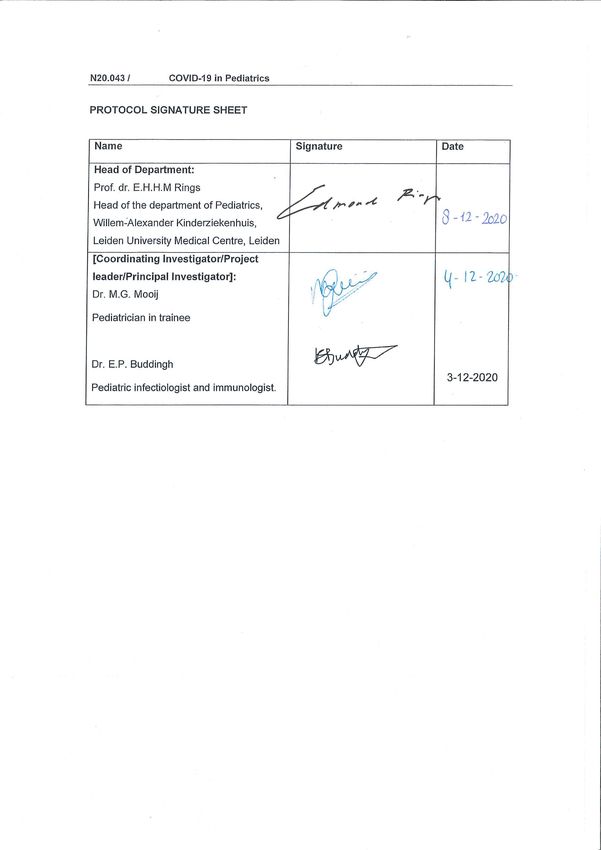
PROTOCOL SIGNATURE SHEET
Name Signature Date
Head of Department:
Prof. dr. E.H.H.M Rings
~'~
Head of the department of Pediatrics, /~^ o~ ~
Willem-Alexander Kinderziekenhuis, ~ - ~2 - %L2v
Leiden University Medical Centre, Leiden
[Coordinating Investigator/Project
leader/Principal Investigator]: ~ ~ ~, ~ 2 - '~~.
Dr. M.G. Mooij `f~ i ,
Pediatrician in trainee
Dr. E.P. Buddingh
3-12-2020
Pediatric infectiologist and immunologist.N20.043 / COVID-19 in Pediatrics
TABLE OF CONTENTS
1. INTRODUCTION AND RATIONALE .............................................................................. 8
2. OBJECTIVES ................................................................................................................. 8
3. STUDY DESIGN ............................................................................................................ 9
4. STUDY POPULATION ................................................................................................... 9
a. Population (base)....................................................................................................... 9
b. Inclusion criteria ......................................................................................................... 9
c. Exclusion criteria.......................................................................................................10
d. Sample size calculation ............................................................................................10
5. TREATMENT OF SUBJECTS .......................................................................................10
6. INVESTIGATIONAL PRODUCT ....................................................................................10
7. NON-INVESTIGATIONAL PRODUCT ...........................................................................10
8. METHODS ....................................................................................................................10
i. Main study parameter/endpoint .............................................................................11
ii. Secondary study parameters/endpoints (if applicable) ..........................................11
iii. Other study parameters (if applicable) ..................................................................11
9. SAFETY REPORTING ..................................................................................................13
10. STATISTICAL ANALYSIS .............................................................................................13
11. ETHICAL CONSIDERATIONS ......................................................................................14
a. Regulation statement ................................................................................................14
b. Recruitment and consent ..........................................................................................14
c. Objection by minors or incapacitated subjects (if applicable) ....................................14
d. Benefits and risks assessment, group relatedness ...................................................15
e. Compensation for injury ............................................................................................15
f. Incentives (if applicable) ...........................................................................................15
12. ADMINISTRATIVE ASPECTS, MONITORING AND PUBLICATION .............................15
a. Handling and storage of data and documents ...........................................................15
b. Monitoring and Quality Assurance ............................................................................15
c. Amendments.............................................................................................................15
d. Annual progress report .............................................................................................16
e. Temporary halt and (prematurely) end of study report ..............................................16
f. Public disclosure and publication policy ....................................................................16
13. STRUCTURED RISK ANALYSIS ..................................................................................16
14. REFERENCES ..............................................................................................................17
LIST OF ABBREVIATIONS AND RELEVANT DEFINITIONS
CCMO Central Committee on Research Involving Human Subjects; in Dutch:
Centrale Commissie Mensgebonden Onderzoek
COVID-19 Coronavirus Disease 2019
CV Curriculum VitaeN20.043 / COVID-19 in Pediatrics
DMP Data Management Plan
GDPR General Data Protection Regulation; in Dutch: Algemene Verordening
Gegevensbescherming (AVG)
IC Informed Consent
IMP Investigational Medicinal Product
METC Medical research ethics committee (MREC); in Dutch: medisch-
ethische toetsingscommissie (METC)
PICU Pediatric Intensive Care Unit
RIVM Rijksinstituut voor Volksgezondheid en Milieuhygiëne
RT-PCR Reverse Transcriptase Polymerase Chain Reaction
SARS-CoV-2 Severe Acute Respiratory Syndrome Coronavirus type 2
Sponsor The sponsor is the party that commissions the organisation or
performance of the research, for example a pharmaceutical
company, academic hospital, scientific organisation or investigator.
A party that provides funding for a study but does not commission it
is not regarded as the sponsor, but referred to as a subsidising party.
UAVG Dutch Act on Implementation of the General Data Protection
Regulation; in Dutch: Uitvoeringswet AVG
WMO Medical Research Involving Human Subjects Act; in Dutch: Wet
Medisch-wetenschappelijk Onderzoek met Mensen
Version number: 5, date December 3rd, 2020 6 of 28N20.043 / COVID-19 in Pediatrics SUMMARY Rationale: The pandemic novel coronavirus (SARS-CoV-2) causes the disease COVID-19, ranging from mild flu-like symptom to a severe and potentially fatal acute respiratory illness. Data on clinical features and risk factors in children are limited. Objective: We aim to describe clinical features of COVID-19 in children. Study design: Multicenter prospective cohort study. Study population: Children age 0-17 years, in- or outpatient in Dutch hospitals with COVID- 19. Intervention (if applicable): Not applicable. Main study parameters/endpoints: The main study parameters are 1) Description of the clinical features and risk factors of COVID-19 in hospitalized and outpatient pediatric patients in the Netherlands. 2) Description of the clinical course of COVID-19 in hospitalized and outpatient pediatric patients. 3) Description of the response to treatment, including supportive care. Secondary parameters are characterization of the host responses to infection and COVID-19 in pediatric patients. Nature and extent of the burden and risks associated with participation, benefit and group relatedness: There will be minimal burden and risk involved in this non-therapeutic study. Version number: 5, date December 3rd, 2020 7 of 28
N20.043 /         COVID-19 in Pediatrics

            1. INTRODUCTION AND RATIONALE

The novel human coronavirus, severe acute respiratory syndrome coronavirus (SARS-CoV-
2), is responsible for the current pandemic. It was first reported in Wuhan, Hubei province in
China in December 2019 [1]. In Europe it has affected Italy and consequently the majority of
European countries. In the Netherlands, the first case was reported on February 27, 2020
(RIVM).
The infection leads to the disease known as COVID-19. Clinical features in adults range from
mild non-specific respiratory symptoms (e.g. sore throat, cough, fatigue, mucus, myalgia,
headache) to a more severe illness (e.g. fever, dyspnea, pneumonia, acute respiratory stress
syndrome, septic shock and multi-organ failure).
In adults, an estimated 80% of infections follow a mild course, 13.8% of patients have severe
complaints and 6.1% of patients suffer from a very severe disease. In China, the case fatality
rate was estimated at 2.3%, but the true case fatality rate may be lower if there are more
mildly symptomatic cases that are not detected [2-4].

It seems that SARS-CoV-2 infection causes a less severe disease in children. The first data
from China show milder clinical symptoms and a smaller proportion of severe and critical
cases (10.6%, 7.3%, 4.2%, 4.1% and 3.0% respectively in the age groups 15 years of age) [5, 6]. It is currently unknown why children are less affected and if
certain categories of children, for example with underlying comorbidities, are at a higher risk
of developing clinically apparent COVID-19.

SARS-CoV-2 infection can be confirmed using real-time Reverse Transcriptase Polymerase
Chain Reaction (RT-PCR) to detect viral RNA in nasopharynx and/or oropharyngeal swabs,
sputum and feces.

Since this is a novel virus and disease, data on clinical features is very limited. We aim to
describe the clinical presentation and clinical course of SARS-CoV-2 infected pediatric
patients presented in hospitals in the Netherlands. We will include all children admitted to
hospital with COVID-19, and patients presenting to outpatient and emergency departments in
whom infection with SARS-CoV-2 is confirmed. We will not include patients only presenting
to general practitioners.

            2. OBJECTIVES

Version number: 5, date December 3rd, 2020                                                8 of 28
N20.043 / COVID-19 in Pediatrics
Primary objective:
- To describe the clinical features of the COVID-19 in hospitalized and outpatient pediatric
patients in the Netherlands.
- To describe the clinical course of the COVID-19 in hospitalized and outpatient pediatric
patients.
- To describe the response to treatment, including supportive care.
- To determine risk factors for severe disease in children with COVID-19.
Secondary study objective:
- To characterize the host responses to infection and COVID-19 in pediatric patients.
- To describe interregional treatment variations of COVID-19 in Dutch hospitals.
3. STUDY DESIGN
This study is a multicenter, observational, prospective cohort study in hospital-setting in the
Netherlands.
During one year data will be collected from patients with COVID-19.
4. STUDY POPULATION
a. Population (base)
Pediatric patients with COVID-19 who present at the emergency or outpatient
department and/or are hospitalized in a hospital in the Netherlands.
Even though estimates from China suggest that only about 1-2% of clinically
apparent SARS-CoV-2 infections occur in children, the current pandemic will
result in a presumed infection rate of 40-60% of the general population.
Therefore, we assume we will be able to include a considerable number of
pediatric patients.
b. Inclusion criteria
In order to be eligible to participate in this study, a subject must meet all of the following
criteria:
- Age 0-17 years AND
- Present to an emergency department or outpatient department of a Dutch hospital
and/or be admitted to hospital AND
Version number: 5, date December 3rd, 2020 9 of 28N20.043 / COVID-19 in Pediatrics
- Have at least one positive real-time RT-PCR test on nasopharyngeal, oropharyngeal,
sputum or fecal sample for SARS-CoV-2 OR
- Fulfil a clinical diagnosis of COVID-19, should testing of SARS-CoV-2 yield
inconclusive results and/or if testing is no longer possible due to lack of reagents. This
includes:
* signs, symptoms and imaging results indicative of COVID-19 pneumonia without
evidence for other causes;
* inflammatory syndrome with a history consistent with recent COVID-19 and/or
laboratory results consistent with current or recent COVID-19 (e.g. positive SARS-
CoV2-PCR and/or positive serology).
c. Exclusion criteria
A potential subject who meets any of the following criteria will be excluded from
participation in this study:
- No evidence of COVID-19
- No consent from guardian and/or patient
d. Sample size calculation
Not applicable
5. TREATMENT OF SUBJECTS
Not applicable
6. INVESTIGATIONAL PRODUCT
Not applicable
7. NON-INVESTIGATIONAL PRODUCT
Not applicable
8. METHODS
a. Study parameters/endpoints
Version number: 5, date December 3rd, 2020 10 of 28N20.043 / COVID-19 in Pediatrics
i. Main study parameter/endpoint
Description of the clinical features of the COVID-19 in hospitalized and outpatient
pediatric patients in the Netherlands.
Description of the clinical course of the COVID-19 in hospitalized and outpatient
pediatric patients.
Description of the response to treatment, including supportive care.
ii. Secondary study parameters/endpoints (if applicable)
Characterization of the host responses (inflammatory parameters) to infection and
COVID-19 in pediatric patients.
iii. Other study parameters (if applicable)
Determine cytokine levels (e.g. IL-6) and medication concentrations (e.g.
chloroquine) in scarce material.
Description of the recovery of COVID-19 disease in children at short-term follow-up
at 6 weeks after hospitalization. Prospective data collection from standard-of-care
follow-up programs of patients admitted to the Pediatric Intensive Care Unit (PICU).
This post-PICU follow-up program is part of routine care for patients who have been
admitted to the PICU. The national standard-of-care post-PICU follow-up program
includes evaluation of overall clinical condition and assessment of
neuropsychological functioning 3 to 6 months and 24 months after hospital
discharge.
b. Randomisation, blinding and treatment allocation
Not applicable
c. Study procedures
1. Patients will be included in the study in case of SARS-CoV-2 positive test (or
fulfilling a clinical diagnosis of COVID-19) and after obtaining informed consent
(IC) from guardian and/or patient.
Version number: 5, date December 3rd, 2020 11 of 28N20.043 / COVID-19 in Pediatrics
2. Clinical data from the subject at time of presentation in the hospital will be noted in
a case report form. In case of a diagnosis of COVID-19 after hospital presentation
the data will be collected from the electronic medical record.
Summarized this data will contain:
- Patient characteristics and risk factors: age, gender, height, weight, exposure to
known COVID-19 cases, prior medical history, medication.
- Clinical features at presentation: symptoms, vital signs, physical examination, imaging
results, laboratory results.
- Course of illness: clinical symptoms, vital signs, physical examination, imaging results,
laboratory result, the need for respiratory support, the need for IC treatment,
medication, aerosol treatment, co-morbidity and outcome.
3. Scarce material from blood samples will be stored in local centers. They will be
used to retrospectively analyze additional laboratory parameters associated with
severity of disease and outcome, such as cytokine levels (particularly IL-6) and
medication concentrations (particularly chloroquine).
4. Follow-up questionnaire at 6 weeks after hospitalization (see Appendix B). The
questionnaires are age-appropriate and contain the following topics: general
complaints, remaining symptoms, recovery to normal life, pulmonary complaints
and quality of life using validated surveys: PedsQL and PROMIS. PROMIS
outcomes are: anxiety, depression, anger, peer relations, sleeping problems and
overall health. These surveys have been evaluated by the patient support group
(Kind & Ziekenhuis). These surveys have been evaluated by the patient support
group (Stichting Kind en Ziekenhuis). The flow diagram of the follow-up surveys is
displayed in Appendix C.
5. Prospective data collection from the standard-of-care post-PICU follow-up
program includes evaluation of general wellbeing after PICU admission and
hospitalization. Assessment of specific deficits after PICU admission and
neuropsychological screening tools as listed in Appendix D.
Detailed information can be found in the Data Management Plan (DMP) (See
Appendix E).
Data will be recorded in Castor.
Version number: 5, date December 3rd, 2020 12 of 28N20.043 / COVID-19 in Pediatrics
d. Withdrawal of individual subjects
Subjects can leave the study at any time for any reason if they wish to do so
without any consequences. The investigator can decide to withdraw a subject
from the study for urgent medical reasons.
i. Specific criteria for withdrawal (if applicable)
Not applicable.
e. Replacement of individual subjects after withdrawal
Subjects will not be replaced after withdrawal.
f. Follow-up of subjects withdrawn from treatment
Not applicable
g. Premature termination of the study
The study will be prematurely terminated in case of failure to include any
patient in the study.
9. SAFETY REPORTING
Since this is a non-therapeutic prospective cohort study the safety reporting is not
applicable. There are no imposed measures on the subjects in this study.
10. STATISTICAL ANALYSIS
For real-time reporting of anonymous data on the website R will be used (R Foundation for
Statistical Computing; Vienna, Austria). IBM SPSS Statistics software (SPSS Statistics for
Windows; IBM, Armonk, NY) will be used.
Demographic and clinical characteristics will be described using standard statistical analysis
methods. The descriptive data will be presented as percentages and medians ± interquartile
range, or numbers with percentages.
Validated quality of life surveys will be compared with a reference group which is period
specific considering National lockdown limitations.
Version number: 5, date December 3rd, 2020 13 of 28N20.043 / COVID-19 in Pediatrics
11. ETHICAL CONSIDERATIONS
a. Regulation statement
This prospective cohort study is not subject to the Medical Research Involving Human
Subjects act (WMO). It does concern medical scientific research but the participants are
NOT subject to procedures nor are required to follow rules of behavior.
The study will be conducted according to the principles of the Declaration of Helsinki
version Oct 2008 (www.wma.net).
b. Recruitment and consent
The recruitment and informed consent procedures will be done by local researcher in the
hospital. Local researchers will be recorded in a researcher log. Subjects will be
approached for consent preferably within at least 24h after presentation in the hospital.
They will have 24h to consider their decision. This time facilitates the subject to make a
considered decision, yet will ensure reliable prospective data collection.
Local hospital policies regarding current circumstances in SARS-CoV-2 infection
prevention, dictates often only one parent or caregiver is allowed to stay with a patient
with COVID-19. Therefore, we will accept written informed consent of at least one of the
parents or caregivers as opposed to both parents/caregivers in case of legal guardianship
of more than one parent/caregiver. This has been supported by a statement from
COREON (Commissie Regelgeving Onderzoek of The Federation of Dutch Medical
Scientific Societies (Federa)) regarding the use of patient data in observative cohort
studies in current circumstances regarding COVID (see Appendix A and
https://www.medlaw.nl/wp-content/uploads/2020/04/Statement-nader-gebruik-
spoedsituaties-v4.1.pdf). Quote: “Vanwege de hoge werkdruk kan evenmin van betrokken
behandelaars verwacht worden dat familieleden gebeld of aangeschreven worden om
toestemming in plaats van de patient te verlenen voor deelname aan onderzoek.
Vanwege mogelijk besmettingsgevaar worden zij ook op locatie geweerd.”
In case of study subjects age 12-16 years of age, we will require their written consent, as
well as at least one parent or caregiver.
In case of study subjects age 16+, we will only require their written consent and not from
their parents or caregivers.
See attachment for patient information letter and informed consent.
c. Objection by minors or incapacitated subjects (if applicable)
The research will be conducted according to the Code of Conduct for Medical Research by
the The Federation of Dutch Medical Scientific Societies (Federa)
Version number: 5, date December 3rd, 2020 14 of 28N20.043 / COVID-19 in Pediatrics
https://english.ccmo.nl/investigators/legal-framework-for-medical-scientific-research/codes-
of-conduct/code-of-conduct-for-medical-research.
d. Benefits and risks assessment, group relatedness
Subjects do not benefit personally from study participation. This non-therapeutic research
with minors will have negligible risks and minimal burden. The only burden is a researcher
taking the time to explain the study and ask for consent. Data collection will be done by local
researcher from medical records. Data collection will be done according to the Dutch Act on
Implementation of the General Data Protection Regulation; in Dutch: Uitvoeringswet AVG.
This study can only be performed in minors, as it will provide age-specific data that cannot be
obtained otherwise.
e. Compensation for injury
No liability insurance has been arranged since this study is purely observational.
f. Incentives (if applicable)
The subjects will not receive any incentives for participation in the study.
12. ADMINISTRATIVE ASPECTS, MONITORING AND PUBLICATION
a. Handling and storage of data and documents
Extracted data will be coded used and stored by the local research team. In LUMC this is
(Buddingh, Mooij, von Asmuth). Patient data will be coded with a study number. The key
to the code is safeguarded by the research team at the local site. Documentation
belonging to the trial will be archived for 15 years in the “Investigator File”. Persons who
will be involved in the research will be listed in the Signature List with the corresponding
tasks.
Data will be collected in Castor. This is a LUMC approved data storage program.
b. Monitoring and Quality Assurance
Multicenter: Monitoring in all sites in the Netherlands will be executed by (internal)
monitors of the LUMC according to the monitor plan.
c. Amendments
Amendments are changes made to the research after a favorable opinion by the
accredited METC has been given. All amendments will be notified to the METC that gave
a favorable opinion.
Version number: 5, date December 3rd, 2020 15 of 28N20.043 / COVID-19 in Pediatrics
d. Annual progress report
The sponsor/investigator will submit a summary of the progress of the trial to the
accredited METC once a year. Information will be provided on the date of inclusion of the
first subject, numbers of subjects included and numbers of subjects that have completed
the trial, serious adverse events/ serious adverse reactions, other problems, and
amendments.
e. Temporary halt and (prematurely) end of study report
The investigator/sponsor will notify the accredited METC of the end of the study within a
period of 8 weeks. The end of the study is defined as the last patient’s last visit. The
sponsor will notify the METC immediately of a temporary halt of the study, including the
reason of such an action.
In case the study is ended prematurely, the sponsor will notify the accredited METC
within 15 days, including the reasons for the premature termination.
Within one year after the end of the study, the investigator/sponsor will submit a final
study report with the results of the study, including any publications/abstracts of the study,
to the accredited METC.
f. Public disclosure and publication policy
Upon closure of the study, data will be reported in a scientific journal. Data published in
articles (scientific or non-scientific) will not be traceable to the actual patients. An
extraction of the data entered in Castor will be continuously uploaded to a secure
website (www.covidkids.nl), accessible to medical professionals. This uploaded data will
summarize data regarding number of children diagnosed with COVID-19, age (median
and range), duration of hospital stay (median and range), intensive care admissions and
outcome (recovery and death).
13. STRUCTURED RISK ANALYSIS
Not applicable.
Version number: 5, date December 3rd, 2020 16 of 28N20.043 / COVID-19 in Pediatrics
14. REFERENCES
1. Zhu, N., et al., A Novel Coronavirus from Patients with Pneumonia in China, 2019. N
Engl J Med, 2020. 382(8): p. 727-733.
2. Guan, W.J., et al., Clinical Characteristics of Coronavirus Disease 2019 in China. N
Engl J Med, 2020.
3. Huang, C., et al., Clinical features of patients infected with 2019 novel coronavirus in
Wuhan, China. The Lancet, 2020. 395(10223): p. 497-506.
4. Wang, Y., et al., Unique epidemiological and clinical features of the emerging 2019
novel coronavirus pneumonia (COVID-19) implicate special control measures.
Journal of Medical Virology. n/a(n/a).
5. Lu, X., et al., SARS-CoV-2 Infection in Children. New England Journal of Medicine,
2020.
6. Dong, Y., et al., Epidemiological Characteristics of 2143 Pediatric Patients With 2019
Coronavirus Disease in China. Pediatrics, 2020: p. e20200702.
Version number: 5, date December 3rd, 2020 17 of 28N20.043 / COVID-19 in Pediatrics APPENDIX Appendix A Statement patient data in observative cohort studies in emergency situations and COVID-19 https://www.medlaw.nl/wp-content/uploads/2020/04/Statement-nader-gebruik-spoedsituaties- v4.1.pdf Version number: 5, date December 3rd, 2020 18 of 28
N20.043 /         COVID-19 in Pediatrics

Version number: 5, date December 3rd, 2020   19 of 28
N20.043 /            COVID-19 in Pediatrics

Appendix B Questionnaire at 6 weeks follow-up

   COPP_FU 6
weeks_all surveys_28-4-2020.pdf

Version number: 5, date December 3rd, 2020      20 of 28
N20.043 /          COVID-19 in Pediatrics

Appendix C Flow diagram follow up vragenlijst versturen na 6 weken

                   Inclusie in COPP studie: registratie email adres van ouders

            6 weken na ontslagdatum: automatische mail wordt gestuurd vanuit Castor.

 In de mail aan ouders van kinderen vanaf 8 jaar gevraagd ook naar de website (www.copp-
 studie.nl) te gaan voor de PROMIS vragenlijst via een link in de mail. Deze vragenlijsten
 kunnen niet in Castor worden ingebouwd. Er wordt gebruik gemaakt van het KLIK
 systeem, wat door het METC-AMC is goedgekeurd.

 Elke patiënt heeft een individuele link. Hierdoor kunnen we de gegevens uit beide database
 (PROMIS en Castor database) uit elkaar koppelen, zonder andere demografische gegevens
 opnieuw te vragen.

 Geachte ouder,                                        Geachte ouder,

 Enkele weken terug heeft uw kind in het ziekenhuis    Enkele weken terug heeft uw kind in het
 de diagnose COVID-19 gekregen, een ziekte die         ziekenhuis de diagnose COVID-19
 wordt veroorzaakt door een besmetting met het         gekregen, een ziekte die wordt
 “nieuwe corona” virus, het SARS-CoV-2 virus.          veroorzaakt door een besmetting met het
 Het kan ook zijn dat uw kind weinig symptomen         “nieuwe corona” virus, het SARS-CoV-2
 had, maar dat bij toeval is ontdekt dat uw kind het   virus. Het kan ook zijn dat uw kind weinig
 Corona virus bij zich droeg.                          symptomen had, maar dat bij toeval is
 Tijdens deze periode in het ziekenhuis heeft u        ontdekt dat uw kind het Corona virus bij
 samen met of namens uw kind toestemming               zich droeg.
 gegeven om mee te doen aan een studie naar de         Tijdens deze periode in het ziekenhuis
 verschijnselen van het Corona virus bij kinderen.     heeft u samen met of namens uw kind
 Door deze ziekte te beschrijven leren we hoe de       toestemming gegeven om mee te doen aan
 ziekte zich uit, hoe het verloopt en welke            een studie naar de verschijnselen van het
 behandelingen er voor gegeven worden.                 Corona virus bij kinderen. Door deze
 U heeft ook toestemming gegeven om u en uw kind       ziekte te beschrijven leren we hoe de
 later nog te benaderen voor vervolgonderzoek,         ziekte zich uit, hoe het verloopt en welke
 waarbij we graag op de hoogte blijven hoe het met     behandelingen er voor gegeven worden.
 uw kind gaat.                                         U heeft ook toestemming gegeven om u en
 Bij deze sturen we u vragenlijsten op waarin we       uw kind later nog te benaderen voor
 willen inschatten of er nog sprake is van             vervolgonderzoek, waarbij we graag op
 lichamelijke klachten en van klachten op het          de hoogte blijven hoe het met uw kind
 gebied van kwaliteit van leven. Dit leert ons wat     gaat.
 de gevolgen zijn van COVID-19 na de eerste ziekte     Bij deze sturen we u vragenlijsten op
 periode.                                              waarin we willen inschatten of er nog

Version number: 5, date December 3rd, 2020                                                21 of 28
N20.043 / COVID-19 in Pediatrics
Wij willen u vriendelijk verzoeken deze in te vullen sprake is van lichamelijke klachten en van
via onderstaande link klachten op het gebied van kwaliteit van
leven. Dit leert ons wat de gevolgen zijn
{url} van COVID-19 na de eerste ziekte
periode.
Bij voorbaat zeer veel dank voor de bijdrage van u Wij willen u vriendelijk verzoeken deze in
en uw kind aan dit onderzoek. te vullen via onderstaande links
Met vriendelijke groet, {url Castor}
Namens het COPP onderzoeksteam" Wij verzoeken u, aangezien uw kind
ouder dan 8 jaar is, om ook de tweede
Caroline Brackel vragenlijst in te vullen, betreffende
Simone Hashimoto kwaliteit van leven. Deze vragenlijst
Lotte Haverman nemen wij ook af bij kinderen die geen
Emmeline Buddingh COVID-19 hebben gehad. Wij willen
Miriam Mooij graag weten of er een verschil is tussen
Erik von Asmuth kinderen die wel en geen COVID-19
hebben gehad.
U bereikt deze vragenlijst via
onderstaande link:
{url KLIK}
Bij voorbaat zeer veel dank voor de
bijdrage van u en uw kind aan dit
onderzoek.
Met vriendelijke groet,
Namens het COPP onderzoeksteam
Caroline Brackel
Simone Hashimoto
Lotte Haverman
Emmeline Buddingh
Miriam Mooij
Erik von Asmuth
Link castor: alle deelnemers Link KLIK (deelnemers >8
jaar)
Version number: 5, date December 3rd, 2020 22 of 28N20.043 / COVID-19 in Pediatrics
Via de URL bereikt de deelnemer 1 van de volgende 5 vragenlijsten, afhankelijk van
de leeftijd:
• Age zero to 1 yr_ general questions + TAPQOL parents
• Age 2 to 4 yrs_ general questions + PEDsQL parents + PedsQL children
• Age 5 to 7_ general questions + PEDsQL parents + PedsQL children
• Age 8 to 12_ general questions + PEDsQL parents + PedsQL children
• Age 13 to 18_general questions + PEDsQL parents + PedsQL children
Deze vragenlijst starten met de onderstaande introductie:
"Voor wie is deze vragenlijst?
Deze vragenlijst is voor ouders van kinderen die hebben diagnose van COVID-19
gekregen. Als u de lijst niet zelf kunt invullen, kan iemand u misschien helpen.
Bijvoorbeeld een familielid.
Waar gaat de vragenlijst over?
De vragenlijst gaat over de gezondheid van uw kind in de afgelopen weken.
Hoe lang duurt het om de lijst in te vullen?
Het duurt ongeveer 15 minuten om de lijst in te vullen.
Hoe moet u de lijst invullen?
- Begin
De bij de start
vragenlijst eerstemet
vraag
een en volg de nummering
vragenlijst over medische situatie en kwaliteit van leven
- Kruis voor iedere vraag 1 hokje
(PEDsQL of TAPQL). zie bijlage “COPP_FUaan, behalve6als er bij desurveys_28-4-
weeks_all vraag staat dat u meer
dan 1 hokje mag aankruisen.
2020.PDF”.
- Bij sommige vragen kunt u een getal of iets anders invullen.
- U kunt
Deze geen foute
vragenlijst wordtantwoorden geven.
als eerste ingevuld.
Wat gebeurt er met uw antwoorden?
Uw antwoorden worden gebruikt voor onderzoek. Alleen de onderzoekers zien uw
antwoorden. Dus niemand anders. De onderzoekers schrijven uw naam nergens
op. En zij vertellen aan niemand dat u aan het onderzoek heeft meegewerkt.
Fijn dat u de lijst voor ons wilt invullen!"
Version number: 5, date December 3rd, 2020 23 of 28N20.043 / COVID-19 in Pediatrics
Aan het eind van de vragenlijst in Castor zien deelnemers de
onderstaande tekst.
"U heeft de vragenlijst volledig ingevuld.
Hartelijk bedankt hiervoor!
Wij verzoeken u, indien uw kind ouder dan 8 jaar is, om ook de
tweede vragenlijst in te vullen, betreffende kwaliteit van leven. Deze
vragenlijst nemen wij ook af bij kinderen, ouder dan 8 jaar, die
geen COVID-19 hebben gehad. Wij willen graag weten of er een
verschil is tussen kinderen die wel en geen COVID-19 hebben
gehad.
Aangezien wij nog weinig weten over de lange termijn klachten van
COVID-19 bij kinderen, kan het zijn dat we uw kind later nogmaals
benaderen om deel te nemen aan vervolgonderzoek.
Wilt u meer informatie, of zich toch uitschrijven? Neem dan contact
op met info@covidkids.nl of met uw behandelend arts.
Vriendelijke groeten,
Het COPP-onderzoeksteam"
(voor ouders van kinderen vanaf 8 jaar)
Op de website www.copp-studie.nl staat de volgende introductietekst:
Welkom op de onderzoekswebsite van het Emma Kinderziekenhuis. Wat fijn dat jullie willen
deelnemen aan de follow-up fase van het COPP onderzoek!
Het doel van dit onderzoek is om aan de hand van een aantal vragenlijsten meer inzicht te krijgen in
het functioneren van kinderen en jongeren die in de afgelopen weken ziek zijn geworden van het
nieuwe coronavirus, of die een positieve test hadden voor het nieuwe coronavirus. Deze vragenlijst
is onderdeel van de COPP studie, welke onderzoek doet naar de klinische verschijnselen, het
verloop, de behandeling en de lange termijnklachten van COVID-19 bij kinderen.
De vragenlijsten op deze website worden ook afgenomen bij Nederlandse kinderen die niet ziek zijn
geworden van het nieuwe corona-virus, maar, net als jou, ook leven in veranderde
omstandigheden. Hierdoor kunnen we vergelijken hoe het gaat met kinderen die wel of niet ziek zijn
geworden van het nieuwe coronavirus.
Version number: 5, date December 3rd, 2020 24 of 28N20.043 / COVID-19 in Pediatrics
Meer informatie over de COPP studie vinden jullie hier: www.covidkids.nl
Deelnemen
Jullie kunnen inloggen via de link in de mail van de COPP studie. Vervolgens kunnen jullie kiezen
om vragenlijsten in te vullen als ouder of als kind/jongere.
Vragenlijst voor ouder(s)
We vragen aan alle ouder(s) om een korte vragenlijst in te vullen over het
gezin.
Vragenlijsten voor kinderen/jongeren
We vragen aan alle kinderen/jongeren om een aantal korte vragenlijsten
in te vullen over stemming, slaap en contact met leeftijdsgenoten.
Mochten jullie tussentijds uitloggen, dan kunnen jullie met behulp van de link in de mail van de
COPP studie opnieuw inloggen.
Bij vragen en/of opmerkingen kunt u contact opnemen met het KLIK team via: info@hetklikt.nu.
Met vriendelijke groet,
Dr. L. Haverman
Sectiehoofd onderzoek Psychosociale afdeling Emma Kinderziekenhuis
Drs. C. Brackel
Kinderarts, fellow kinderlongziekten Emma kinderziekenhuis.
Via de twee links voor vragenlijsten worden de betreffende vragenlijsten ingevuld.
Deze vragenlijsten bestaan uit de volgende items:
- Demografische gegevens
- PROMIS pediatric SF v2.0 – Anger 5a_DUT_29Dec2019
- PROMIS pediatric SF v2.0 – Anxiety 8a_DUT_FLE_29Dec2019
- PROMIS pediatric SF v2.0 – Depressive Symptoms 8a_DUT_FLE_29Dec2019
- PROMIS pediatric SF v2.0 – Peer Relationships 8a_DUT_FLE_29Dec2019
- PROMIS Pediatric SF v1.0 – Sleep-Related Impairment 4a_DUT_FLE_5Jan2020.)
Aan het eind van de vragenlijst zien ouders van kinderen tot 8 jaar oud de onderstaande
tekst:
"U heeft de vragenlijst volledig ingevuld.
Hartelijk bedankt hiervoor!
Version number: 5, date December 3rd, 2020 25 of 28N20.043 / COVID-19 in Pediatrics
Aangezien wij nog weinig weten over de lange termijn klachten van COVID-19 bij
kinderen, kan het zijn dat we uw kind later nogmaals benaderen om deel te nemen aan
vervolgonderzoek.
Wilt u meer informatie, of zich toch uitschrijven? Neem dan contact op met
info@covidkids.nl of met uw behandelend arts.
Vriendelijke groeten,
Het COPP-onderzoeksteam
Indien de vragenlijst niet is ingevuld, wordt er een reminder na 2 dagen verstuurd.
De tweede reminder volgt na 1 week.
Reminder deelnemers jonger dan 8 jaar:
"Geachte ouder,
Enkele dagen geleden hebben uw een mail gestuurd met de vraag of u enkele
vragenlijsten in wilt vullen waarmee wij willen weten hoe het met gaat met de
gezondheid van uw kind.
Wij begrijpen dat u deze mogelijk over het hoofd heeft gezien, of hier nog geen tijd
voor hebt gevonden. Aangezien het nieuwe corona virus een heel nieuw virus is voor
ons, willen wij erg graag weten of kinderen die hier mee besmet zijn geweest nog
restklachten hebben. Daarom verzoeken wij u nogmaals om onze vragenlijsten in te
vullen.
U ontvangt deze mail omdat u tijdens de periode in het ziekenhuis samen met of
namens uw kind heeft gegeven om mee te doen aan een studie naar de
verschijnselen van het Corona virus bij kinderen. Door deze ziekte te beschrijven
leren we hoe de ziekte zich uit, hoe het verloopt en welke behandelingen er voor
gegeven worden.
Wij willen u vriendelijk verzoeken deze in te vullen via onderstaande link
{url}
Bij voorbaat zeer veel dank voor de bijdrage van u en uw kind aan dit onderzoek.
Met vriendelijke groet,
Namens het COPP onderzoeksteam"
Version number: 5, date December 3rd, 2020 26 of 28N20.043 / COVID-19 in Pediatrics
Reminder deelnemers ouder dan 8 jaar:
"Geachte ouder,
Enkele dagen geleden hebben uw een mail gestuurd met de vraag of u enkele
vragenlijsten in wilt vullen waarmee wij willen weten hoe het met gaat met de
gezondheid van uw kind.
Wij begrijpen dat u deze mogelijk over het hoofd heeft gezien, of hier nog geen tijd
voor hebt gevonden. Aangezien het nieuwe corona virus een heel nieuw virus is voor
ons, willen wij erg graag weten of kinderen die hier mee besmet zijn geweest nog
restklachten hebben. Daarom verzoeken wij u nogmaals om onze vragenlijsten in te
vullen.
U ontvangt deze mail omdat u tijdens de periode in het ziekenhuis samen met of
namens uw kind heeft gegeven om mee te doen aan een studie naar de
verschijnselen van het Corona virus bij kinderen. Door deze ziekte te beschrijven
leren we hoe de ziekte zich uit, hoe het verloopt en welke behandelingen er voor
gegeven worden.
Wij willen u vriendelijk verzoeken deze in te vullen via onderstaande link
{url}
Voor kinderen van 8 jaar oud en ouder willen wij ook graag weten hoeveel last zij in
hun dagelijks leven ondervinden. Wij verzoeken hen en de ouders ook de volgende
vragenlijst in te vullen.
{url}
Bij voorbaat zeer veel dank voor de bijdrage van u en uw kind aan dit onderzoek.
Met vriendelijke groet,
Namens het COPP onderzoeksteam"
Version number: 5, date December 3rd, 2020 27 of 28N20.043 / COVID-19 in Pediatrics
Appendix D. Overview of neuropsychological tests at post-PICU follow-up program
This is an overview of the neuropsychological test battery which is used as part of the national
standard-of-care post-PICU follow-up program. Since 2017 The Netherlands has a guideline for follow-
up programs of post-PICU patients (NVK-richtlijn: ‘Richtlijn follow-up van kinderen na opname op een
intensive care’) to provide an outpatient care framework to evaluate patient wellbeing and
development after PICU admission with the goal of signaling potential deficits in an early stage and
providing patient-specific care. Outpatient follow-up is performed by a pediatric intensivist, a pediatric
neurologist in the event of overt neurological deficits and a neuropsychologist.
Moment of evaluation post-event
Development (BSID)/Intelligence (Wechsler)
Memory (Kaufman/REY/15-wrd)
Visuo-motor integration (Beery)
Concentration (NEPSY)
3 – 6 months and 24 months Focus (NEPSY)
Interference (STROOP)
Executive functions BRIEF)
Mental flexibility (TMT)
Planning/problem solving (BADS sleutel + 6-delen/)
Version number: 5, date December 3rd, 2020 28 of 28You can also read


