Directorate of Research Tamil Nadu Agricultural University Coimbatore 641 003
←
→
Page content transcription
If your browser does not render page correctly, please read the page content below
TAMIL NADU AGRICULTURAL UNIVERSITY

 Proceedings of the 7th Scientists Meet on
    Non Crop Specific Projects - 2019

        Agricultural Meteorology
               AICRP-IFS
    Sustainable Organic Agriculture

     Directorate of Research
Tamil Nadu Agricultural University
       Coimbatore 641 003

                  2019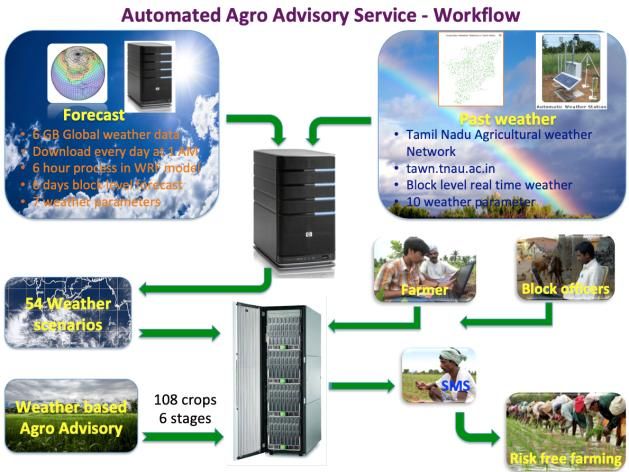
Proceedings of 7th Scientist Meet on Non crop specific projects – 2019
6th & 7th May2019
Seventh Scientist Meet on Non crop specific projects – 2019 was held on 7th, May 2019
at Seminar Hall-I, TNAU, Coimbatore. The Programme was chaired by the honourable Vice
Chancellor Dr. N. Kumar and Co-chaired by Dr. K.S. Subramanian, Director of Research.
On 06.05.2019, 10.00 AM, a pre review meet was conducted by Dr. V. Geethalakshmi,
Director, Directorate Crop Management (DCM) along with Dr. S. Panneerselvam, the Director,
Water Technology Centre (WTC). Before the start of individual scientist presentation, the
Director, Crop Management had narrated the expectation of University and points to be
considered during the presentation. Action taken on the recommendations of 6th Meet, 2018
was presented by Dr. SP. Ramanathan, Professor and Head, Agro Climate Research Centre
(ACRC), Directorate of Crop Management, Tamil Nadu Agricultural University, Coimbatore. This
was followed by project wise presentation of individual scientist and action plan for 2019-22.
Suggestions made by the Director, DCM and the Director, WTC were incorporated, accordingly.
On 07.05.2019, 2.00 pm, the Director of Research elaborated the research highlights of
the non crop research projects. The Professor and Head, ACRC made the consolidated
presentation of pre reviewed action taken on recommendations of 6th scientist meet, salient
findings for information and adoption from the agro meteorological research during 2018 -19
and action plan 2019 – 22 at the 7th Scientist Meet on Non crop specific project at Seminar Hall-
I, TNAU, Coimbatore.
i. Vice Chancellor’s Remarks
In the “TNAU – Web cum Mobile App”, concentrate on important pests and diseases of
major crops.
ii. Director of Research’s remarks
Design robust Agrotechnology advisory services using intellectual and indigenous
knowledge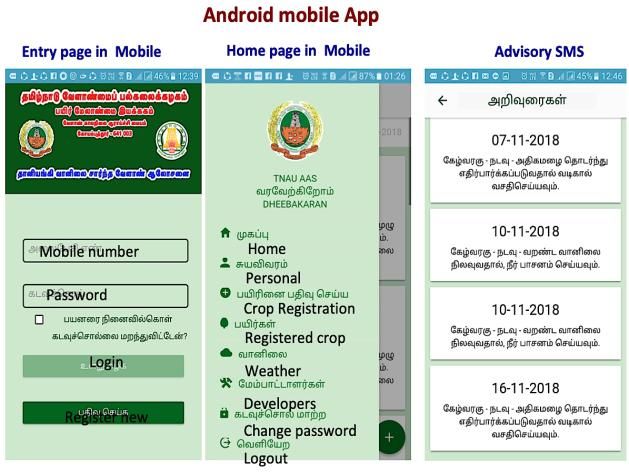
A. AGRL. METEOROLOGY
iii. Salient findings for adoption and information
a. For Adoption
Theme 1: Weather forecast and agro advisory
Weather during the cropping season contributes more than 50 per cent of crop yield.
Response farming with timely weather based agro advisories helps the resource poor
farmers to plan in advance on crop selection, intercultural, harvest and post harvest
operations will increase the yield in addition to reduce the weather based risks on input
loss. In this context, Weather based Automated Agro Advisory Web cum Mobile App has
been successfully developed under Government of Tamil Nadu sponsored NADP scheme
titled “Development of Agro Advisory Services using Automatic Weather Station data at
block level in Tamil Nadu” at Agro Climate Research Centre, Directorate of Crop
Management, TNAU, Coimbatore. “TNAU-AAS web cum Mobile App” automatically
generates block level weather forecast for next 6 days, develops weather scenario for the
every block of Tamil Nadu using past weather data observed from AWS installed in 385
blocks of Tamil Nadu under Tamil Nadu Agricultural Weather Network (TAWN) and for the
block level forecasted weather data.
TNAU-AAS web cum Mobile App picks up weather scenario based agro advisory from
the data base containing advisory for six crop stages of 108 major agricultural and
horticultural crops and sends to the registered farmer mobile as SMS. The weather specific,
crop specific, stage specific agro advisories includes both management and plant
protection.
Web portal: aas.tnau.ac.in. Mobile App could be downloaded from Google Play store by
typing “TNAUAAS” and install “Automate Agro Advisory Service”
Usefulness of “TNAU - AAS web cum Mobile App”
Fully automated, reduce the work load of extension functionaries
Lab to land transfer of technologies become direct and easy.
No holidays, no need of technocrats except simple monitoring
Surely reduce the crop failure risk of climate dependent farming
AAS is viable option to do weather based precision farming
Expected about 45 lakhs beneficiaries may get SMS every year.
Total number of SMS required is very less as it is specific to farmer
Can send special advisory / extreme events warning SMS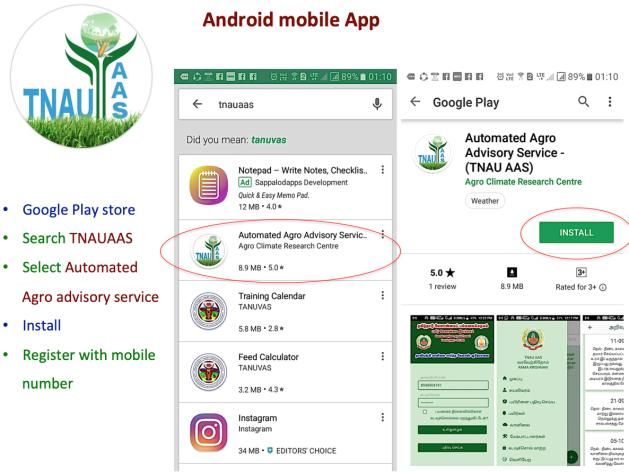
Figure 3.1 Work flow of TNAU - AAS App Figure 3.2 TNAU - AAS web portal
Figure 3.3 Weather based AAS Mobile Figure 3.4 TNAU – AAS Mobile App
App
Theme 2: Basic and applied meteorological studies
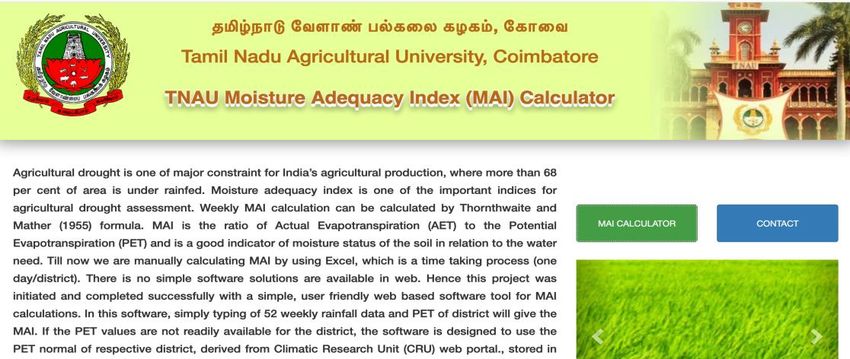
TNAU – MAI calculator
Simple, user friendly, web based “TNAU Moisture Adequacy Index software” is developed
for agricultural drought assessment. This product will be highly useful for Department of
Agriculture officials and State Disaster management to calculate weekly drought scenarios
using weekly rainfall data for any length of period during a year.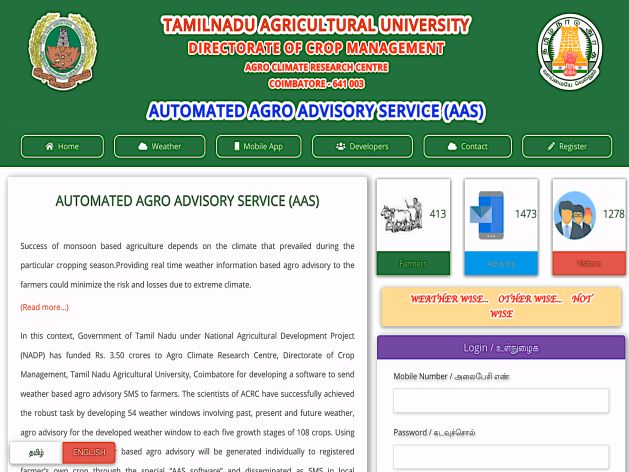
b. For Information
Theme 1: Weather forecast and agro advisory
In GKMS scheme, analysis of IMD’s district level rainfall forecast indicated that, inclusion of
Western Ghats in Coimbatore gives more false alarms to other plains of Coimbatore district.
The correctness of 2018-19 rainfall forecast was 80%) matched with actual.
Weather based agro advisories issued by GKMS-AMFU scheme has increased the income of
Agro Advisory Service adoptive farmers to the tune of Rs. 9500/- per acre maize
(Coimbatore-AMFU), Rs. 2400/- acre maize and Rs. 7000 – 8000/- per acre Chillies
(Kovilpatti- AMFU)
In Astrometeorological rainfall forecast studies, the planet activeness cart developed at
Agro Climate Research Centre increased the hourly astromet rainfall forecast accuracy and
verified successfully. Moist planets viz., Neptune, Saturn and Venus at their active azimuth
and hot planets viz., Sun, Mars and Uranus at their negative range to a particular location
had good influence on the rainfall of that location. The planet activeness concept
developed by our TNAU scientist is under process for “PATENT”.
In Astro-meteorological wind speed forecast studies inferred that, among the planets,
Neptune and Mercury had higher number of wind speed influencing capability. Irrespective
of planet, the azimuth range of 61 – 120 degree and 240 – 300 degree azimuth had good
influence on the wind speeds in the study locations. Active state of Mercury, Venus, Moon,
Mars, Jupiter and Uranus and ruling state of Saturn have increased the wind speed of a
location. Irrespective of 36 two-planet combinations, the 0-30 degrees aspects had more
wind speed events than other aspects.
In Weather Research Forecast (WRF) Model, the Kessler scheme produced highly usable
forecast in the both input data resolution (0.25 and 0.5) than other schemes with same
resolutions input data. The usability of forecast (correct + usable) obtained from WRF
model with 0.25 degree resolution cum Kessler scheme microphysics options were between
76 to 89 per cent, whereas it was 64 to 77 in WSM3 class scheme and 60 to 80 in WSM6
class schemes.
Theme 2: Basic and applied meteorology
According to Moisture Adequacy Index (MAI) analysis, there was moderate drought in
Dharmapuri, Karur and Krishnagiri, in both SWM and NEM of 2018. The Namakkal,
Perambalur, Pudhukkottai, Salem, Vellore, Trippur and Virudhunagar had moderate drought
during SWM and mild drought during NEM. Whereas other districts had mild to moderate
drought during SWM and then recovered during NEM 2018.
Microclimate modification with variety, spacing and method of planting influences the
growth and yield of organic rice varieties. Among the varieties, Co52 with SRI planting
perform better.
Climate variability and Chillies productivity studies inferred that Sivaganga,
Ramanathapuram, Thoothukudi, Tiruppur, Karur and Ariyalur were low productivity regions
for Chillies. Whereas, Vellore, Kancheepuram Tiruvannamalai, Viluppuram, Cuddalore,
Namakkal, Thanjavur, Thiruvarur, Nagapattinam, Pudukkottai, Theni, Madurai were fallen
under moderate productive region. Districts such as Erode, Krishnagiri, Coimbatore,
Thiruchirappalli, Dharmapuri, Dindigul, Tirunelveli, Virudhunagar districts managed to be in
high productive regions for Chillies. In comparing the average productivity index of Tamil
Nadu with rainfall deviation, it could be conclude that the excess and normal years gave
moderate to high productivity, but deficit rainfall years resulted in low to moderate
productivity. The positive nature of correlation also proved that rainfall deviation and
productivity index was linearly correlated with a positive relationship. Further, the
regression model indicated that there was a considerable amount of variation in productivity
due to rainfall deviation.
Theme 3: Climate change and crop weather model
The crop yield forecast developed under FASAL scheme with crop simulation model perform
better (- 6 to 10.8) than Statistical model (-24 to 24). Between flowering (F2) and pre
harvest (F3) forecast, the F3 forecast gave more accurate estimation of rice, maize and
groundnut yield. Hence, the CSM models could be used for yield estimation.
Climate change and pulse productivity study inferred that the major pulse crops such as
blackgram and redgram are expected to be highly vulnerable for the future temperature
rise in Tamil Nadu. However, this effect would be counteracted to certain extent by thesimultaneous increase in the carbon dioxide. Even though the yield is expected to sustain,
the climate variability would adversely affect the yield of blackgram and redgram.Selection
of suitable cultivar and a perfect sowing time would sustain the productivity and make the
crop more profitable.
iv. Projects reviewed
Theme Wise Research Projects
External funded Projects
Studnets
Theme URP Total
AICRP GOI GoTN Private Research
1. Weather forecast,
6 1 3 10
Agro Advisory
2. Basic and applied
2 4 6
meteorology
3. Climate change &
1 2 1 8 12
Crop models
4. RS & GIS 1 1
Total 3 0 8 1 1 16 29
Crop Wise
External
Studnets
Type of project URP AICRP GOI GoTN funded Total
Research
Projects
Rice 2* 2 4
Millets 1* 1 2
Minor millets 1 1 2
Pulses 1 1
Oil seeds 1* 1 2
Sugarcane 1 1
Cotton 1 1
Horticulture 2 2
Non crop 2 6 1 1 6 16
Total 3 10* 1 1 16 31
* - Multi crop projects
Staff Pattern
Faculty Prof. & Head Professor Assoc. Prof. Asst. Prof
Agronomy 1 1 1 1
Agrl. Meteorology 1 - - -v. Remarks on the ongoing research projects
A. University Research Projects
SN Project Title Project Leader(s) Period & remarks
I Theme 2: Basic and applied meteorology
1. DCM/CBE/AMT/2016/001 Dr. S. Kokilavani, July 2016- Mar.
Revalidation of efficient cropping Asst. Prof. (Agrl. Met.) 2019. Project
zonation for major food crops in Dr. Ga. Dheebakaran, Completed.
Tamil Nadu Asst. Prof. (Agronomy), Recommended
ACRC, TNAU, for closure of the
project and
submit
completion report
2. DCM/CBE/AMT/2015/001 Dr. S. Kokilavani, Jun. 2015-Dec.
Computation of Water Budgeting for Asst. Prof. (Agrl. Met.) 2018
blocks/ Taluks of Western agro Project Completed.
climatic zone of Tamil Nadu Recommended
for closure of the
project and
submit
completion report
II Theme 3: Climate change and crop weather model
3. DCM/CBE/AGR/SMM/2016/001 Dr. S. Panneerselvam, Sep. 2016- Mar.
Effect of elevated temperature on Director, WTC, TNAU 2019
nutri millets tenai, samai, kuthraivali Dr. N. Chandrasekaran, Project Completed.
and pulses Professor (SS&AC) Recommended
Dr. N. Sritharan, for closure of the
Asst. Prof. (Crop Phy.) project and
submit
completion report
B. Externally Funded Projects
S. Project Title Project Leader(s) Period & remarks
N
I Theme 1: Weather forecasting and agro advisory services
1. NCMRWF/DCM/ADT/AGR/2013/ Dr. K. Sathiya Bama Apr. 2014 Mar. 2020
R003 Assoc. Prof. (SS&AC) Forecast
GOI – IMD – Agromet –Gramin Krishi Dr. M. Raju, verification should
Mausam Sewa (GKMS) - Experimental be done at district
Assoc. Prof. (Agronomy)
Agro-Met Advisory Services (AAS), level.
Aduthurai. TRRI, Aduthurai Recommended to
continue.
2. IMD/DCM/CBE/ACR/2014/R006 Dr. Ga. Dheebakaran Apr. 2014 Mar. 2020
GOI – IMD – Agmet – Gramin Krishi Asst. Prof. (Agronomy), Forecast
Mausam Sewa (GKMS) - Weather Dr. SP. Ramanathan, verification should
based agro advisory services for farm Prof. and Head, be done at district
decision making for western zone of level.
ACRC, TNAU, Cbe -3
TN. Recommended to
continue.3. IMD/ DCM/ KPT/ AGR/ 1995/ Dr. B. Arthirani Apr. 2014 Mar. 2020
R001 Asst. Prof. (Agrl. Met) Forecast
GOI – IMD - Agromet – Gramin Krishi ARS, Kovilpatti verification should
Mausam Sewa (GKMS) – Rural Agro be done at district
meteorological Advisory Service for level.
Southern zone Recommended to
continue.
4. GOI/DCM/OTY/ACRC/2016/R00 Dr. S. Karthikeyan Mar. 2014 Mar. 2020
3 Asst. Prof. (Horti),
Forecast
Agrometeorology Field Unit (AMFU) HRS, Ooty verification should
for Agrometeorological Advisory be done at district
Services (GKMS – level.
GraminKrishiMausamSewa) under Recommended to
IMD, GOI at HRS, Ooty continue.
5. GOI/DCM/PPI/ACRC/2016/R001 Dr. P. Rajarathinam, Mar. 2014 Mar. 2020
Agro meteorology Field Unit (AMFU) Ph.D., Forecast
for Agro meteorological Advisory Assistant Prof. verification should
Services (GKMS – Gramin Krishi (Agronomy) be done at district
Mausam Sewa) under IMD, GOI at level.
HRS, Pechiparai. Add more
beneficiaries.
Recommended to
continue.
6. NADP/DCM/CBE/ACR/2016/D00 PI: Dr. SP. Ramanathan Apr. 2014 Mar. 2019
6 Prof. & Head, ACRC Extension
Development of Agro Advisory Co-PI: Dr. Ga. requested to the
Services using Automatic Weather Dheebakaran sponsor.
Station data at block level in Tamil Asst. Prof. (Agronomy) Recommended to
Nadu under NADP 2013-14 Dr. S. Kokilavani, continue.
Asst. Prof. (Agrl. Met.),
II Theme 2: Climate change & crop modeling
7. IMD/DCM/ADT/AGR/2011/R00 PI: Dr. M. Raju, Apr. 2013 Mar. 2018
1 Assoc. Prof. (Agronomy) extended up to 2020
Forecasting Agricultural output using Dr. K. SathiyaBama, New
Space, Agrometerology and Land methodologies
Assoc. Prof. (SS&AC)
based observations (FASAL) to Agro and crops may be
Advisory Services for Cauvery Delta TRRI, Aduthurai
included.
Zone – a linked project of AMFU for Recommended to
AAS (GKMS) at TRRI, Aduthurai continue.
8. IMD/DCM/CBE/ACR/2010/R00 PI: Dr. V. Geethalakshmi Jan. 2011 Mar. 2020
1 Director, DCM New
Yield forecasting for rice, maize and Co-PI: Dr. Ga. methodologies
Groundnut in Western zone of Tamil Dheebakaran and crops may be
Nadu using space, Agrometeorology included.
Asst. Prof. (Agronomy),
and land based observation (FASAL) Recommended to
ACRC, TNAU, Coimbatore
continue.9. DST/DCM/CBE/AGR/2018/R00 PI: Dr. V. Geethalakshmi Nov. 2018 -Mar.
3 Director, DCM 2021
DST - CCP- SPLICE (BRIFS) - Co-PI: Dr. Ga. Recommended to
Building Resilience to Climate Dheebakaran continue.
Change and Improving Food
Asst. Prof. (Agronomy),
Security through Climate Smart
Solutions (E28ADP) Co-PI: Dr. S. Kokilavani,
Asst. Prof. (Agrl. Met),
ACRC, TNAU
vi. Action plan for year 2018-2019
a. Tailor made agro advisory Dr. SP. Ramanathan, P&H, ACRC
services for farm level Dr. V. Geethalakshmi, Director, DCM, TNAU
planning Dr. NK Sathyamoorthy, Assoc. Prof, ACRC – NWZ
Dr. Ga. Dheebakaran, Asst. Prof. (Agron), ACRC – WZ
Dr. S. Kokilavani, Asst. Prof. (Agromet.) – NEZ
Dr. Sathyabama, Assoc. Professor (SS & AC) – CDZ
Dr. B. Arthirani, Asst. Prof. (Agromet), ARS, KVPT – SZ
Dr. P. Rajarathinam, Asst. Prof (Agron), HRS, PPI – HRZ
Dr. S. Karthikeyan, Asst. Prof (Horti), HRS, Ooty – HAZ
b. Improving the accuracy of Dr. V. Geethalakshmi, Director, DCM, TNAU
TNAU’s Season weather Dr. S. Kokilavani, Asst. Prof. (Agromet.), ACRC
forecast Dr. NK Sathyamoorthy, Assoc. Prof, ACRC
c. Developing TNAU’s village Dr. Ga. Dheebakaran, Asst. Prof. (Agron), ACRC
level medium range Dr. KP. Ragunath, Asst. Prof. (SS&AC), RS&GIS
forecast with higher
accuracy.
d. Developing hybrid weather Dr. Ga. Dheebakaran, Asst. Prof. (Agron), ACRC
forecast by integrating the Dr. SP. Ramanathan, P&H, ACRC
numerical and Dr. S. Kokilavani, Asst. Prof. (Agromet.), ACRC
astrometeorological
forecast
e. Delineation of efficient Dr. S. Kokilavani, Asst. Prof. (Agromet.), ACRC
cropping zone major Dr. Ga. Dheebakaran, Asst. Prof, (Agronomy), ACRC
commercial crops for
Tamil Nadu
f. Studying the microclimate Dr. N. Maragatham, Prof. (Agronomy), ACRC
modification options for Dr. Thirunavukkarasu, Asst, Professor (AH)
improving the milk yield
g. Crop Simulation Model Dr. NK Sathyamoorthy, Assoc. Prof. (Agronomy), ACRC
studies on the impact of Dr. S. Kokilavani, P&H, ACRC
climate variability on Dr. SP. Ramanathan, P&H, ACRC
Cereals. (Rice and Maize)
h. Crop Simulation Model Dr. NK. Sathyamoorthy, Assoc. Prof. (Agronomy), ACRC
studies on the impact of Dr. Ga. Dheebakaran, Asst. Prof, (Agronomy), ACRC
climate variability on
Dr. N. Maragatham, Prof. (Agronomy), ACRC
millets.
(Sorghum, Cumbu and Ragi)List of scientist participated in the 7th Non Crop Scientist Meet – Agrometeorology
SN Department / Station Name of Scientist
1. Agro Climate Research Centre Dr. SP. Ramanathan, Prof. &Head, ACRC
2. TNAU, Coimbatore Dr. N. Maragatham, Prof. (Agronomy)
3. Dr. N.K. Sathyamoorthy, Assoc. Prof. (Agronomy)
4. Dr. Ga. Dheebakran, Asst. Prof. (Agronomy)
5. Dr. S. Kokilavani, Asst. Prof (Agrl. Met.)
6. Agricultural Research Station Dr.B. Arthirani, Asst Prof. (Agrl. Met.)
Kovilpatti
7. Tamil Nadu Rice Research Dr. M. Raju, Assoc. Prof. (Agronomy)
Institute, Aduthurai Dr. K. SathiyaBama, Assoc. Prof. (SS& AC)
8.
9. Horticultural Res. Station, Ooty Dr. S. Karthikeyan, Asst. Prof.(Horti),
10. Horticultural Res. Station, Dr. M. Rajarathinam, Asst. Prof (Agronomy)
Pechiparai
11. Water Technology Centre, TNAU Dr. A. Raviraj, Professor (SWE)B. DEPARTMENT OF SUSTAINABLE ORGANIC AGRICULTURE
i. Action Taken on the Previous Crop Scientist Meet
The Department of Sustainable Organic Agriculture was instructed to present the
research activities in the crop-wise scientist meet during 2018 and hence, the action taken on
the previous CSM 2017 on Non-crops is presented below;
Recommendation Action taken
Coordinate with ICAR-IIFSR, Modipuram for Coordinate with ICAR-IIFSR, Modipuram for
finalization of the results of the organic finalization of the results of the organic
experiments conducted at TNAU and after experiments conducted at TNAU and after
thorough scrutiny and confirmation the same thorough scrutiny and confirmation the same
communicated in future SWC communicated in future SWC
Organic seed treatment package need to be At Dept of Seed Science & Technology
developed in consultation with the Department already validated organic seed treatment
of Seed Science and Technology, TNAU, techniques are available
Coimbatore.
Eg. Bio-priming for foxtail millet: Nutrigold,
Pulse sprout for various crops
Organic seed production programme have to Four certified organic vegetable growers have
be taken up in vegetables in collaboration been identified through TNOCD and the seed
with TNOCD, Coimbatore production is on going
To compare the quality of Beejamruth
produced by the Regional Organic Research IOF, Dharwad has validated the dosage of
Station, Bengaluru/ Dharwad and organic application of Beejamruth. The ingredients
farmers of Tamil Nadu. An official visit to added in the preparation differs from Tamil
Karnataka Centre may be made to discuss Nadu preparation.
about the organic inputs preparation done at RCOF, Bengaluru concentrates on the quality
Karnataka. analyses of organic inputs from various
research centres, farmers, other stakeholders
etc.
Demonstration of organic medicinal rice may
be initiated at TNAU Demonstration of organic medicinal rice are
being done at Wetlands of TNAU. Farmers
visiting SOA, TNAU were exposed to the
demonstration plots
A visit to organic vegetable field at
Meenakshipuram, Palakkad may be made to Visited the Sattakkal Pudur and
study the organic agricultural practices Meenakshipuram areas. Due to shortage of
followed. organic inputs and techniques of Pest and
Disease management, many farmers are now
practicing INM and IPDM practices in
vegetable cultivation.ii. Crop Wise Recommendations
Crop: Rice
A. Specific recommendation
Complete package of practices for growing rice under organic cultivation may be
developed and validated (through the visit to organic rice cultivation cluster at
Singampatti, Thirunelveli district)
B. General recommendation
For Information:
Rice varieties suited for organic farming are Bhavani, Improved white Ponni, Mapillai
samba, Kitchadi samba, IR 20, CO 43 and CO (R) 48.
Medicinal and aromatic category varieties such as Red kavuni, Jeeraga samba, KDML
105 and culture CB 05022 are also suitable for organic rice cultivation.
Crop : Vegetable crops
A. Specific recommendation
Nil
B. General recommendation
For Information:
The brinjal yield was more (25.7t/ha) in 100% organic manure applied plots
The yield of chilli was the highest (13.7t/ha) under 75% organic + 25% inorganic
manure applied plots
The tomato yield was more (17.6t/ha) in 75% organic manure + innovative
practices applied treatment
The quality parameters are better in 100% organic manures applied plots when
compared to 100% inorganic and integrated nutrient management practices
SOC content is increasing trend in the organic experimental fields from 0.57%
(2013) to 0.82% (2019)
Crop: Millets
A. Specific recommendation
Nil
B. General recommendation
For Information:
In a study on the impact of organic, conventional and integrated management practices
on the productivity of finger millet, the plots treated with 75% organic (organic manures
equivalent to 75% N requirement) followed by innovative organic practice (3%
Panchagavya + Azophos @ 2kg/ha) registered the higher grain yield (2906 Kg/ha) and
BCR (1.77).
For organic finger millet, in places where the availability of FYM is a problem, the
application of enriched vermicompost @ 1t/ha in two equal splits on 25 and 40 DASfollowed by Foliar application of Panchagavya @ 3% on 30 and 45 DAS recorded the
higher grain yield of 2563 kg/ha.
ICAR/DCM/CBE/SOA/2015/R001: Network Project on Organic Farming:
Evaluation of organic, inorganic and integrated production systems in Finger millet
(August, 2013 to August 2018) : To be closed/continued as per the proceeding of the
NPOF, ICAR.
ICAR/DCM/CBE/SOA/2015/R001: Network Project on Organic Farming: Evaluation of
organic, inorganic and integrated production systems in Barnyard millet
(August, 2013 to August 2018) : To be closed/continued as per the proceeding of the
NPOF, ICAR.
DCM / CBE / AGR / SMM / 2018 / CP011: Developing organic package of practices for
finger millet (August, 2018 to July, 2020): To be continued
DCM/CBE/ENS/SOA/2018/CP062: On-farm resource quantification and utilization under
Zero Budget Natural Farming System (Low external input organic farming) : The project may
be continued.
Crop: Cotton
CPPS/CBE/ENT/COT/2018/001: Studies on the impact of ginger, garlic
and green chilli extract for the management of insect pests in
organic cotton: The project may be continued
Social Science
CARDS/CBE/EXT/2019/001: Assessment of the Cost and Returns and Marketing of
Organic Vegetables in Tamil Nadu: The project may be continued
Non-Crops
A. Specific recommendation
Complete package of practices for finger millet, pearl millet, banyard millet and fox
tail millet under organic cultivation may be developed and validated
B. General recommendation
For Information:
From Integrated organic farming system model following informations were
generated;
Employment generated was 463 man-days
Crop component shared 68 % of the total income (Rs.85,864/-)
Dairy component contributes 32% of the total income of Rs. 41,119/-
About 5.48 tones of fresh cow dung was obtained from 2 heifer cows
The income from composting from crop residues with cow dung slurry was Rs.
8496/-per annum Green fodder yield of 95.4 t/ha and 42.5 t/ha / year was recorded for CO (CN) 5
and Desmanthus, respectively
The green leaf manure yield of 148t/ha was observed through Gliricidia as
border crop
From Organic inputs and bio inputs characterization for sustainable organic
agriculture following information’s were generated;
1. Jeevamruth - Compounds and their activity
Common name (fatty Acid) Activity of compound
Diffractaic acid Antifungal, secondary metabolites
Retinoic acid herbicide
Isoenanthic acid capsules for seed
D-Glucoheptose antimicrobial
Benzoic acid, methyl ester Herbicide
Carboxybenzene Fungistatic compound
Daphnin (daphnetin-7-O-glucoside) strongest antibacterial activity
Columbianetin, lomatin Increase seed longevity
Retinoic acid, methyl ester Herbicide and solvent
Fumaric acid Pesticides manufacturing.
1,6-Hexanediol Coatings, Adhesives
1,4-Cyclohexanediol Insect repellent
Benzoic acid Preservatives & inhibit bacteria
Linoleic acid Activates Peroxisome
2-hydroxygarvin B fungicides
Common name (Alkains) uses
Trimethylbenzene Component of herbicides
á-Selinene Insecticidal and Antifungal
Pseudolimonene insecticide
9 - propyl - anthracene insecticides
Common name (Alconols and
Uses
alcohols)
ar-turmerone Insecticide and antimicrobial
Stigmasterol Growth promotor & Salt stress tolerence
Common name (Ester) Uses
Benzoic acid, 2-ethyl hexanediol diester defense response
2.Vermiwash
pH – 7.80,EC – 3.86 dsm-1 ,Organic Carbon – 2.32 %,Total N – 1.51 %,Total P –
0.92 %,Total K – 0.12 %,Total Zn – 0.18 ppm,Total Mn – 0.72 ppm,Total Fe – 0.1
ppm,Total Ca - 0.06 ppm,Total Mg – 6.2 ppm,Total Na – 11.0 ppm,Bacteria – 83 x
106 ,Fungi – 8 x 10³ and Actinomycetes – 3 x 10²³. Crop residue compost
Parameters Total value
PH 6.86
EC 0.29 dsm-1
Organic Carbon 9.25 %
Total N 0.62 %
Total P 0.39 %
Total K 0.52 %
Total Mn 23.7 ppm
Total Zn 17.3 ppm
Total Fe 7.4 ppm
Total Cu 9.6 ppm
Bacteria 92 x 106
Fungi 17 x 103
Actinomycetes 12x 102
4.BEEJAMRUTH-Compounds observed and their activity
Compound name (Fatty Acid) Uses /Activity
Pinocembrin Antimicrobial,antifungal
4-tert-butylcalix[4]axene Herbicide
Mevastatin, Gitoxigenin Bioconversion, repellents
Columbianetin, lomatin Increase seed longevity
Dibutoxyanthracine Pesticide
Enterolactone Antimicrobials
Prednacinolone Insecticides
Ubiquinol, dupical Antioxidant, reduces reductase activity
4-methoxychalcone, Cicloprofen Antibacterial coating
Macrocyclon Antimicrobial, cryopreservation
Macrocyclon, 8-heptadecene dioic acid Antimicrobial
Erioflorin, Nagilactone a Plant growth regulators and herbicide
Trimegestone Antibiotic
Rofe coxib Antibiotic
Isobornyl acetate Solvent
Clupanodonic acid Plant defense
Cyclohexyl dodecyl euceinate Plant pesticide
Eldecalcifol Insecticide
Petrosaspongiolide m, Hyatolide a Lipid signaling pathway
Catalpol Plant defense
Garcinone-d Prevention and treatment of diseases
(Propoxyethoxy) ethylbenzene SolventSubglutinol a Immunosuppressive agent
Benzoic acid, 2-ethyl hexanediol diester Defense response
Kuraidin, oxogedunin Insecticide
Compound name (alkanes)
Decylnaphthalene Plant growth regulating compound
P-quinquephenyl Fungicide
Tetrahydrosqualene Fungicides
Compound name (alconol & alcohols)
Farnesal, Isoacolamone Assist in the pollination
Curlone, Germacrone Antiviral activity
Eucalyptol, Gexanid Insecticide,assist in the pollination
Camphor Biopesticide
Taraxerone, Arborinone Antimicrobial
Farnesal Natural antifungal
5. Arappu Buttermilk karaisal
pH – 5.20,EC – 4.52 dsm-1 ,Total N – 0.80 %,Total P – 0. 20 %, Total K – 0.80 %,
Bacteria – 1020 x 106 ,Fungi – 33 x 103 and Actinomycetes - 93 x 102
6. 3G extract (ginger, garlic and green chilli)
Compound name Uses
Tetracosane Antifungal
Hexatriacontane Antimicrobial
Beta sesquiphellandrene Antimicrobial
2,6-octadienal 3 7-dimethyl- (z)- Antimicrobial
3-vinyl-1 ,2-dithiacyclohex-4-ene Antibacterial
Diallyl disulfide Antimicrobial
1,2-dithin, 3-ethenyl-3, 4-dihydro- Antimicrobial
2-vinyl-4h-1 3-dithiin Antioxidant
Tetradecane Cytotoxic & Antifeedant
7. Egg Amino acid (EAA)
Among the four isolates identified (E1 to E4) identified from EAA, E4 recorded an
inhibition zone of more than 2 cm, and hence its antimicrobial activity against
Fusarium sp. is confirmed8.Fish amino acid (FAA)
Four isolates (F1 to F4) were identified from FAA
F1, & F2 isolates from FAA exhibited antifungal activity against Macrophomina
phaseolina
F3 & F4 isolates had antifungal activity against Macrophomina phaseolina and Fusarium
sp.
General:
The cow urine based five leaf extracts (neem, notchi, Adathoda, Ailanthus and Jatropha)
and 3G extracts (ginger, garlic and green chilli) showed comparable nympal mortality
and adult emergence in white backed plant hoppers in rice.
Benzene-1-ethoxy-4-methyl, Tetracosane, Diallyl disulphide were identified as the major
bio-active compounds indentified in cow urine based 3G extract analyzed through GCMS.
The highest Bhendi yield of 13.5t/ha was recorded in plots treated with 5 leaf herbal
repellent @10% concentration as foliar spray followed by foliar spraying of 3G extract
@10% with the yield potential of 12.9t/ha.
iii. Action Plans (2019-2022)
Action plan 1. Climate smart organic farming in rice
Period: Three years (2019-20 to 2021-22)
Rationale
Widespread changes in rainfall and temperature
Climate induced water scarcity
Elevated soil temperature and emission of Methane
Growing interest on organic rice cultivation
Objectives
To develop a climate resilient protocol for sustainable organic rice farming
To study the impact of organic packages on rice quality growth and productivity
To analyze the economic feasibility of the protocol developed
Treatments
T1
Modified SRI with RDF
Modified SRI with EFYM @ 750 kg/ha+neem cake @250
T2 kg/ha+vermicompost@1t/ha in two equal splits at AT and PI stages + 3%
Panchagavya as foliar spray twice (15 days before and after flowering)
Green manure/Green leaf manure application @6.25t/ha+vermicompost @
T3 1t/ha+neem cake @250 kg/ha+3% Panchagavya as foliar spray twice (15
days before and after flowering)
T4 T2 +AWD using FWT
T5 T3 + AWD using FWT
T6 FYM @12.5 t/ha + RDF (check)
Green manure grown in situ and incorporated at 50% flowering + 3%
T7
Panchagavya spray ( farmer’s practice)Design : RBD
Replications : 3
Variety : CO (R) 48
Season : Rabi
Duration : Three Years (2019-20 to 2021-22)
Observations
Weather parameters (air temperature, soil temperature, rainfall, windspeed etc),
Greenhouse gas emission (Methane, CO2, etc.,), Growth and yield attributes of rice and
Economic analysis
Centre Department / Station Scientists
Agro Climatic Research
Dr. SP. Ramanathan, Prof & Head, ACRC
Co-ordinating Centre & Sustainable
Dr. E. Somasundaram,Prof& Head, SOA
centre Organic Agriculture,
Dr. K .Ganesan, Asst. Prof (Ag. Ento.),SOA
TNAU, Coimbatore
Centres for
Dr. V. M. Sankaran, Prof & Head
conducting RRS, Tirur
Dr. S. Malathi, Asst. Prof (Pl. Patho.)
experiment
Dr. E. Subramanian, Asst. Prof (Agron.)
AC & RI, Madurai
Dr. P. Kannan, Asst. Prof (SS & AC)
Dr. S.R. Shri Rangasami, Asst. Prof (Agron.)
RRS, Ambasamudram
Dr. K. G. Sabarinathan, Asst. Prof (Ag.Micro.)
Dr. M. Raju, Assoc. Prof. (Agron.)
TRRI, Aduthurai
Dr. C. Umamageswari, Assoc. Prof. (Agron.)
Participants
1. Dr. E. Somasundaram, Professor and Head
2. Dr. K. Ganesan, Assistant Professor (Agrl. Entomology)
3. Dr. R. Sunitha, Assistant Professor (Environ. Sciences)
Action plan 2. Developing package of practices for organic production of curry
leaf
Period: Three years (2019-20 to 2021-22)
Objective / Theme : Standardization of improved agro techniques for increasing the
productivity of spices
2019-20 : Standardization of cost effective sustainable organic cultivation practices in curry
leaf for yield and quality
2020-21 : Standardization of agro techniques
2021-22 : Confirmation trial
Deliverables : Developing package of practices for organic production of curry leaf
Centres& Scientist 1. HC&RI, Coimbatore
In-charge for 2. HC&RI,Periyakulam,
conducting 3. Dept. of Sustainable Organic Agriculture
experiment 4. CPPS, TNAU, Coimbatore
Participants
1. Dr. E. Somasundaram, Professor and Head
2. Dr. K. Ganesan, Assistant Professor (Agrl. Entomology)Action Plan : 3. Comparative evaluation of desi and cross bred cow dung, cow urine
and milk for sustainable agriculture
Period: Three years (2019-22)
Rationale: Desi cow products (dung, urine and milk) are superior in quality and safer to the
environment
Objectives:
To study the quantitative and qualitative characters of desi and cross bred cow products
To analyze the bio-active compounds in cow dung and urine of desi and cross breds
Deliverables: Qualitatively superior and safe source of cow dung, cow urine and
milk can be identified.
Centre Department Scientists Activity
1. Dr. E. Somasundaram Soil health
Sustainable Prof & Head, SOA
Organic 2. Dr. K .Ganesan Plant protection aspects
Agriculture, Asst. Prof (Ag. Ento.),SOA
Co-
TNAU, 3. Dr. R. Sunitha Qualitative analysis
ordinating
Coimbatore Asst. Prof (ENS)
centre and
Centres
1. Dr. K. R. Latha Quantitative evaluation
conducting
Chief Scientist (Agronomy),
experiment
AICRP-IFS
Agronomy
2. Dr. S.P. Sangeetha
Asst. Prof (Agronomy),
AICRP-IFS
C. Ongoing project details
Core Externall
UR ICAR- VC
Project details Projec y
P NPOF S
t Funded
Rice - - 1 - -
Cotton 1 - - - -
Finger Millet - 1 - - -
Green Manure -Brinjal - Bajra
- - 1 - -
Cropping System
GM - Chilli - Barnyard Millet Cropping
- - 1 - -
System
GM - Tomato - Finger Millet Cropping
- - 1 - -
System
IOFS - Integrated Organic Farming
- - 1 - -
System Model
ZBNF- Zero Budget Natural Farming - 1 - - -Cost and Return assessment - 1 - - -
Bio-characterization of Organic Inputs - - - 1 -
Organic inputs and training on
- - - - 1
organic farming
Total 1 3 5 1 1
G.Total :11
E. List of scientists working in SOA
1. Dr. E. Somasundaram
Professor and Head
2. Dr. R. Jansirani
Professor (Agrl. Extn.)
3. Dr. K. Ganesan
Asst. Professor (Agrl. Ento)
4. Dr. R. Sunitha
Asst. Professor (ENS)C. AGRONOMY - AICRP-IFS
i. Decisions made on Adoption / OFT : Nil
ii. For Information
IFS model developed for 1.0 ha area under irrigated dryland condition involving crop (8500
m2), horticulture (1000 m2), dairy (50 m2), goat (50 m2), kitchen garden (200 m2) and
vermicompost (50 m2) recorded net return of Rs. 3,54,271/- with B:C ratio of 1.82 during
2017-18.
The cropping system contributed 36.1 % of total Gross returns and 42.4 % of total net
returns followed by dairy unit with 32.8 % gross return and 14.5 % of net return. Among
cropping systems, Prosomillet – Chillies – Green manure (Daincha) recorded the highest
net return of Rs. 44, 873/-
The system generated an employment of 558 mandays and with an additional nutrient
generation of 108.7 kg N, 47.6 kg P2O5 and 65.6 kg K2 O by recycling livestock wastes and
crop residues.
2. Research Projects on Pulses Crop
Centre URP AICRP EFP TNAU Core Total
project
(Phase II)
Agronomy
AICRP- Department of - 3 - 1 4
IFS Agronomy,
Coimbatore
SWMRI, - 1 - 1
Thanjavur
ARS, - 3 - 3
Bhavanisagar
TCRS, Yethapur - 3 - 3
3. Ongoing URPs /AICRPs / Externally Funded Projects
Agronomy
AICRP-IFS
No. Project No. and Title Remarks
1. AICRP/DCM - CBE – AGR/001
Sustainable resource management for climate smart The project may be
IFS continued
(June 2017- May 2022) Salient findings to be
Dr.K.R.Latha given for information
Professor (Agronomy) &
Chief Agronomist (AICRP – IFS), TNAU, Coimbatore
2. AICRP/DCM - CBE – AGR/001 The project may be
Expt. 1 a. -- Identification of cropping system module continued
for different farming system modules
(June 2017- May 2022)
Dr.S.P.Sangeetha, Assistant Professor (Agronomy),
TNAU, Coimbatore3. AICRP/DCM - CBE – AGR/001 The project may be
Carbon crediting and GHG emission in IFS model continued
(June 2017- May 2022)
Dr.A.Renukadevi, Assistant Professor (SS & AC), TNAU,
Coimbatore
4. AICRP/DCM - CBE – AGR/001 Salient findings to be given
Integrated farming system for marginal farmers of for information
Cauvery New Delta Zone
(August 2016 – August 2019)
Dr. S. Porpavai, Professor (Agronomy) and Head,
SWMRI, Thanjavur
5. AICRP/DCM - CBE – AGR/001 Important constraints
OFR Experiment I- On-Farm crop response to plant for each block may be
nutrients in pre-dominant cropping systems and their taken for intervention.
impact on crop-livestock-human continuum The project may be
(April 2017 to March 2020) continued
Dr.N.Satheeskumar, Asst. Professor (Agronomy), ARS,
Bhavanisagar
6. AICRP/DCM - CBE – AGR/001 The project may be
OFR Experiment II- Diversification of Existing Farming continued
Systems under Marginal household conditions
(April 2017 to March 2020)
Dr.N.Satheeskumar, Asst. Professor (Agronomy), ARS,
Bhavanisagar
7. AICRP/DCM - CBE – AGR/001 The project may be
OFR Experiment III- On-farm evaluation of farming continued
system modules for improving profitability and
livelihood of small and marginal farmers
(April 2017 to March 2020)
Dr.N.Satheeskumar, Asst. Professor (Agronomy), ARS,
Bhavanisagar
8. AICRP/DCM - CBE – AGR/001 The project may be
OFR 1: On Farm crop response to plant nutrients in continued
pre-dominant cropping systems and their impact on
crop – livestock – human continuum
(April 2017 to March 2020)
Dr.D. Raja, Professor (Agronomy), TCRS, Yethapur
9. AICRP/DCM - CBE – AGR/001 The project may be
OFR 2: Diversification of existing farming systems continued
under marginal household conditions.
(April 2017 to March 2020)
Dr.D. Raja, Professor (Agronomy), TCRS, Yethapur
10. AICRP/DCM - CBE – AGR/001 The project may be
OFR 3: On-farm evaluation of farming system modules continued
for improving profitability and livelihood of small and
marginal farmers
(April 2017 to March 2020)
Dr.D. Raja, Professor (Agronomy), TCRS, Yethapur(TNAU Core project – Phase II)
1. DCM/CBE/AGR/IFS/2018/CP060 The project to be
GOTAG/GEN/2018/R001 continued for one more
Integration of Rice + duck farming system in irrigated years
transplanted rice under organic farming
June 2018 to May 2019
Dr. N. Thavaprakaash, Assoc. Prof. (Agronomy),
Department of Agronomy (CFU),
TNAU, Coimbatore.
4. Action plan
Action plan 1: Agricultural and horticultural crops based integrated organic farming
system model for small and marginal farmers of
Tamil Nadu
Theme Leader: Dr K.R.Latha, Professor, Dept. of Agronomy, TNAU , Coimbatore
Activity Name of the 2019-2020 2020-2021 Deliverables
scientist and / expected
centre out come
To identify Department of Project The suitable
the best Agronomy, proposal and Confirmative integrated
integrated TNAU, approval trial organic
organic Coimbatore Experiment data farming
farming layout and processing system model
system Dr.K.R.Latha sowing Report will be
model for Professor Crop preparation identified for
Tamil Nadu (Agronomy) & management small and
Treatments Chief Agronomist , monitoring marginal
T1: Control (AICRP – IFS), and farmers of
T2: Field TNAU, observation Tamil Nadu
Crops Coimbatore Monitoring
(Green and
manure- Dr. N. maintenance
Rice- Thavaprakaash, of fish, duck,
Blackgram) Assoc. Prof. desi chicken
+ fish + (Agronomy), and Japanese
Japanese Department of quail and
quail Agronomy observation
T3: (CFU), Soil fertility
Vegetable TNAU, analysis
crops Coimbatore
(Tomato-
Green Dr.S.P.Sangeeth
manure- a, Assistant
Pumpkin) + Professor
fish + duck (Agronomy),
T4: Leaf TNAU,
Banana + Coimbatore
fish + Desi
chicken Dr.T.Saraswathi
Kitchen Professor
garden: (Horticulture)Amaranthus TNAU,
, Coriander, Coimbatore
Fenugreek,
Mint,
Gourds,
Radish,
Palak
Border
Planting:
Papaya,
Moringa
Action Plan 2. Validation of GHG emission in IFS model for Crop Component from
real time field data
Theme Leader: Dr K.R.Latha, Professor & Chief Agronomist (AICRP – IFS), Dept. of
Agronomy, TNAU , Coimbatore
Activity Name of the 2019-2020 2020-2021 2021-2022 Deliverable
scientist and s/
centre expected
out come
To study Centre : Dept. Project Sowing of Sowing of Quantificatio
the GHG of Agronomy proposal crops at crops at n of green
emission and different different house gases
from crop Scientists approval seasons seasons from
component Involved Sowing of Collection Collection different
in IFS crops at of gases of gases cropping
model Dr.K.R.Latha different and and systems in
Professor seasons estimation estimation IFS model
Treatmen (Agron.) Collection in Gas in Gas
ts of gases Chromatogr Chromatogr
A. Dr.A.Renukade and aphy aphy
Cropping vi estimation
Systems Asst. Prof.( in Gas
1. Cowpea SS&AC) Chromatogr
(G) – Ragi aphy
– Dr.S.
G.Manure Kokilavani
2. Maize – Asst. Prof. (
Sunflower Agrl.
– Meterology)
G.Manure
3. Dr.S.P.Sangeet
Prosomillet ha Asst. Prof.
– Chillies – (Agron)
G.Manure TNAU,
4. Coimbatore
Pearlmillet
– Cotton –
G.Manure
5.Perennial fodder grass and Desmanth us B. Sample Collectio n Seasons- (kharif, rabi and summer), Stages of crop and at Regular intervals
IV) CONTACT DETAILS OF SCIENTISTS PARTICIPATED IN THE CSM ON PULSES,
2019

S.No.   Name & Designation with           Email ID                       Mobile Number
        full address
1.      Dr.K.R.Latha                      palaiappan_latha@yahoo.co.in   8825912770
        Professor (Agronomy) & Chief
        Agronomist (AICRP – IFS),
        Dept. of Agronomy
        TNAU,
        Coimbatore
2.      Dr.S.P.Sangeetha,                 sangeetha.agr@gmail.com        9976961660
        Assistant Professor (Agronomy),
        Dept. of Agronomy
        TNAU, Coimbatore
3.      Dr.A.Renukadevi                   renu_remsen@yahoo.co.in        9994084375
        Assistant Professor (SS&AC),
        Dept. of Agronomy
        TNAU, Coimbatore
4.      Dr. S. Porpavai,                  porpavaiswmri@yahoo.co.in      9442987904
        Professor (Agronomy) and
        Head,
        SWMRI,
        Thanjavur
5.      Dr.D. Raja,                       arsyethapur@tnau.ac.in         8903769689
        Professor (Agronomy),
        Tapioca and Castor Research
        Station
        Yethapur
6.      Dr.N.Satheeskumar,                nsatheeshe2000@gmail.com       9894563397
        Asst. Professor (Agronomy),
        Agricultural Research Station
        Bhavanisagar
7       Dr. N. Thavaprakaash,             thavaprakaash.n@tnau.ac.in     9443622977
        Assoc. Prof. (Agronomy),
        Department of Agronomy (CFU),
        TNAU, Coimbatore.
You can also read


