DRAFT 2021-2025 February 23, 2021 - District of Saanich
←
→
Page content transcription
If your browser does not render page correctly, please read the page content below
1 | Financial Plan 2020-2024

dd

DRAFT

2021-2025
February 23, 2021

                               District of Saanich
District of Saanich
TABLE OF CONTENTS
EXECUTIVE SUMMARY .................................................................. 2
INTRODUCTION ............................................................................... 9
COMMUNITY PROFILE ....................................................................................... 9
ORGANIZATION PROFILE ................................................................................ 10
BUDGET GUIDELINES FOR 2021 ..................................................................... 14
BUDGET POLICY AND PRINCIPLES ................................................................ 15
General Operating Fund ............................................................... 25
Council, Administration and Legislative Services ......................................... 30
Corporate Services ........................................................................................... 32
Finance .............................................................................................................. 35
Corporate Revenues and Expenses ................................................................ 37
Fiscal Services .................................................................................................. 38
Building, Bylaw, Licensing and Legal Services ............................................. 39
Fire Protection................................................................................................... 42
Emergency Program ......................................................................................... 45
Planning............................................................................................................. 47
Engineering ....................................................................................................... 50
Parks, Recreation and Community Services .................................................. 55
Police Services.................................................................................................. 65
Library, Grants and Economic Development ................................................. 66
General Capital Program .............................................................. 67
Water Utility Fund.......................................................................... 79
Sewer Utility Fund ......................................................................... 84
Reserve Funds .............................................................................. 89
General Operating Fund Estimates 2022 - 2025 ......................... 92
Water Utility Fund Estimates 2022 - 2025 .................................... 93
Sewer Utility Fund Estimates 2022 - 2025 ................................... 93
Glossary......................................................................................... 94
Bylaws............................................................................................ 97
Appendix A - Saanich Police Board 2021 Provisional Budget
Appendix B - Greater Victoria Public Library 2021 Budget and
Five Year Financial Plan

                                                District of Saanich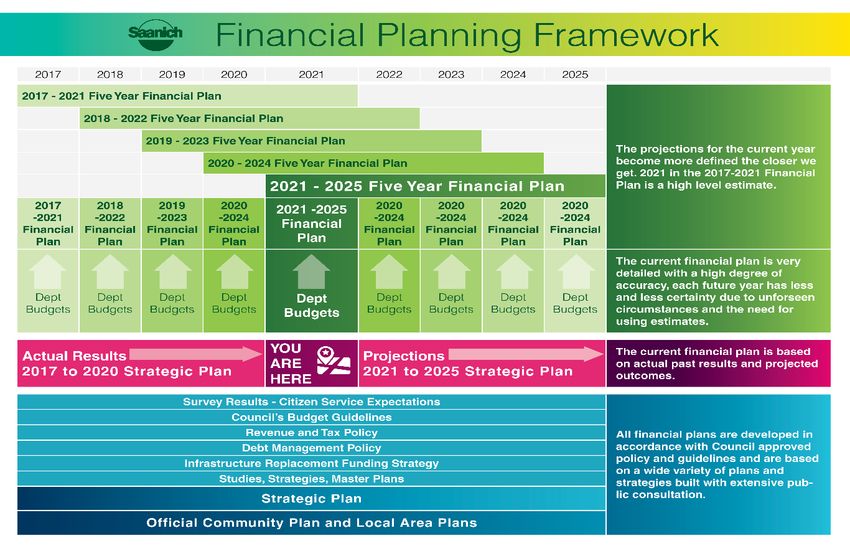
2 | Financial Plan 2021-2025

EXECUTIVE SUMMARY
The Community Charter requires that the District of Saanich approve a Five Year Financial Plan
bylaw each year prior to the adoption of the annual property tax bylaw. This document provides the
supporting details to the 2021-2025 Draft Financial Plan Bylaw, which will be considered for
adoption by Council before May 15, 2021.

1. Consolidated Financial Plan Summary

Local governments in British Columbia are required through provisions in the Community Charter
to have balanced financial plans. Current revenue, including transfers from reserves, must be
sufficient to support current expenditures for each of the three funds: general operating, sewer and
water.

Saanich’s consolidated financial plan for 2021 balances $359,781,300 in revenues and transfers
with $359,781,300 in expenditures.

                                       District of Saanich
Financial Plan 2021-2025 | 3

The budget is based on:

    1. A municipal property tax increase of 1.80% ($50.34) for core operations and non-discretionary
       costs, 1.83% ($51.18) for capital infrastructure replacement, 1.02% ($28.53) for Police Board,
       and tax decrease of 0.12% ($3.36) for the Greater Victoria Public Library. This totals 4.53% or
       $126.69 to the average single family homeowner,

    2. No service reductions from 2020 levels,

    3. Sewer Utility rates approved in December 2020 of $2.051 per cubic meter for the Capital
       Regional District Sewer Usage Charge and $1.409 per cubic meter for the Saanich Sewer
       Usage Charge.

    4. Water Utility rates approved in December 2020 of $1.742 per cubic meter for Regular Retail
       rate.

    5. Garbage Utility rates approved in December 2020 of $139.20 for base fee, $28.80 for 80 litre
       Organics Cart Fees, $40.32 for 120 litre Organics Cart Fees, $80.64 for 240 litre Organics Cart
       Fees, $28.50 for 120 litre Garbage Cart Fees and $41.04 for 180 litre Garbage Cart Fees.

Including all municipal taxes and utilities, an average homeowner is projected to pay about $194 more
in 2021:
                                           2020            2021       Increase
        Property Taxes                  $ 2,797         $ 2,924          $127
        Sewer                               599             636             37
        Water                               493             514             21
        Refuse Collection                   199             208              9
                                        $ 4,088         $ 4,282          $ 194

                                         District of Saanich
4 | Financial Plan 2021-2025

Summary of Consolidated Financial Plan Changes from 2020 To 2021
Additional revenues from taxation, reserves and user fees will be used to fund non-discretionary
increases in 2021 operating programs, new infrastructure maintenance and increased capital
replacement. Grants from senior levels of government and some reserves will also be used to fund large
capital projects such as the Shelbourne Street Improvement project:

                                             Consolidated Revenue
                              General            General          Sew er &     2021 Budget 2020 Budget
        Source               Operating           Capital         Water Utility    Total       Total
Taxes                        121,472,000         17,288,200                  -       138,760,200        131,949,200
Grants                          4,539,800          4,260,400                 -          8,800,200          8,054,400
COVID-19 Safe
Restart Grant                   2,195,300            100,000           720,000          3,015,300                 -
Other revenue                   3,610,700                 -                  -          3,610,700          4,415,500
Fees and charges              25,423,000                  -         51,791,900        77,214,900         80,197,500
Reserve transfers               9,338,200        80,888,600         28,298,700       118,525,500        102,161,800
Borrow ing proceeds                     -          8,754,500         1,100,000          9,854,500        15,746,100
Total                        166,579,000        111,291,700         81,910,600       359,781,300        342,524,500

                                            Consolidated Expenditure

                              General            General          Sew er &          2021 Budget 2020 Budget
        Function             Operating           Capital         Water Utility         Total       Total
Administration                  2,771,300                 -                  -          2,771,300          2,670,500
Corporate Services              8,770,100        12,655,500                  -        21,425,600         21,692,300
Finance                         3,846,500                 -                  -          3,846,500          3,400,900
Corporate Revenues
and Expenses                    9,338,500                 -                  -          9,338,500          7,186,300
Fiscal Services                 7,929,400                 -            956,000          8,885,400          8,752,700
Building, Bylaw ,
Licensing & Legal
Services                        6,641,700                 -                  -          6,641,700          6,153,000
Police Protection             43,184,800           1,412,100                 -        44,596,900         42,896,600
Fire Protection               21,497,500           1,023,800                 -        22,521,300         20,654,700
Emergency Program                 466,500            120,000                 -            586,500            455,600
Planning                        3,887,000                 -                  -          3,887,000          5,029,400
Engineering                   22,544,000         82,856,400         80,954,600       186,355,000        170,529,200
Parks, Recreation
and Community
Services                      28,202,500         13,223,900                  -        41,426,400         45,003,000
Library, Grants and
Economic
Development                     7,499,200                 -                  -          7,499,200          8,100,300
Total                        166,579,000        111,291,700         81,910,600       359,781,300        342,524,500

Note: The above total figure for General Operating is $31,280,200 less than the total amount on page 24 due to the removal of
the inter-departmental recoveries and the allocation of the capital expenditure funded by property taxes to the General Capital
Fund.

                                                   District of Saanich
Financial Plan 2021-2025 | 5

Consolidated Revenue level in 2020                                                        $ 342,524,500

Revenues were increased because:
          Increased General Taxes                                                              6,811,000
          Increased use of grant revenue mainly for infrastructure spending                      745,800
          Increased use of COVID-19 Safe Restart Grant                                         3,015,300
          Decreased fees and charges from recreation                                          (5,354,900)
          Increased fees and charges from water and sewer programs                             1,467,000
          Increased fees fees and charges from other programs                                    100,500
          Decreased borrowing for infrastructure                                              (5,891,600)
          Increased use of reserve funds (including Work in Progress)                         16,363,700

New Consolidated Revenue level for 2021                                                   $ 359,781,300
Consolidated Expenditures level in 2020                                                   $ 342,524,500

Expenses were increased because:
          Increased General Operating costs                                                      221,300
          Increased General Capital costs                                                     14,479,300
          Increased Water System operating and capital costs                                   2,004,500
          Increased Sewer System operating and capital costs                                     551,700
New Consolidated Expenditure level for 2021                                               $ 359,781,300

2. 2021 Consolidated Fund Balance Summary
Municipal activities are accounted for on a fund basis. Under the Community Charter municipalities are
required to have a balanced budget with expenditures not exceeding revenues. With the exception of
reserve funds, all funds are budgeted to remain at 2020 levels. Reserve funds are expected to decrease
in 2021 as funds are appropriated for equipment replacement, capital projects and estimated land
purchases.

                                                Fund Balances
                              General       General                                      Reserve
                             Operating      Capital       Sew er Utility Water Utility    Fund          Total

Fund Balance, January 1       23,643,300    23,147,200       18,418,200    19,073,600 116,506,400     200,788,700

Total Revenues              197,859,200    111,291,700      42,813,100    39,097,500     32,801,700   423,863,200
Total Expenditures          (197,859,200) (111,291,700)    (42,813,100)   (39,097,500) (57,774,300) (448,835,800)

Fund Balance, December 31     23,643,300    23,147,200       18,418,200    19,073,600    91,533,800   175,816,100

3. General Operating Fund Summary:
This budget provides for the annual operation of the municipality in 2021 based on a 1.80% increase for
core operations and non-discretionary costs to maintain 2020 service levels, 1.83% for capital funding,
1.02% for Police Board and a decrease of 0.12% for the Greater Victoria Public Library.

This tax revenue funds the net cost to maintain services at 2020 levels and continues past practice of
gradually increasing tax funded capital programs to address any funding deficits.

A refuse collection fee of $208 (based on cart sizes of 120 Litre each for garbage and organic) per
household is charged on the utility bill to fund refuse, garden and kitchen waste collection and disposal.
The increase of $9.00 over prior year is attributable to increase in tonnage for both compost and
garbage, wage increments, Solid Waste’s share of Engineering and corporate support and increases to
the transfer to the fleet maintenance budget to support maintenance of the garbage and organic fleet

                                            District of Saanich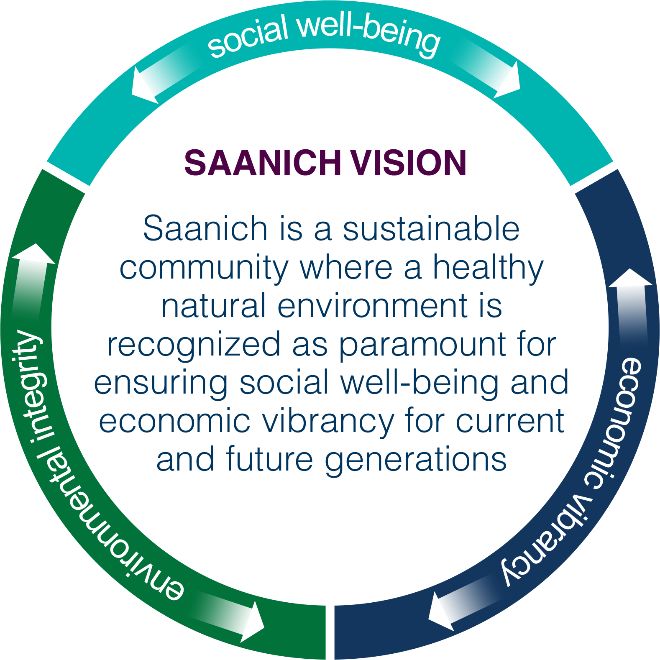
6 | Financial Plan 2021-2025

which are trending higher than anticipated. The District’s experience with higher maintenance costs is
similar to other jurisdictions using this type of fleet vehicles.

4. Water Utility Fund Summary:
The Water Utility Budget provides for all operations and capital funding to support the water system. In
December 2020 a 4.62% annual increase in water rates was approved to address contracted increases
to labour costs, water utility’s share of engineering and corporate support and higher cost of materials
used for waterline repairs and small equipment replacement. A significant portion of the needed
increase is due to continued reduction in water consumption. As the budgeted consumption is reduced
the water usage rate increases to offset the lost revenue which is needed to pay for the fixed costs of
delivering water services. The rate increase also covers an increase in CRD bulk water purchase rates
of 2.58%. Cost to the average homeowner increased by $21 from $493 to $514 per year.

5. Sewer Utility Fund Summary:
The Sewer Utility Budget provides for all operations and capital to support the sewage disposal system.
In December 2020 a 6.56% increase in sewer rates was approved to support CRD operating costs of
the Wastewater Treatment Plant as it comes online in 2021, contracted increases to the District’s labour
costs, sewer utility’s share of engineering and corporate support and higher material costs used for
maintenance and repairs. Annual cost to the average homeowner increased by $37 from $599 to $636
per year.

6. General Capital Fund Summary:

The 2021 General Capital Program provides for $111 million program of infrastructure and equipment
replacement funded from a mixture of property taxation, debt, reserves, grants and development cost
charges. Significant new capital projects in 2021 include $3.0 million for sidewalk installation program,
$4.9 million in sub-standard drain replacement, $3.9 million in parks projects, $14.7 million in facility
upgrades and $2.4 million in total fleet replacement.

The Capital Plan matches the District’s needs for investment in capital with available financial resources.
Replacement of aging infrastructure is given priority in balancing capital requirements with funding.
Funding is being gradually increased to support replacement of information technology assets and
facility infrastructure through transfers to capital reserves. The addition of $327,000 annually over 5
years is required to reinstate the Facilities Reserve Fund transfer that was reduced in the 2020 budget.
A new transfer of $600,000 is also required to establish funding for the municipal portion required to
fulfill the updated Development Cost Charge program. In addition Council approved $262,000 in annual
funding for the Park Washroom Capital Plan which will fund the addition and enhancement of washrooms
at various parks. Total capital funding has risen from $11 million in 2007 to an annual average of over
$36 million in the last three years demonstrating Council’s commitment to infrastructure replacement.

7. Reserve Fund Summary:

Reserve Funds are projected to decrease from $148,292,200 in 2020 to $118,349,100 in 2021 as work
in progress reserves are used to complete capital projects planned in previous years and funding is
provided for equipment replacement, capital projects and land purchases.

                                           District of Saanich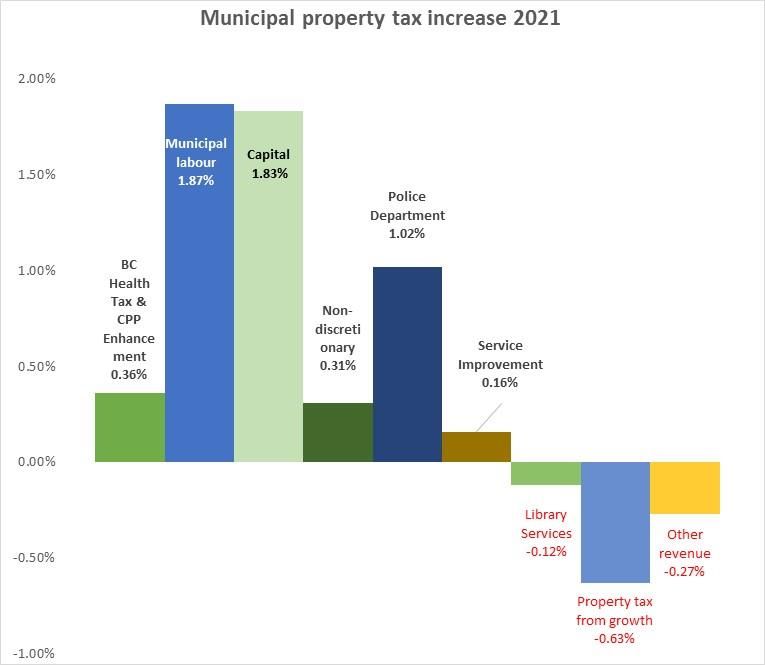
Financial Plan 2021-2025 | 7

8. Debt Summary:

Overall debt levels are projected to increase to $58.3 million in 2021. This remains well below Council
policy of $116 million in general debt. Current outstanding debt, interest rates and maturity dates are
listed below. Temporary borrowing will be paid off and replaced by long term borrowing approved by
Council in the last financial plan. The short term borrowing is used for financing equipment purchases
and range from one to five years.

Over the 5 year term of the financial plan, $1.43 million in debt servicing will become available to apply
to other borrowing needs.

BY-LAW           LOAN          GENERAL          SEWER            TOTAL       SERVICING INTEREST               MATURITY
NUMBER           TYPE                                                             COST     RATE                  DATE
                                        $              $                $             $       %                D/M/Y

3363          Long Term          389,601                         389,601           303,822         1.75%      19.10.2021
3466          Long Term          289,452         101,782         391,234           167,071         2.25%      12.01.2022
3968          Long Term        1,074,080                       1,074,080           271,898         3.00%      14.10.2024
3726          Long Term          699,936                         699,936           154,365         3.35%      01.10.2025
3726          Long Term                          460,462         460,462           100,327         3.73%      06.10.2025
4361          Long Term          695,000                         695,000           140,544         0.91%      02.10.2025
3771          Long Term        3,908,570                       3,908,570           737,133         3.65%      29.09.2026
3853          Long Term                          404,874         404,874            59,206         2.90%      04.10.2027
3051          Long Term          687,871                         687,871            65,179         2.25%      03.06.2028
4163          Long Term          627,473                         627,473           104,347         3.41%      04.10.2028
3968          Long Term        1,738,729      1,421,077        3,159,806           377,722         3.00%      14.10.2029
4061          Long Term        4,142,270      2,160,702        6,302,972           627,628         2.60%      19.04.2031
4163          Long Term        2,334,676                       2,334,676           228,946         2.80%      07.04.2032
4199          Long Term        1,830,886      1,250,719        3,081,605           315,128         3.15%      04.10.2032
4283          Long Term        4,234,395        123,010        4,357,405           370,088         2.66%      09.04.2034
4319          Long Term          531,628                         531,628           136,276         1.97%      09.10.2024
4319          Long Term        3,775,471      1,816,768        5,592,239           450,145         2.24%      09.10.2034
4361          Long Term        1,635,000        950,000        2,585,000           175,722         0.91%      02.10.2035
9563          Temporary        4,040,400                       4,040,400            29,761         0.95%      09.10.2021
9592          Temporary          100,000                         100,000               260         0.95%      09.04.2021
9593          Temporary          800,000                         800,000             2,082         0.95%      09.04.2021
9594          Temporary          430,000                         430,000             1,119         0.95%      09.04.2021
9669          Temporary        1,500,000                       1,500,000             3,904         0.95%      09.04.2021
9670          Temporary        1,400,000                       1,400,000             3,644         0.95%      09.04.2021
9671          Temporary        1,500,000                       1,500,000             3,904         0.95%      09.04.2021
9672          Temporary          100,000                         100,000               260         0.95%      09.04.2021
9673          Temporary          800,000                         800,000             5,893         0.95%      09.10.2021
9674          Temporary          575,000                         575,000             4,235         0.95%      09.10.2021
Resolution    Short Term         203,516                         203,516           211,573         0.95%      31.12.2021
Resolution    Short Term          51,096                          51,096            25,590         0.95%      31.12.2022
Resolution    Short Term         104,389                         104,389            36,845         0.95%      31.12.2023
Resolution    Short Term          48,174                          48,174            12,775         0.95%      31.12.2024
Resolution    Short Term          16,100                          16,100             3,321         0.95%      31.12.2025

                                (128,626)       (34,154)       (162,780)                      Accrued Actuarial Gains

TOTAL                         40,135,087      8,655,240      48,790,327          5,130,713

* Temporary and Short Term loans interest are based on the daily CDOR rates. The above rate is as of December 31st, 2020.

                                                 District of Saanich
8 | Financial Plan 2021-2025
Consolidated 2021 Budget Highlights by Strategic Plan Goal Areas
Funding of key initiatives has been allocated to each Strategic Plan Goals as follows:
Community Well-Being:
$2,099,900 in funding to provide fleet, IT and other capital replacement for protective
services
$253,500 in net funding for establishing the new Bylaw and Parking Enforcement service
delivery model
$498,400 in funding to hire an additional 24/7 firefighter (5.25 FTE)
$150,000 in annual funding for the Active and Safe Route to School program
$1,105,000 in various road improvements to Bus Stops, Signals and Street Lights:
Carey at Glanford Pole Replacement
Carey at Tillicum Pole Replacement
LED street light program
Climate Action and Environment Leadership:
$286,600 in funding for three positions in Parks to advance the Tree Protection Bylaw work
$3,475,400 for park, playground, trail and other park infrastructure replacement
Playgrounds at Allenby, Normandy and Rutledge Parks
Playfair and Rutledge Park Washroom Additions
Cedar Hill Park Derby Road Connector
Various tree planting projects
A minimum of $8,046,300 of road, sidewalk and bikeways additions and improvements in
areas such as:
Shelbourne Valley Improvement 400m sidewalk and 2km cycling
Richmond Road (Newton St. to CoV boundary) 450m sidewalks
Seaton Street (Burnside Road to Regina Ave.) 1km sidewalks
Orillia Street (Maddock Ave. to Burnside Road) 150m sidewalks
Douglas (McKenzie to Sanctuary) 750m cycling
Viewmont (Royal Oak to Mann) 1km cycling
Affordable Housing, Land Use and Infrastructure Management:
$11,515,000 to continue replacing asbestos cement sewer mains and asbestos cement and
cast iron water mains
$2,118,400 for Information Technology infrastructure upgrades
Economic Diversification:
$143,000 for supporting the operations of High Performance Sports at Saanich
Commonwealth Place
Organizational Excellence:
$321,300 in funding to hire an Assistant Municipal Solicitor and two Purchasing positions to
help advance corporate procurement and support fulfillment of Council’s strategic plan.
$2,110,800 for operations Business Systems upgrades
$575,000 for Council Agenda Management and Council Chamber Teams Technology
Upgrade
District of SaanichFinancial Plan 2021-2025 | 9
INTRODUCTION
COMMUNITY PROFILE
Population
Saanich’s population was reported to be 114,148 in the 2016 census making Saanich the eighth
largest municipality in British Columbia.
Age Distribution
The population is distributed among age groups similar to other cities in the province. Saanich’s
population is slightly older than that of the provincial average, with a higher percentage of its
population in the highest two age groups.
Age and Gender Distribution
Ages Male Female Total Percent BC
0 to 14 7,765 7,275 15,040 13.7% 15.5%
15 to 24 7,955 7,625 15,580 14.2% 12.6%
25 to 44 12,565 13,060 25,625 23.3% 26.3%
45 to 64 15,635 17,815 33,450 30.5% 30.0%
65+ 9,010 11,035 20,045 18.3% 15.6%
Total 52,930 56,810 109,740 100.0% 100.0%
History
The District of Saanich lies within the territories of the lək̓ʷəŋən (lay-kwung-gen) peoples represented
by the Songhees and Esquimalt Nations and the W̱ SÁNEĆ (weh-saanich) peoples represented by the
Tsartlip (Sart-Lip), Pauquachin (Paw-Qua-Chin), Tsawout (Say-Out), Tseycum (Sigh-Come)
and Malahat (Mal-a-hat) Nations.
Since incorporation on March 1, 1906, Saanich has become a major Saanich’s appealing,
residential area in the Capital Regional District. The history of Saanich clean environment, its
and its pattern of settlement are still evident in many of the old recreation and parks
buildings and structures located throughout the district. amenities, skilled
Geographically, elevations range from sea level to 213 meters, and workforce & responsive
the municipality is complemented by 817.49 hectares of fresh water public service make the
lakes and 30 km of marine shoreline. municipality a great
community to live, work
Today, Saanich is the largest of the municipalities in Greater Victoria, & do business in.
with an area of 10,334 hectares and a population of approximately
114,000. Located in a core position within the metropolitan area – the Trans-Canada Highway enters
from the west and the Pat Bay Highway enters from the north, converging within the Municipality and
running parallel into the City of Victoria. Traditionally, Saanich has been the bedroom community or
“gateway” to the downtown core of Victoria, by virtue of its location and strong historical rural roots.
Saanich is a thriving community that benefits from strong infrastructure and a wide range of community-
based services for youth, families, adults, and seniors. This infrastructure helps sustain local economic
development, while meeting or exceeding social and environmental commitments.
District of Saanich10 | Financial Plan 2021-2025
ORGANIZATION PROFILE
The District of Saanich has a motto in Latin – "Populo Serviendo" – which means serving the people. It
is a message that all Councillors and staff take to heart in their respective roles.
Saanich Council
The Saanich municipal council represents the citizens of Saanich and provides leadership as the
legislative and policy-making body for the organization. Saanich Council is made up of a Mayor and
eight Councillors who are elected for four-year terms. Saanich Council is currently comprised of the
following members:
Mayor: Fred Haynes
Councillors: Susan Brice Karen Harper
Judy Brownoff Rebecca Mersereau
Nathalie Chambers Colin Plant
Zac de Vries Ned Taylor
Senior Management Team
The Chief Administrative Officer (CAO) leads a senior management team responsible for providing
recommendations to Council and ensuring effective provision of municipal services through their
departmental staff. The senior management team also provides leadership throughout the organization
to support implementation of Council’s Strategic Plan initiatives. As illustrated in the following diagram,
the senior management team consists of the CAO, Directors of the municipal departments, the Fire Chief
and the Chief Constable:
District of SaanichFinancial Plan 2021-2025 | 11
Saanich Vision
The Official Community Plan (Saanich Vision) expresses the fundamental values and goals of
our community and describes a future view of our community that we are committed to
achieving. The OCP embraces three themes that Council and the community identified as core
focus areas for Saanich over the next 20 years, including environmental integrity, social well-
being and economic vibrancy.
Mission and Values
Our mission describes both our purpose and our practices. It acknowledges that Saanich
serves many stakeholders, and all of their interests are important to us. Our mission also
speaks directly to our employees, without whose tremendous effort and contributions we can
never achieve our goals. Both our OCP and mission are founded on the values that guide all
our actions and decisions.
District of Saanich12 | Financial Plan 2021-2025
STRATEGIC CONTEXT
1. Strategic Plan
The Saanich Strategic Plan offers a framework to focus and measure progress towards the preferred
future as a municipality. Specifically, moving towards and achieving the Saanich Vision. The
development of the plan is based on public consultation involving council, citizens and staff. The plan
identifies the goals of this Council which are aligned with Saanich’s Official Community Plan:
Community Well- Affordable Housing, Organizational Economic Climate Action and
Being Land Use and Excellence Diversification Environmental
Infrastructure Leadership
Management
The Strategic Plan is used to:
define the municipality’s priorities,
processes, and short and long term plans;
guide work priorities through
departmental plans;
prioritize budget and resource
allocations through the five-year
financial plan;
provide context for staff reports
to Council; and
evaluate achievement of
Saanich goals.
Ultimately, the success of
the Strategic Plan is
moving toward our vision.
District of SaanichFinancial Plan 2021-2025 | 13
2. Financial Planning Process
Financial planning is an on-going year round process. The cycle begins in June and continues until the
following May when the plan is adopted by Council:
June - July Council develops Budget Guidelines
August – October Departmental Financial Plans
October – January Draft Financial Plan is prepared
January - February Senior Management Review
March – April Public Budget Meetings
May Final Financial Plan and bylaws adopted
Each department prepares a work plan that contains major activities to accomplish in the coming year,
including those initiatives contained in the Strategic Plan. Based on those activities and while adhering
to the budget guidelines (page14), departmental budgets are provided outlining expected costs and
associated revenue. The departmental budgets are compiled to create a draft financial plan which is
reviewed by the Director of Finance and the Chief Administrative Officer.
Upon finalization of the draft financial plan public meetings are scheduled where each department
presents its portion of the financial plan, allowing Council review and for public scrutiny and input.
Additional meetings related to grants, resource requests and other matters relevant to current
circumstances are scheduled thereafter to allow further public input for Council’s consideration.
As input is received from the public and Council discusses financial plan priorities, the proposed financial
plan is revised until a final version is reached. This becomes the document the District uses to develop
the Financial Plan Bylaw. The property tax revenue requirement established in the Financial Plan Bylaw
forms the basis for the tax rates approved through the property tax bylaw. The financial plan may be
amended by bylaw at any time. The Financial Planning Framework shown below demonstrates how
layers of public process, plans, strategies and policies from the past and into the future inform the
development of the five year financial plan.
Financial Planning Framework
District of Saanich14 | Financial Plan 2021-2025
BUDGET GUIDELINES FOR 2021
Council Approved Budget Guidelines
At the August 17, 2020 meeting of Council, the following motion was passed:
Preliminary 2021 departmental net budget totals will be limited to a 0.0 percent increase over the 2020
adopted net budget totals, exclusive of existing personnel costs, phased in funding for positions
approved by Council in the prior year, core capital increases, and non-discretionary increases;
Capital expenditures funded from current taxation revenue (Core Capital) be increased by 2%;
Provision will be made for an addition of $327,000 to commence reinstating the Facilities Reserve Fund
transfer that was reduced in the 2020 budget and a minimum of $250,000 to support major repair work
to Saanich facilities;
Provision will be made for Corporate Information Technology replacement with an annual addition of
$750,000 until such time as annual sustained funding is achieved;
Provision will be made commencing in 2021 for the municipal portion required to fulfill the updated
Development Cost Charge program;
Resource requests for additional operating budgets (including one-time resource projects) and new tax
funded personnel only be considered for critical capacity issues or where upfront investment will result
in longer term savings;
Council will consider resourcing needs for strategic initiatives from the 2019-2023 Strategic Plan;
A long term staffing plan be developed and considered as part of the 2021 budget and financial plan
process; and
Council will consider resourcing needs to implement the Climate Action Plan including acceleration of
the Active Transportation Plan.
District of SaanichFinancial Plan 2021-2025 | 15
BUDGET POLICY AND PRINCIPLES
1. Financial Plan Policies and Assumptions
Balanced Financial Plan
The District of Saanich, under the Community Charter, is required to have a balanced financial plan.
Expenditures may not exceed the total of revenues, transfers from reserves and proceeds from debt.
Financial performance is monitored through quarterly budget variance analysis at the department level
and monthly at division and section levels.
Accounting
The accounting policies of the District conform to Canadian generally accepted accounting principles for
local governments and the Consolidated Financial Statements are prepared as prescribed by the Public
Sector Accounting Board (“PSAB”) of the Chartered Professional Accountants of Canada.
The District uses various funds to account for its revenue and expenditures. The revenue in each fund
may be spent only for the purpose specified by the fund. Each fund belongs to one of three categories:
operating, capital, or reserve. Operating funds are used for day-to-day operations. Capital funds pay
for physical assets with a life of more than two years. Reserve funds accumulate revenue and interest
that will be used to pay for major capital expenses in future years.
All funds (general, water utility, sewer utility and reserves) are accounted for on the accrual basis.
Sources of revenue are recognized when earned. Revenue unearned in the current period is reported
on the balance sheet as deferred revenue. All funds are appropriated for specific purposes as follows:
General Operating Fund - used to account for all general operating revenues and expenses of
the Municipality other than water and sewer operations.
Water Utility Fund - provides for all revenues and expenses related to the operation of the
municipal water system. Revenues are collected through water billing based on volume of water
consumed.
Sewer Utility Fund - community sewage disposal system revenues and expenditure are
accounted for separately. Revenues are primarily recovered from consumption based utility
billings.
General Capital Fund (Capital Programs) - used to account for all capital expenditures.
Statutory Reserve Fund - used to account for all statutory reserve revenues and transfers.
District of Saanich16 | Financial Plan 2021-2025
The operating component of the Five Year Financial Plan is focused on 2021 but includes a general
forecast for the balance of the five year horizon based on the following:
1. 0% annual inflation factor applied to most expenditures.
2. 1% annual inflation factor applied to fees and charges.
3. Recovery of recreation programs budgets to pre COVID-19 amounts.
4. Wage and benefit costs per collective agreement commitments.
5. Water and sewer rates increased annually to accommodate a construction inflation factor
of 4% for infrastructure replacement.
The capital component of the Five Year Financial Plan focuses on maintaining funding for infrastructure
replacement. This forecast is based on the following assumptions:
1. 2% annual increase from taxation to support construction cost inflationary increases;
2. Debt servicing budget levels maintained within policy.
3. Federal gas tax funding allocated to transportation and drainage projects.
4. New infrastructure funding mainly relies on modest debt room, government grants,
community contributions and operating budgets.
5. Continued annual funding increases to Facilities Reserve Fund, capital funding for
facilities major repairs and Corporate IT and municipal portion of the Development Cost
Charge (DCC) program.
6. All figures shown in current year (2021) dollars – no inflation allowance,
2. Revenue And Tax Policies
Proportion of Total Revenue: The Municipality will continue to pursue revenue diversification to minimize
the overall percentage of revenue raised from property taxes wherever possible. The objective is to
continue maintaining a reasonable tax burden by maximizing other revenue sources and shifting the
burden to user fees and charges where feasible.
Distribution of Property Taxes: The Municipality will continue to set tax rates to ensure tax stability by
maintaining uniform annual tax increases between the classes.
% Property Tax
2020 2021 Tax Levy Multiple
Residential 3.0810
Utilities 27.6325
Supportive Housing 3.0810 Tax rates are established once
Light Industry 7.2143 the budget has been finalized
Business/Other 12.2234 by Council and BC Assessment
Managed Forest 18.3757 has provided the Revised
Rec/Non Profit 8.0172 Assessment Roll
Farm 0.5000
Permissive Tax Exemptions: The District of Saanich will continue to support local organizations through
permissive tax exemptions. The objective is to consider exemptions individually on their merits, in
context with the Saanich Strategic Plan, consistent with the other Saanich policies and the principles of
accountability, reasonableness, equality/fairness, inclusiveness, and accessibility.
District of SaanichFinancial Plan 2021-2025 | 17
3. Expenditure Policies
Debt Limit Policy
The Community Charter sets a limit on the amount of debt a Local Government may carry. The limit
states that no additional debt may be issued if it would result in the total annual debt servicing costs
exceeding 25% of the revenue collected in the previous year. At the end of 2020, the legal debt limit is
such that average annual servicing costs cannot exceed $53.5 million or total debt of $671 million.
The municipality limits debt internally to a maximum of 7% of the property tax revenue collected in the
previous year. At the end of 2020 this limits annual debt servicing costs to no more than $9.2 million or
total debt of $116 million.
Debt principal repayments are charged to financial activities when payments are made.
4. Relationship Between Funds and District’s Departments
While the District’s finances are structured according to funds, its daily activities are structured by
functional departments (e.g., Engineering Services, Fire, Police, etc.). Funds and departments overlap
somewhat with some departments using all funds.
Use of Funds by Departments
Operating Capital Reserve
Department Fund Fund Fund
G W S GC WC SC R
Council, Administration and
Legislative Services
G- General
R- Reserves
Corporate Services
W- Water Utility Finance
S- Sewer Utility Building, Bylaw, Licensing
GC - General Capital and Legal Services
WC - Water Capital Police Protection
SC - Sewer Capital Fire Protection
Emergency Program
Planning
Engineering
Parks, Recreation and
Community Services
Library, Grants and
Economic Development
District of Saanich18 | Financial Plan 2021-2025
5. Staffing Level In 2021
Between 2020 and 2021, total full-time equivalent (FTE) positions are expected to decrease by 19.79
FTE or 1.75%. Temporary FTE’s hired based on one time funding are not included. Details listed below:
Full time Equivalent (FTE) Employees
Department 2019 2020 2021 FTE Description of Change
Change
Administration 16.24 16.23 16.23 -
Corporate Services 46.08 47.27 47.27 -
Finance 39.81 41.37 43.37 2.00 Full year budgeting of purchasing
positions approved last September.
Building, Bylaw, 30.84 31.90 36.08 4.18 Full year budgeting of Assistant
Licensing and Legal Solicitor position approved last
September and partial budgeting of a
Bylaw Manager, 3 Bylaw Enforcement
Officers and half a Bylaw Clerk
approved February of 2021.
Police Protection 233.94 237.78 239.86 2.08 Full year budgeting of 3 civilian
positions and 2 sworn positions
approved last year and the partial year
budgeting of the new Disclosure
Administrator position.
Fire Protection 126.85 127.85 132.40 4.55 Full year budgeting of 5.25 fire fighter
positions approved last September
less a partial FTE related to a duty to
accommodate position from prior year.
Emergency Program 3.00 3.00 3.00 -
Planning 30.26 31.84 31.84 -
Engineering (includes 265.13 269.80 270.84 1.04 Full year budgeting of Building Service
utilities) Worker for the Blanshard building and
inrease in auxiliary hours for new
inventory maintenance.
Parks & Recreation 320.61 323.19 289.55 (33.64) Full year budgeting of the Development
Review Coordinator, Bylaw Clerk and
Urban Forest Technician positions
approved last September and additions
to washroom cleaning less reductions
in recreation due to COIVD-19 impact
on operations.
Total 1,112.76 1,130.23 1,110.44 (19.79)
District of SaanichFinancial Plan 2021-2025 | 19
6. Change in Carbon Footprint
In January 2020, Council approved the Climate Plan, which commits to reducing greenhouse gas (GHG)
emissions from municipal operations to 50% of 2007 levels by 2025 and net-zero by 2040.
2020 presented an unusual year for energy use and conservation given the impacts of COVID-19. Many
District of Saanich facilities were closed to the public for several weeks and, once re-opened, some were
running at lower capacity. This resulted in a lower energy demand at certain facilities in comparison to
regular years. At the same time, increased energy demands were placed on other facilities through
such measures as increased ventilation. Additional energy conservation opportunities associated with
COVID-19 were identified throughout the year to supplement those climate action projects that were
already planned for 2020.
In 2020, we have shifted from reporting GHG emissions by Departments to reporting by emissions
source categories such as buildings, equipment, and fleet as shown in Table 1. This increases reporting
transparency by more clearly identifying specific climate projects and decision makers, which are usually
at the emissions source category level rather than by department.
Overall, Saanich saw a decrease of 406 tCO2e (tonnes of carbon dioxide equivalent) in our 2020
corporate GHG inventory compared to 2019. This is an 8% reduction from the previous year, and a 19%
reduction from our 2007 baseline, despite increasing services to a growing population (Figure 1).
Figure 1: District of Saanich Corporate GHG Emissions
These emissions savings were mostly associated with building energy projects and reduced demand
due to COVID-19. Given this, stationary energy (buildings, street lighting and underground services)
only account for 36% of our corporate emissions inventory compared with mobile emissions that account
for 64%. While, 2020 marked a climate milestone for the municipal fleet, with all light duty cars now fully
electric, our heavy duty vehicles and trucks continue to be the main contributor to our corporate GHG
emissions.
District of Saanich20 | Financial Plan 2021-2025
District of Saanich Corporate GHG Emissions Inventory 2019 and 2020
GHG Emissions
(tCO2e)
Source Chang Description of change
2019 2020 e 2019-
20
Stationary 2,114 1,704 -410
Key Buildings
Saanich COVID – reduced energy consumption, reduced
1,163 887 -276
Commonwealth Place pool temperature
G.R. Pearkes 352 262 -90 REALice, switch to electric zamboni, and COVID
Cedar Hill Recreation COVID testing centre, higher ventilation rates
98 125 +26
Centre increased heating natural gas use.
Public Safety Building 119 114 -5 No significant change
Public Works 87 90 +3 No significant change
Cedar Hill Golf Course 69 29 -40 COVID - reduced energy consumption.
Annex Building 24 26 +2 No significant change
Les Passmore 25 22 -3 No significant change
COVID – reduced energy consumption, pool
Gordon Head
29 19 -10 unheated for part year, other energy efficiency
Recreation Centre
measures
Other buildings 80 67 -13 COVID – reduced energy consumption
Street Lighting 46 44 -2 LED street lighting replacement project.
Underground No significant change
22 19 -2
Services
Mobile 2,969 2,973 +4
Includes vehicles (e.g. garbage trucks) &
Municipal Fleet 2,022 1,991 -31
equipment.
Police Fleet 402 418 +16 COVID – increased single use police vehicles
Contractors* 299 299 0 Includes roads, composting, parks etc.
COVID – increased use of ladder truck & fuel
Fire Fleet 156 173 +16 Use of Engine 2 & 3 increased for inspections &
training
Reimbursed in-city No significant change
47 47 0
travel
Golf course equipment 43 46 +3 No significant change
Total 5,083** 4,677 -406
*Figure from 2018
**Updated figure based upon final utility data (4,999 tCO2e were reported in the 2019 Financial Plan)
There are multiple climate action projects; some funded and others currently seeking funding that are
projected to take us close to our 2025 target (see Figure 1). Design work progressed in 2020 for the
boiler upgrades at Saanich Commonwealth Place that will reduce the centre’s GHG emissions by 90%
once complete. Grant applications were also submitted for heat reclaim and electrification projects at
G.R. Pearkes and Cedar Hill Recreation Centre. However, Renewable Natural Gas for our remaining
facility natural gas use and Renewable Diesel as an interim strategy to reduce our fleet emissions while
the heavy duty electric vehicle market progresses will also be needed if we are to reach our 2025 target.
A slight increase in emissions may be seen in 2021 while some of these projects come online.
The District of Saanich has also committed to becoming a 100% renewable energy corporation by
2040. As of 2020, 44% of corporate energy use was renewable, with 56% being non-renewable.
District of SaanichFinancial Plan 2021-2025 | 21
BUDGET PLANNING ISSUES
1. 2021 Financial Planning Issues
Preparation of the 2021 budget proposal has taken into account the following financial planning issues:
COVID-19 – On March 11, 2020 the World Health Organization (WHO) declared the COVID-19
pandemic. By mid-March various senior levels of governments through the recommendations of their
Public Health bodies began implementing restrictions on travel, closures of schools, daycare, non-
essential businesses such as entertainment industries and recreation. These closures have had a
significant impact on the District’s recreation operations, water consumption revenues and expenditures
related to measures throughout District operations based on Worksafe requirements that keep staff and
the public distanced and safe. In November of 2020 the Province provided the District a one-time
COVID-19 Safe Restart Grant in the amount of $7,453,000. These funds will be used to address revenue
shortfalls, facility reopening and additional operating costs associated directly with the pandemic. The
economic challenges and ongoing uncertainty for recovery in the community are expected to remain an
issue through and potentially beyond 2021.
Infrastructure – Replacement of aging infrastructure continues to be a priority. An overall plan to increase
capital funding to reach estimated sustainability targets was reached in 2019 for most assets with the
exception of Information Technology and major facility repair. An additional increase of 0.76% in
property taxes is recommended to address those funding deficits. The sustainability levels of all assets
will be reviewed in the future to determine if any additional funding for capital is needed. Capital program
funding for General capital has been increased by 2% in recognition of inflationary pressures. Utility
charges have also been increased for both Sewer and Water to provide appropriate annual funding to
ensure timely replacement of aging infrastructure in light of increasing construction costs.
Wage and benefit costs – In 2020 the Police Association and CUPE have renegotiated their collective
agreements with the District. The IAFF (Fire) contract ended December 2019 and negotiations have yet
to be concluded. Contingency estimates have been included for any increases that will arise from
upcoming negotiations. CPP costs continue to increase for all employees due to the Federal CPP
Enhancement program. WCB rates have increased for all employees as the maximum earning amount
at which the base rate is applied has gone up by $15,000 and the base rate itself was increased due to
lower investment income earned by Worker’s Compensation and higher payments made for mental
health claims. Other benefit costs increased marginally over last year.
Employer Health Tax (EHT) – The province completed full implementation of the EHT in 2020. This tax
replaced the Medical Services Plan which, depending on the employee group, was either cost shared
with the District or fully paid by the employer. The impact of the EHT increase on this year’s budget is
a 0.03% increase to property taxes. Annual increases will now reflect the overall increase to gross pay
of employees.
Growth – The District continues to experience low growth and while 2020 is marginally below the 5 year
historical average for new taxable properties the trend is becoming established with growth well below
1% of taxation.
District of Saanich22 | Financial Plan 2021-2025
Non-discretionary expenditures – For 2021, 0.30% of the proposed tax increase is for non-discretionary
items as listed:
Cost driver Budget Increase
Service Contracts $ 53,121
Management of new assets $ 215,222
Building Maintenance $ 45,000
Statutory Advertising $ 43,000
Safety Measures $ 19,960
Services $ 28,815
Total $ 405,118
Tax Impact 0.30%
Resource Requests – For 2021, an additional 0.98% tax increase was implemented to provide funding
for positions approved by Council in August 2020 and the implementation of the new service delivery
model for Bylaw and Parking Enforcement approved by Council February 2021. Additional resource
requests will be considered during the 2021 budget deliberation as per Council budget guideline.
Water costs – A large proportion of water costs (39.6% for 2021) are bulk water purchases from the
CRD. These costs are subject to change each year dependant on CRD regional infrastructure work
and operating costs. In 2021 the CRD bulk water rate went up 2.58%. In 2021 $720,000 of the
COVID Grant Revenue received from the Province is being to supplement the loss in water usage and
therefore revenue loss due to expected extension of public health orders requiring certain businesses
and institutions to remain closed or curtail their operation in 2021.
Sewer costs – A significant proportion of overall sewer costs are from CRD regional Sewage Treatment
(56.5% for 2021). CRD sewer charges increased by 9.80% over last year due to operational cost of the
new regional sewer treatment plant which commenced operations in 2021.
Various action plans and operational reviews – The District continues to improve operations through
development of plans and strategies that are considered and adopted by Council. The most recent plans
with significant financial implications are the Strategic Facility Master Plan, Active Transportation Plan,
Climate Plan and Fire Services Review. These plans and strategies identify the current and future needs
of the District and what resources are needed to implement them. There are a number of resource
requests that Council will be considering in this year’s budget that will address this year’s implementation
costs.
District of SaanichFinancial Plan 2021-2025 | 23
2. 2022 – 2025 Financial Planning Issues
Future year budget planning will take into account the following more significant issues:
Economic uncertainty – Economic impact on the local community due to continued restrictions on
economic activity required by the Public Health Officer to combat the spread of COVID-19 and related
trade and regulation uncertainty and its impact on commodity costs.
Provincial grants uncertainty – Unconditional operating grants of $1.5 million are paid annually by the
Province of BC based on sharing of traffic fine revenues. It is uncertain whether this grant will continue
in the long term given the current economic climate. Should the grant be discontinued the equivalent
effect would be a 1.09% tax increase on property taxes or an equivalent reduction in programs or
services that are funded by this grant.
Wage costs uncertainty – The IAFF collective agreement expired at the end of 2019. While the extent
of possible wage cost impact is uncertain for the future years, public safety settlements continue to trend
higher than 2.0%.
Benefit costs increases – Based on historical trends and future outlook from benefit providers, all benefits
will be experiencing increases in the long term due to aging workforce, longer life spans and rising health
care costs. CPP costs will continue to increase for majority of employees as the Federal enhancement
continues to 2025. WCB’s base rate for municipalities and law enforcement are also expected to
increase over 2.5% annually for the next two years.
Active Transportation Plan (ATP) – In 2018 Council adopted the ATP which is used to guide Saanich’s
investments in active transportation over the next 30 years. The plan establishes a vision, goals and
targets to improve active transportation, along with a series of strategies and actions related to three
overarching themes: Connections, Convenience, and Culture. The Active Transportation Plan also
includes an implementation and monitoring plan to prioritize investments and actions over the short-,
medium-, and long-term and to monitor progress in achieving the Plan’s goals.
The strategies and actions in the Active Transportation Plan are designed to double the proportion of all
trips made by walking, cycling and transit by 2036. The financial impact on the District’s capital funding
requirements is significant as new funds are needed to expand the sidewalk, biking and transit
infrastructure. Continued increases in operating budgets will also be needed to maintain and fund future
replacement of these new assets.
Strategic Facility Master Plan (SFMP) – In April 2018, Council adopted the SFMP. The plan looks at the
strategic management of the District's publicly owned facility based assets over the next twenty years
with the goal of maintaining and improving services that residents rely on. The plan takes into account
the District's anticipated population and demographic growth trends along with changes in services,
standards and practices, building codes and the wear and tear that the facilities experience on a daily
basis. The result is a comprehensive plan that prioritizes facility projects to ensure that funds are properly
allocated.
Climate Plan: 100% Renewable and Resilient Saanich – Council declared a Climate Emergency on
March 25, 2019 and adopted the Climate Action Plan in early 2020. The plan outlines options for
achieving the ambitious climate targets necessary to stay below 1.5 ºC of global warming and preparing
the community for the anticipated climate change in response to the latest climate science and
increasing public concern.
A total of 131 actions are identified in the Climate Plan, and about 40% of those are already underway
or could be delivered with existing staff and financial resources. The implementation of the remaining
actions will require re-allocation of existing resources, new resources and funding, and increased
capacity in the organization.
District of Saanich24 | Financial Plan 2021-2025
Fire Services Review – The Fire Department conducted this review through 2019 and the
recommendations were presented to Council in 2020. The Saanich Fire Department (SFD) initiated this
review to determine its future requirements as the last review was done in 2007. Since that time the
population of the District has continued to grow, the number of incidents has increased, and the
regulatory framework is in flux. The review has identified operational needs that require additional
staffing in suppression, training and other positions over the next ten years.
Water purchases – Water sale volumes in the municipality have started to decline again due to
homeowner’s conservation of water use. The cost of bulk water purchases from the CRD is projected
to increase as the CRD has projected an average increase to its rates of 3.12% for the next four years,
fluctuating between 2.02% to 3.83% in any given year.
Sewer costs – With the provincially mandated regional sewer treatment system starting operations this
year the future increases to the CRD’s requisition from its participating municipalities is projected to keep
up with inflationary costs of operations which are estimated at less than 2% annually.
Infrastructure Replacement – The overall plan to increase capital funding to sustainable levels was
reached in 2019 with the exception of Information Technology and major repairs to facilities. In addition
further work is needed to determine the future replacement cost of minor facilities owned by the District.
Future increases will be based on applying an inflationary increase to keep up with rising costs of
construction and as replacement costs are updated.
District of SaanichFinancial Plan 2021-2025 | 25
General Operating BUDGET SUMMARY
Fund
2021 Tax Levy $ 138,740,200
2020 Tax Levy $ 131,929,200
The total tax levy for the General Operating
Fund is proposed to increase by $6,811,000 Net Change $ 6,811,000
or 4.53%. Average Single Family
4.53%
Homeowner Increase %
The increase in property tax revenue this 2021 FTE 1032.92
year is made up of a 1.80% increase for
core Municipal and non-discretionary costs, 2020 FTE 1052.73
1.83% in infrastructure replacement
FTE Change (19.81)
funding, 1.02% for Police Board and a
decrease of 0.12% for the Greater Victoria FTE Change % (1.88%)
Public Library.
Saanich 2021 Financial Plan Budget Increase Tax Increase
$ %
Operating Increases
Core budget
Existing personnel costs - municipal 3,159,242 2.39%
Non-discretionary increases 405,118 0.30%
General Municipal Core Operating Increase $ 3,564,360 2.69%
Increase in non-tax revenue (359,814) -0.27%
Tax revenue from new sources (preliminary) (832,089) -0.63%
Core Operating Increase to Existing Taxpayers $ 2,372,457 1.80%
Increase for Capital Infrastructure 2,409,410 1.83%
Total General Muncipal Increase $ 4,781,867 3.63%
Police Board Budget Submission $ 1,347,700 1.02%
Greater Victoria Public Library (150,800) -0.12%
General Municipal, Police and Library $ 5,978,767 4.53%
District of Saanich26 | Financial Plan 2021-2025
BUDGET SUMMARY BY OBJECT
Budget By Object Actual Actual Budget Budget % Change
EXPENDITURES 2019 2020 2020 2021 2021/2020
Personnel (1) 102,925,300 105,882,500 110,433,700 115,995,300 5.04%
Goods and Services (2) 42,170,600 38,202,200 42,625,800 39,678,800 (6.91%)
Debt Payment and Bank Charges (3) 4,124,300 4,762,800 4,993,700 4,893,500 (2.01%)
Grants, Overheads & Transfers 15,895,400 16,832,300 21,084,800 20,003,400 (5.13%)
Capital (tax funded portion only) (4) 15,259,300 14,909,600 14,878,800 17,288,200 16.19%
TOTAL 180,374,900 180,589,400 194,016,800 197,859,200 1.98%
REVENUES AND RECOVERIES
Property Taxation (125,099,800) (131,685,200) (131,929,200) (138,740,200) 5.16%
Parcel Tax (20,000) (20,000) (20,000) (20,000) 0.00%
Other Corporate Revenues (5) (9,754,200) (8,053,500) (8,662,900) (7,820,400) (9.73%)
Other Departmental Revenues (32,958,600) (26,071,100) (29,872,600) (25,423,000) (14.90%)
Inter-Departmental Recoveries (6) (11,836,800) (12,982,300) (13,546,300) (13,992,000) 3.29%
Transfer from Reserves (7) (2,372,900) (2,253,900) (9,596,000) (8,838,200) (7.90%)
COVID-19 Safe Restart Grant (8) - (2,737,300) - (2,695,300) 100.00%
Other Grants (471,700) (524,800) (389,800) (330,100) (15.32%)
TOTAL (182,514,000) (184,328,100) (194,016,800) (197,859,200) 1.98%
NET OPERATIONS (2,139,100) (3,738,700) - - 0.00%
1. Personnel costs - increase in wage increment and addition of new positions.
2. Goods and Services – decrease in one time projects funded from reserves.
3. Debt Payment and Bank Charges – lower borrowing costs.
4. Property tax based capital funding - increased to continue progress to sustainable funding levels.
5. Other Corporate Revenues – COVID-19 related decrease in recreation programs provided.
6. Inter-Departmental Recoveries – increase to recognize actual recovery levels of services.
7. Transfer from Reserves – decrease in projects funded from reserves.
8. COVID-19 Safe Restart Grant – one-time provincial funding to offset loses and reimburse for additional costs
related to the pandemic.
Budget Summary by Function:
Operating Budget Actual Actual Budget Budget % Change
ALL DEPARTMENTS 2019 2020 2020 2021 2021/2020
Property Taxation (125,099,800) (131,685,200) (131,929,200) (138,740,200) 5.16%
Parcel Tax (20,000) (20,000) (20,000) (20,000) 0.00%
Utility and Hotel Tax (1,918,800) (1,604,900) (1,869,400) (1,654,600) (11.49%)
Grants In Lieu (2,747,200) (2,753,000) (2,693,300) (2,655,600) (1.40%)
Interest and Penalties (3,076,600) (1,806,100) (2,230,000) (1,624,200) (27.17%)
Other Revenues (470,900) (348,800) (316,100) (331,900) 5.00%
COVID-19 Safe Restart
Grant - (423,900) - (432,000) 100.00%
Capital Contribution 15,624,400 14,909,600 14,878,800 17,288,200 16.19%
Net Departmental Cost 115,569,800 119,993,600 124,179,200 128,170,300 3.21%
SURPLUS/DEFICIT (2,139,100) (3,738,700) - - 0.00%
District of SaanichYou can also read


