SCHOOL OF ACCOUNTANCY - Yearbook 2020-2021 - massey.ac.nz/accountancy - Massey ...
←
→
Page content transcription
If your browser does not render page correctly, please read the page content below
SCHOOL OF ACCOUNTANCY
Yearbook 2020-2021

massey.ac.nz/accountancy

Contents

Head of School’s Report ............................................................................................... 1

School’s Mission Statement ......................................................................................... 4

2020 Publications ......................................................................................................... 6

Academic Staff Profiles .............................................................................................. 12

Professional Staff ....................................................................................................... 37

Other Staff Research Activities 2020 ......................................................................... 38

School PhD 1986-2020 ............................................................................................... 45

Research Funding, Awards and Nominations 2020 ................................................... 51

NZMA Conference ...................................................................................................... 52

School of Accountancy Prizes..................................................................................... 53

School of Accountancy Board of External Advisors ................................................... 55

Professor for a Day ..................................................................................................... 56

Massey University Accountancy Clubs....................................................................... 57

Community Accounting.............................................................................................. 58

School Highlights 2020 ............................................................................................... 60

University Service, Community Engagements and Professional Associations .......... 68

Academic Programmes and Accreditations ............................................................... 71

School Details ............................................................................................................. 73
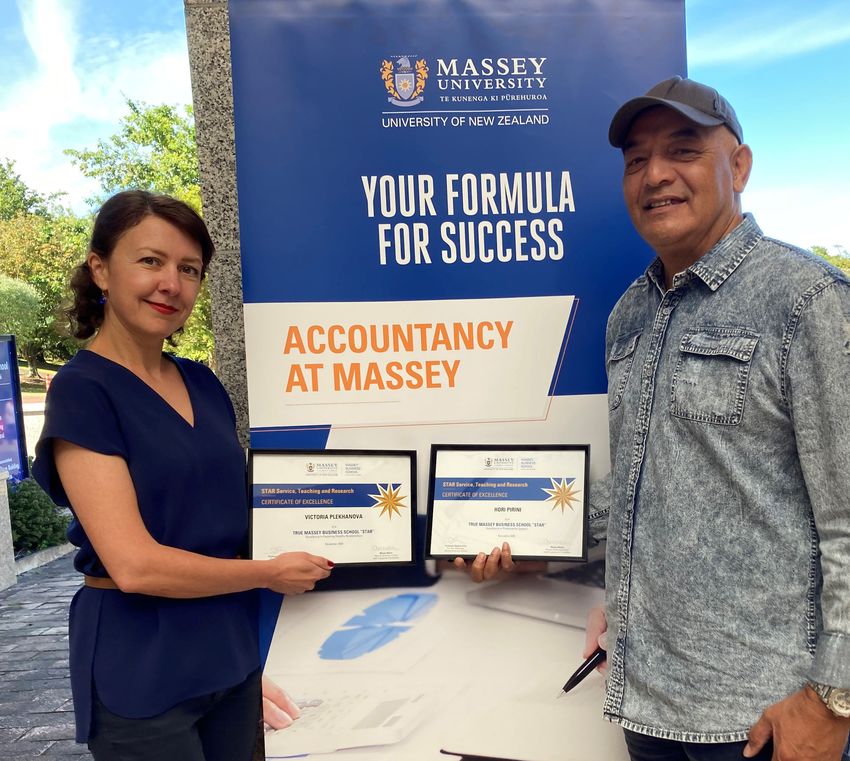
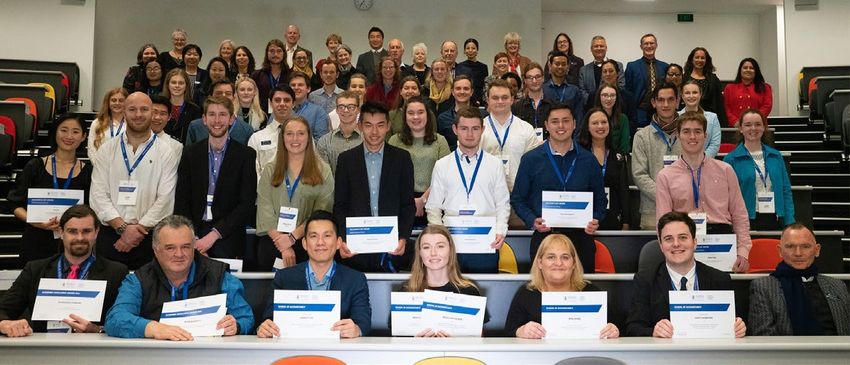
Cover photo: Massey Business School Star Award winners in the School, (from left) Victoria
Plekhanova - Excellence in Fostering Healthy Relationships and Hori Pirini - Excellence in Professional
Support (joint winner).

Information in this publication is correct at the time of going to press but may be subject to change. While all
reasonable efforts will be made to ensure listed papers and programmes are offered and regulations are up to date,
the University reserves the right to change the content or method of presentation, or to withdraw any course of study,
or impose limitations on enrolments should circumstances require this. (February 2021)
Head of School’s Report
The 2020 academic year has been unlike any other. The global pandemic has disrupted and challenged many
of the routines and comforts that were part of our ‘normal’ lives. Our campus experience, learning, and
assessment has had to change and adapt within a short time. However, it has been an opportunity to show
our resilience. It has also confirmed that we are fortunate to be living in Aotearoa New Zealand.

In March, using Zoom virtual classes, we all moved from in-person teaching to online delivery. The School’s
already extensive use of digital technology made this an easy transition for both staff and students. Teaching
continued with minimum disruption to student learning.

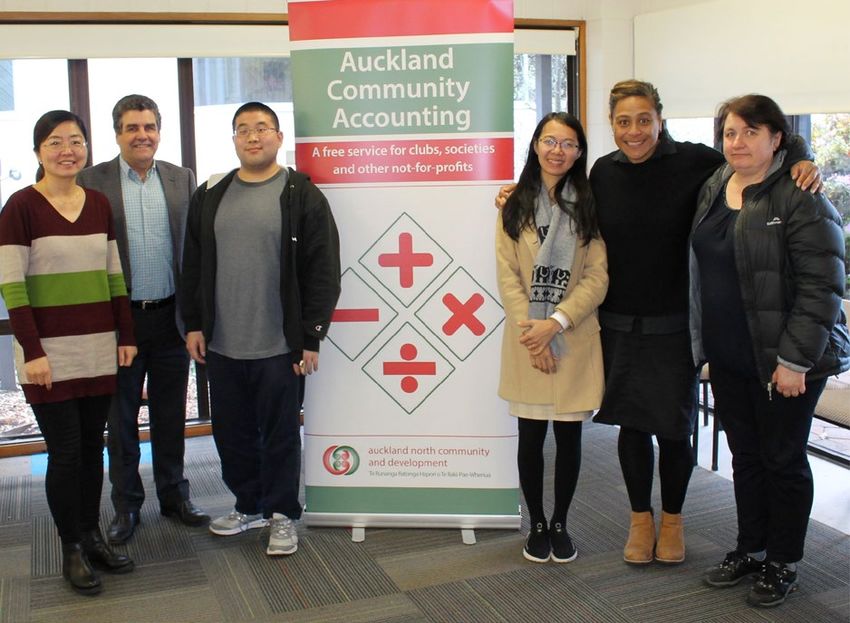
Community Accounting had a successful year. With the support and coordination of Auckland North
Community and Development (ANCAD), we were able to continue Auckland Community Accounting (ACA) and
Community Accounting Aotearoa (CAA) in both semesters. Using online communication tools and the
supervision of Chartered Accountants, student groups were able to continue to attend training workshops
and support their not-for-profit (NFP) community organisations, leading the project into its fourth successful
year. In 2020, ACA had 32 students participate, CAA had 18 students, and both groups supported 19 NFP
clients – the most successful year to date. In semester two, Palmerston North Community Accounting had six
students participate in the project with two NFP community organisations.

The Auckland Accountancy Club continued to be very active throughout the year. The club organised
numerous seminars, presentations and online social events, even during lockdown, with the support of many
professional bodies and organisations such, as CA ANZ, CPA Australia, ACCA, XERO, Audit NZ and KPMG.

The School has made progress in the use of new and powerful technology to develop students’ analytical
mindsets and technological confidence in both undergraduate and postgraduate levels. The School has
incorporated the use of Microsoft Power BI in more School courses. We have also enhanced exposure to cloud
accounting, and integrated the use of MYOB and Xero accounting software into our Accounting Information
Systems and Financial Accounting courses.

On 19th November, the School hosted a very successful 14th New Zealand Management Accounting
Conference. The conference theme for this year was “The changing face of management accounting”, a
befitting theme for the current time. This annual conference provides management accounting educators in
New Zealand with opportunities to present their research, receive feedback, and network with their peers.
Originally planned to be held on campus, it was decided to move the conference online for everyone’s safety.
We would like to express again our appreciation to the 40 attendees, including our plenary speakers: Dr Derryl
Northcott from Auckland University of Technology, and Leeanne McAviney and Leanne Arker from the Office
of the Auditor-General.

During 2020 the School had many celebrations. In April, during lockdown, we acknowledged the 20th
anniversary of the current School structure. We congratulated numerous staff on their academic promotions:
Drs Nives Botica Redmayne and Radiah Othman to Associate Professor, and Drs Nirmala Nath and Dimu
Ehalaiye on their promotion to Senior Lecturer (Range 2). The School was also very proud to receive two
Excellence Awards at the Massey Business School (MBS) Star Awards ceremony. Auckland based academic
staff member, Dr Victoria Plekhanova, received an award for Excellence in Fostering Healthy Relationships,
while Auckland Administrator, Hori Pirini, received the joint award for Excellence in Professional Support. We
also congratulated Dr Nives Botica Redmayne on her appointment as President of Chartered Accountants
Australia and New Zealand (CAANZ), and Dr Warwick Stent on his CAANZ Fellowship.

The uncertainty and lockdowns during the year did not slow down researchers in the School, or their
collaboration with colleagues and associates around the world. We had another very productive year with 52
published articles in refereed quality journals, such as European Accounting Review, International Review of
Financial Analysis, International Journal of Auditing, and The New Zealand Journal of Taxation Law and Policy.

                                                                                   Head of School’s Report   1
More than half of these articles were published in A or A* Journals (three A* and 25 A journals), using the
ABDC journal rankings. We also had two authored books and 5 book chapters published and numerous media
articles featuring School staff. Most of the research in the School is undertaken collaboratively by two or more
staff members.

We look back at 2020 as a challenging year. As the global pandemic disrupted all of our lives, we will remember
the challenges we faced individually and as a School, and how our resilience and dedication to our students,
research and to the University helped us through.

In 2021, we are looking forward to returning to the classroom with our students for in-person internal classes.
The School is also preparing for the AACSB Continuous Improvement (now virtual) Review in May 2021, where
we will endeavour to continue to be one of only two institutions in New Zealand and Australia achieved this
prestigious accreditation.

We are excited about 2021 and hopefully returning to a new ‘normal’.

Professor Fawzi Laswad
Head of School

2   Head of School’s Report
Head of School’s Report 3
School’s Mission Statement
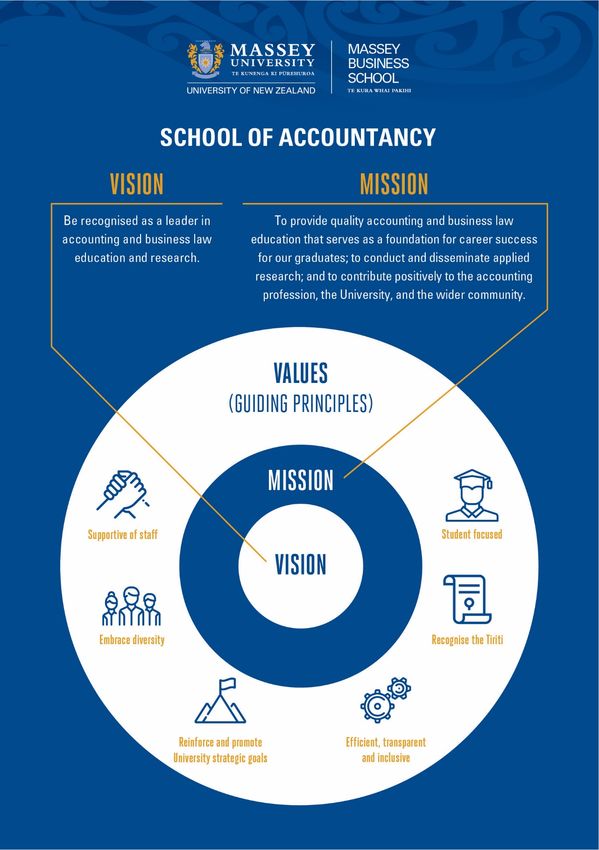
Vision

Massey University School of Accountancy aims to be recognised as a leader in accounting and business law
education and research.

Mission

To provide quality accounting and business law education that serves as a foundation for career success for
our graduates; to conduct and disseminate applied research; and to contribute positively to the accounting
profession, the University, and the wider community.

Values (Guiding Principles)

To achieve our mission the School will:
 • Be student focused:
        o Ensure its student education programmes are relevant and up-to-date
        o Encourage alternative modes of delivery and learning
 • Be supportive of its staff:
        o Provide staff with opportunities for personal development
        o Maintain quality and uphold professional standards
        o Encourage and support staff research
 • Reinforce and promote the University’s strategic goals
 • Embrace diversity
 • Recognise the Tiriti
 • Maintain efficient, transparent and inclusive (participative) management systems

School Goals and Objectives

The School seeks to be recognised as a quality provider of accounting and business law education and
research. It will attain this vision through realising goals and objectives in the following key areas: education,
research, and contribution to the profession, the University, and the wider community.

4   School’s Mission Statement
Student Education

Goal
To provide quality learning that develops and encourages the capabilities, potential and intellectual
independence of students, on a life-long basis, through open entry and blended education both on and off
campus.

Objectives
 • To develop students' communication, analytical, and critical thinking skills.
 • To develop students' understanding of ethical standards and ethical dilemmas and improve their
     ethical judgement.
 • To support continuous improvement through a rigorous programme of evaluation and assessment.
 • To reinforce strong commitment to research-led teaching and scholarship.
 • To provide all students access to on-line educational opportunities, support tools and pedagogy of a
     high standard.
 • To ensure that accounting and business law programmes are delivered to allow flexible learning and
     the integration of new technologies into the creation and design of curricula.
 • To ensure that all papers, regardless of the campus or mode of delivery, provide students with access
     to excellent education, supported by effective quality systems and, where relevant, with appropriate
     national and international accreditation.

Research

Goal
To advance the reputation and performance of the School as a research unit of international standing.

Objectives
 • To give a high priority to the development of comprehensive research capability on all campuses.
 • To target publication in quality journals ranked as B or higher.
 • To encourage applied research and scholarship in the pursuit of academic excellence and to recognise
     and reward outstanding achievement.
 • To place a high priority on the support and resourcing of researchers, research groups and research
     activities and to promote emerging researchers through mentoring.
 • To promote emerging researchers through mentoring.
 • To increase the numbers of students undertaking postgraduate research programmes and the level
     of scholarship and other support available to them.

Contribution to the Profession, the University and the Wider Community

Goal
To contribute to the profession, the university and wider community.

Objectives
 • To contribute to the development of the profession by actively contributing to and participating in
     professional activities.
 • To contribute to the university by providing quality accounting and business law education.
 • To contribute to the wider community by being a source of expertise and advice.

                                                                               School’s Mission Statement   5
2020 Publications
Journals

Abbasi, K., Alam, A., & Bhuiyan, M. B. U. (2020). Audit committees, female directors and the types of female
and male financial experts: Further evidence. Journal of Business Research, 114, 186-197.
http://doi.org/10.1016/j.jbusres.2020.04.013

Ahmed, K., Houqe, M. N., Hillier, J., & Crockett, S. (2020). Properties of analysts’ consensus cash flow forecasts
for Australian firms. Accounting Research Journal, 33(1), 128-147. https://doi.org/10.1108/ARJ-11-2017-0197

Al Mallak, M. A., Tan, L. M., & Laswad, F. (2020). Generic skills in accounting education in Saudi Arabia:
Students’ perceptions. Asian Review of Accounting, 28(3), 395-421. https://doi.org/10.1108/ARA-02-2019-
0044

Al-Mulla, M., & Bradbury, M. E. (2020). The demand and supply timely financial reports. Pacific Accounting
Review, 32(3), 335-353. http://doi.org/10.1108/PAR-10-2018-0076

Barrett, M., Watene, K., & McNicholas, P. (2020). Legal personality in Aotearoa New Zealand: An example of
integrated thinking on sustainable development. Accounting, Auditing and Accountability Journal, 33(7), 1705-
1730. http://doi.org/10.1108/AAAJ-01-2019-3819

Bhuiyan, M. B. U., & Costa, M. D. (2020). Audit committee ownership and audit report lag: Evidence from
Australia.   International   Journal   of    Accounting    and   Information    Management,       28(1).
http://doi.org/10.1108/IJAIM-09-2018-0107

Bhuiyan, M. B. U., Cheema, M. A., & Man, Y. (2020). Risk committee, corporate risk-taking and firm value.
Managerial Finance. http://doi.org/10.1108/MF-07-2019-0322

Bhuiyan, M. B. U., Rahman, A., & Sultana, N. (2020). Female tainted directors, financial reporting quality and
audit    fees.     Journal    of    Contemporary       Accounting     and     Economics,       16(2),    1-18.
http://doi.org/10.1016/j.jcae.2020.100189

Bhuiyan, M.B.U. & Nguyen, T. (2020). Impact of CSR on cost of debt and cost of capital: Australian evidence.
Social Responsibility Journal, 16(3), 419-430. https://doi.org/10.1108/SRJ-08-2018-0208

Bradbury, M. E. (2020). How the XRB uses research in setting accounting and assurance standards. Australian
Accounting Review, 30(4), 249-256. http://doi.org/10.1111/auar.12318

Bradbury, M. E., & Scott, T. (2020). What accounting standards were the cause of enforcement actions
following IFRS adoption? Accounting & Finance. http://doi.org/10.1111/acfi.12661

Bui, B., Houqe, M. N., & Zaman, M. (2020). Climate governance effects on carbon disclosure and performance.
British Accounting Review, 52(2). https://doi.org/10.1016/j.bar.2019.100880

Bui, B., Moses, O., & Houqe, M. N. (2020). Carbon disclosure, emission intensity and cost of equity capital:
Multi-country evidence. Accounting & Finance, 60(1), 47-71. https://doi.org/10.1111/acfi.12492

Costa, M. D., & Habib, A. (2020). Trade credit and cost stickiness. Accounting & Finance.
https://doi.org/10.1111/acfi.12606

Ehalaiye, D., Botica Redmayne, N., & Laswad, F. (2020). Does accounting information contribute to a better
understanding of public assets management? The case of local government infrastructural assets. Public
Money & Management, 41(2), 88-98. https://doi.org/10.1080/09540962.2020.1719669

6   2020 Publications
Ehalaiye, D., Tippett, M., & van Zijl, T. (2020). The impact of SFAS 157 on fair value accounting and future bank
performance. International Journal of Accounting and Information Management, 28(4), 739-757.
https://doi.org/10.1108/IJAIM-11-2019-0135

Habib, A., & Costa, M. D. (2020). Debt maturity structure and cost stickiness. Journal of Corporate Accounting
and Finance, 32(1), 78-89. https://doi.org/10.1002/jcaf.22479

Habib, A., Costa, M. D., Huang, H. J., & Sun, X. S. (2020). Financial constraints and workforce environment: An
international investigation. International Review of Finance. https://doi.org/10.1111/irfi.12302

Habib, A., Hasan, M. M., & Sun, X. S. (2020). Organization capital and audit fees around the world. International
Journal of Auditing, 24(3), 321-346. https://doi.org/10.1111/ijau.12197

Hasan, M. M., & Habib, A. (2020). Readability of narrative disclosures, and corporate liquidity and payout
policies. International Review of Financial Analysis, 68. http://doi.org/10.1016/j.irfa.2020.101460

Hasan, M. M., & Habib, A. (2020). Social capital and payout policies. Journal of Contemporary Accounting and
Economics, 16(1). http://doi.org/10.1016/j.jcae.2020.100183

Houqe, M. N., Ahmed, K., & Richardson, G. (2020). The effect of environmental, social, and governance
performance factors on firms' cost of debt: International Evidence. The International Journal of Accounting,
55(3). https://doi.org/10.1142/S1094406020500146

Houqe, M. N., Bhuiyan, M., Nomura, T., & van Zijl, T. (2020). Determinants of cash holdings—evidence from
New Zealand local councils. Public Money & Management. https://doi.org/10.1080/09540962.2020.1836803
Houqe, M. N., Zahir-ul-Hassan, M. K., Idrus, M. A., & van Zijl, T. (2020). Bribery and corruption: Assessing the
fairness of the Malaysian judicial system. Crime, Law and Social Change, 74(2), 135-154.
https://doi.org/10.1007/s10611-019-09882-1

Jia, J., & Bradbury, M. E. (2020). Complying with best practice risk management committee guidance and
performance.        Journal     of     Contemporary       Accounting       and    Economics,     16(3).
http://doi.org/10.1016/j.jcae.2020.100225

Jia, J., & Bradbury, M. E. (2020). Risk management committees and firm performance. Australian Journal of
Management. http://doi.org/10.1177/0312896220959124

Jiang, H., Habib, A., & Hasan, M. M. (2020). Short selling: A review of the literature and implications for future
research. European Accounting Review. http://doi.org/10.1080/09638180.2020.1788406

Mear, K., Bradbury, M., & Hooks, J. (2020). Is the balance sheet method of deferred tax informative? Pacific
Accounting Review, 32(1), 20-31. http://doi.org/10.1108/PAR-02-2019-0020

Miah, M. S., Jiang, H., Rahman, A., & Stent, W. (2020). Audit effort, materiality and audit fees: Evidence from
the adoption of IFRS in Australia. Accounting Research Journal, 33(1).

Nath, N., Othman, R., & Laswad, F. (2020). External performance audit in New Zealand public health: A
legitimacy perspective, Qualitative Research in Accounting and Management, 17(2), 145-175.
https://doi.org/10.1108/QRAM-11-2017-0110

Noonan, C., & Plekhanova, V. (2020). Taxation of Digital services under trade agreements. Journal of
International Economic Law, 23(4), 1015–1039. https://doi.org/10.1093/jiel/jgaa031

Opare, S., Houqe, M. N., & van Zijl, T. (2020). IFRS adoption and seasoned equity offering underperformance.
Pacific-Basin Finance Journal, 61. http://doi.org/10.1016/j.pacfin.2020.101289

Othman, R. (2020). Managing student and faculty expectations and the unexpected during the COVID-19
lockdown: Role transformation. Accounting Research Journal. http://doi.org/10.1108/ARJ-09-2020-0283

Othman, R., & Ameer, R. (2020). Unemployment and fraud during the Great Depression in New Zealand.
Journal of Financial Crime. http://doi.org/10.1108/JFC-07-2020-0135

Othman, R., Ameer, R., & Laswad, F. (2020). Fraud in New Zealand, 1840–1939. Accounting History.
http://doi.org/10.1177/1032373220949943

                                                                                            2020 Publications   7
Othman, R., Laswad, F., & Berkahn, M. (2020). Financial C.R.I.M.Es in small businesses: Causes and consequences. Journal of Financial Crime. http://doi.org/10.1108/JFC-03-2020-0032 Othman, R., Rashid, A., & Laswad, F. (2020). Uncovering Toshiba’s fraudulent financial statements: An audit perspective. Journal of Forensic and Investigative Accounting, 12(2), 213-231. https://www.nacva.com/jfia Plekhanova, V. (2020). China’s perspectives on distribution of digital gains. New Zealand Journal of Taxation Law and Policy, 26(3), 359-373. Plekhanova, V. (2020). Digital services taxes and the unified approach under the Pillar One Proposal: Exploring the nexus frameworks through the example of Alibaba. Australian Tax Review, 49, 309-334. Plekhanova, V. (2020). Surviving the digital tax storm: Options for New Zealand. New Zealand Journal of Taxation Law and Policy, 26(2), 187-211. Plekhanova, V. (2020). Value creation within multinational platform firms: A challenge for the international corporate tax system. eJournal of Tax Research, 17(2), 280-320. Plekhanova, V. (2020). Viya’s visit to New Zealand: Can New Zealand tax Alibaba’s profits? New Zealand Journal of Taxation Law and Policy, 26(4), 473-496. Plekhanova, V., & Barrett, J. (2020) Equity crowdfunding in New Zealand: The role of income tax incentives. Journal of the Australasian Tax Teachers Association, 15, 142-164. Roje, G., & Botica Redmayne, N. (2020). On the management and financial reporting for state assets - a comparative analysis between Croatia and New Zealand. Public Money & Management, 41(2), 118-126. https://doi.org/10.1080/09540962.2020.1723261 Sangchan, P., Habib, A., Jiang, H., & Bhuiyan, M. B. U. (2020). Fair value exposure, changes in fair value and audit fees: Evidence from the Australian real estate industry. Australian Accounting Review, 30(2), 123-143. http://doi.org/10.1111/auar.12299 Sangchan, P., Jiang, H., & Bhuiyan, M. B. U. (2020). The decision usefulness of reported changes in fair values and fair value measurement-related disclosure for debtholders: Evidence from Australian real estate industry. Accounting Research Journal. http://doi.org/10.1108/ARJ-11-2019-0222 Sun, S. L., & Habib, A. (2020). Determinants and consequences of tournament incentives: A survey of the literature in accounting and finance. Research in International Business and Finance, 54. http://doi.org/10.1016/j.ribaf.2020.101256 Sun, X. S., Habib, A., & Bhuiyan, M. B. U. (2020). Workforce environment and audit fees: International evidence. Journal of Contemporary Accounting and Economics, 16(1). http://doi.org/10.1016/j.jcae.2020.100182 Tan, L., & Sawyer, A. (2020). Reflections on tax research: An analysis of over 25 years of research published in the New Zealand Journal of Taxation Law and Policy. New Zealand Journal of Taxation Law and Policy, 26(4), 431-451. Tareq, M., Houqe, M. N., & van Zijl, T. (2020). Governance of tunnelling in developing countries: Evidence from Bangladesh. Accounting & Finance. http://doi.org/10.1111/acfi.12693 Tunyi, A. A., Ehalaiye, D., Gyapong, E., & Ntim, C. G. (2020). The value of discretion in Africa: Evidence from acquired intangible assets under IFRS 3. International Journal of Accounting. http://doi.org/10.1142/S1094406020500080 Xuan, S., Bhuiyan, M.B.U. (2020). Board tenure – A review. Journal of Corporate Accounting & Finance, 31(4), 178-196. https://doi.org/10.1002/jcaf.22464 8 2020 Publications
Editorials, Comments and Discussions in a Refereed Journal

Bradbury, M., & Howieson, B. (2020). Editorial. Australian Accounting Review, 30(2), 83-84.
http://doi.org/10.1111/auar.12312

Bradbury, M., & Howieson, B. (2020). Editorial: Evidence on APRA Proposals and Impact of COVID-19 on
expected      credit   loss   accounting.    Australian    Accounting   Review,    30(3),   157-158.
http://doi.org/10.1111/auar.12323

Sawyer, A., & Tan, L. (2020). Editorial. New Zealand Journal of Taxation Law and Policy, 26(4), 401-406.

Sawyer, A., & Tan, L. (2020). Editorial. New Zealand Journal of Taxation Law and Policy, 26(2), 121-126.

Sawyer, A., & Tan, L. (2020). Editorial. New Zealand Journal of Taxation Law and Policy, 26(1), 5-8.

Authored book

Tan, L. (2020). Tax Rates Guide 2020. Thomson Reuters. Retrieved from https://www-westlaw-co-
nz.ezproxy.massey.ac.nz/maf/wlnz/api/tocectory?ndd=1&sttype=stdtemplate&stnew=true&tds=AUNZ_TOC
&ao=o.AUNZ_TOC%7C%7Canzhmbyjurisdiction&stid=std-anz&expanded=2

Turner, T., Lin, M. T., & Macalister, C. (2020). Staples Tax Guide New Zealand Tax Guide Updated to 31 March
2020.

Chapter in a book

Othman, R. (2020). Financial statement fraud detection and investigation in a digital environment. In M. S.
Husain, & M. Z. Khan (Eds.), Critical Concepts, Standards, and Techniques in Cyber Forensics (pp. 187-214). IGI
Global. http://doi.org/10.4018/978-1-7998-1558-7.ch011

Othman, R., & Ameer, R. (2020). Benford Law and earnings analysis: International comparison. In F. Luis, C.
Ana Baltazar, & S. João Renato (Eds.), Handbook of Research on Accounting and Financial Studies (pp. 381-
404). http://doi.org/10.4018/978-1-7998-2136-6.ch018

Othman, R., & Ameer, R. (2020). Cultured crime of obedience and fraudulent financial reporting in the time of
crisis. In Z. Norhayati, A. -T. Asmat-Nizam, & A. Amelia (Eds.), Transcending Cultural Boundaries - Practices,
Challenges and Strategy for International Business.

Tan, L. (2020). Fringe Benefit Tax. In New Zealand Taxation 2020 Principles, Cases and Questions (2020 ed.,
pp. 843-892). Thomson Reuters.

Tan, L. (2020). Income from property. In New Zealand Taxation 2020 Principles, Cases and Questions (2020
ed., pp. 155-204). Thomson Reuters.

Conference Paper

Ahmad, F., Bradbury, M., & Habib, A. (2020). Auditors’ response to political connections and political
uncertainty in Pakistan. In Journal of Contemporary Accounting and Economic Conference, Colombo, Sri Lanka.

Noonan, C., & Plekhanova, V. (2020). Ball of confusion. In 14th International Tax Administration Conference,
Sydney, Australia.

Othman, R., & Ameer, R. (2020). Dishonest of the past. In AFAANZ 13th Accounting History Symposium, online.

Plekhanova, V. (2020). Taxation of equity crowdfunding in New Zealand. In Australasian Tax Teachers’
Association Conference, Tasmania, Australia.

                                                                                           2020 Publications   9
Bhuiyan, B., & Ahmad, F. (2020). Dividend payment and financial restatements: US evidence. In Auckland Regional Accounting Conference, Auckland, New Zealand. Houqe, N., Ahmad, F., Bui, B., & Ali, J. (2020). Information and telecommunication technology, corporate governance and firm performance: An international study. In New Zealand Management Accounting Conference, online. Al Mallak, M. Laswad, F., & Tan, L. M. (2020, 10-13 August) Development of generic skills in accounting education: Comparing the perceptions of students, graduates, educators, and employers. In AAA Conference, online. Conference Paper in Published Proceedings Botica Redmayne, N., Langella, C., & Anessi Pessina, E. (2020, 5 July). The board of statutory auditors and accounting manipulation: Evidence from the Italian National Health Service. In Accounting and Finance Association of Australia and New Zealand Annual Conference (online). Houqe, M., Bui, B., Ali, M. J., & Ahmed, J. (2020). Information and Communication Technology (ICT), Corporate governance, and firm performance: An international study. New Zealand Management Accounting Conference, Palmerston North, New Zealand. Marasigan, A., Houqe, M. N., Stent, W., & Hooks, J. (2020). Early evidence on extended external reporting in the electricity industry. New Zealand Management Accounting Conference, Palmerston North, New Zealand. Marasigan, A., Houqe, M. N., Stent, W., & Hooks, J. (2020). Early evidence on extended external reporting in the electricity industry. Sustainability Accounting research Network Conference, Auckland University of Technology, New Zealand. Roos, C., Laswad, F., & Nath, N. (2020). Lean literature review: A comparative analysis global and New Zealand. In The 14th New Zealand Management Accounting (NZMA) Conference Published Proceedings. Massey University, Palmerston North, New Zealand. Conference Oral Presentation Berkahn, M., Trotman, L., & Ronald, B. (2020, 2 February). Should New Zealand and India adopt Lord Sumption’s ‘evasion’ principle? In 2020 Corporate Law Teachers Association Conference, Monash University, Melbourne, Australia. Botica Redmayne, N., & Roje, G. (2020, 26 October). Managing public sector assets. Online webinar for Southeast European Countries organized by Center of Excellence in Finance, Ljubljana, Slovenia. Costa, M., Habib, A., & Bhuiyan, B. (2018, 8 November). Financial constraints and cost stickiness. In 13th World Congress of Accounting Educators and Researchers, Sydney, Australia. Edeigba, J. (2020, December 9). Employers’ accounting skills expectations: The case of vocational education providers. In Auckland Region Accounting (ARA) Conference, Auckland University of Technology, New Zealand. Pavlovich, A. (2020). How should New Zealand tax its inbound investors? In Australasian Tax Teachers’ Association Conference, Tasmania, Australia. Plekhanova, V. (2020, January 22). Taxation of equity crowdfunding in New Zealand. In Australasian Tax Teachers’ Association Conference, Hobart, Australia. 10 2020 Publications
Discussion Paper

Kashyap, V., Hooks, J., Rahman, A., & Bhuiyan, M.B.U (2020). Institutional Determinants of Carbon Financial
Accounting Practice, Unitec ePress Occasional and Discussion Papers Series, 2, 1-15. Retrieved from
http://www.unitec.ac.nz/epress

News and Media

Pavlovich, A. (2020, 16 March). How NZ Tax Working Group recommendations differ from previous reviews?
The influence of the living standards framework and Māori Principles. Austaxpolicy: Tax and Transfer Policy
Blog. Retrieved from: https://www.austaxpolicy.com/how-nz-tax-working-group-recommendations-differs-
from-previous-reviews-the-influence-of-the-living-standards-framework-and-maori-principles/

Pavlovich, A. (2020, 26 November). Interview: Proposed extension to Brightline test. NewsHub.

Plekhanova, V. (2020, 13 May). Google and Facebook pay way less tax in New Zealand than in Australia – and
we’re paying the price. The Conversation. Retrieved from https://theconversation.com/google-and-facebook-
pay-way-less-tax-in-new-zealand-than-in-australia-and-were-paying-the-price-137075

Re-published by:

     NZ Herald: https://www.nzherald.co.nz/business/news/article.cfm?c_id=3&objectid=12331791

     Stuff.co.nz: https://www.stuff.co.nz/business/121505796/google-and-facebook-pay-way-less-tax-in-
     new-zealand-than-in-australia--and-were-paying-the-price

Plekhanova, V. (2020, 21 May). Interview: Taxing the digital giants. Radio New Zealand. Retrieved from:
https://www.rnz.co.nz/national/programmes/nights/audio/2018747472/taxing-the-digital-giants

Plekhanova, V. (2020, 9 June). International tax policy for the global platform economy. Austaxpolicy: Tax and
Transfer Policy Blog. Retrieved from: https://www.austaxpolicy.com/international-tax-policy-for-the-global-
platform-economy/
Plekhanova, V. (2020, 12 June). Comments for: Google NZ's missing millions: Massey academic re-totals tech
giant's local tax bill. NZ Herald. Retrieved from:
https://www.nzherald.co.nz/business/news/article.cfm?c_id=3&objectid=12339258

Plekhanova, V. (2020, 8 October). Comments for: Facebook doesn't front with NZ financials, academic calls
for change. NZ Herald. Retrieved from:
https://www.nzherald.co.nz/business/news/article.cfm?c_id=3&objectid=12371223

                                                                                        2020 Publications   11
Academic Staff Profiles
FAWAD AHMAD BBA-IT(Hons), MBA, PG Dip Acc., PhD
Lecturer
Dr Fawad Ahmad is a lecturer in the School of Accountancy, Massey University. He holds
a PhD in Accountancy from Massey University, New Zealand. He taught courses such as
introductory financial accounting, advanced financial accounting, accounting
information systems and auditing at the undergraduate and postgraduate levels.
Fawad’s research interests include political economy, political institutions, financial
reporting, and auditing. He is currently teaching financial reporting and auditing. He is
equally passionate about teaching and research and enjoys interactive teaching where
students participate in classroom discussion. Besides teaching at Massey University,
Fawad has also taught at various other institutions including the University of Southern
Queensland, Australia.
MEREANA BARRETT BMS, MMgt Waik., PhD GCU UK
Lecturer
Mereana Barrett is a lecturer in the School of Accountancy at the Auckland Campus.
Mereana’s main interest is in assessing climate-related financial disclosures and the
reporting standards yet to be developed by the External Reporting Board (XRB) based on
the Task Force on Climate-related Financial Disclosures (TCFD)’s recommendations.
These are structured around four themes: (i) governance, (ii) strategy, (ii) risk
management, and (iv) metrics and targets.
Mereana’s research focuses on what contributions Māori organisations can make
towards External Reporting as it relates to climate change.
Journal Publications 2016-2020
Barrett, M., Watene, K., & McNicholas, P. (2020). Legal personality in Aotearoa New Zealand: An example of
integrated thinking on sustainable development. Accounting, Auditing and Accountability Journal, 33(7), 1705-
1730. http://doi.org/10.1108/AAAJ-01-2019-3819
12 Academic Staff ProfilesMATTHEW BERKAHN BBS(Hons), LLM(Hons) Well., SJD Deakin
Associate Professor
Matt is the Undergraduate Business Law Co-ordinator for the School of Accountancy. His
teaching is mainly in the area of company law. He supervises research on company and
consumer law topics, and is the course coordinator of all research courses in Business
Law. He also teaches law as part of the School’s MPAF programme and has contributed
to the Massey Executive MBA.
Matt’s doctorate in company law was completed at Deakin University (Australia) in 2003.
Recent research has been in the areas of consumer law, particularly misleading or
deceptive conduct under the Fair Trading Act, and company law. Publications also
include several chapters in a leading company law treatise.
Journal Publications 2016-2020
Othman, R., Laswad, F., & Berkahn, M. (2020). Financial C.R.I.M.Es in small businesses: Causes and
consequences. Journal of Financial Crime. http://doi.org/10.1108/JFC-03-2020-0032
Berkahn, M., & Trotman, L. (2019). Arrangements or Understandings Affecting Price: Clarification from the
New Zealand Court of Appeal. Australian Journal of Competition and Consumer Law, 27(2), 161.
Trotman, L., & Berkahn, M. (2019). The ‘Doctrine of Erroneous Assumption’- Clearing up the confusion. Journal
of the Australasian Law Teachers Association, 11, 15-25.
Trotman, L. G. S., & Berkahn, M. (2017). Liability of corporate representatives for misleading or deceptive
conduct revisited. New Zealand Universities Law Review, 27(3), 552-568.
Trotman, L. G. S., & Berkahn, M. (2017). Thirty years on: The pearl anniversary of New Zealand's Fair Trading
and Commerce Acts. Australian Journal of Competition and Consumer Law, 25(2), 169-176.
Berkahn, M. A., & Trotman, L. G. S. (2016). Two issues in misleading or deceptive conduct. New Zealand
Universities Law Review, 27(1), 145-161.
BORHAN BHUIYAN MBA Dhaka, PhD Lincoln, CA
Associate Professor
Borhan is an Associate Professor of Financial Accounting in the School, teaching at both
graduate and post-graduate level. Before joining Massey University, Borhan taught
accounting in Fiji and New Zealand tertiary institutes for several years. He is a member
of CA ANZ.
Borhan completed his PhD from Lincoln University, New Zealand. His research interests
include corporate governance, financial reporting quality and auditing. His research has
been published in different international accounting journals including Accounting and
Business Research, Accounting & Finance, International Journal of Auditing, The
International Journal of Accounting, Australian Accounting Review, Research in
Accounting Regulation, Managerial Finance, Asian Review of Accounting and Journal of
International Accounting Auditing and Taxation. He serves as a reviewer in different
accounting and corporate governance journals.
Borhan is an associate editor of the Accounting Research Journal. His research has
received much recognition including the ‘Best Paper Award 2012’ awarded by the New
Zealand Institute of Chartered Accountants (now Chartered Accountants Australia and
New Zealand) and a New Zealand Institute of Chartered Accountants’ Travel Grant 2010,
among others. He is also a member of the American Accounting Association (AAA) and
the Accounting and Finance Association of Australia and New Zealand (AFAANZ).
Academic Staff Profiles 13Journal Publications 2016-2020 Abbasi, K., Alam, A., & Bhuiyan, M. B. U. (2020). Audit committees, female directors and the types of female and male financial experts: Further evidence. Journal of Business Research, 114, 186-197. http://doi.org/10.1016/j.jbusres.2020.04.013 Bhuiyan, M. B. U., & Costa, M. (2020). Audit committee ownership and audit report lag: Evidence from Australia. International Journal of Accounting and Information Management, 28(1). http://doi.org/10.1108/IJAIM-09-2018-0107 Bhuiyan, M. B. U., Cheema, M. A., & Man, Y. (2020). Risk committee, corporate risk-taking and firm value. Managerial Finance. http://doi.org/10.1108/MF-07-2019-0322 Bhuiyan, M. B. U., Rahman, A., & Sultana, N. (2020). Female tainted directors, financial reporting quality and audit fees. Journal of Contemporary Accounting and Economics, 16(2), 1-18. http://doi.org/10.1016/j.jcae.2020.100189 Bhuiyan, M.B.U. & Nguyen, T. (2020). Impact of CSR on cost of debt and cost of capital: Australian evidence. Social Responsibility Journal, 16(3), 419-430. https://doi.org/10.1108/SRJ-08-2018-0208 Houqe, M. N., Bhuiyan, M., Nomura, T., & van Zijl, T. (2020). Determinants of cash holdings—evidence from New Zealand local councils. Public Money & Management. https://doi.org/10.1080/09540962.2020.1836803 Sangchan, P., Habib, A., Jiang, H., & Bhuiyan, M. B. U. (2020). Fair value exposure, changes in fair value and audit fees: Evidence from the Australian real estate industry. Australian Accounting Review, 30(2), 123-143. http://doi.org/10.1111/auar.12299 Sangchan, P., Jiang, H., & Bhuiyan, M. B. U. (2020). The decision usefulness of reported changes in fair values and fair value measurement-related disclosure for debtholders: Evidence from Australian real estate industry. Accounting Research Journal. http://doi.org/10.1108/ARJ-11-2019-0222 Sun, X. S., Habib, A., & Bhuiyan, M. B. U. (2020). Workforce environment and audit fees: International evidence. Journal of Contemporary Accounting and Economics, 16(1). http://doi.org/10.1016/j.jcae.2020.100182 Xuan, S., Bhuiyan, M.B.U. (2020). Board tenure – A review. Journal of Corporate Accounting & Finance, 31(4), 178-196. https://doi.org/10.1002/jcaf.22464 Bhuiyan, M.B.U., & Hooks, J. (2019). Cash Holding and Investment Behaviour in Firms with Problem Directors, International Review of Economics and Finance, 61 (May), 35-51. Habib, A., Bhuiyan, B., Huang, H.J., & Muhammad, S.M. (2019). Determinants of audit report lag: A meta- analysis, International Journal of Auditing, 23 (1). https://doi.org/10.1111/ijau.12136 Habib, A., Bhuiyan, M. B. U., & Hasan, M. M. (2019). IFRS adoption, financial reporting quality and cost of capital: A life cycle perspective. Pacific Accounting Review, 31(3), 497-522. https://doi.org/10.1108/PAR-08- 2016-0073 Habib, A., Bhuiyan, M.B., & Rahman, A. (2019). Problem directors and audit fees. International Journal of Auditing, 23(1), 125-143. Habib, A., Bhuiyan, M.B.U., & Sun, X., (2019). Audit Partner Busyness, Financial Reporting Quality and Cost of Capital, International Journal of Auditing, 23(1), 57-72. Habib, A., Wu, J., Bhuiyan, M. B. U., & Sun, X. (2019). Determinants of auditor choice: Review of the empirical literature. International Journal of Auditing, 23(2), 308-335. https://doi.org/10.1111/ijau.12163 Bhuiyan, M. B. U., & Roudaki, J. (2018). Related party transactions and finance company failure: New Zealand evidence. Pacific Accounting Review, 30(2), 199-221. http://doi.org/10.1108/PAR-11-2016-0098 Habib, A., Bhuiyan, M. B. U., & Hasan, M. M. (2018). Firm life cycle and advisory directors. Australian Journal of Management, 43(4), 575-592. http://doi.org/10.1177/0312896217731502 14 Academic Staff Profiles
Habib, A., Costa, M. D., Huang, H. J., Bhuiyan, M. B. U., & Sun, L. (2018). Determinants and consequences of
financial    distress:    review     of    the     empirical     literature.   Accounting     and   Finance.
http://doi.org/10.1111/acfi.12400
Habib, A., & Bhuiyan, M. B. U. (2017). Overlapping membership on audit and compensation committees,
equity holdings of overlapping members, and audit outcomes. Accounting Research Journal.
Habib, A., & Bhuiyan, M. B. U. (2017). Determinants of monetary penalties for environmental violations.
Business Strategy and the Environment, 26(6), 754-775. http://dx.doi.org/10.1002/bse.1947
Xu, Bing., Bhuiyan, M. B. U., & Rahman, Asheq. (2016). Underlying profit in New Zealand. Pacific Accounting
Review, 28(2), 111-134. http://dx.doi.org/10.1108/PAR-01-2016-0006
Habib, A., & Bhuiyan, M. B. U. (2016). Problem directors on the audit committee and financial reporting
quality.         Accounting       and         Business         Research,        46(2),         121-144.
http://dx.doi.org/10.1080/00014788.2015.1039477
Bhuiyan, M. B. U., & Hooks, J. (2016). Operational problem directors and environmental performance.
Sustainability Accounting Management and Policy Journal, 7(2), 268-294. http://dx.doi.org/10.1108/SAMPJ-
12-2014-0088
Bhuiyan, M. B. U., & Hooks, J. J. (2016). Operational ‘problem’ directors and environmental performance.
Sustainability Accounting, Management and Policy Journal, 7(2), 268-294. http://dx.doi.org/10.1108/SAMPJ-
12-2014-0088
Habib, A.., & Bhuiyan, M. B. U. (2016). Overlapping membership on audit and compensation committees and
financial      reporting      quality.      Australian    Accounting       Review,     26(1),    76-90.
http://dx.doi.org/10.2139/ssrn.2445936

NIVES BOTICA REDMAYNE BSc(Econ), MSc(Econ) Zagreb, PhD, FCA
Associate Professor

                    Nives teaches third year and postgraduate auditing and financial accounting courses. She
                    also supervises doctoral students at the School of Accountancy. She received her PhD
                    from Massey University in 2005. Her doctoral research was an investigation into the
                    effects of political risk and corporate governance on audit effort in the production of
                    audit services in the NZ public sector. Her main area of research and expertise is
                    assurance, in particular the highly specialised area of economics and production of
                    assurance services and assurance markets. Nives also contributes to the development of
                    professional standards, guidance and policies for practicing auditors and regulators in
                    New Zealand. Her other area of expertise and research is financial reporting and auditing
                    of public benefit entities. Her recent research focuses on the introduction of
                    International Financial Reporting Standards (IFRS) and International Public Sector
                    Accounting Standards (IPSAS) in public sector reporting and the effects of these
                    standards on the quality and cost of reporting and auditing.

Nives is the New Zealand Vice President for Chartered Accountants Australia and New Zealand (CAANZ) and a
member of the New Zealand Accounting Standards Board. In her role as the CAANZ Office Bearer/ NZ Vice
President she is also the Chair of the New Zealand CAANZ Council, member of the Trans-Tasman CAANZ
Council, a member of the CAANZ Board, and a member of the NZICA Regulatory Board. She is also appointed
by the Financial Markets Authority (FMA) as a member of the FMA Audit Regulation Committee. Nives is the
board member of the New Zealand Accounting Standards Board. Nives is a Fellow of Chartered Accountants
Australia and New Zealand (FCA). She also serves as a board member for a number of Manawatū community
groups and societies.

                                                                                  Academic Staff Profiles   15
Journal Publications 2016-2020
Ehalaiye, D., Botica Redmayne, N., & Laswad, F. (2020). Does accounting information contribute to a better
understanding of public assets management? The case of local government infrastructural assets. Public
Money & Management, 41(2), 88-98. https://doi.org/10.1080/09540962.2020.1719669
Roje, G., & Botica Redmayne, N. (2020). On the management and financial reporting for state assets - a
comparative analysis between Croatia and New Zealand. Public Money & Management, 41(2), 118-126.
https://doi.org/10.1080/09540962.2020.1723261
Botica Redmayne, N., Laswad, F., & Ehalaiye, D. (2019). Evidence on the costs of changes in financial reporting
frameworks in the public sector. Public Money & Management.
https://doi.org/10.1080/09540962.2019.1679482
Ehalaiye, D., Botica Redmayne, N., & Laswad, F. (2019). Does accounting information contribute to a better
understanding of public assets management? The case of local government infrastructural assets. Public
Money & Management https://doi.org/10.1080/09540962.2020.1719669
Ehalaiye, D., Laswad, F., Botica Redmayne, N., Stent, W., & Cai, L. (2018). Are financial reports useful? The
views of New Zealand public versus private users. Australian Accounting Review.
http://doi.org/10.1111/auar.12254
Hay, D., Stewart, J., & Botica Redmayne, N. (2017). The role of auditing in corporate governance in Australia
and New Zealand: A research synthesis. Australian Accounting Review, 27(4): 457–479.
Ehalaiye, D., Botica Redmayne, N., & Laswad, F. (2017). Financial determinants of local government debt in
New Zealand. Pacific Accounting Review, 29(4): 512-533. http://dx.doi.org/10.1108/PAR-11-2016-0104
MICHAEL BRADBURY MCom, PhD Auck., FCA, CMA
Professor
Michael is Professor of Accounting. He obtained his PhD at the University of Auckland.
His research and consulting interests are in the area of corporate financial reporting, and
financial analysis and governance. He has over 60 peer reviewed publications, including
articles in Journal of Accounting Research, The Accounting Review, Journal of Accounting
and Public Policy, Abacus, Accounting and Finance, Journal of Corporate Finance, and
over 50 articles in professional journals. He is joint Editor-in-Chief of Australian
Accounting Review, and is on the editorial board of eight other journals.
Michael is actively involved in professional accounting activities, including: External
Reporting Board (XRB) and the Academic Advisory Panel of the Australian Accounting
Standards Board. He is a founding and current member of the Quantitative Accounting
Research Network. He is a Fellow of Chartered Accountants Australia and New Zealand
and a Life Member of AAANZ.
Journal Publications 2016-2020
Al-Mulla, M., & Bradbury, M. E. (2020). The demand and supply timely financial reports. Pacific Accounting
Review, 32(3), 335-353. http://doi.org/10.1108/PAR-10-2018-0076
Bradbury, M. E. (2020). How the XRB uses research in setting accounting and assurance standards. Australian
Accounting Review, 30(4), 249-256. http://doi.org/10.1111/auar.12318
Bradbury, M. E., & Scott, T. (2020). What accounting standards were the cause of enforcement actions
following IFRS adoption? Accounting & Finance. http://doi.org/10.1111/acfi.12661
Jia, J., & Bradbury, M. E. (2020). Complying with best practice risk management committee guidance and
performance. Journal of Contemporary Accounting and Economics, 16(3).
http://doi.org/10.1016/j.jcae.2020.100225
16 Academic Staff ProfilesJia, J., & Bradbury, M. E. (2020). Risk management committees and firm performance. Australian Journal of
Management. http://doi.org/10.1177/0312896220959124
Mear, K., Bradbury, M., & Hooks, J. (2020). Is the balance sheet method of deferred tax informative? Pacific
Accounting Review, 32(1), 20-31. http://doi.org/10.1108/PAR-02-2019-0020
Aman, H., Beekes, W., Berkman, H., Bohmann, M., Bradbury, M., Chapple, L., Wright, S. (2019). Responsible
science: Celebrating the 50-year legacy of Ball and Brown (1968) using a registration-based framework. Pacific
Basin Finance Journal, 56, 129-150. http://doi.org/10.1016/j.pacfin.2019.05.002
Mear, K., Bradbury, M., & Hooks, J. (2019). The ability of deferred tax to predict future tax. Accounting and
Finance. https://doi.org/10.1111/acfi.12564
Bradbury, M. E. (2018). Commentary on the adjustments required for intercompany transactions when equity
accounting under IAS 28. Australian Accounting Review, 28(1), 140-147. http://doi.org/10.1111/auar.12180
Bradbury, M. E., & Scott, T. (2018). Do managers forecast asymmetric cost behaviour? Australian Journal of
Management, 43(4), 538-554. http://doi.org/10.1177/0312896218773136
Bradbury, M. E., Ma, D., & Scott, T. (2018). Explanations for not having an audit committee in a 'comply or
explain' regime. Australian Accounting Review. http://doi.org/10.1111/auar.12241
Bradbury, M. E., Raftery, A., & Scott, T. (2018). Knowledge spillover from other assurance services. Journal of
Contemporary Accounting and Economics, 14(1), 52-64. http://doi.org/10.1016/j.jcae.2018.02.006
Khan, S., Bradbury, M. E., & Courtenay, S. (2018). Value relevance of comprehensive income. Australian
Accounting Review, 28(2), 279-287. http://doi.org/10.1111/auar.12181
Bradbury, M. E. (2017). Large audit firm premium and audit specialisation in the public sector. Accounting and
Finance, 57(3), 657-679. http://dx.doi.org/10.1111/acfi.12167
Stent, W., Bradbury, M. E., & Hooks, J. (2017). Insights into accounting choice from the adoption timing of
International Financial Reporting Standards. Accounting and Finance. http://dx.doi.org/10.1111/acfi.12145
Bradbury, M. E., & Mear, K. M. (2017). Interpreting the impact of IFRS adoption. Australian Accounting Review,
27(2), 214-219. http://dx.doi.org/10.1111/auar.12174
Bradbury, M. E. (2016). Discussion of ‘other’ comprehensive income: A review and directions for future
research'. Accounting and Finance, 56(1), 47-58. http://dx.doi.org/10.1111/acfi.12196
FRANCES CHUA BA Taiwan, MBS, PhD, DipEd, DipSLT, CPA Aust.
Senior Lecturer
Frances teaches the School’s undergraduate capstone course “Integrative Accounting,”
a case-based course aiming to create an appreciation of how accounting operates in
practice through an integrated study of accounting sub-disciplines and other related
disciplines.
She is the School’s Accountancy Undergraduate Co-ordinator and a Harassment
Complaint Contact Person for the Harassment Advisory Committee of the University.
Her research interests include ethics, the professional development of accounting,
accounting education, and the role of accounting in corporate governance.
Journal Publications 2016-2020
Rahman, A., Perera, H., & Chua, F. (2016). Asia Pulp & Paper: a balanced balance sheet? Emerald Emerging
Markets Case Studies, 6(3): 1-26. http://dx.doi.org/10.1108/EEMCS-05-2015-0095
Academic Staff Profiles 17MABEL D’ COSTA B.B.A., M.Sc. Leeds
Lecturer
Mabel is an Assistant Lecturer at the School of Accountancy (Albany campus). In 2020, she
completed her PhD in Accountancy at the School of Accountancy, Massey University. Mabel
has over seven years of university teaching experience in three different countries. She is
also one of the Massey University Accountancy Club’s (MUAC – Auckland) mentors.
Prior to pursuing her PhD, she was working as a Senior Lecturer at the School of Business
and Economics, North South University (NSU), Bangladesh, where she taught introductory
and intermediate accounting courses to undergraduate students. Before joining NSU, she
taught in the Faculty of Business and Law, Leeds Beckett University (former Leeds Metropolitan University),
U.K., as a part-time Lecturer for two academic years.
Mabel achieved merit in her Masters of Science in Accounting and Finance from the University of Leeds, U.K.,
in 2011. In 2008, she was awarded the scholastic award Summa Cum Laude by North South University, Dhaka,
Bangladesh, for successful completion of her Bachelor of Business Administration.
Journal Publications 2016-2020
Bhuiyan, M. B. U., & Costa, M. (2020). Audit committee ownership and audit report lag: Evidence from
Australia. International Journal of Accounting and Information Management, 28(1).
http://doi.org/10.1108/IJAIM-09-2018-0107
Costa, M. D., & Habib, A. (2020). Trade credit and cost stickiness. Accounting & Finance.
https://doi.org/10.1111/acfi.12606
Habib, A., & Costa, M. D. (2020). Debt maturity structure and cost stickiness. Journal of Corporate Accounting
and Finance, 32(1), 78-89. https://doi.org/10.1002/jcaf.22479
Habib, A., Costa, M. D., Huang, H. J., & Sun, X. S. (2020). Financial constraints and workforce environment: An
international investigation. International Review of Finance. https://doi.org/10.1111/irfi.12302
Habib, A., D’Costa, M., Huang, H. J., Bhuiyan, M. B. U., & Sun, L. (2018). Determinants and Consequences of
Financial Distress: Review of the Empirical Literature. Accounting and Finance.
http://doi.org/10.1111/acfi.12400
D’Costa, M., Talukdar, K. H. and Habib, A. (2016). In Light of the New Code Does Corporate Governance Impact
Performance of Bangladeshi Firms? North South Business Review, 6(2), pp. 1-22.
JUDE EDEIGBA B.Sc Benin., MBA Mal., PhD Chch., CPA Aust.
Lecturer
Jude received his PhD from Lincoln University, New Zealand. He has taught foundation,
intermediate and advanced accounting courses and supervised postgraduate theses and
industry research projects at different institutions. Prior to joining Massey University in
2020, he worked at Toi Ohomai Institute of Technology, one of New Zealand's largest
institutes of technologies. His work experience includes academic and industry
engagements.
Jude is an Editorial Board Member of the Journal of Accounting and Financial Reporting
at Macrothink Institute, United States. His research interests include International
Accounting, Corporate Accountability and Transparency, and Accounting for Managerial
Performance (Throughput Accounting).
18 Academic Staff ProfilesJournal Publications 2016-2020
Edeigba J., Gan C., & Amenkhienan F. (2019). The Influence of Cultural Diversity on the Convergence of IFRS:
Evidence from Nigeria IFRS implementation. Review of Quantitative Finance and Accounting. https://doi.org/
10.1007/s11156-019-00837-0
Edeigba, J., Gan, C., & Amenkhienan, F. (2018). The Effects of Organisational Culture on IFRS Adoption:
Evidence from Nigerian ‘Companies. International Journal of Accounting & Financial Reporting 8(1), 2162-
3082.
Edeigba, J., & Amenkhienan, F. (2017). The Influence of IFRS Adoption on Corporate Transparency and
Accountability: Evidence from New Zealand. Australasian Accounting, Business & Finance Journal, 11(3), 3-19.
DIMU EHALAIYE BSc, MBA Jos., PhD Well., CPA Aust.
Senior Lecturer
Dimu is a Senior Lecturer in Accounting at the Palmerston North campus of Massey
University. He joined Massey’s School of Accountancy in January 2015. His current
research interests focus on financial accounting and reporting, accounting in financial
institutions, accounting in emerging markets, accounting standards setting and public
sector accounting. His research has been published in prominent journals like The
International Journal of Accounting, Pacific-Basin Finance Journal, Applied Economics,
Public Money & Management, Emerging Markets Finance and Trade, International
Journal of Accounting and Information Management, Australian Accounting Review and
Pacific Accounting Review. Dimu currently teaches Intermediate and Advanced Financial
Accounting.
Journal Publications 2016-2020
Ehalaiye, D., Botica Redmayne, N., & Laswad, F. (2020). Does accounting information contribute to a better
understanding of public assets management? The case of local government infrastructural assets. Public
Money & Management, 41(2), 88-98. https://doi.org/10.1080/09540962.2020.1719669
Ehalaiye, D., Tippett, M., & van Zijl, T. (2020). The impact of SFAS 157 on fair value accounting and future bank
performance. International Journal of Accounting and Information Management, 28(4), 739-757.
https://doi.org/10.1108/IJAIM-11-2019-0135
Tunyi, A. A., Ehalaiye, D., Gyapong, E., & Ntim, C. G. (2020). The value of discretion in Africa: Evidence from
acquired intangible assets under IFRS 3. International Journal of Accounting.
http://doi.org/10.1142/S1094406020500080
Botica Redmayne, N., Laswad, F., & Ehalaiye, D. (2019). Evidence on the costs of changes in financial reporting
frameworks in the public sector. Public Money & Management.
https://doi.org/10.1080/09540962.2019.1679482
Ehalaiye, D., Botica Redmayne, N., & Laswad, F. (2019). Does accounting information contribute to a better
understanding of public assets management? The case of local government infrastructural assets. Public
Money and Management. https://doi.org/10.1080/09540962.2020.1719669
Akande, J. O., Kwenda, F., & Ehalaiye, D. (2018). Competition and commercial banks risk-taking: Evidence from
the Sub-Saharan Africa region. Applied Economics, 50(44), 4774-4787.
http://doi.org/10.1080/00036846.2018.1466995
Ehalaiye, D., Laswad, F., Botica Redmayne, N., Stent, W., & Cai, L. (2018). Are financial reports useful? The
views of New Zealand public versus private users. Australian Accounting Review.
http://doi.org/10.1111/auar.12254
Moses, O., Ehalaiye, D., Maimako, S., & Fasua, K. (2018). Consequences of the Treasury Single Account policy
on the wealth of Nigerian commercial banks’ shareholders. Emerging Markets Finance & Trade, 54(9), 2076-
2092. http://dx.doi.org/10.1080/1540496X.2017.1356715
Academic Staff Profiles 19You can also read


