Everyday Life at Bjerre Site 7, a Late Bronze Age House in Thy, Denmark
←
→
Page content transcription
If your browser does not render page correctly, please read the page content below

European Journal of Archaeology 2022, page 1 of 24
                  This is an Open Access article, distributed under the terms of the Creative Commons Attribution-
                  NonCommercial-NoDerivatives licence (https://creativecommons.org/licenses/by-nc-nd/4.0/), which permits
                  non-commercial re-use, distribution, and reproduction in any medium, provided the original work is
                  unaltered and is properly cited. The written permission of Cambridge University Press must be obtained for
                  commercial re-use or in order to create a derivative work.

                  Everyday Life at Bjerre Site 7, a Late
                  Bronze Age House in Thy, Denmark

                  TIMOTHY EARLE1 , ANNE-LOUISE HAACK OLSEN2, BERIT VALENTIN ERIKSEN3                                                              ,
                  PETER STEEN HENRIKSEN4 AND INGE KJÆR KRISTENSEN5
                  1
                    Anthropology, Northwestern University, Evanston (IL), USA
                  2
                    Museum Thy, Thisted, Denmark
                  3
                    Centre for Baltic and Scandinavian Archaeology, Schleswig, Germany
                  4
                    Environmental Archaeology and Materials Science, National Museum of Denmark,
                  Lyngby, Denmark
                  5
                    Museum Salling, Skive, Denmark

                  Bjerre 7 is a modest Late Bronze Age house in Thy, Denmark. Excellent preservation and full-recovery
                  techniques provided comprehensive evidence of farm self-sufficiency, local exchange, and amber collection
                  for trade. Spatial analyses of ceramics, lithics, plant macrofossils, and amber identified distinctive activ-
                  ity areas at both ends of the house and outside. Routines are discussed for refuse disposal, ceramic use in
                  everyday activities, ad hoc knapping and use of flint tools, plant processing, and amber storage. The
                  household was economically generalized and largely self-sufficient, with limited specialization. Located
                  close to the North Sea, the householders collected raw amber for trade. Metal was obtained from outside
                  for a small-scale, household industry. Although some division of labour is likely, it seems that the whole
                  household engaged in the diverse activities identified on site.

                  Keywords: Late Bronze Age, Denmark, household archaeology, palaeobotany, amber

                                      INTRODUCTION                                   equivocal, based on assumptions of nor-
                                                                                     mality in traditional Scandinavian society
                  Farmsteads have been thought to represent                          that require reconsideration (Gröhn,
                  independent households spread across                               2004). Distinction by status, for example,
                  Scandinavia from at least 2000 BC. As                              is a well-recognized factor, and Mikkelsen
                  Jensen (1988: 161) states, ‘little doubt                           (2020) suggests that even common farms
                  [exists] that each [farm] building formed a                        consisted of people of different standing,
                  complete unit, whose material basis,                               including the unfree. Although often iso-
                  however, could vary from area to area even                         lated, farms sometimes clustered as
                  within a single settlement’. This conclu-                          hamlets and small villages (Artursson,
                  sion was based on the dispersed farms                              2009) but their self-sufficiency is difficult
                  known from Scandinavian history, but this                          to ascertain. The study of the socio-eco-
                  model may not necessarily apply to the                             nomic organization of such farms or farm-
                  Bronze Age. The evidence seems quite                               steads is constrained by archaeological
                  Copyright © The Author(s), 2022. Published by Cambridge University Press on behalf of the European Association of
                  Archaeologists                                                                            doi:10.1017/eaa.2021.63
                  Manuscript received 1 December 2020
                  accepted 28 November 2021, revised 29 June 2021

Downloaded from https://www.cambridge.org/core. IP address: 46.4.80.155, on 28 Feb 2022 at 00:50:58, subject to the Cambridge Core terms of use, available at
https://www.cambridge.org/core/terms. https://doi.org/10.1017/eaa.2021.63
2                                                                                     European Journal of Archaeology 2022

                 methods developed to deal with intensively                         expertise) involving family members
                 ploughed sites. Nonetheless, the well-pre-                         extended as necessary to meet work
                 served occupation layers of one Late                               requirements.
                 Bronze Age farmstead at Bjerre gave us                                Third is the House Society as intro-
                 the opportunity to consider these ideas                            duced by Levi-Strauss (1982) and made
                 substantially and theoretically (Bech et al.,                      popular in archaeology by Beck (2007)
                 2018).                                                             and others. As a social group, the House
                    The independent Scandinavian farm fits                          was seen as a minimal corporate group
                 a theoretical model applicable to many                             owning land and other material and non-
                 traditional societies. At scales ranging                           material things. The House was the base
                 from egalitarian local groups to stratified                        social unit with kin and non-kin members.
                 agrarian states, households were, ethno-                           Slaves were important in Levi-Strauss’
                 graphically, basal economic and social                             original case (North-west coast Native
                 units (Johnson & Earle, 2000). The sig-                            Americans), and the organization of the
                 nificance of independent households                                House fits the objectives proposed by
                 comes from three theoretical approaches                            Sahlins.
                 that have emerged independently but                                   To investigate householding concepts in
                 should be considered together. First is the                        Denmark, the Thy Archaeological Project
                 Germanic Mode of Production (GMP) as                               (Bech et al., 2018) examined changing
                 originally suggested in the Grundrisse                             domestic economies in north-western
                 manuscript (Marx, 1974) and adapted to                             Jutland. At the Bronze Age settlement of
                 archaeology by Gilman (1995; Earle &                               Bjerre in Denmark, we excavated two
                 Kristiansen, 2020). Based on an historical                         habitation sites (Early Bronze Age Bjerre
                 understanding of northern European soci-                           6 and Late Bronze Age Bjerre 7) to study
                 eties, the GMP recognizes that often iso-                          patterns of everyday life. Located on
                 lated agropastoral farms owned fields and                          Jutland’s north-western coast, Bjerre lies
                 animals, allowing self-sufficiency and                             on an old sea floor, close to an ancient
                 independent action. The GMP can best                               shoreline. Soils are flat, moist and sandy,
                 be understood as anarchistic (Angelbeck                            and they were extensively farmed in the
                 & Grier, 2012), with the capability, even                          Bronze Age.
                 propensity, to self-organize.                                         Analysed here, Bjerre 7 offers exceptional
                    Second is the Domestic Mode of                                  opportunities to scrutinize a well-preserved
                 Production (DMP hereafter), introduced                             house with an associated occupation layer
                 by Sahlins (1972) and adapted to archae-                           and features (see Supplementary Material).
                 ology by Earle (2002; Cveček, 2021).                              Using systematic full-recovery and record-
                 Refining Polanyi’s concept of household-                           ing techniques, we excavated a longhouse
                 ing, Sahlins suggests the DMP as a base                            and immediately adjacent activity areas
                 strategy to meet household needs.                                  (Olsen & Earle, 2018). Four radiocarbon
                 Although always tied into systems of                               measurements date the site to the ninth
                 interhousehold reciprocity, political tax-                         century cal BC, within the Late Bronze
                 ation, and even market exchange, these                             Age period V (Figure 1).
                 domestic units sought self-sufficiency to                             In this article, two research questions
                 reduce risks and uncertainty. Sahlins                              refer to the operation of the farm as a
                 emphasized that households were trad-                              socio-economic unit: did the farm consti-
                 itionally organized by elemental divisions                         tute a largely independent household unit
                 of labour (age, gender, and special                                responsible for meeting the requirements

Downloaded from https://www.cambridge.org/core. IP address: 46.4.80.155, on 28 Feb 2022 at 00:50:58, subject to the Cambridge Core terms of use, available at
https://www.cambridge.org/core/terms. https://doi.org/10.1017/eaa.2021.63
Earle et al. ‒ Everyday Life at a Late Bronze Age House in Denmark                                                              3

                  Figure 1. Radiocarbon dates from Bjerre 7.

                  of everyday life? And if so, how were tasks                        m at the west to 4.5 m at the east. At the
                  organized internally for self-sufficiency?                         south-east, a limestone entrance pavement
                     We propose that Bjerre 7 provides arch-                         (N4) was recorded 12 m from the western
                  aeological evidence of a Scandinavian farm                         end. Patches of clay and dark, cultural
                  oriented towards self-sufficiency, using                           deposits that we identify as a compacted
                  locally available resources and technologies                       earthen floor partially disturbed by post-
                  designed to provide shelter, warmth, and                           occupational ploughing. The dwelling was
                  subsistence, with evidence of food prepar-                         a fairly simple structure, resembling other
                  ation, tool making, and possibly household                         asymmetrical Late Bronze Age structures
                  ritual. Collecting amber, an opportunity                           (Davidsen, 1982), with size and construc-
                  offered by the farm’s proximity to the                             tion suggesting a commoner household
                  North Sea, allowed it to acquire metal for                         (compare other Bronze Age house excava-
                  small-scale production. The farm appears                           tions at Bjerre; Bech et al., 2018).
                  to have been occupied by a single family                              House construction was slight and
                  engaged in different rather ad hoc activities                      irregular. Five pairs of roof-supporting
                  not strongly divided by gender roles.                              posts provided framing in two crooked
                                                                                     lines: two pairs formed a square in the
                                                                                     west, single pairs occupied the east, and
                    SHELTER       AND    WORK       AT   BJERRE SITE 7               two posts were unpaired. The postpipes
                                                                                     ranged from 6 to 20 cm in section, indi-
                  Bjerre 7 consists of a farming household                           cating a modest construction. One post-
                  defined by features preserved in situ below                        pipe retained traces of alder, a locally
                  its occupation layer. The house structure                          available, poor-quality wood. The outer
                  and related pits document inside and                               posts were smaller, probably supporting
                  outside facilities for shelter, warmth and                         wattle-and-daub walls. The variation in
                  light (fire), and refuse disposal (Figure 2).                      spacing between the wall posts is probably
                  The dwelling itself was a three-aisled,                            due to poor preservation.
                  trapezoidal longhouse, oriented NW-SE,                                Three feature clusters existed within the
                  at least 15 m long and narrowing from 5.5                          house, and several fire features were

Downloaded from https://www.cambridge.org/core. IP address: 46.4.80.155, on 28 Feb 2022 at 00:50:58, subject to the Cambridge Core terms of use, available at
https://www.cambridge.org/core/terms. https://doi.org/10.1017/eaa.2021.63
4                                                                                     European Journal of Archaeology 2022

                 Figure 2. Location of Bjerre 7 and excavation plan showing the house structure, activity area, and
                 major coeval features.

Downloaded from https://www.cambridge.org/core. IP address: 46.4.80.155, on 28 Feb 2022 at 00:50:58, subject to the Cambridge Core terms of use, available at
https://www.cambridge.org/core/terms. https://doi.org/10.1017/eaa.2021.63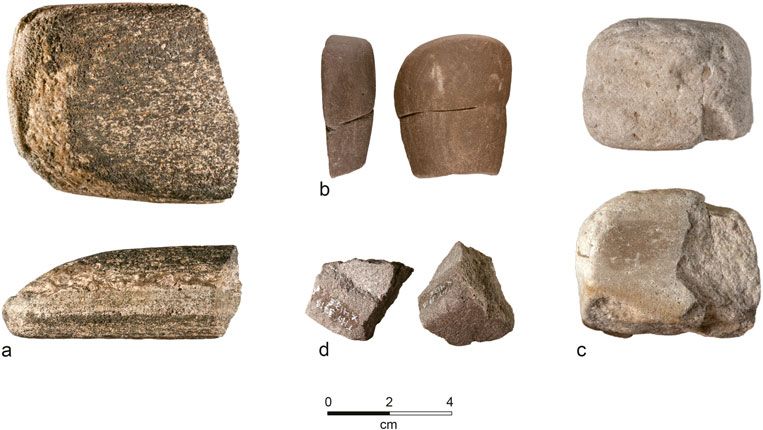
Earle et al. ‒ Everyday Life at a Late Bronze Age House in Denmark                                                              5

                  identified in each cluster, at the transition                      cooking, refuse disposal, and amber
                  between the occupation and underlying                              storage (N190). An irregular, shallow
                  layers; the basal layers in the pits con-                          depression (N191), at least 4 m across,
                  tained homogeneous, charred material,                              contained a peaty fill above a thin clay
                  which palaeobotanical analysis identified                          layer; assorted refuse filled this wet depres-
                  as peat. The western cluster comprised four                        sion, perhaps representing a workspace. A
                  fire pits (N149, N150, N159A–B, and                                pit with at least six phases (N208) docu-
                  N161); N159A was 36 cm deep (inter-                                menting fire and refuse disposal was
                  preted as a fire pit), others were shallower                       located nearby, capped by a peaty layer
                  (12–24 cm deep, identified as hearths).                            containing flint, pottery, and chalk.
                  Two hearths (N116 and N107) were in a                                 The features at Bjerre 7 defined a house
                  central position. At the eastern end, near                         and working yard used for different activ-
                  the entrance, a cluster of four fire pits                          ities. We conclude that the household
                  (N42, N58, N64, and N96) was recorded;                             group would have been capable of per-
                  N42 and N96 were deep with flat bases,                             forming all the tasks involved in building
                  N58 and N64 were shallower. A hearth                               and maintaining such a simple structure
                  (N49) was found farther east. The fire fea-                        and facilities. All materials (timber,
                  tures would have provided heat, light, and                         branches, thatch, limestone, and clay) were
                  cooking throughout the house.                                      locally available. We shall now turn to the
                     Other features included a sunken pot                            excavation of the well-preserved occupa-
                  containing an amber cache (N163), an                               tion layer at Bjerre 7 to investigate
                  unusually large central pit (N30, 2 m across                       whether more can be added to the inter-
                  and 30 cm deep) with vertical sides and a                          pretation of the features themselves.
                  horizontal base suggesting a cellar, and a
                  sunken storage pot close to N30. A number
                  of other poorly defined features were identi-                         BJERRE SITE 7: HOUSEHOLD ACTIVITY
                  fied, a few used for refuse disposal.                                             PATTERNING
                     Outside the house, limited funding pre-
                  cluded extensive excavations. It is highly                         Artefact distributions across a living
                  likely that structures and features remain                         surface can define activity patterning, as
                  unexplored. One possible irregular struc-                          exemplified in American household
                  ture includes a limestone pile (N157) to                           archaeology (Wilk & Rathje, 1982). Bjerre
                  the south-west of the house.                                       7’s good preservation conditions meant
                     Two outside activity areas (south and                           that archaeological methods for intensive,
                  west) were defined by pits used primarily for                      systematic artefact recovery were appropri-
                  refuse disposal but also for fires and storing                     ate. They included systematic sampling for
                  amber. To the south, and extending almost                          flotation and full soil screening (sieving),
                  as far as the eastern end of the house, were                       which provided comprehensive data sets
                  many features separated from the house by a                        for the analysis of plant macrofossils, cer-
                  2 m-wide void bridged by the entrance                              amics, lithics, and amber. The macrofossils
                  pavement. Some twenty-three refuse pits                            included 12,000 grains and parts of culti-
                  contained pottery sherds, flint, charcoal,                         vated plants, 6000 arable weed seeds,
                  lumps of unfired clay, and a few amber                             30,000 seeds from other wild plants, and
                  pieces. Two features (N6 and N141) were                            more than 700 twigs, leaves, and flowers
                  fire pits with charred layers in their base.                       from heather and shrubs. The most
                     To the west, and extending beyond the                           common artefacts were 46,066 ceramic
                  excavation area, features were dedicated to                        sherds, representing perhaps 200–500

Downloaded from https://www.cambridge.org/core. IP address: 46.4.80.155, on 28 Feb 2022 at 00:50:58, subject to the Cambridge Core terms of use, available at
https://www.cambridge.org/core/terms. https://doi.org/10.1017/eaa.2021.63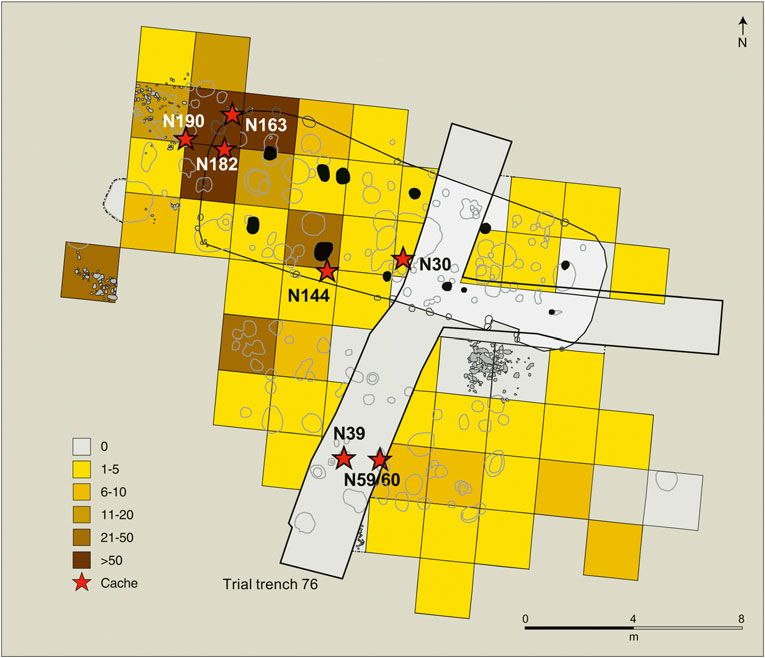
6                                                                                     European Journal of Archaeology 2022

                 discarded pots calculated from the number                          household cuisine (Henriksen et al.,
                 of sherds in reconstructed vessels. The                            2018). Barley (Hordeum vulgare), bread
                 second most common class comprised                                 wheat (Triticum aestivum), emmer
                 worked flints with 13,550 pieces, predom-                          (Triticum dicoccum), and spelt (Triticum
                 inantly debitage (96 per cent), and 115                            spelta) were routinely recovered by flota-
                 pieces of non-flint stone. Amber was sur-                          tion at Bjerre 7, as at other Danish Late
                 prisingly abundant. We begin by consider-                          Bronze Age sites (Robinson, 1994). Oil-
                 ing household activities involving food and                        rich plants included gold-of-pleasure
                 crafts linked to the farm.                                         (Camelina sativa) and two flax (Linum usi-
                    Activity patterns associated with in situ                       tatissimum) seeds, attesting to the early
                 features and artefacts document tasks that                         cultivation of flax in Denmark. The seeds
                 took place immediately around the farm-                            of these two plant species contain up to 40
                 stead. Most evidence is circumstantial as                          per cent oil, and they were also found
                 we rely on the simplest explanations                               together in an Iron Age site in Thy
                 derived from standard patterns observed                            (Henriksen & Harild, 2020).
                 among traditional peoples. When possible,                             The fields surrounding Bjerre 7 were
                 we shall examine contrasting and common                            capable of producing these crops, as docu-
                 patterns between inside vs outside activ-                          mented by ard-marks in soil horizons
                 ities and between the five feature areas.                          above, below, and outside the occupation
                 Levels of analysis depend on the contexts                          layer. The ard-marks indicate regular
                 of the finds defined by site formation pro-                        fields, suggesting sustained farming, as
                 cesses (see Supplementary Material). Here,                         does the presence of carbonized arable
                 we consider tasks oriented towards house-                          weed seeds. Flint blades (as well as heavy
                 hold subsistence, self-sufficiency in food,                        knives and laterally retouched flakes) prob-
                 and technology, and address questions of                           ably served for harvesting (Figure 4 e–g),
                 specialization involving exchange. While                           but they were all-purpose cutting tools
                 we try to avoid hesitation in our expos-                           that could have had multiple uses. Blade-
                 ition, the tentative nature of our modelling                       like flakes have lateral retouching or
                 must be taken as read.                                             natural backing, creating a sharp blade
                                                                                    with a blunt back suitable to be handheld,
                                                                                    and some were used for cutting plant
                             FOOD TASKS          AT   BJERRE 7                      material, as indicated by silica gloss;
                                                                                    however, their varied forms suggest a
                 Crops and animal products were raised                              range of uses (Jensen, 2018: 367ff). We
                 nearby in the fields and pastures surround-                        know little about Late Bronze Age tool
                 ing the site and were prepared inside and                          hafting, except a preserved example of a
                 outside the house, and eaten by household                          hafted blade knife used for harvesting
                 members. Fish was caught locally. All sub-                         from eastern-central Jutland (Jensen, 2018:
                 sistence resources could, and probably                             368). Our large blade knives show traces
                 were, regularly procured by household                              of similar hafting.
                 members.                                                              Domestic animals are likely to have
                                                                                    been raised in the grasslands and fields
                                                                                    around the farm, but, because of soil con-
                                  Household cuisine                                 ditions, their bones did not survive. Bones
                                                                                    of cattle and sheep/goats were present at
                 Plant macrofossil remains (Figure 3) docu-                         other Bjerre farms (Nyegaard, 2018).
                 ment cereals and oil plants basic to                               Supporting evidence for animal use in

Downloaded from https://www.cambridge.org/core. IP address: 46.4.80.155, on 28 Feb 2022 at 00:50:58, subject to the Cambridge Core terms of use, available at
https://www.cambridge.org/core/terms. https://doi.org/10.1017/eaa.2021.63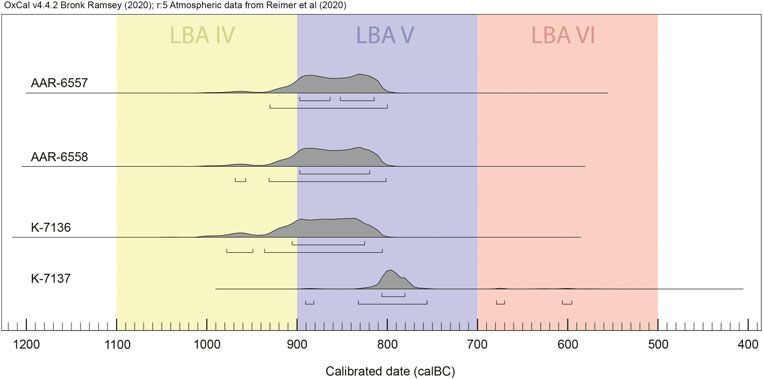
Earle et al. ‒ Everyday Life at a Late Bronze Age House in Denmark                                                              7

                  Figure 3. Distribution of food-related plant macrofossil remains from activity areas at Bjerre 7.

                  Bjerre 7 includes animal dung as fuel,                             ceramics, and non-flint stone artefacts
                  animal residue on ceramics, and heavy-                             constitute primary evidence of activities
                  duty flint tools used for such activities as                       linked to food preparation. Flotation
                  cutting and scraping likely involving bone                         samples provided good evidence for burnt
                  in addition to wood. Fish is documented                            seeds and fuels that could be locally pro-
                  in a refuse pit (N208), where chalk con-                           cured from Bjerre’s environs. Although
                  served many partially burnt fish bones and                         burnt fuel was found in virtually all
                  scales of local salmon/trout (Salmo) and                           samples, almost no wood charcoal was
                  stickleback (Gasterosteidae).                                      present, which corresponds to the almost
                                                                                     treeless landscape around Late Bronze
                                                                                     Age Bjerre (Søgaard et al., 2018). Instead,
                   Food preparation, cooking, and serving                            burnt peat is documented by seeds and the
                                                                                     root parts of sedges (Carex) and heather
                  Fire features (hearths and deeper fire pits                        twigs (Calluna) as well as burnt animal
                  used for cooking), plant macrofossils,                             manure, as attested by stem fragments and

Downloaded from https://www.cambridge.org/core. IP address: 46.4.80.155, on 28 Feb 2022 at 00:50:58, subject to the Cambridge Core terms of use, available at
https://www.cambridge.org/core/terms. https://doi.org/10.1017/eaa.2021.63
8 European Journal of Archaeology 2022
Figure 4. Characteristic flint artefacts from Bjerre 7 (a–b: scrapers; c–d: strike-a-lights; e: heavy blade
knife; f: laterally retouched piece; g: sickle blade; h–i: borers; j–k: ad hoc tools).
seeds from grass (Poaceae) and clover household. The ratios of plant seeds and
(Trifolium). More than half the 9000 seeds parts show areas where the harvest was
from grasses were found in the house’s cleaned (high proportion of chaff and field
easternmost pit (N49), with intact drop- weeds) vs cooking (high proportion of
pings from sheep or goats, indicating that edible seeds). The distribution of the plant
manure was burnt here. Eight strike-a- material across the site (Figure 3) shows
lights made from local flint were identi- food-related macrofossil remains divided
fied, half of them confirmed microscopic- into a) cereal grains (barley, wheat,
ally as fire starters. emmer, and spelt); b) camelina seeds
Macrofossils can document steps in pre- (gold-of-pleasure); c) rachis of barley/
paring and cooking plants within the wheat (chaff); d) rachis of emmer/spelt
Downloaded from https://www.cambridge.org/core. IP address: 46.4.80.155, on 28 Feb 2022 at 00:50:58, subject to the Cambridge Core terms of use, available at
https://www.cambridge.org/core/terms. https://doi.org/10.1017/eaa.2021.63Earle et al. ‒ Everyday Life at a Late Bronze Age House in Denmark 9
(chaff); and e) field weeds. Plant parts most with no/low lipid residues, a barrel-
were all carbonized accidently or as fuel in shaped vessel with terrestrial animal and
fire features, probably close to primary vegetable residues, and one small vessel
working areas. contained ruminant, vegetable, and meat
The preparation and serving of food are residues.
documented by abundant ceramics and Fifty-two sherds from four or more
non-flint stone artefacts. We assume that strainers had multiple drilled holes (2-6
most pottery involved storage, preparation, mm diameter) placed variably a few centi-
cooking, and serving foods, although iden- metres below the rim, on the belly, and/or
tifying specific activities proved difficult at the base. Although strainers are often
because the assemblage was fragmented, thought to document cheese-making, four
and the vessels are likely to have had mul- residue analyses show no traces of milk or
tiple uses. Nevertheless, a diversity of forms plant-based liquids, and other uses like
suggests different uses (Figure 5), including steaming should be considered.
food preparation (cooking, straining), For serving, vessel forms include three
storage, and serving (thin-walled and/or cups or small vessels, two bowls with or
decorated vessels), although only four without handle(s), and two conical or
vessels are preserved from rim to base and biconical vessels. Four were analysed for
fifteen from rim to below belly. These lipids: a cup or small vessel contained
vessels include two conical-neck examples ruminant, vegetable, and meat residues; a
(Figure 5g, h), two concave-convex vessels bowl contained milk and vegetable; and
(Figure 5d, k), three pot- and barrel-shaped two vessels (a cup or small bowl and a
items (Figure 5e, f, l), and three miniatures conical or biconical vessel) had little
(Figure 5a, b, c); strainers were also identi- residue. Vessel forms include both
fied (Kristensen, 2018). thinner and decorated vessels, which
Some vessels have thick walls, including were most probably used for serving,
fifteen undecorated pots with wall thick- because the risk of breakage was reduced
ness of 7–9 mm. Thicker walls probably and perhaps the transfer of information
made vessels more durable during cooking. was more important. As discussed below,
Sherds with charred organic material cooking and serving vessels show distinct
represent c. one per cent of the total, burnt distributions.
during cooking and perhaps disposal. Stone tools were also used in food prep-
They have diverse shapes and sizes, aration. Non-flint stone artefacts included
including a 3.4 cm-high vessel side (rim fragmented hammerstones and crushing
diameter: 8 cm), a handled vessel (diam- stones (pestles) associated with plant pro-
eter: 16 cm), and a barrel-shaped vessel cessing (Eriksen, 2018: 303–06). They
(diameter: 32 cm) (Kristensen, 2018: were recovered across the site, probably
251ff.). The general lack of patterning not where they were originally used. Many
suggests a rather ad hoc use of vessels. edged lithics could have served for butch-
Twenty-two sherds with burnt organic ering, although function is hard to deter-
material were chosen for lipid analysis, to mine and tool use may have been
identify the presence or absence of lipids opportunistic.
or low lipids, ruminant (adipose), dairy, The evidence from plant macrofossils,
terrestrial animal (non-ruminant), meat, organic residue analysis, and from stone
and vegetable matter (Isaksson, 2018). tools, suggests that food was produced and
Analysis of fifteen vessels with thick pro- processed for use by the farm household.
files documents a mixed agropastoral diet, Although various forms of lithics and
Downloaded from https://www.cambridge.org/core. IP address: 46.4.80.155, on 28 Feb 2022 at 00:50:58, subject to the Cambridge Core terms of use, available at
https://www.cambridge.org/core/terms. https://doi.org/10.1017/eaa.2021.6310 European Journal of Archaeology 2022
Figure 5. Ceramic vessel forms from Bjerre 7.
Downloaded from https://www.cambridge.org/core. IP address: 46.4.80.155, on 28 Feb 2022 at 00:50:58, subject to the Cambridge Core terms of use, available at
https://www.cambridge.org/core/terms. https://doi.org/10.1017/eaa.2021.63Earle et al. ‒ Everyday Life at a Late Bronze Age House in Denmark 11
ceramics are present, these artefact classes ‘pointed tools’. One borer is made on an
show ad hoc, unspecialized, and variable irregular quartzite piece, available in glacial
uses. Related tasks were uncomplicated deposits. No on-site evidence exists for
and could be handled by the farm’s small skilled knapping; tool manufacture was
workforce. House building may have simple and could be performed by
required reciprocal participation by neigh- anybody, anywhere, anytime for cutting,
bours. As for the choices of cuisine, they scraping, and drilling. Knapping was by
seem to fit the DMP model. direct, hard-hammer percussion to crude
flake cores, supplemented by bipolar and
anvil techniques to maximize raw material
TECHNOLOGICAL TASKS AT BJERRE 7 use. Two ‘fabricators’, heavy-duty tools
used ‘for retouching other flint tools, or
The tasks involved in resource procure- for grinding, or […] as part of a fire-light-
ment and making and using tools could all ing kit’ (Butler, 2005: 56), were identified.
be, and probably were, performed by Other tool uses are described under the
household members. Stone, moraine relevant task categories. Overall, the lithic
deposits, wood, bone, and skins were tool assemblage included tools for cutting,
available, and tool manufacture suggests scraping, and boring, performed by a het-
an ad hoc fabrication for household use. erogeneous range of flint flake tools
Small-scale metal production, evidenced at (including pieces with discontinuous,
Bjerre 7, would have required imported irregular retouch, notches, denticulation,
metal, but the simple metallurgy suggests etc.). Numerous retouched flakes display
that production was for domestic use and great variation, making it challenging to
perhaps small-scale exchange. Although distinguish morphologically between more
ceramics were produced from local clays, or less regular scrapers, knives, and
no direct evidence exists for manufacture retouched pieces. Most tools appear to
immediately around the farm. have been multifunctional. Many ad hoc
tools (274 examples) were recorded, along
with scrapers (101), borers (62), and
Making stone tools several large blade knives (26).
At Bjerre 7, debitage was abundant and
ubiquitous, without obvious concentrations Making tools from wood and animal
of debris. The materials were erratic flints products
and water-rolled cobbles available around
the farm and probably collected as needed. Although probably used for food prepar-
On-site flintknapping is well documented ation, the multiple-purpose lithic assem-
by extensive lithic waste, including widely blage could also have served to produce
distributed nodules, cores, flakes, and tools and to build structures, evidencing
shatter. No micro-debitage was recovered. organic materials otherwise not preserved,
Approximately half the scrapers (the most except for one bone spatula.The common
common tool) were fashioned on cortical scrapers served to work hard material like
blanks indicative of on-site manufacture, wood or bone (Jensen, 2000). Several
although refits were impracticable. Some fragmented scraper edges indicate heavy
borers are quite regular, typically with one use and/or resharpening. Scrapers have a
or two pronounced tips. Classic drills are distinct angle along the edge, which
present, but others are best described as varies considerably in steepness, and no
Downloaded from https://www.cambridge.org/core. IP address: 46.4.80.155, on 28 Feb 2022 at 00:50:58, subject to the Cambridge Core terms of use, available at
https://www.cambridge.org/core/terms. https://doi.org/10.1017/eaa.2021.6312 European Journal of Archaeology 2022
Figure 6. Metallurgical ceramics from Bjerre 7 (a–c: crucible fragments; d: mould fragment).
standardization exists in length, width, or seems likely that these pieces were made
thickness. Heterogeneous flint borers are by the metalurgists themselves. The
our second-most common tool type. mould, although too fragmentary to iden-
Many borers were put under great strain. tify what it was intended for, had two
Several were broken, and many tips show slots. Technically similar Late Bronze Age
heavy abrasion, edge rounding, and splin- crucibles and moulds were found in a large
tering, presumably caused by boring into refuse pit near Skive about sixty kilometres
a hard material like wood, bone, or even south-east of Bjerre.
stone. Four stone artefacts were likely to have
been involved in metalworking (Figure 7)
(Eriksen, 2018: 306). The item illustrated
Metallurgy in Figure 7a is a well-worn, fragmented
whetstone made from a fairly coarse-
Small-scale, rather rudimentary metallurgy grained sedimentary rock, used to sharpen
is documented by ceramic and stone arte- metal edges or to remove irregularities
facts at Bjerre 7. Since the technology was from casting. The object illustrated in
quite straightforward, it could have been Figure 7b is tentatively interpreted as a
conducted by experienced household small whetstone made from a fine-grained,
members. The metal, however, must have slate-like sedimentary rock. The front is
been obtained through trade and recycling. flat, smooth, and slightly faceted but not
Metal objects were probably intended for polished, the base is partly faceted, and a
household use, but they could have been fine groove is visible on the back. The
exchanged with neighbours. stone illustrated in Figure 7c is perhaps a
For bronze working, nine ceramic cushion stone (hammer or anvil), made of
pieces (crucible and mould fragments) were quartzite. The lower face is flat and excep-
recovered. The crucibles (Figure 6a–c) and tionally smooth, the upper is rounded, and
mould (Figure 6d) were made of local the side is grooved, presumably for fixing
clay, but distinct from standard ceramics. (Eriksen, 2018: 306f). The fragment illu-
The matrix of the crucibles was clay mixed strated in Figure 7d is a piece of grey-
with sand, and the crucibles were well wacke with traces of modification that
fired with surfaces almost vitrified. It may have been a preform mould;
Downloaded from https://www.cambridge.org/core. IP address: 46.4.80.155, on 28 Feb 2022 at 00:50:58, subject to the Cambridge Core terms of use, available at
https://www.cambridge.org/core/terms. https://doi.org/10.1017/eaa.2021.63Earle et al. ‒ Everyday Life at a Late Bronze Age House in Denmark 13
Figure 7. Possible metalworking stone tools from Bjerre 7 (a–b: whetstones; c: cushion stone; d: mould
fragment?).
additional fragments of this material could evidence from traditional societies shows
not be refitted. that part-time household specialists regu-
larly produced pots (Miloglav & Vukovic,
2018). Although pottery is often assumed
Pottery making to have been produced by each
Scandinavian farm, this seems unlikely.
At Bjerre 7, evidence for ceramic manu- Suitable clays are not common, perhaps
facture is absent from the excavated area, encouraging part-time specialization.
although analysis of the pots’ clays sug-
gests that they ‘seem to have local charac-
teristics’ (Rasmussen & Bech, 2018: 263). Summary: technological tasks
Small, well-rounded stones might,
however, have been burnishers. Both the Tool making almost exclusively appears to
quantity and relatively high firing tem- have been largely for household use, in
perature of the Late Bronze Age ceramics line with the DMP model. No evidence
(in contrast to those of the Early Bronze exists for specialized lithic production for
Age) suggest a degree of skill and scale in exchange; production was ad hoc for a
their production. Ceramic manufacture, variety of activities, probably involving har-
not unlike metallurgy, is a messy affair vesting, making plant and animal products,
producing considerable waste; hence, even and working wood and perhaps bone for
if production had taken place away from tools, structures, and clothing. Local pro-
the house, we would expect debris in the duction is dominant, the exception being
household refuse. Because pyrotechnic metallurgy. Although for household use, it
industries have considerable economies of required exchange-based procurement of
scale (as ad hoc production for household metal. Bjerre 7 was technologically generally
use would be inefficient), ethnographic self-sufficient, but probably exchanged some
Downloaded from https://www.cambridge.org/core. IP address: 46.4.80.155, on 28 Feb 2022 at 00:50:58, subject to the Cambridge Core terms of use, available at
https://www.cambridge.org/core/terms. https://doi.org/10.1017/eaa.2021.6314 European Journal of Archaeology 2022
items locally, perhaps including ceramic located close to the ancient coastline, and
vessels and a few stone tools. amber was probably procured along the
beach by household members. All amber
was raw, without any trace of modification
EVIDENCE OF HOUSEHOLD RITUAL? or use within the household. We posit
that it served as an exchange medium pri-
Although ritual is typically embedded in marily to obtain metal.
everyday and community life, evidence from Nearly 1800 pieces of amber were
Bjerre 7 is ambiguous. Small (‘miniature’) recovered during excavation. Most pieces
vessels could have been used for serving, or were small, with a mean weight of just
as ritual props (as they are often inter- over 1 g. They were found in almost all
preted), or again as children’s toys, or any contexts, from special storage pits to refuse
combination. The clay of the item illu- disposal features, from sub-floor caches to
strated in Figure 5b is yellowish and badly the occupation layer. We identified seven
fired. The vessel is poorly formed, with an caches (concentration: > 30 pieces), and
uncertain diameter and irregular rim as amber was recovered from almost all (51
might be expected for a pot made by a out of 53 = 96 per cent) 2 × 2 m excavation
child or perhaps by a household member units targeting the occupation layer.
who is not a potter. Four distinctive vessels Caches appear in two contexts, pits and
(a miniature, a shallow bowl, and two orna- clusters. Pits originally contained sunken
mented vessels) were found close to the storage vessels. A distinctive storage vessel
entrance pavement (N4 on Figure 2). This with associated amber was recovered from
does not appear to be random, and the N163. As reconstructed, the vessel is 40
context suggests that this cluster lies close cm high with a rim diameter of 34 cm;
to the vessels’ place of deposition. Entrances these dimensions are outside those of food
are points of social transition that are often storage vessels, and the vessel could have
culturally significant, perhaps indicating a held many kilograms of amber (Figure 5i);
ritual function, although other interpreta- 863 raw pieces were recovered from N163,
tions are plausible (see Bradley, 2005). The many directly on the in situ pot base, in
abundant amber finds, however, show no the fill, and in the unit directly above it.
evidence of ritual contexts. Because the vessel base was only 24 cm
below the occupation layer, its rim would
have protruded from the ground level,
EXCHANGE GOODS providing easy access. The pit profile of
N59 matched the contours of a storage
While most food and materials used to vessel, and an inverted base was recovered
make tools were probably obtained and in the pit fill, among eighty pieces of
transformed by household members for amber. Feature N190 contained the frag-
their own uses, tasks involving amber, ments of a third large storage vessel with a
metal, perhaps ceramics, and a few lithics rim diameter of 40 cm and a horizontal
were linked to local and longer-distance lug, suggesting that it was transportable.
exchange, as detailed here. Although no amber was found in the fill
of that pit, two fragments adhered to the
Amber interior of a body sherd. With a scattering
of 127 pieces of amber, pit N39 would
Bjerre 7 shows evidence of sorting and seem to fit the category of vessel storage,
storing amber (Earle, 2018). The site is but no sherds were recovered. At some
Downloaded from https://www.cambridge.org/core. IP address: 46.4.80.155, on 28 Feb 2022 at 00:50:58, subject to the Cambridge Core terms of use, available at
https://www.cambridge.org/core/terms. https://doi.org/10.1017/eaa.2021.63Earle et al. ‒ Everyday Life at a Late Bronze Age House in Denmark 15
point during the life of the house, subter- We contend that the household at
ranean storage pots were broken, leaving Bjerre 7 engaged in part-time tasks gath-
variable amounts of amber behind. All ering considerable amounts of amber to
storage in vessels was outside the house, obtain metal. A linkage between amber
although one vessel was located on the collection on the seashore and metal crafts
house wall-post line and may have been may be a more widespread phenomenon.
accessible from inside the house. At the nearby Late Bronze Age coastal
Two clusters (N30 and N182) suggest site of Troldsting, co-occurrence of amber
that amber was packed in a small bag or and metal casting indeed suggests such an
other container. One cache, within the economic linkage (Müller, 1919).
cellar N30, consisted of 158 pieces (132 g) If pottery were acquired, this too would
tightly packed together, including the require some yet unidentified product in
largest chunk (39.5 g) excavated by the Thy exchange. Local pottery is often produced
Project. Despite some rodent disturbance, by households with limited subsistence
the dense packing appears similar to a sub- opportunities (e.g. poor soils) but with
floor cache from Bjerre 6 that was inter- access to suitable clays. In such situations,
preted as a small bag of amber. As for pottery is produced in exchange for food.
N182, it was a posthole containing a dense Perhaps Bjerre 7 produced a surplus of
packing of thirty-three pieces of amber. In animals, cereals, oils, and/or metal objects?
another shallow, saucer-like pit (N144), a This would fit the logic of the DMP model.
scattering of forty-nine pieces was recov- Although the goal is self-sufficiency, house-
ered, perhaps representing a disturbed con- holders become part-time specialists to
centration. It is possible that bags of amber obtain specific commodities that they cannot
were stored within the house. produce on their own. Pyrotechnology and
special materials demand such exchanges,
and the amber gathering fits this pattern.
Other materials and tools for exchange With a largely self-sufficient household,
part-time specialization complements house-
Household bronze metallurgy requires hold independence.
metal obtained as ingots or scrap, possibly
through long-distance trade. Additionally,
because metallurgy and ceramics are tech- ORGANIZING WORK: TASK AREAS
nologies with strong economies of scale
(decreasing costs with expanding volume), The second aspect of the DMP, which
it is likely that both products involved also characterizes Household Societies,
exchange between households engaged in consists of obtaining and organizing
part-time specialization. Probably, some labour for self-sufficiency. Here we con-
metal products were traded out, and cer- sider the tasks involved in subsistence,
amics traded in. craft, and amber collection as illustrated by
Two formally diagnostic lithic blade their distribution inside and outside the
knives found at Bjerre 7 appear to have house and between activity areas.
been obtained by regional exchange. In
central Thy, a specialized knapping site for
such Late Bronze Age knives has been Subsistence tasks
identified (Masojć, 2016: 62ff), and it may
be that special skills or flint encouraged Plant macrofossils and ceramics from
such part-time specialization. Bjerre 7 provide the best data for specific
Downloaded from https://www.cambridge.org/core. IP address: 46.4.80.155, on 28 Feb 2022 at 00:50:58, subject to the Cambridge Core terms of use, available at
https://www.cambridge.org/core/terms. https://doi.org/10.1017/eaa.2021.6316 European Journal of Archaeology 2022
subsistence tasks in distinct activity areas. Figure 8 shows that the distribution
The eastern end of the house was the of ceramics probably documents mainly
primary cooking area, attested by macro- the disposal of refuse, but some pattern-
fossils documenting the final processing ing suggests cooking and serving activ-
and cooking of barley, wheat, and emmer ities. Within the house, pottery
or spelt. Most cereal grains of all species concentrations show a contrast between
were found here, in fire pits N42, N49, cooking vessels (foodcrusts) at the
and N64; N42 also contained chaff from eastern end and serving vessels (thin-
barley and bread wheat. These pits also had walled) at the west (see Supplementary
abundant field-weed seeds from a final Material). Just west of the house, food
sieving. Sherds with encrusted food were activities were documented from a refuse
recovered here, and eleven strainer sherds pit (N208) and area to the north
were found in the central cellar (N30). (N191). The absence of cultivated
At the western end of the house, by cereals in N208 suggests little cooking;
contrast, chaff of emmer or spelt concen- the pit contained 546 sherds weighing
trated in fire pits N149, N150, and N159 almost ten kilos, including an ornamen-
documented their dehusking, probably by ted serving vessel, two ribbon-shaped
crushing with mortars. Here thirty-five handles from serving vessels, and pos-
sherds representing three or four vessels sibly a lid. Feature N190, also north of
for food preparation or cooking, and two N208, contained a smaller ornamented
ornamented body sherds, perhaps from vessel, perhaps suggesting serving, and a
serving vessels, were recovered. Thin- bowl-like vessel with a rim diameter of
walled (< 4 mm thick) serving vessels were c. 20 cm. A large, barrel-shaped storage
found concentrated in the western fire- container and a smaller vessel for
pits. Perhaps some special activities involv- pouring was found in N208 and N190.
ing food processing and eating took place Thin-bodied serving vessels concentrate
here; unlike in the east, evidence of here. This distinctive assemblage sug-
cooking is limited (few cereals). gests a place for special activities or dis-
Outside the house, despite much debris posal, perhaps related to festive meals.
resulting from cleaning, a distinctive Stone artefacts are hard to interpret as
pattern exists. Although food-encrusted to function, but knives were probably
vessels were heavily concentrated south of used, at least partly, for butchering.
the house, this concentration is probably Abundant burnt flint concentrated around
owed to cleaning and not cooking tasks; fireplaces where such butchering and other
because items difficult to clean (cereals activities are likely to have taken place.
and chaff) were rare here, cooking of Hammerstones and crushing stones,
cereals was evidently limited. However, perhaps used in preparing cereal and plant
many gold-of-pleasure seeds and two flax food, were concentrated outside, in the
seeds were found here. Attesting to oil south-east, probably reflecting cleaning.
extraction, these seeds (which contain up Overall, food-related activities domi-
to 40 per cent of oil) represent approxi- nated everyday life in the immediate sur-
mately seventy-five per cent of the total roundings of the farm. Some distinct
276 seeds recovered, compared to only activity areas exist, but interpretations are
seven per cent for grains. We conclude confounded by patterns of disposal. Food
that oil extraction was an outdoor activity, preparation and cooking concentrated at
but cereal cooking was primarily an indoor the eastern end of the house and prepar-
activity. ation of oil outside the house. Serving
Downloaded from https://www.cambridge.org/core. IP address: 46.4.80.155, on 28 Feb 2022 at 00:50:58, subject to the Cambridge Core terms of use, available at
https://www.cambridge.org/core/terms. https://doi.org/10.1017/eaa.2021.63Earle et al. ‒ Everyday Life at a Late Bronze Age House in Denmark 17
Figure 8. Distribution of ceramics at Bjerre 7.
vessels appear to be somewhat separated all lithics (tools as well as debitage) are
from primary cooking, in the western interpreted as waste from the manufacture
sector of the house and perhaps outside of simple tools used once and discarded.
the house to the west. The distributions of nodules, cores, flakes,
and shatter suggest that flintknapping
generally took place outdoors, especially
Crafting south-east of the house. Some flintknap-
ping was also undertaken inside the house
Used in diverse crafts, the lithics at Bjerre (especially in the eastern end), where flint
7 are widely distributed, like the food debris was routinely recovered. Knapping
tasks. Evidence of elementary tool manu- was broadly associated with general activity
facture is ubiquitous, often associated areas that included food processing and
with fire. Burnt flint is quite abundant, other tasks requiring cutting, scraping, and
often near fireplaces, especially outside to drilling.
the south-east, associated with refuse Late Bronze Age flintknapping was exe-
disposal. cuted as needed, for heavy work with food
Tool production and use were expedi- preparation, wood- and stone-working. The
ent, without discrete work areas. Almost distributions and the presence of irregular
Downloaded from https://www.cambridge.org/core. IP address: 46.4.80.155, on 28 Feb 2022 at 00:50:58, subject to the Cambridge Core terms of use, available at
https://www.cambridge.org/core/terms. https://doi.org/10.1017/eaa.2021.6318 European Journal of Archaeology 2022
Figure 9. Distribution of lithic debitage and tools at Bjerre 7.
morphological types suggest that such activ- Amber handling
ities were widespread. Scrapers are evenly
spread in the house and outside, with a Figure 10 shows the spread of amber-
faint concentration in the exterior south- related activities across the site. The distri-
eastern area. Borers show a similar distribu- bution of amber in virtually all the units
tion. Sickles blades were found outside the excavated in the occupation layer suggests
house, primarily in the south-east, while that it formed part of everyday activities.
large blade knives were also found outside Within the house, amber was concentrated
the house, especially in the southern activity in its western part, associated with many
areas; two blade knives (one used as a fire pits. We presume that this represents
sickle, the other to cut reeds) were located an area of primary sorting for storage and
in the house at its eastern end, possibly as eventual exchange. A similar pattern was
curated objcts. observed in the Early Bronze Age house
Although associated artefacts are few, the of Bjerre 6 (Earle, 2018). Scattered
distribution of metal-making tools (crucible outside, some western culture-layer units
and mould fragments) outside the house is had high densities of amber not directly
associated with intense fire (Figure 8), associated with storage; these may have
whereas the tools used for finishing the been sorting locations possibly associated
metal were found inside (Figure 9). with a structure (Figure 2).
Downloaded from https://www.cambridge.org/core. IP address: 46.4.80.155, on 28 Feb 2022 at 00:50:58, subject to the Cambridge Core terms of use, available at
https://www.cambridge.org/core/terms. https://doi.org/10.1017/eaa.2021.63Earle et al. ‒ Everyday Life at a Late Bronze Age House in Denmark 19
Figure 10. Distribution of amber indicating related storage features at Bjerre 7.
Storage caches were found close to, but labour for its tasks. Most tasks lacked
somewhat removed from, general household strong patterning, despite good spatial
activity spaces. A large amber storage pot data. Subsistence, tool manufacture, and
(N163) was recovered at the extreme western amber handling were found inside and
end along the house wall and another cache outside the house, suggesting considerable
was found nearby. Outside, N39 and N59 flexibility as people moved around accord-
were somewhat removed from the primary ing to conditions (e.g. rain, cold, wind)
activity. That amber storage was both inside and needs; any distinction would be
and outside the house and that storage jars obscured partially by disposal patterns.
stood visibly above the ground surface sug- The close association of tasks for food and
gests few security concerns. lithic manufacture speaks in favour of such
flexibility. Sorting and storage of amber
was undertaken close to normal household
Organizing tasks tasks, and shows little concern for security.
Finally, flexibility in carrying out tasks
How did the farmstead at Bjerre 7 obtain would decrease potential clashes in timing
and organize its labour to maintain a high that could have created labour shortages.
degree of self-sufficiency? The simplest Martin Mikkelsen (2020) describes how,
explanation is that the farm had sufficient across a spectrum of sizes and status, Bronze
Downloaded from https://www.cambridge.org/core. IP address: 46.4.80.155, on 28 Feb 2022 at 00:50:58, subject to the Cambridge Core terms of use, available at
https://www.cambridge.org/core/terms. https://doi.org/10.1017/eaa.2021.6320 European Journal of Archaeology 2022
Age farmsteads had features suggesting that exchanged for the metal used in small-scale
two families occupied the ends of the houses metallurgy. Simple metal products, perhaps
or paired houses. He proposes that one of sickles, axes, and decorative items, would
these families may have been unfree. At have served the household, and small quan-
Bjerre 7, parallel feature areas existed at the tities may have been exchanged. Some
eastern and western ends, which might exchange of goods and labour undoubtedly
support Mikkelsen’s model. The artefact dis- took place between neighbouring farms.
tributions, however, suggest that these dis- How were tasks organized within the
tinctions could be more easily explained as a household for self-sufficiency? The pattern-
separation between cooking and other, ing we observed may raise more questions
cleaner activities, including eating and amber than it answers. As modelled by the DMP,
sorting, within a single family. Mikkelsen division of labour characterizes most
notes that Late Bronze Age houses became domestic units cross-culturally, and typical
paired, the second house perhaps accommo- divisions, for example by gender and age,
dating a servant family, but this was not involve activities separated spatially. Bjerre
found at Bjerre 7, possibly because the exca- 7 is divided into inside and outside spaces;
vation area was limited. the transition from the outside to the inside
is marked by a zone with few activities: a
paved entrance, and a cluster of four dis-
CONCLUSIONS tinctive ceramics that may have had a ritual
function. Some distinction exists between
We asked two questions at the beginning inside and outside activities, but this may
of this article: did the farm constitute a be for pragmatic reasons, as between cereal
largely independent household responsible vs oil processing, or finishing vs pyrotech-
for meeting requirements of everyday life, nic metalworking.
and how were tasks organized within the Ceramic use in food and lithic produc-
household for self-sufficiency? In answer tion for butchering and tool manufacture
to the first question, the farm was indeed were quite generalized and ad hoc, suggest-
largely independent, with some engage- ing much flexibility. The collection and
ment with local and long-distance sorting of amber were combined with
exchange networks. Subsistence was sup- other activities. Farming was in established
ported by a mixed agropastoral economy: fields, probably near the house. Whatever
the household grew and processed cereals the division of labour, we found no evi-
and some oil-containing crops, practised dence that tasks were rigidly divided by
husbandry, and could rely on fishing. gender roles (cf. Robin, 2013).
As posited by the DMP model, some The patterning of features, artefacts,
part-time specialization was embedded in and macrofossils at Bjerre 7 does not
the household as a means of obtaining a few support Mikkelsen’s suggestion that Late
outside commodities, but specialized activ- Bronze Age houses with fire features at
ities were part of general household tasks. both ends generally incorporated two fam-
Amber gathering, perhaps opportunistically ilies living under the same roof. Living/
by men, women, and children, would have working spaces existed at either end of the
required only collecting by hand or with house, but with distinct zones for cooking,
simple nets, as is still done today (Earle, work, and eating. The house’s better con-
2018). Once gathered, amber was sorted structed part was at the west, where four
and stored among other routine activities. substantial supporting posts and stronger
The amber was not modified but probably walls defined an improved living space
Downloaded from https://www.cambridge.org/core. IP address: 46.4.80.155, on 28 Feb 2022 at 00:50:58, subject to the Cambridge Core terms of use, available at
https://www.cambridge.org/core/terms. https://doi.org/10.1017/eaa.2021.63Earle et al. ‒ Everyday Life at a Late Bronze Age House in Denmark 21
away from the entrance and thus more 13080-3 7/1998 and 10/2001; and by the
private, compared to the eastern end, German Research Foundation (DFG,
interpreted as the cooking space. In our Grant 2901391021-SFB 1266).
opinion, Bjerre 7 did not accommodate
separate families of different status at each
end. Although slavery seems unlikely for
REFERENCES
this specific farm, the hypothesis must not
be rejected out of hand. Angelbeck, B. & Grier, C. 2012. Anarchism
In terms of the archaeology of Bronze and the Archaeology of Anarchic Societies:
Age farms, we emphasize the importance of Resistance to Centralization in the Coast
detailed area excavations and inter-farm Salish Region of the Pacific Northwest
comparisons as a means to test economic Coast. Current Anthropology, 53: 547–87.
https://doi.org/10.1086/667621
and social hypotheses (Gröhn, 2004; Artursson, M. 2009. Bebyggelse och
Artursson, 2009). Despite the high cost of samhällsstruktur. Södra och mellersta
such excavations, this is feasible whenever Skandinavien under senneolitikum och
occupation layers are preserved; even plough- bronsålder 2300–500 f. Kr. (GOTARC
soil excavation can provide good evidence at B:52). Gothenburg: University of
Gothenburg.
the household level (see Supplementary
Bech, J.H., Eriksen, B.V. & Kristiansen, K.
Material). We thus hope that future house- eds. 2018. Bronze Age Settlement and
hold research excavations will become Land-Use in Thy, Northwest Denmark, I
routine parts of rescue work. The opportun- and II. Højbjerg: Jutland Archaeological
ity to evaluate socio-economic relations will Society.
benefit studies of household specialization Beck, R. ed. 2007. The Durable House: House
Society Models in Archaeology (Center for
(especially ceramics and metal), the divisions Archaeological Investigations, Occasional
of labour, wealth differentials, and amber Paper, 35). Carbondale (IL): Southern
flows from coastal collecting sites to long- Illinois University.
distance exchange networks. Bradley, R. 2005. Ritual and Domestic Life in
Prehistoric Europe. London: Routledge.
Bronk Ramsey, C. 2020. OxCal 4.2 [online]
[accessed 14 December 2021]. Available
SUPPLEMENTARY MATERIAL at: https://c14.arch.ox.ac.uk/oxcal.html
Butler, C. 2005. Prehistoric Flintwork. Stroud:
To view supplementary material for this Tempus.
article please visit https://doi.org/10.1017/ Cveček, S. 2021. Çukuriçi Höyük 4: Household
Economics in the Early Bronze Age Aegean.
eaa.2021.63. Vienna: OREA.
Davidsen, K. 1982. Bronze Age Houses at
Jegstrup, Near Skive, Central Jutland.
ACKNOWLEDGMENTS Journal of Danish Archaeology, 1: 65–75.
Earle, T.K. 2002. Bronze Age Economics.
Boulder (CO): Westview Press.
This work was supported by the United
Earle, T.K. 2018. Amber Finds from the
States’ National Science Foundation under Bronze Age of Thy. In: J.H. Bech, B.V.
Grants DBS 9207082 and DBS 9116921; Eriksen & K. Kristiansen, eds. Bronze Age
by the Danish Research Council for the Settlement and Land-Use in Thy, Northwest
Humanities under Grant 25-03-0520; the Denmark, Vol. II. Højbjerg: Jutland
Danish Agency for Culture and Palaces Archaeological Society, pp. 375–84.
Earle, T.K. & Kristiansen, K. 2020. Modes of
under Grants 2003-3321/78701-0002 and Production Revisited. In: P. Díaz-del-Río,
-0008; Queen Margrethe II’s K. Lillios & I. Sastre, eds. The Matter of
Archaeological Foundation under Grants Prehistory: Papers in Honor of Antonio
Downloaded from https://www.cambridge.org/core. IP address: 46.4.80.155, on 28 Feb 2022 at 00:50:58, subject to the Cambridge Core terms of use, available at
https://www.cambridge.org/core/terms. https://doi.org/10.1017/eaa.2021.63You can also read


