On the Politics of Decadent Rebellion: Beardsley, Japonisme, Rococo
←
→
Page content transcription
If your browser does not render page correctly, please read the page content below
On the Politics of Decadent Rebellion: Beardsley,
                  Japonisme, Rococo
                  RACHEL TEUKOLSKY

                         HAT did decadent rebellion look like in visual form? The graphic
                  W      designer Aubrey Beardsley was a signal contributor to the British
                  decadent movement of the 1890s. His tremendous artistic influence
                  came to span continents despite his 1898 death from tuberculosis at
                  the early age of twenty-five. Beardsley’s visual interests encapsulate
                  some of the typical qualities we associate with decadent visuality: elon-
                  gated, grotesque bodies, weird costumes, strange proportions, fetuses,
                  dwarfs, ambiguous or pornographic markers of sex and gender. This
                  imagery rebelled against conventional Victorian styles, in which realistic
                  renderings conveyed the bourgeois values of family, morality, and
                  respectability. Most scholarship on Beardsley has focused on his images’
                  perverse gender play. His effeminate men and monstrous women—hall-
                  marks of decadent gender—have inspired scholars to apply Freudian the-
                  ories of sexuality, or to link them to the advent of feminism and the New
                  Woman.1 Critics have also focused on Beardsley’s illustrations for Oscar
                  Wilde’s Salomé (1894), images that Wilde famously disliked for their defi-
                  ant refusal to subordinate themselves to the verbal original. The compe-
                  tition between word and image staged by the Salomé illustrations has
                  invited diverse scholarly theories of medium, as critics compare Wilde’s
                  words, Beardsley’s images, subsequent theatrical stagings, and even
                  recent film adaptations.2
                       This essay, however, chooses a different emphasis. Beardsley’s visual
                  experiments were famously influenced by foreign styles—most strikingly,
                  those of nineteenth-century Japan and eighteenth-century France.
                  Looking to Japanese prints, Beardsley experimented with linear forms
                  and flattened picture planes. And his turn to eighteenth-century
                  France informed a late style of extreme ornament, adorning human

                  Rachel Teukolsky is professor of English at Vanderbilt University. She is the author of The Literate
                  Eye: Victorian Art Writing and Modernist Aesthetics (Oxford University Press, 2009) and Picture World:
                  Image, Aesthetics, and Victorian New Media (Oxford University Press, 2020). Her recent book studies
                  the new visual media of the nineteenth century, from mass photography to pictorial journalism to
                  illustrated Bibles. Her essays and criticism have appeared in PMLA, ELH, Victorian Studies, Artforum,
                  and elsewhere.

                  Victorian Literature and Culture, Vol. 49, No. 4, pp. 643–666.
                  © The Author(s), 2021. Published by Cambridge University Press.
                  doi:10.1017/S1060150320000182

Downloaded from https://www.cambridge.org/core. Vanderbilt University Library, on 22 Dec 2021 at 16:58:31, subject to the Cambridge Core terms of use, available at
https://www.cambridge.org/core/terms. https://doi.org/10.1017/S1060150320000182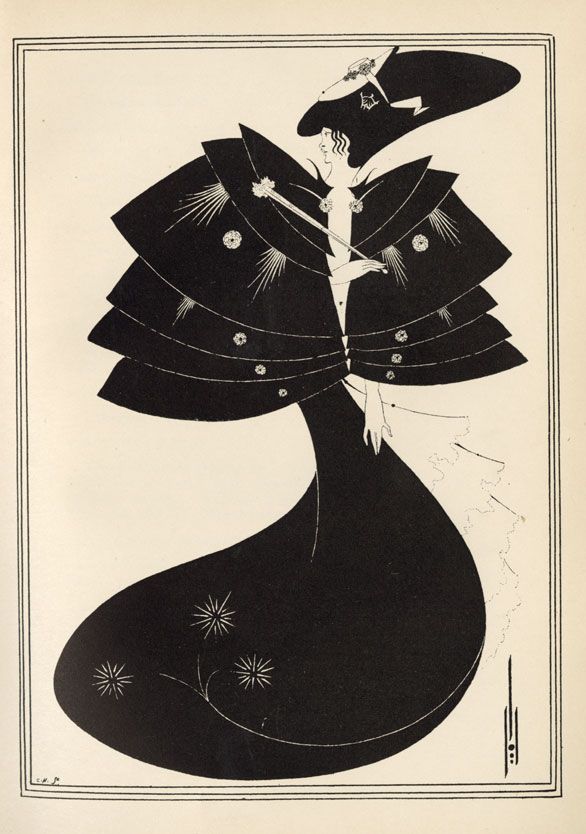
644         VL C      •    VO L. 4 9, N O. 4

                         figures with highly patterned surfaces. While scholars have acknowledged
                         these influences, I want to delve deeper into the decadent visual engage-
                         ment with Japanese and French models. Looking at Beardsley’s illustra-
                         tions for Salomé and The Rape of the Lock (1896), I’ll argue that these
                         two stylistic influences are actually connected despite their diverse geog-
                         raphies and temporalities. An analysis of both styles will reveal the ways
                         that decadence embraced hierarchy and the inequality of persons, wield-
                         ing a surprisingly normative politics of racial and cultural otherness to
                         produce a Victorian counterculture.
                               This account will intervene in a larger conversation about deca-
                         dence and the politics of its rebellions. Critics in the 1890s accused dec-
                         adence of being distasteful and degenerate—accusations that the
                         movement itself invited, as when Arthur Symons declared in 1893 that
                         it was really a “new and beautiful and interesting disease.”3 Liz
                         Constable, Dennis Denisoff, and Matthew Potolsky, in their introduction
                         to the important collection Perennial Decay: On the Aesthetics and Politics of
                         Decadence (1999), note how scholarship across the twentieth century
                         tended to malign decadence for its perverse morals, its deliberate naugh-
                         tiness, and its investments in negative qualities like disease, decay, and
                         promiscuity. Starting in the 1980s, however, scholars began to embrace
                         decadence for its admirable rebelliousness, its willingness to engage in
                         formal experimentation in both word and image. Decadent philosophies
                         of self-as-surface were seen to anticipate the more relativistic and decon-
                         structionist strains of postmodernism. Queer theorists celebrated deca-
                         dence for its radical “sexual dissidence,” as it rejected constraining
                         Victorian gender roles (see Dollimore). Many of the scholars writing in
                         Perennial Decay see decadence as desirable for its oppositional stance, res-
                         onating with scholars’ own critiques of Victorian middle-class moral
                         bromides.4
                               As a number of contributions to this special issue make clear, schol-
                         ars today are still divided as to the politics and moral valences of the dec-
                         adent movement.5 In this essay, I want to highlight the perhaps
                         counterintuitive ways that decadence, as practiced by Aubrey Beardsley,
                         in fact recapitulated some of the mainstream values of the 1890s, for
                         all its countercultural attitudes. When we contemplate decadence not
                         as an aesthetic tactic but as a historical art movement of the fin de
                         siècle, we notice how it was very much a product of its era. Its deliberate
                         immorality and amorality unfolded in the midst of high European impe-
                         rialism, a development that it in many ways accommodated. Decadence
                         was not a democratic enterprise; it thrived on a power dynamics of

Downloaded from https://www.cambridge.org/core. Vanderbilt University Library, on 22 Dec 2021 at 16:58:31, subject to the Cambridge Core terms of use, available at
https://www.cambridge.org/core/terms. https://doi.org/10.1017/S1060150320000182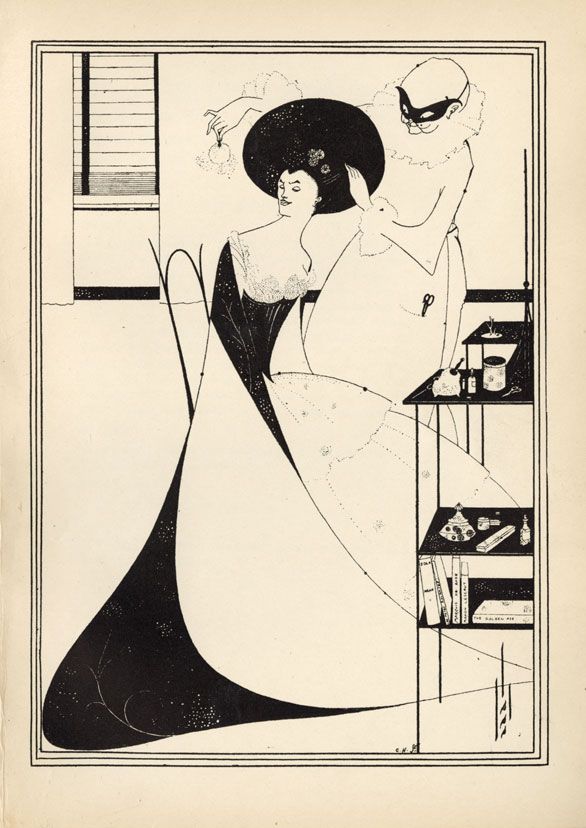
O N T H E PO LI T I CS O F DECA DE N T RE BE LL I ON                                  645

                  inequality, attuned to differences of culture or class, even while it gained
                  energy from transgressing gender divides. If scholars take gender non-
                  conformity as decadence’s most defining rebellion, they miss some of
                  its more accepting attitudes toward normative concepts of distinction
                  and otherness, including its racism, elitism, misogyny, and ease with late-
                  century imperialism and orientalism. What’s interesting, I’ll argue, is that
                  decadence harnessed these familiar attitudes in strange ways, using mod-
                  els of taboo difference to create a transgressive aesthetics that moved
                  toward both embodiment and abstraction. Beardsley’s turn toward new
                  Japan or old France came weighted with philosophical and political res-
                  onances: a reckoning with these models of otherness will afford a more
                  nuanced vision of decadence as a whole.

                                                                       1. JAPONISME
                  Already in the 1890s, critics were observing that Japanese and eighteenth-
                  century French influences were producing a new kind of decadent coun-
                  terculture. Arthur Symons, writing in “The Decadent Movement in
                  Literature,” quotes from Edmond de Goncourt: “The search after reality
                  in literature, the resurrection of eighteenth-century art, the triumph of
                  Japonisme—are not these . . . the three great literary and artistic move-
                  ments of the second half of the nineteenth century?”6 The sentiment
                  links modernism and artistic experimentation to the influences of
                  Japanese art and French eighteenth-century styles—which also connoted
                  the fearless decadent portrayal of “reality in literature,” a willingness to
                  offend mainstream tastes and values.
                        Art historians have studied the profound influence of Japanese
                  prints, ceramics, lacquer objects, and other decorative wares on
                  Western artists in the later nineteenth century.7 After Japanese markets
                  opened to the West in 1858, Japanese art objects made a sensation at
                  London’s International Exposition of 1862, with over six hundred objects
                  on display. Aesthetes signaled their cultivated taste by displaying Japanese
                  décor, including screens, fans, and textiles, while impressionist painters
                  imitated Japanese style with brilliant blocks of color and flattened picture
                  planes. For many scholars, the artistic turn to Japan inaugurated the tri-
                  umphant arrival of modernism, as Japonisme opened an avenue to
                  Western formal experimentation across diverse media.
                        Beardsley’s illustrations for Salomé show his use of Japanese visual
                  motifs. Each image offers its own strange spatial play. Patterns on cos-
                  tumes move sinuously around planes of white and black. Figures float

Downloaded from https://www.cambridge.org/core. Vanderbilt University Library, on 22 Dec 2021 at 16:58:31, subject to the Cambridge Core terms of use, available at
https://www.cambridge.org/core/terms. https://doi.org/10.1017/S1060150320000182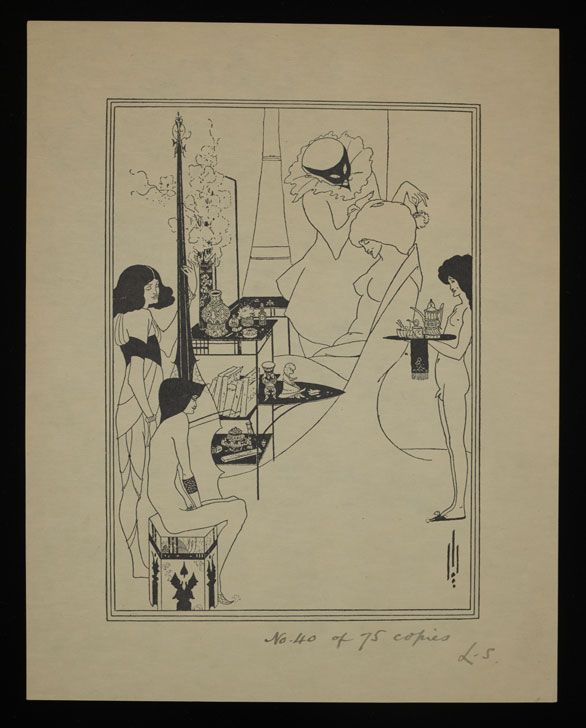
646         VL C      •    VO L. 4 9, N O. 4

                         Figure 1. Aubrey Beardsley, “The Black Cape.” From Oscar Wilde, Salomé (London: Elkin Matthews and
                         John Lane, 1894). Courtesy of Dartmouth College Library.

                         against a white backdrop, a netherworld lacking coordinates in space and
                         time. In “The Black Cape” (fig. 1), Salomé appears incongruously attired
                         in Japanese dress, with swooping black layers imitating a samurai’s armor.
                         A petite Victorian ladies’ hat perches on her large, stylized black hair.
                         The image uses Japanese visual style to render a formalist vision, as
                         Salomé’s dress assembles black blocks in elegant, shapely forms. Linda
                         Gertner Zatlin, in a study of Beardsley’s Japonisme, notes how this

Downloaded from https://www.cambridge.org/core. Vanderbilt University Library, on 22 Dec 2021 at 16:58:31, subject to the Cambridge Core terms of use, available at
https://www.cambridge.org/core/terms. https://doi.org/10.1017/S1060150320000182
O N T H E PO LI T I CS O F DECA DE N T RE BE LL I ON                                  647

                  image combines two stylistic influences borrowed from Japanese prints:
                  shironuki, picking out a linear design in white against a black background;
                  and ishizuri, using blocks of white against a black ground to create an illu-
                  sion of volume and depth.8 Zatlin’s study traces numerous formal mirror-
                  ings between Beardsley’s work and the Japanese print tradition. She
                  narrates a familiar story by which a Western artist embraced a foreign
                  art style to arrive at both formal innovations and rebellious subversions.
                        With its unlikely mixture of cultures and eras, this image raises some
                  pointed questions about Beardsley’s use of Japanese iconography. The
                  startling eruption of Japanese style occurs in what is essentially an illustra-
                  tion to a Christian Bible story. Outfitting Salomé in samurai style,
                  Beardsley draws on Japan’s associations with “the Orient,” connoting
                  all the stereotypical sensuousness and racial exoticism assigned to the
                  East. The image emphasizes the fact that the biblical Salomé was a
                  Middle Eastern princess, rather than an English one. As I’ve discussed
                  elsewhere, nineteenth-century British audiences had thoroughly appro-
                  priated the Christian Bible for Britishness, such that Salomé’s racial over-
                  tone might not have been an immediate signifier.9 But both Wilde’s play
                  and Beardsley’s image bring forward the Bible’s racial otherness. Wilde’s
                  Salomé depicts Herod’s court as a melting pot of empire, as different
                  characters dispute the nature of religion and politics according to their
                  diverse ethnic backgrounds. Characters within the play label each
                  other according to their cultures of birth, including “Romans,” “Jews,”
                  “Syrians,” “Nubians” (African people indigenous to present-day Sudan
                  and southern Egypt), “Nazarenes” (a Jewish sect considered an early
                  form of Christianity), and “Cappadocians” (from a historical region in
                  central Turkey), among others. Wilde’s Salomé implicitly links the
                  Roman Empire under Caesar to the British Empire and its dominions,
                  including Ireland and Africa. In both realms, diverse ethnic traditions
                  are held together under the military might of a strong central ruler.
                  When Beardsley clothes Salomé in Japanese costume, he alludes to the
                  heterogeneous styles and ethnicities brought together under the modern
                  British Empire. Victorian Japan was not directly colonized by Britain, but
                  the British played a large role in the economy and commercial profits of
                  Japan’s newly opened markets. Japan belonged to Britain’s so-called
                  “informal empire,” designated by economic historians to describe the
                  impact of British culture through trading treaties and laissez-faire capital-
                  ism.10 When Beardsley clothes Salomé in Japanese dress, then, he marks
                  her with a foreign otherness that Victorian audiences would have associ-
                  ated with other imperial subordinates. Japan, like India, China, and

Downloaded from https://www.cambridge.org/core. Vanderbilt University Library, on 22 Dec 2021 at 16:58:31, subject to the Cambridge Core terms of use, available at
https://www.cambridge.org/core/terms. https://doi.org/10.1017/S1060150320000182
648 VL C • VO L. 4 9, N O. 4
Egypt, was a source of “Eastern” allure whose commodities became
prized by British collectors and connoisseurs.
Japanese style here offers a motif for maneuvering around cultural
otherness, courting its exoticism, wielding its sensuality, and using its pat-
terns to make human bodies strange. Salomé’s Japonisme is a desirable
exoticism put on like a costume, available for a Western feminine iden-
tity. Her body in “The Black Cape” reflects grotesque distortions. One
prominent hand is insectile and four-fingered; along the dress’s plunging
neckline, she appears to have no breasts, but a marked belly button. Her
legs are impossibly skinny and lengthened within the tight black dress.
The serpentine shape of her body is almost more snakelike than
human. When Salomé becomes a Japanese geisha, the sexuality bestowed
on that exotic figure melds with the notorious allure of the biblical
princess.
Beardsley’s Japonisme reflects a complicated Orientalism, one that
exceeds the basic model described by Edward Said in Orientalism. The
feminized voluptuousness by which Western artists and spectators charac-
terized “the East,” according to Said, certainly manifests in Beardsley’s
images. But for decadent writers and artists, Japan sometimes also con-
noted a more ethereal abstraction. In “The Decay of Lying” (1891),
Wilde’s decadent manifesto, Vivian famously announces that “in fact
the whole of Japan is a pure invention. There is no such country, there
are no such people.” Japanese artists have fabricated scenes, styles, and
figures with no bearing on any actual reality. Vivian takes a “Japanese
effect” to epitomize the formalist antirealism espoused by the essay as a
whole, one that pivots away from the concrete world toward a more quick-
silver, abstracted aesthetic. This antihuman artifice is a kind of “lying,” a
romance of beautiful confabulations, rather than any straightforward
account of real people. When a Japanese effect appears in the opening
of Wilde’s novel A Picture of Dorian Gray (1891), it too performs a dema-
terialized abstraction. Lord Henry Wotton, lounging in an artist’s studio,
watches as birds cast their shadows across a curtained window, “produc-
ing a kind of momentary Japanese effect.” The bird shadows transform
the window into a Japanese screen, making Lord Henry “think of those
pallid, jade-faced painters of Tokyo who, through the medium of an
art that is necessarily immobile, seek to convey the sense of swiftness
and motion.” Here Lord Henry reflects the values Wilde promotes in
his essay, privileging Art and Mind over Nature and its discomfiting
embodiments. In this aspect, Japan connotes what Grace Lavery
describes as “aesthetic judgment in general, and what Kant calls the
Downloaded from https://www.cambridge.org/core. Vanderbilt University Library, on 22 Dec 2021 at 16:58:31, subject to the Cambridge Core terms of use, available at
https://www.cambridge.org/core/terms. https://doi.org/10.1017/S1060150320000182O N T H E PO LI T I CS O F DECA DE N T RE BE LL I ON 649
‘subjective universal’ character of the judgment of taste in particular.” As
Lavery glosses this concept, Japanese style invited “the feeling that every-
body in the world should and would find this object beautiful.”11 Japanese
visual abstraction was taken by Victorian decadents and others to signify a
universalized aesthetic, a disembodied truth of beauty that moved toward
universalism precisely because it left behind the specific, particularizing
details of an actual world.
Yet Japanese style, for Western artists, also always evoked racial differ-
ence, a truth inescapably rooted in the body. Lord Henry thinks of
Japanese artists as “pallid” and “jade-faced,” their racial difference lead-
ing them to create an art defined by its oxymoronic combinations of still-
ness and movement. “Jade-faced” is an especially rich descriptor; while it
typically connoted a pale green color, here it also clearly invokes yellow as
the familiar stereotypical Asian racial marker. That both yellow and green
were signature hues of the aesthetic movement, even blurring together as
“greenery-yallery” in the Gilbert and Sullivan parody, is a slippage under-
lying the Asian racial imagery of “jade-faced.”12 (Jade sculpture, more-
over, was a characteristically Chinese art form rather than a Japanese
one, suggesting that Lord Henry is engaging in a typical Victorian confla-
tion of Asian cultures.) Jade-faced artists become art objects themselves,
stony and semi-precious, their Japanese-ness imbuing them with an aes-
thetic quality that is itself a distinction of race. Lord Henry’s imaginings
also draw upon the familiar Victorian stereotype by which Asian cultures
were “immobile,” static, and circular, while European cultures were pro-
gressive and driving forward in history. Wilde’s imagery employs a com-
mon decadent tactic by invoking racial difference in order to embrace
it, celebrating an exotic other that mainstream culture would disdain
or exclude. (In this case, Lord Henry admires the abstracted beauty of
a Japanese screen, showing off his aesthetic sensibility.) In fact, art for
art’s sake was profoundly compatible with racialized embodiment, since
the aesthetic avant-garde valued beautiful shape, pattern, color, and pig-
ment, inviting the eye to land emphatically upon the body of the art
object, rather than encouraging the mind to see through the object
toward a narrative or moral conclusion. When Beardsley makes Salomé
look Japanese, arranging her body according to the formal distortions
familiar from Japanese prints, he invokes the broader racialized counter-
culture that united both erotic embodiment and ethereal abstraction—as
both of these opposed the Victorian middle-class values of realist style,
three-dimensional space, moral storytelling, Christian ethics, and female
chastity.
Downloaded from https://www.cambridge.org/core. Vanderbilt University Library, on 22 Dec 2021 at 16:58:31, subject to the Cambridge Core terms of use, available at
https://www.cambridge.org/core/terms. https://doi.org/10.1017/S1060150320000182650 VL C • VO L. 4 9, N O. 4
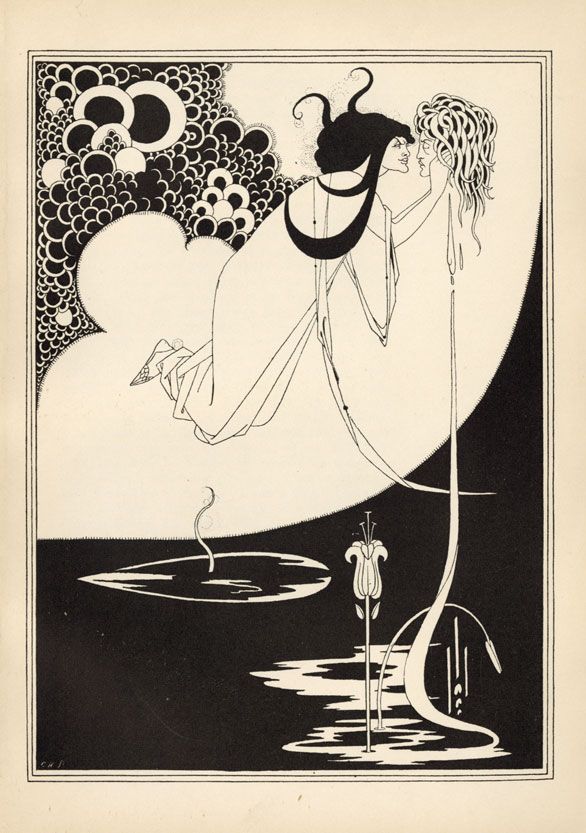
Figure 2. Aubrey Beardsley, “The Climax.” From Oscar Wilde, Salomé (London: Elkin Matthews and John
Lane, 1894). Courtesy of Dartmouth College Library.
Beardsley’s art also particularizes the kind of abstraction that the
Japanese effect entailed. It cultivates qualities of “the exquisite,” a word
that, as Lavery argues, Victorian writers applied to Japanese aesthetics
to describe a link between “tasteful formal arrangement” and “an expe-
rience of some kind of pain.” Japan in the Victorian mind suggested
“an irresistible violence,” says Lavery, but one precise and targeted rather
than vast and bludgeoning.13 The exquisite beauty of Japanese style
Downloaded from https://www.cambridge.org/core. Vanderbilt University Library, on 22 Dec 2021 at 16:58:31, subject to the Cambridge Core terms of use, available at
https://www.cambridge.org/core/terms. https://doi.org/10.1017/S1060150320000182O N T H E PO LI T I CS O F DECA DE N T RE BE LL I ON 651
connoted a sadomasochistic eroticism, a brutality channeled into formal
constraints, bindings, and bondage. Lavery’s study does not focus on dec-
adence per se, but her term seems especially evocative for the decadent
arts of the 1890s, with their outré experiments in gender and pain.
Beardsley’s illustrations for Wilde’s Salomé capture exactly this kind of
combination of formal exactitude with power-inflected violence. The
drawings are precise, linear, patterned, detailed, and perfectly con-
trolled; they echo the violent yet stylized thematics of Wilde’s play, in
which men and women are forced to perform for the pleasures of a
tyrannical king. When, in Beardsley’s image of “The Climax” (fig. 2),
the monstrous Salomé floats in space while holding the decapitated
head of John the Baptist—her lips adjacent to his—the odd bubbles imi-
tate marine-themed Japanese prints, while the flower growing out of John
the Baptist’s spilled blood imitates a Japanese flower.14 The picture
shocks with its erotic glorying in decapitation, but it also distances itself
from that obscene violence, rendering messy bodily disfigurement in
neat swathes of light and shadow. Blood becomes ink, as the drops
from the Baptist’s head solidify into a sinuous, pleasing pattern. The
image is actually a tasteful, neatly organized scene of a ghastly woman
holding a decapitated head. All the violence of the scene, and the
power wielded by the monstrous woman, is concentrated into a matter
of forceful lines, shapes, and blocks, some of them completely abstract.
The image’s controlling formalism reflects an aesthetic of the Japanese
exquisite, the binding of power into line and pattern. Beardsley’s
Japonisme, then, united formal experimentation with some of the exoti-
cized, stereotypical associations of Japaneseness, harnessed toward the
expression of an erotic counterculture both embodied and abstract.
2. ROCOCO
The other distinctive visual influence in Beardsley’s imagery was that of
the French eighteenth century. While Japonisme inspired stripped-down,
minimalist forms and blocks of dark and light, eighteenth-century influ-
ences wrought a more extreme ornamentalism, with detailed patterns
and encrusted spaces. Beardsley’s illustrations for Alexander Pope’s The
Rape of the Lock (1896) epitomize this influence, though it can also be
traced across a range of his later works, including his illustrations to
Ernest Dowson’s Pierrot of the Minute (1897) and his pornographic illustra-
tions to Aristophanes’ Lysistrata (1896). The visual influence of Japan
seems very different from that of a style adopted from a previous
Downloaded from https://www.cambridge.org/core. Vanderbilt University Library, on 22 Dec 2021 at 16:58:31, subject to the Cambridge Core terms of use, available at
https://www.cambridge.org/core/terms. https://doi.org/10.1017/S1060150320000182652 VL C • VO L. 4 9, N O. 4
European century. Yet I want to explore some ideological connections
between these two very different cultures and times, as they were appro-
priated by Beardsley’s decadent works. Both styles featured within
late-Victorian interior design, as collectors sought both Japanese wares
and eighteenth-century objets. As Linda Dowling notes, both styles shared
“a concern with asymmetrical compositions and elongated proportions,
with the ornamentation of flat surfaces, and with the treatment of a
room—architecture, furnishings, and decoration—as a unified aesthetic
whole.”15 Like Japonisme, eighteenth-century style also enabled formal
visual experimentation, pushing against the realist three-dimensional
modeling typical of Victorian visual culture.
Visual experiment also accompanied a distinct counterculture phi-
losophy. While “high” Victorianism aspired to seriousness and authentic-
ity, with realist figures engaging in weighty psychological dramas, the
eighteenth century offered a lighter gaiety. It was “the age of mask and
pose, superficiality and mere surface,” as Dowling summarizes.16 Light,
but not lightweight: eighteenth-century culture modeled a theory of
self-as-surface that would be taken up by many decadent writers and art-
ists, a theory that some scholars have seen to anticipate postmodernist
accounts of subjectivity. Wilde’s “Truth of Masks” (1886) sums up a dec-
adent antihumanism that eighteenth-century style helped to channel,
proposing notions of the self as performative, theatrical, and artificial.
A major figure in the late-Victorian revival of the eighteenth century
was the French painter Antoine Watteau (1684–1721). The artist was the
subject of an “imaginary portrait” by Walter Pater, “A Prince of Court
Painters” (1885).17 Arthur Symons and Michael Field wrote poems
about Watteau paintings. Beardsley celebrated the Watteau vogue in an
1895 letter: “The cult for him is so entirely modern.”18 They were all
inspired by the Goncourt brothers, whose writings in French XVIII
Century Painters (1859–75) turned a decadent eye on the previous cen-
tury. The Goncourts wrote of the sensuality of Watteau:
All the fascination of women in repose: the languor, the idleness, the aban-
donment, the mutual leanings on one another, the outstretched limbs, the
indolence, the harmony of attitudes, the delightful air of some gamme
d’amour, the breasts’ receding, elusive contours, the meanderings, the undu-
lations, the pliancies of a woman’s body; the play of slender fingers upon the
handle of a fan, the indiscretion of high heels peeping below the skirt, the
chance felicities of demeanour, the coquetry of gesture, the manoeuvering
of shoulders, and all that erudition, that mime of grace, which the women
of the preceding century acquired from their mirrors; all this, with its pecu-
liar intensity of tone, its special lustre, lives on in Watteau.19
Downloaded from https://www.cambridge.org/core. Vanderbilt University Library, on 22 Dec 2021 at 16:58:31, subject to the Cambridge Core terms of use, available at
https://www.cambridge.org/core/terms. https://doi.org/10.1017/S1060150320000182O N T H E PO LI T I CS O F DECA DE N T RE BE LL I ON 653
This description echoes Edmund Burke’s aesthetic category of “the
beautiful”—feminized, curved, petite, voluptuous—as opposed to the
seemingly more masculine, overawing concept of the sublime.
Watteau’s style merges into the qualities of his painted seductive
women, an eroticism that is performative and “acquired from mirrors.”
Watteau, like Japonisme, offered another route toward eroticism, taking
the female body as the symbol of embodiment itself. But this embodi-
ment also occurs via a play of façades, a mode of feminine indirection
and swerves implying larger philosophical values based in game-playing
and the self as a surface.
The Goncourts were French writers looking back on a native French
tradition, but the cult of Watteau gained additional significance in
England, where it took on the loaded connotations of Frenchness.
Indeed, it is significant that the decadents looked specifically to
eighteenth-century France rather than to England. The English eigh-
teenth century might have signaled what Dowling humorously labels
“roast beef, brown ale, and genial Henry Fielding”—in other words, a
comic middle-class aesthetic.20 France, by contrast, signaled an exotic for-
eignness in its Catholicism, its licentiousness, and its loose morals. Most
importantly (and not discussed by Dowling), it was the site of a
pre-Revolutionary aristocratic culture, a deeply unequal world of wealthy
gentility alongside peasants or servants. The era’s visual arts focused
especially on aristocratic games of etiquette and flirtation. Watteau was
famous for his depictions of fêtes galantes, aristocratic parties in the coun-
tryside, where French courtiers dressed up as rustic commedia dell’arte
characters to perform scenes of playful seduction. The frothy curves of
rococo style relayed scenes of playful revelries, the elegant leisured pur-
suits of an aristocratic elite.21 In Watteau’s painting Embarkation for Cythera
(1717), a parade of figures in lavish costumes—some of them commedia
dell’arte—make their way toward a ship wreathed with winged putti.
Men and women exchange glances and caresses; they process toward
“Cythera,” already a famously sexualized utopian garden, described in
the Hypnerotomachia Poliphili (1499) as a topiary labyrinth and fountain
of Venus evocative of a woman’s body. The gardens of Cythera invited
“pilgrimages of love” from carousing aristocrats.22 For late-Victorian dec-
adent writers, Watteau’s countryside parties connoted a frank eroticism
and overt sexuality that was forbidden by middle-class taboos in the
later moment.
These associations inform Beardsley’s illustrations to The Rape of the
Lock. Pope’s satirical poem renders the battle of the (elite) sexes as a
Downloaded from https://www.cambridge.org/core. Vanderbilt University Library, on 22 Dec 2021 at 16:58:31, subject to the Cambridge Core terms of use, available at
https://www.cambridge.org/core/terms. https://doi.org/10.1017/S1060150320000182654 VL C • VO L. 4 9, N O. 4
Figure 3. Aubrey Beardsley, “The Rape of the Lock.” From Alexander Pope, The Rape of the Lock (London:
L. Smithers, 1896). Courtesy of Dartmouth College Library.
mock epic, serving as the perfect vehicle for a rococo visual style. While
Pope’s poem is English, rather than French, its admiring and voyeuristic
view into aristocratic lifestyles makes it an ideal subject for Beardsley’s
rococo illustrations. His depiction of the climactic scene of the “rape”
(fig. 3) presents a surfeit of décor, swirling patterns on costumes and cur-
tains that overwhelm the eye and obscure the narrative action. In fact, the
Downloaded from https://www.cambridge.org/core. Vanderbilt University Library, on 22 Dec 2021 at 16:58:31, subject to the Cambridge Core terms of use, available at
https://www.cambridge.org/core/terms. https://doi.org/10.1017/S1060150320000182O N T H E PO LI T I CS O F DECA DE N T RE BE LL I ON 655
Baron’s scissors are poised over the unwitting hair of the victim, Belinda,
but these are sidelined to the image’s very far edge. We see Belinda’s hair
and exposed back; her face is abruptly cut off. The omission of Belinda’s
face implies that her deep personhood is not important to the metaphys-
ics of the image. What matters is the gorgeous spectacle of figures luxu-
riously costumed, maneuvering like peacocks within the space of the
frame. Men and women alike sport poufed coats and dresses covered
with patterns. The predatory baron, scissors aloft, wears a costume
equally elaborate to those of the women, with his shapely bared leg
and high heeled shoe. Like Pope’s satire, the image gains force with its
visual jokes: the women’s ornate hair is mirrored by the men’s luxuriant
wigs, which in turn echo the manicured trees through the window.
Victorian gender norms emphasized a biological divide between men
and women, but Beardsley undermines essentialist gender distinctions
by costuming male and female characters identically. The baron is
swathed in ruffles, his frilly pants evoking a woman’s petticoat. Art tri-
umphs over nature, and even the trees outside participate in the artful
game. (The mirroring of humans and gardens also hearkens back to
the Goncourts’ Watteau, whose female figures epitomized an erotic arti-
fice embedded into a sinuous landscape.) In another joke, human cos-
tumes match the inanimate décor, as patterns writhe across curtains,
screens, and table legs. Human interactions and manners become a mat-
ter of winding surfaces, games wrought on the façade. The swanning
figures exhibit a patent eroticism, especially in their corseted voluptuous-
ness. And at the image’s center, a grotesque dwarf, also fabulously attired,
sips what appears to be a cup of tea. This figure situates us solidly within
the terrain of decadence, showing us the artist’s knowing eye. We are dis-
tanced from the scene: the illustration does not yearn for an old aristocracy
so much as it uses the style to invoke manners that are themselves gro-
tesque and discomfiting.
Eighteenth-century style enables Beardsley to pursue both taboo
embodiments and ethereal abstractions: figures flirt and coquette,
while intense patterning evokes a mode of life lived entirely through sur-
faces. Both of these transgressive modes are signaled by visual grotesque-
rie, a recurring motif throughout all of Beardsley’s work. In his
illustration to “The Cave of Spleen” from The Rape of the Lock (fig. 4),
Beardsley’s image literalizes the fantasia of Pope’s verses, blurring
together human bodies, animals, wings, plumage, tails, headdresses,
ornamented objects, and swirling costumes. Pope writes of “Bodies
chang’d to various forms by Spleen,” including “living teapots” and
Downloaded from https://www.cambridge.org/core. Vanderbilt University Library, on 22 Dec 2021 at 16:58:31, subject to the Cambridge Core terms of use, available at
https://www.cambridge.org/core/terms. https://doi.org/10.1017/S1060150320000182656 VL C • VO L. 4 9, N O. 4
Figure 4. Aubrey Beardsley, “The Cave of Spleen.” From Alexander Pope, The Rape of the Lock (London:
L. Smithers, 1896). Courtesy of Dartmouth College Library.
talking jars; “Men prove with Child, as pow’rful Fancy works, / And Maids
turn’d Bottels, call aloud for Corks.” The bodies of Beardsley’s figures are
likewise distended and grotesque, insinuating strange pregnancies and
weird mixtures of human flesh and ceramic vessels. The grotesque was
a venerable Victorian style with weighty resonances; for John Ruskin, it
signified a profound authenticity, linking ugliness to truth. Grotesque
Downloaded from https://www.cambridge.org/core. Vanderbilt University Library, on 22 Dec 2021 at 16:58:31, subject to the Cambridge Core terms of use, available at
https://www.cambridge.org/core/terms. https://doi.org/10.1017/S1060150320000182O N T H E PO LI T I CS O F DECA DE N T RE BE LL I ON 657
medieval ornaments bespoke a sublime individualism, modeling an aes-
thetics that was rugged and deep. Beardsley’s grotesque, by contrast,
emerges by way of Watteau and the Goncourts. It is feminized and per-
verse, based in curves, surfaces, and linearity; it bespeaks brittleness
rather than depth, featuring monsters of gender and culture, fetuses
and gnomes.
Both Japonisme and rococo style provided means of stylization and
detachment. The grotesque figure at the center of Beardsley’s
eighteenth-century scene offers a commentary on the realm it occupies,
separating the artistic intelligence from the values of the old aristocratic
world. Yet aristocracy itself, an idea of stark class difference, was crucial to
decadent aesthetics, whose works often featured male gentlemen sur-
rounded by luxury. These fantasies were usually created by middle-class
male artists, highlighting their phantasmatic and symbolic aspects. The
smirking grotesque in the midst of plumed gentry does not undermine
the fact of gentry so much as propose a new aristocracy, one that will
appreciate erotic jokes and visual games without applying the codes of
Victorian morality.
Beardsley’s own background was middle-class—his father worked as
a jeweler and clerk, while his family often battled poverty—lending a cer-
tain wistful gleam to the luxurious scenes of The Rape of the Lock.23
Pre-Revolutionary French culture offers a way to meditate on style and
stylization itself, as class becomes not a matter of birth or blood but a the-
atrical performance or masquerade. In Beardsley’s decadent visual cul-
ture, the extreme ornamentalism of minute patterning foregrounds
the hand and the handmade, itself a pre-industrial referent; but these
images are produced using photomechanical processes of reproduction,
remaking a faux-aristocratic aesthetic for the modern world of circulating
media.
3. TWO TOILETTES
Both Japanese nineteenth-century styles and French eighteenth-century
styles enabled Beardsley to produce a visual counterculture, arriving at
forms of embodiment and abstraction based in modes of difference
and hierarchy. At a basic level, Beardsley’s illustrations for Salomé seem
strikingly different from those for The Rape of the Lock, as Salomé ’s
Japanese-inflected biblical horror seems a far cry from The Rape of the
Lock’s satirical gender games. Yet the two are surprisingly connected
via Beardsley’s imagery. As James A. Heffernan argues, the illustrations
Downloaded from https://www.cambridge.org/core. Vanderbilt University Library, on 22 Dec 2021 at 16:58:31, subject to the Cambridge Core terms of use, available at
https://www.cambridge.org/core/terms. https://doi.org/10.1017/S1060150320000182658 VL C • VO L. 4 9, N O. 4
reveal certain shared thematics between Salomé and The Rape of the Lock:
“[B]oth works incongruously mingle the social and domestic rituals of
civilized life—applying makeup, formal dining, dancing, card-playing,
tea-drinking, gossiping, flirting—with acts of brutal barbarity: rape and
decapitation.”24 Heffernan does not study the contrasting visual styles
of the illustrations, nor their Japanese or French influences, but these
elements help to elucidate his keen insight. Beardsley’s style-mixing
across time periods and geographies is subversive: at a moment when
many Victorian artists were striving for realism, using historical research
to inform authentic costumes and settings, Beardsley dresses his biblical
figures as Japanese geishas and eighteenth-century aristocrats in the same
work. In particular, Beardsley made two different versions of “The
Toilette of Salomé,” portraying the heroine seated before a mirror
while an attendant in a Pierrot costume applies cosmetics with a powder
brush. This scene does not occur in Wilde’s play. It is pure invention on
Beardsley’s part. (The original version of the scene appeared to include
masturbating figures and was censored by the publisher [fig. 5];
Beardsley replaced it with a second version that was published in
Salomé [fig. 6].) In both versions, the toilette scene shows how an
eighteenth-century trope became a useful vehicle for decadent aesthet-
ics: as the Goncourts described the beauty of Watteau’s female figures,
defined by artifice, game-playing, coquetry, and skills “acquired from mir-
rors,” so too the decadent woman was often portrayed seated in front of a
mirror, applying cosmetics and glorying in her own beauty. The makeup
artificially enhanced her allure so that she could more effectively ensnare
men.
An illustration for The Rape of the Lock likewise portrays Belinda
seated at her toilette, while a female servant fixes her hair (fig. 7). The
visual style of this image, with its eighteenth-century patterning, seems
very different from the more Japanese-inflected minimalism of the
Salomé scene. Yet it is striking that both works portray a heroine seated
at her toilette in a boudoir-type chamber. In The Rape of the Lock, the
image emphasizes the cleavage of both mistress and maid while elaborat-
ing the voluminous décor of their dresses. The maid’s dress even appears
to be decorated with a ruffled vagina, a visual joke naming the frank erot-
icism of the woman-in-the-boudoir motif. Meanwhile, the feminized ruf-
fles and flounces are visually pierced by the long, vertical candles on the
dressing-table, and a pair of scissors sits ominously beside them, foreshad-
owing the “rape” to come. In the published Salomé toilette scene (fig. 6),
a pair of scissors also appear on a dressing table, though in this case they
Downloaded from https://www.cambridge.org/core. Vanderbilt University Library, on 22 Dec 2021 at 16:58:31, subject to the Cambridge Core terms of use, available at
https://www.cambridge.org/core/terms. https://doi.org/10.1017/S1060150320000182O N T H E PO LI T I CS O F DECA DE N T RE BE LL I ON 659
Figure 5. Aubrey Beardsley, “The Toilette of Salomé.” First version. Broadside, 23 x 18 cm., 1894.
Courtesy of the Rare Book Division, Special Collections, Princeton University Library.
hint at the more ominous and gruesome violence that will unfold at the
play’s end. Books on Salomé’s bookshelf mention Zola’s Nana, the
Marquis de Sade, and “Les Fêtes Galantes”—tracing a lineage of outré
French sexuality from the eighteenth into the nineteenth centuries.
Both Salomé and Belinda are players in a power game, mock-epic in
Pope and slant biblical epic in Wilde. In the original Bible story, princess
Salomé is merely an obedient daughter to her mother; in Wilde’s play,
though, she becomes her own perverse agent working against Herod’s
dominant power, using her sexuality as her only available weapon.
Beardsley’s images amplify these moments of female agency, showing a
female figure preparing to dominate over a man by amplifying her
Downloaded from https://www.cambridge.org/core. Vanderbilt University Library, on 22 Dec 2021 at 16:58:31, subject to the Cambridge Core terms of use, available at
https://www.cambridge.org/core/terms. https://doi.org/10.1017/S1060150320000182660 VL C • VO L. 4 9, N O. 4
Figure 6. Aubrey Beardsley, “The Toilette of Salomé.” From Oscar Wilde, Salomé, 1894. Courtesy of
Dartmouth College Library.
sexuality, or even taking pleasure in her own appearance without any
need for a male spectator. The woman supervising her own makeup or
hair-styling is an agent of self-creation: she becomes her own work of art.
Not coincidentally, both of these “toilette” scenes portray the female
protagonist assisted by servants. The aristocratic Belinda is attended to by
her maid, while the princess Salomé is attended by a smirking Pierrot
with a powder brush. In the earliest version of Salomé’s toilette
Downloaded from https://www.cambridge.org/core. Vanderbilt University Library, on 22 Dec 2021 at 16:58:31, subject to the Cambridge Core terms of use, available at
https://www.cambridge.org/core/terms. https://doi.org/10.1017/S1060150320000182O N T H E PO LI T I CS O F DECA DE N T RE BE LL I ON 661
Figure 7. Aubrey Beardsley, “The Toilet.” From Alexander Pope, The Rape of the Lock (London:
L. Smithers, 1896). Courtesy of Dartmouth College Library.
(fig. 5), she’s surrounded by a group of servants, two of them nude, one
standing ready with a tea tray. These details point to some of the tricky
political connotations underlying Beardsley’s imagery. On one hand,
Salomé in particular centers on a disempowered princess who attempts
to seize control over both a tyrannical king and a male religious zealot.
The play’s final grotesque imagery, in which Salomé holds aloft John
Downloaded from https://www.cambridge.org/core. Vanderbilt University Library, on 22 Dec 2021 at 16:58:31, subject to the Cambridge Core terms of use, available at
https://www.cambridge.org/core/terms. https://doi.org/10.1017/S1060150320000182662 VL C • VO L. 4 9, N O. 4
the Baptist’s decapitated head, evokes the French Revolution and its
bloody reckoning against kings and aristocrats.25 Yet Salomé cannot be
unambiguously aligned with the leveling forces of revolution. Beardsley’s
inserted toilette scenes, with their referents to eighteenth-century France,
still draw upon a titillating aesthetics of the aristocratic woman and her
subversive, sexualized idleness. In fact, with the respective toilette scenes
in both Salomé and The Rape of the Lock, Beardsley links the realms of both
artworks via a kind of dream logic. Wilde’s biblical world, ruled over by
King Herod, is luxuriously materialistic, erotic, and deeply hierarchical
and brutal. These are qualities that Victorians also associated with the
eighteenth century before its revolutions, a world occupied by aristocrats
and servants (or slaves). Japan, too, summoned associations of the char-
acter of the “Oriental despot,” connoting feudal stagnation despite its
modernizations during the Meiji period. Ultimately, Beardsley doesn’t
seem especially interested in political critique. His Salomé is surrounded
by fawning attendants and servants. (Wilde’s play, too, highlights an erot-
ics of enslavement, with Herod’s court populated by peoples he has
enslaved, and some characters pronouncing themselves “slaves” for
love.) Like many decadent artists, Beardsley enjoys the elite exclusivity
conjured by luxurious worlds of masters and slaves while exploiting the
implicitly violent power dynamics underlying forms of bondage and
servitude.
This discussion has examined Beardsley’s illustrations for Salomé and
The Rape of the Lock in order to limn the complicated politics of otherness
wielded by decadent visuality. The images transgress Victorian moral
codes, especially those surrounding gender and sexuality. But they also
draw on familiar, stereotypical tropes of race and class in order to
make their transgressions. Decadent visual and verbal rhetorics of
Japaneseness or pre-Revolutionary Frenchness depict perverse power
dynamics, gaining pleasure from forms of difference, hierarchy, and
abject otherness. Scholars have long noted that both Japanese and
French styles enabled late-Victorian modes of visual experiment, tending
toward antirealism, flatness, and abstraction. But my analysis has also
brought other connections to the fore. Both styles served as avenues
toward forms of antihumanism, in the flattening of bodies and persons,
enabling distortions, masks, and grotesque transformations of the
human. Both styles highlighted forms of distinction, portraying aristocra-
cies, empires, hierarchies, domination, and an antidemocratic ethos of
grandeur and violence. And both styles were channels for a perverse sex-
uality, whether the games of flirtation and seduction in Watteau, or the
Downloaded from https://www.cambridge.org/core. Vanderbilt University Library, on 22 Dec 2021 at 16:58:31, subject to the Cambridge Core terms of use, available at
https://www.cambridge.org/core/terms. https://doi.org/10.1017/S1060150320000182O N T H E PO LI T I CS O F DECA DE N T RE BE LL I ON 663
geishas of Japanese prints, producing distorted bodies and strange gen-
derings. Paradoxically, this stylized imagery worked via both embodiment
and abstraction, drawing especially on the embodied racialized body to
convey an art-for-art’s-sake aesthetic. My account ultimately provokes a
reconsideration of how a counterculture actually works, as it uses familiar
modes of belief to make its radical challenges.
NOTES
1. Many scholars, too numerous to cite here, have debated the gender
politics of Beardsley’s imagery, especially in his illustrations to
Wilde’s Salomé. Two representative examples are Bernheimer,
Decadent Subjects, which applies a Freudian lens to Beardsley’s imag-
ery; and Zatlin, Aubrey Beardsley and Victorian Sexual Politics, which
argues that Beardsley’s images supported a feminist agenda.
2. See, among others, Kooistra, The Artist as Critic; and Boyd, “Staging
the Page.”
3. Symons, “Decadent Movement,” 859.
4. See especially Spackman, “Interversions,” 35–49; and Riffaterre,
“Decadent Paradoxes,” 65–82.
5. For a recent account, see Potolsky, The Decadent Republic of Letters.
6. Symons, “Decadent Movement,” 860.
7. See, among others, Ono, Japonisme in Britain; Irvine, Japonisme; and
Burnham, Looking East.
8. Zatlin, Beardsley, 106–11.
9. See Teukolsky, “Orients of the Self,” 143–214.
10. See Gallagher and Robinson, “The Imperialism of Free Trade.”
11. Lavery, Quaint, Exquisite, x.
12. The phrase “greenery-yallery” appears in the famous Gilbert and
Sullivan operetta Patience. The aesthete character, Bunthorne,
declares himself “A greenery-yallery, Grosvenor Gallery,
Foot-in-the-grave young man!” The conflation of aesthetic yellow
and green also occurs in Oscar Wilde’s poem “A Symphony in
Yellow.” The poem’s lines all delineate yellow objects, until the
final two lines: “And at my feet the pale green Thames / Lies like
a rod of rippled jade.”
13. Lavery, Quaint, Exquisite, 5.
14. In Beardsley, Japonisme, Zatlin reproduces numerous examples of
Japanese prints featuring abstracted flower-forms. Two of the most
Downloaded from https://www.cambridge.org/core. Vanderbilt University Library, on 22 Dec 2021 at 16:58:31, subject to the Cambridge Core terms of use, available at
https://www.cambridge.org/core/terms. https://doi.org/10.1017/S1060150320000182664 VL C • VO L. 4 9, N O. 4
famous nineteenth-century Japanese printmakers, Hokusai and
Hiroshige, both painted water using formalist effects; they often styl-
ized water in swirling, circular, or rounded forms.
15. Dowling, “The Aesthetes,” 364.
16. Dowling, “The Aesthetes,” 359. Studying artists like Beardsley, Wilde,
and W. B. Yeats, Dowling concludes that the late-century returns to
the eighteenth century were largely ineffectual failures. “Centered
in an unconscious ideology created out of a rejection of ideology,
[this revivalism] largely dissipated its energies in prettiness and
mere fashion” (360). The eighteenth century ultimately offered
“for each late-Victorian revivalist an essentially private meditation
upon a personally experienced past” (377). By contrast, my analysis
reads the eighteenth-century revival as operating politically, beyond
the choices of individual artists, and of greater significance than
“mere fashion.”
17. For a useful discussion of the late-Victorian Watteau revival, see
Andrews, “The Figure of Watteau.”
18. The letter is reproduced in Maas, Duncan, and Good, The Letters of
Aubrey Beardsley, 89.
19. Goncourt, French XVIII Century Painters, 1–2. This passage is also
quoted in Dowling, “The Aesthetes,” 368.
20. Dowling does not delve into the aristocratic class associations of the
French aesthetic, simply noting that it allowed late-Victorian artists to
disdain what she calls “vulgarity” (369).
21. Thomas E. Crow argues that the commedia dell’arte dress-up in
Watteau’s paintings represented a subtle rebellion on the part of aris-
tocrats against an absolutist French state. Opposing the court’s values
of universalism, classicism, and nationalism, aristocratic nobility
turned to “a resistance . . . displaced into style, leisure, and intimate
forms of art” (“Fêtes Galantes” 70).
22. Ennis explicates the erotic symbolism of Cythera in “From Gardens
to Grub Street.”
23. Stetz and Lasner suggest that Beardsley’s illustrations of eighteenth-
century aristocratic culture reflect his own middle-class cravings for
wealth and class, especially following his financial difficulty in the
wake of the disastrous Wilde trial (“Aubrey Beardsley in the 1990s,”
301).
24. Heffernan, “Love, Death, and Grotesquerie,” 211.
25. Heffernan, “Love, Death, and Grotesquerie,” 207.
Downloaded from https://www.cambridge.org/core. Vanderbilt University Library, on 22 Dec 2021 at 16:58:31, subject to the Cambridge Core terms of use, available at
https://www.cambridge.org/core/terms. https://doi.org/10.1017/S1060150320000182O N T H E PO LI T I CS O F DECA DE N T RE BE LL I ON 665
WORKS CITED
Andrews, Kit. “The Figure of Watteau in Walter Pater’s ‘Prince of Court Painters’
and Michael Field’s Sight and Song.” ELT 53, no. 4 (2010): 451–84.
Bernheimer, Charles. Decadent Subjects: The Idea of Decadence in Art, Literature,
Philosophy, and Culture of the Fin de Siècle in Europe. Baltimore: Johns Hopkins
University Press, 2002.
Boyd, Jason. “Staging the Page: Visibility and Invisibility in Oscar Wilde’s Salomé.”
Nineteenth Century Theatre and Film 35, no. 1 (2008): 17–47.
Burnham, Helen. Looking East: Western Artists and the Allure of Japan. Boston: Museum
of Fine Arts, Boston, 2014.
Constable, Liz, Dennis Denisoff, and Matthew Potolsky. “Introduction.” In Perennial
Decay: On the Aesthetics and Politics of Decadence. Edited by Liz Constable,
Dennis Denisoff, and Matthew Potolsky, 1–32. Philadelphia: University of
Pennsylvania Press, 1999.
Crow, Thomas E. “Fêtes Galantes and Fêtes Publiques.” In Painters and Public Life in
Eighteenth-Century Paris, 45–74. New Haven: Yale University Press, 1985.
Dollimore, Jonathan. Sexual Dissidence: Augustine to Wilde, Freud to Foucault. Oxford:
Oxford University Press, 1991.
Dowling, Linda C. “The Aesthetes and the Eighteenth Century.” Victorian Studies 20,
no. 4 (1977): 357–77.
Ennis, Mary Louise. “From Gardens to Grub Street: Cythera after Watteau.”
Dalhousie French Studies 29 (1994): 143–58.
Gallagher, John, and Ronald Robinson. “The Imperialism of Free Trade.” Economic
History Review n.s. 6, no. 1 (1953): 1–15.
Goncourt, Edmond de and Jules de. French XVIII Century Painters. Translated by
Robin Ironside. London: Phaidon Press, 1948.
Heffernan, James A. “Love, Death, and Grotesquerie: Beardsley’s Illustrations in
Wilde and Pope.” In Book Illustrated: Text, Image, and Culture, 1770–1930, edited
by Catherine J. Golden, 195–240. New Castle: Oak Knoll, 2000.
Irvine, Gregory. Japonisme and the Rise of the Modern Art Movement: The Arts of the Meiji
Period. New York: Thames & Hudson, 2013.
Kooistra, Lorraine Janzen. The Artist as Critic: Bi-Textuality in Fin-de-Siècle Illustrated
Books. Aldershot: Scolar, 1995.
Lavery, Grace. Quaint, Exquisite: Victorian Aesthetics and the Idea of Japan. Princeton:
Princeton University Press, 2019.
Maas, Henry, John Duncan, and W. G. Good, eds. The Letters of Aubrey Beardsley.
Rutherford: Fairleigh Dickinson University Press, 1970.
Ono, Ayako. Japonisme in Britain: Whistler, Menpes, Henry, Hornel, and
Nineteenth-Century Japan. London: Routledge Curzon, 2003.
Pope, Alexander. The Rape of the Lock. Illustrations by Aubrey Beardsley. London: L.
Smithers, 1896.
Potolsky, Matthew. The Decadent Republic of Letters: Taste, Politics, and Cosmopolitan
Community from Baudelaire to Beardsley. Philadelphia: University of Pennsylvania
Press, 2012.
Downloaded from https://www.cambridge.org/core. Vanderbilt University Library, on 22 Dec 2021 at 16:58:31, subject to the Cambridge Core terms of use, available at
https://www.cambridge.org/core/terms. https://doi.org/10.1017/S1060150320000182666 VL C • VO L. 4 9, N O. 4
Riffaterre, Michael. “Decadent Paradoxes.” In Constable, Denisoff, and Potolsky,
Perennial Decay, 65–82.
Said, Edward. Orientalism. New York: Pantheon, 1978.
Spackman, Barbara. “Interversions.” In Constable, Denisoff, and Potolsky, Perennial
Decay, 35–49.
Stetz, Margaret, and Mark Samuels Lasner. “Aubrey Beardsley in the 1990s.”
Victorian Studies 42, no. 2 (1999): 289–302.
Symons, Arthur. “The Decadent Movement in Literature.” Harper’s New Monthly
Magazine 87 (Nov. 1893): 858–67.
Teukolsky, Rachel. “Orients of the Self: Bible Illustration and the Victorian World
Picture.” In Picture World: Image, Aesthetics, and Victorian New Media, 143–214.
Oxford: Oxford University Press, 2020.
Wilde, Oscar. “The Decay of Lying.” In Intentions (1891). Project Gutenberg, www.
gutenberg.org/files/887/887-h/887-h.htm (accessed August 30, 2021).
———. The Picture of Dorian Gray (1891). Project Gutenberg, www.gutenberg.org/
files/174/174-h/174-h.htm (accessed August 30, 2021).
———. Salomé: A Tragedy in One Act. Illustrations by Aubrey Beardsley. London: Elkin
Matthews and John Lane, 1894.
———. “A Symphony in Yellow.” In Charmides and Other Poems (1913). Project
Gutenberg, www.gutenberg.org/files/1031/1031-h/1031-h.htm (accessed
August 30, 2021).
Zatlin, Linda Gertner. Aubrey Beardsley: A Catalogue Raisonné. 2 vols. New Haven: Yale
University Press, 2016.
———. Aubrey Beardsley and Victorian Sexual Politics. Oxford: Clarendon, 1990.
———. Beardsley, Japonisme, and the Perversion of the Victorian Ideal. Cambridge:
Cambridge University Press, 1997.
Downloaded from https://www.cambridge.org/core. Vanderbilt University Library, on 22 Dec 2021 at 16:58:31, subject to the Cambridge Core terms of use, available at
https://www.cambridge.org/core/terms. https://doi.org/10.1017/S1060150320000182You can also read


