The Sandby Borg Massacre: Interpersonal Violence and the Demography of the Dead - Cambridge University Press
←
→
Page content transcription
If your browser does not render page correctly, please read the page content below
European Journal of Archaeology 22 (2) 2019, 210–231
              This is an Open Access article, distributed under the terms of the Creative Commons Attribution-
              NonCommercial-ShareAlike licence (http://creativecommons.org/licenses/by-nc-sa/4.0/), which permits
              non-commercial re-use, distribution, and reproduction in any medium, provided the same Creative
              Commons licence is included and the original work is properly cited. The written permission of Cambridge
              University Press must be obtained for commercial re-use.

              The Sandby Borg Massacre: Interpersonal
              Violence and the Demography of the Dead

              CLARA ALFSDOTTER1                     AND     ANNA KJELLSTRÖM2
              1
                  School of Cultural Studies, Linnaeus University, Kalmar, Sweden
              2
                  Department of Archaeology and Classical Studies, University of Stockholm, Sweden

              During excavations of the Iron Age ringfort of Sandby borg (AD 400–550), the remains of twenty-six
              unburied bodies were encountered inside and outside the buildings. The skeletons and the archaeological
              record indicate that after the individuals had died the ringfort was deserted. An osteological investigation
              and trauma analysis were conducted according to standard anthropological protocols. The osteological
              analysis identified only men, but individuals of all ages were represented. Eight individuals (31 per cent)
              showed evidence of perimortem trauma that was sharp, blunt, and penetrating, consistent with interper-
              sonal violence. The location of the bodies and the trauma pattern appear to indicate a massacre rather than
              a battle. The ‘efficient trauma’ distribution (i.e. minimal but effective violence), the fact that the bodies
              were not manipulated, combined with the archaeological context, suggest that the perpetrators were
              numerous and that the assault was carried out effectively. The contemporary sociopolitical situation was
              seemingly turbulent and the suggested motive behind the massacre was to gain power and control.

              Keywords: violence, trauma, Migration period, Sandby borg, Iron Age, unburied

                                  INTRODUCTION                                   mainland in the Baltic Sea. The remains of
                                                                                 fifteen Iron Age ringforts (i.e. fortified vil-
              The timespan between AD 400 and 550,                               lages) are still visible on Öland. These ring-
              the so-called Migration period when the                            forts might be the result of a general
              Roman empire was declining, is considered                          change in settlement, as many settlements
              a period of social instability and political                       were abandoned during the Migration
              turmoil in Europe. The regions north of                            period (Stenberger, 1933; Näsman, 1988).
              the Rhine and Danube were populated by                             Initial studies have shown that a massacre
              various tribes, the tribes of Scandinavia                          was carried out in the ringfort of Sandby
              each being ruled by a few elites as a result                       borg, and that the victims were not buried
              of growing social differentiation. While the                       (Victor, 2015; Alfsdotter et al., 2018)
              written sources are few, archaeological                            (Figure 1). The word massacre is used to
              records document widespread contact with                           describe a collective act of intentionally
              the continent (Näsman, 1984; Lund                                  killing a group of people unprepared for
              Hansen, 1987; Fischer, 2005). This era is                          battle. Here, we examine the violent event
              characterized by finds of Roman solidi and                         in general, and its victims in particular.
              hoards of gold, not least on the island of                         Though it is clear that many people died
              Öland, located east of the Swedish                                 during a single event at Sandby borg, the

              © European Association of Archaeologists 2018                                                           doi:10.1017/eaa.2018.55
              Manuscript received 6 March 2018,
              accepted 3 September 2018, revised 5 July 2018
Downloaded from https://www.cambridge.org/core. IP address: 176.9.8.24, on 20 Sep 2020 at 06:41:41, subject to the Cambridge Core terms of use, available at
https://www.cambridge.org/core/terms. https://doi.org/10.1017/eaa.2018.55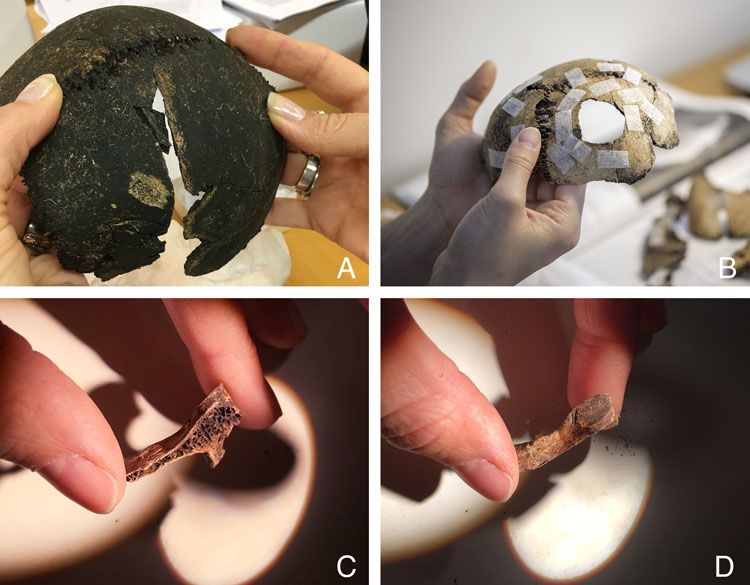
Alfsdotter and Kjellström – The Sandby Borg Massacre                                                                         211

               Figure 1. Map showing the location of Sandby borg, Öland, Sweden (basemap © OpenStreetMap
               contributors, modified by Helena Victor).

               history behind the massacre is not known.                          culture-specific, the results are further con-
               We present the demography of the dead,                             textualized in an attempt to discuss the
               the trauma patterns, the type of trauma, and                       event, the perpetrators, and the possible
               the positions of the dead. Since violence is                       motives that prompted the violence.

Downloaded from https://www.cambridge.org/core. IP address: 176.9.8.24, on 20 Sep 2020 at 06:41:41, subject to the Cambridge Core terms of use, available at
https://www.cambridge.org/core/terms. https://doi.org/10.1017/eaa.2018.55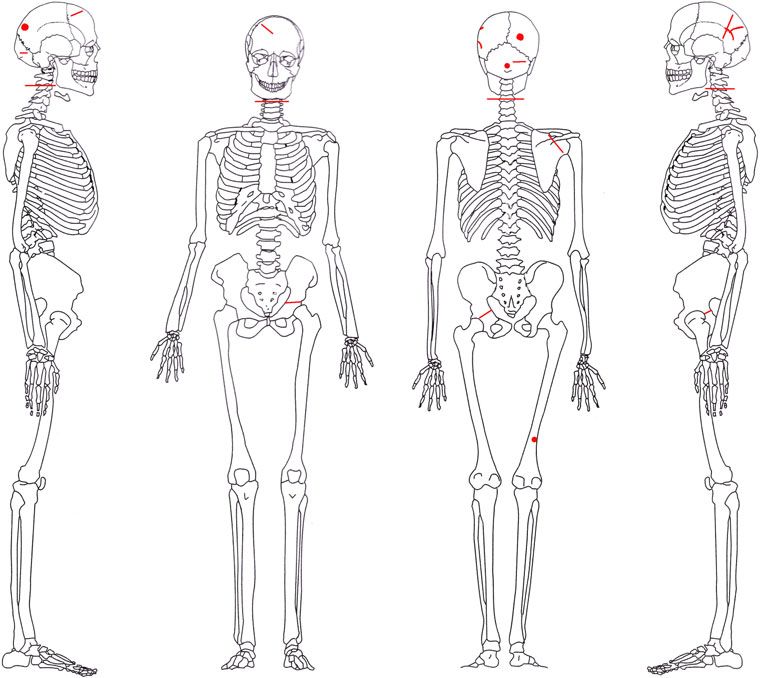
212                                                                           European Journal of Archaeology 22 (2) 2019

                         The Sandby borg ringfort                                to have housed 200–300 inhabitants (Victor,
                                                                                 2015). A mix of prestigious jewellery and
              The vast majority of artefacts found within                        everyday items was discovered in the
              the ringfort indicate that Sandby borg was                         dwellings (Victor, 2015; Gunnarsson et al.,
              occupied between AD 400 and 550 (Victor,                           2016). The large quantity of valuable arte-
              2015; Alfsdotter et al., 2018). Since 2011,                        facts, in association with the discovery of
              small-scale annual excavations have been                           articulated human and animal remains, gives
              carried out by Kalmar County Museum.                               the impression of a ‘moment frozen in time’
              Three houses have been fully excavated, and                        (Alfsdotter et al., 2018). Articulated and
              six partially. Additionally, parts of the street                   partially scattered skeletons of humans and
              surrounding the central block have been                            animals (sheep, dogs, and pigs) were found
              subject to excavation (Figure 2). The exca-                        within the houses. Macro-botanical and
              vated area amounts to a modest 9 per cent                          taphonomic analyses indicate that the ring-
              of the ringfort interior, but the results are                      fort was not revisited after the violent attack
              nevertheless informative in terms of the                           (Heimdahl, 2014, 2016; see discussion in
              history of the ringfort. Future excavations                        Alfsdotter et al., 2018; for a taphonomic
              will clarify this further. The fort is believed                    discussion, see Alfsdotter & Kjellström, in

              Figure 2. The internal structures of Sandby borg in accordance with geophysical prospection (Viberg
              2012). Identified plausible house structures have been numbered 1–53. Marked areas have been subject
              to excavation. (Figure by Helena Victor.)

Downloaded from https://www.cambridge.org/core. IP address: 176.9.8.24, on 20 Sep 2020 at 06:41:41, subject to the Cambridge Core terms of use, available at
https://www.cambridge.org/core/terms. https://doi.org/10.1017/eaa.2018.55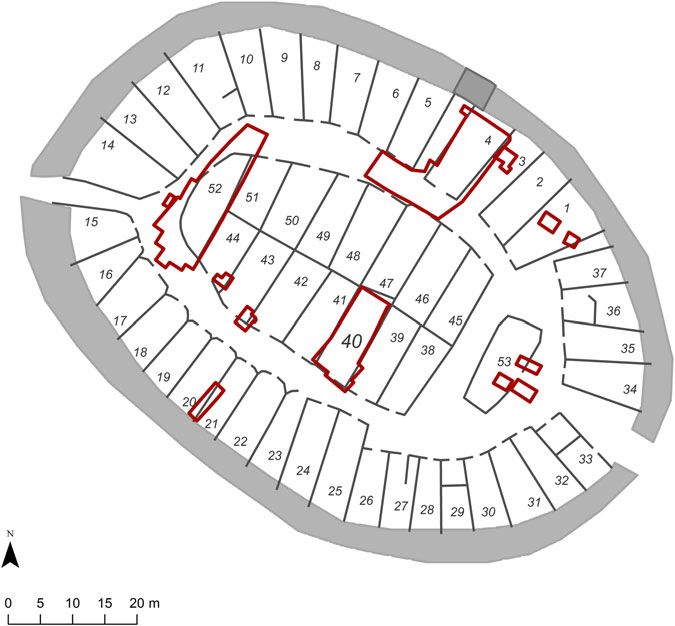
Alfsdotter and Kjellström – The Sandby Borg Massacre                                                                         213

               preparation). The commingled skeletal                              and necrosis, or an abnormal elemental
               remains are predominant in an outdoor                              shape (i.e. inadequate fusion or pseudoar-
               environment. The archaeozoological analysis                        throsis). When a fracture does not show
               has shown that the event is likely to have                         any signs of healing in fresh bone, it is clas-
               taken place between late spring and early                          sified as a perimortem trauma, which indi-
               autumn (Alfsdotter in Gunnarsson et al.,                           cates that it occurred around the time of
               2016). Recent isotopic analyses indicate that                      death (Knüsel, 2005; Ubelaker, 2015).
               at least two of the individuals (ID1 and                           However, since the perimortem interval is
               ID2) were probably locals (Wilhelmson,                             related to the moisture retention of the
               2017: 143). For a detailed description of                          bone, the period can be prolonged in
               comparative     materials,     contemporary                        certain environments (Kjellström & Ham-
               weapons, and tactics, see the online supple-                       ilton, 2014). Characteristics of perimortem
               ment (Supplementary materials 1).                                  trauma include smooth, obtuse fracture
                                                                                  angles with the same coloration as the rest
                                                                                  of the bone, sometimes in combination
                           MATERIAL        AND    METHODS                         with a plastic response and distinctive frac-
                                                                                  ture types described in the medical litera-
                    Minimum number of individuals                                 ture (Ubelaker, 2015). Perimortem trauma
                   (MNI), sex, and age determinations                             was further categorized according to type:
                                                                                  sharp force trauma (SFT), puncture trauma
               Standard osteological techniques were                              (PT), and blunt force trauma (BFT). SFT
               applied for sex and age determinations of                          are injuries (incisions, stab wounds, or
               the individuals. The methods are listed in                         chop wounds) sustained from a sharp
               the online supplement (Supplementary                               object which leaves linear marks, V-shaped
               materials 2). All individuals were assigned                        in cross section, and a smooth kerf wall
               to the following age groups: fetal=
214 European Journal of Archaeology 22 (2) 2019
Table 1. Preservation, demographic distribution, and trauma in relation to context (AT = antemortem
trauma; PT = perimortem trauma; F = find number, used for elements without clear association to a
unique individual).
ID Majority of skeleton Age group (years) Sex Trauma Context
articulated (in brackets,
per cent of skeleton preserved)
1 Yes (100) Adolescent (17–19) Male PT + AT House 40
2 Yes (100) Young adult (19–25) Male PT House 40
3 No (20) Middle adult PT House 40
4 Yes (75) Young adult Male? PT + AT House 40
5 Yes (60) Young(?) adult Male House 40
6 Yes (90) Adolescent (12–15) PT House 40
7 Yes (100) Adolescent (12–15) House 40
8 No (5) Infant/Child (2–5) House 40
9 Yes (85) Old adult Male House 52
10 No (5) Infant House 52
11 No (5) Middle adult House 52 (pit 4)
12 Yes (80) Child (6–8) House 4
13 No (40) Adolescent (10–13) PT House 4
14 No (20) Old(?) adult PT House 4
15 No (75) Old adult Male House 4
16 No (20) Middle adult Street
17 No (5) Child (5–9) Street/alley
18 No (30) Young adult (20–25) Alley
19 No (20) Old adult Male Alley
20 No (5) Child (3.5–6.5) Street/alley
21 No (25) Adolescent (12–15) Street
22 No (5) Child (3.5–6.5) Street
23 No (20) Young adult (20–25) Male? PT Street
24 No (20) Middle adult Male House 3
25 No (5) Infant (1.5–3 months) House 40
26 No (5) Infant (2–4) House 3
F6671/F6141 No (1) Adult AT House 40
the preservation of different elements). three; Street: eight) (see Figures 5A and
This means that it is likely that the identified B). The age distribution is varied: the
injuries are only a minimum representation youngest individual (ID25) was an infant
of the full extent of the original trauma. 1.5–3 months old and the two oldest indi-
viduals (ID9 and ID15) were over 50
years old. The nine adults with sufficiently
RESULTS preserved morphological traits to deter-
mine biological sex exhibit male character-
A minimum of twenty-six individuals was istics. The sex of the children is unknown.
identified (House 3: two individuals; The sample size was too limited to iden-
House 4: four; House 40: nine; House 52: tify any demographic patterning on the
Downloaded from https://www.cambridge.org/core. IP address: 176.9.8.24, on 20 Sep 2020 at 06:41:41, subject to the Cambridge Core terms of use, available at
https://www.cambridge.org/core/terms. https://doi.org/10.1017/eaa.2018.55Alfsdotter and Kjellström – The Sandby Borg Massacre 215
site; but, in the house with the most 7 × 8 mm and is located on the distal-
bodies (House 40), all age groups were lateral part of the shaft.
represented, from infants to old adults. ID2: the skeleton of a young adult
Similarly, children, teenagers, and adults male, was lying in a prone extended pos-
were also discovered in the street. ition in House 40. The cranium presented
Perimortem trauma was identified in its left posterior-lateral side and was lying
eight individuals (Table 2) (Figure 3 and 4): adjacent to the left hip and lower thorax
ID1: the skeleton of a male adolescent, of ID1. The left upper limb was abducted,
was found in a supine position in House rotated medially, and slightly flexed at the
40. The humeri were abducted (c. 30°) and elbow, with the forearm pronated. The
the lower limbs flexed at the knees. SFT right upper limb was slightly abducted,
was identified on the right scapula and the rotated medially, and projected posteriorly.
cranium together with a circular defect, The PT identified consists of a rhombic
likely to be a PT, on the right femur. The puncture wound of the central occipital,
linear scapula lesion is located diagonally just above the external occipital protuber-
over the acromion and extends into the ance. The injury, 7.3 mm in length, pene-
corpus in posterior view, left superior to trated the outer table and diploë but not
right inferior (c. 110° to the sagittal plane). the tabula interna. (In a preliminary ana-
Fragmentation prevents us from determin- lysis, SFT on a rib and a tooth of ID 2
ing the maximum length. The SFT on the was suggested by Wilhelmson (2017) but
left parietal runs from just below the sagit- this could not be confirmed in the present
tal suture towards the squamous suture, analysis.)
aligned to the frontal plane (Figure 4A). ID3: the skeleton of a middle adult
The cut measures 102 mm and penetrates individual, was found disarticulated in
the tabula interna. The kerf wall is primar- House 40. Adjacent to a fragmented
ily visible on the posterior part in the cranium, presenting its lateral right aspect,
superior section of the wound and on the a radius and a humerus were found. An
anterior part in the inferior section. The articulated tibia, fibula, and a foot were
smooth femoral circular defect measures encountered 1.2 metres to the north.
Table 2. Perimortem trauma identified (R = right, L = left. SFT = sharp force trauma; PT = punctur-
ing trauma; BFT = blunt force trauma).
ID Element Side Trauma Description
1 parietal L SFT Linear lesion (102 mm) on central section
1 scapula R SFT Linear lesion (30 mm) diagonally in acromion and corpus
1 femur R PT Circular lesion (7 × 8 mm) on lateral-distal shaft
2 occipital central PT Rhombic lesion (4.3 × 7.3 mm) in central section
3 parietal L SFT Linear lesion (50 mm kerf wall) on central section
3 frontal R SFT Linear lesion (>30 mm) on medial section
4 occipital R SFT Linear lesions (both fragments >16 mm) lateral occipital
6 parietal R BFT Circular lesion (36 × 29 mm in diameter) on central section
13 cervical vertebra corpus SFT Linear horizontal lesion (right: 10 mm + left: 22 mm) through lamina
(C3–5?)
14 parietal L BFT? Horizontal convex lesion (>24 mm) on central section
23 ilium L SFT Linear lesion (19 × >19 mm) through arc composé
Downloaded from https://www.cambridge.org/core. IP address: 176.9.8.24, on 20 Sep 2020 at 06:41:41, subject to the Cambridge Core terms of use, available at
https://www.cambridge.org/core/terms. https://doi.org/10.1017/eaa.2018.55216 European Journal of Archaeology 22 (2) 2019
Figure 3. Distribution of perimortem trauma of all the victims. One lesion to the occipital bone of
ID4 is not included, as the exact location could not be established (original illustration by Buikstra &
Ubelaker, 1994, modifications by Alfsdotter and Kjellström).
However, it cannot be established whether perimortal secondary fracture radiates pos-
the latter unit of elements belong to the teriorly. A second SFT of the medial right
same individual as the cranium. The sub- part of the frontal bone was identified. In
section of the house (House 40) where the frontal view, the cut runs from left super-
individual was discovered contained ior to right inferior (c. 45°). The maximum
several skeletons with partial postmortem length of the injury is unknown as frag-
disarticulation, likely to have resulted from ments are missing bilaterally. The cut has
the partial destruction of the roof follow- penetrated tabula interna.
ing a fire associated with the assault ID4: the highly fragmented skeleton of
(Alfsdotter & Kjellström, in preparation). a young adult, was encountered in House
SFT to the centre of the left parietal was 40 in a prone extended position with the
identified, in lateral view the injury radi- right upper limb extended and the left
ates right superior to left inferior. The kerf upper limb flexed, with the hand under
wall is primarily on the anterior side, the the left shoulder. The positioning of the
posterior fracture surface is rough. A cranium could not be established. The
Downloaded from https://www.cambridge.org/core. IP address: 176.9.8.24, on 20 Sep 2020 at 06:41:41, subject to the Cambridge Core terms of use, available at
https://www.cambridge.org/core/terms. https://doi.org/10.1017/eaa.2018.55Alfsdotter and Kjellström – The Sandby Borg Massacre 217
Figure 4. A: Sharp force trauma on the left parietal bone of individual ID2. B: Blunt force trauma on
the right parietal bone of a young teenager (ID6) (photograph by Daniel Lindskog). C–D: The skeleton
of a 10–13 years old adolescent (ID13) shows evidence of decapitation. Sharp force trauma is visible on
a cervical vertebra.
skeleton was slightly rotated towards the blow aimed from the lower right. The
right, judging from the position of the other lesion could be part of the same
thorax and the pelvis. The femora were traumatic incident, but it could also be the
extended. All bones inferior of femora result of a different blow. It cannot be
were missing (this might be the result of a established whether the cuts penetrated
disturbance in form of an earlier archaeo- the tabula interna, as the diploë is
logical trench). The calvarium was frag- fragmented.
mented and scattered. Two sharp force ID6: the skeleton of an adolescent, was
injuries (both at least 16 mm in length) found in House 40 in a supine extended
were identified on the right side of the position with the left upper limb and the
occipital. Due to fragmentation, the exact lower limbs extended. The right upper
location of only one of the lesions could limb was partially missing. The cranium
be established. The injury radiates hori- was fragmented but presented its lateral
zontally in posterior view and has probably right side. The vertebral column shows a
crossed the lambdoid suture on the right postmortem dislocation between T12 and
side. The angle of the cut in relation to L1. The feet were partly on top of the hip
the horizontal plane is c. 20° and striae are of ID5, whose hand bones were discovered
visible radiating diagonally, indicating a under the left fibula of ID6, implying that
Downloaded from https://www.cambridge.org/core. IP address: 176.9.8.24, on 20 Sep 2020 at 06:41:41, subject to the Cambridge Core terms of use, available at
https://www.cambridge.org/core/terms. https://doi.org/10.1017/eaa.2018.55218 European Journal of Archaeology 22 (2) 2019
ID6 fell after ID5. The cranium of ID6 The vertebra(e) affected is between C3
displays BFT of the right parietal bone and C5. The mandibula of the individual
(Figure 4B). Just medially of the parietal was not affected.
tuber, a circular injury (36 × 29 mm) with ID14: the remains of another predomin-
internal bevelling was observed. At least antly disarticulated skeleton of an older indi-
five secondary fractures radiate from the vidual, were found in front of the entrance
point of impact. All showed perimortem of House 4. A fragment of the left parietal
characteristics but only three of these ends displayed perimortal BFT. Centrally on the
at the lambdoid suture. Two of the frac- element, above the squamous suture, a hori-
tures continue across the lambdoid suture, zontal convex fracture radiates. The injury is
indicating a postmortem origin (Berryman funnel-shaped, internal bevelling is visible,
& Symes, 1998). and the fracture surface of the tabula externa
ID13: consists of disarticulated bones is smooth. The preserved part of the fracture
that are seemingly from the same young measures 24 mm medio-laterally. However,
adolescent. They were found in front of the anterior extension of the fracture is
the entrance of House 4 (Alfsdotter, in missing. From the posterior end of the frac-
press). Two bones display gnawing from a ture, a postmortal fracture radiates towards
rodent. SFT was noted on two vertebral the lambda.
arch fragments from the cervical region of ID23: On the street, a fragment of a
the vertebral column. One of the frag- left ilium from a young adult displaying
ments, the right superior articular process SFT was found. The injury is located next
and part of the lamina, exhibited a linear to the auricular surface, through the com-
horizontal cut angled inferiorly and radiat- posite arch. The recovered cut surface
ing laterally-medially (Figure 4C, 4D). measures 19 × 19 mm. In lateral view, the
The inferior part of the right side of the injury radiates from right superior to left
vertebrae is missing. The second arcus inferior, of the ilium (at an angle of c. 40°
fragment (inferior articular process and to the sagittal plane). The bone is frac-
lamina) displaying SFT is from the left tured anteriorly, hindering analysis of the
side. The lesion is similar to the first frag- full extent of the trauma. No antagonist is
ment, a horizontal cut, but the kerf wall present. The weapon seems to have pene-
has another angle (superior rather than trated the lateral aspect of the acetabulum
inferior). Since both fragments lack and cut the entire left side gluteus
antagonists and striation of the cut sur- muscles.
faces, it cannot be ruled out that the There are few antemortem injuries
traumas are the result of the same blow. (Table 3). Healed fractures were
Table 3. Antemortem trauma identified (F = find number, used for elements without clear association
to a unique individual; R = right, L = left).
ID Element Side Trauma Description
1 scapula R Fracture? Separation of coracoid
1 ribs R+L Fractures Posterior corpus, >2 fractures right side and >3 left
2 metacarpal V R+L Fractures? Bilateral swelling of shafts
4 humerus R Fracture Spiral fracture of proximal shaft
4 clavicle L Pseudoarthrosis On costal tuberosity, inferior-posterior on sternal end
F6671/F6141 neurocranium Fracture Circular depression (15 mm in diameter).
Downloaded from https://www.cambridge.org/core. IP address: 176.9.8.24, on 20 Sep 2020 at 06:41:41, subject to the Cambridge Core terms of use, available at
https://www.cambridge.org/core/terms. https://doi.org/10.1017/eaa.2018.55Alfsdotter and Kjellström – The Sandby Borg Massacre 219
documented in three, or possibly four, indi- 2010). The investigation showed that eight
viduals. Two individuals (ID1 and ID4, of twenty-six individuals exhibit perimor-
both found in House 40) show traces of tem trauma. This means that at least 31
two injuries each. The first (ID1), an ado- per cent were subject to violent acts near
lescent around 17–19 years old, showed a the time of death. In comparison, if we
separation of the right coracoid of the look at only cranial blade wounds, 96 per
scapula and callus formation on the poster- cent of the men from the Battle of Towton
ior section of the ribs from both sides (a (England, War of the Roses, AD 1461;
minimum of 2 right and 3 left), most likely Novak, 2000), 60 per cent from the Battle
caused by direct trauma (i.e. through force of Good Friday at Uppsala in AD 1520
transmitted at a right angle). As for the (Kjellström, 2005), 90 per cent from medi-
second individual (ID4), the right humerus eval Sandbjerget (Næstved, Denmark;
exhibited a malalignment of the proximal Bennike, 1998), and 40 per cent at the
humeral diaphysis and a pseudoarthrosis in Battle of Wisby in AD 1361 on Gotland
the sternal end of the left clavicular diaph- (Ingelmark, 1939) were affected. However,
ysis, indicating oblique or spiral fractures the comparison is impaired by a number of
and indirect trauma. In addition, a neuro- factors: these comparative data are not only
cranial fragment still not allocated to a of a later date, but they represent a com-
skeleton (F6671/F6141, House 40) had a pletely different composition of people,
healed, circular depressed fracture measur- who were often trained for battle, died in
ing 15 mm in diameter. ID2, again from battle, and were subsequently buried. The
House 40, shows possible trauma-induced human remains excavated at the Iron Age
anomalies bilaterally on the lateral aspects hillfort of Fin Cop (Derbyshire, England)
of the shafts of the fifth metacarpals. The are a better comparison in terms of date (c.
projecting bone growth takes the same 300 BC), type of violence encountered, and
form on both sides but is located slightly deposition of bodies. At Fin Cop, the
superior on the left side. The appearance of remains of fifteen individuals (women,
the bone anomalies bears some resem- adolescents, and newborn/unborn chil-
blance to boxer’s fractures (i.e. a fracture of dren) were found in a ditch together with
the fifth metacarpal due to the direct debris from the demolition of the hillfort
impact of a clenched fist with a person or (Waddington et al., 2012). Some skeletons
object). The bilateral presence makes a were articulated and others commingled.
traumatic cause less likely, though not Despite the low amount of perimortem
impossible. An alternative explanation injury (only one confirmed), the cause of
could be a congenital malformation. death of the individuals is believed to have
been interpersonal violence. This interpret-
ation is based on the manner of interment,
DISCUSSION with bodies thrown into the ditch at the
time of the hillfort’s destruction. The
The unhealed sharp force lesions are con- researchers suggest that the manner of
sistent with interpersonal violence. death was probably soft-tissue wounds that
Furthermore, the location of the two cases left no skeletal marks (Waddington et al.,
of blunt trauma, above the hat brim line, 2012: 226). As at Sandby borg, only a
suggests that the individuals were subjected small part of the whole site has been exca-
to aggressive acts rather than accidental vated and the number of individuals is
falls or similar mishaps (Kremer & likely to have been much greater at both
Sauvageau, 2009; Guyomarc’h et al., sites. The unburied corpses in Sandby borg
Downloaded from https://www.cambridge.org/core. IP address: 176.9.8.24, on 20 Sep 2020 at 06:41:41, subject to the Cambridge Core terms of use, available at
https://www.cambridge.org/core/terms. https://doi.org/10.1017/eaa.2018.55220 European Journal of Archaeology 22 (2) 2019
were exposed to the weather, animals, objects varied in location and direction. Of
insects, and house debris (such as that the eleven perimortem lesions identified,
from stone walls, wooden beams and turf five were aimed at the back of the body
roofs), leaving the skeletal material frag- (scapula, ilium, femur, and two on the
mented. It should be noted that most of occipital) of the victims, implying that
the individuals found in Sandby borg only they were attacked from behind. The
comprise a few bone units, sometimes only trauma identified in the cervical region of
teeth, as the human remains recovered ID13 could perhaps also be included in
from the street are commingled and have this group. The lesions on top of the
been subject to vast taphonomic degrad- cranium of at least ID1 may indicate that
ation (Table 1). The nature of the skeletal the individual was in a lower position in
remains gives us reason to believe that relation to the perpetrator, or that the
traumatic lesions inflicted on several bodies latter was on horseback (that scenario is
have not been identified. Although the however very unlikely given that the skel-
number of perimortem traumatic injuries eton was found indoors1). Only two of the
encountered in Sandby borg is compara- lesions (on ID 3 and ID14) are consistent
tively low, it is their connection with the with battle wounds that could be expected
sample’s demographic aspects and body in face-to-face combat with a right-
positions that enable us to attempt a recon- handed assailant (Larsen, 1999: 157).
struction of the course of events and the However, there might be an under-
underlying motive. representation of facial trauma identified
since the preservation of the delicate facial
bones was poor. Characteristic defence
How? the perimortem trauma pattern injuries, such as parry fractures on the
forearms or hands, or sharp incisions on
By studying the positions of the unburied the palmar aspect of the finger bones, are
skeletons at Sandby borg in tandem with missing (Dolinak et al., 2005: 149–50).
the perimortem trauma, it is possible to Moreover, the bodies of the remaining
obtain additional information about the individuals who do not have observable
modus operandi of the perpetrators. perimortem lesions were also found in the
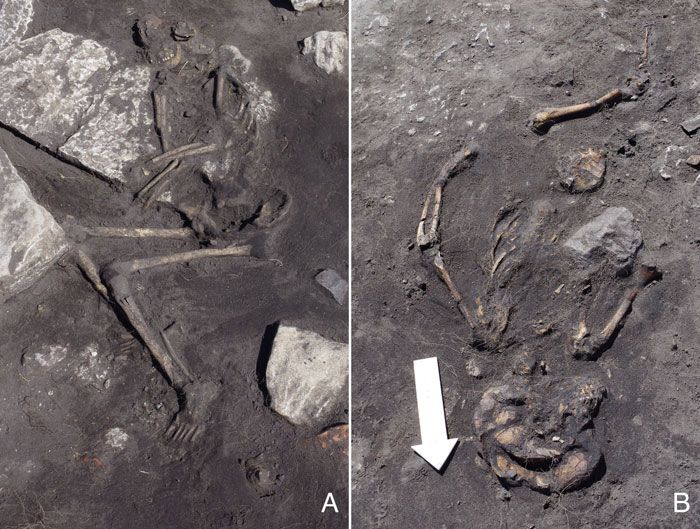
In total, eleven perimortem lesions were dwellings and in the street (Figure 5).
identified in eight individuals. Sharp force They were discovered in a flexed position
trauma was documented in seven cases, (ID7, figure 5A) and lying extended, both
blunt force was used in two cases, and prone (ID9) and supine (ID 5 and ID12,
puncture wounds were caused in two cases the latter in figure 5B), and possibly
(Table 2). Two individuals (ID1 and ID3) sitting (ID15). In one case, individuals
suffered at least two sharp force blows. had fallen over each other (Alfsdotter
Bones of the cranium were the most
affected, suggesting that this was the 1
The body seems not to have been arranged in a formal
primary target, but postcranial wounds position but was likely left behind after the assault. The
remains of nine individuals in house 40 follow no
were noted in the neck (cervical vertebra pattern in terms of skeletal position or postmortem
(e)), shoulder (scapula), and hip region treatment. In House 52, a skeleton (ID9) was lying
(the ilium) of the individuals, with no prone across a hearth. Parts of his skeleton were
charred, a testimony to the hearth having been lit as the
preference as to which side of the body. man fell(?) over it never to rise again. The Sandby borg
The blunt injuries were located on the top context so far indicates a rapid killing with no or
limited handling of the dead bodies (the taphonomy is
of the head, near the sagittal suture, further discussed in Alfsdotter & Kjellström, in
whereas the wounds inflicted by sharp preparation).
Downloaded from https://www.cambridge.org/core. IP address: 176.9.8.24, on 20 Sep 2020 at 06:41:41, subject to the Cambridge Core terms of use, available at
https://www.cambridge.org/core/terms. https://doi.org/10.1017/eaa.2018.55Alfsdotter and Kjellström – The Sandby Borg Massacre 221
Figure 5. A: The articulated skeleton of ID7, an adolescent, is one of nine individuals whose remains
have been found inside House 40. B: The partially articulated skeleton of a child (ID12) excavated in
House 4.
et al., 2018). An older man (ID9) was caused by an axe (Reichs, 1998), swords
lying face down diagonally over the central were most likely to have been the weapon
hearth of House 52. The anterior pelvic used. The penetrating lesion did not have
region was partially charred, suggesting enough characteristic traits to identify the
that the fireplace was still burning, or at weapon type, and could have been caused
least smouldering, when the man fell by any sharp, pointed weapon (such as a
(Papmehl-Dufay & Alfsdotter, 2016). spear or lance) or other object. The same
Although the number of identified goes for the blunt force traumatic injuries.
injuries is low, the varied distribution lacks By combining the perimortem lesions
patterning, which implies that the victims with body positions, it may be possible to
did not carry any protective gear (this is establish the circumstances surrounding
hardly surprising given the demographic the deaths of certain individuals. The
spread). This is in line with the general supine skeleton of individual ID1 had
impression that the inhabitants were taken three injuries where the sharp force trauma
off guard. If the trauma analysis is repre- on the scapula must have severed the
sentative of a massacre, the preferred muscles of the right rotator cuff (teres
weapon of the assailants was the sword. It minor, supraspinatus and infraspinatus).
is not possible to rule out axes; but, as This impaired the stability and movement
none of the sharp force lesions exhibit the of the shoulder and upper limb. The blow
fracture pattern expected from a combin- does not seem to have penetrated the pos-
ation of sharp and blunt force trauma terior thorax. The penetrating wound on
Downloaded from https://www.cambridge.org/core. IP address: 176.9.8.24, on 20 Sep 2020 at 06:41:41, subject to the Cambridge Core terms of use, available at
https://www.cambridge.org/core/terms. https://doi.org/10.1017/eaa.2018.55222 European Journal of Archaeology 22 (2) 2019
ID1’s femur could, in a similar way, have group is not yet known, but it is likely
damaged muscles and tendons (musculus that the youngest victims of the massacre
biceps femoris and tractus iliotibialis). Both were born on the island. Moreover, it is
lesions must have led to blood loss but probable that all the victims were local
need not have been lethal. The cranium, inhabitants. Only male remains have been
however, shows a wound which penetrated identified among the adults for whom sex
the inner table of the parietal bone, expos- could be determined. The presence of an
ing the brain tissue. The sequence of the infant and young children, and the finds
lesions is hypothetical, but it is likely that of female attire (Magnus, 1997, 2002),
the blow to the back and thigh preceded imply that women lived within the walls.
that on the head since the latter caused Within the bioarchaeological field, there
severe cranial damage which could, in are examples where a biased sex distribu-
itself, have resulted in the death of the tion (with no or few women) in a skeletal
man. Consequently, it is possible that the collection has been interpreted as raiding
man managed to survive an initial blow, for women and girls. This practice is not
before being struck on the head and uncommon in attacks on small settlements
falling on his back. In another house, the (e.g. Kohler & Kramer Turner, 2006;
skeleton of the 10–13 year old adolescent Cameron, 2013; Martin & Harrod, 2015).
(ID13) had SFT in the neck region. Although the main purpose of the attack
Though the cervical vertebra(e) are was not necessarily to take prisoners, the
severely fragmented, it is clear that at least kidnap of women may have been an added
one horizontal blow cut through the soft benefit. They could be taken as wives,
tissue and penetrated the medulla, which used as extra labour, or sold as slaves (e.g.
would have damaged major arteries (pos- Martin et al., 2010). However, since only
terior inferior cerebellar artery and possibly a small part (c. 9 per cent) of the ringfort
anterior spinal artery). The cut(s) are likely has been excavated, the absence of female
to have led to the instant death of the remains could be a coincidence, and we
individual at the site where the human must be wary of over-interpreting this
remains were discovered (if they were not aspect. It should also be stressed that the
moved secondarily). These two case sex distribution among the children is yet
studies suggest that, at one point, the to be established through DNA analysis.
wounded shared space with the dead and Nevertheless, it is not uncommon that
dying, illustrating a chaotic situation with women are treated differently in massacres,
people in a state of shock. Perhaps ID1, and perhaps the female remains are to be
who died just inside the entrance of discovered in another part of the ringfort.
House 40, was wounded in the street, If we consider the taking of slaves as a
after which he entered the house (for possible reason behind the attack, this is
shelter?) where he then received the final complicated by the presence of children
blow to his head. and teenagers, who we may assume were
easy prey. Could the children have taken
part in the battle? Little is known about
Who? trauma and demography the socialization processes of children
during the period, and it is not clear when
The isotopic data (Wilhelmson, 2017) a child was considered to have become an
indicate that at least two of the Sandby adult. The transition from childhood into
borg victims grew up in the region. adulthood was likely to have been based
Whether this is true for the rest of the on physical and mental maturity, but
Downloaded from https://www.cambridge.org/core. IP address: 176.9.8.24, on 20 Sep 2020 at 06:41:41, subject to the Cambridge Core terms of use, available at
https://www.cambridge.org/core/terms. https://doi.org/10.1017/eaa.2018.55Alfsdotter and Kjellström – The Sandby Borg Massacre 223
could also be connected to the social status individuals in this group (ID1 and F6671)
of the individual (Mejsholm, 2009: 24). show signs of healed direct fractures, and
For boys, it could be associated with a the number of antemortem traumatic
time when the youth was physically fit for injuries was generally modest in the
weapon training. The youngest individuals Sandby borg skeletons. The prevalence is
at Sandby borg with documented perimor- similar to that found in contemporary
tem injuries were the decapitated 10–13 cemetery populations. For instance, c. 8
year old adolescent (ID13), and a 12–15 per cent of the individuals (both men and
year old (ID6) with a blunt force lesion to women) in the Migration-period cemetery
the right parietal (Tables 1 and 2). The of Prague-Zliín, Czech Republic, showed
sexes are not known, and it is not clear traces of healed traumatic lesions (Vargová
whether these individuals were passive et al., 2016). A high frequency of ante-
victims or if they put up armed resistance. mortem trauma may indicate previous
Attempts to identify active engagement of battle experience. In the study of the skel-
non-adults in violent encounters have been etal remains from the Battle of Towton
made in prehistoric skeletal assemblages (England), for instance, at least 32 per
(Fibiger, 2014). Adolescents of similar age cent of the crania exhibited healed,
to those found in Sandby borg were weapon related lesions, implying experi-
assessed as having probably participated in ence of previous encounters (Novak,
armed conflict in early medieval Ireland 2000). Overall, the demographic compos-
(Geber, 2015). Even if this were the case ition, along with the trauma pattern,
with the two young individuals from shows that most individuals exhumed in
Sandby borg, the younger children were Sandby borg had little chance to defend
either deliberately killed (but without themselves, and that only a few are likely
lesions identified) or left to die. This indi- to have had battle experience. Although
cates that the killings were indiscriminate grown men were probably the primary
with regard to age. Furthermore, the target group, all members in the Sandby
young individuals (twelve of the twenty-six borg community seem to have been sub-
individuals were younger than 15 years jected to violence, and non-combatants
old) could not, if we disregard the signs of could at least be considered collateral
visible trauma, have had much, or any, damage (see Tegtmeyer & Martin, 2017).
battle experience. At the other end of the The deliberate killing or abandonment of
age spectrum, there were three men older young children further suggests that the
than 50, none of whom had identifiable intention of the attack was to annihilate
antemortem or perimortem wounds. Both the inhabitants. Though it is possible that
groups could be seen as ‘atypical warriors’. some of the fallen adult men belonged to
The remaining group (n = 12) of young the attackers, it appears unlikely that the
or adults in the category ‘middle adult’ assailants would have left any of their own
may be considered able-bodied and fit for behind, as the victorious group in a battle
fighting. Indeed, it is this group that exhi- normally has the opportunity to tend to
bits the highest number of perimortem their dead.
lesions, and it is tempting to interpret Does the trauma pattern at Sandby borg
these visible weapon wounds as indicative and the identification of weapon injuries
of a more active resistance to the attack. reveal anything about the assailants? It has
However, the biased distribution of been suggested that Scandinavian men
wounds could be due to preservation could have received military training in the
factors. At any rate, only one or two Roman Empire (Nicklasson, 1997: 173;
Downloaded from https://www.cambridge.org/core. IP address: 176.9.8.24, on 20 Sep 2020 at 06:41:41, subject to the Cambridge Core terms of use, available at
https://www.cambridge.org/core/terms. https://doi.org/10.1017/eaa.2018.55224 European Journal of Archaeology 22 (2) 2019
see online supplement: Supplementary Ember, 1997). Studies of different geo-
Material 1). At least in theory, formal graphical regions, dating from 10,000 BC
training with weapons could lead to ‘stan- to today, have shown that there is a strong
dardized’ violence, a recognizable pattern relationship between climate change and
with regard to injuries sustained by the intergroup conflict (Hsiang et al., 2013).
victims. However, no such injury pattern This is interesting, since tree ring data has
was discernible, since the small size of the shown that the period AD 450–550 in
sample and the poor preservation of Europe was a time of climatic changes
the remains has affected the outcome of (Büntgen et al., 2011). It is difficult to
the analysis. Given the few perimortem establish to what degree a small-scale
traumatic injuries identified, the same can society like that at Sandby borg would
be said about the primary choice of have been affected by fluctuations in tem-
weapon, thought to be the sword. In close perature and precipitation and what spe-
combat, this is the most effective weapon; cific social stress factors could have led to
but, as discussed, other types of weapons, the Sandby borg massacre. A combination
pointed, edged, or blunt, could also have of several factors was probably at play.
been used. A change in settlement pattern can be
seen in Scandinavia during the Migration
period, where several settlements were
Why? contextualization of trauma and abandoned or destroyed. This has been
the inhabitants of Sandby borg interpreted as a socioeconomic crisis, pos-
sibly related to changing political struc-
Martin and Harrod write that massacres tures in the aftermath of the fall of the
(i.e. multiple killings of all age groups and Western Roman Empire (e.g. Stenberger,
of both sexes) can be seen as a political 1933; Näsman, 1988; Fischer, 2005;
instrument that is ‘[…] often used by per- Heather, 2006; Hedeager, 2011; see also
petrators to either subjugate or eradicate a discussion in Alfsdotter et al., 2018). The
group defined as having cultural character- presence of dead children at Sandby borg
istics that separate them in some way from may be indicative of extraordinary circum-
the aggressors’ (Martin & Harrod, 2015: stances. Non-accidental perimortem injur-
129). Since interpersonal violence is ies documented among young children
seldom random, it allows the perpetrators from the fourth–fifth-century AD cemetery
to gain control over land or other groups. of Lisieux in Normandy in France have
The competition for women can be a con- previously been interpreted as the result of
tributing factor behind conflicts in both social stress caused by political distur-
prehistoric and present-day small-scale bances and perhaps raiding groups
societies (Sanderson, 2014: 291–96); (Timmins et al., 2017). In another study,
although groups demonstrate a great vari- in the context of the fifteenth-century
ability regarding the causes of violence massacre of Č epin in Croatia, bioarchaeo-
(McCall & Shields, 2008). Furthermore, logical results were used to identify the
massacres are part of complex processes, causative agent behind a specific raid, and
not only because they imply planning and to differentiate attempts to take prisoners
the involvement of many people, but also of war from attempts to strategically
because they operate at a sociopolitical and spread fear and panic in a population
cultural level. Environmental stress factors (Šlaus et al., 2010). Judging from the
and risk of losing resources could also be a current analysis of the Sandby borg
motivating factor for violence (Ember & assault, it is unlikely that the massacre was
Downloaded from https://www.cambridge.org/core. IP address: 176.9.8.24, on 20 Sep 2020 at 06:41:41, subject to the Cambridge Core terms of use, available at
https://www.cambridge.org/core/terms. https://doi.org/10.1017/eaa.2018.55Alfsdotter and Kjellström – The Sandby Borg Massacre 225
the result of an attempt to obtain wealth, very interested in staying and searching for
since potential prisoners (e.g. children), loot, considering the quantity of jewellery
luxury items, and animals were left and other luxury items found during the
behind. Theoretically, the attack on excavations. The injury pattern and the
Sandby borg could have been some form positions of the bodies is another indica-
of retribution. In discussing violent behav- tion of a brief attack. The victims do not
iour and its aftermath during the Iron Age have the appearance of having been moved
in Scandinavia, Lindbom (2006: xviii) after they died, and the injuries are almost
suggests that an attack on a farm (i.e. ‘efficiently’ distributed, in the sense that
attacking people in their home) was an only the minimum amount of violence
extreme act with dire consequences. The necessary to kill was used (for a tapho-
attackers were consequently forced to kill nomic analysis, see Alfsdotter &
everyone to eliminate witnesses and, thus, Kjellström, in preparation). The compara-
avoid being subjected to vengeance. So far, tively few instances of perimortem frac-
there is no archaeological or osteological tures (even in the rather complete
evidence of feuding between Sandby borg skeletons, e.g. ID7 and ID12) suggest that
and other local groups (e.g. evidence of each victim was overcome with a
burning in cultural layers caused by previ- minimum of effort by the attacker. The
ous fires, large collections of weapons, or injury pattern and reconstructed body
healed weapon-related trauma). positions also indicate that the victims’
In skeletal series associated with con- bodies were not further brutalized or
texts similar to those of Sandby borg, manipulated after death. Furthermore, the
bioarchaeological analyses have revealed repeated pattern, with dead humans inside
information about the extent of the vio- and outside several houses, suggests that
lence. In well-known cases of attacks on the perpetrators were numerous and
villagers in other periods and geographical coordinated.
regions, documented for example on pre- Dutton et al. (2005) explored the
historic and historic sites in the US, varying motives behind massacres and
dreadful acts of violence, such as mutila- genocides during the twentieth century.
tion and trophy-taking, have been docu- Although the social systems of modern
mented (e.g. Owsley et al., 1977; Willey, states and small Iron Age chiefdoms differ
1990; Andrushko et al., 2005). Acts of greatly, some arguments put forward in
body processing in a ritual or sacrificial this study may be pertinent to the discus-
manner have also been observed in Iron sion of the motives behind the Sandby
Age wetland contexts, showing that post- borg massacre. A common denominator of
mortem manipulation of human bodies mass killings is that the perpetrating group
was not a completely uncommon or perceives the target group as having
extreme behaviour (see Supplementary obtained some form of unfair advantage.
Material 1). However, the scene at Sandby Historical and political circumstances
borg suggests a different situation. The affect the identification of the target
attack appears to have been an expedient group, and the mass killing is legitimized
and brutal affair. The villagers were seem- among the perpetrators as revenge
ingly taken by surprise rather than (Dutton et al., 2005: 470). Often, mass
engaged in a conventional battle. killings are the result of feared future con-
Although it is impossible to say anything flict, and rapid social change is frequently
about how much has been plundered, the behind the perception of a threat that
perpetrators do not appear to have been must be eliminated. When indiscriminate
Downloaded from https://www.cambridge.org/core. IP address: 176.9.8.24, on 20 Sep 2020 at 06:41:41, subject to the Cambridge Core terms of use, available at
https://www.cambridge.org/core/terms. https://doi.org/10.1017/eaa.2018.55226 European Journal of Archaeology 22 (2) 2019
killing takes place (e.g. of children), the wiped out. The finds at Sandby borg
actions are often justified on the basis that strengthen the perception of the
the target group poses a future threat. A Migration period on Öland as a socially
plausible alternative (or additional) motive turbulent time, probably involving strife
can be to cause terror through the ruthless with conflicting groups of inhabitants.
killing of vulnerable individuals. The The proposed mass killing at Sandby
excessive violence commonly witnessed in borg can be contrasted with the image of
massacres (mutilations, rape, torture, and warfare associated with finds such as the
killing of defenceless victims) differs from weapon deposits in Hjortspring and
the violence often seen in genocides, Nydam in Denmark (see Supplementary
where the violence is ‘dispassionate’ and Material 1). The weapon offerings are
‘instrumental’ (since the violence is carried deposited in an organized and orchestrated
out by those who only execute orders) form, demonstrating control and power in
(Wolfgang, 1958; Dutton & Kerry, 1999). relation to the contemporary narrative and
Dutton et al. (2005) argue that socio- ideology. At Sandby borg, the grim result
political circumstances may be enough to and reality of violence is evident.
explain instrumental violence, whereas the
‘passionate’ killing seen in many massacres
is not yet well understood. If we combine SUMMING UP
theories of modern mass killing with the
efficient slaughter so far evidenced in Archaeological excavations have revealed
Sandby borg, it is plausible to interpret the evidence of a Migration-period massacre
dispassionate killing as having been caused in the ringfort of Sandby borg on Öland.
by sociopolitical instability. The lack of Thus far, the remains of twenty-six indivi-
traces of overkill combined with the effect- duals have been found in several houses
ive killing pattern could indicate that the and on the surrounding street outside
individuals who carried out the slaughter them. Perimortem sharp, blunt, and pene-
were not personally involved with the trating trauma consistent with interper-
victims. Possibly, the killing was ordered. sonal violence was identified in eight
Credible motives behind the massacre individuals (31 per cent of the assem-
were likely to have been connected to blage). In addition, the locations and skel-
experienced past injustice, the perception etal positions of the remaining individuals
of the Sandby borg inhabitants as a threat, imply that they were killed in the same
and the will to spread fear to achieve event. The victims belonged to all age
control. This hypothesis fits with the groups, from infants to individuals over 50
interpretation that the massacre in Sandby years of age. However, only men have
borg was not a raid carried out for the been identified so far. The perpetrators
purposes of plundering. The motives sug- were seemingly numerous and coordinated.
gested point to the attackers having been a The assault was carried out expediently,
neighbouring group (also discussed in judging from the efficient distribution of
Victor, 2015; Alfsdotter et al., 2018). trauma, the absence of body modification,
Though a ‘personal’ scenario cannot be and the fact that items of value still remain.
verified based on the current analysis, and Though most injuries were located on the
remains speculative, the unburied bodies skulls, a clear trauma pattern could not be
appear to signal a provoking motive. They established. The identified weapon types
could be seen as a final act of violence, are consistent with contemporary weapons.
and even that the entire community was The prevailing sociopolitical situation is
Downloaded from https://www.cambridge.org/core. IP address: 176.9.8.24, on 20 Sep 2020 at 06:41:41, subject to the Cambridge Core terms of use, available at
https://www.cambridge.org/core/terms. https://doi.org/10.1017/eaa.2018.55Alfsdotter and Kjellström – The Sandby Borg Massacre 227
likely to have led to social stress. It is Evidence of a Late Fifth-Century Massacre
hypothesized that the decision to kill the at Sandby Borg. Antiquity, 92: 421–36.
Sandby borg inhabitants was based on a https://doi.org/10.15184/aqy.2018.21
Andrushko, V.A., Latham, K.A.S., Grady, D.B.,
feeling of past injustices and a perception Pastron, A.G. & Walker, P.L. 2005.
of the Sandby borg group as a threat. The Bioarchaeological Evidence for Trophy
killing of children is indicative of a fear of Taking in Prehistoric Central California.
retribution among the attackers. Ultim- American Journal of Physical Anthropology,
ately, the motive behind the massacre was 127: 375–84. https://doi.org/10.1002/ajpa.
20044
probably to attain regional power and Bennike, P. 1998. De faldne fra Krigergraven-
control. analys af skeletterne fra Sandbjerget. Liv
og Levn, 12: 14–21.
Berryman, H.E. & Symes, S.A. 1998.
Recognizing Gunshot and Blunt Cranial
ACKNOWLEDGEMENTS Trauma Through Fracture Interpretation.
In: K. Reichs, ed. Forensic Osteology.
This work was supported by the Riksban- Springfield (IL): Charles C. Thomas, pp.
kens jubileumsfond under Grant P15- 333–52.
0138:1, the Knowledge Foundation, Bohus- Boylston, A. 2000. Evidence for Weapon-
Related Trauma in British Archaeological
läns Museum, and Linnaeus University Samples. In: M. Cox & S. Mays, eds.
through the Graduate School in Contract Human Osteology in Archaeology and
Archaeology (GRASCA). The present Forensic Science. London: Greenwich
article builds on osteological analysis con- Medical Media, pp. 357–80.
ducted by Alfsdotter and on excavation Buikstra, J.E. & Ubelaker, D.H. 1994.
Standards for Data Collection from Human
records by Victor, Papmehl-Dufay, Gun- Skeletal Remains: Proceedings of a Seminar
narson, Alfsdotter, and colleagues. We at the Field Museum of Natural History.
would like to thank the anonymous Fayetteville (AR): Arkansas Archaeological
reviewers for helpful comments and sugges- Survey.
tions. Many thanks to Tim Sandusky and Büntgen, U., Tegel, W., Nicolussi, K.,
McCormick, M., Frank, D., Trouet, V.
Dejan Gajic for language review, and to et al. 2011. 2500 Years of European
Anders Högberg for comments on an Climate Variability and Human
earlier version of the manuscript. We also Susceptibility. Science, 331: 578–82.
thank Daniel Lindskog and Helena Victor https://doi.org/10.1126/science.1197175
for providing photographs and illustrations. Cameron, C.M. 2013. How People Moved
Among Ancient Societies: Broadening
the View. American Anthropologist, 115:
218–31. https://doi.org/10.1111/aman.
REFERENCES 12005
Dolinak, D., Matshes, E. & Lew, E. 2005.
Alfsdotter, C. in press. Humanosteologi i Forensic Pathology. Principles and Practice.
Sandby borg. In: L. Papmehl-Dufay & H. Burlington (MA): Elsevier.
Victor, eds. Sandby borg IX. Undersökningar Dutton, D.G. & Kerry, G. 1999. Modus
2016, Sandby sn, Mörbylånga kommun, Operandi and Personality Disorder in
Öland. Report prepared for Kalmar läns Incarcerated Spousal Killers. International
museum. Journal of Law and Psychiatry, 22: 287–
Alfsdotter, C. & Kjellström, A. in preparation. 300. https://doi.org/10.1016/S0160-2527
A Taphonomic Interpretation of the (99)00010-2
Postmortem Fate of the Victims Following Dutton, D.G., Boyanowsky, E.O. &
the Mass Killing at Sandby Borg. Bond, M.H. 2005. Extreme Mass
Alfsdotter, C., Papmehl-Dufay, L. & Victor, H. Homicide: From Military Massacre to
2018. A Moment Frozen in Time: Genocide. Aggression and Violent Behavior,
Downloaded from https://www.cambridge.org/core. IP address: 176.9.8.24, on 20 Sep 2020 at 06:41:41, subject to the Cambridge Core terms of use, available at
https://www.cambridge.org/core/terms. https://doi.org/10.1017/eaa.2018.55228 European Journal of Archaeology 22 (2) 2019
10: 437–73. https://doi.org/10.1016/j.avb. Hsiang, S.M., Burke, M. & Miguel, E. 2013.
2004.06.002 Quantifying the Influence of Climate on
Ember, C.R. & Ember, M. 1997. Violence in Human Conflict. Science, 341: 6151.
the Ethnographic Record: Results of https://doi.org/10.1126/science.1235367
Cross-Cultural Research on War and Ingelmark, B.E. 1939. The Skeletons. In: B.
Aggression. In: D.L. Martin & D.W. Thordeman, ed. Armour from the Battle of
Frayer, eds. Troubled Times: Violence and Wisby 1361. Stockholm: Kungliga Vitterhets
Warfare in the Past. Amsterdam: Gordon Historie och Antikvitets Akademien, pp.
and Breach, pp. 1–20. 149–209.
Fibiger, L. 2014. Misplaced Childhood? Kjellström, A. 2005. A Sixteenth-Century
Interpersonal Violence and Children in Warrior Grave from Uppsala, Sweden:
Neolithic Europe. In: C. Knüsel & M. The Battle of Good Friday. International
Smith, eds. The Routledge Handbook of the Journal of Osteoarchaeology, 15: 23–50.
Bioarchaeology of Human Conflict. https://doi.org/10.1002/oa.746
Abingdon: Routledge, pp.127–45. Kjellström, A. & Hamilton, M. 2014. The
Fischer, S. 2005. Roman Imperialism and Runic Taphonomy of Maritime Warfare: A
Literacy: The Westernization of Northern Forensic Reinterpretation of Sharp Force
Europe (150–800 AD) (Aun 33). Uppsala: Trauma from the 1676 Wreck of the Royal
Department of Archaeology and Ancient Swedish Warship Kronan. In: D.L. Martin
History, Uppsala University. & C.P. Anderson, eds. Bioarchaeological and
Geber, J. 2015. Comparative Study of Forensic Perspectives on Violence. How Violent
Perimortem Weapon Trauma in Two Death is Interpreted from Skeletal Remains.
Early Medieval Skeletal Populations (AD Cambridge: Cambridge University Press, pp.
400–1200) from Ireland. International 34–50.
Journal of Osteoarchaeology, 25: 253–64. Knüsel, C.J. 2005. The Physical Evidence of
https://doi.org/10.1002/oa.2281 Warfare: Subtle Stigmata? In: M. Parker
Gunnarsson, F., Victor, H. & Alfsdotter, C. Pearson & I.J.N. Thorpe, eds. Warfare,
2016. Sandby borg VII. Undersökningar Violence, and Slavery (British Archaeo-
2015, Sandby sn, Mörbylånga kommun, logical Reports International Series 1374).
Öland. Kalmar: Kalmar läns museum. Oxford: Archaeopress, pp. 49–65.
Guyomarc’h, P., Campagna-Vaillancourt, M., Kohler, T.A. & Kramer Turner, K. 2006.
Kremer, C. & Sauvageau, A. 2010. Raiding for Women in the Pre-Hispanic
Discrimination of Falls and Blows in Northern Pueblo Southwest? Current
Blunt Head Trauma: A Multi-Criteria Anthropology, 47: 1035–45. https://doi.org/
Approach. Journal of Forensic Sciences, 55: 10.1086/508697
423–27. https://doi.org/10.1111/j.1556- Kremer, C. & Sauvageau, A. 2009. Discrimin-
4029.2009.01310.x ation of Falls and Blows in Blunt Head
Heather, P.J. 2006. The Fall of the Roman Trauma: Assessment of Predictability
Empire: A New History of Rome and the Through Combined Criteria. Journal of
Barbarians. Oxford & New York: Oxford Forensic Science, 54: 923–26. https://doi.
University Press. org/10.1111/j.1556-4029.2009.01072.x
Hedeager, L. 2011. Iron Age Myth and Larsen, C.S. 1999. Bioarchaeology: Interpreting
Materiality: An Archaeology of Scandinavia Behavior from the Human Skeleton (2nd
AD 400–1000. London: Routledge. ed). New York: Cambridge University
Heimdahl, J. 2014. Makroskopisk analys 2014. Press.
In: H. Victor, ed. Sandby borg IV. Lindbom, P. 2006. Vapnen under Wreccornas
Undersökningar 2014. Sandby socken, tid, 150–500 e.Kr. Uppsala: Department
Mörbylånga kommun, Öland. Kalmar: of Archaeology and Ancient History,
Kalmar läns museum, pp. 399–401. Uppsala University.
Heimdahl, J. 2016. Växtmakrofossilanalyser. Lund Hansen, U. 1987. Römischer Import im
In: L. Papmehl-Dufay & C. Alfsdotter, Norden. Warenaustausch zwischen dem
eds. Sandby borg V. Ögonblicket under mar- Römischen Reich und dem freien Germanien
kytan. Seminarieundersökning i Sandby borg während der Kaiserzeit unter besonderer
2014. Sandby sn, Öland. Kalmar: Kalmar Berücksichtigung Nordeuropas. Kopenhagen:
läns museum, pp. 50–51. Kongelige Nordiske Oldskriftselskab.
Downloaded from https://www.cambridge.org/core. IP address: 176.9.8.24, on 20 Sep 2020 at 06:41:41, subject to the Cambridge Core terms of use, available at
https://www.cambridge.org/core/terms. https://doi.org/10.1017/eaa.2018.55You can also read


