ExxonMobil in Norway 2014
←
→
Page content transcription
If your browser does not render page correctly, please read the page content below

2014

ExxonMobil in Norway
ExxonMobil in Norway Exxon Mobil Corporation
ExxonMobil in Norway includes several companies – i.e. Esso Norge AS, ExxonMobil Exxon Mobil Corporation is the world’s largest listed energy company.
Exploration and Production Norway AS, and ExxonMobil Production Norway Inc. Founded in 1882, it is also one of the oldest industrial corporations in the world.
– all of which are affiliates of Exxon Mobil Corporation in the USA. Esso Norge AS handles The ExxonMobil Group employs around 75,000 people working in approximately
the operation of all upstream and downstream activities in Norway. In this brochure 80 countries around the world. Turnover in 2013 reached USD 438 billion.
we use the term ExxonMobil when referring to the companies’ activities in Norway.
Financially strong – long-term perspective • Upstream: We continue to build on seismic and
The company has its headquarters at Forus in cent of the total Norwegian production and almost Exxon Mobil Corporation’s net income in 2013 reservoir modeling technologies which enable us
Sandnes municipality, from where all offshore 6 per cent of ExxonMobil’s production worldwide. reached almost USD 32.6 billion, with a 17 per cent to identify new resource opportunities and improve
exploration and production activities are return on average capital employed. The company’s the recovery rate.
coordinated. ExxonMobil’s marketing activities are The refinery at Slagentangen has a processing total oil and gas production was 4.2 million oil-equivalent • Downstream: We use our advanced Molecule
operated from the Skøyen office in Oslo, while the capacity of 6 million tons of crude oil per year, and barrels per day. ExxonMobil’s leading position in the Management technology to run lower-cost crudes,
refinery is located at Slagentangen near Tønsberg. its production is based on crude oil from the North energy market is based on its long-term outlook of maximize the value of every hydrocarbon molecule,
Sea. ExxonMobil has a market share of approx. 19 worldwide economic growth and energy. The and optimize overall refinery utilization.
ExxonMobil is, after Statoil and Petoro, the third per cent of total Norwegian sales of oil products. company is continually making large investments, • Chemical: Our Chemical business has developed
largest oil Investeringer
and gas producer on the Norwegian
(i mrd. kroner) The company markets both Esso and Mobil branded independent of the ups and downs in the industry. In technologies that can make vehicles more fuel
Continental
10 Shelf, holding ownership interests in products. The number of petrol stations is around addition to our continued investments in conventional efficient, including advanced polymers that can
over 248producing oil and gas fields. ExxonMobil 260. oil and gas production, ExxonMobil is also making help tires maintain proper inflation, lightweight
operates the Balder, Jotun, Ringhorne, and Sigyn significant investments in the development of oil plastics for automotive parts, and base stocks for
6
fields. Total ExxonMobil production in Norway in In 2013, the company celebrated its 120th sands, Arctic and deepwater production, and advanced lubricants.
2013 reached
4 around 243,000 oil equivalent (o.e.) Anniversary in Norway. ExxonMobil is Norway’s unconventional oil and gas resources.
barrels per day – which corresponds to about 7 per oldest energy company – established in 1893.
2 Future Energy Outlook
0 ExxonMobil expects to invest approximately USD
2011 2012 2013
190 billion in energy projects over the next five years.
In this respect, the company uses the annual report
1) Key figures in million NOK 2013 2012 2011 – The Outlook for Energy – as a basis for selecting
future strategies. It is critical that we take an objective
Outline of profit
Investments (billion NOK) and analytic approach to ensure that we have the
10 Sales income incl. excise taxes 70 005 70 615 77 013
most accurate picture of energy trends.
8 Operating profit 31 868 39 548 42 841
Financial items 281 366 209 Global energy demand is expected to grow 35 per
6
Pre-tax profits 32 149 39 914 43 050 cent by 2040 compared to 2010. A major part
4
Profits of the year 7 903 12 761 13 466 of this growth will be driven by developing nations
(Non OECD) where energy demand will rise by
2 Outline of balance
around 67 per cent. ExxonMobil takes the
Fixed assets 66 252 49 710 49 519
0
2011 2012 2013
environmental challenge seriously
Current assets 13 903 24 292 25 844 Natural gas will be the fastest growing source of ExxonMobil’s corporate citizenship approach
Equity 17 251 13 454 5 171 energy and will by 2025 overtake coal for the No. 2 focuses on addressing the challenge of sustainability
Oil and gas production in Norway Provisions for liabilities 13 847 13 720 14 366 spot. Oil will retain its first position. Together with – balancing economic growth, social development,
(1000 barrels o.e. per day)
300 Long-term debt 25 818 24 744 25 728 the rest of the petroleum industry, ExxonMobil will and environmental protection so that future
therefore continue to be a major contributor to generations are not compromised by actions taken
Short-term debt 23 239 22 084 30 098
meeting the world’s future energy demand. today. We are committed to making positive
200 Other main figures contributions to society’s broader sustainability
Investments 7 198 8 823 4 897 Development of new technologies objectives and managing the impact of our
100 Ordinary depreciation 5 172 3 788 5 021 To deal with future energy challenges, new energy operations on local economies and the environment.
Company capital (capital stock) 917 917 917 efficient technology and innovative processes need
Staff
to be developed. ExxonMobil employs more than Responsible energy development – critical to
0
2011 2012 2013 18,000 scientists and engineers. Exxon Mobil social and economic progress – also requires a
Average number of employees 830 847 866
Corporation invests USD 1 billion annually in commitment to protecting the environment. Our
Oil Production Gas Production Wages and social costs 1 355 1 489 1 230
research, development and technology application. environmental stewardship processes are based on
detailed analyses that include environmental and
1)
The main figures are a direct summation of items in the accounts of ExxonMobil Exploration and Production Norway AS, ExxonMobil Production Our research has given the company a competitive social impact assessments.
Norway Inc., and Esso Norge AS. Internal sales between the companies have been eliminated. Short-term liabilities and debt between the companies
Olje- og gassproduksjon
have been eliminated. edge in business areas like exploration, oil and gas
( i 1000 fat o.e. per dag)
300 production, project development, and in the refining For more information on Exxon Mobil Corporation
and chemicals industries. Here are some examples: please visit www.exxonmobil.com
200
2 ExxonMobil in Norway 2014 ExxonMobil in Norway 2014 3
100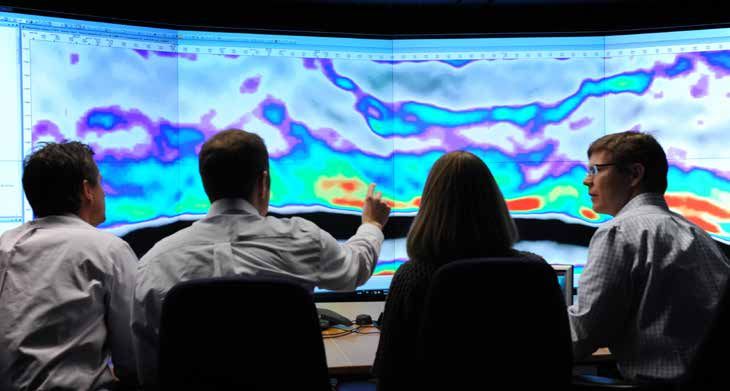
Exploration Production – operated fields
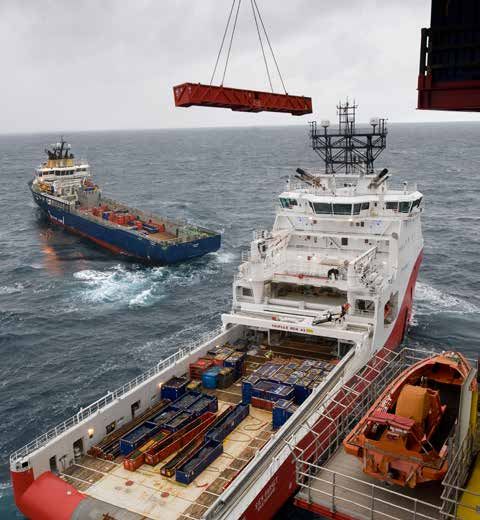
ExxonMobil has been an active player on the Norwegian exploration scene since 1965, when ExxonMobil operates the Ringhorne, Balder, Jotun and Sigyn fields on
Esso Norge AS was awarded the first three exploration licenses on the Norwegian Continental the Norwegian Continental Shelf (NCS). Total daily production from
Shelf (NCS). ExxonMobil is actively exploring blocks in more frontier areas and around existing these fields in 2013 was 61,000 barrels of o.e.
infrastructure in the North Sea and Haltenbanken.
The company has, both as an operator and as a ExxonMobil will continue to evaluate available Balder Jotun
partner in OBO (Operated By Others) projects, acreage in the North Sea, the Norwegian Sea and The Balder field is developed with a floating The Jotun field is developed with two installations; a
made many oil and gas discoveries. The success is the Barents Sea. Early 2014 the company was production, storage, and offloading vessel (FPSO) wellhead platform (Jotun B), which transfers
due to the application of state-of-the-art exploration awarded a license in the APA round (Awards in and several subsea production systems. The field is resources to production vessel Jotun A. The field is
technologies, a highly qualified and trained local pre-defined areas) for 2013. Activities relating to located in the North Sea, approximately 190 km located in the North Sea, 200 km west of Stavanger.
staff, and access to ExxonMobil’s technical expertise the 23rd licensing round in 2015 have started. Focus northwest of Stavanger. The Ringhorne platform is The average production rate in 2013 was 2,800 oil
on a global scale. for this round will be the Barents Sea, particularly the tied back to the Balder FPSO for processing and equivalent barrels per day. Jotun production has
border area to Russia, where acquisition of 3D export. Balder exports gas to Statpipe via the been on the decline over the last few years, thus
ExxonMobil has participated in many of the recent seismic has been initiated. production vessel, Jotun A. resulting in spare production capacity. In order to
discoveries made on the NCS. These finds were utilize this capacity, Balder has been connected
made near producing fields, which gives a short The company will continue the emphasis on Numerous upgrades to the Balder FPSO process to Jotun via a gas pipeline, while pipelines were
time from discovery to production. In the frontier, co-existence with other interests through flawless and compression systems have been carried out installed between Ringhorne and Jotun thereafter,
deepwater areas of the Norwegian Sea, ExxonMobil implementation of our exploration programs, with during the last few years, resulting in significantly allowing parts of the Ringhorne field to produce
has interests in two licenses: PL596 (Møre West), minimized impact on the environment. improved reliability. In 2013 the Balder FPSO to the Jotun FPSO, in addition to the Balder
PL598 (Ygg High). ExxonMobil is operator of the processed 36,000 barrels of oil per day, 17,000 FPSO.
Møre West license, and is a partner in the Ygg High. The company’s performance on the Norwegian barrels from the Balder field and 19,000 barrels
In 2013, acquisition of 2D seismic was conducted Continental Shelf to date, coupled with its world from the Ringhorne field. In 2013 Ringhorne sent an average of 9,700 barrels
in PL596, in order to identify the potential of the wide experience in environmentally sensitive areas, of oil per day to Jotun for final processing and
license. In PL598 interpretation of 3D seismic is in operating procedures and advanced technology, Seismic surveys in the Balder area were carried storage prior to export. In addition 7 million standard
progress to evaluate the license’s potential. Both ensures that sustainable co-existence with other out in 2009 and in 2012 to prepare for a drilling cubic feet per day (MCFD) of gas was exported to
licenses have volcanic rocks over the most interests will continue. campaign, which commenced in the first quarter Jotun from Balder and Ringhorne for further gas
interesting reservoir layers, which poses challenges Geoscientists in Norway of 2013 using the semi-submersible drilling unit export to Statpipe. As operator of the Jotun field,
studying seismic lines for
in terms of seismic data quality and evaluation of increased recovery on the “West Alpha”. Until now 3 new wells have been ExxonMobil has 45 per cent ownership interests.
the prospects. Balder and Ringhorne fields. put into production, which has boosted our Other partners are Dana (45 per cent), Det norske
production significantly. (7 per cent), and Faroe Petroleum (3 per cent).
ExxonMobil is the operator and has 100 per cent In 2012, modifications were made
ownership in the Balder field. to the Jotun facilities to tie-in the
Jette field. Production from Jette
Ringhorne commenced in spring 2013, and
The Ringhorne field is located about 9 km north Det norske oljeselskap, operator of
of the Balder FPSO and includes a platform with Jette, has entered into a production
initial processing and water injection capabilities. handling agreement with ExxonMobil.
Production is routed to the Balder and Jotun
installations for final processing, storage and Sigyn
offloading. The Sigyn field, which is located in
the Sleipner area in the North Sea,
Production commenced in February 2003, commenced production in 2002. The
thereafter including two discoveries in the western field consists of two gas/condensate
and eastern part of the field. The latter became producers and one oil producer that
on-stream in 2006. In 2013 the Ringhorne field are connected to the Sleipner A
produced an average of 28,000 barrels of oil platform via a subsea template. In
per day. 2013, the average production on
Sigyn was 26 million standard cubic
Photo: Kjetil Alsvik, ExxonMobil
ExxonMobil is the operator and has 100 per cent feet of gas per day and 6,000 barrels
ownership in the Ringhorne field, except for of condensate per day.
Ringhorne East where ExxonMobil’s equity is 77.4
per cent. The other Ringhorne East partners are ExxonMobil is the operator with
Statoil (14.8 per cent) and Faroe Petroleum 40 per cent ownership. The other
(7.8 per cent). participant is Statoil (60 per cent).
4 ExxonMobil in Norway 2014 ExxonMobil in Norway 2014 5
Production – Fields Operated By Others (OBO) Refining and logistics
ExxonMobil has ownership interests in over 20 producing fields on the Norwegian ExxonMobil’s refinery at Slagentangen near Tønsberg,
Continental Shelf (NCS), which are operated by others (Statoil and Shell). ExxonMobil’s inaugurated in 1961, is located in a sheltered location
net production from these fields per day in 2013 was about 194,000 o.e. barrels. by the Oslo Fjord.
The company also participates in a number of The refinery processes crude oil, mainly from the Approximately 60 per cent of the
development and modification projects related North Sea, into fuel products for consumption and refinery’s production of petroleum
to the fields, e.g. Kristin/Tyrihans low-pressure industrial purposes. The annual processing capacity products is exported, which makes
production, Svalin, Ormen Lange Onshore is 6 million tons of crude oil. The production of the refinery one of Norway’s largest
Compression and Åsgard Subsea Compression petroleum products represents more than half of onshore export businesses. All crude
projects. In 2013, the company participated in Norway’s total consumption. The lightest products oil and around 90 per cent of the total
over 30 production/injection wells, including five are propane and butane, followed by petrol, aviation production is offloaded and loaded at
exploration wells. fuel, kerosene, diesel and light fuel oil. The heaviest the jetty, which can receive ships up
Photo: Harald Pettersen, Statoil
product is heavy oil. Naturally the Slagentangen to 190,000 ton deadweight. Every
refinery produces sulphur free diesel (less than 10 year around 700 ships call on the
ppm sulphur), which is a prerequisite for modern, port.
environmentally friendly cars with catalyst treatment
of exhaust gases. The Slagentangen office also
manages the Supply, Transportation
In 2007, the refinery installed a plant for blending of and Distribution businesses.
biodiesel. It supplies diesel with up to 7 per cent Transportation & Supply conduct all
blend of a bio component based on rape oil. This ExxonMobil’s trade of crude oil and petroleum
low blend biodiesel can be used by all diesel cars products, both refinery production and production
EMWI % without causing any engine trouble, nor is it in from the fields in the North Sea. The Distribution
Sleipner Area conflict with guarantees given by the car department manages the company’s three main
manufacturers. Further market penetration of storage terminals located in Fredrikstad, Bergen and
Sleipner East 30.40
Sandnessjøen biofuels depends on the authorities’ adoption Trondheim, and the refinery’s truck loading facilities.
Sleipner West 32.24
of sustainability criteria, etc.
Volve 30.40 Brønnøysund
PL046 / Gungne 28.00 Kristin
Åsgard
Trestakk
Marketing
Tyrihans
Mikkel
Utsira Area
Grane 28.22
PL169 (C&M) 13.00
Ormen
Lange Trondheim ExxonMobil markets products both under the Esso and Mobil brands
Fram through a nationwide chain of around 260 retail service stations,
Fram 25.00
of which 44 are On-the-Run stations offering a broad selection of
®
Tampen Area Vigdis/
Tordis
Snorre
merchandise and meals. In 2007 the company introduced its first
Statfjord Unit 21.37
Statfjord North 25.00
Statfjord Fram Norway automated station under the name Esso Express.
Statfjord East 20.60
Sygna 21.02
Bergen
Oslo
ExxonMobil’s sales organization directly serves the a renewed series Mobil SHC for
wholesale segment. The end user segment is partly increased productivity in the industrial
Snorre Unit 17.43
Jotun based on sales directly to customers, and partly segment, are our flagships within
PL089 (Vigdis, Tordis) 16.10 Ringhorne Sweden through Esso Energi AS and other dealers. All kinds scientifically produced synthetic
Balder Grane
Stavanger of products are sold, but there is a special focus on quality oils. Mobil Autocare centers
Mid-Norway low sulphur and environmentally friendly heating for oil change and minor repairs are
Volve
Åsgard Unit 7.24 Sleipner products. The company will continue its major focus in operation, available at 14 Esso
Oil Fields
Mikkel 33.48 Sigyn
Gas Fields on the private residential market. In the Marine retail service stations.
ExxonMobil segment, ExxonMobil is an active marketing
Operated
Kristin (HWU) 10.88 ExxonMobil company of low sulphur gas oil as well as heavy ExxonMobil’s overall market share
Interest
Ormen Lange 6.34 Other oil produced at the Slagentangen refinery. for petroleum products is 19.0
Licenses
Tyrihans 11.75 Denmark 0 50 100 Km per cent.*
Trestakk 33.00 0 25 50 Miles
ExxonMobil is also an important player in the lubes
MAP-NO-NA-IM-0422
and special products markets. The world’s leading
synthetic motor oil Mobil1 to the auto segment and *Based on data from Statistics Norway.
6 ExxonMobil in Norway 2014 ExxonMobil in Norway 2014 7
Safety, health and environment
Continuation of the systematic work on safety, health and environment
has in 2013 been going on unabated.

Safety and health                                         since 1999, and the system is an important tool to                                            Emissions to air focus on CO2, NOx, and volatile             International comparisons show that the ExxonMobil
In the Upstream business, we are maintaining a            further develop safety measures and culture.                                                  organic compounds (nmVOC). In 2013 an increase               refinery at Slagentangen is one of the most energy
good safety performance, thus avoiding severe             Another important aspect is to mobilize employees                                             in the emissions of NOx and CO2 were recorded                efficient refineries in the world. Since the early
personnel injuries. The number of minor injuries is       and contractors to actively participate in identifying                                        compared to previous year. This is mainly due to             1990s, the refinery has implemented internal
also still at a very low level.                           and reporting hazards in order to eliminate these.                                            drilling activities made from semi-submersible rig           measures to save energy, and the use of energy
                                                          Among the target areas in the daily safe work effort                                          West Alpha on the Balder field, which were ongoing           today is 25 per cent more efficient than it was in
Since 2010 our main objective has been to improve         in 2014 is to improve risk management regarding                                               during the entire year. Emissions from the other             1990. The reason why CO2 emissions nevertheless
the overall safety culture. Three key drivers were        routine maintenance work and cooperation with                                                 production installations were kept at a low,                 have increased during this period, is mainly due to
identified: leadership, safety tools and alignment        contracted personnel.                                                                         stable level.                                                new environmental requirements to products, e.g.
with contractors. The leadership aspect includes                                                                                                                                                                     increased desulphurization. Furthermore, the
visibility, communication and messaging, and              ExxonMobil’s statistics for sick leave in Norway has                                          ExxonMobil has participated in CO2 quota trading             refinery has increased its processing capacity for
recognition of safe behavior. Based on the strong         for many years been low. In 2013 average quarterly                                            since 2008, and quotas equal to our CO2 emissions            crude oil. The refinery at Slagentangen has low
results that have been achieved until now, the            sickness absence varied between 2.5 and 3.2 per cent,                                         in 2013 were bought. All of ExxonMobil’s own                 emissions of CO2 compared to other refineries’
program will be continued in the years to come.           which is significantly lower than the national average.                                       operated licenses on the Norwegian Continental               emissions in Europe.
                                                                                                                                                        Shelf have been participants in the Business Sector’s
A new program aimed at preventing serious injuries        Environment                                                                                   NOx Fund since its start in 2008. The objective was
was introduced in 2012, and continued in 2013. The        The petroleum activities both onshore and offshore                                            to support the implementation of cost-effective
program is called Life Saving Actions and addresses       must be undertaken within the framework of a                                                  measures in order to reduce NOx emissions across
seven areas such as energy isolation, working at          sustainable development, and the environmental                                                all business sectors. The fund is financed by
heights, crane and lifting operations, etc., where the    challenges must be addressed in a manner that                                                 companies contributing with basis in the size of their
consequences of not following procedures can be           ensures coexistence with other interests. As an                                               own NOx emissions. ExxonMobil is on a continuous
severe. Although there have not been any severe           example, the consideration of the fisheries has been                                          basis evaluating the potential for implementing
incidents in the Upstream organization related to         a central element in the planning and                                                         company specific measures to cut NOx emissions,
these areas in recent years, the potential for such       implementation of drilling operations.                                                        which would qualify for support from the fund. The
accidents is always present, and avoiding them                                                                                                          rebuilding of the first of four diesel generators on
remains our main priority.                                To meet these challenges, the environmental                                                   Balder initiated in 2013 is partly financed by the fund.
                                                          program of ExxonMobil in Norway is fully integrated
Within Refining, Supply and Distribution there were       into the planning process and execution of all activities.                                    ExxonMobil’s cooperation with other operators to
no incidents in 2013 causing lost time among our          The environmental management system, which is                                                 ensure efficient reduction of emissions to air of
own employees or contractor personnel. The                aligned with the international standard ISO 14001, is                                         nmVOC in relation to offshore oil loading to shuttle
refinery passed a decade in operation without             designed to ensure systematic and continuous                                                  tankers has continued in 2013. The nmVOC
sustaining lost time injuries of any kind. The refinery   improvement within the environmental area.                                                    recovery facilities regarding storage of oil on the
had one incident that qualified for adapted work,                                                                                                       Balder and Jotun production ships have had an
and two incidents requiring medical treatment, all        ExxonMobil’s overall environmental                                                            efficiency of 97 and 100 per cent.
involving contractor personnel.                           objectives include:
                                                          • zero acute pollution                                                                        In 2013, systematic sorting and handling of waste
In our marketing organization there occurred in May       • maintain status of zero harmful discharges to sea                                           was performed on all ExxonMobil’s operated offshore
a serious accident with a tragic outcome, when a          • reduce emissions to air                                                                     installations, and all installations met the objective for
worker hired by a subcontractor lost his life following   • achieve high segregation of waste produced                                                  minimum 70 per cent of all waste to be sorted.
an industrial accident at one of Esso’s gas stations.     • minimize the risk of undesirable environmental
Preventive measures were immediately adopted for             incidents                                                                                  Environment – refining 2013
the same kind of work. Esso also carried out a            • more efficient use of energy                                                                The refinery delivers ”eco-diesel” in all qualities,
thorough investigation of the accident, and has since                                                                                                   including almost sulphur free ”eco-diesel” with less
implemented a number of measures to reduce the            Environment – exploration and Production 2013                                                 than 0.001 per cent sulphur content.
risk of working at height. Moreover, the police and       A series of measures continued to maintain
the Labor Inspection investigated the accident.           discharges to sea at the ExxonMobil operated fields                                            All the refinery’s emissions to air and water in 2013
                                                                                                                       Photo: Odd Furenes, ExxonMobil

                                                          at a minimum level. Jotun and Ringhorne have been                                             were within the permit limits, and there were no acute
Targeted and systematic efforts to reduce the             designed with solutions for discharging drilling waste                                        spills to the environment. However, two emissions of
probability for high potential incidents are              through injection. Substituting environmentally                                               propane/butane occurred, which were reported to
continuously ongoing, and we have developed a             harmful chemicals with more environmentally                                                   the Petroleum Safety Authority and followed up.
well-established system for reporting and analyzing       friendly alternatives has also made it possible to                                            Relevant emission figures and environmental focus
incidents that are typical to cause major incidents.      further reduce environmental risks related to                                                 areas for the refinery are further described in the
Our Loss Prevention System (LPS) has been effective       discharges to sea.                                                                            annual status report “Miljø og samfunnsansvar”.

8    ExxonMobil in Norway 2014                                                                                                                                                                                                                                             ExxonMobil in Norway 2014   9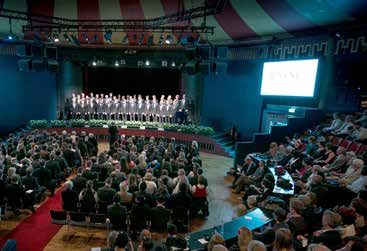
ExxonMobil’s contributions to society
ExxonMobil contributes to society in many ways through significant taxes, investments, creation
of jobs, participation in development and technology research projects, sharing knowledge, and
providing local societies with development opportunities. Furthermore, we contribute financially
to local communities through our contribution to sports, culture, education and social activities.
Listed below are some activities recently sponsored by ExxonMobil.

Cooperation with “Ungt Entreprenørskap” (Young                For many years ExxonMobil sponsored the car                                                                                     1    2
Entrepreneurship) on mathematics and science (3)              museum of Horten, where e.g. an Esso tanker from
As part of ExxonMobil’s global initiative for the             1931 is located. In addition the company has
promotion of education, the company has cooperated            contributed financially to several maritime cultural
with the organization “Ungt Entreprenørskap” since            projects in Tønsberg including the Naval Historical
2010. Together we have developed a pan-European               Center, repurchase and restoration of the listed
program for the purpose of motivating upper                   sailing-ship Berntine, and to the building of a replica
secondary pupils to opt for scientific subjects. In the US,   of the famous Oseberg viking ship in Tønsberg.
ExxonMobil has for several years successfully run a
similar project, the aim of which is to attract attention     Title sponsor of ExxonMobil Bislett Games (4)
to the significance of mathematics, natural science and       For the 27th year, ExxonMobil has been the title
technological skills in our society. Nine European            sponsor of the ExxonMobil Bislett Games, an
countries currently participate in the project.               international track and field event in Oslo. Featuring
                                                              in the Diamond League series, it renders Norway an
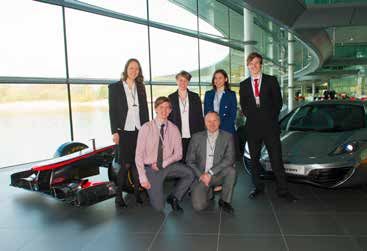
Cooperation on the teaching of geology (5)                    important nation in the world of athletics,
For several years, ExxonMobil has cooperated with             strengthening at the same time its position among                                                                               3    4
St. Olav upper secondary school in Stavanger on the           the public in our country. In addition to the
subject of geology. Geologists from our company               economic support provided, the event provides an
have contributed to create an education program               opportunity to raise awareness and funds for
partly based on authentic data from one of the                preventing the deadly disease malaria.
company ’s fields in the North Sea. The pupils work
on a project assignment to be presented to                    Cooperation with the Norwegian Red Cross
ExxonMobil professionals, for which they receive an           in the fight against malaria (1)
award. Subsequently, Sola upper secondary school              ExxonMobil and the Norwegian Red Cross have for
has copied parts of this program.                             several years cooperated on the occasion of the

                                                                                                                                                                                                                                                                          Photo: Thor Nielsen/NTNU Info
                                                              athletics meeting at Bislett Stadium to collect funds
Doctoral degree prizes – NTNU (6)                             for the fight against malaria. In 2012, this cooperation
For a number of years, ExxonMobil has awarded                 was extended. ExxonMobil gave significant funding
prizes annually for the best doctoral thesis at NTNU,         in support of an initiative to save thousands of lives
Trondheim, within the fields of basic as well as              from the deadly disease in several African countries
applied research. The company runs one of the                 by using a new mobile phone based tool. Together,                                                                               5    6
industry’s largest research programs.                         we also organize the business relay race “Race Against
                                                              Malaria” in Oslo. ExxonMobil is the world’s largest
Museums (2)                                                   non-pharmaceutical contributor in the fight against
Science centers are experiential centres of popular           malaria.                                                   2013. In 2013, the club had 90 teams in different           centre guild of Sandnes, and contributes financially
science, whose aim is to stimulate the interest of                                                                       leagues and has a wide-ranging offer to all age             to its operation. Thus, the centre is enabled to offer
children and young people in technology and natural           Main sponsor of the athletic clubs                         groups including active talent development.                 an exciting program with new major productions,
science, by means of activating and inspiring                 Sandnes Idrettslag and IL Skjalg                                                                                       reaching more than 75,000 visitors each year.
methods. ExxonMobil provides annual operational               In order to support recruitment and wide                   Domkirken Musikk, Stavanger
support to the science centre in the municipality of          participation in local athletics, the company has been     A significant part of the activities of the Cathedral of    The Vestfold International Festival
Sandnes, and to the Norwegian Petroleum Museum                the main sponsor of Skjalg Friidrett in Stavanger and      Stavanger and the city culture in general, its traditions   ExxonMobil has for many years been a contributor
in Stavanger. ExxonMobil has also donated several             Sandnes IL Friidrett for several years, where the main     of choral singing and concerts boast a long history.        to the Vestfold International Festival, an important
interactive and educational games.                            focus is the promotion of young, talented athletes         ExxonMobil supports the five Cathedral choirs,              promoter of music and dramatic art to the general
                                                                                                                         whose aim is to create high quality church music for        public through a lot of arrangements every summer.
ExxonMobil has also provided technical and financial          Flint fotball (soccer club)                                the enrichment of services and concert experiences.
support to a new exhibition on oil and gas at the             After having been a sponsor of the Esso Cup arranged                                                                   For more information about ExxonMobil’s corporate
Technical Museum in Oslo through the trade                    by Flint Fotball in Tønsberg for several years, the        Cultural Centre of Sandnes                                  social responsibility, visit our website:
organization Norwegian Oil and Gas.                           company extended its commitment in Flint Fotball in        ExxonMobil is one of the members of the cultural            www.exxonmobil.com/Corporate/community.aspx

10    ExxonMobil in Norway 2014                                                                                                                                                                                                               ExxonMobil in Norway 2014            11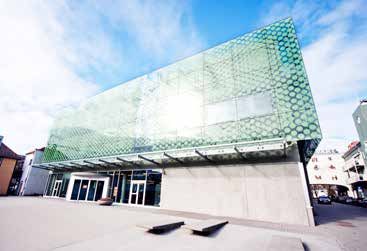
Forus               Oslo                  Slagen
                           Grensev. 6          Drammensv. 149        P.O. Box 2001
                           P.O. Box 60         P.O. Box 350 Skøyen   Postterminalen
Esso Norge AS
An ExxonMobil Subsidiary   4064 Stavanger      0212 Oslo             3103 Tønsberg
www.exxonmobil.no          Tel.: 51 60 60 60   Tel.: 22 66 30 30     Tel.: 33 37 73 00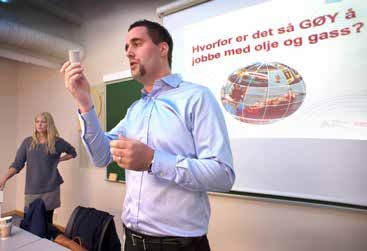

You can also read


