Federal Reserve Bank of Minneapolis - Modern Business Cycle Analysis: A Guide to the Prescott-Summers Debate (p. 3)
←
→
Page content transcription
If your browser does not render page correctly, please read the page content below
Federal Reserve Bank
of Minneapolis

Modern Business Cycle Analysis:
A Guide to the Prescott-Summers
Debate (p. 3)
Rodolfo E. Manuelli

Theory Ahead
of Business Cycle Measurement (p. 9)
Edward C. Prescott

Some Skeptical Observations
on Real Business Cycle Theory (p. 23)
Lawrence H. Summers

Response to a Skeptic (p. 28)
Edward C. Prescott

Federal Reserve Bank of Minneapolis

Quarterly Review
Vol. 10, NO. 4         ISSN 0271-5287

This publication primarily presents economic research aimed at improving
policymaking by the Federal Reserve System and other governmental
authorities.

Produced in the Research Department. Edited by Preston J. Miller and
Kathleen S. Rolte. Graphic design by Phil Swenson and typesetting by Barb
Cahlander and Terri Desormey, Graphic Services Department.

Address questions to the Research Department, Federal Reserve Bank,
Minneapolis, Minnesota 55480 (telephone 612-340-2341).

Articles may be reprinted it the source is credited and the Research
Department is provided with copies of reprints.

 The views expressed herein are those of the authors and not
necessarily those of the Federal Reserve Bank of Minneapolis or
the Federal Reserve System.
Federal Reserve Bank of Minneapolis
   Quarterly Review Fall 1986

   Theory Ahead of Business Cycle Measurement*

   Edward C. Prescott
   Adviser
   Research Department
   Federal Reserve Bank of Minneapolis
   and Professor of Economics
   University of Minnesota

Economists have long been puzzled by the observations         restricted to those that generate the growth observa-
that during peacetime industrial market economies             tions. The process governing the technology parameter
display recurrent, large fluctuations in output and           is selected to be consistent with the measured tech-
employment over relatively short time periods. Not            nology changes for the American economy since the
uncommon are changes as large as 10 percent within            Korean War. We ask whether these artificial econo-
only a couple of years. These observations are con-           mies display fluctuations with statistical properties
sidered puzzling because the associated movements in          similar to those which the American economy has dis-
labor's marginal product are small.                           played in that period. They do.1
   These observations should not be puzzling, for they           I view the growth model as a paradigm for macro
are what standard economic theory predicts. For the           analysis—analogous to the supply and demand con-
United States, in fact, given people's ability and willing-   struct of price theory. The elasticities of substitution
ness to intertemporally and intratemporally substitute        and the share parameters of the growth model are
consumption and leisure and given the nature of the           analogous to the price and income elasticities of price
changing production possibility set, it would be puz-         theory. Whether or not this paradigm dominates, as I
zling if the economy did not display these large fluctua-     expect it will, is still an open question. But the early
tions in output and employment with little associated         results indicate its power to organize our knowledge.
fluctuations in the marginal product of labor. Moreover,      The finding that when uncertainty in the rate of techno-
standard theory also correctly predicts the amplitude         logical change is incorporated into the growth model it
of these fluctuations, their serial correlation proper-
ties, and the fact that the investment component of out-
put is about six times as volatile as the consumption             *This paper was presented at a Carnegie-Rochester Conference on Public
component.                                                    Policy and will appear in a volume of the conference proceedings. It appears
                                                              here with the kind permission of Allan H. Meltzer, editor of that volume. The
   This perhaps surprising conclusion is the principal        author thanks Finn E. Kydland for helpful discussions of the issues reviewed
finding of a research program initiated by Kydland and        here, Gary D. Hansen for data series and some additional results for his growth
                                                              economy, Lars G. M. Ljungqvist for expert research assistance, Bruce D. Smith
me (1982) and extended by Kydland and me (1984),              and Allan H. Meltzer for comments on a preliminary draft, and the National
Hansen (1985a), and Bain (1985). We have computed             Science Foundation and the Minneapolis Federal Reserve Bank for financial
the competitive equilibrium stochastic process for            support. The views expressed herein are those of the author alone.
variants of the constant elasticity, stochastic growth            Others [Barro (1981) and Long and Plosser (1983), for example] have
                                                              argued that these fluctuations are not inconsistent with competitive theory that
model. The elasticities of substitution and the share         abstracts from monetary factors. Our finding is much stronger: standard theory
parameters of the production and utility functions are        predicts that the economy will display the business cycle phenomena.

                                                                                                                                            9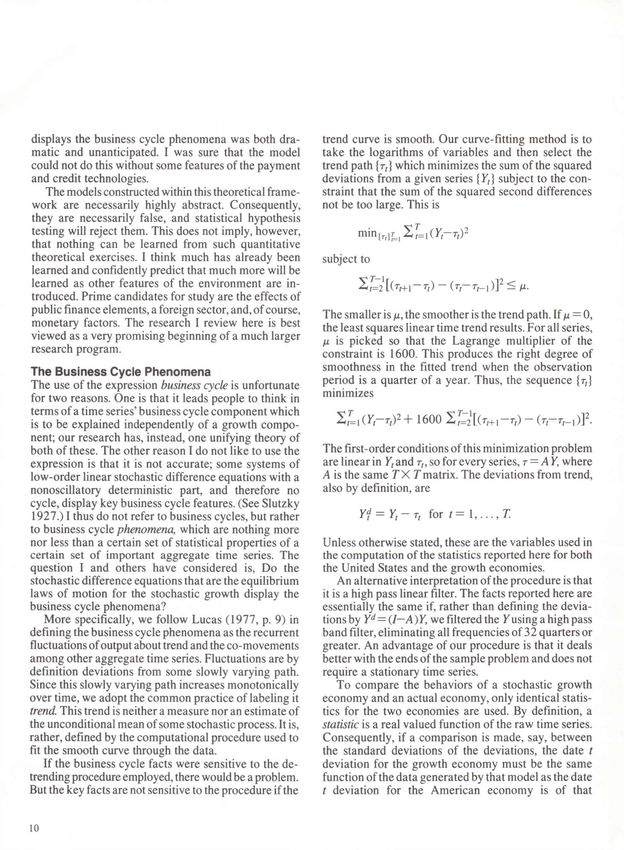
displays the business cycle phenomena was both dra-           trend curve is smooth. Our curve-fitting method is to
matic and unanticipated. I was sure that the model            take the logarithms of variables and then select the
could not do this without some features of the payment        trend path {r,} which minimizes the sum of the squared
and credit technologies.                                      deviations from a given series {Yt} subject to the con-
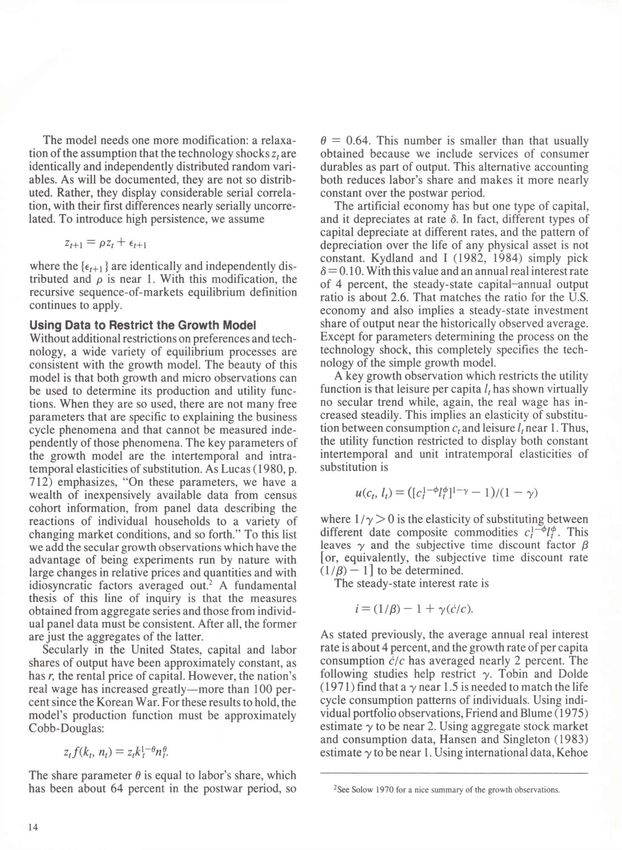
   The models constructed within this theoretical frame-      straint that the sum of the squared second differences
work are necessarily highly abstract. Consequently,           not be too large. This is
they are necessarily false, and statistical hypothesis
testing will reject them. This does not imply, however,               min { r / } t i Xf=i (Y-T t ) 2
that nothing can be learned from such quantitative
theoretical exercises. I think much has already been          subject to
learned and confidently predict that much more will be
learned as other features of the environment are in-                                        -   ( T - T   t   - O f ^   M-
troduced. Prime candidates for study are the effects of
public finance elements, a foreign sector, and, of course,    The smaller is iu, the smoother is the trend path. If /i = 0,
monetary factors. The research I review here is best          the least squares linear time trend results. For all series,
viewed as a very promising beginning of a much larger         fi is picked so that the Lagrange multiplier of the
research program.                                             constraint is 1600. This produces the right degree of
The Business Cycle Phenomena                                  smoothness in the fitted trend when the observation
The use of the expression business cycle is unfortunate       period is a quarter of a year. Thus, the sequence {r,}
for two reasons. One is that it leads people to think in      minimizes
terms of a time series' business cycle component which
is to be explained independently of a growth compo-              XLi(Y-rt)2+          1600 S ^ W l - r , ) " (r-r, t - { )?-
nent; our research has, instead, one unifying theory of
both of these. The other reason I do not like to use the      The first-order conditions of this minimization problem
expression is that it is not accurate; some systems of        are linear in Yt and r„ so for every series, t — AY, where
low-order linear stochastic difference equations with a       A is the same TX T matrix. The deviations from trend,
nonoscillatory deterministic part, and therefore no           also by definition, are
cycle, display key business cycle features. (See Slutzky
 1927.) I thus do not refer to business cycles, but rather            Yf = Yt— Tt for r = l , . . . , r .
to business cycle phenomena, which are nothing more
nor less than a certain set of statistical properties of a    Unless otherwise stated, these are the variables used in
certain set of important aggregate time series. The           the computation of the statistics reported here for both
question I and others have considered is, Do the              the United States and the growth economies.
stochastic difference equations that are the equilibrium          An alternative interpretation of the procedure is that
laws of motion for the stochastic growth display the          it is a high pass linear filter. The facts reported here are
business cycle phenomena?                                     essentially the same if, rather than defining the devia-
    More specifically, we follow Lucas (1977, p. 9) in        tions by Yd = (I~A)Y, we filtered the Yusing a high pass
defining the business cycle phenomena as the recurrent        band filter, eliminating all frequencies of 32 quarters or
fluctuations of output about trend and the co-movements       greater. An advantage of our procedure is that it deals
among other aggregate time series. Fluctuations are by        better with the ends of the sample problem and does not
definition deviations from some slowly varying path.          require a stationary time series.
Since this slowly varying path increases monotonically            To compare the behaviors of a stochastic growth
over time, we adopt the common practice of labeling it        economy and an actual economy, only identical statis-
trend. This trend is neither a measure nor an estimate of     tics for the two economies are used. By definition, a
the unconditional mean of some stochastic process. It is,     statistic is a real valued function of the raw time series.
rather, defined by the computational procedure used to        Consequently, if a comparison is made, say, between
fit the smooth curve through the data.                        the standard deviations of the deviations, the date t
    If the business cycle facts were sensitive to the de-     deviation for the growth economy must be the same
trending procedure employed, there would be a problem.        function of the data generated by that model as the date
But the key facts are not sensitive to the procedure if the   t deviation for the American economy is of that

10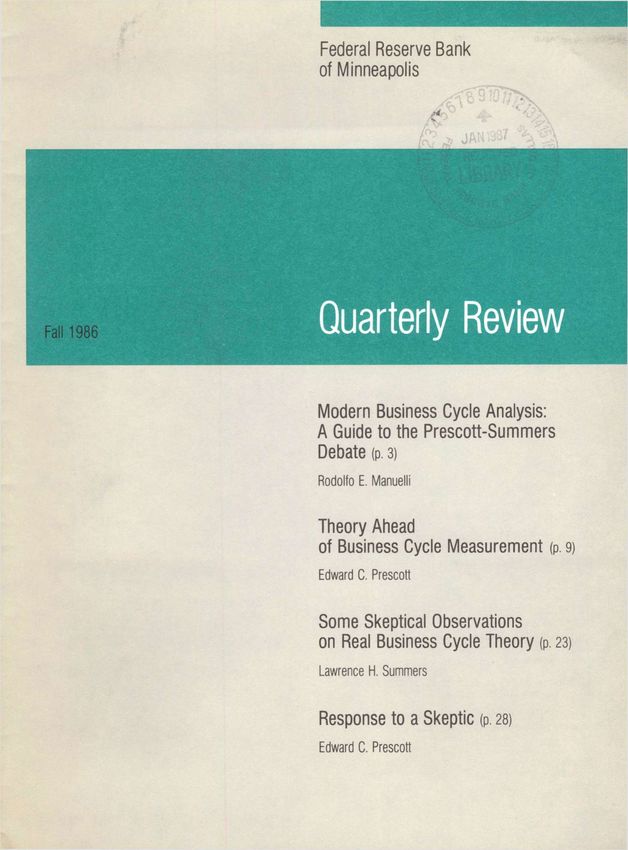
Edward C. Prescott
  Theory Ahead of Measurement

economy's data. Our definitions of the deviations
satisfy this criterion.                                     Figure 1
   Figure 1 plots the logs of actual and trend output for   Actual and Trend Logs of U.S. Gross National Product
the U.S. economy during 1947-82, and Figure 2 the           Quarterly, 1947-82
corresponding percentage deviations from trend of
output and hours of market employment. Output and
hours clearly move up and down together with nearly
the same amplitudes.
   Table 1 contains the standard deviations and cross
serial correlations of output and other aggregate time
series for the American economy during 1954-82.
Consumption appears less variable and investment
more variable than output. Further, the average product
of labor is procyclical but does not vary as much as
output or hours.
T h e G r o w t h Model
This theory and its variants build on the neoclassical
growth economy of Solow (1956) and Swan (1956). In
the language of Lucas (1980, p. 696), the model is a
"fully articulated, artificial economic system" that can
be used to generate economic time series of a set of
                                                                  Source of basic data: Citicorp's Citibase data bank
important economic aggregates. The model assumes an
aggregate production function with constant returns to
scale, inputs labor n and capital k, and an output which
                                                            Figure 2
can be allocated either to current consumption c or to
investment x. If t denotes the date, f : R 2 ^ R the        Deviations From Trend of Gross National Product
production function, and zt a technology parameter,         and Nonfarm Employee Hours in the United States
then the production constraint is                           Quarterly, 1947-82

        xt + ct < ztf(kt,       nt)                           %

where xtf ct, kt, nt > 0. The model further assumes that
the services provided by a unit of capital decrease
                                                                              Awl

                                                                                      A,tuM/\ Af
                                                                                      f
geometrically at a rate 0 < 8 < 1:
                                                                                      I
        kt+\ = (1 ~8)kt + xt.

Solow completes the specification of his economy by
hypothesizing that some fraction 0 < o < 1 of output is                                                 Hours                  |
invested and the remaining fraction 1 — o consumed
and that nt is a constant—say, h—for all t. For this
economy, the law of motion of capital condition on zt is
                                                                    Mil 1 II 11 1 11 11 1 1 1 1 1 1 1 1 1 1 1 1 1 1 1 1 1
                                                                    1947   1950                       1960              1970       1980 1982

        kt+\ = (1—8)kt + oztf(kt,     n).
                                                                  Source of basic data: Citicorp's Citibase data bank

Once the {zt} stochastic process is specified, the sto-
chastic process governing capital and the other eco-
nomic aggregates are determined and realizations of         the business cycle because in it neither employment nor
the stochastic process can be generated by a computer.      the savings rate varies, when in fact they do. Being
   This structure is far from adequate for the study of     explicit about the economy, however, naturally leads to

                                                                                                                                               11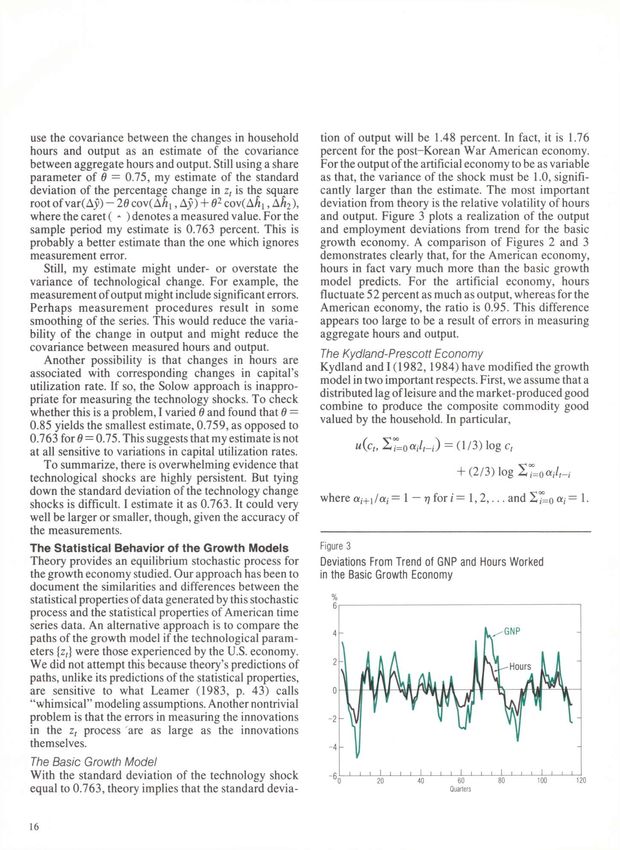
Table 1
Cyclical Behavior of the U.S. Economy
Deviations From Trend of Key Variables, 1954:1-1982:4

                                                                                                   Cross Correlation of GNP With
                                                                                 Standard
                          Variable/                                              Deviation      x(M)           x(t)         x(/+1)

                           Gross National Product                                  1.8%           .82         1.00           .82

                           Personal Consumption Expenditures
                              Services                                              .6            .66          .72           .61
                               Nondurable Goods                                    1.2            .71          .76           .59

                           Fixed Investment Expenditures                          5.3             .78          .89           .78
                               Nonresidential Investment                          5.2             .54          .79           .86
                                   Structures                                     4.6             .42          .62           .70
                                   Equipment                                      6.0             .56          .82           .87

                           Capital Stocks
                              Total Nonfarm Inventories                           1.7              .15          .48          .68
                              Nonresidential Structures                            .4            -.20         -.03           .16
                              Nonresidential Equipment                            1.0              .03          .23          .41

                           Labor Input
                              Nonfarm Hours                                       1.7             .57          .85           .89
                              Average Weekly Hours in Mfg.                        1.0             .76          .85           .61

                           Productivity (GNP/Hours)                               1.0             .51          .34          -.04

                           Source of basic data: Citicorp's Citibase data bank

the question of what determines these variables, which                                    Zoo commodity-space economy. That existence argu-
are central to the cycle.                                                                 ment, however, does not provide an algorithm for
   That leads to the introduction of a stand-in house-                                    computing the equilibria. An alternative approach is to
hold with some explicit preferences. If we abstract from                                  use the competitive welfare theorems of Debreu (1954).
the labor supply decision and uncertainty (that is,                                       Given local nonsaturation and no externalities, compet-
zt = z and nt = n\ the standard form of the utility                                       itive equilibria are Pareto optima and, with some
function is                                                                               additional conditions that are satisfied for this econ-
                                                                                          omy, any Pareto optimum can be supported as a
          27=o j8'n(c,) for 0 < p < 1                                                     competitive equilibrium. Given a single agent and the
                                                                                          convexity, there is a unique optimum and that optimum
where (3 is the subjective time discount factor. The                                      is the unique competitive equilibrium allocation. The
function u: /?+ — /? is twice differentiable and concave.                                 advantage of this approach is that algorithms for
The commodity space for the deterministic version of                                      computing solutions to concave programming prob-
this model is Z^, infinite sequences of uniformly bound-                                  lems can be used to find the competitive equilibrium
ed consumptions {ct}°?=0.                                                                 allocation for this economy.
   The theorems of Bewley (1972) could be applied to                                          Even with the savings decision endogenous, this
establish existence of a competitive equilibrium for this                                 economy has no fluctuations. As shown by Cass (1965)

12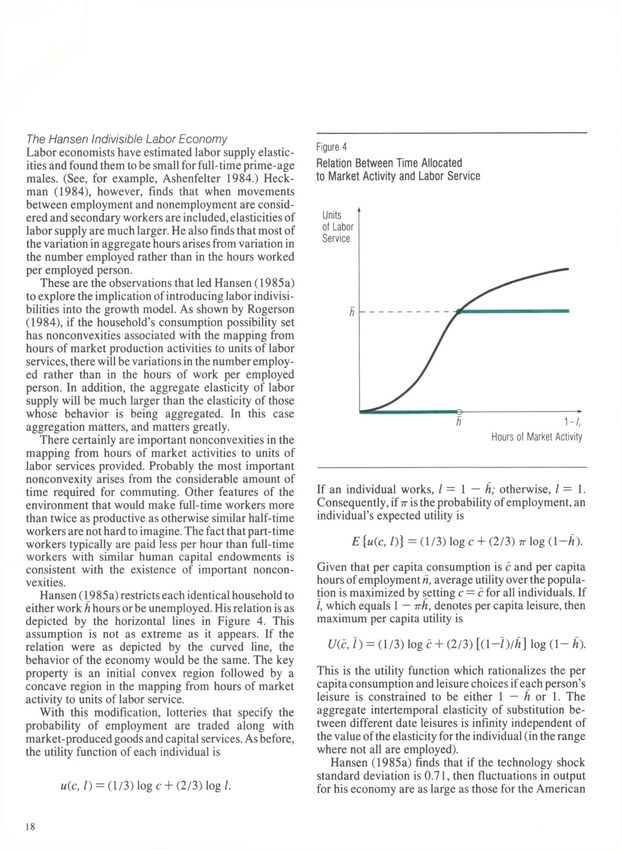
Edward C. Prescott
   Theory Ahead of Measurement

and Koopmans (1965), the competitive equilibrium                and given a0 — k0. In forming expectations, a household
path converges monotonically to a unique rest point or,         knows the relation between the economy's state (k t , zt)
if zt is growing exponentially, to a balanced growth            and prices, wt = xv(kt, zt) and rt = r(kt, zt). Further, it
path. There are multisector variants of this model in           knows the process governing the evolution of the per
which the equilibrium path oscillates. (See Benhabib            capita capital stock, a variable which, like prices, is
and Nishimura 1985 and Marimon 1984.) But I know                taken as given.
of no multisector model which has been restricted to               The elements needed to define a sequence-of-
match observed factor shares by sector, which has a             markets equilibrium are the firm's policy functions
value for p consistent with observed interest rates, and        y(kt, zt), n(kt, zt\ and k(ktf z,); the household's policy
which displays oscillations.                                    functions x(atf kt, zt) and c(at, kt, zt)\ a law of motion of
   When uncertainty is introduced, the household's              per capita capital kt+ \ = g(kt, zt)\ and pricing functions
objective is its expected discounted utility:                   w(kt, zt) and r(kt, zt). For equilibrium, then,

         E{XUp'u(ct)}.                                             • The firm's policy functions must be optimal given
                                                                     the pricing functions.
The commodity vector is now indexed by the history
of shocks; that is, {ct(z{,. . . , z,)}7=o is the commodity        • The household's policy functions must be optimal
point. As Brock and Mirman (1972) show, if the {zt} are              given the pricing functions and the law of motion
identically distributed random variables, an optimum to              of per capita capital.
the social planner's problem exists and the optimum is a           • Spot markets clear; that is, for all kt and zt
stationary stochastic process with            = g(kt, zt) and
ct = c(kt, zt). As Lucas and Prescott (1971) show, for a                   h — n(kt, zt)
class of economies that include this one, the social
optimum is the unique competitive equilibrium alloca-                      kf   k(kff zt)
tion. They also show that for these homogeneous agent
economies, the social optimum is also the unique                           x(kt, kt, zt) + c(kt, kt) zt) = y(kh zt).
sequence-of-markets equilibrium allocation. Conse-
quently, there are equilibrium time-invariant functions              (Note that the goods market must clear only when
for the wage wt = w(kt, zt) and the rental price of capital           the representative household is truly representa-
rt = r(kt, zt\ where these prices are relative to the date t          tive, that is, when at = kt.)
consumption good. Given these prices, the firm's period
t problem is                                                       • Expectations are rational; that is,

         max ku „,>o {yt ~ rtkt - wtnt}                                    g(kt> z,) = (1 ~d)kt + x(kt, kt, zt).

subject to the output constraint                                   This definition still holds if the household values
                                                                productive time that is allocated to nonmarket activi-
         yt < ztf(kt, nt).                                      ties. Such time will be called leisure and denoted lt. The
                                                                productive time endowment is normalized to 1, and the
   The household's problem is more complicated, for it          household faces the constraints
must form expectations of future prices. If at is its
capital stock, its problem is                                           nt + lt< 1

         max E S7=o P*u(ct)                                     for all t. In addition, leisure is introduced as an argument
                                                                of the utility function, so the household's objective
subject to                                                      becomes the maximization of

         ct + xt < wtn + rtat                                           E X7=o Plu{cu       lt\

                                                                Now leisure—and therefore employment—varies in
         at+i
The model needs one more modification: a relaxa-           d = 0.64. This number is smaller than that usually
tion of the assumption that the technology shocks zt are      obtained because we include services of consumer
identically and independently distributed random vari-        durables as part of output. This alternative accounting
ables. As will be documented, they are not so distrib-        both reduces labor's share and makes it more nearly
uted. Rather, they display considerable serial correla-       constant over the postwar period.
tion, with their first differences nearly serially uncorre-      The artificial economy has but one type of capital,
cted. To introduce high persistence, we assume                and it depreciates at rate
Edward C. Prescott
   Theory Ahead of Measurement

(1984) also finds a modest curvature parameter 7. All          changes are px = —0.21, p2 = —0.06, p3 = 0.04, p4 =
these observations make a strong case that 7 is not too        0.01, and p5 = —0.05. To a first approximation, the
far from 1. Since the nature of fluctuations of the            process on the percentage change in the technology
artificial economy is not very sensitive to 7, we simply       process is a random walk with drift plus some serially
set 7 equal to 1. Taking the limit as 7 — 1 yields             uncorrelated measurement error. This error produces
                                                               the negative first-order serial correlation of the differ-
         u(ct, /,) = ( 1 - 0 ) log ct +  log /,.            ences.
                                                                   Further evidence that the random walk model is not
This leaves /? and  still to be determined.                 a bad approximation is based on yearly changes. For the
   Hansen (1985b) has found that growing economies—            quarterly random walk model, the standard deviation of
that is, those with zt having a multiplicative, geometrical-   this change is 6.63 times the standard deviation of the
ly growing factor (1 + \ y with A > 0—fluctuate in             quarterly change. For the U.S. data, the annual change
essentially the same way as economies for which A = 0.         is only 5.64 times as large as the quarterly change. This,
This justifies considering only the case k = 0. If A = 0,      along with the negative first-order serial correlation,
then the average interest rate approximately equals the        suggests that the standard deviation of the persistent
subjective time discount rate.3 Therefore, we set /? equal     part of the quarterly change is closer to 5.64/6.63 =
to 0.96 per year or 0.99 per quarter.                          0.85 than to 1.2 percent. Some further evidence is the
   The parameter  is the leisure share parameter.           change over four-quarter periods—that is, the change
Ghez and Becker (1975) find that the household                 from a given quarter of one year to the same quarter of
allocates approximately one-third of its productive            the next year. For the random walk model, the standard
time to market activities and two-thirds to nonmarket          deviation of these changes is 2 times the standard
activities. To be consistent with that, the model's            deviation of the quarterly change. A reason that the
parameter 4> must be near two-thirds. This is the value        standard deviation of change might be better measured
assumed in our business cycle studies.                         this way is that the measurement noise introduced by
   Eichenbaum, Hansen, and Singleton (1984) use                seasonal factors is minimized. The estimate obtained in
aggregate data to estimate this share parameter , and       this way is 0.95 percent. To summarize, Solow growth
they obtain a value near five-sixths. The difference           accounting finds that the process on the technology
between two-thirds and five-sixths is large in the             parameter is highly persistent with the standard devia-
business cycle context. With  = 2/3, the elasticity of      tion of change being about 0.90.5
labor supply with respect to a temporary change in the             The Solow estimate of the standard deviation of
real wage is 2, while if $ = 5/6, it is 5. This is because a   technological change is surely an overstatement of the
1 percent change in leisure implies a /(—1) percent      variability of that parameter. There undoubtedly are
change in hours of employment.                                 non-negligible errors in measuring the inputs. Since the
   We do not follow the Eichenbaum-Hansen-Single-              capital input varies slowly and its share is small, the
ton approach and treat  as a free parameter because it      most serious measurement problem is with the labor
would violate the principle that parameters cannot be          input. Fortunately there are two independent measures
specific to the phenomena being studied. What sort of          of the aggregate labor input, one constructed from a
science would economics be if micro studies used one           survey of employers and the other from a survey of
share parameter and aggregate studies another?                 households. Under the assumption of orthogonality of
                                                               their measurement errors, a reasonable estimate of the
The Nature of the Technological      Change                    variance of the change in hours is the covariance
One method of measuring technological change is to             between the changes in the two series. Since the house-
follow Solow (1957) and define it as the changes in            hold survey is not used to estimate aggregate output, I
output less the sum of the changes in labor's input times
labor share and the changes in capital's input times               3
                                                                     Actually, the average interest rate is slightly lower because of risk premia.
capital share. Measuring variables in logs, this is the        Given the value of y and the amount of uncertainty, the average premium is
percentage change in the technology parameter of the           only a fraction of a percent. See Mehra and Prescott 1985 for further details.
Cobb-Douglas production function. For the U.S. econ-              4
                                                                    I use Hansen's (1984) human capital-weighted, household hour series.
                                                               The capital stock and GNP series are from Citicorp's Citibase data bank.
omy between the third quarter of 1955 and the first                5
                                                                     The process z,+i = .9z, + e,+i is, like the random walk process, highly
quarter of 1984, the standard deviation of this change         persistent. Kydland and I find that it and the random walk result in essentially
is 1.2 percent.4 The serial autocorrelations of these          the same fluctuations.

                                                                                                                                               15
use the covariance between the changes in household            tion of output will be 1.48 percent. In fact, it is 1.76
hours and output as an estimate of the covariance              percent for the post-Korean War American economy.
between aggregate hours and output. Still using a share        For the output of the artificial economy to be as variable
parameter of 0 = 0.75, my estimate of the standard             as that, the variance of the shock must be 1.0, signifi-
deviation of the percentage change in zt is the square         cantly larger than the estimate. The most important
root of var(Ay) - 26 cov(Ah { , Ay) + 02 cov(Ah{, Ah 2 \       deviation from theory is the relative volatility of hours
where the caret ( - ) denotes a measured value. For the        and output. Figure 3 plots a realization of the output
sample period my estimate is 0.763 percent. This is            and employment deviations from trend for the basic
probably a better estimate than the one which ignores          growth economy. A comparison of Figures 2 and 3
measurement error.                                             demonstrates clearly that, for the American economy,
   Still, my estimate might under- or overstate the            hours in fact vary much more than the basic growth
variance of technological change. For example, the             model predicts. For the artificial economy, hours
measurement of output might include significant errors.        fluctuate 52 percent as much as output, whereas for the
Perhaps measurement procedures result in some                  American economy, the ratio is 0.95. This difference
smoothing of the series. This would reduce the varia-          appears too large to be a result of errors in measuring
bility of the change in output and might reduce the            aggregate hours and output.
covariance between measured hours and output.
                                                               The Kydland-Prescott       Economy
   Another possibility is that changes in hours are
                                                               Kydland and I (1982,1984) have modified the growth
associated with corresponding changes in capital's
                                                               model in two important respects. First, we assume that a
utilization rate. If so, the Solow approach is inappro-
                                                               distributed lag of leisure and the market-produced good
priate for measuring the technology shocks. To check
                                                               combine to produce the composite commodity good
whether this is a problem, I varied 0 and found that 0 =
                                                               valued by the household. In particular,
0.85 yields the smallest estimate, 0.759, as opposed to
0.763 for 0 = 0.75. This suggests that my estimate is not
                                                                          u(ct, X7=o ah-i)   = (1/3) log ct
at all sensitive to variations in capital utilization rates.
   To summarize, there is overwhelming evidence that
                                                                                                + (2/3) log 27=o a;',-;
technological shocks are highly persistent. But tying
down the standard deviation of the technology change
                                                               where a I + 1 / a / = 1 —17 for / = 1 , 2 , . . . and X7=o   = 1•
shocks is difficult. I estimate it as 0.763. It could very
well be larger or smaller, though, given the accuracy of
the measurements.
The Statistical Behavior of the Growth Models                  Figure 3
Theory provides an equilibrium stochastic process for          Deviations From Trend of GNP and Hours Worked
the growth economy studied. Our approach has been to           in the Basic Growth Economy
document the similarities and differences between the
statistical properties of data generated by this stochastic
process and the statistical properties of American time
series data. An alternative approach is to compare the
paths of the growth model if the technological param-
eters {zt} were those experienced by the U.S. economy.
We did not attempt this because theory's predictions of
paths, unlike its predictions of the statistical properties,
are sensitive to what Learner (1983, p. 43) calls
"whimsical" modeling assumptions. Another nontrivial
problem is that the errors in measuring the innovations
in the zt process are as large as the innovations
themselves.
The Basic Growth Model
With the standard deviation of the technology shock
equal to 0.763, theory implies that the standard devia-

16
Edward C. Prescott
Theory Ahead of Measurement
Table 2
Cyclical Behavior of the Kydland-Prescott Economy*
Cross Correlation of GNP With
Standard
Variable x Deviation *(M) *(/) *(/+D
Gross National Product 1.79% .60 1.00 .60
(.13) (.07) (-) (.07)
Consumption .45 .47 .85 .71
(.05) (.05) (.02) (.04)
Investment 5.49 .52 .88 .78
(.41) (.09) (.03) (.03)
Inventory Stock 2.20 .14 .60 .52
(.37) (.14) (08) (.05)
Capital Stock .47 -.05 .02 .25
(.07) (.07) (.06) (07)
Hours 1.23 .52 .95 .55
(.09) (.09) (.01) (06)
Productivity (GNP/Hours) .71 .62 .86 .56
(.06) (.05) (.02) (.10)
Real Interest Rate (Annual) .22 .65 .60 .36
(.03) (.07) (.20) (.15)
'These are the means of 20 simulations, each of which was 116 periods long. The numbers in parentheses are standard errors.
Source: Kydland and Prescott 1984
Kydland (1983) provides justification for this prefer- the technology shock is 0.72 percent, then fluctuations
ence ordering based on an unmeasured, household- in the output of this artificial economy are as large as
specific capital stock that, like ct and l t , is an input in the those experienced in the U.S. economy.
production of the composite commodity. The economy A comparison of Tables 1 and 2 shows that the
studied has a 0 = 0-5 and 77 = 0.1. This increases the Kydland-Prescott economy displays the business cycle
variability of hours. phenomena. It does not quite demonstrate, however,
The second modification is to permit the workweek that there would be a puzzle if the economy did not
of capital to vary proportionally to the workweek of the display the business cycle phenomena. That is because
household. For this economy, increases in hours do not the parameters a 0 a n d rj have not been well tied down
reduce the marginal product of labor as much, so hours by micro observations.6 Better measures of these param-
fluctuate more in response to technology shocks of a eters could either increase or decrease significantly the
given size. amount of the fluctuations accounted for by the uncer-
The statistical properties of the fluctuations for this tainty in the technological change.
economy are reported in Table 2. As is clear there,
hours are now about 70 percent as variable as output.
This eliminates much of the discrepancy between 6
Hotz, Kydland, and Sedlacek (1985) use annual panel data to estimate ao
theory and measurement. If the standard deviation of and rj and obtain estimates near the Kydland-Prescott assumed values.
17The Hansen Indivisible Labor Economy
Figure 4
Labor economists have estimated labor supply elastic-
ities and found them to be small for full-time prime-age Relation Between Time Allocated
males. (See, for example, Ashenfelter 1984.) Heck- to Market Activity and Labor Service
man (1984), however, finds that when movements
between employment and nonemployment are consid-
ered and secondary workers are included, elasticities of
labor supply are much larger. He also finds that most of
the variation in aggregate hours arises from variation in
the number employed rather than in the hours worked
per employed person.
These are the observations that led Hansen (1985a)
to explore the implication of introducing labor indivisi-
bilities into the growth model. As shown by Rogerson
(1984), if the household's consumption possibility set
has nonconvexities associated with the mapping from
hours of market production activities to units of labor
services, there will be variations in the number employ-
ed rather than in the hours of work per employed
person. In addition, the aggregate elasticity of labor
supply will be much larger than the elasticity of those
whose behavior is being aggregated. In this case
aggregation matters, and matters greatly.
There certainly are important nonconvexities in the Hours of Market Activity
mapping from hours of market activities to units of
labor services provided. Probably the most important
nonconvexity arises from the considerable amount of
time required for commuting. Other features of the If an individual works, / = 1 — h; otherwise, 1=1.
environment that would make full-time workers more Consequently, if tt is the probability of employment, an
than twice as productive as otherwise similar half-time individual's expected utility is
workers are not hard to imagine. The fact that part-time
workers typically are paid less per hour than full-time E {u(c, I)} = (1/3) log c + (2/3) tt log ( 1 - / 0 .
workers with similar human capital endowments is
consistent with the existence of important noncon- Given that per capita consumption is c and per capita
vexities. hours of employment h, average utility over the popula-
Hansen (1985a) restricts each identical household to tion is maximized by setting c = c for all individuals. If
either work h hours or be unemployed. His relation is as /, which equals 1 — ivh} denotes per capita leisure, then
depicted by the horizontal lines in Figure 4. This maximum per capita utility is
assumption is not as extreme as it appears. If the
relation were as depicted by the curved line, the t/(c, 7) = (1/3) log c + (2/3) [(1 - l ) / h ] log ( 1 - h).
behavior of the economy would be the same. The key
property is an initial convex region followed by a This is the utility function which rationalizes the per
concave region in the mapping from hours of market capita consumption and leisure choices if each person's
activity to units of labor service. leisure is constrained to be either 1 — h or 1. The
With this modification, lotteries that specify the aggregate intertemporal elasticity of substitution be-
probability of employment are traded along with tween different date leisures is infinity independent of
market-produced goods and capital services. As before, the value of the elasticity for the individual (in the range
the utility function of each individual is where not all are employed).
Hansen (1985a) finds that if the technology shock
standard deviation is 0.71, then fluctuations in output
u(c, I) = (1/3) log c + (2/3) log /. for his economy are as large as those for the American
18Edward C. Prescott
Theory Ahead of Measurement
economy. Further, variability in hours is 77 percent as
large as variability in output. Figure 5 shows that Figure 5
aggregate hours and output for his economy fluctuate Deviations From Trend of GNP and Hours Worked
together with nearly the same amplitude. These theo- in Hansen's Indivisible Labor Economy
retical findings are the basis for my statement in the
%
introduction that there would be a puzzle if the
economy did not display the business cycle phenomena.
WW h V
Empirical Labor Elasticity -GNP
One important empirical implication of a shock-to-
technology theory of fluctuations is that the empirical
r
labor elasticity of output is significantly larger than the
n! I
H
true elasticity, which for the Cobb-Douglas production
f
function is the labor share parameter. To see why, note
that the capital stock varies little cyclically and is nearly
, v T f y f
uncorrelated with output. Consequently, the deviations
almost satisfy
yt=dht + zt 1 11 1 1 1 1 1 1 1 1 1 1 1 11 1 11 1 1 1
0 20 40 60 80 100 120
Quarters
where yt is output, ht hours, and zt the technology shock.
The empirical elasticity is Source: Gary D. Hansen, Department of Economics, University of California, Santa Barbara
r] = COv(ht, yt)/\ar(ht)
which, because of the positive correlation between ht output has small variance or e u is uncorrelated with the
and zt, is considerably larger than the model's 6, which hours measurement errors or both, the covariance
is 0.64. For the basic, Kydland-Prescott, and Hansen between measured output and either measured hours
growth economies, the values of 77 are 1.9,1.4, and 1.3, series is a reasonable estimate of the covariance
respectively. between output and hours. These two covariances are
Because of measurement errors, the empirical elastic- 2.231 X 10~4 and 2.244 X 10"4 for the sample period,
ity for the American economy is not well-estimated by and I take the average as my estimate of cov(h t , yt) for
simply computing the ratio of the covariance between the American economy. My estimate of the empirical
hours and output and dividing by the variance of hours. labor elasticity of output is
The procedure I use is based on the following proba-
bility model: 77 = [cov(hu, yt) + co\(h2t, yt)]/2 cov(h u , h2t)
yt = yt + = 1.1.
ht = ht + e2t
This number is considerably greater than labor's share,
which is about 0.70 when services of consumer dur-
hit = ht+ e3t ables are not included as part of output. This number
strongly supports the importance of technological
where the caret ( - ) denotes a measured value. The eit shocks in accounting for business cycle fluctuations.
are measurement errors. Here, the hu measure of hours Nevertheless, the number is smaller than those for the
uses the employer survey data while the h2t measure Kydland-Prescott and Hansen growth economies.
uses the household survey data. Since these are inde- One possible reason for the difference between the
pendent measures, a maintained hypothesis is that e2t U.S. economy and the growth model empirical labor
and e3, are orthogonal. With this assumption, a reason- elasticities of output is cyclical measurement errors in
able estimate of;var(/z,) is the sample covariance output. A sizable part of the investment component of
between hu and h2t. Insofar as the measurement of output is hard to measure and therefore not included in
19the U.S. National Product Accounts measure of output, effect on the aggregate production function. Therefore,
the gross national product (GNP). In particular, a firm's insofar as they are important, they reduce the empirical
major maintenance expenditures, research and develop- labor elasticity of output.
ment expenditures, and investments in human capital
are not included in GNP. In good times—namely, when Extensions
output is above trend—firms may be more likely to The growth model has been extended to provide a
undertake major repairs of a not fully depreciated asset, better representation of the technology. Kydland and I
such as replacing the roof of a 30-year-old building (1982) have introduced a technology with more than
which has a tax life of 35 years. Such an expenditure is one construction period for new production capacity.7
counted as maintenance and therefore not included in We have also introduced inventory as a factor of
GNP even though the new roof will provide productive production. This improves the match between the
services for many years. The incentive for firms to do model's serial correlation properties and the U.S.
this is tax savings: by expensing an investment rather postwar data, but has little effect on the other statistics.
than capitalizing it, current tax liabilities are reduced. Kydland (1984) has introduced heterogeneity of
Before 1984, when a railroad replaced its 90-pound labor and found that if there are transfers from high
rails, the expenditure was treated as a maintenance human capital people to low human capital people,
expense rather than an investment expenditure. If these theory implies that hours of the low fluctuate more than
and other types of unmeasured investment fluctuate in hours of the high. It also implies a lower empirical labor
percentage terms more than output, as do all the elasticity of output than the homogeneous household
measured investment components, the volatility of model.
GNP is larger than measured. We do know that Bain (1985) has studied an economy that is richer in
investment in rails was highly procyclical and volatile sectoral detail. His model has manufacturing, retailing,
in the postwar period. A careful study is needed to and service-producing sectors. A key feature of the
determine whether the correction for currently un- technology is that production and distribution occur
measured investment is small or large. sequentially. Thus there are two types of inventories—
Another reason to expect the American economy's those of manufacturers' finished goods and those of
labor elasticity to be less than the model's is that the final goods available for sale. With this richer detail,
model shocks are perfectly neutral with respect to the theory implies that different components of aggregate
consumption and investment good transformation. Per- inventories behave in different ways, as seen in the data.
sistent shocks which alter the product transformation It also implies that production is more volatile than final
frontier between these goods would cause variation in sales, an observation considered anomalous since inven-
output and employment but not in the productivity tories can be used to smooth production. (See, for
parameters. For fluctuations so induced, the empirical example, Blinder 1984.)
labor elasticity of output would be the true elasticity. Much has been done. But much more remains to be
Similarly, relatively permanent changes in the taxing of explored. For example, public finance considerations
capital—such as altering depreciation rates, the cor- could be introduced and theory used to predict their
porate income tax rate, or the investment tax credit implications. As mentioned above, factors which affect
rate—would all result in fluctuations in output and the rental price of capital affect employment and
employment but not in the productivity parameters. output, and the nature of the tax system affects the
A final reason for actual labor elasticity to be less rental price of capital. Theory could be used to predict
than the model's is the way imports are measured. An the effect of temporary increases in government expendi-
increase in the price of imported oil, that is, an increase tures such as those in the early 1950s when defense
in the quantity of output that must be sacrificed for a expenditures increased from less than 5 to more than 13
given unit of that input, has no effect on measured percent of GNP. Theory of this type could also be used
productivity. From the point of view of the growth to predict the effect of terms-of-trade shocks. An
model, however, an oil price increase is a negative implication of such an exercise most likely will be that
technology shock because it results in less output, net of economies with persistent terms-of-trade shocks fluctu-
the exports used to pay for the imported oil, available
for domestic consumption and investment. Theory 7
predicts that such shocks will induce variations in Altug (1983) has introduced two types of capital with different gestation
periods. Using formal econometric methods, she finds evidence that the model's
employment and output, even though they have no fit is improved if plant and equipment investment are not aggregated.
20Edward C. Prescott
Theory Ahead of Measurement
ate differently than economies with transitory shocks. If theoretical research. This feedback between theory and
so, this prediction can be tested against the observa- measurement is the way mature, quantitative sciences
tions. advance.
Another interesting extension would be to explicitly The policy implication of this research is that costly
model household production. This production often efforts at stabilization are likely to be counterproduc-
involves two people, with one specializing in market tive. Economic fluctuations are optimal responses to
production and the other specializing in household uncertainty in the rate of technological change. How-
production while having intermittent or part-time ever, this does not imply that the amount of techno-
market employment. The fact that, cyclically, the logical change is optimal or invariant to policy. The
employment of secondary wage earners is much more average rate of technological change varies much both
volatile than that of primary wage earners might be over time within a country and across national econo-
explained. mies. What is needed is an understanding of the factors
A final example of an interesting and not yet that determine the average rate at which technology
answered question is, How would the behavior of the advances. Such a theory surely will depend on the
Hansen indivisible labor economy change if agents did institutional arrangements societies adopt. If policies
not have access to a technology to insure against adopted to stabilize the economy reduce the average
random unemployment and instead had to self-insure rate of technological change, then stabilization policy is
against unemployment by holding liquid assets? In such costly. To summarize, attention should be focused not
an economy, unlike Hansen's, people would not be on fluctuations in output but rather on determinants of
happy when unemployed. Their gain of more leisure the average rate of technological advance.
would be more than offset by their loss as an insurer.
Answering this question is not straightforward, because
new tools for computing equilibria are needed.
Summary and Policy Implications
Economic theory implies that, given the nature of the
shocks to technology and people's willingness and
ability to intertemporally and intratemporally substi-
tute, the economy will display fluctuations like those
the U.S. economy displays. Theory predicts fluctuations
in output of 5 percent and more from trend, with most of
the fluctuation accounted for by variations in employ-
ment and virtually all the rest by the stochastic tech-
nology parameter. Theory predicts investment will be
three or more times as volatile as output and consump-
tion half as volatile. Theory predicts that deviations will
display high serial correlation. In other words, theory
predicts what is observed. Indeed, if the economy did
not display the business cycle phenomena, there would
be a puzzle.
The match between theory and observation is excel-
lent, but far from perfect. The key deviation is that the
empirical labor elasticity of output is less than predicted
by theory. An important part of this deviation could
very well disappear if the economic variables were
measured more in conformity with theory. That is why I
argue that theory is now ahead of business cycle
measurement and theory should be used to obtain better
measures of the key economic time series. Even with
better measurement, there will likely be significant
deviations from theory which can direct subsequent
211984. Labor-force heterogeneity and the business cycle. In Essays
on macroeconomic implications of financial and labor markets and
References political processes, ed. K. Brunner and A. H. Meltzer. Carnegie-Rochester
Conference Series on Public Policy 21: 1 7 3 - 2 0 8 . Amsterdam:
North-Holland.
Kydland, F. E., and Prescott, E. C. 1982. Time to build and aggregate
fluctuations. Econometrica 50-70.
1984. The workweek of capital and labor. Research Department
Working Paper 267, Federal Reserve Bank of Minneapolis.
Altug, S. 1983. Gestation lags and the business cycle. Working paper,
Carnegie-Mellon University. Learner, E. E. 1983. Let's take the con out of econometrics. American Economic
Review 73: 31-43.
Ashenfelter, O. 1984. Macroeconomic analyses and microeconomic analyses
of labor supply. In Essays on macroeconomic implications of financial and Long, J. B., and Plosser, C. I. 1983. Real business cycles. Journal of Political
labor markets and political processes, ed. K. Brunner and A. H. Meltzer. Economy 91: 39-69.
Carnegie-Rochester Conference Series on Public Policy 21: 117-55. Lucas, R. E., Jr. 1977. Understanding business cycles. In Stabilization of the
Amsterdam: North-Holland. domestic and international economy, ed. K. Brunner and A. H. Meltzer.
Bain, I. R. M. 1985. A theory of the cyclical movements of inventory stocks. Carnegie-Rochester Conference Series on Public Policy 5: 7 - 2 9 .
Ph.D. dissertation, University of Minnesota. Amsterdam: North-Holland.
Barro, R. J. 1981. Intertemporal substitution and the business cycle. In Supply 1980. Methods and problems in business cycle theory. Journal of
shocks, incentives and national wealth, ed. K. Brunner and A. H. Meltzer. Money, Credit and Banking 12:696-715. Reprinted in Studies in business-
Carnegie-Rochester Conference Series on Public Policy 14: 237-68. cycle theory, pp. 271-96. Cambridge, Mass.: MIT Press, 1981.
Amsterdam: North-Holland. Lucas, R. E., Jr., and Prescott, E. C. 1971. Investment under uncertainty.
Benhabib, J., and Nishimura, K. 1985. Competitive equilibrium cycles. Journal Econometrica 39: 659-81.
of Economic Theory 35: 284-306. Marimon, R. 1984. General equilibrium and growth under uncertainty: The
Bewley, T. F. 1972. Existence of equilibria in economies with infinitely many turnpike property. Discussion Paper 624. Northwestern University,
commodities. Journal of Economic Theory 4: 514-40. Center for Mathematical Studies in Economics and Management
Science.
Blinder, A. S. 19 84. C an the production smoothing model of inventory behavior
be saved? Working paper, Princeton University. Mehra, R., and Prescott, E. C. 1985. The equity premium: A puzzle. Journal of
Monetary Economics 15: 145-61.
Brock, W. A., and Mirman, L. J. 1972. Optimal economic growth and
uncertainty: The discounted case. Journal of Economic Theory 4: Rogerson, R. D. 1984. Indivisible labor, lotteries and equilibrium. In Topics in
479-513. the theory of labor markets, chap. 1. Ph.D. dissertation, University of
Minnesota.
Cass, D. 1965. Optimum growth in an aggregative model of capital accumula-
tion. Review of Economic Studies 32: 233-40. Slutzky, E. 1927. The summation of random causes as the source of cyclic
processes. In Problems of Economic Conditions, ed. Conjuncture Institute,
Debreu, G. 1954. Valuation equilibrium and Pareto optimum. Proceedings of
Moskva (Moskow), vol. 3, no. 1. Revised English version, 1937, in
the National Academy of Science 70: 558-92.
Econometrica 5: 105-46.
Eichenbaum, M. S.; Hansen, L. P.; and Singleton, K. S. 1984. A time series
Solow, R. M. 1956. A contribution to the theory of economic growth. Quarterly
analysis of representative agent models of consumption and leisure
Journal of Economics 70: 65-94.
choice under uncertainty. Working paper, Carnegie-Mellon University.
1970. Growth theory. Oxford: Oxford University Press.
Friend, I., and Blume, M. E. 1975. The demand for risky assets. American
Economic Review 65: 900-22. Swan, T. W. 1956. Economic growth and capital accumulation. Economic
Record 32:334-61.
Ghez, G. R., and Becker, G. S. 1975. The allocation of time and goods over the
life cycle. New York: National Bureau of Economic Research. Tobin, J., and Dolde, W. 1971. Wealth, liquidity and consumption. In Consumer
spending and monetary policy: The linkages. Monetary Conference Series
Hansen, G. D. 1984. Fluctuations in total hours worked: A study using
5: 99-146. Boston: Federal Reserve Bank of Boston.
efficiency units. Working paper, University of Minnesota.
. 1985a. Indivisible labor and the business cycle. Journal of
Monetary Economics 16: 309-27.
. . 1985b. Growth and fluctuations. Working paper, University of
California, Santa Barbara.
Hansen, L. P., and Singleton, K. J. 1983. Stochastic consumption, risk aversion,
and the temporal behavior of asset returns. Journal of Political Economy
91:249-65.
Heckman, J. 1984. Comments on the Ashenfelter and Kydland papers. In
Essays on macroeconomic implications of financial and labor markets and
political processes, ed. K. Brunner and A. H. Meltzer. Carnegie-Rochester
Conference Series on Public Policy 21: 2 0 9 - 2 4 . Amsterdam:
North-Holland.
Hotz, V. S.; Kydland, F. E.; and Sedlacek, G. L. 1985. Intertemporal preferences
and labor supply. Working paper, Carnegie-Mellon University.
Kehoe, P. J. 1984. Dynamics of the current account: Theoretical and empirical
analysis. Working paper, Harvard University.
Koopmans, T. C. 1965. On the concept of optimal economic growth. In The
econometric approach to development planning. Chicago: Rand-McNally.
Kydland, F. E. 1983. Nonseparable utility and labor supply. Working paper,
Hoover Institution.
22You can also read


