Guidelines 2021 Reporting Beyond Chocolate & GISCO
←
→
Page content transcription
If your browser does not render page correctly, please read the page content below

Guidelines 2021 Reporting
Beyond Chocolate & GISCO

This guidance document supports partners of the Beyond
Chocolate initiative and the German Initiative on Sustainable
Cocoa (GISCO) with the completion of the 2021 reporting
exercise.
Table of contents

 1   CONTEXT
                                13   REPORTING
       A Process of                  QUESTIONS
       Harmonization                   Partner Questionnaire
       The 2021 Joint Online           Project Questionnaire
       Reporting
       Piloting the Reporting
       Tool
       Synchronizing
                                23   WHAT WILL
       Reporting Cycles              HAPPEN TO MY
                                     DATA?
                                       Data Confidentiality
 4    WHO NEEDS TO                     Publication Annual
      REPORT?                          Report
        For Beyond Chocolate
        For GISCO               24   NEXT STEPS &
                                     INFO

 6    DEMO OF THE                      Launch of the Online
                                       Reporting Tool
      ONLINE TOOL                      Coaching Sessions

        How to Register and
        Log-in
        How to Select
        Questionnaires
        Filling out the
        Questionnaires
        How to Hand in and
        save Submissions
        How to give Feedback
Dear Reporting Signatories,
                       We would like to thank you for committing to the annual
                       monitoring of Beyond Chocolate and GISCO. Your reporting
                       efforts are essential to our partnerships, helping to track
                       progress towards our joint objectives, as well as raising
                       transparency and accountability in the sector. As monitoring
                       is an ongoing process which requires continuous
                       improvement, we welcome your continuous feedback and
                       contributions. Only jointly can we make our monitoring a
                       success.

                       This document is intended to guide you through the first
                       joint monitoring round of Beyond Chocolate and GISCO
                       which will start on April 28th, 2021.

                       Context
                       Over the past few years, national initiatives for sustainable
                       cocoa (ISCO's) have taken shape in Belgium (Beyond
                       Chocolate), the Netherlands (DISCO), Germany (GISCO) and
                       Switzerland (SWISSCO). To reduce the burden of reporting,
                       these initiatives have agreed to align their work as much as
                       possible. This collaboration was documented in a
                       Memorandum of Understanding (MoU) signed in June 2020.
                       By cooperating, the ISCO's want to accelerate efforts to
                       address the key issues in the cocoa industry.

                       A Process of Harmonization
                       One of the MoU's cornerstones is the harmonization of
                       monitoring frameworks. Previously, Beyond Chocolate,
                       GISCO and SWISSCO each had their own monitoring
                       framework in place that members used to report on an
                       annual basis. Since the signing of the MoU, the three
                       initiatives have harmonized indicators as much as possible
                       and are working on a joint monitoring system. The Dutch
                       Initiative on Sustainable Cocoa (DISCO) joined the
                       harmonization effort after its signing in January 2021.

    Download the Memorandum of Understanding between Beyond Chocolate,
    GISCO, DISCO and SWISSCO here.

1
The 2021 Joint Online Reporting

Beyond Chocolate and GISCO are now bringing this newly
developed common monitoring framework into practice.
The two platforms have synchronized monitoring cycles and
have together commissioned the development of a joint
online reporting tool. Reporting signatories of Beyond
Chocolate and GISCO are invited to log-in to this tool in
May 2021 and report for both initiatives at the same time (in
case they are signatory of both initiatives).

SWISSCO and DISCO will not yet participate in this first
joint reporting exercise in 2021, but are actively involved in
the development of both the monitoring framework as well
as the online reporting tool and have expressed the
intention to join in a next phase.

Piloting the Joint Reporting Tool
To prepare for the first joint reporting both Beyond
Chocolate and GISCO have executed pilot exercises. In
December 2020, GISCO asked its members to report for a
first time on their 2019 data via a pilot version of the online
reporting tool. Partners were then asked to provide
feedback on how to improve the KPI's and tool.

                                                                  2
Beyond Chocolate partners, on the other hand, had already
    reported on their 2019 data via an Excel version of the
    platform's Accountability, Monitoring and Evaluation (AME)
    Framework in April 2020. Once the pilot reporting tool was
    in place, the Beyond Chocolate secretariat pushed these
    2019 data into the tool to check if the tool was user-friendly
    enough and if there were any points for improvement.

    The results of these two pilot exercises were discussed in a
    joint Monitoring Working Group held in March 2021. Based
    on the feedback of members, Beyond Chocolate and GISCO
    are now finalizing the reporting tool. The Monitoring
    Working Group will continue to be involved in the further
    development and improvement of the framework and tool.

    Synchronizing Reporting Cycles

    Beyond Chocolate and GISCO have harmonized reporting
    cycles. Members of both platforms are asked to report every
    year on their progress in the month of May. In the month of
    June, data will be cleaned and analyzed. Partners might be
    asked additional questions on their reporting. In the
    following summer months, there will be a common sense
    making and interpretation of data together with partners.
    The results of the reporting exercise will be published in an
    aggregated way in the annual reports of the two platforms
    in September. The period from October-April will be
    dedicated to improving the reporting framework in order to
    optimize data capturing.
3
    .
Who needs to report for
Beyond Chocolate?
Obligatory Full Reporters
In 2021, traders, retailers, standard setting organizations and
large chocolate producers are obligated to do a full
reporting via the tool. For Beyond Chocolate, this concerns
the following partners;

Other Brands & Producers
Next to the obligatory full reporters, Beyond Chocolate is
adopting an open door policy for other interested industry
members. We welcome each partner listed below to report
on the sustainability of its cocoa, These partners can choose
whether they would already like to take up their reporting
results in the aggregated annual report, or if they would like
to report for the sake of learning without being published.
The Beyond Chocolate Management is available for further
questions.

                                                                  4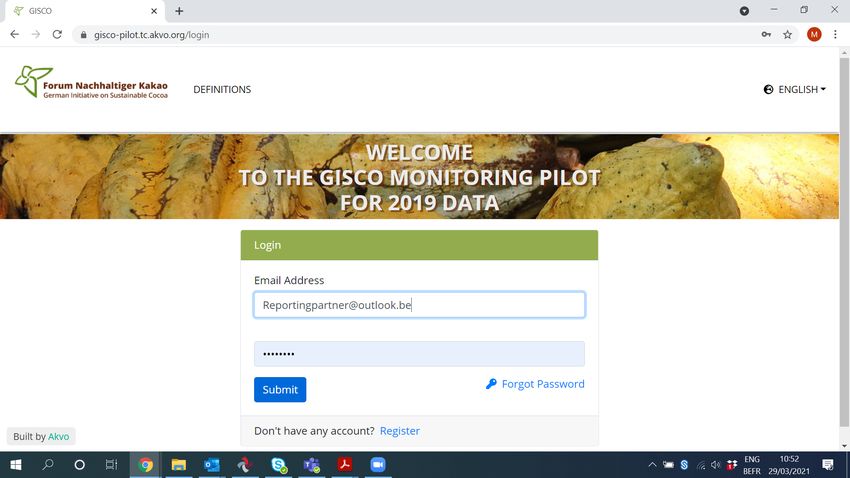
Individual Commitments (All Partners)
    When signing Beyond Chocolate some partners wanted to
    take their commitment one step further. These partners
    formulated an individual commitment concerning the way in
    which they intend to go further and/or faster towards a
    sustainable Belgian chocolate sector. Currently, several
    companies, NGO's, universities, investors and trade unions
    have taken up such a commitment and have reported on it in
    2020. Partners who have not yet taken up such a
    commitment are encouraged to do so.

                            Beyond Chocolate asks these
                            partners to report on their individual
                            commitment again in 2021. This
                            reporting will not be done through
                            the online reporting tool, but via mail
                            in a simple template provided to the
                            partners. Since some partners have
                            indicated their individual
                            commitment is no longer up to date
                            or too vague, Beyond Chocolate will
                            offer the opportunity of
                            reformulating their individual
                            commitment. The template will
                            enquire after the following;
                                The commitment
                                The score the partner would
                                attribute to this commitment
                                Whether or not the partner would
                                like to reformulate the
                                commitment
                                The new commitment

    Who needs to report for
    GISCO?
    As was the case for the pilot exercise, GISCO is asking all of
    its members to report via the online reporting tool. In case
    you haven't participated to the GISCO pilot, please contact
    Julia Jawtusch for more information and guidance.

5
Demo of the Online Tool
The Beyond Chocolate and GISCO secretariats will closely
assist partners with the technical aspect of the reporting. In
the chapter below, we will guide you step by through the
tool. A live demo will also be provided during the launch of
the online reporting tool on April 28th and individual
sessions are planned in May to assist in one-to-one setting.
Please note that the screenshots below are from the GISCO
pilot and that the lay-out of the tool will be adjusted to
include the Beyond Chocolate style.

How to Register and Log-in

On April 28th, Beyond Chocolate and GISCO will organize a
joint launch event. We intend to make this event as practical
as we can. Partners will thus be invited to complete the
registration process during the event, and will immediately be
able to access the tool. Partners who cannot attend the
launch event, can register by clicking the 'Register' button on
the page http://www.cocoamonitoring.net.

Each partner account is linked to a stakeholder type. This
implies that you'll only have access to information and survey
questions that are relevant to you.

                                                                  6
How to Select Questionnaires
               When partners log-in, they will see different tabs in the top
               menu. The survey tab is where the reporting will happen.
               Partners can start a new reporting by clicking on the 'start
               filling a new form' section in the top right corner.

               Partners will then be able to choose from two questionnaires: a
               partner questionnaire, linked to their stakeholder type
               (members will only see the partner questionnaires applicable to
               them. So an industry member would only see the industry
               partner questionnaire) and a project questionnaire.
                  The Partner Questionnaire: is mandatory for all reporting
                  partners and aims to get a better view of the overall
                  progress the partner is making. If you are a member of both
                  initiatives, please note that as some questions are market
                  specific, there are slight differences in the questions for
                  Beyond Chocolate and/or GISCO partners.
                  The Project Questionnaire: enquires after the progress
                  members are making within a certain sustainability
                  project/program. Each partner can fill out as many project
                  questionnaires as they like. The questionnaire is identical for
                  both Beyond Chocolate and GISCO partners.

    Please note that for Beyond Chocolate the project questionnaire is
    only mandatory for sustainability standards and programs. Reporting
    on other sustainability projects is encouraged, but optional.

7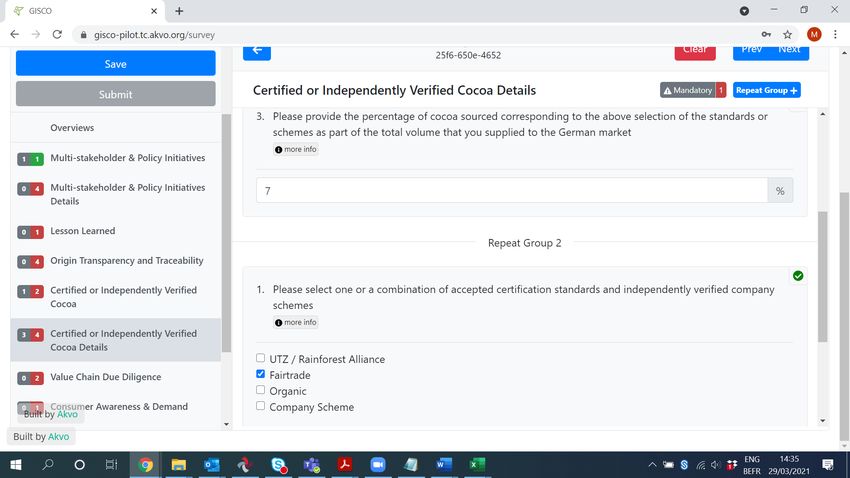
Filling out the Questionnaires
Once partners have opened a questionnaire, a first question
will appear. Once a question has been completed, partners
can click on the button 'next' to move to a next question.
Partners can also select question groups on the left side of
the screen if they would like to switch between questions
non chronologically.

Each question group on the left of the screen indicates a
theme under which several questions are convened. The tool
always allows members to indicate first if they have
information available or not. If not, the member is given an
open tab to explain why information is not available.

                                                               8
If members indicate that information is available, more question
(groups) will pop up.
Partners will be asked multiple choice questions, open
questions and numeric questions. Some sections of the
questionnaires are designed to allow members to report
separately on more than one occurrence. Such sections have
a Repeat Group + button displayed on the top right.
Each Repeat Group allows partners to report on only one
initiative/ one country/ one lesson learned/ one project
partner, etc. To report on additional occurrences partners
can add repeat groups by clicking the blue Repeat Group +
button in the top right of their screen.
9How to Save and Submit Reports
Members are able to save their reporting by clicking the blue
'save' button on the left side of the screen. Please note that
questionnaires are not automatically saved and progress will
be lost if not saved. Once partners have saved a
questionnaire, they will be able to log-in at any time during
the reporting period and continue working on that
questionnaire. Saved questionnaires can be found under the
'pick a previously saved form' tab.
10When partners complete a question group, this group will
turn green in the left side menu. Once all questions are
completed and have turned green, partners will be able to
submit their reporting by clicking the 'submit' button.
Partners will receive a confirmation via mail once they have
submitted their reporting. They can also verify if they have
submitted by clicking the submission tab at the top of the
page. Once submitted, partners can no longer access the
questionnaire through the tool, but can reach out the
program management in case needed.
Prefer to Work Offline?
Partners who prefer to work offline can download their
questionnaires in an Excel file by clicking the 'Overviews'
button at the left side of their screen (above the question
group navigation menu in the left column of the screen).
11 6How to Give Feedback
As mentioned above, partners will be given a more extensive
demo of the online reporting tool during its launch on April
28th. During the reporting itself, partners will be able to
directly give feedback via the feedback form in the tool
itself. Questions and feedback can concern technical
aspects, questions on indicators, questions on the reporting
process,...
Most frequently asked questions will be shared with all
reporting partners in the 'FAQ' tab. Make sure to check this
tab first when you have a question.
12Reporting Questions
GISCO and Beyond Chocolate have developed a
questionnaire style reporting tool. This tool brings together
the KPI's from the Beyond Chocolate AME Framework and
the GISCO monitoring framework. The KPI's are transformed
into questions to decrease the complexity for partners. To
adequately prepare partners for the 2021 reporting exercise,
an overview of the required question groups is provided
below. Please note that partners will always be able to
indicate whether they have information available or not. If
not, an open field will appear in which partners can give
additional information on the reason there is a data gap.
Partner Questionnaire
The partner questionnaire is obligatory for all reporting
partners of GISCO and Beyond Chocolate. Partner
questionnaires differ slightly per type of stakeholder.
Industry members and retailers will need to complete the full
list of below questions. Civil Society actors and standard
setters will only need to fill out the first four questions.
Multi-stakeholder & Policy Initiatives
Partners will need to select which sustainability initiatives
they have participated in in 2020 (e.g. National cocoa
platform, WCF, CFI,...) and elaborate on how they have
contributed to these initiatives.
Lessons Learned
Partners are asked whether they have documented any
lessons learned and if they have made this information
publicly available.
Consumer awareness (GISCO only)
GISCO members will be asked if they have a strategy
and/or undertake initiatives to inform, sensitize and/or
mobilize consumers regarding sustainable cocoa in the
reporting year.
Member commitment (GISCO only)
GISCO members will be asked to report the commitments
or initiatives they have taken up as member of the GISCO
platform in the reporting year that are not yet covered
under the other reporting questions.
13Volumes Sourced
Consumer brands and retailers (only on private label) are
asked to provide data on the volume of cocoa contained
in the chocolate and other end consumer products that
they supplied to the Belgian and/or German market, as
expressed in MT-BE.
For Beyond Chocolate this group can choose whether
they would like to report only on chocolate or also on
other cocoa-containing products. If so, each partner
can choose and indicate themselves which cut-off
percentage cocoa they apply.
Consumer Brands & Retailers
Do you have data available to report on the volume of cocoa contained
in the chocolate and other end consumer products that you supplied to
the Belgian/ German market, as expressed in MT-BE?
NO Why not?
YES MT-BE
Direct vs.Indirect
Sourcing
Report on Chocolate alone
% Chocolate
Details on share
Also report on other cocoa certified and
containing products independently
verified
% Other Cocoa
Containing Products
Origin Transparency
cut-off % cocoa
contained
Origin Traceability
14Volumes Sourced
Cocoa producers are asked to provide data on the
volume of cocoa, expressed in MT-BE, that they sourced
for production processes in Belgium and/or Germany.
Partners will be asked if they sourced this cocoa from
another platforms member or if they are the first in the
value chain to report on this volume.
Partners will then be asked to provide the % of:
Consumer chocolate
Other cocoa-containing consumer products
Couverture chocolate
Semi-finished cocoa products
Cocoa Producers
Do you have data available to report on the volume of cocoa, expressed in
MT-BE, that you sourced for production processes in Belgium/ Germany?
NO Why not? First Reporting
YES MT-BE
Sourced from
Platform
member
Direct vs. Indirect Sourcing
Consumer products
Details on share certified
Other Cocoa
and independently
Containing consumer
verified
products
Couverture Chocolate
Origin Transparency
Semi-finished Cocoa
Products Origin Traceability
15Origin Transparency level
The supply origin transparency level is about the extent
to which detailed information on the origin of cocoa is
being documented at the initial stages of the sourcing
process, with such information remaining available at later
stages of the supply chain. Partners will need to indicate
the origin transparency level via the following scoring
system:
Score 1: origin unknown or only country of origin
known
Score 2: country and region of origin known
Score 3: country, region and municipality/cooperative
of origin known
Score 4: farm known, in addition to the country, region
and municipality/cooperative of origin
Score 5: farm known and having point coordinates of
the farm household (farm mapping)
Score 5+: farm known and having polygon boundaries
of the farm.
Score 6: farm known, having polygon boundaries of
the farm and farm fields verified as not in a protected
forest and as not comprising land that was deforested
since 2018.
Conversion to MT-BE, of cocoa sourced in different forms, is to be done using the ICCO
conversion factors; being: 1,33 for cocoa butter (1804), 1,25 for cocoa paste/liquor
(18031), and 1,18 for cocoa powder and cake (1805, 18032).
16Origin Traceability level
Partners will be asked to indicate which percentage of the
total sourced volume of cocoa complies with which of the
below scores.
Conventional (traceability level 0)
Mass balance (traceability level 1)
Segregated (traceability level 2)
Identity preserved (traceability level 3)
Certified or Independently Verified
Partners will be asked to provide the share of
certified/independently verified cocoa supplied to the
Belgian/German market. Partners will then be asked to
indicate applicable certification standards/schemes and
the share per standard/scheme as part of the total
volume that they supplied to the Belgian/German market.
Partners will also be able to indicate a combination of
standards/schemes.
Value Chain Due Diligence
Partners will be asked if they have implemented Human
Rights Due Diligence approaches and/or environmental
due diligence approaches in their supply chains in the
reporting year, and if so, which of the 6 components of
the Human Rights Due Diligence (HRDD) concept have
been implemented:
Human Rights policy statement and embedding
respect for Human Rights in the own organization.
Risk assessment (identifying and assessing human
rights impacts of the supply chain).
Measures - identifying and implementing measures to
prevent or mitigate adverse HR effects
Tracking implementation and Human Rights results
Reporting (communicating on how Human Rights
impacts are is addressed)
Human Rights Grievance Mechanisms
Child labor
Partners will be asked to indicate if they have a strategy
and/or system regarding child protection/ HRDD that
prevents and addresses child labor and to elaborate on
this strategy/system.
17Premiums
Partners will be asked to provide input on the type of
premium granted to the farmer and the same for the
premiums granted to the cooperative/farmer
organization. For each premium, partners will need to
indicate the USD premium granted per kg of cocoa beans
and the volume of cocoa beans (in kg) sourced under this
premium.
Certification premium for UTZ/RA
Certification premium for Fairtrade
Certification premium for Organic or Bio
Quality premium
Environmental services / performance related premium
Voluntary living income/ fairness related premium
Other premiums directly paid per kg to the farmer
Other premiums shared by the cooperative with the
farmer
Subsidy per kg for productivity enhancement investments
managed by the cooperative or other farmer organization
Subsidy for operational costs or other funding to the
cooperative or other farmer organization
18Project questionnaire
The project questionnaire enquires after information on
sustainability projects and/or programs. As mentioned
above, for Beyond Chocolate this project questionnaire is
only obligatory for sustainability standards and programs.
Reporting on sustainability projects is optional, but
welcomed. For GISCO, the project questionnaire is required
for all sustainability projects.
General information project/program
Partners will be asked to give the project/program name,
contact person, location and project partners.
Farming households
How many farming households were reached by the
project/program?
Farming land
What is the average size of farming land per farming
household?
What is the average size (per farming household) of the
farming land under cocoa cultivation (with cocoa being
the main crop produced on that land)?
Training/capacity enhancement
How many people participated in trainings?
Split Male/female
Split age groups
Which topics were addressed in the training?
Household incomes
Did the project/program use indicators to monitor its
efforts to enhance the income of cocoa farming
households in the reporting year?
Did the project/program analyze the gap between actual
farming household income and living income in the
reporting period and did you report publicly on this gap?
Do you have information on the (average) yearly net
household income of farmers "reached" by the project /
program?
19Per country:
What was the average total yearly net household
income of the cocoa farming households reached by
the project / program?
What was the average total yearly net household
income, from cocoa production, of the cocoa farming
households reached by the project /program?
Please specify how the income data were collected
and the average income was calculated or estimated
Is it possible to disaggregate the number of farming
households per-following categories
+100% of a living income
81% to 100% of a living income
61% to 80% of a living income
41% to 60% of a living income
40% of a living income or below
Cocoa productivity
What is the average cocoa yield per ha (in kg)?
What is the average number of ha per farmer?
What is the total cost of cocoa production (inputs + paid
labour, including costs for fermentation if externalised,
excluding cost of own labour of the farming household)
per MT of cocoa beans produced?
Please specify how the data on cocoa yield was collected
and analyzed
Access to finance
(How) is the project/program enhancing access to
finance for farmers?
Child labor
Does the program/project have a strategy and/or system
regarding child protection/ HRDD that prevents and
addresses child labor and to elaborate on this
strategy/system.
How many farming households, among those "reached"
by the project/ program in the reporting year, were
covered by child protection/ HRDD systems that prevent
and address child labor?
Please specify the type of child protection/ HRDD
systems.
20Environmental-friendly cocoa production
Does the project have a strategy to promote diversified
and sustainable farming systems, as a contribution to
environmental sustainability?
Farm mapping
Is the project involved in mapping cocoa farms and if so,
how many farms are mapped:
Single GPS point
Polygon mapping
Cocoa agroforestry systems
How many hectares of the following types of agroforestry
systems have been established
Entry Level for Agroforestry
Basic Category for Agroforestry
Advanced Category for Agroforestry
Dynamic Agroforestry System
On farm trees
How many multi-purpose trees been distributed to
farmers for on-farm planting in the context of agroforestry
promotion?
How many different species of trees have been
distributed ?
21Forest Restoration
How many hectares of off-farm forest have been restored
with the support of the project/program in total and per
type of forest:
National Parks and Reserves
Forest Reserves/Classified forests
High Conservation Value (HCV) and High Carbon
Stock (HCS) forests
Other forests (as per national definition)
Other areas identified for (re) forestation
Forest protection
How many hectares of off-farm forest have been
protected with the support of the project/program in
total and per type of forest:
National Parks and Reserves
Forest Reserves/Classified forests
High Conservation Value (HCV) and High Carbon
Stock (HCS) forests
Other forests (as per national definition)
Other areas identified for (re) forestation
Pest Management
Do you contribute to integrated pest management
applied by cocoa farming households?
How many farming households apply integrated pest
management?
How do you estimate the occurrence of hazardous
pesticides among the cocoa farming households reached
by your project/program?
What About the Beyond Chocolate co-financed
projects?
The sustainability projects that are co-financed under the Beyond
Chocolate partnership are reporting on a bi-annual basis to IDH The
Sustainable Trade Initiative and will therefore not need to report via
the online reporting tool in May. The reporting results will be shared
with the wider partnership in the Beyond Chocolate Annual Report
in September.
22What will happen to my
Data?
Data Confidentiality
Your data are safe! We ensure our partners that partner-
specific data will never be made publicly available. Any
publication of results will happen in an aggregated way and
will be shared for feedback before publication.
Once all partners have reported, the Beyond Chocolate and
GISCO secretariats, together with the team of C-Lever.org,
will start analyzing the data. The following people will have
access to the data:
A limited number of Beyond Chocolate and/or GISCO
staff, listed in the Data Security Provisions and having
signed corresponding nondisclosure declarations, will
have access to individual questionnaire data, as needed
to check the validity and consistency of data and/or
check whether the conclusions from analysis on
anonymized and/or aggregated data makes sense. Please
note that only the platform secretariat a partner is
reporting to will have access to the data. This means that
in case you are only reporting for Beyond Chocolate,
GISCO staff will not see your data.
Authorized staff of C-Lever.org who will be responsible
for the data analysis and aggregation.
Authorized staff of AKVO, being the contracted IT service
provider / data processors for the system. Their role is
limited to intervening when IT issues occur and providing
data processing support. AKVO is contractually withheld
to share data. Find the Akvo Privacy Policy here.
Publication Annual Reports
Once data are cleaned and completed, a first analysis will be
discussed with reporting partners .The objective is to reach a
shared understanding and interpretation of results.
Reporting partners will also get the chance to provide
feedback on the annual reports that GISCO and Beyond
Chocolate will publish in September 2021.
23GISCO and Beyond Chocolate will publish two separate
annual reports linked to respectively the German and Belgian
market. Reporting data will be aggregated and partner-
specific data will not be made publicly available. Beyond
Chocolate and GISCO will also include one page of joint
analysis in their annual reports to provide an overview of the
progress booked in both markets combined.
Next Steps and Information
The Beyond Chocolate and GISCO secretariats want to
support all reporting partners in completing the 2021
exercise. Several sessions will be organized to assist partners
with the reporting. We understand that some partners might
not have had the chance to join the launch, and that the
reporting exercise is challenging. The secretariats of the
platforms are here to support so do not hesitate to take up
contact.
24April 28th
Launch of the Online Reporting Tool
On April 28th, the online reporting tool will be officially launched
during a joint event for Beyond Chocolate and GISCO partners. In
the first half of the event, the Beyond Chocolate and GISCO
Secretariats will give more information on the reporting process and
use of data. Partners will also be able to register in the tool during
the event.
13h-13h10 Greeting words and joint introductions chairmen
13h10-13h20 Presentation of overall reporting process
13h20-13h30 Data confidentiality and how the data will be used
13h30-13h35 Registration in the online reporting tool
13h35-14h Q&A
14h-14h10 Wrap-up
The second part of the event will be split-up in break-out groups per
stakeholder type. In these break-out groups, partners will get a
detailed demo of their questionnaires in the online reporting tool.
Please note that partners are only required to participate in their
own stakeholder group demo. Partners who will report on Programs
and standards, should also participate to the 'project questionnaire'
session.
14h25-15h05 Break-out Group 1: Industry Members
Break-out Group 2: Retail Members
15h10-15h30 Breakout group 3: Standard setters
Breakout group 4: NGOs and others
15h35-16h Project questionnaire session
16h05-16h45 Optional: German explanation of the tool
Participation Link
25May 11th and 26th
Beyond Chocolate Individual coaching sessions
The Beyond chocolate management has blocked May 11th for
individual coaching sessions with partners who would like to receive
one on one assistance with the reporting exercise. During these
sessions, partners can ask specific questions or even go over the
entire reporting together with the program management.
Partners can block an individual coaching session via the below link.
The Program Management asks partners to prepare for this session by
already trying to complete the reporting beforehand. In this way,
discussions can be more to the point.
Please let us know if you are not available on May 11th and would like
to book a different date.
Register for a session
May 10th and 26th
GISCO Individual coaching session days
the Secretariat of the German Initiative for Sustainable Cocoa has
blocked May 10th and 26th for individual coaching sessions with
members. For more information, please contact Julia Jawtusch.
26For more Information and questions, please contact For Beyond Chocolate Charles Snoeck via snoeck@idhtrade.org Marloes Humbeeck via humbeeck@idhtrade.org For GISCO Beate Weiskopf, beate.weiskopf@giz.de Julia Jawtusch via julia.jawtusch@giz.de
You can also read


