Investor Presentation - June 2021 - BMO
←
→
Page content transcription
If your browser does not render page correctly, please read the page content below
Investor Presentation

June 2021
Forward looking statements & non-GAAP measures
Caution Regarding Forward-Looking Statements
Bank of Montreal’s public communications often include written or oral forward-looking statements. Statements of this type are included in this document and may be included in other filings with Canadian securities
regulators or the U.S. Securities and Exchange Commission, or in other communications. All such statements are made pursuant to the “safe harbor” provisions of, and are intended to be forward-looking statements under, the
United States Private Securities Litigation Reform Act of 1995 and any applicable Canadian securities legislation. Forward-looking statements in this document may include, but are not limited to, statements with respect to our
objectives and priorities for fiscal 2021 and beyond, our strategies or future actions, our targets, expectations for our financial condition or share price, the regulatory environment in which we operate and the results of or
outlook for our operations or for the Canadian, U.S. and international economies, the expected impact of the COVID-19 pandemic on our business, operations, earnings, results, and financial performance and condition, as well
as its impact on our customers, competitors, reputation and trading exposures, and include statements of our management. Forward-looking statements are typically identified by words such as “will”, “would”, “should”,
“believe”, “expect”, “anticipate”, “project”, “intend”, “estimate”, “plan”, “goal”, “target”, “may” and “could.”
By their nature, forward-looking statements require us to make assumptions and are subject to inherent risks and uncertainties, both general and specific in nature. There is significant risk that predictions, forecasts, conclusions
or projections will not prove to be accurate, that our assumptions may not be correct, and that actual results may differ materially from such predictions, forecasts, conclusions or projections. The uncertainty created by the
COVID-19 pandemic has heightened this risk given the increased challenge in making assumptions, predictions, forecasts, conclusions or projections. We caution readers of this document not to place undue reliance on our
forward-looking statements, as a number of factors – many of which are beyond our control and the effects of which can be difficult to predict – could cause actual future results, conditions, actions or events to differ materially
from the targets, expectations, estimates or intentions expressed in the forward-looking statements.
The future outcomes that relate to forward-looking statements may be influenced by many factors, including but not limited to: the severity, duration and spread of the COVID-19 pandemic, its impact on local, national or
international economies, and its heightening of certain risks that may affect our future results; the possible impact on our business and operations of outbreaks of disease or illness that affect local, national or international
economies; general economic and market conditions in the countries in which we operate; information, privacy and cyber security, including the threat of data breaches, hacking, identity theft and corporate espionage, as well
as the possibility of denial of service resulting from efforts targeted at causing system failure and service disruption; changes in monetary, fiscal, or economic policy, and tax legislation and interpretation; interest rate and
currency value fluctuations, as well as benchmark interest rate reforms; technological changes and technology resiliency; political conditions, including changes relating to or affecting economic or trade matters; the Canadian
housing market and consumer leverage; climate change and other environmental and social risks; weak, volatile or illiquid capital or credit markets; the level of competition in the geographic and business areas in which we
operate; changes in laws or in supervisory expectations or requirements, including capital, interest rate and liquidity requirements and guidance, and the effect of such changes on funding costs; judicial or regulatory
proceedings; the accuracy and completeness of the information we obtain with respect to our customers and counterparties; failure of third parties to comply with their obligations to us; our ability to execute our strategic
plans and to complete proposed acquisitions or dispositions, including obtaining regulatory approvals; critical accounting estimates and the effect of changes to accounting standards, rules and interpretations on these
estimates; operational and infrastructure risks, including with respect to reliance on third parties; changes to our credit ratings; global capital markets activities; the possible effects on our business of war or terrorist activities;
natural disasters and disruptions to public infrastructure, such as transportation, communications, power or water supply; and our ability to anticipate and effectively manage risks arising from all of the foregoing factors.
We caution that the foregoing list is not exhaustive of all possible factors. Other factors and risks could adversely affect our results. For more information, please refer to the discussion in the Risks That May Affect Future Results
section, and the sections related to credit and counterparty, market, insurance, liquidity and funding, operational, legal and regulatory, strategic, environmental and social, and reputation risk, in the Enterprise-Wide Risk
Management section that starts on page 73 of BMO’s 2020 Annual Report, and the Risk Management section that starts on page 31 of our Second Quarter 2021 Report to Shareholders, all of which outline certain key factors
and risks that may affect our future results. Investors and others should carefully consider these factors and risks, as well as other uncertainties and potential events, and the inherent uncertainty of forward-looking statements.
We do not undertake to update any forward-looking statements, whether written or oral, that may be made from time to time by the organization or on its behalf, except as required by law. The forward-looking information
contained in this document is presented for the purpose of assisting our shareholders in understanding our financial position as at and for the periods ended on the dates presented, as well as our strategic priorities and
objectives, and may not be appropriate for other purposes.
Material economic assumptions underlying the forward-looking statements contained in this document are set out in the Economic Developments and Outlook section on page 18 of BMO’s 2020 Annual Report and updated in
the Economic Review and Outlook section set forth in our Second Quarter 2021 Report to Shareholders, as well as in the Allowance for Credit Losses section on page 114 of BMO’s 2020 Annual Report and the Allowance for
Credit Losses section set forth in our Second Quarter 2021 Report to Shareholders. Assumptions about the performance of the Canadian and U.S. economies, as well as overall market conditions and their combined effect on our
business, are material factors we consider when determining our strategic priorities, objectives and expectations for our business. In determining our expectations for economic growth, we primarily consider historical
economic data, past relationships between economic and financial variables, changes in government policies, and the risks to the domestic and global economy. Please refer to the Economic Review and Outlook and
Allowance for Credit Losses sections in our Second Quarter 2021 Report to Shareholders.
Non-GAAP Measures
Bank of Montreal uses both GAAP and non-GAAP measures to assess performance. Readers are cautioned that earnings and other measures adjusted to a basis other than GAAP do not have standardized meanings under GAAP
and are unlikely to be comparable to similar measures used by other companies. Reconciliations of GAAP to non-GAAP measures, the rationale for their use, as well as the effects of changes in exchange rates on BMO’s U.S.
segment reported and adjusted results can be found on pages 7 and 8 of BMO’s Second Quarter 2021 Report to Shareholders and on pages 17 and 23 of BMO’s 2020 Annual Report, all of which are available on our website at
www.bmo.com/investorrelations
Examples of non-GAAP amounts or measures include: efficiency and leverage ratios; revenue and other measures presented on a taxable equivalent basis (teb); amounts presented net of applicable taxes; results and
measures that exclude the impact of Canadian/U.S. dollar exchange rate movements (i.e. constant currency basis or CCY), adjusted net income, revenues, non-interest expenses, earnings per share, effective tax rate, ROE,
efficiency ratio, pre-provision pre-tax earnings, and other adjusted measures which exclude the impact of certain items such as, acquisition integration costs, amortization of acquisition-related intangible assets, impact of
divestitures, reinsurance adjustment and restructuring costs. Bank of Montreal provides supplemental information on combined business segments to facilitate comparisons to peers.
Investor Presentation June 2021 2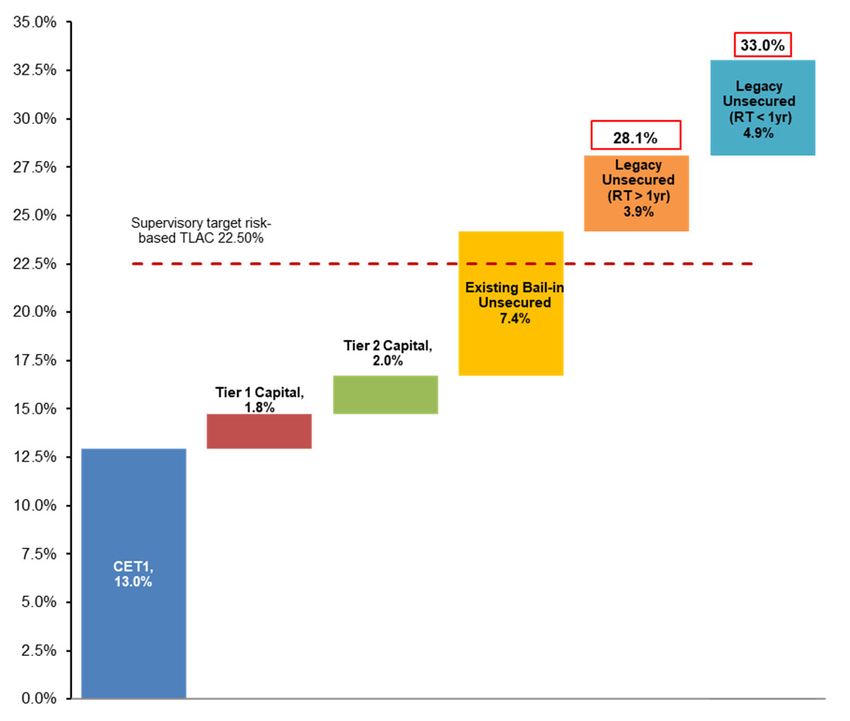
About Us
Established in 1817, BMO Financial Group is a highly diversified financial services provider based in North America
8th largest $950 billion 12+ million
bank in North America in total assets customers globally
by assets1
Operating Groups Personal & Commercial Banking BMO Wealth Management BMO Capital Markets
Our Purpose Our Strategic Priorities Our Values
Boldly Grow the Good World-class client loyalty and growth Integrity
in business and life Winning culture driven by alignment, Empathy
For a thriving economy empowerment and recognition
Diversity
For a sustainable Future Digital first for speed, efficiency
and scale Responsibility
For an inclusive society
Simplify work and eliminate
complexity
Superior management of risk and
capital performance
1 Source: Bloomberg GICS screen of largest North American banks by total assets
Investor Presentation June 2021 3
Our Purpose
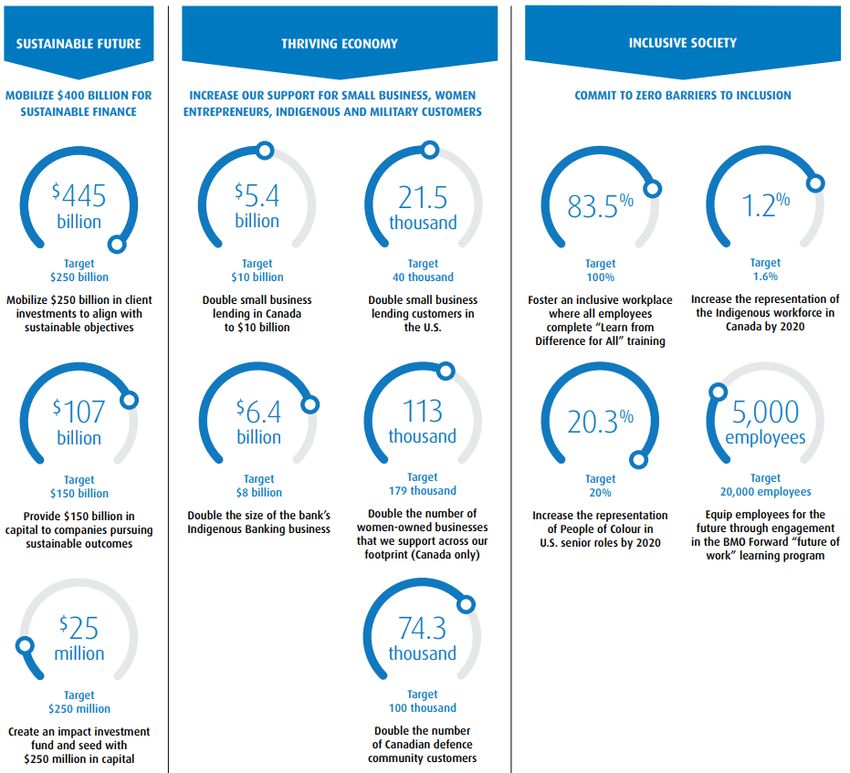
For a sustainable future For a thriving economy For an inclusive society
Declared Climate Ambition, a Deployed ~US$1.5B in loans and Recognized as one of the World's
focused commitment to drive investments against BMO Most Ethical Companies for the
economic transformation toward EMpower, a 5-year, US$5B 4th consecutive year by the
a net zero world commitment to address key Ethisphere Institute
barriers faced by minority
Ranked top bank in North businesses, communities and Recognized for the 6th consecutive
America on Corporate Knights’ families in the U.S. year on the Bloomberg Gender-
2021 Global 100 Equality Index
Committed $1.2MM to SheEO
Among first Canadian banks Programs Helping Women-Led Issued $750MM Women in
to sign UN Principles for Venture Companies funding Business Bond In Support of
Responsible Banking ventures that address Women-Owned Businesses
Joined the Partnership for Carbon sustainability issues faced Announced US$10MM donation to
Accounting Financials (PCAF) worldwide create the Rush BMO Institute for
Continuing to support customers Health Equity in Chicago
Acted as Joint Bookrunner and
Green Structuring Agent on the with access to government relief
first labelled Green Loan in programs helping them bridge to
Canada financial recovery, including the
CEBA, PPP, HASCAP and TELP
programs
CEBA: Canadian Emergency Business Assistance, PPP: U.S. Paycheck Protection Program, HASCAP: Highly Affected Sectors Credit Availability Program, TELP: Trade Expansion Lending Program
Investor Presentation June 2021 4
Reasons to Invest in BMO
• Diversified businesses that continue to deliver • Well-capitalized with an attractive dividend yield
resilient and robust earnings growth and long-
term value for shareholders • Leading momentum in operating leverage and
efficiency improvement through resource
• Strong foundation built for growth and optimization, simplification and digitization
differentiating strengths that drive competitive
advantage: • Leading employee engagement and winning
— Top 10 commercial lender in North America with culture
advantaged market share in Canada and the U.S.
• Digital first operating model where business and
— Well-established, highly profitable flagship banking technology are completely integrated, driving
business in Canada efficiency, speed and scale
— Strong U.S. deposit market share, top 3 in our core • Purpose-driven commitment to sustainability, 2
footprint with a digital banking platform that extends
applying industry-leading approaches to seize
nationally 1
opportunities and manage risks in key areas
— Diversified, high-return wealth franchise with a strong such as sustainable finance, climate change,
client focus and competitive position human rights, and diversity and inclusion
— Competitively advantaged Canadian capital markets
franchise with an integrated North American platform
Investor Presentation June 2021 5
Strong financial performance
Medium Term Financial Objectives (Adjusted basis) Earnings per Share ($)
EPS Growth 7% to 10% per year 8.99 9.43
7.71
Return on 8.17 8.66
15% or more 7.55
Equity
Operating
2% or more
Leverage
Maintain strong capital ratios that exceed 2018 2019 2020
Capital
regulatory requirements Reported Adjusted
2
4.24 4.24
Dividends Declared 4.06
3.78
($ per share) 1
3.56
3.40
3.24
3.08
• BMO has the longest-running dividend payout 2.94
2.71 2.80 2.80 2.80 2.80 2.82
record of any company in Canada, at 192 years
2.26
• Dividend Yield1: 3.3% 1.85 F2020 15-year CAGR 6%
1 As at June 17, 2021
2 Based on Q2’21 dividend of $1.06 annualized
Investor Presentation June 2021 6
Continued operating momentum across our businesses
• Advantaged and diversified business mix Top tier financial performance4
positioned for resilience and growth
• Leading adjusted1 PPPT3 growth and efficiency2 #1 #1
improvement, better than average net revenue2 Adjusted1 PPPT3 growth – Adjusted1 efficiency2
YTD4 (%) improvement – YTD4 (bps)
and expense growth
26.6 560
• Peer-leading YTD PPPT1,3 growth in Canadian
P&C, up 11.3%
8.0 140
• U.S. P&C PPPT1,3 up 22% YTD with strong
revenue growth and expense management
BMO Peer average BMO Peer average
• Record earnings in Capital Markets and
continued strong earnings in Wealth #2 #2
Net revenue2 growth – Adjusted1 expense growth –
Management YTD4 (%) YTD4 (%)
• Very strong credit performance reflecting
10.5 2.3
portfolio quality and strength in risk
management 4.8 0.7
• Continued progress on returns and efficiency
— ROE improved to 16.3%1 YTD BMO Peer average BMO Peer average
— Efficiency1,2 improved to 56.4%1 from 62%
YTD
1 On an adjusted basis. Adjusted measures are non-GAAP measures, see slide 2 for more information; US P&C reported YTD PPPT 23.0%; total bank reported YTD ROE 13.0% and YTD Efficiency 63.0%
2 Revenue is net of insurance claims, commissions and changes in policy benefit liabilities (CCPB); efficiency ratio based on net revenue
3 Pre-Provision Pre-Tax earnings (PPPT) is the difference between net revenue and expenses
4 Based on YTD 2021 performance. Peers: BNS, CIBC, NA, RBC, TD; peer average based on company disclosures and internal calculations for comparative purposes
Investor Presentation June 2021 7
Diversified business mix with strong, resilient revenue
Diversified by business Diversified by geography
% of Operating Groups Net Revenue – LTM1 % of Net Revenue by Geography – LTM1
Other
Canadian BMO Capital
7%
P&C Markets
33% Canadian
23%
Personal
Banking
Canadian
Commercial
Banking
Global Markets
Canada
56%
U.S.
37%
Insurance
U.S. P&C BMO Wealth
23% Management
21%
1 Net revenue is net of insurance claims, commissions and changes in policy benefit liabilities (CCPB); LTM is last twelve months
Investor Presentation June 2021 8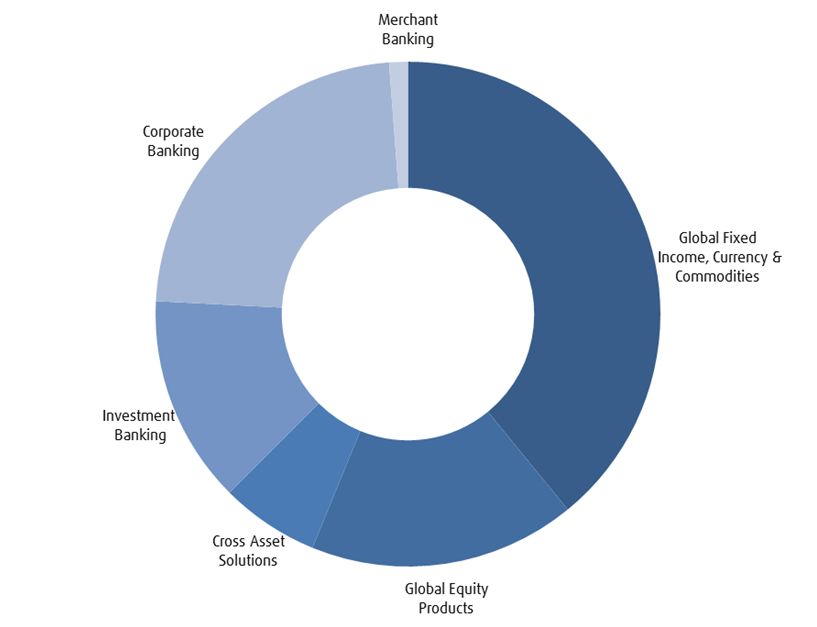
U.S. segment continuing to deliver strong results
Figures that follow are on a U.S. dollar basis
• U.S. segment adjusted1 PPPT1 up 46% YTD; contributed 40% of total bank adjusted1 earnings YTD
• Average assets of ~$290B with over 50% of revenue from outside of core footprint3 states
• Adjusted1 efficiency of 55.0%, operating leverage of 16.1% YTD
• #122 in U.S. commercial lending; top-tier market position in flagship U.S. markets
• #3 deposit market share3 in our core footprint3; #2 in Chicago and Milwaukee
• Leveraging strong integration and collaboration across businesses to provide integrated client offering
U.S. Segment Adjusted1 Net Income
by Operating Group – YTD
BMO
CM
U.S. 32%
P&C
64%
Personal and Commercial Banking and Wealth
Management footprint BMO WM
Additional Commercial Banking, 4%
Wealth Management and Capital Markets
footprint
1 Adjusted measures are non-GAAP measures, see slide 2 for more information. Pre-Provision Pre-Tax earnings (PPPT) is the difference between net revenue and expenses. On a reported basis YTD: U.S. Segment PPPT
growth 46%, contributed 48% of total bank earnings, efficiency 56.5%, operating leverage 15.1%; Total bank reported net income by geography YTD: Canada 55%, U.S. 39%, Other 6%; U.S. Segment reported net
income by operating group for YTD: U.S. P&C 65%, BMO CM 31%, BMO WM 4%, excludes Corporate Services
2 Based upon publicly available U.S. regulatory filings (FR Y-9Cs and FFIEC 002s) and internal analysis
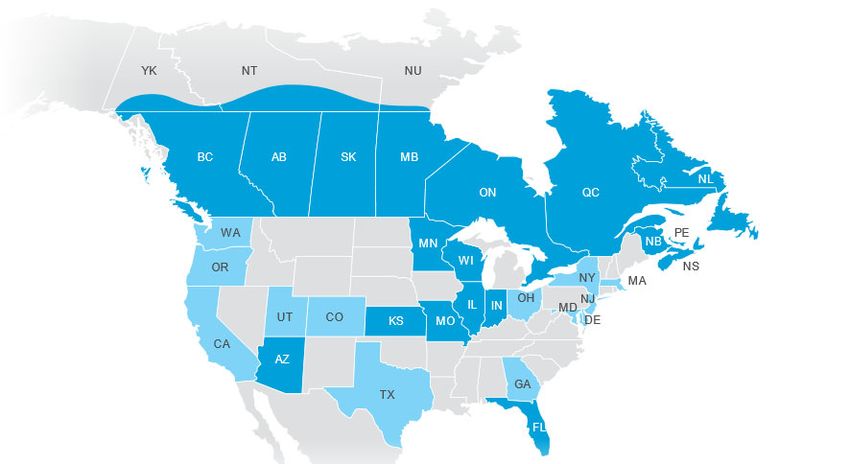
3 Based on FDIC deposit share data; core footprint includes Illinois, Kansas, Wisconsin, Missouri, Indiana and Minnesota
Investor Presentation June 2021 9
Canadian P&C - Strong flagship business
• Flagship business contributing 33% of total bank Strong financial performance vs peers
revenue1,2 and 36% of adjusted2 net income YTD #1
Adjusted1 efficiency
#1
Adjusted1 PPPT3 growth –
• Top-tier performance and growing market share in YTD4 (%) improvement – YTD4 (bps)
key areas of focus 310
11.3
• Good expense discipline; YTD expenses down 2%
Y/Y; peer leading efficiency improvement 1.3 20
• Average loans up 3% Y/Y. Commercial flat Y/Y; up
BMO Peer average BMO Peer average
2% Q/Q. Proprietary channel residential
mortgages and amortizing HELOC up 10% Y/Y
#1 #1
Revenue2 growth – Adjusted1 expense growth –
• Average deposits up 13% Y/Y; Commercial up
YTD4 (%) YTD4 (%)
27% Y/Y; Personal up 5% Y/Y
BMO Peer average
• Continuing to invest in digital innovation, 4.9
providing leading, customer-centric digital 0.5
experiences 0.8
BMO Peer average (1.8)
Recognized as the best commercial Awarded first place in J.D. Power’s 2020
bank in Canada for six consecutive years Canada Retail Banking Advice Study
1 On an adjusted basis. Adjusted measures are non-GAAP measures, see slide 2 for more information
2 Net revenue is net of insurance claims, commissions and changes in policy benefit liabilities (CCPB)
3 Pre-Provision Pre-Tax earnings (PPPT) is the difference between net revenue and expenses
4 Based on YTD 2021 performance. Peers: BNS, CIBC, NA, RBC, TD; peer average based on company disclosures and internal calculations for comparative purposes
Investor Presentation June 2021 10Advancing our digital experience in-line with customer preferences
Canadian Personal
Digital Adoption Rate1 (%) Active Mobile Users1 (000s) Self-Serve Transaction 2 (%)
+210bps +7% +200bps
59.7% 60.8% 1,947 2,049 2,081 91.8% 91.5%
58.7% 89.5%
Q2 F’20 Q1 F’21 Q2 F’21 Q2 F’20 Q1 F’21 Q2 F’21 Q2 F’20 Q1 F’21 Q2 F’21
U.S. Personal
Digital Adoption Rate3 (%) Active Mobile Users3 (000s) Self-Serve Transaction4 (%)
+11% +250bps
+310bps
525 544 74.0% 76.6% 76.5%
50.0% 51.0% 491
47.9%
Q2 F’20 Q1 F’21 Q2 F’21 Q2 F’20 Q1 F’21 Q2 F’21 Q2 F’20 Q1 F’21 Q2 F’21
1 Digital adoption is percent of deposit customers that logged on in last 90 days. Active mobile users is number of deposit customers that logged into mobile in the last 90 days
2 Self–Serve Transactions includes deposits, bill payments, internal funds transfers, withdrawals and e-transfers sent across ATM and Digital channels
3 Digital adoption is percent of retail deposit customers that logged on in last 90 days. Active mobile users is number of retail deposit customers that logged into mobile in the last 90 days
4 Self–Serve Transactions includes deposits, bill payments, internal funds transfers, withdrawals and Zelle payments (P2P) sent across ATM and Digital channels
Investor Presentation June 2021 11Proven strength in Commercial Banking with advantaged market share
• A relationship-based commercial bank; top 10 commercial
lender1 in North America
— In Canada: Top-tier commercial banking business, #2 market Commercial Banking Revenue as %
share for business loans up to $25 million2 of Total Bank Revenue – LTM
— In the U.S.: Large, diversified national business, supported
by industry knowledge, best-in-class customer experience,
and top-tier share in flagship markets; #12 in U.S.
commercial lending3 U.S. Other
Commercial 61%
• Sole or lead position on ~90% of relationships Banking
• Diversified growth, consistent risk appetite and underwriting 21%
— Quality and reputation of the business; deep industry
expertise
— In Canada: new sectors and capacity creation through
technology Canadian
Commercial
— In the U.S.: focused expansion of national specialty lending Banking
sectors; strength in traditional footprint 18%
• Commercial portfolio ~84% secured
1 Based on internal analysis
2 Canadian Bankers Association; loan market share $0-$25MM, as at December 2020
3 Based upon publicly available U.S. regulatory filings (FR Y-9Cs and FFIEC 002s) and internal analysis
Investor Presentation June 2021 12BMO Wealth Management - Strong & stable growth engine
Strong Momentum
• Well-diversified competitive businesses, contributing Adjusted2 ROE (%) Adjusted2 efficiency4 (bps)
~20% of BMO’s revenue mix
360bps
550bps 69.5
• Repositioned the business to accelerate growth 23.2
17.7
65.9
— Exited select high-efficiency, lower-return businesses
— Unified Canadian full-service brokerage and private
bank – delivering a full solutions experience F2020 YTD '21 F2020 YTD '21
— Digitized and streamlined client and back-office
processes Top Tier Performance in Traditional Wealth1,4
• Leveraging leading positions to accelerate growth #1 #1
Adjusted2 PPPT3 growth Adjusted2 efficiency4
— Deliver top-tier digital wealth management YTD5 (%) improvement – YTD5 (bps)
— Scale our North American wealth advisory leadership 47.0
700
— Build out Asset Management in leading growth areas 22.3
240
including ETFs, Alternatives and ESG
BMO Peer average BMO Peer average
Recognized as the Best #1 on net new ETF flows for Top-2 in Canadian Digital Advice
Private Bank in Canada 10 consecutive years in Canada with adviceDirect and SmartFolio
for 10 consecutive years and Top-2 ETFs share
1 Wealth management excluding Insurance
2 Adjusted measures are non-GAAP measures
3 Pre-Provision Pre-Tax earnings (PPPT) is the difference between net revenue and expenses;
4 Efficiency ratio based on net revenue
5 Based on YTD 2021 performance. Peers: BNS, NA, RBC, TD; peer average based on company disclosures and internal calculations for comparative purposes
Investor Presentation June 2021 13Net Interest Margin and Interest Rate Sensitivity
• Term rates increased in Q2, but remain below averages of
Total bank NII & NIM ex trading recent years
1.70 1.60 1.64 1.65
1.53
• If term rates remain low, NIM could continue to be
pressured as higher rate fixed investments roll off and are
467 595 512 478 449
reinvested at lower rates
3,051 2,940 3,018 3,100 3,006
5-Year US and CAD swap rates
Q2'20 Q3'20 Q4'20 Q1'21 Q2'21 CAD 5‐Yr CAD 5‐yr Avg USD 5‐Yr USD 5‐yr Avg
3.50
NII ex trading ($MM) Trading NII ($MM) NIM ex trading (%)
3.00
• Excluding trading, net interest margin increased 1 basis point
Q/Q, primarily due to higher loan spreads mostly offset by 2.50
lower deposit spreads
2.00
Earnings sensitivities over the next 12 months 2,3 1.50
Q2’21 +25 bps
+100 bps -25 bps 1.00
Pre-Tax CDE ($MM) Short Rates
Canada1 19 (35) 6 0.50
U.S. 285 (88) 94
0.00
Total 304 (123) 100
Jul‐16
Jul‐17
Jul‐18
Jul‐19
Jul‐20
Oct‐16
Jan‐17
Oct‐17
Jan‐18
Oct‐18
Jan‐19
Oct‐19
Jan‐20
Oct‐20
Jan‐21
Apr‐16
Apr‐17
Apr‐18
Apr‐19
Apr‐20
Apr‐21
Source: Bloomberg
• Year 1 benefit to a +100 bps rate shock driven 2/3 by short
rates
• Higher Year 2 benefit to rising rates (+100 bps) of ~$675MM 1 Includes Canadian dollar and other currencies
2 Assumes no benefit to rising rates from surge deposit growth experienced in F2020 and the first half of F2021
driven primarily by long rates and the continued reinvestment 3 For more details see the Structural (Non-Trading) Market Risk section of BMO’s Q2 2021 Report to
of capital and deposits Shareholders
Investor Presentation June 2021 14Continuous path to building a strong, more competitive bank
ROE1 (%) Adjusted1,2 efficiency (bps) CET1 (%)
61.4
16.3 500bps 13.0
260bps 160bps
56.4
13.7 11.4
F2019 YTD '21 F2019 YTD '21 F2019 YTD '21
• Specific actions to allocate capital and resources to areas expected to generate strong returns
• Continuing to make progress against our efficiency commitments through automating processes,
digitizing activities and simplifying the way we do business
• Above target ROE with increases in all businesses
1 On an adjusted basis. Adjusted measures are non-GAAP measures, see slide 2 for more information; F2019 reported ROE 12.6% and Efficiency 64.2%; YTD F2021 reported ROE 13.0% and Efficiency 63.0%
2 Efficiency ratio based on net revenue. Net revenue is net of insurance claims, commissions and changes in policy benefit liabilities (CCPB)
Investor Presentation June 2021 15Strong balance sheet and capital position
Credit Ratings
• CET1 Ratio of 13.0%, up 60bps Q/Q; Total Capital Moody’s S&P DBRS Fitch
Ratio of 16.7%
Long term deposits / Aa2 A+ AA AA
• Sound leverage and liquidity ratios legacy senior debt1
− Leverage Ratio 5.1% Senior debt2 A2 A- AA (low) AA-
− Liquidity Coverage Ratio 129% Outlook Stable Stable Stable Negative
CET1 Ratio3
+12 bps
+39 bps 13.0%
-1 bp
12.4%
4.0%
9% Current OSFI expectation
1.0% Domestic Stability Buffer5
1.0% D-SIB Surcharge
2.5% Capital Conservation Buffer
4.5% Minimum CET1
Q1'21 Internal capital Lower source Other Q2'21
generation 4 currency RWA
1 Long term deposits / legacy senior debt includes: (a) Senior debt issued prior to September 23, 2018; and (b) Senior debt issued on or after September 23, 2018 which is excluded from the Bank Recapitalization
(Bail-In) Regime
2 Subject to conversion under the Bank Recapitalization (Bail-In) Regime
3 Chart is not to scale
4 Internal capital generation excludes goodwill write-down related to the announced sale of our EMEA Asset Management business
5 On June 17, 2021, OSFI announced that the Domestic Stability Buffer will increase to 2.5% from 1.0% but consistent with its March 2020 commitment not to increase the DSB level for 18 months, this change will
take effect on October 31, 2021
Investor Presentation June 2021 16Leading track record in risk management
• Long track record of outperforming peers on credit, with 20-year historical average loss rates well below
peer banks
• PPPT earnings would cover PCL rate of ~240bps1, over six times the historical average
• Prudent underwriting, consistent approach, unparalleled expertise and industry knowledge, effectiveness of
work-out process. Deep expertise across Risk and business teams
• Credit risk discipline will serve us well through stress period
• Credit allowances appropriately reflect diversification and underlying strength of portfolios
PCL on Impaired Loans as a % of Avg. Net Loans & Acceptances
1.80%
1.60%
1.40%
1.20%
1.00%
0.80% 0.52% Cdn Peer Historical Avg. (1990- 2020)
0.38% BMO Historical Avg. (1990- 2020)
0.60%
0.40%
0.31% Cdn. Peer Avg.
0.20%
0.13% BMO
0.00%
'90 '91 '92 '93 '94 '95 '96 '97 '98 '99 '00 '01 '02 '03 '04 '05 '06 '07 '08 '09 '10 '11 '12 '13 '14 '15 '16 '17 '18 '19 '20 '21 '21
Q1 Q2
BMO Cdn Peers Avg. BMO Historical Avg. (1990 - 2020) Cdn Peers Historical Avg. (1990 - 2020)
1 Based on Q2’21 adjusted pre-provision, pre-tax earnings annualized
Investor Presentation June 2021 17Q2 F2021 Highlights
Q2 F2021 - Financial Highlights
Continued momentum across businesses
• Adjusted1 EPS $3.13 (reported $1.91) Reported Adjusted1
• Adjusted1 net income $2,095MM ($MM) Q2 21 Q1 21 Q2 20 Q2 21 Q1 21 Q2 20
Net interest income 3,455 3,578 3,518 3,455 3,578 3,518
– Reported net income $1,303MM includes $772MM impact of
Non-interest revenue, net2 2,904 2,796 1,943 2,875 2,796 1,943
divestitures4
Net Revenue2 6,359 6,374 5,461 6,330 6,374 5,461
• Adjusted1 ROE 16.7% (reported 10.2%) Expenses 4,409 3,613 3,516 3,583 3,585 3,483
PPPT3 1,950 2,761 1,945 2,747 2,789 1,978
• Adjusted1 PPPT3 up 39% Y/Y (reported flat) Total PCL 60 156 1,118 60 156 1,118
• Adjusted1 net revenue2 up 16% Y/Y Net Income4 1,303 2,017 689 2,095 2,038 715
Diluted EPS ($) 1.91 3.03 1.00 3.13 3.06 1.04
• NIM excluding trading down 5 bps Y/Y and up 1 bp Q/Q ROE (%) 10.2 15.7 5.3 16.7 15.8 5.5
ROTCE5 (%) 11.8 18.2 6.4 19.1 18.2 6.4
• Adjusted1 expenses up 3% Y/Y (reported up 25%) CET1 Ratio (%) 13.0 12.4 11.0
• Adjusted1 efficiency ratio2 56.6% (reported 69.3%) NIM excluding Trading 1.65 1.64 1.70 1.65 1.64 1.70
• Adjusted1 operating leverage2 13.1% (reported (9.0)%) Net Income1,4 Trends 2,095
2,038
• Total PCL $60MM, down $1,058MM Y/Y and down $96MM 2,017
1,610
Q/Q
1,259 1,584
– PCL on impaired loans $155MM or 13 bps; recovery of
provisions on performing loans $95MM 1,232 1,303
715
689
Q2'20 Q3'20 Q4'20 Q1'21 Q2'21
Reported Net Income ($MM) Adjusted Net Income ($MM)
1 Adjusted measures are non-GAAP measures, see slide 2 for more information
2 Net revenue and non-interest revenue, net is net of insurance claims, commissions and changes in policy benefit liabilities (CCPB). Operating leverage and efficiency ratio based on net revenue. Reported gross revenue:
Q2‘21 $6,076MM; Q1‘21 $6,975MM; Q2’20 $5,264MM
3 Pre-Provision Pre-Tax earnings (PPPT) is the difference between net revenue and expenses
4 Q2’21 reported net income included a $747MM pre-tax and after-tax write-down of goodwill related to the announced sale of our EMEA Asset Management business to Ameriprise Financial, Inc., a $22MM ($29MM pre-tax)
net gain on the sale of our Private Banking business in Hong Kong and Singapore to J. Safra Sarasin Group, and $47MM ($53MM pre-tax) of divestiture-related costs for both transactions. The net gain on the sale was
included in revenue with the goodwill write-down and divestiture costs included in non-interest expense, all recorded in Corporate Services
5 Return on Tangible Common Equity (ROTCE)
Investor Presentation June 2021 19Canadian Personal & Commercial Banking
Strengths and Value Drivers Q2’21 Highlights (Adjusted1)
• Highly engaged team focused on providing a personalized banking Net Income $765MM
experience, anticipating customers’ needs and finding new ways to
help Net Income Growth (Y/Y) 112%
• Top-tier commercial banking business, number two ranking in Revenue Growth (Y/Y) 9%
Canadian market share for business loans up to $25 million
PPPT2 Growth (Y/Y) 19%
• Strong and growing retail banking business, accelerating digital
engagement and digital sales ROE 27.8%
• Largest Mastercard® card issuer in Canada Efficiency Ratio 45.4%
• Consistently applied credit risk management practices, providing Operating Leverage 9.8%
reliable access to appropriate financing solutions
Average Loans and Acceptances $258B
Average Deposits $223B
Net Income1 ($MM) and NIM (%) Revenue ($MM)
2.60 2.66 2.66 2,142
2.58 2.54 2,099
1,960 1,962 2,031
Reported
Net
737 765 Income 807 842
736 749 778
648
Commercial
Adjusted Personal
363 764
319 737 Net
647
Income 1,224 1,213 1,253 1,292 1,300
362 319
NIM
Q2'20 Q3'20 Q4'20 Q1'21 Q2'21 Q2'20 Q3'20 Q4'20 Q1'21 Q2'21
1 Adjusted measures are non-GAAP measures, see slide 2 for more information. For details on adjustments refer to pages 7 and 8 of BMO’s Q2’21 Report to Shareholders
1 Q2’21 on a reported basis: Net Income $764MM; Net Income Growth 112%; PPPT Growth 19%; ROE: 27.8%; Efficiency Ratio 45.4%; Operating Leverage 9.8%
2 Pre-Provision Pre-Tax profit contribution; PPPT is the difference between revenue and expenses
Investor Presentation June 2021 20Canadian Personal & Commercial Banking
Strategic Priorities
• Continue to improve customer loyalty by deepening primary relationships, provide necessary support to customers and employees in the
new operating environment, and drive an inclusive and high-performance work culture
• Leverage the full suite of products, solutions and capabilities, and the unique cross-border advantage to offer a compelling value
proposition to customers
- In Personal Banking, drive top-tier customer acquisition, build leading share of wallet, and enhance the digital experience
- In Commercial Banking, strengthen core market presence and continue to build share of wallet, strengthen digitization and digital
capabilities, drive growth and enhance return on equity, while continuing to manage risk effectively, and leverage cross-bank
collaboration
• Drive efficiencies by simplifying and streamlining operations, investing in digital capabilities and through cross-bank collaboration
Performance
Average Gross Loans & Acceptances ($B) Average Deposits ($B) Digital Adoption1
197.1 220.0 222.8
251.4 253.8 257.9
59% 61%
55%
130.1 129.4
103.6 108.3 110.1
123.6
48.6 49.3 50.0
8.9 8.3 7.8 42% 44%
89.9 93.4 36%
90.3 87.9 89.9 73.5
Q2'20 Q1'21 Q2'21 Q2'20 Q1'21 Q2'21 Q2'19 Q2'20 Q2'21
Commercial Credit Cards Commercial Deposits Personal Deposits
Consumer Loans Residential Mortgages Digital Mobile
1 Adoption is the percent of retail deposit customers that have logged in within the last 90 days; as at April 30, 2019, 2020 and 2021
Investor Presentation June 2021 21U.S. Personal & Commercial Banking
Strengths and Value Drivers Q2’21 Highlights (Adjusted1)
• Rich Midwestern heritage dating back to 1847, with a long-standing Net Income US$439MM
commitment to the success of our customers and communities Net Income Growth (Y/Y) 73%
• Large-scale, diversified national commercial business, supported by in- Revenue Growth (Y/Y) 4%
depth industry knowledge, best-in-class customer experience, and
top-tier market share in our core footprint PPPT2 Growth (Y/Y) 19%
• Continued momentum in personal banking with a large and growing ROE 16.4%
customer base, top-tier deposit market share and accelerating digital
Efficiency Ratio 49.2%
engagement
• Comprehensive, integrated control structure to actively manage risk Operating Leverage 12.0%
and regulatory compliance Average Loans and Acceptances US$93B
Average Deposits US$110B
Net Income1 (US$MM) and NIM (%) Revenue (US$MM)
3.51 3.51
3.36 3.31 3.34 1,030 1,099 1,092
Reported 1,046 1,007
459 439 Net
Income 315 333 328
330 320
Personal
253 254 Adjusted
199 Commercial
454 434 Net 731 766 764
700 687
246 246 Income
192
NIM
Q2'20 Q3'20 Q4'20 Q1'21 Q2'21 Q2'20 Q3'20 Q4'20 Q1'21 Q2'21
1 Adjusted measures are non-GAAP measures, see slide 2 for more information. For details on adjustments refer to pages 7 and 8 of BMO’s Q2’21 Report to Shareholders
1 Q2’21 on a reported basis: Net Income $434MM; Net Income Growth 76%; PPPT Growth 21%; ROE 16.2%; Efficiency Ratio 49.8%; Operating Leverage 12.4%
2 Pre-Provision Pre-Tax profit contribution; PPPT is the difference between revenue and expenses
Investor Presentation June 2021 22U.S. Personal & Commercial Banking
Strategic Priorities
• Deliver a great experience for customers and employees, while adapting to the new operating environment, and continue
to build a base of loyal customers
– In Personal Banking, continue to drive new customer acquisition, maintain robust deposit growth, improve profitability in
consumer lending, build a flagship franchise in Small Business Banking and increase digital engagement
– In Commercial Banking, strengthen core market presence and continue to build share of wallet, strengthen digitization
and digital capabilities, drive growth and enhance return on equity, while continuing to manage risk prudently
• Drive efficiencies by simplifying and streamlining operations, investing in digital capabilities and through cross-bank
collaboration
Performance
Average Gross Loans and Acceptances1 Average Deposits Digital Adoption2
(US$B) (US$B)
93.5 108.1 110.0
94.4 91.4 93.4 51%
47.9 48.2 48%
16.0 14.9 15.1 43%
47.9
39%
36%
78.4 76.5 78.3 30%
60.2 61.8
45.6
Q2'19 Q2'20 Q2'21
Q2'20 Q1'21 Q2'21 Q2'20 Q1'21 Q2'21
Commercial Personal & Business Banking Commercial Personal & Business Banking Digital Mobile
1 Certain loan and deposit balances have been re-classified from Personal to Commercial within U.S. P&C reflecting a re-alignment of our Business Banking segment
2 Adoption is the percent of deposit customers that have logged in within the last 90 days; as at April 30, 2019, 2020, and 2021
Investor Presentation June 2021 23BMO Wealth Management
Strengths and Value Drivers Q2’21 Highlights (Adjusted1)
• Planning and advice-based approach that integrates investment, Net Income $353MM
insurance, specialized wealth management and core banking
Net Income Growth (Y/Y) 131%
solutions, offered by a team of highly skilled professionals
• Diversified products and services, from digital investing to integrated Revenue2 Growth (Y/Y) 29%
full-service investment management, banking and wealth advisory PPPT3 Growth (Y/Y) 123%
services for retail, business and institutional clients
ROE 23.6%
• Global asset manager with a commitment in responsible investing
delivering innovative investment solutions to institutional and Efficiency Ratio2 66.6%
individual clients including BMO Mutual Funds and BMO Exchange
Operating Leverage2 22.5%
Traded Funds across a range of channels
AUA / AUM $979B
• Robust risk management framework supporting alignment with
heightened regulatory expectations Average Loans / Deposits $28B / $51B
Net Income1 ($MM) Performance ($B)
349 358 366 346 353
341 320 328 968 979
72 72 50 50 865
70 70 67
67
519 525
153 464
144
271 279 286 294 296 303
253 261
169 43 49 51
160 401 449 454
27 28 28
-16 -16
Reported Adjusted Reported Adjusted Reported Adjusted Reported Adjusted Reported Adjusted Q2'20 Q1'21 Q2'21 Q2'20 Q1'21 Q2'21
Q2’20 Q3’20 Q4’20 Q1’21 Q2’21 Avg Gross Loans Avg Deposits AUA AUM
Traditional Wealth Insurance and Acceptances
1 Adjusted measures are non-GAAP measures, see slide 2 for more information. For details on adjustments refer to pages 7 and 8 of BMO’s Q2’21 Report to Shareholders
1 Q2’21 on a reported basis: Net Income $346MM; Net Income Growth 140%; PPPT Growth 131%; ROE 23.0%; Efficiency Ratio 67.3%; Operating Leverage 22.7%
2 Revenue, efficiency ratio and operating leverage based on net revenue. Net revenue is net of insurance claims, commissions and changes in policy benefit liabilities (CCPB)
3 Pre-Provision Pre-Tax profit contribution; PPPT is the difference between net revenue and expenses
Investor Presentation June 2021 24BMO Wealth Management
Strategic Priorities
• Deliver a differentiated client experience, providing outstanding support and working together to plan, grow, protect and
transition their wealth with confidence
• Extend our advantage as a solutions provider, delivering innovative asset management and insurance offerings that anticipate
clients’ evolving needs and exceed their expectations
• Build on a strong foundation and continue to evolve, simplify and streamline businesses to drive value, efficiency and returns
• Activate and drive an inclusive, high-performance culture, focused on strong collaboration and alignment across the enterprise
and a commitment to building diverse and inclusive teams to bring the best of BMO to all clients
Diversification
Net Revenue1 by Business – LTM BMO GAM Investment Asset Class3
~65%
BMO Wealth
11% Management Retail
U.S.
14% Multi-Asset
29% BMO Fee-based
9% 24%
Insurance Revenues2 Fixed
Income
BMO Private 36% Alternatives
Wealth 4%
8%
BMO
InvestorLine ETF Liquidity
Management
5%
43% #1 inIntermediary
net new
Institutional Equity
BMO Global
59%assets in 31%
Asset 37%
Management Canadian
market4
1 Net revenue is net of insurance claims, commissions and changes in policy benefit liabilities (CCPB)
2 % of F2020 total Wealth Management net revenue
3 Investment Asset Class as of October F2020
4 Net new assets as of F2020
Investor Presentation June 2021 25BMO Capital Markets
Strengths and Value Drivers Q2’21 Highlights (Adjusted1)
• A valued financial partner to our clients; leveraging our people, Net Income $570MM
innovative solutions and capital to help them overcome their
Net Income Growth (Y/Y) 944%
challenges and achieve their goals
Revenue Growth (Y/Y) 46%
• Unified coverage and integrated North American platform,
delivering a seamless and exceptional client experience PPPT2 Growth (Y/Y) 136%
• Well diversified platform and business mix by sector, geography, Efficiency Ratio 53.8%
product and currency, including a strong and scalable U.S. business Operating Leverage 36.1%
• Strong first line of defense risk management and regulatory and Average Gross Loans and Acceptances $59B
compliance capabilities
U.S. Revenue Contribution3 50%
• High performance culture with strong focus on diversity and
inclusion
Net Income1 ($MM) Revenue ($MM)
1,528 1,574 1,538
1,378
570 547 543
489 Reported Net 619 Investment
435 1,051 524
387 Income and
Corporate
563 487
483 Banking
426 379
Adjusted Net 981 1,031 919
854
Income Global
564
(74) (68) Markets
Q2'20 Q3'20 Q4'20 Q1'21 Q2'21 Q2'20 Q3'20 Q4'20 Q1'21 Q2'21
1 Adjusted measures are non-GAAP measures, see slide 2 for more information. For details on adjustments refer to page 7 and 8 of BMO’s Q2’21 Report to Shareholders
Q2’21 on a reported basis: Net Income $563MM; Net Income Growth 861%; PPPT Growth 140%; Efficiency Ratio 54.3%; Operating Leverage 36.1%
2 Pre-Provision Pre-Tax profit contribution; PPPT is the difference between revenue and expenses
3 U.S. Revenue as a % of Total (Q2’21)
Investor Presentation June 2021 26BMO Capital Markets
Strategic Priorities
• Continue to invest where BMO Capital Markets has the strengths and capabilities to deliver value-added solutions and meet
client needs
• Build on a foundation to work smarter and simplify how BMO Capital Markets does business, to enhance efficiency and return
on equity with a particular focus on digitization
• Activate and drive an inclusive, high performance culture – focused on urgency and accountability to clients, strong
partnership and alignment across the enterprise, and a commitment to eliminate barriers to diversity and inclusion
• Continue to be prudent managers of capital and risk for clients, employees and shareholders
Diversified Performance
Revenue by Sector1 U.S. Contribution Revenue by Product5
Power, Real Estate Diversified
Utilities & Industries
Infrastructure
~49% of Revenue
Industrials
2
Healthcare Energy
~52% of Capital
Government
3
Global
Mining
Technology,
Food,
Consumer &
Business
Services &
Media
~45% of FTE 4
Retail
*Excluding non-
client revenues Financial
Institutions
1 As a % of last twelve months (LTM) revenue as at April 30, 2021, excluding non-client revenues & investor-only clients
2 U.S. Revenue as a % of Total (LTM as of April 30, 2021)
3 U.S. Capital as a % of Total (LTM as of April 30, 2021)
4 U.S. FTE as a % of Total (LTM as of Q2’21)
5 As a % of LTM Q2’21 revenue excluding ‘Other’
Investor Presentation June 2021 27Risk Overview
Provision for Credit Losses (PCL)
PCL By Operating Group
Q2’21 Q1’21 Q2’20
($MM)
$ bps $ bps $ bps PCL in bps
Total Canadian P&C 154 24 149 24 212 34 94 89
Total U.S. P&C 6 2 20 7 124 38
31 37
BMO Wealth Management 1 2 2 2 3 4
38 14 13
BMO Capital Markets (6) (4) 45 29 73 41 29 35 29
5
19
Corporate Services 0 n.m. (1) n.m. 1 n.m. Q1'20 Q2'20 Q3'20 Q4'20 Q1'21 Q2'21
PCL on Impaired Loans 155 13 215 19 413 35 PCL on Impaired Loans Total
PCL on Performing Loans (95) (8) (59) (5) 705 59
Total PCL 60 5 156 14 1,118 94
PCL on Impaired Loans as a % of Avg. Net Loans &
PCL on Impaired Loans as a 2.00% Acceptances
% of Average Net Loans &
1.50%
Acceptances
• BMO’s PCL loss rates have 1.00% 0.52% Cdn Peer Historical Avg. (1990- 2020)
been lower than peer 0.38% BMO Historical Avg. (1990- 2020)
average over time 0.50%
0.31% Cdn. Peer Avg.
0.13% BMO
0.00%
'90 '91 '92 '93 '94 '95 '96 '97 '98 '99 '00 '01 '02 '03 '04 '05 '06 '07 '08 '09 '10 '11 '12 '13 '14 '15 '16 '17 '18 '19 '20 '21 '21
BMO Cdn Peers Avg. Q1 Q2
BMO Historical Avg. (1990 - 2020) Cdn Peers Historical Avg. (1990 - 2020)
Investor Presentation June 2021 29Allowance and Provision on Performing Loans
Allowance on Performing
Loans (APL) and PCL on
Q2 21
APL to • The APL decreased $162MM to $2,829MM, driven
Performing Loans (PCL) Q1 21 Q2 21 Q2 21 Performing by a reduction in PCL on performing loans and the
Foreign
By Operating Group APL1 PCL APL1 Loans impact of the weaker U.S. dollar
Exchange
($MM) 2 (bps)
• The $95MM reduction in PCL on performing loans
Consumer – Canadian P&C 922 (20) (2) 900 53 reflects positive credit migration and an improving
economic outlook, partially offset by a more
Commercial – Canadian P&C 515 7 (2) 520 58
severe adverse scenario
Allowance for Performing Loans (bps)
Total Canadian P&C 1,437 (13) (4) 1,420 55
65 67 65 62
Consumer – U.S. P&C 142 (10) (6) 126 75 49
36
Commercial – U.S. P&C 847 (19) (34) 794 84
Total U.S. P&C 989 (29) (40) 920 83 Q1'20 Q2'20 Q3'20 Q4'20 Q1'21 Q2'21
BMO Wealth Management 43 (4) (1) 38 13 Coverage Ratio
BMO Capital Markets 519 (49) (22) 448 79 2.45
1.99 2.13 2.04 2.12
1.74
Corporate Services 3 - - 3 n.m.
Total 2,991 (95) (67) 2,829 62
Q1'20 Q2'20 Q3'20 Q4'20 Q1'21 Q2'21
1 Q1 21 and Q2 21 includes APL on Other Assets of $19MM and $20MM respectively and excludes APL on Securities of $4MM for both periods APL as a % of Trailing 4-Quarter PCL on Impaired Loans
2 Q2 21 PCL includes PCL on Other Assets of $2MM and excludes PCL on Securities of $0.1MM
Investor Presentation June 2021 30Gross Impaired Loans and Formations
• Gross Impaired Loans (GIL) ratio 65 bps,
Formations Gross Impaired Loans down 9 bps Q/Q
By Industry
($MM, as at Q2 21) Formations ($MM)
Canada & Canada &
U.S. Total U.S. Total
Other Other1
Consumer 190 29 219 449 325 774
Service Industries 25 9 34 173 297 470 1,760
1,396
Oil & Gas 0 0 0 78 253 331 831 662 665 425
Retail Trade 10 1 11 265 77 342
Agriculture 13 1 14 81 188 269 Q1'20 Q2'20 Q3'20 Q4'20 Q1'21 Q2'21
Manufacturing 46 3 49 179 65 244
Gross Impaired Loans ($MM)
Transportation 8 26 34 19 123 142
Financing Products 0 0 0 0 94 94
Wholesale Trade 2 12 14 24 65 89
4,413
Commercial Real Estate 9 13 22 42 35 77 3,645 3,638 3,442 3,000
2,822
Construction (non-real estate) 9 3 12 50 29 79
Mining 0 0 0 0 31 31 Q1'20 Q2'20 Q3'20 Q4'20 Q1'21 Q2'21
Financial 11 0 11 24 7 31
2
Other Business and Government 4 1 5 21 6 27 GIL (bps)
Total Business and
137 69 206 956 1,270 2,226 94
Government 78
74 74 65
62
Total Bank 327 98 425 1,405 1,595 3,000
1 Total Business and Government includes $42MM GIL from Other Countries Q1'20 Q2'20 Q3'20 Q4'20 Q1'21 Q2'21
2 Other Business and Government includes industry segments that are eachOur loans are well-diversified by geography and industry
Loans by Geography3
Gross Loans & Acceptances
Canada &
By Industry U.S. Total % of Total
Other1
($B, as at Q2 21) 33%
Canada
Residential Mortgages 122.5 8.0 130.5 28%
U.S.
Consumer Instalment and Other 65%
59.9 12.0 71.9 16% Others
Personal
Cards 7.1 0.4 7.5 2% 2%
Total Consumer 189.5 20.4 209.9 46%
Financial 13.3 33.7 47.0 10% Loans by Product3
Service Industries 22.9 22.4 45.3 10%
Commercial Real Estate 25.5 14.8 40.3 9% 29%
Commercial
Manufacturing 7.9 18.4 26.3 6% 12%
Corporate
Retail Trade 12.1 6.6 18.7 4% 17% Residential Mortgage
Wholesale Trade 5.1 9.3 14.4 3% Personal Lending
4
Agriculture 12.1 1.4 13.5 3% 42%
Transportation 3.5 8.7 12.2 3%
Oil & Gas 6.2 4.3 10.5 2% Loans by Operating Group5
2
Other Business and Government 10.4 11.1 21.5 4%
Canadian P&C
Total Business and Government 119.0 130.7 249.7 54% 25%
U.S. P&C
13% BMO Capital Markets
Total Gross Loans & Acceptances 308.5 151.1 459.6 100%
56% BMO Wealth
6% Management
1 Includes ~$9.3B from Other Countries
2 Other Business and Government includes all industry segments that are eachCanadian Residential-Secured Lending
Residential-Secured Lending by Region ($160.8B)
$73.1
HELOC
• Total Canadian residential-secured lending
Uninsured Mortgages $31.9 portfolio at $160.8B, representing 35% of total
Insured Mortgages
25%
loans
$25.2
— LTV1 on uninsured of 50%
25%
— 90-day delinquency rate for RESL remains
$19.4 good at 17 bps; loss rates for the trailing 4
quarter period were 1 bp
29%
53% 17% • Residential mortgage portfolio of $122.5B
59% — 36% of portfolio insured
40% 32%
— LTV1 on uninsured of 54%
$6.6
$4.6 — 79% of the mortgage portfolio has an
13%
42% 51% 16% effective remaining amortization of 25 years
31% 22% 37% or less
16%
45% 47%
Atlantic Quebec Ontario Alberta British Columbia All Other Canada • HELOC portfolio of $38.2B outstanding of which
Avg. LTV1 British All Other Total
67% is amortizing
Atlantic Quebec Ontario Alberta
Uninsured Columbia Canada Canada
• GTA and GVA portfolios demonstrate better LTV1,
Mortgage
- Portfolio 57% 57% 53% 61% 50% 55% 54%
delinquency rates and bureau scores compared
- Origination 73% 74% 69% 73% 67% 73% 70%
to the national average
HELOC
- Portfolio 46% 52% 44% 56% 44% 47% 47%
- Origination 74% 74% 64% 66% 63% 71% 66%
1 LTV is the ratio of outstanding mortgage balance or the HELOC authorization to the original property value indexed using Teranet data. Portfolio LTV is the combination of each individual mortgage or HELOC LTV
weighted by the mortgage balance or HELOC authorization
Investor Presentation June 2021 33Oil and Gas Industry Overview
Industry by Sub-sector Industry by Risk Rating
3%
5%
9%
39%
25% $10.5 B $10.5 B
61%
58%
Exploration and development Pipelines
Investment Grade Non Investment Grade Impaired
Services Manufacturing and refining
• The oil and Gas Portfolio is geographically well diversified; 49% in Canada, 41% in the U.S. and the remaining in other
geographies
• Of the $6.3B in Exploration and Development (E&D) gross loans and acceptances, 66% is borrowing-base lending:
— 99% of U.S. E&D loans
— 43% of Canada and other countries E&D loans; 73% of non-borrowing base E&D loans in Canada and other countries are
investment grade
Investor Presentation June 2021 34Sectors Impacted by COVID-19 Pandemic
Gross Loans
& % of Total
By Industry of Heightened Focus
Acceptances GL&A • Sectors highly impacted by COVID make up less than
($B, as at Q2 21) 5% of the portfolio
(GL&A)
Hotels 4.3 0.9% • Portfolio is diversified and well-secured by real estate
Restaurants 4.2 0.9%
in some sectors
Amusement & Recreational 3.2 0.7%
• Loss rates remain manageable
CRE – Lodging REITS 0.6 0.1%
CRE – Retail REITS 1.7 0.4%
CRE – Retail Property Types 2.5 0.5%
Retail Trade excl. Auto, Grocers & Pharmacies 4.8 1.0%
Airlines 0.3 0.1%
Total Industries of Heightened Focus 21.6 4.7%
Total Business & Government
249.7 54.3%
Gross Loans & Acceptances
Total Gross Loans & Acceptances 459.6 100.0%
Investor Presentation June 2021 35Economic and Housing Market Overview
Economic outlook and indicators1
Canada United States Eurozone
Economic Indicators (%)1, 2 2020 2021E2 2022E2 2020 2021E2 2022E2 2020 2021E2 2022E2
GDP Growth (5.3) 6.0 4.5 (3.5) 7.0 4.3 (6.7) 4.5 4.5
Inflation 0.7 3.1 2.9 1.2 3.9 3.3 0.3 2.5 1.9
Interest Rate (3mth Tbills) 0.44 0.10 0.10 0.37 0.05 0.05 (0.44) (0.55) (0.54)
Unemployment Rate 9.6 7.5 6.0 8.1 5.4 3.9 8.0 8.0 7.0
Current Account Balance / GDP3 (1.8) 0.2 (0.7) (3.1) (3.8) (4.0) 2.3 2.8 2.7
Budget Surplus / GDP3 (16.1) (6.4) (2.3) (14.9) (15.9) (6.5) (7.6) (6.7) (3.3)
Canada United States
• Economic growth likely stalled in the spring due to • Substantial fiscal stimulus, pent-up demand and
restrictions to suppress a third wave of the virus, but it easing restrictions should result in the strongest
is poised to rebound strongly as businesses reopen, annual economic growth since 1984
with additional support from expansionary fiscal policy,
• The unemployment rate is projected to decline from
high resource prices, and rising vaccinations
5.8% in May to pre-pandemic levels of 3.5% by the
• The jobless rate is expected to fall from 8.2% in May to end of 2022
5.6% at the end of 2022, returning to pre-virus levels
• Despite higher inflation, the Federal Reserve is
• The Bank of Canada is expected to keep policy rates expected to keep policy rates near zero until early
steady through 2022 to support a broad recovery in 2023 to support a broad recovery in employment
labour markets
1 This slide contains forward looking statements. See caution on slide 2
2 Data is annual average. Estimates as of June 18, 2021
3 Eurozone estimates provided by IMF
Investor Presentation June 2021 37Canada’s housing market is strong
• National existing home sales fell for a second straight month in May 2021 from record highs in March but remain well above
normal levels. Record-low mortgage rates and shifts in demand arising from remote working have supported the market
• Benchmark prices have accelerated 24.2% in the past year amid historically low supply relative to sales
• Home sales growth should moderate amid less pent-up demand, eroding affordability, and a higher minimum qualifying rate
on federally-regulated mortgages. However, prices are likely to continue to increase due to low supply
• Substantial fiscal income-support and mortgage deferral programs have kept foreclosure rates low
• Mortgage arrears remain near record lows, though they could rise moderately due to elevated unemployment
• Debt servicing costs (relative to income) have eased from all-time highs
Debt Service Ratio Mortgage Delinquencies/Unemployment
16.0
14.0 0.50 14.0
12.0 13.0
0.45
12.0
10.0 0.40 11.0
8.0 10.0
0.35
6.0 9.0
0.30 8.0
4.0
7.0
2.0 0.25
6.0
0.0 0.20 5.0
1990
1991
1992
1993
1994
1995
1996
1997
1998
1999
2000
2001
2002
2003
2004
2005
2006
2007
2008
2009
2010
2011
2012
2013
2014
2015
2016
2017
2018
2019
2020
2021
2007
2008
2009
2010
2011
2012
2013
2014
2015
2016
2017
2018
2019
2020
2021
Canada: Percent of Arrears to Total Number of Residential Mortgages (%)
Total Interest only
Canada: Unemployment Rate: Both Sexes, 15 Years and Over (SA, %)
Source: BMO CM Economics and Canadian Bankers’ Association as at June 18, 2021
This slide contains forward looking statements. See caution on slide 2
Investor Presentation June 2021 38You can also read


