Learner Management Information System Policy - Learning ...
←
→
Page content transcription
If your browser does not render page correctly, please read the page content below
Learner Management Information System Policy

                                               Learner Management
                                                Information System
                                                      Policy

                                               Policy Area          Management Information Systems
                                               Version              1.1
                                               Date                 Created: April 2020
                                                                    Revised:

                                               Monitored            Annually
                                               Responsibility       FET Senior Management
                                               Approval
                                               This policy document is an uncontrolled copy. Each staff
                                               member should consult StaffConnect for the latest version of
                                               this document.

© Limerick and Clare Education and Training Board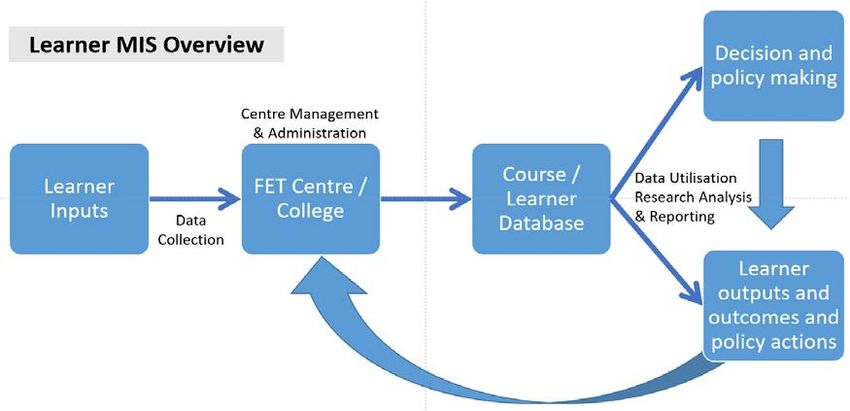
Contents
List of Abbreviations ............................................................................................................................................... 3
Glossary .................................................................................................................................................................. 3
Rationale ................................................................................................................................................................. 5
Purpose ................................................................................................................................................................... 5
Scope ...................................................................................................................................................................... 6
Data Protection Awareness .................................................................................................................................... 6
Issue Date: This Policy is effective from 05 May 2020............................................................................................ 6
1.      Overview of Programme and Learner Support System (PLSS)....................................................................... 7
2.      Learner Management Information System Access Control ........................................................................... 8
3.      Local Business Process ................................................................................................................................... 9
4.      Scheduling and Management of FET Provision ............................................................................................ 11
5.      Learner Inputs – Applications and Registrations ......................................................................................... 13
  5.1.  Applicant Referral Process .................................................................................................................. 13
  5.2.  Learner Registration Process............................................................................................................... 14
  5.3.  Learner Identity and PPSN Ownership ................................................................................................ 14
6. Learner Outputs – Completions and Certifications ..................................................................................... 15
  6.1.  Learner Completion Outputs .............................................................................................................. 15
  6.2.  Learner Certification Outputs ............................................................................................................. 15
7. Learner Outcomes – Progressions and Employments ................................................................................. 16
     7.1.    Learner Outcomes ............................................................................................................................... 16
8.      Applicant and Learner Lifecycle Progression ............................................................................................... 17
  8.1. FET Applicant and Learner Lifecycle Workflow Graphic ..................................................................... 17
  8.2. Applicant Referrals .............................................................................................................................. 17
  8.3. In-Process Applications ....................................................................................................................... 17
  8.4. Call-for-course Management .............................................................................................................. 17
  8.5. Commencement On-course ................................................................................................................ 18
  8.6. Finish Course ....................................................................................................................................... 18
  8.7. Course Date Amendments .................................................................................................................. 18
  8.8. Course Evaluation Feedback and Exit Interviews ................................................................................ 19
9. FETCH Learner Accounts .............................................................................................................................. 19
  9.1.   FETCH Account Management ............................................................................................................. 19
10.    Reporting and Returns............................................................................................................................. 19
  10.1. Activity Reports ................................................................................................................................... 19
  10.2. National Returns ................................................................................................................................. 19
  10.3. ESF Returns ......................................................................................................................................... 20
  10.4. Strategic Performance Agreement (SPA) Reports............................................................................... 20
  10.5. Audit Requests .................................................................................................................................... 20
  10.5.1.   FET Coordinators/Manager shall respond in a timely manner to all audit requests ...................... 20
11.    System Support Requests ........................................................................................................................ 20
  11.1. System Queries (PLSS, FETCH and FARR) ............................................................................................ 20
  11.2. Change Request Proposals (PLSS and FETCH) ..................................................................................... 20
12.    Retention of Data .................................................................................................................................... 20
     12.1.      Retention Policy and Schedule ............................................................................................................ 20

© Limerick and Clare Education and Training Board                                                                                                                           2
List of Abbreviations ACM Activation Caseload Management System (BOMi) CCS Community and Comprehensive Schools CSS Client Services System - legacy DEASP Dept. Employment Affairs and Social Protection DPIA Data Protection Impact Assessment EOI Expression of Interest ESF European Social Fund ETB Education and Training Board EU European Union FAQs Frequently Asked Questions FARR Funding Allocation Request & Reporting System FET Further Education and Training FETCH FET Course Hub (www.fetchcourses.ie) GDPR General Data Protection Regulation 2016/679 HEA Higher Education Authority ITABE Intensive Tuition - Category of FET provision LMIS Learner Management Information System MIS Management Information System NCC PLSS National Course Calendar NLD PLSS National Learner Database NPD PLSS National Programme Database PLC Post Leaving Certification - Category of FET provision PLSS Programme and Learner Support System PPSN Personal Public Service Number PSC Public Services Card QASS Quality Assurance Support Service QBS QQI Business System QQI Quality and Qualifications Ireland RCCRS Results Capture and Certification Request System SFW Skills for Work - Category of FET provision SLA Service level Agreement SMS Short Message Service SOLAS The National Training Authority SPA Strategic Performance Agreement SUN Financials Accounting System SUSI Student Universal Support Ireland TEL Technology Enhanced Learning VSS Voluntary Secondary Schools XML Extensible Markup Language Glossary Applicant A person who expresses interest (applies) to a particular course instance Completer A Learner who participates in more than 25% of the course Core Skills Category of FET provision (L1-4 Transversal Skills Clusters) Finisher A Learner who leaves the course on finish or earlier Full Completer A Learner who participates in >=90% of the course Fully Certified All of the certifications available on this course were achieved Learner An Applicant who has progressed on to course (participates) No Certification No certification available to achieve (unaccredited) or none of the certifications available achieved Achieved by Learner Output Course direct outputs - completion status and certification results achieved Partial Completer A Learner who participates in more than 25% and
This Page is Intentionally Blank

© Limerick and Clare Education and Training Board                      4
Learner Management Information System Policy

Rationale
Limerick and Clare Education and Training Board (ETB) is funded by the National Training Authority,
SOLAS, and has committed as part of a published Strategic Performance Agreement 2018-2020 (PDF) to
deliver a broad range of Further Education and Training (FET) provision and services to priority and
marginalised cohorts, while continuing to improve organisational performance; to report on key learner
input, output and outcome metrics; and to capture specific learner support data for national and
European research and analysis in order to demonstrate that the ETB is adequately addressing the
identified need to engage with and improve outcomes for priority and marginalised cohorts. The ETB is
aligned with the national FET sectoral approach and is fully committed to doing so in a collaborative and
transparent way, which complies with the General Data Protection Regulation (GDPR) 2016/679

Further Education and Training Strategy 2014-2019 (PDF) states, in section 5.1.2, that the data
infrastructure around FET is weak, particularly by international standards. There is a bewildering myriad
of FET data; a multiplicity of data‐gathering systems across FET; a lack of systematic data collection and
analysis of FET data at national (and local) level; and limited use of data in decision making at all levels.
However, it also documents a commitment to ‘develop and install a ‘fit-for-purpose’ [national] data
infrastructure to support FET policy and provision.

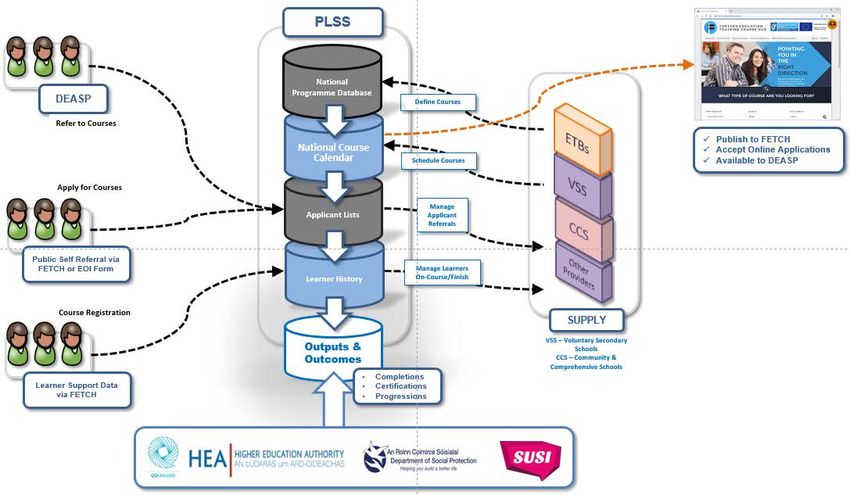
The national Programme and Learner Support System (PLSS) has since been designed and developed in
collaboration with FET Sector stakeholders, and continues to evolve. The PLSS system consists of a
National Course Calendar incorporating a National Learner Database; a National Programme Database;
and a companion course finder and online application website, www.fetchcourses.ie (FETCH), which is
fully integrated via a real-time synchronisation link to PLSS. An integrated Funding Allocation Request
and Reporting (FARR) System is also contained within which supports the annual planning cycle for FET
provision so as to facilitate alignment with the Strategic Performance Agreement. Given the broad
range of provision category types (e.g. Youthreach, PLC, Core Skills, SFW, ITABE, etc.) introduced over
many years in response to particular national initiatives, the ETB continues to operate a number of
inherited legacy management information systems (MIS) but the national PLSS system is now adopted
as the primary learner MIS system, and it is in widespread use throughout the entire FET Division.

Purpose
The purpose of this policy relates to a number of key areas associated with Learner Management
Information Systems (LMIS) which include appropriate user access controls; adequate security and data
protections (GDPR); verification of learner identity and unique identifier; maintaining accurate and
up-to-date data; applicant and learner lifecycle management; and the efficient and effective use of
learner management information systems in support of provision planning, operational delivery, and
reporting requirements. The primary systems referenced are the national Programme and Learner
Support System (PLSS) and a companion national course hub and online application website
www.fetchcourses.ie (FETCH), and www.learningandskills.ie with the FETCH widget embedded.

The policy is also to ensure that accurate; complete; and up-to-date learner inputs, outputs, outcomes;
and associated learner details and support data are collected on a per application/intervention/support
basis for all FET learners, to meet operational requirements and to fulfil national and EU co-funding
source reporting obligations in compliance with the ETB’s Policy and Procedures on Data Protection.

It is intended that course and learner related data to be used in compliance with the lawful basis under
which it is gathered in order to support and inform planning, operational decision-making, monitoring
and review of FET provision outputs and outcomes for priority and marginalised cohorts; in order to
achieve target improvements set in the current Strategic Performance Agreement and to fulfil ongoing
national and EU reporting obligations.

© Limerick and Clare Education and Training Board                                                        5
Learner Management Information System Policy

Modified from: http://wbgfiles.worldbank.org/documents/hdn/ed/saber/supporting_doc/Background/EMIS/Framework_SABER-EMIS.pdf

Scope
This policy shall apply to all Limerick and Clare Education and Training Board members of staff, including
contracted, agency and temporary members; communications with DEASP colleagues; all Partner
Group/Second Provider colleagues who have limited direct access to PLSS to manage specific cohorts of
learners; all providers acting as first point of contact with learners in supporting the FET application and
learner registration processes. The primary mode of learner registrations shall be online via FETCH.
This policy shall apply to all applicant and learner data and information including sensitive personal
data; irrespective of whether the learner is undertaking a fulltime course, part-time course, or availing
of guidance and/or support services under the remit of the FET Division.

Data Protection Awareness
Personal data to be secured in all its forms and where provided in physical form that it is filed and
secured on receipt, and that a clean desk – clear screen policy is enforced. Appropriate measures to be
introduced to ensure that visiting members of the public, learners, or other unauthorised persons do
not have sight of or access to personal data.
Personal data that is provided in support of audit requests, etc. to be transmitted as a protected file
with the encryption password sent separately, ideally by another communications method
(e.g. separate email/SMS). FET Coordinator/Manager to ensure that requests are made to IT Support
for appropriate software to be installed on all computers/devices where such activity originates.
Commonly used Microsoft Office file formats (Word, Excel, etc.) may be encrypted using a password
and this encryption method to be used when sending files containing personal data. PDF files, including
scanned documents, may be encrypted using Adobe Acrobat Professional or other software. Note: it is
unsafe to send scanned unprotected copies of personal data by email/electronically and this practice
presents a high risk of a data protection breach. I.e. files that traverse the Internet (email and/or
attachments) may be intercepted and personal data within exposed. FET Coordinator/Manager to
ensure that file encrypting software be installed on all computers/devices acting as a source of
transmitted documents containing personal data, and to ensure that staff members are fully briefed
and trained in the proper use of all software installed for this purpose. Vigilance is required to ensure
compliance.

Issue Date: This Policy is effective from 05 May 2020

© Limerick and Clare Education and Training Board                                                                             6
Learner Management Information System Policy

1. Overview of Programme and Learner Support System (PLSS)
    1.1. The Programme and Learner Support System (PLSS) is partitioned nationally into 16 separate
         and locally autonomous ETBs; additional Voluntary Secondary Schools; additional Community
         and Comprehensive Schools; along with some other providers; and access control is
         established and limited to within these partitions for each ETB/FET provider
        1.1.1. Limerick and Clare ETB to manage access control to its various FET Centres/Colleges and
               Partner Groups by creating sub-partitions, known as Providers within PLSS, to limit the
               scope of data access to local administration teams and thus minimise the potential
               exposure level of learner data at any access point
            1.1.1.1. Limerick and Clare ETB to adopt a FET Centre, campus-wide approach to creating
                     Providers within PLSS
        1.1.2. SOLAS retains access to aggregated data across all providers at national level
    1.2. The PLSS system during national design and development was subject to a Data Protection
         Impact Assessment (DPIA), conducted in forward compliance of the GDPR Regulation that
         came into force in May 2018
        1.2.1. A copy of the DPIA is available at link which contains further detail on the various PLSS
               modules, and how data is to be accessed
        1.2.2. A data sharing agreement, associated with an SLA, to be established and maintained
               current between Limerick and Clare ETB and SOLAS, and with other local Partner Groups
        1.2.3. PLSS is a web-based portal which facilitates granular and controlled access from
               outreach locations, and by local Partner Groups where applicable
        1.2.4. FETCH (www.fetchcourses.ie) is a FET Course Hub website with a real-time synchronised
               link to PLSS to display upcoming and future courses. It also facilitates online applications
               and course fee payments (a link to the SUN Financials Accounting System is currently
               piloting)

© Limerick and Clare Education and Training Board                                                      7
Learner Management Information System Policy
1.3. System guides, forms, FAQ documents, etc. are available online within the different PLSS
modules, available from the bottom of screen where applicable
1.3.1. E.g. National Course Calendar per image below:
2. Learner Management Information System Access Control
2.1. Limerick and Clare ETB to manage access control to its various FET Centres/Colleges, and
Partner Groups, by creating sub-partitions, known as Providers within PLSS, to limit the scope
of data access to local administration teams and thus minimise the potential exposure level
of learner data at any access point
2.2. Authorised users to be granted appropriate granular level access sufficient only to enable
them to carry out required functions in the performance of assigned administrative and
managerial roles
2.3. PLSS User Accounts to be created only with identifiable username/email address,
e.g. ‘@lcetb.ie’ email addresses in the main with a few exceptions for local Partner Groups
2.3.1. Gmail, Yahoo, etc. email accounts are not identifiable and shall not be accepted
2.4. A system user access request process to be established and used that provides an audit trail
of user access requests
2.4.1. A PLSS User Access Request Form to be available online to the FET Coordinator/Manager
from within the FET Systems Support Team | Access and Change Request Forms channel
via the PLSS User Request tab
2.4.1.1. All PLSS user access requests to be authorised and submitted by the relevant
FET Coordinator/Manager (user requests to be processed within 5 working days)
2.4.2. Annual and specific need audits of user access and permission levels shall be conducted
to ensure that users who no longer require the assigned level of access are identified
and updated so that access to personal data is controlled
2.4.2.1. FET Coordinator/Manager to review and confirm the status of existing user access
accounts and permissions annually, and as may be requested from time to time
2.4.3. FET Coordinator/Manager to ensure that user access changes/deactivations are notified
immediately upon change in user status, via the PLSS User Access Request Form, in
order to maintain the security and protect the integrity of learner data
2.4.3.1. E.g. for extended leave periods, staff movements, departures, etc.
2.5. User access requests to the Learner Database shall require upfront confirmation by the
FET Coordinator/Manager that the requested user has undertaken Data Protection
Awareness training and that this training has been formally recorded at FET Division level
2.5.1. The purpose is dual fold;
2.5.1.1. To protect learner data from being inadvertently disclosed, and
2.5.1.2. To ensure that the staff member is adequately advised upfront of their
responsibilities in relation to the data protection measures required in the role
© Limerick and Clare Education and Training Board 8Learner Management Information System Policy
2.5.2. A professional development course, developed in-house by the Technology Enhanced
Learning (TEL) Team, offers basic Data Protection Awareness training and is available at
https://lcetbfet.etbonline.ie
2.5.2.1. Simply login with work account credentials (email address and password)
2.6. User Access Control to the National Programme Database (NPD)
2.6.1. User access requests relating to the NPD shall be redirected to the Quality Assurance
Support Service (QASS) for approval where they involve edit access permissions
(Contributor or Local Admin)
2.6.1.1. I.e. apart from general viewing access permissions (Reader and Super Reader), the
QASS to be responsible for the approval of all edit access permissions (Contributor
and Local Admin); and for the governance, control and oversight of the
programme development process lifecycle as defined within the NPD
2.6.1.2. It is highly recommended that the Local Admin access permission be assigned to
QASS personnel only to ensure effective control over the initial setup of new local
programmes and the checkout for content population and independent review to
ensure that the relevant award standard is met
2.6.1.3. NPD lifecycle process to include actions such as; Save Programme, Module User
Assign/De-assign, Create Programme Master, Check in Programme, Select
Awarding Body, Programme Add Module, Programme Add/Remove User,
Programme Upload Specification, Programme Add Comments, Approve
Programme, Reject Programme, Reject Programme With Correction, Review
Programme, Programme Check Out Programme, Programme Edit Programme,
Programme Remove Award, Programme Add Award, Programme Assign Target
Major, Programme Remove Module, Search Module, Create a New Module,
Create Module, Create Module Assign User, Approve Module, Reject Module,
Reject With Correction, Checkout, Edit, Review, Undo Checkout, etc.
2.6.2. Only locally developed programmes may be created and modified in the ETB local
partition of the NPD. Proposed changes to national programmes shall be submitted for
consideration to SOLAS via plssqueries@lcetb.ie
2.6.3. All award related queries to be submitted to plssqueries@lcetb.ie for onward processing
2.6.4. Requests for new awards to be listed in the NPD in support of locally developed
programmes shall be submitted to plssqueries@lcetb.ie with the necessary
accompanying support documentation; record of approval by the Programmes Approval
Group, link to non-QQI awarding body and associated award (e.g. City & Guilds Series
number, etc.), and a specific list of components and/or elective units to be delivered
2.6.4.1. Requests that do not furnish the required level of supporting documentation shall
be notified and rejected
3. Local Business Process
3.1. All FET Coordinators/Managers to ensure that a well-defined and effective Local Business
Process is instituted and documented at each FET Centre/College, with its core elements
common across all provision categories, and ideally FET Division-wide, in order to coordinate
the data collection and processing of learner data at all application and registration points; and
for the timely processing, management and retention of this data throughout the entire
applicant/learner lifecycle; along with the recording of learner achieved outputs and outcomes
© Limerick and Clare Education and Training Board 9Learner Management Information System Policy
3.1.1. Digital and online methods of learner data processing to be prioritised at all times over
paper based forms. I.e. online applications to be promoted and all learner registrations
to be conducted online via FETCH. Appropriate support measures to be put in place to
assist with digital inclusion and online application/registration efforts
3.1.2. As per FET Steering Group decision for 2019-2020 intake, FETCH to be used for >90% of
all learner registrations to ensure that the ESF learner support data completion target
rate of 95% is achieved
3.1.2.1. With a further improvement in FETCH uptake planned for the 2020-2021 intake
3.1.3. Local Business Process instituted to be effective in ensuring that the learner data
collected and associated outputs and outcomes are entered in PLSS in a timely manner
(target same day entries for most activities but within 5 working days)
3.1.4. The accuracy of the data collected to be verified, especially learner identity and PPSN
ownership aspects, and maintained up-to-date by processing furnished updates (via
signed form or FETCH) in a timely manner (within 5 working days)
3.1.4.1. It has been agreed at FET Division level that the sighting and recording of evidence
(e.g. via tick on induction sheets or attendance tracker and a record of proof
document type presented) is sufficient for now as verification of learner identity
and PPSN ownership
3.1.4.2. IMPORTANT: Relevant FET Coordinator/Manager to ensure that this evidence is
sighted and recorded for all learners as this is a critical action with regard to
ensuring that existing PLSS records belonging to one learner are not inadvertently
disclosed (linked and published) to another learner’s FETCH account, giving rise to
a notifiable breach of data protection
3.2. IMPORTANT: the European Social Fund (ESF) Managing Authority mandates that the May 2019
issue, or later, of the PLSS Learner Details Form, or the equivalent online version via FETCH
‘My Details’ section, is the sole learner registration form be completed by all FET learners
3.2.1. FET Coordinator/Manager to ensure that the migration to the sole use of this form
and/or FETCH has been fully complied with and that all alternative/legacy forms have
now been displaced completely, or adapted to capture supplemental data only
3.2.1.1. I.e. learner support data captured via FETCH or the Learner Details Form (available
from within PLSS for very exceptional cases only) should not be duplicated on any
other application form. Instead, any additional learner data required in support of
particular programmes to be captured separately and used in conjunction with
FETCH registrations, or the Learner Details Form only where necessary
3.3. Best practice to be adopted with regard to ensuring that learner data collection, via the various
applicant referral methods as detailed in section 5.1.2 per below, always takes place at the
initial point of contact with an applicant/learner to ensure that all contacts are managed via
the primary communication channels available within PLSS (SMS/email/letter), and so that an
audit trail of learner contacts is established with associated date/time stamping
3.4. Relevant FET Coordinators/Managers to coordinate efforts to ensure that standardised PLSS
Notification Templates using appropriate mail merge fields be developed within PLSS and
adopted campus-wide, and preferably FET Division-wide, to ensure a consistent and
professional response to all communications throughout the entire applicant and learner
lifecycle
© Limerick and Clare Education and Training Board 10Learner Management Information System Policy
3.4.1. E.g. Referral: application received and initial response notification via SMS/Email to
confirm receipt and advise some detail of the process and likely next step/contacts, etc.;
In-Progress: notification of prerequisite outcome (interview, Garda vetting, initial
assessment, call to discussion/briefing, etc.) and impact with regard to undertaking
course, next step/contacts, opportunity to re-attend prerequisite step, etc.;
Call-for-Course: notification of when to attend and key information to bring, etc.;
On-Course: notification of Call-for-Course outcome and any impact, opportunity to start
late, etc.; Finish: notification of finish date and outputs, any finish documents to issue
and timing of same (SC4, etc.), etc.
3.5. FET Coordinator/Manager to actively consider how e-Learner files could be introduced in a
safe manner consistent with Data Protection requirements
3.5.1. Liaise and consult with FET Steering Group and Corporate Services in this regard
4. Scheduling and Management of FET Provision
4.1. All planned FET provision for each upcoming year to be scheduled in advance of FARR
opening, as notified nationally, for planning and operational delivery purposes
4.1.1. FET Coordinator/Manager to mitigate the burden of this task by scheduling
replacement/follow-on courses on an ongoing basis throughout the year with a rolling
one year period always in view, especially for courses aligned to the academic year
4.1.2. FET Coordinator/Manager to fully adhere to ‘FARR Guidelines for Courses approximately
two years in duration’ 31.01.2018 (PDF)
4.2. Published description for all courses to clearly and concisely convey the specific nature of
such provision, including identifying target cohorts and advising upfront of any conditions
and/or restrictions that may apply
4.3. Learning outcomes to be individually tailored and entered at course level to reflect the
modules/elements of the overall programme award to be covered in that course instance
4.4. All course details to be double-checked for accuracy prior to course approval by
FET Coordinator/Manager, and well in advance of learner referrals
4.4.1. All details to be checked, to include: no continuous intake courses, start/finish dates;
prerequisite requirements; delivery mode, time, and type; delivery days; provision
category; learning outcomes; published description; venue, and contact person;
programme/module code (centre is validated), special validation requirements, and
module selection; funding and staffing resources available in support; etc.
4.4.2. IMPORTANT: particular attention to be paid to programme and award review and expiry
dates to ensure that all learner assessments can be undertaken, fully processed, and
certifications requested in advance of deactivation/expiry/archive dates
4.4.2.1. Related notification trace to be maintained in FET Systems Support Team | PLSS
Programme Database, with listing of archived and deactivated awards available
within PLSS
4.4.3. Provision categories with multi-year programmes to schedule course instances on a
yearly basis consistent with SOLAS guideline in section 4.1.2 PDF (e.g. Years 1 and 2 of a
2 year duration programme to be scheduled as separate course instances within PLSS)
4.4.3.1. Guidelines to apply to all relevant provision categories, e.g. VTOS, Youthreach,
PLC, Community Training, etc.
© Limerick and Clare Education and Training Board 11Learner Management Information System Policy
4.4.3.2. PLC Principals to ensure learners progress from a level 5 course instance to a level
6 course instance, where applicable
4.4.3.3. Community Training provision (e.g. CTC, STP, etc.) to schedule new course
instances/intakes annually by differing qualification level and programme award
type. FET Coordinator/Manager to ensure that learners starting in current year
are not enrolled on prior year course instances, i.e. learners to be enrolled on the
first year only of such courses
4.5. All approved courses to be made Active and published to FETCH, well in advance of course
start date to allow an adequate period of time for applicants to view published courses and to
have an opportunity to express their interest; and with the ‘Accept Online Applications’
option enabled to facilitate self-referrals, some very limited exceptions may apply
4.5.1. It is recommended that the ‘Available to DEASP’ option be selected, some very limited
exceptions may apply
4.6. All courses scheduled to be specific as to actual content delivery, qualification level, and
award type. Generic courses shall not be scheduled for initial assessment screening or other
group referral purposes, except where a dedicated facility is in-built e.g. Guidance (currently
piloting). Instead communications to be improved and appropriate feedback mechanisms to
be put in place to resolve or mitigate any such problem areas
4.6.1. E.g. ESOL referrals, courses to be published at different proficiency levels (e.g.
introduction, intermediate, and advanced) with administrative referrals and self-
referrals enabled. Where applicant referrals are received at an incorrect level then
improved feedback communications and coordination between Partner Groups,
including the DEASP, is required along with a review of how course information is
conveyed/published in the first place
4.7. FET Coordinator/Manager to generate regular progress and monitoring reports to oversee
and manage each upcoming and elapsing period of provision delivery
4.7.1. Ensure all Planned courses are approved and activated in advance of course start date to
facilitate referrals at the earliest time, and to prevent automatic course cancellations
4.7.2. Local Business Process to ensure effective control over how course start and finish dates
are amended, particularly where learners already exist on-course or have finished
course
4.7.2.1. Accuracy and integrity of learner records to be closely monitored via regular
activity reporting
4.7.3. Ensure learners are referred to and started on all commenced courses, and that all
pending referrals are processed (e.g. switched to other courses, etc.) in a timely manner
(within 15 working days of course start date)
4.7.4. Ensure that all learners are processed as finished on past courses with outputs and
outcomes entered in a timely manner (within 5 working days)
4.7.5. Course status to be set to Active in advance of course start date to avoid automatic
cancellation by PLSS
4.7.6. Cancelled courses to be unapproved to prevent inadvertent reuse and bypass of course
approval process
© Limerick and Clare Education and Training Board 12Learner Management Information System Policy
5. Learner Inputs – Applications and Registrations
5.1. Applicant Referral Process
5.1.1. Applicants are referred to PLSS so that an expression of interest (EOI) in a particular
course/intervention may be wait-listed, and managed to ensure that eligibility criteria
and pre-requisite course requirements are satisfied
5.1.1.1. I.e. applicant data to be collected/updated at initial point of contact, and on a per
application/intervention basis, with eligibility determined on the same basis
5.1.1.2. A Parental/Guardian Consent Form, available from within PLSS, shall be
completed for learnersLearner Management Information System Policy
5.1.3.4. A staff member’s personal communication device, electronic/digital account, etc.
shall not be used for applicant/learner communications
5.2. Learner Registration Process
5.2.1. A revised PLSS Learner Details Form with updated content issued nationally in May 2019
and the ESF Managing Authority mandates that this updated form, or the electronic
version via FETCH ‘My Details’ section, be used for all FET learner registrations, or
newer/superseded version as may issue from time to time
5.2.1.1. Where legacy and/or alternative forms continue in use for learner registrations
then this practice shall be discontinued immediately, as the national mandate is to
use the PLSS Learner Details Form (or electronic equivalent – FETCH) as updated
and the migration process to its sole use should already be finalised by now
5.2.1.2. Where supplemental information is required in addition to the Learner Details
Form content and where this overlaps with alternative forms still in use, then the
supplemental details only to be captured in a separate form devised by the
relevant FET Coordinator/Manager, and shall be addressed immediately where
this practice continues to exist. This supplemental data may relate to specific
provision categories such as Youth and Community Training, etc. and a
FET Division-wide approach to be adopted where practicable
5.2.2. Source evidence of learner support data to be declared per tab section within PLSS as
either entered from FETCH (automatically recorded by PLSS) or administratively entered
and stated based on a signed form (EOI Form or Learner Details Form, or other signed
learner data change request deemed by FET Coordinator/Manager to comply with GDPR
and source evidence requirements and documented in the Local Business Process)
5.2.3. The FET Division has instructed that all learner registrations shall be conducted online
via FETCH, except for very exceptional and previously notified and agreed circumstances
5.2.3.1. ESF reporting mandates that a learner support data completion rate of 95% shall
be achieved by ESF programme activity (roughly aligns with provision category)
5.2.3.2. A derogation currently exists for the 2019-2020 intake to allow FETCH
registrations for >90% of learner registrations
5.2.4. IMPORTANT: where learner registrations are conducted using the PLSS Learner Details
Form then the FET Coordinator/Manager to ensure that additional measures are taken
to secure paper based forms containing sensitive personal data, where the PLSS Data
Protection Impact Assessment states that this personal data to be collected in aggregate
form only and shall not be identifiable at individual learner level. This strict requirement
poses additional challenge for the FET Coordinator/Manager to ensure that sensitive
personal data shall not be stored along with the remainder of the Learner Details Form
for any period, where used. And that additional protective measures shall be put in
place to safeguard sensitive personal data from identifying individual learners and also
ensure that source evidence linkage is retained for data entered. This is a complicated
area that the FET Coordinator/Manager shall consider carefully before adopting and
shall be documented in the Local Business Process
5.3. Learner Identity and PPSN Ownership
5.3.1. Proof of learner identity to be sighted and recorded for now as supporting source
evidence (e.g. via tick on induction sheets or attendance tracker and a record of proof
document type presented) to ensure the accuracy of learner records
© Limerick and Clare Education and Training Board 14Learner Management Information System Policy
5.3.1.1. Photo ID such as Drivers licence, Passport, Public Services Card (PSC) card, etc.
shall be sighted and proof document type recorded
5.3.1.2. Learner FETCH Account validations within PLSS shall be based upon above proof
document type recorded
5.3.2. Proof of learner PPSN ownership (unique identifier) to be sighted and recorded for now
as supporting source evidence (e.g. via tick on induction sheets or attendance tracker
and a record of proof document type presented) to ensure the accuracy of learner
records. PPSN acts as the primary (unique) identifier for all learner records in PLSS and
its verification is critical to the accuracy of records retained in PLSS and synchronised
with associated FETCH accounts
5.3.3. FET Coordinator/Manager to ensure that effective measures are in place in this regard,
in conjunction with a robust Local Business Process supplemented with close monitoring
to ensure its effectiveness
6. Learner Outputs – Completions and Certifications
6.1. Learner Completion Outputs
6.1.1. FET Coordinator/Manager to ensure that learner completion status (Full/Partial/Early
Leaver); Early Finish Reason, where applicable; to be entered in PLSS on learner finish
date, or within 5 working days, exceptions may apply during extended closure periods
6.1.1.1. Completion Status to be recorded based on the following attendance rate bands:
Completion Status Attendance Rate
Full Completer >=90%
Partial Completer >25% and =75%
6.1.2. FET Coordinator/Manager to ensure that an appropriate method of recording learner
attendance shall be in place and used for all learner attendance, e.g.:
6.1.2.1. Time and Attendance Clocking System (TACS) to be utilised in Raheen Campus and
Shannon Campus (former Training Centres), and by some FET Centres - VTOS and
Youthreach provision where fully deployed
6.1.2.2. A legacy Client Services System (CSS) to continue in use to record Evening
provision attendance while a replacement attendance capture facility within PLSS
is developed and rolled out, currently piloting at some ETBs
6.1.2.3. An Excel based Learner Attendance Tracker template to be rolled out to Part-time
Provision that provides for automatic determination of completion status and the
recording of learner outcomes. Support infrastructure (StaffConnect)
configuration and template operational guidelines to be put in place
6.1.2.4. Appropriate alternative/manual recording systems to be implemented elsewhere
with the process fully documented
6.2. Learner Certification Outputs
6.2.1. Learner certification status to be entered in PLSS for all learners on course finish, and
updated when known in advance of the annual certification snapshot report (E/April)
© Limerick and Clare Education and Training Board 15Learner Management Information System Policy
6.2.1.1. All certification outputs to be processed in a timely manner for learner results
notification purposes, well in advance of the annual certification snapshot report
6.2.1.2. QQI learner personal details to be exported on a per course (class) basis, using the
QQI Award XML action within PLSS, and uploaded to the QBS system in
preparation for results entry, apart from former Training Centres where the
RCCRS System is in use. Fee exemption status of each learner is now included in
this export file; PLSS course reference linkage to be retained in any custom group
names entered in the QBS system
6.2.1.3. Where the dropdown option ‘Waiting for Certification Details’ is selected then the
FET Coordinator/Manager to ensure that an effective and documented follow-up
process is in place to complete certification outputs, report gaps via PLSS Reports
Certification Description
Fully Certified All of the certifications available on this course were achieved
Some of the certifications available on this course were
Partially Certified
achieved
No certification available or none of the certifications available
No Certification Achieved were achieved
Waiting for Certification Details Assessment outputs are not yet known or available
6.2.2. Learner award details to be entered in PLSS for all learners on course finish, or when
known or available per above
Certification Award
QQI Major
QQI Special Purpose/Supplemental Award
QQI Component Award
Other Award
QQI Major and Other Award
QQI Special Purpose/Supplemental and Other Award
QQI Component and Other Award
7. Learner Outcomes – Progressions and Employments
7.1. Learner Outcomes
7.1.1. Evidence to be retained of reported Learner Outcomes achieved within 4 weeks of finish
7.1.1.1. Formal/informal exit discussions/interviews to take place to ascertain learner
outcomes, and subsequent follow-up to update outcomes within the 4 week
period directly after course finish
7.1.2. FET Coordinator/Manager to ensure that all members of staff involved in recording
learner Completion Outcomes (progressions/employments/etc.), in PLSS within 4 weeks
of course finish, to retain a documented record of the learner outcomes reported and
entered. This evidence does not need to be verified at source, e.g. with employers,
institutions, etc.
Completion Outcome Completion Outcome
FET Course at the same or higher level Unemployed
HET Course at the same or higher level Inactive-engaged in home duties
Paid full-time employment Inactive-retired from employment
Paid part-time employment Inactive for other reasons
Self-employment Other
Employment scheme Unknown
Voluntary work Deceased
© Limerick and Clare Education and Training Board 16Learner Management Information System Policy
7.1.3. Learner outcomes indicate relevance of each course and how successful it is in achieving
stated aims thus appropriate attention and resources to be assigned to the area of
course reviews with a view to end of life courses, and to alternative and renewal courses
7.1.4. The Learner Attendance Tracker template referenced in section 6.1.2.3 incorporates a
facility to save the entered outcomes as a PDF declaration within 4 weeks of course
finish, this is deemed satisfactory for now as an evidence base that the entered
outcomes were reported and recorded within the 4 week period
7.1.5. A Late Outcome action exists within PLSS to allow learner outcome updates to be
recorded up to 36 weeks after course finish
8. Applicant and Learner Lifecycle Progression
8.1. FET Applicant and Learner Lifecycle Workflow Graphic
8.1.1. A visual aid to the entire applicant and learner lifecycle is available at link
8.2. Applicant Referrals
8.2.1. All applications received, and applicant data update notifications, to be processed within
5 working days (apart from centre closure periods)
8.2.1.1. FET Coordinator/Manager to consider practicable measures for extended closure
periods
8.2.1.2. All FETCH learner data updates to be processed within 5 working days
8.2.2. Ensure applicant referral date reflects the actual submission date for record accuracy
and to afford fair access to provision and services
8.2.3. Parental/Guardian Consent to be in place, where applicable (Learner Management Information System Policy
8.5. Commencement On-course
8.5.1. Learner registrations to be conducted/finalised via FETCH ensuring that a complete
learner support dataset is collected, or that individual learner decisions not to disclose
certain data is documented
8.5.1.1. FET Coordinator/Manager to ensure that all learners to view the Enrolment Video
available at http://learningandskills.ie/our-courses/ in advance of group and
individual learner registrations
8.5.1.2. Late starters to view Enrolment Video during individual learner registration or
during any late group registration sessions arranged
8.5.2. Refer to section 5.2.4 in relation to specific measures required when the PLSS Learner
Details Form is used in very exceptional circumstances
8.5.3. Ensure that learner actual start date is accurately recorded and that it is not before
course start date, or after finish date
8.5.4. Learner start record to be updated in a timely manner, i.e. within 2-3 working days, and
may be more critical where learner training allowance payments apply
8.6. Finish Course
8.6.1. Ensure that learner actual finish date is accurately recorded and that it is not after
course finish date, or before course start date
8.6.2. Learner finish record to be updated in a timely manner, i.e. within 2-3 working days, and
may be more critical where learner training allowance payments apply
8.6.3. IMPORTANT: much care and attention shall be taken to distinguish between the course
Switch action and the course finish actions, Finish and ‘Finish & Refer’
8.6.3.1. The Switch action to be used for applicants only to switch the applicant’s
expression of interest from one course to another where no record of
participation in the source course is to be recorded. I.e. applicant has not yet
progressed to On-course or has inadvertently been started On-course. Take care
with the latter to undo a learner start before using the Switch action
8.6.3.2. The Finish and ‘Finish & Refer’ actions are normally used at course finish to
process learner participation, and also progression in relation to the latter.
However, these actions may also be used when a learner wishes to transfer to
another course after a period of participation in a source course. These actions
will ensure that a record of the learner’s participation in the source course is
retained, particularly important where a training allowance payment applies
8.7. Course Date Amendments
8.7.1. Application Closing Date field to be used to extend or curtail course application date
rather than adjusting course start date
8.7.1.1. To be employed also when using FETCH for online Expressions of Interest to a
course, or when completing EOI as part of a group FETCH Learner Registration
process
8.7.2. FET Coordinator/Manager to ensure that all course date adjustments are requested by
team members, documented and approved, and that any date amendments do not
impact on the integrity of learner records (on-course/finished, start/finish dates, etc.)
© Limerick and Clare Education and Training Board 18Learner Management Information System Policy
8.7.2.1. E.g. issues may present when course start date amended beyond a learner start
date, course finish date amended before a learner finish date, course finish date
before course start date, etc.
8.7.3. FET Coordinator/Manager to ensure that learner start/finish dates do not conflict with
original, or as subsequently amended, course dates
8.7.4. FET Coordinator/Manager to ensure that learner records within PLSS fully align with
training allowance payment (financial) records, where applicable
8.8. Course Evaluation Feedback and Exit Interviews
8.8.1. FET Coordinator/Manager to ensure that the Local Business Process instituted includes
arrangements for course evaluation feedback and exit interviews, and follow-up with 4
weeks of course finish to determine/update initial learner outcomes
9. FETCH Learner Accounts
9.1. FETCH Account Management
9.1.1. FETCH is a SOLAS managed website that applicants and learners may use to self-refer to
provision and services and to complete the learner registration process online
9.1.1.1. This area poses a particular challenge in how we continue to support learner
access to ETB provision, with many FETCH account related issues presenting. This
area to be monitored closely to see how it can be improved
9.1.2. FETCH Accounts are learner personal accounts and no staff member shall retain FETCH
account credentials belonging to an applicant/learner
9.1.2.1. I.e. staff members shall take particular care not to create learner FETCH accounts
and/or to list/store/use learner FETCH account credentials
9.1.3. Learners with digital literacy skills deficits may be supported when completing the
FETCH application and registration processes using the Advocacy Support Consent Form
available at link, and prompt cards/methods (mobile snap), etc. to be used to assist the
applicant in reusing these credentials for follow-on applications
9.1.3.1. Advocacy support person to ensure that each learner takes all confirmatory type
actions (e.g. accepts data protection acknowledgement/statement, creates
password, click ‘Apply Now’ button, click ‘Save’ button, etc.) unless the advocacy
support person is also a parent/guardian of the learner supported
10. Reporting and Returns
10.1. Activity Reports
10.1.1. PLSS Reports offers a flexible means of generating a variety of user specific report
formats and saving them for regular use
10.1.2. Activity Progress and Monitoring reports to be created and saved in support of
operational delivery and monitoring against Strategic Performance Agreement targets
10.2. National Returns
10.2.1. National Activity Returns deadlines to be adhered to with all course, applicant, and
learner data maintained up-to-date throughout
© Limerick and Clare Education and Training Board 19Learner Management Information System Policy
10.3. ESF Returns
10.3.1. EU annual reporting of ESF (e-Cohesion) Non-Financial Declarations (Learner Support
Data) by end of January deadline to be adhered to
10.3.1.1. Necessitates that all course, learner, and learner support data records are
complete and maintained up-to-date
10.3.2. Learner support data completion rates to be in excess of 95% are required, and
particularly so for critical support data fields (highest level of Education achieved,
Economic status and date on uptake of course/programme, outputs, outcomes, etc.)
10.4. Strategic Performance Agreement (SPA) Reports
10.4.1. Pertinent SPA target reports to all areas of provision delivered to be generated in order
to monitor progress toward achieving SPA targets
10.5. Audit Requests
10.5.1. FET Coordinators/Manager shall respond in a timely manner to all audit requests
11. System Support Requests
11.1. System Queries (PLSS, FETCH and FARR)
11.1.1. All errors, bugs, and other queries to be submitted to plssqueries@lcetb.ie with a clear
and concise outline of the issue presenting
11.1.1.1. User to ensure that the issue is repeatable via a second user on another computer
11.1.1.2. User to capture a screen grab of the particular issue or error message displayed
and to note the precise conditions under which the error is presenting to assist a
speedy resolution
11.1.2. Requests for new/enhanced functionality shall be processed as a system change request
proposal
11.2. Change Request Proposals (PLSS and FETCH)
11.2.1. FET Coordinator/Manager to ensure that all proposed system change requests stem
from a campus-wide review, input, and consideration of the likely gain or improvement
at campus and FET Division levels before submitting a change request form
11.2.1.1. PLSS Change Request Form available at link to be completed and submitted to
plssqueries@lcetb.ie
11.2.2. All PLSS Change Requests to be prioritised based on the likely acceptance at PLSS
Advisory Group level (multiple ETBs to support) and the immediate impact in relation to
daily and future operations
11.2.3. Unfortunately, development resources may not be available to implement all requested
changes, and delays can arise due to the potential impact on a live national environment
12. Retention of Data
12.1. Retention Policy and Schedule
12.1.1. Learner data and associated source documents, where applicable, to be retained per
relevant ETB document retention and disposal policies (link)
© Limerick and Clare Education and Training Board 20You can also read


