Modern Methods Experimental Physics - Lecture 14 - 19 2 2021 Marc Vrakking marc.vrakking@mbi berlin.de
←
→
Page content transcription
If your browser does not render page correctly, please read the page content below
Modern Methods Experimental
         Physics

     Lecture 14 – 19‐2‐2021

          Marc Vrakking
       marc.vrakking@mbi‐berlin.de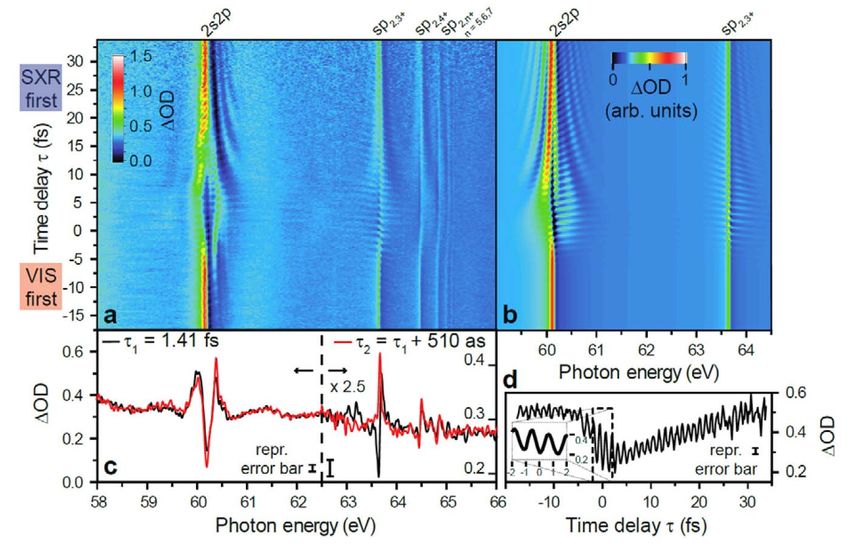
Tentative schedule and topics
Lecture
Fr : 10:00 – 11:45
https://fu‐berlin.webex.com/meet/vrakking

Working group
Fr : 8.00 – 9.45 (every other week, first time 20‐11‐2020)
https://fu‐berlin.webex.com/meet/vrakking
• Active participation in the working group requires a laptop
• Slides will be posted following each lecture, incl. suggestions
  for further reading:
       http://staff.mbi‐berlin.de/vrakking/lecture/index.html
• The exam will consist of a 15‐page paper on a selected topic
• Last lecture: 28‐2‐2021; paper due 1‐5‐2021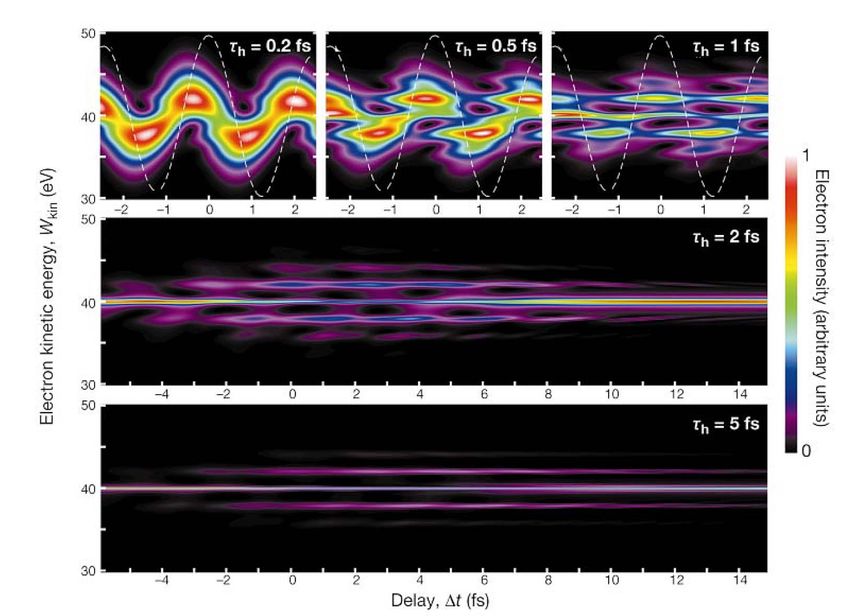
Schedule of Lecture Wintersemester 2020‐2021 (tentative)
November 6, 2020                 Lecture 1          Introduction
November 13, 2020                Lecture 2          Pump‐probe spectroscopy
November 20, 2020                Lecture 3+WG1      Pump‐probe spectroscopy (cont.)
November 27, 2020                Lecture 4          Lasers – I
December 4, 2020                 Lecture 5+WG2      Lasers – II
December 11, 2020                Lecture 6          Lasers – III
December 18, 2020                Lecture 7+WG3      Atoms in strong laser fields – I
Januari 8, 2021                  Lecture 8          Atoms in strong laser fields – II
Januari 15, 2021                 Lecture 9          Molecules in strong laser fields
Januari 22, 2021                 Lecture 10+WG4     HHG – I
Januari 29, 2021                 Lecture 11         HHG ‐ II
Februari 5, 2021                 Lecture 12+WG5     Attosecond pulse generation WG5
Februari 12, 2021                Lecture 13         Attosecond pump‐probe spectroscopy ‐ I
Februari 19, 2021                Lecture 14+WG6     Attosecond pump‐probe spectroscopy ‐ II
Februari 26, 2021                Lecture 15         Attosecond pump‐probe spectroscopy ‐ III

Working groups (tentative):

WG 1 ‐ vibrational wavepackets            WG 4 ‐ dressed states
WG 2 – velocity map imaging               WG 5 – SFA
WG 3 ‐ lasers                             WG 6 – t.b.d.
Topics for 15‐page end‐of‐term paper
Wavelength dependence of strong‐field ionization – how it functions and how
we can exploit it in laser‐induced electron diffraction
Wavelength dependence of electron localization in H2 – numerical project
using software discussed in working group
Attosecond ionization time delays – a critical survey of the recent literature
Attosecond transient absorption spectroscopy – accomplishments and
prospects
Attosecond molecular electron dynamics – a survey of theoretical predictions
Attosecond spectroscopy without attosecond pulses – a survey of HHG
imaging, inelastic X‐ray scattering and core‐hole clock methods
Other topics possible with permission
4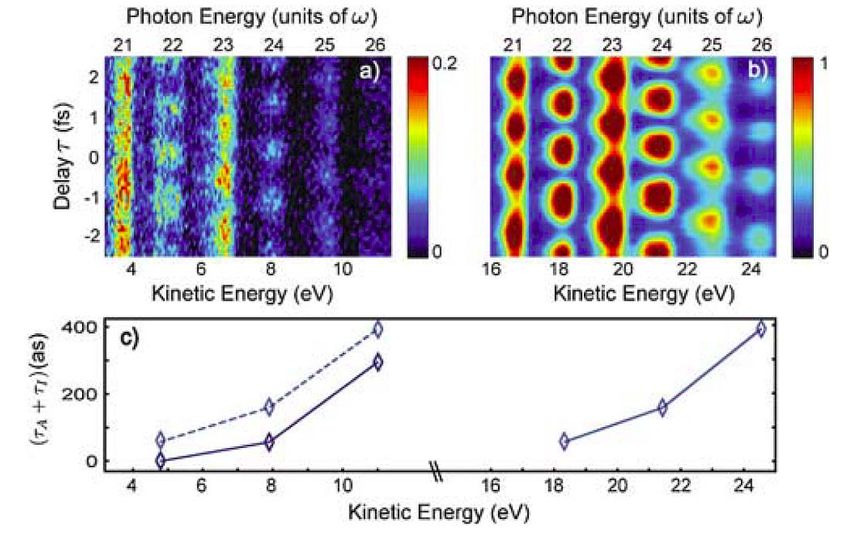
Application of attosecond pulses
            in atoms

                                   5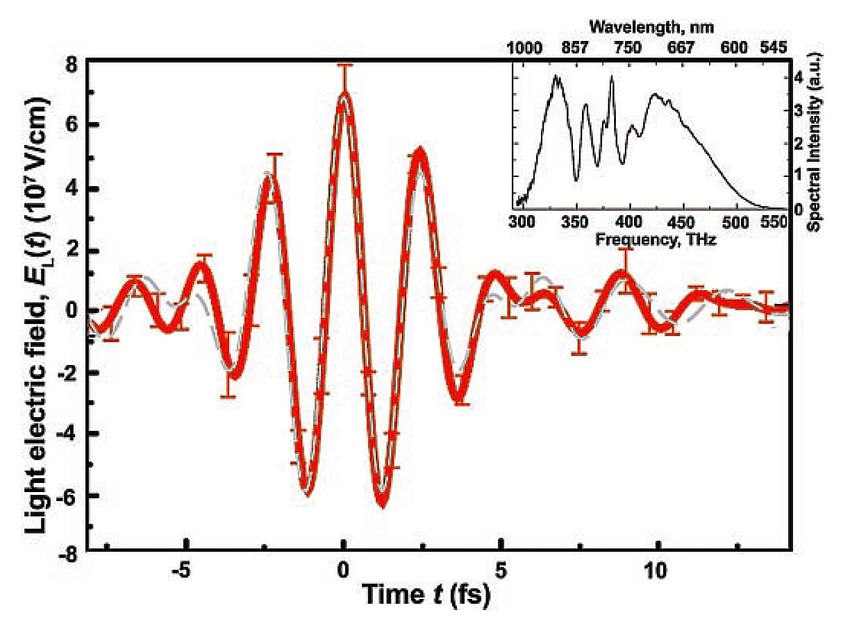
Attosecond
atomic
physics Examples:
Single electron removal
Direct Measurement of Light Waves,
continuum electron Goulielmakis et al., Science 305,
dynamics following XUV 1267 (2004)
photoionization Attosecond electron wave packet
(streaking) interferometry, Remetter et al.,
Nature Physics 2, 323 (2006)
time delays between
photoionization from Delay in photoemission, Schultze et
different initial orbitals al, Science 328, 1658 (2010), Klunder
et al, Phys. Rev. Lett. 106, 143002
coherent electron (hole) (2012)
motion following
Real‐time observation of valence
excitation of multiple
electron motion, Goulielmakis et al.,
orbitals or ionization Nature 466, 739 (2010), Mauritsson et
from multiple orbitals al, Phys. Rev. Lett. 105, 053001 (2010)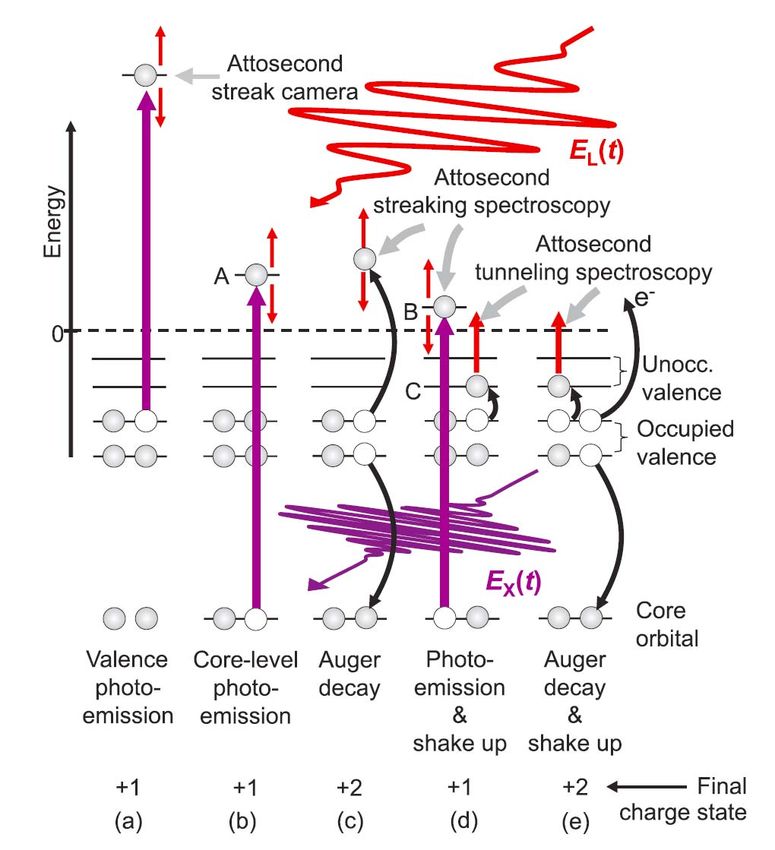
Direct Measurement of Light Waves
Experimental proof that isolated attosecond pulses
(cut‐off harmonics) are obtained for CEP=0
E(t) reconstructed
(red line) from the
streaking measurement
and calculated (gray
line) from the measured
pulse spectrum
Goulielmakis et al., Science 305, 1267 (2004)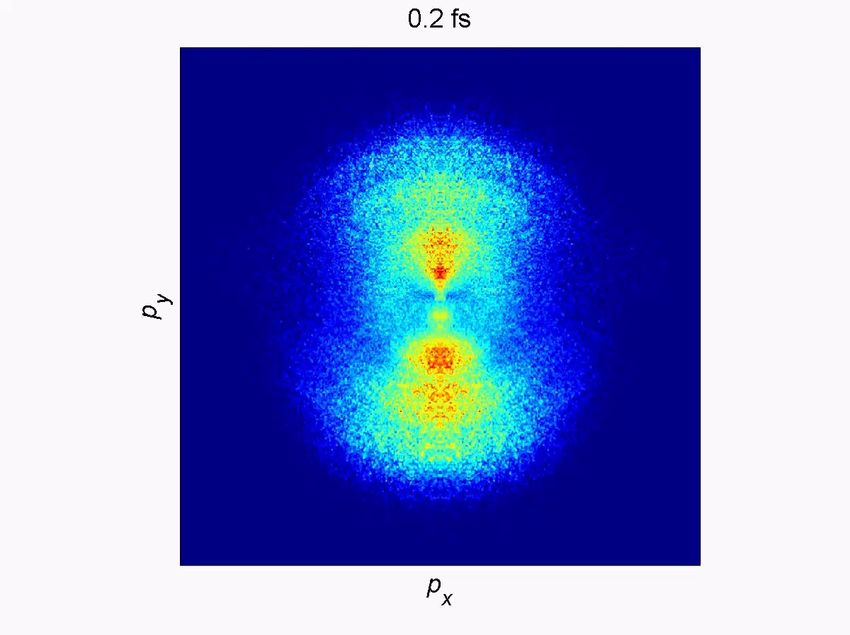
Delay in photoemission
A = group delay of the attosecond pulses
I = atomic delay two‐color ionization
Important:
Measured time delays /phases accumulate
both during ionization process and during
propagation in the Coulomb+laser fields
Kluender et al, Phys. Rev. Lett. 106, 143002 (2012)
Real‐time
observation of
valence electron
motion
Ionization produces the ion in a
superposition of two states that
are probed by the XUV
Can observe stepsize formation
of different ionic states
Can observe coherence
Goulielmakis et al., Nature 466, 739 (2010) between different ionic states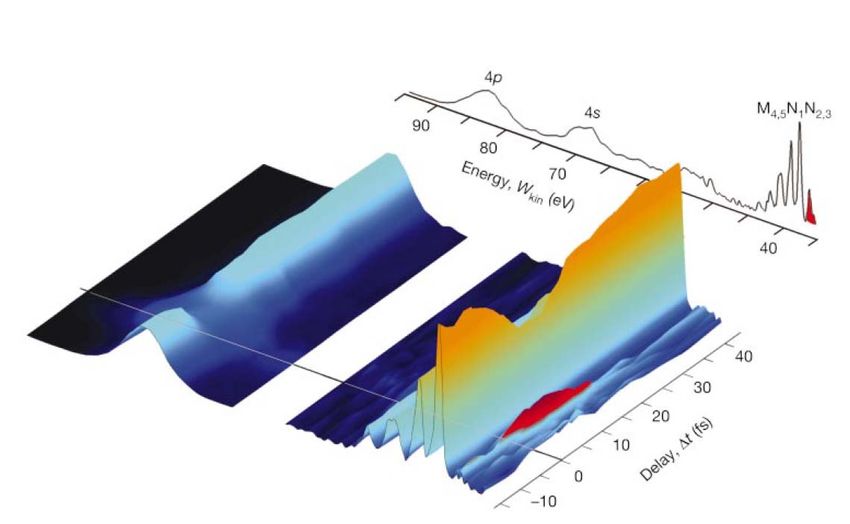
Observation of electronic coherence

                  Goulielmakis et al., Nature 466, 739 (2010)
Holographic observation of electronic
coherence
Reference WP
( Eref E A ) //ℏ
IR
0
Unknown WP
XUV
-IP Time
Mauritsson et al, Phys. Rev. Lett. 105, 053001 (2010)Near‐threshold Electron Wavepackets
HHG in Xenon, polarization gated
100 nm Al filter VMIS image
Helium
py
ionization
px
IP
excitation Helium ionization
(raw image)
Mauritsson et al, Phys. Rev. Lett. 105, 053001 (2010)Near‐threshold Electron Wavepackets
HHG in Xenon, Helium two-color ionization, I ~1013 W/cm2
Mauritsson et al, Phys. Rev. Lett. 105, 053001 (2010)First-ever observation of
bound electron dynamics
using attosecond lasers!!!
In (E,E) plot the beats of individual
states against the continuum and
beats among the states can be
observed access to energy,
amplitude and phase!!!
Mauritsson et al, Phys. Rev. Lett. 105, 053001 (2010)Attosecond
atomic
physics
Multi‐electron dynamics
Auger decay
Example:
Time‐resolved atomic inner shell
spectroscopy, Drescher et al.,
Nature 419, 803 (2002)
15Attosecond measurement of Auger
decay
Photoionization of Kr at 95 eV leads to both
the removal of valence electrons and that of
3d core M‐shell electrons (purple)
The removal of a core electron may be
followed by an MNN Auger decay (green),
allowing a measurement of the liftetime of the
core hole
M core level hole,
N relaxing electron state
N emitted electron state
M. Drescher et al., Nature 419, 803 (2002)Attosecond measurement of Auger
decay
streaking regime
Auger >laser
M. Drescher et al., Nature 419, 803 (2002)Attosecond measurement of Auger
decay
The Auger lifetime can be revealed by
a streaking /sideband measurement
valence ionization
broadening due to streaking
(no CEP stabilization) Auger sideband
photoelectrons from Auger proces
M. Drescher et al., Nature 419, 803 (2002)Attosecond measurement of Auger
decay
Determination of Auger
lifetime of 7.9 1 fs
M. Drescher et al., Nature 419, 803 (2002)Attosecond
atomic
physics
Multi‐electron dynamics
Auger decay
Shake‐up
Example:
Time‐resolved atomic inner shell
spectroscopy, Drescher et al.,
Nature 419, 803 (2002)
Attosecond real‐time
observation of electron
tunneling in atoms, Uiberacker et
20
al., Nature 446, 627 (2007)Time‐resolving the tunneling process
Photoionization of Ne at 90 eV leads to both
the removal of a 2p valence electron and
shake‐up of a second 2p electron into a
Rydberg state
The shake‐up electron can be ionized by a low‐
order NIR multi‐photon ionization process
Uiberacker et al., Nature 446, 627 (2007)Uiberacker et al., Nature 446, 627 (2007)
22Uiberacker et al., Nature 446, 627 (2007)
See sub‐cycle time‐dependence
of ionization, even for low‐
order processes where >>1
23Attosecond atomic physics Increasingly complex atomic physics problems addressed by attosecond pump‐probe spectroscopy
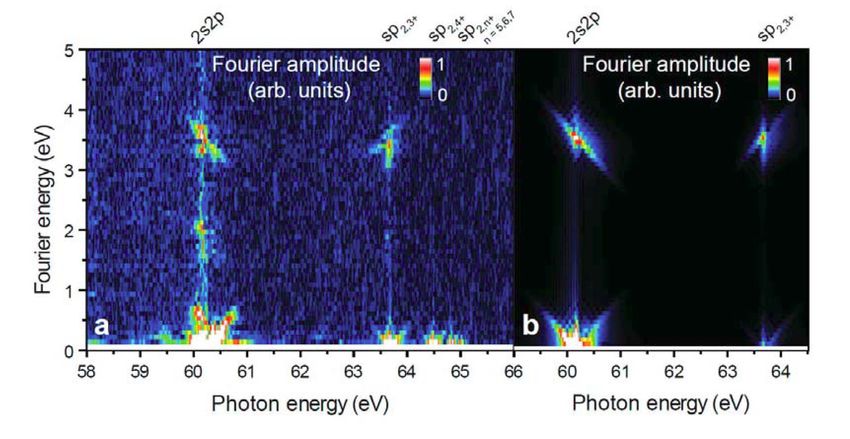
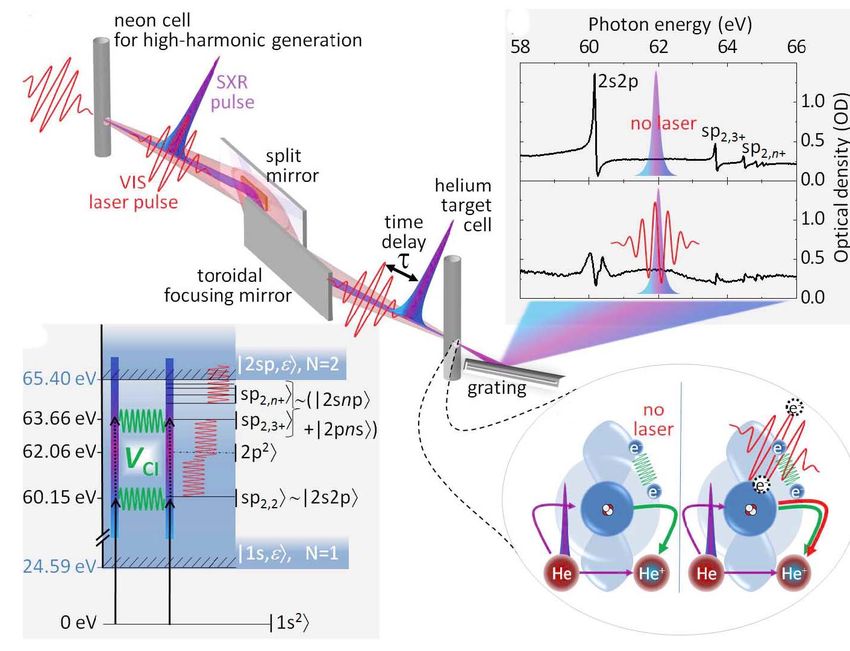
Fano Resonances in Transient Absorption

                           C. Ott et al., arXiv:1205.0519
Fano Resonances in Transient Absorption
C. Ott et al., arXiv:1205.0519Fano Resonances in Transient Absorption:
Frequency analysis similar to previous holography
experiment
C. Ott et al., arXiv:1205.0519Useful materials for further reading (strong field
ionization):
C.J. Joachain, N.J. Kylstra and R.M. Potvliege, Atoms in Intense Laser
Fields, (Cambridge University Press, 2012)
M. Ivanov et al., Anatomy of strong field ionization, J. Mod. Optics
52, 165 (2005)
L. DiMauro and P. Agostini, Adv. At. Mol. And Opt. Physics 35, 79
(1995)
+ several chapters (DiMauro, Ivanov, Smirnova, L´Huillier) in
upcoming book „Attosecond and XUV Physics“ (ed. by M.J.J. Vrakking
and Th. Schultz, Wiley, december 2013)
28You can also read


