Multicomponent and multisensory communicative acts in orang-utans may serve different functions
←
→
Page content transcription
If your browser does not render page correctly, please read the page content below
ARTICLE
                  https://doi.org/10.1038/s42003-021-02429-y                 OPEN

                  Multicomponent and multisensory communicative
                  acts in orang-utans may serve different functions
                  Marlen Fröhlich 1 ✉, Natasha Bartolotta1, Caroline Fryns1, Colin Wagner2, Laurene Momon                                                2,

                  Marvin Jaffrezic2, Tatang Mitra Setia3, Maria A. van Noordwijk1 & Carel P. van Schaik1,4

                  From early infancy, human face-to-face communication is multimodal, comprising a plethora
                  of interlinked communicative and sensory modalities. Although there is also growing evi-
                  dence for this in nonhuman primates, previous research rarely disentangled production from
                  perception of signals. Consequently, the functions of integrating articulators (i.e. production
1234567890():,;

                  organs involved in multicomponent acts) and sensory channels (i.e. modalities involved in
                  multisensory acts) remain poorly understood. Here, we studied close-range social interac-
                  tions within and beyond mother-infant pairs of Bornean and Sumatran orang-utans living in
                  wild and captive settings, to examine use of and responses to multicomponent and multi-
                  sensory communication. From the perspective of production, results showed that multi-
                  component acts were used more than the respective unicomponent acts when the presumed
                  goal did not match the dominant outcome for a specific communicative act, and were more
                  common among non-mother-infant dyads and Sumatran orang-utans. From the perception
                  perspective, we found that multisensory acts were more effective than the respective uni-
                  sensory acts, and were used more in wild compared to captive populations. We argue that
                  multisensory acts primarily facilitate effectiveness, whereas multicomponent acts become
                  relevant when interaction outcomes are less predictable. These different functions under-
                  score the importance of distinguishing between production and perception in studies of
                  communication.

                  1 Department of Anthropology, University of Zurich, Zurich, Switzerland. 2 DEPE-IPHC – Département Ecologie, Physiologie et Ethologie, University of

                  Strasbourg, Strasbourg, France. 3 Fakultas Biologi, Universitas Nasional, Jakarta Selatan, Indonesia. 4 Center for the Interdisciplinary Study of Language
                  Evolution (ISLE), University of Zurich, Zurich, Switzerland. ✉email: marlen.froehlich@uzh.ch

                  COMMUNICATIONS BIOLOGY | (2021)4:917 | https://doi.org/10.1038/s42003-021-02429-y | www.nature.com/commsbio                                                  1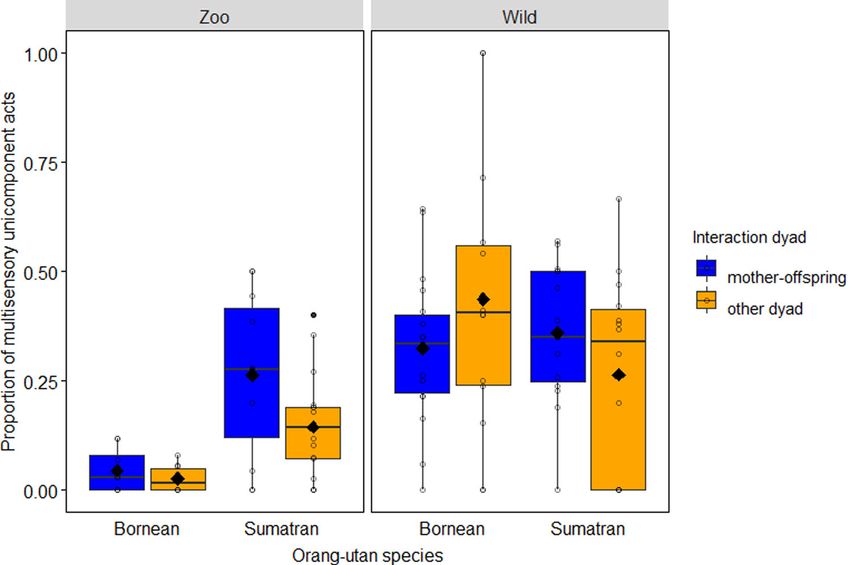
ARTICLE                                                                COMMUNICATIONS BIOLOGY | https://doi.org/10.1038/s42003-021-02429-y

H
         uman face-to-face communication is a multimodal phe-                production of signals is critical as some communication systems
         nomenon: our everyday speech is embedded in an inter-               (e.g. those of primate species) often lack the one-to-one corre-
         actional exchange of coordinated visual, auditory, and              spondence between signal and outcome8,17. On the other hand,
often even tactile signals. Some parts of these complex displays             understanding the role of perception is important because the
are intrinsically coupled due to the effort of vocal production              function of animal signals is predicted by receiver psychology18,19
(such as mouth movement accompanying speech sounds), but                     and thus by the receiver’s sensory systems7,20. However, to date,
others are flexible (e.g. gaze and co-speech gestures). Research on           no study has explicitly examined specifically how the function of
the nature and function of human multimodal interaction has                  multicomponent signals compares to that of multisensory signals
focused particularly on flexible combinations of different articu-            in a great ape taxon (nor, to our knowledge, in humans). The
lators (i.e. signal production organs such as hands, lips and                theoretical and empirical differences between these combination
eyes)1,2. For instance, speech acts accompanied by gestures and              types are often ignored in comparative research12,17, but
gaze are processed faster3 and elicit faster responses4,5, respec-           addressing them would be key to draw conclusions about
tively. This suggests that a complex orchestration of articulators           homologous features in the human/ape communication system21.
and sensory channels facilitates comprehension and prediction                   A neurobiological perspective underscores the plausibility of
during language processing6. Many non-human species also have                differentiating between the production and perception aspects of
a natural predisposition for multimodal social interactions, as              communicative acts: in contexts or situations requiring a multi-
evident in complex mating, warning and dominance displays7,8.                component act, the signaller is forced to execute (at least) two
   Multimodal signalling can be disentangled based on the per-               different motor commands in different articulators. Neurobiolo-
spective of production versus perception: multicomponent (or:                gical research on human communicative processing suggests that
multiplex) communication involves at least two different articu-             the integration between speech and gesture depends on the
lators or communication organs at the production side6, such as              context and is under voluntary control rather than obligatory22.
hands plus gaze, whereas multisensory (or: multimodal sensu                  Co-speech gestures may therefore provide additional information,
stricto) communication involves at least two different sensory               depending on the communicative nature of the situation (e.g.
channels at the perception end, such as visual plus auditory9.               whether or not there is shared common ground between the
Many communicative acts are both multi-component and mul-                    signaller and the recipient)23 as well as on gaze direction (i.e.
tisensory, for instance, a tactile gesture combined with a vocali-           whether or not the signaller’s gaze is directed at the addressee)24.
sation, whereas some are just multisensory, such as the audio-               Together with rich evidence that multicomponent acts serve to
visual loud scratch gesture (observed during the initiation of               refine messages1,25,26, this suggests they are of particular rele-
mother-offspring joint travel in chimpanzees and orang-                      vance when outcomes are less predictable: when social partners
utans10,11), and others are only multicomponent, such as a                   are less familiar or more socially distant to each other, they are
visual gesture combined with a facial expression. In fact, our               less likely to have engaged in a specific communicative context,
closest living relatives, the great apes, are renowned for signalling        and disambiguation of signal meaning may become necessary.
intentional communicative acts in large part by non-vocal means                 The multisensory case explicitly takes the recipient’s (and thus,
in their close-range dyadic interactions8,12,13. Many of these               the perception) perspective: the recipient is forced to integrate
signals are intrinsically multisensory (e.g. tactile gestures that can       incoming information in at least two different sensory channels
be simultaneously seen and felt by a receiver, or lip-smacking               that initially are processed in different brain regions. Visual and
which can be seen and heard), but they can also be integrated                auditory pathways, for instance, are largely separate before con-
with other, non-vocal or vocal acts in multicomponent signal                 verging in the ventrolateral prefrontal cortex (vlPFC) onto neu-
combinations (e.g.12–14). The term multimodality has confusingly             rons that represent higher-order multisensory representations of
been used to refer to communicative acts that involve multiple               signals, such as vocalisations and their associated facial
communicative features/articulators (e.g.15,16), but also multiple           expressions27. This need to integrate may make it more likely that
sensory channels (e.g.7,17). Therefore, we will henceforth refer to          the communicative act is accurately processed compared to a
multicomponent and multisensory acts, respectively, to explicitly            unisensory signal, suggesting that multisensory communication
discriminate between the aspects of communicative acts that                  serves to ensure that a signal is understood28,29.
reflect production and affect perception, respectively (Table 1).                These neurobiological considerations suggest that multi-
   The fact that close-range communicative acts may be either                component and multisensory acts may serve different functions.
multicomponent or multisensory (even if many are both) high-                 Comparative researchers have recently begun to study the func-
lights the importance of teasing apart production and perception             tion of great apes’ multicomponent and multisensory commu-
aspects of communicative acts if we wish to assess whether they              nication via observational research, focusing on bi-articulatory
serve different communicative functions. Studying the flexible                gesture-vocal combinations12–14,16 and considering mostly two

 Table 1 Definition and operationalisation of relevant terms used in analyses.

 Term                       Definition                                                                        Coding for GLMMs
 Communicative act (CA)     Socially directed, mechanically ineffective movements of the face, head,         Rows of dataset
                            limbs, or body, or vocalisations
 Articulator                Organ involved in the production of CAs: manual, bodily, gaze, facial            Each 2 levels, e.g. not manual (0),
                            and vocal                                                                        manual (1)
 Sensory channel            Modality involved in the perception of CAs: visual, tactile, auditory, seismic   Each 2 levels, e.g. not visual (0), visual (1)
 Multisensory acts          CAs perceived through at least two different sensory channels                    2 Levels: unisensory (0), multisensory (1)
 Multi-component acts       CAs involving at least two different articulators                                2 Levels: uni-component (0),
                                                                                                             multicomponent (1)
 Effectiveness              Presence of apparently satisfactory outcome (ASO) sensu11                        2 Levels: other than ASO (0), ASO (1)
 Dominant outcome match     Presumed goal sensu63 matches interaction outcome that is most                   2 Levels: non-dominant (0), dominant (1)
                            commonly (>50%) attributed to a specific CA sensu75.

2                         COMMUNICATIONS BIOLOGY | (2021)4:917 | https://doi.org/10.1038/s42003-021-02429-y | www.nature.com/commsbio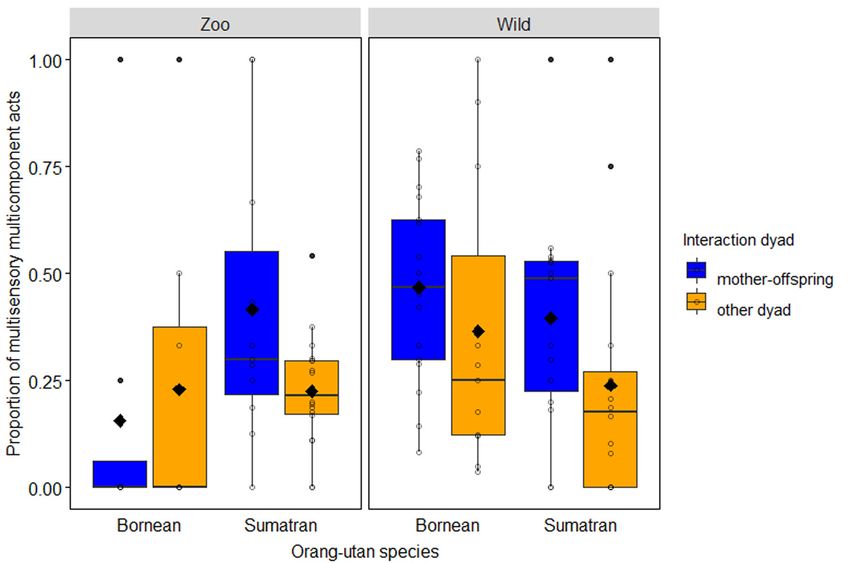
COMMUNICATIONS BIOLOGY | https://doi.org/10.1038/s42003-021-02429-y                                                                 ARTICLE

different function(s): redundancy and refinement9,17,29 (but see                aimed to evaluate two major hypotheses explaining the function
e.g. refs. 17,30 for further hypotheses that have been discussed in            of multisensory and multicomponent communication (i.e. in the
relation to complex signal function). The redundant signal                     same sensory modality) discussed for great apes: redundancy and
(hereafter referred to as redundancy) hypothesis implies that the              refinement. Since there are virtually no studies applying a similar
different components convey the same information9, facilitating                comparative approach to any primate species, our predictions are
the detection and processing of a message28. For example, using a              largely exploratory.
conspicuous signal involving multiple modalities that contain the                 If multisensory communicative acts indeed function as backup
same information (e.g. audible and visual) makes it easier to be               signals (constituent parts convey the same information as sug-
detected by a recipient in noisy environments31,32 and can thus                gested by the redundancy hypothesis9,28), two predictions follow.
increase effectiveness (i.e. responsiveness). Multisensory displays            First, these acts (e.g. comprising visual plus auditory acts pro-
in several taxa, such as monkeys33, birds34–36, fish37, and                     duced in one articulator) should be more effective (i.e. more likely
insects38,39 were found to be consistent with this hypothesis.                 to result in the apparently satisfactory outcome11, see ‘Methods’
   In contrast, the refinement hypothesis posits that the presence              section) than the single (e.g. purely visual) constituent parts, but
of one signal component may provide the context in which a                     have little or no effect on the type of outcome (i.e. dominant
receiver can interpret and respond to the second, with the com-                versus non-dominant interaction outcome, referring to whether
binations serving to disambiguate meanings (i.e. functions) when               or not the presumed goal of a particular communicative act
these partly overlap17,29. For instance, adding a signal (e.g. facial          aligned with its most common outcome, see Table 1). Second,
expression) to another one (e.g. gesture) may affect the likelihood            multisensory acts should be more common in the wild than in
of a certain interaction outcome (e.g. affiliative behaviour)40, but            captive settings, where semi-solitariness limits interaction
also overall effectiveness (despite the fact that information of the           opportunities and visual communication is impeded by poor
constituent parts is non-redundant). Some evidence corroborat-                 visibility17,29,30.
ing this hypothesis was gathered from great apes12–14,40. An                      We now turn to multicomponent acts. If they primarily serve to
important shortcoming of previous work, however, was that                      refine messages, we predict that they would be used more often for
researchers did not disentangle production and perception of                   non-dominant communicative goals (i.e. reducing ambiguity). For
communicative acts, i.e. whether constituent parts varied with                 instance, if a certain communicative act is most frequently (>50%)
regard to articulators (signal production organs) or sensory                   produced towards a single interaction outcome (e.g. soliciting food
channels (modalities). Teasing these apart will allow us to gain               transfers), but occasionally also in other contexts (e.g. initiating
more insight into the function of multisensory signals and signal              grooming or co-locomotion), we predict that this communicative
combinations in great apes.                                                    act is accompanied by other constituent parts (e.g. specific facial
   The aim of this study was to disentangle multisensory and                   expression such as a pout face, or gaze directed at recipient) more
multicomponent communication in the great ape genus that is                    often for outcomes that are less common for that communicative
one of the most suitable for this avenue of research: orang-utans              act (i.e. non-dominant; in our example grooming or co-locomo-
(Pongo spp.). First, the orang-utan populations of Borneo (Pongo               tion) to reduce ambiguity in these situations. Second, we predict
pygmaeus wurmbii) and Northwest-Sumatra (i.e. Suaq and                         that multicomponent acts would be more common in settings and
Ketambe, Pongo abelii) differ considerably in sociability (41, cf. 42)         interactions with higher uncertainty and in more varied social
and social tolerance (Bornean orang-utans become more stressed                 interactions with partners of different age-sex classes in diverse
in group settings than Sumatrans43). The consistently higher level             social contexts12,14,17. Specifically, we expect an effect of species-
of sociability in Sumatrans may lead to a greater need to refine                and dyad-dependent effect of setting: although wild individuals
messages conveyed in signals, and thus to more multicomponent                  may use more acts associated with recipient-oriented gaze than
use of communicative acts. Second, in contrast to natural envir-               their captive counterparts (due to lower degrees of social tolerance
onments, captive orang-utans are always in close proximity and                 and thus less predictable outcomes), this effect should be more
more on the ground9,17,29, and the lack of visual obstruction by               pronounced in Sumatrans (i.e. the more sociable population) and
vegetation may reduce the need for multisensory signals. Their                 in interactions beyond the mother–offspring unit.
sociability is also not constrained by food availability44. In the                A secondary aim was to examine the sources of variation in the
wild, individuals may have fewer opportunities to interact, and                individual sensory modalities and articulators that constitute
communication is hampered by arboreality and obscuring vege-                   multicomponent communication in orang-utans. We predict that
tation, whereas captivity enables frequent interactions and short-             some modalities and articulators are more often involved in the
distance communication with conspecifics other than the mother.                 communication process of orang-utans than others: in natural
Third, the pairing of social partners (interaction dyad) also affects          settings, dense vegetation in the canopy means that there are
features of social interactions regardless of captive-wild and                 fewer opportunities for the direct lines-of-sight needed for
Bornean-Sumatran contrasts, e.g. due to differences in social                  visual communication, which means that we find fewer purely
tolerance and familiarity45,46. Although mothers are the most                  visual acts of facial expressions and recipient-directed gaze. As
important communication partner of infant orang-utans10,47,48,                 arboreal species, orang-utans are thus thought to rely less on
temporary associations during feeding or travelling occur, parti-              purely visual signals than other (e.g. tactile or audio-visual)
cularly if food is abundant49,50, thus providing opportunities for             communicative means49,54. Moreover, previous work in wild and
social interactions beyond the mother–infant unit51–53. We                     captive settings leads to the expectation that vocalisations play a
expect that the reduced social tolerance of these dyads, and thus              profoundly lesser role than manual and bodily communicative
the lower predictability of interaction outcomes, would lead them              acts in orang-utans close-range communication10,48,55.
to use more multicomponent signals.                                               We found that that multisensory acts in orang-utans were
   We examined close-range communicative interactions of                       more effective than corresponding unisensory acts and were more
Bornean and Sumatran orang-utans in two wild populations and                   common in wild populations, suggesting a redundancy function.
five zoos. While focal units in this study consisted of mothers and             In contrast, multicomponent acts were more common for com-
their dependent offspring, we also examined interactions with                  municative acts whose presumed goal did not match with the
and among other members of the group/temporary association.                    dominant outcome, and in interactions with less socially tolerant
By examining species differences related to differential sociability           interaction partners, requiring the usage of refining (or dis-
on one hand, and recipient-dependent factors on the other, we                  ambiguating) acts. Together, these findings demonstrate the

COMMUNICATIONS BIOLOGY | (2021)4:917 | https://doi.org/10.1038/s42003-021-02429-y | www.nature.com/commsbio                                       3
ARTICLE                                                                            COMMUNICATIONS BIOLOGY | https://doi.org/10.1038/s42003-021-02429-y

                                           Perception                                     that unisensory acts used by Sumatran orang-utans in either
                                                MS US                                     research setting were more likely to be multicomponent than
                                                         Multicomponent acts              those of Borneans (captivity: −1.99 ± 0.291, Z = −6.849, P <
                                                                                          0.001, wild: −0.91 ± 0.215, Z = −4.238, P < 0.001), and that uni-
                                                                                          sensory acts of wild orang-utans of both species were more likely
                                                                                          to be multicomponent than those of their captive counterparts
                                                                                          (Borneans: −2.36 ± 0.314, Z = −7.508, P < 0.001, Sumatrans:
          Production

                       MC                                                                 −1.28 ± 0.186, Z = −6.892, P < 0.001). Unisensory commu-
                       UC                                                                 nicative acts among mother–infant interactions (−1.071 ± 0.193,
                                                                                          χ21 = 28.144, P < 0.001; see Fig. 2) were less likely to be multi-
                            Multisensory acts
                                                                                          component than those among other interaction dyads. For effects
                                                                                          of non-significant key predictors and those of control variables
                                                                                          see Supplementary Table S2.

                                                                                          Use of multisensory uni-component acts. Next, we used an
                                                   Unicomponent unisensory acts           equivalent GLMM to test sources of variation in the use of multi-
                                                                                          sensory acts, this time considering uni-component (UC) acts only.
Fig. 1 Composition of the dataset with regard to production and perception                The full model with the key test predictors fitted the data better than
of communicative acts. Venn diagram depicting the composition of the                      the null model (LRT: χ25 = 141.954, P < 0.001, N = 4954). With
dataset distinguishing four exclusive categories of communicative acts:                   regard to effects of specific key test predictors, we found a significant
multicomponent unisensory (MC-US), multicomponent multisensory (MC-                       interaction between orang-utan species and research setting
MS; overlapping area), uni-component multisensory (UC-MS), and uni-                       (−1.306 ± 0.391, χ21 = 12.041, P = 0.001): post hoc Sidak tests
component unisensory (UC-US). Depicted values represent total sample                      showed that uni-component acts in wild orang-utans were more
sizes per category (Total N = 7587).                                                      likely to be multisensory (than unisensory) compared to those of
                                                                                          their captive counterparts regardless of species (Borneans: −3.13 ±
importance of empirically distinguishing between production and                           0.338, Z = −9.314, P < 0.001, Sumatrans: −1.82 ± 0.216, Z = −8.461,
perception of communicative acts.                                                         P < 0.001), and that captive Sumatrans produced more multisensory,
                                                                                          uni-component acts than captive Borneans (−1.342 ± 0.334, Z = −
Results                                                                                   4.021, P < 0.001; see Fig. 3). For effects of other, non-significant key
Production and perception of communicative acts. Out of the                               predictors and those of control variables see Supplementary Table S2.
7587 coded communicative acts, 3465 were unisensory and uni-
component, 1774 multi-component but unisensory, 1489 multi-                               Use of multicomponent multisensory acts. Finally, we tested
sensory but uni-component, and 859 both multi-component and                               sources of variation in the use of multicomponent multisensory acts,
multisensory (see Fig. 1 for Venn diagram).                                               considering subsets of the dataset that consisted either only of mul-
   Focusing on the production side first, we found that individuals                        ticomponent acts or only of multisensory acts (allowing to test the
used multicomponent communicative acts (i.e. acts that com-                               effect of the second type of integration). First, considering only the
prised combinations of different articulators) on average in 31%                          dataset of multisensory acts (i.e. contrasting MC-MS with UC-MS),
of instances, 21% of which were unisensory, and about 10 %                                we again found that the full model including the key test predictors
multisensory. In terms of specific articulators, individuals used                          fitted the data better than the null model (LRT: χ25 = 45.235, P <
manual acts on average in 66% of observed cases, bodily acts in                           0.001, N = 2348). Specifically, we found a significant interaction
24%, facial acts in 2%, vocal acts in 3% and recipient-directed                           between species and setting (−2.071 ± 0.866, χ21 = 6.049, P = 0.014;
gaze in 57% of cases (for detailed results in relation to species and                     see Fig. 4): post hoc Sidak tests showed that the multisensory acts of
setting, see Table 2; for sources of variation in individuals’ use of                     captive Sumatran orang-utans consisted more often of multiple
specific articulators, see Supplementary Table S1 as well as                               components than those of wild Sumatrans (1.406 ± 0.343, Z = 4.097,
Supplementary Figs. S1 and S2).                                                           P = 0.001) and captive Borneans (−2.458 ± 0.815, Z = −3.016, P =
   Focusing on perception, we found that individuals used                                 0.003). With regard to kinship effects, we found that multisensory
multisensory communicative acts on average in 25% of observed                             acts among mother-offspring dyads were less likely to be multi-
cases, of which 15% were uni-component and about 10% were                                 component than those among other interaction dyads (−0.627 ±
multicomponent. For specific sensory channels, we found that                               0.314, χ21 = 3.987, P = 0.046; see Fig. 4). For effects of control vari-
communicative acts contained salient visual components in 49%                             ables see Supplementary Table S2.
of cases, tactile components in 75%, auditory components in 3%,                              Second, considering only the dataset of multicomponent acts
and seismic components in 1%. (for detailed results in relation to                        (i.e. contrasting MC-MS with MC-US), the full model including
species and setting, see Table 2; for sources of variation in                             the key test predictors fitted the data better than the null model
individuals’ use of specific modalities, see Supplementary Table S1                        (LRT: χ25 = 33.793, P < 0.001, N = 2633). Specifically, we found a
and Supplementary Fig. S3).                                                               significant interaction between species and setting (−1.916 ±
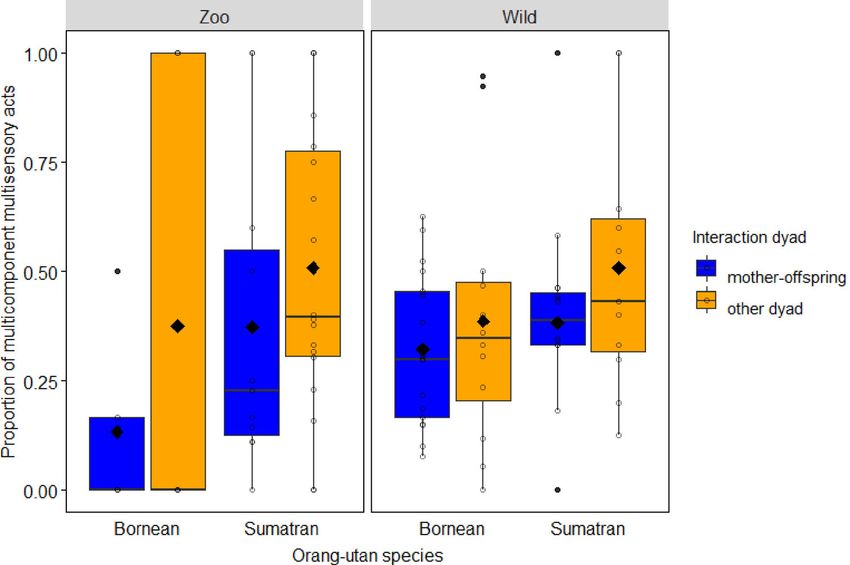
                                                                                          0.726, χ21 = 7.664, P = 0.006; see Fig. 5): post hoc Sidak tests
Use of multicomponent unisensory acts. Using a GLMM with                                  showed that the multicomponent acts of wild Bornean orang-
binomial error structure, we test sources of variation in the use of                      utans were more likely to be multisensory than those used by wild
multicomponent acts, considering unisensory (US) acts only.                               Sumatrans (0.691 ± 0.299, Z = 2.312, P = 0.021) and captive
Overall, the full model including the key test predictors (i.e.                           Borneans (−1.461 ± 0.68, Z = − 2.15, P = 0.032). For the
species x setting, kin relationship) fitted the data better than the                       individual main effects, we found that multicomponent acts were
null model (Likelihood ratio tests [LRT]: χ25 = 127.093, P < 0.001,                       more likely to be multisensory in interactions among mother and
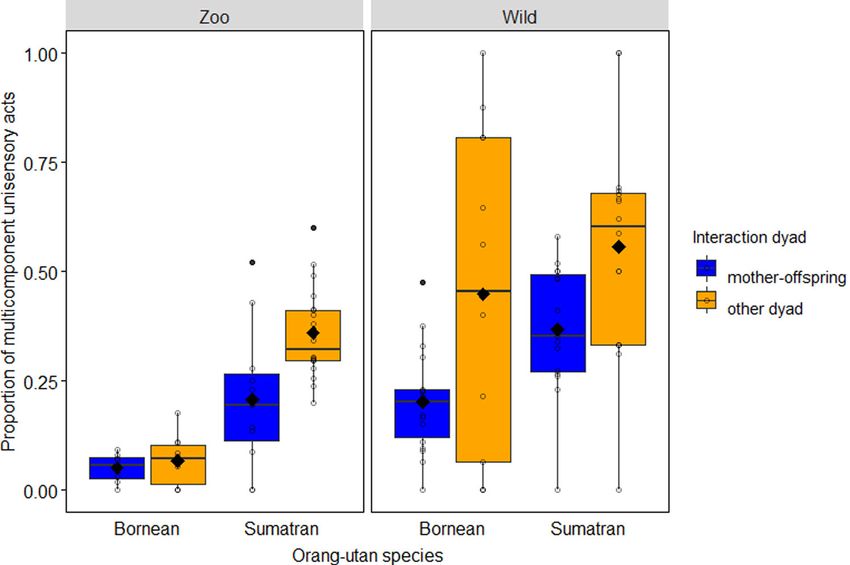
N = 5239). Specifically, we found a significant interaction                                 offspring (0.558 ± 0.279, χ21 = 3.933, P = 0.047), but less likely so
between species and setting (estimate ± s.e. = −1.08 ± 0.356,                             in interactions among maternal kin (−0.914 ± 0.263, χ21 =
χ21 = 9.456, P = 0.002; see Fig. 2): post hoc Sidak tests showed                          11.526, P = 0.001).

4                                       COMMUNICATIONS BIOLOGY | (2021)4:917 | https://doi.org/10.1038/s42003-021-02429-y | www.nature.com/commsbio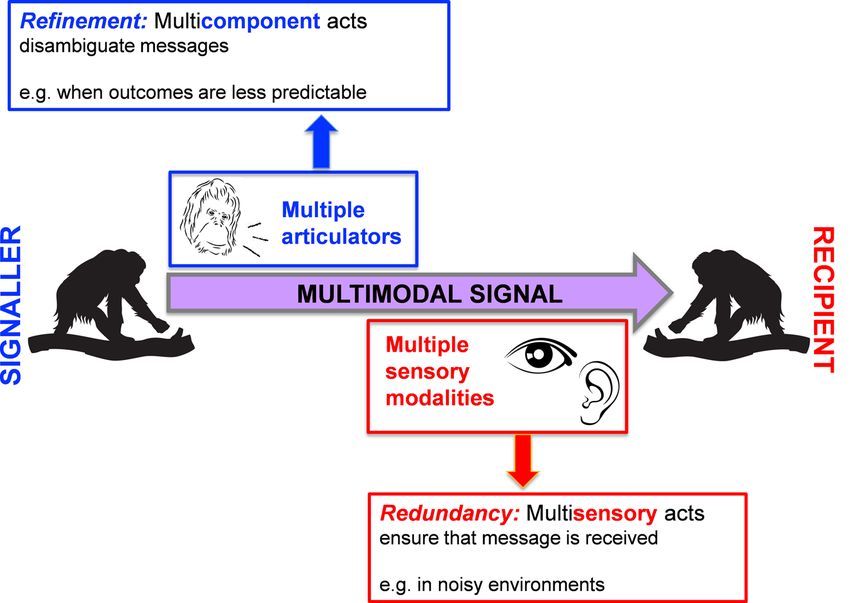
COMMUNICATIONS BIOLOGY | https://doi.org/10.1038/s42003-021-02429-y                                                                                     ARTICLE

 Table 2 Mean percentage and SD (%) of individuals’ use of communicative acts involving specific articulators and sensory
 modalities, and their outcomes, in relation to the research setting and orang-utan species.

                                                Captivity                                                  Wild                                       All
                                                Bornean                       Sumatran                     Bornean                  Sumatran
                                                Mean            SD            Mean           SD            Mean            SD       Mean       SD     Mean      SD
 Articulators
   Manual                                       71.6            10.1          57.6            13.2         69.5            17.6     68.1       20.8   66.4      17.1
   Bodily                                       23.9             11.7         35.6            13.9         22.4            15.3     16.8       18.7   24.4      16.8
   Vocal                                         0.3             0.8           2.0             3.7          5.2            12.9      2.7        3.8    2.9       7.6
   Facial                                        1.5              2.7          4.6             4.1          0.6             1.2      0.8        1.1    1.8       3.0
   Gaze                                         12.9              7.5         57              12.3         68.3            20.7     72.3       19     57.2      26.5
 Sensory modalities
   Visual                                       31.8             8.9          50.5            10.2         42.5             15      63.2       17.1   48.6       17.4
   Tactile                                      72.0             9.2          66.7             8.4         92.9              8.4    63.5       23.0   74.5       18.6
   Auditory                                      3.2             8.2           1.8             3.2          5.5             13.5     3.8        5.7    3.2        8.2
   Seismic                                       0.0             0.0           0.4             0.7          0.6              1.2     2.3        4.8    0.9        2.8
 Communicative use
   UC-US                                        89.7             5            53.4             9.7         47.8             19.7    39         13.5   54.1      22
   UC-MS                                         3.6             3.4           11              7.4         22.3             12.5    19.1       11.3   15.3       11.9
   MC-US                                         5.9             4.9          27.3             9           16.1              11     30.3       11.8   21.1      13.3
   MC-MS                                         0.7             1.1           8.2             4.6         13.8             13.8     11.7       7.8    9.5       9.8
 Outcomes
   Effectiveness                                57.6            16.3          50.9            11.8          72.1             11.5   49.5       13.6   57.9      16.0
   Dominant outcome matches                     69.3            21.6          67.8           23.7           81.5            14.1    65.5       28.3   71.5      22.9

 Note that communicative acts may comprise multiple articulators and sensory modalities, thus these rows do not add up to 100%.
 MC multicomponent, MS multisensory, UC uni-component, US unisensory.

Fig. 2 Use of multicomponent unisensory (MC-US) acts in captive versus wild orang-utans. Proportion of multicomponent communicative acts in the
sample of unisensory acts (N = 5239) as a function of research setting, species and interaction dyad (other dyad includes maternal kin). Proportions were
significantly higher in Sumatran orang-utans compared to Borneans in both settings, and higher in wild orang-utans compared to captive ones in both
species. Indicated are individual means (circles), population means (filled diamonds), medians (horizontal lines), quartiles (boxes), percentiles (2.5% and
97.5%, vertical lines) and outliers (filled dots).

Effectiveness of multicomponent versus multisensory acts. On                                      whether the multisensory (i.e. visual plus other, tactile plus other)
average, signallers received apparently satisfactory responses to                                 and multicomponent (i.e. manual plus other, bodily plus other,
their communicative acts in 58% of observed cases (for detailed                                   recipient-directed gaze plus other) use of communicative acts
results in relation to species, setting, and communicative use see                                predicted the probability of receiving an apparently satisfactory
Table 2 and Supplementary Fig. S4). Using a GLMM, we tested                                       outcome. The full models including the key test predictor fitted

COMMUNICATIONS BIOLOGY | (2021)4:917 | https://doi.org/10.1038/s42003-021-02429-y | www.nature.com/commsbio                                                             5
ARTICLE COMMUNICATIONS BIOLOGY | https://doi.org/10.1038/s42003-021-02429-y Fig. 3 Use of multisensory uni-component (MS-UC) acts in captive versus wild orang-utans. Proportion of multisensory communicative acts in the sample of uni-component acts (N = 4954) as a function of the research setting, species and interaction dyad. Proportions were significantly higher in wild orang-utans compared to captive ones regardless of species, and in captive Sumatran orang-utans compared to captive Borneans. Indicated are individual means (circles), population means (filled diamonds), medians (horizontal lines), quartiles (boxes), percentiles (2.5% and 97.5%, vertical lines) and outliers (filled dots). Fig. 4 Use of multicomponent-multisensory acts (MC-MS) in captive versus wild orang-utans. Proportion of multicomponent acts in the sample of multisensory acts (N = 2348) as a function of the research setting, species and interaction dyad. Proportions were significantly higher in captive Sumatran orang-utans compared to wild Sumatrans and captive Borneans. Indicated are individual means (circles), population means (filled diamonds), medians (horizontal lines), quartiles (boxes), percentiles (2.5% and 97.5%, vertical lines) and outliers (filled dots). the data better than the null models for multisensory use of manual: χ21 = 0.043, P = 0.837, N = 3037). For effects of non- communicative acts (LRT visual plus: χ21 = 14.458, P < 0.001, significant key predictors and those of control variables, see N = 2301, see Fig. 6a; tactile plus: χ21 = 9.692, P = 0.002, N = Supplementary Table S3. Thus, uni-component communicative 3743, Fig. 6b), as well as for multicomponent acts involving acts were more likely to be effective (i.e. result in apparently recipient-directed gaze (LRT gaze plus: χ21 = 15.81, P < 0.001, N satisfactory interaction outcomes) when they involved more than = 4513, see Supplementary Fig. S5). No such effect was found for one sensory modality, or when recipient-directed gaze was other articulators (LRT bodily: χ21 = 0.936, P = 0.333, N = 1498; accompanied by another articulator. 6 COMMUNICATIONS BIOLOGY | (2021)4:917 | https://doi.org/10.1038/s42003-021-02429-y | www.nature.com/commsbio
COMMUNICATIONS BIOLOGY | https://doi.org/10.1038/s42003-021-02429-y                                                                        ARTICLE

Fig. 5 Use of multisensory multicomponent (MS-MC) acts in captive versus wild orang-utans. Proportion of multisensory acts in the sample of
multicomponent acts (N = 2633) as a function of the research setting, species and interaction dyad. Proportions were significantly higher in wild Bornean
orang-utans compared to wild Sumatrans and captive Borneans. Indicated are individual means (circles), population means (filled diamonds), medians
(horizontal lines), quartiles (boxes), percentiles (2.5% and 97.5%, vertical lines) and outliers (filled dots).

                                                                  a)                  b)
                      Proportion of communicative acts with ASO

Fig. 6 Effectiveness of multisensory uni-component (MS-UC) acts. Proportion of uni-component communicative acts receiving an apparently satisfactory
outcome (ASO) as a function of multisensory use (a: visual, N = 2301; b: tactile, N = 3743). Circles indicate individual means, with circle area representing
sample size (a range = 1–128, b range = 1–175). Red diamonds depict model estimates with 95% confidence intervals (all other variables centred to a mean
of zero).

Association with dominant outcomes by multicomponent                            0.01, N = 3869, see Fig. 7b; manual plus other: χ21 = 0.702, P =
versus multisensory acts. Communicative acts were associated                    0.402, N = 2590). No significant effect was found for multisensory
with their dominant outcomes in 72% of observed cases (for                      use (LRT visual plus other: χ21 = 3.377, P = 0.066, N = 1674;
detailed results in relation to species, setting, and communicative             tactile plus other: χ21 = 3.099, P = 0.078, N = 3129). Effects of
use see Table 2 and Supplementary Fig. S6). Using a GLMM, we                    non-significant key predictors and those of control variables are
tested whether the multicomponent (i.e. manual plus other,                      provided in Supplementary Table S4. Thus, unisensory commu-
bodily plus other, recipient-directed gaze plus other) and multi-               nicative acts were significantly less likely to match dominant
sensory (i.e. visual plus other, tactile plus other) use of commu-              interaction outcomes when they involved at least two articulators
nicative acts predicted whether the predominant outcome of a                    (e.g. gaze plus bodily act), irrespective of setting, species or type of
specific type of communicative act was matched. The key test                     communicative act.
predictor significantly enhanced the model fit for multi-
component use of communicative acts except for those invol-                     Discussion
ving a manual component (LRT bodily plus other: χ21 = 4.69,                     This study was aimed at disentangling multicomponent and mul-
P = 0.03, N = 1429, see Fig. 7a; gaze plus other: χ21 = 6.56, P =               tisensory communication, and at deciphering the constituting

COMMUNICATIONS BIOLOGY | (2021)4:917 | https://doi.org/10.1038/s42003-021-02429-y | www.nature.com/commsbio                                                7
ARTICLE COMMUNICATIONS BIOLOGY | https://doi.org/10.1038/s42003-021-02429-y
a) b)
Proportion of communicative acts with DOM
Fig. 7 Dominant outcome matching of multicomponent unisensory (MC-US) acts. Proportion of unisensory communicative acts whose presumed goal
matched the dominant outcome (DOM) as a function of multicomponent use (a bodily, N = 1429; b recipient-directed gaze, N = 2590). Circles indicate
individual means, with circle area representing sample size per individual (a range = 1–105, b range = 1–182). Red diamonds depict model estimates with
95% confidence intervals (all other variables centred to a mean of zero).
elements (that is, specific sensory modalities and articulators, our results strikingly demonstrate that orang-utan signallers are
respectively) in wild and captive orang-utans of two different able to flexibly adjust their signalling to specific recipients, in line
species. More specifically, we wanted to gain insight into the with previous work on African apes e.g. refs. 46,58.
functions of these two types of communicative acts by studying Second, and again in line with our prediction, multicomponent
the effects of species and research setting on signallers’ behaviour, unisensory acts (e.g. bodily acts accompanied by other means of
as well as effects of multicomponent and multisensory use on the same sensory modality) were more likely to be produced
responses and types of interaction outcomes. when the presumed goal of the interaction did not match the
One key finding of this study is that both multicomponent dominant interaction outcome of a particular communicative act.
and multisensory acts differ from the respective constituent parts This finding suggests that constituent parts of multicomponent
in both production and outcomes, and may have different func- acts are non-redundant and thus may serve to refine the
tions depending on social circumstances. Thus, we can greatly message17. Human and ape communication have in common that
improve our understanding of the function of multimodality if we signals are not always tightly coupled with a given referent:
tease apart the articulators and sensory channels involved. meaning does not only depend on the communicative act that is
We will first attend to our predictions and results regarding the being used but also on the interaction history, contextual infor-
signaller-based (articulator) perspective, and thus, multi- mation and social aspects of the interaction59–61. This ambiguity
component communication. Our results suggest that multi- facilitates the production and reuse of simple, efficient signals
component communication may serve to reduce ambiguity, at when contextual and social aspects of the interaction aid in
least under certain circumstances (e.g. involving bodily acts). First inferring a specific meaning61,62. Importantly, by combining
and as predicted, we found that multicomponent acts (both uni- articulators in social interactions, interactants are able to clarify
and multisensory), were more common in dyads other than their ambiguous main signals (e.g. speech acts in humans6,25).
mother–infant regardless of orang-utan species, but also more Importantly, multicomponent communication in orang-utan
likely to be produced in Sumatran compared to Bornean orang- consisted mainly of manual/bodily acts (potential gestures sensu63)
utans. The profound difference between mother-offspring and associated with recipient-directed eye gaze (constituting gestures
other interactions is arguably due to the high trust the signaller according to common definitions in comparative research), rather
can have that the recipient is socially tolerant. This finding cor- than with vocalisations or facial expressions. Multi-component acts
roborates previous work on wild chimpanzees, demonstrating involving vocalisations were rare, which was probably largely due to
that purely visual, non-contact communication is more prevalent the overall rare use of vocalisation in orang-utan close-range
in interactions with less socially tolerant conspecifics45,46. As to communication10, but is also consistent with reports of the relatively
the island difference, although orang-utans generally have fewer rare use of gesture-vocalisation combinations in chimpanzees12,13
opportunities for social interactions than the African apes outside and bonobos14,16. It is important to note that gaze, even though it
the mother-offspring bond (but see ref. 56 showing the overlap in definitely has a communicative function, often acts as a social cue
solitariness between eastern chimpanzee females and North- rather than an intentionally produced signal. However, we do know
West-Sumatran orang-utans), such social interactions are com- that orang-utans are capable of controlling their gaze for bouts of
mon in the populations of North-West Sumatra41,57, and to a intentional communication47,48,64, suggesting that recipient-directed
lesser extent in some Bornean populations for mother–infant eye gaze serves as an important communicative articulator just as it
pairs of larger matrilineal clusters51,52. Social interactions with does in humans. As an important component of social interactions,
conspecifics beyond the matriline are rarer in Tuanan than in gaze can be directed at specific individuals (thereby being less
Suaq52, as are unpredictable outcomes of interactions that would ambiguous than auditory and olfactory signals), and may be used to
require subtler communication from a larger distance. The predict another individual’s behaviour65. We speculate that unrelated
environments that captive and wild Sumatran orang-utans orang-utans are generally much more unpredictable in their
inhabit, at least in this study, were also characterised by more responses, so they may have a strong tendency to visually check the
frequent encounters with conspecifics and a thus probably a emotional and attentional state of their potential interaction
wider set of possible social partners see also52. Taken together, partners.
8 COMMUNICATIONS BIOLOGY | (2021)4:917 | https://doi.org/10.1038/s42003-021-02429-y | www.nature.com/commsbioCOMMUNICATIONS BIOLOGY | https://doi.org/10.1038/s42003-021-02429-y ARTICLE
Turning to the recipient’s (perception) perspective, in line with our likely to match the response of the gestural than the vocal
expectation that the arboreal setting would impose particular com- components13. Another study showed that wild chimpanzees, after
municative constraints, we found that multisensory uni-component presumed goals were not achieved, switched to gesture-vocalisation
communication was more commonly observed in wild than captive combinations only if the initially single signals were vocal12.
orang-utans (for Borneans, this setting contrast was also found for Moreover, a recent study on semi-wild chimpanzees’ combinations
multisensory-multicomponent acts). Moreover, wild Bornean orang- of gestures and facial expressions showed that different combina-
utans more often used multisensory acts in their multicomponent tions (i.e. stretched arm plus bared-teeth versus bent arm plus bared
communication than wild Sumatran orang-utans. Accordingly, for teeth) elicit different responses40. Thus, the evidence so far,
orang-utans the benefits of communicating in several sensory including our own work, suggests that the combination of different
channels at once (as a backup strategy) at the expense of subtler articulators in great ape communication is apparently non-redun-
communicative acts may be greater in the wild, where greater dant, and serves to resolve ambiguity in the communicative
competition due to food scarcity may require facilitation of mutual act regardless of sensory modalities involved.
understanding, and particularly among Bornean orang-utans. Multimodality seems to be functionally heterogeneous, which is
Multisensory (uni-component) acts involving both visual and also highlighted by the wealth of predictive frameworks that dif-
tactile components were more likely to receive apparently satis- ferent behaviour researchers came up with9,17,29,30. If we split
factory responses (i.e. outcomes that resulted in the cessation of communicative acts by production and perception features, we get
communication sensu11,63) than unisensory acts. At the same a clearer functional picture (Fig. 8): the integration of different
time, we found no evidence that multisensory acts predicted non- articulators in a multicomponent act seems to primarily serve to
dominant interaction outcomes. Therefore, in orang-utans, disambiguate a message (i.e. specify meaning, as suggested by the
multisensory communication seems to primarily enhance effec- refinement hypothesis)12,14,17, whereas the integration of different
tiveness rather than reducing ambiguity: communication through sensory modalities in a multisensory act serves to ensure that the
multiple sensory channels in orang-utans may facilitate detection message arrives (i.e. enhance effectiveness, as suggested by the
and provide insurance that the message will be received, con- redundancy hypothesis)28,33. This is consistent with human com-
sistent with a redundancy function28. munication, in which multisensory (audio-visual) messages were
Nevertheless, our results also demonstrate that multicomponent shown to be processed faster, and gestural and facial acts accom-
unisensory acts (at least those involving recipient-directed gaze) panying spoken language serve to refine and disambiguate the
can be more effective than their uni-component constituent parts. message conveyed in speech acts6,25. Given that communicative
It is probably not surprising that successful disambiguation also acts can be both multicomponent and multisensory, it becomes
results in more appropriate responses, which suggests that effec- clear that both functions can be served simultaneously.
tiveness alone is not sufficient to disentangle hypotheses for the The finding that functions of multisensory and multi-
function of multimodal communication (i.e. inferring whether component communication may differ depending on the specific
signals have redundant versus non-redundant components). sensory modalities and articulators involved demonstrates the
Nonetheless, our findings are consistent with the notion that the importance of empirically distinguishing between these forms of
redundancy function applies more to multisensory signalling and communication. It is therefore important that comparative stu-
thus perception features of communicative acts, whereas refine- dies do not compare apples with oranges: the upsurge of multi-
ment applies more to multicomponent signalling and thus pro- modal study designs in primate communication is timely, but
duction aspects (Fig. 8). This does not mean that signals consisting comparisons with human communication will be most fruitful if
of non-redundant components may not also enhance respon- the difference between production and perception features of
siveness, which is consistent with studies showing that gaze- communicative acts is explicitly addressed. Implementing such a
accompanied communicative acts receive faster responses4,5). biological meaningful comparative approach to non-human
We stress that these findings have to be viewed with some species will comprise an invaluable tool to study the origins of
caution given that multisensory communication in our study the human multimodal communication system.
mainly involved visual and tactile (rather than auditory and seis-
mic components) in close-range interactions, and that we probably Methods
missed some low-amplitude auditory acts (e.g. vocalisations) due Study sites and subjects. Data were collected at two field sites and five captive
to environmental constraints (e.g. glass barriers in captivity or facilities (zoos). We observed wild orang-utans at the long-term research sites of
noisy surroundings in the field). However, the gestural repertoire Suaq Balimbing (03°02′N; 97°25′E, Gunung Leuser National Park, South Aceh,
Indonesia) and Tuanan (02°15′S; 114°44′E, Mawas Reserve, Central Kalimantan,
of great apes has indeed been considered to be widely redundant60, Indonesia), inhabited by a population of wild Sumatran (Pongo abelii) and Bornean
and studies conducted in communities of wild chimpanzees66,67 orang-utans (Pongo pygmaeus wurmbii), respectively. Both field sites consist
suggest that both simultaneously and sequentially redundant sig- mainly of peat swamp forest and show high orang-utan densities, with 7 indivi-
nalling might play a particular role in certain developmental stages duals per km2 at Suaq and 4 at Tuanan68,69. Captive Bornean orang-utans were
in apes, as a mechanism to learn context-appropriate commu- observed at the zoos of Cologne and Munster, and at Apenheul (Apeldoorn), while
Sumatran orang-utans were observed at the zoo of Zurich and at Hellabrunn
nicative techniques67. (Munich; see EEP studbook for details on captive groups70). While captive
Although previous studies on great apes mainly focused on Sumatran orang-utans were housed in groups of nine individuals each, captive
multicomponent communication (and specifically the function of Bornean groups were generally smaller and sometimes included only a mother and
gesture-vocal combinations), not all of these communicative acts her offspring (e.g. Apenheul). Signallers (i.e. individuals producing communicative
acts) included in this study consisted of 33 Bornean (21 wild/12 captive) and 38
may have actually also been multisensory (e.g. audible gestures plus Sumatran orang-utans (20 wild/18 captive). All these subjects were also recipients
vocalisation when recipients are turned away or out of sight, such as (i.e. individuals at which communicative acts were directed) except for one wild
drumming displays associated with pant-hoots in chimpanzees.). Sumatran subject. In addition, 11 wild Sumatran orang-utans (mostly adults) were
Captive bonobos, but not chimpanzees, have been shown to be recipients but never signallers (see Supplementary Table S5 for detailed informa-
tion on subjects).
more responsive to multicomponent (i.e. gestures combined with
facial/vocal signals) than uni-component communication despite its
rare usage16. Moreover, male bonobos use the same vocalisation Data collection. Focal observations were conducted between November 2017 and
October 2018 (Suaq Balimbing: November 2017–October 2018; Tuanan: January
(i.e. contest-hoots) in playful and aggressive contexts but add ges- 2018–July 2018, European zoos: January 2018–June 2018). At the two field sites,
tures to distinguish between the two14. For wild chimpanzees, they consisted of full (nest-to-nest) or partial (e.g. nest-to-lost or found-to-nest)
responses to combinations of gestures and vocalisations were more follows of mother–infant units, whereas in zoos 6-hour focal follows were
COMMUNICATIONS BIOLOGY | (2021)4:917 | https://doi.org/10.1038/s42003-021-02429-y | www.nature.com/commsbio 9ARTICLE COMMUNICATIONS BIOLOGY | https://doi.org/10.1038/s42003-021-02429-y
Fig. 8 Conceptual summary of findings. Our results suggest that refinement is the primary function of multicomponent communicative acts, whereas
redundancy refers more to multisensory communicative acts.
conducted. Behavioural data were collected following an established protocol for between object and recipient, facial acts involved (visible) movements of the lower
orang-utan data collection (https://www.aim.uzh.ch/de/orangutannetwork/sfm. face (i.e. facial expressions), and vocal acts involved the (audible) movement of
html), using focal scan sampling. All observers (M.F., N.B., C.F., C.W.) were vocal folds (see also ref. 8).
trained to use this protocol and inter-observer reliability tests were conducted after To create mutually exclusive categories, we distinguished (1) uni-component
each training phase. MF collected data at both field sites and two zoos ensuring the unisensory acts (UC-US; one single articulator involved in the production,
use of the same criteria during training (see ref. 71 for a recent study following the perceived through a single sensory modality), (2) multicomponent unisensory acts
same procedure). Two different behavioural sampling methods were combined: (MC-US; at least two different articulators simultaneously involved in the
First, intra-specific communicative interactions of all social interactions of the focal production, but perceived through a single sensory modality), (3) uni-component
as signaller and as receiver with all partners, but also among other conspecifics multisensory acts (UC-MS; i.e. at least two salient sensory modalities
present (if the focal was engaged in a non-social activity while still in full sight) simultaneously involved in perception but produced with a single articulator), and
were recorded using a digital High-Definition camera (Panasonic HC-VXF 999 or (4) multicomponent, multisensory communicative acts (MC-MS; i.e. at least two
Canon Legria HF M41) with an external directional microphone (Sennheiser salient sensory modalities simultaneously involved in perception and at least two
MKE600 or ME66/K6). In captive settings with glass barriers, we also used a Zoom articulators involved in production). We used the R package Venn Diagram74 to
H1 Audio recorder that was placed in background areas of the enclosure whenever visualise the proportional composition of the dataset (Fig. 1).
possible, to enable the recording of audible communicative acts. Second, using Adopting the terminology of Hobaiter and Byrne11, we considered an outcome
instantaneous scan sampling at ten-minute intervals, we recorded complementary as apparently satisfactory if the signaller ceased communication and if it
data on the activity of the focal individual, the distance and identity of all asso- represented the signaller’s plausible social goal. The specific types of
ciation partners, in case of social interactions the interaction partner as well as communicative acts comprising individual and group repertoires, as well as their
several other parameters. During ca. 1760 h of focal observations, we video- interaction outcomes, are reported elsewhere75, but we used data on the dominant
recorded more than 6300 social interactions which were subsequently screened for outcomes of communicative acts for a given research setting and orang-utan
good enough quality to ensure video coding. species for our test of the refinement hypothesis (Supplementary Table S7 and
Ethical approval for our research on wild Bornean and Sumatran orang-utans Supplementary Data S1).
was granted by the Indonesian State Ministry for Research and Technology After an initial training period of 2–4 weeks, and afterwards, in regular intervals
(RISTEK, 398/SIP/FRP/E5/Dit.KI/XI/2017) and the Directorate General of Natural (once a month), reliability of coding performance (using the established coding
Resources and Ecosystem Conservation—Ministry of Environment & Forestry of template) between at least two observers was evaluated with different sets of video
Indonesia (KSDAE-KLHK, SI.70/SET/HKST/Kum.I/II/2017). recordings (10–20 clips each) using the Cohen’s Kappa coefficient to ensure inter-
coder reliability76. Trained coders (M.F., N.B., C.F., C.W., L.M., M.J.) proceeded
with video coding only if at least a good level (κ = 0.75) of the agreement was found
Video coding procedure. A total of 2655 high-quality video recordings of orang-
for communicative act type, articulator, sensory modality, presumed goal, and
utan interactions (wild: 1643, captive: 1012), which could each include multiple
interaction outcome. For further details on the distribution of coded interactions
communicative acts, were coded using the programme BORIS version 7.0.4.72. We
across species, settings and interaction dyads, see Supplementary Table S8.
designed a coding scheme to enable the analysis of articulators and sensory
modalities involved in presumably communicative acts directed at conspecifics (i.e.
close-range social behaviours that apparently served to elicit a behavioural change Statistics and reproducibility. For the dataset of 7587 communicative acts
in the recipient and were mechanically ineffective, thus excluding practical acts resulting from the coding procedure, we used Generalised Linear Mixed Models77
such as picking up an object or acts produced with physical force63,73; see also with a binomial error structure and logit link function. We investigated sources of
Table 1) and thus included potential gestures sensu63. Actions that were directed at variation in four sets of response variables, referring to (a) the use of commu-
observers or achieved their presumed goal sensu63 (apparent aim based on the nicative acts produced with different articulators (manual, bodily, facial, vocal,
individuals involved and the immediate social context) directly (e.g. nursing soli- recipient-directed gaze), (b) the use of communicative acts perceived via different
citations, infant collections) were thus excluded from the dataset. For each com- sensory modalities (visual, tactile, auditory, seismic), (c) multicomponent and
municative act, we coded the following modifiers: body parts involved in multisensory use of communicative acts, (d) effectiveness (i.e. whether or not the
production (e.g. hands or head), sensory modalities involved in perception (e.g. signaller received an apparently satisfactory response; sensu11,63), and (e) dominant
visual or tactile), presumed goal (e.g. share food/object, play/affiliate, co-locomo- outcome matching (i.e. whether or not the presumed goal sensu63 of a commu-
tion, following the distinctions of ref. 63), gaze direction (e.g. recipient, object), nicative act matched the major interaction outcome [i.e. share food/object, play/
recipient’s attentional state (e.g. faced towards signaller), and interaction outcome affiliate, co-locomote, stop action, sexual contact, or move away] associated with it;
(e.g. apparently satisfactory outcome; see Supplementary Table S6 for levels and see Table 1, and Supplementary Data S1 for the dominant outcome of commu-
definitions of all coded variables). With regard to articulators analysed in this study nicative acts for every setting and species75).
(Table 1), manual communicative acts were movements executed with the limbs, In models (a), (b), and (c), we included orang-utan species (2 levels: Bornean,
bodily acts involved movements of the body, head or body postures, gaze was Sumatran), research setting (2 levels: captive, wild), and kin relationship (3 levels:
considered as a communicative act if it was recipient-directed or alternating mother–infant [i.e. only including unweaned immatures], maternal kin, unrelated)
10 COMMUNICATIONS BIOLOGY | (2021)4:917 | https://doi.org/10.1038/s42003-021-02429-y | www.nature.com/commsbioCOMMUNICATIONS BIOLOGY | https://doi.org/10.1038/s42003-021-02429-y ARTICLE
as our key test predictors. Because we assumed that the effect of the research setting 3. Holle, H., Gunter, T. C., Rüschemeyer, S.-A., Hennenlotter, A. & Iacoboni, M.
might depend on genetic predisposition (i.e. species), we included the interaction Neural correlates of the processing of co-speech gestures. NeuroImage 39,
between these two variables in all models. To ensure valid comparisons within only 2010–2024 (2008).
one communicative perspective (i.e. production or perception) at a time, datasets 4. Stivers, T. et al. Universals and cultural variation in turn-taking in
included (i) only uni-component acts when testing the multisensory (MS-UC) conversation. Proc. Natl Acad. Sci. USA 106, 10587–10592 (2009).
versus unisensory (US-UC) use of uni-component acts, (ii) only unisensory acts 5. Holler, J., Kendrick, K. H. & Levinson, S. C. Processing language in face-to-
when testing the multicomponent (MC-US) versus uni-component (UC-US) use of face conversation: Questions with gestures get faster responses. Psychon. Bull.
unisensory acts, (iii) only multicomponent acts when testing the multisensory (MS- Rev. 25, 1900–1908 (2018).
MC) versus unisensory (US-MC) use of multicomponent acts, (iv) only 6. Holler, J. & Levinson, S. C. Multimodal language processing in human
multisensory acts when testing the multicomponent (MC-MS) versus uni- communication. Trends Cogn. Sci. 23, 639–652 (2019).
component (UC-MS) use of multisensory acts. 7. Higham, J. P. & Hebets, E. A. An introduction to multimodal communication.
In models (d) and (e), we included multisensory (2 levels: visual/tactile only, Behav. Ecol. Sociobiol. 67, 1381–1388 (2013).
visual/tactile plus other modality) or multicomponent use (2 levels: manual/bodily/ 8. Liebal, K., Waller, B. M., Burrows, A. M. & Slocombe, K. E. Primate
gaze only, manual/bodily/gaze plus other articulator) as only key test predictor Communication: A Multimodal Approach (Cambridge University Press, 2013).
(communicative acts involving vocal, seismic, facial or vocal components were not 9. Partan, S. R. & Marler, P. Communication goes multimodal. Science 283,
common enough to allow inferential analyses; see Table 2). Analogous to the previous
1272–1273 (1999).
analyses, we considered only uni-component communicative acts when testing
10. Fröhlich, M., Lee, K., Mitra Setia, T., Schuppli, C. & van Schaik, C. P. The loud
multisensory (MS-UC) versus unisensory (US-UC) use, and only unisensory acts
scratch: a newly identified gesture of Sumatran orangutan mothers in the wild.
when testing multicomponent (MC-US) versus uni-component (UC-US) use. We did
Biol. Lett. 15, 20190209 (2019).
not test effects of multicomponent-multisensory communication (MC-MS) on
effectiveness and dominant outcome matches since these models did not have an 11. Hobaiter, C. & Byrne, RichardW. The meanings of chimpanzee gestures. Curr.
acceptable stability (insufficient data for each condition). Biol. 24, 1596–1600 (2014).
As great ape dyadic interactions are also profoundly shaped by individual and social 12. Hobaiter, C., Byrne, R. W. & Zuberbühler, K. Wild chimpanzees’ use of single
variables8,12, we included further fixed effects as control predictors in the models: and combined vocal and gestural signals. Behav. Ecol. Sociobiol. 71, 96 (2017).
subjects’ age class (3 levels: adult, older immature >5 years of age, young immatureYou can also read


