MULTIPHASE CHEMISTRY EXPERIMENT IN FOGS AND AEROSOLS IN THE NORTH CHINA PLAIN (MCFAN): INTEGRATED ANALYSIS AND INTENSIVE WINTER CAMPAIGN 2018
←
→
Page content transcription
If your browser does not render page correctly, please read the page content below
Faraday Discussions
Cite this: Faraday Discuss., 2021, 226, 207
View Article Online
PAPER View Journal | View Issue
This article is licensed under a Creative Commons Attribution 3.0 Unported Licence.
Multiphase chemistry experiment in Fogs
Open Access Article. Published on 05 oktyabr 2020. Downloaded on 26.09.2021 22:52:44.
and Aerosols in the North China Plain
(McFAN): integrated analysis and intensive
winter campaign 2018†
Guo Li, a Hang Su, *a Nan Ma,b Jiangchuan Tao,b Ye Kuang,b
Qiaoqiao Wang,b Juan Hong,b Yuxuan Zhang,c Uwe Kuhn,a
Shaobin Zhang,b Xihao Pan,a Nan Lu,b Min Tang,b Guangjie Zheng, a
Zhibin Wang,d Yang Gao,e Peng Cheng,f Wanyun Xu,g
Guangsheng Zhou,h Chunsheng Zhao,i Bin Yuan,b Min Shao,b
Aijun Ding,c Qiang Zhang,j Pingqing Fu, k Yele Sun, l
Ulrich Pöschl a and Yafang Cheng a
Received 6th August 2020, Accepted 5th October 2020
DOI: 10.1039/d0fd00099j
Fine-particle pollution associated with winter haze threatens the health of more than 400
million people in the North China Plain. The Multiphase chemistry experiment in Fogs and
Aerosols in the North China Plain (McFAN) investigated the physicochemical mechanisms
leading to haze formation with a focus on the contributions of multiphase processes in
aerosols and fogs. We integrated observations on multiple platforms with regional and
a
Max Planck Institute for Chemistry, Mainz, 55128, Germany. E-mail: h.su@mpic.de
b
Institute for Environmental and Climate Research (ECI), Jinan University, Guangzhou, 511443, China
c
School of Atmospheric Sciences, Nanjing University, Nanjing, 210023, China
d
Research Center for Air Pollution and Health, College of Environmental and Resource Sciences, Zhejiang
University, Hangzhou, China
e
Key Laboratory of Marine Environment and Ecology, Ministry of Education, Institute for Advanced Ocean
Study, Ocean University of China, Qingdao, 266100, China
f
Institute of Mass Spectrometry and Atmospheric Environment, Jinan University, Guangzhou, 511443, China
g
State Key Laboratory of Severe Weather, Key Laboratory for Atmospheric Chemistry, Institute of Atmospheric
Composition and Environmental Meteorology, Chinese Academy of Meteorological Sciences, Beijing, 100081,
China
h
Gucheng Experimental Station of Ecological and Agricultural Meteorology, Chinese Academy of
Meteorological Sciences, Beijing, 100081, China
i
Department of Atmospheric and Oceanic Sciences, School of Physics, Peking University, Beijing, China
j
Ministry of Education Key Laboratory for Earth System Modeling, Department of Earth System Science,
Tsinghua University, Beijing 100084, China
k
Institute of Surface-Earth System Science, Tianjin University, Tianjin, 300072, China
l
State Key Laboratory of Atmospheric Boundary Layer Physics and Atmospheric Chemistry, Institute of
Atmospheric Physics, Chinese Academy of Sciences, Beijing, China
† Electronic supplementary information (ESI) available. See DOI: 10.1039/d0fd00099j
This journal is © The Royal Society of Chemistry 2021 Faraday Discuss., 2021, 226, 207–222 | 207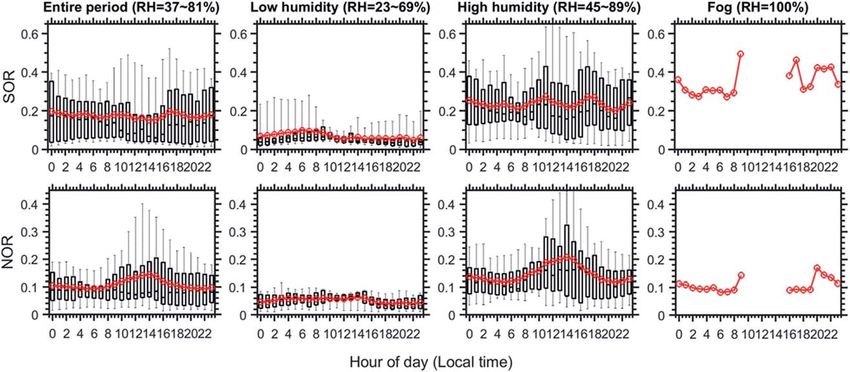
View Article Online
Faraday Discussions Paper
box model simulations to identify and characterize the key oxidation processes producing
sulfate, nitrate and secondary organic aerosols. An outdoor twin-chamber system was
deployed to conduct kinetic experiments under real atmospheric conditions in
comparison to literature kinetic data from laboratory studies. The experiments were
spanning multiple years since 2017 and an intensive field campaign was performed in
This article is licensed under a Creative Commons Attribution 3.0 Unported Licence.
the winter of 2018. The location of the site minimizes fast transition between clean and
polluted air masses, and regimes representative for the North China Plain were
Open Access Article. Published on 05 oktyabr 2020. Downloaded on 26.09.2021 22:52:44.
observed at the measurement location in Gucheng near Beijing. The consecutive multi-
year experiments document recent trends of PM2.5 pollution and corresponding
changes of aerosol physical and chemical properties, enabling in-depth investigations of
established and newly proposed chemical mechanisms of haze formation. This study is
mainly focusing on the data obtained from the winter campaign 2018. To investigate
multiphase chemistry, the results are presented and discussed by means of three
characteristic cases: low humidity, high humidity and fog. We find a strong relative
humidity dependence of aerosol chemical compositions, suggesting an important role
of multiphase chemistry. Compared with the low humidity period, both PM1 and PM2.5
show higher mass fraction of secondary inorganic aerosols (SIA, mainly as nitrate,
sulfate and ammonium) and secondary organic aerosols (SOA) during high humidity and
fog episodes. The changes in aerosol composition further influence aerosol physical
properties, e.g., with higher aerosol hygroscopicity parameter k and single scattering
albedo SSA under high humidity and fog cases. The campaign-averaged aerosol pH is
5.1 0.9, of which the variation is mainly driven by the aerosol water content (AWC)
concentrations. Overall, the McFAN experiment provides new evidence of the key role
of multiphase reactions in regulating aerosol chemical composition and physical
properties in polluted regions.
1. Introduction
In the recent decade, frequently occurring severe haze events in the North China
Plain (NCP) have triggered numerous studies on the underlying formation
mechanisms, and the contribution of multiphase chemistry to haze formation
has become one of the focal points.1–4 Besides directly emitted primary pollut-
ants,5,6 high levels of secondary inorganic aerosols (SIA, mainly sulfate, nitrate
and ammonium) and secondary organic aerosols (SOA) have been observed
during haze episodes in many regions of China. As an important component of
ne particles, sulfate shows rapid formation during haze events and this high
growth rate could not be explained by current state-of-the-art models, suggesting
the existence of yet unknown sources of sulfate.2 Cheng et al.1 discovered that
high rates of sulfate production and large differences between observed and
modeled sulfate concentrations were related to high aerosol water content (AWC),
suggesting that aqueous-phase oxidation in aerosol water may play a key role,
following different reaction pathways depending on aerosol pH and oxidant
concentration levels: at pH > 4.5 multiphase reactions of NO2 and O3 dominate,
while at pH < 4.5 reactions involving transition metal ions (TMI) and H2O2 may
prevail.1 Though the importance of multiphase reactions has been widely
accepted, the exact formation pathway is still under debate.1,2,7–16 Besides sulfate,
nitrate, ammonium and secondary organic aerosols also show distinct
208 | Faraday Discuss., 2021, 226, 207–222 This journal is © The Royal Society of Chemistry 2021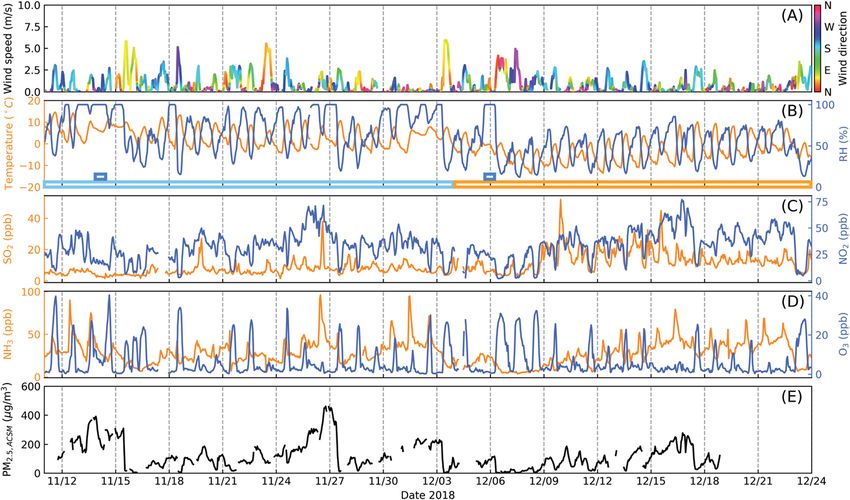
View Article Online
Paper Faraday Discussions
characteristics during the haze events, and the increased contribution of multi-
phase reactions has been suggested as a potential explanation.
To elucidate the chemical mechanisms leading to severe haze formation in
Beijing and the NCP, a number of eld campaigns and laboratory studies have
been carried out. These early studies have revealed several challenges. For
This article is licensed under a Creative Commons Attribution 3.0 Unported Licence.
example, the observed aerosol concentrations in Beijing were found to be strongly
inuenced by atmospheric transport processes, which may challenge proper
Open Access Article. Published on 05 oktyabr 2020. Downloaded on 26.09.2021 22:52:44.
analysis of the prevailing chemical reactions.2 Likewise, simple laboratory
experiments may differ from that in the real atmosphere, in which synergic effects
or high ionic strengths may lead to orders of magnitude difference in reaction
rates. Besides, many studies lack information about aerosol pH, which controls
the rates of many atmospheric multiphase reactions.1
Under this background, the Multiphase chemistry experiment in Fogs and
Aerosols in the North China Plain (McFAN) was organized to advance our
understanding of the physical–chemical mechanisms leading to severe haze
formation, especially with a focus on the contributions of multiphase processes in
aerosols and fogs. Instead of Beijing, we selected a site located in the central
polluted region of the NCP, where the inuence of transport was smaller. We
made a comprehensive design to cover more parameters (such as aerosol pH) that
are required for a closure study on the multiphase reactions. We also introduced
an environmental chamber system and an automatic-shiing aerosol inlet system
to perform kinetic experiments under real ambient air conditions. In this over-
view paper, the eld site and the instrumentation deployed during the McFAN
experiment are rstly described. Then new observation-based ndings are
presented.
2. Experiment design and criteria for site
selection
One of the main scientic objectives of the McFAN experiment was to investigate
the effects of multiphase processes on particle formation and evolution. To
achieve this goal, the related research was schemed into three cases: (1) the
formation and evolution of aerosols during fog conditions (i.e., fog case); (2) the
formation and transformation of aerosols during high relative humidity days and
the respective impact of multiphase reactions (i.e., high RH case); (3) the
formation and transformation of aerosols during low humidity days (i.e. low RH
case). Given the temporal and spatial variations of the air quality in the NCP, one
intensive eld campaign was performed from 11th November to 24th December
2018 at the Gucheng site, to capture fog and haze events. The observation was
equipped with abundant online and offline instruments, allowing to record and
analyze meteorological parameters as well as variations and properties of aerosol
and gas species. The instruments and their measured parameters are listed in
Table 1. Briey, the trace gas instruments (O3, NOx, CO, SO2, NH3) from Chinese
Academy of Meteorological Sciences (CAMS, see Table 1) were housed in an air-
conditioned room in a two-story building in the southern part of the Gucheng
station,17 and the other instruments were installed in two air-conditioned
containers placed on the north side of the site. To investigate multiphase reac-
tion kinetics, an environmental chamber system was also employed. The
This journal is © The Royal Society of Chemistry 2021 Faraday Discuss., 2021, 226, 207–222 | 209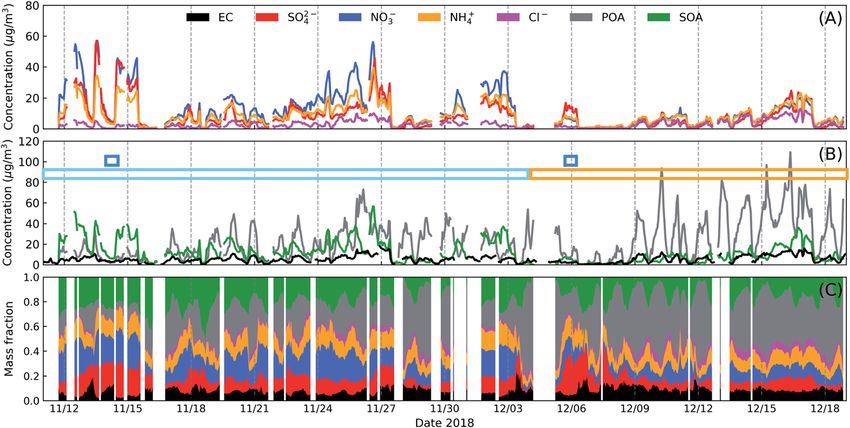
View Article Online
Faraday Discussions Paper
Table 1 Instrumentation, measurement parameters, and partners involved in the McFAN
experiment
Instrument Measured parameter Organizationa
Aerosols Scanning Mobility Particle Sizer (SMPS) Aerosol number size JNU
distribution (10–1000
This article is licensed under a Creative Commons Attribution 3.0 Unported Licence.
nm)
Aerodynamic Particle Sizer (APS) Aerosol number size JNU
Open Access Article. Published on 05 oktyabr 2020. Downloaded on 26.09.2021 22:52:44.
distribution (0.5–20
mm)
Particle Size Magnier (PSM) Aerosol number MPIC
concentration (1–4 nm)
Nephelometer Aerosol optical PKU
properties
Aethalometer AE33 Black carbon optical JNU
properties
Aerosol photometer Aerosol optical JNU
properties
Capture Vaporizer Time-of-Flight Aerosol composition NJU, IAP-CAS
Aerosol Chemical Speciation Monitor
(CV-ToF-ACSM)
OC/EC Aerosol Analyzer Aerosol composition JNU
Four-channel high-volume aerosol Aerosol composition JNU
sampler
Cascade impactor Aerosol composition CAMS
Cloud Condensation Nucleus Counter Aerosol hygroscopicity JNU
(CCNC) (combined with DMA)
Hygroscopic Tandem Differential Aerosol hygroscopicity JNU
Mobility Analyzer (HTDMA)
Humidied nephelometer Aerosol hygroscopicity PKU
Single-Particle soot Photometer (SP2) Black carbon JNU
Centrifugal Particle Mass Analyzer Black carbon density JNU
(CPMA) (combined with SP2)
Ground-based Counterow Virtual Fog JNU
Impactor (GCVI)
Trace gases Proton-Transfer-Reaction Mass VOCs JNU
Spectrometry (PTR-MS)
Chemical Ionization Mass VOCs JNU
Spectrometry (CIMS)
Model 43i SO2 analyzer SO2 MPIC, CAMS
Model 42i NOx analyzer NOx MPIC, CAMS
Model 49i O3 analyzer O3 MPIC, CAMS
LOng Path Absorption Photometer HONO JNU
(LOPAP)
Monitor for AeRosols and Gases in Trace gases: HCl, SO2, JNU
ambient Air (MARGA) NH3, HNO3, HONO
Picarro G2103 gas concentration NH3 JNU
analyzer
Economical ammonia analyzer (LGR NH3 CAMS
DLT-100)
210 | Faraday Discuss., 2021, 226, 207–222 This journal is © The Royal Society of Chemistry 2021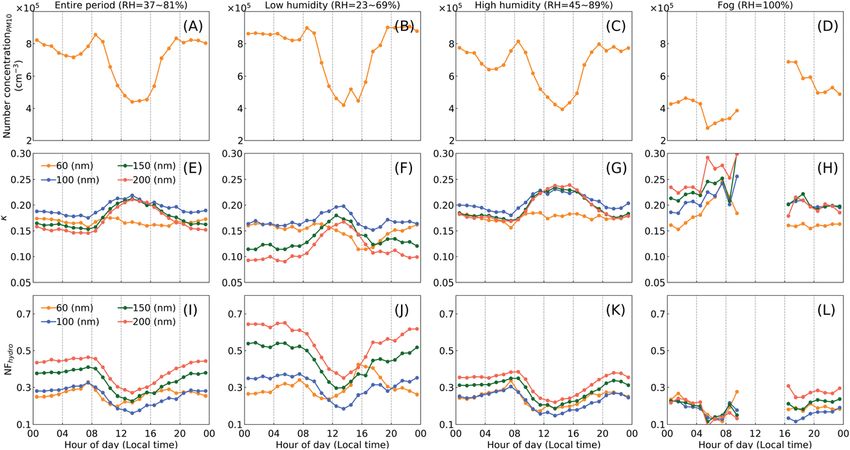
View Article Online
Paper Faraday Discussions
Table 1 (Contd. )
Instrument Measured parameter Organizationa
Multiphase Environmental chamber system Multiphase reaction MPIC
This article is licensed under a Creative Commons Attribution 3.0 Unported Licence.
reactions kinetics, sulfate
formation rate
Open Access Article. Published on 05 oktyabr 2020. Downloaded on 26.09.2021 22:52:44.
a
JNU: Jinan University; NJU: Nanjing University; PKU: Peking University; IAP-CAS: Institute
of Atmospheric Physics Chinese Academy of Sciences; CAMS: Chinese Academy of
Meteorological Sciences; MPIC: Max Planck Institute for Chemistry.
chambers were installed on the roof of one container and the associated analyzers
were located inside the container. Data obtained from the chamber experiments
are still under analysis, therefore are not presented in this study.
The Gucheng site was selected to carry out the McFAN campaign. The site is
100 km southwest of Beijing and 35 km north of Baoding city. It is a suburban
site located at the Ecological and Agricultural Meteorology Station (39 090 N,
115 440 E) of the Chinese Academy of Meteorological Sciences.18 It is surrounded
by agricultural elds (for cultivation of wheat and corn) and the closest residential
town (Dingxing county) is 1.5 km away. The location of the site minimizes fast
transition between clean and polluted air masses (e.g., in Beijing), and helps to
maintain a pollution regime representative for the NCP, making it an ideal
position to investigate atmospheric chemical processes.
3. Overview of meteorology, gas and aerosol
variation
Fig. 1 shows the observed time series of meteorological parameters, concentra-
tions of inorganic gas pollutants and PM2.5 during the McFAN campaign. The
average wind speed observed over the whole campaign was only 0.5 m s1, but
occasionally it could reach up to 8.5 m s1. For most of the measurement time,
the wind speed displayed a diel variation with higher values during daytime than
at nighttime. The level of ambient air relative humidity (RH) for the whole
campaign can be generally classied into two stages: from 11th November to 03rd
December, the daily averaged RH covered a high range of 45–89%, deemed as
high humidity period; from 04th to 24th December, the daily averaged RH was in
a relatively low range of 23–69%, considered as low humidity period. Moreover,
two typical fog events (with RH ¼ 100%) were observed during the campaign. All
these periods are indicated by the colored rectangles in Fig. 1B. The ambient
temperature (T) ranged from 14 C to 18 C, with an average of 1.3 C. More
information of the meteorological conditions can be found in the ESI.† The
campaign-averaged concentrations of key gas pollutants were: 10 ppb for SO2,
32 ppb for NO2, 28 ppb for NH3 and 7 ppb for O3 (Fig. 1C and D). The mass
concentration of PM2.5 covered a wide range from 3 to 462 mg m3 (Fig. 1E)
with an average of 121 mg m3. Additional information about volatile organic
compounds (VOCs) can be found in Fig. S3.† Fig. 2 shows the variations of
This journal is © The Royal Society of Chemistry 2021 Faraday Discuss., 2021, 226, 207–222 | 211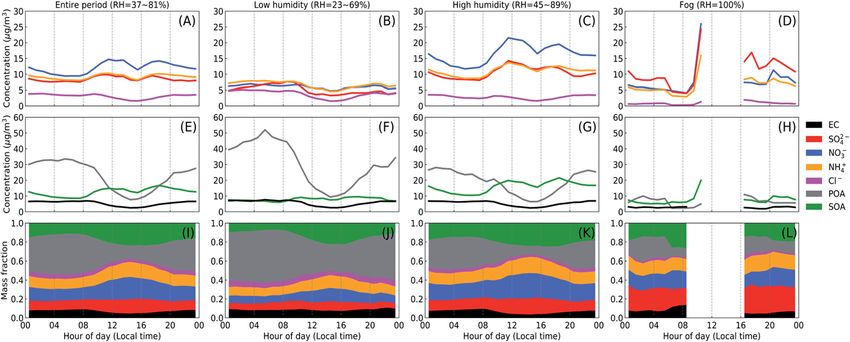
View Article Online
           This article is licensed under a Creative Commons Attribution 3.0 Unported Licence.   Faraday Discussions                                                                       Paper
Open Access Article. Published on 05 oktyabr 2020. Downloaded on 26.09.2021 22:52:44.

                                                                                                 Fig. 1 Time series of meteorological parameters (A and B), inorganic gas pollutants (C and
                                                                                                 D) and mass concentration of PM2.5 (E) during the McFAN campaign. The colored rect-
                                                                                                 angles in panel (B) indicate different characteristic periods: dark blue – fog, light blue –
                                                                                                 high humidity, orange – low humidity. The mass concentration of PM2.5 is obtained by
                                                                                                 summing up elemental carbon (EC) and other non-refractory aerosol components
                                                                                                 measured by the OC/EC analyzer and the CV-ToF-ACSM (Table 1), respectively.

                                                                                                 Fig. 2 Time series of submicron aerosol (PM1) mass concentrations (A and B) and mass
                                                                                                 fractions of different components (C). In panel (B), the colored rectangles have the same
                                                                                                 meaning as in Fig. 1. Positive matrix factorization analysis is employed to classify organic
                                                                                                 aerosol (OA) into various primary OA (POA) factors including hydrocarbon-like OA (HOA),
                                                                                                 cook-related OA (COA), biomass burning OA (BBOA) and coal combustion OA (CCOA),
                                                                                                 and a secondary OA (SOA) factor: oxygenated OA (OOA). More details can be found in
                                                                                                 Fig. 5 and in the work of Sun et al.19

                                                                                                 chemical compositions of submicron particles (PM1). The mean mass concen-
                                                                                                 tration of PM1 was 67 mg m3 with a maximum of 250 mg m3. In the low
                                                                                                 humidity period, the averaged contributions of inorganic components (mainly as

                                                                                                 212 | Faraday Discuss., 2021, 226, 207–222   This journal is © The Royal Society of Chemistry 2021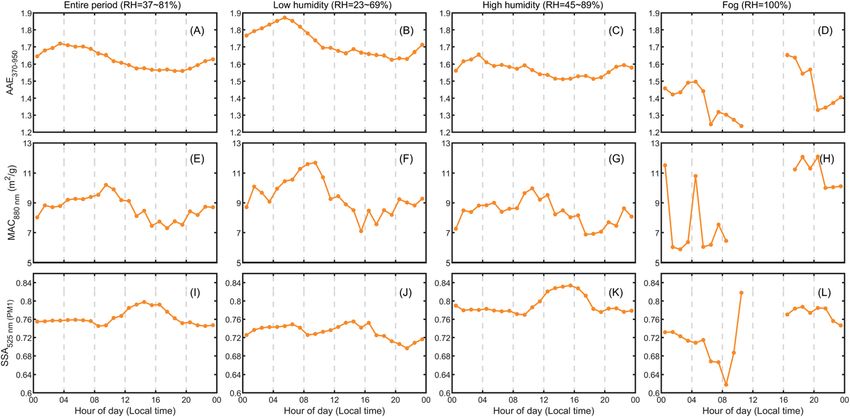
View Article Online
Paper Faraday Discussions
nitrate, sulfate and ammonium) and organics were 34% and 57%, respectively.
While in the high humidity period, the contribution of inorganics increased to
50%, slightly higher than that of the organic aerosols (43%). During fog periods,
the averaged mass fraction of inorganics reached 59% and the contribution of
organics dropped to 34%. Among organics, the mass fraction of secondary
This article is licensed under a Creative Commons Attribution 3.0 Unported Licence.
organic aerosols (SOA) in total organic aerosols (ACSM-determined) increased
from 23% in the low humidity period to 47% and 53% in high humidity and fog
Open Access Article. Published on 05 oktyabr 2020. Downloaded on 26.09.2021 22:52:44.
episodes, respectively.
4. Impact of multiphase processes on aerosol
composition and acidity
4.1. Aerosol chemical composition
Ambient RH strongly inuences the reaction pathways and their magnitude.20,21
Under high RH conditions (e.g., during fog and haze episodes), aerosols tend to
become liquid with increased surface and volume concentrations due to hygro-
scopic growth while under low RH aerosols become solid or semi-solid particles.
Thus, we rst compared the aerosol composition between different RH condi-
tions. Fig. 3 shows the diel variation of the composition of PM1 between three
cases (as marked in Fig. 1 and 2): low humidity (RH ¼ 23–69%), high humidity
(RH ¼ 45–89%) and fog (RH ¼ 100%) along with the averages of the entire
campaign period. For the entire campaign (Fig. 3I), PM1 was on average composed
of 9% elemental carbon (EC), 11% sulfate, 20% nitrate, 15% ammonium,
3% chloride, 15% POA and 27% SOA. The inorganic mass fraction
substantially increased from low humidity to high humidity and to the fog case,
and SOA also showed a similar but lesser increasing trend even with a decreasing
contribution of the total OA. Such phenomenon suggests enhanced formation of
secondary species with increasing RH, potentially due to the multiphase
processes.22 Interestingly, while the mass fraction of sulfate follows the order of
low humidity < high humidity < fog periods, for nitrate the order is low humidity <
Fig. 3 Diel variations of the submicron aerosol (PM1) mass concentrations (A–H) and mass
fractions (I–L) of the major components of submicron aerosols (PM1) averaged over the
entire campaign and focus periods with different relative humidity (RH) conditions. The
solid lines in (A–H) show the mean value of hourly averaged concentrations of each
component. The displayed RH range relevant to each focus period is based on daily
averaged data.
This journal is © The Royal Society of Chemistry 2021 Faraday Discuss., 2021, 226, 207–222 | 213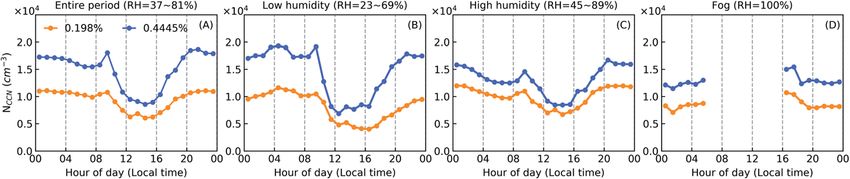
View Article Online
                                                                                                 Faraday Discussions                                                                       Paper
                                                                                                 fog < high humidity (Fig. 3I–L). A clear RH effect is also found on NOR and SOR
                                                                                                 (molar ratio of nitrate or sulfate to the sum of nitrate and NO2 or sulfate and SO2),
                                                                                                 which represents the degree of secondary formation of nitrate and sulfate.2,23 As
                                                                                                 shown in Fig. 4, the variations of SOR and NOR follow the same trend as the mass
                                                                                                 fraction of sulfate and nitrate. These results indicate an important role of high RH
           This article is licensed under a Creative Commons Attribution 3.0 Unported Licence.

                                                                                                 in promoting the formation of SIA and SOA, probably through multiphase reac-
                                                                                                 tions. Information of gases (SO2, NO2, NH3, O3 and VOCs) and PM2.5 concentra-
Open Access Article. Published on 05 oktyabr 2020. Downloaded on 26.09.2021 22:52:44.

                                                                                                 tions can be found in the ESI.†

                                                                                                 4.2. Size dependence of aerosol chemical composition
                                                                                                 Sun et al.19 characterized aerosol composition and sources of organic aerosol (OA)
                                                                                                 during the McFAN campaign in 2018, and also the compositional differences
                                                                                                 between PM1 and PM2.5 by using the CV-ToF-ACSM (Table 1). As depicted in Fig. 5,
                                                                                                 comparable contributions of OA and secondary inorganic aerosol (SIA) were
                                                                                                 found during the high humidity period (RH ¼ 73  24%), while the low humidity
                                                                                                 period (RH ¼ 48  18%) showed a reduced contribution of SIA. OA composition
                                                                                                 was also substantially different with a much higher contribution of secondary OA
                                                                                                 (46–47%) during the high humidity period than the low humidity phase (19–
                                                                                                 21%). In contrast, primary OA from biomass burning, coal combustion, and
                                                                                                 traffic emissions dominated OA (71–73%) during the low humidity period
                                                                                                 (Fig. 5B). These results highlight that meteorological conditions, in particular RH,
                                                                                                 play an important role in secondary aerosol formation in NCP, and hence change
                                                                                                 the contributions of primary and secondary aerosol.
                                                                                                    Sun et al.19 further analyzed the chemical differences between PM1 and PM2.5
                                                                                                 during both high and low humidity periods. As indicated in Fig. 5, aerosol
                                                                                                 composition and OA composition of PM1 and PM2.5 were relatively similar during
                                                                                                 both focus periods, despite the concentration differences by up to 30%. However,
                                                                                                 the decreases in PM1/PM2.5 ratios as a function of RH were also observed for
                                                                                                 secondary organic and inorganic aerosol species, which was likely due to the
                                                                                                 changes in aerosol hygroscopicity and phase states. In contrast, primary aerosol

                                                                                                 Fig. 4 Diel variations of the ratios of nitrate to nitrate plus NO2 (NOR) and sulfate to sulfate
                                                                                                 plus SO2 (SOR) averaged over the entire campaign and focus periods with different relative
                                                                                                 humidity (RH) conditions. The boxes and whiskers indicate percentiles (90th, 75th, 50th
                                                                                                 (median), 25th and 10th).

                                                                                                 214 | Faraday Discuss., 2021, 226, 207–222   This journal is © The Royal Society of Chemistry 2021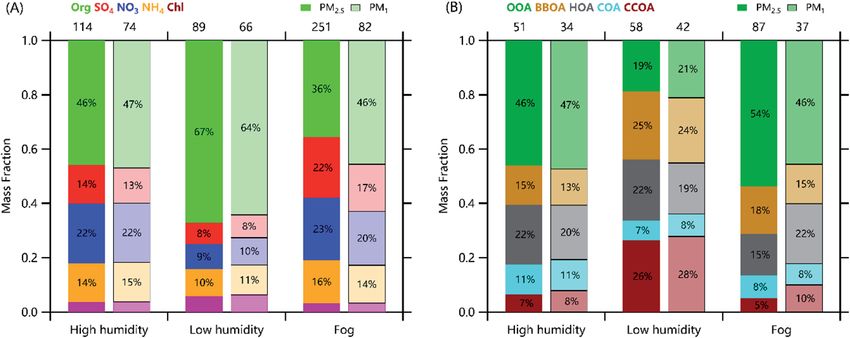
View Article Online
This article is licensed under a Creative Commons Attribution 3.0 Unported Licence. Paper Faraday Discussions
Open Access Article. Published on 05 oktyabr 2020. Downloaded on 26.09.2021 22:52:44.
Fig. 5 Average (A) chemical composition of non-refractory PM2.5 and PM1, and (B) OA
composition during the focus periods with different relative humidity (RH) conditions. The
numbers on the top of the figures are the average mass concentrations (mg m3) for each
period. Adopted and modified from Sun et al.19
species with low hygroscopicity did not show clear RH dependence of PM1/PM2.5
ratios. Large differences in both mass concentrations and composition were
observed during fog events. For instance, PM1 on average accounted for 33% of
PM2.5 due to the rapid hygroscopic growth of aerosol particles under high RH
levels, and PM2.5 showed largely elevated contributions of SIA (61% vs. 51%) and
SOA (54% vs. 46%) compared with PM1. Further analysis showed that the
chemical differences between PM1 and PM2.5 had negligible impacts on predic-
tions of particle acidity, while they could affect aerosol liquid water content by up
to 50–70%.
4.3. Aerosol acidity
To examine aerosol acidity during the campaign, we modelled the aerosol pH
based on the ISORROPIA model24 and observation data. The concentrations of
sulfate, nitrate, ammonium and chloride were taken from the CV-ToF-ACSM
measurement, and the ammonia concentrations were taken from observations
using the Picarro G2103 gas analyzer. Only the data points with RH > 40% are
used here. Sensitivity studies show that the uncertainty in chloride measurements
by the ACSM is expected to result in a pH variation of 0.15 to 0.35, while the
missing measurements of non-volatile species (i.e., Na+, Ca2+, K+ and Mg2+) are
expected to result in a pH underestimation of 0.07 to 0.35. In general, simulated
gas–particle partitioning of ammonia agrees well with the observations. As shown
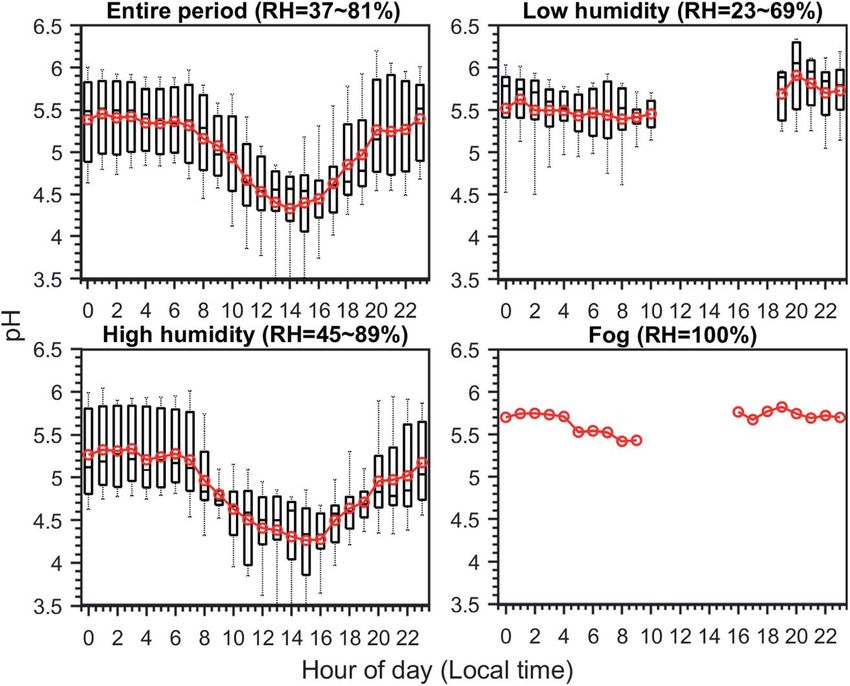
in Fig. 6, the aerosol pH averaged 5.1 0.9 over the whole observation period. A
clear diel variation is observed for the entire and high humidity periods, with an
obvious drop in pH during the daytime, and bottomed around 15:00. This pH
drop is mainly driven by the diel variation in RH and therefore the aerosol water
content (AWC) concentrations.25 The diel variation is not complete for low
humidity and fog periods, as there is no available aernoon data. The absence of
aernoon data during the low humidity period is due to its low RH (View Article Online
This article is licensed under a Creative Commons Attribution 3.0 Unported Licence. Faraday Discussions Paper
Open Access Article. Published on 05 oktyabr 2020. Downloaded on 26.09.2021 22:52:44.
Fig. 6 Diel variation of aerosol pH averaged over the entire campaign and focus periods
with different relative humidity (RH) conditions. The boxes and whiskers indicate
percentiles (90th, 75th, 50th (median), 25th and 10th), and the red circles represent
arithmetic mean values. Note that the displayed RH ranges for each focus period represent
daily averages. Due to limited data points at each hour, only mean values are shown for the
fog period.
detailed analysis on the drivers of aerosol pH can be found elsewhere (Zheng
et al., Drivers of aerosol pH during the multiphase chemistry experiment in fogs
and aerosols (McFAN) experiment in the North China Plain, in preparation).
5. Impact of multiphase processes on aerosol
physical properties
5.1. Aerosol hygroscopicity and phase state
Fig. 7 shows the diel variations of the measured cloud condensation nuclei (CCN)
number concentration at two different supersaturation (SS) levels, under the three
cases. For the entire period, NCCN was lower during daytime (09:00–20:00) than
at night and this difference became more pronounced at the higher SS value.
Similar phenomenon has been reported in another study at the same site during
winter time.26 At larger SS values, particle size tends to be more crucial in affecting
NCCN.27 The lower NCCN during daytime was likely caused by the varied particle
number size distribution (see Fig. S8†) and the decreased particle number
concentration (see Fig. 8A–D). Compared to the low humidity case, NCCN in the
high humidity case was slightly higher at the lower SS value, which might be due
to (1) the larger mass fraction of SIA (nitrate, sulfate and ammonium) and SOA
216 | Faraday Discuss., 2021, 226, 207–222 This journal is © The Royal Society of Chemistry 2021View Article Online
This article is licensed under a Creative Commons Attribution 3.0 Unported Licence. Paper Faraday Discussions
Fig. 7 Diel variations of CCN number concentration at two different supersaturation
Open Access Article. Published on 05 oktyabr 2020. Downloaded on 26.09.2021 22:52:44.
levels averaged over the entire campaign and focus periods with different relative humidity
(RH) conditions. The symbols represent the mean value of hourly averaged
concentrations.
Fig. 8 Diel variations of particle number concentration in PM10 size range (top row),
hygroscopicity parameter k (second row) and number fraction of hydrophobic particles
NFhydro for selected particle sizes (bottom row) averaged over the entire campaign and
focus periods with different relative humidity (RH) conditions.
found for the high humidity case in Fig. 3; (2) the increased concentration of
larger-size particles under high RH. Increasing the fraction of hydrophilic inor-
ganics and organics in aerosols will enhance their ability to activate into CCN,
leading to a higher NCCN. However, for the fog period, NCCN was even lower than
that of the low humidity case. Since fog droplets can efficiently scavenge particles
with smaller sizes, the observed particle number concentration within fog events
was much lower than during non-fog periods (Fig. 8). Thus, the low aerosol
number concentration during fog events might result in the much less NCCN.
The hygroscopicity parameter k (ref. 28 and 29) showed higher values in
daytime than at night (Fig. 8E–G), indicating the potential effect of photochem-
istry in enhancing particles’ hygroscopicity. Based on hygroscopicity and aerosol
composition measurements during the McFAN campaign, Kuang et al.17 found
that the hygroscopicity parameter of organic aerosols, kOA, showed a prominent
diel variation with a peak value present near 14:30 local time. And this diel
variation was highly and positively correlated with the mass fraction of oxygen-
ated organic aerosols (OOA), pointing to the important role of photochemical
This journal is © The Royal Society of Chemistry 2021 Faraday Discuss., 2021, 226, 207–222 | 217View Article Online
Faraday Discussions Paper
processing in enhancing kOA. Similar photochemical impact was also reported by
Wang et al.27 at a suburban site in the central NCP. Moreover, an increase of k
could be found with increasing ambient RH, i.e., from low humidity to fog case
(Fig. 8F–H). Meanwhile, an opposite trend was observed for NFhydro, meaning that
the number fraction of hydrophobic particles is getting less. Along with the
This article is licensed under a Creative Commons Attribution 3.0 Unported Licence.
results shown in Fig. 3, we conclude that the enhanced hygroscopicity of aerosols
is due to the increased hydrophilic fraction which is most likely caused by either
Open Access Article. Published on 05 oktyabr 2020. Downloaded on 26.09.2021 22:52:44.
high-RH favored multiphase reactions or photochemistry, and the coupling of
both effects.
5.2 Aerosol optical properties
Aerosol optical properties have been found to show a strong RH dependence,
which may result in a positive feedback and inuence the planetary boundary
layer (PBL) meteorology and the haze formation.30–32 Fig. 9 shows the optical
properties of aerosols under the three cases. The diel variation of the Absorption
Ångström Exponent (AAE) showed higher values during nighttime than during
daytime with a much higher AAE370–470 (average std, 1.8 0.35) than AAE880–950
(0.8 0.1) (Fig. S9†). This implies that, besides black carbon (BC), there existed
some brown carbon (BrC), which had comparable light-absorbing capacities as
BC at short wavelengths. Thus, the feature of higher nighttime AAE370–950 in
Fig. 9A–C might be due to increased levels of BrC generated by domestic heating
and biomass burning during the night. Signicant differences among different
RH cases can be found for AAE and the Single Scattering Albedo (SSA). With
increased RH from the low humidity to the high humidity case, AAE decreased
from 1.7 to 1.55 and even down to 1.4 under fog conditions. The decreased
AAE suggests that the fraction of light-absorbing components such as BC and BrC
is reduced, due to either decreased mass fraction or changed mixing state.33,34 For
the SSA, however, its values under high humidity were remarkably higher than at
low humidity, indicating an enhanced fraction of light-scattering components.
This phenomenon could be due to the boosted formation of SIA (i.e., nitrate,
Fig. 9 Diel variations of Absorption Ångström Exponent (top row), Mass Absorption Cross
section (second row), and Single Scattering Albedo (bottom row) averaged over the entire
campaign and focus periods with different relative humidity (RH) conditions.
218 | Faraday Discuss., 2021, 226, 207–222 This journal is © The Royal Society of Chemistry 2021View Article Online
Paper Faraday Discussions
sulfate and ammonium) and SOA through high-RH-favored multiphase reactions,
as shown in Fig. 3. For example, Lim et al.35 have reported the important role of
sulfate in East Asia: it could enhance SSA and also alter the absorption properties
of aerosols. Moreover, in Fig. 9K, the more prominent enhancement of SSA during
daytime correlates well with the enhanced formation of nitrate and SOA under the
This article is licensed under a Creative Commons Attribution 3.0 Unported Licence.
inuence of solar radiation (Fig. 3K). A recent study at the same site by Kuang
et al.22 has revealed that rapid OOA formation could be induced by photochemical
Open Access Article. Published on 05 oktyabr 2020. Downloaded on 26.09.2021 22:52:44.
aqueous-phase reactions. The RH effect on the Mass Absorption Cross-section
(MAC), however, was negligible, and further investigations on the underlying
mechanisms may be needed.
6. Summary
In this work, we present an overview of the preliminary results obtained from an
intensive winter campaign in 2018 in the North China Plain, during the McFAN
experiment. The McFAN experiment aimed at exploring the underlying mecha-
nisms of haze formation and evolution, especially focusing on the effect of
multiphase chemistry. The ambient RH conditions during the 45-day campaign
were separated into two stages, with the rst stage staying at a relatively high RH
range (daily averages about 45–89%) and the second at a low RH level (daily
averages about 23–69%). Two typical fog events (RH ¼ 100%) during the obser-
vation period were captured additionally. Thus, to better elucidate the potential
inuence of multiphase processes, we generally present and discuss the
measurement results in terms of three characteristic periods: low humidity, high
humidity and fog.
The aerosol composition and OA composition of PM1 and PM2.5 were relatively
similar during both low and high humidity periods. However, compared with the
low RH period, both PM1 and PM2.5 showed increased mass fraction of SIA
(nitrate, sulfate and ammonium) and SOA during high RH and fog episodes. The
enhanced contribution of SIA and SOA was most likely caused by aqueous-phase
reactions favored by high RH. Moreover, the rapid growth of nitrate and SOA
during daytime highlighted the important role of photochemical reactions.
The change in aerosol composition could drive variations in multiple aerosol
physicochemical properties. For example, the increased k at high RH reected the
more hydrophilic feature of aerosols, likely due to the increased fraction of
hydrophilic SIA and SOA. The calculated aerosol pH displayed a signicant diel
variation, with lower pH during daytime than at nighttime. Diel variations were
also found for aerosol optical properties such as AAE and SSA, but with opposite
trends between the two parameters. The variations found for these parameters
were most likely driven by varied ambient RH and thereby the changed aerosol
composition affected by multiphase processes.
Author contributions
H.S. and Y.C. conceived and designed this study. H.S., Y.C. and N.M. organized
the campaign. N.M., G.L., Y.S., Y.G. and G.Z. contributed to data analyses, plots
and related discussions in the manuscript. S.Z., X.P., N.L. and M.T. helped to
make plots and provided suggestions on experiment results discussion. J.T., Y.K.,
Q.W., J.H., Y.Z., U.K., S.Z., X.P., Z.W., P.C., W.X., G.Z., C.Z., B.Y., M.S., A.D., Q.Z.,
This journal is © The Royal Society of Chemistry 2021 Faraday Discuss., 2021, 226, 207–222 | 219View Article Online
Faraday Discussions Paper
P.F. and Y.S. provided measurement data. G.L. and H.S. wrote the manuscript
with inputs from Y.C., G.Z., U.P. and U.K.
Conflicts of interest
This article is licensed under a Creative Commons Attribution 3.0 Unported Licence.
There are no conicts to declare.
Open Access Article. Published on 05 oktyabr 2020. Downloaded on 26.09.2021 22:52:44.
Acknowledgements
We acknowledge the National Key Research and Development Program of China
(grant no. 2017YFC0210104), the National Natural Science Foundation of China
(grant no. 91644218) and the support from the Max Planck Society. G. L.
acknowledges the nancial support from the China Scholarship Council (CSC).
Open Access funding provided by the Max Planck Society.
References
1 Y. Cheng, G. Zheng, C. Wei, Q. Mu, B. Zheng, Z. Wang, M. Gao, Q. Zhang,
K. He, G. Carmichael, U. Pöschl and H. Su, Sci. Adv., 2016, 2, e1601530.
2 G. J. Zheng, F. K. Duan, H. Su, Y. L. Ma, Y. Cheng, B. Zheng, Q. Zhang,
T. Huang, T. Kimoto, D. Chang, U. Pöschl, Y. F. Cheng and K. B. He, Atmos.
Chem. Phys., 2015, 15, 2969–2983.
3 Y. Sun, Q. Jiang, Z. Wang, P. Fu, J. Li, T. Yang and Y. Yin, J. Geophys. Res.:
Atmos., 2014, 119, 4380–4398.
4 Y. L. Sun, Z. F. Wang, P. Q. Fu, T. Yang, Q. Jiang, H. B. Dong, J. Li and J. J. Jia,
Atmos. Chem. Phys., 2013, 13, 4577–4592.
5 M. Li, Q. Zhang, D. G. Streets, K. B. He, Y. F. Cheng, L. K. Emmons, H. Huo,
S. C. Kang, Z. Lu, M. Shao, H. Su, X. Yu and Y. Zhang, Atmos. Chem. Phys.,
2014, 14, 5617–5638.
6 M. Li, Q. Zhang, J. I. Kurokawa, J. H. Woo, K. He, Z. Lu, T. Ohara, Y. Song,
D. G. Streets, G. R. Carmichael, Y. Cheng, C. Hong, H. Huo, X. Jiang,
S. Kang, F. Liu, H. Su and B. Zheng, Atmos. Chem. Phys., 2017, 17, 935–963.
7 R. Zhang, G. Wang, S. Guo, M. L. Zamora, Q. Ying, Y. Lin, W. Wang, M. Hu and
Y. Wang, Chem. Rev., 2015, 115, 3803–3855.
8 D. Chen, Z. Liu, J. Fast and J. Ban, Atmos. Chem. Phys., 2016, 16, 10707–10724.
9 G. Wang, R. Zhang, M. E. Gomez, L. Yang, M. Levy Zamora, M. Hu, Y. Lin,
J. Peng, S. Guo, J. Meng, J. Li, C. Cheng, T. Hu, Y. Ren, Y. Wang, J. Gao,
J. Cao, Z. An, W. Zhou, G. Li, J. Wang, P. Tian, W. Marrero-Ortiz, J. Secrest,
Z. Du, J. Zheng, D. Shang, L. Zeng, M. Shao, W. Wang, Y. Huang, Y. Wang,
Y. Zhu, Y. Li, J. Hu, B. Pan, L. Cai, Y. Cheng, Y. Ji, F. Zhang, D. Rosenfeld,
P. S. Liss, R. A. Duce, C. E. Kolb and M. J. Molina, Proc. Natl. Acad. Sci. U. S.
A., 2016, 113, 13630–13635.
10 G. Li, N. Bei, J. Cao, R. Huang, J. Wu, T. Feng, Y. Wang, S. Liu, Q. Zhang, X. Tie
and L. T. Molina, Atmos. Chem. Phys., 2017, 17, 3301–3316.
11 J. Shao, Q. Chen, Y. Wang, X. Lu, P. He, Y. Sun, V. Shah, R. V. Martin, S. Philip,
S. Song, Y. Zhao, Z. Xie, L. Zhang and B. Alexander, Atmos. Chem. Phys., 2019,
19, 6107–6123.
12 T. Chen, B. Chu, Y. Ge, S. Zhang, Q. Ma, H. He and S.-M. Li, Environ. Pollut.,
2019, 252, 236–244.
220 | Faraday Discuss., 2021, 226, 207–222 This journal is © The Royal Society of Chemistry 2021View Article Online
Paper Faraday Discussions
13 M. Gen, R. Zhang, D. D. Huang, Y. Li and C. K. Chan, Environ. Sci. Technol.,
2019, 53, 8757–8766.
14 J. Wu, N. Bei, B. Hu, S. Liu, M. Zhou, Q. Wang, X. Li, L. Liu, T. Feng, Z. Liu,
Y. Wang, J. Cao, X. Tie, J. Wang, L. T. Molina and G. Li, Atmos. Chem. Phys.,
2019, 19, 8721–8739.
This article is licensed under a Creative Commons Attribution 3.0 Unported Licence.
15 J. Xue, X. Yu, Z. Yuan, S. M. Griffith, A. K. H. Lau, J. H. Seinfeld and J. Z. Yu,
Nat. Geosci., 2019, 12, 977–982.
Open Access Article. Published on 05 oktyabr 2020. Downloaded on 26.09.2021 22:52:44.
16 W. Tao, H. Su, G. Zheng, J. Wang, C. Wei, L. Liu, N. Ma, M. Li, Q. Zhang,
U. Pöschl and Y. Cheng, Atmos. Chem. Phys. Discuss., 2020, 2020, 1–31.
17 Y. Kuang, Y. He, W. Xu, P. Zhao, Y. Cheng, G. Zhao, J. Tao, N. Ma, H. Su,
Y. Zhang, J. Sun, P. Cheng, W. Yang, S. Zhang, C. Wu, Y. Sun and C. Zhao,
Atmos. Chem. Phys., 2020, 20, 865–880.
18 W. Xu, Y. Kuang, C. Zhao, J. Tao, G. Zhao, Y. Bian, W. Yang, Y. Yu, C. Shen,
L. Liang, G. Zhang, W. Lin and X. Xu, Atmos. Chem. Phys., 2019, 19, 10557–
10570.
19 Y. Sun, Y. He, Y. Kuang, W. Xu, S. Song, N. Ma, J. Tao, P. Cheng, C. Wu, H. Su,
Y. Cheng, C. Xie, C. Chen, L. Lei, Y. Qiu, P. Fu, P. Croteau and D. R. Worsnop,
Geophys. Res. Lett., 2020, 47, e2019GL086288.
20 A. R. Ravishankara, Science, 1997, 276, 1058–1065.
21 H. Su, Y. Cheng and U. Pöschl, Acc. Chem. Res., 53, 2034–2043.
22 Y. Kuang, Y. He, W. Xu, B. Yuan, G. Zhang, Z. Ma, C. Wu, C. Wang, S. Wang,
S. Zhang, J. Tao, N. Ma, H. Su, Y. Cheng, M. Shao and Y. Sun, Environ. Sci.
Technol., 2020, 54(7), 3849–3860.
23 Y. Sun, G. Zhuang, A. Tang, Y. Wang and Z. An, Environ. Sci. Technol., 2006, 40,
3148–3155.
24 C. Fountoukis and A. Nenes, Atmos. Chem. Phys., 2007, 7, 4639–4659.
25 G. Zheng, H. Su, S. Wang, M. O. Andreae, U. Pöschl and Y. Cheng, Science,
2020, 369, 1374–1377.
26 Y. Zhang, J. Tao, N. Ma, Y. Kuang, Z. Wang, P. Cheng, W. Xu, W. Yang,
S. Zhang, C. Xiong, W. Dong, L. Xie, Y. Sun, P. Fu, G. Zhou, Y. Cheng and
H. Su, Sci. Total Environ., 2020, 719, 137473.
27 Y. Wang, Z. Li, Y. Zhang, W. Du, F. Zhang, H. Tan, H. Xu, T. Fan, X. Jin, X. Fan,
Z. Dong, Q. Wang and Y. Sun, Atmos. Chem. Phys., 2018, 18, 11739–11752.
28 S. M. Kreidenweis, K. Koehler, P. J. DeMott, A. J. Prenni, C. Carrico and
B. Ervens, Atmos. Chem. Phys., 2005, 5, 1357–1370.
29 H. Su, D. Rose, Y. F. Cheng, S. S. Gunthe, A. Massling, M. Stock,
A. Wiedensohler, M. O. Andreae and U. Pöschl, Atmos. Chem. Phys., 2010, 10,
7489–7503.
30 Y. F. Cheng, A. Wiedensohler, H. Eichler, J. Heintzenberg, M. Tesche,
A. Ansmann, M. Wendisch, H. Su, D. Althausen, H. Herrmann, T. Gnauk,
E. Brüggemann, M. Hu and Y. H. Zhang, Atmos. Environ., 2008, 42, 6373–6397.
31 A. J. Ding, X. Huang, W. Nie, J. N. Sun, V.-M. Kerminen, T. Petäjä, H. Su,
Y. F. Cheng, X.-Q. Yang, M. H. Wang, X. G. Chi, J. P. Wang, A. Virkkula,
W. D. Guo, J. Yuan, S. Y. Wang, R. J. Zhang, Y. F. Wu, Y. Song, T. Zhu,
S. Zilitinkevich, M. Kulmala and C. B. Fu, Geophys. Res. Lett., 2016, 43, 2873–
2879.
32 X. Tie, R.-J. Huang, J. Cao, Q. Zhang, Y. Cheng, H. Su, D. Chang, U. Pöschl,
T. Hoffmann, U. Dusek, G. Li, D. R. Worsnop and C. D. O’Dowd, Sci. Rep.,
2017, 7, 15760.
This journal is © The Royal Society of Chemistry 2021 Faraday Discuss., 2021, 226, 207–222 | 221View Article Online
Faraday Discussions Paper
33 Y. F. Cheng, M. Berghof, R. M. Garland, A. Wiedensohler, B. Wehner,
T. Müller, H. Su, Y. H. Zhang, P. Achtert, A. Nowak, U. Pöschl, T. Zhu,
M. Hu and L. M. Zeng, J. Geophys. Res.: Atmos., 2009, 114, D00G10.
34 Y. F. Cheng, H. Eichler, A. Wiedensohler, J. Heintzenberg, Y. H. Zhang, M. Hu,
H. Herrmann, L. M. Zeng, S. Liu, T. Gnauk, E. Brüggemann and L. Y. He, J.
This article is licensed under a Creative Commons Attribution 3.0 Unported Licence.
Geophys. Res.: Atmos., 2006, 111, D20204.
35 S. Lim, M. Lee, S.-W. Kim and P. Laj, Sci. Rep., 2018, 8, 5172.
Open Access Article. Published on 05 oktyabr 2020. Downloaded on 26.09.2021 22:52:44.
222 | Faraday Discuss., 2021, 226, 207–222 This journal is © The Royal Society of Chemistry 2021You can also read


