Nature-Based Solutions for Urban Resilience - by Julia Knollmann, Jenni Ottilie Keppler, Laila Heising, Ipek Genc, Alina Haenler, Felix Faller ...
←
→
Page content transcription
If your browser does not render page correctly, please read the page content below
Nature-
Based Solutions
for Urban
Resilience
by Julia Knollmann, Jenni Ottilie Keppler,
Laila Heising, Ipek Genc, Alina Haenler,
Felix Faller and Deira Linke
26 March 2021
Structure

A. Analysis
  1. Global climate urban risks and their impacts
  2. Defining (Urban) Nature-based Solutions
  3. Nature-based solutions and their impacts on urban climate risks
  4. Examples of mentioned NbS
B. Case study – Istanbul
  5. Case study: Urban climate risks and impacts on Istanbul
  6. NbS for Istanbul
  7. Evaluation of NbS
Why nature-
based solu9ons
for urban
resilience?
Global climate urban
risk and impacts

• 55 % of the global population
  lives in urban areas
• To mitigate and adapt to the
  consequences of climate
  change is one of the greatest
  challenge's society faces today

                                    Source: https://ourworldindata.org/grapher/share-of-population-urban, last access 24.03.2021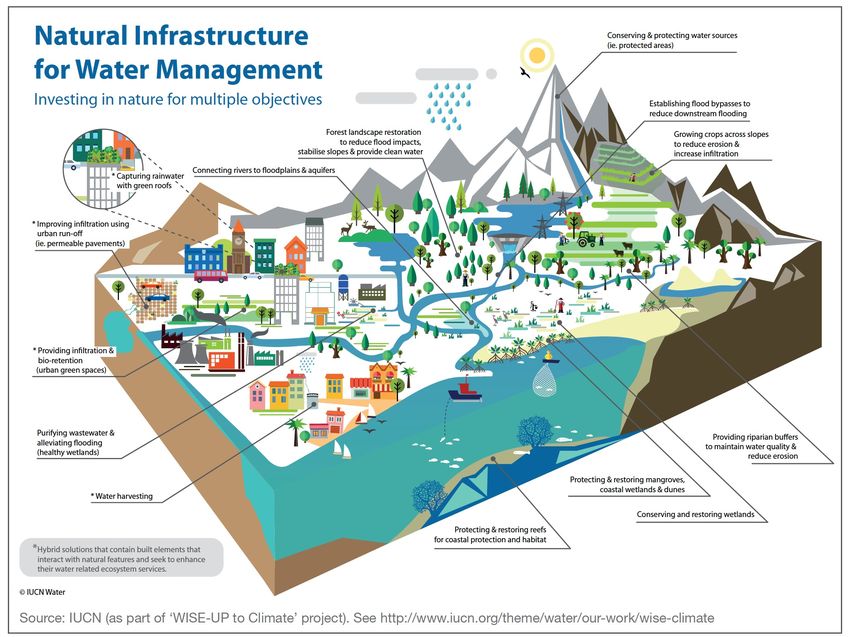
What are
climate related
   drivers of
   impacts?
What are
climate related
   drivers of
   impacts?

                  Source: h?ps://bit.ly/3tY8URc , last access 24.03.2021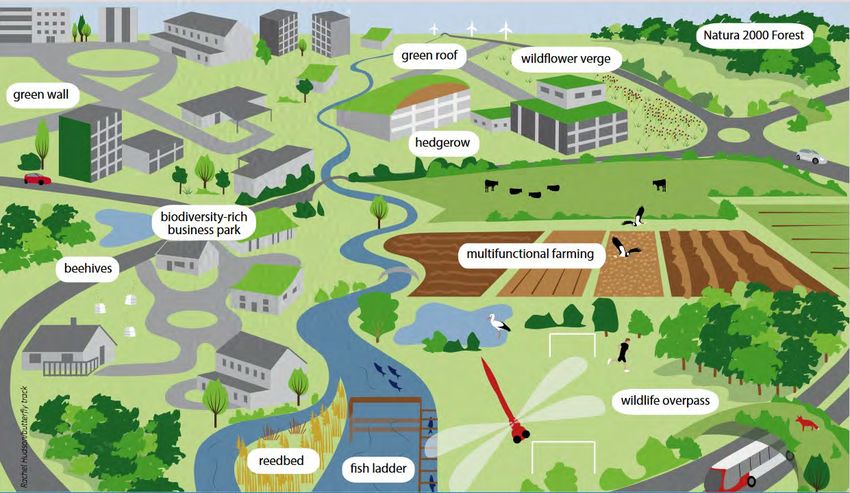
Urban agglomerations 2025 with projected climate
change (RCP8.5)

                                           Source: https://bit.ly/3lSz44Q, last access
                                           24.03.2021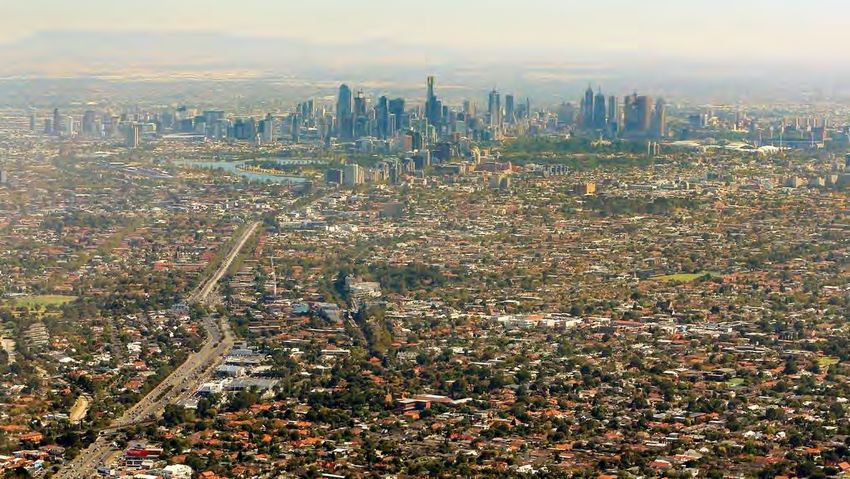
Urban Heat Island
Effect

• Experience higher
  temperatures than the outlying
  areas and cool down slower
• Structures (buildings, roads,
  and other infrastructure)
  absorb and re-emit radiation
  more than natural landscapes
  (forests & water bodies)
Ø major problem of urbanization

                                   Source: https://bit.ly/3rpLzpu, last access 24.03.2021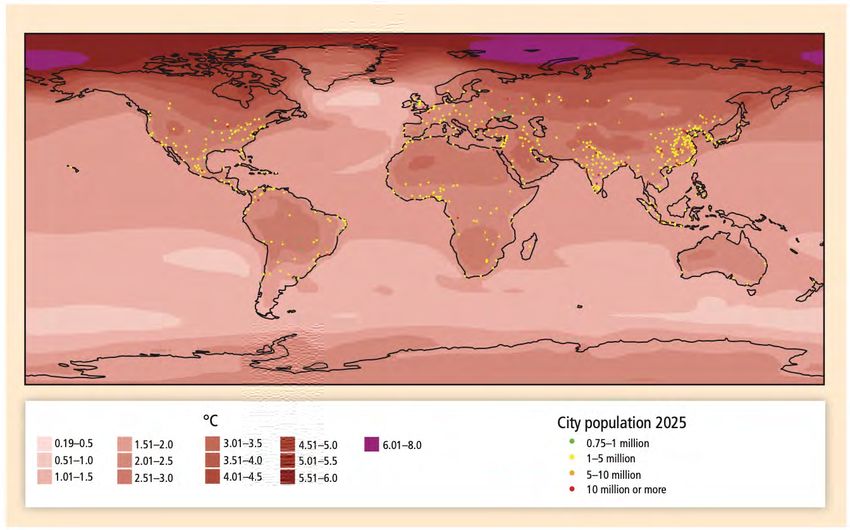
Sea level rise

• Caused by the thermal
  expansion of ocean water
  and ocean mass gain induced
  by climate change
• Accelerating over time and
  will become more common
  by 2100 under all emission
  scenarios
Ø Severe flooding

                                Source: h?ps://bit.ly/2QH31ta , last access 24.03.2021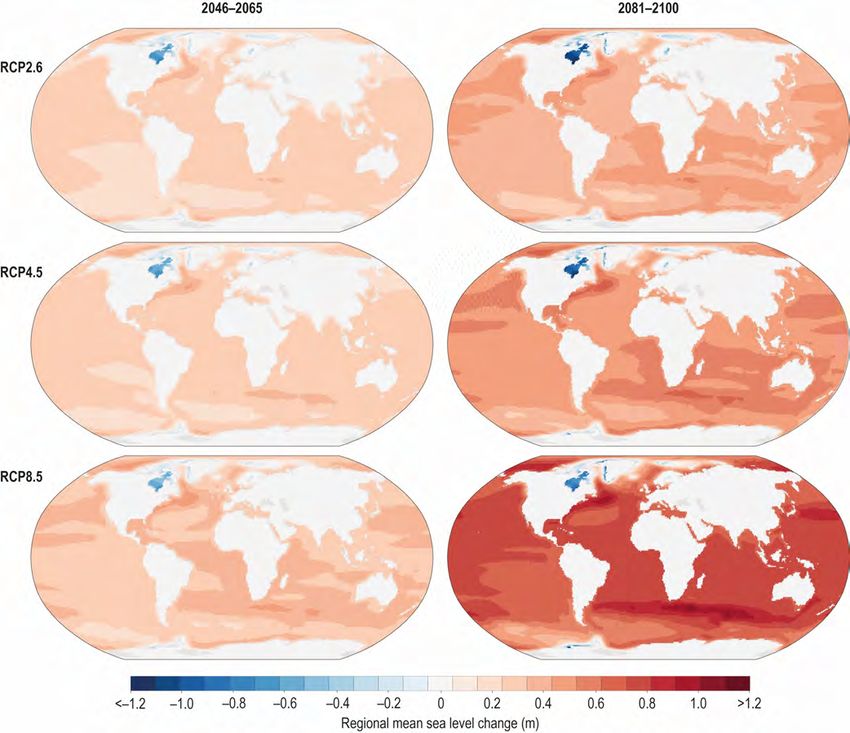
Coastal cities
                                                 Future risks for low-lying coastal cities

Source: Barragán, J. M., & de Andrés, M., 2015

                                                                           Source: https://earth.org/data_visualization/sea-level-rise-by-2100-hamburg/, last access 24.03.2021
Defining (Urban) Nature-based Solutions
IUCN framework for NbS

1. Definition by IUCN:
Nature-based Solutions are defined as “actions to
protect, sustainably manage, and restore natural or
modified ecosystems, that address societal challenges
effectively and adaptively, simultaneously providing
human well-being and biodiversity benefits.”

– Umbrella concept for ecosystem-related approaches —>

                                                         Image: Cohen-Shacham, 2016, p.11
What or Who is Nature anyway?
What or Who is Nature anyway?

                         ?
Features specific to
urban areas
Image: Melbourne Sprawl – https://bit.ly/39dlJyUUrban or peri- urban?
Human or nature or
         humanure?
                          – less than 2% of 2.8
                          billion tons of organic
                          waste from cities are
                          looped!

                          — if we are part of nature,
                          we need to fix that!

Images:
https://bit.ly/31kAXxJ
https://bit.ly/3w3WUiy
Our definiLon
Urban Nature-based Solutions (UNbS)
are actions based on natural processes to address societal challenges, providing benefits
for both human well-being and biodiversity resilience in highly fragmented and densely
populated built environments.
They increase against impacts from extreme events, supporting and creating
regenerative and self-sustaining capacity of the city.
Specifically, they involve the creation, protection, restoration or management of natural
and semi-natural ecosystems in and around the city.
Actions and interventions are based on trans-disciplinary approaches designed and
implemented with the participation of local communities and Indigenous Peoples.NbS and their
impact on
urban climate
risk
Image: https://bit.ly/3w0qGF83.NbS on the watershed scale and their impact on
urban climate risk
Source: FEMA RiskMAP
Land conservation Wetland and floodplain Greenways Stormwater parks
restora9on and protec9on
Cooling effect Flood preven9on Linkage of habitats Treating floodwaters
Risk reduction of droughts Increases biodiversity Precipitation uptake Improved water quality3.NbS on the site scale and their impact on urban
climate risk
Source: FEMA RiskMAP
Green roofs and rain gardens Rainwater harvesting Permeable Pavement Tree Canopy and Tree
Trenches
Cooling effect Drought protection Precipitation uptake Extreme weather protec9on
Rainfall uptake Extreme precipation Reduced flood risk Procec9on to extrem
temperatures3.NbS on costal areas and their impact on urban
climate risk
Source: FEMA RiskMAP
Costal Wetlands and Waterfront Parks Dunes Living Shorelines and Oyster
Mangroves Reefs
Storm protection Flood protection Sea level rise protection Reduced erosion
Increased biodiversity Increases biodiversity Protection from extreme Improved water quality3.NbS and their co-benefits
Impact on urban climate risk
Flood prevention
Cooling effect
Increase biodiversity
Increased air quality
Co-benefits
New recreational site
Health benefits for citizens
Increased social cohesion
Increase life quality
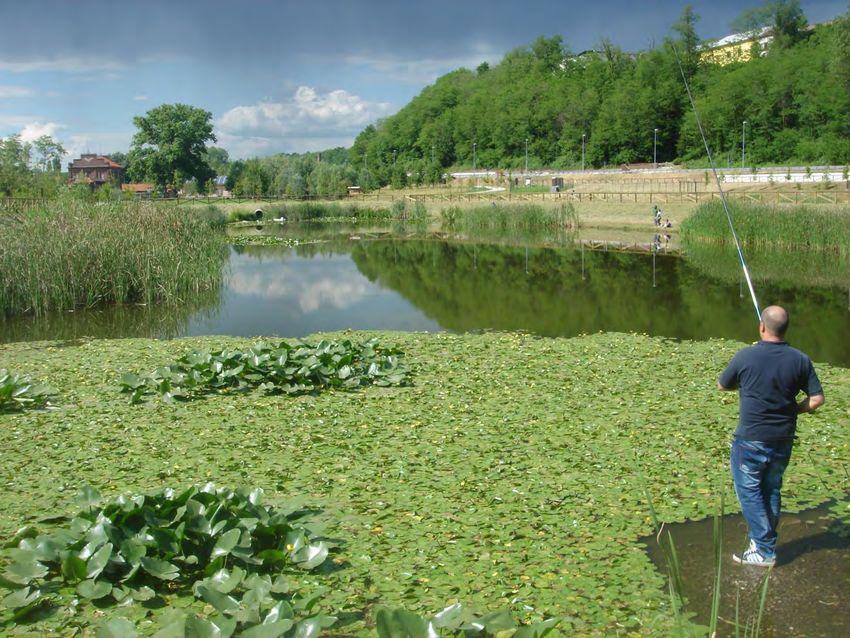
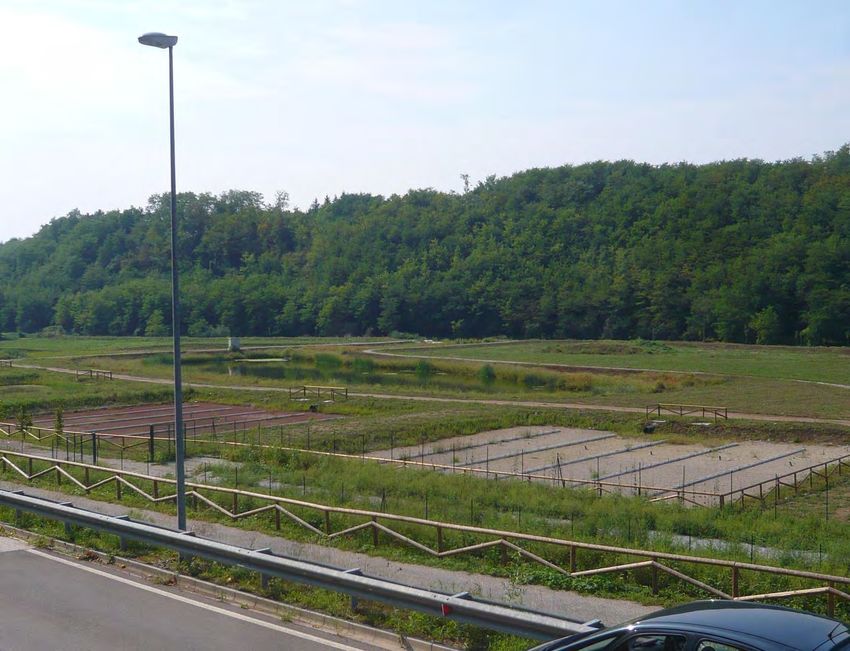
Source: Ramboll Studio Dreisteil4. NbS Examples 4. NBS Examples Gorla Maggiore Water Park (Source: ResearchGate, 2021)
4. NbS Examples

• Project duration: 2008 – 2013

• Project cost: 500 000 - 2 000 000 EUR

• Financing sources: Public regional budget,
  Private Foundation

                                               Pond in Gorla Maggiore Water Park
                                               (Source: Fabio Masi, 2018 in Naturvation, 2020)
4. NbS Examples Constructed Wetland in Gorla Maggiore Water Park Source: Fabio Masi, 2018 in Naturvation, 2020
4. NbS Examples

Potentional components of Green Infrastructure (Source: European Union, 2013)
4. NbS
Examples
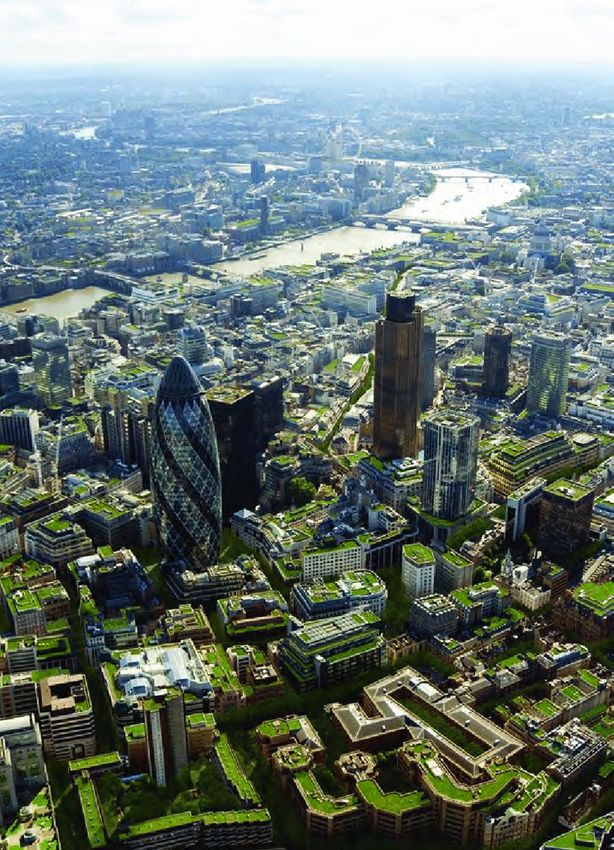
           Green design for Londons Roofs

           Source: Arup in Enzi et al., 2017
4. NbS Examples Zero-emission Boutique Hotel Stadthalle, Vienna Source: Michaela Reitterer in Enzi et al., 2017
4. NbS Examples

Living Wall, Vienna

               Source: Enzi et al., 2017
4. NbS Examples Sengkang Floating Wetland Source: PUB Singapore’s National Water Agency, 2021
4. NbS Examples

                                                                ABC Waters Programme in Singapore

                                                                • Completion Date: 2010

                                                                • Site Area: 2500 m²

                                                                • Project cost: SGD 8.000.000 SGD
                                                                    --> 5.044.340 €

                                                                • Financing: the national water agency
                                                                  Singapore (PUB)

Sengkang Floating Wetland (Source: PUB Singapore’s National Water Agency, 2021)
4. NbS Examples Sengkang Floating Wetland Source: PUB Singapore’s National Water Agency, 2021
B. Implementation

5. Case study: Urban climate risks and
impacts on Istanbul

6. NbS for Istanbul

7. Evaluation of NbS
5. Case study: Urban
              climate risks and impacts
              on Istanbul

Source:TURKSTAT

.
        1
        15.46 million
                        2
                                 Source: Istanbul Climate
                                 Change Action Plan

                                                                4                       5
                                                                                                             Source: Güneralp, B., Tezer, A., &
        people
                                                   3
                                                                                                             Albayrak, İ. (2013). Local Assessment
                                                                                                             of İstanbul: Biodiversity and
                                                                                                             Ecosystem Services. Urbanization,
                                                                                                             Biodiversity and Ecosystem Services:
                        Most populated                          Mediterranean                                Challenges and Opportunities, 291–

                        city in Europe             Trade and    climate and interacts   Increased built-up   311. https://doi.org/10.1007/978-
                                                                                                             94-007-7088-1_16

                                                   industrial   with the surrounding    area and urban
                                                   networks     climate zones           sprawl threat
5. Case study: Urban
climate risks and
impacts on Istanbul
Source: Krellenberg, Kers_n; Turhan, Ethemcan (2017) : How to respond to climate change at the local level: A guideline for Turkish ci_es,
UFZ-Bericht, No. 03/2017, HelmholtzZentrum für Umweleorschung (UFZ), Leipzig, hfp://nbn-resolving.de/urn:nbn:de:gbv:3:2-80144
Source: Istanbul Climate Change Action Plan5. Case study: Urban climate risks and impacts
on Istanbul, Drought
Source: Turkey General Directorate of Meteorology
Reasons
Rising temperatures
Changes in precipitation
Population growth
Rapid urbanization
The impact of industrial
activities5. Case study: Urban climate risks and impacts
on Istanbul, Drought
Impacts
Source: INHABITAT
The Guardian
DailyMail
Increasing water needs
Lack amount of fresh water
in reservoirs
Urban economy/ecosystem/socio-cultural
asset
Meteorological droughts
Agricultural droughts
Source: Hüseyin Turoğlu. (2016, July 4). Hydrology and Water Resources DROUGHT HAZARD AND WATER SHORTAGES IN ISTANBUL, TURKEY. Retrieved March 25, 2021,
from ResearchGate website:
Hydrological droughts
https://www.researchgate.net/publication/311103486_Hydrology_and_Water_Resources_DROUGHT_HAZARD_AND_WATER_SHORTAGES_IN_ISTANBUL_TURKEY5. Case study: Urban climate risks and impacts
on Istanbul, Flooding
Reasons
Deforestation
Irregular urbanization
Mega projects
Wrong land uses
Non-rehabilitation
of urban streams
Wrong intervention
to urban streams
Source: Fatma Aycim Turer Baskaya (February 2nd 2018). Revealing Landscape Planning Strategies for Disaster-Prone Coastal Urban Environments: The Case of Istanbul Megacity, Sea Level Rise and Coastal Infrastructure, Yuanzhi Zhang, Yijun Hou and Xiaomei Yang, IntechOpen,
DOI: 10.5772/intechopen.73567. Available from: https://www.intechopen.com/books/sea-level-rise-and-coastal-infrastructure/revealing-landscape-planning-strategies-for-disaster-prone-coastal-urban-environments-the-case-of-is5. Case study: Urban climate risks and impacts
on Istanbul, Flooding
Source: CBS News
DW
Impacts
Loss of life
Loss of property
Damage to historical areas
Interruption of life
Financial loss6. NbS-Solutions for
Istanbul
view of Levent business district by Derrick Brutel via Wikimedia Commons, Istanbul Roo=ops by Josiah Mackenzie CC BY, Street Scene in Istanbul by CCo, via PxhereOption 1: Green Roofs Picture from ZinCo https://www.zinco.de/systeme/schraegdach_bis_35_grad
6.1 Solutions for Istanbul: Green Roofs

     rainwater capture            Heat protection   insulation    pollutant   stepping stones
  cooling evapotranspiration                                     and carbon   for biodiversity
                                                                   capture

Illustrations from ZinCo (2020)
6.1 Solutions for Istanbul: Green Roofs
pi
intensive extensive sloped
Illustrations from American Hydrotech, Inc. https://www.hydrotechusa.com6.1 Solutions for Istanbul: Green Roofs modified from Copernicus Sentinel-2, ESA modified from Selda Yildiz and Erol Gülsen via Wikimedia Commons via Wikimedia Commons
Option 2:
  Atatürk Climate
  Park

Picture by Ercan Karakaş via Wikimedia Commons
6.2 Solutions for Istanbul: Atatürk Climate Park

                                                           rain gardens with diverse
                                                           native vegetation

                                                           native, drought resistent trees

                                                           cultural/recreational area

                                                           info boards

                                                    Participatory planning process!

modified from Ercan Karakaş via Wikimedia Commons
7. Evaluation of the NBS
Option 1:
Green Roofs

Kagithane Gardens in Istanbul by JDS Architects.
Source: https://bit.ly/3sqYXLo
Challenges – Option 1: Green Roofs

 Many pointed roofs in old city center

 Variable Precipita4on

 Only selected plants can withstand the
 arid climate

 Hybrid solu4ons necessary to
 implement water storing mechanisms
                                          Kapali Carsi (Grand Bazaar), Istanbul. Rooftops. Source: ©iharsten, flickr.
Benefits – Option 1: Green Roofs
Implementation in existing
infrastructure
Severe urban risks are being adressed:
droughts and flooding
Many other co-benefits
More appealing cityscape
Zorlu Center in Istanbul. Source: https://zinco-greenroof.com/references/zorlu-center-istanbul
Creates venues for citizensOption 2:
Recreation of
Istanbul Atatürk
Airport
• https://bit.ly/3d4gyCGChallenges – Option 2: Atatürk Airport Conflict of interest between different stakeholders Fight for space – need for housing, medical infrastructure etc. Gentrifica4on of neighborhood Habitat creates risk for invasive species Narrow streets in Instanbul. Copyright © 2016-2017 Corneliu Cazacu.
Benefits – Option 2: Ataturk Airport
  Unused Space

  Cooling effect of vast space (946ha)

  Located next to the sea – Reduction of
  Floodings

  Recreational space for citizens

  Increase of Tourism
                                           Istanbul Ataturk Airport from Above. Source: https://bit.ly/3lPtWym

  Increase of property value
OUR CHOSEN NBS ARE ... FEASIBLE AFFORDABLE SUSTAINABLE
Together for a sustainable future!
Sources
Bodur, A. (2018) Sel ve İstanbul: Sel Riskine Karşı Yapılan Dere Islah Çalışmaları ile İlgili Bir Değerlendirme. Retrieved from:
     https://www.researchgate.net/publication/327722562_Sel_ve_Istanbul_Sel_Riskine_Karsi_Yapilan_Dere_Islah_Calismalari_ile_Ilgili_Bir_Degerlendirme (March 25, 2021)

Anand, C.K., Apul, D.S. (2014) Composting toilets as a sustainable alternative to urban sanitation – A review, Waste Management, Volume 34, Issue 2, Pages 329-343, http://www.sciencedirect.com/science/article/pii/S0956053X13004923

Aygün, A. (2015). Climate Change and Urban Resilience: Vulnerability and Risk Assessment for Istanbul. Retrieved from:
     https://www.researchgate.net/publication/340105274_CLIMATE_CHANGE_AND_URBAN_RESILIENCE_VULNERABILITY_AND_RISK_ASSESSMENT_FOR_ISTANBUL (March 26, 2021)

Baskaya, F. A. T. (2018) Revealing Landscape Planning Strategies for Disaster-Prone Coastal Urban Environments: The Case of Istanbul Megacity. Sea Level Rise and Coastal Infrastructure. https://doi.org/10.5772/intechopen.73567

Cohen-Shacham, G Walters, C Janzen, S Maginnis (2016) Nature-based Solutions to address global societal challenges, IUCN, Gland, Switzerland
                                                                                                                 . retrievef
Department of Environmental Protection and Developmen İBB Beyoğlu Ek Hizmet Binas (2017) Istanbul Climate Change Action Plan. Retrieved from: https://www.iklim.istanbul/wp-content/uploads/%C3%96zetRapor%C4%B0ngilizce.pdf

Barragán, J. M., de Andrés, M. (2015) Analysis and trends of the world's coastal cities and agglomerations. Ocean & Coastal Management, 114, 11-20.

Ellen MacArthur Foundation (2019) Cities and Circular Economy for Food. Retrieved from: https://www.ellenmacarthurfoundation.org/assets/downloads/CCEFF_Full-report-pages_May-2019_Web.pdf (April 30, 2020)

Enzi, V., Cameron, B., Dezsényi, P., Gedge, D., Mann, G., Pitha, U. (2017) Nature-Based Solutions and Buildings – The Power of Surfaces to Help Cities Adapt to Climate Change and to Deliver Biodiversity. In: Nature-Based Solutions to Climate
Change Adaptation in Urban Areas. pp.159-183.

EP (2021). Heat Island Effect. Retrieved from https://www.epa.gov/heatislands. (Ap2021)

Erkens, G., Bucx, T., Dam, R., Lange, G., & Lambert, J. (2015). Sinking coastal cities. Proceedings of the International Association of Hydrological Sciences, 372, 189-198.

FEMA (2020): Building Community Resilience with Nature-Based Solutions: A Guide for Local Communities.

Güneralp, B., Tezer, A., & Albayrak, İ. (2013) Local Assessment of İstanbul: Biodiversity and Ecosystem Services. Urbanization, Biodiversity and Ecosystem Services: Challenges and Opportunities, 291–311. https://doi.org/10.1007/978-94-007-7088-
    1_16

Turoğlu, H. (2011) Flashfloods and Floods in Istanbul. Retrieved from: https://www.researchgate.net/publication/265682972_Flashfloods_and_Floods_in_Istanbul (March 26, 2021)

Turoğlu, H. (2013) Possible Effects of Climate Change on Water Management in Istanbul. Retrieved from: https://www.researchgate.net/publication/290805169_Possible_Effects_of_Climate_Change_on_Water_Management_in_Istanbul (March
     26, 2021)

Turoğlu. H. (2016) Hydrology and Water Resources DROUGHT HAZARD AND WATER SHORTAGES IN ISTANBUL, TURKEY. Retrieved from:
     https://www.researchgate.net/publication/311103486_Hydrology_and_Water_Resources_DROUGHT_HAZARD_AND_WATER_SHORTAGES_IN_ISTANBUL_TURKEY (March 25, 2021)
Sources
Jenkins, J. (2005) The Humanure Handbook – A guide to composqng, 2005, hrp://skrconline.net/content/images/stories/documents/Humanure_Handbook_all.pdf (April 30, 2020)
Kabisch, N., Korn, H., Stadler, J., & Bonn, A. (2017): Nature-based soluLons to climate change adaptaLon in urban areas linkages between science, policy and pracLce. Cham, Switzerland: Springer Internaqonal Publishing.
Kurnaz, L. (2014) DROUGHT IN TURKEY IPC-MERCATOR POLICY BRIEF. Retrieved from: hrps://ipc.sabanciuniv.edu/Content/Images/CKeditorImages/20200323-16034017.pdf MGM. (2021). Kuraklık Analizi- Meteoroloji Genel Müdürlüğü. Retrieved March 25, 2021, from
Mgm.gov.tr website: hrps://mgm.gov.tr/veridegerlendirme/kuraklik-analizi.aspx.
Naturvaqon (2021) Gorla Maggiore Water Park. hrps://naturvaqon.eu/nbs/milano/gorla-maggiore-water-park. (March 25, 2021).
Oppenheimer, M., B.C. Glavovic , J. Hinkel, R. van de Wal, A.K. Magnan, A. Abd-Elgawad, R. Cai, M. Cifuentes-Jara, R.M. DeConto, T. Ghosh, J. Hay, F. Isla, B. Marzeion, B. Meyssignac, and Z. Sebesvari (2019): Sea Level Rise and Implicaqons for Low-Lying Islands, Coasts
and Communiqes. In: IPCC Special Report on the Ocean and Cryosphere in a Changing Climate [H.-O. Pörtner, D.C. Roberts, V. Masson-Delmore, P. Zhai, M. Tignor, E. Poloczanska, K. Mintenbeck, A. Alegría, M. Nicolai, A. Okem, J. Petzold, B. Rama, N.M. Weyer (eds.)]. In
press.
ResearchGate (2021) Going green? Ex-post valuaqon of a mulqpurpose water infrastructure in Northern Italy- Scienqfic Figure on ResearchGate. Retrieved from: hrps://www.researchgate.net/figure/Locaqon-and-characterisqcs-of-the-Gorla-Maggiore-water-
park_fig1_320358119.(25.03.21).
Revi, A., D.E. Sarerthwaite, F. Aragón-Durand, J. Corfee-Morlot, R.B.R. Kiunsi, M. Pelling, D.C. Roberts, and W. Solecki (2014) Urban areas. In: Climate Change (2014) Impacts, Adaptaqon, and Vulnerability. Part A:
Global and Sectoral Aspects. Contribuqon of Working Group II to the Fi{h Assessment Report of the Intergovernmental Panel on Climate Change [Field, C.B., V.R. Barros, D.J. Dokken, K.J. Mach, M.D. Mastrandrea, T.E. Bilir, M. Charerjee, K.L. Ebi, Y.O. Estrada, R.C.
Genova, B. Girma, E.S. Kissel, A.N. Levy, S. MacCracken, P.R. Mastrandrea, and L.L. White (eds.)]. Cambridge University Press, Cambridge, United Kingdom and New York, NY, USA, pp. 535-612.
PUB Singapore’s Naqonal Water Agency (2021) Sengkang Floaqng Wetland. hrps://www.pub.gov.sg/Pages/album.aspx?24PW07of9GVLHNefpqvi+FVCjcfBEN2iPMSSzTs6q/J/vLW4QFZh+pNM3uCWYHkGuJzh88TAaUFrYsRJBFEFAg==.(25.03.2021).
Sara Favargio• (2018) Renewed landscapes: Obsolete airfields as landscape reserves for adapqve reuse, Journal of Landscape Architecture, 13:3, 90-100, DOI:10.1080/18626033.2018.1589147
Seddon, N. (2018) Evidence Brief—How effecqve are Nature-based Soluqons to climate change adaptaqon? Nature Based Soluqons Iniqaqve. University of Oxford.
Soz, S. A., Kryspin-Watson, J., Stanton-Geddes, Z. (2016) The Role of Green Infrastructure Soluqons in Urban Flood Risk Management. World Bank, Washington, DC. hrps://openknowledge.worldbank.org/handle/10986/25112 License: CC BY 3.0 IGO.”
ZinCo (2020) Planungshilfe: Systeme für begrünte Schrägdächer. Retrieved from: hrps://www.zinco.de/sites/default/files/2020-08/ZinCo_Schraegdachbegruenung.pdf (March 26, 2020)You can also read


