Ornithologists' Help to Spiders: Factors Influencing Spiders Overwintering in Bird Nesting Boxes
←
→
Page content transcription
If your browser does not render page correctly, please read the page content below
insects
Article
Ornithologists’ Help to Spiders: Factors Influencing Spiders
Overwintering in Bird Nesting Boxes
Ondřej Machač * and Ivan Hadrián Tuf

                                          Department of Ecology and Environmental Sciences, Faculty of Science, Palacký University Olomouc,
                                          Šlechtitelů 27, 77900 Olomouc, Czech Republic; ivan.tuf@upol.cz
                                          * Correspondence: machac.ondra@seznam.cz

                                          Simple Summary: Nesting boxes are often used to support hole-nesting birds, but are also attractive
                                          as a shelter for many invertebrates, especially for overwintering. We studied assemblages of spiders
                                          overwintering in nesting boxes in a lowland forest and the factors influencing their abundance and
                                          activity during winter. The results show that the majority of arboreal spider species use nesting boxes
                                          to overwinter and that their abundance increases with the presence of nest material. Some spider
                                          species are also active at low temperatures in winter and can resettle emptied nesting boxes during
                                          the winter season. By hanging nesting boxes on trees, ornithologists support not only hollow nesting
                                          birds, but also overwintering spiders.

                                          Abstract: Spiders are common inhabitants of tree hollows, as well as bird nesting boxes, especially
                                          in autumn and winter. Some species of spiders use bird nesting boxes for overwintering. We
                                          investigated spider assemblages in nesting boxes and how temperature influences the abundance
                                          of overwintering spiders in nesting boxes in lowland forest in the Czech Republic. The study was
                                conducted in the European winters of 2015–2017. In total, 3511 spider specimens belonging to

                                          16 identified species were collected from nesting boxes over three years in late autumn and winter.
Citation: Machač, O.; Tuf, I.H.          Almost all species were arboreal specialists. The dominant species were Clubiona pallidula, Anyphaena
Ornithologists’ Help to Spiders:          accentuata, Platnickina tincta, and Steatoda bipunctata. Although the tree species had no effect on the
Factors Influencing Spiders
                                          abundance of overwintering spiders, the presence of nest material affected the abundance of spiders
Overwintering in Bird Nesting Boxes.
                                          in the nesting boxes (preferred by C. pallidula and P. tincta). In general, spiders resettled nesting
Insects 2021, 12, 465. https://
                                          boxes during winter only sporadically, however A. accentuata reoccupied boxes continuously, and its
doi.org/10.3390/insects12050465
                                          activity was positively correlated with the outside temperature. Nesting boxes support insect-eaters
Academic Editor: Brian T. Forschler
                                          all year around—birds during spring and summer and spiders during autumn and winter.

Received: 6 April 2021                    Keywords: Araneae; bird nests; Anyphaena accentuata; Clubiona pallidula; overwintering; artificial shelter
Accepted: 13 May 2021
Published: 18 May 2021

Publisher’s Note: MDPI stays neutral      1. Introduction
with regard to jurisdictional claims in        Trees provide many specific microclimatic and structural microhabitats such as bark,
published maps and institutional affil-   trunk, cavities, hollows, and foliage microhabitats [1–3]. Spiders can be found in all
iations.                                  microhabitats on trees: in spaces around the roots and trunk in soil [4], in foliage in the
                                          canopy [5], as well as on the bark [6]. Some species are specialist or temporal dwellers in
                                          tree hollows and cavities [7–9].
                                               Tree cavities and hollows play an important role as a keystone component in biodi-
Copyright: © 2021 by the authors.         versity conservation [10,11]. Tree cavities provide breeding, feeding, and roosting habitats
Licensee MDPI, Basel, Switzerland.        for many vertebrates, especially hole-nesting birds and mammals [12,13]. In hollows with
This article is an open access article    nests (inhabited by birds or mammals), there is usually nest material with a rich abundance
distributed under the terms and           of prey and shelter for many invertebrates, including spiders. Spiders in bird and mammal
conditions of the Creative Commons        nests are rarely studied, and only a few studies are known from Central Europe [14–19].
Attribution (CC BY) license (https://
                                               Spiders inhabiting tree hollows belong to web-builders, sit-and-wait predators, and
creativecommons.org/licenses/by/
                                          active hunters [9]. Some species of spiders live in tree hollows throughout the year, whereas
4.0/).

Insects 2021, 12, 465. https://doi.org/10.3390/insects12050465                                              https://www.mdpi.com/journal/insects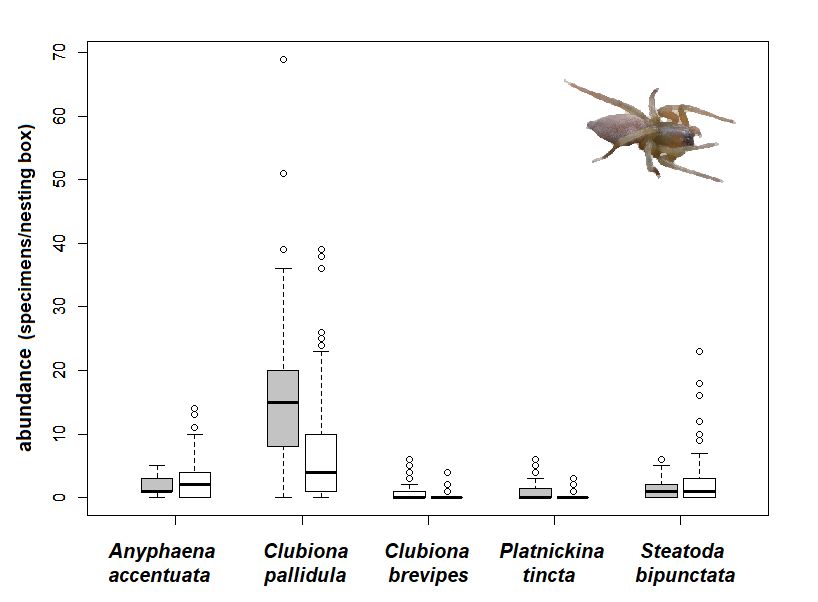
Insects 2021, 12, 465                                                                                             2 of 11

                        other spiders use trees only during a certain period of the year, mainly for overwinter-
                        ing [20–23]. Many spiders hibernate in silk sacs or stay non active if the temperature is
                        low [24], although some species are active and hunt during winter [25]. Winter-active
                        arboreal hunters, such as some Philodromus spp. or Anyphaena accentuata, use tree cavities
                        as shelter in winter during daylight and hunt for prey at night [26].
                              Nest material is attractive for many groups of invertebrates, for example, parasites
                        of nesting vertebrates or commensals eating organic nest detritus and/or prey on their
                        parasites [27]. The density and distribution of tree hollows in forests depends on the
                        tree species and the age of forest stands [28]. Due to human management, the major-
                        ity of Central European forests have changed their structure from old mixed forests to
                        rather young monocultures of single-aged plantations, where minimum hollow trees are
                        present [29,30]. Nesting boxes are often used to support birds and small mammals, espe-
                        cially in younger and single-aged forests [31,32]. Only a few studies have evaluated spider
                        communities in bird nesting boxes [33], but, to our knowledge, none have investigated
                        spiders overwintering there.
                              In this study, we investigated the community of spiders overwintering in nesting
                        boxes in lowland forests. Specifically, we studied the influence of selected factors on
                        its distribution such as tree species, the presence of nest material, vertebrate predator
                        exclusion by closing the entrance with a rubber bung, and the influence of temperature on
                        the resettlement of nesting boxes during winter.

                        2. Materials and Methods
                              The study was performed in a floodplain forest habitat in the Království Natural Re-
                        serve near Olomouc (Czech Republic: 49◦ 300 36.3700 N, 17◦ 180 1.3100 E, 205 m a.s.l.). Sampling
                        sites were located in a mature broadleaf lowland forest dominated by lindens (Tilia spp.),
                        oaks (Quercus spp.), ash (Fraxinus excelsior L.), hornbeam (Carpinus betulus L.), alders (Alnus
                        spp.), and elms (Ulmus spp.), with a mean annual temperature of about 12 ◦ C. In this area,
                        bird nesting biology has been studied intensively [33] and several sites with nesting boxes
                        are managed. Wooden nesting boxes (290 × 220 × 180 mm, inlet 35 mm) are mounted
                        on trees 1.5 m above the ground. The boxes are spaced about 15 m apart in parallel lines.
                        The boxes were mounted on trees by ornithologists in the spring of 2005, and their spatial
                        distribution does not reflect tree species. Therefore, the frequency of host trees reflects the
                        frequency of these trees in the stand.
                              Spiders were collected from the nesting boxes by individual sampling using a hand
                        aspirator. Some boxes were emptied and the nest material was heat extracted (see below).
                        Spiders were usually identified to the species level [34]; however, some juveniles were
                        only identified to the genus level. The majority of nonadult specimens of Clubiona were
                        subadults and were bred to adults confirming their identity as C. pallidula. We used the
                        nomenclature according to the World Spider Catalog Version 21.5 [35]. The spiders were
                        classified into hunting strategy guilds based on Cardoso et al. [36]. All material is deposited
                        in the first author’s collection.
                              Our research aims were split into three groups:
                        (1)   The effect of tree species and bunging nesting boxes on spider abundance
                              In this part of the study, we used 50 wooden nesting boxes sampled in Novem-
                        ber/December of 2015, 2016, and 2017. The nesting boxes were on 28 lindens, 16 oaks,
                        3 ashes, and 3 alders. Half of them were closed to birds by a bung before the start of the
                        bird nesting season (providing vertebrate predatory exclusion for spiders). The spiders
                        were collected once a year at the turn of November/December from the same trees each
                        year.
                        (2)   The effect of temperature on nesting box resettlement by spiders
                             For the second part of our study, the same 50 wooden nesting boxes were sampled in
                        two-week intervals from January–March 2016. Temperature was measured by a datalogger
                        (EasyLog-USB) inside and outside of three of the nesting boxes.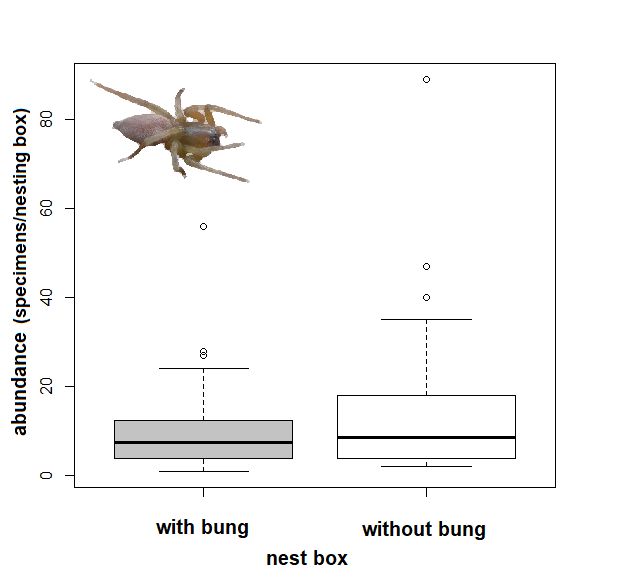
Insects 2021, 12, 465                                                                                             3 of 11

                        (3)   The effect of the presence of nest material on spider abundance
                             For this part of the study, we sampled 126 nesting boxes at the end of November 2017.
                        The nesting boxes were on 66 lindens, 28 oaks, 21 ashes, and 11 other trees (birch, elm, and
                        alder). Nest material from 39 nests (35 nests of Parus major Linnaeus, 1758; 2 Parus caeruleus
                        Linnaeus, 1758; and 2 Ficedula albicollis (Temminck, 1815)) consisted of dry grass, moss, and
                        mammal hair. This material was heat-extracted in Tullgren extractors in the laboratory.
                             For the statistical analyses, canonical correspondence models were developed in
                        Canoco [37]. The abundances of individual species were analysed as species-dependent
                        variables, whereas the independent environmental variables were year, tree species, tem-
                        peratures (minimal, mean, and maximal, measured inside and outside the boxes), the
                        presence of nest material, and bung. In a preliminary analysis, the length of the gradient in
                        species variables was calculated (gradient 4.5 SD units long), and the unimodal Canonical
                        Correspondence Analysis was subsequently chosen. There were no rare species (1–2 speci-
                        mens) collected requiring exclusion from the analysis. Species data were log transformed
                        as skewed by zero counts by the formula Y0 = Y + 1. First, we performed a global test of
                        significance for the explanatory variables (i.e., tree species, season, bung, nest material)
                        to avoid Type I errors resulting from multiple comparisons. We then performed forward
                        selection to investigate the significance of particular variables and their conditional term
                        effect. Significance was tested by Monte Carlo permutation test (499 repetitions).
                             Changes in the abundance of spiders that were dependent on ambient temperatures
                        were assessed using generalized additive models. From all tested temperatures, the outside
                        maximum temperature was chosen as it had the highest conditional effect (pseudo-F = 17.7,
                        explaining 6.1% of the variability) in the CCA model. Changes in the abundance of
                        individual species reflecting this temperature were analysed in GAM using Poisson’s
                        distribution and 2.0 df temperature term smoothness.
                             The influence of the nest material and a bunged entrance on spider abundance were
                        tested by Welsch two sample t-test in R version 3.6.3 [38].

                        3. Results
                        3.1. Assemblages of Spiders in Nesting Boxes
                             Altogether, 3511 specimens of spiders belonging to 16 identified species (11 families)
                        were obtained from 92% of the nesting boxes (Table S1 in Supplementary Materials). Some
                        specimens were identified to the genus level (Table 1). Almost all spiders were arboreal
                        specialists and facultative dwellers on trees. The most abundant species were as follows:
                        Clubiona pallidula (47% of all collected specimens), Anyphaena accentuata (24%), Steatoda
                        bipunctata (13%), and Platnickina tincta (5%). The majority of species were common forest
                        arboreal species, only Pseudicius encarpatus was rare; none of the species were listed on the
                        Red List of Czech Spiders [39].
                             Four species were space web hunters or orb web hunters, and three were sheet web
                        hunters, but the most abundant guilds were non-web hunters (9 species), with one ambush
                        hunter, two ground hunters, and seven other hunters (Table 1).

                        3.2. Effect of Tree Species and Bunging Nesting Boxes
                             The spider assemblages differed significantly between the studied years (CCA: from
                        2015 to 2017: F = 2.6, p = 0.002; and 2016 to 2017: F = 3.2, p = 0.006, respectively; Figure 1).
                        The tree species studied revealed no significant effect on the abundance of overwintering
                        spiders in nesting boxes (CCA: linden: F = 0.8, p = 0.666; oak: F = 1.00, p = 0.408; ash:
                        F = 0.30, p = 0.97). Nesting boxes without a bung hosted significantly more spiders than
                        the bunged boxes (CCA: F = 2, p = 0.026; Figure 2).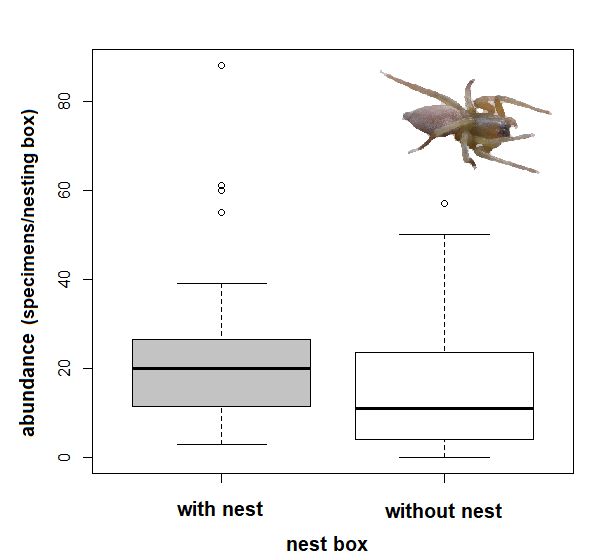
Insects 2021, 12, 465                                                                                                                  4 of 11

      Table 1. Species list of spiders overwintering in nesting boxes and their numbers. Hand collected = number of spiders hand
      collected in 2015–2017, heat extracted = number of spiders heat-extracted from nest material from 39 nesting boxes in 2017.

                 Species/Families                    Ecological Niche         Hunter Guild          Hand Collected         Heat Extracted
                       Agelenidae
           Tegenaria silvestris L. Koch, 1872       ground, trunk base          sheet web                  3                      0
                     Anyphaenidae
      Anyphaena accentuata (Walckenaer, 1802)         branches, bark           other hunters              851                    67
                       Araneidae
        Mangora acalypha (Walckenaer, 1802)           herbs, branches            orb web                    1                     0
          Nuctenea umbratica (Clerck, 1757)                bark                  orb web                   14                     0
            Zilla diodia (Walckenaer, 1802)              branches                orb web                    1                     0
                      Clubionidae
          Clubiona brevipes Blackwall, 1841              branches              other hunters               84                   31
           Clubiona pallidula (Clerck, 1757)               bark                other hunters              1635                  574
                      Gnaphosidae
           Micaria subopaca Westring, 1861                bark                ground hunters               4                      2
                     Scotophaeus sp.                     hollows              ground hunters              112                     9
                      Linyphiidae
      Lepthyphantes minutus (Blackwall, 1833)             bark                  sheet web                   6                     1
            Neriene montana (Clerck, 1757)          hollows, branches           sheet web                  28                     2
                     Philodromidae
        Philodromus dispar Walckenaer, 1826              branches              other hunters               1                     0
                     Philodromus sp.                     branches              other hunters              105                    25
                        Salticidae
      Pseudicius encarpatus (Walckenaer, 1802)             bark                other hunters               2                      0
         Salticus zebraneus (C. L. Koch, 1837)             bark                other hunters               20                     9
                      Theridiidae
                       Dipoena sp.                         bark                 space web                  2                     0
        Platnickina tincta (Walckenaer, 1802)            branches               space web                 162                    42
         Steatoda bipunctata (Linnaeus, 1758)             hollow                space web                 449                    51
                      Theridion sp.                   bark, branches            space web                 14                     3
                      Thomisidae
            Diaea dorsata (Fabricius, 1777)              branches            ambush hunters                12                     3
Insects 2021, 12, x Tetragnathidae
                     FOR PEER REVIEW                                                                                                   5 of 12
                     Tetragnatha sp.                     branches                orb web                   5                      0

                                     Figure 1. Spider species in relation to the sampling year, tree species, and bunging of nesting
                                     Figure  1. Spider
                                     boxes during      species
                                                    three yearsin(AnyAcc–Anyphaena
                                                                  relation to the sampling year, tree
                                                                                     accentuata,      species, and pallidula,
                                                                                                  CluPal–Clubiona  bunging CluBre–Clubiona
                                                                                                                              of nesting
                                     boxes  during  three years  (AnyAcc–Anyphaena    accentuata, CluPal–Clubiona  pallidula,
                                     brevipes, DiaDor–Diaea dorsata, LepMin–Lepthyphantes minutus, NerMon–Neriene montana,    CluBre–
                                                                                                                                    NucUmb–
                                     Clubiona  brevipes, DiaDor–Diaea   dorsata, LepMin–Lepthyphantes  minutus,  NerMon–Neriene
                                     Nuctenea umbratica, Phisp–Philodromus sp., PlaTin–Platnickina tincta, SalZeb–Salticus zebraneus,montana,
                                                                                                                                        Scosp–
                                     NucUmb–Nuctenea umbratica, Phisp–Philodromus sp., PlaTin–Platnickina tincta, SalZeb–Salticus ze-
                                     Scotophaeus sp., SteBip–Steatoda bipunctata). CCA biplot is statistically significant (pseudo-F = 1.6,
                                     braneus, Scosp–Scotophaeus sp., SteBip–Steatoda bipunctata). CCA biplot is statistically significant
                                     p = 0.012), and explanatory variables account for 7.0% of the variability.
                                     (pseudo-F = 1.6, p = 0.012), and explanatory variables account for 7.0% of the variability.
Figure 1. Spider species in relation to the sampling year, tree species, and bunging of nesting
boxes during three years (AnyAcc–Anyphaena accentuata, CluPal–Clubiona pallidula, CluBre–
Clubiona brevipes, DiaDor–Diaea dorsata, LepMin–Lepthyphantes minutus, NerMon–Neriene montana,
NucUmb–Nuctenea umbratica, Phisp–Philodromus sp., PlaTin–Platnickina tincta, SalZeb–Salticus ze-
Insects 2021, 12, 465 braneus, Scosp–Scotophaeus sp., SteBip–Steatoda bipunctata). CCA biplot is statistically significant
5 of 11
(pseudo-F = 1.6, p = 0.012), and explanatory variables account for 7.0% of the variability.
Figure2.2.Comparison
Figure Comparisonofofthe thenumber
numberofofspider
spiderspecimens
specimensper
perbox and
box inspection
and inspection(abundance
(abundance = indi-
=
viduals) in bunged
individuals) nesting
in bunged boxesboxes
nesting and boxes without
and boxes a bung
without (sampled
a bung once once
(sampled in winter of 2015,
in winter 2016,
of 2015,
and 2017),
2016, and bold
2017),lines
boldinlines
the box plot
in the areplot
box the are
median and theand
the median lines are
the 95%are
lines CI,95%
the CI,
dotsthe
aredots
outliers.
are
outliers.
3.3. Effect of Temperature on the Nesting Box Resettlement by Spiders
3.3. The
Effecttemperature
of Temperature inside and
on the outside
Nesting BoxofResettlement
the nestingby boxes did not difer significantly.
Spiders
Temperature had a significant effect on seven species
The temperature inside and outside of the nesting boxes did active during
not winter (GAM: A.
difer significantly.
Insects 2021, 12, x FOR PEER REVIEW
accentuata, F = 42, p < 0.001; C. pallidula, F = 31.4, p < 0.001; C. brevipes, F = 8, p6 of< 12 0.001; P.
Temperature had a significant effect on seven species active during winter (GAM: A.
tincta, F = 16.1, p < 0.001; S. bipunctata, F = 7.3, p < 0.001; Scotophaeus sp., F = 3.9, p = 0.021;
accentuata, F = 42, p < 0.001; C. pallidula, F = 31.4, p < 0.001; C. brevipes, F = 8, p < 0.001; P.
Tetragnatha sp., F = 3.1, p = 0.046). The strongest positive effect on the resettlement of the
tincta, F = 16.1, p < 0.001; S. bipunctata, F = 7.3, p < 0.001; Scotophaeus sp., F = 3.9, p = 0.021;
inspected
inspectedboxes by spiders
boxes had had
by spiders the maximum
the maximum temperature outside
temperature the boxes
outside (CCA: (CCA:
the boxes t-max t-max
Tetragnatha
outside: sp.,p F = 3.1, pt-max
= 0.046). The strongest positive effectoutside:
on the Fresettlement of the
outside: F = 17.70, p = 0.002; t-max inside: F = 7.10, p = 0.002; t-mean outside:pF= = 4.20,
F = 17.70, = 0.002; inside: F = 7.10, p = 0.002; t-mean = 4.20,
0.002;
p = t-mean inside: inside:
0.002; t-mean F = 3.80,F p==3.80,
0.002;
p=t-min outside:
0.002; t-min Foutside:
= 3.60, pF==0.002;
3.60, t-min inside:
p = 0.002; F = inside:
t-min
2.50, p = 0.006). There were two dominant species with opposite patterns: C.
F = 2.50, p = 0.006). There were two dominant species with opposite patterns: C. pallidula pallidula was
abundant in nesting
was abundant boxes at
in nesting lower
boxes maximal
at lower temperatures
maximal (Figure (Figure
temperatures 3), whereas A.
3), whereas A.
accentuata was significantly more abundant in boxes following higher
accentuata was significantly more abundant in boxes following higher outside maximal outside maximal
temperatures
temperatures (Pearson’s
(Pearson’sR=R 0.72; Figure
= 0.72; 3). 3).
Figure
Figure
Figure 3. Abundance
3. Abundance of Anyphaena
of Anyphaena accentuata
accentuata and Clubiona
and Clubiona pallidula
pallidula per boxper box winter
during duringand
winter
the and the
maximum and minimum temperature outside the boxes measured 14 days prior to spider collec-collection
maximum and minimum temperature outside the boxes measured 14 days prior to spider
tioninin 2016.
2016.
3.4. Effect of Presence of Nest Material on Spider Abundances
In 2017, material was collected from 126 nesting boxes, of which 39 boxes contained
nest material (grass, moss, hair). The majority of the nests were built by the great tit (Parus
major). A total of ten spider species were heat-extracted from the nesting material in theInsects 2021, 12, 465 6 of 11
3.4. Effect of Presence of Nest Material on Spider Abundances
In 2017, material was collected from 126 nesting boxes, of which 39 boxes contained
nest material (grass, moss, hair). The majority of the nests were built by the great tit (Parus
major). A total of ten spider species were heat-extracted from the nesting material in the
laboratory (Table 1). The most common species were C. brevipes (37% of the specimens
collected), C. pallidula (35%), and P. tincta (26%). Other invertebrates extracted included
mites, fleas, earwigs, and the larvae of Diptera and Lepidoptera. Nest material significantly
supported the higher abundance of spiders in the nesting boxes (Welch two sample t-test,
F = 8.80, p = 0.002, Figure 4). Three spider species heat-extracted from the nest material
had a significantly higher abundance than those found in the boxes without nest material
(Welch two sample t-test: C. pallidula: T = 4.14, df = 53.309, p < 0.001; C. brevipes: T = 2.80,
df = 42.611, p = 0.008; P. tincta: T = 3.17, df = 41.880, p = 0.003). On the other hand, A.
Insects 2021, 12, x FOR PEER REVIEWaccentuata and S. bipunctata were more abundant in the empty nesting 7boxes
7 of 12 (Welch two
of 12
Insects 2021, 12, x FOR PEER REVIEW
sample t-test: A. accentuata: T = −2.65, df = 123.970, p = 0.009; S. bipunctata: T = −2.61,
df = 121.380, p = 0.010, Figure 5).
Figure
Figure4.4.4.
Comparison of theofnumber
Comparison of spider
the number of specimens per box and
spider specimens perinspection
box and(abundance
inspection== (abundance = indi-
Figure Comparison of the number of spider specimens per box and inspection (abundance
individuals) in nesting boxes with and without nest material), bold lines in the boxplot are the
individuals)
viduals) ininnesting
nesting boxes
boxes with
withand
and without
withoutnestnest
material), bold lines
material), bold in lines
the boxplot
in theare the
boxplot are the median
median and the lines are 95% CI, the dots are outliers.
median and the lines are 95% CI, the dots are outliers.
and the lines are 95% CI, the dots are outliers.
Figure 5. Number of spider specimens per box and inspection (abundance) of dominant
Number
Figure5.5.Number
Figure of of spider
spider specimens
specimens per and
per box box inspection
and inspection (abundance)
(abundance) of dominant spider
of dominant
spider species in nesting boxes with nest material (grey) and without nest material (white),
spider species in nesting boxes with nest material (grey) and without nest material (white),
species in nesting boxes with nest material (grey) and without nest material (white), the bold lines in
the bold lines in the boxplot are the median and the lines are 95% CI, the dots are outliers.
the
thebold linesare
boxplot in the
theboxplot
medianare thethe
and median and95%
lines are the lines aredots
CI, the 95% are
CI, the dots are outliers.
outliers.
4. Discussion
4. Discussion
We analysed the assemblages of spiders overwintering in nesting boxes, as well as
We analysed the assemblages of spiders overwintering in nesting boxes, as well as
several environmental factors affecting their abundance in nesting boxes in a lowland for-
several environmental factors affecting their abundance in nesting boxes in a lowland for-
est. As we know, spiders are common invertebrates in nesting boxes in different habitats
est. As we know, spiders are common invertebrates in nesting boxes in different habitats
not only in winter, but also during the whole year [33,40,41]. The abundance of spiders in
not only in winter, but also during the whole year [33,40,41]. The abundance of spiders inInsects 2021, 12, 465 7 of 11
4. Discussion
We analysed the assemblages of spiders overwintering in nesting boxes, as well as
several environmental factors affecting their abundance in nesting boxes in a lowland
forest. As we know, spiders are common invertebrates in nesting boxes in different habitats
not only in winter, but also during the whole year [33,40,41]. The abundance of spiders in
nesting boxes are higher per nest than for other bird nest habitats, e.g., in burrow nests [18]
or free nests [42]. Comparing to our results, more species of spiders were collected from
bird nests in a similar study in Slovakia. However, in that study, the spiders were collected
from spring to autumn (October) [19]. The highest abundance of spiders in nesting boxes
was in late autumn, because spiders migrate to boxes for overwintering. During the spring
and summer, spiders are preyed on by nesting birds [19], whereas the predatory impact by
birds in autumn and winter is only low. Spiders were missing in nesting boxes where birds
roosted. Few such boxes were recognisable by the presence of droppings.
Almost all species obtained from nesting boxes are common arboricolous species [3],
typical for the local lowland forests of Central Europe [6]. Only Tegenaria silvestris is not
a typical tree inhabitant, as it generally lives on the ground and only occasionally in the
lower part of tree trunks [43]. Mangora acalypha is better known as an herb dweller [35].
The majority of species were bark and trunk dwellers, fewer were branch dwellers, and
some were typical hollow specialists [9]. The species spectrum was similar to that found
by Černecká et al. [19], with A. accentuata and Clubiona species being most dominant [3,35].
A relatively low abundance of Philodromus spp. in the nesting boxes was surprising,
as this species is a common inhabitant of trees and nesting boxes [19] and overwinters
under bark and in hollows [22]. Some other abundant species from nesting boxes in
Slovakia [19], such as Amaurobius fenestralis (Ström, 1768) and Segestria senoculata (Linnaeus,
1758), generally live in coniferous forests [3,44], and were absent in our study, which
focused on deciduous forests.
The most abundant hunter gild was other hunters, due to the dominant species
C. pallidula and A. accentuata. A similar guild spectrum was found in nesting boxes in
Slovakia [19]. Spiders in nesting boxes and on trees are most numerous in autumn [19,22]
because of the need to find shelters in which to overwinter, often in hollows or spaces under
the bark [6]. Some species overwinter in nesting boxes in the remains of the nest material
or on the inner sides of nesting boxes in silk shelters (Clubiona), whereas some other species
build webs in the spaces inside nesting boxes (S. bipunctata) or stay active and do not
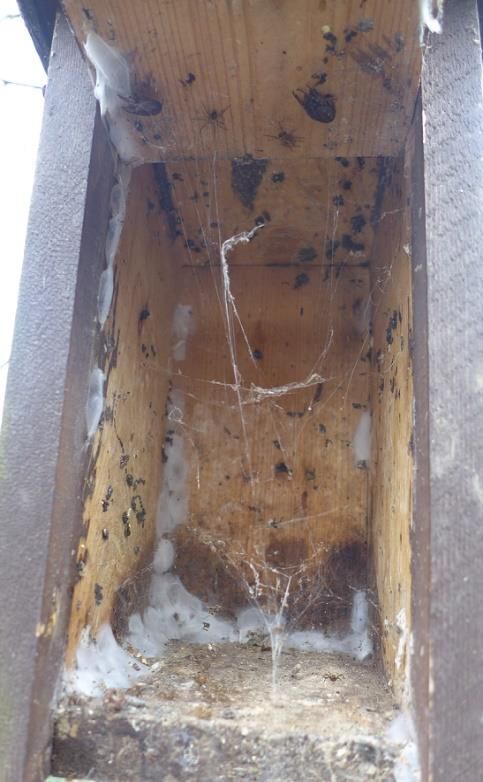
make web shelters (A. accentuata) (Figure A1 in Appendix A). Species classified as orb web
builders do not build webs in nesting boxes and use nesting boxes only as shelter. Steatoda
bipunctata, which is classified as a space web hunter, is a typical tree hollow dweller [9]
that dwells in its web in nesting boxes probably for the whole year, as in tree hollows. On
the other hand, another space web builder, P. tincta, lives on leaves in branches during the
vegetation season and migrates to nesting boxes or tree hollows only for overwintering
(we only found inactive specimens without webs on the inner walls of boxes or in the nest
material). The most abundant species in nesting boxes, C. pallidula, overwintered inactive
in silk sacs under the bark or in tree hollows [20,45,46].
In the U.S.A., McComb and Noble [40] reported arachnids in only 6.7% of nesting
boxes, with the lowest abundances found in winter, whereas in our study, spiders were
found in almost all (92%) of the nesting boxes. Closing nesting boxes with a bung had a
significantly negative effect on the spider abundance in the boxes [19]. Spiders probably
use artificial entrances to preferably colonize boxes, but small and flat species can use
fissures under the roof or between the wooden walls for entering. During autumn or
winter, predatory pressure on invertebrates in nesting boxes is probably not as high as
in the spring and summer. Nevertheless, some species of birds (e.g., present Parus major)
roost in nesting boxes during winter nights [47].
We did not find a significant difference between the studied tree species, in accordance
with Černecká et al. [19]. This effect was expected in our study because the studied tree
species did not recognizably differ in bark structure and habitat. Some spider speciesInsects 2021, 12, 465 8 of 11
can prefer a specific tree and, consequently, abundances of different tree species can be
significantly different [48], but such differences between broadleaf and coniferous trees
may be more apparent [23].
Temperature had a significant effect on the probability of the resettlement of inspected
and emptied nesting boxes by A. accentuata, which was the most active species during
winter [26,49]. This species and some species of Philodromus are winter-active predators
and prey even at temperatures close to 0 ◦ C [48]. Other dominant species resettled emptied
boxes only sporadically, and not during cold days. Anyphaena accentuata was the only
spider able to regularly resettle emptied boxes without nest material during winter.
The nest material had a significant positive effect on the abundance of spiders. For
example, Salticus zebraneus was found only in boxes with nest material. Nest material is
both a shelter and a source of prey for spiders [27]. Spiders, especially juvenile P. tincta and
Clubiona species (C. pallidula and C. brevipes), were overwintering in nest material. Juveniles
of Clubiona were also found to be numerous in nest material in other studies [14,44].
Clubiona overwinters in silk sacs on the sides of nesting boxes and also among the nest
material. Nest material is also used as shelter by A. accentuata; this species is known as an
active winter predator [50], preying on invertebrates in the nest material. Only juvenile
inactive specimens of S. bipunctata were found in the nest material, whereas adults built
webs in the nesting boxes.
Nesting boxes are an artificial habitat and, during winter, offer shelter for a diverse
spectrum of tree-dwelling spiders. We found about half of the arboreal spider species
that are recorded in this region [6], and almost all that are known to overwinter on trees.
By hanging nesting boxes on trees, ornithologists support not only hollow nesting birds
and small mammals, but also overwintering spiders; the birds during the nesting season,
and the spiders during winter. Both birds and spiders are important agents for protecting
forests against pest insects.
5. Conclusions
During winter, nesting boxes offer shelter for a diverse spectrum of tree-dwelling
spiders. We found about half of the arboreal tree species recorded in this region. The
dominant overwintering species are Clubiona pallidula, Anyphaena accentuata, Platnickina
tincta, and Steatoda bipunctata. The study revealed that tree species had no significant effect
on the abundance of overwintering spiders in nesting boxes. The open nesting boxes
with nest material significantly supported a higher abundance of spiders inside the boxes.
Temperature had a significant effect on the probability for resettlement of the nesting box
by A. accentuata, which was the most active species during the winter. We recommend
that ornithologists leave nest material in the nesting boxes for the winter months without
sealing them (the cleaning of nest boxes is better in early spring), thus helping spider
species on the trees during the wintering season.
Supplementary Materials: The following are available online at https://www.mdpi.com/article/10
.3390/insects12050465/s1, Table S1: datasets.
Author Contributions: Conceptualization, O.M. and I.H.T.; methodology, O.M.; validation, O.M.
and I.H.T.; formal analysis, I.H.T.; investigation, O.M.; resources, O.M.; data curation, O.M.; writing—
original draft preparation, O.M. and I.H.T.; writing—review and editing, O.M. and I.H.T.; visu-
alization, O.M.; supervision, I.H.T. All authors have read and agreed to the published version of
the manuscript.
Funding: This research received no external funding.
Institutional Review Board Statement: Not applicable.
Data Availability Statement: All raw data are available in Table S1 in Supplementary Materials.
Spiders are in the collection of the firt author.
Acknowledgments: We would like to thank to Anežka Koubková and Petra Kovaříková for their
help with the nest box inspection. We are very grateful to the three anonymous reviewers, to editorInsects 2021, 12, 465 9 of 11
Rainer Meyhöfer and to Robin Kundrata for their corrections, suggestions, and comments that
improved the manuscript. We are grateful to Andy Kennedy who kindly edited an advanced draft
for English usage.
Insects 2021, 12, x FOR PEER REVIEW 10 of 12
Conflicts of Interest: The authors declare no conflict of interest.
Appendix A
Appendix A
Figure A1. Open nesting box with overwintering spiders (silk sacs at the bottom—Clubiona pallid-
Figure A1. Open nesting box with overwintering spiders (silk sacs at the bottom—Clubiona pallidula;
ula; web remains—Steatoda bipunctata; Anyphaena accentuata and Nuctenea umbratica on the top).
web remains—Steatoda bipunctata; Anyphaena accentuata and Nuctenea umbratica on the top).
References
References
1.1. Wunderlich,J.J.Mitteleuropäische
Wunderlich, MitteleuropäischeSpinnenSpinnen(Araneae)
(Araneae)der derBaumrinde.
Baumrinde.Z.Z.Angew. Angew.Entomol.
Entomol.1987,
1987,94,94,9–21.
9–21.[CrossRef]
2.2. Nikolai,V.V.The
Nikolai, Thebark
barkofoftrees:
trees:Thermal
Thermalproperties,
properties,microclimate
microclimate andand fauna.Oecologia
fauna. Oecologia1986,
1986,69,69, 148–160.[CrossRef] [PubMed]
148–160.
3.3. Szinetár,C.;
Szinetár, C.;Horváth,
Horváth,R.R.AAreview
reviewofofspiders
spidersonontree
treetrunks
trunksininEurope
Europe (Araneae).Acta
(Araneae). Acta Zool.Bulg.
Zool. Bulg.2005,
2005,1,1,221–257.
221–257.
4.4. Laška, V.; Kopecký, O.; Růžička, V.; Mikula, J.; Véle, A.; Šarapatka, B.; Tuf, I.H. Vertical distribution of spiders ininsoil.
Laška, V.; Kopecký, O.; Růžička, V.; Mikula, J.; Véle, A.; Šarapatka, B.; Tuf, I.H. Vertical distribution of spiders soil.J.J.Arachnol.
Arachnol.
2011,39,
2011, 39,393–398.
393–398.[CrossRef]
5.5. Otto,S.;
Otto, S.;Floren,
Floren,A.A. The
The spider fauna (Araneae)
(Araneae) of oftree
treecanopies
canopiesininthe theBialowieza
BialowiezaForest.
Forest.Fragm.
Fragm.Faunistica. 2007,
Faunistica. 50, 57–70.
2007, 50, 57–70.
6. Machač, O.; Tuf, I.H. Spiders and harvestmen on tree trunks obtained by three sampling methods. Arachnol. Mitt. 2016, 51, 67–
[CrossRef]
6. 72, doi:10.5431/aramit5110.
Machač, O.; Tuf, I.H. Spiders and harvestmen on tree trunks obtained by three sampling methods. Arachnol. Mitt. 2016, 51, 67–72.
7. Růžička, V.; Boháč, J.; Macek, J. Bezobratlí živočichové dutých stromů na Třeboňsku. Sbor. Jihočes. Muz. Čes. Budějovicích Přír.
[CrossRef]
7. RVědy. 1991,
ůžička, 31, 33–46.
V.; Boháč, J.; Macek, J. Bezobratlí živočichové dutých stromů na Třeboňsku. Sbor. Jihočes. Muz. Čes. Budějovicích Přír.
8. Nitu,1991,
Vědy. E.; Olenici, N.; Pop, I.; Nae, A.; Biris, I.A. Soil and saproxylic species (Coleoptera, Collembola, Araneae) in primeral forests
31, 33–46.
8. fromE.;
Nitu, theOlenici,
northernN.;part
Pop,ofI.;South Eastern
Nae, A.; Biris,Carpathians.
I.A. Soil and Ann. For. Res.
saproxylic 2009,(Coleoptera,
species 52, 27–54. Collembola, Araneae) in primeral forests
9. Machač,
from O.; Christophoryová,
the northern J.; Krajčovičová,
part of South Eastern Carpathians.K.; Ann.
Budka, For.J.;Res.
Schlaghamerský,
2009, 52, 27–54.J. Spiders and pseudoscorpions (Arachnida:
9. Araneae,O.;
Machač, Pseudoscorpiones)
Christophoryová,inJ.;old oaks of Central
Krajčovičová, K.; European
Budka, J.; floodplains.
Schlaghamerský,Arachnol. Mitt. 2018,
J. Spiders and 56, 24–31.
pseudoscorpions (Arachnida:
10. Tews, J.;Pseudoscorpiones)
Araneae, Brose, U.; Grimm, V.; Tielbörger,
in old M.; Wichmann,
oaks of Central EuropeanC.; Schwager, Arachnol.
floodplains. M. Animal species
Mitt. 2018,diversity
56, 24–31. driven by habitat hetero-
[CrossRef]
10. geneity/diversity:
Tews, The importance
J.; Brose, U.; Grimm, of keystone
V.; Tielbörger, structures.
M.; Wichmann, C.; J.Schwager,
Biogeogr. M.2004, 31, 79–92.
Animal species diversity driven by habitat heterogene-
11. Siitonen, J.; Ranius,
ity/diversity: T. The importance
The importance of keystone of veteran trees
structures. for saproxylic
J. Biogeogr. 2004, insects. In Europe’s
31, 79–92. [CrossRef]Changing Woods and Forests: From Wild-
11. wood to Cultural
Siitonen, Landscape;
J.; Ranius, Kirby, K., Watkins,
T. The importance C., Eds.;
of veteran trees CAB International:
for saproxylic Wallingford,
insects. UK,Changing
In Europe’s 2015; pp.Woods
140–153.
and Forests: From
12. Mainwaring,
Wildwood M.C. The
to Cultural use of Kirby,
Landscape; nestboxes by roosting
K., Watkins, birdsCAB
C., Eds.; during the non-breeding
International: season:UK,
Wallingford, A review
2015; pp. of the costs and benefits.
140–153.
12. Ardea 2011, 99,
Mainwaring, 167–176.
M.C. The use of nestboxes by roosting birds during the non-breeding season: A review of the costs and benefits.
13. Robles,
Ardea 2011,H.;99,
Ciudad,
167–176.C.;[CrossRef]
Matthysen, E. Tree-cavity occurrence, cavity occupation and reproductive performance of secondary
13. cavity-nesting
Robles, birdsC.;
H.; Ciudad, in Matthysen,
oak forests: E.The role of traditional
Tree-cavity occurrence, management practices.and
cavity occupation For.reproductive
Ecol. Manag. 2011, 261, 1428–1435.
performance of secondary
14. Nordberg, S. Biologisch-Ö
cavity-nesting birds in oakkologische
forests: The Untersuchungen
role of traditional übermanagement
die Vogelnidicolen. ActaFor.
practices. Zool.Ecol.
Fenn.Manag.
1936, 21,2011,
1–168.
261, 1428–1435.
15. Svatoň, J. Pavúky (Araneida) v hniezdach belorítky obyčajnej (Delichon urbica) na západnom Slovensku. Zbor. Slov. Nár. Múz.
[CrossRef]
Prí r. Vedy. 1985, 31, 189–192.
16. Miller, F.; Buchar, J. Spiders (Chelicerata: Araneae) collected in small mammal nests in the Western Carpathians. Acta Soc. Zool.
Bohem. 1997, 61, 373–379.
17. Krumpál, M.; Cyprich, D.; Fenďa, P.; Pinowski, J. Invertebrate fauna in nests of the house sparrow Paser domesticus and the
tree sparrow Paser montanus in central Poland. Int. Stud. Sparrows 2001, 27–28, 35–58.Insects 2021, 12, 465 10 of 11
14. Nordberg, S. Biologisch-Ökologische Untersuchungen über die Vogelnidicolen. Acta Zool. Fenn. 1936, 21, 1–168.
15. Svatoň, J. Pavúky (Araneida) v hniezdach belorítky obyčajnej (Delichon urbica) na západnom Slovensku. Zbor. Slov. Nár. Múz. Prír.
Vedy. 1985, 31, 189–192.
16. Miller, F.; Buchar, J. Spiders (Chelicerata: Araneae) collected in small mammal nests in the Western Carpathians. Acta Soc. Zool.
Bohem. 1997, 61, 373–379.
17. Krumpál, M.; Cyprich, D.; Fend’a, P.; Pinowski, J. Invertebrate fauna in nests of the house sparrow Paser domesticus and the tree
sparrow Paser montanus in central Poland. Int. Stud. Sparrows 2001, 27–28, 35–58.
18. Henenberg, J.; Řezáč, M.; Nováková, M. Spider assemblages in bird burrows. Biologia 2016, 73, 267–272. [CrossRef]
19. Černecká, L’.; Michalko, R.; Krištín, A. Abiotic factors and biotic interactions jointly drive spider assemblages in nest-boxes in
mixed forests. J. Arachnol. 2017, 45, 213–222. [CrossRef]
20. Pekár, S. Some observations on overwintering of spiders (Araneae) in two contrasting orchards in the Czech Republic. Agric.
Ecosyst. Environ. 1999, 73, 205–210. [CrossRef]
21. Horváth, R.; Szinetár, C. 2002: Ecofaunistical study of bark-dwelling spiders (Araneae) on black pine (Pinus nigra) in urban and
forest habitats. Acta Biol. Debrecina 2002, 24, 87–101.
22. Horváth, R.; Lengyel, S.; Szinetár, C.; Jakab, S. The effects of prey availability on spider assemblages on European black pine
(Pinus nigra) bark: Spatial patterns and guild structure. Can. J. Zool. 2005, 83, 324–335. [CrossRef]
23. Spitzer, L.; Konvička, O.; Tropek, R.; Roháčová, M.; Tuf, I.H.; Nedvěd, O. Společenstvo členovců (Arthropoda) zimujících na jedli
bělokoré na Valašsku (okr. Vsetín, Česká republika). [Assemblage of overwintering arthropods on white fir (Abies alba) in the
Moravian Wallachia region (West Carpathians, Czech Republic)]. Časopis Slez. Muz. Opava 2010, 59, 217–232.
24. Schaefer, M. Winter ecology of spiders (Araneida). Z. Angew. Entomol. 1977, 83, 113–134. [CrossRef]
25. Aitchison, C.W. Low temperature feeding by winter-active spiders. J. Arachnol. 1984, 12, 297–305.
26. Koomen, P. Winter activity of Anyphaena accentuata (Walckenaer, 1802) (Araneae: Anyphaenidae). In Proceedings of the 17th
European Colloquium of Arachnology Edinburgh 1997; Selden, P., Ed.; British Arachnological Society: Edinburgh, UK, 1998; pp. 20–23.
27. Krištofík, J.; Mašán, P.; Šustek, Z. Arthropods (Pseudoscorpionidea, Acari, Coleoptera, Siphonaptera) in the nests of the bearded
tit (Panurus biarmicus). Biologia 2007, 62, 749–755. [CrossRef]
28. Larrieu, L.; Cabanettes, A. Species, live status, and diameter are important tree features for diversity and abundance of tree
microhabitats in subnatural montane beech-fir forests. Can. J. For. Res. 2012, 42, 1433–1445. [CrossRef]
29. Bradshaw, R.H.W. Past anthropogenic influence on European forests and some possible genetic consequences. For. Ecol. Manag.
2004, 197, 203–212. [CrossRef]
30. Gamfeldt, L.; Snäll, T.; Bagchi, R.; Jonsson, M.; Gustafsson, L.; Kjellander, P. Higher levels of multiple ecosystem services are
found in forests with more tree species. Nat. Commun. 2013, 4, 13–40. [CrossRef] [PubMed]
31. Twedt, D.J.; Henne-Kerr, J.L. Artificial cavities enhance breeding bird densities in managed cottonwood forests. Wildl. Soc. Bull.
2001, 29, 680–687.
32. Mänd, R.; Tilgar, V.; Lõhmus, A.; Leivits, A. Providing nesting boxes for hole-nesting birds—Does habitat matter? Biodivers.
Conserv. 2005, 14, 1823–1840. [CrossRef]
33. Tyller, Z.; Paclík, M.; Remeš, V. Winter night inspections of nesting boxes affect their occupancy and reuse for roosting by cavity
nesting birds. Acta Ornithol. 2012, 47, 79–85. [CrossRef]
34. Nentwig, W.; Blick, T.; Bosmans, R.; Gloor, D.; Hänggi, A.; Kropf, C. Spiders of Europe. Version 01.2021. Available online:
https://www.araneae.nmbe.ch (accessed on 10 January 2021).
35. World Spider Catalog. World Spider Catalog. Version 21.5. Natural History Museum Bern. Available online: http://wsc.nmbe.ch
(accessed on 10 January 2021).
36. Cardoso, P.; Pekár, S.; Jocque, R.; Coddington, J. Global patterns of guild composition and functional diversity of spiders. PLoS
ONE 2011, 6, e21710. [CrossRef] [PubMed]
37. ter Braak, C.J.F.; Šmilauer, P. Canoco Reference Manual and User’s Guide: Software for Ordination, Version 5.0; Microcomputer Power:
Ithaca, NY, USA, 2012.
38. R Core Team. R: A Language and Environment For Statistical Computing; R Foundation for Statistical Computing: Vienna, Austria, 2020.
39. Řezáč, M.; Kůrka, A.; Růžička, V.; Heneberg, P. Red List of Czech spiders: 3rd edition, adjusted according to evidence-based
national conservation priorities. Biologia 2015, 70, 645–666. [CrossRef]
40. McComb, W.C.; Noble, E.R. Invertebrate Use of Natural Tree Cavities and Vertebrate Nesting boxes. Am. Midl. Nat. 1982, 107,
163–172. [CrossRef]
41. Conner, R.N.; Saenz, D.; Rudolph, D.C. Fauna using nesting boxes in four timber types in eastern Texas. Bull. Tex. Ornithol. Soc.
1995, 28, 2–6.
42. Gajdoš, P.; Krištofík, J.; Šustek, Z. Spiders (Araneae) in the birds’ nests in Slovakia. Biologia 1991, 48, 887–905.
43. Kubcová, L.; Schlaghamerský, J. Zur Spinnenfauna der Stammregion stehenden Totholzes in südmährischen Auenwäldern.
Arachnol. Mitt. 2002, 24, 35–61. [CrossRef]
44. Machač, O. Pavouci a sekáči na kmenech stromů Hostýnsko-vsetínské hornatiny. (Spiders and harvestmen on tree trunks in
Hostýnsko-vsetínská highlands). Acta Carp. Occ. 2014, 5, 64–67.
45. Isaia, M.; Bona, F.; Badino, G. Comparison of polyethylene bubble wrap and corrugated cardboard traps for sampling tree
inhabiting spiders. Environ. Entomol. 2006, 35, 1654–1660. [CrossRef]Insects 2021, 12, 465 11 of 11
46. Pekár, S.; Michalko, R.; Loverre, P.; Líznarová, E.; Černecká, L’. Biological control in winter: Novel evidence for the importance of
generalist predators. J. Appl. Ecol. 2015, 52, 270–279. [CrossRef]
47. Krištín, A.; Mihál, I.; Urban, P. Roosting of the great tit, Parus major and the nuthatch, Sitta europaea in nesting boxes in an
oak-hornbeam forest. Folia Zool. 2001, 50, 43–53.
48. Korenko, S.; Kula, E.; Šimon, V.; Michalková, V.; Pekár, S. Are arboreal spiders associated to particular tree canopies? North-West J.
Zool. 2011, 7, 261–269.
49. Petráková, L.; Michalko, R.; Loverre, P.; Sentenská, L.; Korenko, S.; Pekár, S. Intraguild predation among spiders and their effect
on the pear psylla during winter. Agric. Ecosyst. Environ. 2016, 233, 67–74. [CrossRef]
50. Korenko, S.; Pekár, S. Is there intraguild predation between winter-active spiders (Araneae) on apple tree bark? Biol. Control.
2010, 54, 206–212. [CrossRef]You can also read


