Political Corruption and Firm Access to the Initial Public Offering Market - Dimitrios Gounopoulos Chen Huang Xiaoding Liu
←
→
Page content transcription
If your browser does not render page correctly, please read the page content below
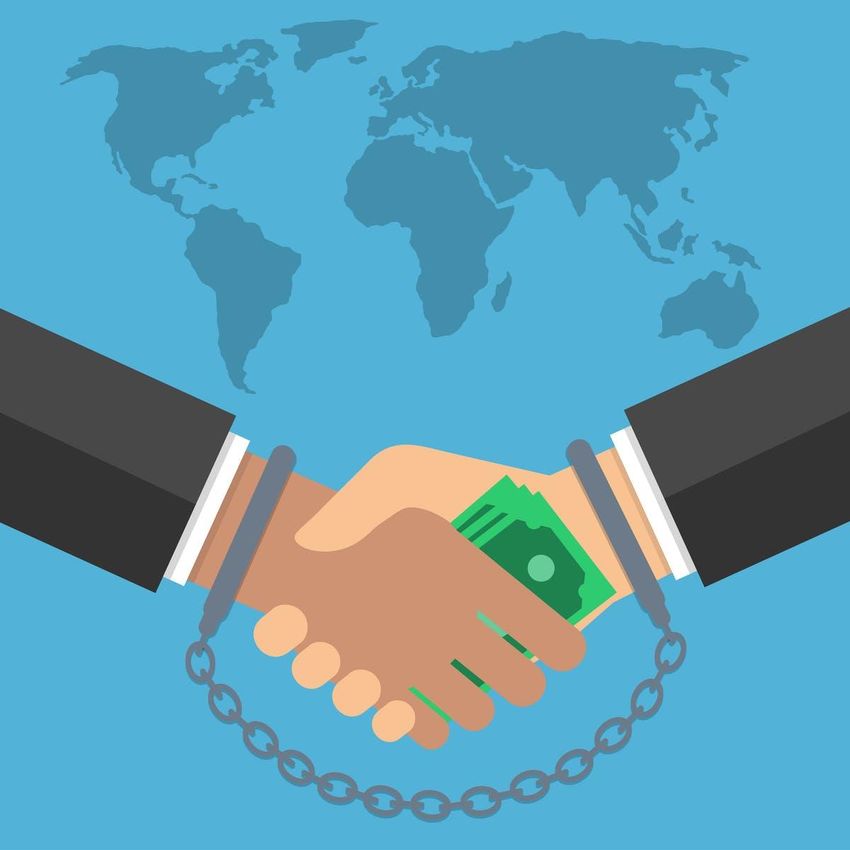
Political Corruption and Firm Access to the
        Initial Public Offering Market

               Dimitrios Gounopoulos
                 University of Bath

                   Chen Huang
                 University of Bath

                    Xiaoding Liu
               Texas A&M University
Introduction
• Corruption is pervasive in the world and results in enormous damage to
economy and society.
• When taking in the form of rent-seeking, corruption can set up barriers
for firms carrying out business.
• firms may need to pay bribes to public officials in exchange for the
necessary requirements to run business, such as operating permit or
patent.
• Only small number of enterprises can enjoy and benefit from the
bargaining process,
• Corrupt officials would only accept bribes from certain companies for
the risk-free purpose.
• Firms with no access to the illicit business activities will experience losses
from their corrupt-resorted competitors.What is this study about?
• Political corrupt environment may have an impact on IPO market,
because IPO market is featured with high information asymmetry.
• Firms operating in a corrupt environment are highly opaque.
− Either corruption-resorted companies may use more
concentrated decision-making process within the organization;
− Or firms damaged by corrupt business environment are not
willing to let investors know more about their performance.
− Therefore, a corrupt environment enlarges the problem of
information asymmetry between the informed and uninformed
investors, and increases the uncertainty of firm value.
• Underwriters working in a corrupt environment should exert their
certification role to promote newly listed sharesMotivation • Empirical evidence shows that rent-seeking activity affects firm performance negatively • To fill the gap between political corruption and IPO market.
Research Questions
• The effects of corruption on firm performance raise several questions:

a)Does political corruption have an impact for firms to access public capital
  market?

b)If so, do prestigious underwriters who act as intermediaries in financial market
  help?

c) Does corrupt environment affect pre-shareholder’s benefit?
Theoretical Framework

• The relationship between rent-seeking(corruption), production and economy was first
  modelled by Murphy, Shleifer and Vishny (1993).

• If rent-seekers, either from public or private sectors, attempt to expropriate values from
  the society, this will diminish the returns to the production as more resources are allocated
  to rent-seekers (e.g. corrupt officials).

    − Alternatively, this will result in another party losing the opportunity to
       share the resources.

• The corrupt business activity breaks the fair competitiveness in the market and results in
  only those firms benefit from the public resources.
Related Literature-1
• Literature addresses that corruption diverts company’s
productivity away from its regular operation. Corruption can
− reduce investment and R&D expenses (Ades and Tella, 1997);
− make firm inefficient (Dal Bó and Rossi, 2007);
− obstruct firms to attain business access and regulation
(Nguyen and Van Dijk, 2012);
− deteriorate management and productivity (Athanasouli and
Goujard, 2015) and
− set up barriers for firm to obtain quality certificates (North
(1990) and Paunov (2016).Related literature-2
• Another stream of studies relates to firms that can benefit from rent-
seeking behaviour.
− Corruption can help companies to deal with the low efficient
government and bad laws from the local (Leff (1964) and Lui (1985)),
and therefore help firm’s growth (e.g. Rock and Bonnett (2004); Vial
and Hanoteau (2010); and Mironov (2015)).
• However, using briberies in business acts as a bargaining process
between corrupt governors and firms (Paunov, 2016).IPO data-US sample
• Sample covers US IPOs from 1990 to 2015.
− Following the literature (e.g. Loughran and Ritter, 2002), we
exclude IPOs priced below $5 per share, unit offerings, LBOs,
rights issues, American Depositary receipts (ADRs), closed-end
funds, real estate investment trusts (REITs), spin-offs, and
financial institutions
• Database:
− IPOs: Thomson One Banker
− Corruption conviction data : Department of Justice (DOJ)
− Our main sample includes 4670 IPOsMeasuring Corrupt Environment
• The US level: We use corruption convictions data from Department of
Justice (DOJ) on the US public officials in each state and adopt per capital
convictions as our primary link to measure corrupt business
environment.
− This approach is similar to that of Butler, Fauver and Mortal (2009)
and Smith (2016)
• We calculate number of public corruption convictions per million people
from 1976 to IPO year.
• PCR (political corruption rate) represents the measure of public corrupt
environmentCorruption Perception Index
Change of Accumulated Corrupt Environment in the US

            Graph Top 10 States with the Most IPOs: Change of Accumulated
                       Political Corrupt Environemnt Over Time
        5
      4.5
        4
      3.5
        3
PCR

      2.5
        2
      1.5
        1
      0.5
        0

                                                 Year

               California   NewYork      Texas          Massachusetts   Florida
               Illinois     New Jersey   Pennsylvania   Georgia         Colorado
Hypothesis development-1
• IPO underpricing (initial returns) refers to the percentage changes from the stock price on
the first day of trading to the offer price
• The higher underpricing, the less capital that the firm can raise from going
public, of which will benefit investors.
• IPO underpricing is mainly caused by information asymmetry in the market
(e.g. “lemon problem”).
• Corruption increases market uncertainty and asymmetric information (e.g., Athanasouli and
Goujard (2015)). For example:
• firms tend to adopt opaque disclosure policies to protect resources when
they are surrounded by risks in a rent-seeking business environment
(Stulz,2005)
• using bribes for business may lead firms to centralize their decision-making
processes to prevent information leakage (Athanasouli and Goujard,2015)
• Hypothesis 1: IPOs from a strong political corrupt environment are associated with higher
initial returns.Hypothesis development-2
• Underwriters are frequent market players
• Less informed investors and more uninformed investors in a more corrupt
environment
• During IPO bookbuilding process, underwriters work hard to extract private
information from investors
• A lower filing price range is attractive for investors during the roadshow
• IPO revision is treated as an effective means for investment banks to collect
private information from informed investors and induce them to reveal it
(Benveniste and Spindt (1989); Hanley (1993)).
• Hypothesis 3: The demand of collecting information in the corrupt environment
is higher, reflected by greater offer price revisions.
• Hypothesis 4: Prestigious underwriters can price issues accurately in political
corrupt environment.Summary Statistics- The US sample
difference in means
Variable Low-corrupt areas High-corrupt areas
(p-value)
IPO Initial returns 15.73 21.73 0.00
Firm Age 15.67 14.53 0.03
Total Assets 348.44 341.24 0.44
Leverage 0.38 0.36 0.03
High-tech 0.35 0.44 0.00
Top-tier 0.72 0.74 0.07
Venture Capital 0.39 0.49 0.00
Auditor 0.62 0.70 0.00
Nasdaq 0.70 0.74 0.00
Share Overhang 3.78 3.74 0.00
No.of Bookrunners 1.27 1.35 0.00
Hot market 0.77 0.69 0.00
Revision -0.45 0.58 0.00
Revision dummy 0.62 0.67 0.00
Insider's wealth dummy 0.53 0.57 0.01
Proceeds(in millions) 84.50 92.60 0.21IPO underpricing: the US evidence
(1) (2) (3) (4) (5) (6)
PCR 1.253** 1.297*** 1.357*** 1.327*** 0.925**
(2.58) (2.69) (2.80) (2.77) (2.16)
High-corrupt areas 2.761***
(2.61)
Firm Age -3.186*** -3.036*** -3.111*** -3.175*** -3.133***
(-5.79) (-5.75) (-5.90) (-5.97) (-5.92)
Total Assets 3.301*** 3.091*** 3.103*** 3.054*** 3.143***
(4.42) (3.88) (3.91) (3.88) (3.95)
Leverage -15.683*** -14.193*** -14.102*** -14.245*** -14.333***
(-4.09) (-4.10) (-4.25) (-4.29) (-4.29)
High-tech 5.682*** 5.099*** 4.700*** 4.756*** 4.674**
(3.04) (2.78) (2.59) (2.63) (2.57)
Top-tier 1.321 0.943 1.018 0.874
(1.11) (0.77) (0.85) (0.72)
Venture capital 4.413*** 3.902*** 4.129*** 3.811***
(2.85) (2.66) (2.81) (2.59)
Auditor -0.482 -0.248 -0.116 -0.306
(-0.47) (-0.24) (-0.11) (-0.30)
Nasdaq 1.655 1.555 1.628 1.539
(1.42) (1.34) (1.40) (1.33)
Share Overhang 0.552** 0.559** 0.554**
(2.01) (2.00) (2.03)
No. of Bookrunners -1.547*** -1.554*** -1.461**
(-2.67) (-2.68) (-2.51)
Hot Market 5.893 5.980 5.714
(1.61) (1.63) (1.56)
Intercept 4.806 8.670* 6.726 7.363 9.541** 10.199**
(1.28) (1.89) (1.31) (1.44) (2.01) (2.09)
Year control Yes Yes Yes Yes Yes Yes
Industry control Yes Yes Yes Yes Yes Yes
Region control Yes Yes Yes Yes No Yes
Adjusted R2 0.1745 0.2010 0.2045 0.2095 0.2092 0.2097
Number of observations 4655 4655 4655 4655 4655 4655Omitted variable and fix effect analysis
Adding more controls fixed effects analysis
(1) (2) (3) (4) (5)
PCR 1.056** 1.685*** 1.471** 0.329** 0.677**
(2.20) (2.62) (2.14) (2.02) (2.53)
Ln (GDP) 0.330 -0.732
(0.47) (-0.17)
Unemployment 0.398 0.571
(0.65) (0.71)
Education attainment -0.068 -0.125
(-0.47) (-0.68)
Ln (Police) -3.422 -2.930
(-0.92) (-0.63)
Ln (Judicial) 4.015 3.797
(1.09) (1.00)
Intercept 5.707 -3.806 -3.115 2.942 -0.933
(0.83) (-0.36) (-0.14) (0.57) (-0.14)
Other controls Yes Yes Yes Yes Yes
Year control Yes Yes Yes No No
Industry control Yes Yes Yes No No
Region control Yes Yes Yes No No
State-year control No No No Yes No
State-Year-Industry control No No No No Yes
Adjusted R2 0.2093 0.2248 0.2243 0.1602 0.0827
Number of observations 4655 3078 3078 4655 4655
• PCR are district level measured in columns 4 and 5.Endogeneity challenge • We use a two-stage least squares (2SLS) analysis to address this self-selection of IPO firm’s headquarter location concern. • The model requires the use of proper exogenous variables that can affect the dependent variable through a main explanatory variable but do not have a direct impact on the outcome (Wooldridge, 2015). • Ideally, the variable should influence the choice of a firm's location of its headquarters in terms of the local, politically corrupt environment but should not influence the IPO's initial returns directly.
Instrumental variable selection
• Gravity-based Centered Index for Spatial Concentration (GCISC)
  developed by Campante and Do (2010)
   • isolated capitals are associated with reduced public accountability, leading
     to higher levels of political corruption in the US, and vice versa.
• Cordis and Warren (2014) find that Freedom of Information Act
  (FOIA) enables people to access public information easily and
  increases transparency in government, thereby effectively
  deterring corrupt activities
   • scores ranging from 1 to 11 to each of the 50 states. A state with strong
     FOIA laws has a score above 6; otherwise a state has weak FOIA laws.
   • the effect is obvious in the long run after 7 years if the state experiences a
     transition from weak to strong FOIA laws.
• How many days that a citizen is required to reside in a state before
  becoming eligible to vote
   • the electorate faces more constraints to punish political corruption if a
     resident has to wait for a longer period to be qualified the right to vote.
     (e.g., Dass et al. (2016); Huang and Yuan (2019)).
2SLS analysis
(1) (2)
First stage Second stage
Dependent variable: PCR IPO initial returns
GCISC -0.575***
(12.09)
FOIA -0.326**
(2.50)
Voting 0.003***
(3.62)
PCR 3.579***
(3.44)
Intercept 3.427*** 1.749
(11.31) (0.30)
Baseline controls Yes Yes
Year control Yes Yes
Industry control Yes Yes
Region control Yes Yes
Weak identification F-statistics 52.50
Overidentification J-statistic (p-value) 0.167
Adjusted R2 0.4065 0.2148
Number of observations 4650 4650Propensity score matching analysis
• Statistically compare the outcome of a treated observation (IPO firm) with
an effect (high corrupt environment) to the same observation but not
treated based on a number of covariates.
• We define our treatment observations as those IPOs from high corrupt
areas and include rich sets of covariates from the previous analysis.
• We extend our testing by controlling for year, industry, and region effects.
IPO initial returns
ATET
High corrupt environment vs. Low corrupt environment 3.686**
(2.29)
Year control Yes
Industry control Yes
Region control Yes
Number of observations 4655Impact of Public Corruption on IPO Revisions
OLS Logit Model
(1) (2) (3)
Absolute Revisions Revisions Revision Dummy
PCR -0.200 0.405** 0.099***
(-1.20) (2.20) (2.94)
Intercept 7.371*** -3.699* 0.731*
(3.96) (-1.74) (1.90)
Other controls Yes Yes Yes
Year control Yes Yes Yes
Industry control Yes Yes Yes
Region control Yes Yes Yes
Adjusted R2/Pseudo R2 0.0436 0.1203 0.062
Number of observations 4655 4655 4655
• IPO firms operating in highly corrupted environment are hard to value,
because the sign PCR in column 1 is not significant;
• As shown in column 2, underwriters need to increase offer price revisions
because of high information asymmetry under political corruption;
• There are more upward offer price revisions in politically corrupted
environment, which is consistent with the third hypothesis that underwriters
are likely to use revisions to induce private information.Analysis of Underwriter’s role in a Corrupt Environment
(1) (2)
PCR 2.222*** 2.967***
(3.54) (3.15)
PCR*Top-tier -1.539**
(-2.22)
PCR*Underwriter Rank -0.251**
(-2.31)
Intercept -0.936 -2.921
(-0.12) (-0.46)
Other controls YES YES
Year control YES YES
Industry control YES YES
Region control YES YES
Adjusted R2 0.2028 0.2030
Number of observations 4655 4655
• Top-tier underwriters know the market better, they can pay more to
hire excellent analysts to overcome the problems from analysing
new issues in a corrupt environment.
• In unreported results, we find that underwriters charge higher fees
(e.g., gross spread and selling concessions) from issuers in highly
corrupted environments.
• Thus, underwriters make efforts to reduce information asymmetry
and lower IPO initial returns when political corruption is high.Political Corruption, Initial Returns and Business Operations
➢Following Garcia and Norli (2012) and Smith (2016), a firm’s operation
concentration is measured as the citation of the HQ state over all states in a 10-K
report.
➢Results suggest that when an IPO firm has more operations concentrated around
the HQ location, the increased local corrupt environment has more impact on initial
returns and revisions.
(1) (2)
Initial returns Revisions
PCR -0.163 -0.233
(-0.36) (-0.90)
Operation Concentration% -7.186** -3.964***
(-2.72) (-3.57)
PCR*Operation Concentration% 2.856*** 1.318**
(3.09) (2.60)
Intercept -10.214 -7.682**
(-1.13) (-2.16)
Other controls Yes Yes
Year control Yes Yes
Industry control Yes Yes
Region control Yes Yes
Adjusted R2 0.2150 0.1500
Number of observations 3026 3026Corruption and S-1 language
➢Loughran and McDonald (2013) conclude that the tone of the S-1 affects
investor’s ability to value the IPO.
➢ They find that the more uncertain/negative words result in higher underpricing.
Therefore, we should expect IPO firms use less positive, and more
negative/uncertain words to describe their business strategies and operations in
corrupt environments.
➢ We follow Loughran and McDonald (2013) to measure the language tone
used in IPO firms’ prospectuses (e.g., S-1).
➢ We count number of positive, negative, uncertain, and constraining words in
S-1 based on word lists provided by McDonald’s website.
(1) (2) (3) (4)
%Positive %Negative %Uncertainty %Constraining
PCR -0.010** 0.019* 0.017** 0.015*
(-2.02) (1.68) (2.07) (1.84)
Intercept 2.117*** 4.660*** 1.599*** 1.339***
(60.08) (66.98) (36.90) (23.76)
Control variables Yes Yes Yes Yes
Year control Yes Yes Yes Yes
Industry control Yes Yes Yes Yes
Adjusted R2 0.4607 0.2092 0.5062 0.1332
Obs. 2648 2648 2648 2648Analysis of Insider Wealth Gains in a Corrupt Environment
➢ Pre-IPO shareholder’s wealth gains depend on greater offer price revisions and
reduced initial returns, relative to the share that insiders retain
➢ Underwriters increase revisions and reduce initial returns in a corrupt environment
(Table 5 and Table 6).
➢ Underwriters have to benefit issuers in a corrupt environment in order to maintain
their reputations
➢ In unreported results, underwriters charge higher fees from issuers when local
political corruption increases.
Insider's wealth dummy
PCR 0.113***
(2.87)
Initial return residuals 0.079***
(10.35)
Ln (Proceeds) 0.407***
(8.22)
Float Ratio -6.681***
(-11.39)
Intercept -0.856*
(-1.91)
Year control Yes
Industry control Yes
Region control Yes
Pseudo R2 0.317
Number of observations 4323Robustness Checks
(1)Measure PCR from the firm founding year to IPO year;
(2)Use raw conviction data (NOT convictions per million people);
(3)Use government employee based PCR (e.g. not scaled by whole population);
(4)Adopt a survey based corruption measure developed by Boyland and Long
(2003);
(5)Use operation concentration weighted PCR;
(6)&(7)Use conviction data from alternative database (e.g. Transactional Records
Access Clearinghouse);
(1) (2) (3) (4) (5) (6) (7)
PCR
Measuring from Boyland and Operation
Raw conviction (govt TRAC TRAC
firm founding year Long (2003) weighted PCR
employee)
PCR 1.489*** 0.002** 0.097*** 2.210** 1.865** 0.853*** 0.768***
(3.97) (2.03) (2.88) (2.01) (2.14) (5.07) (4.18)
WCC 0.121
(1.31)
Intercept -0.033 4.196 1.079 -0.023 -14.632 3.236 0.450
(-0.01) (0.72) (0.18) (-0.00) (-1.31) (0.56) (0.08)
Other controls Yes Yes Yes Yes Yes Yes Yes
Year control Yes Yes Yes Yes Yes Yes Yes
Industry control Yes Yes Yes Yes Yes Yes Yes
Region control Yes Yes Yes Yes Yes Yes Yes
Adjusted R2 0.2039 0.2021 0.2027 0.2166 0.2155 0.2027 0.2028
Number of observations 4655 4655 4655 3339 3026 4655 4655Contribution • The study provides the first empirical evidence that political corruption imposes additional costs on firms to access IPO market. • It contributes to the literature which argues that the market is riskier and more uncertain under corruption. • It adds new evidences on how corruption affects firm performance on the growing literature within country studies. • We address a new influential factor of IPO short-run returns in the stock market-political corruption.
Conclusion
• Corruption increases market uncertainty and information
  asymmetry
   • Results in a higher level of IPO underpricing

• Underwriters exert certification roles in a corrupt environment:
   • extract useful information in the market, reflected by high
     revisions;
   • reduce IPO initial returns;
   • help insiders to manage positive gains;
Thank you! Any questions?
You can also read


