Prefabricated Modular Data Centers: From Disruption to Default Option - An Essential Strategy to Future Proof the Data Center - Vertiv
←
→
Page content transcription
If your browser does not render page correctly, please read the page content below
VERTIV WHITEPAPER

Prefabricated Modular Data Centers:
From Disruption to Default Option
An Essential Strategy to Future Proof the Data Center
Executive Summary
The speed of disruption and the current data surge cycle continues to demand transformation in the data center industry.
The response to these demands bring prefabricated modular (PFM) data centers to the arena - delivering low-risk, high-value
implementations with the added benefits of faster delivery and easier on-site assembly.
But new technology invariably introduces a knowledge gap, and perceived risks of the unknown: what do we mean when we
say prefabricated, what do we mean when we say modular, and what benefits do they confer to the construction, operation, and
modification of critical facilities like data centers?
This white paper addresses those questions and provides clarity on the specific benefits that PFM data centers can offer over
traditional construction techniques; benefits that could eventually see PFM shift from being an alternative and disruptive technology
to becoming the default option for new data center capacity in the future.

Introduction
Disruption in the data center industry brings a multitude of challenges, but one primary concern is universal: how to manage
unpredictable growing demand today while remaining flexible for the future.
Growing edge compute use cases will potentially require vast volumes of medium to small (or even micro) data centers to manage
the workloads associated with an explosion in demand related to IoT. Edge site deployments could range from a 5MW facility in a
city to a single, hardened-rack next to a 5G mast on a building rooftop. Meeting that disruption from the core to the edge with
conventional building approaches where every new facility is a “beautiful, unique snowflake” will be near impossible.
Traditional approaches, such as the conventional ‘stick-build’ construction process, have represented the default choice for many
organizations seeking to add capacity simply because there has been no viable alternative. However, traditional methods have
proven insufficient in many cases. They can’t meet the accelerated development requirements of dynamic organizations and often
don’t factor future growth into the design. Relying on these processes, organizations have either had to deploy capacity before it
is needed —creating risk and stranding capital— or consistently stay a step behind their capacity requirements, limiting growth.
Prefabricated and/or modular methods are increasingly the choice of data center owners and operators for the value of its
integrated approach. Designing, configuring, and fabricating data center infrastructure off-site is creating tighter integration across
systems, streamlining processes and enhancing management of those systems. Through the review of the background and history
that led PFM data center systems toward industry mass adoption, a summary of variations that meet market demands, and analysis of
PFM benefits, this paper provides information and support as to why PFM should be a default consideration for data center operators.

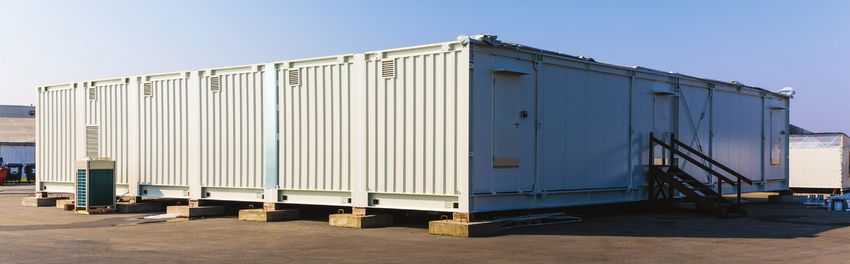
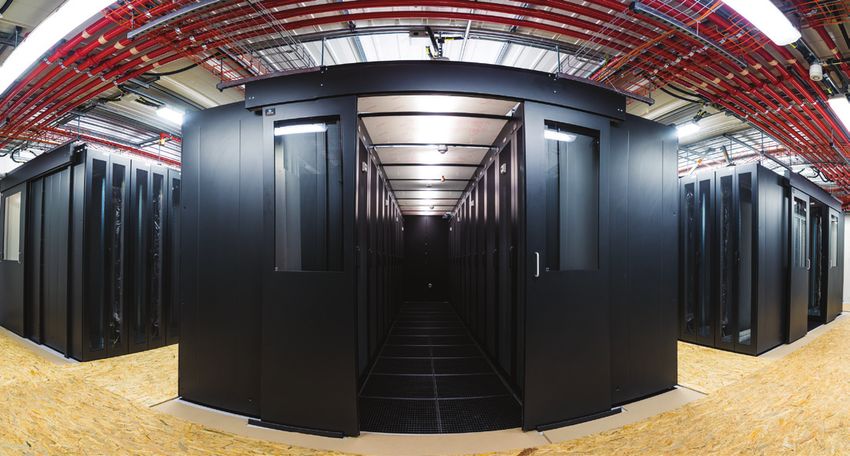
Dimension Data: high-quality prefabricated modular Tier III compliant data center system prefabricated, integrated, and tested in Vertiv’s European facility.
It was then disassembled into 12 shippable units, packed for transport, and made the journey to South Africa, where it was reassembled on site and ready for
testing in under 6 weeks.

2
Background/History
                     Key Findings:
                                                            Sun Microsystems introduced one of the first PFM data
yy Prefabrication (manufacturing components
                                                            centers – based around a containerized design – in 2006
   off-site) and modularity (building in discrete units)    with its project BlackBox. Within a few years, most of the
   are separate but disruptive approaches to data           significant server OEMs had followed suit including Dell,
   center construction. That disruption multiplies when     IBM, and HP.
   the two methods combine in PFM data centers.
                                                            The fact that the IT industry created the first wave of PFM
yy PFM is gaining acceptance as operators                   products around ISO containers meant that this form-factor
   require ever more efficient, agile and globally          was closely associated with the term PFM – perhaps to the
   consistent infrastructure.                               detriment of a speedier uptake of the technology to some
                                                            extent due to its perception of being “affordable”.
yy PFM is not just containerized data centers:
                                                            Another level of complexity is the fusion of the two terms
   a wide variety of customizable form-factors now
   exist to meet almost any customer requirement for
                                                            “prefabrication” and “modular” when independently they
   new capacity from whitespace to power to cooling.        mean different things.
                                                            Modularity refers to building out/adding units of capacity
yy The market for PFM data centers is set to expand
   at a five-year compound annual growth rate (CAGR)        in building blocks to meet demand; this avoids stranded
   of 14.4 percent through 2021                             capacity which can be extremely costly in terms of CapEx
                                                            and OpEx. Modularity ultimately provides option value.
yy The benefits of PFM include:                             This value comes from closely matching the supply of
                                                            needed capacity to the business demand.
   •    Rapid design leads to faster time to availability
                                                            Prefabrication refers to the process of manufacturing
   •    Build capacity to match demand today instead
                                                            and assembling units of capacity (rows, rooms, data halls,
        of planning for unforeseen growth
                                                            power, and thermal infrastructure) off-site. It allows activities
   •    Optimized performance of the components with        to move forward in parallel, which wouldn’t be possible in
        a holistic view of the system                       a conventional on-site build.
   •    Higher quality controls extends geographic reach    In the last ten years, the term “prefabricated modular data
                                                            centers” forged its way into industry vocabulary and has
yy PFM has applications and benefits from the core right    since been validated by numerous objective industry experts.
   through to the edge. However, demand for large scale     PFM is its own term and encompasses the full spectrum of
   deployments of standardized edge data centers will be
                                                            units of data center capacity from rows to rooms to full
   a dynamic driver of future demand.
                                                            facilities, as well as power and thermal infrastructure.

                                                                                                                                3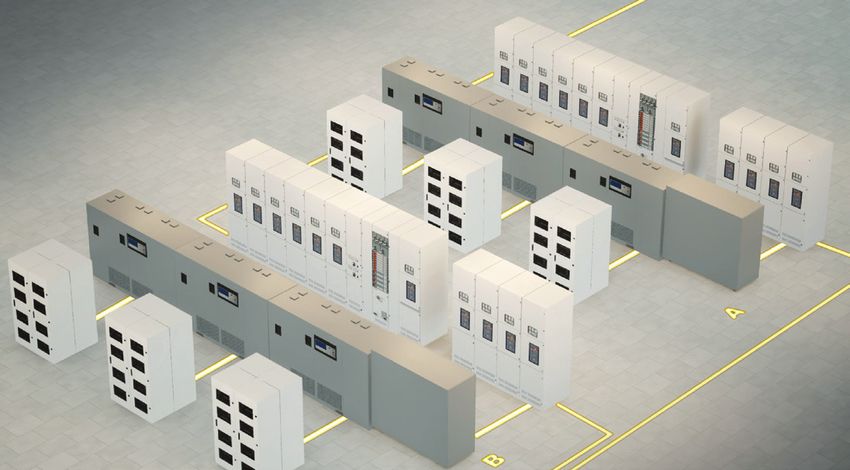
“PFM methodology is becoming the preferred way to expand and build new data center
capacity, turnkey or critical subsystems. Underpinned by industrial processes, it has
distinct advantages in terms of quality control, installation speed and build consistency”
said Daniel Bizo, principal analyst 451 Research.

Figure 1: Aggregate PFM Revenue Forecast Through 2021 ($M)                     A Variety of Solutions
Source: 451 Research, 2018
                                                                               Prefabricated modular encompasses data centers and
       2015-2021 CAGR
              14.4%                                       $4,160      $4,398
                                                                               other critical facilities that are pre-engineered with systems
                                                $3,548                         assembled, integrated, and tested in a factory environment to
                                      $3,029
                                                                               shorten deployment time frame and improve the predictability
                             $2,625                                            of both schedule and cost performance. They are flexible,
                  $2,243                                                       allowing for faster deployment and lower risk, scalable, allowing
    $1,953                                                                     for customization and rapid response to unforeseen demand,
                                                                               and efficient, allowing for lower total cost.
                                                                               It can include such subsystems as thermal management,
                                                                               power protection and distribution, controls and management
                                                                               software, and services — plus ancillary systems such as
                                                                               lighting, fire protection, physical security, and water treatment
    2015           2016       2017     2018     2019      2020         2021    — pre-configured to create a complete environment for the
                                                                               efficient and reliable operation of technology systems.
According to industry analysts 451 Research, this                              For the expansion of pre-existing facilities and retrofits,
industrialized methodology for building data center                            building block solutions range from single enclosed racks
infrastructure has taken root at numerous sizeable operators;                  to larger multi-rack contained systems may represent a
it is not a question of “why do prefabrication?” but “how to do                viable answer, as they allow for a staged retrofit or expansion
it best.” The market for PFM data centers is set to expand at a                with minimal disruption and controlled growth. A refresh of
five-year compound annual growth rate (CAGR) of 14.4 percent                   this nature could include a range of other form-factors
through 2021 when it will reach $4.4bn.                                        including infrastructure that is not entirely enclosed but
The continuing challenge for data center technology suppliers                  delivered on a skid.
is to communicate to customers and partners the method,
breadth, and flexibility of design PFM can support.

             The IT industry is not alone in seeing the
             advantages of prefabricated facilities. Other
             sectors such as pharmaceuticals as well as oil
             and gas have invested in PFM buildings to house
             complex machinery within strict timelines and
             often in difficult locations like remote oil fields or
             offshore platforms. During the 1960s and 1970s,
             the US and other countries adopted PFM designs
             for residential housing to meet the growing
             demand for affordable homes.

4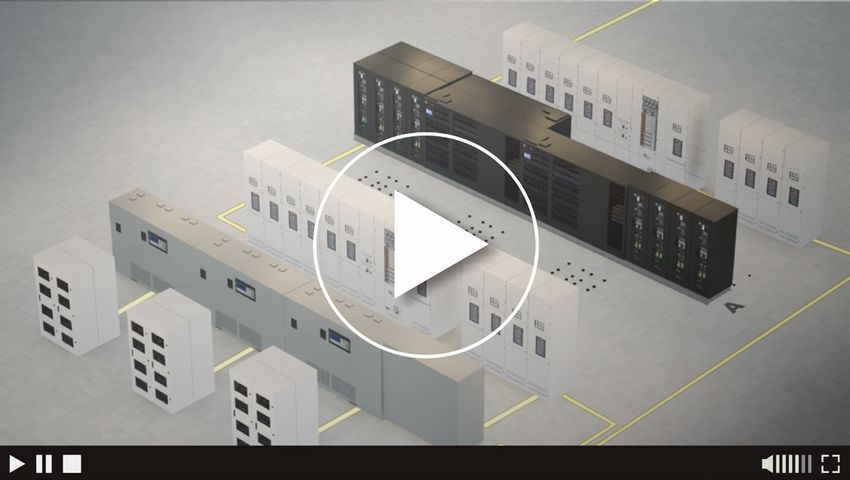
Before
           A Hypothetical Example of
              Retrofit for Success

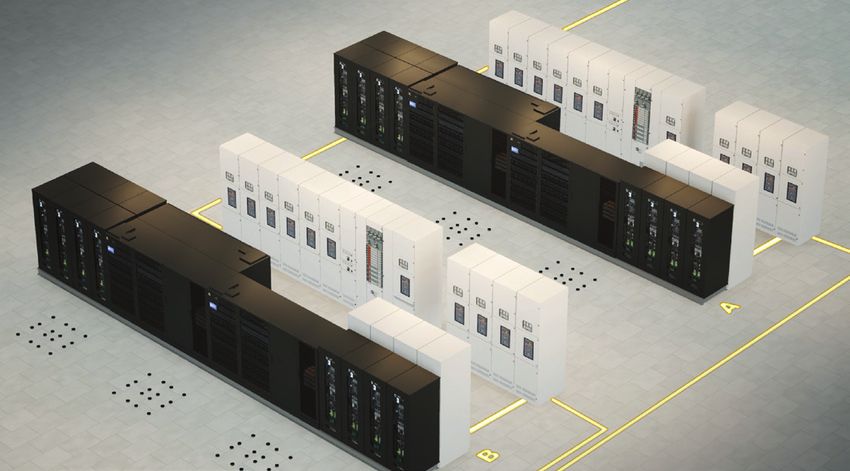
   A legacy data center that houses six (6) Liebert® 610 UPS
   units, each with a capacity of 625kW, in a 2N architecture
   with three (3) units on each bus. To provide 1.5 MW to the
   IT load, the UPS units in the system run at approximately
   42% capacity and 90% efficiency. Although that utilization
   rate is standard for modern UPS deployments, the efficiency
   is low and outdated, and very costly to the operator of this
   data center.

  To upgrade, we can develop a purpose-built skid with pre-
  integrated system components: in this case, a modern UPS          After
  and Lithium Ion batteries with input/output connections
  specifically designed to line up with the existing connections
  for the replacement system. These upgrade skids can be
  integrated off-site but staged on-site ahead of the critical
  upgrade commencement.

  The upgrade is completed one unit at a time, one bus at a
  time, much like the performance of preventative maintenance
  on UPS units – without taking the critical loads offline. Once
  the process is complete, the power system provides the same
  1.5 MW of power to the IT load, still running at similar
  utilization as before the upgrade, but at a much-improved
  efficiency rate of over 96% and in a reduced footprint. In this
  example, the data center operator saves over $125,000 of
  annual operational cost on power alone.                           For new builds, prefabricated facilities represent an
                                                                    emerging solution. These modular, facility-sized solutions allow
                                                                    organizations to bring new capacity online faster and can be
                                                                    easily scaled. Prefabricated methods design the growth plan
Watch The Full Video Here:
                                                                    into the solution from the beginning.
https://vertiv.biz/GH2017StructuralRefreshAnimation                 A PFM data center is custom designed to match the
                                                                    geography, climate, technology profile, IT applications, and
                                                                    business objectives of a project while taking advantage of the
                                                                    speed and economy of modular design and pre-fabrication.
                                                                    Modular integration techniques combined with the off-site
                                                                    prefabrication process results in a state-of-the-art, tightly
                                                                    integrated facility deployed faster and at an overall lower cost
                                                                    than a similar facility using traditional construction practices.

                                                                                                                                        5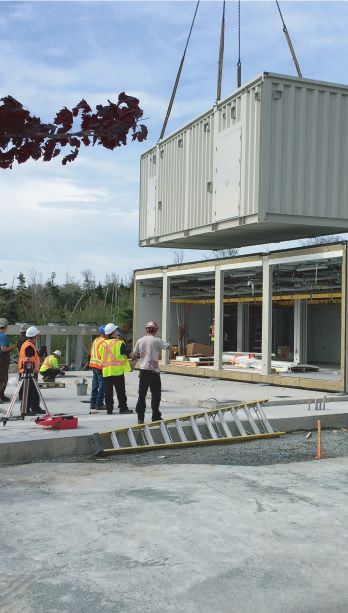
Traditional New Build                         Prefabricated Modular New Build
           PROJECT                                          PROJECT
           CONCEPT                                          CONCEPT

                                                                                                                              Data Center Owner
           ENGINEER &
           PURCHASE                                         ENGINEER &                                                        Data Center Provider
           • Schematic Design                               PURCHASE
           • Design Development                            • Schematic Design

                                                                                       PREFABRICATED MODULAR
           • Construction Documents                        • Design Development
           • Part Acquisition                              • Construction Documents
            & Purchase                                     • Part Acquisition                                  CIVIL WORKS
                                                                                                               SITE PREP
                                                            & Purchase
           CIVIL WORKS
           SITE PREP                                        FACTORY INSTALL
                                                            & TESTING
                                                                                                               CONSTRUCTION
           CONSTRUCTION
                                                           SITE ASSEMBLY
                                                           & TESTING
           ON SITE
           INSTALLATION
                                                            STARTUP
           STARTUP

For augmentation of conventional facilities, PFM units                   For expansion beyond the core data center, PFM units
can be deployed to add additional power (UPS) or cooling                 come in various shapes and sizes, but come fully self-contained
capacity to a new or existing site that may have sufficient              and, in some cases, ready-to-order. The all-in-one data center
whitespace but that are constrained from a thermal or                    generally includes IT cabinets, power distribution, and
resiliency perspective.                                                  uninterruptible power supplies (UPS) with batteries and direct
                                                                         expansion cooling.
A specific example of this technology in action is Vertiv’s
Power Module product family. The Power Module design is                  This ‘plug and play’ approach has the benefit of not only
for deployment in new or existing facilities that require an agile       cutting the time for startup and commissioning – to just a few
and flexible way to scale-up power distribution and resiliency.          days instead of weeks or months – but also reducing the
                                                                         potential for quality issues as components are pre-integrated
At new sites it allows the data center operator to deploy
                                                                         and pre-tested off-site. The pre-engineered and integrated
critical power infrastructure in a pre-packaged way,
                                                                         design also provides greater cost-certainty for customers by
independent from other construction activities. For existing
                                                                         reducing the likelihood of additional on-site modifications.
facilities, the module deploys outside the facility without taking
                                                                         The ability to enable on-site assembly rather than build and
up expensive floor-space that could otherwise be used for IT
                                                                         integration allows the data center to push closer to businesses
equipment. Operators can also utilize the module in a site
                                                                         and consumers in previously inaccessible locations.
architecture that is hot scalable – meaning you can add
capacity to the site by simply adding additional units, without
taking the critical loads offline.

6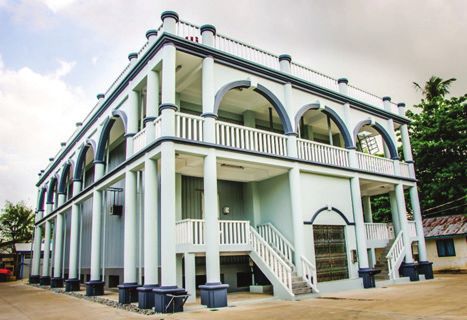
Benefits:
                                                            Rapid
                                                            Design
                                                                                        Low Risk
                                                                                        Cost Certain
                                                            Tailored
                                                            Integration                 Scalable
                                                                                        Repeatable
                                                                                        High quality control
                                                            Simplistic
                                                            Assembly                    Extended geographic
                                                                                        reach

Rapid Design
Simplistic, repeatable, subsystem buidling blocks create
an efficient, automated, and low-risk design process.
Leveraging repeatable subsystem building block designs
enables simplicity, resulting in an efficient, automated,
and low-risk design process. Mass-customized MEP
designs are uniquely constructible, easy to operate and
low cost using a system that utilizes a repetitive and
standardized modular approach.
This efficiency on the front end of the process can cut
months off the time-to-deploy, and organizations seeking
to accelerate data center deployment should strongly
consider it as an option.
                                                                         HANTHAWADDY DATA CENTER (KSGM)
Also, the standard set of building blocks remove inherent
                                                                         This full design new build was a two story, Tier 2
limitations in terms of functionality or aesthetics.
                                                                         compliant modular data center, but the location
                                                                         façade had to meet strict requirements for city code.
                                                                         PFM allowed the aesthetics to be adjusted to meet
                                                                         the customer demands.

                                                                                                                                 7
Tailored Integration
Complex mechanical & electrical integration activities are Customer quote: "The modular design gives
completed at the factory to maintain quality and velocity. us increased flexibility and scalability for future
Highly complex mechanical & electrical integration activities investment, while immediately offering an array
are offloaded to the factory where quality and velocity can be of benefits for our customers," says Núria Berché,
maintained. All systems are designed and configured in Program Manager at T-Systems Iberia.
concert, resulting in a tightly integrated facility that can meet LINK TO T-Systems case study:
the highest standards of availability and efficiency. Assembly in www.vertiv.com/globalassets/products/facilities-
a factory-controlled environment enables more control over the enclosures-and-racks/integrated-solutions/t-
fit, finish, and quality of workmanship, and supports more systems-case-study-english.pdf
thorough pre-testing and optimization before delivery.
Simplistic Assembly
Clear documentation and a dedicated team of engineers Examples of PFM Success
enables on-site teams to assemble factory-integrated
modules easily in a variety of locations.
Dimension Data
Concise and clear site documentation provides on-site
teams with essential information needed to assemble The burgeoning growth of data-enabled businesses across
modules effortlessly. The focus on assembly rather than the developing markets of Africa has led to an explosion of
build and integration dramatically reduces complexity as data center demand closer to users. It is no longer economical
well as the risk of malfunctioning or poorly configured system to serve these customers from hubs located thousands of
deployment. Barrier-free assembly allows deployment across kilometers from where the information is produced and
a global estate, without needing highly skilled and experienced consumed. For this reason, Internet Solutions, with their partner
local construction crews at each location. This opens up Dimension Data made the decision to expand its data center
opportunities to extend global reach to regions of the world footprint in the increasingly connected center of African
previously thought unavailable. commerce, Johannesburg. However, the key challenge in this
market is to build a highly reliable, world-class facility in a way
PFM continues to rise to the top with overall risk reduction
that offers future flexibility and enhanced performance.
through better quality controls, repeatable results, and
streamlined project management. Internet Solutions and Dimension Data turned to Vertiv to
deliver a high-quality prefabricated modular Tier III compliant
data center system for their Parklands facility. The solution
consists of 120 racks with expansion to up to 286 racks and
built around industry-leading Vertiv power (including the
Liebert® Trinergy™ Cube UPS) and thermal management
technologies (including room cooling, and SmartAisle
containment and control), as well as advanced Lithium Ion
batteries for reduced operational expenses. Designed to
accommodate ocean shipment, the facility was prefabricated,
integrated, and tested in Vertiv’s European facility. It was then
disassembled into 12 shippable units, packed for transport, and
made the journey to South Africa, where it was reassembled on
site and ready for testing in under six weeks.
www.vertiv.com/globalassets/documents/case-
studies/dimension-data/vertiv-dimension-data-case-study-
cs-en-na-ch-00084-web_270338_0.pdf
8T-Systems Household Product Manufacturer
Following its strategic vision to provide cloud services, A leading household product manufacturer needed to add a
T-Systems’ need for data center expansion became paramount. new data center to its facility to support critical production
To fulfill the company's expectations and meet their clients’ applications. Due to the nature of its production facility, the
business cases, a combination of requirements needed to company required a data center to optimize space as well as
be achieved for availability, reliability, security, scalability, tolerate a dusty manufacturing environment, which can be
transparency, efficiency and sustainability - plus a rapid hostile to computing systems. They needed to increase their
deployment. Expanding or building a traditional data center mission-critical capacity while protecting the new data center.
in a short timeframe can be a great challenge which requires They chose Vertiv. Working with its electrical contractor
significant resources. After a thorough analysis, a modular, partner, we helped by providing turn-key delivery for a local,
containerized construction proved to be the ideal option to yet separate data center facility built around Vertiv's compact
achieve rapid availability and high scalability successfully, and powerful SmartMod™ infrastructure. Ensuring that critical
quickly allowing for future phases of expansion as well as a technologies always work, the SmartMod is a modular IT
staged investment. For more see: infrastructure solution in the form of a customized data center
enclosure. It is a fully integrated, self-contained, rapidly
https://www.vertiv.com/globalassets/products/facilities-
deployable unit that is easy to relocate and architected to
enclosures-and-racks/integrated-solutions/t-systems-case-
support organizations for years to come. For more see:
study-english.pdf
www.vertiv.com/globalassets/documents/case-
studies/household_product_manufacturer_case_
Mobile Disaster Recovery Unit study_252410_0.pdf
A leading provider of satellite-based communications systems
needed a mobile disaster recovery unit to support its terrestrial
network in the event of a fixed facility failure. Never knowing
Conclusion
when and where a disaster might occur, this company required Prefabricated modular data centers are the technology to
that the mobile backup unit be easy to transport and maintain, help combat future challenges the data center industry faces
and designed to operate in extreme environments. Specializing to build out efficient, agile and globally consistent capacity
in critical technologies that always work, Vertiv created a from the core to the edge. As established practices and dated
custom trailer-mounted SmartMod™ solution with an internal proclivities are increasingly compared with PFM - driven by
sliding rail system for easy access to keep their backup system new core and edge demand – modular and prefabricated
always ready. The trailer solution offers a quick-connect system approaches will only gain more traction; possibly even so
for power and signal, as well as DX-based condensers mounted much that PFM becomes the default approach and operators
on the trailer. It delivered a backup infrastructure with a will need to come up with a compelling business case for
constant “ready for service” state that exceeded the not adopting it. For more about Vertiv’s PFM approaches
communication company's needs. Our SmartMod is a modular, check out:
customized data center enclosure. It is a fully integrated, self-
contained, rapidly deployable system that’s adaptable, flexible, https://www.vertiv.com/en-us/solutions/
and efficient. The compact nature of the SmartMod allows for https://www.vertiv.com/en-emea/solutions/
easy transportation without compromising functionality or
long-term value. For more see: https://www.vertiv.com/en-asia/solutions/
www.vertiv.com/globalassets/documents/case-
studies/na_communication_provider_case_study_252412_0.pdf
9Vertiv.com | Vertiv Headquarters, 1050 Dearborn Drive, Columbus, OH, 43085, USA © 2019 Vertiv Group Corp. All rights reserved. Vertiv™ and the Vertiv logo are trademarks or registered trademarks of Vertiv Group Corp. All other names and logos referred to are trade names, trademarks or registered trademarks of their respective owners. While every precaution has been taken to ensure accuracy and completeness here, Vertiv Group Corp. assumes no responsibility, and disclaims all liability, for damages resulting from use of this information or for any errors or omissions. Specifications, rebates and other promotional offers are subject to change at Vertiv’s sole discretion upon notice. SL-70441 (R07/19)
You can also read


