Revised June 2021 - Rio Nuevo
←
→
Page content transcription
If your browser does not render page correctly, please read the page content below
Revised June 2021
SUNSHINE MILE DISTRICT

Table of Contents
I.          Sunshine Mile District (“SMD”) Overview ........................................................................................ I-1
       A.      Introduction ......................................................................................................................................................... I-1

       B.      Purpose ............................................................................................................................................................... I-2

       C.      Infrastructure ...................................................................................................................................................... I-3

       D.      Historic Preservation ........................................................................................................................................ I-5

II.         Establishment & Administration of SMD ........................................................................................ II-1
       A.      Establishment of Sunshine Mile District ....................................................................................................... II-1

       B.      Conflict of Laws ................................................................................................................................................. II-1

       C.      PDSD Application Requirements.................................................................................................................. II-2

       D.      Review Process ................................................................................................................................................. II-2

       E.      Urban Design Best Practices ......................................................................................................................... II-9

III.        Standards & Guidelines ..................................................................................................................... III-1
       A.      Definitions .......................................................................................................................................................... III-1

       B.      Land Use ........................................................................................................................................................... III-3

       C.      Affordable Housing ........................................................................................................................................ III-8

       D.      Streetscape Design ........................................................................................................................................III-10

       E.      Shade ................................................................................................................................................................ III-11

       F.      Development Transition Standards ........................................................................................................... III-11

       G.      Pedestrian Circulation ...................................................................................................................................III-13

       H.      Mobility & Parking .........................................................................................................................................III-15

       I.      Landscaping ................................................................................................................................................... III-24

       J.      Open Space.................................................................................................................................................... III-25

       K.      Historic Preservation .................................................................................................................................... III-26

       L.      Signage.................................................................................................................................................. III-30III-29

       M.          Environmentally Conscious Design Practices ........................................................................... III-31III-30

IV. SMD Subdistricts ................................................................................................................................. IV-1
       A.      Euclid/Park Subdistrict ................................................................................................................................... IV-1

                                                                                                                                                                                          ii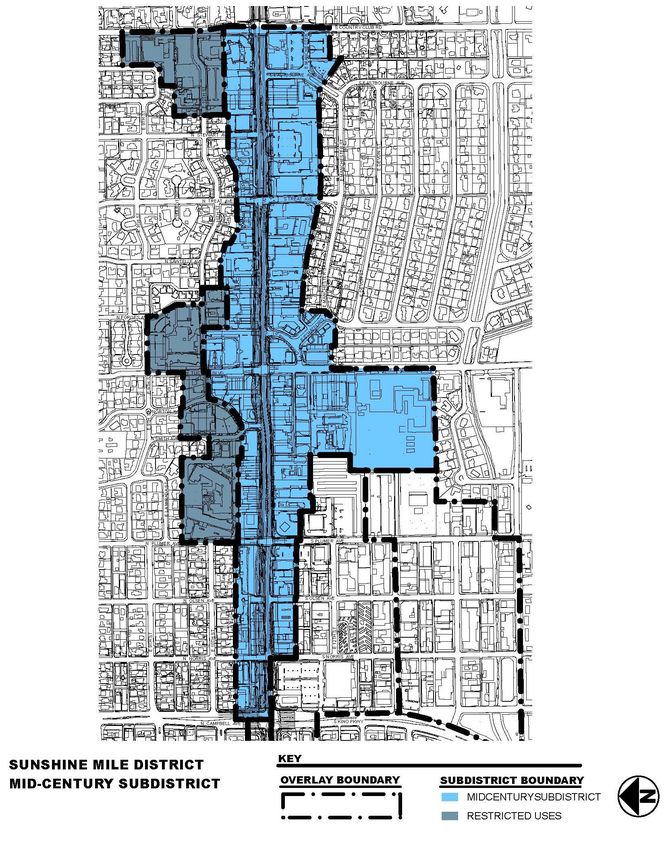
SUNSHINE MILE DISTRICT

   B.     Bungalow Subdistrict.................................................................................................................................... IV-14

   C.     Kino Subdistrict .............................................................................................................................................. IV-21

   D.     Mid-Century Subdistrict ............................................................................................................................. IV-33

Table of Figures
Figure I.A: Sunshine Mile District Boundaries ........................................................................................ I-4

Figure III.B: Mid-Century Land Use ........................................................................................................ III-7

Figure IV.A.1: Euclid/Park Subdistrict Map .......................................................................................... IV-3

Figure IV.A.4.a(2)(a): Park Subarea – Building Placement ............................................................... IV-4

Figure IV.A.4.a(2)(b): Park Subarea – Building Height ..................................................................... IV-5

Figure IV.A.4.a(2)(c): Park Subarea – Open Space............................................................................ IV-6

Figure IV.A.4.a(2)(d): Park Subarea – Building Massing ................................................................... IV-7

Figure IV.A.4.b(2)(a): Euclid Subarea – Building Placement............................................................ IV-9

Figure IV.A.4.b(2)(b): Euclid Subarea – Building Height ................................................................ IV-10

Figure IV.A.4.b(2)(c): Euclid Subarea – Open Space........................................................................ IV-11

Figure IV.A.4.b(2)(d): Euclid Subarea – Building Massing.............................................................. IV-12

Figure IV.B.1: Bungalow Subdistrict Map ........................................................................................... IV-15

Figure IV.B.4.b(1): Bungalow Subdistrict – Building Placement .....................................................IV-17

Figure IV.B.4.b(2): Bungalow Subdistrict – Building Height .......................................................... IV-18

Figure IV.B.4.b(3): Bungalow Subdistrict – Open Space ................................................................ IV-19

Figure IV.B.4.b(4): Bungalow Subdistrict – Building Massing ....................................................... IV-20

Figure IV.C.1: Kino Subdistrict Map ..................................................................................................... IV-22

Figure IV.C.4.a(2)(a): Kino North Subarea – Building Placement.................................................IV-24

Figure IV.C.4.a(2)(b): Kino North Subarea – Building Height ....................................................... IV-25

                                                                                                                                                                            iii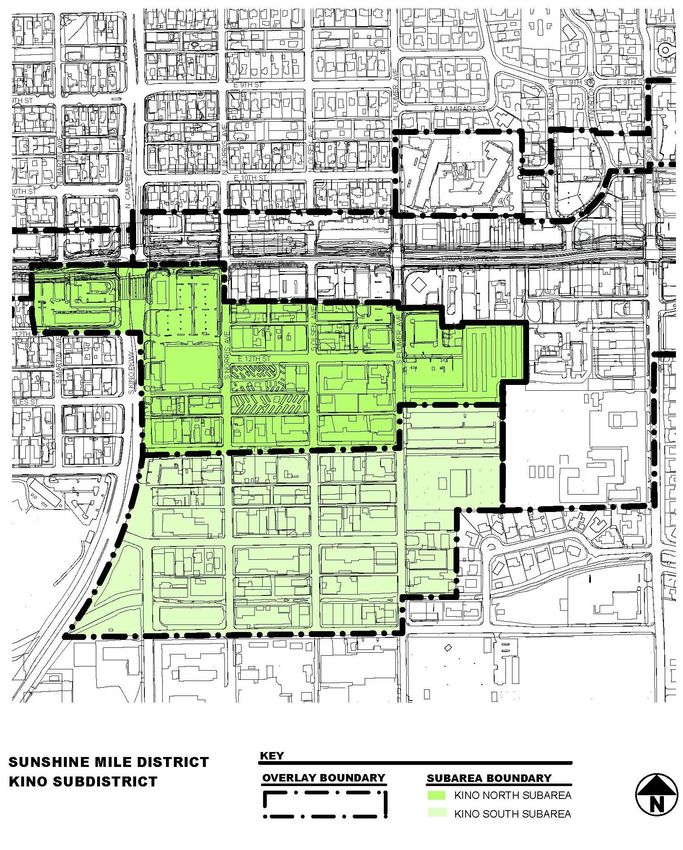
SUNSHINE MILE DISTRICT

Figure IV.C.4.a(2)(c): Kino North Subarea – Open Space.............................................................. IV-26

Figure IV.C.4.a(2)(d): Kino North Subarea – Building Massing .................................................... IV-27

Figure IV.C.4.b(2)(a): Kino South Subarea – Building Placement ................................................ IV-29

Figure IV.C.4.b(2)(b): Kino South Subarea – Building Height ....................................................... IV-30

Figure IV.C.4.b(2)(c): Kino South Subarea – Open Space ............................................................. IV-31

Figure IV.C.4.b(2)(d): Kino South Subarea – Building Massing .................................................... IV-32

Figure IV.D.1: Mid-Century Subdistrict Map .....................................................................................IV-34

Figure IV.D.4.b(1): Mid-Century Subdistrict – Building Placement .............................................. IV-38

Figure IV.D.4.b(2): Mid-Century Subdistrict – Building Height .................................................... IV-39

Figure IV.D.4.b(3): Mid-Century Subdistrict – Open Space ..........................................................IV-40

Figure IV.D.4.b(4): Mid-Century Subdistrict – Building Massing.................................................. IV-41

                                                                                                                                   iv
SUNSHINE MILE DISTRICT

I.   Sunshine Mile District (“SMD”) Overview
     A. Introduction

        On March 19, 2019, in accordance with Section 5.13 (Urban Overlay District, “UOD”) of the
        Unified Development Code (“UDC”), the City of Tucson’s (“City”) Mayor and Council initiated
        a UOD rezoning for a geographic area along Broadway Boulevard from Euclid Avenue to
        Country Club Road (the “Sunshine Mile”). This UOD is known as the Sunshine Mile District
        (“SMD”) and conforms to the policies adopted in Plan Tucson, the City of Tucson General
        and Sustainability Plan, and the surrounding Area and Neighborhood Plans, including the
        University and Arroyo Chico Area Plans and the Miles, Sam Hughes and Broadmoor-
        Broadway Village Neighborhood Plans. The SMD has been divided into four (4) Subdistricts
        and two (2) of those Subdistricts are broken down into Subareas based on location,
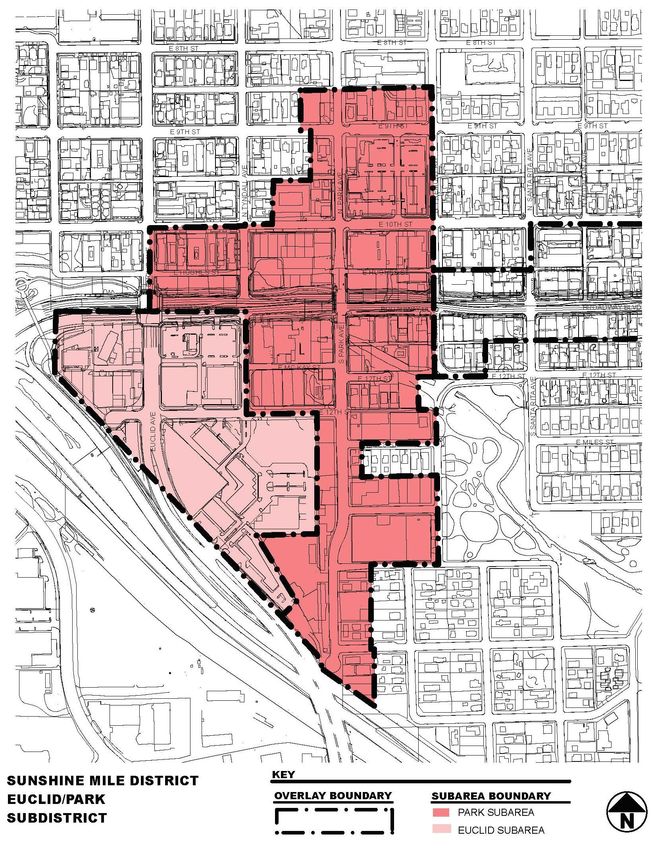
        character of existing development and opportunities for future development. Figure I.A
        depicts the overall SMD boundary and identifies the Subdistricts and Subareas within the
        SMD. Descriptions of each Subdistrict and Subarea are included in Subsection IV (SMD
        Subdistricts).

        Within the SMD, a property owner may choose to develop property in conformance with
        the existing underlying zoning or utilize the UOD’s flexible, mixed-use standards, which
        promote transit-oriented site and building design (the “SMD Zoning Option”). Transit-
        Oriented Development refers to mixed-use urban infill designed to maximize access to
        public transportation and encourage transit ridership. Other UOD policies encourage
        urban and architectural design features that ensure pedestrian and bicyclist comfort and
        the use of the best practices for Transit-Oriented Design.

        The SMD does not preclude a property owner from pursuing a separate rezoning, if
        desired. A property owner who chooses the SMD Zoning Option cannot revert to the
        underlying zoning standards without applying for a Modification of Zoning Requirements or
        pursuing a separate rezoning. Any Project that has demolished an eligible, individually
        listed or Contributing historic structure after XXX (date of ordinance adoption) may not
        utilize the SMD.

                                                                                                    I-1
SUNSHINE MILE DISTRICT

B. Purpose

   The primary purpose of the SMD is to support economic vitality along a multi-modal
   transportation corridor that forwards community values, embraces its historic features,
   enhances the character of the Sunshine Mile and is compatible with surrounding existing
   uses. The SMD demonstrates compliance with Plan Tucson and applicable Area and
   Neighborhood Plans by:

       • Encouraging sustainable, environmentally conscious, infill development that supports
          vibrant urban pedestrian-, bicycle- and transit-oriented neighborhoods.
       • Supporting a diverse mix of uses along the corridor that encourages economic
          revitalization synergistic with surrounding neighborhoods.
       • Enhancing the sense of place exhibited by the Sunshine Mile.
       • Recognizing there are four Subdistricts along the Sunshine Mile, each with a distinct
          character, as described within Section IV of this UOD.
       • Protecting historic architectural styles that encourages retention and restoration of
          historic resources.
       • Encouraging development compatible with the existing historic resources and
          neighborhoods.
       • Encouraging creative infill development by establishing urban development
          standards with flexibility to meet the unique physical constraints of properties along
          the Sunshine Mile.
       • Promoting compatibility with existing properties through the use of creative design
          practices that are sensitive to the desert environment.
       • Offering development incentives by permitting modifications to development
          requirements and offering flexible design solutions based on industry best practices.
       • Promoting infill development that builds on existing and future transportation
          modes that are emerging in a community committed to reducing its carbon
          footprint.
       • Creating a streamlined development review process that encourages neighborhood
          participation.

   The Broadway: Euclid to Country Club Improvement Project (“Broadway Project”) will have
   significant impacts on properties along and near the Broadway corridor, especially on the
   north side of Broadway Boulevard where the alignment has resulted in full or partial
   acquisitions to accommodate the planned improvements. These acquisitions have reduced
   the depth and size of many parcels, thereby creating properties that do not conform to
   current zoning regulations, particularly setback and parking requirements. This makes

                                                                                                 I-2
SUNSHINE MILE DISTRICT

   redevelopment along the Sunshine Mile more challenging, and addressing these challenges
   is a primary goal of the SMD.

C. Infrastructure

   Significant public investment in roadway, utility, transit and infrastructure improvements has
   been made in the SMD area. Voters approved the Broadway Project and its half-cent sales
   tax funding in May 2006 as part of the 2.1-billion-dollar Regional Transportation (“RTA”)
   plan. The improvements to the Sunshine Mile include widening Broadway Boulevard to 6
   lanes with bike lanes, sidewalks and landscaping.

                                                                                               I-3
SUNSHINE MILE DISTRICT

Figure I.A: Sunshine Mile District Boundaries

                                                                    I-4
SUNSHINE MILE DISTRICT

D. Historic Preservation

   The SMD contains historic properties that contribute to the character of the Sunshine Mile
   and the surrounding areas. There are multiple historic neighborhoods that are within or
   Adjacent to the SMD, including Iron Horse, Pie Allen, Rincon Heights and Sam Hughes. The
   Broadmoor-Broadway Village Neighborhood is also seeking designation as a National
   Historic Register District. In addition, a nomination to designate the Sunshine Mile as a
   historic district was approved by the State in May 2020. A key goal of the SMD is to honor
   the Sunshine Mile’s history, and as such, the SMD discourages demolition throughout the
   entire SMD of eligible, individually listed and Contributing Properties and encourages their
   preservation by supporting their retention, restoration and Adaptive Reuse.

   The SMD Zoning Option is not available to a property that would result in any of the
   following:

       The demolition of an eligible, individually listed or Contributing Property.

       A modification including alteration, addition or partial demolition of an eligible,
       individually listed or Contributing Property that, as determined by the City of Tucson
       Historic Preservation Officer (“CHPO”), does not meet the U.S. Secretary of Interior’s
       Standards for Treatment of Historic Buildings and would cause a building or structure to
       be no longer eligible or de-listed from the National Register of Historic Places.

                                                                                                I-5
SUNSHINE MILE DISTRICT

II.   Establishment & Administration of SMD
      A. Establishment of Sunshine Mile District

             The SMD was established by Ordinance #XXXX, adopted by the Mayor and Council on
             XXXXXX.

             The Mayor and Council may amend or dissolve the SMD by separate ordinance,
             pursuant to UDC Section 3.5.3, Zoning Examiner Legislative Procedure.

             The SMD’s boundaries shall be identified on the City’s Zoning Maps.

             A property owner may elect to develop and use his/her property either utilizing the
             existing underlying zoning district or the SMD Zoning Option. Applications and plans
             submitted utilizing the SMD Zoning Option shall comply with the regulations herein,
             including Section IV (SMD Subdistricts), as applicable.

             A Planned Area Development (“PAD”) provides the primary zoning and design
             standards for a property. Use of the SMD Zoning Option by a property with PAD
             zoning is subject to approval by PDSD.

             Unless otherwise permitted, the SMD Zoning Option cannot be used in conjunction
             with other waivers or modification provisions of the UDC, and the Applicant cannot
             select the provisions of other overlay zones.

             The SMD Zoning Option for a property shall be effective upon the issuance of a
             Certificate of Occupancy (“C of O”) or at time of final inspection, as applicable, for a
             Project being developed or altered in accordance with the SMD requirements. The
             owner of an existing development in the SMD may elect to change or expand the use
             of the property utilizing the SMD requirements by so stating in the required SMD
             Application, and the election of the SMD Zoning Option shall be effective upon the
             issuance of the C of O or at time of final inspection.

             A property owner using the SMD Zoning Option shall have his/her existing zoning
             designation prefaced by a “U” on the City’s Zoning Maps upon issuance of a C of O
             using the UOD.

             Figures contained in this document are for illustrative purposes only. Unless otherwise
             specifically indicated, figures are not to scale.

      B. Conflict of Laws

         The requirements and standards of the SMD should be interpreted to avoid conflict
         whenever possible with other UDC provisions, and flexible alternatives to support innovative

                                                                                                        II-1
SUNSHINE MILE DISTRICT
design solutions are encouraged. Where the standards of this Section conflict with other
Sections of the UDC, the standards of this Section shall control.
C. PDSD Application Requirements
An Applicant electing to develop utilizing the SMD Zoning Option must submit an SMD
Application demonstrating compliance with applicable SMD development design standards
and requirements. For all Projects that include site or exterior building modifications, the
SMD Application shall include a Development Package prepared in compliance with City
Administrative Manual Section 2-06.0.0 and/or any other materials required by the Planning
and Development Services Department (“PDSD”) Director to demonstrate compliance with
the SMD. SMD Applications that only request a change in use (with minimal or no site or
exterior building modifications) do not require the preparation of a Development Package.
The SMD Application must clearly state the Applicant’s intention to use the SMD Zoning
Option in lieu of the existing underlying zoning.
Prior to Application submittal, the Applicant may request in writing a modification or waiver
of specific SMD Application requirements from the PDSD Director, subject to the following:
The Applicant shall specifically identify the submittal requirement(s) for which a
modification or waiver is requested and provide a rationale for the request.
The PDSD Director shall determine whether to grant the modification or waiver request
within ten (10) working days. In making the decision, the PDSD Director shall consider
the purpose statements of the SMD and the applicable General Plan, Neighborhood
Plan and Area Plan policies. The PDSD Director’s approval of a request under this
subsection is not, nor shall it be construed as, an endorsement of a Project by PDSD.
D. Review Process
The PDSD shall review SMD Applications and Development Packages pursuant to UDC
Section 3.3.3., except that a pre-application conference is required.
Pre-Application Conference
Each Applicant shall meet with PDSD staff in a pre-application conference to verify the
requirements for Projects utilizing the SMD Zoning Option. The conference is intended
to be an opportunity for the Applicant and staff to discuss the proposed Project and
provide a preliminary review of the proposal for compliance with SMD development
standards. Staff will provide direction as to whether the SMD Application will be
II-2SUNSHINE MILE DISTRICT
reviewed through the Major or the Minor Design Review procedure (described below)
and advise the Applicant of any additional requirements (e.g., demolition review, traffic
statement, parking plan) to be included with the SMD Application submittal.
Major Design Review
a. Criteria
The Major Design Review procedure is required if a proposal for new development
meets any two or more criteria listed in Subsections II.D.2.a.(1) and/or II.D.2.a.(2)
below.
(1) The Project proposal contains structures that are higher than
Three (3) stories or thirty-six (36) feet, or
Two (2) stories or twenty-five (25) feet if Adjacent to an Affected
Residential Property.
(2) The Project proposal is at any one or more of the following locations:
An intersection of two Major Arterial streets.
Adjacent to a(n)
1. Affected Residential Property,
2. Eligible, individually listed or Contributing Property, or
3. National Register Historic District.
b. Review and Approval Procedures
Steps required for processing SMD Plans through the Major Design Review process
include
(1) A neighborhood meeting pursuant to UDC Section 3.2.2. that provides
notice to all property owners within 400 feet of the subject property and all
neighborhood associations within one-quarter mile. A written summary of
the meeting must be included with the SMD Application submittal.
(2) Review by the City Design Professional and recommendation to the PDSD
Director.
(3) Review by the Plans Review Subcommittee (“PRS”) of the Tucson-Pima
County Historic Commission (“TPCHC”), if applicable, and recommendation
to the PDSD Director.
II-3SUNSHINE MILE DISTRICT
(4) Review by the SMD Design Review Board (“DRB”) and recommendation to
the PDSD Director.
(5) Decision by the PDSD Director pursuant to Subsection II.D.7 below.
c. Minor Development Exemption
Notwithstanding Subsection II.D.2.a., Major Design Review Criteria, a
redevelopment proposal that has a site area of 6,000 square feet or less or not
visible from a street is exempt from the Major Design Review process and shall
proceed through the Minor Design Review. Adaptive Reuse Projects that do not
involve physical modifications to the exterior of a structure do not require Major or
Minor Design Review and may proceed through PDSD Director approval pursuant
to the SMD and UDC Section 3.3.3.
Minor Design Review
a. Criteria
The proposed Project does not meet the criteria or is otherwise exempt from the
criteria for a Major Design Review in Subsection II.D.2.c above.
b. Review and Approval Procedures
Steps required for processing an SMD Application through the Minor Design
Review include
(1) Mailed notice of proposal in accordance with UDC Section 3.3.4 (100’
Notice Procedure).
(2) Review by the City Design Professional and recommendation to the PDSD
Director.
(3) Decision by the PDSD Director pursuant to Subsection II.D.7 below.
SMD Historic Preservation Review
a. Criteria
In addition to (and prior to) review through the Major or Minor Design Review
processes as applies in this section, the Tucson-Pima County Historical Commission
(“TPCHC”) Plans Review Subcommittee (“PRS”) shall review any Project that is any
one or combination of the following:
II-4SUNSHINE MILE DISTRICT
(1) Eligible, individually listed or Contributing Property
Projects proposing alterations or additions to an eligible, individually listed
or Contributing Property using the SMD Zoning Option.
(2) Adjacent to an eligible, individually listed or Contributing Property
Projects proposing new development using the SMD Zoning Option that
are Adjacent to a structure meeting any one or more of the following
characteristics:
Listed or eligible to be listed in the National or Arizona Register of
Historic Places, individually or as a Contributing Property.
Designated as a City Historic Landmark.
b. PRS Design Compatibility Review
(1) The PRS reviews to ensure consistency with the U.S. Secretary of the
Interior's Standards and design compatibility of a proposed Project with the
architecture of Adjacent Contributing Properties, including building
setbacks, building step-backs, textures, materials, forms and landscaping.
(2) Exceptions
The PDSD Director may waive the compatibility requirement of this section
under the following circumstances:
Where the Adjacent lot is vacant.
If the Adjacent lot is developed with a non-residential building.
(3) The PRS may continue the hearing on an item only once before making a
decision unless the applicant for the Project requests a further continuation.
The PRS must make a decision at the conclusion of the hearing.
SMD Design Review Board
The SMD DRB has the authority to review for the design criteria listed in Section III
(Standards & Guidelines) and Section IV (SMD Subdistricts). The purpose of the SMD
DRB is to review all criteria against site and Project constraints and to determine how
best to accomplish the goals and intent of the SMD.
a. The SMD DRB is composed of the existing members of the City’s DRB and
(1) The City Design Professional.
II-5SUNSHINE MILE DISTRICT
(2) One ad hoc member plus one alternate ad hoc member appointed by the
neighborhood association for the area in which the proposed Project is
located. If the Project site is located in an area that does not have a
neighborhood association, the member is appointed by the association
nearest the Project site.
b. The SMD DRB shall use the City’s DRB rules of procedure, pursuant to UDC Section
2.2.6.B., to carry out its functions.
c. SMD DRB Quorum, Voting and Recommendation
(1) The Design Professional and ad hoc member are voting members of the
SMD DRB. The ad hoc member and alternate may both participate in the
design review and deliberations. The alternate ad hoc member may vote
on a matter only if serving as a replacement for the regular ad hoc
member.
(2) Quorum and voting procedures of the SMD DRB is the same as the City‘s
DRB, as defined in UDC Section 2.2.6.B.3.
(3) Notwithstanding Subsection II.D.5.c.(2) above, if for any reason a quorum is
not obtained for a particular SMD Application for a two-month period, then
the Design Professional shall make a recommendation directly to the PDSD
Director without consultation with the SMD DRB.
(4) The Design Professional may give a recommendation separate from the
SMD DRB recommendation in all cases.
d. SMD DRB Review
(1) All Projects submitted using the SMD Zoning Option and subject to
Subsections II.D.2.a. and II.D.4. are reviewed by the SMD DRB for
compliance with applicable SMD design standards and requirements
(Sections III & IV). If an Applicant is unable to meet the criteria, specifically
those that include a “should” or other aspirational language (as opposed to
a “shall”) statement, the Applicant must justify the reason(s) for not meeting
the criteria and explain how the overall goals and intent of the SMD are
otherwise being met.
(2) An Applicant may request a courtesy review by the SMD DRB to receive
input on the proposal's features. After the courtesy review, the SMD DRB
may continue the hearing on an item only once before making a decision
unless the Applicant asks for further continuation. The SMD DRB must
make a decision at the conclusion of the meeting.
II-6SUNSHINE MILE DISTRICT
Review by the Design Professional
a. Prior to the SMD DRB meeting, either during the pre-application meeting with staff
or at a separate meeting, the Applicant must meet with the Design Professional to
discuss the Project and its compliance with the SMD and applicable design
standards and requirements.
b. The Design Professional must provide a written report to the Applicant, the SMD
DRB members and the PDSD Director at least five (5) business days before the
scheduled SMD DRB meeting. The report shall contain
(1) A listing and description of the recommendations and any other issues of
concern raised by staff at the pre-application meeting and the SMD DRB
courtesy review, if applicable.
(2) A statement describing how the proposal complies with each of the
applicable design standards.
(3) Recommendations on any modifications to the Project needed to bring it
into compliance with the design standards.
(4) The Design Professional’s recommendation to the Director may also include
comments on other aspects of the Project, such as façade treatment,
building colors, compatibility with Adjacent properties and other design
elements.
PDSD Director’s Notice of Decision
a. Recommendations from the SMD DRB, PRS and Design Professional are advisory to
the PDSD Director. The PDSD Director makes the final decision on a Project's
compliance with the SMD’s applicable requirements and standards.
b. The SMD DRB, PRS and the Design Professional may recommend special
conditions, and the PDSD Director may add special conditions to an approval
pursuant to Subsection II.D.7.a., above, to ensure compliance with the intent of the
SMD and to address safety issues.
c. Special conditions may include mitigation standards or plans based on the scale,
setting and intensity of the proposed Project on a case-by-case basis. Examples of
such plans may include, but are not limited to, vehicular reduction plan, traffic
impact analysis and noise mitigation plan.
II-7SUNSHINE MILE DISTRICT
Final Approval
The PDSD Director must issue a Notice of Decision within ten (10) business days after
receiving final recommendations from the SMD DRB, PRS and the Design Professional,
pursuant to Subsection II.D.7.
Appeals
a. Major Design Review
Appeals of the PDSD Director's decision for Projects reviewed pursuant to the
Major Design Review process may be made by a party of record and must be filed
in writing with PDSD within ten (10) business days of the date of the decision.
Appeals are heard in accordance with UDC Section 3.9.2., Mayor and Council
Appeal Procedure.
b. Minor Design Review
Appeals of the PDSD Director’s decision for Projects reviewed pursuant to the
Minor Design Review Process may be made by a party of record and must be filed
in writing with PDSD within ten (10) business days of the date of the decision.
Appeals are heard in accordance with UDC Section 3.10.2., Board of Adjustment
Appeals Procedure.
Design Professional Review of Building Plans
Prior to the issuance of a building permit for Projects utilizing the SMD Zoning Option,
the Design Professional shall review the Development Package and the building plans
for compliance with the approved SMD Application.
Amendments
An amendment or revision to an approved SMD Application is subject to Design
Professional review. If the Design Professional, at his sole discretion, determines that
the revision constitutes a major change, the same procedure as the initial approval
would apply.
II-8SUNSHINE MILE DISTRICT
Development Review Fees
The development review fees shall be reduced by fifty (50) percent for the Adaptive
Reuse of an existing building described in Subsection III.A, Definitions.
E. Urban Design Best Practices
In order to accommodate creative solutions to design and development, the PDSD Director
may approve alternatives to the design standards and development regulations determined
by the PDSD Director to be consistent with “urban design best practices.” For the purposes
of the SMD, “urban design best practices” may include, but are not limited to, design
studies endorsed by the City; design approaches recommended by the Design Professional;
adopted urban design standards for a downtown or transition area in a city of comparable
size; standards or books written by urban design experts or endorsed by a professional
organization, such as the American Institute of Architects or the American Planning
Association, addressing downtown or transition area development; or any comparable
report, study or standards recommended by the City’s Design Professional and approved
by the PDSD Director.
For both new Projects and Adaptive Reuse Projects, the applicant may propose alternative
compliance to the strict application of design standards and guidelines, such that the
alternative
Achieves the intent of the subject design standard to the same or better degree than
the subject standard.
Achieves the mixed-use goals and policies of the SMD to the same or better degree
than the subject standard.
Results in equivalent or better benefits to the community than strict compliance with the
subject standard.
II-9SUNSHINE MILE DISTRICT
III. Standards & Guidelines
The general standards and guidelines in this Section apply to all Projects utilizing the SMD
Zoning Option.
A. Definitions
Terms defined in the UDC shall have the same meaning when used in the SMD unless
defined differently in this Subsection. The following terms shall have the meanings given
below.
1. Acre. As defined in UDC Section 11.4.2.
2. Accessory Structure: As defined in UDC Section 11.4.2. Accessory Structure may serve a
single property or serve as a shared facility among multiple properties. Examples
include, but are not limited to, restrooms, storage areas and bicycle lockers.
2.3. Adaptive Reuse. The process of reusing an existing structure for a purpose other than
for which it was built or designed. To qualify for Adaptive Reuse incentives herein, a
Project must include a change of occupancy, change in use, interior modifications
and/or exterior modifications that incorporates and retains the existing structure.
3.4. Adjacent. As defined in UDC Section 11.4.2, related to Optional Zoning Sub-Districts,
including items A-D.
4.5. Affected Residential Property. An existing detached single-family or duplex dwelling
that is Adjacent to an SMD Project.
5.6. Affordable Housing Unit. A dwelling unit committed for a minimum term as affordable,
through covenants or restrictions, to households with incomes at 80 percent or less of
the area median income (“AMI”) for a family, as defined by the United States
Department of Housing and Urban Development, for the City; and where housing costs
(rents, mortgages, utilities and condo, homeowners or other association fees) do not
exceed thirty (30) percent of a family’s income as verified on an annual basis.
6.7. Bicycle Share. A service in which bicycles are made available for shared use to
individuals on a short-term basis, either for a rental price or free, and parked or stored
in a short-term bicycle parking facility. Includes investment and/or partnership with
TuGo Bike Share or other current City docked Bike Share system.
7.8. Car Share. A short-term vehicle rental service that makes cars available to people on a
pay-per-use basis. This service may also be provided as an amenity to residents of
multi-family residential or Mixed-Use Development. Members have access to a
III-1SUNSHINE MILE DISTRICT
common fleet of vehicles on an as-needed basis, gaining most of the benefits of a
private car without the costs and responsibilities of ownership.
8.9. Density. As defined in UDC Section 11.4.5.
9.10. Last-Mile Delivery. The movement of goods from the final transportation
center or sorting facility to the delivery destination. The final delivery destination is
typically a personal residence or business.
10.11. Mobility Hubs. Places of connectivity where different modes of travel – walking,
biking, transit and shared mobility – converge. They are best suited near transit stops
and where there is a concentration of employment, housing, shopping and/or
recreation. They provide an integrated suite of mobility services, amenities and
technologies to bridge the distance between transit stops and an individual’s origin or
destination.
11.12. Mixed-Use Development. Development that blends two or more residential,
commercial, cultural, institutional and/or industrial uses. Mixed use is one of the ten
principles of Smart Growth, a planning strategy that seeks to foster community design
and development that serves the economy, community, public health and the
environment. The mix of uses may be vertical (within the same building) or horizontal
(single-use buildings on same parcel).
12.13. Open Space. Outdoor public, semi-public or private gathering places that
foster social interaction within the community. Examples include parks, plazas, outdoor
patios at restaurants and coffeeshops, roof gardens, balconies and landscaped seating
amenities.
13.14. Pick-Up Lane. Drive-up lane at a restaurant or retail establishment that allows
customers who have placed orders in advance via phone, online, through a mobile
application or other means to receive their orders at a pick-up window. Unlike a
traditional drive through, a Pick-Up Lane does not include a menu board or
microphone.
14.15. RAC. Number of residences per Acre.
15.16. Vehicular Pick-Up/Drop-Off Area. Designated area for vehicles utilized for ride
hailing services (means of transportation in which the user of the service can digitally
request transportation) or delivery services.
16.17. Pedestrian Passthrough. A feature providing unrestricted public pedestrian
access through a building or structure or between buildings or structures.
17.18. Project. A land area consisting of one or more parcels designated for
development, which involves any human-caused change to improved or unimproved
III-2SUNSHINE MILE DISTRICT
land that requires a permit or approval from the City, including but not limited to, new
construction or modifications to an existing structure(s), grading, paving, excavation or
filling.
18.19. Public Open Space. Open Spaces that foster social interaction within the
community and are accessible to the public for use. Examples include parks, plazas,
outdoor patios and landscaped seating amenities Adjacent to pedestrian paths and
within Mobility Hubs. Public Open Space is a portion of, and included within, the
calculations for the total required Open Space.
19.20. Shared Parking. Shared parking is publicly and/or privately-owned parking that
is used by two (2) or more separate land uses on the same property or on two (2) or
more different properties without conflict. The success of Shared Parking depends on
the specific uses on site and works best when Adjacent land uses have different peak-
activity periods.
20.21. Transit-Oriented Development. A development pattern that is characterized by
a mix of uses where buildings and uses cater to the pedestrian accessing the area via
alternate modes of transportation. It typically incorporates compact development and
dense activity centers within easy walking distance of transit stops. It generally includes
a mix of residential, employment and shopping opportunities designed for transit riders,
cyclists and pedestrians.
21.22. Transit-Supportive Plaza. A Public Open Space amenity located and designed
in coordination with DTM that incorporates an enhanced transit stop with a shelter
within a Project.
B. Land Use
1. Permitted Uses.
Table III.B.1, below, indicates all the permitted uses within the SMD. UDC Section 4.9
(Use-Specific Standards) shall not apply. The PDSD Director may permit any use not
specifically listed in the table below if determined to be similar in nature to other
permitted uses within a specific Subdistrict.
Uses marked with “X” are permitted within the indicated Subdistrict/Subarea.1 Uses
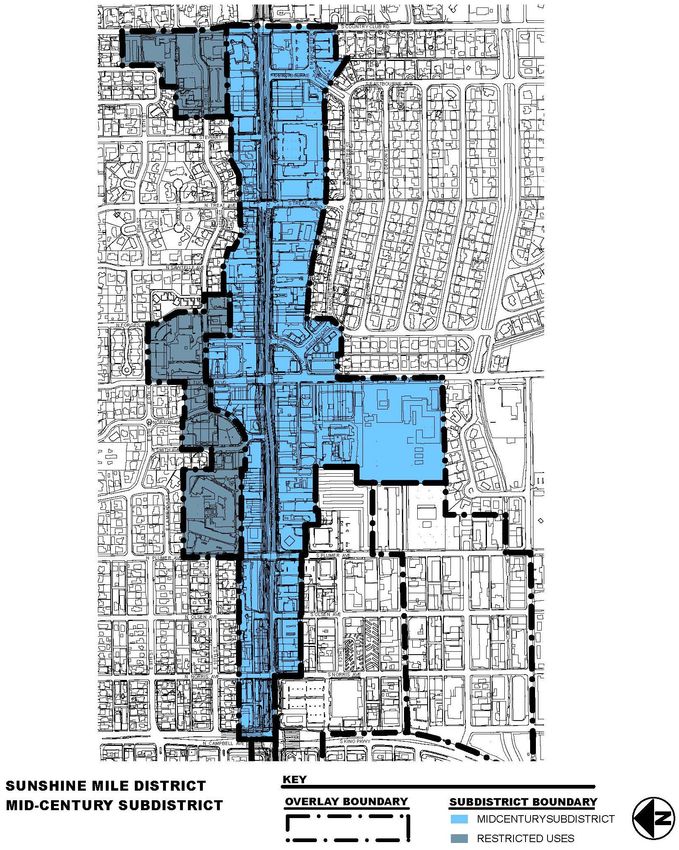
marked with “X®” are not permitted on properties designated “Restricted Uses” as
shown on Figure III.B: Mid-Century Land Use.
1
The Sam Hughes Neighborhood Plan may need to be updated to support the development of certain uses marked
as permitted within Table III.B.1. Consultation with PDSD staff is recommended.
III-3SUNSHINE MILE DISTRICT
Table III.B.1: Permitted Uses
Kino Kino Mid-
Park Euclid Bungalow
Land Use North South Century
Adult Activities Use Group (no uses from this Use Group are permitted within the SMD)
Agricultural Use Group
Community Garden X X X X X X
Urban Farm X X
Civic Use Group
Civic Assembly X X X X X X
Cultural Use X X X X X X
Educational Use X X X X X X
Membership Organization X X X X X X
Postal Service X X X X X X
Protective Service X X X X X X
Religious Use X X X X X X
Commercial Services Use Group
Administrative and Professional Office X X X X X X
Alcoholic Beverage Service X X X X X X®
Animal Service, provided all activity
occurs within an enclosed building X X X X X2 X®
Artisan Residence X X X X X X
Automotive – Minor, Service & Repair X X
Buildings & Grounds Maintenance X
Commercial Recreation X X X X
Construction Service X
Day Care X X X X X X
Entertainment, except circuses,
carnivals and tent shows X X X X X
Financial Service, except non-
chartered financial institutions, such
as check cashing and payday loan
businesses X X X X X X
Food Service, including catering
3
services, except soup kitchens X X X X X X
Funeral Service X X X®
Medical Service – Extended
Healthcare X X X
Mobility Hub X X X X X X®
2 Outdoor activities are permitted as long as they are conducted a minimum of 200 feet from any Affected Residential Property.
3 Outdoor dining located in Adjacent Right-of-Way is permitted, subject to the user obtaining and maintaining the requisite
license or easement from the Right-of-Way owner.
III-4SUNSHINE MILE DISTRICT
Kino Kino Mid-
Park Euclid Bungalow
Land Use North South Century
Parking X X X X X X®
Personal Service X X X X X X
4
Research and Product Development X X X X X X
Technical Service X X X X X X
Trade Service and Repair, Minor X X X X X X
Transportation Service – Land
Carrier5 X X X
Travelers’ Accommodation, Lodging X X X X X X
Industrial Use Group
Craftwork X X6 X X6
General Manufacturing X X
Motion Picture Industry X X
7
Perishable Goods Manufacturing X X X X X X
Precision Manufacturing X X
Processing & Cleaning X X
8
Salvaging & Recycling X
Recreation Use Group
Open Space X X X X X X
Parks and Recreation X X X X X X
Residential Use Group
Family Dwelling, limited to Duplex
and Multifamily Development X X X X X
Group Dwelling X X
Residential Care Services, limited to
Adult Care Service X X X X X X
Retail Trade Use Group
Construction Material Sales X X
Food and Beverage Sales X X X X X X
9
General Merchandise Sales X X X X X X
4 Activities that include storage of hazardous materials and/or require a permit from Arizona Department of Environmental
Quality (“ADEQ”) are not permitted.
5 Includes Last Mile Delivery.
6 Products manufactured on site, in addition to potential off-site sales, shall be sold at retail within the Project.
7 Manufacturing of fish or meat products, sauerkraut, sugar beets, vinegar and yeast and the rendering or refining of fats and oils
shall not be permitted. Slaughterhouses, meat packing plants, fertilizer yards and plats for the reduction of animal matter is not
permitted.
8 All activities and storage shall occur within an enclosed building. Junkyards, salvaging of motorized vehicles, such as cars,
trucks, airplanes and similar vehicles; salvaging of hazardous materials; and landfills are not permitted.
9 Display or storage of fertilizer, manure or other odorous material is not permitted. Large Retail Establishments are not
permitted.
III-5SUNSHINE MILE DISTRICT
Kino Kino Mid-
Park Euclid Bungalow
Land Use North South Century
10
Medical Marijuana Dispensary X X X X X X®
Vehicle Rental and Sales, limited to
Care Share and rental of
automobiles, vans and non-
commercial trucks X X X X X X®
Storage Use Group
Commercial Storage X X
Personal Storage X X
Wholesaling Use Group
Business Supply & Equipment
Wholesaling X X
Food & Beverage Wholesaling X X
10Medical Marijuana Dispensary is only permitted subject to use-specific standards in UDC and other City regulationsSection
4.9.9.E.1. If recreational marijuana use is approved by voters, recreational marijuana dispensaries will be permitted in all
Subdistricts of the SMD, subject to the City’s adopted regulations and policies.
III-6SUNSHINE MILE DISTRICT
Figure III.B: Mid-Century Land Use
III-7SUNSHINE MILE DISTRICT
Accessory Uses and Structures
a. Accessory uses are permitted for the use groups in the manner provided in the
UDC.
b. Drive-Through Lanes
(1) Existing Drive-Through Lanes, including those that need to be relocated or
reconfigured as a result of the Broadway Project, shall continue to be
permitted throughout the SMD.
(2) No new Drive-Through Lanes shall be permitted within the SMD, except as
an accessory use to Financial Service uses and only when reasonable
vehicular access is provided in a manner designed to minimize conflicts
with pedestrian circulation.
(3) Pick-Up Lanes are permitted throughout the SMD.
c. Renewable Energy Generation, limited to solar power generation, is permitted as an
accessory use.
d. Home occupations are permitted as accessory uses to Family Dwelling uses.
C. Affordable Housing
Purpose & Applicability
To encourage the provision of housing for low- to moderate-income, disabled and
elderly residents, incentives are offered in exchange for the incorporation of Affordable
Housing Units into a Project. To be eligible for these incentives, the following criteria
must be met:
a. Only Projects with a minimum of ten (10) dwelling units, or Projects adding at least
ten (10) dwelling units to an existing Project, shall be eligible for a density bonus.
b. All of the Affordable Housing Units shall be located within a single Project.
c. Affordable Housing Units shall be incorporated throughout the Project and shall
not be distinguishable in any manner from market-rate units, including square
footage, access to amenities, location, grouping, or exterior design.
d. At least fifteen (15) percent of the total number of dwelling units in the Project shall
be Affordable Housing Units for households earning 80 percent of AMI or less.
(Fractions are rounded up or down to the nearest whole number.)
III-8SUNSHINE MILE DISTRICT
Example: If 200 dwelling units are proposed, at least thirty (30) of those units
shall be affordable to households earning an average of 80 percent AMI or less.
Density Bonus
A Project shall qualify for a density increase over the otherwise maximum allowable
residential density pursuant to applicable SMD Subdistrict development standards in
Section IV.
a. Multi-Family Residential for Rent/Lease
(1) Density Bonus
A Project shall qualify for a twenty-five (25) percent density bonus
multiplied by the total number of units (excluding the 15 percent
Affordable Housing Units) if the multi-family residential Project sets
aside fifteen (15) percent of the dwelling units as affordable to
households earning an average of 80 percent AMI or less.
A Project shall qualify for a thirty-five (35) percent density bonus
multiplied by the total number of units (excluding the 15 percent
Affordable Housing Units) if the Project meets the above set-aside
requirement and is located within 650 feet of a Mobility Hub or transit
stop.
These density bonuses may not be used in addition to the density
increase incentive offered in Section III.H.6.b.(3). (Mobility Hubs).
(2) The term of affordability for these units is fifty (50) years from C of O.
b. For-Sale Condominiums
(1) A Project shall qualify for a fifteen (15) percent density bonus if the for-sale
condominium Project sets aside fifteen (15) percent of the dwelling units as
affordable to households earning an average of 80 percent AMI or less.
(2) The term of affordability for these units is thirty (30) years from C of O.
The Project developer or manager shall provide an annual report to the Housing and
Community Development Department (“HCD”) Director verifying the units qualify as
Affordable Housing Units. The report shall identify the income of persons residing in
the Affordable Housing Units and the housing costs, including rents, mortgages, utilities
and association fees being charged, and any other relevant information requested by
the HCD Director to verify the Project is being utilized for affordable housing.
III-9SUNSHINE MILE DISTRICT
Compliance measures can be required at the time of approval, including but not limited
to contracts, restrictive covenants, deed restrictions and stipulated penalties.
Except as otherwise noted, Projects using the Affordable Housing Density Bonus shall
comply with the requirements of the SMD Subdistrict in which it is located.
D. Streetscape Design
Streetscape design will comply with the street design standards in the UDC Technical
Standards Manual and the Street Design Guide as adopted and amended in the future,
except for modifications approved in coordination with the City Department of
Transportation and Mobility (“DTM”) on a case-by-case basis. Projects shall be pedestrian-
oriented and comply with the following standards:
1. New construction shall have architectural elements/details at the first two floor levels.
2. Front doors shall be visible or identifiable from the street and visually highlighted by
graphics, lighting, or similar features.
3. Uses, such as Commercial Services or Retail Trade uses that encourage street level
pedestrian activity, are preferred on the first floor of a structure of a multistory building.
4. Construction and maintenance of sidewalks must be done in compliance with the City
policies. Existing sidewalk widths shall be maintained so as to provide effective,
accessible, connectivity to adjoining properties. Sidewalks may be widened to
accommodate a Project's design characteristics. Where no sidewalks exist, sidewalks
shall be provided. Outdoor seating is encouraged where possible and when it can be
accomplished in accordance with local ordinances.
5. To the extent possible, Projects shall provide lateral pedestrian connections (access
from side or rear of building) to Adjacent neighborhoods.
6. Perimeter yard requirements may be reduced or waived if the PDSD Director
determines that the request is consistent with the Major Streets and Routes (“MS&R”)
Plan. The DTM Director may modify the MS&R setback if there is adequate sight
visibility, no traffic safety issue is created. and the setback does not create a future
roadway expansion problem.
III-10SUNSHINE MILE DISTRICT
E. Shade
Except as provided below, shade shall be provided for at least fifty (50) percent of all
sidewalks and pedestrian access paths as measured at 2:00 p.m. on June 21 when the sun is
82 degrees above the horizon. Shade may be provided by trees, arcades, canopies, or
shade structures provided their location and design characteristics are compatible with the
historic and design context of the street and the architectural integrity of the building. The
use of plantings and shade structures in the City Right-of-Way is permitted to meet this
standard with the approval of DTM. The shade provided by a building may serve to meet
this standard.
The PDSD Director may approve an SMD Application providing less than fifty (50) percent
shade where compliance is not feasible due to a Project site's location and/or building
orientation, and the Applicant has made a reasonable attempt to comply with this standard.
If a building is proposed that is over three (3) stories in height and Adjacent to an Affected
Residential Property, the PDSD Director may require a shade study to determine whether
shadow will be cast on the Affected Residential Property in a manner that would inhibit
existing solar energy panels and/or affect future solar energy installation. If required, the
shade study shall be reviewed by the City’s Design Professional and the SMD DRB with the
applicant to mitigate the effect on solar, and such mitigation will be part of the
recommendations to the PDSD director.
F. Development Transition Standards
The purpose of the Development Transition Standards is to mitigate excessive visual, noise,
odor, vibration intrusion and other similar public health, privacy and safety concerns that
may be created by the proposed Project.
Privacy Mitigation
Privacy mitigation measures, such as the incorporation of vegetative or other screening
or siting elements, walls, siting of buildings, balconies or windows, or other design
strategies shall be incorporated into a Project to reduce views towards an Affected
Residential Property.
Screening
III-11SUNSHINE MILE DISTRICT
Buffers and/or screening consistent with the purpose of this section shall be provided
between a Project and an Affected Residential Property and shall include features such
as, but not limited to, landscaping, walls and architecturally decorative features.
Mitigation of Service Areas
Service areas shall be mitigated to reduce the noise and view of the service features,
reduce the emission of offensive odors to owners or occupants of Adjacent properties,
prevent a nuisance or hazard beyond the property lines of the Project site and prevent
vibrations that are discernible beyond the property lines of the Project site.
a. Service areas for items such as backflow preventers and generators (but excluding
meters) shall be grouped in a joint area and located away from public view.
b. Potential nuisance or noisy areas shall be oriented away from Affected Residential
Properties, such as placing service areas for loading and garbage disposal between
the Project's buildings, behind opaque barriers, or by using architectural or
landscaping treatments that effectively reduce nuisance impacts from service areas.
Off-street loading and solid waste disposal areas within a Project shall be shared
when feasible.
c. Off-street loading zone standards may be reduced or waived if PDSD and DTM
determine that no traffic safety issue is created, and the loading zone is screened as
deemed appropriate.
d. On-site refuse collection container standards governing access, type and location
may be modified if the Environmental Services Department determines that no
public health or traffic safety issue is created.
e. Loading docks and trash and recycling containers may not be located along the
street frontage and may not be visible from the street.
f. Architectural elements, such as landscaping, should be incorporated into properties
fronting alleys to screen utility service activities
Mitigation of Parking Facilities
Where the site has parking facilities or areas with noise and outdoor lighting features,
the areas shall be screened from Affected Residential Property by a combination of a
wall or opaque non-chain link fence with a vegetative hedge or a row of trees that shall
be dense enough to screen views onto the Project site. An alternative treatment may be
used, such as using architectural or landscaping treatments that effectively reduce
nuisance impacts from parking facilities and other areas.
III-12SUNSHINE MILE DISTRICT
G. Pedestrian Circulation
Pedestrian plazas shall be located Adjacent to or visible from sidewalks and/or
pedestrian circulation in the Right-of-Way.
Existing sidewalk widths shall be maintained as a minimum width, where practicable, so
as to provide effective, accessible connectivity to adjoining properties. Where no
sidewalks exist, sidewalks shall be provided.
Outdoor seating, dining areas, public art and landscaping may be located
a. in the sidewalk area when it can be accomplished in accordance with local
ordinances.
b. in the Right-of-Way (subject to the owner/operator obtaining and maintaining the
requisite license or easement from the Right-of-Way owner and in coordination
with DTM).
Sidewalks required by Development Standard 2-08.40 are not required inside parking
structures.
Project uses that generate the highest pedestrian traffic should be located on enhanced
corners and provide
a. a primary entrance that faces both streets and serves the greatest number of
occupants.
b. additional building articulation that emphasizes the corner and promotes activity.
On Broadway Boulevard, the area between the sidewalk and the building may be used
for landscaping, open space or outdoor amenities, but not for parking.
Mid-Block Pedestrian Passthroughs
For Projects that propose to develop an entire block, at least one Pedestrian
Passthrough shall be provided, as follows:
a. Mid-block Pedestrian Passthroughs shall be lighted and designed to be safe and
visually interesting for pedestrians and incorporate such features as display windows
or artwork.
b. Mid-block Pedestrian Passthroughs shall be designed so they cannot be enclosed
or locked.
c. The Pedestrian Passthrough should be used to connect separate buildings, or link
customer parking to the front of buildings. Alternatives to Pedestrian Passthroughs
III-13You can also read


