Situation Analysis - Amy Boe
←
→
Page content transcription
If your browser does not render page correctly, please read the page content below
Situation Analysis
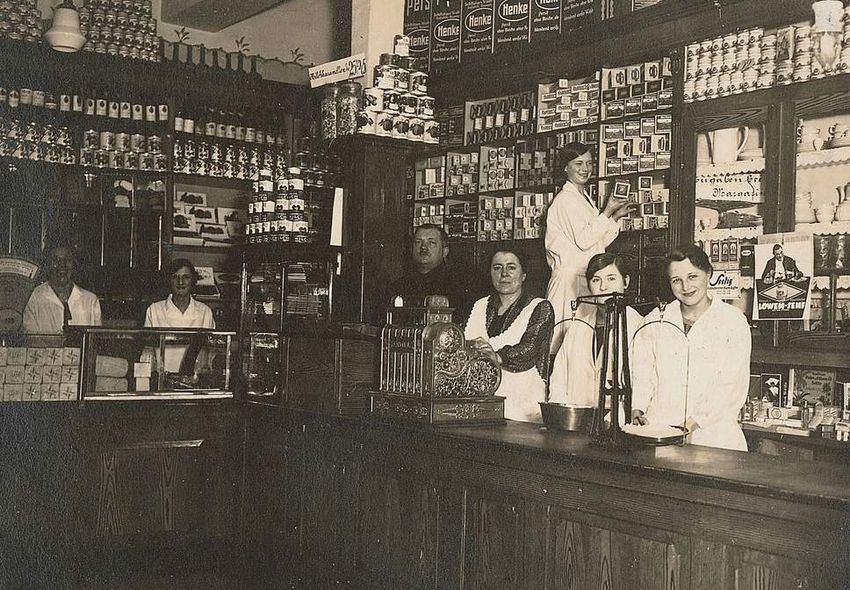
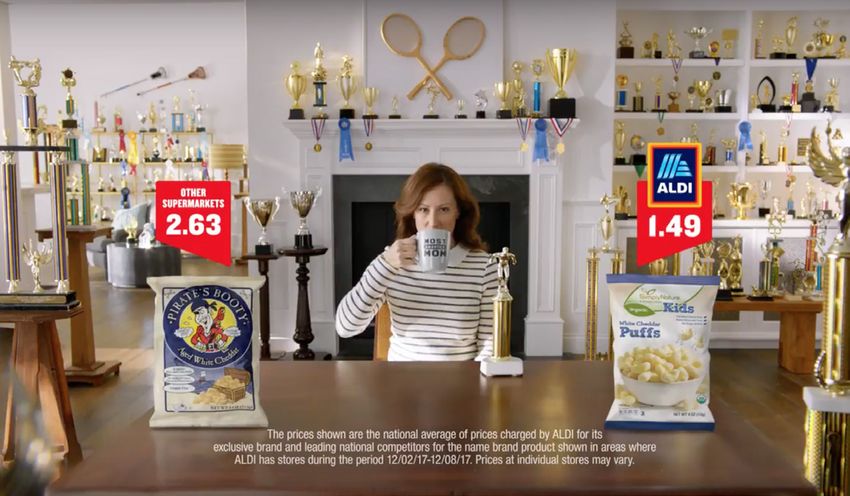
Table of Contents
Executive Summary...................................1
Company Analysis.....................................2
Category Analysis ..................................21
Competition Analysis...............................28
Consumer Analysis...................................34
Target Profile............................................38
SWOT Analysis.........................................40
Key Takeaways.........................................45
Meet the Team

KELSEY BEKERMEIER       HALEY BESLER     AMY BOE

  EMILY COOK           BROOKE EMERY    JOSH GOODMAN
Executive Summary
Our objective is to provide a comprehensive understanding of the Aldi brand and key factors affecting our niche
positioning within the grocery category. This planbook contains secondary research on the company, consumer and
category trends and competition.

Some key findings include:
•       90 percent of Aldi in-store items are Aldi-exclusive brands. Some of these items are labeled “Aldi Finds”–
        seasonal, on-trend, non-grocery products.
•       Aldi is sitting at a niche spot within the grocery category – “specialty discount grocery.”
•       The grocery category is in the midst of an evolution driven by a desire for convenience, wellness and
        technology.
•       Young millennial consumers value brands with strong corporate social responsibility (CSR) and active social
        media.
•       Young millennial shoppers are likely to make impulse buys since most do not engage in pre-shopping planning.
•       Messaging within the category is saturated. The majority of our competition focuses on communicating low
        prices and high value.

Objectives
The ask assigned by the client is to educate younger millennials about Aldi’s business practices without relying on
price messaging and alienating current Aldi Loyalists. To accomplish this objective and influence future advertising
strategies, we created a target profile, analyzed the unique essence and positioning of the brand and conducted a
SWOT analysis.

    1
Company Analysis
Aldi is one of America’s fastest-growing grocers, with about 2,000 stores across 35 states. The company operates
as a cost-effective alternative to typical grocery shopping, with more than 40 million customers each month. Aldi is
one of the largest privately held companies in the world and employs over 25,000 people. As a growing company,
Aldi is projected to have nearly 2,500 stores by the end of 2022.

ALDI Süd
Aldi U.S. is a unit of Aldi Süd, which is the international parent company headquartered in Germany
where Aldi was founded. Aldi Süd has more than 5,900 branches and around 139,000 employees. All
locations in the United States are independently managed and operated.

Business Model
“Great quality at the best price, fair and honest product offers, and
efficient business processes.”

                                                                                                                   2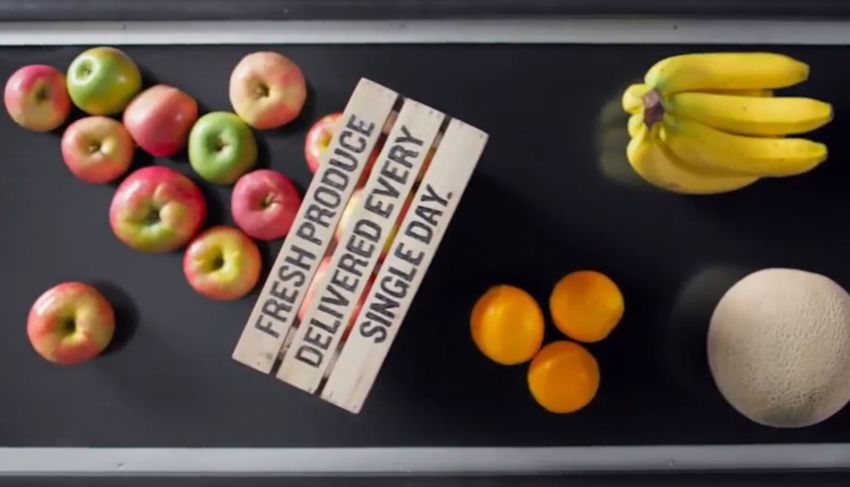
The Aldi Difference

“Our unique business model enables us to provide the highest quality
products at the lowest possible prices. This value stems from the
numerous efficiencies and innovations we’ve instituted at every level of our
organization. Our stores offer the customer the most commonly purchased
grocery and household products in the most common size – in a smaller,
more manageable environment designed with sustainable, long-term
savings in mind.”

3
123
Three Core Values

       CONSISTENCY
   Leads to reliability. We
  mean what we say. We are
consistent in our dealings with
people, product, price and all         SIMPLICITY
 other aspects of our day-to-       Creates efficiency,
     day professional life.          clarity and clear
                                  orientation within our         RESPONSIBILITY
                                  organization as well as   Stands for our commitment
                                    for our customers.          towards our people,
                                                            customers, partners and the
                                                            environment. It also includes
                                                             principles such as fairness,
                                                             honesty, openness, service
                                                            orientation and friendliness.

                                                                                            4
Size

       Over 25,000    Over 40 million    Over 2,000 stores
       employees     monthly customers     nationwide

5
History
In 1913, Anna Albrecht opened her own small food store in the mining town of Essen,
Germany. She gave birth to two sons named Karl and Theo. By 1948, Karl and Theo
took over her business and expanded to four locations. In order to cut costs, the two
decided to rigorously remove products from their
shelves. This resulted in the first self-service store,
which opened in 1954 in Essen-Schonnebeck. In
1962, the brothers split the company over a dispute
on whether or not they should sell cigarettes in their
stores, and they shortened the store name, “ALbrecht
DIscount” to “ALDI.” As separate entities, Karl’s stores
went under the name “Aldi Süd”, while Theo’s stores
went under the name, “Aldi Nord.” By 1968, there
were more than 200 Aldi Süd locations, and by 1976,
Aldi Süd had made its way to the United States, though
its U.S. stores are simply called “Aldi.” Aldi Nord also
expanded to the states, but its stores operate as
“Trader Joe’s.” Over the years, Aldi has expanded to
countries all over the world. In the U.S., we currently
have over 2,000 locations and are growing rapidly.
6Timeline
Anna’s sons took over the
business and expanded to
four locations.
“ALbrecht DIscount”
was shortened to
“ALDI.”
1913 1954 ALDI 1968
1948 1962
Anna Albrecht There are more
opened a small food The first self-service
than 200 Aldi
store in the mining store opened in Essen-
Süd locations.
town of Essen, Schonnebeck, a first in
Germany. Germany.
7New divisions opened up in
South Windsor, Connecticut
and Haines City, Florida in
2008, Denton, Texas in 2010
Aldi made our and Jefferson, Georgia in
U.S. debut in 2011.
southeastern Iowa.
1990s 2016+
1976 2000s
Aldi expanded to Great Today, Aldi is experiencing
Britain in 1990, Ireland in growth in the United
1999, Australia in 2001, States. By the end of 2022,
Slovenia in 2005 and there will be nearly 2,500
Hungary in 2008. Aldi stores in the U.S.
8Product Offering
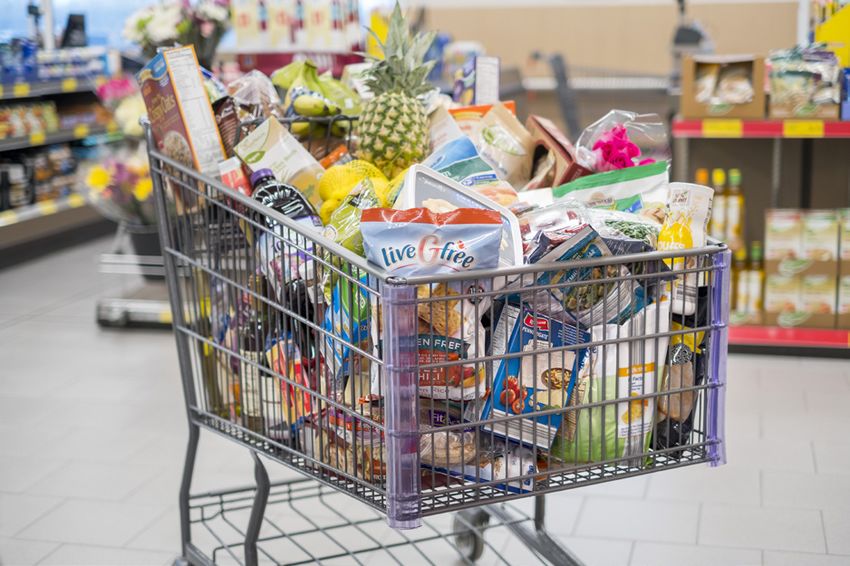
Aldi stores provide over 1,300 of the most
commonly purchased items in the most popular
sizes. Aldi specializes in exclusive brands, which
makes up more than 90 percent of products sold.
Aldi offers a large variety of
alcoholic beverages, including
beer, wine and liquor. Aldi’s
wine selection has won several
prestigious awards over the
years, including its “Broken
Clouds Pinot Noir” brand wine,
which won “Product of the
Year” by the Consumer Survey
of Product Innovation in 2017.
9However, Aldi provides more than just food. The company offers “Aldi Finds,” which are non-food specialty
items that cycle frequently. These include products for home living, entertainment, school and more - each
tending to be seasonally based.
One point of difference in Aldi is the “Twice As Nice Guarantee.” This is a company promise stating that if
customers are not 100 percent satisfied with a product they buy, Aldi will replace that item and refund the
customer’s money.
10In-Store Experience
AVERAGE U.S. GROCERY STORE: AVERAGE U.S. ALDI STORE:
45,000 sq. ft. 15,000 sq. ft.
11Aldi’s narrowed product selection allows stores to be much smaller than the average grocery store. This provides
easy navigation for customers and makes the shopping experience much faster, which is ideal for on-the-go
visitors. Aldi Finds are specially placed in an aisle in the center of the store, encouraging consumers to explore
what new specialty items are being offered.
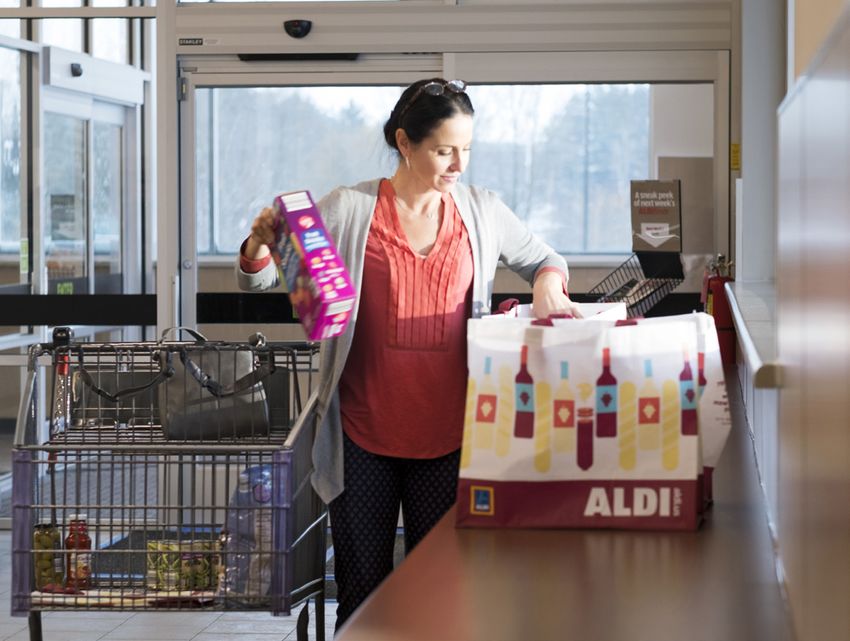
Some other ways that Aldi functions differently than other grocers includes our bag and cart policies. Customers
are encouraged to bring their own reusable shopping bags, as Aldi charges customers for each bag they use.
Customers must also bag their own groceries. Store visitors that want a cart must pay $0.25 to use one, but
can get their quarter back if they return the cart at the end of their shopping run. These policies help the
environment and allow Aldi to keep product prices low.
12Proof Points
Aldi is based around four proof points, which are factors that emphasize the overall message of the company.
Each proof point is achieved through specific actions that Aldi takes.
QUALITY SELECTION
• Hand-picked, narrow
• Quality benchmark tests
product offerings so that
• Taste test kitchen
customers only get the
• Healthy and organic food
best of the best
13VALUE EASY TO SHOP
• Smaller selection and • Smaller store size and
efficient operations layout set up for ideal
allow low prices while customer navigation,
maintaining high quality allowing an in-and-out
shopping experience
14Corporate Social Responsibility Aldi is active in corporate social responsibility (CSR), which means our business is socially accountable to our company, stakeholders and the public. It focuses in categories including the environment, supply chain management, and charitable organizations. ENVIRONMENT: • Member of the Sustainable Packaging Coalition (SPC) to make packaging more sustainable • Partners with How2Recycle, which helps label products with information that will encourage customers to recycle • Reduce carbon footprint emissions by dimming lights, lowering HVAC controls, installing solar panels and reducing & optimizing truck driving 15
SUPPLY CHAIN MANAGEMENT:
• ALDI Animal Welfare Policy that prevents animal abuse or neglect throughout the supply chain
• Programs to reinforce ethical and safe workplaces

CHARITABLE ORGANIZATIONS:
• Every store partners with Feeding America, a food bank that helps in-need individuals around the country and
  contributes to disaster relief
• Established the ALDI Smart Kids Program, which provides funding and gift cards to organizations that
  promote kids being active and healthy
• Partners with Action for Healthy Kids (AFHK) to encourage healthy, active lifestyles for students, teachers and
  family members in communities across the U.S.

                                                                                                               16
Aldi in the News 17
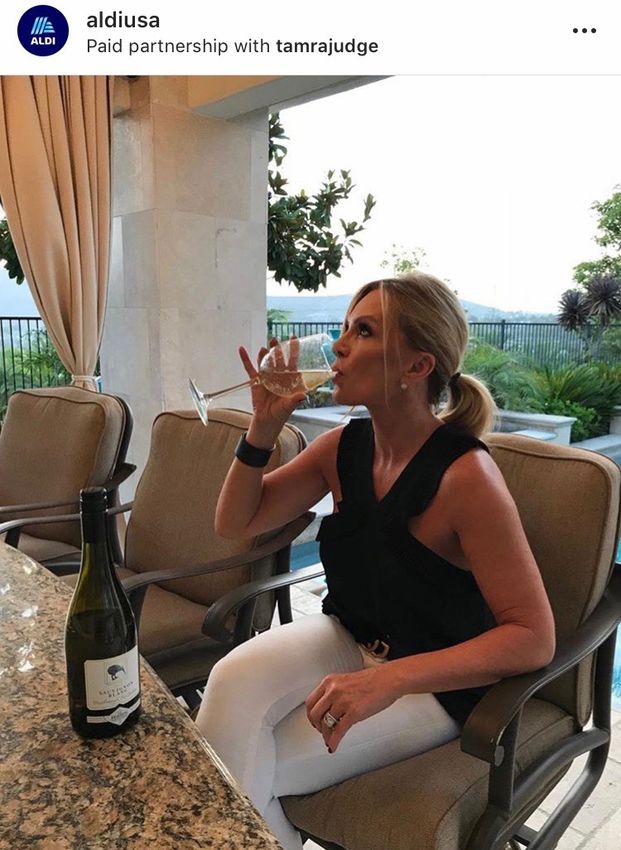
Sponsored and Earned Media Coverage

                                      18
Social Media Presence 19
Ad Campaigns
The tagline, “Simply Smarter Shopping,” was used in a variety of TV spots that highlighted how national brands
compared with Aldi’s private-label ones. In 2018, Aldi unveiled a new campaign featuring the tagline,“Shop Differentli,”
that took a humorous approach to the benefits of shopping at the chain.

                                                                                                                20
Category Analysis Speciality Discount Grocery Aldi is sitting at a niche spot in the grocery category. Aldi encompasses a trait not claimable by all brands in the category – discount pricing. We also carry specialty “Aldi Finds”. The unique combination of grocery, discount pricing and retail products places Aldi in a category beyond general grocery. Aldi lives in the speciality discount grocery category. To understand this category, it is important to look closely at the landscape of the general grocery category. This lays the groundwork for Aldi’s unique category placement. State of the Category The grocery industry is economically healthy, bringing in net sales of $61,011,992. Although the economic state of the category remains consistently strong throughout the years, behavioral trends in the industry pose rapid change. These are not changes that can be glossed over. Every brand in the grocery category will have to accomodate to one or all of the factors driving the grocery evolution. Key factors driving the grocery evolution include convenience, wellness and technology. 21
Category Forecast
SHIFT IN CONSUMER SHOPPING HABITS:
The grocery industry is predicted to become a $700+ billion industry within the next five years.

It is one of the most rapidly changing industries in today’s market. Retailers are forced to be increasingly
strategic when deciding where to place their focus. This is due to two dynamic changes in the industry: 1) a shift
in consumer shopping habits and 2) technology advancements.

                                               Retailers are striving to improve the in-store
     ONE OF ALDI’S MAIN                        experience by implementing the following:
    BUSINESS FOCUSES, OR
    “PROOF POINTS”, IS TO                      • Adding catering services
 SELECT QUALITY PRODUCTS                       • Providing more freshly prepared meals and
  TO PLACE IN THE STORES.                        meal kits
     ALDI STORES ALWAYS
                                               • Incorporating grab-and-go items
   CARRY ORGANIC FOOD,
    WHICH IS IN-LINE WITH                      • Having a broader selection of natural and
   HOW COMPETITORS ARE                           organic foods
 TRYING TO IMPROVE THEIR                       • Carrying items that cater to specific diets
   IN-STORE EXPERIENCES.

                                                                                                                22
ALDI FITS INTO
Consumers are shopping 15 percent more at discount retailers than before.
THIS CATEGORY.
ALDI PARTNERED WITH INSTACART
IN 2018. INSTACART IS A SAME- TECHNOLOGY ADVANCEMENTS:
DAY GROCERY DELIVERY SERVICE.
SHOPPERS SELECT GROCERIES While most shopping is still done in stores, 30 percent of
FROM VARIOUS RETAILERS, AND our millennial target audience does some of their grocery
THE ORDER IS DELIVERED BY A shopping online. According to 2017 Mintel research, 69
PERSONAL SHOPPER. INSTACART percent of millennials shop all in-store, 30 percent shop
IS PARTNERED WITH SEVERAL mostly in-store and some online and 2 percent shop mostly
OTHER BRANDS IN THE CATEGORY, online and some in-store. Brands in the category are aiming
INCLUDING KROGER, ALBERTSON’S, to get ahead of the online shopping trend by incorporating
SAM’S CLUB AND LOBLAW. online grocery options.
23Category Trends
CONSUMER:
In the midst of the rapidly changing grocery landscape, consumers continue to make purchase
decisions based on some general areas of preference:
• Loyalty to a convenient location, not a specific store or chain.
• Quality being most important to consumers, followed by price, then brand.
THE ALDI BRAND IS EXPANDING
GEOGRAPHICALLY. OVER 100
STORES HAVE BEEN BUILT IN 2017
AND 2018. IT IS ESTIMATED THAT
OVER 2,000 ALDI STORES WILL EXIST
NATIONWIDE BY THE END OF 2018.
THIS ALIGNS WITH THE CONVENIENT
LOCATION TREND AND WILL IDEALLY
DRIVE MORE CONSUMERS TO THE
BRAND.
24ADVERTISING MESSAGING:
A large majority of messaging in the category focuses on savings.
The category is highly saturated with this message, and it is
becoming increasingly difficult for brands to stand out on the basis ALDI HAS A FAIRLY STRONG
of price. SOCIAL MEDIA PRESENCE,
WHICH IS SOMETHING THAT
Another common message in the category revolves around YOUNG MILLENNIALS VALUE.
community. Several brands, including Aldi and Hy-Vee, promote WE HAVE THE OPPORTUNITY
recipes on social media that use products from their store. TO MARKET OURSELVES TO
#FamilyMealsMonth was a promotion also executed by more than MILLENNIALS IN A CATEGORY
one brand during the month of September. The campaign focuses THAT SPEAKS PRIMARILY TO
on the importance of eating together as a family and highlights FAMILIES.
recipes using products from the store. Hy-Vee and Kroger, a
regional grocer, have participated in #FamilyMealsMonth.
A majority of the advertising in the category targets families.
25Industry Advertising
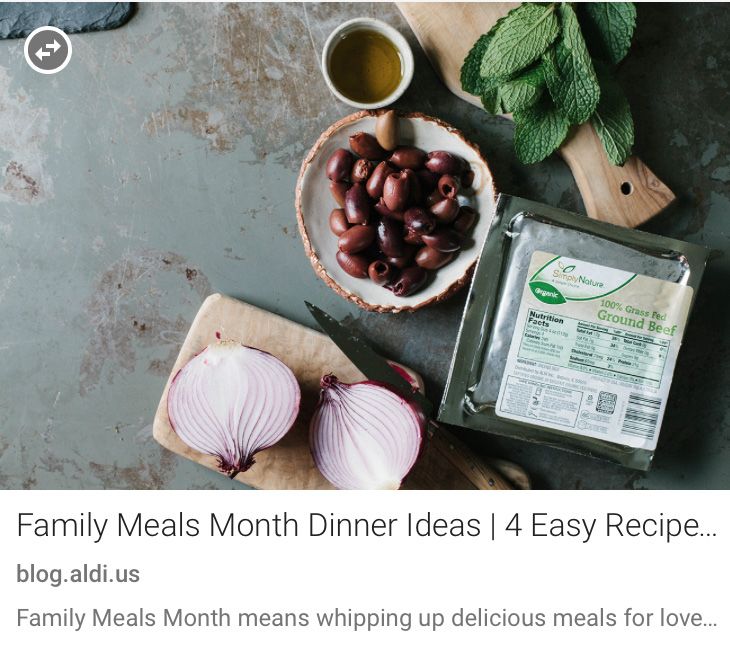
National Family Meals Month™ is a nationwide event designed
to underscore the benefits of family meals and to challenge
consumers to pledge to share one more meal at home per week
with their families using items purchased from the grocery store.
26Category Opportunities Based on the current health trend and the consumer trend that places quality as the most important factor, there is an opportunity to make organic foods more accessible. According to Mintel, 70 percent of consumers are forced to visit more than one store in a shopping trip to meet all their needs. Stores that can provide a one-stop-shop experience will stand out. A strong in-store experience while also keeping up with technology advancement is invaluable in reaching consumers. 27
Competition Analysis
Aldi is a hybrid of a discount grocer and a specialty store due to our narrow selection of food items and aisle of
fun, seasonal items. The consumers who shop at these stores are looking for quality goods at low prices. Aldi
has recently announced plans to remodel and expand over 1,300 U.S. stores by 2020 and aims to expand to
about 2,500 stores by 2022 to further its market position.

Aldi has national and regional competitors, along with a special direct competitor with Aldi’s exact store model
- Lidl. All stores in this discount grocer category seek to have the lowest prices while still maintaining great
quality, freshness and convenience.

                                                                                                                28
LARGE SPECIALTY GROCERY
SAMPLES COUPONS ORGANIC
SELECTION ITEMS PICKUP
X X
X X X X
X X X X X
X X X X X
X X X X X
X
X X X X X
X X X
29National Competitors
Walmart was founded in Rogers, Arkansas in 1962 by the Walton family. Walmart is the
world’s largest company by revenue as well as the largest private employer in the world.
They are best known for low prices, a massive selection and virtually being on every
corner of the street. Their total revenue was $485.9 billion in 2017. Walmart targets
price-sensitive shoppers and wants to make them feel “smart” by focusing on their “live
better” motto. Walmart delivers on their everyday low prices and carries popular, trusted
brands. They also focus on marketing an “easy, fast, one-stop shopping experience.”
Sam’s Club was founded in Midwest City, Oklahoma in 1983. It is a membership-only
retail club owned and operated by Walmart. Sam’s Club sells in bulk, yet has half the
amount of sales as Costco. Sam’s Club’s revenues totaled $14.8 billion in 2017. Sam’s
Club has revamped their strategy recently this year in order to try and outperform
Costco. They committed to focus on respect, service, excellence and integrity.
Convenience has become their main focus and have carried this into their new scan-and-
go app as well as digital displays throughout the store. They have adopted the mission
“to be the membership you love the most.”
Costco was founded in Seattle, Washington in 1983. Costco is a membership warehouse
club and is best known for selling products in bulk, having a wide range of outdoor
products and clothing and for serving plenty of samples. Their total revenue was
$129 billion in 2017. Costco focuses all of their resources on sales volume, so they
do not advertise. They sell a fraction of the brands which increases sales volume and
discounts. The firm’s mission emphasizes quality and cost leadership, which are factors
that consumers usually look for in the retail market. Costco’s generic strategy is cost
leadership, meaning they want to have the lowest prices in their categories. They
have high sales volume and high efficiency, but their membership-only policy limits the
amount of customers they have and makes non-members feel unwelcome.
30Regional Competitors
Meijer was founded in Greenville, Michigan in 1934. About half of the company’s 242
stores are located in Michigan, with additional locations in Illinois, Indiana, Kentucky,
Ohio and Wisconsin. Meijer made $16.6 billion in 2017. Meijer focuses on being
positioned as the one-stop shop and claims to not abandon its large-format stores any
time soon. Recently focusing their efforts on maintaining a good customer experience,
Meijer has tried to adopt the curbside pickup strategy with a flat $5 service fee for
pickup, but is struggling to make it profitable for them.
Save-a-Lot was founded in Cahokia, Illinois in 1977 and is headquartered in Earth City,
Missouri. A majority of Save-A-Lot stores are owned and operated by independent
licensees. Most of these stores are located in small rural communities in Kentucky,
Tennessee, Michigan, Indiana, Ohio, Western Pennsylvania and Western New York. The
store made $3.2 billion in 2017. Save-A-Lot focuses on their exclusive brands, small
store format for a quick and easy shopping experience and low prices. Their locations
are in generally lower income areas where they do not have to pay much for rent. They
also stock mostly dry foods and do not carry organic or fresh produce.
Piggly Wiggly was founded in Memphis, Tennessee in 1916. More than 600
independently owned stores operate in 17 states, primarily in smaller cities and towns
of the Southern and Midwestern parts of the U.S. They made $60.8 million in 2017.
Piggly Wiggly was America’s first self-serve grocery store. They also were the first to
introduce the checkout format and price mark every item in the store. After being
so innovative in the past, they have struggled to stay competitive as bigger stores
have taken their format and capitalized on it. Their newest advertising campaign
communicates to consumers that if they have not shopped at Piggly Wiggly lately,
they are missing out. They focus on high quality and competitive prices.
31Direct Competitor
Lidl is the chief competitor of Aldi. Lidl was founded in 1930 in Germany. The first Lidl
discount store was opened in 1973, copying the Aldi concept. Schwarz Gruppe, the
company that owns and operates Lidl, rigorously removed merchandise that did not sell
from the shelves and cut costs by keeping the size of the retail outlets as small as possible.
Most of Lidl’s locations are in East Coast states. Business Insider reports that Lidl’s prices
ring up as 9 percent cheaper than Walmart and 3 percent cheaper than groceries found
at Aldi. Both stores focus heavily on their private label brands which allows them to keep
prices low, but still have a variety of organic, gluten-free and vegetarian options. Aldi and
Lidl both have their own private label brands of alcohol that have won many prestigious
awards. Aldi has the initial growth advantage over Lidl currently, but Lidl is making
progress.
32What Can We Learn from the Competition? Every competitor focuses on conveying how they either have low prices or an amazing value for their price. We have the lowest prices, so we should continue to emphasize that while conveying that we do not sacrifice value. The most common phrases and feelings among competition in this category are low prices, good value, simplicity, freshness and high standards. Aldi is different than the competition because we have a small format store, specialty items, organic foods and the best brands on the floor within the condensed selection. These differences are what make us stand out and are what will win us over with the consumer who seeks efficiency, values the product itself more than the brand name, appreciates healthy items and will be intrigued with specialty and seasonal items. Seeing the similarities in what the stores in this category choose to focus on allows us to see the things that Aldi does best, the “Aldi Difference.” 33
Consumer Analysis
      Aldi’s Current Consumer

 Average Income $40-60,000

         Caucasian and married

Average age 55+ and college students

         Suburban and rural populations

                                          34
Psychographics
• Not concerned with a wide product range
• Does not need after sale service (packing of the bags)
• Environmentally conscious
• Appreciates locally produced fruits and vegetables
Behavioral
• Wants good quality products at a cheaper price
• Does not need the well-known advertised brands
• Values a quick and efficient in-store experience
• Shops for large, pantry stockings basket sizes (21+ items) TYPICAL PURCHASE CYCLE:
29.2 DAYS
AVERAGE BASKET SIZE:
18.2 ITEMS
AVERAGE BASKET PRICE:
$38.19
35Current Market
The current Aldi customer is typically married and earns a lower income, meaning they have limited money
to spend on groceries. The majority is Caucasian and resides in suburban and rural populations. Essentially,
Aldi is underrepresented in metropolitan areas. The typical customer shops at Aldi to pantry stock and is not
concerned with product range or post-sale service (packing of bags). They value environmentally friendly
packaging and locally produced fruit
and vegetables. These consumers
want high quality products at a
cheaper price and do not need the
well-known, advertised brands.
Current Customer
Perceptions
Aldi customers have the
expectation of purchasing
products with consistent quality
and efficient checkout practices.
Customers expect and appreciate
Aldi’s promises to keep wastage low in all of our marketing practices. Non-loyal consumers often perceive Aldi’s
products to be low quality because of the lower prices.
36Opportunity Market The opportunity market that Aldi is looking to grasp are young millennials aged 22-28. These individuals want fresh, healthy groceries considering their tight budget. This demographic values brands that are socially and environmentally conscious, adept at using technology and have active social media. Shopping Habits “Receptive Value Seekers” do not engage in pre-shopping planning activities, such as scanning newspapers ads or collecting coupons. They are pressed for time and are motivated to process in-store stimuli and make in-store decisions. They want to spend as little time as possible shopping, so they enjoy a smaller store format. They value quality over quantity and are more likely to shop at multiple retailers to ensure the freshness of their food. They are typically smart shoppers who are less price-sensitive and more food savvy. While they are conscious of their personal tastes, they are also adventurous in trying new food choices. 37
Target Profile
Receptive Value Seeker
Insights:

• Health conscious, but not willing to allocate most of their money to buying healthy food
• Justifies buying items on impulse by seeing the value in it rather than the price
• Goes to the store with an idea of what they need to get, but does not stick to a grocery list
• Adventurous in terms of trying new flavors and different products
• Places more importance on the quality of a product than the brand in the purchase decision
  process
• Values a positive shopping experience without crowded aisles and long checkout lines

                                                                                                  38
Consumer Insight “When I go shopping, I don’t bring a grocery list, which is probably why I get sucked into impulse purchases. I choose stores with positive shopping experiences rather than going to chase a deal. I don’t have time to clip coupons or keep up with rewards programs, but I like to know that I am getting a good value. Nutrition is important to me, but it does not dictate my life. I will choose a healthier or organic version of a product if it is something I was already going to buy. I am open to trying new things and love finding new flavors. The quality of a product matters more to me than the brand name. I am willing to try a new product in a different brand, especially choosing the store’s generic brand for cheaper.” 39
SW
                                         • CONFUSION ABOUT
                                           QUALITY PRODUCT
                                           SELECTION
                                         • CONFUSING
•   CONSISTENT STORE FORMAT
                                           OPERATION
•   QUALITY PRODUCT SELECTION
                                         • BRAND LOYALTY
•   LOW PRICES
                                         • NOT A ONE-STOP SHOP

                          OT
•   GROWING COMPANY
                                         • NO LOYALTY/REWARD
•   EMPLOYEE TREATMENT
                                           PROGRAM

•   ALDI RECIPES                         • LOCATION AND
•   POPULARITY OF ORGANIC FOOD             CONVENIENCE LOYALTY
•   PREVALENCE OF IN-STORE SHOPPING      • ONLINE SHOPPING
•   CURATED ITEMS                        • CONVENIENT FOOD
•   STRONG BUSINESS ETHICS                 OPTIONS
•   DELIVERY AND PICKUP SERVICES
•   SOCIAL MEDIA AND WEB PRESENCE
•   ENVIRONMENTALLY FRIENDLY PRACTICES
•   PROMOTIONAL CONTENT

                                                                 40
Strengths • Consistent store format: Unlike many of our competitors, Aldi has a small store with the same aisle layout in each store, leading to less congestion and less time searching for products. • Quality product selection: Two of Aldi’s proof points, quality and selection, relate directly to our available products. All products are tested by employees to ensure great taste and the best value. We carry the most common household products in the most frequently purchased sizes. • Low Prices: Consumers know about Aldi’s low prices due to past promotions and word- of-mouth. • Growing company: Aldi predicts we will have about 2,500 stores in the U.S. by the end of 2022. Almost all of our stores have been or are being renovated to match the new store format and brand image. More than 40 million consumers shop at Aldi per month. • Employee treatment: Aldi values our employees and offers competitive wages, including entry-level positions. Employees complete surveys about workplace quality, and cashiers are allowed to sit while working. 41
Weaknesses
• Confusion about quality product selection: Aldi’s positioning focuses more on price
  and does not mention quality or selection.
• Confusing operation: Aldi requires customers to bring their own shopping bags,
  borrow shopping carts with a quarter and bag their own groceries.
• Brand loyalty: Aldi offers few brands that are not our own private-label brands, which
  may be an issue for consumers who are brand loyal to national brands.
• Not a one-stop-shop: Aldi has a small selection, so consumers may have to shop at
  multiple stores to get everything they need.
• No loyalty/reward program: Aldi does not offer a loyalty or reward program like some
  competitors and does not accept manufacturer coupons.

                                                                                       42
Opportunities • Aldi recipes: Aldi creates recipes using products from our brands on our social media. With the rising popularity of meal kits, these could be turned into meal kits sold in stores. • Popularity of organic food: Organic food is a growing trend in the grocery industry. Aldi sells organic foods and fresh produce, which appeals to our target consumer. • Curated items: Aldi carefully selects the brands and products offered in our stores, which many consumers do not know about. Aldi can communicate our selection process to attract young millennial consumers. • Strong business ethics: Aldi stands by our core values and integrates them into our business practices. Our target consumer is aware of business ethics and considers ethics when making decisions. • Delivery and pickup services: Aldi is partnering with Instacart and plans to offer it at all of our locations by the end of November 2018. This is a growing trend in the category, and Aldi can communicate this as a way to appeal to young millennials. • Social media and web presence: Aldi is beginning to share user-generated content and is encouraging engagement on our social media. Our website has a confusing and outdated layout, which can be updated to be more aesthetically pleasing and user- friendly. 43
• Environmentally-friendly practices: Aldi integrates practices to reduce energy usage
  and food waste. We require consumers to bring their own shopping bags, which
  reduces plastic bag usage. Young millennials place importance on environmentally
  friendly practices, and we can communicate this to appeal to their values.
• Promotional content: Every grocery store, including Aldi, tries to position themselves
  in relation to price or value in their promotional content. Aldi would stand out from the
  clutter by focusing more on quality and selection over price.

Threats
• Location and convenience loyalty: Consumers tend to shop at grocery stores close to
  them, which means they would easily pick a competitor over Aldi if the competitor was
  closer and more convenient for them.
• Online shopping: More grocery competitors are offering online shopping options and
  delivery services or curbside pickup.
• Convenient food options: Most of Aldi’s competitors offer to-go meal options or
  samples. Some grocery stores have in-store restaurants and catering.

                                                                                              44
Key Takeaways As the Situation Analysis team for Aldi, we conducted secondary research and presented a plan to aid Aldi in reaching young millennials as the brand continues to expand within the specialty discount grocer category. The following are our recommendations for further research that can be used by Aldi and teams two and three. Continuously Improve In-Store Experience • Young millennials are more interested in spending their money on experiences rather than possessions. They want their trip to Aldi to be convenient and enjoyable. • These consumers want to spend as little time as possible shopping. They are no longer impressed with quantity, but value quality much more. As a result, smaller retail formats like Aldi have begun to thrive. 45
Emphasize Digital Relevance
• Our target prefers brands with a well-developed social and mobile media presence. These
  consumers are highly adept at using technology and are active social media users. Aldi needs
  to ensure that they have a robust digital position to succeed in this group.
• Aldi’s partnership with companies such as Instacart allows for the brand to reach out to
  consumers on various fronts and to keep up with the digital trends within the category.

Highlight Corporate Social Responsibility (CSR)
• Young millennials associate quality with high brands that have high levels of CSR. They are
  influenced by products marketed as ethical, sustainable or environmentally friendly. Aldi’s
  established business practices would position us well with young millennials.
• Examples of CSR initiatives include environmentally friendly practices and positive employee
  treatment in regard to compensation, benefits and workplace relationships.

                                                                                                 46
Sources https://www.foxbusiness.com/features/discount-grocer-aldi-to-add-about-900-stores-in-u-s-expansion https://www.supermarketnews.com/retail-financial/aldi-kicks-major-product-expansion https://www.esri.com/about/newsroom/publications/wherenext/location-focus-aldi-expands/ https://www.forbes.com/sites/thehartmangroup/2015/04/14/aldi-is-a-growing-menace-to-americas-grocery-retailers/#6a33a8f6f077 https://www.lidl.com https://www.daytondailynews.com/business/surprising-ways-kroger-changing-stores-2018/EKr5JjWkEVV6Rny64z6d8M/ https://www.retailwire.com/discussion/will-hy-vees-grocerant-strategy-set-it-apart-from-rivals/ https://www.businessinsider.com/trader-joes-sales-strategy-2014-10 http://panmore.com/costco-mission-business-model-strategy-swot https://www.businessinsider.com/costcos-simple-strategy-2014-9 https://www.walmartbrandcenter.com/our-brand.aspx https://www.winsightgrocerybusiness.com/retailers/how-aldi-and-lidl-are-shaking-retail https://www.pma.com/content/articles/2017/08/how-consumer-trends-in-grocery-shopping-are-changing-retail https://www.nielsen.com/us/en/insights/news/2017/deep-discount-grocery-stores-are-gaining-share-with-private-label.html https://infoscout.co/retailer/aldi https://www.slideshare.net/paulmuston3/aldi-marketing https://www.npd.com/wps/portal/npd/us/news/tips-trends-takeaways/10-ways-younger-and-older-millennials-shop-differently/ https://scholarworks.wmich.edu/cgi/viewcontent.cgi?referer=https://www.google.com/&httpsredir=1&article=1389&context=hon- ors_theses https://adage.com/article/adagestat/millennial-grocery-shopping-habits-marketing-trends/228480/ https://www.fungglobalretailtech.com/research/millennials-and-grocery-2/ https://www.nielsen.com/uk/en/press-room/2016/millennials-driving-aldi-and-lidl-rise.html https://www.supermarketnews.com/online-retail/aldi-goes-nationwide-instacart https://www.prnewswire.com/news-releases/aldi-ends-2017-with-more-than-200-product-awards-300575236.html http://www.joshuakoenig.com/aldi-common-cents/ http://academic.mintel.com.proxy.mul.missouri.edu/display/860381/# http://academic.mintel.com.proxy.mul.missouri.edu/display/860619/ http://academic.mintel.com.proxy.mul.missouri.edu/display/860573/ 47
http://academic.mintel.com.proxy.mul.missouri.edu/display/860587/
https://techcrunch.com/2018/09/18/instacart-expands-aldi-partnership/
https://corporate.aldi.us/en/newsroom/multimedia-library/aldi-brandproduct-images/
https://corporate.aldi.us/en/newsroom/multimedia-library/aldi-store-images/
https://www.designweek.co.uk/issues/13-19-march-2017/aldi-rebrands-appear-contemporary/
https://www.fmi.org/family-meals-month
https://www.flaticon.com
https://www.glassdoor.com/Salary/ALDI-Salaries-E7337.htm
https://twitter.com/kroger/media
https://blog.aldi.us/family-meals-month-recipes/
https://www.prnewswire.com/news-releases/aldi-named-2018-retailer-of-the-year-300709920.html
https://www.reuters.com/article/us-aldi-delivery/aldi-expands-u-s-instacart-delivery-tie-up-in-time-for-thanksgiving-idUSKCN1LY18U
https://www.delish.com/food-news/a23307102/aldi-grocery-delivery-instacart/
https://www.supermarketnews.com/marketing/aldi-set-kick-national-ad-campaignhttps://www.cookinglight.com/news/new-healthy-
items-at-aldi-taste-price-review
http://bevcooks.com/2017/10/bacon-wrapped-beans-chardonnay-cream-sauce-wine-trip-aldi/
http://www.bravotv.com/the-daily-dish/real-housewives-wine-personality-quiz
https://twitter.com/AldiUSA/status/997149290106585088
https://www.youtube.com/watch?v=GZ1Wg3j2Seo
https://www.mediapost.com/publications/article/325216/aldi-launches-shop-differntli-campaign.html
https://www.supermarketnews.com/print/100554
https://www.independent.co.uk/news/people/the-story-of-karl-albrecht-the-man-who-destroyed-tesco-9621946.html
https://careers.aldi.us/about
https://corporate.aldi.us/en/aldi-history/
https://www.aldi.us/en/about-aldi/our-mission/
https://corporate.aldi.us/en/corporate-responsibility/
https://www.aldi.us/en/about-aldi/twice-as-nice-guarantee/
https://www.aldi.us/en/about-aldi/product-awards/
https://www.prnewswire.com/news-releases/aldi-ends-2017-with-more-than-200-product-awards-300575236.html
https://www.youtube.com/watch?v=9xf2Ee8Rlg0
http://www.slate.com/blogs/browbeat/2013/12/02/aldi_grocery_store_best_in_america_related_to_trader_joe_s.html
https://www.oregonlive.com/window-shop/index.ssf/2015/08/aldi_16_things_to_know.html
                                                                                                                                     48
https://www.businessinsider.com/aldi-store-growth-history-2018-8?r=UK&IR=T#in-1948-albrecht s-sons-karl-and-theo-took-over-the-business-and-expanded-it-to-four-stores-throughout-germany-the-stores-were-called-albrecht-dis- count-2 https://www.businessinsider.com/aldi-store-facts-2018-8#because-of-the-divide-there-are-actually-two-different-aldi-chains-aldi-nord- which-was-controlled-by-theo-albrecht-in-northern-germany-and-aldi-sud-which-was-controlled-by-karl-albrecht-and-operated-in-south- ern-germany-5 https://www.forbes.com/sites/thehartmangroup/2015/04/14/aldi-is-a-growing-menace-to-americas-grocery-retailers/#29e5b2f9f077 https://www.mashed.com/79564/untold-truth-aldi/ https://www.businessinsider.com/lidl-is-opening-stores-in-the-us-2017-5 https://blog.aldi.us/ https://www.facebook.com/ALDI.USA https://twitter.com/AldiUSA https://www.instagram.com/aldiusa/ https://www.pinterest.com/aldiusa/ 49
You can also read


