SMART CAR FEATURES USING EMBEDDED SYSTEMS AND IOT - ARXIV
←
→
Page content transcription
If your browser does not render page correctly, please read the page content below
Smart Car Features using Embedded Systems and IoT

                                                            Abhishek Das 1 Aditya Desai 1 Vivek Dhuri 1 Suyash Ail 1 Ameya Kadam 2

                                        1. Abstract
                                        There has been a tremendous rise in technological advances
                                        in the field of automobiles and autonomous vehicles. With
arXiv:2101.00496v1 [cs.HC] 2 Jan 2021

                                        the increase in the number of driven vehicles, the safety
                                        concerns with the same have also risen. The cases of acci-
                                        dents and life-threatening injuries have skyrocketed. It has
                                        become a necessity to provide adequate safety measures in
                                        automobiles. This project aims to develop a prototype for a
                                        smart vehicle system that provides real-time location of the
                                        vehicle on detection of a crash and alert the police station
                                        and relatives of the user, it has a panic button feature for a
                                        passenger’s safety. We also demonstrate a mechanism for
                                        cabin monitoring and an interactive interface between a user
                                        and a car, where the user can inquire about the temperature,
                                        humidity, and other variables inside the car remotely by
                                        sending a text message to the GSM module which is present
                                        in the car. The GSM module connects to the Arduino, which
                                        fetches the readings from sensors attached to it and sends
                                        it back to the user through a text message. We show the
                                        integration of MQ3 Alcohol sensor with Arduino for drunk                   Figure 1. Block Diagram of Proposed Model
                                        driving prevention.

                                                                                                          shows the block diagram for our prototype.
                                        2. Introduction
                                                                                                          The primary objective of this project is to show how various
                                        Driver safety has been an important feature in automobiles        sensors can be integrated to the Arduino or any microcon-
                                        that have been made compulsion in various countries. An           troller system, how to communicate with such a system
                                        increasing number of amateur rash drivers, careless driving,      remotely using technologies like GSM and GPS technology,
                                        and delayed access to first aid to victims has been a ma-         send commands to inquire about the sensor readings and
                                        jor cause of deaths. Cases of harassment, robbery in cabs         perform desired actions by using the actuators connected
                                        are rising with more people using modern-day cab services.        to the system. We have developed a low-cost prototype to
                                        Driver fatigue monitoring, accident prevention measures,          demonstrate our ideas and create a baseline implementation
                                        GPS-based location and nearest hospital alert, smart brak-        for research purposes in this relatively new domain of the
                                        ing systems, smart airbags, etc. are some of the features         Internet of Things. With the recent developments in the
                                        currently implemented in a few of the high-end luxury-level       capacity to process enormous amount of data from sensors,
                                        vehicles. There hasn’t been a cost-efficient model developed      as well as communication technologies such as 5G, we be-
                                        for the low-end budget cars. It is important to provide ac-       lieve our ideas can be scaled and deployed in real-time. The
                                        cessible safety measures in the vehicle to minimize the risk      scripts have been made publicly available to the research
                                        of loss of life. This project aims to develop a cost-efficient    community for further development here.
                                        smart vehicle system that can help aid the cause. Figure 1
                                                                                                          In what follows, we discuss the related prior work for such
                                           1
                                             UG. Student, Department of Electronics and Telecommunica-    a problem in the next section (3), followed by defining the
                                        tion, DJSCE, Mumbai, India 2 Assistant Professor, Department of   Experimental Setup (4) and discussing our novel approaches
                                        Electronics and Telecommunication, DJSCE, Mumbai, India.
                                                                                                          in section (5), followed with its results and discussion in
                                                                                                          section (6). Finally, we end the discussion with conclusion
                                                                                                          and future directions in the last section (7).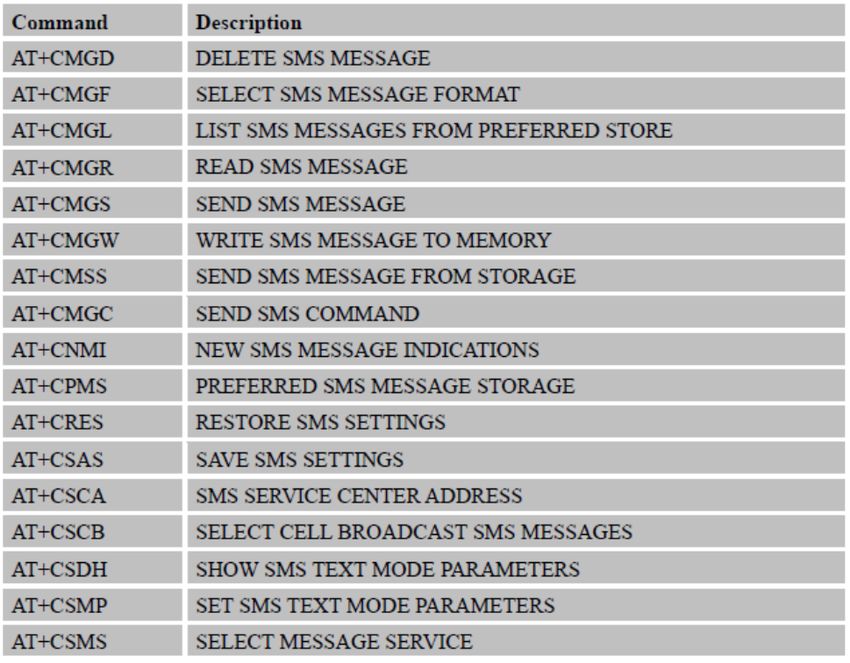
Smart Car Features using Embedded Systems and IoT

              Figure 2. GSM SIM 900A module                          Figure 3. Basic AT commands used with GSM module

                                                                 data sets is currently unavailable. However, with the devel-
3. Related Work
                                                                 opment in Internet of Things, in the future, this might be
According to a Statistical Report (ind, 2016) published by       possible using Vehicle to Vehicle Communications. Nowa-
the Department of Roads and Highways Transport on Vehi-          days, a large population of people chooses to travel by cabs
cle Mishaps in the country in 2016, the country has recorded     and hence, keeping in mind the safety of the commuters, it
4,60,852 accidents in the year resulting in 1,45,685 deaths.     is the need of the hour for developing such products.
Approximately 423 people died in 1,227 vehicle accidents
                                                                 Another study by (deu) mentions that according to National
every day. The data also states that at least 16 deaths occur-
                                                                 Crime Records Bureau (NCRB) report, drunk driving was a
ring in vehicle mishaps out of 55 accidents in every hour
                                                                 major factor in road accidents. 99 per cent of the fatal acci-
in a particular period were primarily because victims were
                                                                 dents that occur on the Highways are due to drunk driving
unable to receive suitable treatment within time. Thus, if an
                                                                 and there is no check on this. Majority of these accidents
alert system is made and an alarm is raised, it might become
                                                                 involved trucks since the truck drivers drive irresponsibly
possible to save many lives.
                                                                 when they are fully drunk. Until and unless the nation starts
There has been prior work in the area of using GSM and GPS       a new system of checking drunk driving on the highways,
systems along with microcontrollers (Shinde et al., 2015)        these fatalities cannot be reduced, as mentioned by a Joint
developed a similar tracking system using an Embedded            Commissioner of Police. The current system of Drunk driver
Linux board namely Raspberry Pi and a GSM SIM900A                checking requires traffic police to make people blow into
module. The objective of their tracker was to raise an alert     the breath-analyzers. However, it is not sufficient to check
whenever the vehicle deviated from the predefined route          every instance of drunk driving cases due to the presence
which was set in the Raspberry Pi by the user. It also had       of an enormous number of vehicles on roads and especially
features for sending notifications when the vehicle exceeded     outside cities and highways. Thus, an automatic monitoring
a set speed limit. (Saaid et al., 2014) implemented a vehicle    system is needed to tackle this problem.
location finder using a similar combination of GSM and
GPS systems particularly for the task of vehicle thefts.         4. Experimental Setup
The use of panic buttons in vehicles is a idea which hasn’t
                                                                 4.1. GSM SMS Alert System
been deployed in real-life applications yet. According to the
newspaper article (hin, 2016), the Parliament of India will      SIM900A Modem is built with Dual Band GSM/ GPRS
make it compulsory from 1st of April 2018 for all public         based SIM900A modem from SIMCOM. It works on fre-
transport vehicles which include buses and cabs to have a        quencies 900/ 1800 MHz SIM900A can search these two
location tracker device and one or more panic buttons to         bands automatically. The baud rate is configurable from
alert the authorities in case of an emergency. Although, the     1200-115200 through AT command. This is a complete
government has not made the installation of cameras in these     GSM module in an SMT type and designed with a very
vehicles mandatory, primarily citing privacy concerns and        powerful single-chip processor integrating AMR926EJ-S
due to the factor that it will generate tremendous amounts       core, allowing you to benefit from small dimensions and
of data every second. The technology to process such huge        cost-effective solutions. Figure 2 shows a GSM SIM900A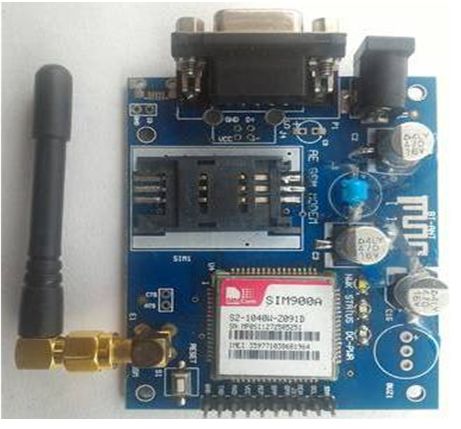
Smart Car Features using Embedded Systems and IoT

                 Figure 4. Neo 6m GPS module                                    Figure 6. SW420 Impact Sensor

Figure 5. Triggering of Airbag circuitry and Accident Alert
                                                                                 Figure 7. MQ3 Ethanol Sensor

module.
                                                                 the Arduino computer program software which is an open-
4.2. GPS Tracking                                                source IDE. The Arduino has a vast support community,
The NEO-6m module shown in Figure 4 is a stand-alone             which makes it a very easy way to get started working with
GPS receiver featuring the high-performance u-blox 6 posi-       it.
tioning engines. It is a flexible and cost-effective receiver
that offers numerous connectivity options in a mini 160 x        5. Proposed Methodology
122 x 24 cm package. It has a compact architecture and
power and memory options which makes NEO-6m modules              5.1. Accident Detection
optimal for space constraint, low-cost devices. It has an        When a car hits something with a strong force, it starts
acquisition engine, and 2 million effective correlators, and     to decelerate very rapidly. An Impact Sensor detects the
can make enormous parallel frequency searches, thus it can       change of velocity/amount of vibration. If the impact is
find a satellite within a small time. This 50-channel u-blox     great enough, the impact sensor triggers the airbag circuit
6 positioning engine gives a Time to First Fix of around 1-2     and at the same time, it signals the Arduino to send an alert.
seconds. It has an anti-jamming technology, Eeprom for           Thus, when the impact is severe, the Arduino extracts the
storing settings which gives these receivers fantastic naviga-   location by signalling the GPS module which connects with
tion performance even when placed in extremely difficult         the GPS satellites and retrieves the location of the car. This
environments.                                                    location co-ordinates along with a google map link are sent
                                                                 to the designated mobile number in an SMS form through
4.3. Arduino Uno Development Board                               the GSM module.
Arduino Uno is a development board based on a dual-inline-       The SW420 sensor module gives outputs as ‘1’s or ‘0’s
package ATmega328 AVR microcontroller (Mazidi et al.,            depending on vibration, tilt, and external force applied to it.
2005). It has 20 digital input/ output pins, 6 of them can be    In absence of vibration, this module gives logic ‘0’ as output
used as Pulse Width Modulated (Holtz, 1992) outputs and 6        and in presence of vibration, it gives logic ‘1’ as output. It
can be used as analog inputs. It has a 16 MHz crystal, a USB     has sensitivity control on the board. Figure 6 shows the
port, an ICSP header. Programs can be loaded onto it from        SW420 impact sensor which we have used in our prototype.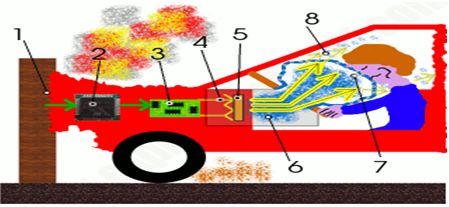
Smart Car Features using Embedded Systems and IoT

                 Figure 8. Rain Sensor Module

5.2. Passenger Safety                                                           Figure 9. Demonstration of Prototype

A panic button is placed such that whenever a passenger
feels terror and discomfort due to certain reasons, an alert       digital output pin to indicate whether water is present or not
message is raised by sending an SMS on pressing the button.        and an analog output pin to give a measure of the intensity
There can be multiple panic buttons placed at different spots      of water. The module has a power indicator led and separate
in the vehicle and connected to the Arduino.                       control board.
                                                                   A servo motor primarily contains a suitable motor, a gear
5.3. Drunk Driver Prevention                                       reduction unit, a position measurement sensor, an control
In this proposed system, an MQ-3 Ethanol Sensor as in              circuitry. Servo motor is a highly precise motor in terms
Figure 7 is placed on the steering of the car or seat belt of      of rotating angle. These are lightweight, low cost, com-
the driver seat, such that it can monitor the percentage of        pact motors that can be easily integrated into any circuits.
alcohol in the breath of the driver. If it is found to be higher   The DC motor is connected to the gear unit which gives
than set limits, then the Arduino signals the GSM to send an       feedback to the position sensor. The potentiometer adjusts
alert for the same to the driver’s predefined safety number        displacement according to the present position of the motor
(such as a home number). Measures can also include not to          shaft. As the resistance changes, the differential voltage is
start the car engine unless the alcohol percentage reduces.        generated. A PWM wave is given to the control wire which
When the user exhales, any ethanol present in their breath         is transformed into voltage and is compared to the signal
is oxidized to acetic acid. At the cathode, oxygen from the        generated from the position sensor module. The control pin
atmosphere is reduced. The overall reaction is the oxidation       is connected to the Arduino’s PWM enabled pins.
of ethyl alcohol. The charge flow produced by this reaction
is measured and resistance is calculated, which results in         6. Results and Discussion
the different levels of intoxication that the Arduino will
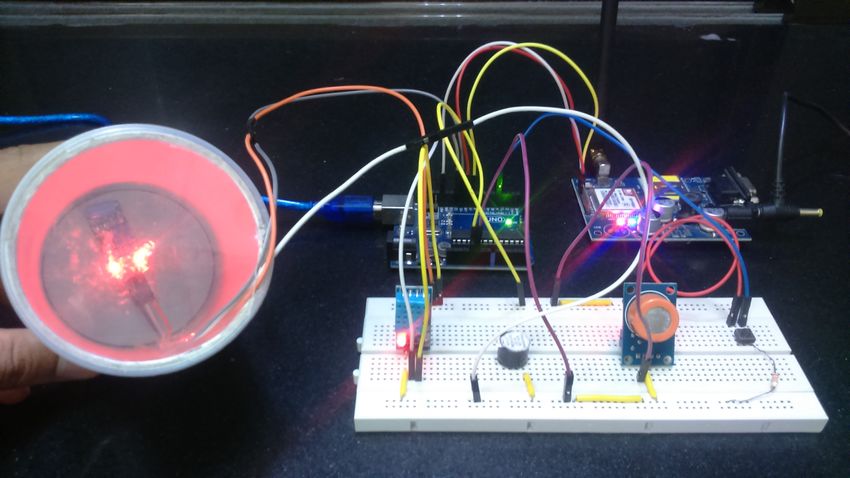
determine.                                                         Figure 9 shows the prototype we have developed for demon-
                                                                   stration. Figure 10 shows the screenshot of an alert sent
                                                                   by our system on detection of an accident. The text mes-
5.4. Rain Sensing Automatic Wiper
                                                                   sage has information about the location coordinates of the
Car wipers in existing models are controlled manually by           car. The message could be sent to a police station or an
the driver. Some of the high-end cars have this feature, but       designated relative by presetting the number in the system.
due to cost factors, they have not yet made their way into         Similarly, Figure 11 shows the screenshot of the message
normal vehicles. A cost-effective version of it is proposed        delivered when the panic button in the vehicle is pressed. It
in this project which includes a rain-drop sensor shown in         has the location coordinated and the link to open it on the
Figure 8 connected to the microcontroller, which is Arduino        Google Map. In addition to these alerts, various other infor-
in this case. The rain sensor detects rain and sends the           mation can be sent in case of an emergency by modifying
corresponding signal to the Arduino. This signal is then           the code in the system.
processed by the Arduino to take the desired action. The rain
sensor consists of nickel tracks which when gets connected         7. Conclusion and Future Directions
by water droplets in between the two tracks, the circuit gets
connected and it detects rain. The raindrop sensor module          The sensors and equipment proposed in this prototype are
is low cost and precise for raindrop detection. Its sensitivity    low cost and efficient to a great extent, however in order to
can be changed by rotating the screw on the board. It has a        integrate this features with an existing vehicle’s embedded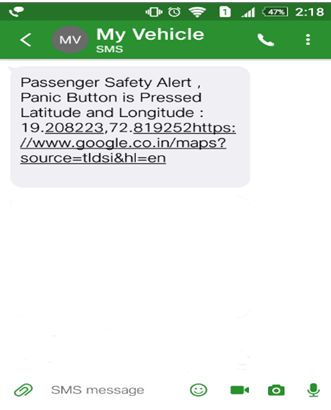
Smart Car Features using Embedded Systems and IoT

                                                    system, a much more compact unit need to be built, which
                                                    can be added on-chip. We believe that with the develop-
                                                    ment of more high quality and accurate sensors, much more
                                                    desirable and reliable outputs can be obtained.
                                                    The main purpose of our demonstrations was to put forward
                                                    our research ideas with the hope of being further developed
                                                    by the community and finally being scaled and deployed by
                                                    the autonomous vehicle industry.

                                                    References
                                                    India has the highest number of road accidents in the world.
                                                      Deutsche Welle. Article.
                                                    Public transport vehicles to get gps, panic buttons from 2018.
                                                      HindustanTimes, Dec 2016. Article.

                                                    Road accidents in india, 2016: 17 deaths on roads every
                                                      hour, chennai and delhi most dangerous. Indian Express,
                                                      2016. Article.
                                                    Holtz, J. Pulsewidth modulation-a survey. IEEE transac-
                                                      tions on Industrial Electronics, 39(5):410–420, 1992.

                                                    Mazidi, M. A., Mazidi, J. G., and McKinlay, R. D. The 8051
                                                     microcontroller and embedded systems using assembly
Figure 10. SMS sent for Accident detection           and C. Dept. of Computer Science and Information Engi-
                                                     neering National Cheng Kung . . . , 2005.

                                                    Saaid, M., Kamaludin, M., and Ali, M. M. Vehicle location
                                                      finder using global position system and global system for
                                                      mobile. In 2014 IEEE 5th Control and System Graduate
                                                      Research Colloquium, pp. 279–284. IEEE, 2014.
                                                    Shinde, P. A., Mane, Y., and Tarange, P. H. Real time vehicle
                                                      monitoring and tracking system based on embedded linux
                                                      board and android application. In 2015 International Con-
                                                      ference on Circuits, Power and Computing Technologies
                                                      [ICCPCT-2015], pp. 1–7. IEEE, 2015.

      Figure 11. Panic Button Alert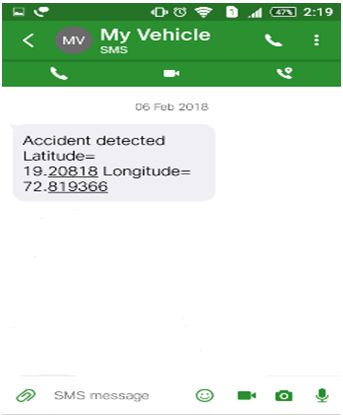
You can also read


