State of Play: Queen Conch Fisheries and Trade in Saint Lucia
←
→
Page content transcription
If your browser does not render page correctly, please read the page content below
State of Play:
    Queen Conch Fisheries and
       Trade in Saint Lucia
Regional stakeholder webinar on Blue BioTrade and BioTrade Principles and Criteria including
                        CITES requirements March 22 – 23, 2021
                                                                                                                   Presented by:
                                                                                                       Mrs Sarita Williams-Peter
                                                                                                           Chief Fisheries Officer
                                                        Department of Agriculture, Fisheries, Natural Resources and Co-operatives
                                                                                                                     SAINT LUCIA
                                                                                                      Email: Sarita.peter@govt.lc
                                                                                                          Tel: +(758)468-4135/83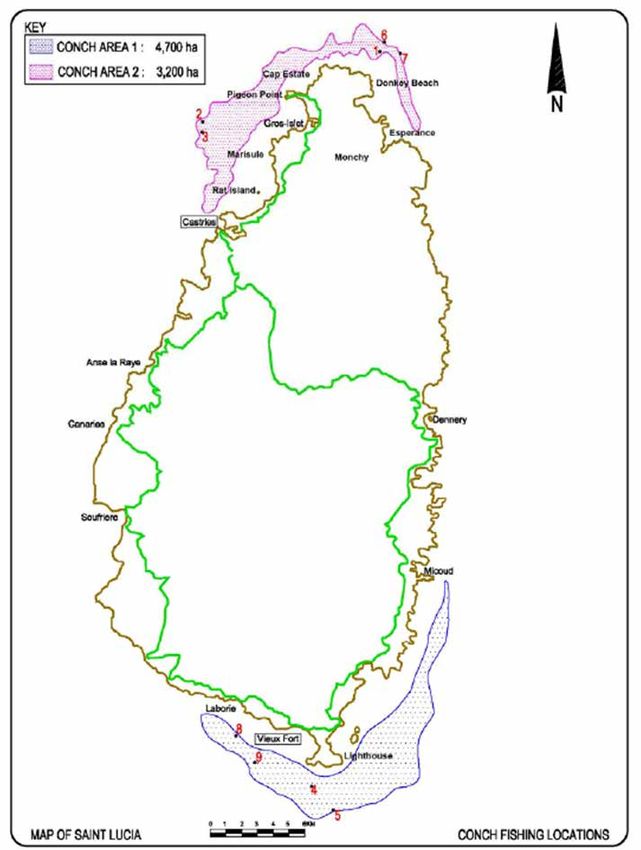
Overview of the Conch Fishery
Fleet size, Production, Harvest methods, fishing locations, ecology and stock
information, and main markets
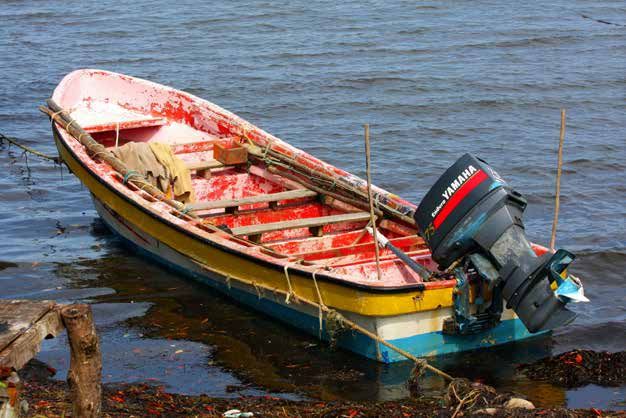
Fleet size

• Open fibreglass pirogues
   •   Number: 10 vessels
   •   length: 7.02 – 8.45 m
   •   Outboard engine: 115 – 250 hp
   •   Day trips
                                          INSERT PICTURE OF VESSEL WITH CONCH CATCH

• No. of Fishers
   • Approx. 40 fishers
   • (Boat owner, Diver, Captain, Crew)
   • Male only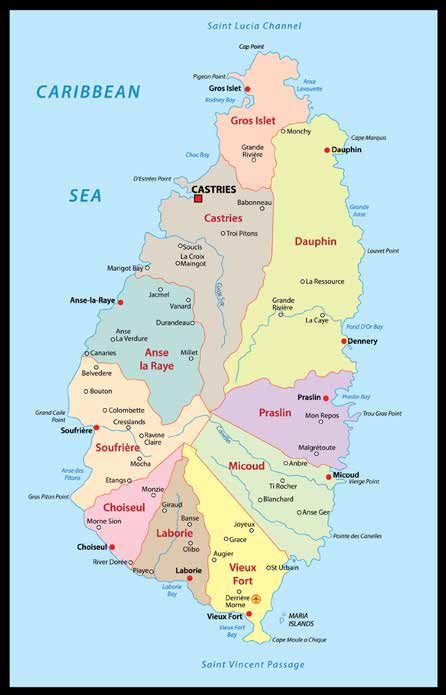
Production
 Total est. landings: 1397.61mt (1993 to 2020)
 Processed grade: “dirty” meat weight (Complete animal extracted from the shell)
                                                                                                                                                                                    Avg. 71.41mt
                                                                                              Est. Conch weight (mt)
120,00

                                                                                        Avg. 41.21mt
                        Avg. 32.80mt
                                                                                                                                                                                     96,82           98,58
100,00
                                                                                                                                                                                             91,74

                                                                                                                                                                     81,59                                             COVID 19
 80,00                                                                                                                                                                                                       74,61
                                                                                                                                                                                                                       Pandemic
                                                                                                                                                                             71,89
                                                                                                                                                                                                                     68,91
                                 65,00
                                                                                                                                                             62,59
                                                                               60,44
 60,00

                                                                                       47,51 45,60
                                                 41,80           40,30 41,40                         41,96           41,01
                                                                                                                             37,72                   39,41
 40,00                                                                                                       34,71                   34,39
                         31,92                           33,31
                                                                                                                                             28,29                                                                           28,5
                                         24,53
                 19,75
 20,00
         13,31

  0,00
         1993    1994    1995    1996    1997    1998    1999    2000   2001   2002    2003   2004   2005    2006    2007    2008    2009    2010    2011    2012    2013    2014    2015    2016    2017    2018    2019    2020

  #Moving average trend line
Production Value
• On average the ex-                                                   Ex-vessel Value of Conch
  vessel value represents     $3.500.000

  7% of the total ex-         $3.000.000

  vessel value of the total   $2.500.000

  marine capture              $2.000.000

  landings
                              $1.500.000

• Ex-vessel est. value
  ranged over XCD600,00
                              $1.000.000

  991(2000) to XCD3.2          $500.000

  million ( 2017 )                   $0
                                           2000 2001 2002 2003 2004 2005 2006 2007 2008 2009 2010 2011 2012 2013 2014 2015 2016 2017 2018 2019 2020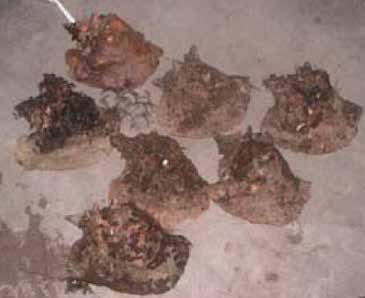
Location of stock
• General Conch area (2008):
   • Preliminary - North (est. 4700ha) and
     South (est. 3200ha)
      • Suitable habitat type not considered
   • Some fishers report that conch is found
     island-wide at depths above 80ft (24m)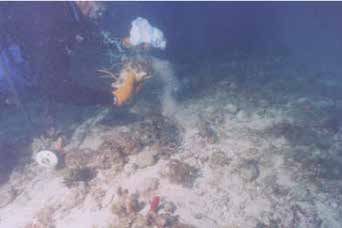
Harvest methods

• Main gear: SCUBA
• Gill nets and free diving in areas along the west and southwest coasts
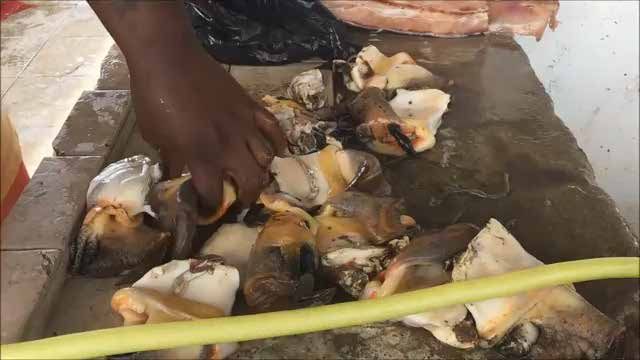
• Majority of Conch meat extracted at sea on vessel, some landed
  whole (in shell)
   • allows transporting higher volumes of conch meat per fishing trip at greater
     speed.
• Meat extraction: cutting a small hole in the spire and severing the
  columnar muscle attached
• Shell typically disposed in the sea
Main Fishing communities

• GROS ISLET and LABORIE
Ecological and stock information
• Stock abundance
   • CPUE (1996 – 2007) shows decline in stock;
     (effort – No. of tanks)
   • Preliminary - Conch average density – 242in./ha
     (2008)
• Majority of fishers reported no change in
  abundance or more
• Stock assessment:
   • Total allowable catch (harvest quota), up to 30
     tonnes per year (2009)
   • Concern with data reliability; Est. of areas of
     fishing grounds and conch density.
• Morphological differences between stock
  from North and South west suggesting
  possible two populations - challenges for
  application of management measures.
Main markets
By-Product LOCAL MARKET EXPORT IMPORT
SHELL Low value. Used as decoration items by Retail value: USD 1.00 – USD 5.00 NONE
local population, also as backfilling (mainly international tourist)
Ex-vessel value: Free – XCD1.00;
MEAT Dirty meat sold; fishers remove shell Limited; Full extent of unregulated Mainly from Saint
Ex-vessel value: XCD10.00 – 16.00 lb; exports unknown. Vincent and the
avg. XCD14.00. Sold to supermarkets; Visitors from neighbouring island Grenadines both
vendors purchase when visiting Saint Lucia regulated and
bringing in significant foreign unregulated by
Retail processors: up to XCD 22.00 lb exchange. fishers directly and
Community Fish frys and restaurants: distributors
primarily grilled approx. 1 cup XCD25.00
PEARL Unknown Pearls are retailed by fishers to TBD
intermediary purchasers who sell to
jewelry stores overseas based on
CITES permit. E.g. USA, Canada ;
price varies (negotiated)
OTHER Unknown Unknown TBDGovernance Policy and Legislation
Main Policy Environment
• Fisheries Policy (draft) 2020
• Plan to management of the Fisheries of Saint Lucia (draft) 2006- 2011
   • Outlines a conch Management Plan
• Sectoral Adaptation Strategic Action Plan
• Ocean Policy and SAP
Main Legislation
• Fisheries Act Cap. 7.15 of the Revised Laws of Saint Lucia
• All local fishing vessels must be licensed and special conditions are
  applied.
   • E.g. Permission to use various gear types such as SCUBA
Main legislation

• Regulation 35 of the
  Fisheries Act, Cap 7.15 of
  the Revised Laws of Saint
  Lucia
   • Closed Season is not
     applied.

• Regulation 27 (f) of the
  Fisheries Act
   • Sportfishing rules
Main government institution interests
Government Institution Role Contact
Department of Fisheries Resource Management
Fishery and Associated Ecosystem
Department of Environmental Food safety
Health
involved in fishery (all both primary
and secondary, SPS, health, vetenary
trade etc)
Veterinary and Livestock Services Animal Health
Division
Customs and Excise Department
Royal Saint Lucia Police Force
Department of Sustainable Prevention of Land Based sources of Lavina Alexander
Development pollution
Coastal zone Management
CommerceCITES focal point
• Scientific Authority
• Fisheries Department (Chief Fisheries Officer)
Department of Agriculture, Fisheries, Natural Resources and Co-operatives
• Management Authority
• Department of Agriculture, Fisheries, Natural Resources and Co-operatives
(Permanent Secretary)
Ministry of Agriculture, Food Production, Fisheries and Rural DevelopmentMain Challenges Socio-economic, Environmental, Administrative
Socio-Economic Challenges
• The depth at which the conch is being fished possesses threats to fishers’
  health and is a limiting factor on the number of dives that are being
  conducted.
• Decompression sickness is the main reason fishers leave the fishery.
• Conch Divers report that they would not encourage close relative to enter
  fishery due to high risk.
• Conch Divers do not have medical insurance coverage to support
  treatment for decompression sickness.
• Access to EU markets (e.g. Martinique)
• Limited capacity to monitor value chain
Environmental Challenges
• Morphological differences among various conch populations in Saint Lucia
  have implications for management measures
• Information on stocks is still scarce, especially information on density,
  abundance and distribution. Scarcity of this information limits the
  reliability of current stock assessments.
• Data and information limitations:
   • Habitat maps for both fished and non fished areas.
   • Sustainable catch and effort data with depth estimates
   • Depth and Conch behaviour limits ability to fine tune conduct conch assessments
     previously done.
• Land based sources of pollution impact on health and availability of
  suitable habitat; particularly issues of siltation of seafloor and loss of
  seagrass.
• The topography of the sea floor within Saint Lucia’s Exclusive Economic
  Zone is a limiting factor to conduct surveys and presents a challenge in
  determining the true status of the stock.
Administrative Challenges • Although biological data have been collected in the past for this species, the collection of such data has not been sustained after the termination of externally funded projects. • Conch obtained from fishers in neighbouring islands between borders – business partnerships • Value of fishery may be less than investments to enhance monitoring. • Limited capacity to sustain effective monitoring and evaluation
Opportunities
Opportunities
                                                       • Markets – Market Access, marketing etc
                                                           • Meat export for foreign exchange (e.g.
                                                             Martinique, France)
• Technology                                               • Higher value for pearls
    • Tenderising                                          • Alternative use for shells and other parts of
    • Mapping (using participatory GIS) of habitats,         animal discarded (viscera, claw, operculum, tips
      resource distribution and other features               of proboscis, eye stalk, verge)

• Monitoring, enforcement and traceability             • Closed areas for conch fishing through Co-
    • NPOA - IUU                                         management approaches and enhance
    • Enhance reporting between agencies (Customs,       management of seagrass habitats
      Police, Fisheries)

• Harvest and Safety                                   • Strengthen tourism expenditure
    • Conditions of licence
        • Oxygen kits as part of safety gear           • Support gender mainstreaming through the
                                                         value chain of the fishery
        • SCUBA certification

                                                       • *Reduce input costs
• Enhance KAP and infrastructure for cold
chain management
Thank you
Sources of Information
• FAO Western Central Atlantic Fishery Commission. Report of the
  second meeting of the CFMC/OSPESCA/WECAFC/CRFM Working
  Group on Queen Conch, Panama City, Panama, 18–20 November
  2014http://www.fao.org/3/i5587t/i5587t.pdf
• CRFM 2009. CRFM Fishery Report - 2009. Volume 1. Report of Fifth
  Annual Scientific Meeting – Kingstown, St. Vincent and the
  Grenadines, 09-18 June 2009. 167p.
• Fisheries Department, Saint Lucia
• King-Joseph, A et al. 2008. Conch Resource Assessment Study
You can also read


