Stem Cell Models for Environmental Health
←
→
Page content transcription
If your browser does not render page correctly, please read the page content below
february 2011

                                            Stem Cell Models for
                                            Environmental Health
                  Introduction
               On June 3–4, 2010, the National Research Council’s Standing Committee on the Use of Emerging
             Science for Environmental Health Decisions held a public meeting to further understanding of
           the utility of stem cell models in evaluating the environmental stressors that affect human health.
         Toxicologists and environmental health regulators learned about state-of-the-art stem cell models,
       including human cells that are derived from embryos, induced pluripotent stem cells, and adult lineage-
      restricted stem cells, which could be used to inform environmental health decisions. Stem cell biologists
     learned more about the critical questions challenging environmental health scientists.

       Stem cells have received much attention because              self-renew in culture, are also thought to be
   of their potential therapeutic applications, but in the          pluripotent.
  short term their expected value as research tools                     Jane Lebkowski (Geron Corporation) explained
  may be even greater. This is because stem cells have              how pluripotent embryonic stem cells can be
 the special property of being able to differentiate to             manipulated to produce more than 200 specific
produce a wide variety of cell types—a property that                cell types corresponding to all the major lineages
enables them to be used to model aspects of human                   (types of cells) and to more immature cells that can
biology that have been largely inaccessible to study by             be used for studying developmental processes. The
other means.                                                        main reason that stem cells can be manipulated to
                                                                    produce so many cell types is that they retain the
Stem Cell Basics                                                    plasticity to express the DNA sequences required
After a human egg and a sperm merge at fertilization,               to produce different types of cells, said M. William
the cells of the resulting two-cell embryo are thought              Lensch (Harvard University). Other cells also
 for the first 1 to 2 days to be totipotent, that is,               contain the full DNA complement that is required
  capable of forming every cell type of the placenta and            to produce all types of cells, but they lack the plas-
   the body. During the next 4 to 5 days, the embryo                ticity that stem cells have. Changing the conditions
    becomes a blastocyst—a hollow ball of cells with an             in which stem cells are cultured, adding components
     outer layer that will become the placenta and an               to or subtracting components from the medium,
      inner cell mass that is comprised of cells that are           can alter their fate.
       pluripotent, that is, capable of forming every cell              Another special property of stem cells is that
        type of the body except placenta cells. Human               they are immortal. This is in contrast with somatic
          embryonic stem cells, which are collected                 cells that make up almost all the body and have a
           from the inner cell mass and continuously                limited life span. Lebkowski pointed out that the

            This newsletter reflects the views of individuals and ideas presented at the meeting—they do not represent either
             formal consensus conclusions of the attendees or positions necessarily endorsed by the National Research Council.
immortality of stem cells allows them to be prop- create stem cells is controversial because of the
agated indefinitely, and it enables companies like potential, although unlikely, of cloning the person
Geron to produce very large, well-characterized who donated the cells. It should be emphasized
cell banks for many types of applications. For that the technology has not been successful in
example, Geron is already producing heart-muscle creating embryonic stem cells except in the mouse
cells (cardiomyocytes) derived from embryonic and would, in any case, cross a second ethical
stem cells in lot sizes of 100 billion. boundary, the destruction of many human eggs.
Lebkowski went on to explain that toxicity Roberts next described induced pluripotent
testing using stem cell models is already under stem cells (iPS cells). iPS cells are not derived
way. Research by ChanTest, a company that from embryos or via cloning technologies, so their
performs screening for drug development, shows use sidesteps the ethical issues discussed above.
that cardiomyocytes produced from embry- Instead, they are created from cells that are easily
onic stem cells can be used to detect potentially obtainable from adults or children. The method of
toxic compounds. Cardiomyocytes in culture can producing iPS cells, realized in the last few years,
produce a coordinated contraction similar to a constitutes a substantial scientific breakthrough.
heartbeat. Hence, it is possible to test effects of Cells that are given specific “factors” can be repro-
chemicals directly by measuring their effects on grammed to behave more like embryonic stem
contractility with methods similar to those used cells. iPS cells can be created in a matter of weeks
to measure heart function. In fact, she said, the and, of interest to researchers exploring stem-cell
company’s testing showed that cardiomyocytes therapy, theoretically can be put back into the host
could predict problems beyond those detected without eliciting an immune reaction.
with the classic rabbit Purkinje-cell test used to Although the use of iPS cells avoids many
assess a compound’s arrhythmic risk. A cardio- ethical issues, it raises technical concerns. There
myocyte is just one type of cell. Worldwide, many are reports that iPS cells have a limited lifespan in
different groups are interested in using embryonic culture, although Roberts said that this may
stem cells to produce other cell types for toxicity depend on the age of the cells from which they
testing, including neural, intestinal, pancreatic were developed. Other reports suggest that iPS
islet, endothelial, hematopoietic, retinal, bone, cells have a limited potential to differentiate and
and cartilage cells. In contrast with many of the that cell lines generated from different kinds of
screening approaches used currently, some scien-
tists envision that those panels of cells will be
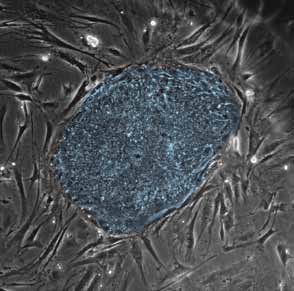
Credit: Clay Glennon, University of Wisconsin-Madison
much better barometers of potential toxic effects
in humans.
In reviewing stem cell basics, Michael Roberts
(University of Missouri) summarized two nonsci-
entific concerns that have been expressed. Some
people are opposed to the use of embryonic stem
cells because creating them requires at least the
Human embryonic stem cells
partial destruction of spare embryos that were
produced as a result of in vitro fertilization (IVF)
treatments. However, he noted, they would other-
wise be discarded. Another concern involves the
derivation of human stem cells via cloning tech-
niques similar to the ones that produced Dolly the
sheep. The idea of using cloning technologies to
2somatic cells behave and differentiate differently, have a rare genetically mediated form of autism
possibly because they carry an “epigenetic called Timothy syndrome.
memory” of their origins. In this regard, different Although the Stanford researchers have not
lineages have different potential. Lensch pointed yet used iPS cells to study environmental triggers
out that the reprogramming process for producing of autism, Dolmetsch believes “that at least in
iPS cells creates a mixed cell population. Some principle it is doable.” Relatively homogeneous
cells are almost completely reprogrammed, and populations of neuronal precursors, which can be
others are not. There is also evidence that the made in large quantities, are good candidates for
reprogramming process does not completely this kind of screening. Dolmetsch thinks it likely
reset the pluripotent state. Nonetheless, these that researchers can use these cells to produce
cells have many interesting applications. For a system that is amenable to high-throughput
example, researchers have used them to model screening. In summarizing, Dolmetsch cautioned
complex genetic diseases, such as using them to that the goal is complicated by the fact that
identify genes that make people who have Down researchers are still trying to identify genetic
syndrome more or less susceptible to some links with autism. In addition, researchers lack key
tumors, as described by Lensch. information, for example, how much of any given
chemical gets into the brain of a developing child
Using Stem Cells to Understand the and for how long.
Role of Environmental Chemicals
Breast cancer
in Disease
Zena Werb (University of California, San Francisco)
Autism researches the role of stem cells in breast cancer.
Ricardo Dolmetsch (Stanford University) is using She is using many experimental systems, including
human stem cells to investigate autism-spectrum mouse models and human tissue grown in mice.
disorders that many believe have both genetic Werb told meeting attendees that there are
and environmental components. Dolmetsch told two kinds of pluripotent stem cells: (1) the actively
conference attendees that the incidence of autism proliferating population (more numerous) and
has been rising and that, although some circum- (2) the quiescent type (much rarer). Both help to
stantial evidence points to environmental agents, maintain the body. The actively proliferating cells
there is not much strong scientific evidence. tend to be involved in routine, day-to-day tasks
Identifying links by using conventional animal such as maintaining the intestinal tract, skin, and
models is problematic because scientists know that blood cell populations. The quiescent cells are
some important classes of neurons exist only in called on under more acute circumstances, in
primates. For example, the von Economo neurons which case they can proliferate rapidly.
believed to control social interactions are found in Stem cells are relatively common in some adult
primates and in elephants but not in rodents. tissues and can play an important role in regenera-
Dolmetsch’s group is studying autism by tion. For example, in mouse mammary epithelium,
harvesting cells from patients’ skin for the produc- stem cells make up 2–4% of the population;
tion of iPS cells, which are then converted into a similar numbers are found in the mouse intestinal
wide variety of functional neurons and glial cells. tract. Breast tissue can undergo multiple rounds
The group has succeeded in recapitulating key of massive regeneration in the presence of the
aspects of neuronal development in the labora- demands of pregnancy, lactation, and restoration
tory and in identifying genes associated with the to a nonpregnant state. Quiescent stem cells are
calcium-signaling deficits found in patients who also involved in generation of secretory tissue.
3Stem Cell Technical Concerns
James Trosko (Michigan State University) was Participants also discussed how stem cells vary
asked to consider the stem cell concepts presented according to their genetic backgrounds, which
at the meeting and share his thoughts about might affect their toxicity responses. This might
other issues that toxicologists and stem cell biolo- warrant studying stem cell lines from different
gists might bear in mind as they develop stem cell genetic backgrounds. However, Lensch pointed
models for toxicologic research. He pointed out a out that the genetic diversity of human embry-
few complications that he sees when stem cell onic stem cell lines may be limited because less
models are used to assess chemical toxicity: diverse populations tend to invest in assisted
Scientists use iPS cells to model the body’s reproductive technologies. Nevertheless, iPS cell
200-plus cell types. But the induction methods approaches may help to expand the genetic diver-
entail artificial “cocktails” that block or enhance sity of tissue culture models that are used for
various differentiation pathways. Therefore, testing purposes.
the processes may not accurately mimic the A major issue with many in vitro systems is
analogous events that occur in people. their failure to mimic the metabolic circuitry of
Stem cells are evolutionarily designed to be less the organism as a whole, said Deborah Hansen
sensitive to toxics than their differentiated (US Food and Drug Administration National
daughters, Trosko said. Indeed, stem cells Center for Toxicological Research). Many
appear to express genes that are associated
with pumping out various types of toxic chemi- We have to figure out how we are going
cals (drug-transporter genes) and thereby to include metabolism in these assays.
protect the stem cells. Helmut Zarbl (Robert —Deborah Hansen, U.S. Food and Drug
Wood Johnson Medical School) pointed out Administration, National Center for
that stem cells may use repair enzymes differ- Toxicological Research
ent from those used by developing cells.
A fundamental problem with testing individual c ompounds must be metabolized for them to be
cells is that these models ignore the key roles active teratogens or carcinogens, she pointed out.
that intercellular communication plays in health “We have to figure out how we are going to
or disease. “Without cell–cell communication include metabolism in these assays,” she said,
and homeostasis, normal development and noting that the use of cocultures is one option.
function cannot occur,” he stressed. David Jacobson-Kram (US Food and Drug Admin-
Most of the body’s stem cells are found in low istration Center for Drug Evaluation and Research)
oxygen environments. Maintaining them in a agreed, noting that he was “very concerned that
high-oxygen environment in vitro may change Tox 21 is now testing tens of thousands of chemi-
how they function by mechanisms that include cals with no provision for metabolic activation.”
oxidative stress and the resulting damage. He believes that finding a way to achieve in vitro
Stem cells can divide both symmetrically (and metabolic activation is important to ensure that
produce other stem cells) and asymmetrically mass chemical screening is useful.
(and produce cells that have an established Richard McFarland (US Food and Drug
fate). Scientists are just beginning to understand Administration Center for Biologics Evaluation
the mechanisms that control these switches, and Research) pointed out that scientists will
which may be important for understanding need to validate the utility of stem-cell–based
carcinogenesis. This is something Trosko models for assessing chemicals by comparing the
thought should be taken into consideration; data that they yield with the relevant existing
indeed, Max Wicha (University of Michigan) bodies of knowledge. He said the Interagency
noted that research is beginning to show that Coordinating Committee on the Validation of
many oncogenes that cause cancer trigger Alternative Methods has validation paradigms that
imbalances between symmetric and asymmetric may prove helpful although they may need to be
cell division. revised to encompass stem-cell models.
4Werb’s laboratory has found that stem cells of cell behavior that very few in vitro systems are
that produce the epithelial cells lining milk ducts designed to study.
can give rise to “mini-mammary glands” if they
are placed in a microenvironment that models the How Stem Cells May Be Used to Assess
three-dimensional (3-D) niche that they normally Toxicity
occupy. The cells behave quite differently when Generating typical target cells
they are grown in a 3-D space rather than in a In addition to their use to study autism, breast
flat 2-D configuration. Accordingly, the 3-D setting cancer, and other diseases that may have environ-
allows researchers to model more complex inter- mental contributions, human pluripotent stem cells
actions. Werb described how introduction of can be used to generate the cell types that scientists
chemicals into these mini-mammary glands shows
examine for evidence of toxicity in animal assays.
promise as an assay for evaluating the effects of
For example, liver, kidney, heart muscle, and nerve
chemicals on breast development, for example,
cells have been difficult to grow in the laboratory
branching of mammary gland ducts.
with conventional cell culture techniques.
Stanley Barone (Environmental Protection
Roger Pederson (Cambridge University) described
Agency) commented that migrating simple 2-D
how scientists could assess how these cells respond
systems to a 3-D architecture that recapitulates
more of the niche’s structural characteristics will be to environmental chemicals by looking for evidence
much more informative because these culture of cell damage and other responses that toxicolo-
conditions are closer to the real-world systems that gists know are important. For example, responses
we are trying to model. Tom Knudsen (Environ- of interest might include the effects of oxidative
mental Protection Agency National Computational stress and the induction of xenobiotic metabolizing
Toxicology Center) was excited about Werb’s work and detoxification networks, programmed cell death
because the extracellular matrix is a critical mediator (apoptosis), and cell proliferation.
Addressing Regulatory Challenges
Now is a “critical time to be talking about stem-cell research in an environmental-health context,”
Tracey Woodruff (University of California, San Francisco) told meeting attendees. There is a
strong incentive to accelerate the pace of toxicity testing given the increased burden of disease being
documented in both adults and children, Woodruff said. Human stem cell models can speed up the
process because they reduce the need to translate results obtained from animal testing to humans,
according to Woodruff. In addition, stem cell assays enable scientists to use dose ranges that are
measured in humans in a high-throughput mode in which the effects of multiple chemicals can be
tested simultaneously at much lower costs.
Both Woodruff and Shafer reminded meeting attendees of the vision outlined in the National
Research Council’s 2007 report, Toxicity Testing in the 21st Century: A Vision and a Strategy [http://www.
nap.edu/catalog.php?record_id=11970]. That report discusses how advances in molecular biology and
toxicology can improve toxicity testing and points out the advantages of reducing animal testing.
The report also recommends that testing for environmental agents cover the broadest possible
array of chemicals, end points, and life stages. Other recommendations include focusing on cell lines
or cellular components, preferably of human origin. Stem cells can help researchers to meet those
goals, Woodruff said.
5In addition to their use in assessing potential these kinds of toxicity are difficult to predict with
end points of toxicity in target cells, stem cells conventional screening models, and stem cells offer
may allow researchers to study how cells that an approach to detecting toxicity sooner, before it
have major metabolic functions, such as liver cells, is manifested at later stages, such as in preclinical
detoxify, activate, or otherwise transform chemi- testing in animal models or clinical trials.
cals. Pederson described how information about Human diversity was a recurring theme in
effects could be gained by using reporter systems the meeting. Pfizer has applied to the National
similar to the ones that have been successful in Institutes of Health for funding to create a panel of
the mouse embryonic stem cell field. For example, pluripotent stem cells that represent the diversity
systems could be devised that report the activity of human genotypes. This may help drug compa-
and gene expression of enzymes, such as CYP3A4, nies to identify whether there is a genetic basis
that help to metabolize xenobiotics. Such reporter of some of the rare, idiosyncratic kinds of toxicity
systems could also enable the mechanization that that now are discovered only in clinical trials with
is required for high-throughput screening efforts. large populations—or even later when a drug is on
the market.
Modeling barriers Shafer described how the Environmental Pro-
Pedersen described another potential use of stem tection Agency (EPA) is developing ways to use
cell models: they can mimic the barriers formed human neuroprogenitor cells to screen chemicals
by human skin, intestines, and blood vessels. Thus, for potential developmental neurotoxicity. These
model systems can be developed to help scientists cells can be produced by differentiating embryonic
to study how toxicants enter the body at these stem cells or iPS cells. Or they can be isolated
points. from fetal or adult brain or spinal cord.
Because there are so many specific targets
Screening with stem cells whereby neurodevelopment can be impaired,
Pharmaceutical companies are already using human Shafer said that he and his colleagues had focused
stem cells in broad-based screens of new drugs for on key processes that could be disrupted by
particular kinds of toxicity, said William Pennie exposure to environmental chemicals, including
(Pfizer). Stem cells have many features that make proliferation, differentiation, neurite outgrowth,
them “far superior to other cell-based models we formation of synapses (synaptogenesis), migration,
have at our disposal” for predicting drug safety, myelination, and apoptosis. As the group works
Pennie told meeting attendees. Conventional toward developing assays to detect chemicals
cell models tend to do a poor job of representing that impact these processes, they are focusing on
the biology of the human cells that pharmaceutical high-throughput methods that use commercially
companies need to model, and they can also be available stem cells, which will enable other inves-
extremely time-consuming to use. tigators to adopt their models easily.
The use of mouse embryonic stem cells to Delving into a specific example of stem cell
assess teratogenicity, the ability to cause birth use, Shafer described how his group validated a
defects, has been validated in multicenter studies proliferation assay that was developed as part of
by the European Centre for the Validation of the ToxCast neurotoxicity battery by testing a
Alternative Methods, Pennie said. Pfizer has further small group of chemicals already known to have
improved on that validated model for use in its own antiproliferative effects. More recently, the assay
teratogenicity screening programs. Stem cells are was used to screen 309 biologically active chemi-
also being used or developed to assess toxic effects cals that are being evaluated by the EPA National
on the liver, nervous system, heart, blood vessels, Computational Toxicology Center’s ToxCast
pancreas, and kidneys. Pennie explained that program, which is aimed at using such tools as
6high-throughput screening to predict the potential
We are just at the cusp of defining
toxicity of untested chemicals. The results showed
significant and relevant
that about 125 chemicals had a significant impact
gene–environment interactions and
on neural proliferation. Knudsen pointed out that
are just beginning to define epigenetic
other researchers in the ToxCast effort are also
effects of environmental agents. The
using stem cells and that they “are seeing . . . some
use of stem cells will certainly
very systematic, very clear correlations between
contribute new insights and
what is happening to the stem cells and what approaches to these areas for further
we are measuring in some of the other ToxCast defining, for example, windows of
assays.” susceptibility, as well as differential
Different views were expressed on the population and age-dependent
doses being evaluated. Shafer’s group has been sensitivities.
testing a range that they believe is physiologically
—Thomas Gasiewicz, University of Rochester
relevant—1 nanomolar to 100 micromolar. Shafer
said that when hundreds and thousands of chemi-
lots of areas where we can see promise with
cals are being screened, the concentration range
these systems.” He said that the meeting had
cannot be adjusted for each individual chemical.
documented the utility of the systems in three
Some a priori decisions about dose will need to
categories, and Thomas Gasiewicz (University of
be made even though some chemicals will be
Rochester) added a fourth to this summary:
missed. However, Barone said that it is impera-
tive that investigators who are developing assays • Investigating how chemicals may affect the
set doses by taking into account concentrations viability and functions of stem cells
that are measured in biomonitoring (measuring • Observing the effects of chemical exposures
body burden of chemical compounds) and what on stem-cell differentiation as a model of
is actually in the environment. He also recom- developmental exposures.
mended using such tools as physiologically based
• Producing common toxicant targets, such as
pharmacokinetic modeling and reverse dosimetry human liver and kidney cells, for studying the
to predict potential real-world exposures. specific effects of chemical exposures.
Shafer’s work brought to light other potential
issues regarding high-throughput assays that use • Screening for gene–environment interactions
stem cells. It takes several weeks to differentiate Meeting attendees who made predictions
the cells into neural progenitors and later to more regarding the utility of stem-cell models for
specific types of neurons. That is similar to the time toxicity testing included Barone, who believes that
required to differentiate other cell types, said Susan they are already proving useful for risk assessment
Fisher (University of California, San Francisco). in a qualitative way. Knudsen said that stem-cell
Researchers must also make decisions about when systems are now ready for attempts to predict the
and for how long cells should be exposed. human pathways that might be the most sensitive
to chemicals. He also pointed out that researchers
Looking Forward have gained important mechanistic insights by
In a panel discussion that he moderated at the studying zebrafish development, and he recom-
end of the meeting’s first day, Committee Chair mended that investigators who are studying the
William Farland (Colorado State University) effects of chemicals on development collaborate
summarized the talks and comments by saying with this community.
that “people are pretty enthusiastic about using Lensch predicted that testing in human stem-cell
stem cells for toxicity testing” and “there are systems could help to reduce the “false negatives
7[that] everybody wants to avoid”—chemicals that and differentiation of human embryonic stem cells
did not affect mice or rats but ultimately prove to are going to be extremely powerful models. “With
be acutely toxic in humans. the advent of human stem-cell systems, we now
Finally, Fisher pointed out that scientists know have the ability to understand these effects, and
very little about the key issue of how exposure to we should embrace this possibility rather than run
environmental chemicals affects human develop- away from it,” she concluded.
ment. She believes that systems that assess how Prepared by Kellyn Betts, with editing
chemicals affect the development, self-renewal, by Marilee Shelton-Davenport
Related News and Publications
Betts KS. 2010. Using Stem Cells to Study Developmental Neurotoxicology. Environmental Health
Perspectives. Oct;118(1): a433-37.
Please join us for these upcoming meetings in 2011:
April 27-28
Interplay of the Microbiome, Environmental Stressors,
and Human Health
July 27- 28
Mixtures and Cumulative Risk Assessment: New Approaches
Using the Latest Science and Thinking About Pathways
September 20- 21
Topic to be determined
December 8-9
Measuring the Individual Exposome
Meeting are held in Washington, DC.
Presentations and audio recordings of this and other meetings
are available at
http://nas-sites.org/emergingscience
About the Committee
At the request of the National Institute of Environmental Health Sciences (NIEHS), the
National Research Council formed the Standing Committee on Use of Emerging Science
for Environmental Health Decisions to facilitate communication among government,
industry, environmental groups, and the academic community about scientific advances
that may be used in the identification, quantification, and control of environmental impacts
on human health.You can also read


