WORLD METEOROLOGICAL ORGANIZATION ASSOCIATION OF SOUTHEAST ASIAN NATIONS TRAINING WORKSHOP ON - WEATHER RADAR QUALITY AND STANDARDIZATION BANGKOK ...
←
→
Page content transcription
If your browser does not render page correctly, please read the page content below
WORLD METEOROLOGICAL ORGANIZATION
  ASSOCIATION OF SOUTHEAST ASIAN NATIONS

          TRAINING WORKSHOP ON
WEATHER RADAR QUALITY AND STANDARDIZATION

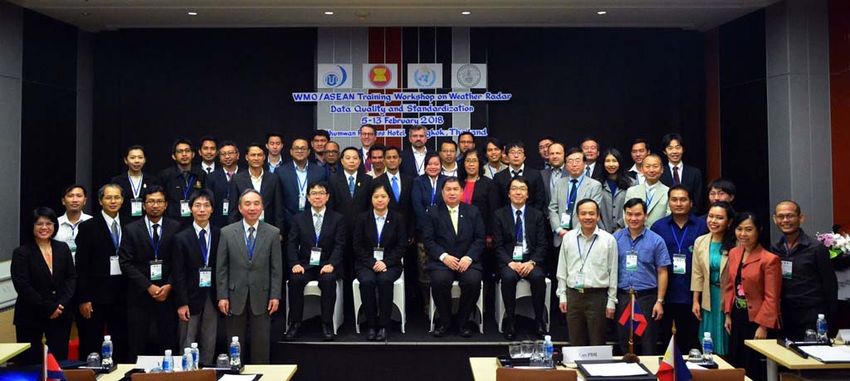
  BANGKOK, THAILAND, 5 – 13 FEBRUARY 2018

               FINAL REPORT
EXECUTIVE SUMMARY

          The World Meteorological Organization (WMO) and the Association of Southeast
Asian Nations (ASEAN) jointly organized the Training Workshop on Weather Radar Quality
and Standardization from 5 to 13 February 2018 at the Pathumwan Princess Hotel in
Bangkok, Thailand at the kind invitation of the Government of Thailand taking into account
that both entities have each project which has identical goals on weather radars in
Southeast Asia: the Regional Association (RA) II (Asia) and RA V (South-West Pacific) joint
regional WMO Integrated Global Observing System (WIGOS) project approved by RA II at
its sixteenth session (Abu Dhabi, United Arab Emirates, February 2017) and the project on
a weather radar workshop endorsed at the Thirty-ninth Meeting of the ASEAN
Sub-Committee on Meteorology and Geophysics (SCMG) (Manila, Philippines, May 2017).
This workshop was kindly hosted by the Thai Meteorological Department (TMD) and
technically and financially supported by the Japan Meteorological Agency (JMA).

        This workshop was attended by radar experts of National Meteorological and
Hydrological Services (NMHSs) from nine (9) ASEAN Member States (Cambodia, Indonesia,
Lao People’s Democratic Republic, Malaysia, Myanmar, the Philippines, Singapore, Thailand
and Viet Nam) and Bangladesh that consisted of 25 participants (22 male and three (3)
female). A representative from JMA, the ASEAN Secretariat and the WMO Secretariat,
members of the WMO Expert Team on Weather Radars, invited experts of JMA, and weather
radar manufacturers in Japan and Germany were also in attendance.

         The workshop was held on the background that the increase of the number of
weather radars in the region has led to an increased need for effective utilization of the data
collected. In addition, improved Quality Control (QC) and international real-time data
exchange are expected to play pivotal roles in Disaster Risk Reduction (DRR) in the region.

         The workshop therefore focused on capacity development of ASEAN Member
States and Bangladesh on the technical aspect of radar maintenance, radar applications,
radar data exchange and format, and cases studies. The participants learned how to
nurture groups of well trained and skillful technical personnel in maintaining weather radar
network in their respective countries through an effective regional capacity building
exercise, to enable Southeast Asian countries to issue effective information on severe
weather based on radar rainfall estimation and forecasting, and to identify common issues
in the region. The workshop addressed common regional challenges in extreme weather
monitoring and forecasting in the region.

         A number of presentations and hands-on training were given to participants, and
the future challenges in each country and the region were discussed. All the participants
recognized their substantial progress and confirmed the next step to further contribute to
DRR using weather radars in the region.

                                       ____________

                                             -1-
GENERAL SUMMARY
Introduction
The WMO/ASEAN Training Workshop on Weather Radar Quality and Standardization was
held from 5 to 13 February 2018 in Bangkok, Thailand. The programme of the workshop and the
list of participants are given as Annex I and Annex II, respectively.
1. Opening
1.1. Welcome remarks
Mr Boonlert Archevarahuprok, Expert on Research and Development for Meteorology of the
Thai Meteorological Department (TMD) reported the background of the workshop. Mr Yoshiro
Tanaka of the Japan Meteorological Agency (JMA) provided his welcome remarks followed by Ms
Lee Sing Cheong and Mr Ryuji Yamada from the Association of Southeast Asian Nations (ASEAN)
Secretariat and the World Meteorological Organization (WMO) Secretariat, respectively.
1.2. Opening address
Mr Wanchai Sakudomachai, Director-General of TMD warmly welcomed all the participants
to the workshop. He outlined that weather radars are very significant and effective tools to assist
National Meteorological and Hydrological Services (NMHSs) to monitor rainfall and support
accurate nowcasting. He expressed sincere appreciation to WMO, ASEAN and JMA for holding this
workshop which aims to enhance the utilization of weather radars and address the challenges on
weather radar data quality and standardization. He expected the workshop could help member
countries increase the effectiveness of weather forecasting and Disaster Risk Reduction (DRR)
activities.
1.3. Keynote speeches
A keynote speech was given by Dr Daniel Michelson, Chair of the WMO Inter-programme
Expert Team on Operational Weather Radar (IPET-OWR). He began by presenting the existing
eight Technical Commissions of WMO, emphasizing that the majority of the activities conducted
thus far addressing weather radar have been made within the Commission for Basic Systems
(CBS) and the Commission for Instruments and Methods of Observation (CIMO). He continued by
presenting IPET-OWR, emphasizing that it is jointly managed by CIMO and CBS, and comprises
previously existing activities from each Technical Commission along with new activities. As such
IPET-OWR is charged with the stewardship of weather radar emerging as a global resource to
meet expected demand for internationally exchanged data regionally, inter-regionally, and
globally. He presented the IPET-OWR work plan, highlighting results like the Member survey on
weather radar requirements conducted in early 2017, the proposed data representation standard
(CfRadial2), and a focus on advice and guidance through a Weather Radar Best Practices Guide
among other documentation deliverables. Liaison with International Telecommunication Union
(ITU) for addressing frequency allocation in relation to radio interference, and International
Organization for Standardization (ISO) in formulating a joint weather radar standard, were also
mentioned.
Dr Michelson highlighted the importance of calibration and monitoring as a means of
ensuring consistent, high quality operations, high system and data availability, and data quality
that meets processing and user requirements. Solar monitoring was given as an example of a
useful technique. Finally, assimilation of radar data from Canada and the United States was given
as an example of an advanced application requiring international data exchange and advanced
quality control and compositing.
Mr Koichiro Kakihara (JMA), Leader of the Regional Association (RA) II (Asia) and RA V
(South-West Pacific) joint regional WMO Integrated Global Observing System (WIGOS) project
“Capacity building in radar techniques in the Southeast Asia” gave a keynote speech “Radar
Network in Southeast Asia” on the purpose of this workshop and the necessity of the regional
weather radar network. In this speech, he emphasized the important roles of weather radars to
contribute to DRR in this disaster-prone region and that the capacity building activities are
-2-essential. He also referred to the multilayered underpinning frameworks which support every
NMHS in Southeast Asia; the joint regional WIGOS project, the ASEAN project and the
ESCAP/WMO Typhoon Committee project.
Mr Kakihara highlighted that the aims of the joint regional WIGOS project on weather radars
are in line with the Jakarta Declaration, which was adopted at the Joint RA II/RA V Workshop on
WIGOS for Disaster Risk Reduction (Jakarta, Indonesia, October 2015), and radar observation
data would be further utilized in DRR activities in each country through improvement of quality
management of weather radars and development of national and regional radar network.
He also highlighted that it was important to "start" data exchange and create regional composite
map so that countries in this region were encouraged to exchange national composite radar data
in a "feasible” data format for each country, while radar data exchange in data representation
standard (CfRadial2), proposed by IPET-OWR, would be a future challenge in this region.
2. Workshop sessions
2.1. Weather radar operation
Dr Masahito Ishihara, former radar meteorologist/researcher of JMA and former professor
of Kyoto University, made a presentation concerning the basics of weather radar. He started from
the brief history of radar and moved to the history of weather radar operation of JMA starting in
1954 as well as the current situation of weather radar networks in Japan. He derived the radar
equation in detail from a point target to distributed targets and finally got to simplified radar
equation. He also introduced the procedure of weather radar observation operated in JMA,
describing the law/rule/guidance/manuals, the timetable of the radar observation, data quality
check, machine maintenance and the replacement schedule of weather radars.
2.2. Weather radar maintenance
Mr Shuichi Inoue of Japan Radio Co., Ltd. (JRC) explained basic weather radar structure and
operation principle of the conventional weather radars (magnetron type and klystron type), and
the importance of conducting periodical maintenance that must be carried out to keep system
conditions stable and to achieve a certain level of data quality and/or appropriate operational
functions of the weather radars. He referred to concrete methods in detail conducting periodical
maintenance such as measurement of output power, transmitting pulse width, frequency and so
on, from the point of view of the weather radar manufacturer. He also explained the operation
principle and maintenance method in recent technology of the weather radars such as the pulse
compression radars and the dual polarization weather radars.
2.3. Country reports
All participants from NMHSs gave presentations on their current status of weather radars
including operation, maintenance, data utilization, technical challenges and future plans.
Additionally, the Meteorological, Climatological and Geophysical Agency (BMKG) of Indonesia, the
Malaysian Meteorological Department (MMD) and TMD reported the outline of their quality control
processes. The detailed information provided by each participant before the workshop is attached
as weather specification table (Annex III) and survey results (Annex IV).
2.4. Weather radar data Quality Control
Dr Ishihara (Japan) showed error sources affecting the weather radar observation and
reducing the quality of weather radar data: ground clutter, sea clutter, bright band, precipitation
aloft, side lobe echoes, second trip echoes, wind turbines, birds, volcanic ash, beam blockage,
beam filling missing and radio wave interference.
Mr Hiroshi Yamauchi (JMA) gave presentations on the quality control of weather radar data
by using dual-polarization. First, he summarized the merits of dual-pol weather radar and
explained the meaning of each dual-polarization parameter. Then he explained ground clutter
removal, sea clutter removal and clear echo removal techniques with a practical example
conducted by JMA. Finally, he emphasized the importance of calibration for dual-polarization
parameters.
-3-2.5. Hands-on training on weather radar QC
Mr Junji Hotta (JMA) gave presentations on the characteristics of non-precipitation echo and
quality control (QC) algorithms including JMA’s Pseudo CAPPI process. He also provided a
hands-on training of adjusting elevation angle composite tables which enable weather radars to
avoid influence of clutters and interferences. He emphasized that the importance of continuing
QC and accumulation and careful investigation of weather radar data will improve QC results.
2.6. Manufacture’s QC
Mr Katsuhiro Nagaya (JRC) explained the manufacture's QC activity regarding the
installation of weather radars with quality assurance organization in factories. After the
explanation about Quantitative Precipitation Estimation (QPE)/Quantitative Precipitation Forecast
(QPF) application for disaster mitigation, he introduced the well-developed QC for single/dual
polarization weather radars in Japan as a successful example. He also introduced the calibration
method for weather radars data by using metal sphere and disdrometer.
Mr Andre Weipert (Selex ES GmbH) presented industrial views on weather radars. Radar
data quality monitoring and control is a demanding challenge since it is not an isolated or radar
system related task; data quality is transversal to the overall system of systems planning and life
cycle considering single and combined/netted weather radars. Radars are usually procured by
different organizations (e.g. NMHSs or Air Navigation Services Providers/Airport Authorities) for
different purposes (e.g. hydrological or aviation applications) in iterative procurement steps over
years using heterogeneous technologies (e.g. dual polarization, different band widths); a
coherent, harmonized and flexible planning strategy is needed, since all radars shall finally run in
an orchestrated way offering different fit-for-purpose meteorological products on national,
regional and international scales. It has been stated that initial perfection, when planning the
national orchestrated radar network, cannot be reached but special emphasis shall be done on
instantaneous radar hardware monitoring (scheduled periodic reports and planning tools for
preventive maintenance), collaborative data quality control using a centralized meteorological
data processing design, since raw data is the “lowest common denominator” in radar networks, a
seamless semantic data interoperability using common data standards and cross application
synergies enabling e.g. the sharing of data between meteorological and aviation applications.
2.7. Radar applications
Mr Yamauchi (JMA) gave a presentation on dual- polarization and Doppler velocity
application such as rain-rate estimation using specific differential phase (Kdp), hydrometer
classification, wind shear detection and velocity azimuth display. He explained the difficulty in
using Doppler velocity caused by velocity aliasing and inability to measure tangential velocity.
Mr Takanori Sakanashi (JMA) gave a presentation on QPE and held a hands-on training in
QPE by using weather radar and rain-gauge observation data in Japan. He emphasized the
importance of QC of both data which are the most fundamental factors to calculate QPE correctly.
Also, he explained that QPE would contribute to further advanced products for disaster prevention
such as QPF and disaster potential indexes.
2.8. Radar data exchange and data format
Mr Boonlert Archevarahuprok (TMD) made a very comprehensive presentation on weather
radar formats and regional data exchange which shared navigational information, current
situation and way forward. In particular, he detailed characteristics of manufacturers’ native raw
data formats (e.g. EEC volume format, UF, Gematronic xml format) as well as its conversions to
Cartesian data (WMO GRIB2, BUFR, NetCDF and HDF 5, etc). He explained that GRIB2 is currently
used for radar composite and data exchange in Southeast Asia while international data exchange
in radial format (i.e. CfRadial2) can be expected as a future challenge.
2.9. Case study on disaster event using radar data
Dr Ishihara (Japan) showed a sample of weather summary issued by JMA to the public via
the JMA website just after severe weather disasters. He stressed that the weather summary is
very important to provide the public and related agencies with simple and accurate weather
-4-information on the severe disaster and that it would be valuable archive data for improving
weather forecast/disaster management/research in the future. He handed over all the NMHSs’
participants in the workshop a template of the weather summary and sample image data of
weather chart (provided by iTacs, the climate analysis tool of JMA), of satellite radar (provided by
GSMaP of JAXA), and of JMA HIMAWARI (provided by the online database run by Kochi University).
All the participants made a hand-on training to create the weather summary using the template
and the image data.
2.10. Technical tours
Participants visited Rayong Weather Station in Rayong Province, and observed C-band
weather radar facility, a local Radio Broadcast tower and meteorological fields on 10 February
2018. They also visited the TMD headquarters on 12 February 2018 to learn TMD’s services and
their facilities including broadcasting studios and a high performance computing system.
2.11. Discussions
Mr Kakihara (JMA) gave a presentation about an outline of the experimental radar
composite data exchange among TMD, MMD and JMA, and lessons learnt from the experimental
exchange. He also talked about an expected next step of the joint RA II/RA V WIGOS project and
what participants of the workshop should do after the workshop. He emphasized that it was
important for all participants to share training materials, presentation files and final report of the
workshop with their colleagues, and to discuss internally how they could improve their radar data
and could join the regional radar composite.
The participants took note and welcomed the Jakarta Declaration (weather radar part) with
its aims listed below, which also form the basis of the joint RA II/RA V WIGOS project;
(1) Improvement of data quality of existing radars,
(2) Development and expansion of national radar networks,
(3) Near real-time international exchange of radar data, and
(4) Development of «sub-regional» radar data centre(s).
With the aims of the WIGOS project in mind, as well as taking into account the
achievements of this training workshop, all participants considered their own NMHSs’ current
challenges and future plans to enhance the capabilities on weather radars. They gave brief
presentations and discussed their plans.
Through the discussion, the participants recognized substantial progress has been made
from the previous workshop held in Bangkok, Thailand in 2014. For future activities of the project,
they agreed that a succeeding workshop, hopefully in a nearest future, may need to have three
pillars;
(1) Basics on weather radar and its operation,
(2) QC of weather radar data and their composite/exchange, and
(3) Usage of dual-polarization function and QPE/QPF.
Also the participants shared their common understanding that they need to increase quality
of radar data as well as to promote regional radar network to enhance the promising abilities of
weather radars and improve DRR in Southeast Asia. For these purposes, they agreed to
emphasize four items shown below;
(1) To ensure creating Cartesian data in common data format such as GRIB2 to achieve
radar composite in Southeast Asia through regional data exchange,
(2) To emphasize the development of QC techniques rather than to respect too much on
the conventional Z-R relation,
(3) To learn and develop dual-polarization techniques to enjoy the latest technologies on
weather radars in the future,
-5-(4) To communicate closely with members and share their experiences regarding various
matters on weather radars to overcome common difficulties in the region.
3. Closing
The certificates were presented to all the participants and invited experts.
Dr Songkran Agsorn, Deputy Director-General of TMD and the ASEAN/SCMG focal point of
Thailand provided a closing remark and the workshop was closed at 3 p.m. on Tuesday, 13
February 2018 with a great success.
____________
-6-Annex I
Programme
Monday, 5 February
1. Opening ceremony
1.1. Welcome remarks
Mr B. Archevarahupro (TMD)
Mr Y. Tanaka (JMA)
Mr R. Yamada (WMO)
Ms L. S. Cheong (ASEAN Secretariat)
1.2. Opening Address
Mr Wanchai Sakudomachai (Director-General, TMD)
1.3. Keynote speeches
- The emergence of weather radar as a global resource
Dr D. Michelson (Chair, WMO/IPET-OWR)
- Radar Network in Southeast Asia
Mr K. Kakihara (JMA)
2. Workshop sessions
2.1. Weather radar operation
- History and current situation of weather radars
- Basics of weather radars
- Operation of weather radars
Dr M. Ishihara (Japan)
2.2. Weather radar maintenance
- Relation of maintenance and radar equation
- Various maintenance items for the radar equipment
- Caution point
Mr S. Inoue (JRC)
Tuesday, 6 February
2.2. Weather radar maintenance (cont.)
- Relation of maintenance and radar equation
- Various maintenance items for the radar equipment
- Caution point
Mr S. Inoue (JRC)
2.3. Country reports on radar operation, maintenance and utilization
ASEAN Members, BMD
Wednesday, 7 February
2.4. Weather radar Data QC
- Calibration
- Noise reduction
Dr M. Ishihara (Japan)
- QC of weather radar data by using dual-polarization radar
Mr H. Yamauchi (JMA)
2.5. Hands on Weather Radar QC
- Introduction of JMA operational system
- Quality control algorithms
Mr J. Hotta (JMA)
2.3. Country reports on radar QC
TMD, MMD, BMKG
-7-Thursday, 8 February
2.5. Hands on Weather Radar QC (cont.)
- Quality control algorithms
Mr J. Hotta (JMA)
2.6. Manufacture’s QC
- German manufacturer
Mr A. Weipert (Selex ES GmbH)
2.7. Radar applications
- Dual-polarization
- Doppler velocity
Mr H. Yamauchi (JMA)
- QPE & QPF
Mr T. Sakanashi (JMA)
Friday, 9 February
2.8. Radar exchange and format
- Radar data format
- Radar data exchange
- ASEAN radar network
Mr B. Archevarahuprok (TMD)
2.9. Case study on disaster event using radar data
- Weather summary on a disaster occurrence (WADO)
- Practice for creating WADO
Dr M. Ishihara (Japan)
Saturday, 10 February
2.10. Technical Tour: Visit to TMD’s radar site (Rayong radar and meteorological station)
Monday, 12 February
2.6. Manufacture’s QC
- Japanese manufacturer
Mr K. Nagaya (JRC)
2.10. Technical Tour
- Visit to TMD Headquarters
Tuesday, 13 February
2.11. Discussion on regional radar network and radar exchange
3. Closing ceremony
____________
-8-Annex II
List of Participants
Participants
Cambodia: Department of Meteorology
Mr Korng Youtray Deputy Director
youtray@yahoo.com
Mr Chuon Sokun Vice Chief Officer
Chuonsokun38@gmail.com
Indonesia: Agency for Meteorology Climatology and Geophysics
Mr Deni Permana Staff of Weather Radar Imagery Management Sub
Division
denpermana@yahoo.com
Mr Henrikus Jatining Wahyu Argo Staff of Weather Radar Imagery Management Sub
Division
wahyuargo@yahoo.com
Lao People’s Democratic Republic: Department of Meteorology and Hydrology
Mr Saleumsack Sidavong Technical Staff on Radar
s.sidavong@yahoo.com, dmhvte@etll.com
Ms Khaemeuy Chao Technical Staff on Weather Forecasting and Warning
Division
khaemeuy@gmail.com, dmhvte@etllao.com
Malaysia: Malaysian Meteorological Department
Mr Mahluddin Sahrin Meteorological Officer
udin@met.gov.my
Mr Ismail Alias Meteorological Officer
ismailalias@met.gov.my
Myanmar: Department of Meteorology and Hydrology
Mr Hla Tun Deputy Director, Meteorological Division
hlatunmr@gmail.com
Mr Ye Htut Deputy Chief Engineer of Engineer Division
yehtut41@gmail.com
Philippines: Philippine Atmospheric, Geophysical and Astronomical Services
Administration
Ms Julie M. Nimes Weather Specialist II
jmnimes@yahoo.com
Mr Joey Hermones Figuracion Weather Specialist I
joeyfiguracion@gmail.com
Singapore: Meteorological Service Singapore
Mr Kiat Haw, Gavin Yeap Executive Meteorologist
gavin_yeap@nea.gov.sg
-9-Thailand:
Thai Meteorological Department
Mr Fatah Masthawee Meteorologist, Meteorological Development Division
fatah_m@yahoo.com
Mr Aphinya Chitchaeng Meteorologist, Division of Aeronautical Meteorological
aphinya.tmd@gmail.com
Mr Theerachai Auttachaipanit Meteorologist, Weather Forecast Division
theerachai3@hotmail.com
Mr Peeranat Longsombun Meteorologist, Weather Forecast Division
peeranat.long@gmail.com
Mr Pramote Klinduang Computer Technical Officer, Division of Meteorological
Digital Services
promote@tmd.go.th
Ms Natkamon Khemngoen Meteorological Officer, Meteorological Observation
Division
new_takamon@hotmail.com
Department of Royal Rainmaking and Agricultural Aviation
Mr Tanthai Polharn Scientist
tan_rainmaker1@hotmail.com
Bangkok Metropolitan Administration
Mr Darat Kammaroeng Electrical Engineer, Department of Drainage and
Sewerage
tonscn@gmail.com
Viet Nam: National Hydro-Meteorological Service of Viet Nam
Mr Toan Minh Hoang Head of Information and Data Aero Meteorology
Observatory, Aero-Meteorological Observatory
minhtoanck@gmail.com, minhtoan@amo.gov.vn
Mr Long Thang Dao Weather Radar Observer-Deputy Head, Viettri Weather
Radar Station, Mid-Northern Regional Hydro
Meteorological Center
longkttvvb@gmail.com
Bangladesh: Bangladesh Meteorological Department
Mr Md. Shadekul Alam Assistant Director
shadekul@gmail.com, info@bmd.gov.bd
Mr Mohammad Sazzad Hossain Senior Communication Engineer
mim_bmd2004@yahoo.com, info@bmd.gov.bd
Observers
Indonesia: Agency for Meteorology Climatology and Geophysics
Ms Nurhayati Noer Head of Center for Public Weather Service
nurhayah@bmkg.go.id
Mr Taufiq Hidayah Head of Sub Division for Weather Early Warning
twkgbmkg@yahoo.com
- 10 -Experts
Dr Masahito Ishihara Former Professor of Kyoto University
mishihar0308@yahoo.co.jp
Mr Katsuhiro Nagaya Assistant General Manager, Engineering Management
Department, Japan Radio Co., Ltd.
nagaya.katsuhiro@jrc.co.jp
Mr Shuichi Inoue General Manager, Solution Business Division, Business
Development Department, Japan Radio Co., Ltd.
inoue.shuichi@jrc.co.jp
Mr Yoshiro Tanaka Vice-chair of WMO Inter-Programme Expert Team on
Operational Weather Radars (IPET-OWR)
Deputy Head, Office of International Affairs,
Administration Department, Japan Meteorological
Agency (JMA)
yoshiro.tanaka@met.kishou.go.jp
Mr Koichiro Kakihara International Strategy Officer, Administration Division,
Observation Department, JMA
k-kakihara@met.kishou.go.jp
Mr Hiroshi Yamauchi Senior Science Officer, Administration Division,
Observation Department, JMA
h-yamauchi@met.kishou.go.jp
Mr Junji Hotta Assistant Scientific Officer, Observation Division,
Observation Department, JMA
junj-hotta@met.kishou.go.jp
Mr Takanori Sakanashi Assistant Scientific Officer, Forecast Division, Forecast
Department, JMA
takanori-sakanasi@met.kishou.go.jp
Mr Hiroaki Minematsu Scientific Officer, Office of International Affairs,
Administration Department, JMA
minematsu_hi@met.kishou.go.jp
Dr Daniel Brause Michelson Chair of WMO Inter-Programme Expert Team on
Operational Weather Radars (IPET-OWR), Research
Scientist, Environment and Climate Change Canada
daniel.michelson@canada.ca
Mr Marcus Kruckow Regional Sales and Business Development Asia &
Australia, Selex ES GmbH (Gematronik)
m.kruckow@selex-es-gmbh.com
Mr Andre Weipert Head of Meteorological Information Systems (MIS) and
SESAR programme, Selex ES GmbH (Gematronik)
a.weipert@selex-es-gmbh.com
Mr Boonlert Archevarahuprok Expert on Research and Development for Meteorology,
TMD
boonlert.arc@tmd.go.th
WMO Secretariat
Mr Ryuji Yamada Programme Manager, Regional Office for Asia and the
South-West Pacific
ryamada@wmo.int
ASEAN Secretariat
Ms Lee Sing Cheong Head of Science & Technology Division
LeeSing.Cheong@asean.org
- 11 -Local Organizing Committee
Thai Meteorological Department
Ms Patchara Petvirojchai Director of Research and Technical Cooperation
Division, Meteorological Development Bureau
patchara@tmd.go.th
Ms Phanumat Lewcharoenthrap Head, International Relations Division
tmd_inter@tmd.go.th
Dr Hathaichanok Ngerndee (Hannah) Foreign Relations Officer, International Relations
Division
tmd_inter@tmd.go.th,
hathaichanok.n@tmd.mail.go.th
Ms Pailin Sangkhao Foreign Relations Officer, International Relations
Division
tmd_inter@tmd.go.th
Mr Asadarnkdej Pokam Meteorological Officer, Meteorological Map Division
asadarnkdej@gmail.com
Acting Sub Lt. Phalakorn Weingdonkor Dissemination Technical Officer, Public Relations
Division
palakorn95@gmail.com
Mr Panomkorn Hematulin Electrician, Telecommunications and Information
Technology Bureau
panomkorn_23@hotmail.com
____________
- 12 -Annex III
Summary of weather radar specification in Southeast Asia (as of January 2018)
Bangladesh Cambodia Indonesia Lao PDR
Types of radars S S C, X C
Number of radars 5 1 42 1
EEC (21),
Gematronik (15),
Manufacturers JRC, Mitsubishi Gematronik JRC
Baron (5),
Vaisala (1)
2 Old Replace by
Number of radars 1 (2018); 1 solid
2020+3 new in three 2 -
(future plan) (dual polarized)
International Airport
2800, 2850, 5600-5625 MHz.
Radiowave frequency 2700 - 2900 MHz 5300 MHz
2770MHz+/_5% 9800 MHz
Rainy season: every
7.5 min (nonstop)
Observation intervals 15 min 15 min 5 min to 15 min
Dry season: 7.5
min/60 min
Doppler or not Yes Yes Yes Yes
Dual polarization or
No No No No
not
B=200, b=1.6 and
B and b B=200, b=1.6 B=200, b=1.6 B=250, b=1.38
B=250, b=1.4
Remotely controlled
operation/ Both Local operation local operator controlled at HQ
local operator
Number of automatic
12 65 155 15
raingauge
Number of AWS 18 35 257 15
Nationwide composite Yes/lowest level
Not yet No/2.0km
map/altitude composite
Maintenance
Yes Yes Yes Yes
problems
Communication
Not always Yes (eastern part) No
problems
Type of
VSAT (64kbps) Fiber optic VSAT/VPN TCP/IP
communication
Human resources
Yes Yes Yes Yes
problems
Budget, spare parts,
Other problems Budget, spare parts Yes Budget, spare parts
radar site
Capability to assist
Yes/No No Yes/No Yes
other members
QC (human) No No No Yes
QC (automatic) May be No Yes Yes
Quality to be
blockage and
improved (ground Ground Clutter Interference
interference (many Interference signal
clutter, sea clutter, (Dhaka Radar) especially in big city
stations)
interference)
IRIS (format open in
Output data format IRIS Vol. volumetric
technical manual)
Meta data availability No Yes No
Availability of raw
Yes No Yes Available
data
- 13 -Malaysia Myanmar Philippines Singapore
Types of radars S, C, X S S, C, X S, C
Number of radars S=7, C=4, X=4 3 S=8, C=7, X=3 S=1, C=1
EEC, Gematronik,
Manufacturers EEC, Gematronik JRC Gematronik
Vaisala, JRC
Number of radars
4 (next 3 years) - 5 (next years) 0
(future plan)
2700-2900 MHz, 2700-2900 MHz,
S: 2700-2900 MHz
Radiowave frequency 5600-5800 MHz, 2796 MHz 5600-5800 MHz,
C: 5430-5600 MHz
9400-9500 MHz 9000-10000 MHz
1min (for Aerodrome
Observation intervals 10 min 15 min 10 and 15 mins Surveillance)
5min (for Volumetric)
Doppler or not Yes Yes Yes Yes, both
Dual polarization or
No No 8 (eight dual pol) Yes, both
not
B=250, b=1.2 B=49, b=1.7 B=200, b=1.6
B and b B=200, b=1.6
B=200, b=1.6 B=40, b=1.9 B=300, b=1.4
Remotely controlled Remotely controlled Remotely controlled
operation/ Both operation/ Both
operation
local operator local operator
Number of automatic
170 30 50+20 Around 90
raingauge
170 (50 manned,
Number of AWS 30 57 Around 90
120 unmanned)
Composite/MAX
products are used
more frequently
Nationwide composite lowest level
Yes/2.0 km Yes/1.0km than CAPPI because
map/altitude composite
more indicative of
intensity of
thunderstorms
Maintenance
Outsource Yes Yes Outsource
problems
Communication
No No Yes No
problems
Type of microwave link,
IP/VPN (2Mbps) VSAT Fiber optics
communication Leased Line, VSAT
Human resources
Yes Yes Not always Yes
problems
Other problems Budget Budget, spare parts Budget, spare parts Budget, Radar Site
Capability to assist
No No Yes Yes/No
other members
QC (human) Partial No Yes Yes
QC (automatic) No No Yes Yes
Sea/ground clutter,
Quality to be interference from
Blockage by high Blockage by high
improved (ground other signal
mountains, ground Interference signal mountains, ground
clutter, sea clutter, sources, blockage
clutter clutter, interference
interference) by tall buildings,
biological returns
Grib2, OdimHDF5,
BUFR, IRIS Native, NETCDF, uf, hdf5, PNG, GeoTiff, BUFR,
Output data format Rainbow native, POLAR.BINARY
jpeg NetCDF etc.
ASCII (old radars
only)
Meta data availability Not available now No Yes Yes
Available but
Availability of raw
impossible to Available Yes Yes (Rainbow)
data
decode (IRIS)
- 14 -Thailand Viet Nam Japan
Types of radars C S, C, X C
Number of radars 23 S=2, C=5 20
EEC (2),
EEC (19), JRC, Mitsubishi,
Manufacturers Thompson (1),
Gematronik (4) Toshiba
JRC (2), Vaisala (2)
Number of radars 1 (2016)/
4 by 2020 -
(future plan) 4 upgrade (by 2016)
C; 5600 - 5670 MHz
Radiowave frequency 5600 - 5650 MHz 5250 - 5350 MHz
(S) 2750 MHz
Thompson: 5 min
Observation intervals 15 min to 1 hour EEC: 15 min 5 min
JRC Japan: 10 min
Doppler or not Yes 6/7 radars Yes
Dual polarization or
4 (C-band) No No
not
B=200, b=1.6 (for 2
B and b B=200, b=1.6 B=200, b=1.6
JRC sites)
Remotely controlled
Remotely controlled
operation/ Both Local operation
operation
local operator
Number of automatic
930 No information 1300
raingauge
Number of AWS 87 No information 1300
Nationwide composite Ongoing/lowest Yes/lowest level
Yes/3km (3 sites)
map/altitude level composite composite
Maintenance
Spare parts Spare parts -
problems
Communication Yes (delay up to
Reliable Not serious
problems 30min)
Type of
ADSL ADSL (2Mbps) TCP/IP
communication
Human resources
Knowledge Yes Yes
problems
Other problems many Budget Budget
Capability to assist
Yes Yes Yes/No
other members
QC (human) Yes Yes Yes
QC (automatic) Yes No Yes
Quality to be
Blockage and
improved (ground
interference (many Ground clutter -
clutter, sea clutter,
stations)
interference)
Output data format Vol. UF for EEC/NETCDF GRIB2
Meta data availability Yes Yes Yes
Availability of raw
Yes Yes (No on 1 site) Yes
data
- 15 -Annex IV
Survey on weather radar in Southeast Asia
Purposes:
This survey aims to encourage Southeast Asian countries to improve capabilities of weather radar
utilization and operation through sharing its information among National Meteorological and
Hydrological Services (NMHSs) in the region.
In line with the aim, question items are arranged to assist NMHSs to recognize necessary matters
to improve operation, data processing, applications and national observation network relating to
weather radars. It will be beneficial to all NMHSs to check and review its own situation and to
share it with other Members, in order to figure out and overcome common challenges and to
establish the regional radar network in Southeast Asia.
Results:
(* The "SUM" column shows the summation of Southeast Asian countries (9 ASEAN Members and Bangladesh).
S B K I L M M P S T V J
1. Roles of weather radar observation in your Service U G H D A Y M H G H N P
M* D M N O S R L P A M N
Currently, for which purposes do you operate the weather radars?
1-1
(Multiple answers allowed)
Heavy rain monitoring 10 x x x x x x x x x x x
Flood prediction 7 x x x x x x x x
Nowcasting of lightning or hazardous wind 7 x x x x x x x x
Aviation (e.g. detection of Low Level Wind Shear) 5 x x x x x x
Initial value of NWP 4 x x x x x
Case studies of severe weather events 7 x x x x x x x x
Climatological study 4 x x x x
Others (please specify below) 1 x
Indonesia: Volcanic Ash Monitoring (at some sites)
In the future, for which purposes are you going to operate the weather
1-2
radars? (Multiple answers allowed)
Heavy rain monitoring 10 x x x x x x x x x x x
Flood prediction 9 x x x x x x x x x x
Nowcasting of lightning or hazardous wind 9 x x x x x x x x x x
Aviation (e.g. detection of Low Level Wind Shear) 10 x x x x x x x x x x x
Initial value of NWP 7 x x x x x x x x
Case studies of severe weather events 9 x x x x x x x x x x
Climatological study 5 x x x x x
Others (please specify below) 1 x
Indonesia: Weather forecast verification
Does your Service use radar data in decision making for issuing
1-3
meteorological warnings and advisories?
No 1 x
Yes 9 x x x x x x x x x x
Does your Service provide training opportunities on radar data
1-4
utilization for forecasters?
No 1 x
Yes 9 x x x x x x x x x x
Which are major challenges for your Service in promoting utilization of
1-5
radar data? (Multiple answers allowed)
No challenges 1 x
Yes. Obtaining better understanding of the necessity of radar data
7 x x x x x x x
(your staff in your Service)
Yes. Obtaining better understanding of the necessity of radar data
8 x x x x x x x x x
(users outside of your Service)
Yes. Deployment and replacement of radars 5 x x x x x
Yes. Radar operation 7 x x x x x x x
Yes. Radar maintenance 7 x x x x x x x
Yes. Quality control of radar data 8 x x x x x x x x
Yes. Learning techniques of radar data utilization 7 x x x x x x x
Others (please specify below) 2 x x
Singapore: No challenges in utilizing, more on educating the public
on the limitation of the radar precipitation products
Viet Nam: Research and develop radar data production
- 16 -S B K I L M M P S T V J
U G H D A Y M H G H N P
M D M N O S R L P A M N
1-6 Does your Service provide radar data to TV stations?
No 9 x x x x x x x x x
Yes 1 x x
1-7 Do TV stations use your radar data in their weather programs?
No 7 x x x x x x x
Yes 3 x x Little x
1-8 Are your radar images available to the public on your website?
No 0
Yes 10 x x x x x x x x x x x
Does your Service provide your radar data to users (public, private
1-9
companies etc.)?
No 5 x x x x x
Yes 4 x x x x x
Does your Service get radar data from other organizations in your
1-10
country?
No 10 x x x x x x x x x x
Yes 0 x
Do you find any benefit if you get other NMHSs' radar data? (Multiple
1-11
answers allowed)
No benefit 0
Yes. Improvement of heavy rain monitoring near boundaries of your
10 x x x x x x x x x x x
country
Yes. Improvement of flood forecast of international rivers 5 x x x x x
Yes. Improvement of monitoring of weather at international flight
7 x x x x x x x x
destinations
Others 0
Do you have any difficulties in sharing radar data with other NMHSs?
1-12
(Multiple answers allowed)
No difficulties 0
Yes. Data policy of my country or Service 6 x x x x x x
Yes. Technical problems of radar data processing 6 x x x x x x
Yes. Technical problems of communication (e.g. speed limit, server
9 x x x x x x x x x x
performance).
Others (please specify below) 1 x
Singapore: Currently not sharing with other NMHSs
2. Deployment and replacement of radars
2-1 How many radars does your Service have? 113 5 1 41 1 12 3 15 2 23 10 29
Fill out the table in the next worksheet to show numbers of radars in (The result of this question is attached
2-2 at the end of this table.)
different types and manufactures.
2-3 Does your Service plan to deploy new radars?
No 2 x x x
Yes (please specify below) 8 x x x x x x x x
Bangladesh: Replace two old and install new three in three
international airports in Bangladesh.
Cambodia: We are looking for the resources to install new radars
for better cover and data.
Lao PDR: DMH has been submitted a proposal of the new radar
network to Japan Government.
Myanmar: DMH proposed to JICA to install two new radars in
Southern and Northern parts of Myanmar
Viet Nam: 3 sites C-band, Vaisala manufacturer
Does your Service plan to upgrade your single-pol radars to dual-pol
2-4
radars?
No 5 x x x x x
Yes (please specify below) 5 x x x x x x
Malaysia: all of them
Viet Nam: in the future
> 15 15-
2-5 How many years does your Service assume the life-span of radars? 10 15 10 15 -30 15 15 15 25 15
Does your country coordinate transmitting frequency of radars with
2-6
neighboring countries to prevent interference?
No 9 x x x x x x x x x x
Yes 1 x
- 17 -S B K I L M M P S T V J
U G H D A Y M H G H N P
M D M N O S R L P A M N
Which is the most serious challenge for your Service to deploy or
2-7
replace radars? (Multiple answers allowed)
No problem 0
Ensuring budget 9 x x x x x x x x x x
Ensuring land, power supply and communication line 6 x x x x x x
Ensuring transmitting frequency 3 x x x
Learning knowledge and information for considering radar
6 x x x x x x
specification
Others (please specify below) 3 x x x
Laos: The existing transmitting frequency band 5.3GHz is not
allowed under the ITT regulation.
3. Radar operation
Does your Service have rules, guidelines and/or manuals on radar
3-1
observation and operation?
No 0
Yes 10 x x x x x x x x x x x
3-2 When does your Service operate radars?
All the time 9 x x x x x x x x x x
Only rainy weather (rainy season) 0
Intermittently 1 x
3-3 How often is your radar observation?
Every hour 1 x
Every 15 minutes 6 x x x x x x
Every 10 minutes 3 x x x
Every 5 minutes 2 x x x
Others (please specify below) 4 x x x x
Indonesia: Every 5 - 15 minutes
Lao PDR: Every 7 minutes
Malaysia: every minute.- for wind shear at airport
Singapore: every minute on aerodrome surveillance wind shear
Does your Service collect radar data into your headquarters in real
3-4
time?
No 0
Yes (all sites) 7 x x x x x x x x
Yes (a part of sites) 3 x x x
Which types of radar data does your Service archive? (Multiple
3-5
answers allowed)
No data is archived 0
Reflectivity (polar coordinates; each site) 6 x x x x x x x
Doppler velocity (polar coordinates; each site) 9 x x x x x x x x x x
Dual polarization parameters (polar coordinates; each site) 4 x x x x x
Reflectivity (Cartesian coordinates; each site) 6 x x x x x x x
Precipitation intensity (Cartesian coordinates; each site) 4 x x x x x
Reflectivity (Cartesian coordinates; national composite data) 2 x x x
Precipitation intensity (Cartesian coordinates; national composite
1 x x
data)
Others (please specify below) 1
Bangladesh: raw data and image of special events x
3-6 Which is the most serious trouble on your radar operation?
No troubles 0
Expensive operation cost 7 x x x x x x x
Unstable commercial power supply 5 x x x x x
Unstable communication line 3 x x x
Frequent hardware troubles 5 x x x x x
Others (please specify below) 1 x
Singapore: Interference of other signal sources, blockage from
surrounding/encroaching tall buildings and lack of land
4. Radar maintenance
4-1 Does your Service have manuals on radar maintenance?
No 2 x x
Yes 8 x x x x x x x x x
- 18 -S B K I L M M P S T V J
U G H D A Y M H G H N P
M D M N O S R L P A M N
How often does your Service conduct periodic maintenance by your
4-2
staff?
Not conducted 0
Every year 2 x x
Every half year 1 x
Every 3 months 1 x
Every month 4 x x x x x
Irregular 0
Others (please specify below) 2 x x
Bangladesh: Some daily, Some weekly, Some monthly, Some six
months and some yearly.
Singapore: Radar maintenance is every month by radar
maintenance contractors
4-3 How often does the manufactures conduct periodic maintenance?
Not conducted 2 x x
Every year 3 x x x
Every half year 1 x x
Every 3 months 1 x
Every month 0
Irregular 1 x
Others (please specify below) 3 x x x
Bangladesh: When any problem happened
Singapore: Radar maintenance are outsourced to external
maintenance contractor with support from OEM
4-4 How often does your Service replace magnetrons? (If magnetrons are x x x x x x x x
used as transmitters.)
Bangladesh: 2 months
Indonesia: 5
Lao PDR: No
Malaysia: 3-4 years
Philippines: when needed
Singapore: NA
Thailand: < 15% Life Time
Viet Nam: not periodic
4-5 How often does your Service replace klystrons? (If klystrons are used x x x x x
as transmitters.)
Bangladesh: 1 year
Lao PDR: 0.5 (rotation method)
Singapore: 5
Thailand: No
Japan: every 2 years
Does your Service have spare transmitting tubes (magnetron or
4-6
klystron)?
No 2 x x
Yes 7 x x x x x x x x
4-7 Does your Service have spare parts except transmitting tubes?
No 2 x x
Yes 7 x x x x x x x x
4-8 Which types of contract does your Service use with manufacturers?
Maintenance contract 5 x x x x x
Spot contract in case of trouble 3 x x x x
Which kinds of troubles on your radar system have your Service
4-9
experienced? (Multiple answers allowed)
Never experienced 0
Failure caused by lightning 4 x x x x x
Failure in transmitter 9 x x x x x x x x x x
Failure in pedestal 4 x x x x x
Failure in receiver 7 x x x x x x x x
Failure in signal processing unit 8 x x x x x x x x
Failure in power supply equipment 10 x x x x x x x x x x x
Failure in communication equipment 8 x x x x x x x x
Others (please specify below) 1 x
- 19 -S B K I L M M P S T V J
U G H D A Y M H G H N P
M D M N O S R L P A M N
Which kinds of troubles on transmitter have your Service
4-10
experienced? (Multiple answers allowed)
Never experienced 1 x
Wastage or abnormal behavior of magnetron 5 x x x x x
Wastage or abnormal behavior of klystron 2 x x x
Abnormal behavior of solid state transmitters 1 x
Others (please specify below) 1 x
Singapore: bias voltage supply circuit for Klystron
What bothers your Service most in maintenance or repair of your
4-11
radars? (Multiple answers allowed)
Nothing 0
Frequent failures 3 x x x
Expensive consumable (e.g. magnetron) 7 x x x x x x x x
Expensive maintenance cost 7 x x x x x x x
Expensive repair cost 6 x x x x x x
Long time needed for repair 5 x x x x x
Lack of knowledge for maintenance 6 x x x x x x
Shortage of human resources for maintenance 8 x x x x x x x x
Others (please specify below) 0
5. Quality Control
Are there any troubles on quality of radar observation data in your
5-1
Service? (Multiple answers allowed)
No trouble 0
Contamination by ground clutter 9 x x x x x x x x x x
Contamination by clear air echo (e.g. biological echo) 4 x x x x
Contamination by sea clutter 7 x x x x x x x x
Contamination by wind turbine 0 x
Interference waves 6 x x x x x x
Multi-trip echo 5 x x x x x x
Anomalous propagation 5 x x x x x x
Beam-cut effect 6 x x x x x x x
Difference between radars 3 x x x
Misalignment of range or azimuth 0
Not sure the cause of bad quality 2 x x
Which kinds of automatic quality control are used by your radar
5-2
system? (Multiple answers allowed)
Invalidate data bins with weak received power (remove effect of
4 x x x x x
thermal noise)
Invalidate data bins with low reflectivity (remove clear air echo) 3 x x x x
Invalidate data bins with low SQI (Signal Quality Index) (remove
4 x x x x x
multiple trip echo or interference)
Invalidate data bins with high CSR (Clutter Signal Ratio) (remove
4 x x x x x
remaining ground clutter after MTI processing)
Invalidate data bins with large velocity width 0
Invalidate isolated echo (remove moving clutters such as ships,
3 x x x x
airplanes)
Invalidate temporally observed echo (remove interferences,
3 x x x x
ships/airplanes echo)
Using elevation composite map table 2 x x x
Not sure 3 x x x
Does your Service conduct quality management of radar data by
5-3 human? (For instance, stopping delivery of radar data to users in case
of interference)
No 8 x x x x x x x x
Yes (please specify below) 1 x x
Viet Nam: Observed by observer
Japan: Stopping delivery of radar data to users in case of
interference without weather echoes.
5-4 Does your Service monitor noise level of receiver?
No 3 x x x
Yes 7 x x x x x x x x
5-5 Does your Service monitor azimuth and range of target?
No 4 x x x x
Yes (check by using Sun signal) 4 x x x x
Yes (check by using distinct ground clutter) 4 x x x x x
- 20 -S B K I L M M P S T V J
U G H D A Y M H G H N P
M D M N O S R L P A M N
Does your Service calibrate reflectivity or precipitation intensity by
5-6
using rain gauge observation data?
No 5 x x x x x
Yes (real time calibration) 1 x x
Yes (statistical calibration) 4 x x x x
6. Radar utilization techniques
6-1 Does your Service estimate rain intensity using radar observation?
No 2 x x
Yes 8 x x x x x x x x x
If yes, which numbers does your Service use for Z-R relation of Band
b?
B 40 200 200 250 200 49 200 200 200 200 200
ß 1.9 1.6 1.6 1.3 1.6 1.7 1.6 1.6 1.6 1.6 1.6
You’re your Service create national (domestic) radar composite map
6-2
from multiple radar observation data?
No 2 x x
Yes (all sites) 6 x x x x x x x
Yes (a part of sites) 2 x x
6-3 Does your Service utilize Doppler velocity data?
No 2 x x
Yes 8 x x x x x x x x x
If yes in 6-3, how you’re your Service use Doppler velocity data?
6-4
(Multiple answers allowed)
Detection of gust/wind shear 4 x x x x x
Estimation of horizontal wind distribution 8 x x x x x x x x x
Estimation of vertical wind distribution 7 x x x x x x x x
Data assimilation for NWP 2 x x x
Others (please specify below) 0
6-5 Does your Service utilize dual polarization data?
No 7 x x x x x x x
part
Yes 3 ial x x x x
If yes in 6-5, how you’re your Service use dual polarization data?
6-6
(Multiple answers allowed)
Quality management of radar data 1 x x
Estimation of precipitation intensity 3 x x x x
Identification of precipitation particle type 4 x x x x
Data assimilation for NWP 2 x x
Others (please specify below) 0
6-7 Does your Service calibrate dual polarization parameters?
No 7 x x x x x x x
Yes 0 x
If yes in 6-7, by what method you’re your Service calibrate dual
6-8
polarization parameters? (Multiple answers allowed)
Metal sphere 0
Bird-bath scan 0 x
Solar signal 0
Comparison with disdrometer 0 x
Others (please specify below) 0
6-9 Does your Service monitor quality of dual polarization parameters?
No 7 x x x x x x x
Yes 0 x
If yes in 6-9, by what method does your Service monitor quality of
6-10
dual polarization parameters? (Multiple answers allowed)
Analyzing weak weather echo (drizzle) 0
Bird-bath scan 0 x
Solar signal 0
Comparison with disdrometer 0
Others (please specify below) 0
- 21 -The number of radars (Results of Q2-2)
Gematr
Freque Polari Mitsubi Thomp
Transmitter Baron EEC onik/Sel JRC Toshiba Vaisala
ncy zation shi son
ex
S-band Single Magnetron 7 (MYS) 1 (KHM) 2 (BGD) 1 (PHL)
-pol 4 (PHL) 2 (PHL)
Klystron 3 (BGD)
Solid-state 3 (MMR)
3 (PHL)
2 (VNM)
Dual- Magnetron 1 (MYS)
pol Klystron 1 (MYS)
1 (SGP)
Solid-state
C-band Single Magnetron 5 (IDN) 17 (IDN) 14 (IDN) 3 (VNM) 1 (IDN)
-pol 4 (MYS) 1 (PHL) 2 (VNM)
2 (PHL) 4 (THA)
9 (THA)
2 (VNM)
Klystron 1 (LAO) 6 (JPN) 3 (JPN)
17 (JPN)
Solid-state
Dual- Magnetron 10 (THA) 1 (IDN) 4 (PHL)
pol 1 (SGP)
Klystron
Solid-state 3 (JPN)
X-band Single Magnetron
-pol Klystron
Solid-state
Dual- Magnetron 3 (MYS)
pol Klystron
Solid-state 3 (IDN) 3 (PHL)
- 22 -You can also read


